Questions as text
Q1 · A part of a cell from a fish, as seen using an electron microscope 9693/31 May/June 2022
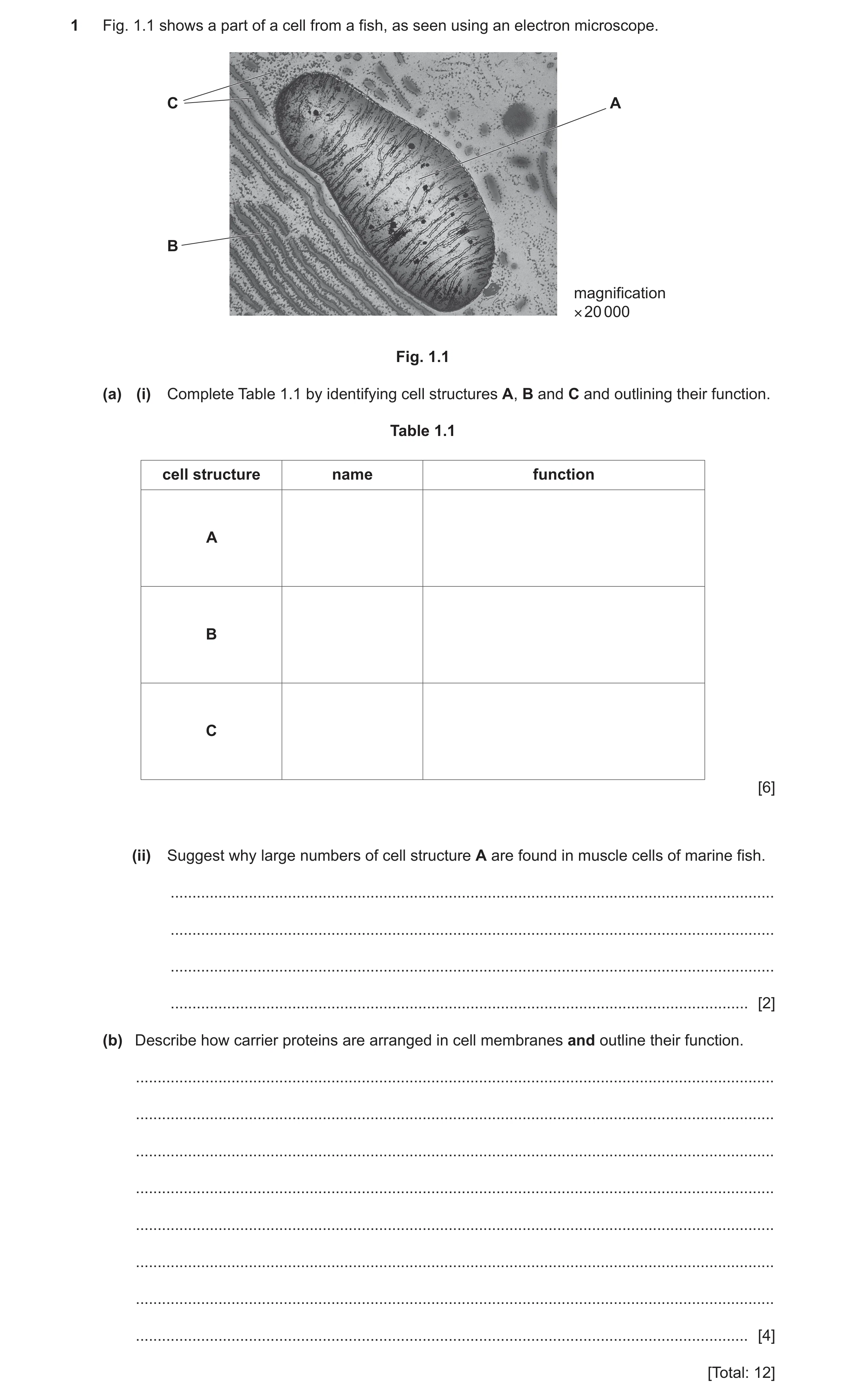
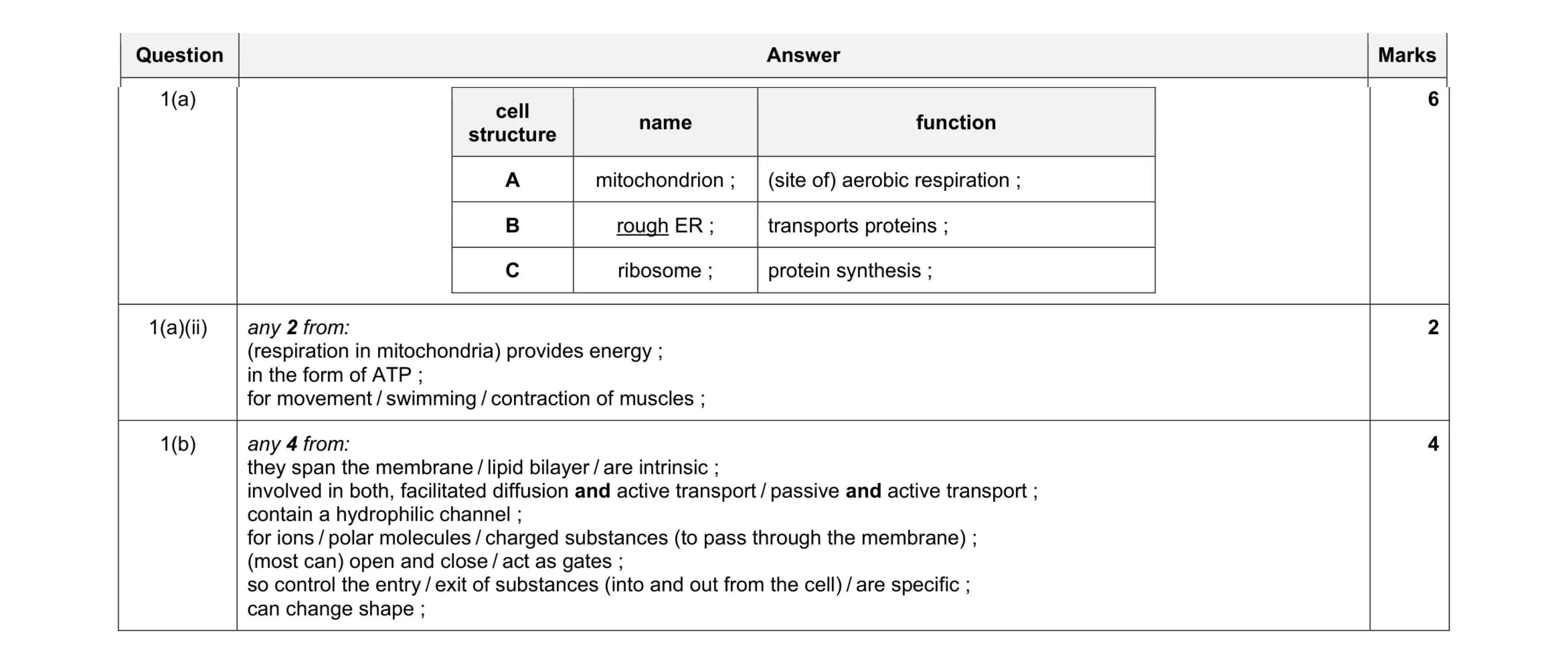
1 Fig. 1.1 shows a part of a cell from a fish, as seen using an electron microscope. C A B magnification × 20 000 Fig. 1.1 (a) (i) Complete Table 1.1 by identifying cell structures A, B and C and outlining their function. Table 1.1 cell structure name function A B C [6] (ii) Suggest why large numbers of cell structure A are found in muscle cells of marine fish. … … … … [2] (b) Describe how carrier proteins are arranged in cell membranes and outline their function. … … … … … … … … [4] [Total: 12]
12 marks
Mark scheme: 1(a) cell structure name function A mitochondrion ; (site of) aerobic respiration ; B rough ER ; transports proteins ; C ribosome ; protein synthesis ; 6 1(a)(ii) any 2 from: (respiration in mitochondria) provides energy ; in the form of ATP ; for movement / swimming / contraction of muscles ; 2 1(b) any 4 from: they span the membrane / lipid bilayer / are intrinsic ; involved in both, facilitated diffusion and active transport / passive and active transport ; contain a hydrophilic channel ; for ions / polar molecules / charged substances (to pass through the membrane) ; (most can) open and close / act as gates ; so control the entry / exit of substances (into and out from the cell) / are specific ; can change shape ; 4
This question in 9693/31 May/June 2022
Q2 · A diagram of a typical plant cell from a mangrove tree as seen using an electron… 9693/32 May/June 2022
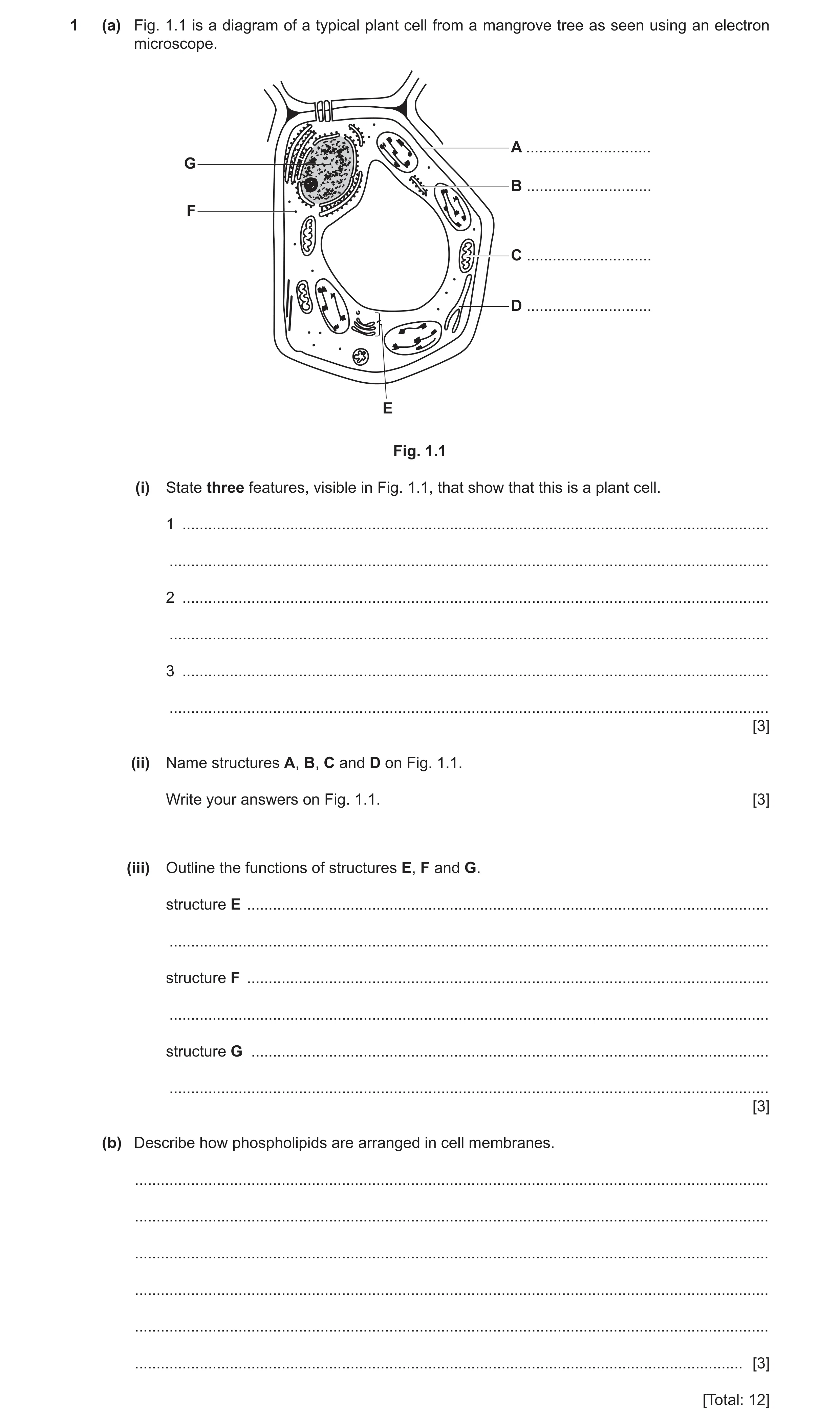
1 (a) Fig. 1.1 is a diagram of a typical plant cell from a mangrove tree as seen using an electron microscope. A … G B … F C … D … E Fig. 1.1 (i) State three features, visible in Fig. 1.1, that show that this is a plant cell. 1 … … 2 … … 3 … … [3] (ii) Name structures A, B, C and D on Fig. 1.1. Write your answers on Fig. 1.1. [3] (iii) Outline the functions of structures E, F and G. structure E … … structure F … … structure G … … [3] (b) Describe how phospholipids are arranged in cell membranes. … … … … … … [3] [Total: 12]
12 marks
Mark scheme: 1(a) cell wall ; large permanent vacuole ; chloroplasts ; 3 1(a)(ii) A – cell membrane B – rough endoplasmic reticulum C – mitochondrion D – smooth endoplasmic reticulum ; ; ; 3 1(a)(iii) E (Golgi apparatus) collects and processes molecules / makes glycoproteins / makes glycolipids / makes lysosomes ; F (ribosome) protein synthesis ; G (nucleus) contains chromosomes / DNA / hereditary material, which determine protein structure ; 3 1(b) forms a bilayer ; heads on outside and tails in inside ; hydrophobic / non-polar tails and hydrophilic / polar heads ; 3
This question in 9693/32 May/June 2022
Q3 · A diagram of a typical plant cell from a mangrove tree as seen using an electron… 9693/33 May/June 2022
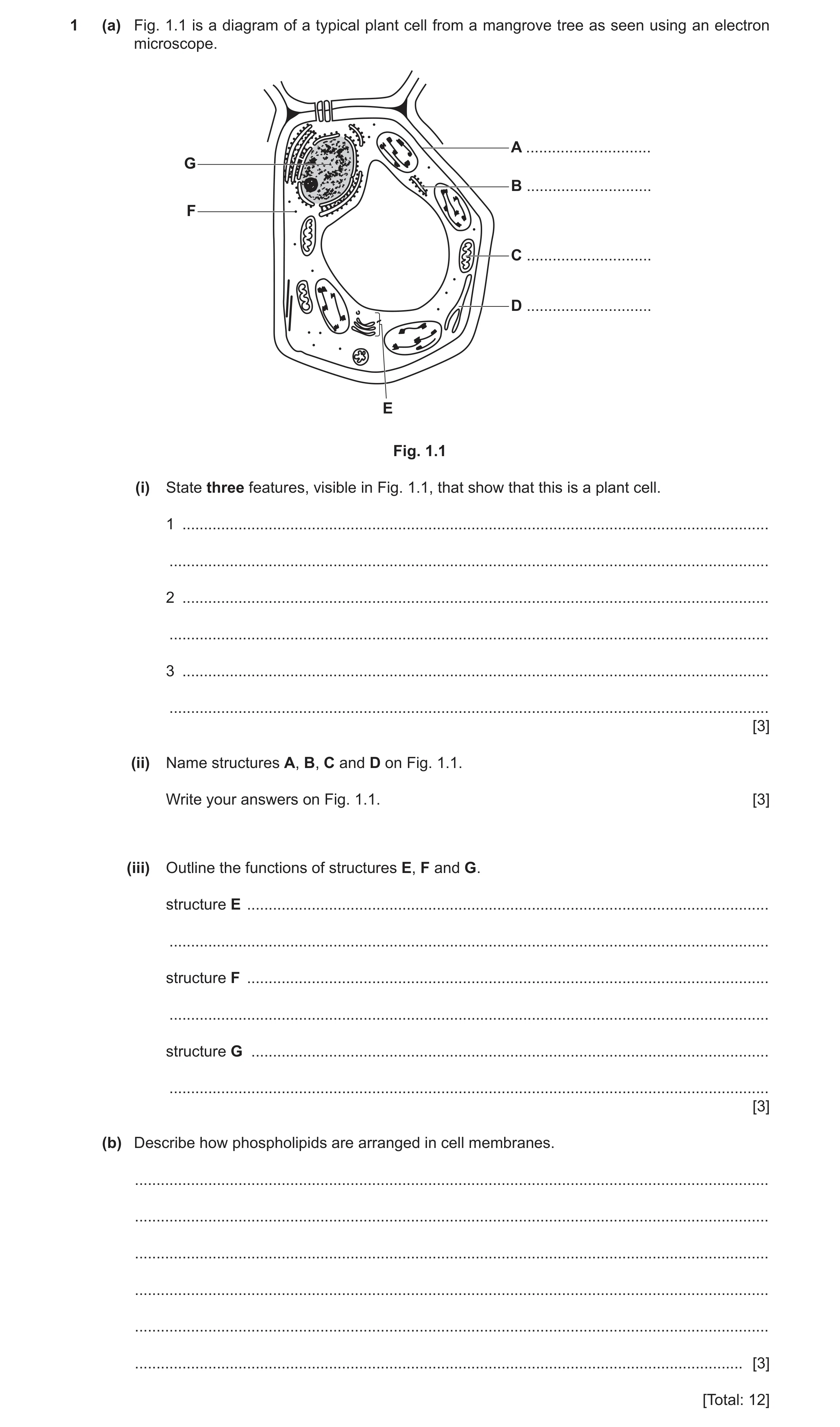
1 (a) Fig. 1.1 is a diagram of a typical plant cell from a mangrove tree as seen using an electron microscope. A … G B … F C … D … E Fig. 1.1 (i) State three features, visible in Fig. 1.1, that show that this is a plant cell. 1 … … 2 … … 3 … … [3] (ii) Name structures A, B, C and D on Fig. 1.1. Write your answers on Fig. 1.1. [3] (iii) Outline the functions of structures E, F and G. structure E … … structure F … … structure G … … [3] (b) Describe how phospholipids are arranged in cell membranes. … … … … … … [3] [Total: 12]
12 marks
Mark scheme: 1(a) cell wall ; large permanent vacuole ; chloroplasts ; 3 1(a)(ii) A – cell membrane B – rough endoplasmic reticulum C – mitochondrion D – smooth endoplasmic reticulum ; ; ; 3 1(a)(iii) E (Golgi apparatus) collects and processes molecules / makes glycoproteins / makes glycolipids / makes lysosomes ; F (ribosome) protein synthesis ; G (nucleus) contains chromosomes / DNA / hereditary material, which determine protein structure ; 3 1(b) forms a bilayer ; heads on outside and tails in inside ; hydrophobic / non-polar tails and hydrophilic / polar heads ; 3
This question in 9693/33 May/June 2022
Q4 · An animal cell from a marine organism as seen under an electron microscope 9693/31 Oct/Nov 2023
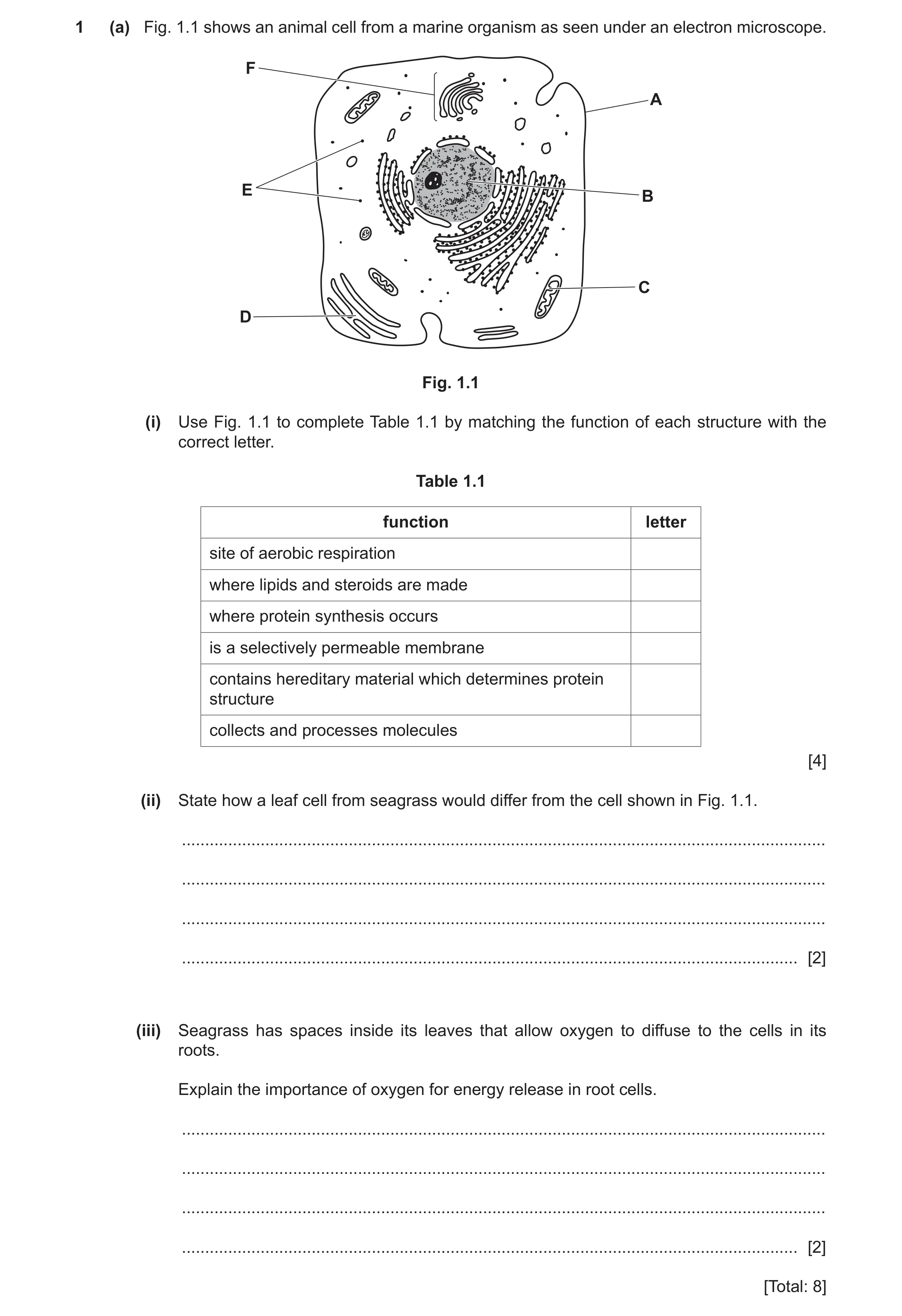
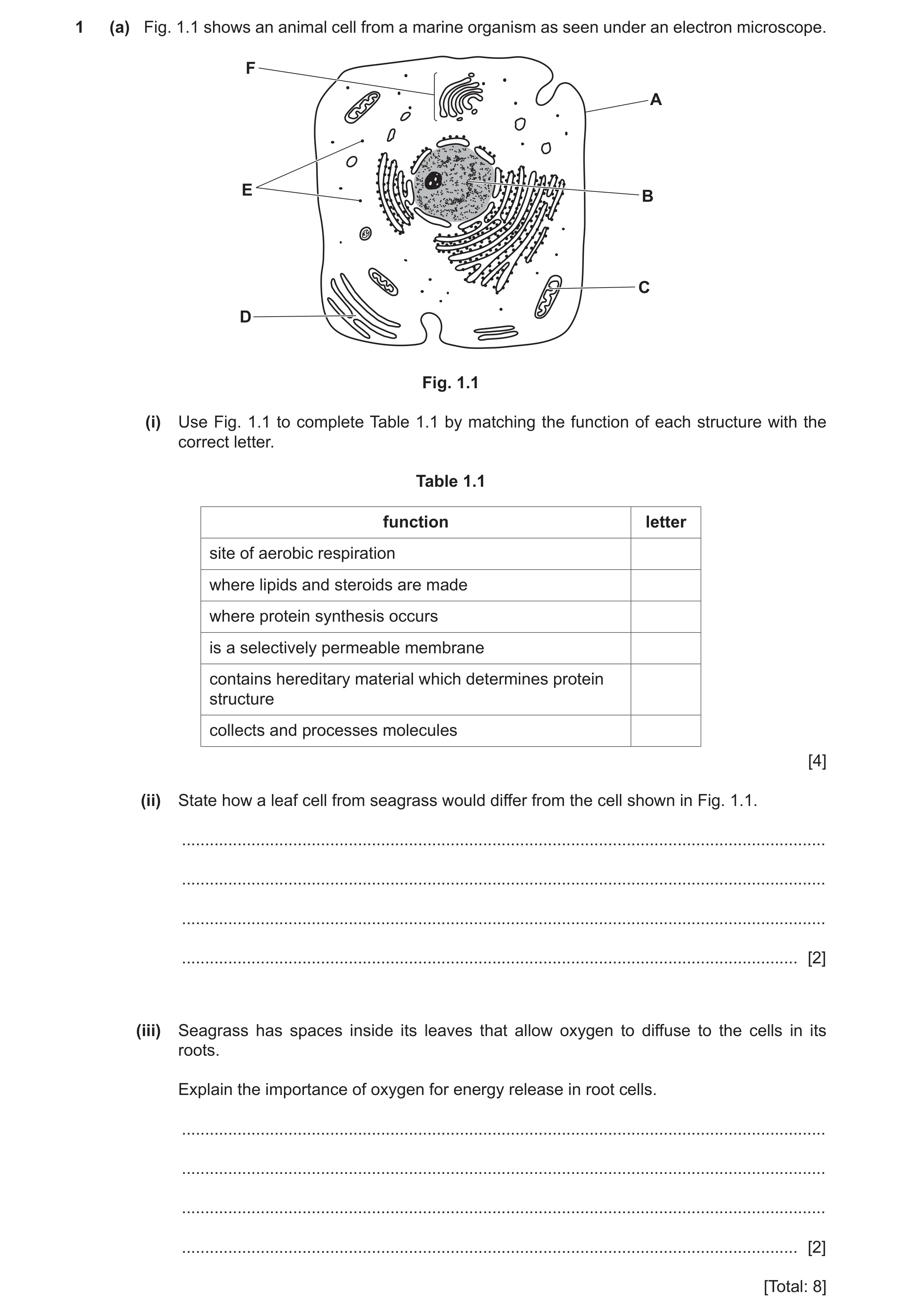
1 (a) Fig. 1.1 shows an animal cell from a marine organism as seen under an electron microscope. F A E B C D Fig. 1.1 (i) Use Fig. 1.1 to complete Table 1.1 by matching the function of each structure with the correct letter. Table 1.1 function letter site of aerobic respiration where lipids and steroids are made where protein synthesis occurs is a selectively permeable membrane contains hereditary material which determines protein structure collects and processes molecules [4] (ii) State how a leaf cell from seagrass would differ from the cell shown in Fig. 1.1. … … … … [2] (iii) Seagrass has spaces inside its leaves that allow oxygen to diffuse to the cells in its roots. Explain the importance of oxygen for energy release in root cells. … … … … [2] [Total: 8]
8 marks
Mark scheme: Question Answer Marks 1(a)(i) C 4 D E A B F All 6 correct, 4 marks 5 correct, 3 marks 4 correct 2 marks 2 or 3 correct, 1 mark 1(a)(ii) any 2 of: 2 (cellulose) cell wall ; (large) permanent vacuole ; chloroplasts ; 1(a)(iii) (ensure that) aerobic respiration (occurs) ; 2 which releases more energy than anaerobic respiration ;
This question in 9693/31 Oct/Nov 2023
Q5 · An animal cell from a marine organism as seen under an electron microscope 9693/32 Oct/Nov 2023
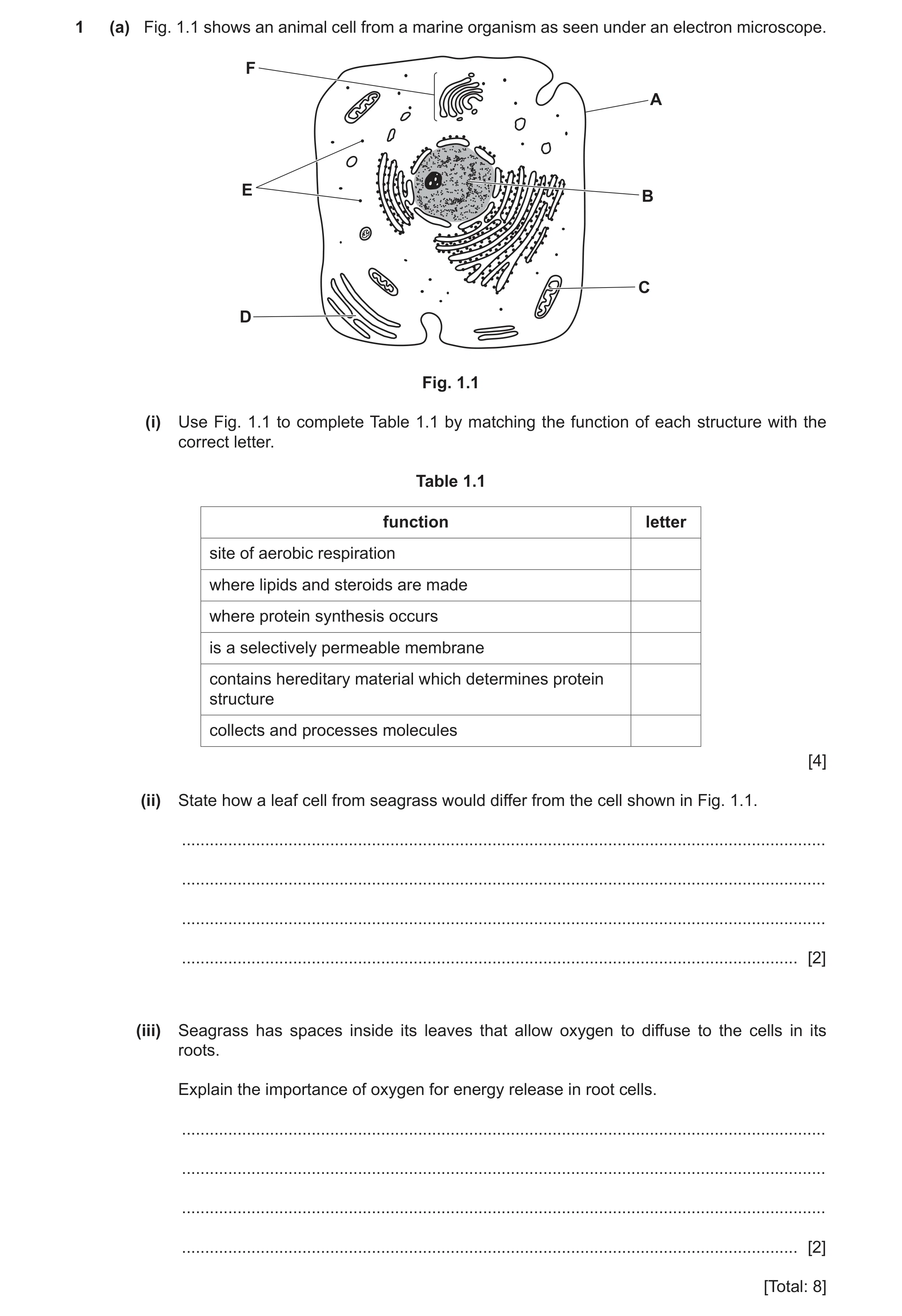
1 (a) Fig. 1.1 shows an animal cell from a marine organism as seen under an electron microscope. F A E B C D Fig. 1.1 (i) Use Fig. 1.1 to complete Table 1.1 by matching the function of each structure with the correct letter. Table 1.1 function letter site of aerobic respiration where lipids and steroids are made where protein synthesis occurs is a selectively permeable membrane contains hereditary material which determines protein structure collects and processes molecules [4] (ii) State how a leaf cell from seagrass would differ from the cell shown in Fig. 1.1. … … … … [2] (iii) Seagrass has spaces inside its leaves that allow oxygen to diffuse to the cells in its roots. Explain the importance of oxygen for energy release in root cells. … … … … [2] [Total: 8]
8 marks
Mark scheme: Question Answer Marks 1(a)(i) C 4 D E A B F All 6 correct, 4 marks 5 correct, 3 marks 4 correct 2 marks 2 or 3 correct, 1 mark 1(a)(ii) any 2 of: 2 (cellulose) cell wall ; (large) permanent vacuole ; chloroplasts ; 1(a)(iii) (ensure that) aerobic respiration (occurs) ; 2 which releases more energy than anaerobic respiration ;
This question in 9693/32 Oct/Nov 2023
Q6 · An animal cell from a marine organism as seen under an electron microscope 9693/33 Oct/Nov 2023
1 (a) Fig. 1.1 shows an animal cell from a marine organism as seen under an electron microscope. F A E B C D Fig. 1.1 (i) Use Fig. 1.1 to complete Table 1.1 by matching the function of each structure with the correct letter. Table 1.1 function letter site of aerobic respiration where lipids and steroids are made where protein synthesis occurs is a selectively permeable membrane contains hereditary material which determines protein structure collects and processes molecules [4] (ii) State how a leaf cell from seagrass would differ from the cell shown in Fig. 1.1. … … … … [2] (iii) Seagrass has spaces inside its leaves that allow oxygen to diffuse to the cells in its roots. Explain the importance of oxygen for energy release in root cells. … … … … [2] [Total: 8]
8 marks
Mark scheme: Question Answer Marks 1(a)(i) C 4 D E A B F All 6 correct, 4 marks 5 correct, 3 marks 4 correct 2 marks 2 or 3 correct, 1 mark 1(a)(ii) any 2 of: 2 (cellulose) cell wall ; (large) permanent vacuole ; chloroplasts ; 1(a)(iii) (ensure that) aerobic respiration (occurs) ; 2 which releases more energy than anaerobic respiration ;
This question in 9693/33 Oct/Nov 2023
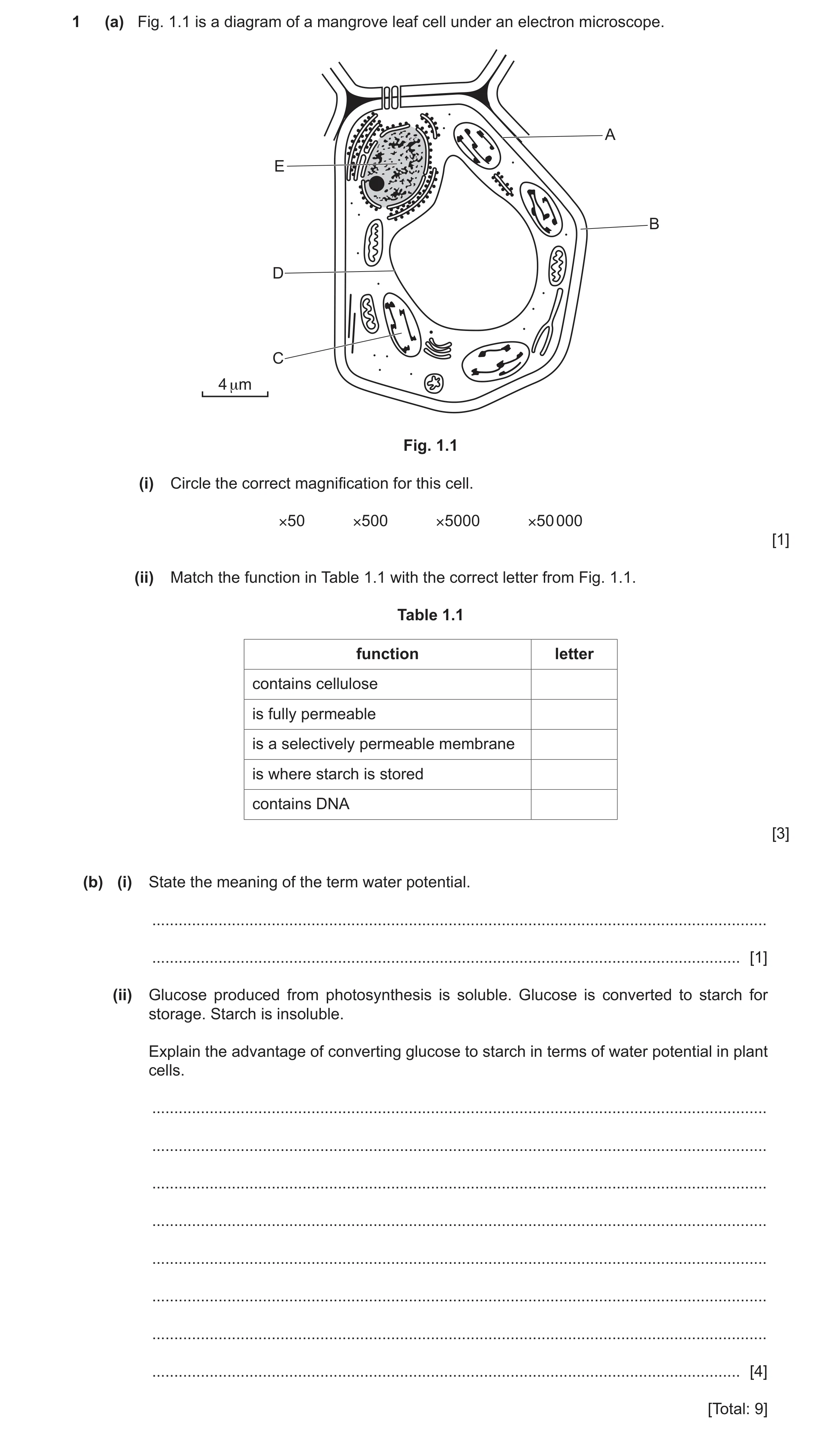
Q7 · A diagram of a mangrove leaf cell under an electron microscope 9693/31 Oct/Nov 2024
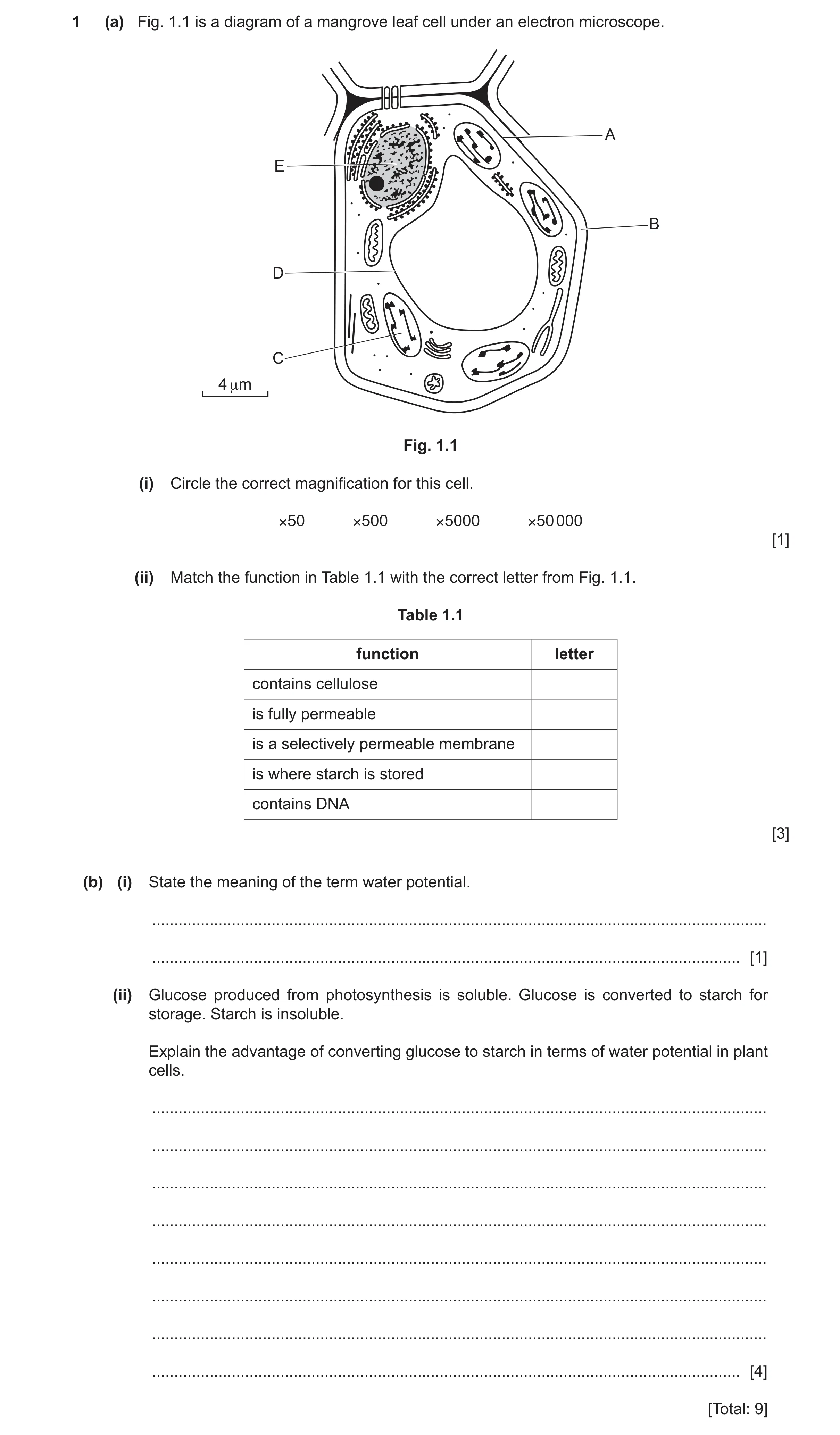
1 (a) Fig. 1.1 is a diagram of a mangrove leaf cell under an electron microscope. A E B D C 4 μm Fig. 1.1 (i) Circle the correct magnification for this cell. ×50 ×500 ×5000 ×50 000 [1] (ii) Match the function in Table 1.1 with the correct letter from Fig. 1.1. Table 1.1 function letter contains cellulose is fully permeable is a selectively permeable membrane is where starch is stored contains DNA [3] (b) (i) State the meaning of the term water potential. … … [1] (ii) Glucose produced from photosynthesis is soluble. Glucose is converted to starch for storage. Starch is insoluble. Explain the advantage of converting glucose to starch in terms of water potential in plant cells. … … … … … … … … [4] [Total: 9]
9 marks
Mark scheme: Question Answer Marks 1(a)(i) x 5000 ; 1 1(a)(ii) B 3 B A or D C E All 5 correct, 3 marks 3 or 4 correct, 2 marks 2 correct, 1 mark 1(b)(i) any correct definition, e.g. the tendency for water to move, out of a solution / from a high water potential to a low water 1 potential ; 1(b)(ii) any 4 of: 4 1 glucose dissolves (in cytoplasm / vacuole) ; 2 so decreases the water potential inside the cell ; 3 higher water potential outside the cell than inside ; 4 so water enters cell (by osmosis) ; 5 starch does not dissolve (in the cytoplasm / vacuole) ; 6 so has no effect on water potential / osmosis ;
This question in 9693/31 Oct/Nov 2024
Q8 · A diagram of a mangrove leaf cell under an electron microscope 9693/32 Oct/Nov 2024
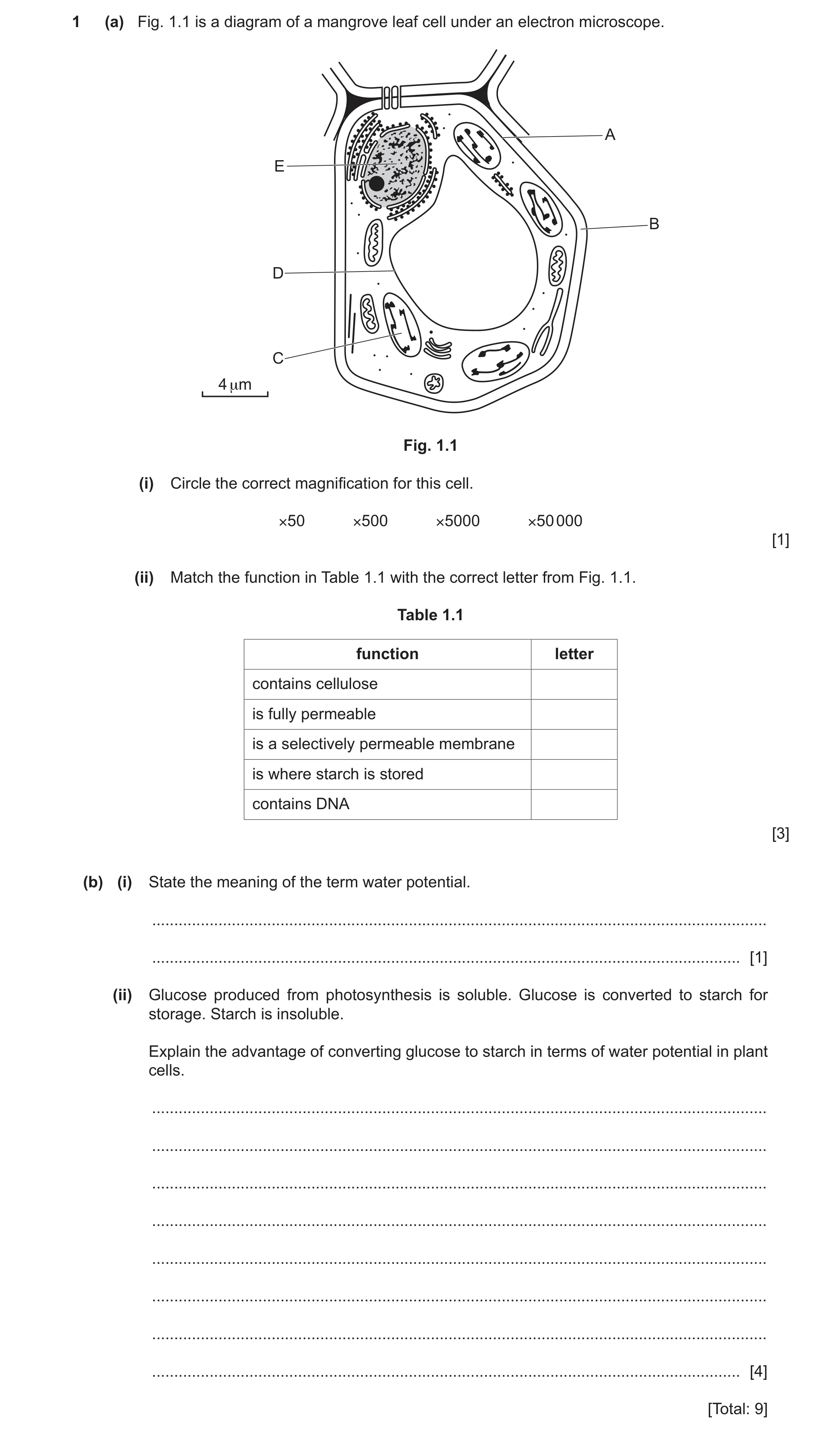
1 (a) Fig. 1.1 is a diagram of a mangrove leaf cell under an electron microscope. A E B D C 4 μm Fig. 1.1 (i) Circle the correct magnification for this cell. ×50 ×500 ×5000 ×50 000 [1] (ii) Match the function in Table 1.1 with the correct letter from Fig. 1.1. Table 1.1 function letter contains cellulose is fully permeable is a selectively permeable membrane is where starch is stored contains DNA [3] (b) (i) State the meaning of the term water potential. … … [1] (ii) Glucose produced from photosynthesis is soluble. Glucose is converted to starch for storage. Starch is insoluble. Explain the advantage of converting glucose to starch in terms of water potential in plant cells. … … … … … … … … [4] [Total: 9]
9 marks
Mark scheme: Question Answer Marks 1(a)(i) x 5000 ; 1 1(a)(ii) B 3 B A or D C E All 5 correct, 3 marks 3 or 4 correct, 2 marks 2 correct, 1 mark 1(b)(i) any correct definition, e.g. the tendency for water to move, out of a solution / from a high water potential to a low water 1 potential ; 1(b)(ii) any 4 of: 4 1 glucose dissolves (in cytoplasm / vacuole) ; 2 so decreases the water potential inside the cell ; 3 higher water potential outside the cell than inside ; 4 so water enters cell (by osmosis) ; 5 starch does not dissolve (in the cytoplasm / vacuole) ; 6 so has no effect on water potential / osmosis ;
This question in 9693/32 Oct/Nov 2024
Q9 · A diagram of a mangrove leaf cell under an electron microscope 9693/33 Oct/Nov 2024
1 (a) Fig. 1.1 is a diagram of a mangrove leaf cell under an electron microscope. A E B D C 4 μm Fig. 1.1 (i) Circle the correct magnification for this cell. ×50 ×500 ×5000 ×50 000 [1] (ii) Match the function in Table 1.1 with the correct letter from Fig. 1.1. Table 1.1 function letter contains cellulose is fully permeable is a selectively permeable membrane is where starch is stored contains DNA [3] (b) (i) State the meaning of the term water potential. … … [1] (ii) Glucose produced from photosynthesis is soluble. Glucose is converted to starch for storage. Starch is insoluble. Explain the advantage of converting glucose to starch in terms of water potential in plant cells. … … … … … … … … [4] [Total: 9]
9 marks
Mark scheme: Question Answer Marks 1(a)(i) x 5000 ; 1 1(a)(ii) B 3 B A or D C E All 5 correct, 3 marks 3 or 4 correct, 2 marks 2 correct, 1 mark 1(b)(i) any correct definition, e.g. the tendency for water to move, out of a solution / from a high water potential to a low water 1 potential ; 1(b)(ii) any 4 of: 4 1 glucose dissolves (in cytoplasm / vacuole) ; 2 so decreases the water potential inside the cell ; 3 higher water potential outside the cell than inside ; 4 so water enters cell (by osmosis) ; 5 starch does not dissolve (in the cytoplasm / vacuole) ; 6 so has no effect on water potential / osmosis ;
This question in 9693/33 Oct/Nov 2024
Q10 · Cells of both animals and plants contain many smaller structures, including smooth… 9693/31 Oct/Nov 2025
6 Cells of both animals and plants contain many smaller structures, including smooth endoplasmic reticulum, Golgi bodies and mitochondria. (a) Outline the structure and function of smooth endoplasmic reticulum and Golgi bodies. … … … … … … … … … … … … [6] (b) Mitochondria are involved in respiration. Describe the process of respiration in marine organisms. … … … … … … … … … … [5] [Total: 11]
11 marks
Mark scheme: 6(a) any six of: 6 smooth ER: 1 flattened / membrane bound, sacs / cisternae ; 2 which can be interconnected ; 3 no ribosomes attached ; 4 makes lipids / steroids / steroid hormones ; 5 suitable example e.g. cholesterol / oestrogen / testosterone ; 6 AVP ; Golgi body: 7 stack of flattened / membrane bound, sacs / cisternae AND vesicles ; 8 (vesicles) from ER ; 9 collects / processes / modifies, molecules ; 10 e.g. proteins ; 11 makes cell wall components in plants ; 12 makes lysosomes ; 6(b) any five of: 5 1 respiration is a process used to release energy ; 2 from organic molecules / organic nutrients ; 3 produce ATP / produce energy in the form of ATP ; 4 aerobic respiration requires oxygen AND anaerobic respiration occurs in the absence of oxygen ; 5 aerobic respiration represented by C6 H12 O6 + 6O2 → 6CO2 + 6H2O ; 6 aerobic respiration takes place in mitochondria and cytoplasm / anaerobic respiration occurs in the cytoplasm ; 7 anaerobic respiration yields far less ATP (per molecule of glucose) than aerobic respiration ; 8 AVP ;
This question in 9693/31 Oct/Nov 2025
Q11 · Cells of both animals and plants contain many smaller structures, including smooth… 9693/32 Oct/Nov 2025
6 Cells of both animals and plants contain many smaller structures, including smooth endoplasmic reticulum, Golgi bodies and mitochondria. (a) Outline the structure and function of smooth endoplasmic reticulum and Golgi bodies. … … … … … … … … … … … … [6] (b) Mitochondria are involved in respiration. Describe the process of respiration in marine organisms. … … … … … … … … … … [5] [Total: 11]
11 marks
Mark scheme: 6(a) any six of: 6 smooth ER: 1 flattened / membrane bound, sacs / cisternae ; 2 which can be interconnected ; 3 no ribosomes attached ; 4 makes lipids / steroids / steroid hormones ; 5 suitable example e.g. cholesterol / oestrogen / testosterone ; 6 AVP ; Golgi body: 7 stack of flattened / membrane bound, sacs / cisternae AND vesicles ; 8 (vesicles) from ER ; 9 collects / processes / modifies, molecules ; 10 e.g. proteins ; 11 makes cell wall components in plants ; 12 makes lysosomes ; 6(b) any five of: 5 1 respiration is a process used to release energy ; 2 from organic molecules / organic nutrients ; 3 produce ATP / produce energy in the form of ATP ; 4 aerobic respiration requires oxygen AND anaerobic respiration occurs in the absence of oxygen ; 5 aerobic respiration represented by C6 H12 O6 + 6O2 → 6CO2 + 6H2O ; 6 aerobic respiration takes place in mitochondria and cytoplasm / anaerobic respiration occurs in the cytoplasm ; 7 anaerobic respiration yields far less ATP (per molecule of glucose) than aerobic respiration ; 8 AVP ;
This question in 9693/32 Oct/Nov 2025
Q12 · Cells of both animals and plants contain many smaller structures, including smooth… 9693/33 Oct/Nov 2025
6 Cells of both animals and plants contain many smaller structures, including smooth endoplasmic reticulum, Golgi bodies and mitochondria. (a) Outline the structure and function of smooth endoplasmic reticulum and Golgi bodies. … … … … … … … … … … … … [6] (b) Mitochondria are involved in respiration. Describe the process of respiration in marine organisms. … … … … … … … … … … [5] [Total: 11]
11 marks
Mark scheme: 6(a) any six of: 6 smooth ER: 1 flattened / membrane bound, sacs / cisternae ; 2 which can be interconnected ; 3 no ribosomes attached ; 4 makes lipids / steroids / steroid hormones ; 5 suitable example e.g. cholesterol / oestrogen / testosterone ; 6 AVP ; Golgi body: 7 stack of flattened / membrane bound, sacs / cisternae AND vesicles ; 8 (vesicles) from ER ; 9 collects / processes / modifies, molecules ; 10 e.g. proteins ; 11 makes cell wall components in plants ; 12 makes lysosomes ; 6(b) any five of: 5 1 respiration is a process used to release energy ; 2 from organic molecules / organic nutrients ; 3 produce ATP / produce energy in the form of ATP ; 4 aerobic respiration requires oxygen AND anaerobic respiration occurs in the absence of oxygen ; 5 aerobic respiration represented by C6 H12 O6 + 6O2 → 6CO2 + 6H2O ; 6 aerobic respiration takes place in mitochondria and cytoplasm / anaerobic respiration occurs in the cytoplasm ; 7 anaerobic respiration yields far less ATP (per molecule of glucose) than aerobic respiration ; 8 AVP ;
This question in 9693/33 Oct/Nov 2025
 12 / 14
 13 / 14
 14 / 14
 12
12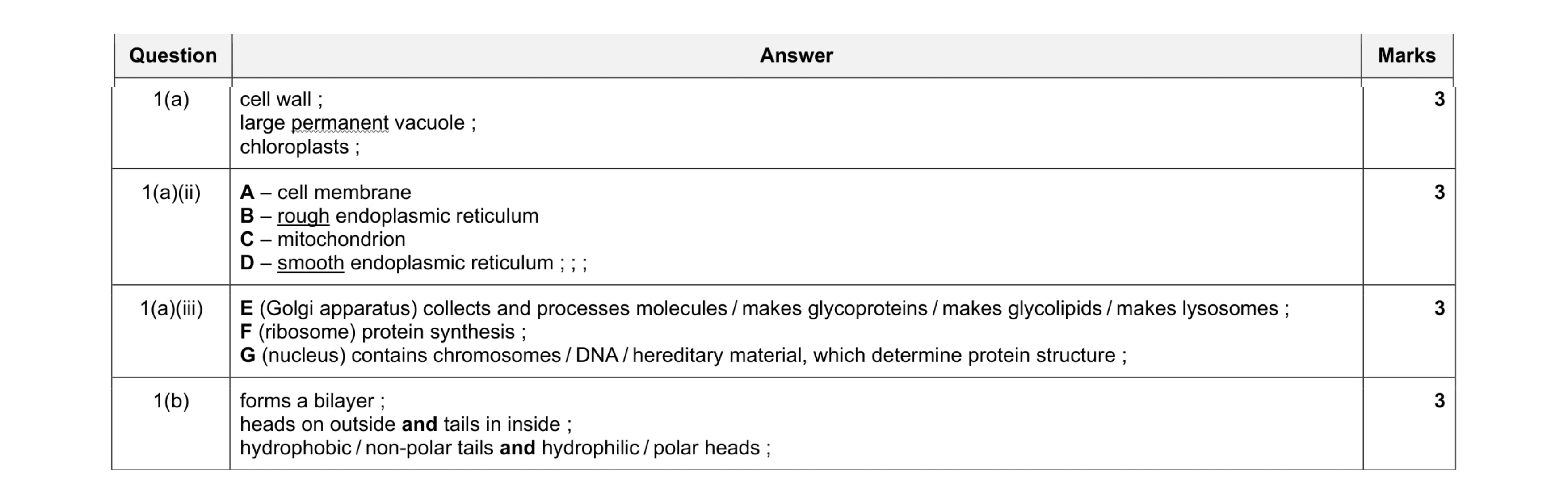 12
12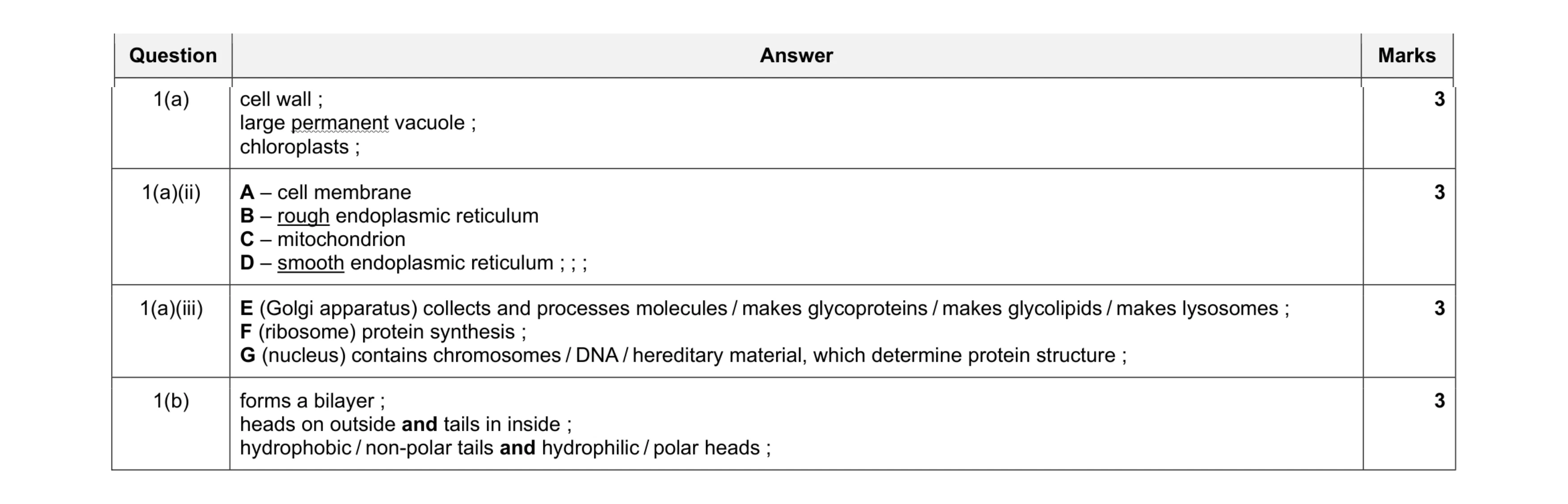 12
12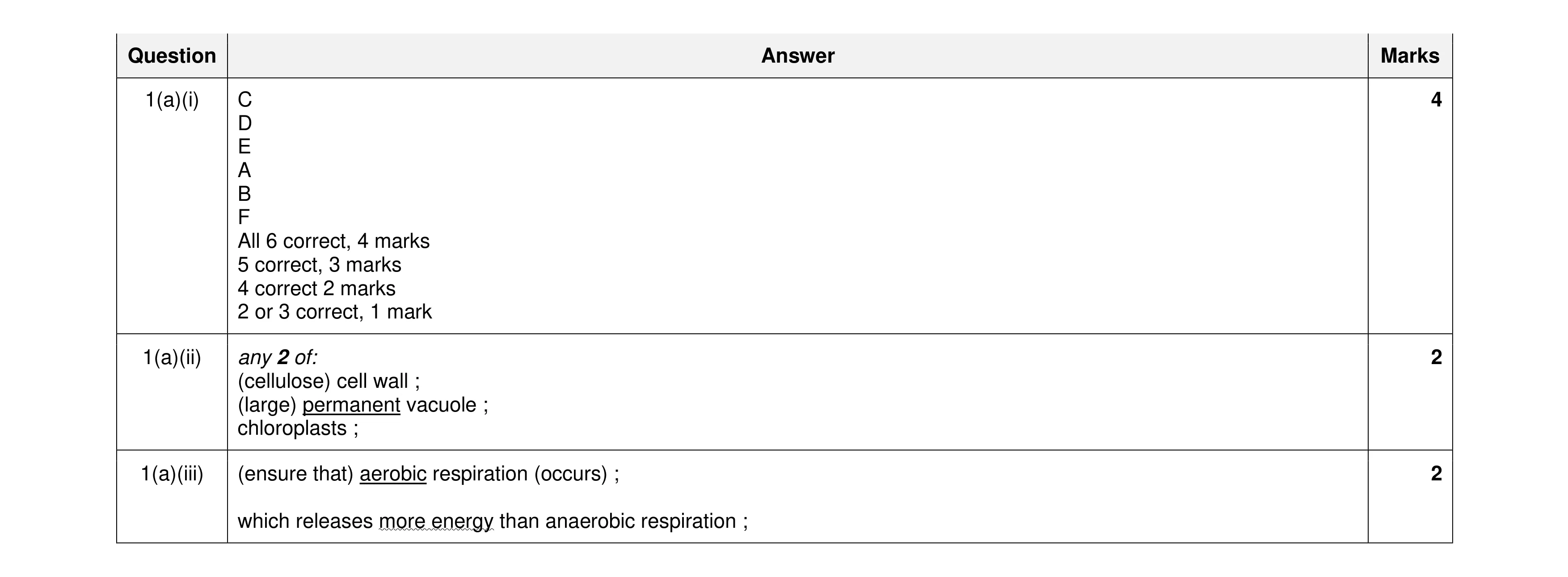 8
8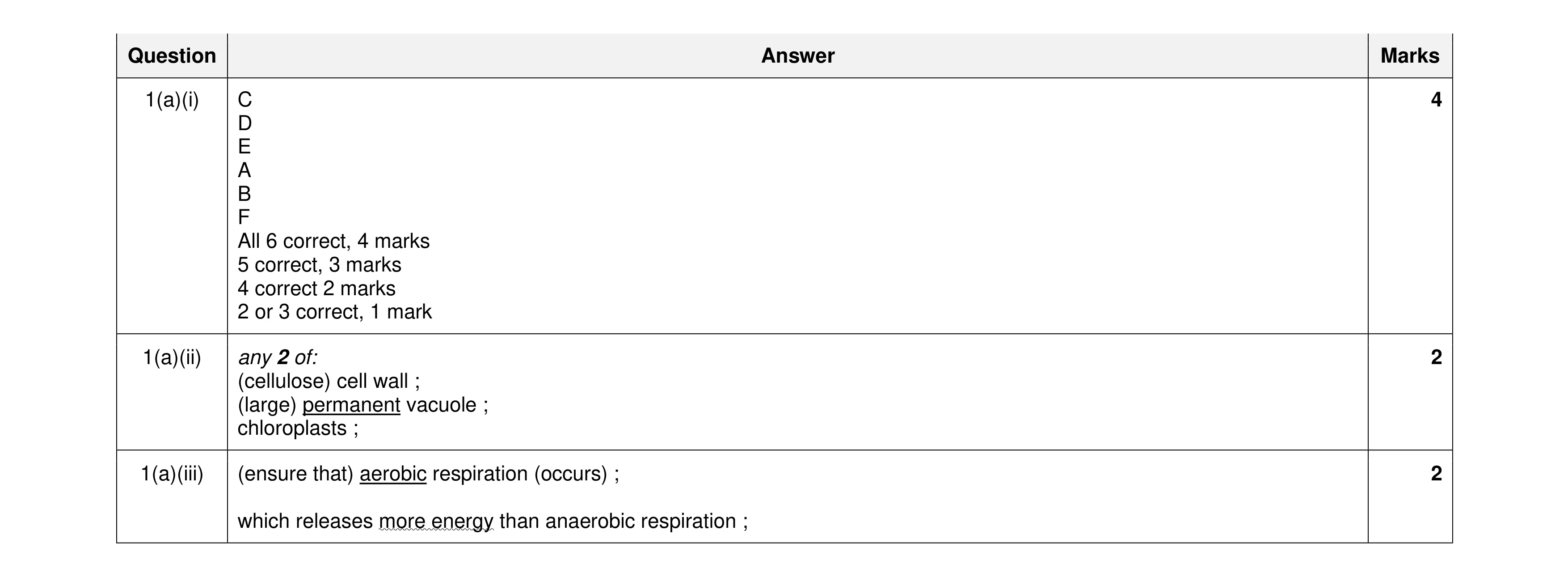 8
8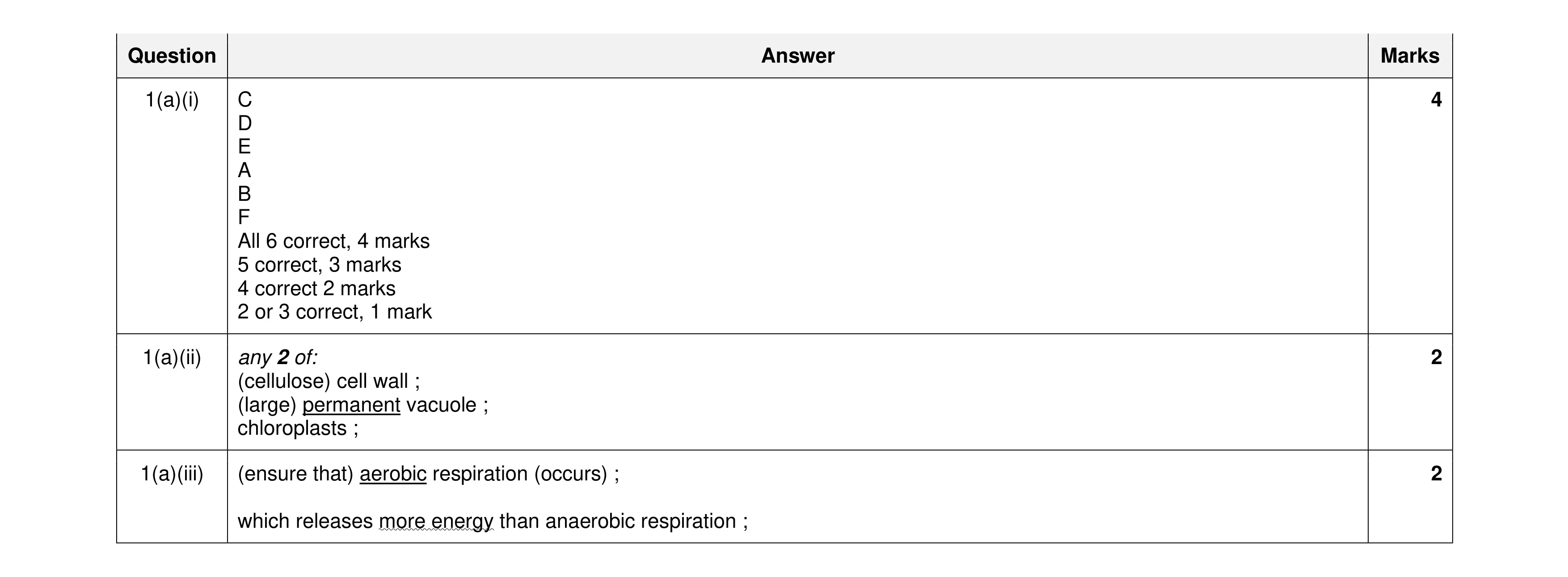 8
8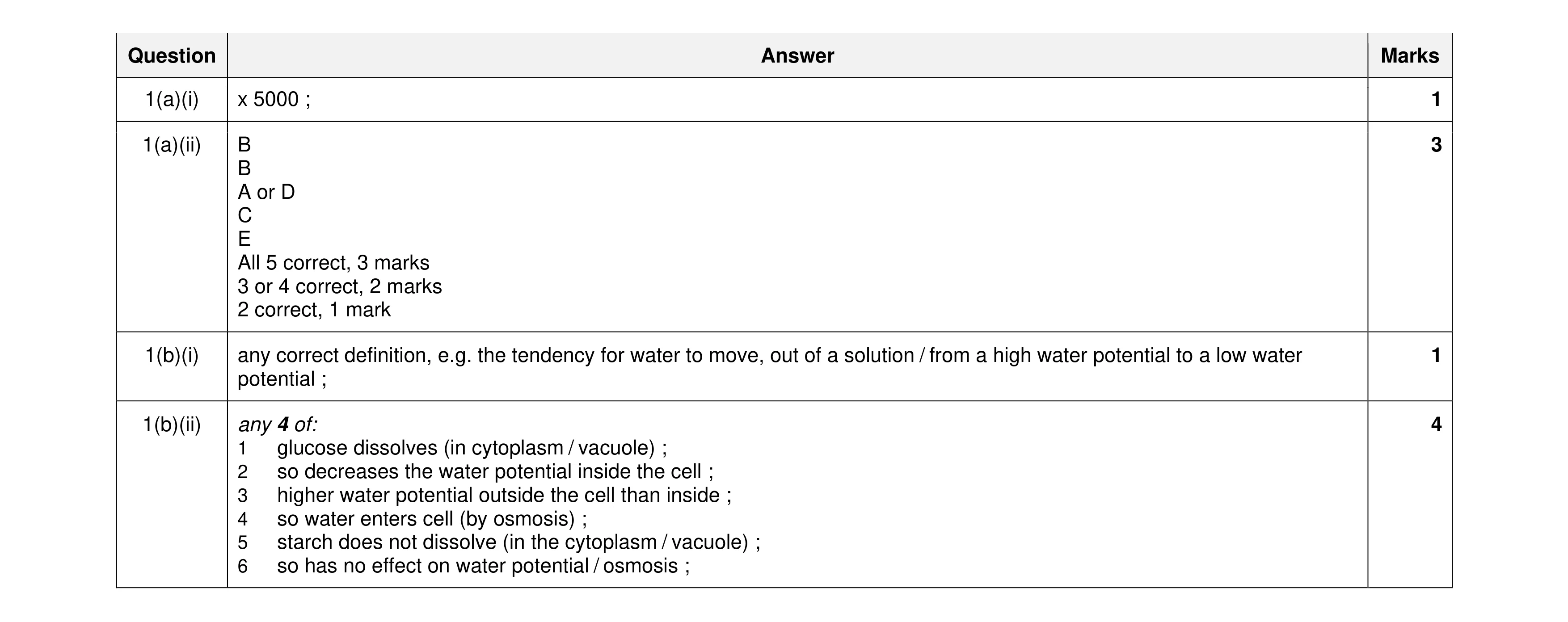 9
9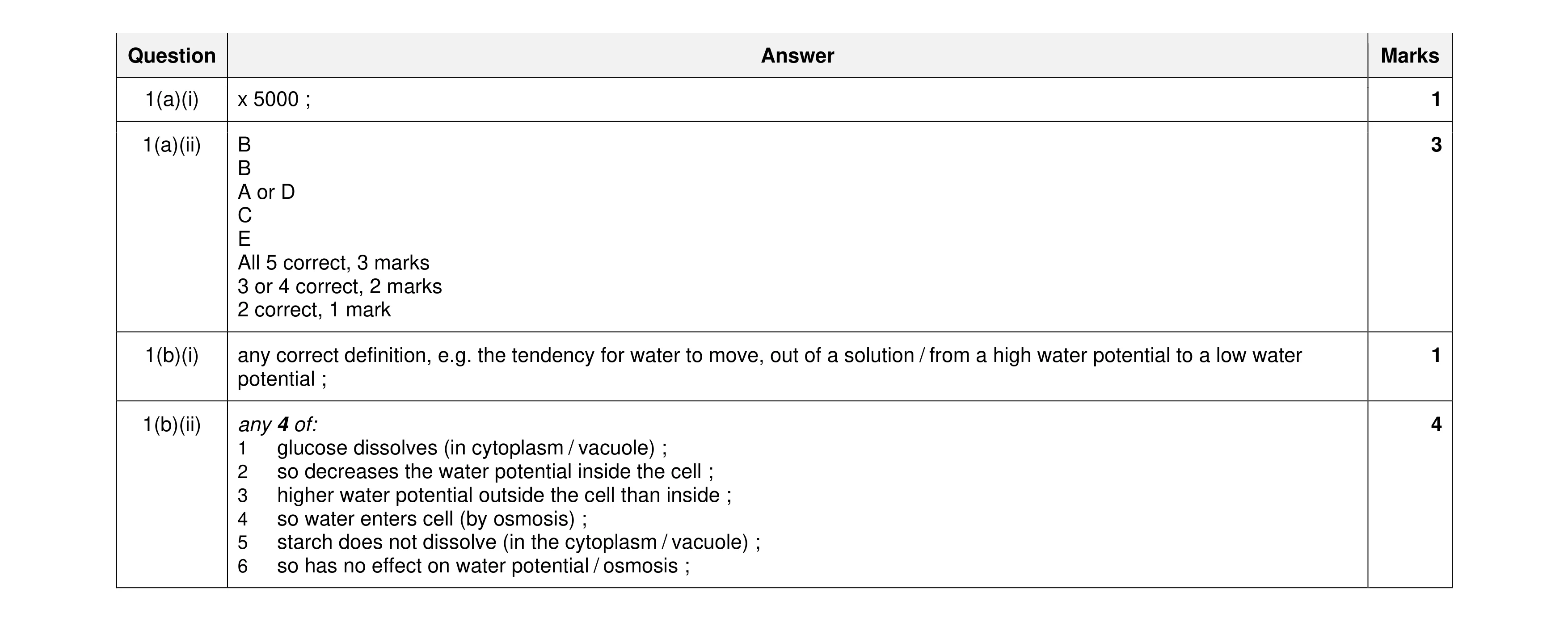 9
9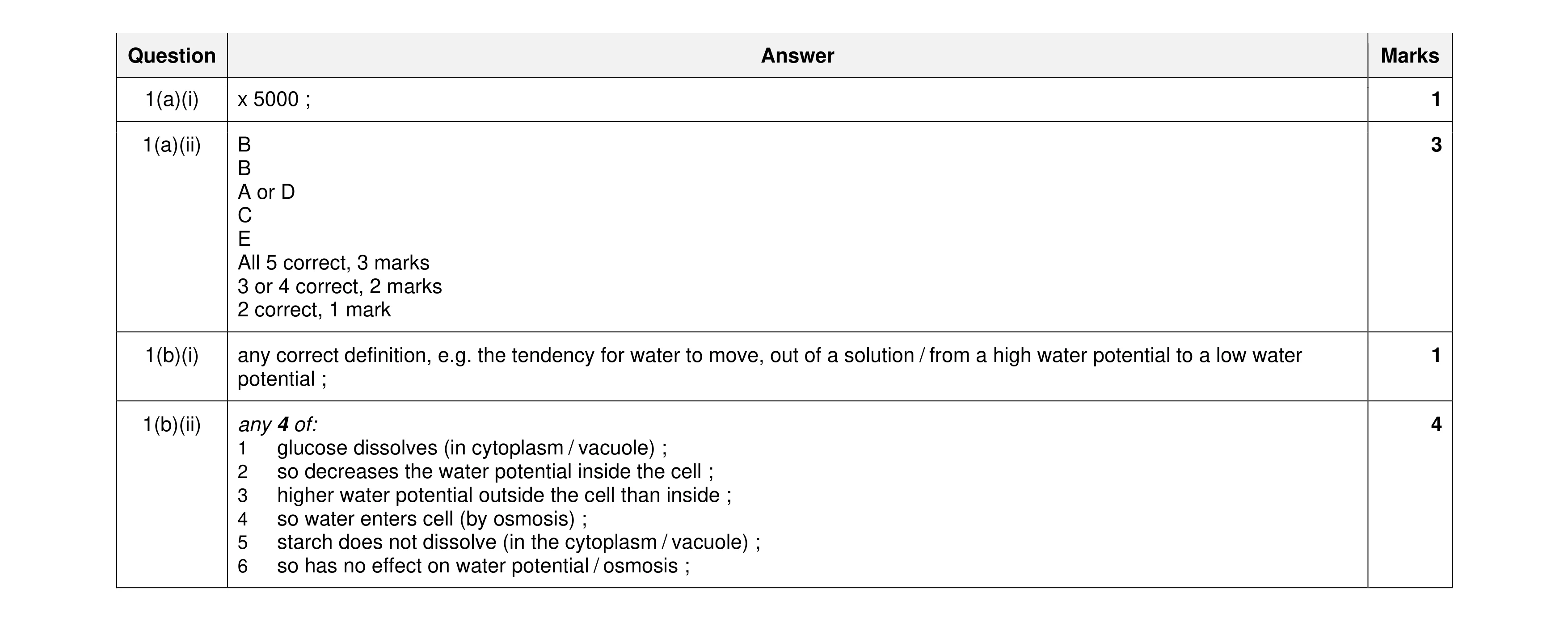 9
9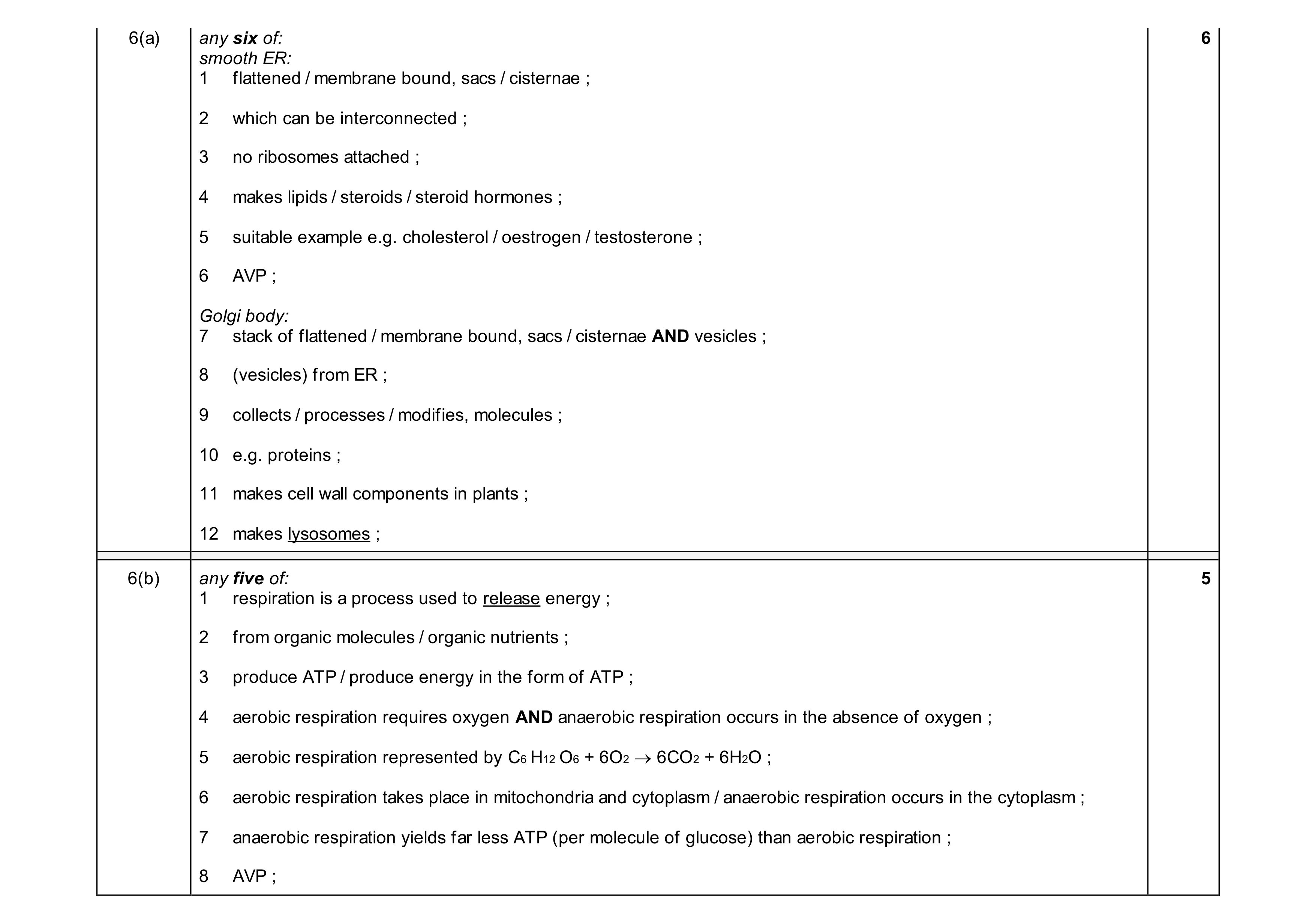 11
11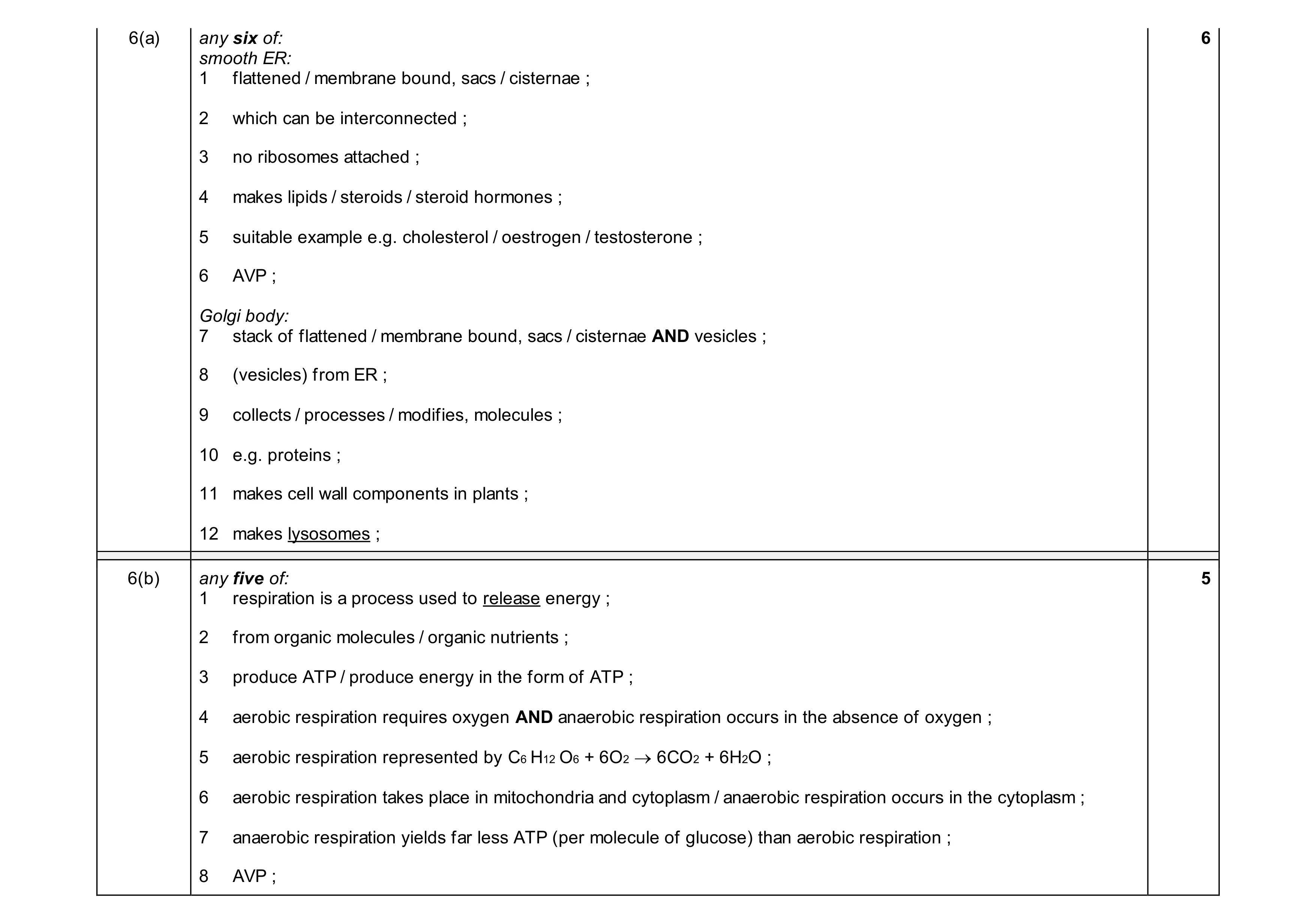 11
11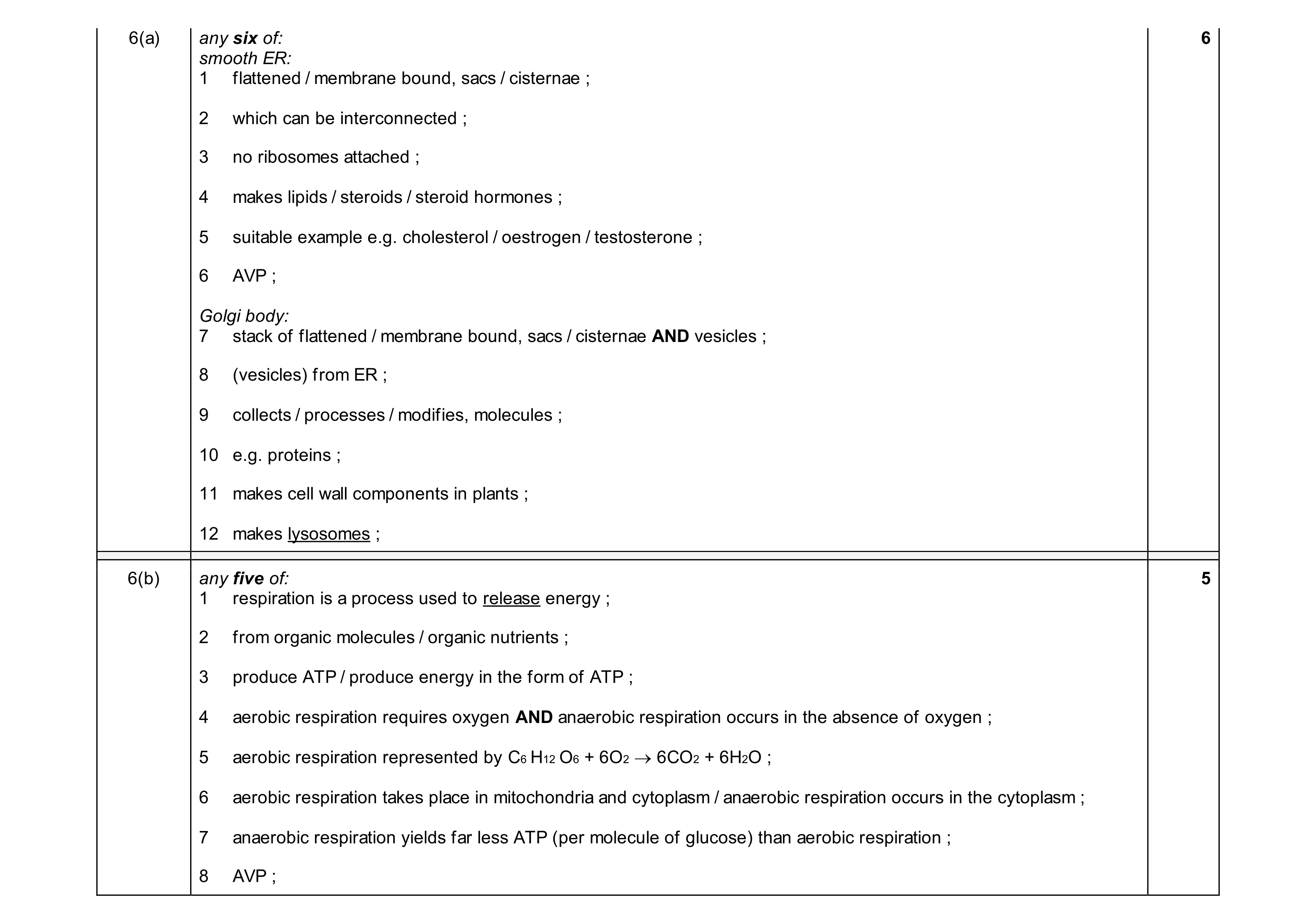 11
11