Cambridge A Level Law 9084 — 2024 May/June Paper 3 · Variant 1
9084/31/M/J/24 · 75 marks · ≈84 min
The question paper and its mark scheme, free to read here and free to download. This is Cambridge’s own paper, exactly as it was sat.
Question paper4 pages
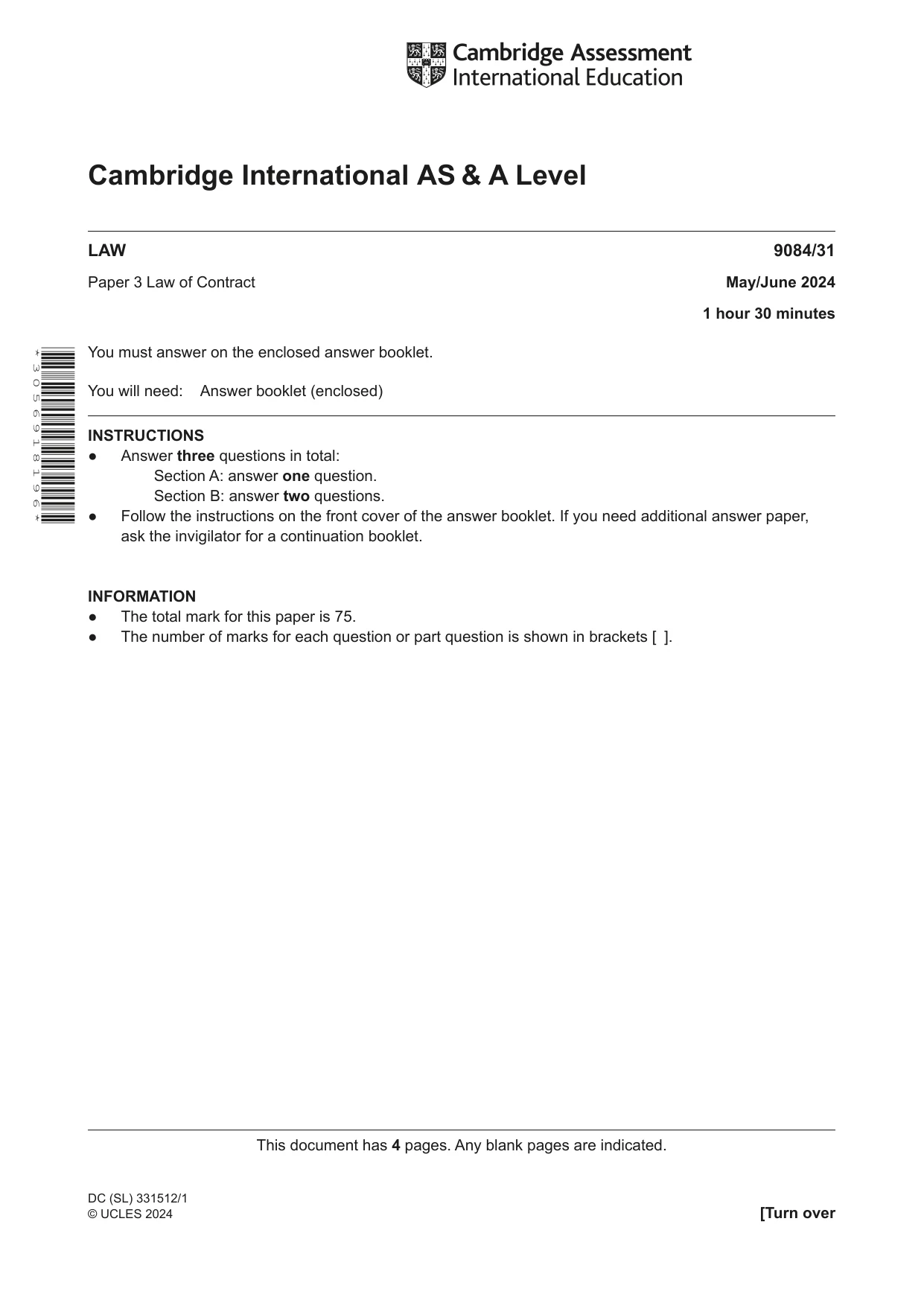
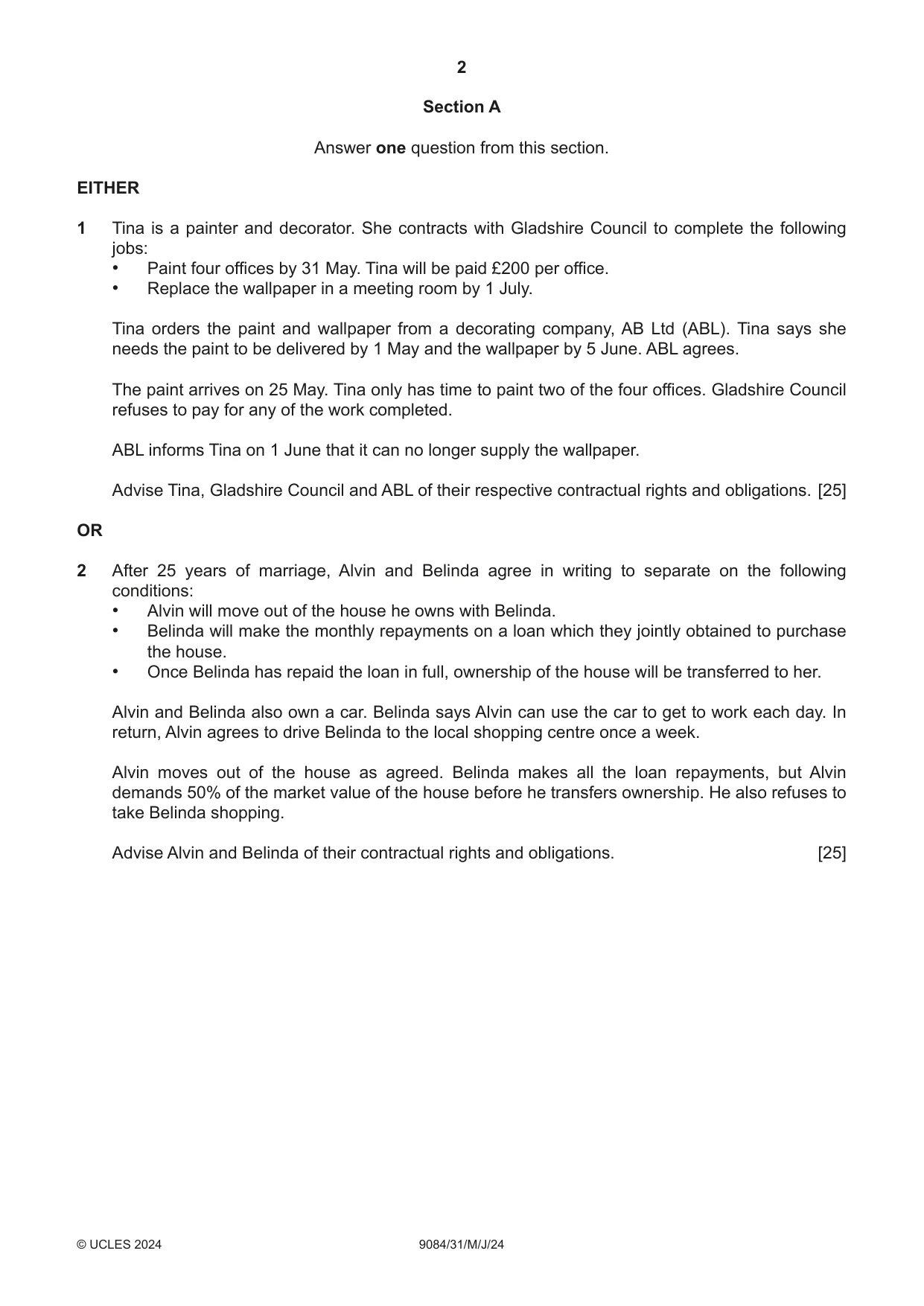
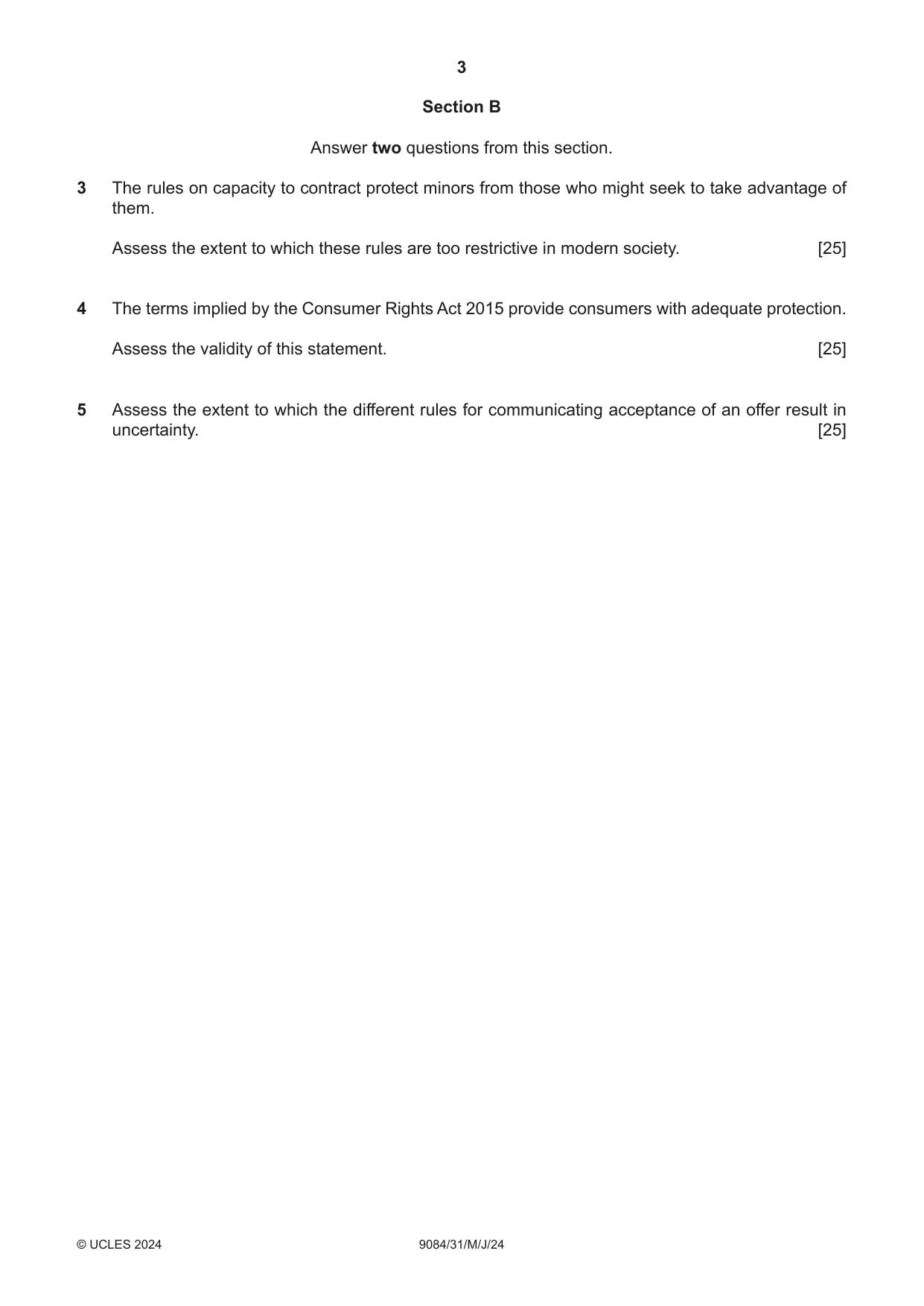

Mark scheme16 pages
Answers below. Sit the paper first if you are practising.
Paper as text
Question paper, page 1
This document has 4 pages. Any blank pages are indicated. [Turn over Cambridge International AS & A Level LAW 9084/31 Paper 3 Law of Contract May/June 2024 1 hour 30 minutes You must answer on the enclosed answer booklet. You will need: Answer booklet (enclosed) INSTRUCTIONS ● Answer three questions in total: Section A: answer one question. Section B: answer two questions. ● Follow the instructions on the front cover of the answer booklet. If you need additional answer paper, ask the invigilator for a continuation booklet. INFORMATION ● The total mark for this paper is 75. ● The number of marks for each question or part question is shown in brackets [ ]. * 3 0 5 6 9 1 8 1 9 6 * DC (SL) 331512/1 © UCLES 2024
Question paper, page 2
2 9084/31/M/J/24 © UCLES 2024 Section A Answer one question from this section. EITHER 1 Tina is a painter and decorator. She contracts with Gladshire Council to complete the following jobs: • Paint four offices by 31 May. Tina will be paid £200 per office. • Replace the wallpaper in a meeting room by 1 July. Tina orders the paint and wallpaper from a decorating company, AB Ltd (ABL). Tina says she needs the paint to be delivered by 1 May and the wallpaper by 5 June. ABL agrees. The paint arrives on 25 May. Tina only has time to paint two of the four offices. Gladshire Council refuses to pay for any of the work completed. ABL informs Tina on 1 June that it can no longer supply the wallpaper. Advise Tina, Gladshire Council and ABL of their respective contractual rights and obligations. [25] OR 2 After 25 years of marriage, Alvin and Belinda agree in writing to separate on the following conditions: • Alvin will move out of the house he owns with Belinda. • Belinda will make the monthly repayments on a loan which they jointly obtained to purchase the house. • Once Belinda has repaid the loan in full, ownership of the house will be transferred to her. Alvin and Belinda also own a car. Belinda says Alvin can use the car to get to work each day. In return, Alvin agrees to drive Belinda to the local shopping centre once a week. Alvin moves out of the house as agreed. Belinda makes all the loan repayments, but Alvin demands 50% of the market value of the house before he transfers ownership. He also refuses to take Belinda shopping. Advise Alvin and Belinda of their contractual rights and obligations. [25]
Question paper, page 3
3 9084/31/M/J/24 © UCLES 2024 Section B Answer two questions from this section. 3 The rules on capacity to contract protect minors from those who might seek to take advantage of them. Assess the extent to which these rules are too restrictive in modern society. [25] 4 The terms implied by the Consumer Rights Act 2015 provide consumers with adequate protection. Assess the validity of this statement. [25] 5 Assess the extent to which the different rules for communicating acceptance of an offer result in uncertainty. [25]
Question paper, page 4
4 9084/31/M/J/24 © UCLES 2024 Permission to reproduce items where third-party owned material protected by copyright is included has been sought and cleared where possible. Every reasonable effort has been made by the publisher (UCLES) to trace copyright holders, but if any items requiring clearance have unwittingly been included, the publisher will be pleased to make amends at the earliest possible opportunity. To avoid the issue of disclosure of answer-related information to candidates, all copyright acknowledgements are reproduced online in the Cambridge Assessment International Education Copyright Acknowledgements Booklet. This is produced for each series of examinations and is freely available to download at www.cambridgeinternational.org after the live examination series. Cambridge Assessment International Education is part of Cambridge Assessment. Cambridge Assessment is the brand name of the University of Cambridge Local Examinations Syndicate (UCLES), which is a department of the University of Cambridge. BLANK PAGE
Mark scheme, page 1
This document consists of 16 printed pages. © Cambridge University Press & Assessment 2024 [Turn over Cambridge International AS & A Level LAW 9084/31 Paper 3 May/June 2024 MARK SCHEME Maximum Mark: 75 Published This mark scheme is published as an aid to teachers and candidates, to indicate the requirements of the examination. It shows the basis on which Examiners were instructed to award marks. It does not indicate the details of the discussions that took place at an Examiners’ meeting before marking began, which would have considered the acceptability of alternative answers. Mark schemes should be read in conjunction with the question paper and the Principal Examiner Report for Teachers. Cambridge International will not enter into discussions about these mark schemes. Cambridge International is publishing the mark schemes for the May/June 2024 series for most Cambridge IGCSE, Cambridge International A and AS Level and Cambridge Pre-U components, and some Cambridge O Level components.
Mark scheme, page 2
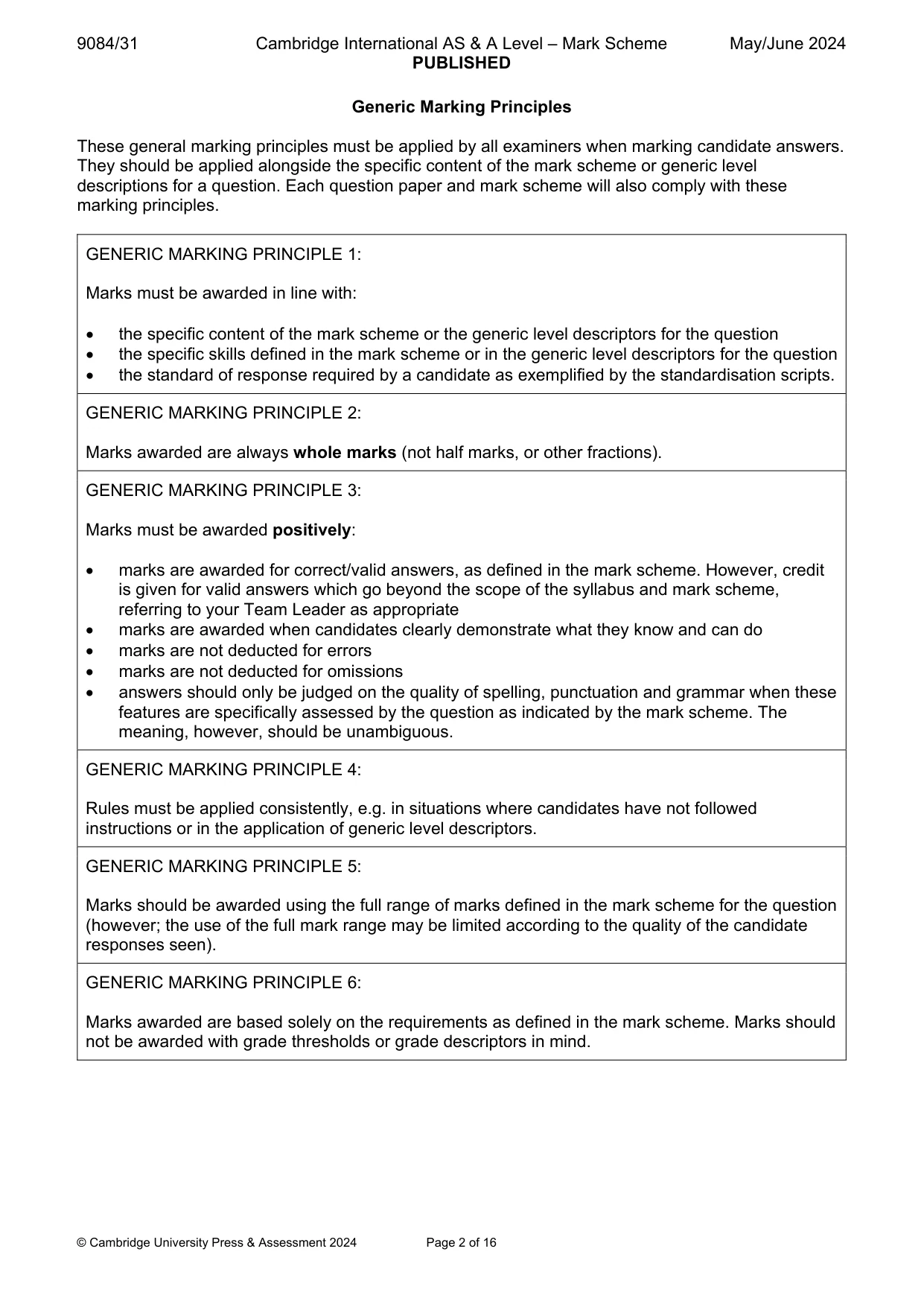
9084/31 Cambridge International AS & A Level – Mark Scheme PUBLISHED May/June 2024 © Cambridge University Press & Assessment 2024 Page 2 of 16 Generic Marking Principles These general marking principles must be applied by all examiners when marking candidate answers. They should be applied alongside the specific content of the mark scheme or generic level descriptions for a question. Each question paper and mark scheme will also comply with these marking principles. GENERIC MARKING PRINCIPLE 1: Marks must be awarded in line with: the specific content of the mark scheme or the generic level descriptors for the question the specific skills defined in the mark scheme or in the generic level descriptors for the question the standard of response required by a candidate as exemplified by the standardisation scripts. GENERIC MARKING PRINCIPLE 2: Marks awarded are always whole marks (not half marks, or other fractions). GENERIC MARKING PRINCIPLE 3: Marks must be awarded positively: marks are awarded for correct/valid answers, as defined in the mark scheme. However, credit is given for valid answers which go beyond the scope of the syllabus and mark scheme, referring to your Team Leader as appropriate marks are awarded when candidates clearly demonstrate what they know and can do marks are not deducted for errors marks are not deducted for omissions answers should only be judged on the quality of spelling, punctuation and grammar when these features are specifically assessed by the question as indicated by the mark scheme. The meaning, however, should be unambiguous. GENERIC MARKING PRINCIPLE 4: Rules must be applied consistently, e.g. in situations where candidates have not followed instructions or in the application of generic level descriptors. GENERIC MARKING PRINCIPLE 5: Marks should be awarded using the full range of marks defined in the mark scheme for the question (however; the use of the full mark range may be limited according to the quality of the candidate responses seen). GENERIC MARKING PRINCIPLE 6: Marks awarded are based solely on the requirements as defined in the mark scheme. Marks should not be awarded with grade thresholds or grade descriptors in mind.
Mark scheme, page 3
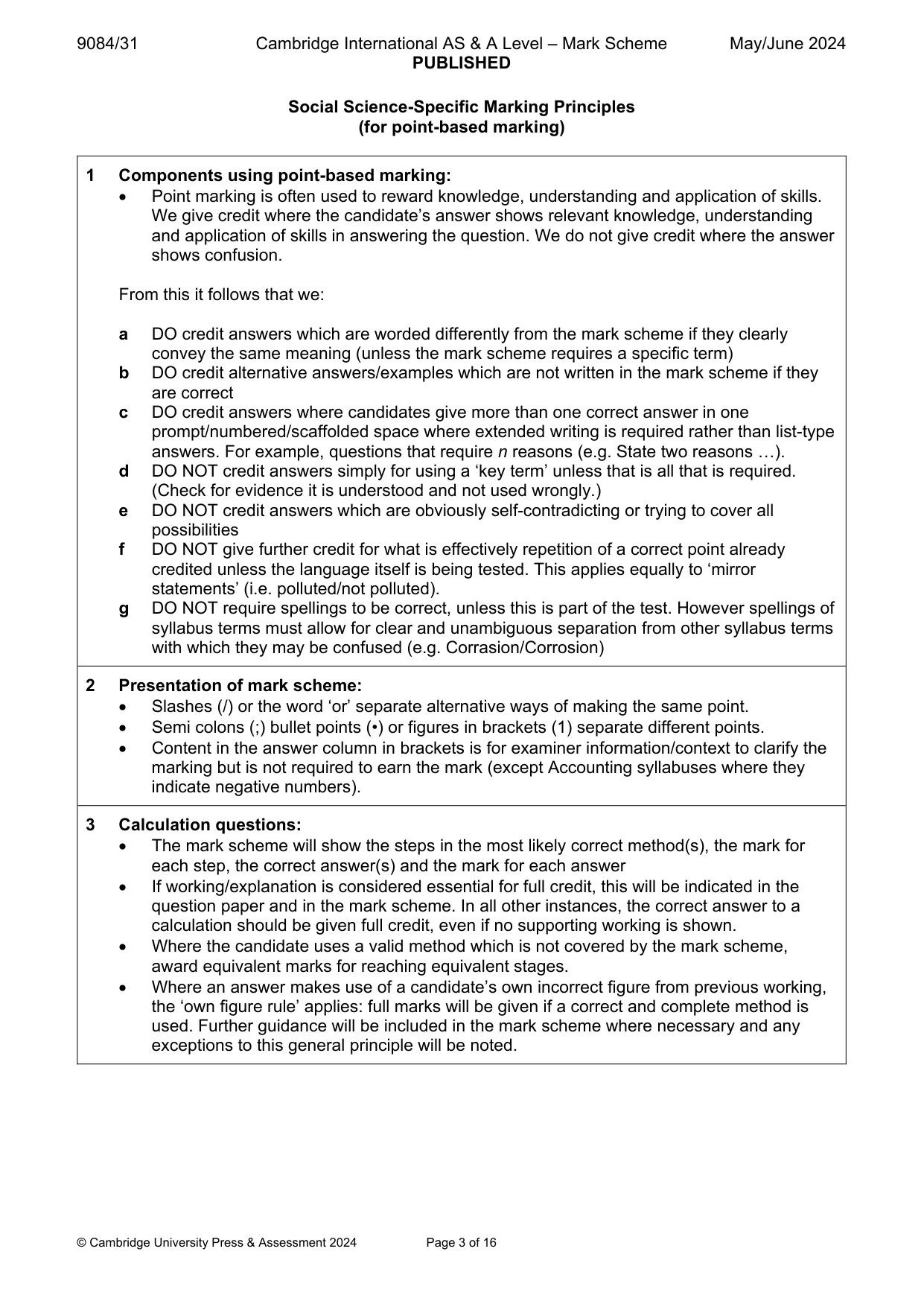
9084/31 Cambridge International AS & A Level – Mark Scheme PUBLISHED May/June 2024 © Cambridge University Press & Assessment 2024 Page 3 of 16 Social Science-Specific Marking Principles (for point-based marking) 1 Components using point-based marking: Point marking is often used to reward knowledge, understanding and application of skills. We give credit where the candidate’s answer shows relevant knowledge, understanding and application of skills in answering the question. We do not give credit where the answer shows confusion. From this it follows that we: a DO credit answers which are worded differently from the mark scheme if they clearly convey the same meaning (unless the mark scheme requires a specific term) b DO credit alternative answers/examples which are not written in the mark scheme if they are correct c DO credit answers where candidates give more than one correct answer in one prompt/numbered/scaffolded space where extended writing is required rather than list-type answers. For example, questions that require n reasons (e.g. State two reasons …). d DO NOT credit answers simply for using a ‘key term’ unless that is all that is required. (Check for evidence it is understood and not used wrongly.) e DO NOT credit answers which are obviously self-contradicting or trying to cover all possibilities f DO NOT give further credit for what is effectively repetition of a correct point already credited unless the language itself is being tested. This applies equally to ‘mirror statements’ (i.e. polluted/not polluted). g DO NOT require spellings to be correct, unless this is part of the test. However spellings of syllabus terms must allow for clear and unambiguous separation from other syllabus terms with which they may be confused (e.g. Corrasion/Corrosion) 2 Presentation of mark scheme: Slashes (/) or the word ‘or’ separate alternative ways of making the same point. Semi colons (;) bullet points (•) or figures in brackets (1) separate different points. Content in the answer column in brackets is for examiner information/context to clarify the marking but is not required to earn the mark (except Accounting syllabuses where they indicate negative numbers). 3 Calculation questions: The mark scheme will show the steps in the most likely correct method(s), the mark for each step, the correct answer(s) and the mark for each answer If working/explanation is considered essential for full credit, this will be indicated in the question paper and in the mark scheme. In all other instances, the correct answer to a calculation should be given full credit, even if no supporting working is shown. Where the candidate uses a valid method which is not covered by the mark scheme, award equivalent marks for reaching equivalent stages. Where an answer makes use of a candidate’s own incorrect figure from previous working, the ‘own figure rule’ applies: full marks will be given if a correct and complete method is used. Further guidance will be included in the mark scheme where necessary and any exceptions to this general principle will be noted.
Mark scheme, page 4
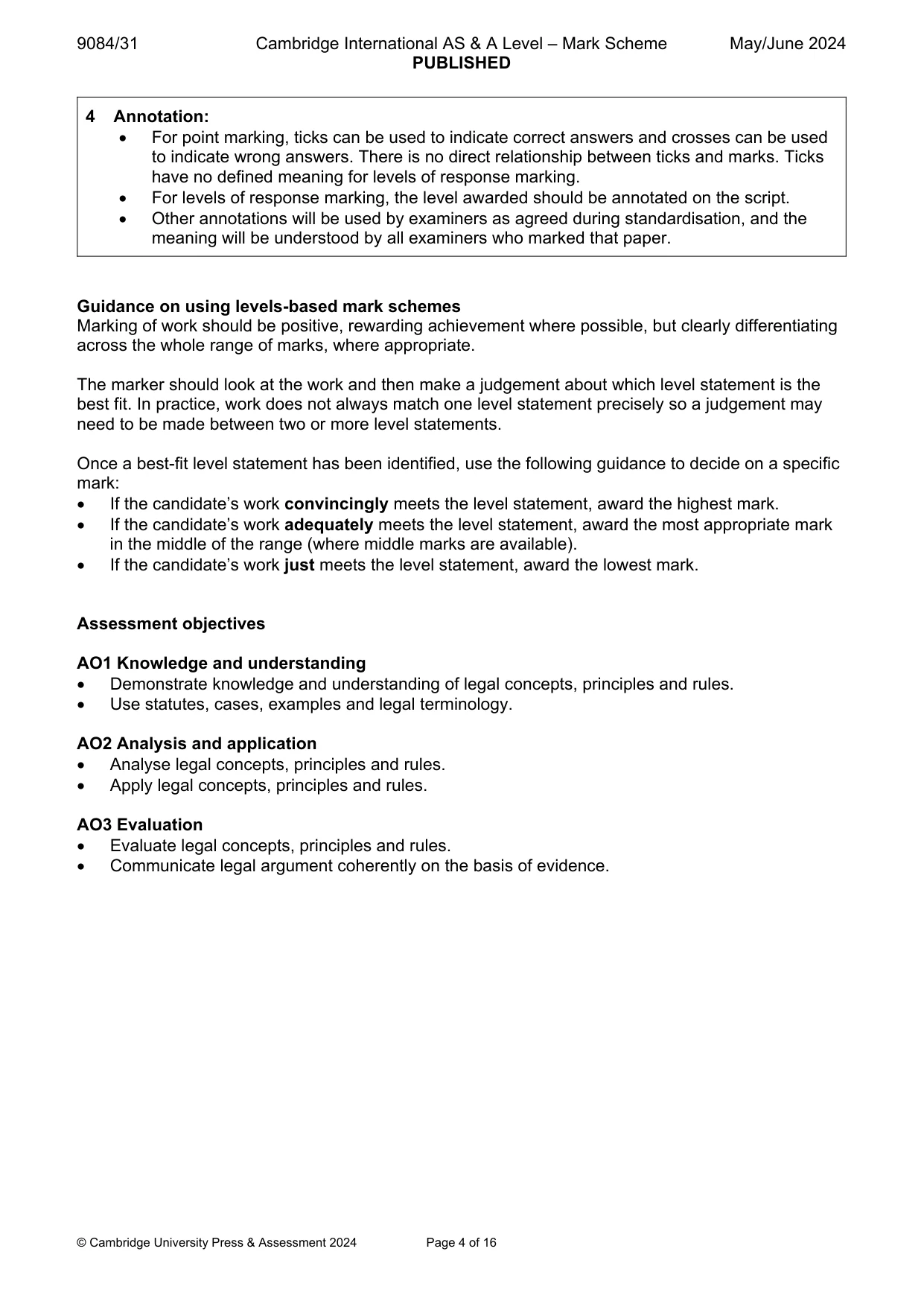
9084/31 Cambridge International AS & A Level – Mark Scheme PUBLISHED May/June 2024 © Cambridge University Press & Assessment 2024 Page 4 of 16 4 Annotation: For point marking, ticks can be used to indicate correct answers and crosses can be used to indicate wrong answers. There is no direct relationship between ticks and marks. Ticks have no defined meaning for levels of response marking. For levels of response marking, the level awarded should be annotated on the script. Other annotations will be used by examiners as agreed during standardisation, and the meaning will be understood by all examiners who marked that paper. Guidance on using levels-based mark schemes Marking of work should be positive, rewarding achievement where possible, but clearly differentiating across the whole range of marks, where appropriate. The marker should look at the work and then make a judgement about which level statement is the best fit. In practice, work does not always match one level statement precisely so a judgement may need to be made between two or more level statements. Once a best-fit level statement has been identified, use the following guidance to decide on a specific mark: If the candidate’s work convincingly meets the level statement, award the highest mark. If the candidate’s work adequately meets the level statement, award the most appropriate mark in the middle of the range (where middle marks are available). If the candidate’s work just meets the level statement, award the lowest mark. Assessment objectives AO1 Knowledge and understanding Demonstrate knowledge and understanding of legal concepts, principles and rules. Use statutes, cases, examples and legal terminology. AO2 Analysis and application Analyse legal concepts, principles and rules. Apply legal concepts, principles and rules. AO3 Evaluation Evaluate legal concepts, principles and rules. Communicate legal argument coherently on the basis of evidence.
Mark scheme, page 5
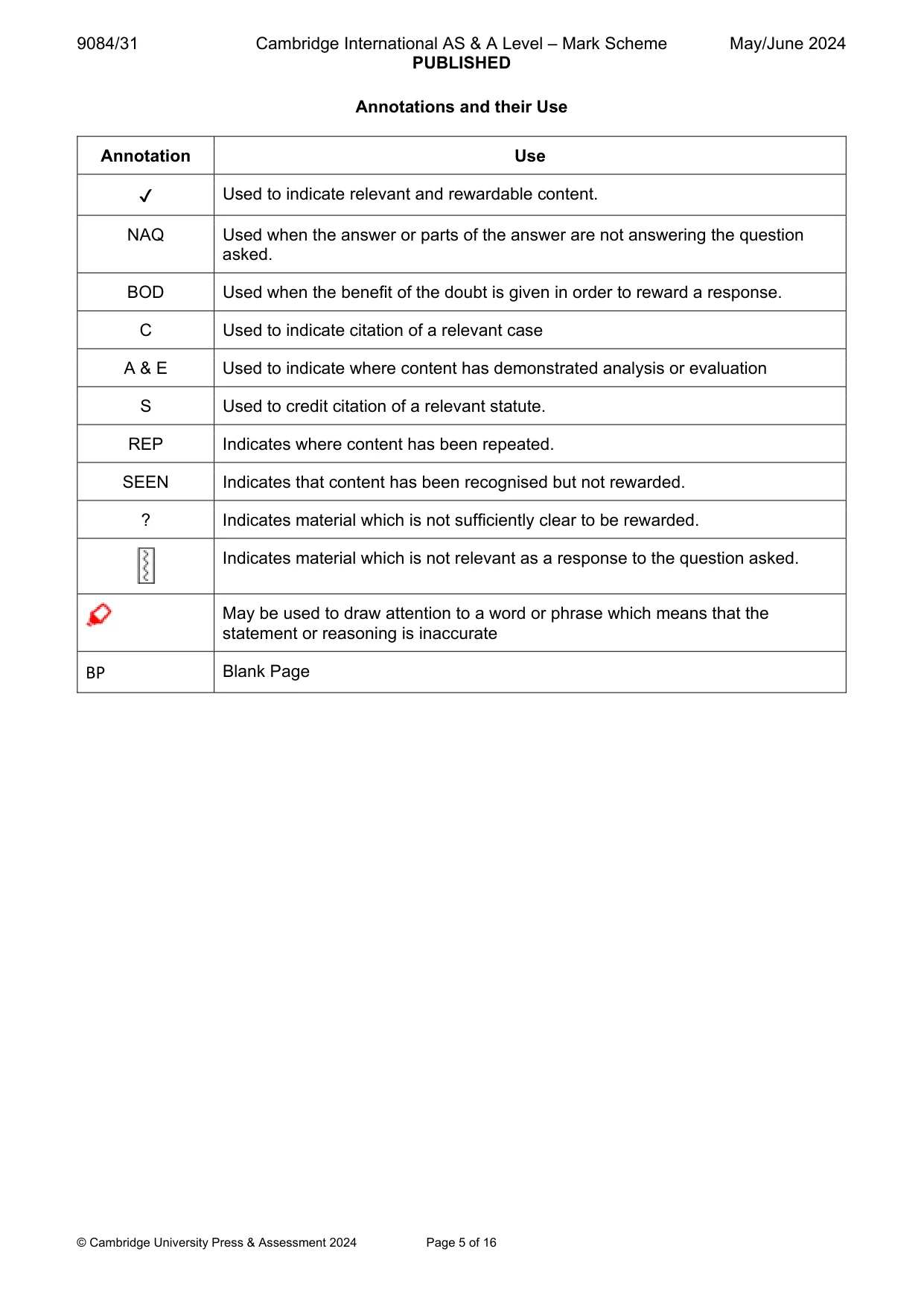
9084/31 Cambridge International AS & A Level – Mark Scheme PUBLISHED May/June 2024 © Cambridge University Press & Assessment 2024 Page 5 of 16 Annotations and their Use Annotation Use ✔ Used to indicate relevant and rewardable content. NAQ Used when the answer or parts of the answer are not answering the question asked. BOD Used when the benefit of the doubt is given in order to reward a response. C Used to indicate citation of a relevant case A & E Used to indicate where content has demonstrated analysis or evaluation S Used to credit citation of a relevant statute. REP Indicates where content has been repeated. SEEN Indicates that content has been recognised but not rewarded. ? Indicates material which is not sufficiently clear to be rewarded. Indicates material which is not relevant as a response to the question asked. May be used to draw attention to a word or phrase which means that the statement or reasoning is inaccurate BP Blank Page
Mark scheme, page 6
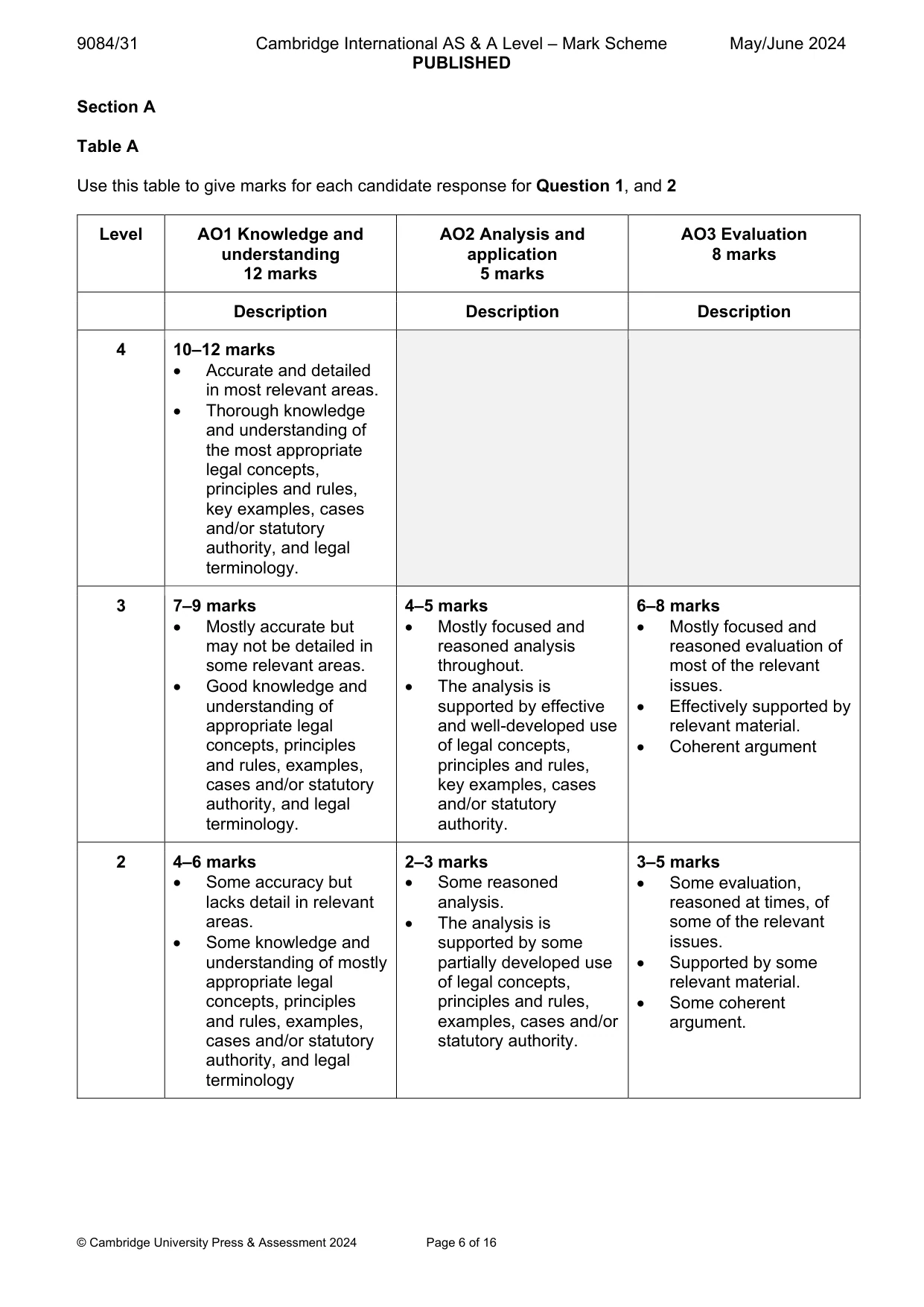
9084/31 Cambridge International AS & A Level – Mark Scheme PUBLISHED May/June 2024 © Cambridge University Press & Assessment 2024 Page 6 of 16 Section A Table A Use this table to give marks for each candidate response for Question 1, and 2 Level AO1 Knowledge and understanding 12 marks AO2 Analysis and application 5 marks AO3 Evaluation 8 marks Description Description Description 4 10–12 marks Accurate and detailed in most relevant areas. Thorough knowledge and understanding of the most appropriate legal concepts, principles and rules, key examples, cases and/or statutory authority, and legal terminology. 3 7–9 marks Mostly accurate but may not be detailed in some relevant areas. Good knowledge and understanding of appropriate legal concepts, principles and rules, examples, cases and/or statutory authority, and legal terminology. 4–5 marks Mostly focused and reasoned analysis throughout. The analysis is supported by effective and well-developed use of legal concepts, principles and rules, key examples, cases and/or statutory authority. 6–8 marks Mostly focused and reasoned evaluation of most of the relevant issues. Effectively supported by relevant material. Coherent argument 2 4–6 marks Some accuracy but lacks detail in relevant areas. Some knowledge and understanding of mostly appropriate legal concepts, principles and rules, examples, cases and/or statutory authority, and legal terminology 2–3 marks Some reasoned analysis. The analysis is supported by some partially developed use of legal concepts, principles and rules, examples, cases and/or statutory authority. 3–5 marks Some evaluation, reasoned at times, of some of the relevant issues. Supported by some relevant material. Some coherent argument.
Mark scheme, page 7
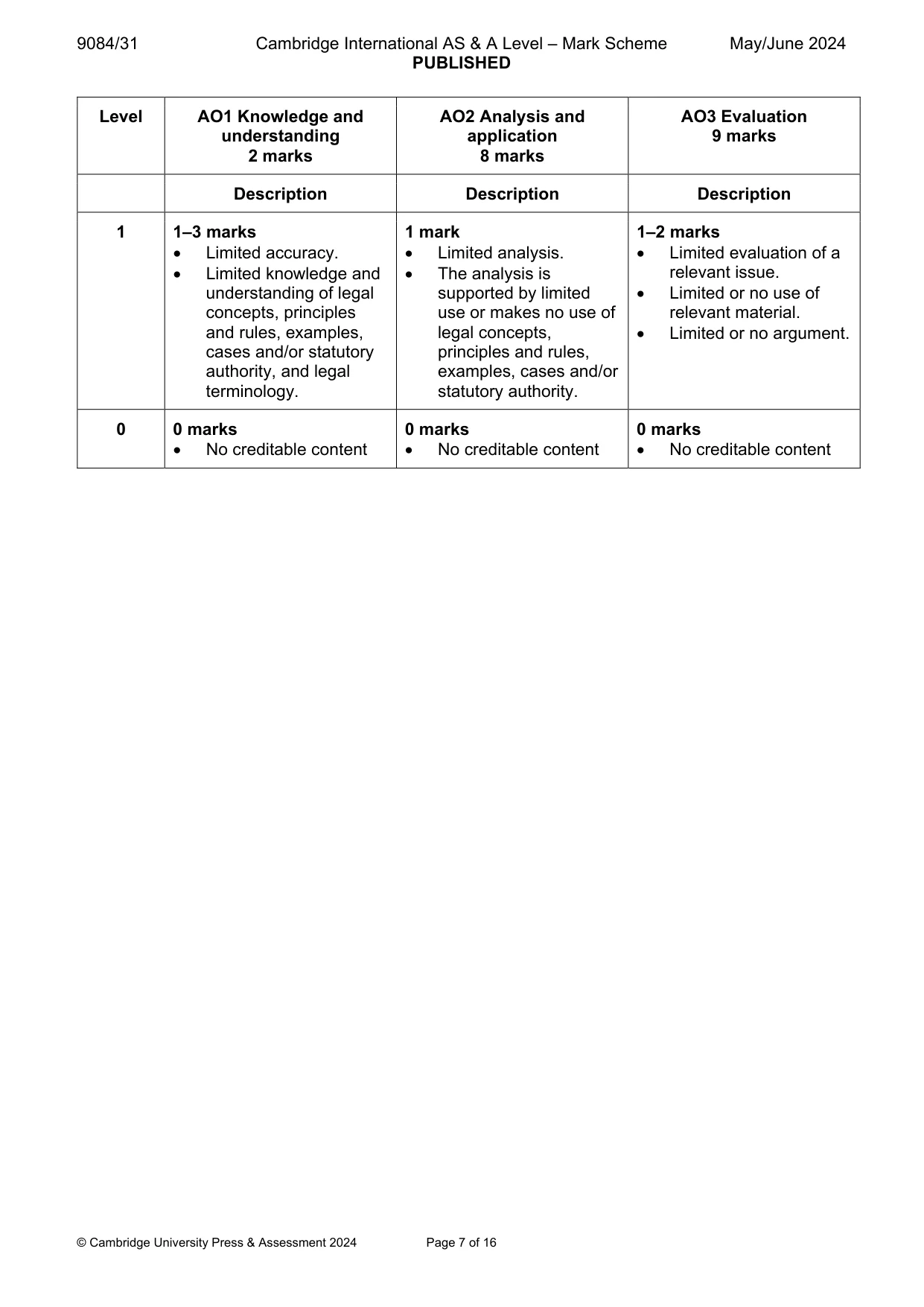
9084/31 Cambridge International AS & A Level – Mark Scheme PUBLISHED May/June 2024 © Cambridge University Press & Assessment 2024 Page 7 of 16 Level AO1 Knowledge and understanding 2 marks AO2 Analysis and application 8 marks AO3 Evaluation 9 marks Description Description Description 1 1–3 marks Limited accuracy. Limited knowledge and understanding of legal concepts, principles and rules, examples, cases and/or statutory authority, and legal terminology. 1 mark Limited analysis. The analysis is supported by limited use or makes no use of legal concepts, principles and rules, examples, cases and/or statutory authority. 1–2 marks Limited evaluation of a relevant issue. Limited or no use of relevant material. Limited or no argument. 0 0 marks No creditable content 0 marks No creditable content 0 marks No creditable content
Mark scheme, page 8
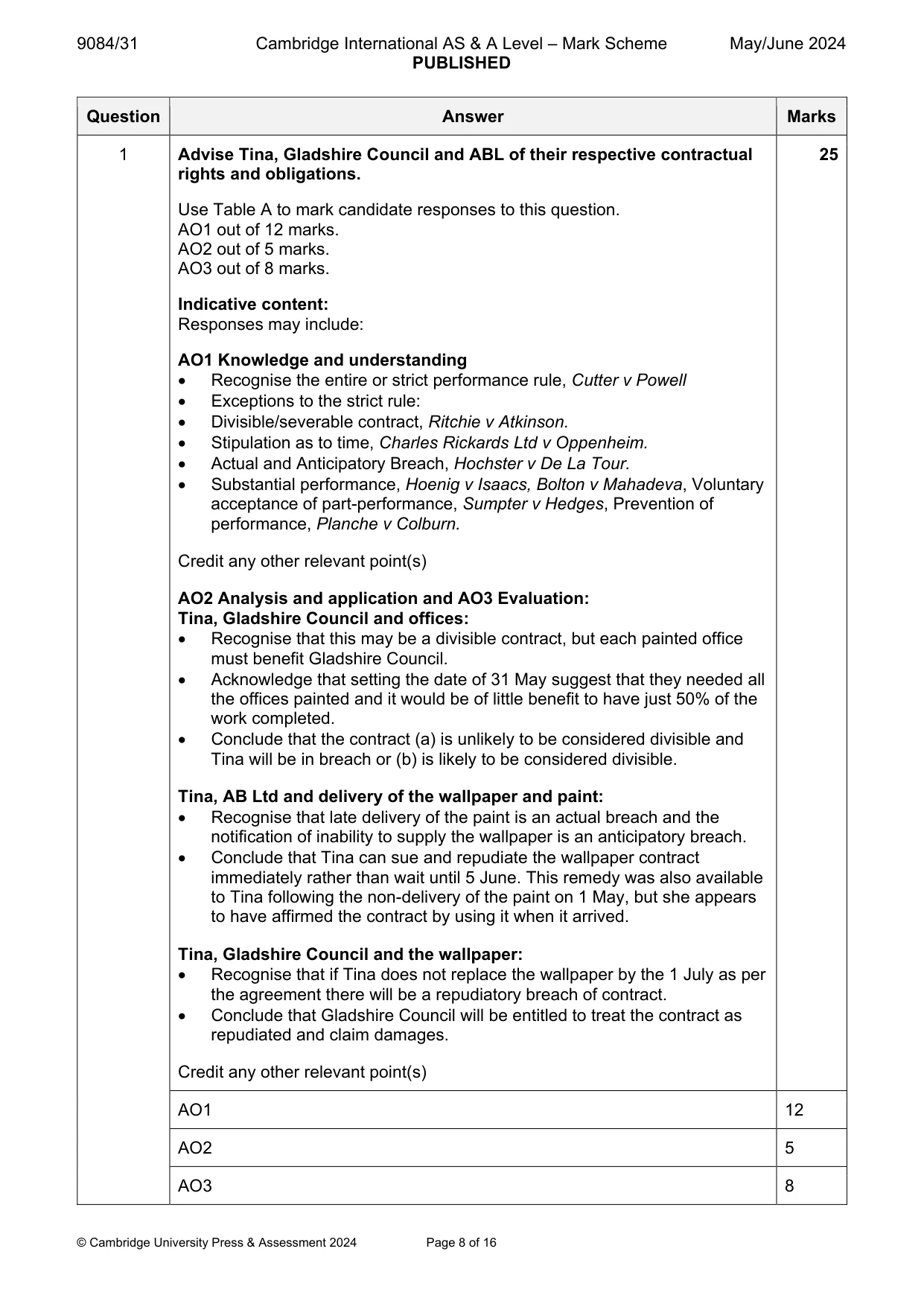
9084/31 Cambridge International AS & A Level – Mark Scheme PUBLISHED May/June 2024 © Cambridge University Press & Assessment 2024 Page 8 of 16 Question Answer Marks 1 Advise Tina, Gladshire Council and ABL of their respective contractual rights and obligations. Use Table A to mark candidate responses to this question. AO1 out of 12 marks. AO2 out of 5 marks. AO3 out of 8 marks. Indicative content: Responses may include: AO1 Knowledge and understanding Recognise the entire or strict performance rule, Cutter v Powell Exceptions to the strict rule: Divisible/severable contract, Ritchie v Atkinson. Stipulation as to time, Charles Rickards Ltd v Oppenheim. Actual and Anticipatory Breach, Hochster v De La Tour. Substantial performance, Hoenig v Isaacs, Bolton v Mahadeva, Voluntary acceptance of part-performance, Sumpter v Hedges, Prevention of performance, Planche v Colburn. Credit any other relevant point(s) AO2 Analysis and application and AO3 Evaluation: Tina, Gladshire Council and offices: Recognise that this may be a divisible contract, but each painted office must benefit Gladshire Council. Acknowledge that setting the date of 31 May suggest that they needed all the offices painted and it would be of little benefit to have just 50% of the work completed. Conclude that the contract (a) is unlikely to be considered divisible and Tina will be in breach or (b) is likely to be considered divisible. Tina, AB Ltd and delivery of the wallpaper and paint: Recognise that late delivery of the paint is an actual breach and the notification of inability to supply the wallpaper is an anticipatory breach. Conclude that Tina can sue and repudiate the wallpaper contract immediately rather than wait until 5 June. This remedy was also available to Tina following the non-delivery of the paint on 1 May, but she appears to have affirmed the contract by using it when it arrived. Tina, Gladshire Council and the wallpaper: Recognise that if Tina does not replace the wallpaper by the 1 July as per the agreement there will be a repudiatory breach of contract. Conclude that Gladshire Council will be entitled to treat the contract as repudiated and claim damages. Credit any other relevant point(s) 25 AO1 12 AO2 5 AO3 8
Mark scheme, page 9
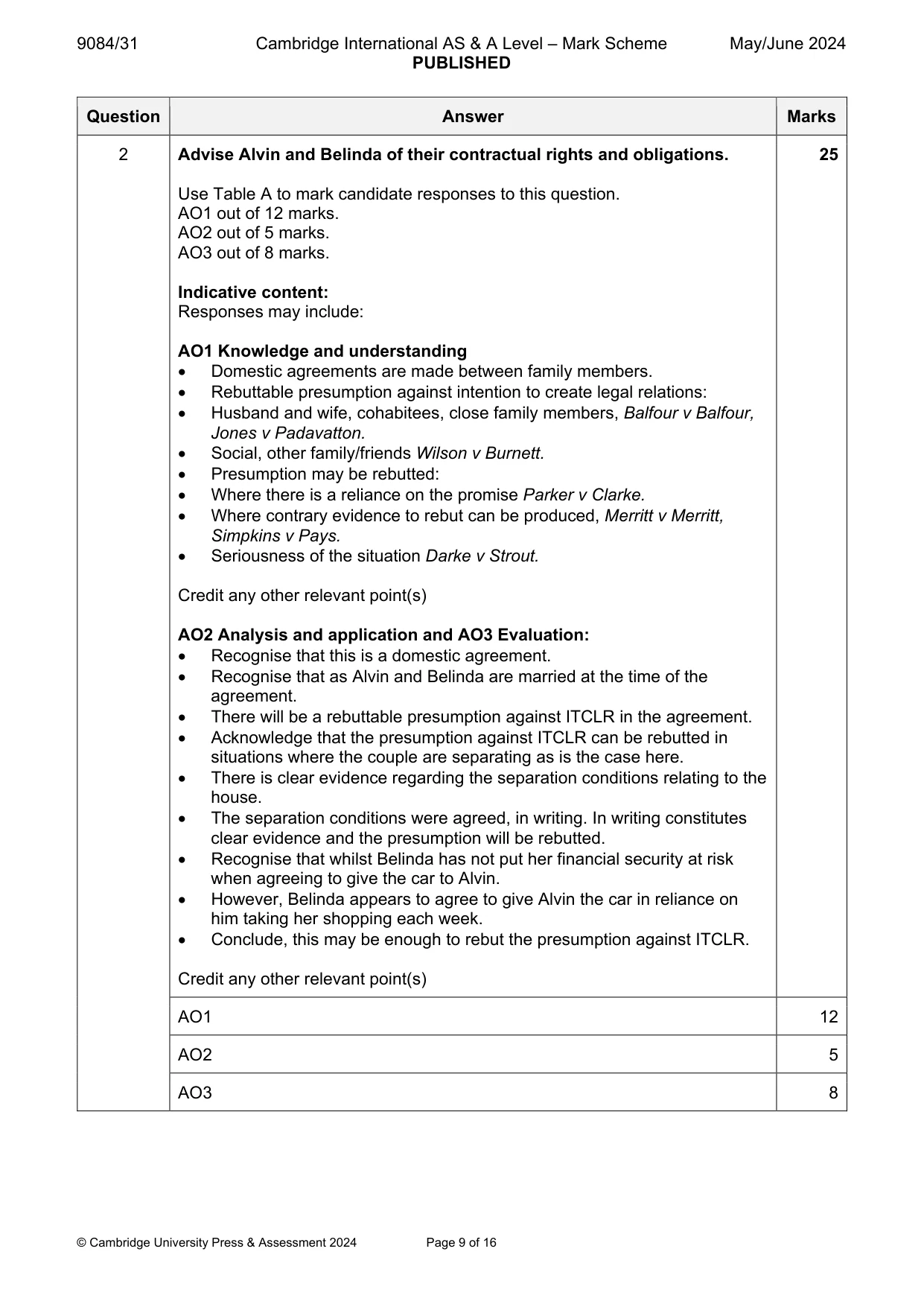
9084/31 Cambridge International AS & A Level – Mark Scheme PUBLISHED May/June 2024 © Cambridge University Press & Assessment 2024 Page 9 of 16 Question Answer Marks 2 Advise Alvin and Belinda of their contractual rights and obligations. Use Table A to mark candidate responses to this question. AO1 out of 12 marks. AO2 out of 5 marks. AO3 out of 8 marks. Indicative content: Responses may include: AO1 Knowledge and understanding Domestic agreements are made between family members. Rebuttable presumption against intention to create legal relations: Husband and wife, cohabitees, close family members, Balfour v Balfour, Jones v Padavatton. Social, other family/friends Wilson v Burnett. Presumption may be rebutted: Where there is a reliance on the promise Parker v Clarke. Where contrary evidence to rebut can be produced, Merritt v Merritt, Simpkins v Pays. Seriousness of the situation Darke v Strout. Credit any other relevant point(s) AO2 Analysis and application and AO3 Evaluation: Recognise that this is a domestic agreement. Recognise that as Alvin and Belinda are married at the time of the agreement. There will be a rebuttable presumption against ITCLR in the agreement. Acknowledge that the presumption against ITCLR can be rebutted in situations where the couple are separating as is the case here. There is clear evidence regarding the separation conditions relating to the house. The separation conditions were agreed, in writing. In writing constitutes clear evidence and the presumption will be rebutted. Recognise that whilst Belinda has not put her financial security at risk when agreeing to give the car to Alvin. However, Belinda appears to agree to give Alvin the car in reliance on him taking her shopping each week. Conclude, this may be enough to rebut the presumption against ITCLR. Credit any other relevant point(s) 25 AO1 12 AO2 5 AO3 8
Mark scheme, page 10
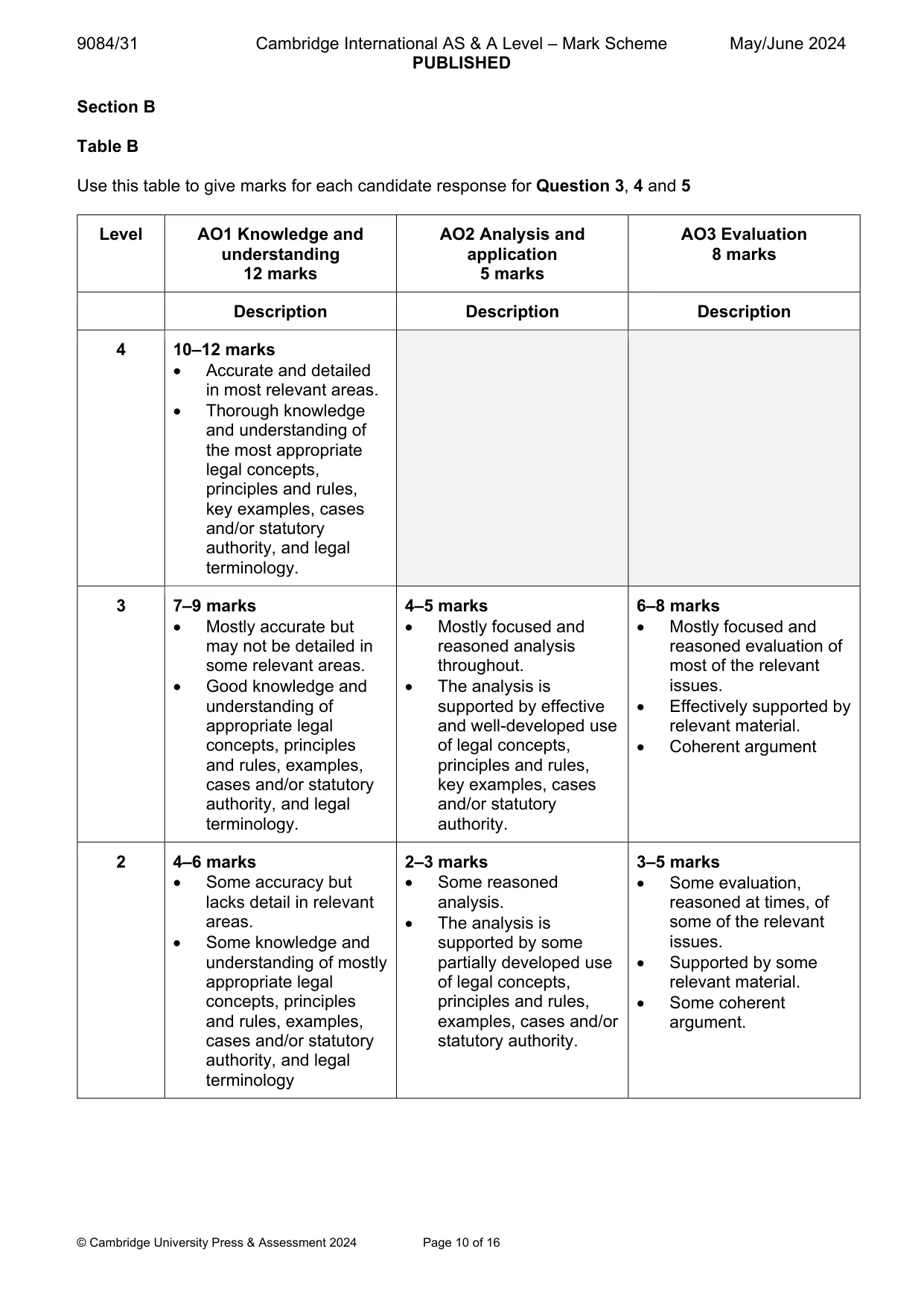
9084/31 Cambridge International AS & A Level – Mark Scheme PUBLISHED May/June 2024 © Cambridge University Press & Assessment 2024 Page 10 of 16 Section B Table B Use this table to give marks for each candidate response for Question 3, 4 and 5 Level AO1 Knowledge and understanding 12 marks AO2 Analysis and application 5 marks AO3 Evaluation 8 marks Description Description Description 4 10–12 marks Accurate and detailed in most relevant areas. Thorough knowledge and understanding of the most appropriate legal concepts, principles and rules, key examples, cases and/or statutory authority, and legal terminology. 3 7–9 marks Mostly accurate but may not be detailed in some relevant areas. Good knowledge and understanding of appropriate legal concepts, principles and rules, examples, cases and/or statutory authority, and legal terminology. 4–5 marks Mostly focused and reasoned analysis throughout. The analysis is supported by effective and well-developed use of legal concepts, principles and rules, key examples, cases and/or statutory authority. 6–8 marks Mostly focused and reasoned evaluation of most of the relevant issues. Effectively supported by relevant material. Coherent argument 2 4–6 marks Some accuracy but lacks detail in relevant areas. Some knowledge and understanding of mostly appropriate legal concepts, principles and rules, examples, cases and/or statutory authority, and legal terminology 2–3 marks Some reasoned analysis. The analysis is supported by some partially developed use of legal concepts, principles and rules, examples, cases and/or statutory authority. 3–5 marks Some evaluation, reasoned at times, of some of the relevant issues. Supported by some relevant material. Some coherent argument.
Mark scheme, page 11
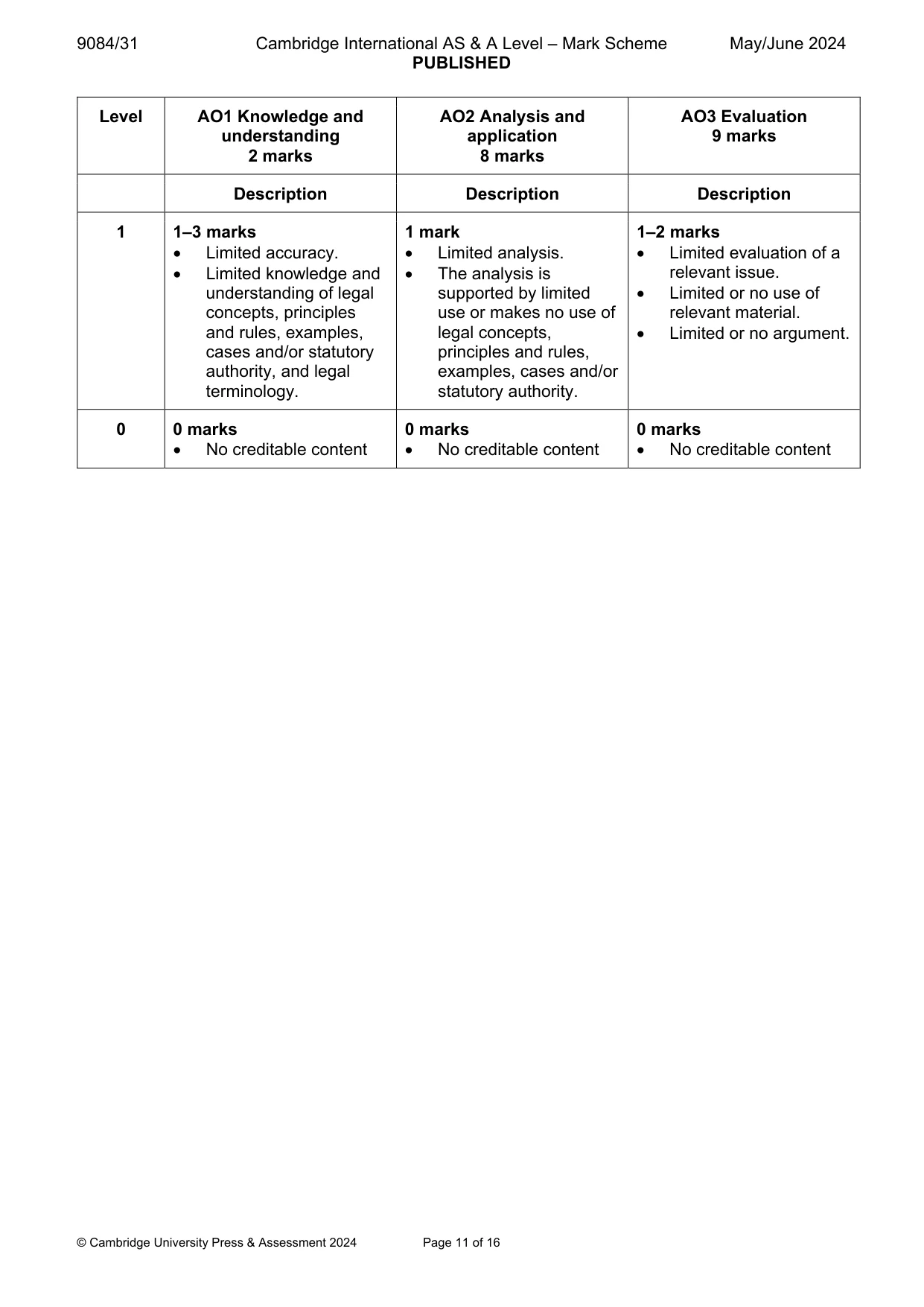
9084/31 Cambridge International AS & A Level – Mark Scheme PUBLISHED May/June 2024 © Cambridge University Press & Assessment 2024 Page 11 of 16 Level AO1 Knowledge and understanding 2 marks AO2 Analysis and application 8 marks AO3 Evaluation 9 marks Description Description Description 1 1–3 marks Limited accuracy. Limited knowledge and understanding of legal concepts, principles and rules, examples, cases and/or statutory authority, and legal terminology. 1 mark Limited analysis. The analysis is supported by limited use or makes no use of legal concepts, principles and rules, examples, cases and/or statutory authority. 1–2 marks Limited evaluation of a relevant issue. Limited or no use of relevant material. Limited or no argument. 0 0 marks No creditable content 0 marks No creditable content 0 marks No creditable content
Mark scheme, page 12
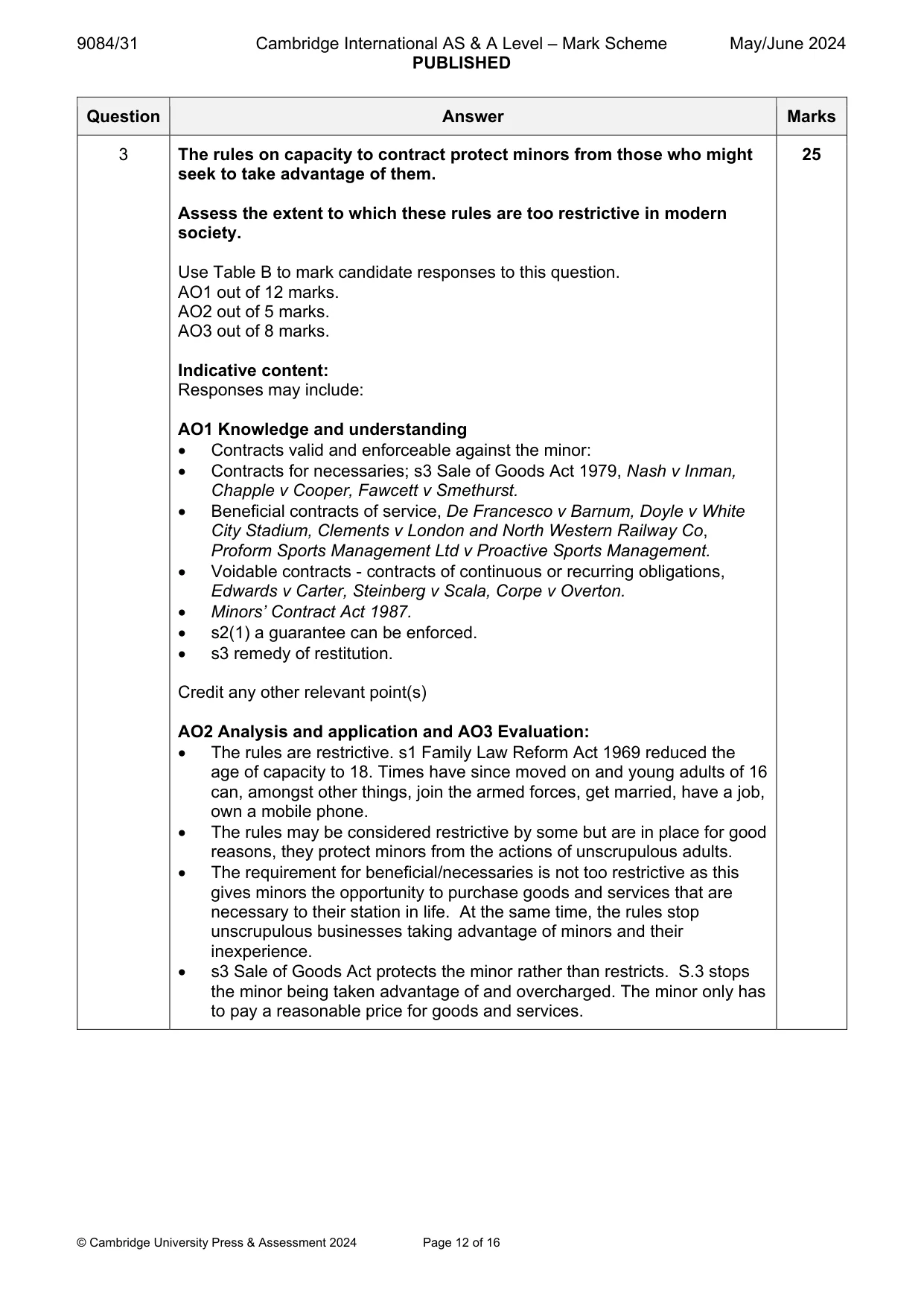
9084/31 Cambridge International AS & A Level – Mark Scheme PUBLISHED May/June 2024 © Cambridge University Press & Assessment 2024 Page 12 of 16 Question Answer Marks 3 The rules on capacity to contract protect minors from those who might seek to take advantage of them. Assess the extent to which these rules are too restrictive in modern society. Use Table B to mark candidate responses to this question. AO1 out of 12 marks. AO2 out of 5 marks. AO3 out of 8 marks. Indicative content: Responses may include: AO1 Knowledge and understanding Contracts valid and enforceable against the minor: Contracts for necessaries; s3 Sale of Goods Act 1979, Nash v Inman, Chapple v Cooper, Fawcett v Smethurst. Beneficial contracts of service, De Francesco v Barnum, Doyle v White City Stadium, Clements v London and North Western Railway Co, Proform Sports Management Ltd v Proactive Sports Management. Voidable contracts - contracts of continuous or recurring obligations, Edwards v Carter, Steinberg v Scala, Corpe v Overton. Minors’ Contract Act 1987. s2(1) a guarantee can be enforced. s3 remedy of restitution. Credit any other relevant point(s) AO2 Analysis and application and AO3 Evaluation: The rules are restrictive. s1 Family Law Reform Act 1969 reduced the age of capacity to 18. Times have since moved on and young adults of 16 can, amongst other things, join the armed forces, get married, have a job, own a mobile phone. The rules may be considered restrictive by some but are in place for good reasons, they protect minors from the actions of unscrupulous adults. The requirement for beneficial/necessaries is not too restrictive as this gives minors the opportunity to purchase goods and services that are necessary to their station in life. At the same time, the rules stop unscrupulous businesses taking advantage of minors and their inexperience. s3 Sale of Goods Act protects the minor rather than restricts. S.3 stops the minor being taken advantage of and overcharged. The minor only has to pay a reasonable price for goods and services. 25
Mark scheme, page 13
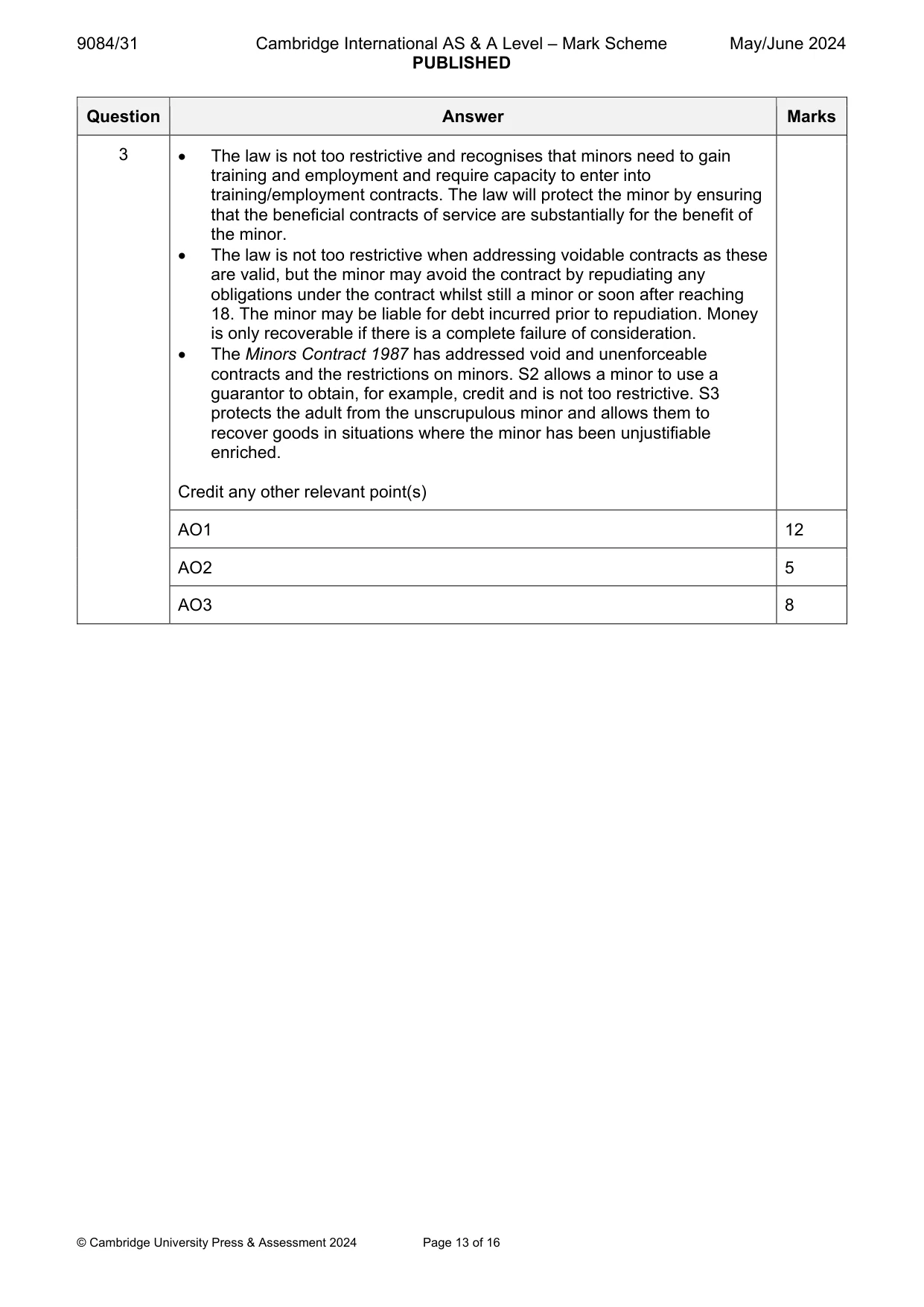
9084/31 Cambridge International AS & A Level – Mark Scheme PUBLISHED May/June 2024 © Cambridge University Press & Assessment 2024 Page 13 of 16 Question Answer Marks 3 The law is not too restrictive and recognises that minors need to gain training and employment and require capacity to enter into training/employment contracts. The law will protect the minor by ensuring that the beneficial contracts of service are substantially for the benefit of the minor. The law is not too restrictive when addressing voidable contracts as these are valid, but the minor may avoid the contract by repudiating any obligations under the contract whilst still a minor or soon after reaching 18. The minor may be liable for debt incurred prior to repudiation. Money is only recoverable if there is a complete failure of consideration. The Minors Contract 1987 has addressed void and unenforceable contracts and the restrictions on minors. S2 allows a minor to use a guarantor to obtain, for example, credit and is not too restrictive. S3 protects the adult from the unscrupulous minor and allows them to recover goods in situations where the minor has been unjustifiable enriched. Credit any other relevant point(s) AO1 12 AO2 5 AO3 8
Mark scheme, page 14
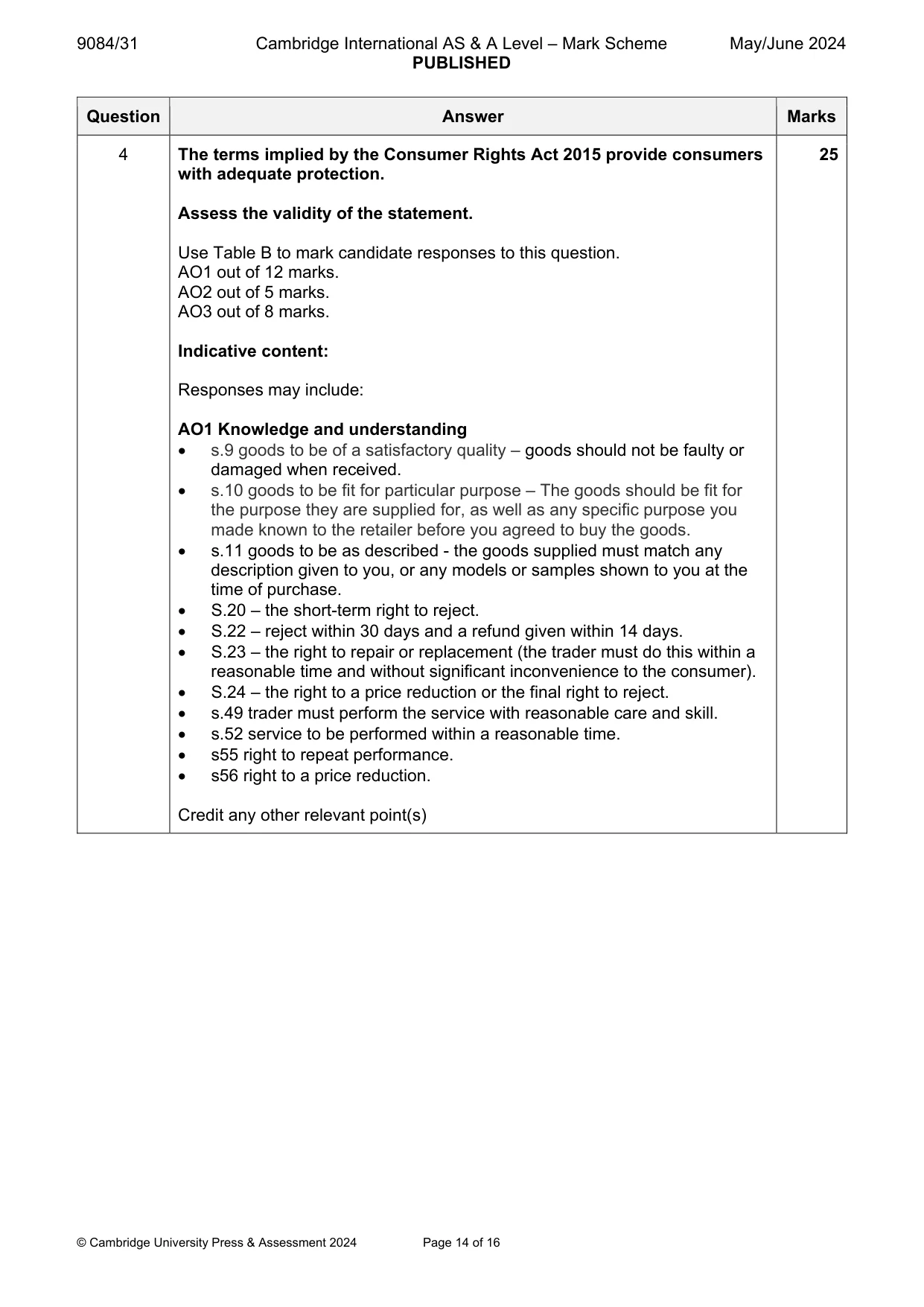
9084/31 Cambridge International AS & A Level – Mark Scheme PUBLISHED May/June 2024 © Cambridge University Press & Assessment 2024 Page 14 of 16 Question Answer Marks 4 The terms implied by the Consumer Rights Act 2015 provide consumers with adequate protection. Assess the validity of the statement. Use Table B to mark candidate responses to this question. AO1 out of 12 marks. AO2 out of 5 marks. AO3 out of 8 marks. Indicative content: Responses may include: AO1 Knowledge and understanding s.9 goods to be of a satisfactory quality – goods should not be faulty or damaged when received. s.10 goods to be fit for particular purpose – The goods should be fit for the purpose they are supplied for, as well as any specific purpose you made known to the retailer before you agreed to buy the goods. s.11 goods to be as described - the goods supplied must match any description given to you, or any models or samples shown to you at the time of purchase. S.20 – the short-term right to reject. S.22 – reject within 30 days and a refund given within 14 days. S.23 – the right to repair or replacement (the trader must do this within a reasonable time and without significant inconvenience to the consumer). S.24 – the right to a price reduction or the final right to reject. s.49 trader must perform the service with reasonable care and skill. s.52 service to be performed within a reasonable time. s55 right to repeat performance. s56 right to a price reduction. Credit any other relevant point(s) 25
Mark scheme, page 15
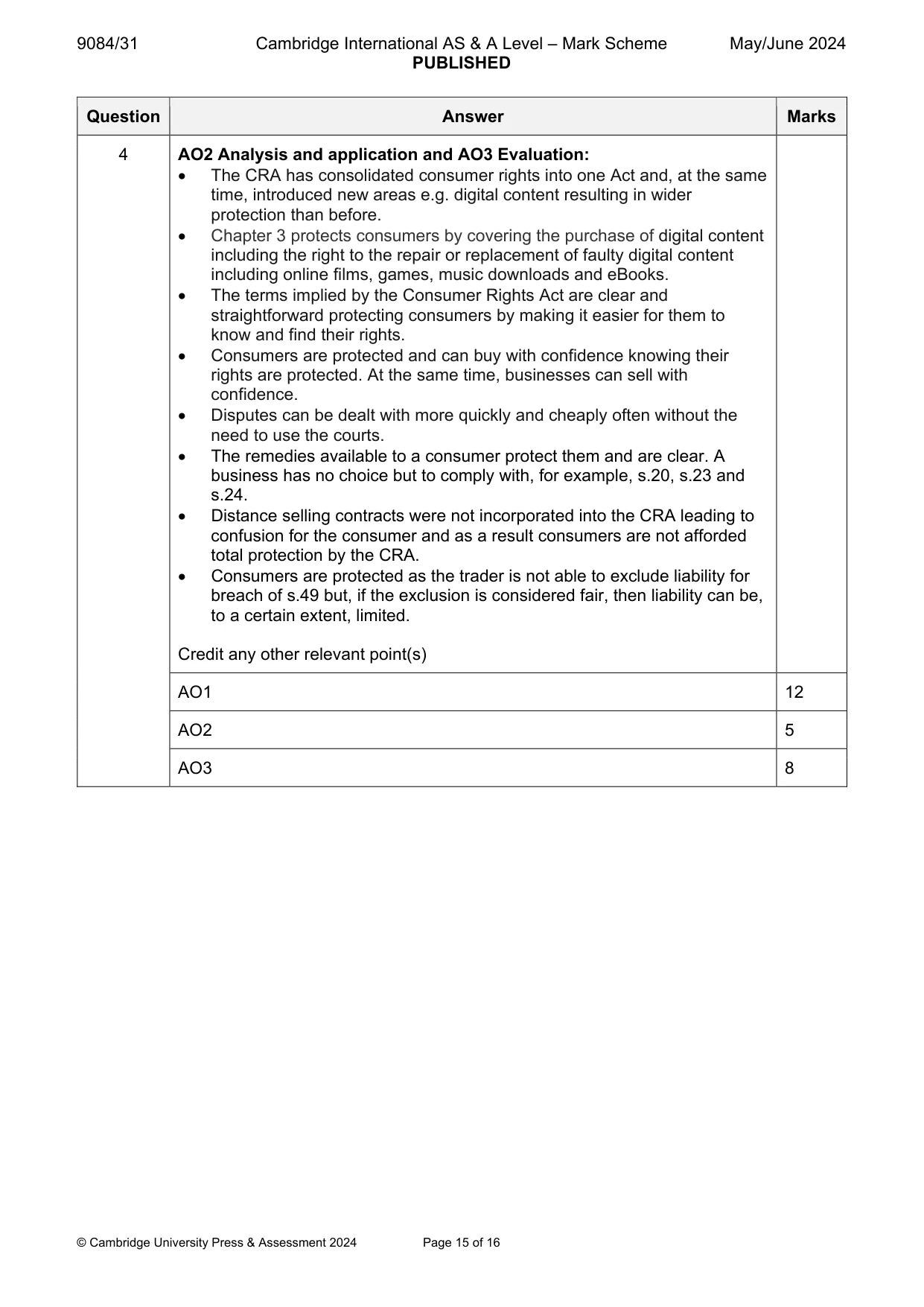
9084/31 Cambridge International AS & A Level – Mark Scheme PUBLISHED May/June 2024 © Cambridge University Press & Assessment 2024 Page 15 of 16 Question Answer Marks 4 AO2 Analysis and application and AO3 Evaluation: The CRA has consolidated consumer rights into one Act and, at the same time, introduced new areas e.g. digital content resulting in wider protection than before. Chapter 3 protects consumers by covering the purchase of digital content including the right to the repair or replacement of faulty digital content including online films, games, music downloads and eBooks. The terms implied by the Consumer Rights Act are clear and straightforward protecting consumers by making it easier for them to know and find their rights. Consumers are protected and can buy with confidence knowing their rights are protected. At the same time, businesses can sell with confidence. Disputes can be dealt with more quickly and cheaply often without the need to use the courts. The remedies available to a consumer protect them and are clear. A business has no choice but to comply with, for example, s.20, s.23 and s.24. Distance selling contracts were not incorporated into the CRA leading to confusion for the consumer and as a result consumers are not afforded total protection by the CRA. Consumers are protected as the trader is not able to exclude liability for breach of s.49 but, if the exclusion is considered fair, then liability can be, to a certain extent, limited. Credit any other relevant point(s) AO1 12 AO2 5 AO3 8
Mark scheme, page 16
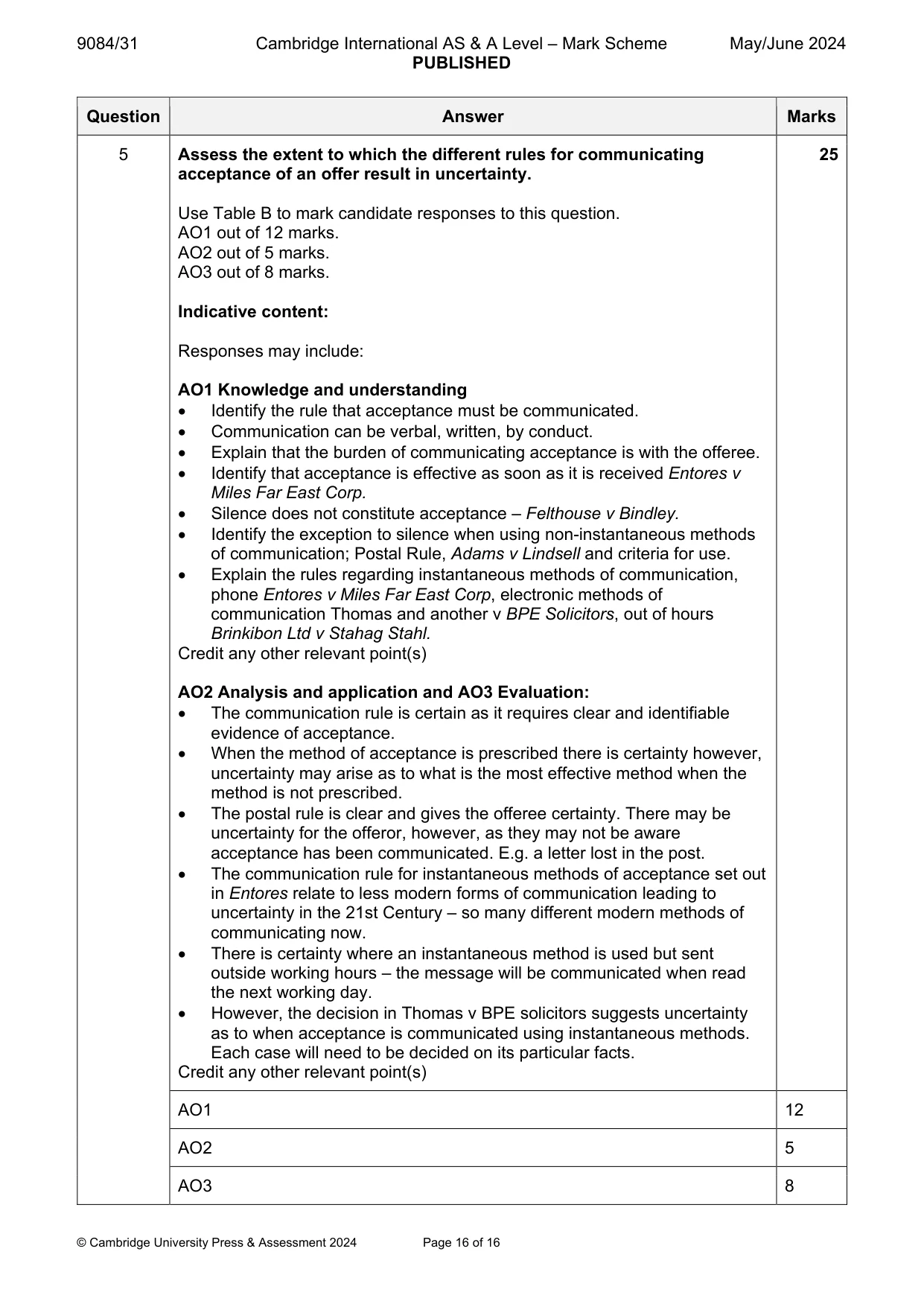
9084/31 Cambridge International AS & A Level – Mark Scheme PUBLISHED May/June 2024 © Cambridge University Press & Assessment 2024 Page 16 of 16 Question Answer Marks 5 Assess the extent to which the different rules for communicating acceptance of an offer result in uncertainty. Use Table B to mark candidate responses to this question. AO1 out of 12 marks. AO2 out of 5 marks. AO3 out of 8 marks. Indicative content: Responses may include: AO1 Knowledge and understanding Identify the rule that acceptance must be communicated. Communication can be verbal, written, by conduct. Explain that the burden of communicating acceptance is with the offeree. Identify that acceptance is effective as soon as it is received Entores v Miles Far East Corp. Silence does not constitute acceptance – Felthouse v Bindley. Identify the exception to silence when using non-instantaneous methods of communication; Postal Rule, Adams v Lindsell and criteria for use. Explain the rules regarding instantaneous methods of communication, phone Entores v Miles Far East Corp, electronic methods of communication Thomas and another v BPE Solicitors, out of hours Brinkibon Ltd v Stahag Stahl. Credit any other relevant point(s) AO2 Analysis and application and AO3 Evaluation: The communication rule is certain as it requires clear and identifiable evidence of acceptance. When the method of acceptance is prescribed there is certainty however, uncertainty may arise as to what is the most effective method when the method is not prescribed. The postal rule is clear and gives the offeree certainty. There may be uncertainty for the offeror, however, as they may not be aware acceptance has been communicated. E.g. a letter lost in the post. The communication rule for instantaneous methods of acceptance set out in Entores relate to less modern forms of communication leading to uncertainty in the 21st Century – so many different modern methods of communicating now. There is certainty where an instantaneous method is used but sent outside working hours – the message will be communicated when read the next working day. However, the decision in Thomas v BPE solicitors suggests uncertainty as to when acceptance is communicated using instantaneous methods. Each case will need to be decided on its particular facts. Credit any other relevant point(s) 25 AO1 12 AO2 5 AO3 8
What you needed in this session
Cambridge’s own grade thresholds for 2024 May/June, Paper 3 · Variant 1. A higher threshold means an easier paper — the bar moves with how the cohort did.