Cambridge A Level Law 9084 — 2020 May/June Paper 3 · Variant 3
9084/33/M/J/20
The question paper and its mark scheme, free to read here and free to download. This is Cambridge’s own paper, exactly as it was sat.
Question paper4 pages

Mark scheme11 pages
Answers below. Sit the paper first if you are practising.
Paper as text
Question paper, page 1
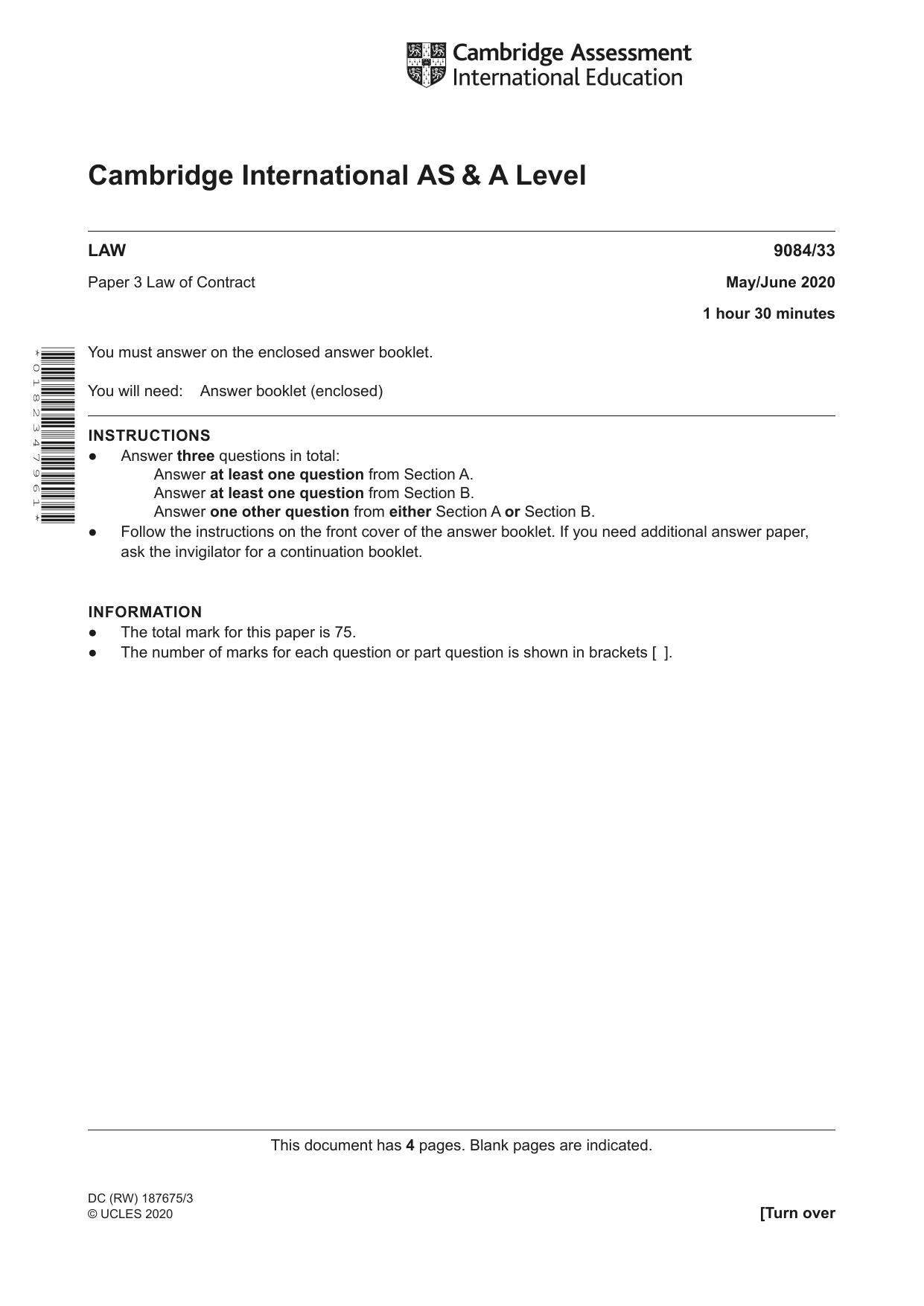
This document has 4 pages. Blank pages are indicated. DC (RW) 187675/3 © UCLES 2020 [Turn over * 0 1 8 2 3 4 7 9 6 1 * Cambridge International AS & A Level LAW 9084/33 Paper 3 Law of Contract May/June 2020 1 hour 30 minutes You must answer on the enclosed answer booklet. You will need: Answer booklet (enclosed) INSTRUCTIONS ● Answer three questions in total: Answer at least one question from Section A. Answer at least one question from Section B. Answer one other question from either Section A or Section B. ● Follow the instructions on the front cover of the answer booklet. If you need additional answer paper, ask the invigilator for a continuation booklet. INFORMATION ● The total mark for this paper is 75. ● The number of marks for each question or part question is shown in brackets [ ].
Question paper, page 2
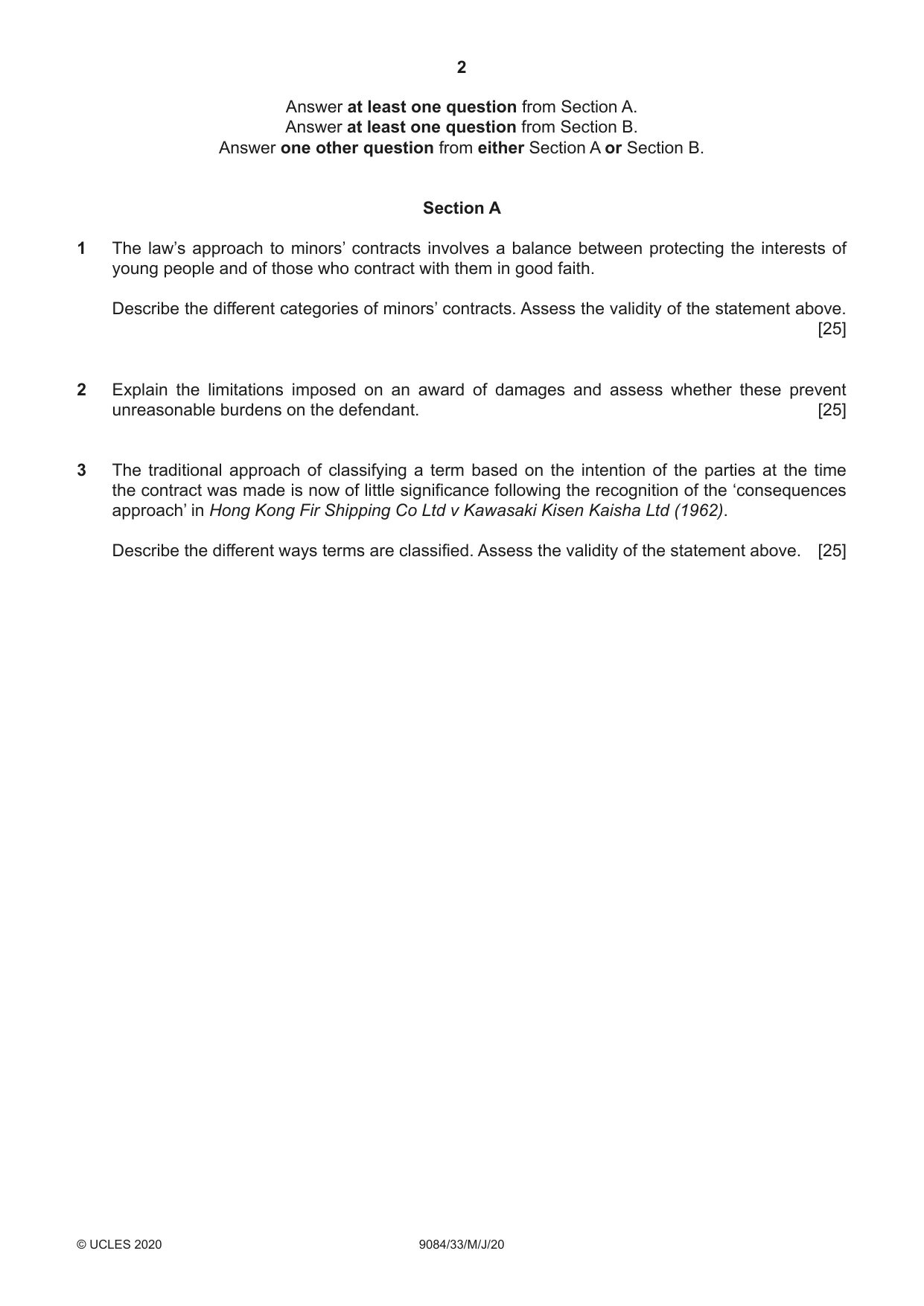
2 9084/33/M/J/20 © UCLES 2020 Answer at least one question from Section A. Answer at least one question from Section B. Answer one other question from either Section A or Section B. Section A 1 The law’s approach to minors’ contracts involves a balance between protecting the interests of young people and of those who contract with them in good faith. Describe the different categories of minors’ contracts. Assess the validity of the statement above. [25] 2 Explain the limitations imposed on an award of damages and assess whether these prevent unreasonable burdens on the defendant. [25] 3 The traditional approach of classifying a term based on the intention of the parties at the time the contract was made is now of little significance following the recognition of the ‘consequences approach’ in Hong Kong Fir Shipping Co Ltd v Kawasaki Kisen Kaisha Ltd (1962). Describe the different ways terms are classified. Assess the validity of the statement above. [25]
Question paper, page 3
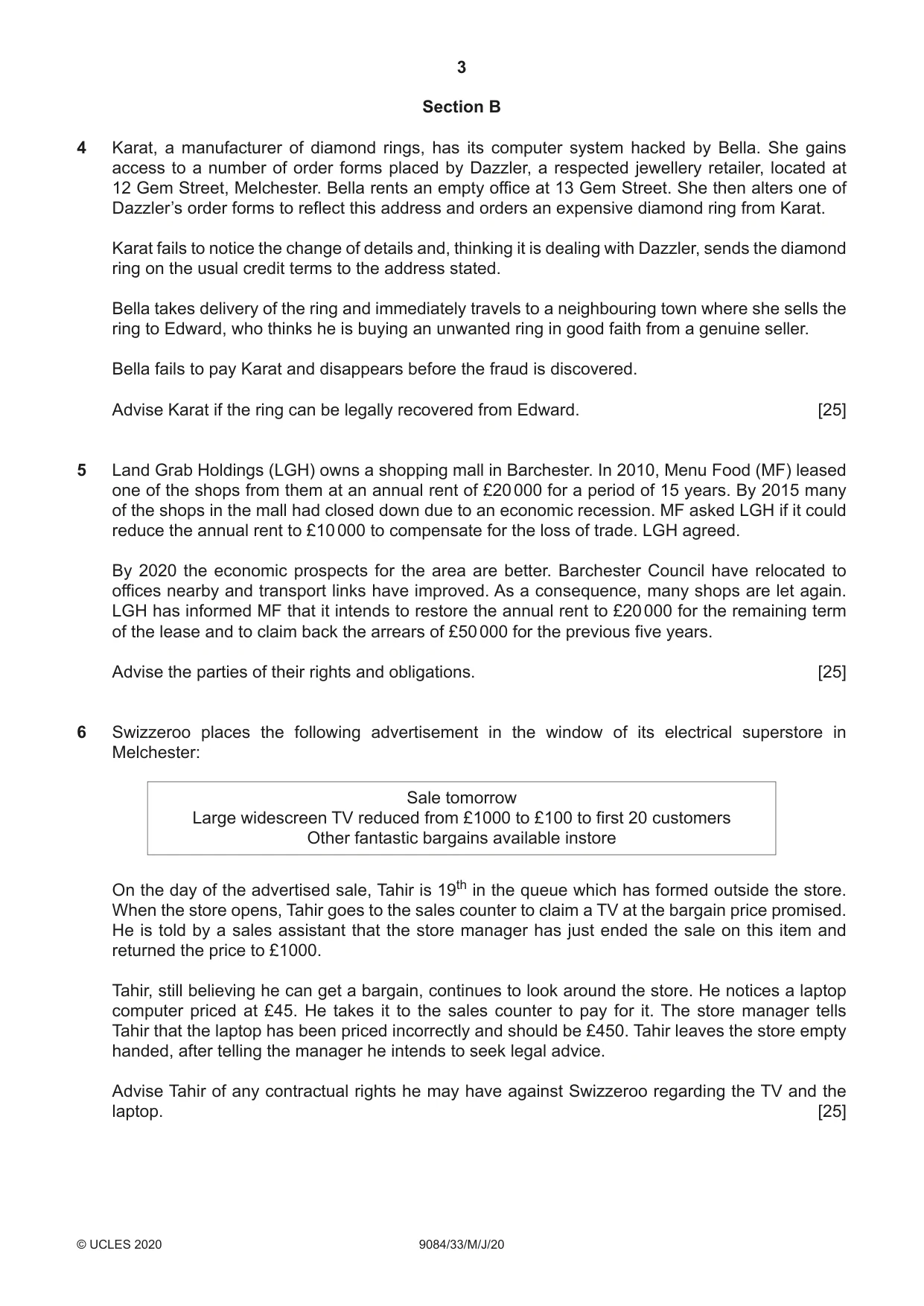
3 9084/33/M/J/20 © UCLES 2020 Section B 4 Karat, a manufacturer of diamond rings, has its computer system hacked by Bella. She gains access to a number of order forms placed by Dazzler, a respected jewellery retailer, located at 12 Gem Street, Melchester. Bella rents an empty office at 13 Gem Street. She then alters one of Dazzler’s order forms to reflect this address and orders an expensive diamond ring from Karat. Karat fails to notice the change of details and, thinking it is dealing with Dazzler, sends the diamond ring on the usual credit terms to the address stated. Bella takes delivery of the ring and immediately travels to a neighbouring town where she sells the ring to Edward, who thinks he is buying an unwanted ring in good faith from a genuine seller. Bella fails to pay Karat and disappears before the fraud is discovered. Advise Karat if the ring can be legally recovered from Edward. [25] 5 Land Grab Holdings (LGH) owns a shopping mall in Barchester. In 2010, Menu Food (MF) leased one of the shops from them at an annual rent of £20 000 for a period of 15 years. By 2015 many of the shops in the mall had closed down due to an economic recession. MF asked LGH if it could reduce the annual rent to £10 000 to compensate for the loss of trade. LGH agreed. By 2020 the economic prospects for the area are better. Barchester Council have relocated to offices nearby and transport links have improved. As a consequence, many shops are let again. LGH has informed MF that it intends to restore the annual rent to £20 000 for the remaining term of the lease and to claim back the arrears of £50 000 for the previous five years. Advise the parties of their rights and obligations. [25] 6 Swizzeroo places the following advertisement in the window of its electrical superstore in Melchester: Sale tomorrow Large widescreen TV reduced from £1000 to £100 to first 20 customers Other fantastic bargains available instore On the day of the advertised sale, Tahir is 19th in the queue which has formed outside the store. When the store opens, Tahir goes to the sales counter to claim a TV at the bargain price promised. He is told by a sales assistant that the store manager has just ended the sale on this item and returned the price to £1000. Tahir, still believing he can get a bargain, continues to look around the store. He notices a laptop computer priced at £45. He takes it to the sales counter to pay for it. The store manager tells Tahir that the laptop has been priced incorrectly and should be £450. Tahir leaves the store empty handed, after telling the manager he intends to seek legal advice. Advise Tahir of any contractual rights he may have against Swizzeroo regarding the TV and the laptop. [25]
Question paper, page 4
4 9084/33/M/J/20 © UCLES 2020 Permission to reproduce items where third-party owned material protected by copyright is included has been sought and cleared where possible. Every reasonable effort has been made by the publisher (UCLES) to trace copyright holders, but if any items requiring clearance have unwittingly been included, the publisher will be pleased to make amends at the earliest possible opportunity. To avoid the issue of disclosure of answer-related information to candidates, all copyright acknowledgements are reproduced online in the Cambridge Assessment International Education Copyright Acknowledgements Booklet. This is produced for each series of examinations and is freely available to download at www.cambridgeinternational.org after the live examination series. Cambridge Assessment International Education is part of the Cambridge Assessment Group. Cambridge Assessment is the brand name of the University of Cambridge Local Examinations Syndicate (UCLES), which itself is a department of the University of Cambridge. BLANK PAGE
Mark scheme, page 1
This document consists of 11 printed pages. © UCLES 2020 [Turn over Cambridge International AS & A Level LAW 9084/33 Paper 3 May/June 2020 MARK SCHEME Maximum Mark: 75 Published Students did not sit exam papers in the June 2020 series due to the Covid-19 global pandemic. This mark scheme is published to support teachers and students and should be read together with the question paper. It shows the requirements of the exam. The answer column of the mark scheme shows the proposed basis on which Examiners would award marks for this exam. Where appropriate, this column also provides the most likely acceptable alternative responses expected from students. Examiners usually review the mark scheme after they have seen student responses and update the mark scheme if appropriate. In the June series, Examiners were unable to consider the acceptability of alternative responses, as there were no student responses to consider. Mark schemes should usually be read together with the Principal Examiner Report for Teachers. However, because students did not sit exam papers, there is no Principal Examiner Report for Teachers for the June 2020 series. Cambridge International will not enter into discussions about these mark schemes. Cambridge International is publishing the mark schemes for the June 2020 series for most Cambridge IGCSE™ and Cambridge International A & AS Level components, and some Cambridge O Level components.
Mark scheme, page 2
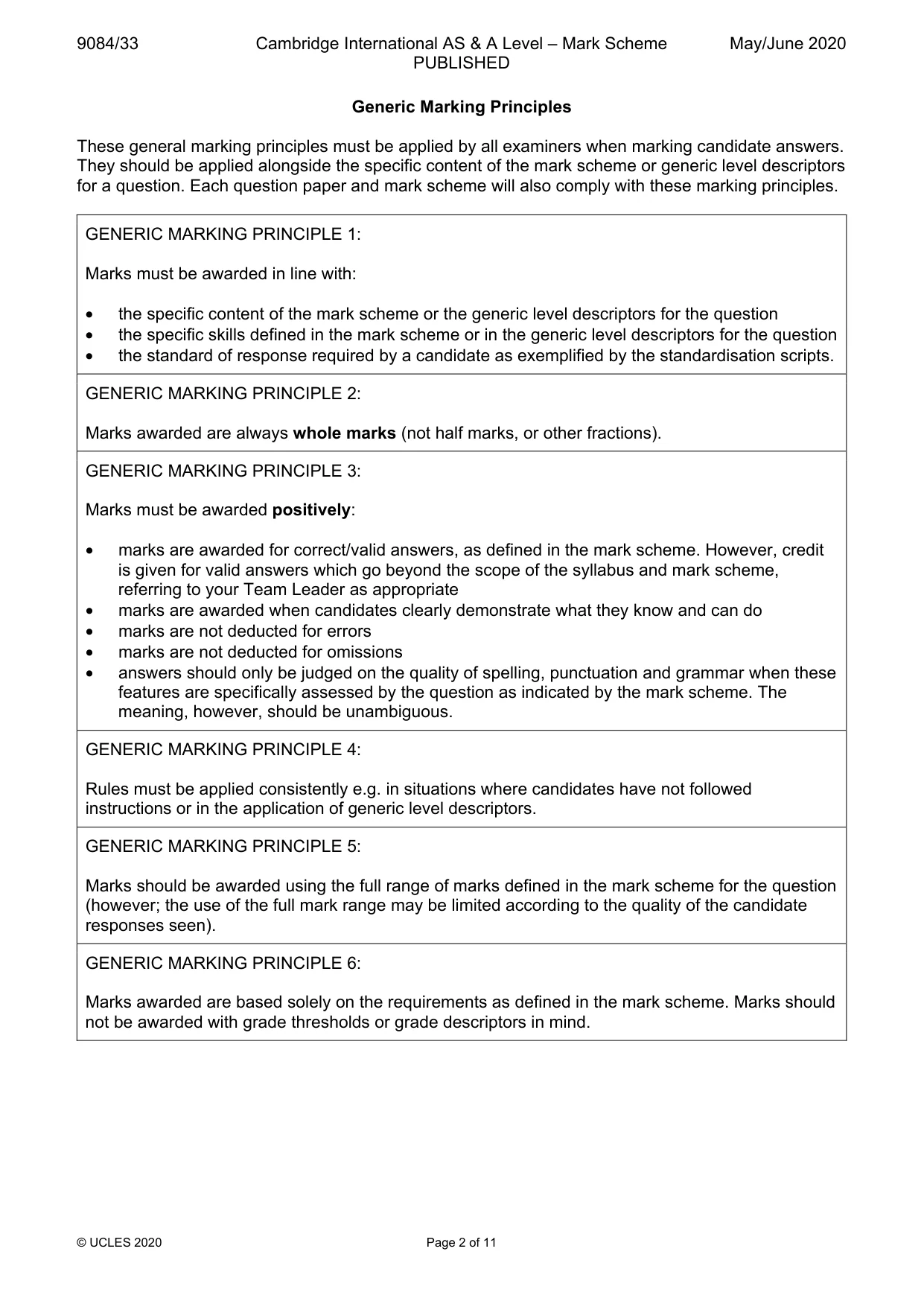
9084/33 Cambridge International AS & A Level – Mark Scheme PUBLISHED May/June 2020 © UCLES 2020 Page 2 of 11 Generic Marking Principles These general marking principles must be applied by all examiners when marking candidate answers. They should be applied alongside the specific content of the mark scheme or generic level descriptors for a question. Each question paper and mark scheme will also comply with these marking principles. GENERIC MARKING PRINCIPLE 1: Marks must be awarded in line with: • the specific content of the mark scheme or the generic level descriptors for the question • the specific skills defined in the mark scheme or in the generic level descriptors for the question • the standard of response required by a candidate as exemplified by the standardisation scripts. GENERIC MARKING PRINCIPLE 2: Marks awarded are always whole marks (not half marks, or other fractions). GENERIC MARKING PRINCIPLE 3: Marks must be awarded positively: • marks are awarded for correct/valid answers, as defined in the mark scheme. However, credit is given for valid answers which go beyond the scope of the syllabus and mark scheme, referring to your Team Leader as appropriate • marks are awarded when candidates clearly demonstrate what they know and can do • marks are not deducted for errors • marks are not deducted for omissions • answers should only be judged on the quality of spelling, punctuation and grammar when these features are specifically assessed by the question as indicated by the mark scheme. The meaning, however, should be unambiguous. GENERIC MARKING PRINCIPLE 4: Rules must be applied consistently e.g. in situations where candidates have not followed instructions or in the application of generic level descriptors. GENERIC MARKING PRINCIPLE 5: Marks should be awarded using the full range of marks defined in the mark scheme for the question (however; the use of the full mark range may be limited according to the quality of the candidate responses seen). GENERIC MARKING PRINCIPLE 6: Marks awarded are based solely on the requirements as defined in the mark scheme. Marks should not be awarded with grade thresholds or grade descriptors in mind.
Mark scheme, page 3
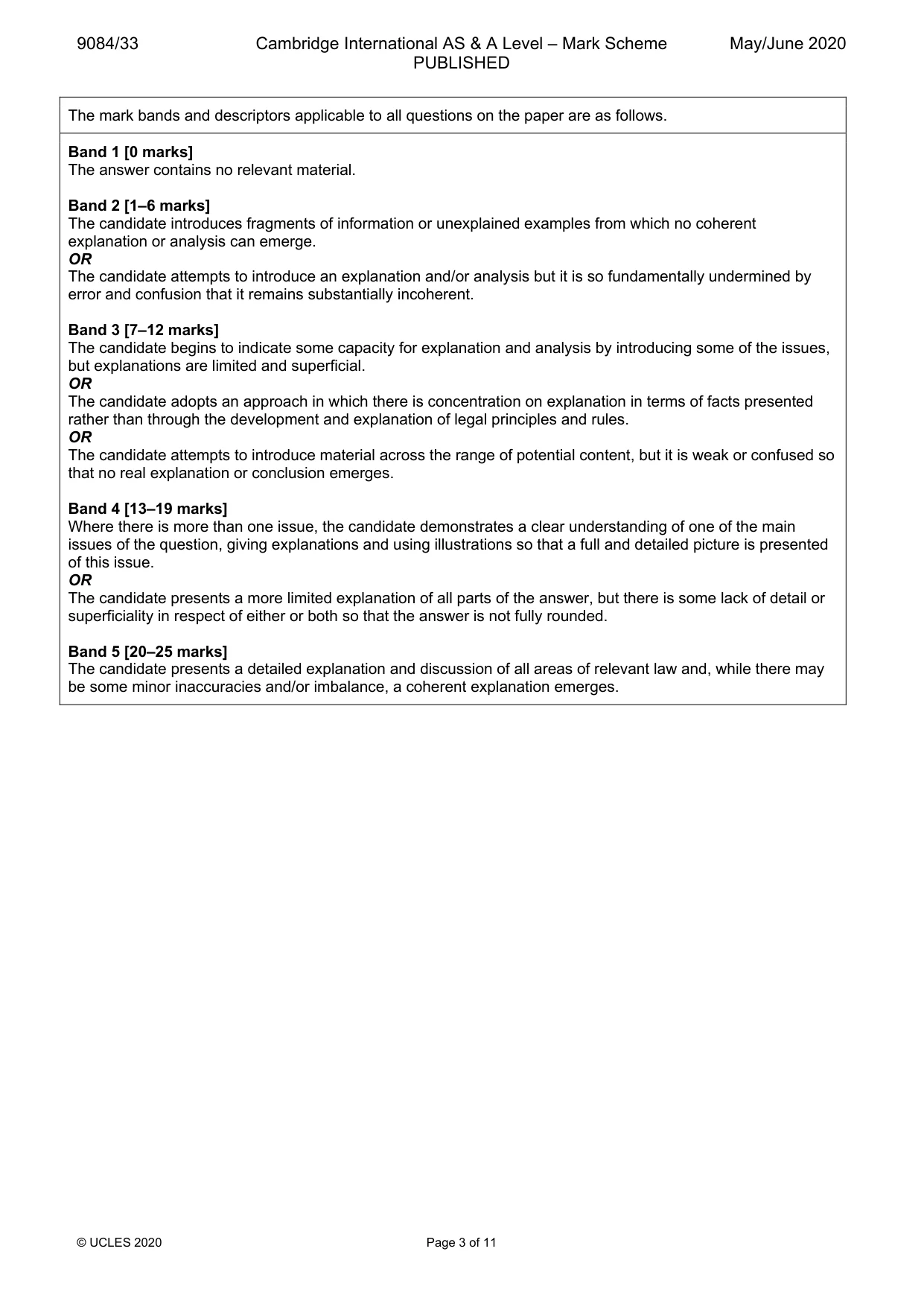
9084/33 Cambridge International AS & A Level – Mark Scheme PUBLISHED May/June 2020 © UCLES 2020 Page 3 of 11 The mark bands and descriptors applicable to all questions on the paper are as follows. Band 1 [0 marks] The answer contains no relevant material. Band 2 [1–6 marks] The candidate introduces fragments of information or unexplained examples from which no coherent explanation or analysis can emerge. OR The candidate attempts to introduce an explanation and/or analysis but it is so fundamentally undermined by error and confusion that it remains substantially incoherent. Band 3 [7–12 marks] The candidate begins to indicate some capacity for explanation and analysis by introducing some of the issues, but explanations are limited and superficial. OR The candidate adopts an approach in which there is concentration on explanation in terms of facts presented rather than through the development and explanation of legal principles and rules. OR The candidate attempts to introduce material across the range of potential content, but it is weak or confused so that no real explanation or conclusion emerges. Band 4 [13–19 marks] Where there is more than one issue, the candidate demonstrates a clear understanding of one of the main issues of the question, giving explanations and using illustrations so that a full and detailed picture is presented of this issue. OR The candidate presents a more limited explanation of all parts of the answer, but there is some lack of detail or superficiality in respect of either or both so that the answer is not fully rounded. Band 5 [20–25 marks] The candidate presents a detailed explanation and discussion of all areas of relevant law and, while there may be some minor inaccuracies and/or imbalance, a coherent explanation emerges.
Mark scheme, page 4
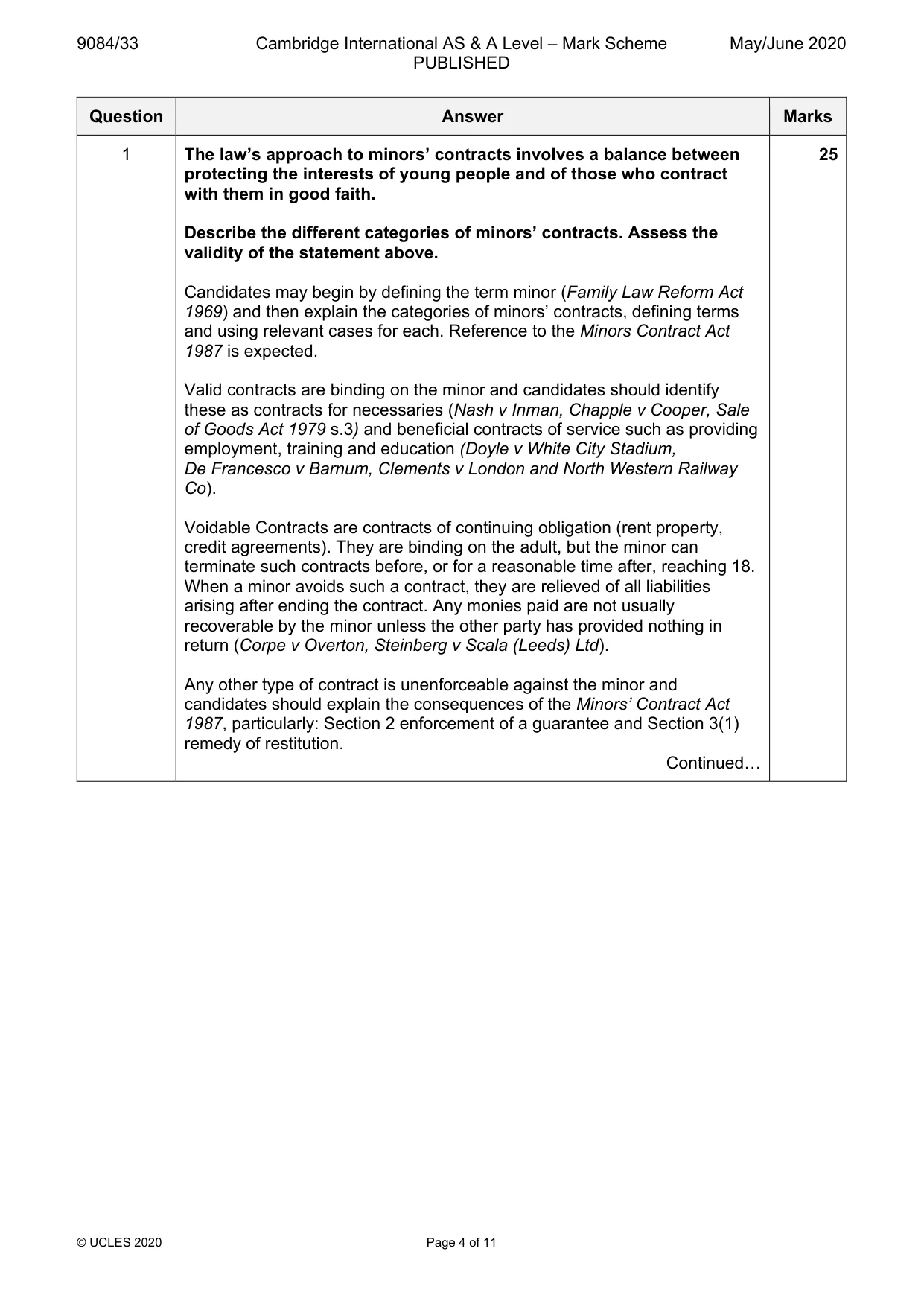
9084/33 Cambridge International AS & A Level – Mark Scheme PUBLISHED May/June 2020 © UCLES 2020 Page 4 of 11 Question Answer Marks 1 The law’s approach to minors’ contracts involves a balance between protecting the interests of young people and of those who contract with them in good faith. Describe the different categories of minors’ contracts. Assess the validity of the statement above. Candidates may begin by defining the term minor (Family Law Reform Act 1969) and then explain the categories of minors’ contracts, defining terms and using relevant cases for each. Reference to the Minors Contract Act 1987 is expected. Valid contracts are binding on the minor and candidates should identify these as contracts for necessaries (Nash v Inman, Chapple v Cooper, Sale of Goods Act 1979 s.3) and beneficial contracts of service such as providing employment, training and education (Doyle v White City Stadium, De Francesco v Barnum, Clements v London and North Western Railway Co). Voidable Contracts are contracts of continuing obligation (rent property, credit agreements). They are binding on the adult, but the minor can terminate such contracts before, or for a reasonable time after, reaching 18. When a minor avoids such a contract, they are relieved of all liabilities arising after ending the contract. Any monies paid are not usually recoverable by the minor unless the other party has provided nothing in return (Corpe v Overton, Steinberg v Scala (Leeds) Ltd). Any other type of contract is unenforceable against the minor and candidates should explain the consequences of the Minors’ Contract Act 1987, particularly: Section 2 enforcement of a guarantee and Section 3(1) remedy of restitution. Continued… 25
Mark scheme, page 5
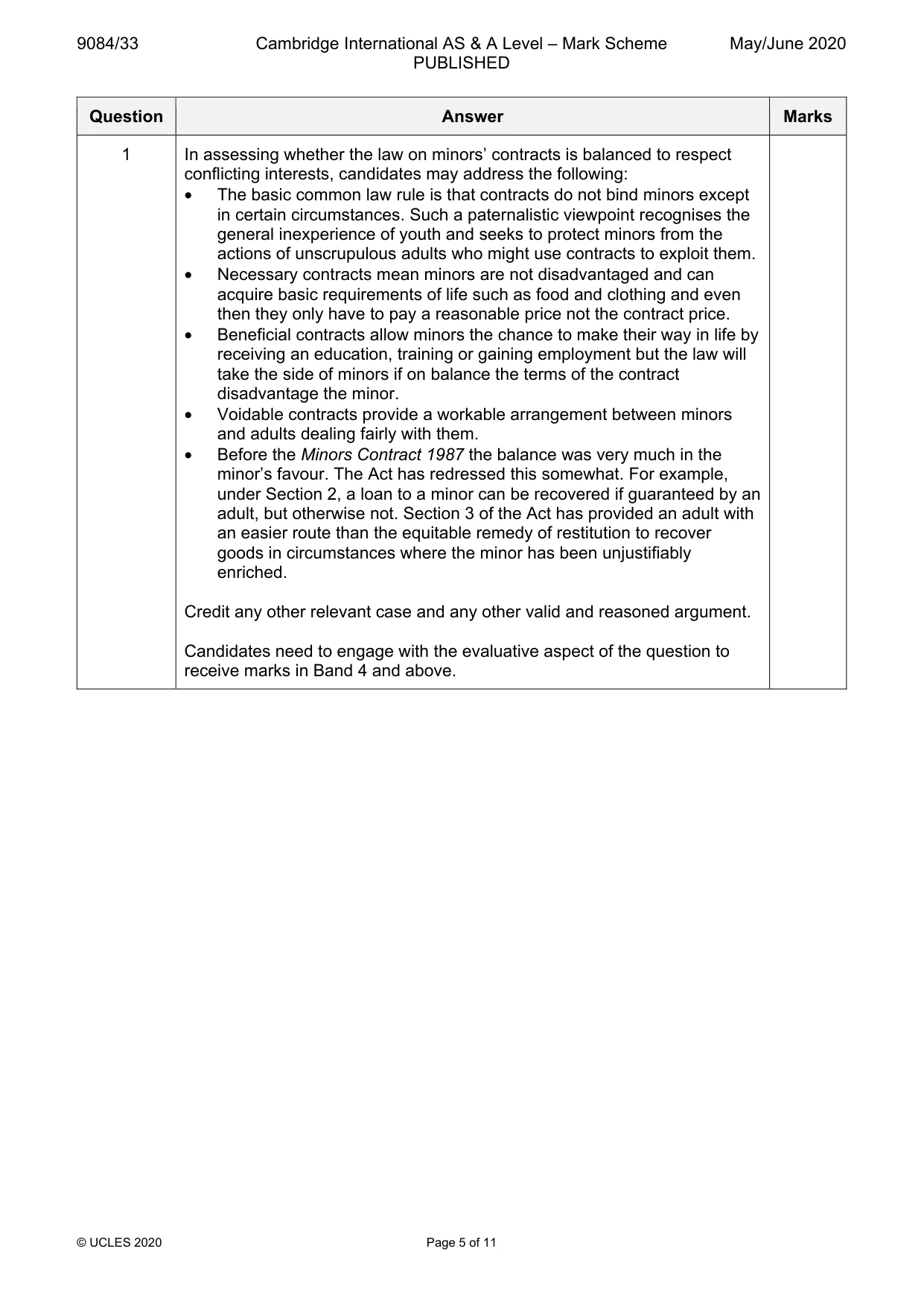
9084/33 Cambridge International AS & A Level – Mark Scheme PUBLISHED May/June 2020 © UCLES 2020 Page 5 of 11 Question Answer Marks 1 In assessing whether the law on minors’ contracts is balanced to respect conflicting interests, candidates may address the following: • The basic common law rule is that contracts do not bind minors except in certain circumstances. Such a paternalistic viewpoint recognises the general inexperience of youth and seeks to protect minors from the actions of unscrupulous adults who might use contracts to exploit them. • Necessary contracts mean minors are not disadvantaged and can acquire basic requirements of life such as food and clothing and even then they only have to pay a reasonable price not the contract price. • Beneficial contracts allow minors the chance to make their way in life by receiving an education, training or gaining employment but the law will take the side of minors if on balance the terms of the contract disadvantage the minor. • Voidable contracts provide a workable arrangement between minors and adults dealing fairly with them. • Before the Minors Contract 1987 the balance was very much in the minor’s favour. The Act has redressed this somewhat. For example, under Section 2, a loan to a minor can be recovered if guaranteed by an adult, but otherwise not. Section 3 of the Act has provided an adult with an easier route than the equitable remedy of restitution to recover goods in circumstances where the minor has been unjustifiably enriched. Credit any other relevant case and any other valid and reasoned argument. Candidates need to engage with the evaluative aspect of the question to receive marks in Band 4 and above.
Mark scheme, page 6
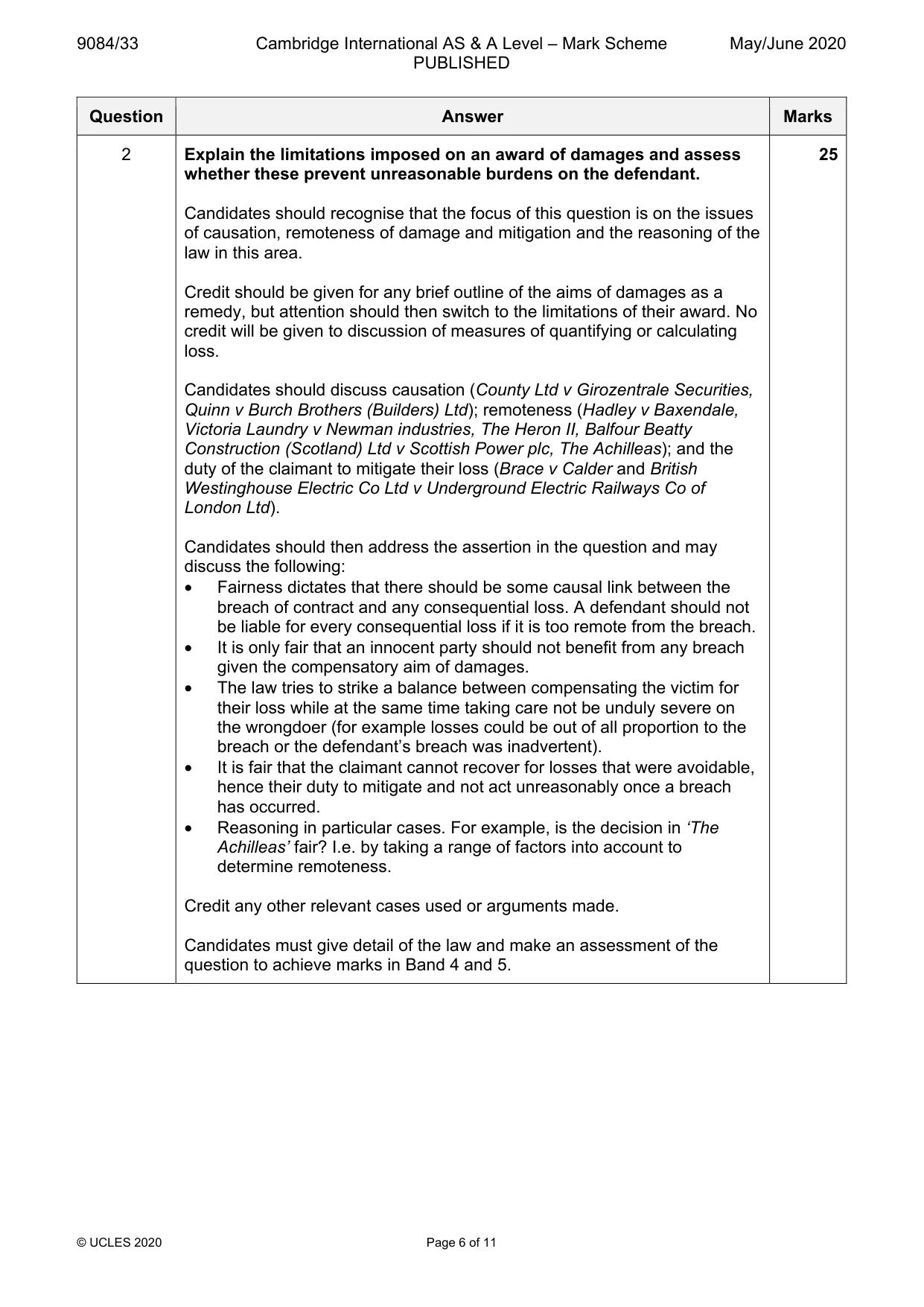
9084/33 Cambridge International AS & A Level – Mark Scheme PUBLISHED May/June 2020 © UCLES 2020 Page 6 of 11 Question Answer Marks 2 Explain the limitations imposed on an award of damages and assess whether these prevent unreasonable burdens on the defendant. Candidates should recognise that the focus of this question is on the issues of causation, remoteness of damage and mitigation and the reasoning of the law in this area. Credit should be given for any brief outline of the aims of damages as a remedy, but attention should then switch to the limitations of their award. No credit will be given to discussion of measures of quantifying or calculating loss. Candidates should discuss causation (County Ltd v Girozentrale Securities, Quinn v Burch Brothers (Builders) Ltd); remoteness (Hadley v Baxendale, Victoria Laundry v Newman industries, The Heron II, Balfour Beatty Construction (Scotland) Ltd v Scottish Power plc, The Achilleas); and the duty of the claimant to mitigate their loss (Brace v Calder and British Westinghouse Electric Co Ltd v Underground Electric Railways Co of London Ltd). Candidates should then address the assertion in the question and may discuss the following: • Fairness dictates that there should be some causal link between the breach of contract and any consequential loss. A defendant should not be liable for every consequential loss if it is too remote from the breach. • It is only fair that an innocent party should not benefit from any breach given the compensatory aim of damages. • The law tries to strike a balance between compensating the victim for their loss while at the same time taking care not be unduly severe on the wrongdoer (for example losses could be out of all proportion to the breach or the defendant’s breach was inadvertent). • It is fair that the claimant cannot recover for losses that were avoidable, hence their duty to mitigate and not act unreasonably once a breach has occurred. • Reasoning in particular cases. For example, is the decision in ‘The Achilleas’ fair? I.e. by taking a range of factors into account to determine remoteness. Credit any other relevant cases used or arguments made. Candidates must give detail of the law and make an assessment of the question to achieve marks in Band 4 and 5. 25
Mark scheme, page 7
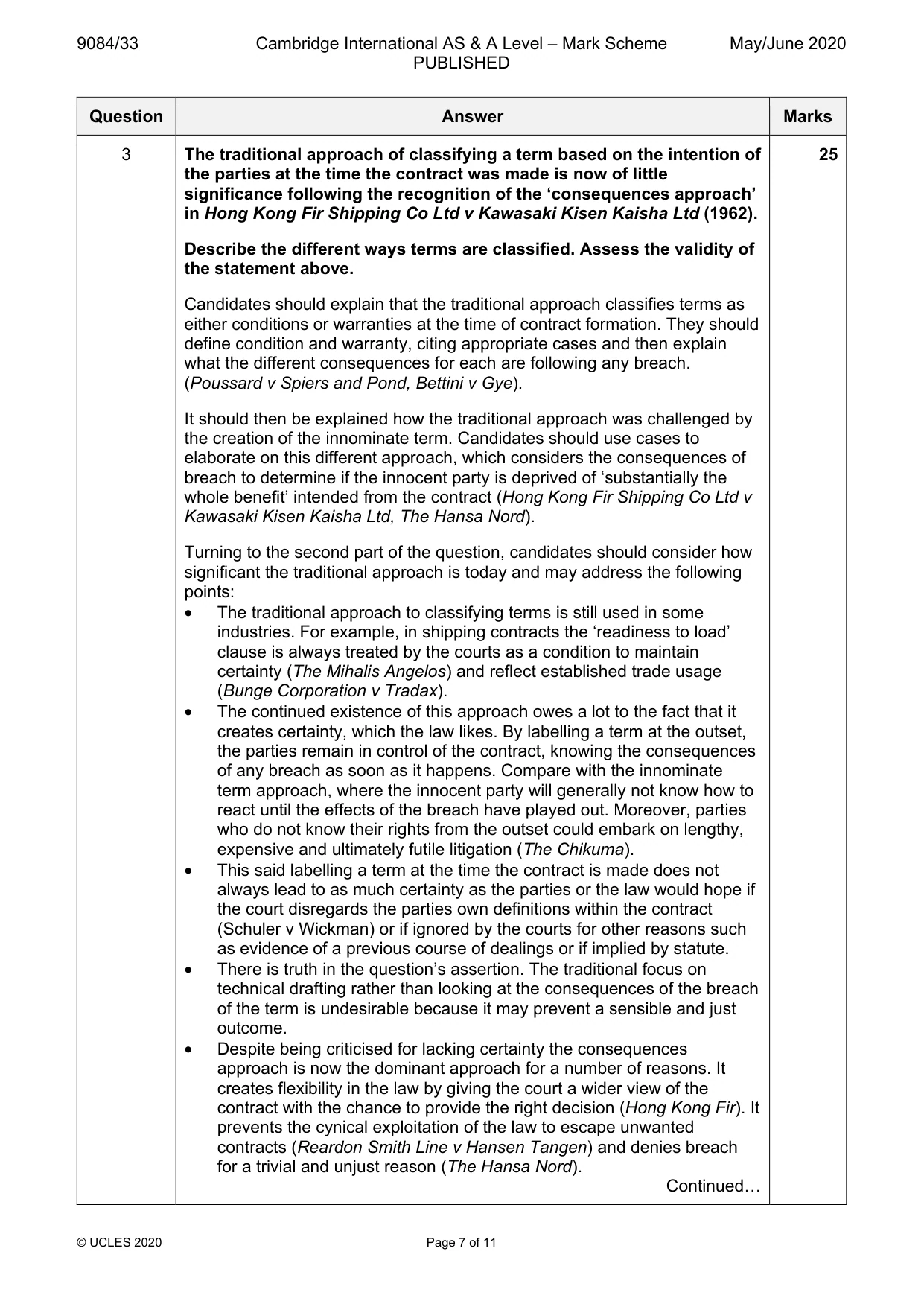
9084/33 Cambridge International AS & A Level – Mark Scheme PUBLISHED May/June 2020 © UCLES 2020 Page 7 of 11 Question Answer Marks 3 The traditional approach of classifying a term based on the intention of the parties at the time the contract was made is now of little significance following the recognition of the ‘consequences approach’ in Hong Kong Fir Shipping Co Ltd v Kawasaki Kisen Kaisha Ltd (1962). Describe the different ways terms are classified. Assess the validity of the statement above. Candidates should explain that the traditional approach classifies terms as either conditions or warranties at the time of contract formation. They should define condition and warranty, citing appropriate cases and then explain what the different consequences for each are following any breach. (Poussard v Spiers and Pond, Bettini v Gye). It should then be explained how the traditional approach was challenged by the creation of the innominate term. Candidates should use cases to elaborate on this different approach, which considers the consequences of breach to determine if the innocent party is deprived of ‘substantially the whole benefit’ intended from the contract (Hong Kong Fir Shipping Co Ltd v Kawasaki Kisen Kaisha Ltd, The Hansa Nord). Turning to the second part of the question, candidates should consider how significant the traditional approach is today and may address the following points: • The traditional approach to classifying terms is still used in some industries. For example, in shipping contracts the ‘readiness to load’ clause is always treated by the courts as a condition to maintain certainty (The Mihalis Angelos) and reflect established trade usage (Bunge Corporation v Tradax). • The continued existence of this approach owes a lot to the fact that it creates certainty, which the law likes. By labelling a term at the outset, the parties remain in control of the contract, knowing the consequences of any breach as soon as it happens. Compare with the innominate term approach, where the innocent party will generally not know how to react until the effects of the breach have played out. Moreover, parties who do not know their rights from the outset could embark on lengthy, expensive and ultimately futile litigation (The Chikuma). • This said labelling a term at the time the contract is made does not always lead to as much certainty as the parties or the law would hope if the court disregards the parties own definitions within the contract (Schuler v Wickman) or if ignored by the courts for other reasons such as evidence of a previous course of dealings or if implied by statute. • There is truth in the question’s assertion. The traditional focus on technical drafting rather than looking at the consequences of the breach of the term is undesirable because it may prevent a sensible and just outcome. • Despite being criticised for lacking certainty the consequences approach is now the dominant approach for a number of reasons. It creates flexibility in the law by giving the court a wider view of the contract with the chance to provide the right decision (Hong Kong Fir). It prevents the cynical exploitation of the law to escape unwanted contracts (Reardon Smith Line v Hansen Tangen) and denies breach for a trivial and unjust reason (The Hansa Nord). Continued… 25
Mark scheme, page 8
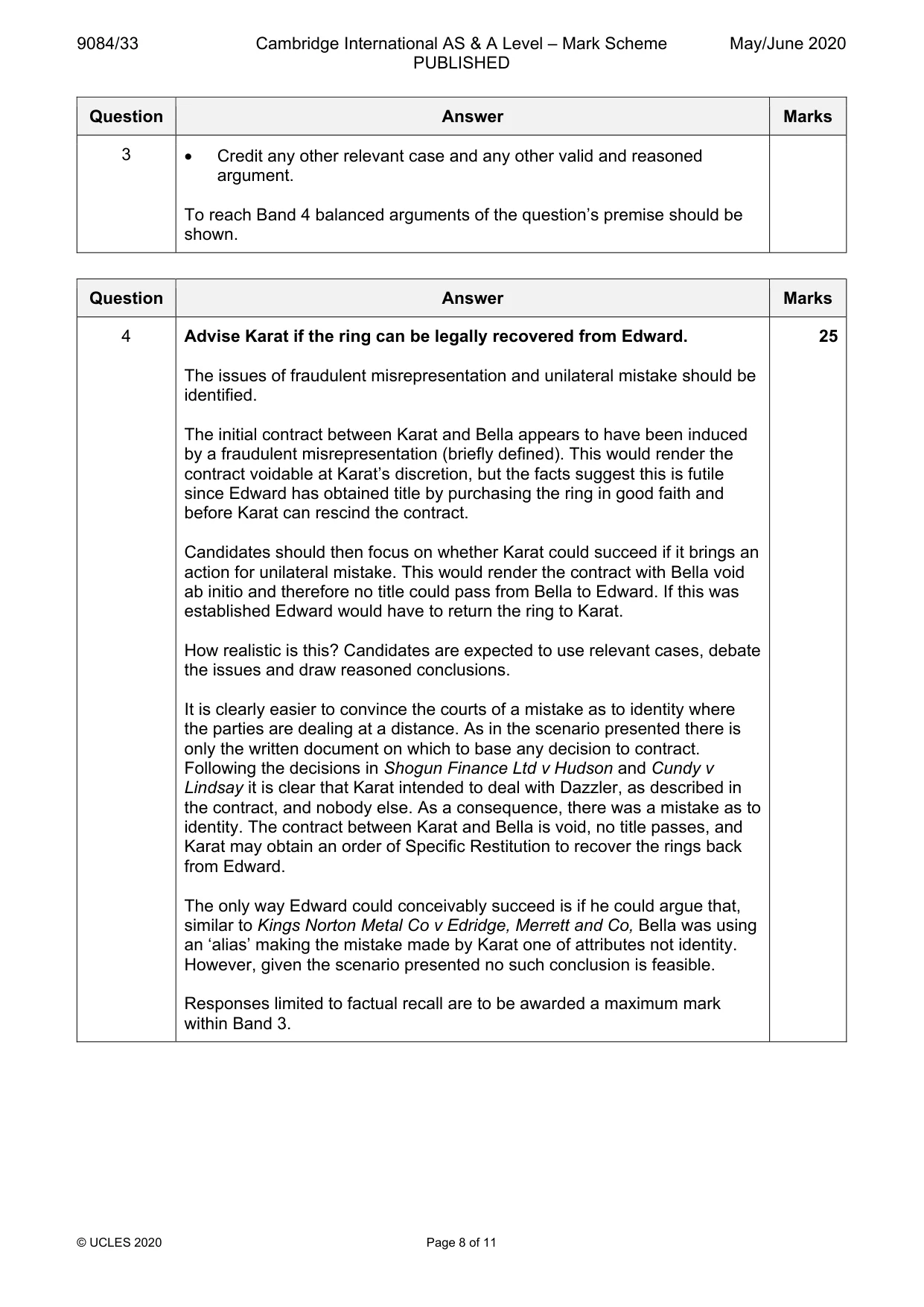
9084/33 Cambridge International AS & A Level – Mark Scheme PUBLISHED May/June 2020 © UCLES 2020 Page 8 of 11 Question Answer Marks 3 • Credit any other relevant case and any other valid and reasoned argument. To reach Band 4 balanced arguments of the question’s premise should be shown. Question Answer Marks 4 Advise Karat if the ring can be legally recovered from Edward. The issues of fraudulent misrepresentation and unilateral mistake should be identified. The initial contract between Karat and Bella appears to have been induced by a fraudulent misrepresentation (briefly defined). This would render the contract voidable at Karat’s discretion, but the facts suggest this is futile since Edward has obtained title by purchasing the ring in good faith and before Karat can rescind the contract. Candidates should then focus on whether Karat could succeed if it brings an action for unilateral mistake. This would render the contract with Bella void ab initio and therefore no title could pass from Bella to Edward. If this was established Edward would have to return the ring to Karat. How realistic is this? Candidates are expected to use relevant cases, debate the issues and draw reasoned conclusions. It is clearly easier to convince the courts of a mistake as to identity where the parties are dealing at a distance. As in the scenario presented there is only the written document on which to base any decision to contract. Following the decisions in Shogun Finance Ltd v Hudson and Cundy v Lindsay it is clear that Karat intended to deal with Dazzler, as described in the contract, and nobody else. As a consequence, there was a mistake as to identity. The contract between Karat and Bella is void, no title passes, and Karat may obtain an order of Specific Restitution to recover the rings back from Edward. The only way Edward could conceivably succeed is if he could argue that, similar to Kings Norton Metal Co v Edridge, Merrett and Co, Bella was using an ‘alias’ making the mistake made by Karat one of attributes not identity. However, given the scenario presented no such conclusion is feasible. Responses limited to factual recall are to be awarded a maximum mark within Band 3. 25
Mark scheme, page 9
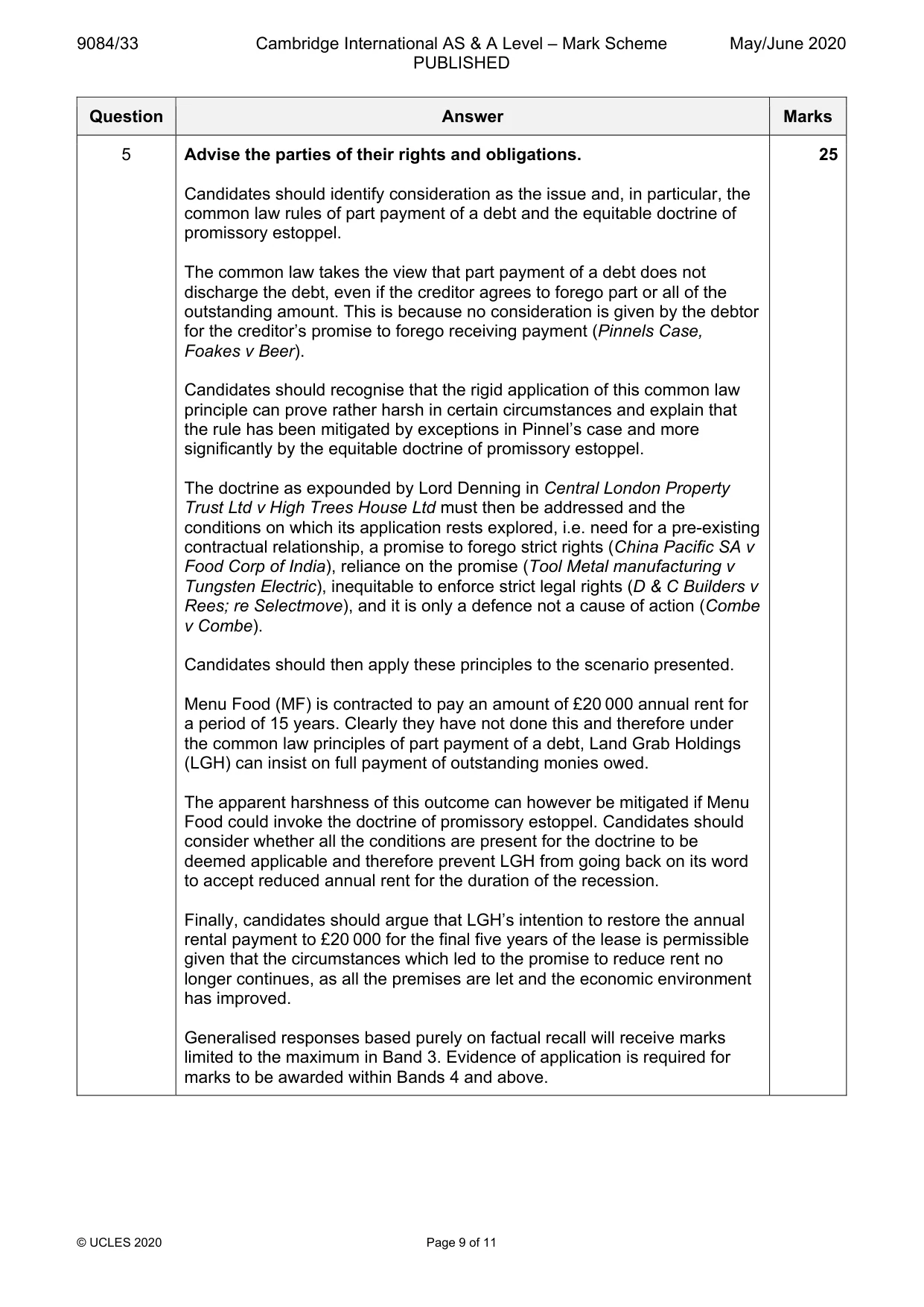
9084/33 Cambridge International AS & A Level – Mark Scheme PUBLISHED May/June 2020 © UCLES 2020 Page 9 of 11 Question Answer Marks 5 Advise the parties of their rights and obligations. Candidates should identify consideration as the issue and, in particular, the common law rules of part payment of a debt and the equitable doctrine of promissory estoppel. The common law takes the view that part payment of a debt does not discharge the debt, even if the creditor agrees to forego part or all of the outstanding amount. This is because no consideration is given by the debtor for the creditor’s promise to forego receiving payment (Pinnels Case, Foakes v Beer). Candidates should recognise that the rigid application of this common law principle can prove rather harsh in certain circumstances and explain that the rule has been mitigated by exceptions in Pinnel’s case and more significantly by the equitable doctrine of promissory estoppel. The doctrine as expounded by Lord Denning in Central London Property Trust Ltd v High Trees House Ltd must then be addressed and the conditions on which its application rests explored, i.e. need for a pre-existing contractual relationship, a promise to forego strict rights (China Pacific SA v Food Corp of India), reliance on the promise (Tool Metal manufacturing v Tungsten Electric), inequitable to enforce strict legal rights (D & C Builders v Rees; re Selectmove), and it is only a defence not a cause of action (Combe v Combe). Candidates should then apply these principles to the scenario presented. Menu Food (MF) is contracted to pay an amount of £20 000 annual rent for a period of 15 years. Clearly they have not done this and therefore under the common law principles of part payment of a debt, Land Grab Holdings (LGH) can insist on full payment of outstanding monies owed. The apparent harshness of this outcome can however be mitigated if Menu Food could invoke the doctrine of promissory estoppel. Candidates should consider whether all the conditions are present for the doctrine to be deemed applicable and therefore prevent LGH from going back on its word to accept reduced annual rent for the duration of the recession. Finally, candidates should argue that LGH’s intention to restore the annual rental payment to £20 000 for the final five years of the lease is permissible given that the circumstances which led to the promise to reduce rent no longer continues, as all the premises are let and the economic environment has improved. Generalised responses based purely on factual recall will receive marks limited to the maximum in Band 3. Evidence of application is required for marks to be awarded within Bands 4 and above. 25
Mark scheme, page 10
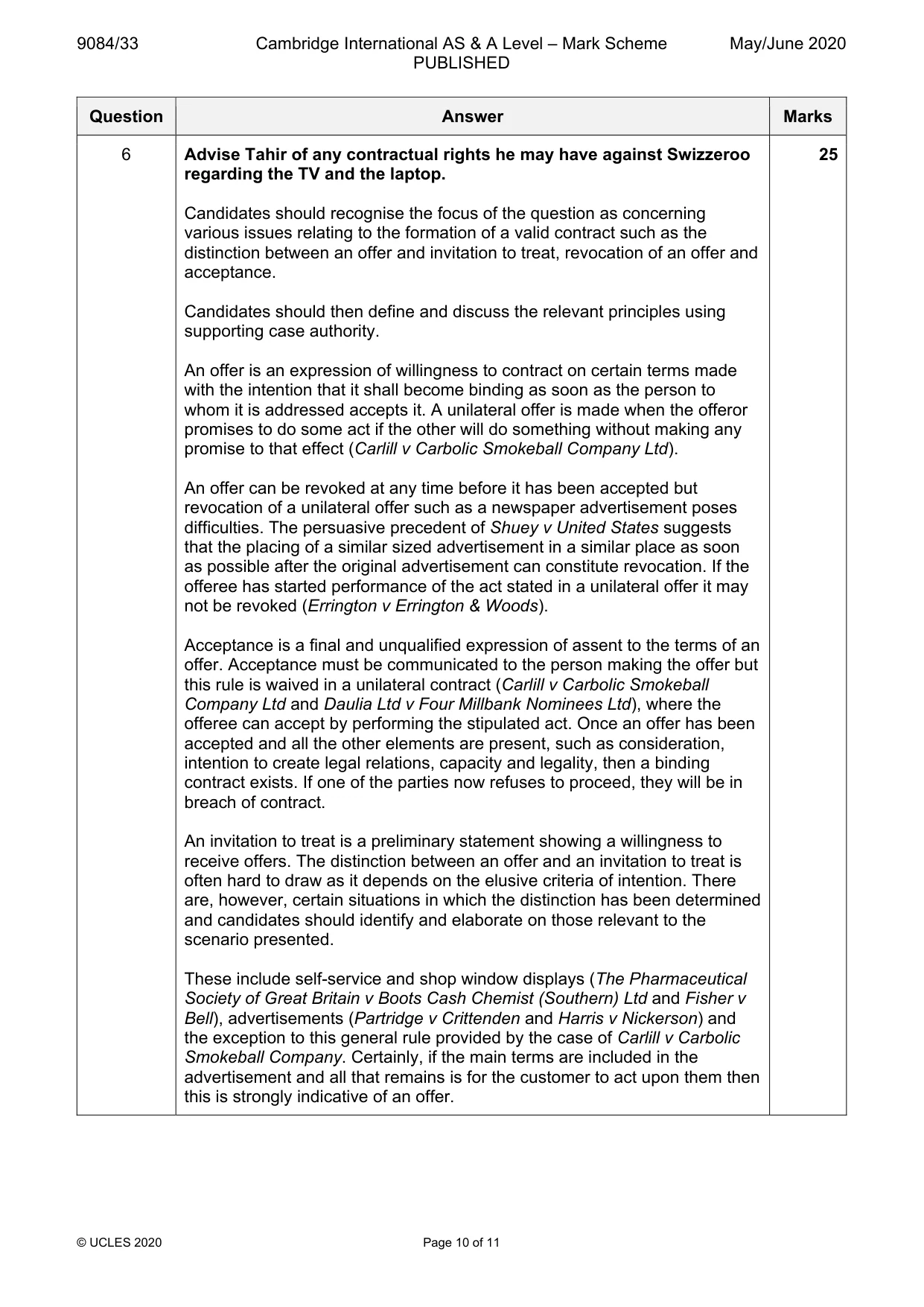
9084/33 Cambridge International AS & A Level – Mark Scheme PUBLISHED May/June 2020 © UCLES 2020 Page 10 of 11 Question Answer Marks 6 Advise Tahir of any contractual rights he may have against Swizzeroo regarding the TV and the laptop. Candidates should recognise the focus of the question as concerning various issues relating to the formation of a valid contract such as the distinction between an offer and invitation to treat, revocation of an offer and acceptance. Candidates should then define and discuss the relevant principles using supporting case authority. An offer is an expression of willingness to contract on certain terms made with the intention that it shall become binding as soon as the person to whom it is addressed accepts it. A unilateral offer is made when the offeror promises to do some act if the other will do something without making any promise to that effect (Carlill v Carbolic Smokeball Company Ltd). An offer can be revoked at any time before it has been accepted but revocation of a unilateral offer such as a newspaper advertisement poses difficulties. The persuasive precedent of Shuey v United States suggests that the placing of a similar sized advertisement in a similar place as soon as possible after the original advertisement can constitute revocation. If the offeree has started performance of the act stated in a unilateral offer it may not be revoked (Errington v Errington & Woods). Acceptance is a final and unqualified expression of assent to the terms of an offer. Acceptance must be communicated to the person making the offer but this rule is waived in a unilateral contract (Carlill v Carbolic Smokeball Company Ltd and Daulia Ltd v Four Millbank Nominees Ltd), where the offeree can accept by performing the stipulated act. Once an offer has been accepted and all the other elements are present, such as consideration, intention to create legal relations, capacity and legality, then a binding contract exists. If one of the parties now refuses to proceed, they will be in breach of contract. An invitation to treat is a preliminary statement showing a willingness to receive offers. The distinction between an offer and an invitation to treat is often hard to draw as it depends on the elusive criteria of intention. There are, however, certain situations in which the distinction has been determined and candidates should identify and elaborate on those relevant to the scenario presented. These include self-service and shop window displays (The Pharmaceutical Society of Great Britain v Boots Cash Chemist (Southern) Ltd and Fisher v Bell), advertisements (Partridge v Crittenden and Harris v Nickerson) and the exception to this general rule provided by the case of Carlill v Carbolic Smokeball Company. Certainly, if the main terms are included in the advertisement and all that remains is for the customer to act upon them then this is strongly indicative of an offer. 25
Mark scheme, page 11
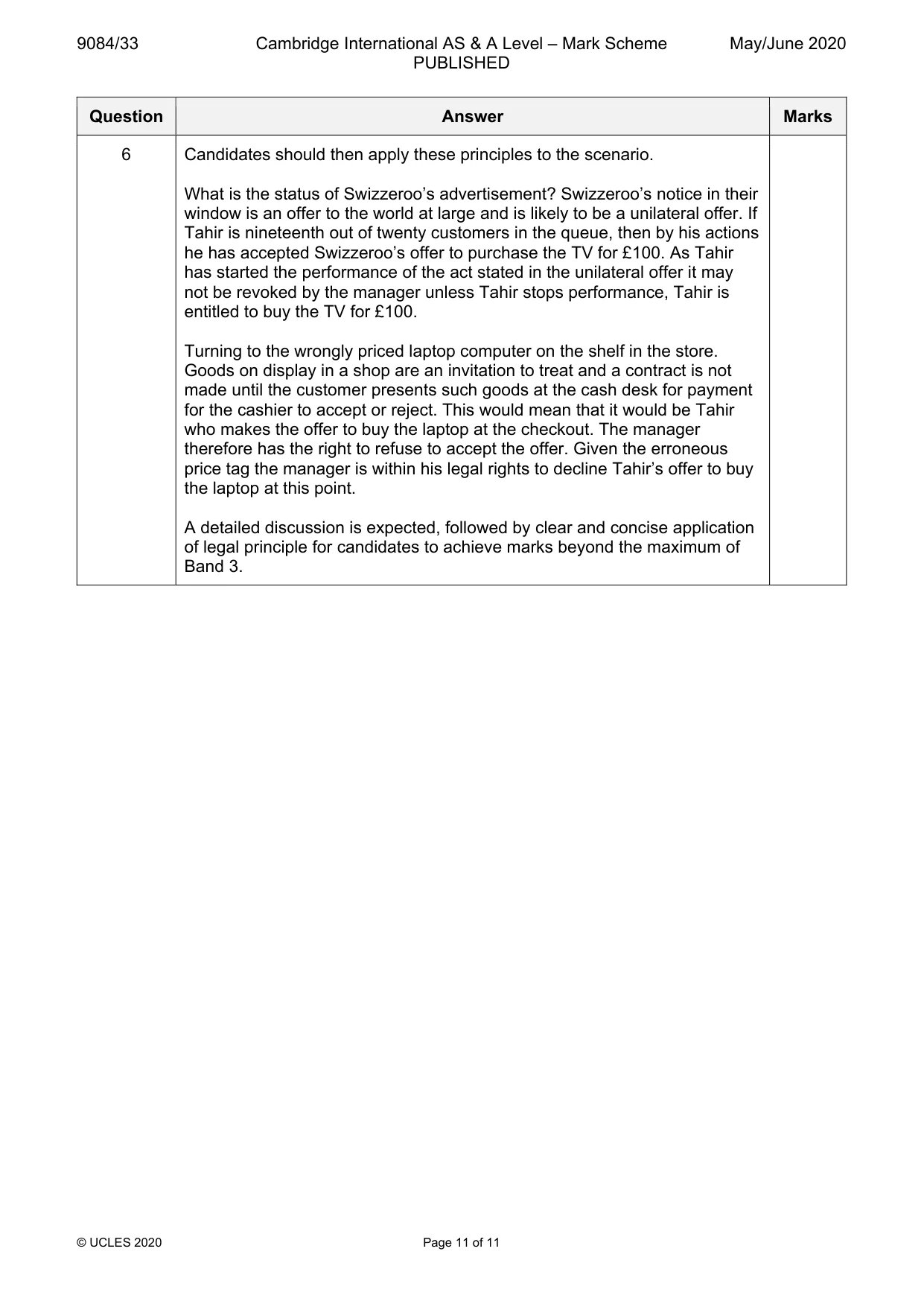
9084/33 Cambridge International AS & A Level – Mark Scheme PUBLISHED May/June 2020 © UCLES 2020 Page 11 of 11 Question Answer Marks 6 Candidates should then apply these principles to the scenario. What is the status of Swizzeroo’s advertisement? Swizzeroo’s notice in their window is an offer to the world at large and is likely to be a unilateral offer. If Tahir is nineteenth out of twenty customers in the queue, then by his actions he has accepted Swizzeroo’s offer to purchase the TV for £100. As Tahir has started the performance of the act stated in the unilateral offer it may not be revoked by the manager unless Tahir stops performance, Tahir is entitled to buy the TV for £100. Turning to the wrongly priced laptop computer on the shelf in the store. Goods on display in a shop are an invitation to treat and a contract is not made until the customer presents such goods at the cash desk for payment for the cashier to accept or reject. This would mean that it would be Tahir who makes the offer to buy the laptop at the checkout. The manager therefore has the right to refuse to accept the offer. Given the erroneous price tag the manager is within his legal rights to decline Tahir’s offer to buy the laptop at this point. A detailed discussion is expected, followed by clear and concise application of legal principle for candidates to achieve marks beyond the maximum of Band 3.