Cambridge A Level Law 9084 — 2020 May/June Paper 3 · Variant 2
9084/32/M/J/20
The question paper and its mark scheme, free to read here and free to download. This is Cambridge’s own paper, exactly as it was sat.
Question paper4 pages

Mark scheme11 pages
Answers below. Sit the paper first if you are practising.
Paper as text
Question paper, page 1
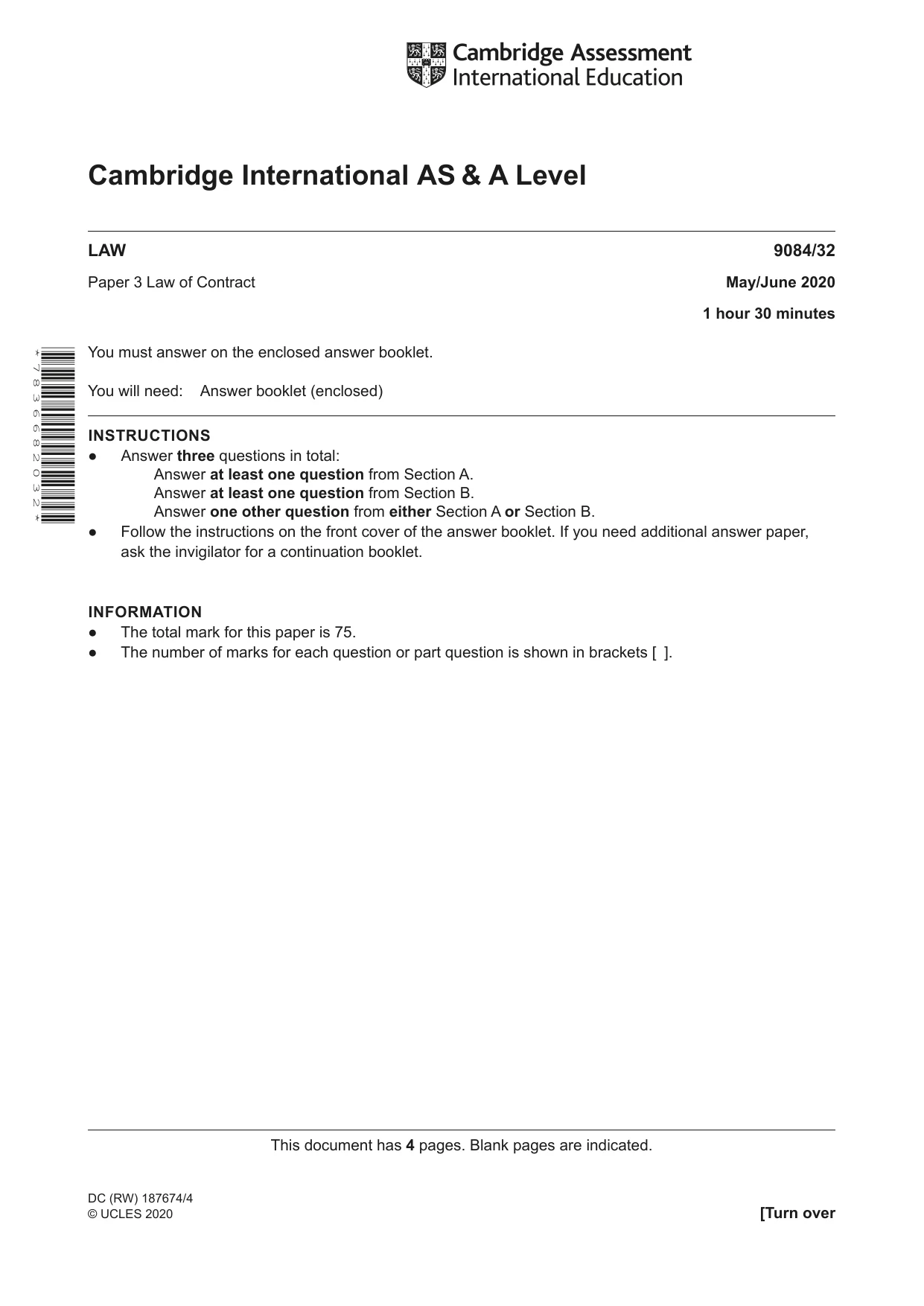
This document has 4 pages. Blank pages are indicated. DC (RW) 187674/4 © UCLES 2020 [Turn over * 7 8 3 6 6 8 2 0 3 2 * Cambridge International AS & A Level LAW 9084/32 Paper 3 Law of Contract May/June 2020 1 hour 30 minutes You must answer on the enclosed answer booklet. You will need: Answer booklet (enclosed) INSTRUCTIONS ● Answer three questions in total: Answer at least one question from Section A. Answer at least one question from Section B. Answer one other question from either Section A or Section B. ● Follow the instructions on the front cover of the answer booklet. If you need additional answer paper, ask the invigilator for a continuation booklet. INFORMATION ● The total mark for this paper is 75. ● The number of marks for each question or part question is shown in brackets [ ].
Question paper, page 2
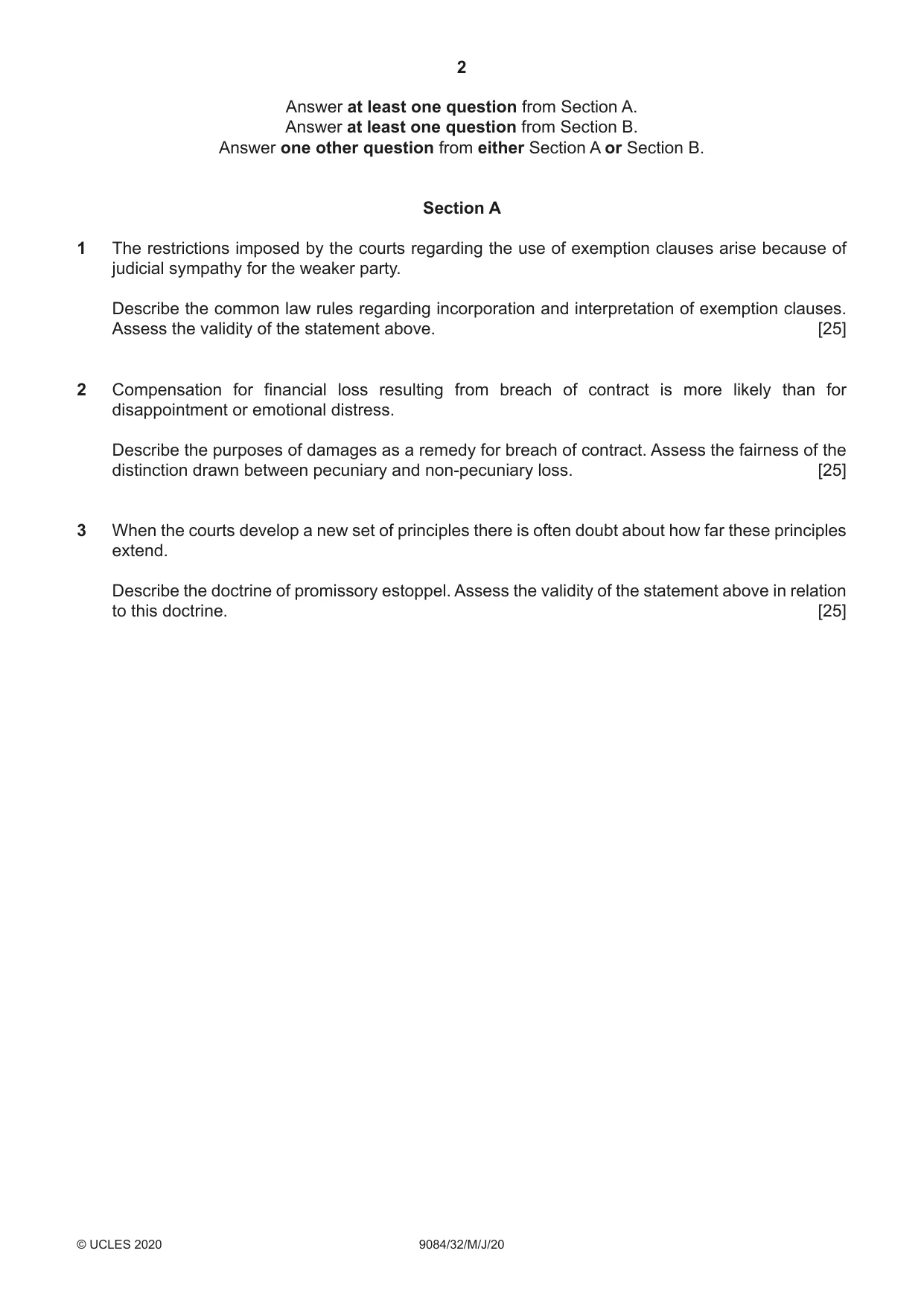
2 9084/32/M/J/20 © UCLES 2020 Answer at least one question from Section A. Answer at least one question from Section B. Answer one other question from either Section A or Section B. Section A 1 The restrictions imposed by the courts regarding the use of exemption clauses arise because of judicial sympathy for the weaker party. Describe the common law rules regarding incorporation and interpretation of exemption clauses. Assess the validity of the statement above. [25] 2 Compensation for financial loss resulting from breach of contract is more likely than for disappointment or emotional distress. Describe the purposes of damages as a remedy for breach of contract. Assess the fairness of the distinction drawn between pecuniary and non-pecuniary loss. [25] 3 When the courts develop a new set of principles there is often doubt about how far these principles extend. Describe the doctrine of promissory estoppel. Assess the validity of the statement above in relation to this doctrine. [25]
Question paper, page 3
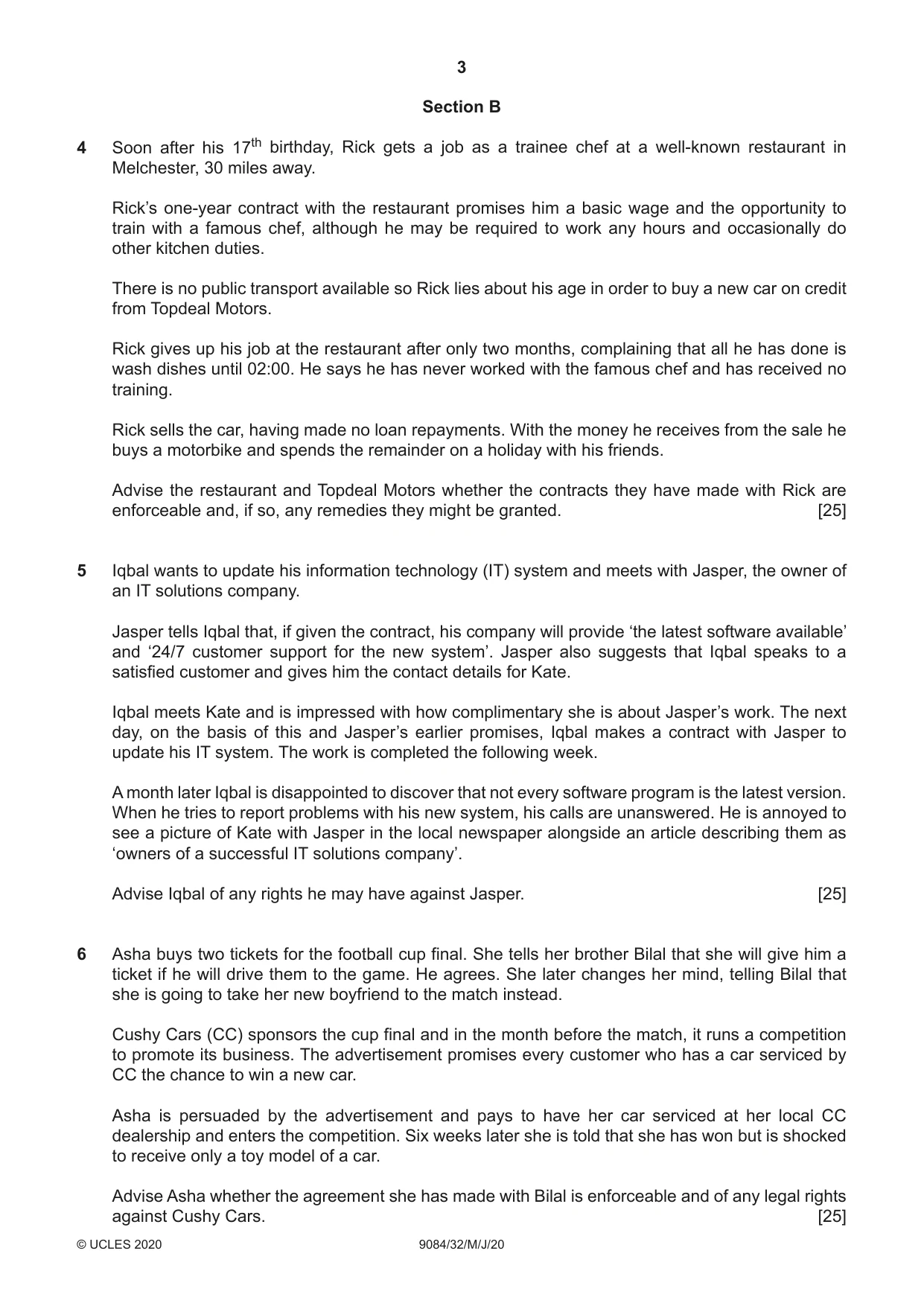
3 9084/32/M/J/20 © UCLES 2020 Section B 4 Soon after his 17th birthday, Rick gets a job as a trainee chef at a well-known restaurant in Melchester, 30 miles away. Rick’s one-year contract with the restaurant promises him a basic wage and the opportunity to train with a famous chef, although he may be required to work any hours and occasionally do other kitchen duties. There is no public transport available so Rick lies about his age in order to buy a new car on credit from Topdeal Motors. Rick gives up his job at the restaurant after only two months, complaining that all he has done is wash dishes until 02:00. He says he has never worked with the famous chef and has received no training. Rick sells the car, having made no loan repayments. With the money he receives from the sale he buys a motorbike and spends the remainder on a holiday with his friends. Advise the restaurant and Topdeal Motors whether the contracts they have made with Rick are enforceable and, if so, any remedies they might be granted. [25] 5 Iqbal wants to update his information technology (IT) system and meets with Jasper, the owner of an IT solutions company. Jasper tells Iqbal that, if given the contract, his company will provide ‘the latest software available’ and ‘24/7 customer support for the new system’. Jasper also suggests that Iqbal speaks to a satisfied customer and gives him the contact details for Kate. Iqbal meets Kate and is impressed with how complimentary she is about Jasper’s work. The next day, on the basis of this and Jasper’s earlier promises, Iqbal makes a contract with Jasper to update his IT system. The work is completed the following week. A month later Iqbal is disappointed to discover that not every software program is the latest version. When he tries to report problems with his new system, his calls are unanswered. He is annoyed to see a picture of Kate with Jasper in the local newspaper alongside an article describing them as ‘owners of a successful IT solutions company’. Advise Iqbal of any rights he may have against Jasper. [25] 6 Asha buys two tickets for the football cup final. She tells her brother Bilal that she will give him a ticket if he will drive them to the game. He agrees. She later changes her mind, telling Bilal that she is going to take her new boyfriend to the match instead. Cushy Cars (CC) sponsors the cup final and in the month before the match, it runs a competition to promote its business. The advertisement promises every customer who has a car serviced by CC the chance to win a new car. Asha is persuaded by the advertisement and pays to have her car serviced at her local CC dealership and enters the competition. Six weeks later she is told that she has won but is shocked to receive only a toy model of a car. Advise Asha whether the agreement she has made with Bilal is enforceable and of any legal rights against Cushy Cars. [25]
Question paper, page 4
4 9084/32/M/J/20 © UCLES 2020 Permission to reproduce items where third-party owned material protected by copyright is included has been sought and cleared where possible. Every reasonable effort has been made by the publisher (UCLES) to trace copyright holders, but if any items requiring clearance have unwittingly been included, the publisher will be pleased to make amends at the earliest possible opportunity. To avoid the issue of disclosure of answer-related information to candidates, all copyright acknowledgements are reproduced online in the Cambridge Assessment International Education Copyright Acknowledgements Booklet. This is produced for each series of examinations and is freely available to download at www.cambridgeinternational.org after the live examination series. Cambridge Assessment International Education is part of the Cambridge Assessment Group. Cambridge Assessment is the brand name of the University of Cambridge Local Examinations Syndicate (UCLES), which itself is a department of the University of Cambridge. BLANK PAGE
Mark scheme, page 1
This document consists of 11 printed pages. © UCLES 2020 [Turn over Cambridge International AS & A Level LAW 9084/32 Paper 3 May/June 2020 MARK SCHEME Maximum Mark: 75 Published Students did not sit exam papers in the June 2020 series due to the Covid-19 global pandemic. This mark scheme is published to support teachers and students and should be read together with the question paper. It shows the requirements of the exam. The answer column of the mark scheme shows the proposed basis on which Examiners would award marks for this exam. Where appropriate, this column also provides the most likely acceptable alternative responses expected from students. Examiners usually review the mark scheme after they have seen student responses and update the mark scheme if appropriate. In the June series, Examiners were unable to consider the acceptability of alternative responses, as there were no student responses to consider. Mark schemes should usually be read together with the Principal Examiner Report for Teachers. However, because students did not sit exam papers, there is no Principal Examiner Report for Teachers for the June 2020 series. Cambridge International will not enter into discussions about these mark schemes. Cambridge International is publishing the mark schemes for the June 2020 series for most Cambridge IGCSE™ and Cambridge International A & AS Level components, and some Cambridge O Level components.
Mark scheme, page 2
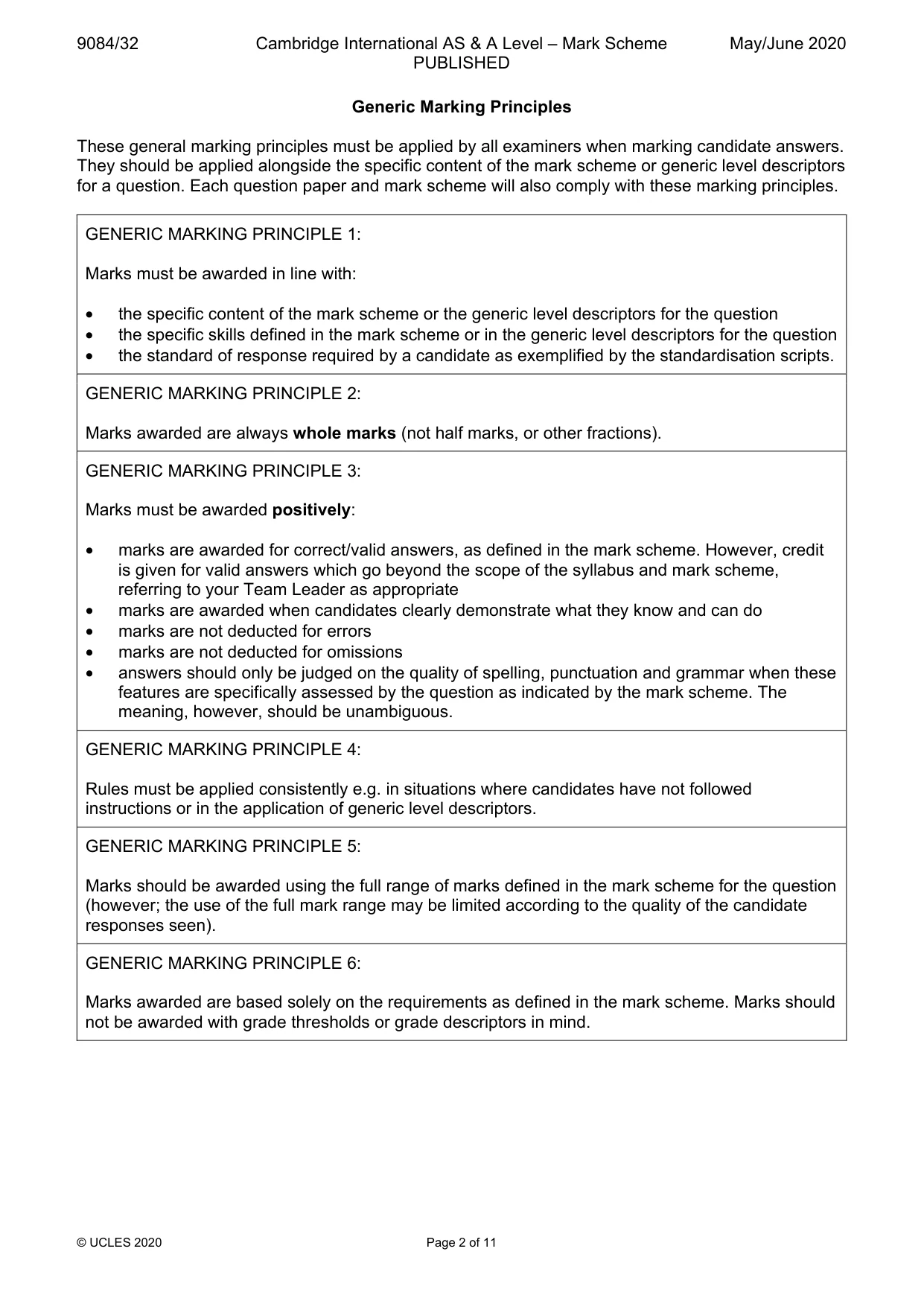
9084/32 Cambridge International AS & A Level – Mark Scheme PUBLISHED May/June 2020 © UCLES 2020 Page 2 of 11 Generic Marking Principles These general marking principles must be applied by all examiners when marking candidate answers. They should be applied alongside the specific content of the mark scheme or generic level descriptors for a question. Each question paper and mark scheme will also comply with these marking principles. GENERIC MARKING PRINCIPLE 1: Marks must be awarded in line with: • the specific content of the mark scheme or the generic level descriptors for the question • the specific skills defined in the mark scheme or in the generic level descriptors for the question • the standard of response required by a candidate as exemplified by the standardisation scripts. GENERIC MARKING PRINCIPLE 2: Marks awarded are always whole marks (not half marks, or other fractions). GENERIC MARKING PRINCIPLE 3: Marks must be awarded positively: • marks are awarded for correct/valid answers, as defined in the mark scheme. However, credit is given for valid answers which go beyond the scope of the syllabus and mark scheme, referring to your Team Leader as appropriate • marks are awarded when candidates clearly demonstrate what they know and can do • marks are not deducted for errors • marks are not deducted for omissions • answers should only be judged on the quality of spelling, punctuation and grammar when these features are specifically assessed by the question as indicated by the mark scheme. The meaning, however, should be unambiguous. GENERIC MARKING PRINCIPLE 4: Rules must be applied consistently e.g. in situations where candidates have not followed instructions or in the application of generic level descriptors. GENERIC MARKING PRINCIPLE 5: Marks should be awarded using the full range of marks defined in the mark scheme for the question (however; the use of the full mark range may be limited according to the quality of the candidate responses seen). GENERIC MARKING PRINCIPLE 6: Marks awarded are based solely on the requirements as defined in the mark scheme. Marks should not be awarded with grade thresholds or grade descriptors in mind.
Mark scheme, page 3
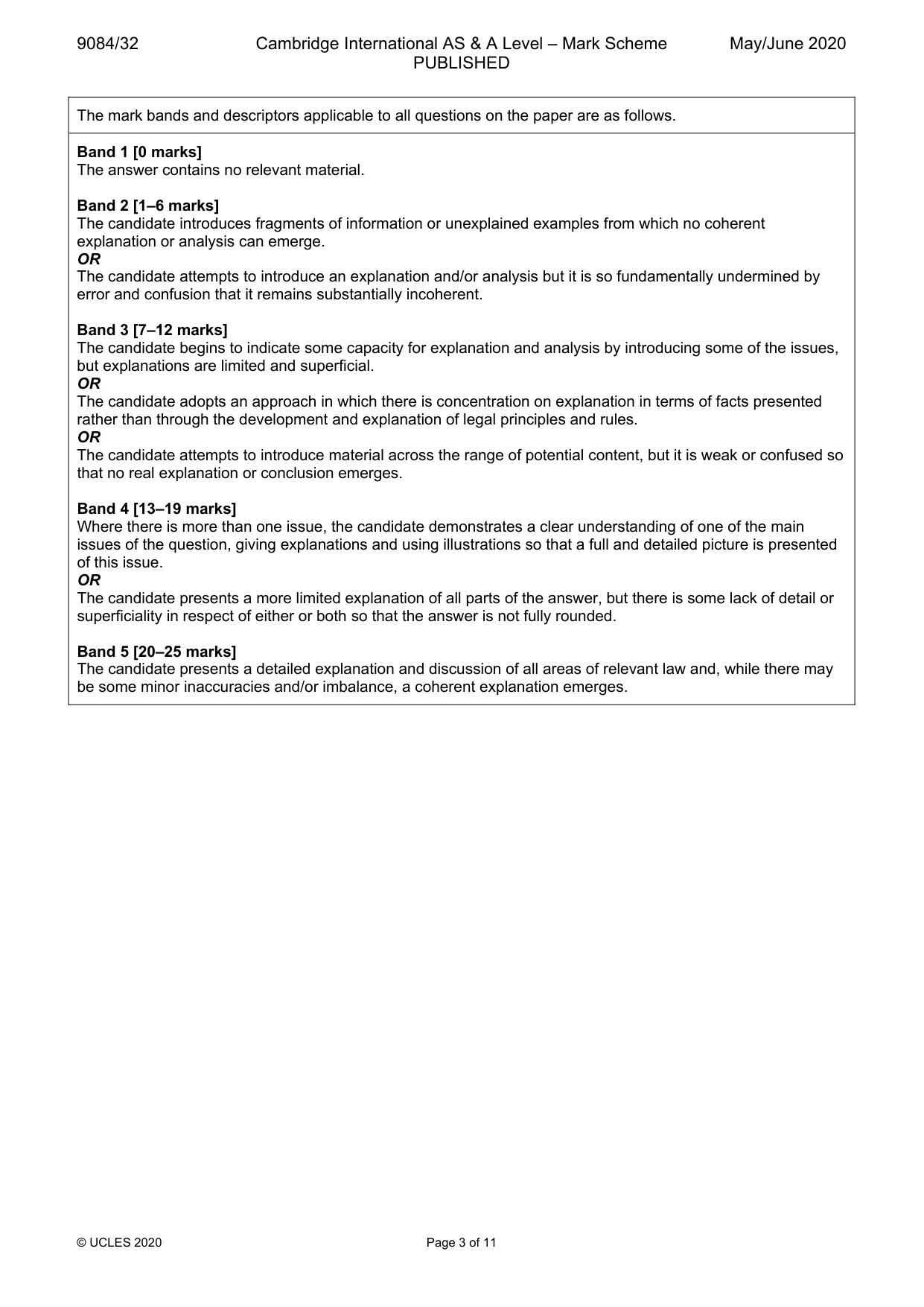
9084/32 Cambridge International AS & A Level – Mark Scheme PUBLISHED May/June 2020 © UCLES 2020 Page 3 of 11 The mark bands and descriptors applicable to all questions on the paper are as follows. Band 1 [0 marks] The answer contains no relevant material. Band 2 [1–6 marks] The candidate introduces fragments of information or unexplained examples from which no coherent explanation or analysis can emerge. OR The candidate attempts to introduce an explanation and/or analysis but it is so fundamentally undermined by error and confusion that it remains substantially incoherent. Band 3 [7–12 marks] The candidate begins to indicate some capacity for explanation and analysis by introducing some of the issues, but explanations are limited and superficial. OR The candidate adopts an approach in which there is concentration on explanation in terms of facts presented rather than through the development and explanation of legal principles and rules. OR The candidate attempts to introduce material across the range of potential content, but it is weak or confused so that no real explanation or conclusion emerges. Band 4 [13–19 marks] Where there is more than one issue, the candidate demonstrates a clear understanding of one of the main issues of the question, giving explanations and using illustrations so that a full and detailed picture is presented of this issue. OR The candidate presents a more limited explanation of all parts of the answer, but there is some lack of detail or superficiality in respect of either or both so that the answer is not fully rounded. Band 5 [20–25 marks] The candidate presents a detailed explanation and discussion of all areas of relevant law and, while there may be some minor inaccuracies and/or imbalance, a coherent explanation emerges.
Mark scheme, page 4
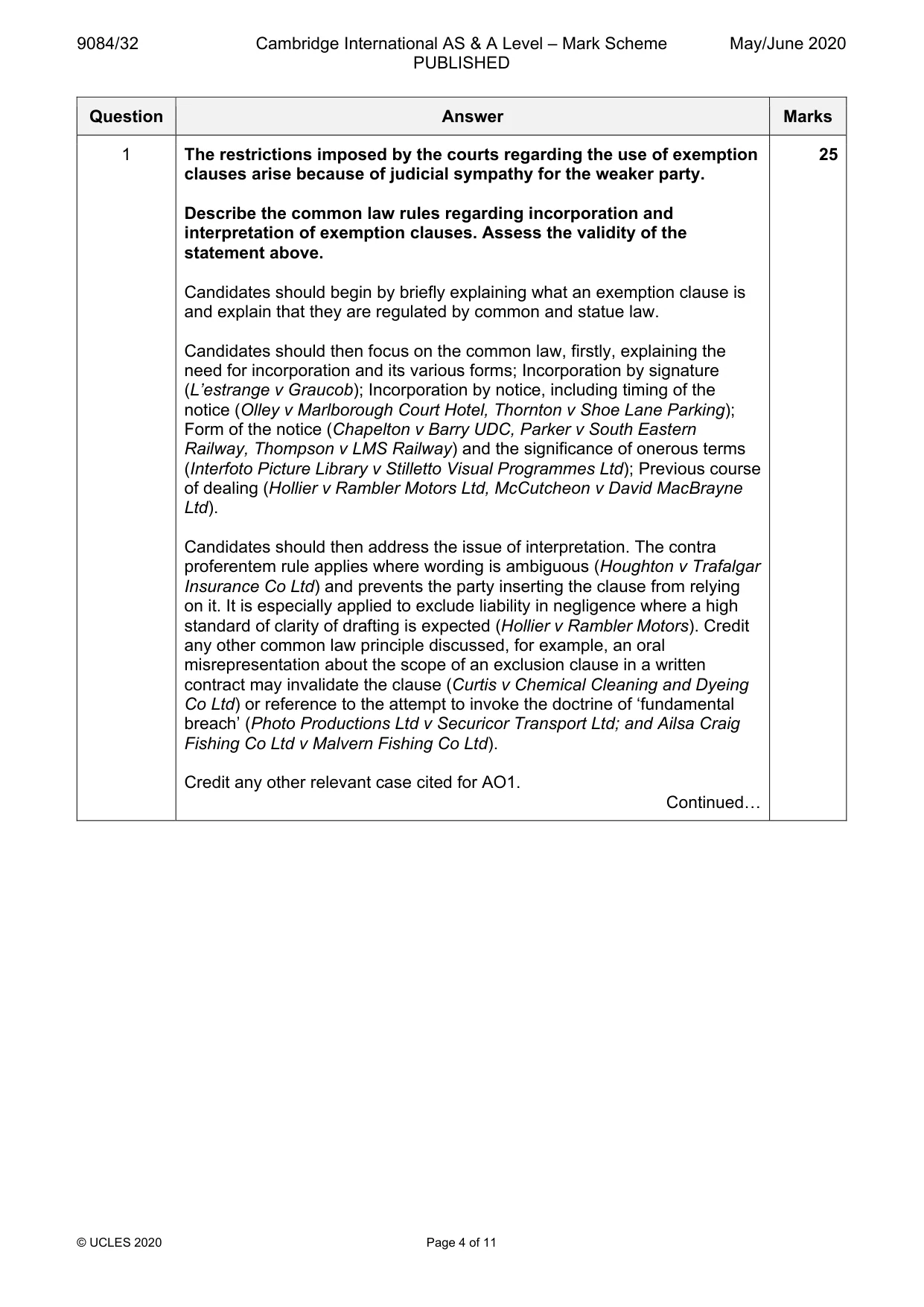
9084/32 Cambridge International AS & A Level – Mark Scheme PUBLISHED May/June 2020 © UCLES 2020 Page 4 of 11 Question Answer Marks 1 The restrictions imposed by the courts regarding the use of exemption clauses arise because of judicial sympathy for the weaker party. Describe the common law rules regarding incorporation and interpretation of exemption clauses. Assess the validity of the statement above. Candidates should begin by briefly explaining what an exemption clause is and explain that they are regulated by common and statue law. Candidates should then focus on the common law, firstly, explaining the need for incorporation and its various forms; Incorporation by signature (L’estrange v Graucob); Incorporation by notice, including timing of the notice (Olley v Marlborough Court Hotel, Thornton v Shoe Lane Parking); Form of the notice (Chapelton v Barry UDC, Parker v South Eastern Railway, Thompson v LMS Railway) and the significance of onerous terms (Interfoto Picture Library v Stilletto Visual Programmes Ltd); Previous course of dealing (Hollier v Rambler Motors Ltd, McCutcheon v David MacBrayne Ltd). Candidates should then address the issue of interpretation. The contra proferentem rule applies where wording is ambiguous (Houghton v Trafalgar Insurance Co Ltd) and prevents the party inserting the clause from relying on it. It is especially applied to exclude liability in negligence where a high standard of clarity of drafting is expected (Hollier v Rambler Motors). Credit any other common law principle discussed, for example, an oral misrepresentation about the scope of an exclusion clause in a written contract may invalidate the clause (Curtis v Chemical Cleaning and Dyeing Co Ltd) or reference to the attempt to invoke the doctrine of ‘fundamental breach’ (Photo Productions Ltd v Securicor Transport Ltd; and Ailsa Craig Fishing Co Ltd v Malvern Fishing Co Ltd). Credit any other relevant case cited for AO1. Continued… 25
Mark scheme, page 5
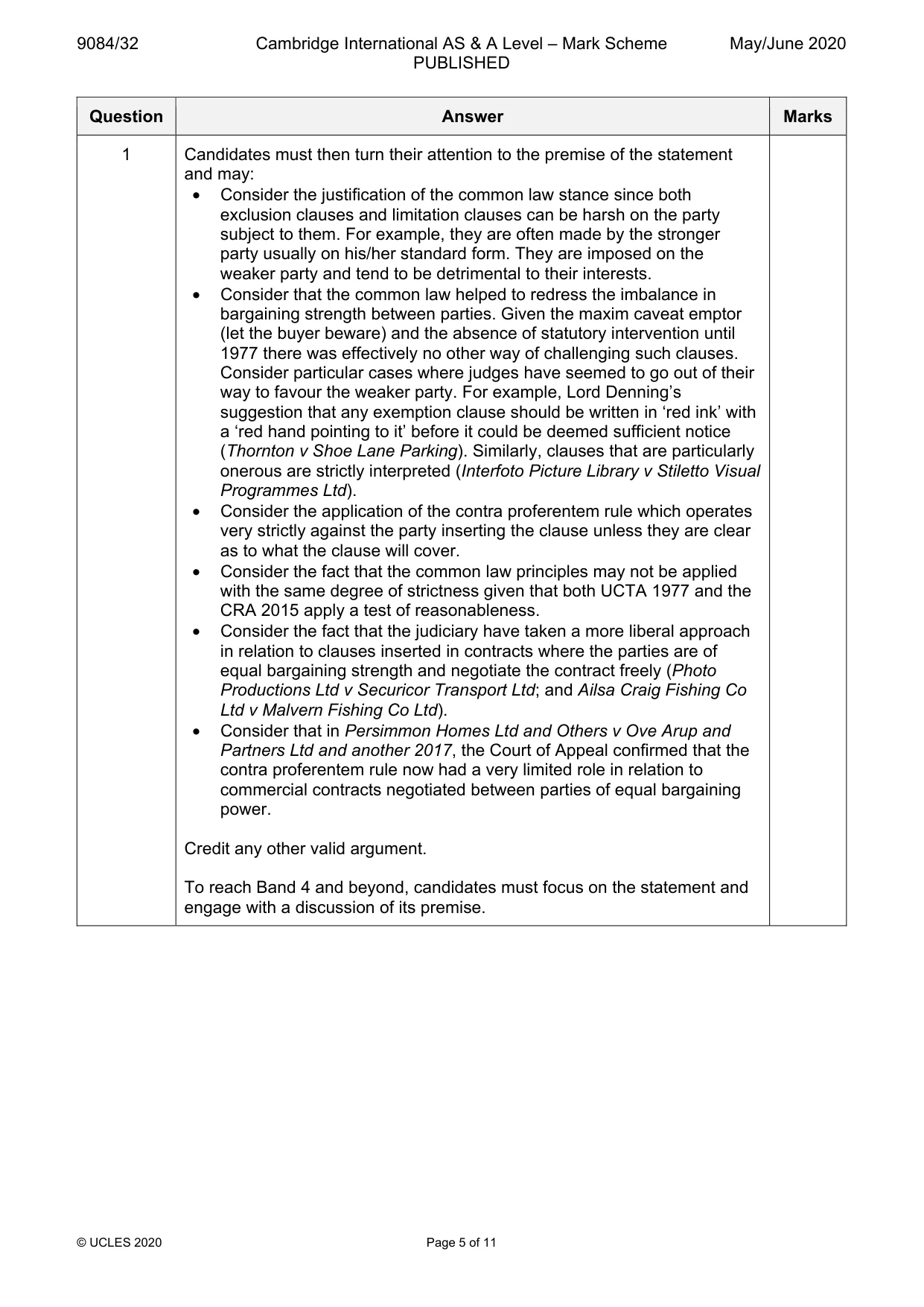
9084/32 Cambridge International AS & A Level – Mark Scheme PUBLISHED May/June 2020 © UCLES 2020 Page 5 of 11 Question Answer Marks 1 Candidates must then turn their attention to the premise of the statement and may: • Consider the justification of the common law stance since both exclusion clauses and limitation clauses can be harsh on the party subject to them. For example, they are often made by the stronger party usually on his/her standard form. They are imposed on the weaker party and tend to be detrimental to their interests. • Consider that the common law helped to redress the imbalance in bargaining strength between parties. Given the maxim caveat emptor (let the buyer beware) and the absence of statutory intervention until 1977 there was effectively no other way of challenging such clauses. Consider particular cases where judges have seemed to go out of their way to favour the weaker party. For example, Lord Denning’s suggestion that any exemption clause should be written in ‘red ink’ with a ‘red hand pointing to it’ before it could be deemed sufficient notice (Thornton v Shoe Lane Parking). Similarly, clauses that are particularly onerous are strictly interpreted (Interfoto Picture Library v Stiletto Visual Programmes Ltd). • Consider the application of the contra proferentem rule which operates very strictly against the party inserting the clause unless they are clear as to what the clause will cover. • Consider the fact that the common law principles may not be applied with the same degree of strictness given that both UCTA 1977 and the CRA 2015 apply a test of reasonableness. • Consider the fact that the judiciary have taken a more liberal approach in relation to clauses inserted in contracts where the parties are of equal bargaining strength and negotiate the contract freely (Photo Productions Ltd v Securicor Transport Ltd; and Ailsa Craig Fishing Co Ltd v Malvern Fishing Co Ltd). • Consider that in Persimmon Homes Ltd and Others v Ove Arup and Partners Ltd and another 2017, the Court of Appeal confirmed that the contra proferentem rule now had a very limited role in relation to commercial contracts negotiated between parties of equal bargaining power. Credit any other valid argument. To reach Band 4 and beyond, candidates must focus on the statement and engage with a discussion of its premise.
Mark scheme, page 6
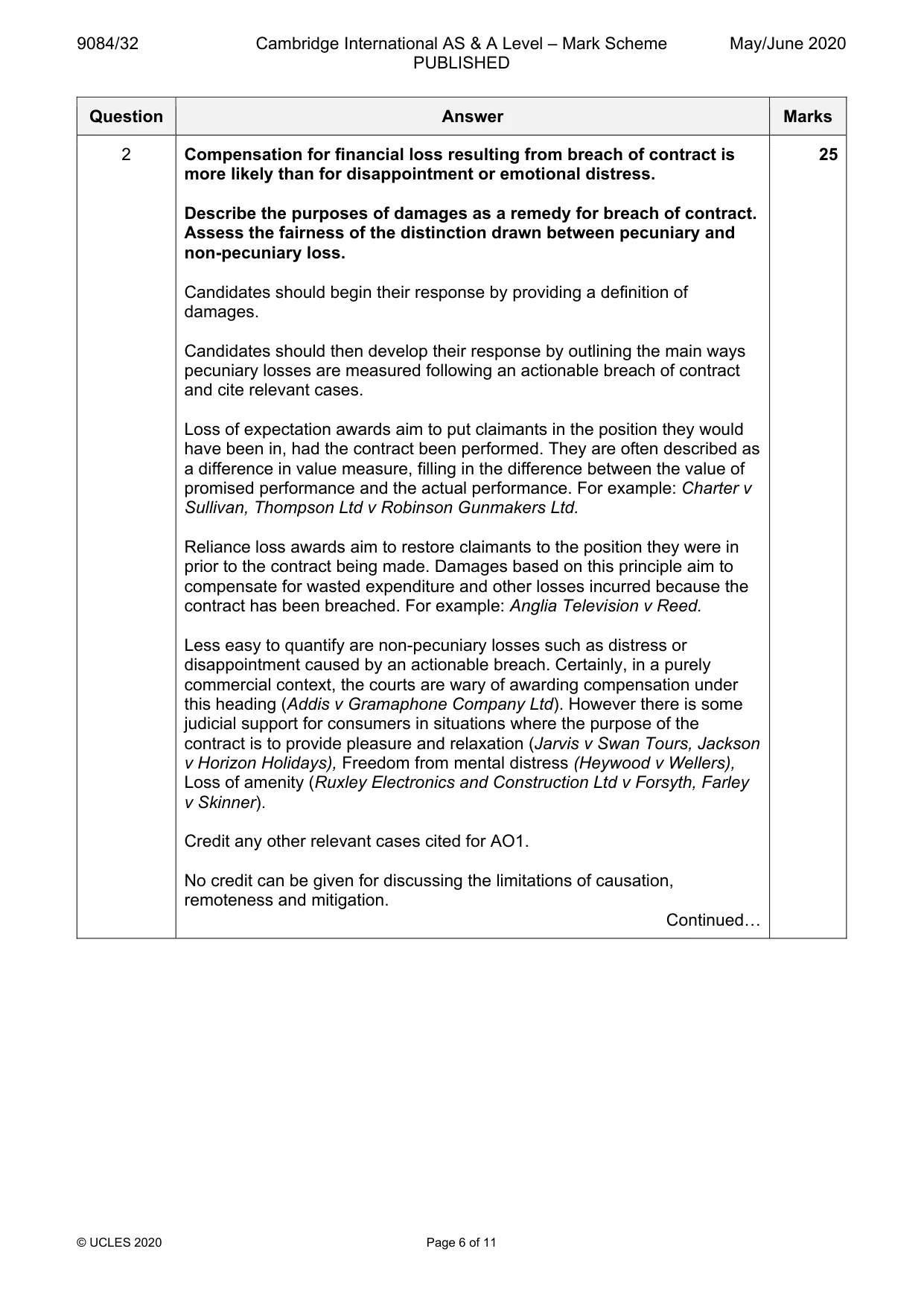
9084/32 Cambridge International AS & A Level – Mark Scheme PUBLISHED May/June 2020 © UCLES 2020 Page 6 of 11 Question Answer Marks 2 Compensation for financial loss resulting from breach of contract is more likely than for disappointment or emotional distress. Describe the purposes of damages as a remedy for breach of contract. Assess the fairness of the distinction drawn between pecuniary and non-pecuniary loss. Candidates should begin their response by providing a definition of damages. Candidates should then develop their response by outlining the main ways pecuniary losses are measured following an actionable breach of contract and cite relevant cases. Loss of expectation awards aim to put claimants in the position they would have been in, had the contract been performed. They are often described as a difference in value measure, filling in the difference between the value of promised performance and the actual performance. For example: Charter v Sullivan, Thompson Ltd v Robinson Gunmakers Ltd. Reliance loss awards aim to restore claimants to the position they were in prior to the contract being made. Damages based on this principle aim to compensate for wasted expenditure and other losses incurred because the contract has been breached. For example: Anglia Television v Reed. Less easy to quantify are non-pecuniary losses such as distress or disappointment caused by an actionable breach. Certainly, in a purely commercial context, the courts are wary of awarding compensation under this heading (Addis v Gramaphone Company Ltd). However there is some judicial support for consumers in situations where the purpose of the contract is to provide pleasure and relaxation (Jarvis v Swan Tours, Jackson v Horizon Holidays), Freedom from mental distress (Heywood v Wellers), Loss of amenity (Ruxley Electronics and Construction Ltd v Forsyth, Farley v Skinner). Credit any other relevant cases cited for AO1. No credit can be given for discussing the limitations of causation, remoteness and mitigation. Continued… 25
Mark scheme, page 7
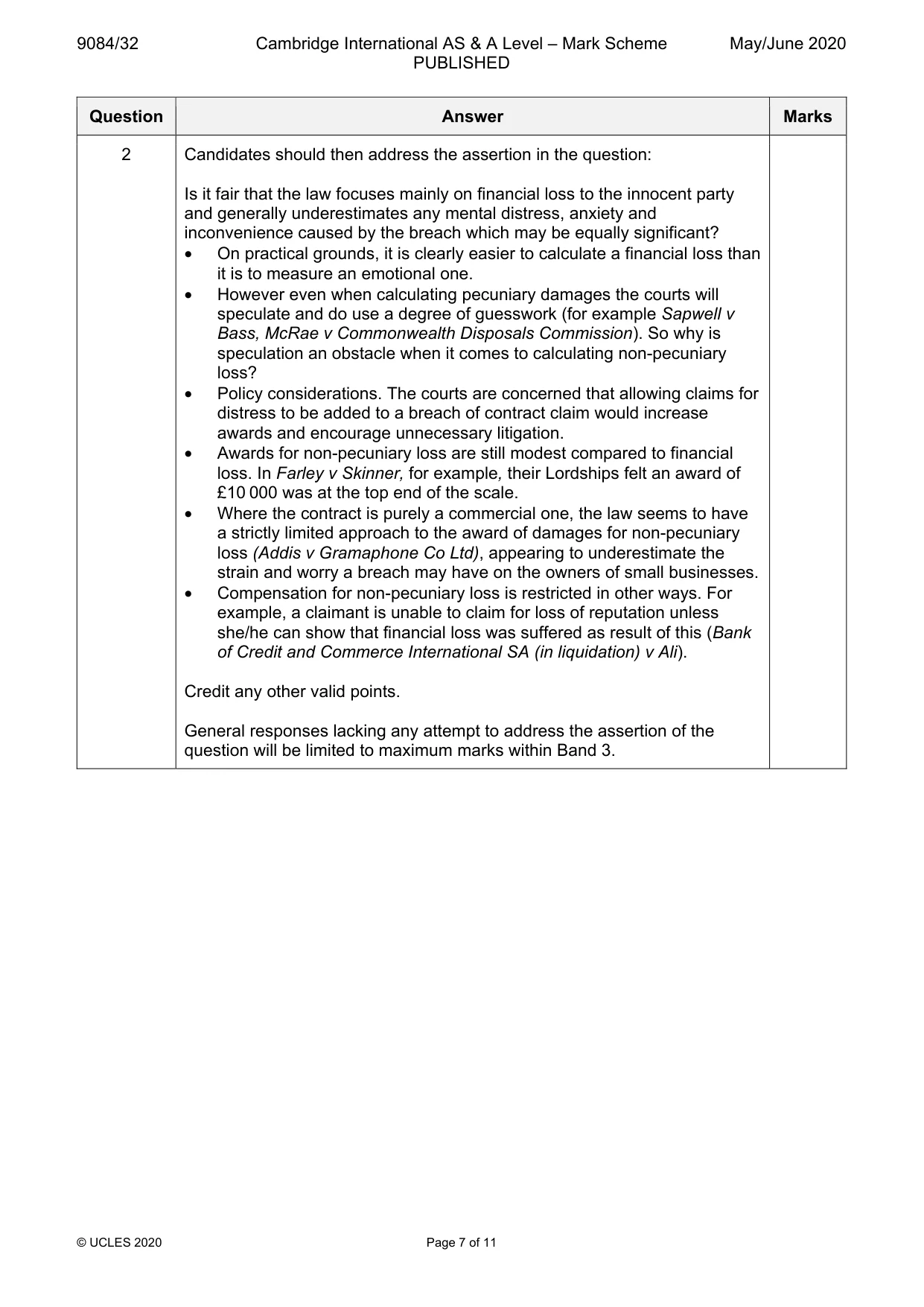
9084/32 Cambridge International AS & A Level – Mark Scheme PUBLISHED May/June 2020 © UCLES 2020 Page 7 of 11 Question Answer Marks 2 Candidates should then address the assertion in the question: Is it fair that the law focuses mainly on financial loss to the innocent party and generally underestimates any mental distress, anxiety and inconvenience caused by the breach which may be equally significant? • On practical grounds, it is clearly easier to calculate a financial loss than it is to measure an emotional one. • However even when calculating pecuniary damages the courts will speculate and do use a degree of guesswork (for example Sapwell v Bass, McRae v Commonwealth Disposals Commission). So why is speculation an obstacle when it comes to calculating non-pecuniary loss? • Policy considerations. The courts are concerned that allowing claims for distress to be added to a breach of contract claim would increase awards and encourage unnecessary litigation. • Awards for non-pecuniary loss are still modest compared to financial loss. In Farley v Skinner, for example, their Lordships felt an award of £10 000 was at the top end of the scale. • Where the contract is purely a commercial one, the law seems to have a strictly limited approach to the award of damages for non-pecuniary loss (Addis v Gramaphone Co Ltd), appearing to underestimate the strain and worry a breach may have on the owners of small businesses. • Compensation for non-pecuniary loss is restricted in other ways. For example, a claimant is unable to claim for loss of reputation unless she/he can show that financial loss was suffered as result of this (Bank of Credit and Commerce International SA (in liquidation) v Ali). Credit any other valid points. General responses lacking any attempt to address the assertion of the question will be limited to maximum marks within Band 3.
Mark scheme, page 8
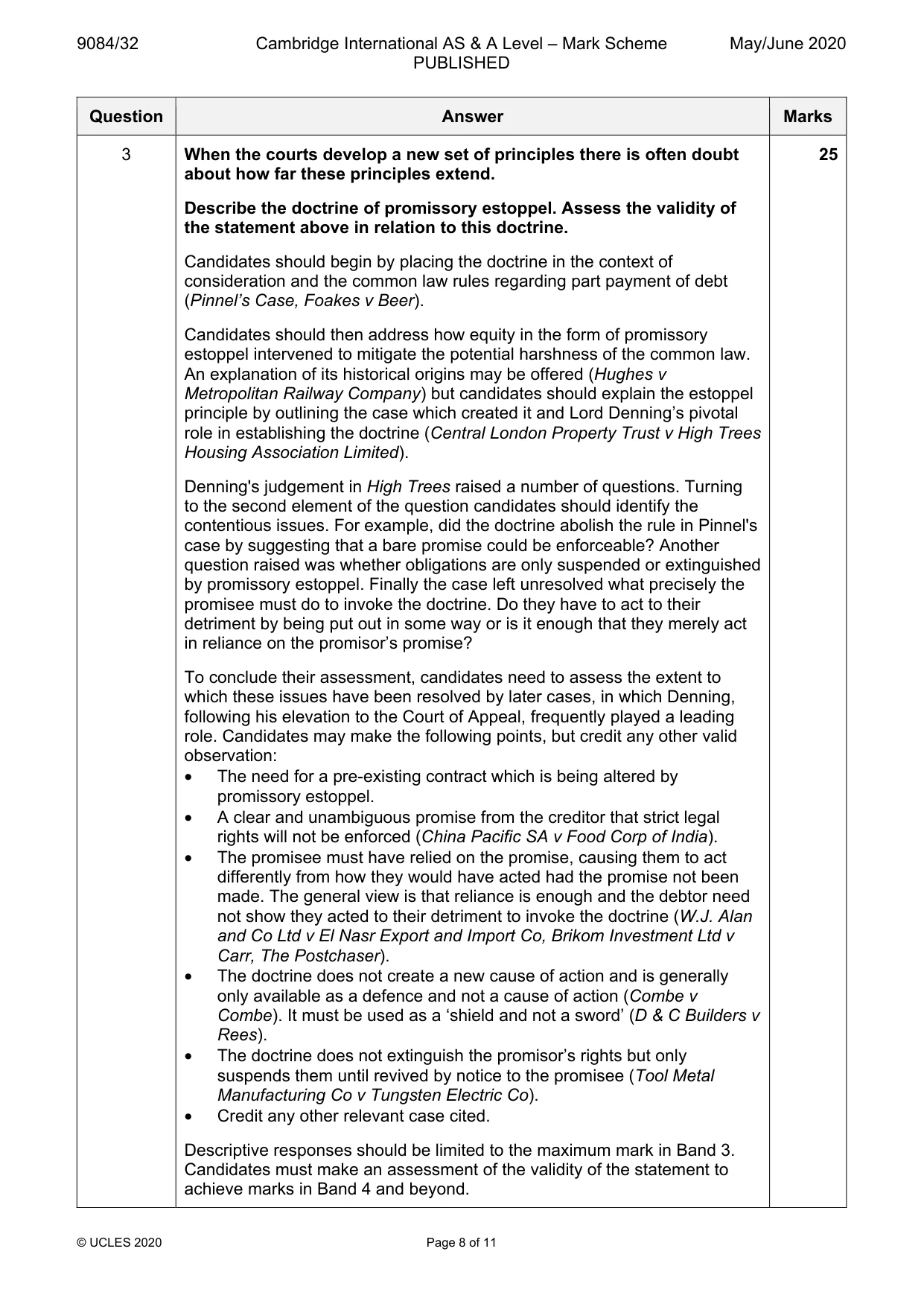
9084/32 Cambridge International AS & A Level – Mark Scheme PUBLISHED May/June 2020 © UCLES 2020 Page 8 of 11 Question Answer Marks 3 When the courts develop a new set of principles there is often doubt about how far these principles extend. Describe the doctrine of promissory estoppel. Assess the validity of the statement above in relation to this doctrine. Candidates should begin by placing the doctrine in the context of consideration and the common law rules regarding part payment of debt (Pinnel’s Case, Foakes v Beer). Candidates should then address how equity in the form of promissory estoppel intervened to mitigate the potential harshness of the common law. An explanation of its historical origins may be offered (Hughes v Metropolitan Railway Company) but candidates should explain the estoppel principle by outlining the case which created it and Lord Denning’s pivotal role in establishing the doctrine (Central London Property Trust v High Trees Housing Association Limited). Denning's judgement in High Trees raised a number of questions. Turning to the second element of the question candidates should identify the contentious issues. For example, did the doctrine abolish the rule in Pinnel's case by suggesting that a bare promise could be enforceable? Another question raised was whether obligations are only suspended or extinguished by promissory estoppel. Finally the case left unresolved what precisely the promisee must do to invoke the doctrine. Do they have to act to their detriment by being put out in some way or is it enough that they merely act in reliance on the promisor’s promise? To conclude their assessment, candidates need to assess the extent to which these issues have been resolved by later cases, in which Denning, following his elevation to the Court of Appeal, frequently played a leading role. Candidates may make the following points, but credit any other valid observation: • The need for a pre-existing contract which is being altered by promissory estoppel. • A clear and unambiguous promise from the creditor that strict legal rights will not be enforced (China Pacific SA v Food Corp of India). • The promisee must have relied on the promise, causing them to act differently from how they would have acted had the promise not been made. The general view is that reliance is enough and the debtor need not show they acted to their detriment to invoke the doctrine (W.J. Alan and Co Ltd v El Nasr Export and Import Co, Brikom Investment Ltd v Carr, The Postchaser). • The doctrine does not create a new cause of action and is generally only available as a defence and not a cause of action (Combe v Combe). It must be used as a ‘shield and not a sword’ (D & C Builders v Rees). • The doctrine does not extinguish the promisor’s rights but only suspends them until revived by notice to the promisee (Tool Metal Manufacturing Co v Tungsten Electric Co). • Credit any other relevant case cited. Descriptive responses should be limited to the maximum mark in Band 3. Candidates must make an assessment of the validity of the statement to achieve marks in Band 4 and beyond. 25
Mark scheme, page 9
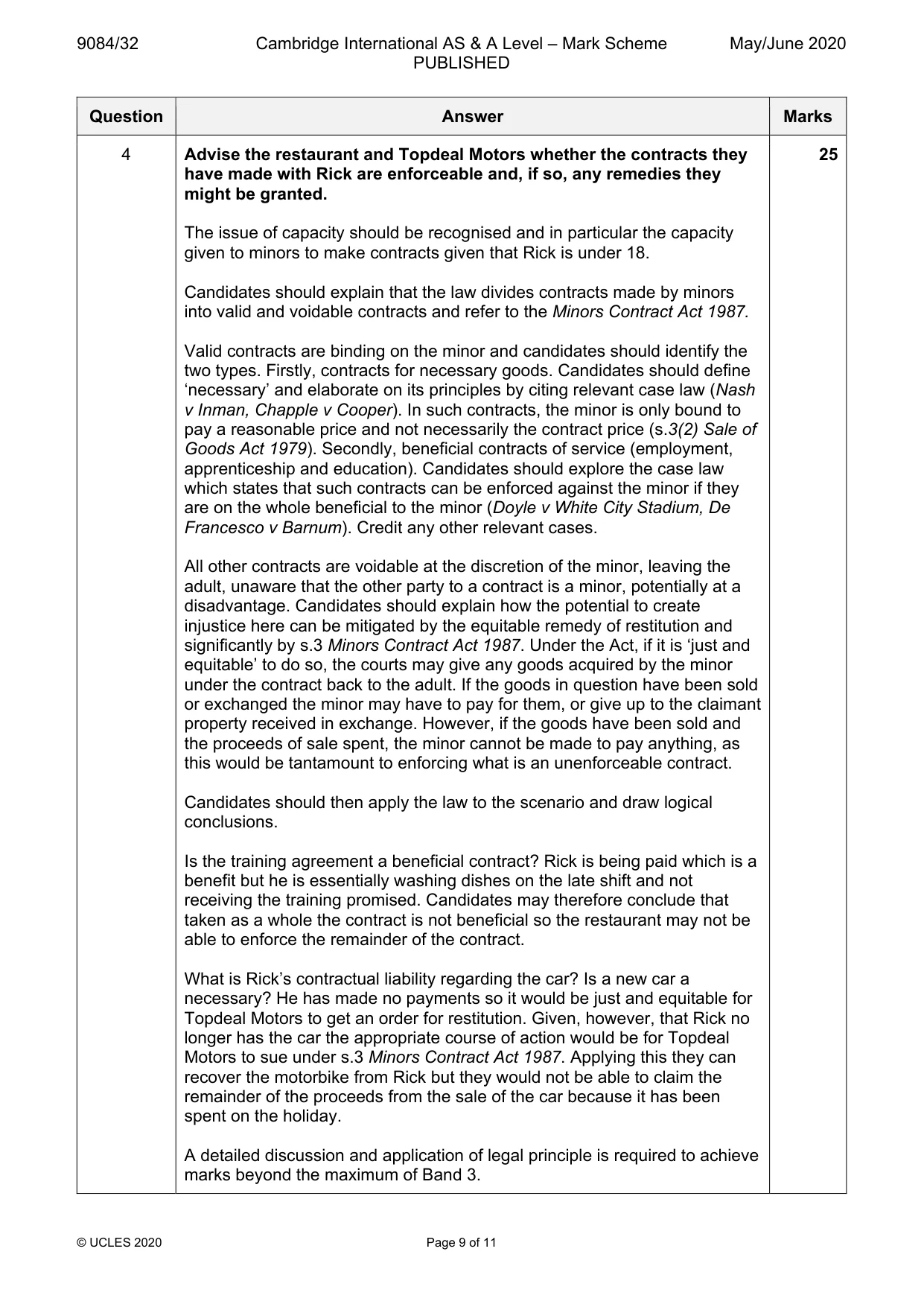
9084/32 Cambridge International AS & A Level – Mark Scheme PUBLISHED May/June 2020 © UCLES 2020 Page 9 of 11 Question Answer Marks 4 Advise the restaurant and Topdeal Motors whether the contracts they have made with Rick are enforceable and, if so, any remedies they might be granted. The issue of capacity should be recognised and in particular the capacity given to minors to make contracts given that Rick is under 18. Candidates should explain that the law divides contracts made by minors into valid and voidable contracts and refer to the Minors Contract Act 1987. Valid contracts are binding on the minor and candidates should identify the two types. Firstly, contracts for necessary goods. Candidates should define ‘necessary’ and elaborate on its principles by citing relevant case law (Nash v Inman, Chapple v Cooper). In such contracts, the minor is only bound to pay a reasonable price and not necessarily the contract price (s.3(2) Sale of Goods Act 1979). Secondly, beneficial contracts of service (employment, apprenticeship and education). Candidates should explore the case law which states that such contracts can be enforced against the minor if they are on the whole beneficial to the minor (Doyle v White City Stadium, De Francesco v Barnum). Credit any other relevant cases. All other contracts are voidable at the discretion of the minor, leaving the adult, unaware that the other party to a contract is a minor, potentially at a disadvantage. Candidates should explain how the potential to create injustice here can be mitigated by the equitable remedy of restitution and significantly by s.3 Minors Contract Act 1987. Under the Act, if it is ‘just and equitable’ to do so, the courts may give any goods acquired by the minor under the contract back to the adult. If the goods in question have been sold or exchanged the minor may have to pay for them, or give up to the claimant property received in exchange. However, if the goods have been sold and the proceeds of sale spent, the minor cannot be made to pay anything, as this would be tantamount to enforcing what is an unenforceable contract. Candidates should then apply the law to the scenario and draw logical conclusions. Is the training agreement a beneficial contract? Rick is being paid which is a benefit but he is essentially washing dishes on the late shift and not receiving the training promised. Candidates may therefore conclude that taken as a whole the contract is not beneficial so the restaurant may not be able to enforce the remainder of the contract. What is Rick’s contractual liability regarding the car? Is a new car a necessary? He has made no payments so it would be just and equitable for Topdeal Motors to get an order for restitution. Given, however, that Rick no longer has the car the appropriate course of action would be for Topdeal Motors to sue under s.3 Minors Contract Act 1987. Applying this they can recover the motorbike from Rick but they would not be able to claim the remainder of the proceeds from the sale of the car because it has been spent on the holiday. A detailed discussion and application of legal principle is required to achieve marks beyond the maximum of Band 3. 25
Mark scheme, page 10
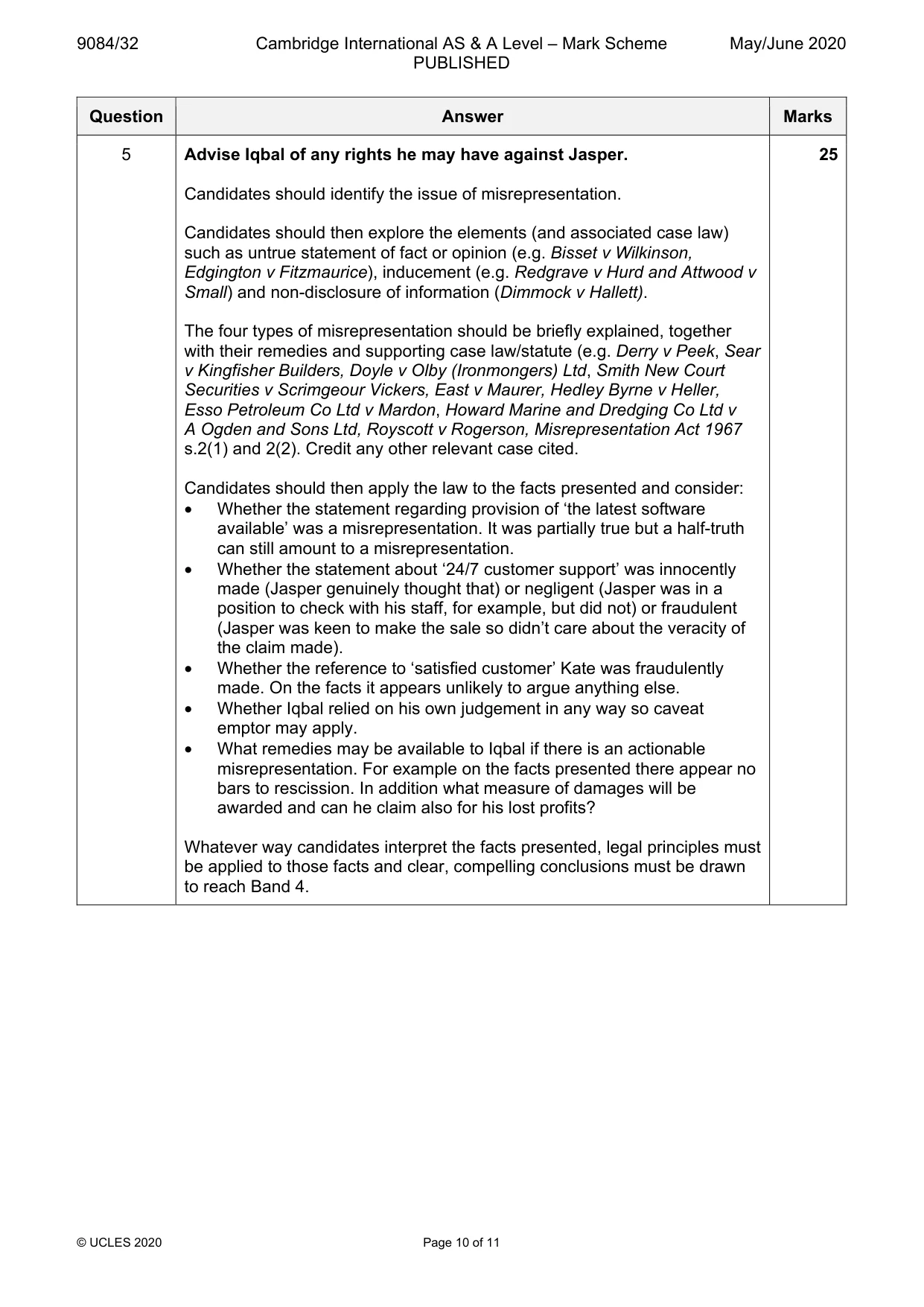
9084/32 Cambridge International AS & A Level – Mark Scheme PUBLISHED May/June 2020 © UCLES 2020 Page 10 of 11 Question Answer Marks 5 Advise Iqbal of any rights he may have against Jasper. Candidates should identify the issue of misrepresentation. Candidates should then explore the elements (and associated case law) such as untrue statement of fact or opinion (e.g. Bisset v Wilkinson, Edgington v Fitzmaurice), inducement (e.g. Redgrave v Hurd and Attwood v Small) and non-disclosure of information (Dimmock v Hallett). The four types of misrepresentation should be briefly explained, together with their remedies and supporting case law/statute (e.g. Derry v Peek, Sear v Kingfisher Builders, Doyle v Olby (Ironmongers) Ltd, Smith New Court Securities v Scrimgeour Vickers, East v Maurer, Hedley Byrne v Heller, Esso Petroleum Co Ltd v Mardon, Howard Marine and Dredging Co Ltd v A Ogden and Sons Ltd, Royscott v Rogerson, Misrepresentation Act 1967 s.2(1) and 2(2). Credit any other relevant case cited. Candidates should then apply the law to the facts presented and consider: • Whether the statement regarding provision of ‘the latest software available’ was a misrepresentation. It was partially true but a half-truth can still amount to a misrepresentation. • Whether the statement about ‘24/7 customer support’ was innocently made (Jasper genuinely thought that) or negligent (Jasper was in a position to check with his staff, for example, but did not) or fraudulent (Jasper was keen to make the sale so didn’t care about the veracity of the claim made). • Whether the reference to ‘satisfied customer’ Kate was fraudulently made. On the facts it appears unlikely to argue anything else. • Whether Iqbal relied on his own judgement in any way so caveat emptor may apply. • What remedies may be available to Iqbal if there is an actionable misrepresentation. For example on the facts presented there appear no bars to rescission. In addition what measure of damages will be awarded and can he claim also for his lost profits? Whatever way candidates interpret the facts presented, legal principles must be applied to those facts and clear, compelling conclusions must be drawn to reach Band 4. 25
Mark scheme, page 11
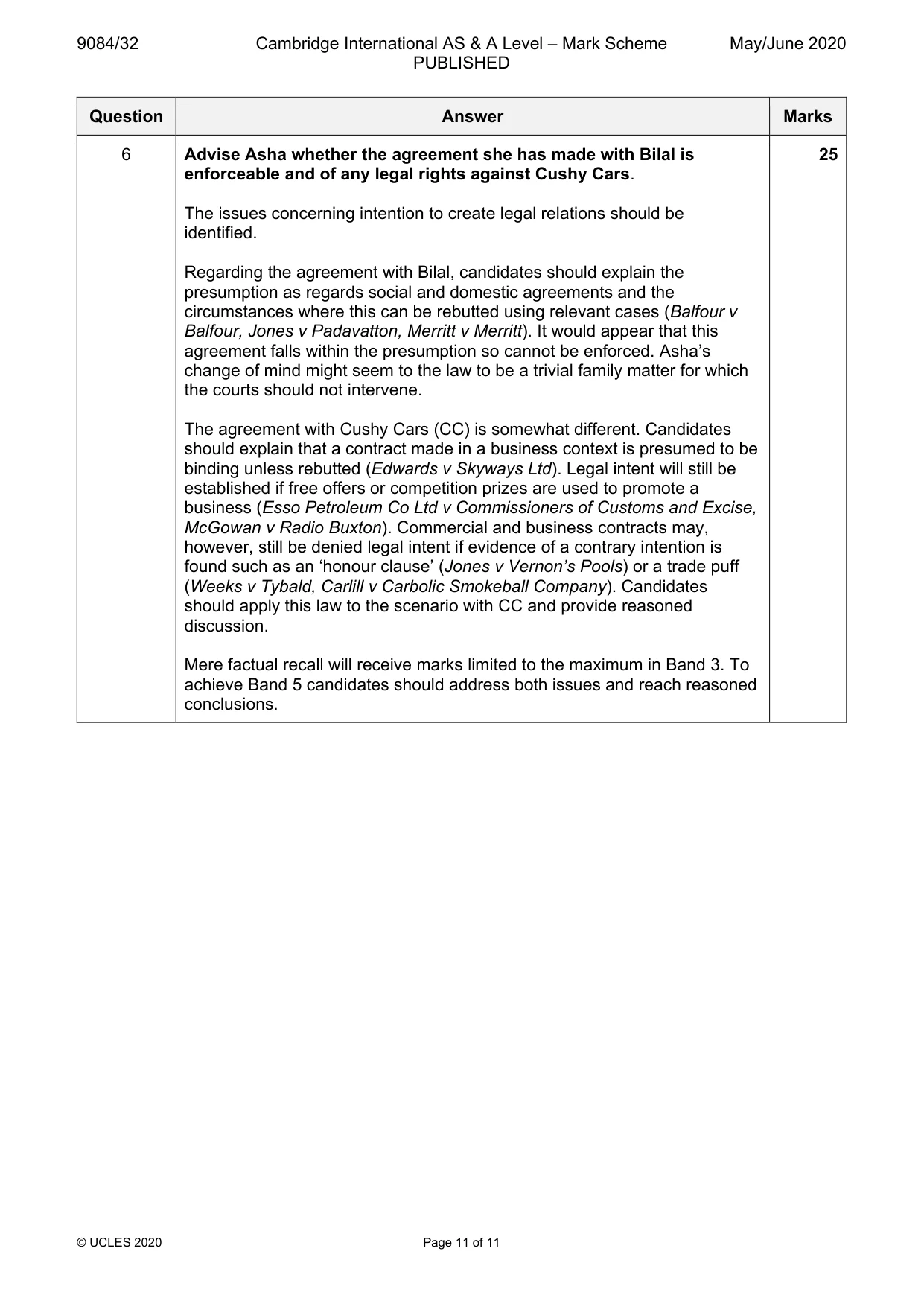
9084/32 Cambridge International AS & A Level – Mark Scheme PUBLISHED May/June 2020 © UCLES 2020 Page 11 of 11 Question Answer Marks 6 Advise Asha whether the agreement she has made with Bilal is enforceable and of any legal rights against Cushy Cars. The issues concerning intention to create legal relations should be identified. Regarding the agreement with Bilal, candidates should explain the presumption as regards social and domestic agreements and the circumstances where this can be rebutted using relevant cases (Balfour v Balfour, Jones v Padavatton, Merritt v Merritt). It would appear that this agreement falls within the presumption so cannot be enforced. Asha’s change of mind might seem to the law to be a trivial family matter for which the courts should not intervene. The agreement with Cushy Cars (CC) is somewhat different. Candidates should explain that a contract made in a business context is presumed to be binding unless rebutted (Edwards v Skyways Ltd). Legal intent will still be established if free offers or competition prizes are used to promote a business (Esso Petroleum Co Ltd v Commissioners of Customs and Excise, McGowan v Radio Buxton). Commercial and business contracts may, however, still be denied legal intent if evidence of a contrary intention is found such as an ‘honour clause’ (Jones v Vernon’s Pools) or a trade puff (Weeks v Tybald, Carlill v Carbolic Smokeball Company). Candidates should apply this law to the scenario with CC and provide reasoned discussion. Mere factual recall will receive marks limited to the maximum in Band 3. To achieve Band 5 candidates should address both issues and reach reasoned conclusions. 25