Cambridge A Level Law 9084 — 2016 Oct/Nov Paper 2 · Variant 2
9084/22/O/N/16
The question paper and its mark scheme, free to read here and free to download. This is Cambridge’s own paper, exactly as it was sat.
Question paper8 pages



Mark scheme4 pages
Answers below. Sit the paper first if you are practising.
Paper as text
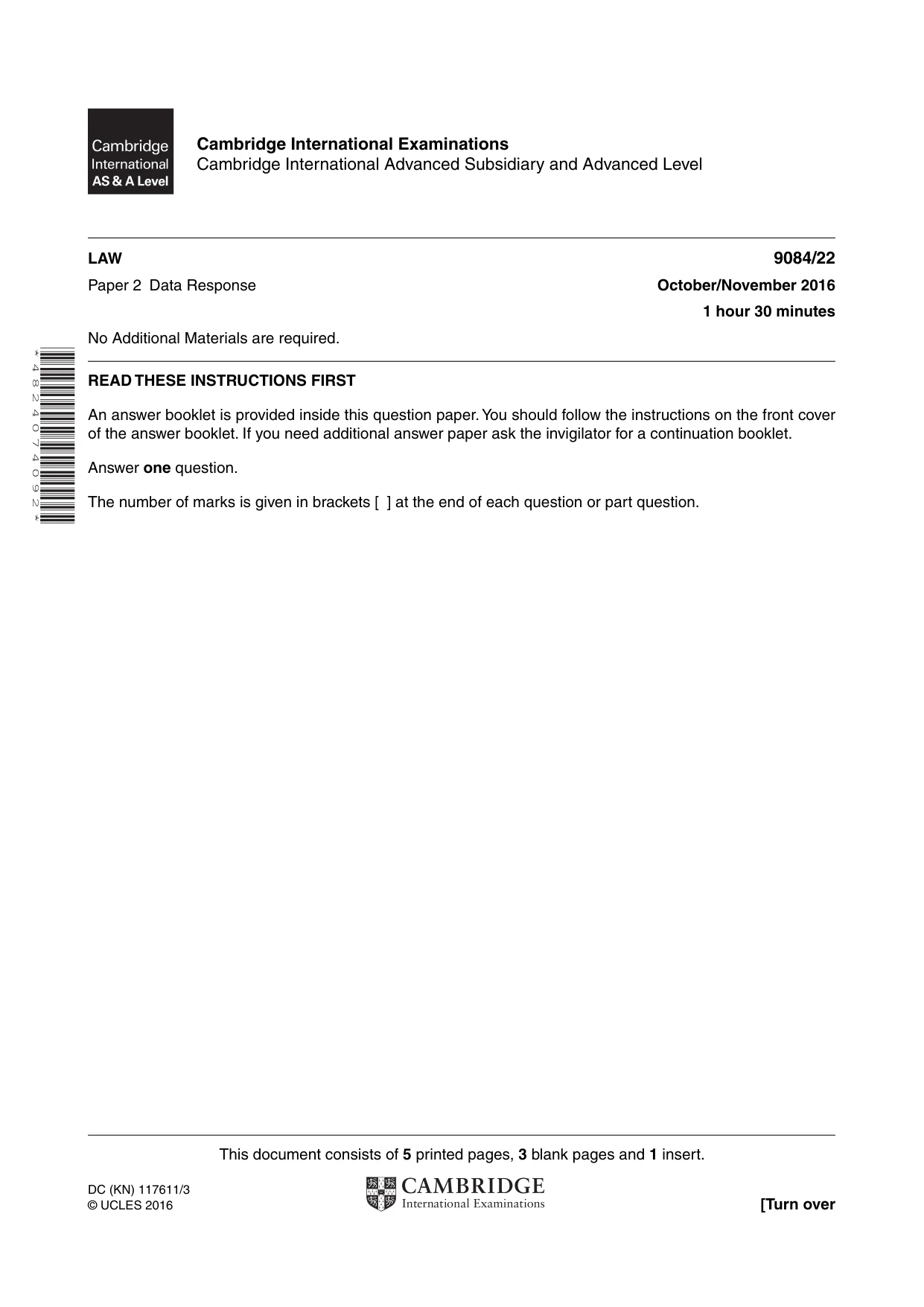
Question paper, page 1
This document consists of 5 printed pages, 3 blank pages and 1 insert. DC (KN) 117611/3 © UCLES 2016 [Turn over Cambridge International Examinations Cambridge International Advanced Subsidiary and Advanced Level * 4 8 2 4 0 7 4 0 9 2 * LAW 9084/22 Paper 2 Data Response October/November 2016 1 hour 30 minutes No Additional Materials are required. READ THESE INSTRUCTIONS FIRST An answer booklet is provided inside this question paper. You should follow the instructions on the front cover of the answer booklet. If you need additional answer paper ask the invigilator for a continuation booklet. Answer one question. The number of marks is given in brackets [ ] at the end of each question or part question.
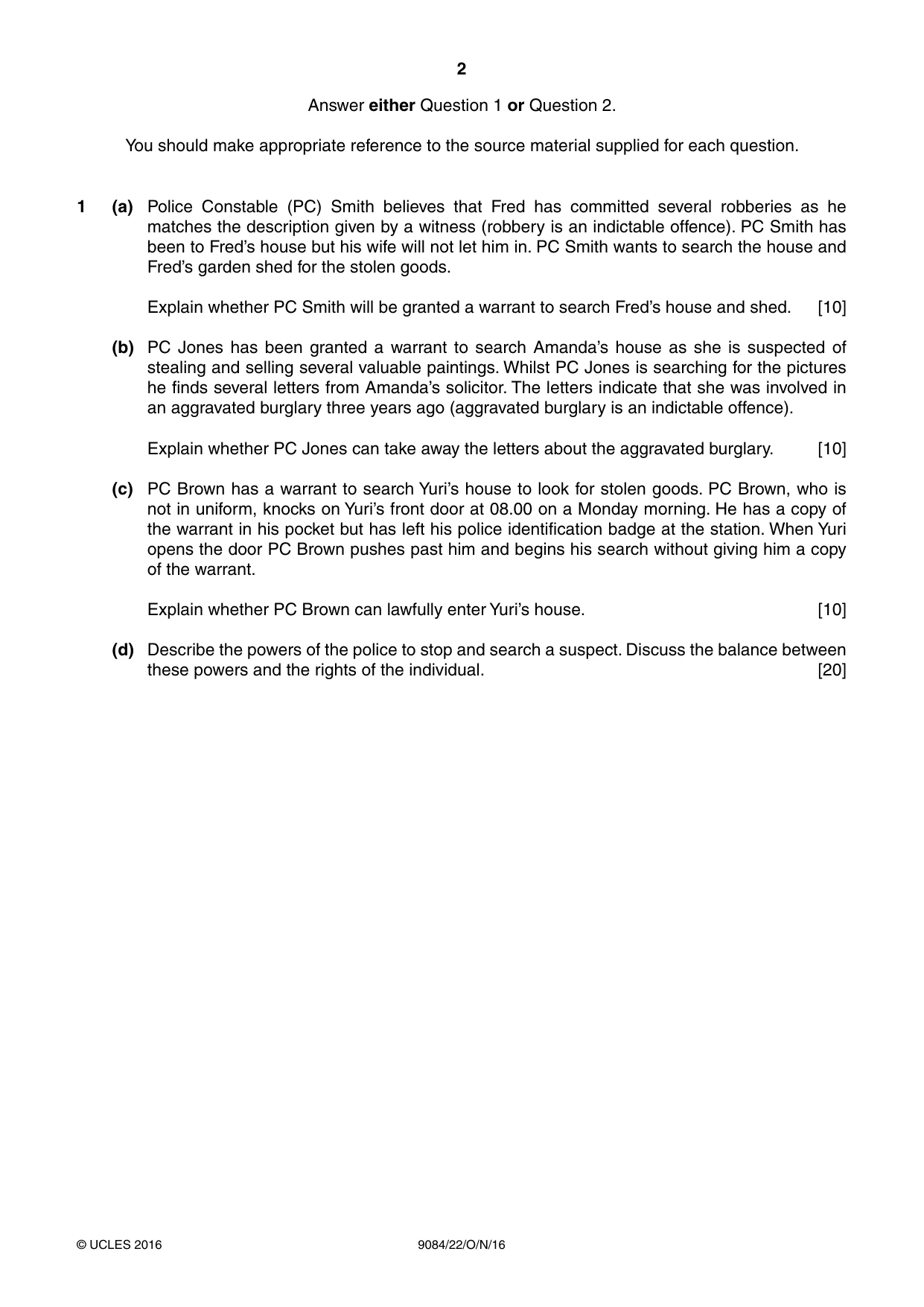
Question paper, page 2
2 9084/22/O/N/16 © UCLES 2016 Answer either Question 1 or Question 2. You should make appropriate reference to the source material supplied for each question. 1 (a) Police Constable (PC) Smith believes that Fred has committed several robberies as he matches the description given by a witness (robbery is an indictable offence). PC Smith has been to Fred’s house but his wife will not let him in. PC Smith wants to search the house and Fred’s garden shed for the stolen goods. Explain whether PC Smith will be granted a warrant to search Fred’s house and shed. [10] (b) PC Jones has been granted a warrant to search Amanda’s house as she is suspected of stealing and selling several valuable paintings. Whilst PC Jones is searching for the pictures he finds several letters from Amanda’s solicitor. The letters indicate that she was involved in an aggravated burglary three years ago (aggravated burglary is an indictable offence). Explain whether PC Jones can take away the letters about the aggravated burglary. [10] (c) PC Brown has a warrant to search Yuri’s house to look for stolen goods. PC Brown, who is not in uniform, knocks on Yuri’s front door at 08.00 on a Monday morning. He has a copy of the warrant in his pocket but has left his police identification badge at the station. When Yuri opens the door PC Brown pushes past him and begins his search without giving him a copy of the warrant. Explain whether PC Brown can lawfully enter Yuri’s house. [10] (d) Describe the powers of the police to stop and search a suspect. Discuss the balance between these powers and the rights of the individual. [20]
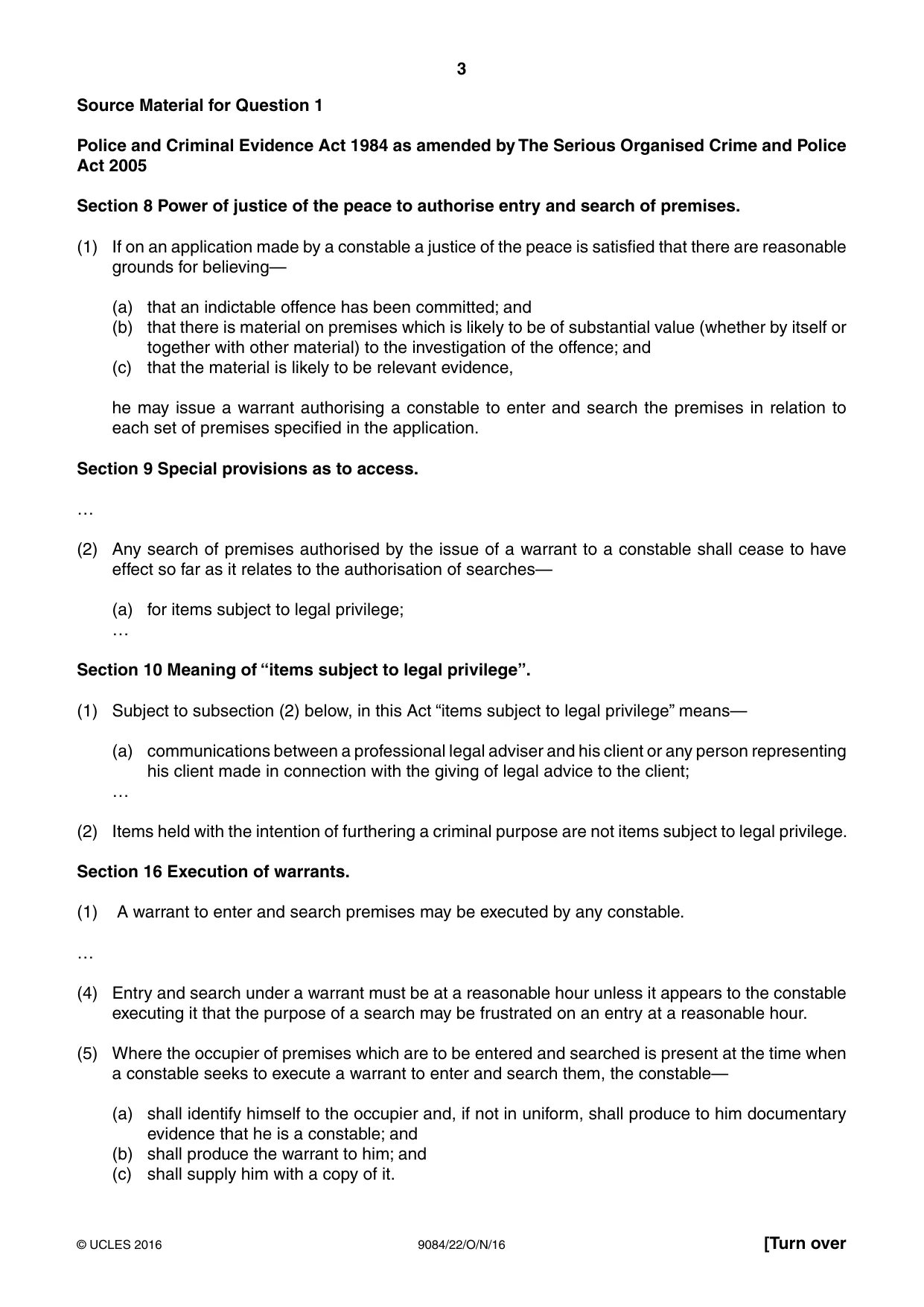
Question paper, page 3
3 9084/22/O/N/16 © UCLES 2016 [Turn over Source Material for Question 1 Police and Criminal Evidence Act 1984 as amended by The Serious Organised Crime and Police Act 2005 Section 8 Power of justice of the peace to authorise entry and search of premises. (1) If on an application made by a constable a justice of the peace is satisfied that there are reasonable grounds for believing— (a) that an indictable offence has been committed; and (b) that there is material on premises which is likely to be of substantial value (whether by itself or together with other material) to the investigation of the offence; and (c) that the material is likely to be relevant evidence, he may issue a warrant authorising a constable to enter and search the premises in relation to each set of premises specified in the application. Section 9 Special provisions as to access. … (2) Any search of premises authorised by the issue of a warrant to a constable shall cease to have effect so far as it relates to the authorisation of searches— (a) for items subject to legal privilege; … Section 10 Meaning of “items subject to legal privilege”. (1) Subject to subsection (2) below, in this Act “items subject to legal privilege” means— (a) communications between a professional legal adviser and his client or any person representing his client made in connection with the giving of legal advice to the client; … (2) Items held with the intention of furthering a criminal purpose are not items subject to legal privilege. Section 16 Execution of warrants. (1) A warrant to enter and search premises may be executed by any constable. … (4) Entry and search under a warrant must be at a reasonable hour unless it appears to the constable executing it that the purpose of a search may be frustrated on an entry at a reasonable hour. (5) Where the occupier of premises which are to be entered and searched is present at the time when a constable seeks to execute a warrant to enter and search them, the constable— (a) shall identify himself to the occupier and, if not in uniform, shall produce to him documentary evidence that he is a constable; and (b) shall produce the warrant to him; and (c) shall supply him with a copy of it.
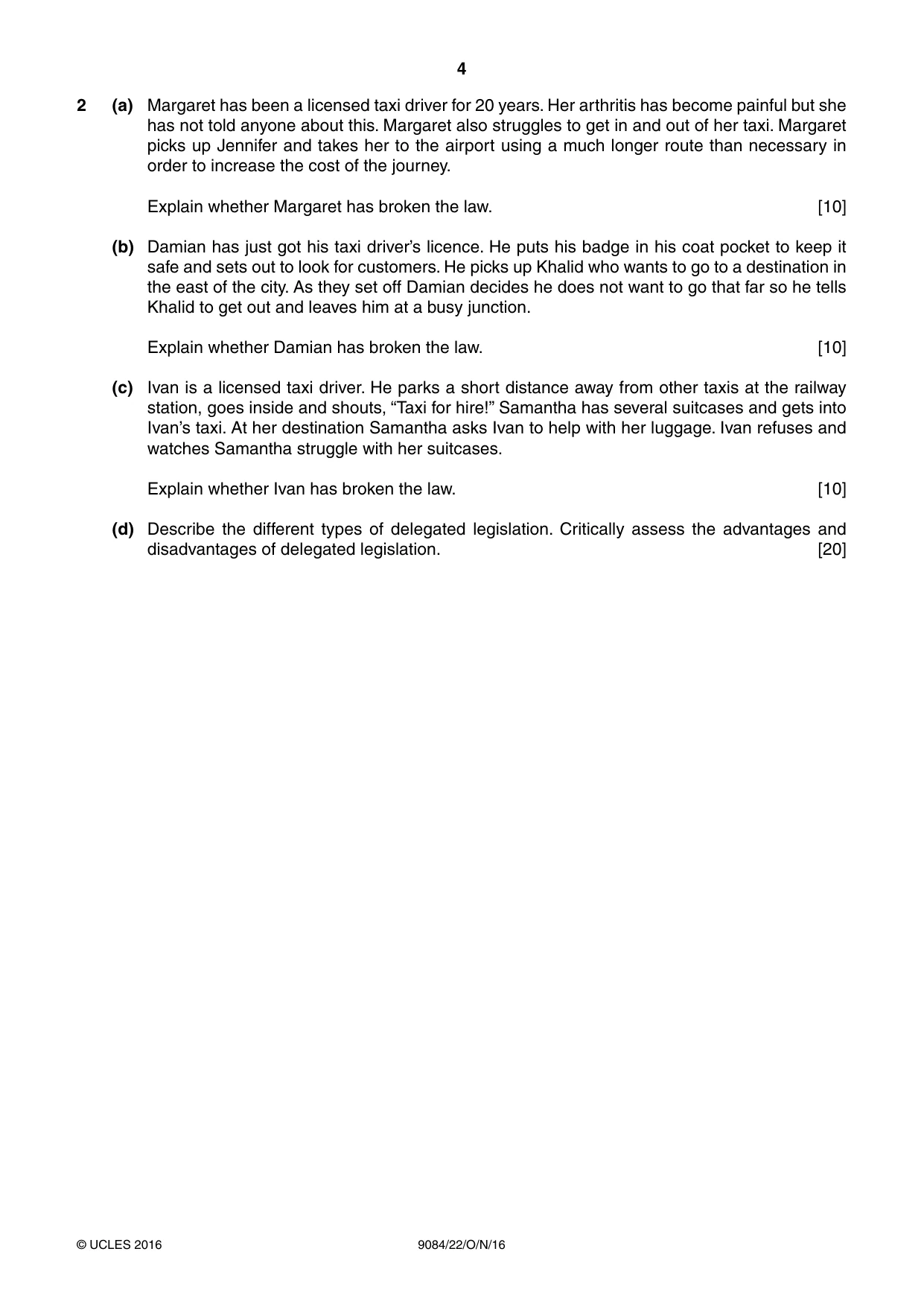
Question paper, page 4
4 9084/22/O/N/16 © UCLES 2016 2 (a) Margaret has been a licensed taxi driver for 20 years. Her arthritis has become painful but she has not told anyone about this. Margaret also struggles to get in and out of her taxi. Margaret picks up Jennifer and takes her to the airport using a much longer route than necessary in order to increase the cost of the journey. Explain whether Margaret has broken the law. [10] (b) Damian has just got his taxi driver’s licence. He puts his badge in his coat pocket to keep it safe and sets out to look for customers. He picks up Khalid who wants to go to a destination in the east of the city. As they set off Damian decides he does not want to go that far so he tells Khalid to get out and leaves him at a busy junction. Explain whether Damian has broken the law. [10] (c) Ivan is a licensed taxi driver. He parks a short distance away from other taxis at the railway station, goes inside and shouts, “Taxi for hire!” Samantha has several suitcases and gets into Ivan’s taxi. At her destination Samantha asks Ivan to help with her luggage. Ivan refuses and watches Samantha struggle with her suitcases. Explain whether Ivan has broken the law. [10] (d) Describe the different types of delegated legislation. Critically assess the advantages and disadvantages of delegated legislation. [20]
Question paper, page 5
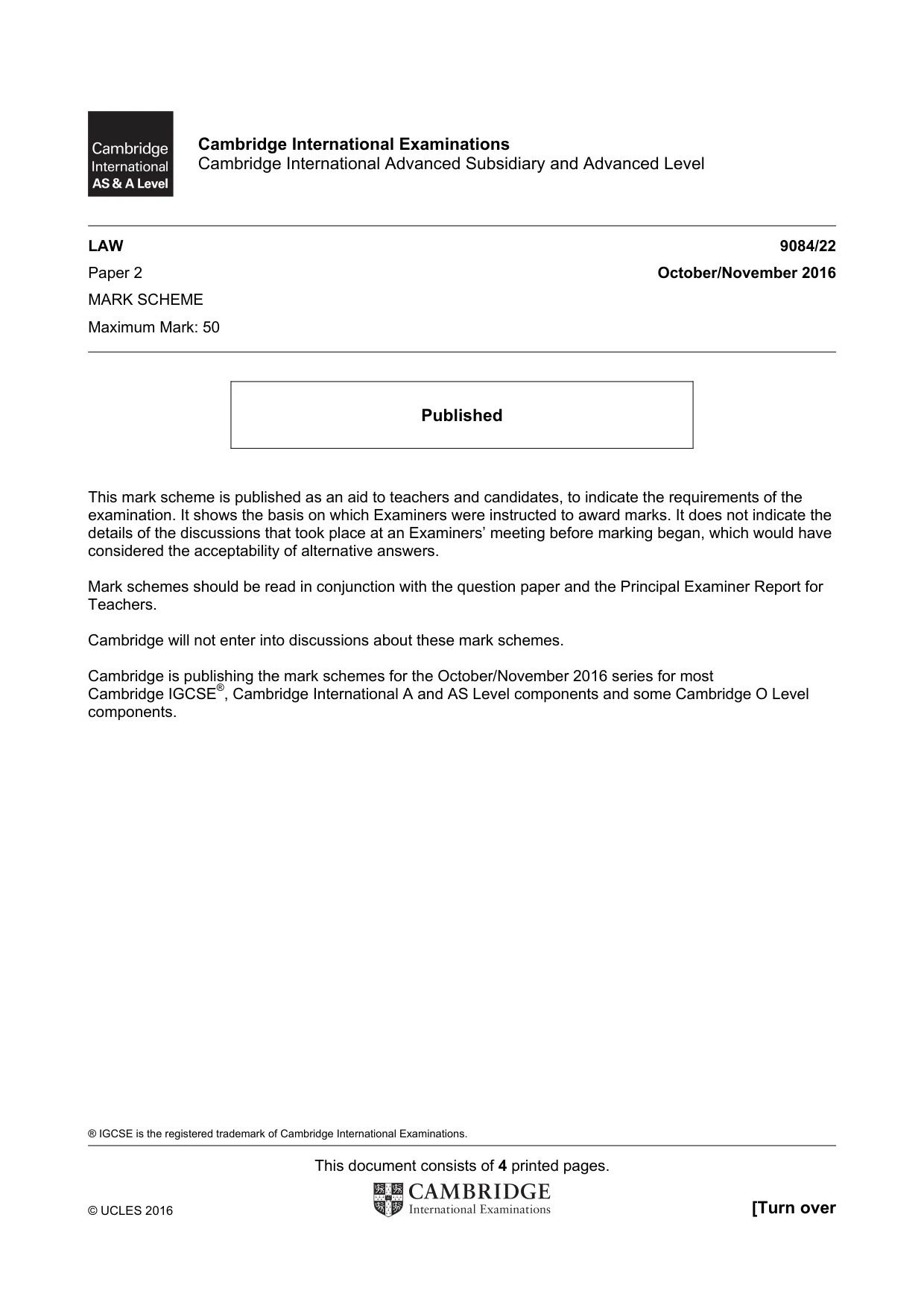
5 9084/22/O/N/16 © UCLES 2016 Source Material for Question 2 Town Police Clauses Act 1847 Section 53 A driver of a hackney carriage who refuses or neglects, without reasonable excuse, to drive such carriage to any place within the prescribed distance shall be liable to a penalty. Section 62 If the driver of any hackney carriage leave it in any street or at any place of public resort or entertainment, whether it be hired or not, without some one proper to take care of it, such driver shall be liable to a penalty. (A hackney carriage is a licensed taxi) Local Government (Miscellaneous Provisions) Act 1976 Section 69 (1) No person being the driver of a hackney carriage or of a private hire vehicle licensed by a district council shall without reasonable cause unnecessarily prolong, in distance or in time, the journey for which the hackney carriage or private vehicle has been hired. (2) If any person contravenes the provisions of this section, he shall be guilty of an offence. Bye-laws (8) The soliciting of passengers by the driver, or any person acting on their behalf, is not permitted. … (10) All licence holders are issued with a badge which should be worn at all times. (11) A driver should, when requested by the hirer:- … (b) Afford reasonable assistance in loading and unloading luggage … (13) When plying for hire, with the vehicle, the driver must proceed to a hackney carriage rank that is not fully occupied. (14) The driver must behave in a civil and orderly manner and take all reasonable precautions to ensure the safety of passengers entering or leaving the vehicle. (15) When hired the driver should complete the journey by the shortest route possible unless directed otherwise by the hirer. Hackney carriage driver’s standard of service If the driver hereby licensed contracts or develops a serious illness or condition during the period of their licence, they shall forthwith notify the Licensing Section. Examples of serious illness are: • Arthritis (chronic) and other joint problems • Depression and other mental health problems • Fainting
Question paper, page 6
6 9084/22/O/N/16 © UCLES 2016 BLANK PAGE
Question paper, page 7
7 9084/22/O/N/16 © UCLES 2016 BLANK PAGE
Question paper, page 8
8 9084/22/O/N/16 © UCLES 2016 BLANK PAGE Permission to reproduce items where third-party owned material protected by copyright is included has been sought and cleared where possible. Every reasonable effort has been made by the publisher (UCLES) to trace copyright holders, but if any items requiring clearance have unwittingly been included, the publisher will be pleased to make amends at the earliest possible opportunity. To avoid the issue of disclosure of answer-related information to candidates, all copyright acknowledgements are reproduced online in the Cambridge International Examinations Copyright Acknowledgements Booklet. This is produced for each series of examinations and is freely available to download at www.cie.org.uk after the live examination series. Cambridge International Examinations is part of the Cambridge Assessment Group. Cambridge Assessment is the brand name of University of Cambridge Local Examinations Syndicate (UCLES), which is itself a department of the University of Cambridge.
Mark scheme, page 1
® IGCSE is the registered trademark of Cambridge International Examinations. This document consists of 4 printed pages. © UCLES 2016 [Turn over Cambridge International Examinations Cambridge International Advanced Subsidiary and Advanced Level LAW 9084/22 Paper 2 October/November 2016 MARK SCHEME Maximum Mark: 50 Published This mark scheme is published as an aid to teachers and candidates, to indicate the requirements of the examination. It shows the basis on which Examiners were instructed to award marks. It does not indicate the details of the discussions that took place at an Examiners’ meeting before marking began, which would have considered the acceptability of alternative answers. Mark schemes should be read in conjunction with the question paper and the Principal Examiner Report for Teachers. Cambridge will not enter into discussions about these mark schemes. Cambridge is publishing the mark schemes for the October/November 2016 series for most Cambridge IGCSE®, Cambridge International A and AS Level components and some Cambridge O Level components.
Mark scheme, page 2
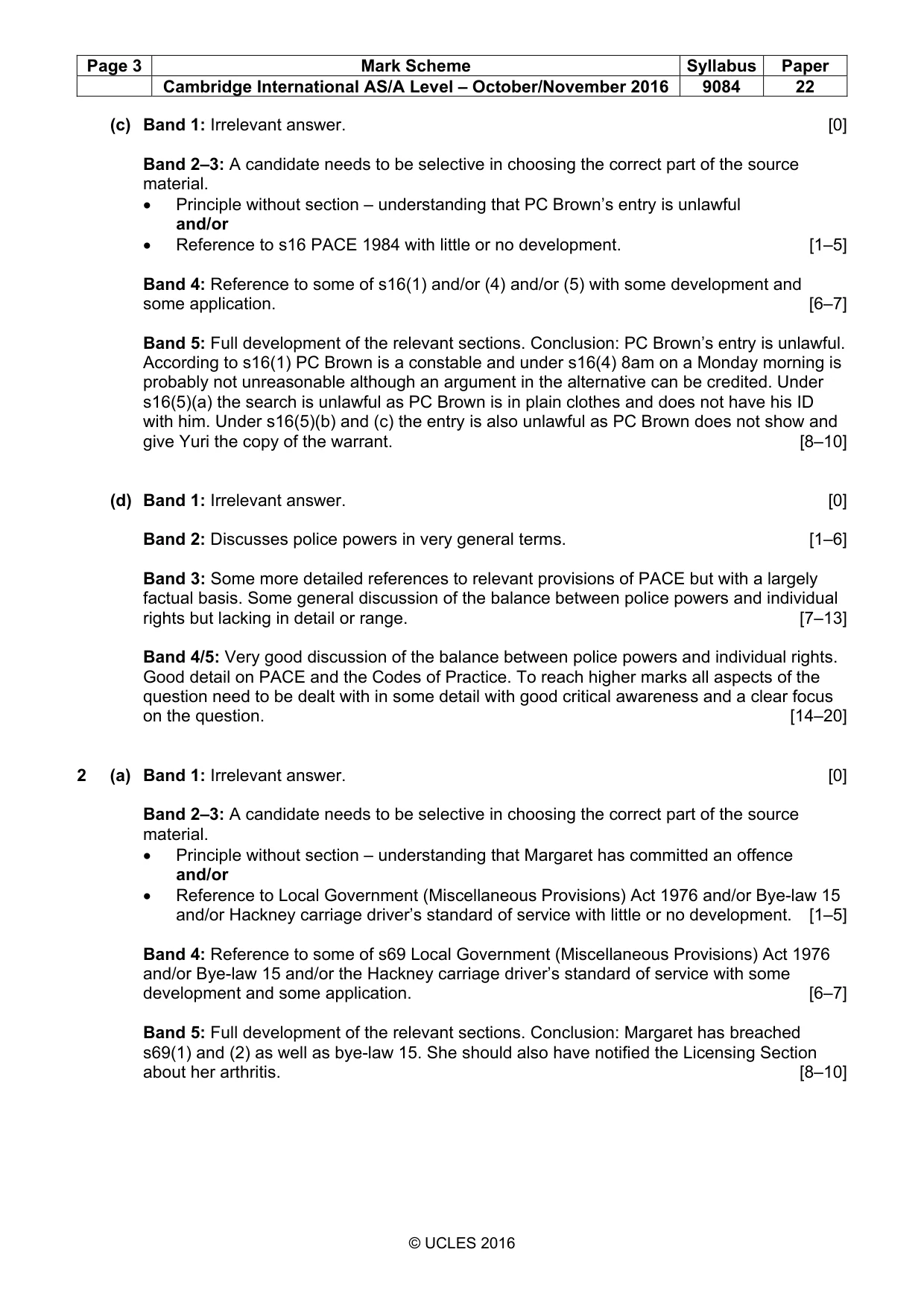
Page 2 Mark Scheme Syllabus Paper Cambridge International AS/A Level – October/November 2016 9084 22 © UCLES 2016 This mark scheme includes a summary of appropriate content for answering each question. It should be emphasised, however, that this material is for illustrative purposes and is not intended to provide a definitive guide to acceptable answers. It is quite possible that among the scripts there will be some candidate answers that are not covered directly by the content of this mark scheme. In such cases, professional judgement should be exercised in assessing the merits of the answer and the senior examiners should be consulted if further guidance is required. 1 (a) Band 1: Irrelevant answer. [0] Band 2–3: A candidate needs to be selective in choosing the correct part of the source material. • Principle without section – understanding that PC Smith will get a warrant and/or • Reference to PACE 1984 s8 with little or no development. [1–5] Band 4: Reference to some of s8(1)(a) and/or (b) and/or (c) with some development and some application. [6–7] Band 5: Full development of the relevant sections. Conclusion: PC Smith is likely to be granted a warrant under s8 to cover the house and the shed as robbery is an indictable offence and the behaviour of Fred’s wife suggests she does not want him in the house. As the shed is in the garden it is realistic that the stolen goods could be hidden there. [8–10] (b) Band 1: Irrelevant answer. [0] Band 2–3: A candidate needs to be selective in choosing the correct part of the source material. • Principle without section – understanding that PC Jones cannot take the letters and/or • Reference to PACE 1984 s9 and/or s10 with little or no development. [1–5] Band 4: Reference to some of s9 and/or s10 with some development and some application. [6–7] Band 5: Full development of the relevant sections. Conclusion: PC Jones is unlikely to be able to take the letters. They will be covered by s9(2)(a) and s10(1)(a). They are not covered by s10(2) as they relate to historical offences. Reference to s8 can be credited but is not essential to achieve full marks. [8–10]
Mark scheme, page 3
Page 3 Mark Scheme Syllabus Paper Cambridge International AS/A Level – October/November 2016 9084 22 © UCLES 2016 (c) Band 1: Irrelevant answer. [0] Band 2–3: A candidate needs to be selective in choosing the correct part of the source material. • Principle without section – understanding that PC Brown’s entry is unlawful and/or • Reference to s16 PACE 1984 with little or no development. [1–5] Band 4: Reference to some of s16(1) and/or (4) and/or (5) with some development and some application. [6–7] Band 5: Full development of the relevant sections. Conclusion: PC Brown’s entry is unlawful. According to s16(1) PC Brown is a constable and under s16(4) 8am on a Monday morning is probably not unreasonable although an argument in the alternative can be credited. Under s16(5)(a) the search is unlawful as PC Brown is in plain clothes and does not have his ID with him. Under s16(5)(b) and (c) the entry is also unlawful as PC Brown does not show and give Yuri the copy of the warrant. [8–10] (d) Band 1: Irrelevant answer. [0] Band 2: Discusses police powers in very general terms. [1–6] Band 3: Some more detailed references to relevant provisions of PACE but with a largely factual basis. Some general discussion of the balance between police powers and individual rights but lacking in detail or range. [7–13] Band 4/5: Very good discussion of the balance between police powers and individual rights. Good detail on PACE and the Codes of Practice. To reach higher marks all aspects of the question need to be dealt with in some detail with good critical awareness and a clear focus on the question. [14–20] 2 (a) Band 1: Irrelevant answer. [0] Band 2–3: A candidate needs to be selective in choosing the correct part of the source material. • Principle without section – understanding that Margaret has committed an offence and/or • Reference to Local Government (Miscellaneous Provisions) Act 1976 and/or Bye-law 15 and/or Hackney carriage driver’s standard of service with little or no development. [1–5] Band 4: Reference to some of s69 Local Government (Miscellaneous Provisions) Act 1976 and/or Bye-law 15 and/or the Hackney carriage driver’s standard of service with some development and some application. [6–7] Band 5: Full development of the relevant sections. Conclusion: Margaret has breached s69(1) and (2) as well as bye-law 15. She should also have notified the Licensing Section about her arthritis. [8–10]
Mark scheme, page 4
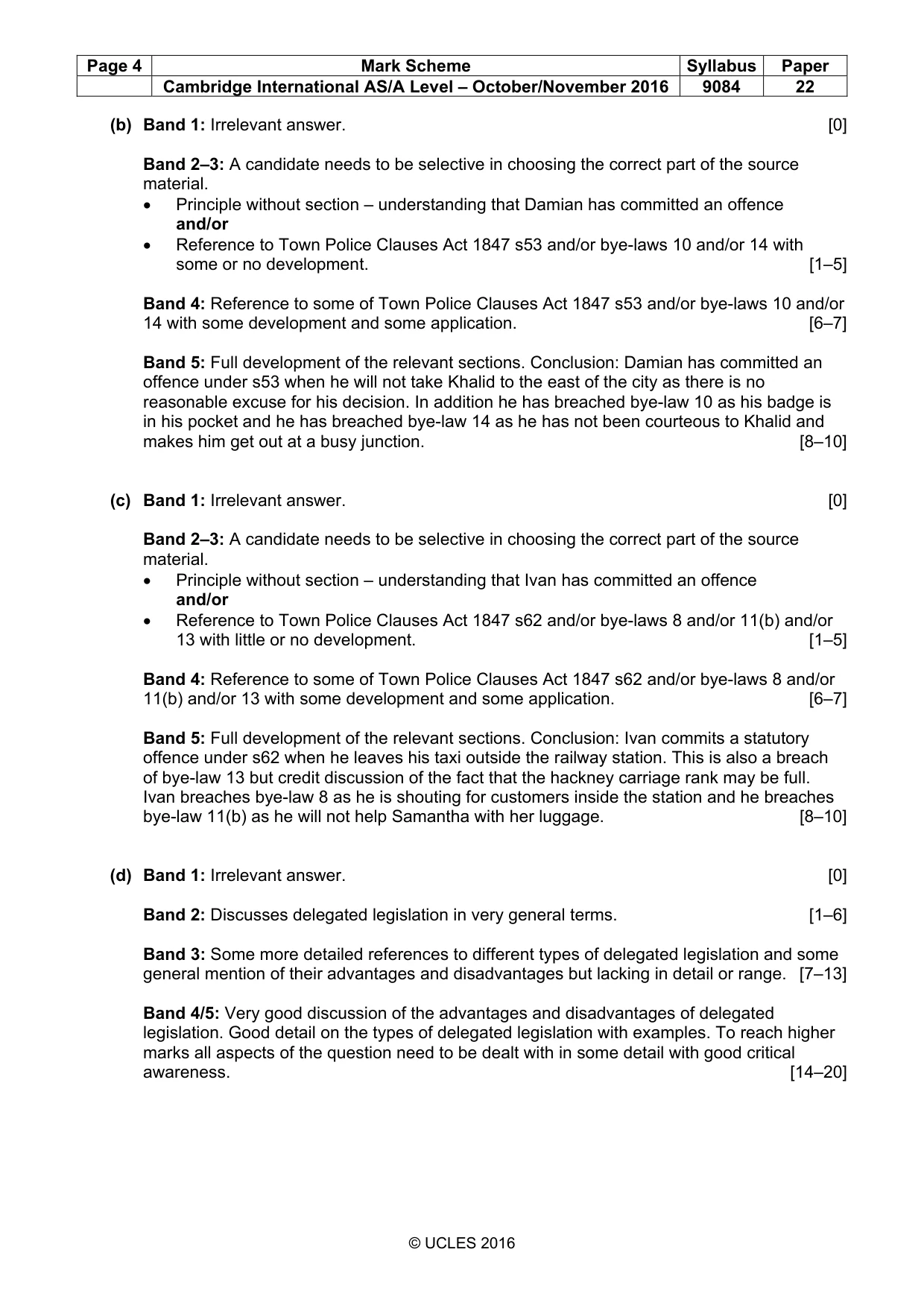
Page 4 Mark Scheme Syllabus Paper Cambridge International AS/A Level – October/November 2016 9084 22 © UCLES 2016 (b) Band 1: Irrelevant answer. [0] Band 2–3: A candidate needs to be selective in choosing the correct part of the source material. • Principle without section – understanding that Damian has committed an offence and/or • Reference to Town Police Clauses Act 1847 s53 and/or bye-laws 10 and/or 14 with some or no development. [1–5] Band 4: Reference to some of Town Police Clauses Act 1847 s53 and/or bye-laws 10 and/or 14 with some development and some application. [6–7] Band 5: Full development of the relevant sections. Conclusion: Damian has committed an offence under s53 when he will not take Khalid to the east of the city as there is no reasonable excuse for his decision. In addition he has breached bye-law 10 as his badge is in his pocket and he has breached bye-law 14 as he has not been courteous to Khalid and makes him get out at a busy junction. [8–10] (c) Band 1: Irrelevant answer. [0] Band 2–3: A candidate needs to be selective in choosing the correct part of the source material. • Principle without section – understanding that Ivan has committed an offence and/or • Reference to Town Police Clauses Act 1847 s62 and/or bye-laws 8 and/or 11(b) and/or 13 with little or no development. [1–5] Band 4: Reference to some of Town Police Clauses Act 1847 s62 and/or bye-laws 8 and/or 11(b) and/or 13 with some development and some application. [6–7] Band 5: Full development of the relevant sections. Conclusion: Ivan commits a statutory offence under s62 when he leaves his taxi outside the railway station. This is also a breach of bye-law 13 but credit discussion of the fact that the hackney carriage rank may be full. Ivan breaches bye-law 8 as he is shouting for customers inside the station and he breaches bye-law 11(b) as he will not help Samantha with her luggage. [8–10] (d) Band 1: Irrelevant answer. [0] Band 2: Discusses delegated legislation in very general terms. [1–6] Band 3: Some more detailed references to different types of delegated legislation and some general mention of their advantages and disadvantages but lacking in detail or range. [7–13] Band 4/5: Very good discussion of the advantages and disadvantages of delegated legislation. Good detail on the types of delegated legislation with examples. To reach higher marks all aspects of the question need to be dealt with in some detail with good critical awareness. [14–20]