Cambridge A Level Law 9084 — 2015 May/June Paper 3 · Variant 3
9084/33/M/J/15 · 75 marks · ≈84 min
The question paper and its mark scheme, free to read here and free to download. This is Cambridge’s own paper, exactly as it was sat.
Question paper4 pages

Mark scheme6 pages
Answers below. Sit the paper first if you are practising.
Paper as text
Question paper, page 1
This document consists of 3 printed pages and 1 blank page. DC (LK) 101027/1 © UCLES 2015 [Turn over Cambridge International Examinations Cambridge International Advanced Subsidiary and Advanced Level * 3 9 1 4 3 6 8 5 1 8 * LAW 9084/33 Paper 3 Law of Contract May/June 2015 1 hour 30 minutes Additional Materials: Answer Booklet/Paper READ THESE INSTRUCTIONS FIRST If you have been given an Answer Booklet, follow the instructions on the front cover of the Booklet. Write your Centre number, candidate number and name on all the work you hand in. Write in dark blue or black pen. Do not use staples, paper clips, glue or correction fluid. Answer one question from Section A, one from Section B and one other, thus making a total of three responses required. At the end of the examination, fasten all your work securely together. The number of marks is given in brackets [ ] at the end of each question or part question.
Question paper, page 2
2 9084/33/M/J/15 © UCLES 2015 Candidates must attempt one question from Section A, one from Section B and one other, thus making a total of three responses required. Section A 1 Explain the nature of liquidated damages clauses and penalty clauses. Evaluate the extent to which these clauses might achieve their desired intention. [25] 2 A contract comes into existence as soon as acceptance is communicated. Analyse the relevant legal rules and identify the exact moment in proceedings when a binding contract is actually formed, using appropriate case law examples. [25] 3 Describe the reasons why the law imposes limitations on the types of valid contract that minors can make. Critically assess whether these limitations ought to be revised to enable young people to progress in the modern world. [25]
Question paper, page 3
3 9084/33/M/J/15 © UCLES 2015 Section B 4 Patsy and Robert have spent their married life in a house which they bought in joint names with the help of a bank loan. Recently their marriage has broken down. They have decided to divorce and they have reached an agreement: Robert is to move out of the house and Patsy is to make the repayments for the remaining 10 years of the loan. Robert also agrees to transfer ownership of the entire property to her once she has repaid the loan in full. Robert moves out of the house but, after three weeks, he changes his mind and informs Patsy that he has decided not to transfer his share of the house to her after all. Patsy has yet to make her first loan payment when she learns of Robert’s decision. Advise Patsy whether or not she can legally enforce Robert’s original promise, using suitable case law to support your views. [25] 5 Sue is a self-employed sales agent and trainer for a large supplier of safety equipment for the prevention of fire. She enters a contract with Firebrand to act as an agent on its behalf with responsibility for making regular sales and training visits to the company’s customers. The written contract makes it a term that all customers in the area she is expected to cover are paid a visit at least once per calendar month. Sue discovers that some of the larger customers need her to visit so frequently that she is unable to visit every customer every month. A number of them complain to Firebrand because Sue has not visited them in the past two months to deliver essential fire safety training. Firebrand wishes to terminate the agency contract with Sue with immediate effect. Advise Sue and Firebrand of their legal positions in this situation. [25] 6 Ahmed wishes to buy Bashir’s tractor. Bashir wants £20 000 for it but Ahmed is undecided. Bashir invites Ahmed to have a close look at the tractor. While Ahmed is inspecting the tractor, Bashir tells him that he has only used it for light farm work, a new engine was fitted and the tractor is in excellent condition. Having completed the inspection and listened to what Bashir has had to say, Ahmed pays Bashir £20 000 and drives the tractor away. While driving it back to his farm, one of the tractor’s tyres bursts due to a dangerous split that Ahmed ought to have been able to see, but missed during his inspection of the vehicle. A few weeks later, Ahmed has difficulty with the tractor’s engine and he asks a mechanic to look at the problem. The mechanic explains that the engine is not new but is the original one which has been poorly repaired. Ahmed is very dissatisfied with his purchase and wishes to return the tractor to Bashir and get his money back. Discuss the parties’ respective rights and liabilities in this situation. [25]
Question paper, page 4
4 9084/33/M/J/15 © UCLES 2015 Permission to reproduce items where third-party owned material protected by copyright is included has been sought and cleared where possible. Every reasonable effort has been made by the publisher (UCLES) to trace copyright holders, but if any items requiring clearance have unwittingly been included, the publisher will be pleased to make amends at the earliest possible opportunity. To avoid the issue of disclosure of answer-related information to candidates, all copyright acknowledgements are reproduced online in the Cambridge International Examinations Copyright Acknowledgements Booklet. This is produced for each series of examinations and is freely available to download at www.cie.org.uk after the live examination series. Cambridge International Examinations is part of the Cambridge Assessment Group. Cambridge Assessment is the brand name of University of Cambridge Local Examinations Syndicate (UCLES), which is itself a department of the University of Cambridge. BLANK PAGE
Mark scheme, page 1
® IGCSE is the registered trademark of Cambridge International Examinations. CAMBRIDGE INTERNATIONAL EXAMINATIONS Cambridge International Advanced Level MARK SCHEME for the May/June 2015 series 9084 LAW 9084/33 Paper 3 (Paper 3), maximum raw mark 75 This mark scheme is published as an aid to teachers and candidates, to indicate the requirements of the examination. It shows the basis on which Examiners were instructed to award marks. It does not indicate the details of the discussions that took place at an Examiners’ meeting before marking began, which would have considered the acceptability of alternative answers. Mark schemes should be read in conjunction with the question paper and the Principal Examiner Report for Teachers. Cambridge will not enter into discussions about these mark schemes. Cambridge is publishing the mark schemes for the May/June 2015 series for most Cambridge IGCSE®, Cambridge International A and AS Level components and some Cambridge O Level components.
Mark scheme, page 2
Page 2 Mark Scheme Syllabus Paper Cambridge International A Level – May/June 2015 9084 33 © Cambridge International Examinations 2015 Assessment Objectives Candidates are expected to demonstrate: Knowledge and Understanding − recall, select, use and develop knowledge and understanding of legal principles and rules by means of example and citation Analysis, Evaluation and Application − analyse and evaluate legal materials, situations and issues and accurately apply appropriate principles and rules Communication and Presentation − use appropriate legal terminology to present logical and coherent argument and to communicate relevant material in a clear and concise manner. Specification Grid The relationship between the Assessment Objectives and this individual component is detailed below. The objectives are weighted to give an indication of their relative importance, rather than to provide a precise statement of the percentage mark allocation to particular assessment objectives, but indicative marks per question attempted on Paper 3 are shown in brackets. Assessment Objective Paper 1 Paper 2 Paper 3 Paper 4 Advanced Level Knowledge/ Understanding 50 50 50 (13) 50 50 Analysis/ Evaluation/ Application 40 40 40 (10) 40 40 Communication/ Presentation 10 10 10 (2) 10 10
Mark scheme, page 3
Page 3 Mark Scheme Syllabus Paper Cambridge International A Level – May/June 2015 9084 33 © Cambridge International Examinations 2015 Mark Bands The mark bands and descriptors applicable to all questions on the paper are as follows. Maximum mark allocations are indicated in the table at the foot of the page. Indicative content for each of the questions follows overleaf. Band 1: The answer contains no relevant material. Band 2: The candidate introduces fragments of information or unexplained examples from which no coherent explanation or analysis can emerge OR The candidate attempts to introduce an explanation and/or analysis but it is so fundamentally undermined by error and confusion that it remains substantially incoherent. Band 3: The candidate begins to indicate some capacity for explanation and analysis by introducing some of the issues, but explanations are limited and superficial OR The candidate adopts an approach in which there is concentration on explanation in terms of facts presented rather than through the development and explanation of legal principles and rules OR The candidate attempts to introduce material across the range of potential content, but it is weak or confused so that no real explanation or conclusion emerges. Band 4: Where there is more than one issue, the candidate demonstrates a clear understanding of one of the main issues of the question, giving explanations and using illustrations so that a full and detailed picture is presented of this issue OR The candidate presents a more limited explanation of all parts of the answer, but there is some lack of detail or superficiality in respect of either or both so that the answer is not fully rounded. Band 5: The candidate presents a detailed explanation and discussion of all areas of relevant law and, while there may be some minor inaccuracies and/or imbalance, a coherent explanation emerges. Maximum Mark Allocations: Question 1 2 3 4 5 6 Band 1 0 0 0 0 0 0 Band 2 6 6 6 6 6 6 Band 3 12 12 12 12 12 12 Band 4 19 19 19 19 19 19 Band 5 25 25 25 25 25 25
Mark scheme, page 4
Page 4 Mark Scheme Syllabus Paper Cambridge International A Level – May/June 2015 9084 33 © Cambridge International Examinations 2015 Section A 1 Explain the nature of liquidated damages clauses and penalty clauses. Evaluate the extent to which these clauses might achieve their desired intention. Candidates should introduce their response by explaining that both liquidated damages and penalty clauses are means by which parties to a contract might attempt to fix the damages payable should the contract eventually be broken by any of the parties to it. The two types of clause should then be compared and contrasted in terms of purpose and effect. Liquidated damages represent a genuine attempt to estimate the loss likely to accrue in the event of a breach. If there is disagreement following breach, a court is likely to allow recovery of the agreed amount without proof of loss, regardless of the size of actual loss relative to the liquidated sum agreed. Penalty clauses usually result from attempts to enforce contract performance through threats of large compensation in the event of breach. The case of Dunlop Pneumatic Tyre Co v New Garage & Motor Co should be explored and the resultant principle as to when pre-determined damages should be considered a penalty explained. If considered a penalty, the clause containing the agreed damages would be ignored and court makes its own award of unliquidated damages based on actual losses flowing from the breach. Candidates must evaluate the effects of the two types of clause and draw clear conclusions supported by examples wherever possible. Factual recall only will limit marks to the maximum in band 3. 2 A contract comes into existence as soon as acceptance is communicated. Analyse the relevant legal rules and deduce the exact moment in proceedings when a binding contract is actually formed, using appropriate case law examples. Candidates must explain that contracts come into existence when a firm offer has been unconditionally accepted. Unconditional assent to the terms of the offer must be defined (Tinn v Hoffman) and its potential to be in oral or written form or implied by conduct should be explored and explained. Candidates should be credited for a brief examination of whether silence can also amount to an acceptance in law (Felthouse v Bindley; re Selectmove). Candidates should explore the battle of the forms in some detail and examine whether it really is the ‘last shot’ that succeeds in such cases (Butler Machine Tool Ltd v Ex-Cell-O Corp; British Road Services v Crutchley (Arthur V) Ltd). Candidates should also consider communication of acceptance (Entores v Miles Far East Corporation) and exceptions thereto, such as conduct and the posting rule (Adams v Lindsell; Henthorn v Fraser; Byrne v Van Tienhoven; Holwell Securities v Hughes; Brinkibon v Stahag Stahl GmbH) Factual recall without suitable discussion and conclusion will result in maximum marks within band 3.
Mark scheme, page 5
Page 5 Mark Scheme Syllabus Paper Cambridge International A Level – May/June 2015 9084 33 © Cambridge International Examinations 2015 3 Describe the reasons why the law imposes limitations on the types of valid contract that minors can make. Critically assess whether the limitations ought to be revised to enable young people to progress in the modern world. The law on minors and contracts is widely considered to be out of step with today’s society. Candidates should outline that the rules provide that only executed contracts for necessary goods and services can be enforced against minors at common law and even then only actions for a reasonable price can be entertained and that all other contracts are voidable at the minor’s option. Candidates might point out that case law is commonly a century or more old and involve 18–21 year olds who would be considered adults today. The age of majority has indeed been reduced and reflected by the law, but does the law need to be updated now that many 16 and 17 year olds are in full-time employment and are far from naïve in the world of modern education and communication. Moreover society’s expectations of young people have changed. Candidates might reflect on the Law Commission’s proposal in 1982 that all contracts should be binding on the over 16s. Candidates are expected to assess the situation and make suggestions regarding revision to reach band 4. Section B 4 Advise Patsy whether or not she can legally enforce Robert’s original promise, using suitable case law to support your views. Candidates might introduce responses to this question by outlining the need not only for agreement, but also for intention that the agreement should be legally binding and potentially lead to legal consequences. Distinctions should be drawn to highlight presumptions ordinarily made by the courts as regards social or domestic agreements and commercial agreements. Candidates should recognise that being a domestic agreement in this case, courts might ordinarily presume no intention to create legal relations (Balfour v Balfour; Merritt v Merritt). On the basis of Merritt, candidates might be correct in deducing that there was intent in this case. On that assumption, candidates need to consider the existence of offer and acceptance. It would appear that Robert made a unilateral offer which was to be accepted by Patsy’s performance. The question to be answered in this instance is whether or not Robert can revoke his offer once Patsy has started to perform her part of the bargain (i.e. repay the loan) or whether he has until completion of performance to do so. Candidates should consider Errington v Errington in this context. On the basis of the findings in this case, it would appear that he could have revoked his offer up until the point that Patsy started to perform her part of the agreement, but that he would be unable to do so otherwise unless she stops paying the loan. Informed debate followed by clear, compelling conclusions is expected. Generalised responses, lacking focus on the question, or those limited to factual recall are to be awarded a maximum mark within band 3.
Mark scheme, page 6
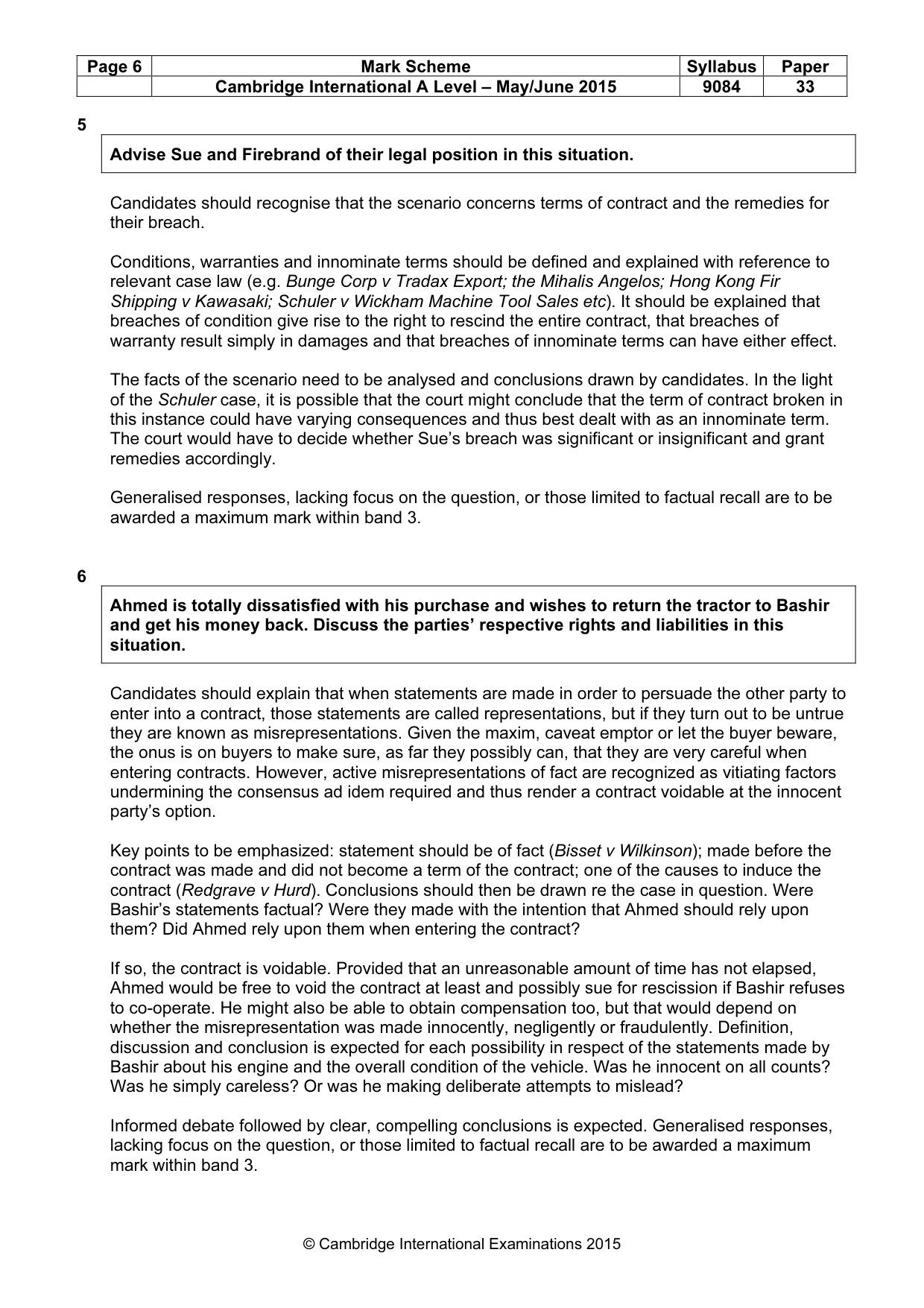
Page 6 Mark Scheme Syllabus Paper Cambridge International A Level – May/June 2015 9084 33 © Cambridge International Examinations 2015 5 Advise Sue and Firebrand of their legal position in this situation. Candidates should recognise that the scenario concerns terms of contract and the remedies for their breach. Conditions, warranties and innominate terms should be defined and explained with reference to relevant case law (e.g. Bunge Corp v Tradax Export; the Mihalis Angelos; Hong Kong Fir Shipping v Kawasaki; Schuler v Wickham Machine Tool Sales etc). It should be explained that breaches of condition give rise to the right to rescind the entire contract, that breaches of warranty result simply in damages and that breaches of innominate terms can have either effect. The facts of the scenario need to be analysed and conclusions drawn by candidates. In the light of the Schuler case, it is possible that the court might conclude that the term of contract broken in this instance could have varying consequences and thus best dealt with as an innominate term. The court would have to decide whether Sue’s breach was significant or insignificant and grant remedies accordingly. Generalised responses, lacking focus on the question, or those limited to factual recall are to be awarded a maximum mark within band 3. 6 Ahmed is totally dissatisfied with his purchase and wishes to return the tractor to Bashir and get his money back. Discuss the parties’ respective rights and liabilities in this situation. Candidates should explain that when statements are made in order to persuade the other party to enter into a contract, those statements are called representations, but if they turn out to be untrue they are known as misrepresentations. Given the maxim, caveat emptor or let the buyer beware, the onus is on buyers to make sure, as far they possibly can, that they are very careful when entering contracts. However, active misrepresentations of fact are recognized as vitiating factors undermining the consensus ad idem required and thus render a contract voidable at the innocent party’s option. Key points to be emphasized: statement should be of fact (Bisset v Wilkinson); made before the contract was made and did not become a term of the contract; one of the causes to induce the contract (Redgrave v Hurd). Conclusions should then be drawn re the case in question. Were Bashir’s statements factual? Were they made with the intention that Ahmed should rely upon them? Did Ahmed rely upon them when entering the contract? If so, the contract is voidable. Provided that an unreasonable amount of time has not elapsed, Ahmed would be free to void the contract at least and possibly sue for rescission if Bashir refuses to co-operate. He might also be able to obtain compensation too, but that would depend on whether the misrepresentation was made innocently, negligently or fraudulently. Definition, discussion and conclusion is expected for each possibility in respect of the statements made by Bashir about his engine and the overall condition of the vehicle. Was he innocent on all counts? Was he simply careless? Or was he making deliberate attempts to mislead? Informed debate followed by clear, compelling conclusions is expected. Generalised responses, lacking focus on the question, or those limited to factual recall are to be awarded a maximum mark within band 3.
What you needed in this session
Cambridge’s own grade thresholds for 2015 May/June, Paper 3 · Variant 3. A higher threshold means an easier paper — the bar moves with how the cohort did.