Cambridge A Level Law 9084 — 2015 May/June Paper 3 · Variant 2
9084/32/M/J/15 · 75 marks · ≈84 min
The question paper and its mark scheme, free to read here and free to download. This is Cambridge’s own paper, exactly as it was sat.
Question paper4 pages

Mark scheme8 pages
Answers below. Sit the paper first if you are practising.
Paper as text
Question paper, page 1
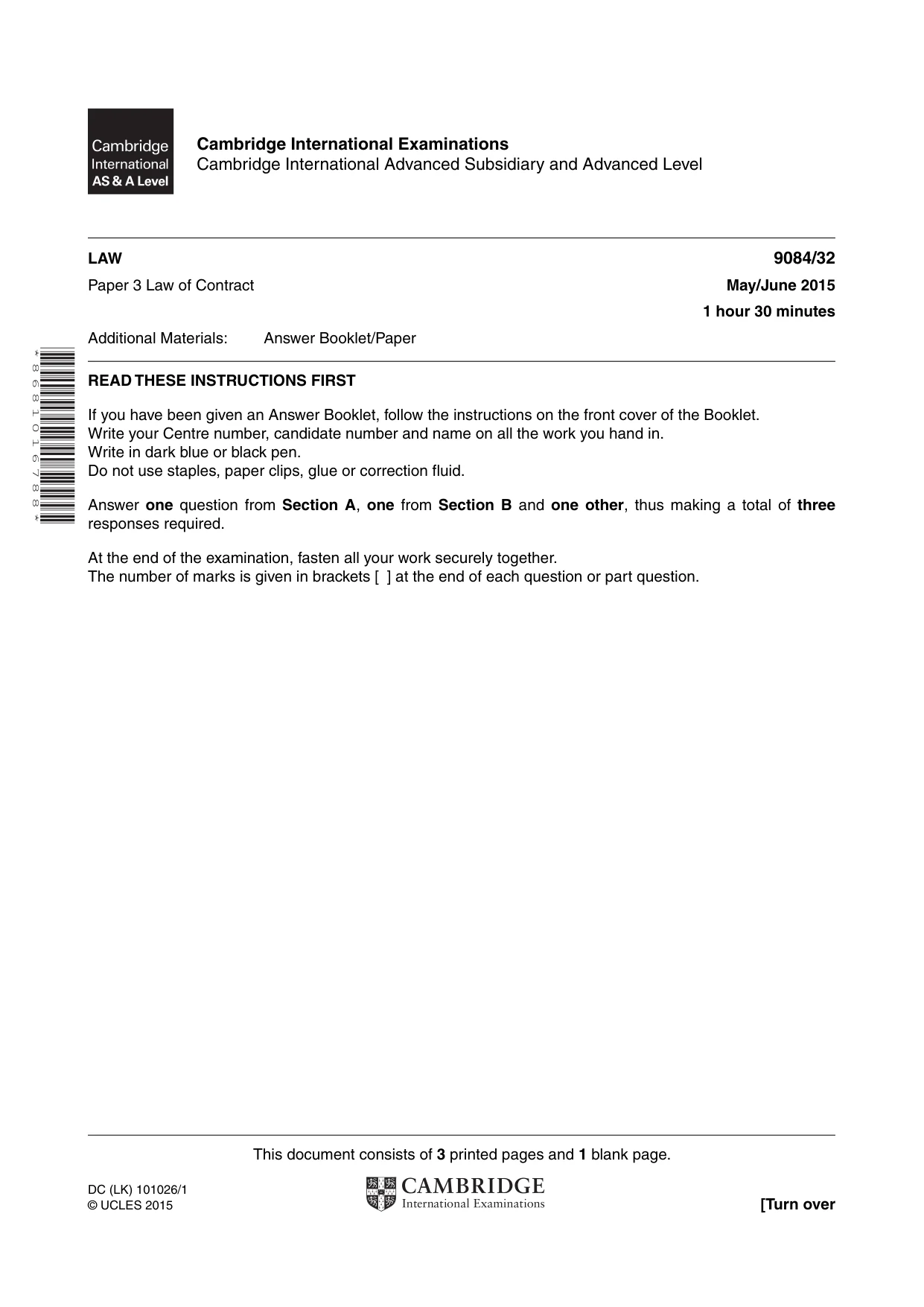
This document consists of 3 printed pages and 1 blank page. DC (LK) 101026/1 © UCLES 2015 [Turn over Cambridge International Examinations Cambridge International Advanced Subsidiary and Advanced Level * 8 6 8 1 0 1 6 7 8 8 * LAW 9084/32 Paper 3 Law of Contract May/June 2015 1 hour 30 minutes Additional Materials: Answer Booklet/Paper READ THESE INSTRUCTIONS FIRST If you have been given an Answer Booklet, follow the instructions on the front cover of the Booklet. Write your Centre number, candidate number and name on all the work you hand in. Write in dark blue or black pen. Do not use staples, paper clips, glue or correction fluid. Answer one question from Section A, one from Section B and one other, thus making a total of three responses required. At the end of the examination, fasten all your work securely together. The number of marks is given in brackets [ ] at the end of each question or part question.
Question paper, page 2
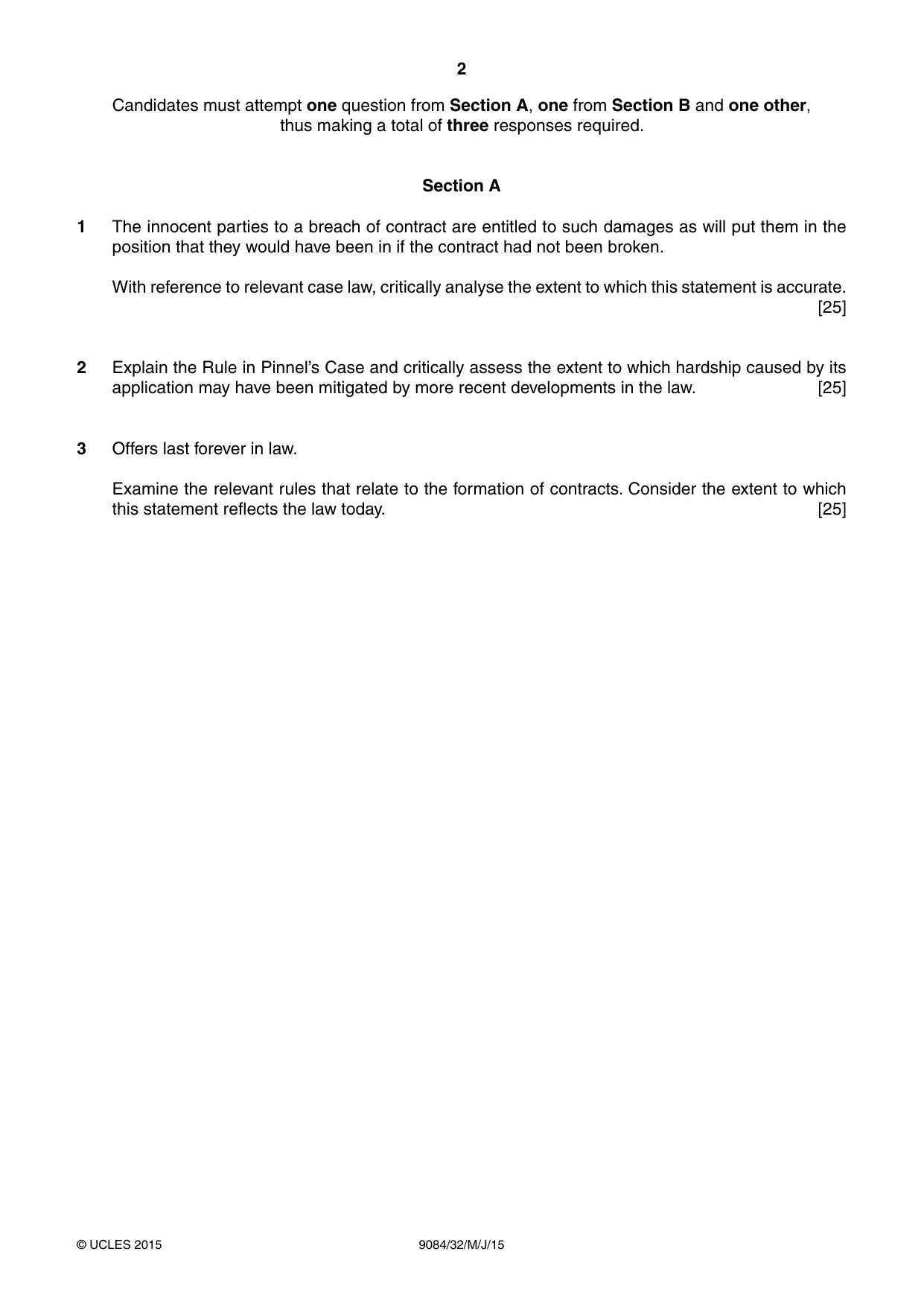
2 9084/32/M/J/15 © UCLES 2015 Candidates must attempt one question from Section A, one from Section B and one other, thus making a total of three responses required. Section A 1 The innocent parties to a breach of contract are entitled to such damages as will put them in the position that they would have been in if the contract had not been broken. With reference to relevant case law, critically analyse the extent to which this statement is accurate. [25] 2 Explain the Rule in Pinnel’s Case and critically assess the extent to which hardship caused by its application may have been mitigated by more recent developments in the law. [25] 3 Offers last forever in law. Examine the relevant rules that relate to the formation of contracts. Consider the extent to which this statement reflects the law today. [25]
Question paper, page 3
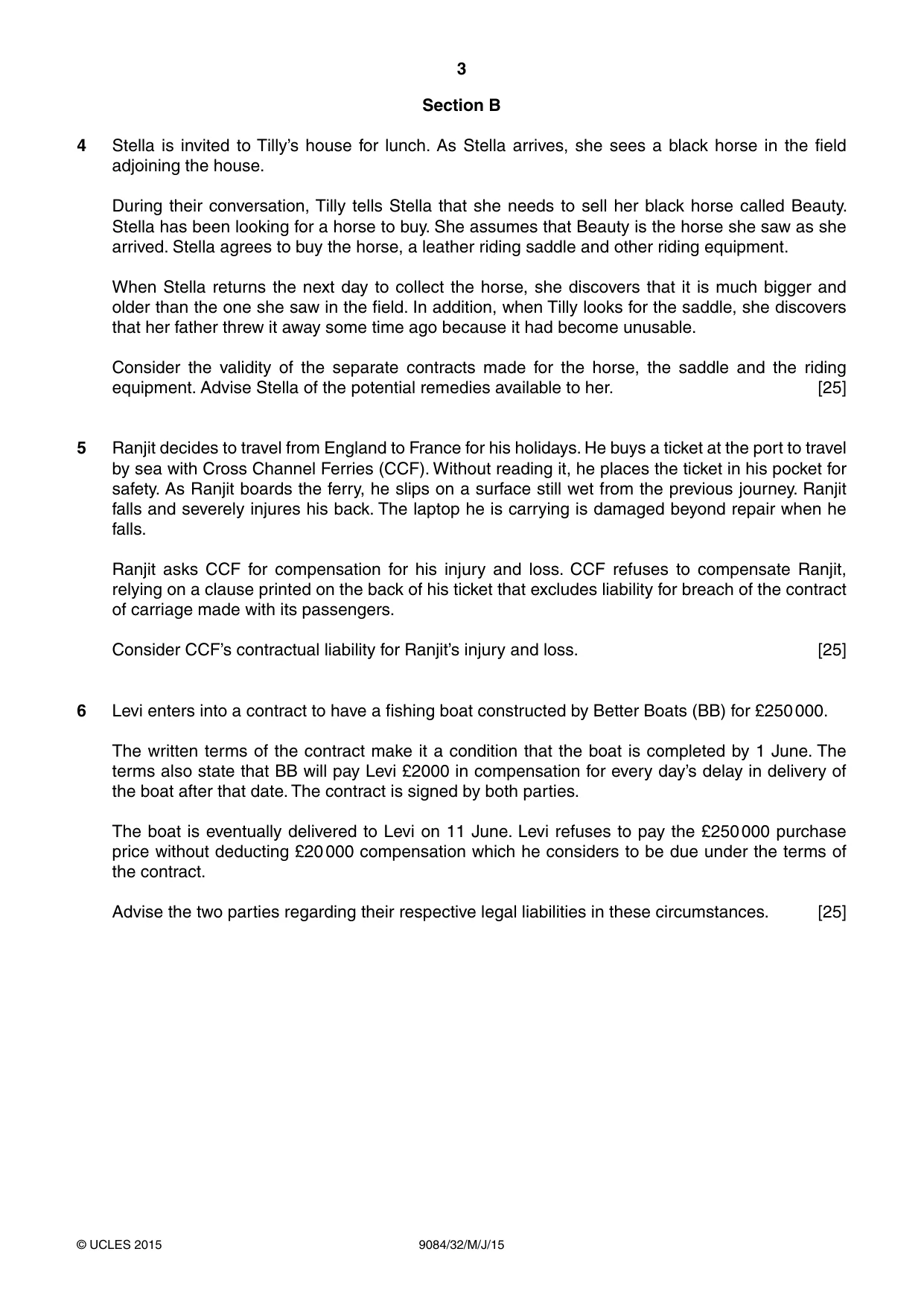
3 9084/32/M/J/15 © UCLES 2015 Section B 4 Stella is invited to Tilly’s house for lunch. As Stella arrives, she sees a black horse in the field adjoining the house. During their conversation, Tilly tells Stella that she needs to sell her black horse called Beauty. Stella has been looking for a horse to buy. She assumes that Beauty is the horse she saw as she arrived. Stella agrees to buy the horse, a leather riding saddle and other riding equipment. When Stella returns the next day to collect the horse, she discovers that it is much bigger and older than the one she saw in the field. In addition, when Tilly looks for the saddle, she discovers that her father threw it away some time ago because it had become unusable. Consider the validity of the separate contracts made for the horse, the saddle and the riding equipment. Advise Stella of the potential remedies available to her. [25] 5 Ranjit decides to travel from England to France for his holidays. He buys a ticket at the port to travel by sea with Cross Channel Ferries (CCF). Without reading it, he places the ticket in his pocket for safety. As Ranjit boards the ferry, he slips on a surface still wet from the previous journey. Ranjit falls and severely injures his back. The laptop he is carrying is damaged beyond repair when he falls. Ranjit asks CCF for compensation for his injury and loss. CCF refuses to compensate Ranjit, relying on a clause printed on the back of his ticket that excludes liability for breach of the contract of carriage made with its passengers. Consider CCF’s contractual liability for Ranjit’s injury and loss. [25] 6 Levi enters into a contract to have a fishing boat constructed by Better Boats (BB) for £250 000. The written terms of the contract make it a condition that the boat is completed by 1 June. The terms also state that BB will pay Levi £2000 in compensation for every day’s delay in delivery of the boat after that date. The contract is signed by both parties. The boat is eventually delivered to Levi on 11 June. Levi refuses to pay the £250 000 purchase price without deducting £20 000 compensation which he considers to be due under the terms of the contract. Advise the two parties regarding their respective legal liabilities in these circumstances. [25]
Question paper, page 4
4 9084/32/M/J/15 © UCLES 2015 Permission to reproduce items where third-party owned material protected by copyright is included has been sought and cleared where possible. Every reasonable effort has been made by the publisher (UCLES) to trace copyright holders, but if any items requiring clearance have unwittingly been included, the publisher will be pleased to make amends at the earliest possible opportunity. To avoid the issue of disclosure of answer-related information to candidates, all copyright acknowledgements are reproduced online in the Cambridge International Examinations Copyright Acknowledgements Booklet. This is produced for each series of examinations and is freely available to download at www.cie.org.uk after the live examination series. Cambridge International Examinations is part of the Cambridge Assessment Group. Cambridge Assessment is the brand name of University of Cambridge Local Examinations Syndicate (UCLES), which is itself a department of the University of Cambridge. BLANK PAGE
Mark scheme, page 1
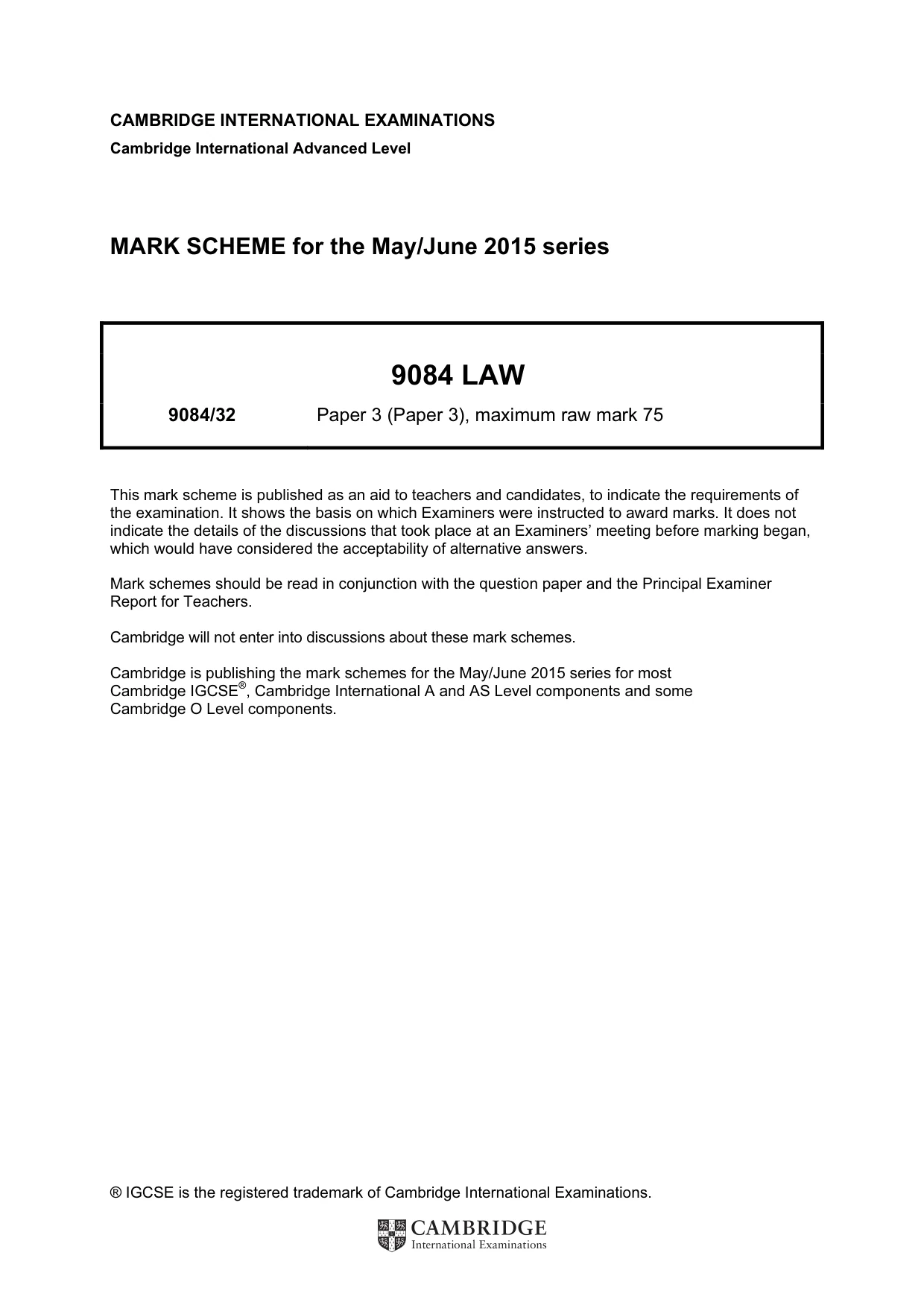
® IGCSE is the registered trademark of Cambridge International Examinations. CAMBRIDGE INTERNATIONAL EXAMINATIONS Cambridge International Advanced Level MARK SCHEME for the May/June 2015 series 9084 LAW 9084/32 Paper 3 (Paper 3), maximum raw mark 75 This mark scheme is published as an aid to teachers and candidates, to indicate the requirements of the examination. It shows the basis on which Examiners were instructed to award marks. It does not indicate the details of the discussions that took place at an Examiners’ meeting before marking began, which would have considered the acceptability of alternative answers. Mark schemes should be read in conjunction with the question paper and the Principal Examiner Report for Teachers. Cambridge will not enter into discussions about these mark schemes. Cambridge is publishing the mark schemes for the May/June 2015 series for most Cambridge IGCSE®, Cambridge International A and AS Level components and some Cambridge O Level components.
Mark scheme, page 2
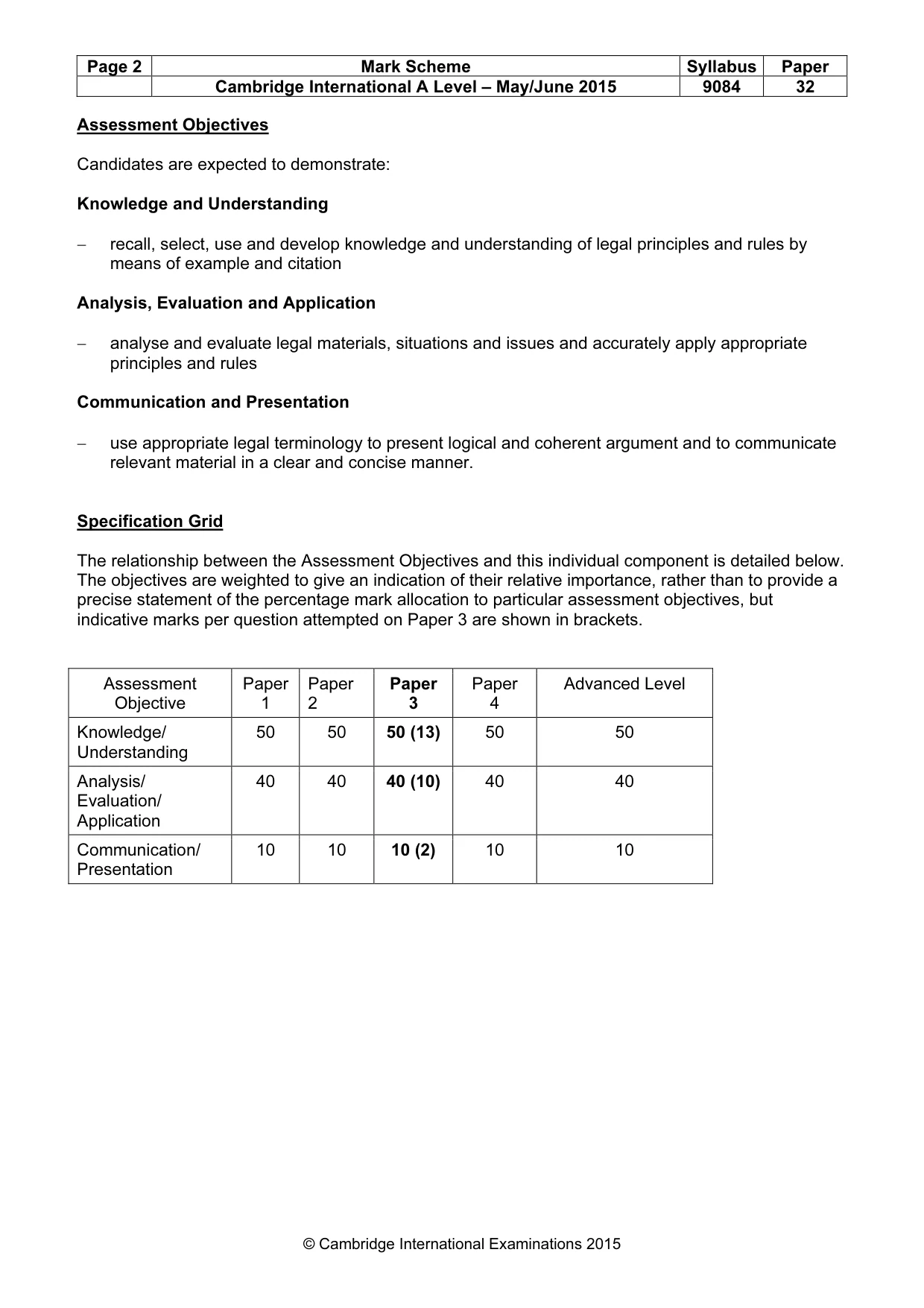
Page 2 Mark Scheme Syllabus Paper Cambridge International A Level – May/June 2015 9084 32 © Cambridge International Examinations 2015 Assessment Objectives Candidates are expected to demonstrate: Knowledge and Understanding − recall, select, use and develop knowledge and understanding of legal principles and rules by means of example and citation Analysis, Evaluation and Application − analyse and evaluate legal materials, situations and issues and accurately apply appropriate principles and rules Communication and Presentation − use appropriate legal terminology to present logical and coherent argument and to communicate relevant material in a clear and concise manner. Specification Grid The relationship between the Assessment Objectives and this individual component is detailed below. The objectives are weighted to give an indication of their relative importance, rather than to provide a precise statement of the percentage mark allocation to particular assessment objectives, but indicative marks per question attempted on Paper 3 are shown in brackets. Assessment Objective Paper 1 Paper 2 Paper 3 Paper 4 Advanced Level Knowledge/ Understanding 50 50 50 (13) 50 50 Analysis/ Evaluation/ Application 40 40 40 (10) 40 40 Communication/ Presentation 10 10 10 (2) 10 10
Mark scheme, page 3
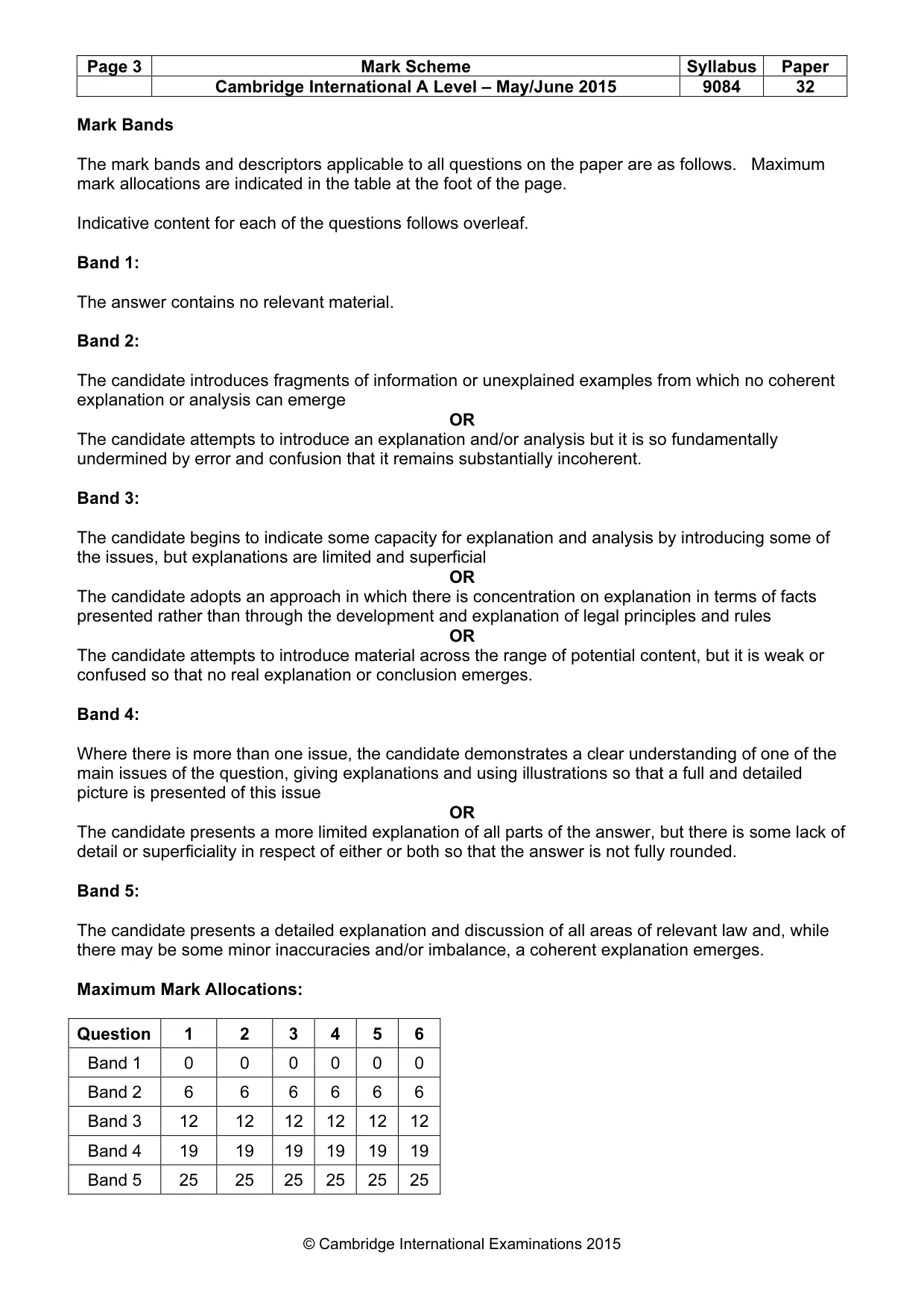
Page 3 Mark Scheme Syllabus Paper Cambridge International A Level – May/June 2015 9084 32 © Cambridge International Examinations 2015 Mark Bands The mark bands and descriptors applicable to all questions on the paper are as follows. Maximum mark allocations are indicated in the table at the foot of the page. Indicative content for each of the questions follows overleaf. Band 1: The answer contains no relevant material. Band 2: The candidate introduces fragments of information or unexplained examples from which no coherent explanation or analysis can emerge OR The candidate attempts to introduce an explanation and/or analysis but it is so fundamentally undermined by error and confusion that it remains substantially incoherent. Band 3: The candidate begins to indicate some capacity for explanation and analysis by introducing some of the issues, but explanations are limited and superficial OR The candidate adopts an approach in which there is concentration on explanation in terms of facts presented rather than through the development and explanation of legal principles and rules OR The candidate attempts to introduce material across the range of potential content, but it is weak or confused so that no real explanation or conclusion emerges. Band 4: Where there is more than one issue, the candidate demonstrates a clear understanding of one of the main issues of the question, giving explanations and using illustrations so that a full and detailed picture is presented of this issue OR The candidate presents a more limited explanation of all parts of the answer, but there is some lack of detail or superficiality in respect of either or both so that the answer is not fully rounded. Band 5: The candidate presents a detailed explanation and discussion of all areas of relevant law and, while there may be some minor inaccuracies and/or imbalance, a coherent explanation emerges. Maximum Mark Allocations: Question 1 2 3 4 5 6 Band 1 0 0 0 0 0 0 Band 2 6 6 6 6 6 6 Band 3 12 12 12 12 12 12 Band 4 19 19 19 19 19 19 Band 5 25 25 25 25 25 25
Mark scheme, page 4
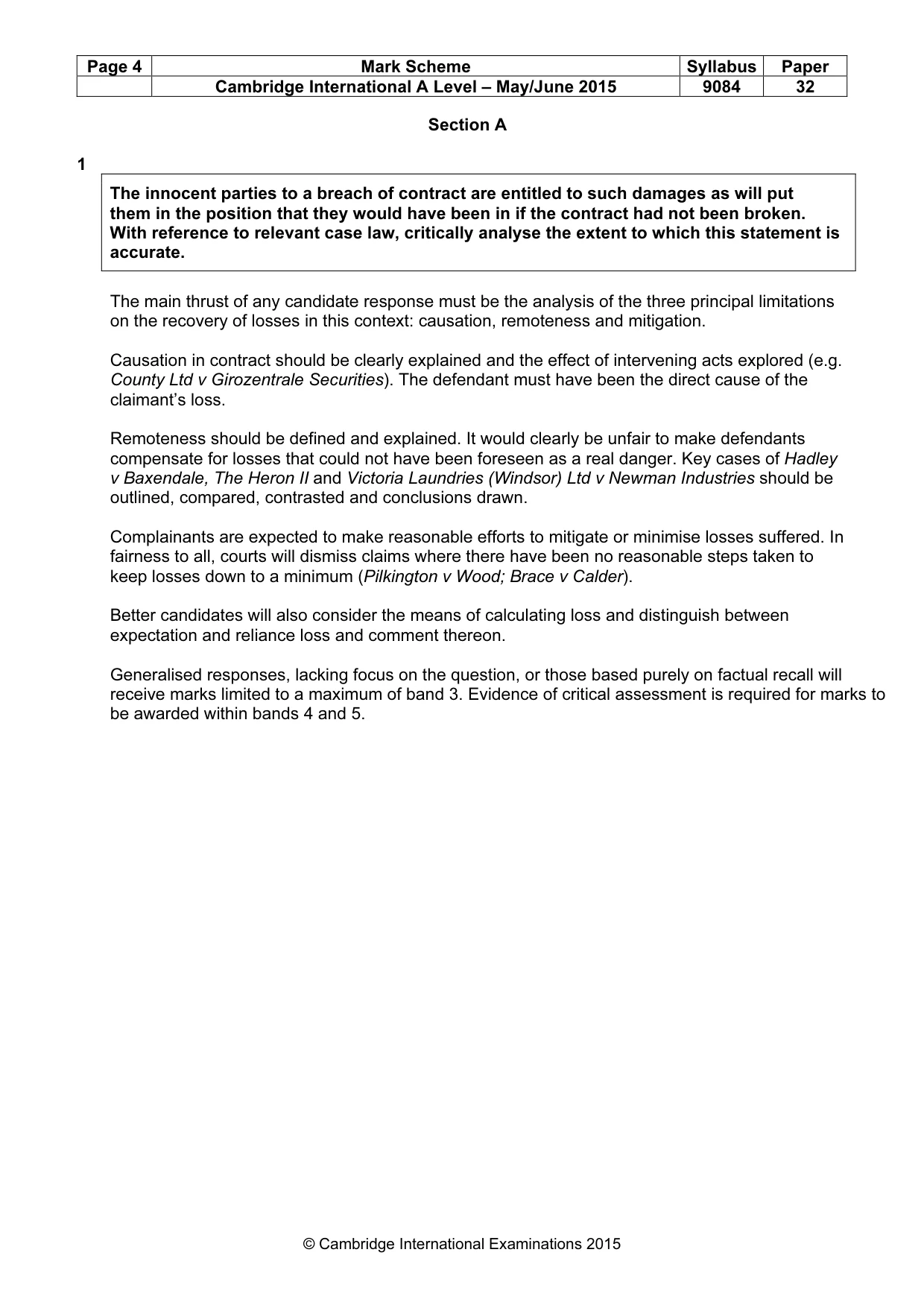
Page 4 Mark Scheme Syllabus Paper Cambridge International A Level – May/June 2015 9084 32 © Cambridge International Examinations 2015 Section A 1 The innocent parties to a breach of contract are entitled to such damages as will put them in the position that they would have been in if the contract had not been broken. With reference to relevant case law, critically analyse the extent to which this statement is accurate. The main thrust of any candidate response must be the analysis of the three principal limitations on the recovery of losses in this context: causation, remoteness and mitigation. Causation in contract should be clearly explained and the effect of intervening acts explored (e.g. County Ltd v Girozentrale Securities). The defendant must have been the direct cause of the claimant’s loss. Remoteness should be defined and explained. It would clearly be unfair to make defendants compensate for losses that could not have been foreseen as a real danger. Key cases of Hadley v Baxendale, The Heron II and Victoria Laundries (Windsor) Ltd v Newman Industries should be outlined, compared, contrasted and conclusions drawn. Complainants are expected to make reasonable efforts to mitigate or minimise losses suffered. In fairness to all, courts will dismiss claims where there have been no reasonable steps taken to keep losses down to a minimum (Pilkington v Wood; Brace v Calder). Better candidates will also consider the means of calculating loss and distinguish between expectation and reliance loss and comment thereon. Generalised responses, lacking focus on the question, or those based purely on factual recall will receive marks limited to a maximum of band 3. Evidence of critical assessment is required for marks to be awarded within bands 4 and 5.
Mark scheme, page 5
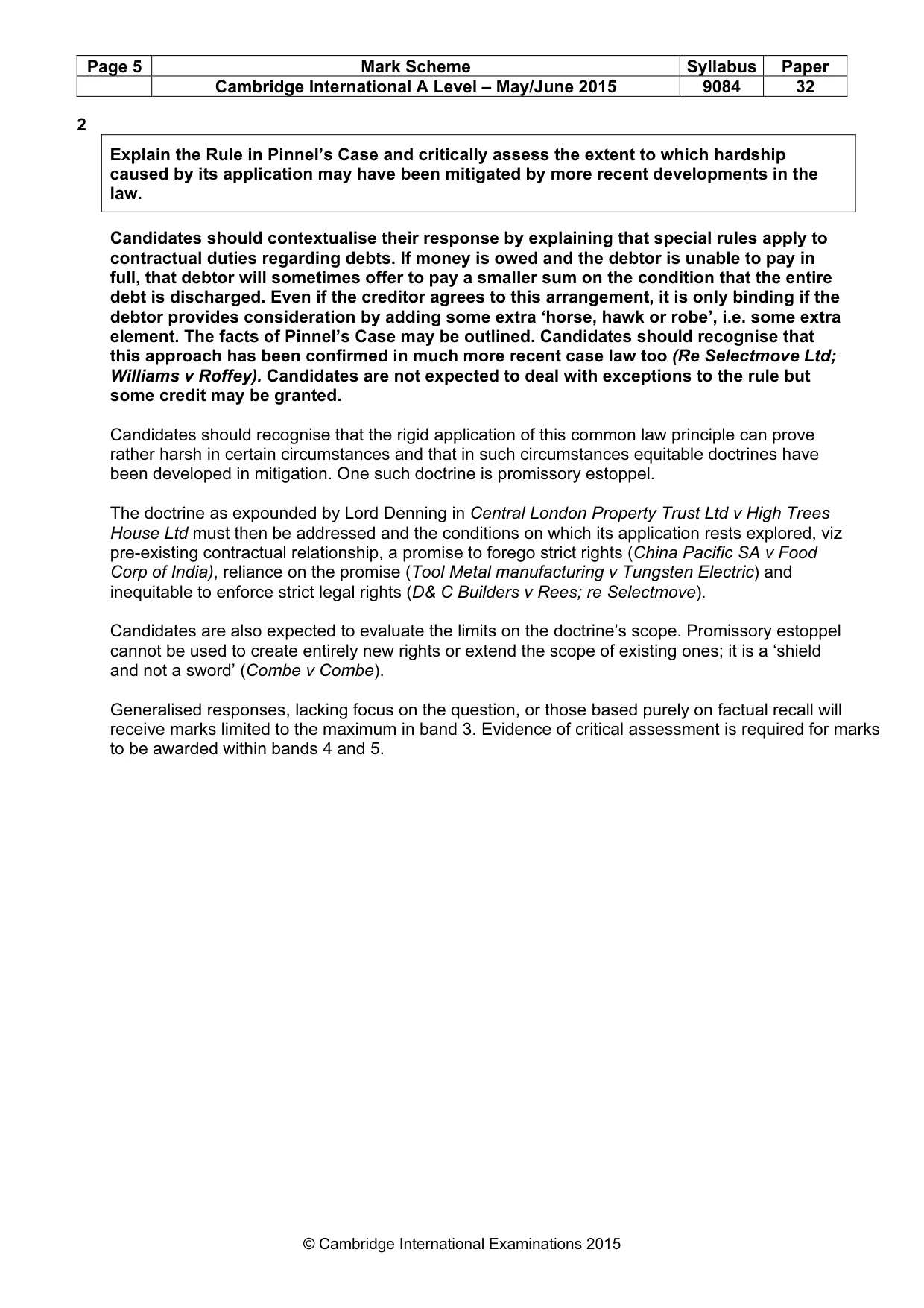
Page 5 Mark Scheme Syllabus Paper Cambridge International A Level – May/June 2015 9084 32 © Cambridge International Examinations 2015 2 Explain the Rule in Pinnel’s Case and critically assess the extent to which hardship caused by its application may have been mitigated by more recent developments in the law. Candidates should contextualise their response by explaining that special rules apply to contractual duties regarding debts. If money is owed and the debtor is unable to pay in full, that debtor will sometimes offer to pay a smaller sum on the condition that the entire debt is discharged. Even if the creditor agrees to this arrangement, it is only binding if the debtor provides consideration by adding some extra ‘horse, hawk or robe’, i.e. some extra element. The facts of Pinnel’s Case may be outlined. Candidates should recognise that this approach has been confirmed in much more recent case law too (Re Selectmove Ltd; Williams v Roffey). Candidates are not expected to deal with exceptions to the rule but some credit may be granted. Candidates should recognise that the rigid application of this common law principle can prove rather harsh in certain circumstances and that in such circumstances equitable doctrines have been developed in mitigation. One such doctrine is promissory estoppel. The doctrine as expounded by Lord Denning in Central London Property Trust Ltd v High Trees House Ltd must then be addressed and the conditions on which its application rests explored, viz pre-existing contractual relationship, a promise to forego strict rights (China Pacific SA v Food Corp of India), reliance on the promise (Tool Metal manufacturing v Tungsten Electric) and inequitable to enforce strict legal rights (D& C Builders v Rees; re Selectmove). Candidates are also expected to evaluate the limits on the doctrine’s scope. Promissory estoppel cannot be used to create entirely new rights or extend the scope of existing ones; it is a ‘shield and not a sword’ (Combe v Combe). Generalised responses, lacking focus on the question, or those based purely on factual recall will receive marks limited to the maximum in band 3. Evidence of critical assessment is required for marks to be awarded within bands 4 and 5.
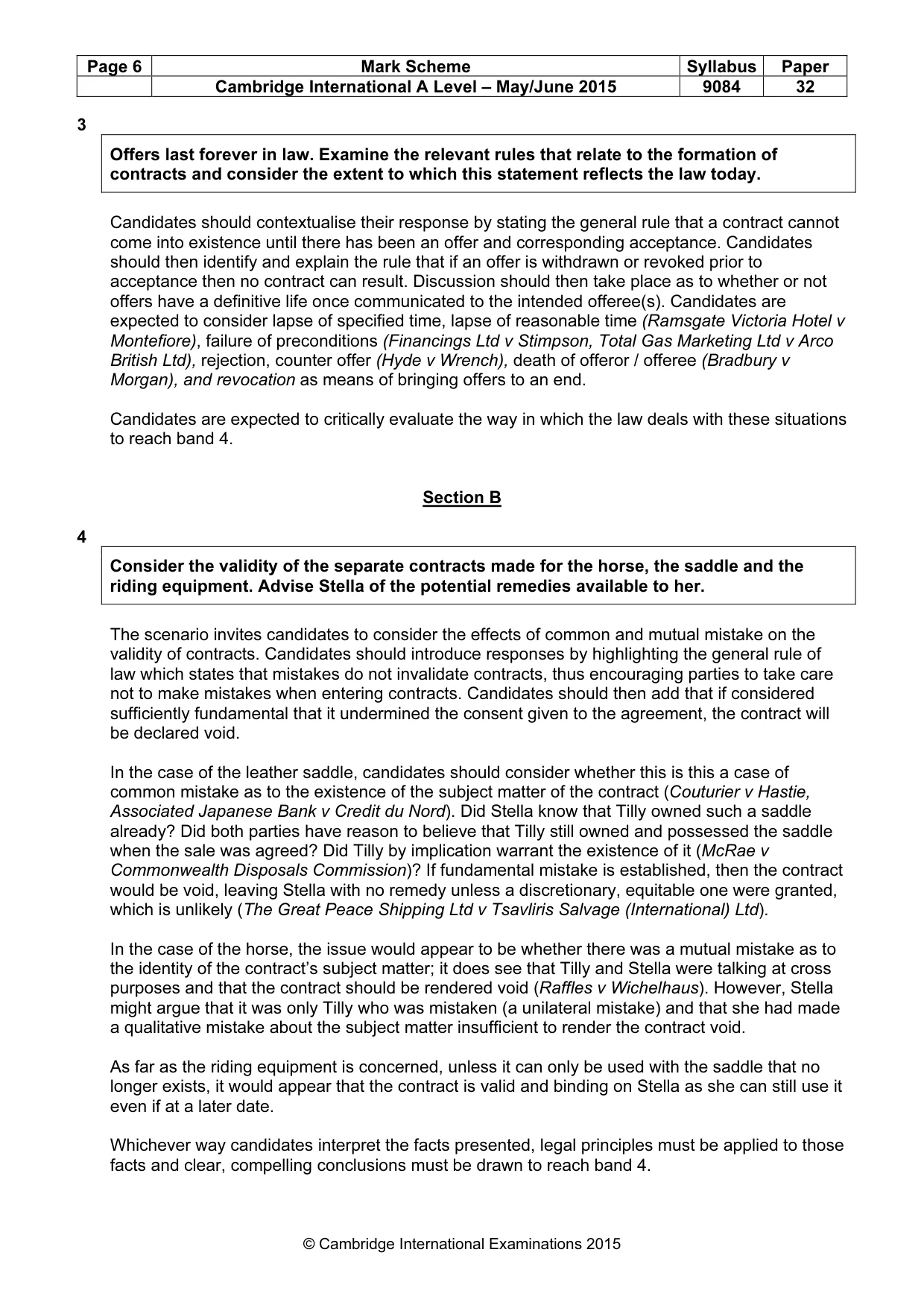
Mark scheme, page 6
Page 6 Mark Scheme Syllabus Paper Cambridge International A Level – May/June 2015 9084 32 © Cambridge International Examinations 2015 3 Offers last forever in law. Examine the relevant rules that relate to the formation of contracts and consider the extent to which this statement reflects the law today. Candidates should contextualise their response by stating the general rule that a contract cannot come into existence until there has been an offer and corresponding acceptance. Candidates should then identify and explain the rule that if an offer is withdrawn or revoked prior to acceptance then no contract can result. Discussion should then take place as to whether or not offers have a definitive life once communicated to the intended offeree(s). Candidates are expected to consider lapse of specified time, lapse of reasonable time (Ramsgate Victoria Hotel v Montefiore), failure of preconditions (Financings Ltd v Stimpson, Total Gas Marketing Ltd v Arco British Ltd), rejection, counter offer (Hyde v Wrench), death of offeror / offeree (Bradbury v Morgan), and revocation as means of bringing offers to an end. Candidates are expected to critically evaluate the way in which the law deals with these situations to reach band 4. Section B 4 Consider the validity of the separate contracts made for the horse, the saddle and the riding equipment. Advise Stella of the potential remedies available to her. The scenario invites candidates to consider the effects of common and mutual mistake on the validity of contracts. Candidates should introduce responses by highlighting the general rule of law which states that mistakes do not invalidate contracts, thus encouraging parties to take care not to make mistakes when entering contracts. Candidates should then add that if considered sufficiently fundamental that it undermined the consent given to the agreement, the contract will be declared void. In the case of the leather saddle, candidates should consider whether this is this a case of common mistake as to the existence of the subject matter of the contract (Couturier v Hastie, Associated Japanese Bank v Credit du Nord). Did Stella know that Tilly owned such a saddle already? Did both parties have reason to believe that Tilly still owned and possessed the saddle when the sale was agreed? Did Tilly by implication warrant the existence of it (McRae v Commonwealth Disposals Commission)? If fundamental mistake is established, then the contract would be void, leaving Stella with no remedy unless a discretionary, equitable one were granted, which is unlikely (The Great Peace Shipping Ltd v Tsavliris Salvage (International) Ltd). In the case of the horse, the issue would appear to be whether there was a mutual mistake as to the identity of the contract’s subject matter; it does see that Tilly and Stella were talking at cross purposes and that the contract should be rendered void (Raffles v Wichelhaus). However, Stella might argue that it was only Tilly who was mistaken (a unilateral mistake) and that she had made a qualitative mistake about the subject matter insufficient to render the contract void. As far as the riding equipment is concerned, unless it can only be used with the saddle that no longer exists, it would appear that the contract is valid and binding on Stella as she can still use it even if at a later date. Whichever way candidates interpret the facts presented, legal principles must be applied to those facts and clear, compelling conclusions must be drawn to reach band 4.
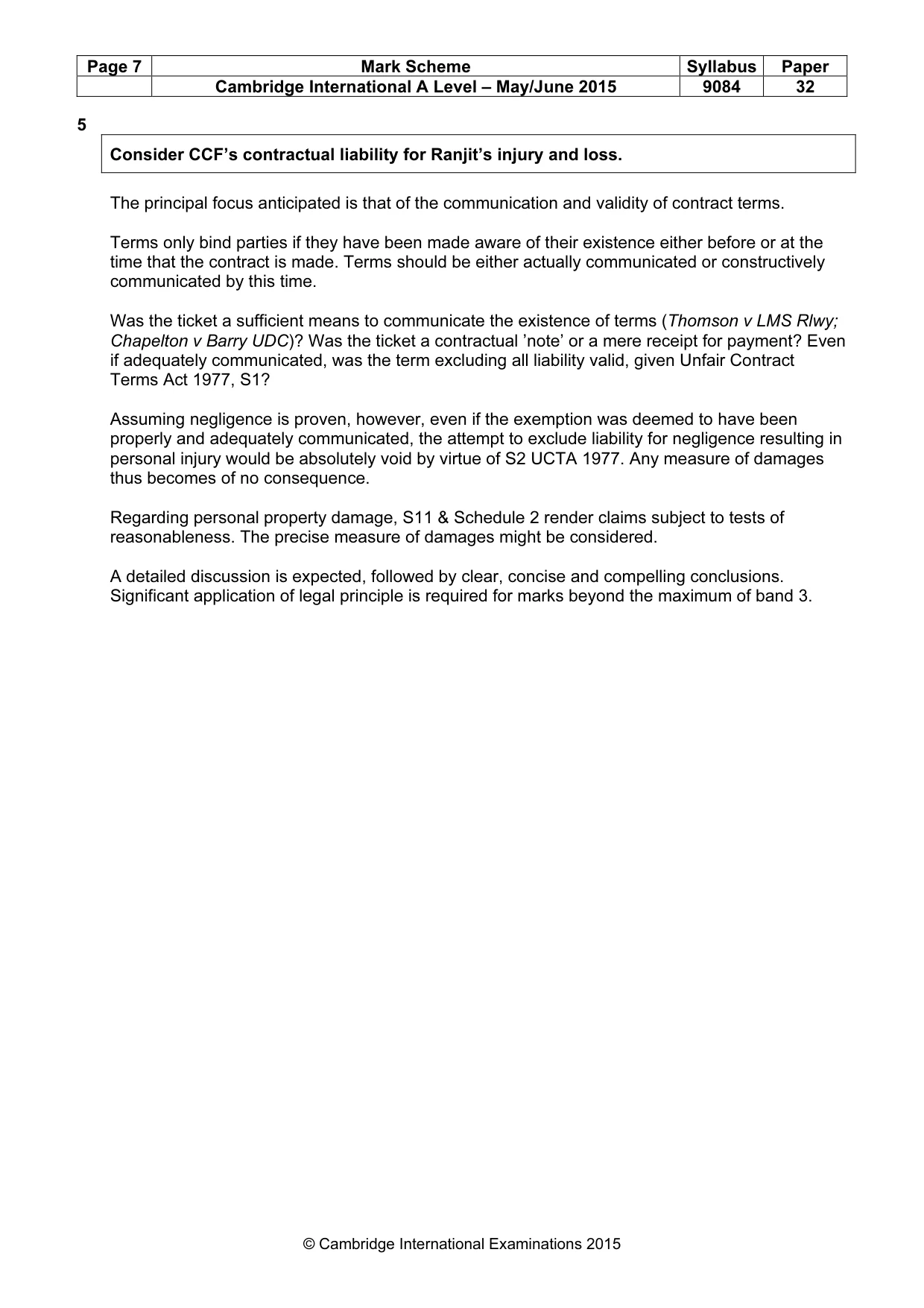
Mark scheme, page 7
Page 7 Mark Scheme Syllabus Paper Cambridge International A Level – May/June 2015 9084 32 © Cambridge International Examinations 2015 5 Consider CCF’s contractual liability for Ranjit’s injury and loss. The principal focus anticipated is that of the communication and validity of contract terms. Terms only bind parties if they have been made aware of their existence either before or at the time that the contract is made. Terms should be either actually communicated or constructively communicated by this time. Was the ticket a sufficient means to communicate the existence of terms (Thomson v LMS Rlwy; Chapelton v Barry UDC)? Was the ticket a contractual ’note’ or a mere receipt for payment? Even if adequately communicated, was the term excluding all liability valid, given Unfair Contract Terms Act 1977, S1? Assuming negligence is proven, however, even if the exemption was deemed to have been properly and adequately communicated, the attempt to exclude liability for negligence resulting in personal injury would be absolutely void by virtue of S2 UCTA 1977. Any measure of damages thus becomes of no consequence. Regarding personal property damage, S11 & Schedule 2 render claims subject to tests of reasonableness. The precise measure of damages might be considered. A detailed discussion is expected, followed by clear, concise and compelling conclusions. Significant application of legal principle is required for marks beyond the maximum of band 3.
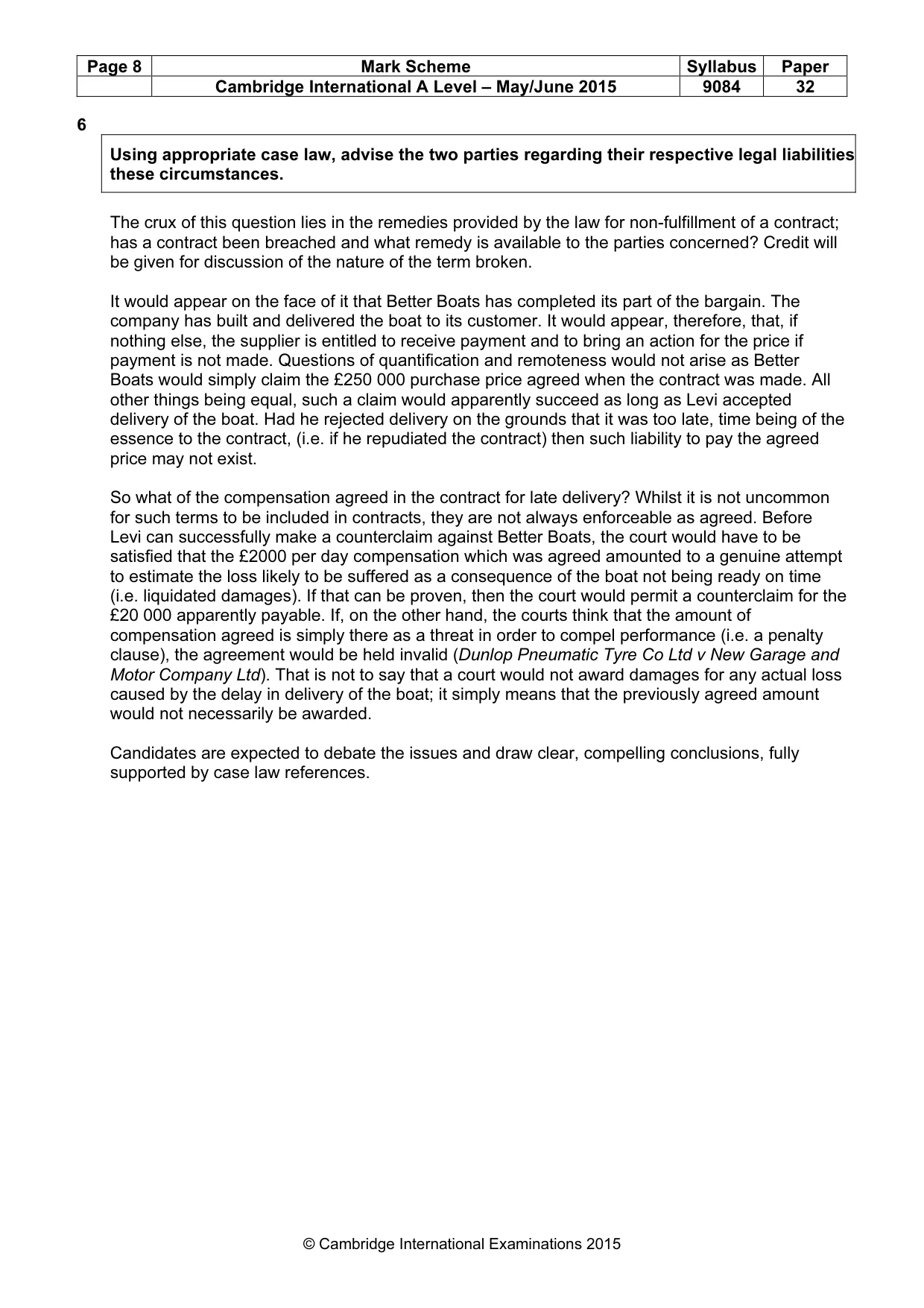
Mark scheme, page 8
Page 8 Mark Scheme Syllabus Paper Cambridge International A Level – May/June 2015 9084 32 © Cambridge International Examinations 2015 6 Using appropriate case law, advise the two parties regarding their respective legal liabilities these circumstances. The crux of this question lies in the remedies provided by the law for non-fulfillment of a contract; has a contract been breached and what remedy is available to the parties concerned? Credit will be given for discussion of the nature of the term broken. It would appear on the face of it that Better Boats has completed its part of the bargain. The company has built and delivered the boat to its customer. It would appear, therefore, that, if nothing else, the supplier is entitled to receive payment and to bring an action for the price if payment is not made. Questions of quantification and remoteness would not arise as Better Boats would simply claim the £250 000 purchase price agreed when the contract was made. All other things being equal, such a claim would apparently succeed as long as Levi accepted delivery of the boat. Had he rejected delivery on the grounds that it was too late, time being of the essence to the contract, (i.e. if he repudiated the contract) then such liability to pay the agreed price may not exist. So what of the compensation agreed in the contract for late delivery? Whilst it is not uncommon for such terms to be included in contracts, they are not always enforceable as agreed. Before Levi can successfully make a counterclaim against Better Boats, the court would have to be satisfied that the £2000 per day compensation which was agreed amounted to a genuine attempt to estimate the loss likely to be suffered as a consequence of the boat not being ready on time (i.e. liquidated damages). If that can be proven, then the court would permit a counterclaim for the £20 000 apparently payable. If, on the other hand, the courts think that the amount of compensation agreed is simply there as a threat in order to compel performance (i.e. a penalty clause), the agreement would be held invalid (Dunlop Pneumatic Tyre Co Ltd v New Garage and Motor Company Ltd). That is not to say that a court would not award damages for any actual loss caused by the delay in delivery of the boat; it simply means that the previously agreed amount would not necessarily be awarded. Candidates are expected to debate the issues and draw clear, compelling conclusions, fully supported by case law references.
What you needed in this session
Cambridge’s own grade thresholds for 2015 May/June, Paper 3 · Variant 2. A higher threshold means an easier paper — the bar moves with how the cohort did.