Cambridge A Level Law 9084 — 2014 May/June Paper 3 · Variant 3
9084/33/M/J/14 · 75 marks · ≈84 min
The question paper and its mark scheme, free to read here and free to download. This is Cambridge’s own paper, exactly as it was sat.
Question paper4 pages

Mark scheme7 pages
Answers below. Sit the paper first if you are practising.
Paper as text
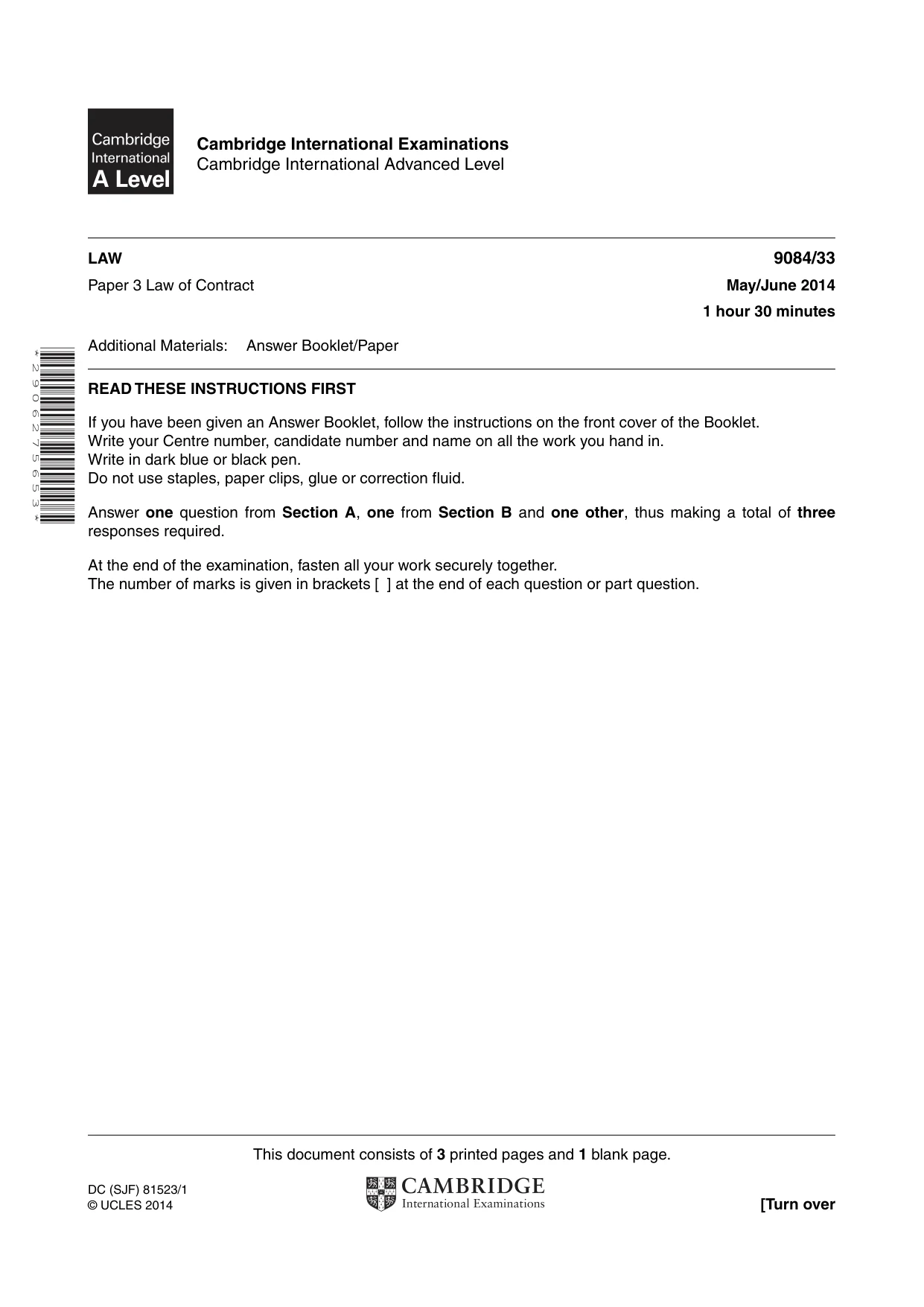
Question paper, page 1
This document consists of 3 printed pages and 1 blank page. DC (SJF) 81523/1 © UCLES 2014 [Turn over Cambridge International Examinations Cambridge International Advanced Level * 2 9 0 6 2 7 5 6 5 3 * LAW 9084/33 Paper 3 Law of Contract May/June 2014 1 hour 30 minutes Additional Materials: Answer Booklet/Paper READ THESE INSTRUCTIONS FIRST If you have been given an Answer Booklet, follow the instructions on the front cover of the Booklet. Write your Centre number, candidate number and name on all the work you hand in. Write in dark blue or black pen. Do not use staples, paper clips, glue or correction fluid. Answer one question from Section A, one from Section B and one other, thus making a total of three responses required. At the end of the examination, fasten all your work securely together. The number of marks is given in brackets [ ] at the end of each question or part question.
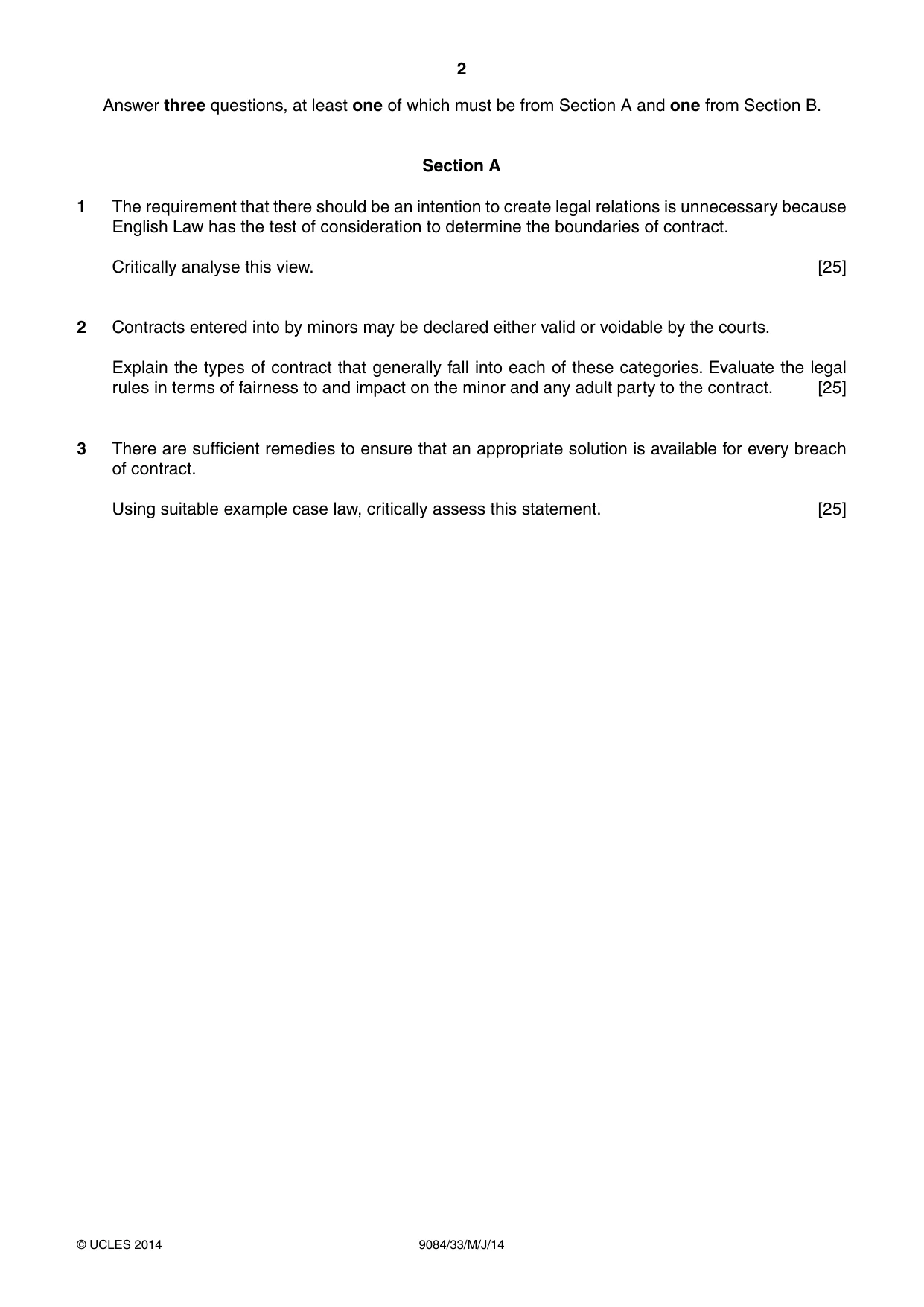
Question paper, page 2
2 9084/33/M/J/14 © UCLES 2014 Answer three questions, at least one of which must be from Section A and one from Section B. Section A 1 The requirement that there should be an intention to create legal relations is unnecessary because English Law has the test of consideration to determine the boundaries of contract. Critically analyse this view. [25] 2 Contracts entered into by minors may be declared either valid or voidable by the courts. Explain the types of contract that generally fall into each of these categories. Evaluate the legal rules in terms of fairness to and impact on the minor and any adult party to the contract. [25] 3 There are sufficient remedies to ensure that an appropriate solution is available for every breach of contract. Using suitable example case law, critically assess this statement. [25]
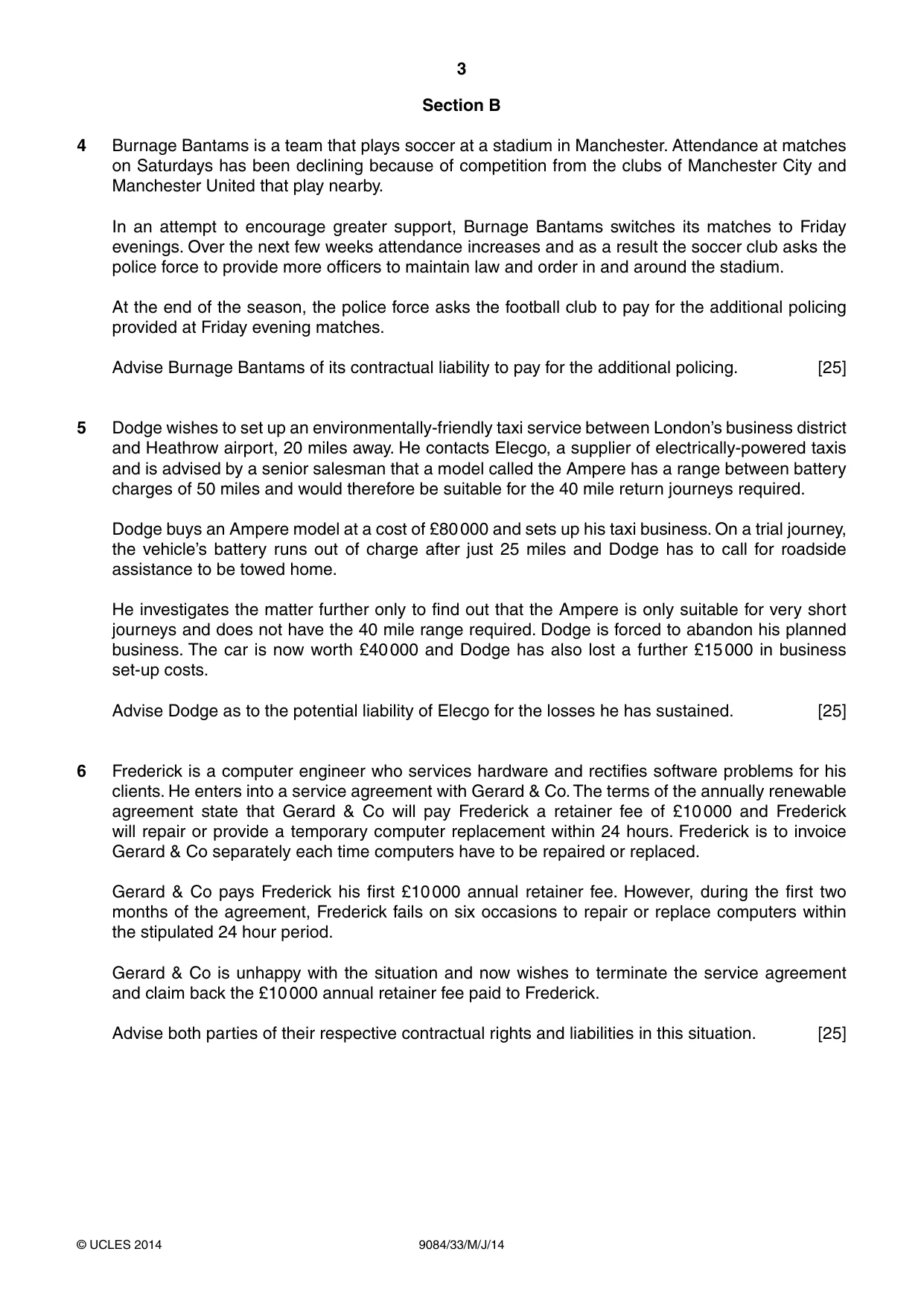
Question paper, page 3
3 9084/33/M/J/14 © UCLES 2014 Section B 4 Burnage Bantams is a team that plays soccer at a stadium in Manchester. Attendance at matches on Saturdays has been declining because of competition from the clubs of Manchester City and Manchester United that play nearby. In an attempt to encourage greater support, Burnage Bantams switches its matches to Friday evenings. Over the next few weeks attendance increases and as a result the soccer club asks the police force to provide more officers to maintain law and order in and around the stadium. At the end of the season, the police force asks the football club to pay for the additional policing provided at Friday evening matches. Advise Burnage Bantams of its contractual liability to pay for the additional policing. [25] 5 Dodge wishes to set up an environmentally-friendly taxi service between London’s business district and Heathrow airport, 20 miles away. He contacts Elecgo, a supplier of electrically-powered taxis and is advised by a senior salesman that a model called the Ampere has a range between battery charges of 50 miles and would therefore be suitable for the 40 mile return journeys required. Dodge buys an Ampere model at a cost of £80 000 and sets up his taxi business. On a trial journey, the vehicle’s battery runs out of charge after just 25 miles and Dodge has to call for roadside assistance to be towed home. He investigates the matter further only to find out that the Ampere is only suitable for very short journeys and does not have the 40 mile range required. Dodge is forced to abandon his planned business. The car is now worth £40 000 and Dodge has also lost a further £15 000 in business set-up costs. Advise Dodge as to the potential liability of Elecgo for the losses he has sustained. [25] 6 Frederick is a computer engineer who services hardware and rectifies software problems for his clients. He enters into a service agreement with Gerard & Co. The terms of the annually renewable agreement state that Gerard & Co will pay Frederick a retainer fee of £10 000 and Frederick will repair or provide a temporary computer replacement within 24 hours. Frederick is to invoice Gerard & Co separately each time computers have to be repaired or replaced. Gerard & Co pays Frederick his first £10 000 annual retainer fee. However, during the first two months of the agreement, Frederick fails on six occasions to repair or replace computers within the stipulated 24 hour period. Gerard & Co is unhappy with the situation and now wishes to terminate the service agreement and claim back the £10 000 annual retainer fee paid to Frederick. Advise both parties of their respective contractual rights and liabilities in this situation. [25]
Question paper, page 4
4 9084/33/M/J/14 © UCLES 2014 Permission to reproduce items where third-party owned material protected by copyright is included has been sought and cleared where possible. Every reasonable effort has been made by the publisher (UCLES) to trace copyright holders, but if any items requiring clearance have unwittingly been included, the publisher will be pleased to make amends at the earliest possible opportunity. Cambridge International Examinations is part of the Cambridge Assessment Group. Cambridge Assessment is the brand name of University of Cambridge Local Examinations Syndicate (UCLES), which is itself a department of the University of Cambridge. BLANK PAGE
Mark scheme, page 1
CAMBRIDGE INTERNATIONAL EXAMINATIONS GCE Advanced Level MARK SCHEME for the May/June 2014 series 9084 LAW 9084/33 Paper 3, maximum raw mark 75 This mark scheme is published as an aid to teachers and candidates, to indicate the requirements of the examination. It shows the basis on which Examiners were instructed to award marks. It does not indicate the details of the discussions that took place at an Examiners’ meeting before marking began, which would have considered the acceptability of alternative answers. Mark schemes should be read in conjunction with the question paper and the Principal Examiner Report for Teachers. Cambridge will not enter into discussions about these mark schemes. Cambridge is publishing the mark schemes for the May/June 2014 series for most IGCSE, GCE Advanced Level and Advanced Subsidiary Level components and some Ordinary Level components.
Mark scheme, page 2
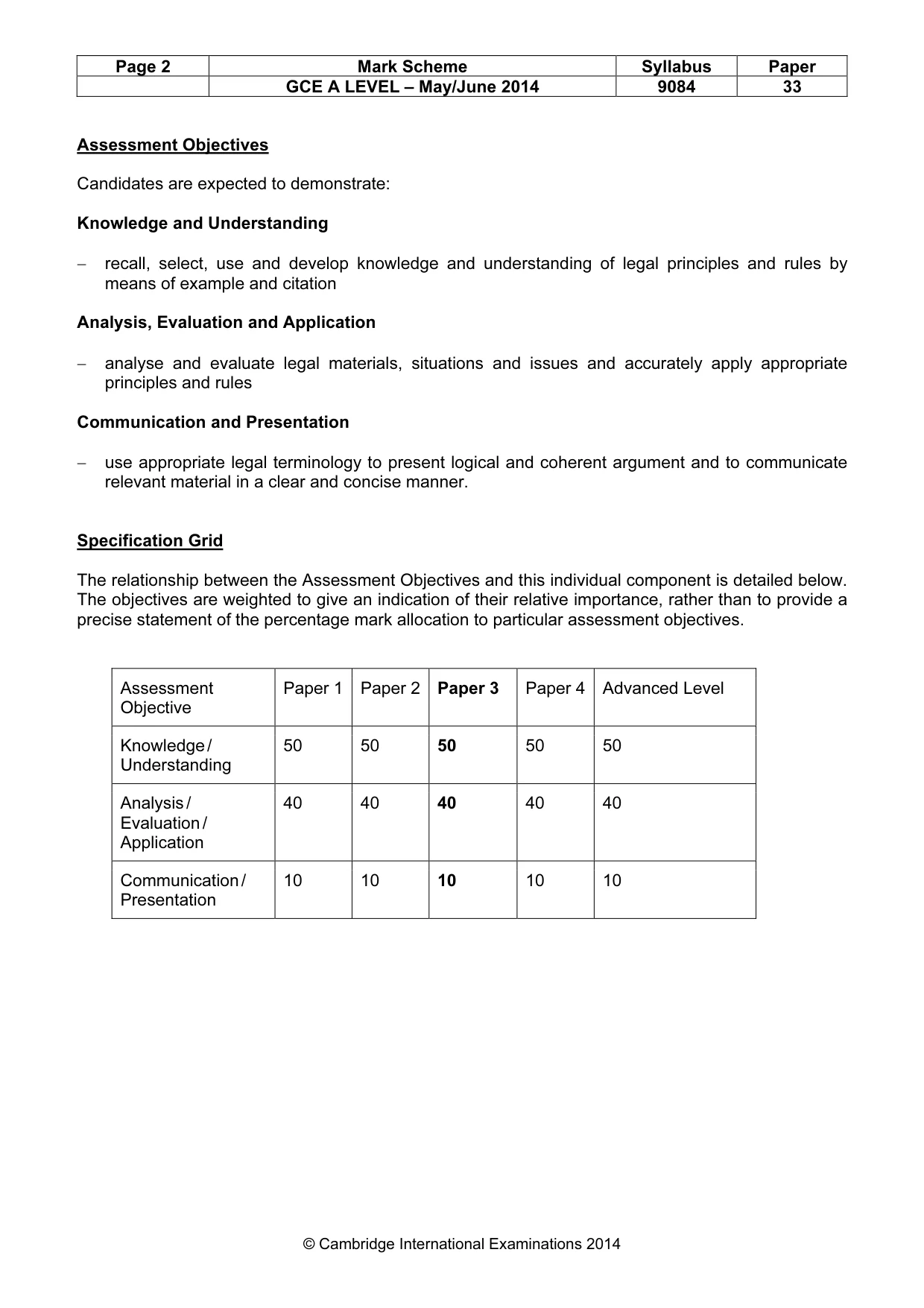
Page 2 Mark Scheme Syllabus Paper GCE A LEVEL – May/June 2014 9084 33 © Cambridge International Examinations 2014 Assessment Objectives Candidates are expected to demonstrate: Knowledge and Understanding − recall, select, use and develop knowledge and understanding of legal principles and rules by means of example and citation Analysis, Evaluation and Application − analyse and evaluate legal materials, situations and issues and accurately apply appropriate principles and rules Communication and Presentation − use appropriate legal terminology to present logical and coherent argument and to communicate relevant material in a clear and concise manner. Specification Grid The relationship between the Assessment Objectives and this individual component is detailed below. The objectives are weighted to give an indication of their relative importance, rather than to provide a precise statement of the percentage mark allocation to particular assessment objectives. Assessment Objective Paper 1 Paper 2 Paper 3 Paper 4 Advanced Level Knowledge / Understanding 50 50 50 50 50 Analysis / Evaluation / Application 40 40 40 40 40 Communication / Presentation 10 10 10 10 10
Mark scheme, page 3
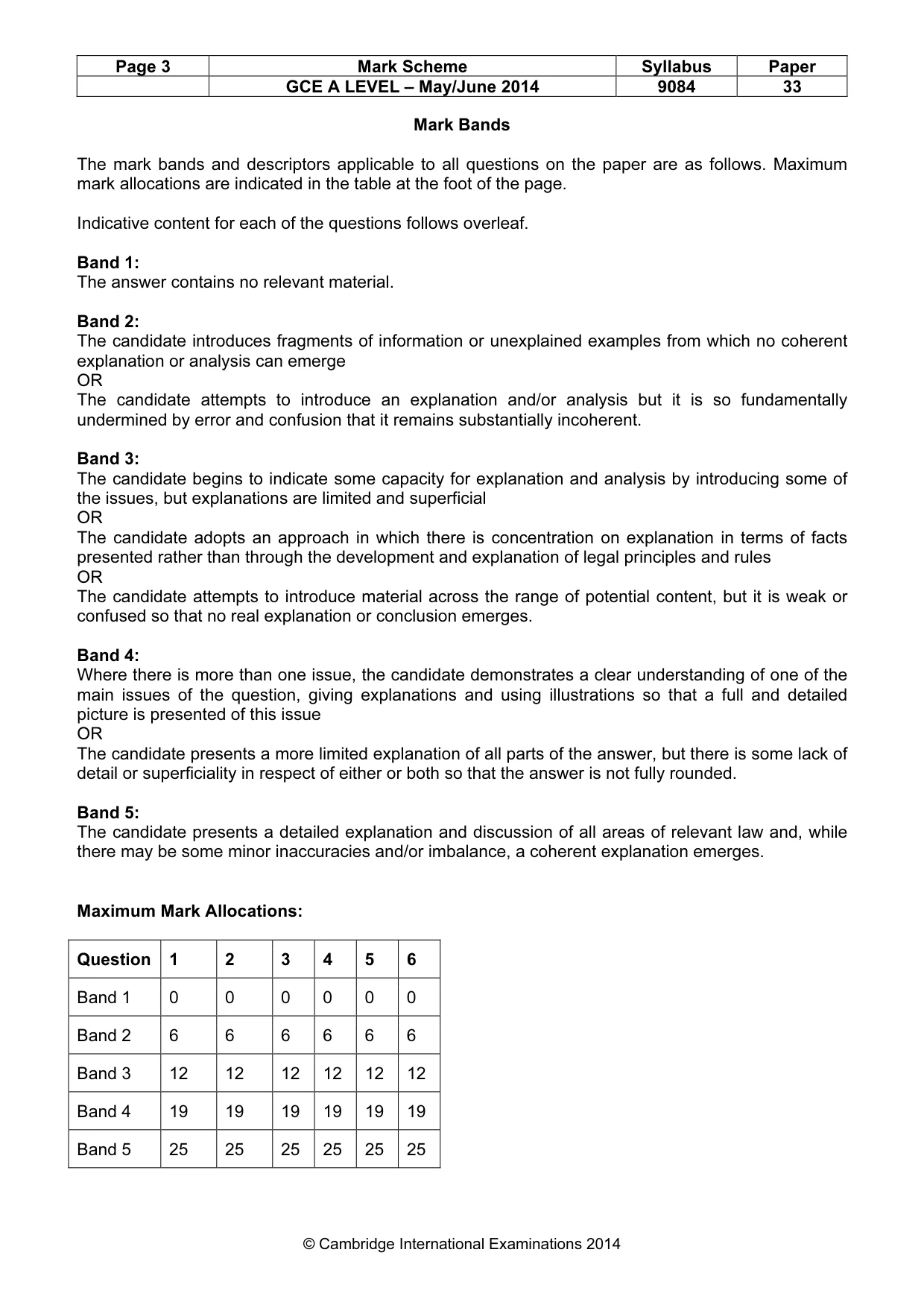
Page 3 Mark Scheme Syllabus Paper GCE A LEVEL – May/June 2014 9084 33 © Cambridge International Examinations 2014 Mark Bands The mark bands and descriptors applicable to all questions on the paper are as follows. Maximum mark allocations are indicated in the table at the foot of the page. Indicative content for each of the questions follows overleaf. Band 1: The answer contains no relevant material. Band 2: The candidate introduces fragments of information or unexplained examples from which no coherent explanation or analysis can emerge OR The candidate attempts to introduce an explanation and/or analysis but it is so fundamentally undermined by error and confusion that it remains substantially incoherent. Band 3: The candidate begins to indicate some capacity for explanation and analysis by introducing some of the issues, but explanations are limited and superficial OR The candidate adopts an approach in which there is concentration on explanation in terms of facts presented rather than through the development and explanation of legal principles and rules OR The candidate attempts to introduce material across the range of potential content, but it is weak or confused so that no real explanation or conclusion emerges. Band 4: Where there is more than one issue, the candidate demonstrates a clear understanding of one of the main issues of the question, giving explanations and using illustrations so that a full and detailed picture is presented of this issue OR The candidate presents a more limited explanation of all parts of the answer, but there is some lack of detail or superficiality in respect of either or both so that the answer is not fully rounded. Band 5: The candidate presents a detailed explanation and discussion of all areas of relevant law and, while there may be some minor inaccuracies and/or imbalance, a coherent explanation emerges. Maximum Mark Allocations: Question 1 2 3 4 5 6 Band 1 0 0 0 0 0 0 Band 2 6 6 6 6 6 6 Band 3 12 12 12 12 12 12 Band 4 19 19 19 19 19 19 Band 5 25 25 25 25 25 25
Mark scheme, page 4
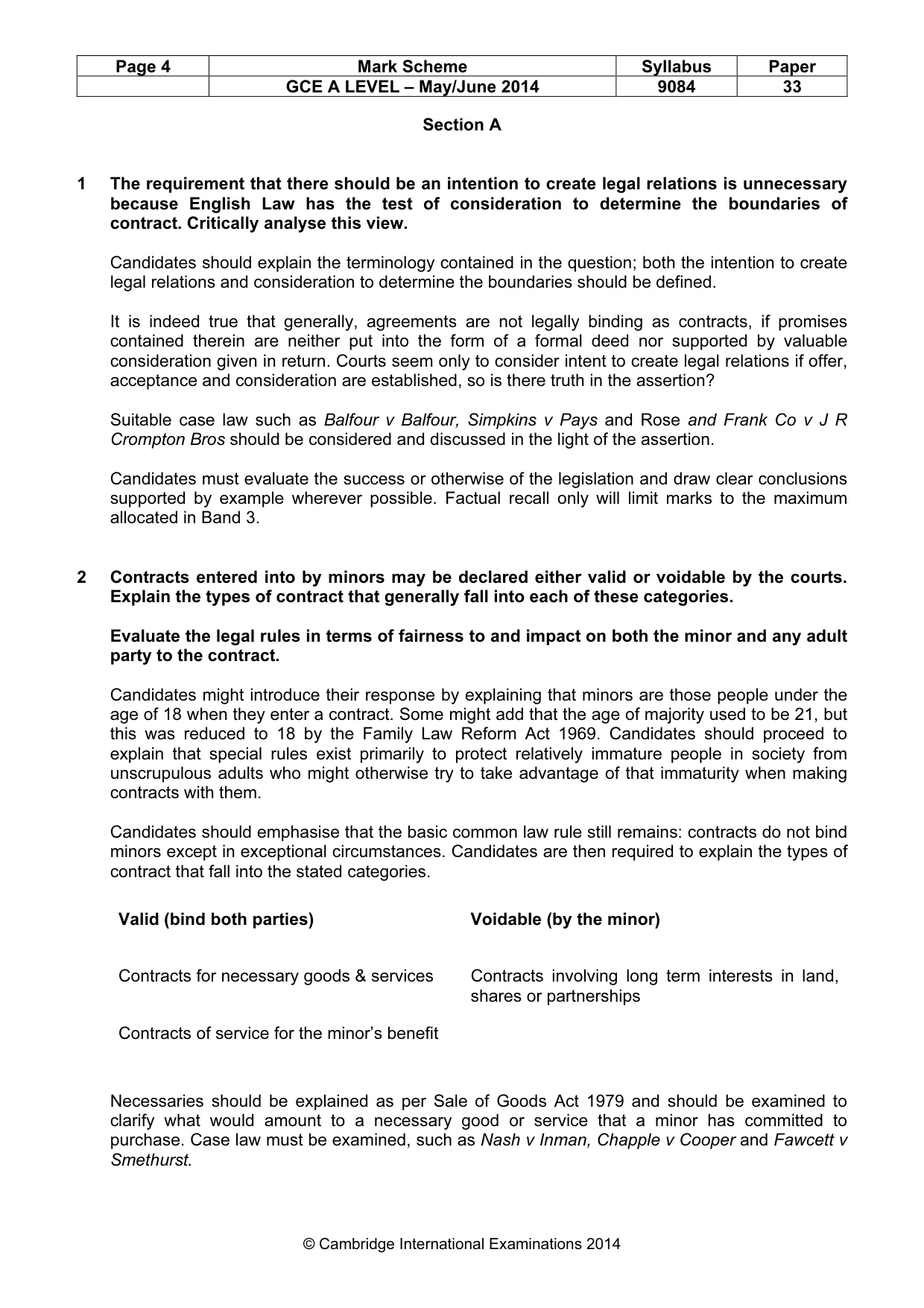
Page 4 Mark Scheme Syllabus Paper GCE A LEVEL – May/June 2014 9084 33 © Cambridge International Examinations 2014 Section A 1 The requirement that there should be an intention to create legal relations is unnecessary because English Law has the test of consideration to determine the boundaries of contract. Critically analyse this view. Candidates should explain the terminology contained in the question; both the intention to create legal relations and consideration to determine the boundaries should be defined. It is indeed true that generally, agreements are not legally binding as contracts, if promises contained therein are neither put into the form of a formal deed nor supported by valuable consideration given in return. Courts seem only to consider intent to create legal relations if offer, acceptance and consideration are established, so is there truth in the assertion? Suitable case law such as Balfour v Balfour, Simpkins v Pays and Rose and Frank Co v J R Crompton Bros should be considered and discussed in the light of the assertion. Candidates must evaluate the success or otherwise of the legislation and draw clear conclusions supported by example wherever possible. Factual recall only will limit marks to the maximum allocated in Band 3. 2 Contracts entered into by minors may be declared either valid or voidable by the courts. Explain the types of contract that generally fall into each of these categories. Evaluate the legal rules in terms of fairness to and impact on both the minor and any adult party to the contract. Candidates might introduce their response by explaining that minors are those people under the age of 18 when they enter a contract. Some might add that the age of majority used to be 21, but this was reduced to 18 by the Family Law Reform Act 1969. Candidates should proceed to explain that special rules exist primarily to protect relatively immature people in society from unscrupulous adults who might otherwise try to take advantage of that immaturity when making contracts with them. Candidates should emphasise that the basic common law rule still remains: contracts do not bind minors except in exceptional circumstances. Candidates are then required to explain the types of contract that fall into the stated categories. Valid (bind both parties) Voidable (by the minor) Contracts for necessary goods & services Contracts involving long term interests in land, shares or partnerships Contracts of service for the minor’s benefit Necessaries should be explained as per Sale of Goods Act 1979 and should be examined to clarify what would amount to a necessary good or service that a minor has committed to purchase. Case law must be examined, such as Nash v Inman, Chapple v Cooper and Fawcett v Smethurst.
Mark scheme, page 5
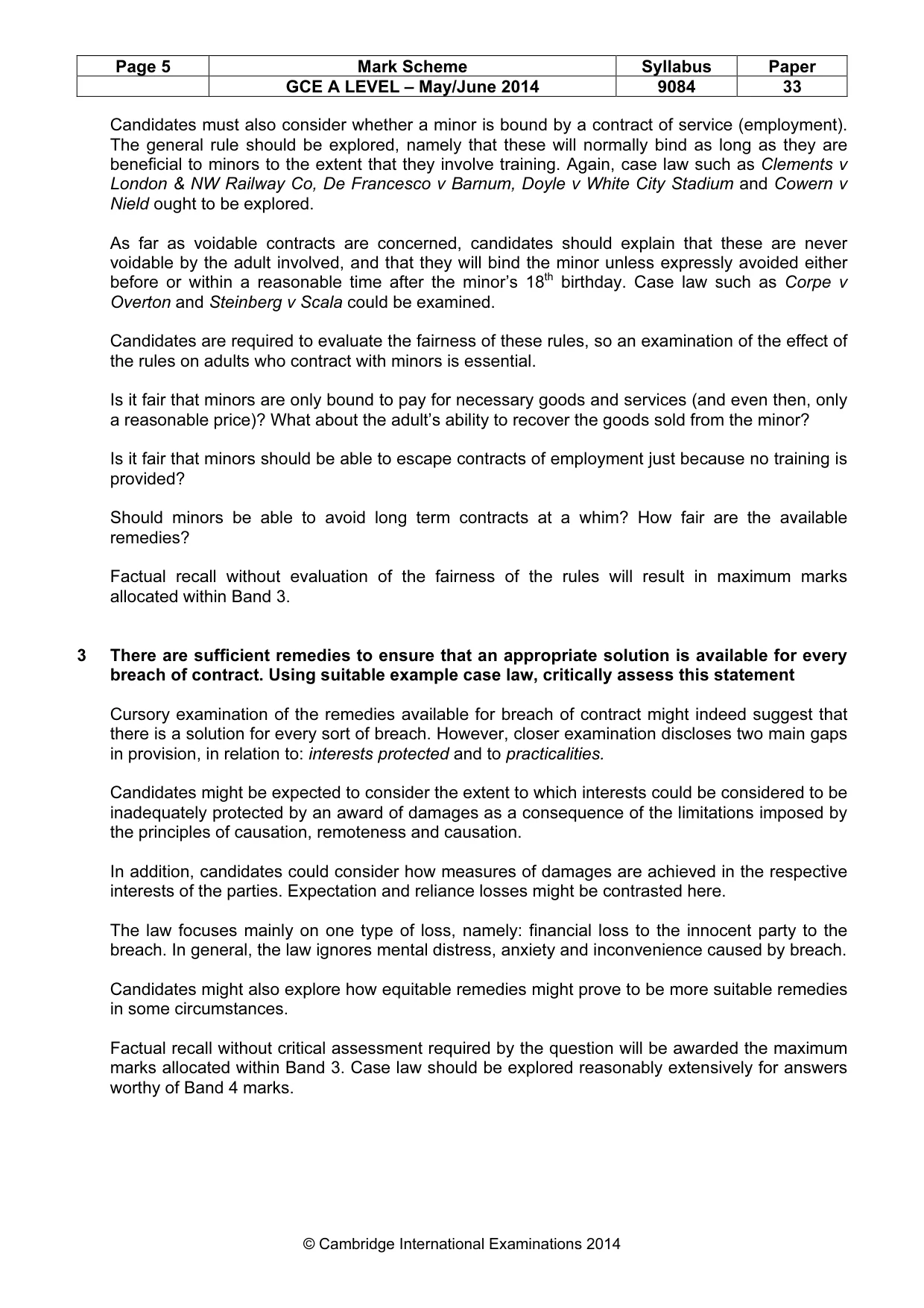
Page 5 Mark Scheme Syllabus Paper GCE A LEVEL – May/June 2014 9084 33 © Cambridge International Examinations 2014 Candidates must also consider whether a minor is bound by a contract of service (employment). The general rule should be explored, namely that these will normally bind as long as they are beneficial to minors to the extent that they involve training. Again, case law such as Clements v London & NW Railway Co, De Francesco v Barnum, Doyle v White City Stadium and Cowern v Nield ought to be explored. As far as voidable contracts are concerned, candidates should explain that these are never voidable by the adult involved, and that they will bind the minor unless expressly avoided either before or within a reasonable time after the minor’s 18th birthday. Case law such as Corpe v Overton and Steinberg v Scala could be examined. Candidates are required to evaluate the fairness of these rules, so an examination of the effect of the rules on adults who contract with minors is essential. Is it fair that minors are only bound to pay for necessary goods and services (and even then, only a reasonable price)? What about the adult’s ability to recover the goods sold from the minor? Is it fair that minors should be able to escape contracts of employment just because no training is provided? Should minors be able to avoid long term contracts at a whim? How fair are the available remedies? Factual recall without evaluation of the fairness of the rules will result in maximum marks allocated within Band 3. 3 There are sufficient remedies to ensure that an appropriate solution is available for every breach of contract. Using suitable example case law, critically assess this statement Cursory examination of the remedies available for breach of contract might indeed suggest that there is a solution for every sort of breach. However, closer examination discloses two main gaps in provision, in relation to: interests protected and to practicalities. Candidates might be expected to consider the extent to which interests could be considered to be inadequately protected by an award of damages as a consequence of the limitations imposed by the principles of causation, remoteness and causation. In addition, candidates could consider how measures of damages are achieved in the respective interests of the parties. Expectation and reliance losses might be contrasted here. The law focuses mainly on one type of loss, namely: financial loss to the innocent party to the breach. In general, the law ignores mental distress, anxiety and inconvenience caused by breach. Candidates might also explore how equitable remedies might prove to be more suitable remedies in some circumstances. Factual recall without critical assessment required by the question will be awarded the maximum marks allocated within Band 3. Case law should be explored reasonably extensively for answers worthy of Band 4 marks.
Mark scheme, page 6
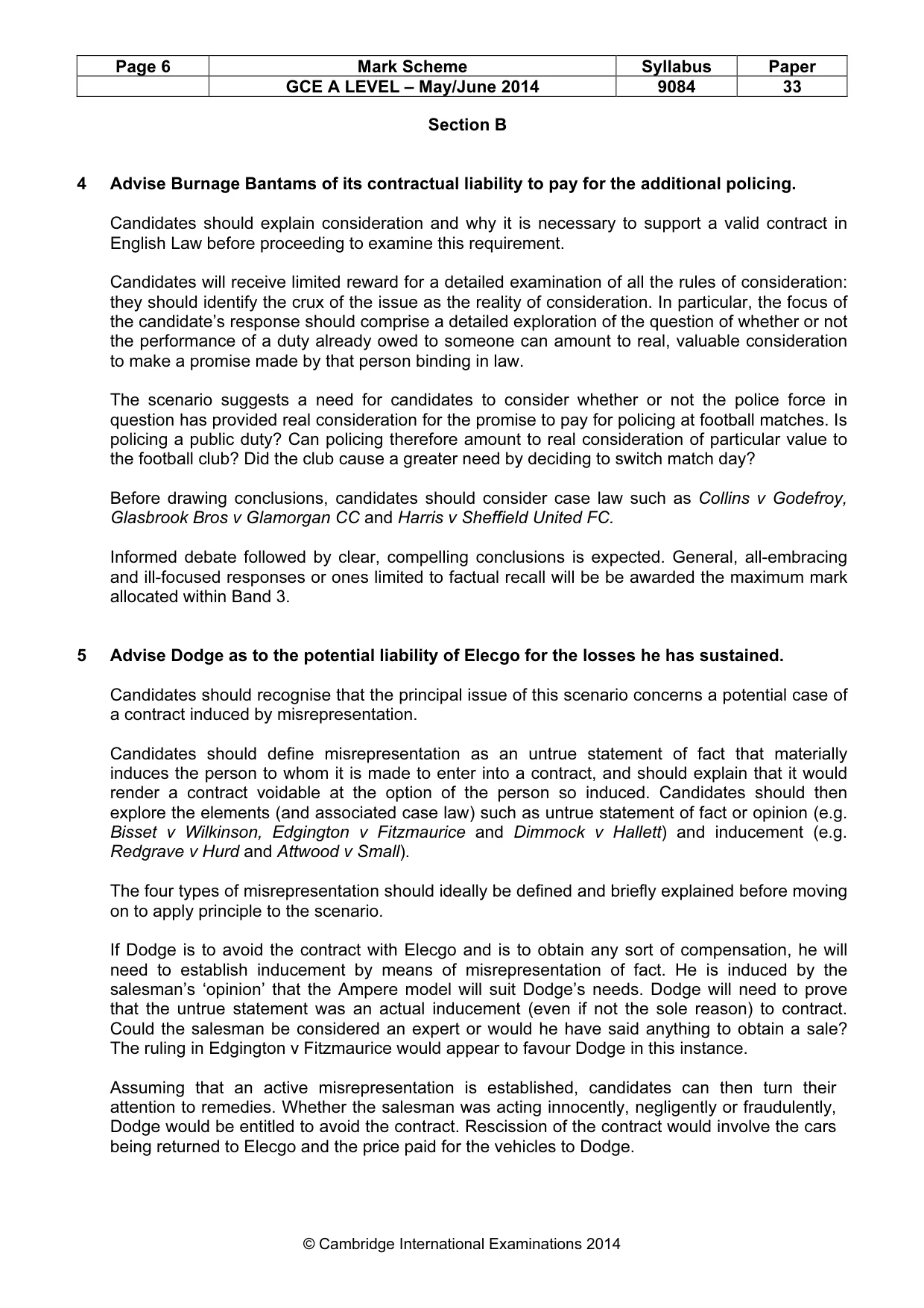
Page 6 Mark Scheme Syllabus Paper GCE A LEVEL – May/June 2014 9084 33 © Cambridge International Examinations 2014 Section B 4 Advise Burnage Bantams of its contractual liability to pay for the additional policing. Candidates should explain consideration and why it is necessary to support a valid contract in English Law before proceeding to examine this requirement. Candidates will receive limited reward for a detailed examination of all the rules of consideration: they should identify the crux of the issue as the reality of consideration. In particular, the focus of the candidate’s response should comprise a detailed exploration of the question of whether or not the performance of a duty already owed to someone can amount to real, valuable consideration to make a promise made by that person binding in law. The scenario suggests a need for candidates to consider whether or not the police force in question has provided real consideration for the promise to pay for policing at football matches. Is policing a public duty? Can policing therefore amount to real consideration of particular value to the football club? Did the club cause a greater need by deciding to switch match day? Before drawing conclusions, candidates should consider case law such as Collins v Godefroy, Glasbrook Bros v Glamorgan CC and Harris v Sheffield United FC. Informed debate followed by clear, compelling conclusions is expected. General, all-embracing and ill-focused responses or ones limited to factual recall will be be awarded the maximum mark allocated within Band 3. 5 Advise Dodge as to the potential liability of Elecgo for the losses he has sustained. Candidates should recognise that the principal issue of this scenario concerns a potential case of a contract induced by misrepresentation. Candidates should define misrepresentation as an untrue statement of fact that materially induces the person to whom it is made to enter into a contract, and should explain that it would render a contract voidable at the option of the person so induced. Candidates should then explore the elements (and associated case law) such as untrue statement of fact or opinion (e.g. Bisset v Wilkinson, Edgington v Fitzmaurice and Dimmock v Hallett) and inducement (e.g. Redgrave v Hurd and Attwood v Small). The four types of misrepresentation should ideally be defined and briefly explained before moving on to apply principle to the scenario. If Dodge is to avoid the contract with Elecgo and is to obtain any sort of compensation, he will need to establish inducement by means of misrepresentation of fact. He is induced by the salesman’s ‘opinion’ that the Ampere model will suit Dodge’s needs. Dodge will need to prove that the untrue statement was an actual inducement (even if not the sole reason) to contract. Could the salesman be considered an expert or would he have said anything to obtain a sale? The ruling in Edgington v Fitzmaurice would appear to favour Dodge in this instance. Assuming that an active misrepresentation is established, candidates can then turn their attention to remedies. Whether the salesman was acting innocently, negligently or fraudulently, Dodge would be entitled to avoid the contract. Rescission of the contract would involve the cars being returned to Elecgo and the price paid for the vehicles to Dodge.
Mark scheme, page 7
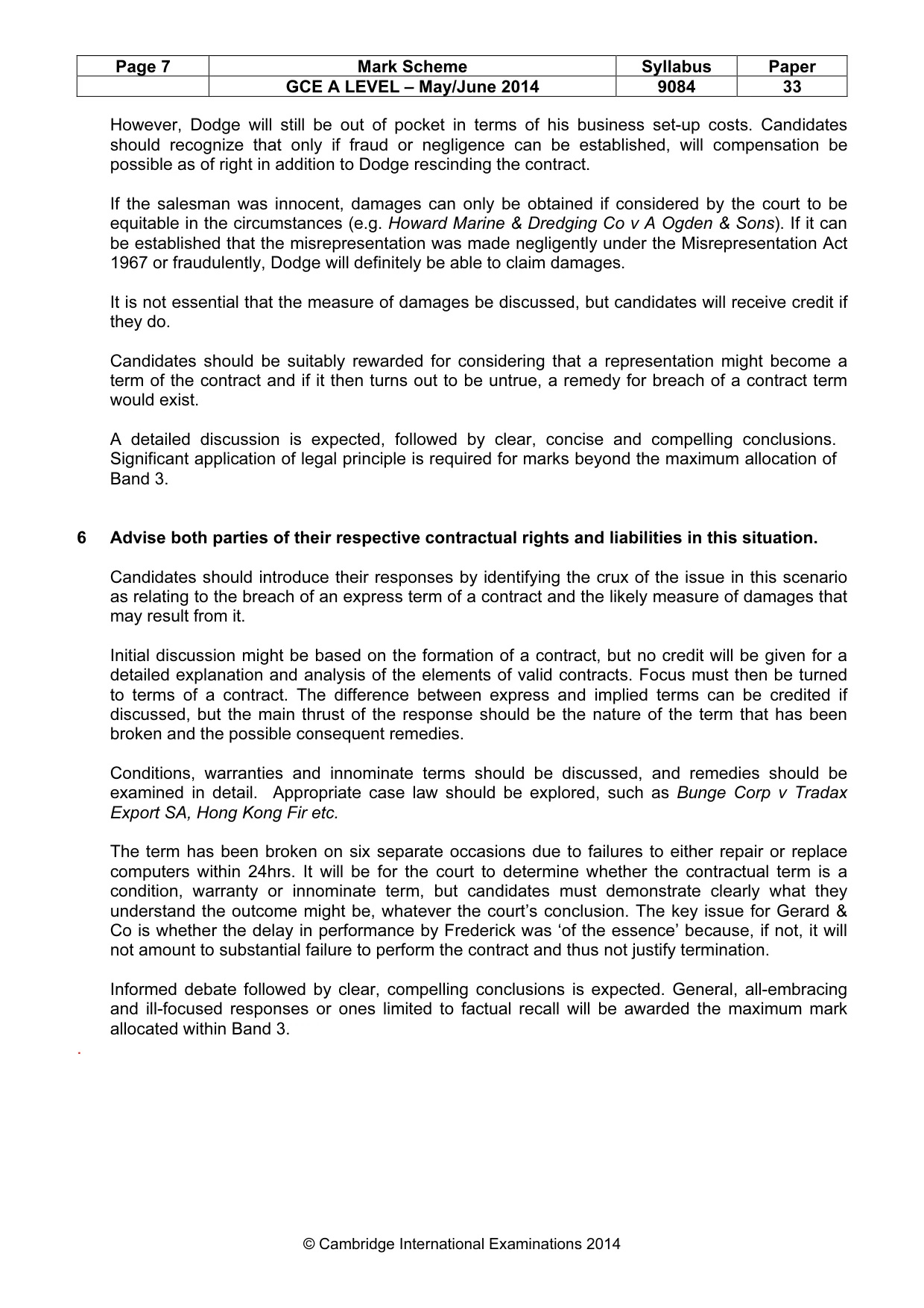
Page 7 Mark Scheme Syllabus Paper GCE A LEVEL – May/June 2014 9084 33 © Cambridge International Examinations 2014 However, Dodge will still be out of pocket in terms of his business set-up costs. Candidates should recognize that only if fraud or negligence can be established, will compensation be possible as of right in addition to Dodge rescinding the contract. If the salesman was innocent, damages can only be obtained if considered by the court to be equitable in the circumstances (e.g. Howard Marine & Dredging Co v A Ogden & Sons). If it can be established that the misrepresentation was made negligently under the Misrepresentation Act 1967 or fraudulently, Dodge will definitely be able to claim damages. It is not essential that the measure of damages be discussed, but candidates will receive credit if they do. Candidates should be suitably rewarded for considering that a representation might become a term of the contract and if it then turns out to be untrue, a remedy for breach of a contract term would exist. A detailed discussion is expected, followed by clear, concise and compelling conclusions. Significant application of legal principle is required for marks beyond the maximum allocation of Band 3. 6 Advise both parties of their respective contractual rights and liabilities in this situation. Candidates should introduce their responses by identifying the crux of the issue in this scenario as relating to the breach of an express term of a contract and the likely measure of damages that may result from it. Initial discussion might be based on the formation of a contract, but no credit will be given for a detailed explanation and analysis of the elements of valid contracts. Focus must then be turned to terms of a contract. The difference between express and implied terms can be credited if discussed, but the main thrust of the response should be the nature of the term that has been broken and the possible consequent remedies. Conditions, warranties and innominate terms should be discussed, and remedies should be examined in detail. Appropriate case law should be explored, such as Bunge Corp v Tradax Export SA, Hong Kong Fir etc. The term has been broken on six separate occasions due to failures to either repair or replace computers within 24hrs. It will be for the court to determine whether the contractual term is a condition, warranty or innominate term, but candidates must demonstrate clearly what they understand the outcome might be, whatever the court’s conclusion. The key issue for Gerard & Co is whether the delay in performance by Frederick was ‘of the essence’ because, if not, it will not amount to substantial failure to perform the contract and thus not justify termination. Informed debate followed by clear, compelling conclusions is expected. General, all-embracing and ill-focused responses or ones limited to factual recall will be awarded the maximum mark allocated within Band 3. .
What you needed in this session
Cambridge’s own grade thresholds for 2014 May/June, Paper 3 · Variant 3. A higher threshold means an easier paper — the bar moves with how the cohort did.