Cambridge A Level Law 9084 — 2014 May/June Paper 3 · Variant 1
9084/31/M/J/14 · 75 marks · ≈84 min
The question paper and its mark scheme, free to read here and free to download. This is Cambridge’s own paper, exactly as it was sat.
Question paper4 pages
Mark scheme9 pages
Answers below. Sit the paper first if you are practising.

Paper as text
Question paper, page 1
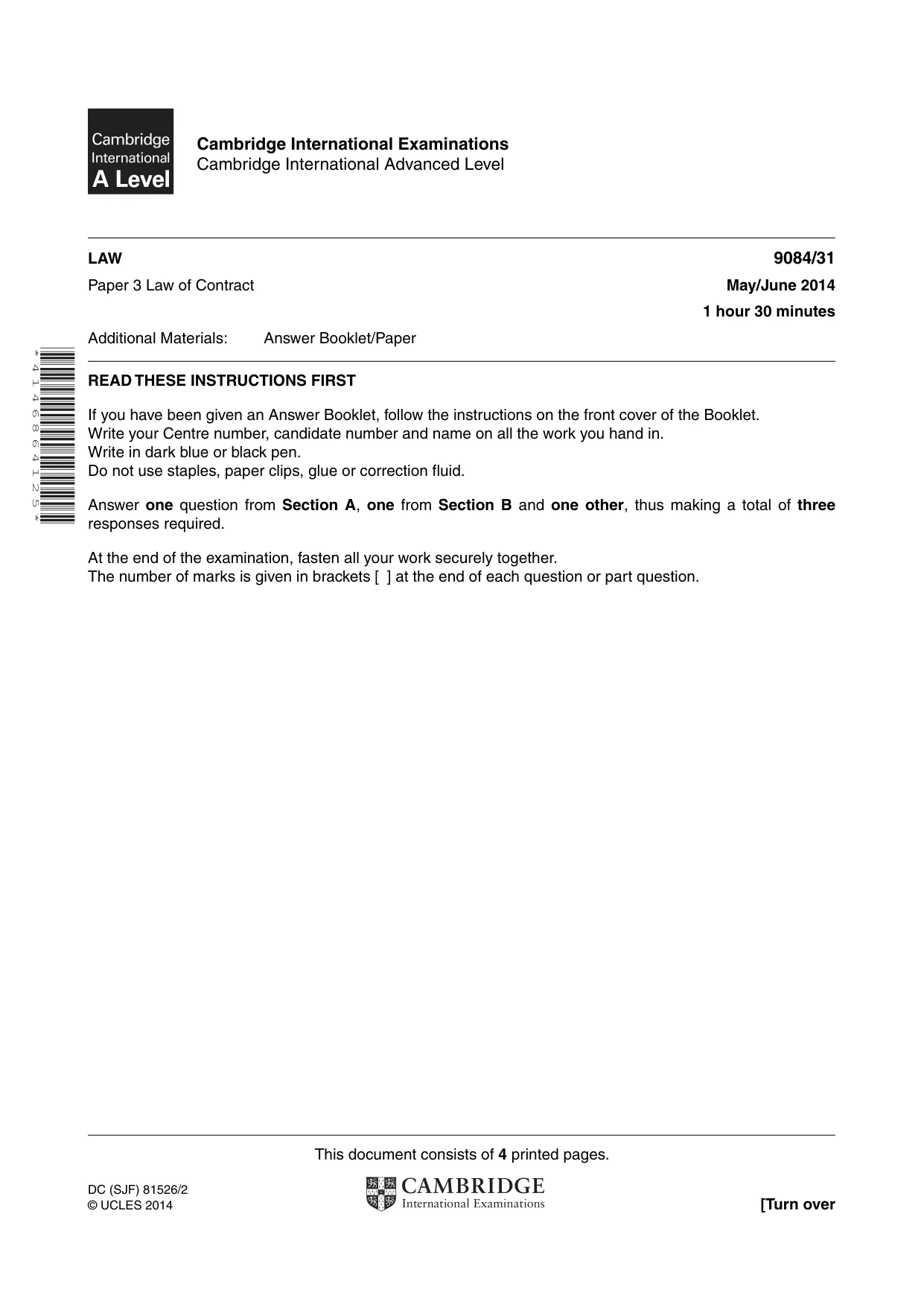
This document consists of 4 printed pages. DC (SJF) 81526/2 © UCLES 2014 [Turn over Cambridge International Examinations Cambridge International Advanced Level * 4 1 4 6 8 6 4 1 2 5 * LAW 9084/31 Paper 3 Law of Contract May/June 2014 1 hour 30 minutes Additional Materials: Answer Booklet/Paper READ THESE INSTRUCTIONS FIRST If you have been given an Answer Booklet, follow the instructions on the front cover of the Booklet. Write your Centre number, candidate number and name on all the work you hand in. Write in dark blue or black pen. Do not use staples, paper clips, glue or correction fluid. Answer one question from Section A, one from Section B and one other, thus making a total of three responses required. At the end of the examination, fasten all your work securely together. The number of marks is given in brackets [ ] at the end of each question or part question.
Question paper, page 2
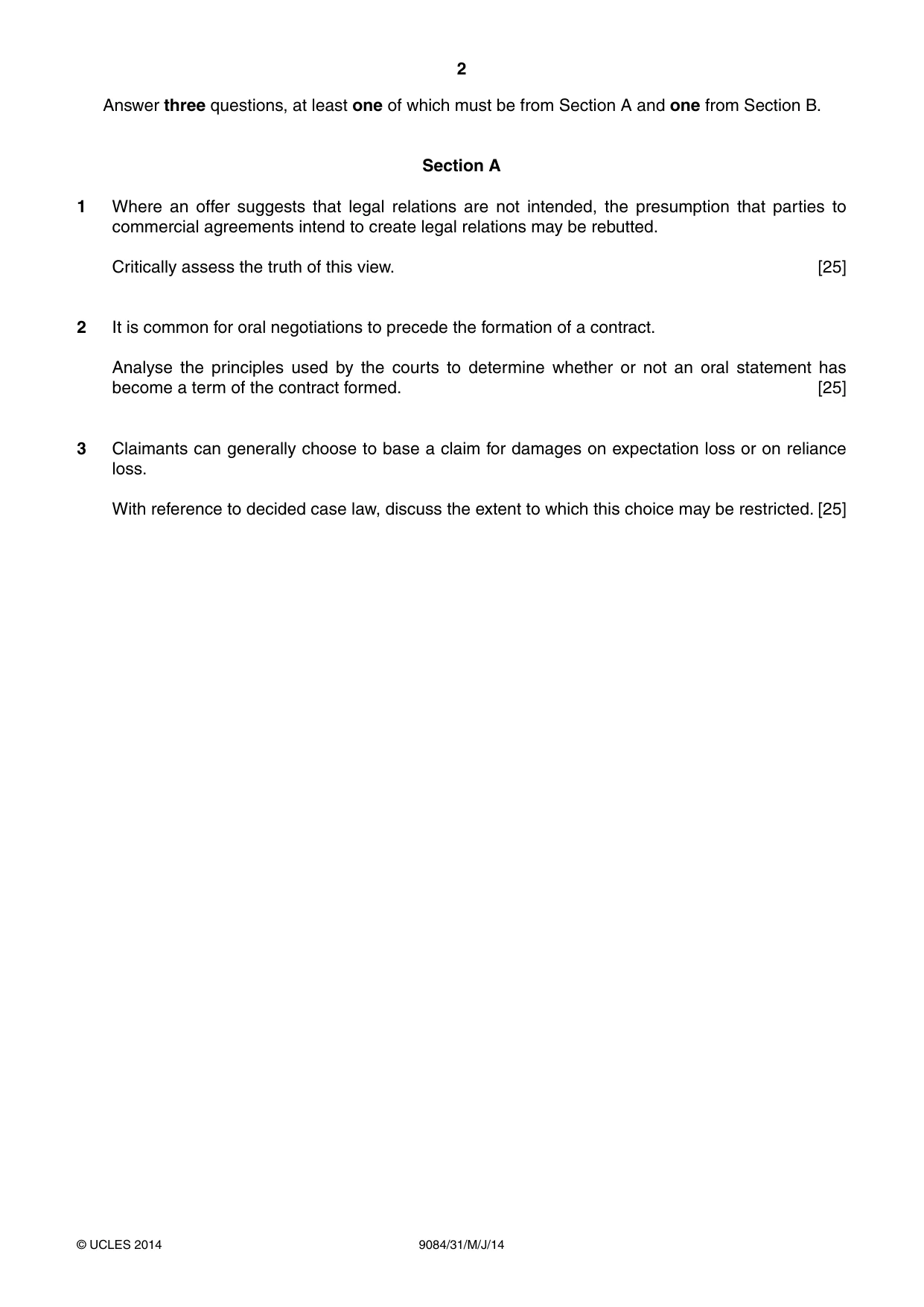
2 9084/31/M/J/14 © UCLES 2014 Answer three questions, at least one of which must be from Section A and one from Section B. Section A 1 Where an offer suggests that legal relations are not intended, the presumption that parties to commercial agreements intend to create legal relations may be rebutted. Critically assess the truth of this view. [25] 2 It is common for oral negotiations to precede the formation of a contract. Analyse the principles used by the courts to determine whether or not an oral statement has become a term of the contract formed. [25] 3 Claimants can generally choose to base a claim for damages on expectation loss or on reliance loss. With reference to decided case law, discuss the extent to which this choice may be restricted. [25]
Question paper, page 3
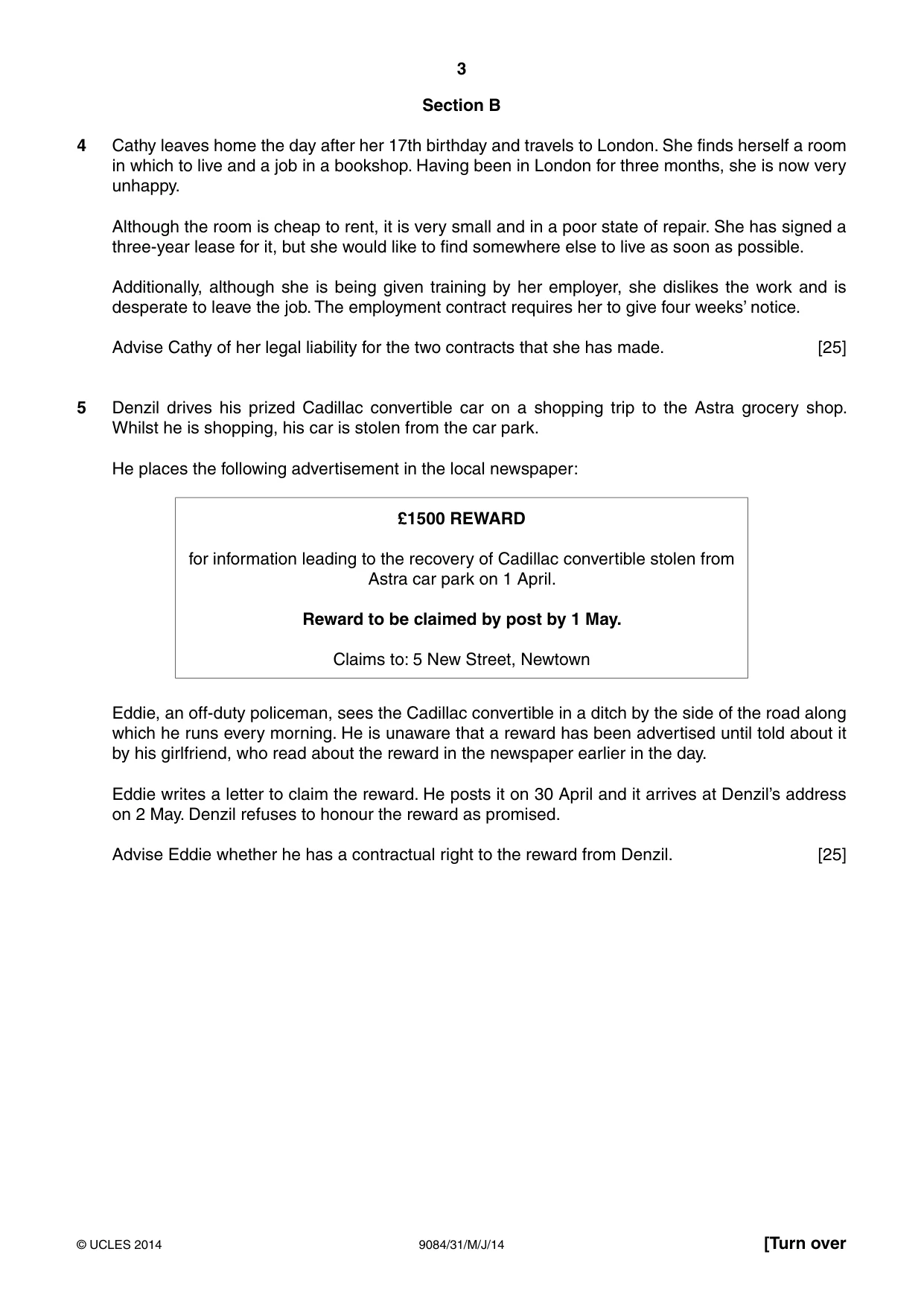
3 9084/31/M/J/14 © UCLES 2014 [Turn over Section B 4 Cathy leaves home the day after her 17th birthday and travels to London. She finds herself a room in which to live and a job in a bookshop. Having been in London for three months, she is now very unhappy. Although the room is cheap to rent, it is very small and in a poor state of repair. She has signed a three-year lease for it, but she would like to find somewhere else to live as soon as possible. Additionally, although she is being given training by her employer, she dislikes the work and is desperate to leave the job. The employment contract requires her to give four weeks’ notice. Advise Cathy of her legal liability for the two contracts that she has made. [25] 5 Denzil drives his prized Cadillac convertible car on a shopping trip to the Astra grocery shop. Whilst he is shopping, his car is stolen from the car park. He places the following advertisement in the local newspaper: £1500 REWARD for information leading to the recovery of Cadillac convertible stolen from Astra car park on 1 April. Reward to be claimed by post by 1 May. Claims to: 5 New Street, Newtown Eddie, an off-duty policeman, sees the Cadillac convertible in a ditch by the side of the road along which he runs every morning. He is unaware that a reward has been advertised until told about it by his girlfriend, who read about the reward in the newspaper earlier in the day. Eddie writes a letter to claim the reward. He posts it on 30 April and it arrives at Denzil’s address on 2 May. Denzil refuses to honour the reward as promised. Advise Eddie whether he has a contractual right to the reward from Denzil. [25]
Question paper, page 4
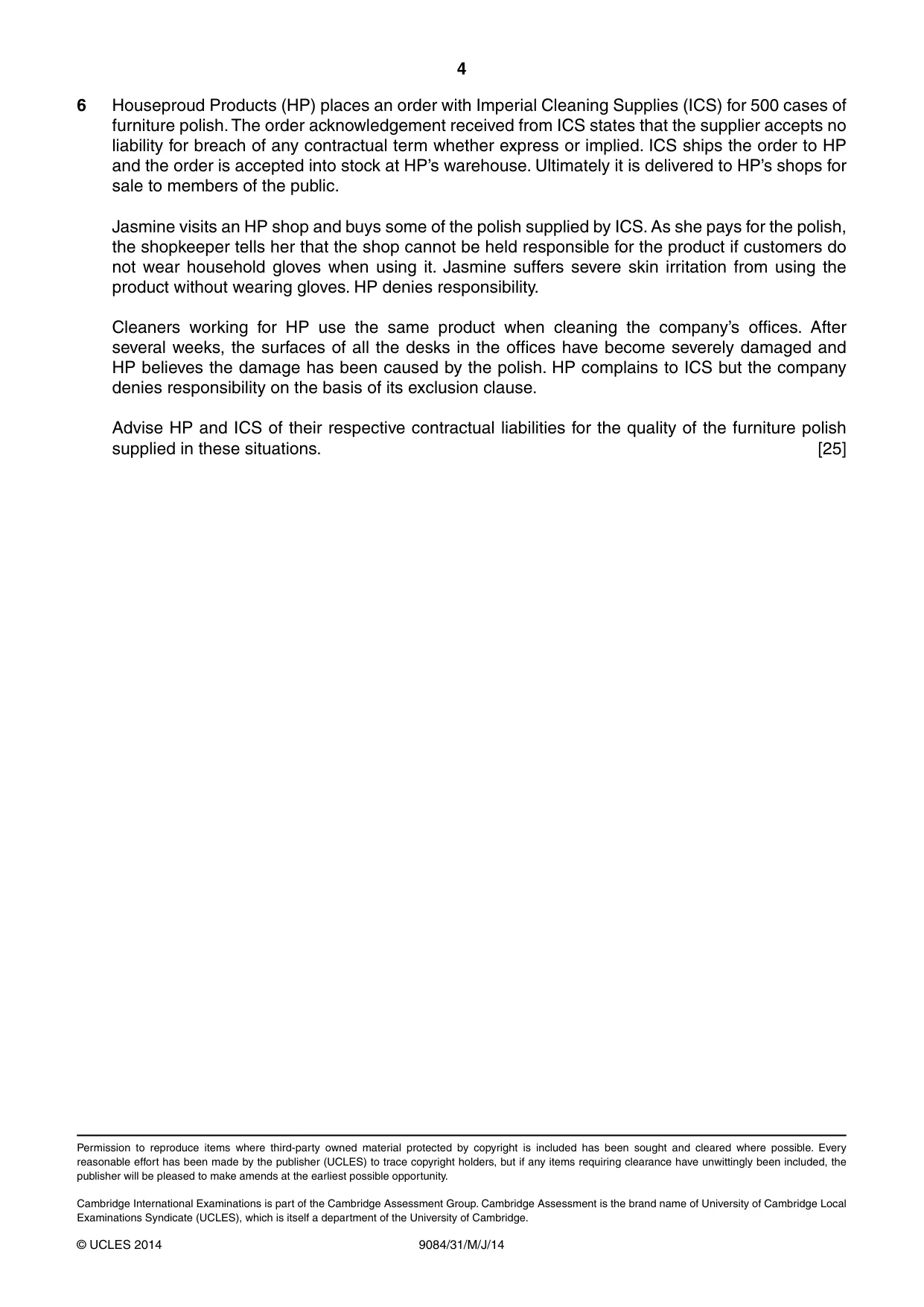
4 9084/31/M/J/14 © UCLES 2014 Permission to reproduce items where third-party owned material protected by copyright is included has been sought and cleared where possible. Every reasonable effort has been made by the publisher (UCLES) to trace copyright holders, but if any items requiring clearance have unwittingly been included, the publisher will be pleased to make amends at the earliest possible opportunity. Cambridge International Examinations is part of the Cambridge Assessment Group. Cambridge Assessment is the brand name of University of Cambridge Local Examinations Syndicate (UCLES), which is itself a department of the University of Cambridge. 6 Houseproud Products (HP) places an order with Imperial Cleaning Supplies (ICS) for 500 cases of furniture polish. The order acknowledgement received from ICS states that the supplier accepts no liability for breach of any contractual term whether express or implied. ICS ships the order to HP and the order is accepted into stock at HP’s warehouse. Ultimately it is delivered to HP’s shops for sale to members of the public. Jasmine visits an HP shop and buys some of the polish supplied by ICS. As she pays for the polish, the shopkeeper tells her that the shop cannot be held responsible for the product if customers do not wear household gloves when using it. Jasmine suffers severe skin irritation from using the product without wearing gloves. HP denies responsibility. Cleaners working for HP use the same product when cleaning the company’s offices. After several weeks, the surfaces of all the desks in the offices have become severely damaged and HP believes the damage has been caused by the polish. HP complains to ICS but the company denies responsibility on the basis of its exclusion clause. Advise HP and ICS of their respective contractual liabilities for the quality of the furniture polish supplied in these situations. [25]
Mark scheme, page 1
CAMBRIDGE INTERNATIONAL EXAMINATIONS GCE Advanced Level MARK SCHEME for the May/June 2014 series 9084 LAW 9084/31 Paper 3, maximum raw mark 75 This mark scheme is published as an aid to teachers and candidates, to indicate the requirements of the examination. It shows the basis on which Examiners were instructed to award marks. It does not indicate the details of the discussions that took place at an Examiners’ meeting before marking began, which would have considered the acceptability of alternative answers. Mark schemes should be read in conjunction with the question paper and the Principal Examiner Report for Teachers. Cambridge will not enter into discussions about these mark schemes. Cambridge is publishing the mark schemes for the May/June 2014 series for most IGCSE, GCE Advanced Level and Advanced Subsidiary Level components and some Ordinary Level components.
Mark scheme, page 2
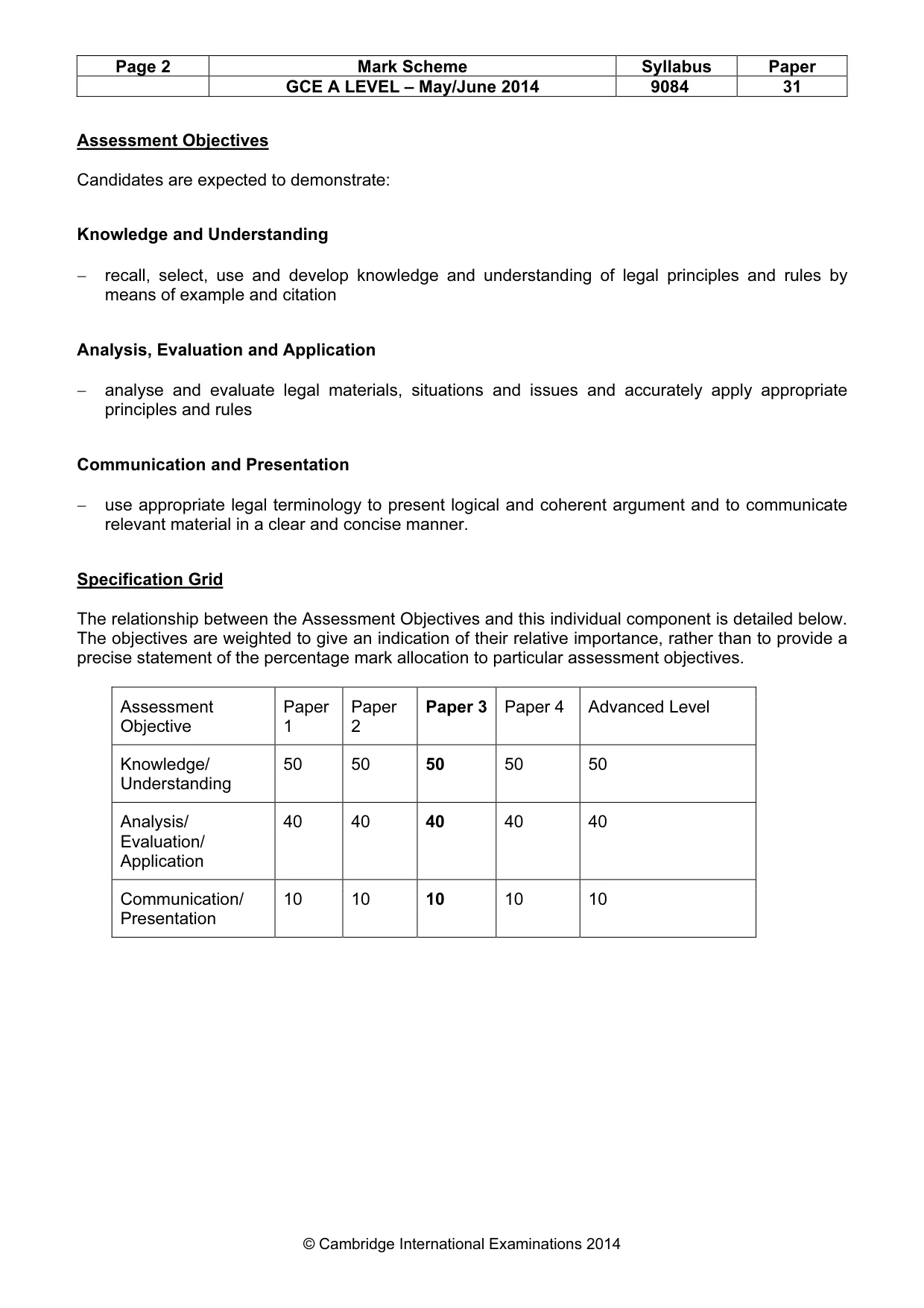
Page 2 Mark Scheme Syllabus Paper GCE A LEVEL – May/June 2014 9084 31 © Cambridge International Examinations 2014 Assessment Objectives Candidates are expected to demonstrate: Knowledge and Understanding − recall, select, use and develop knowledge and understanding of legal principles and rules by means of example and citation Analysis, Evaluation and Application − analyse and evaluate legal materials, situations and issues and accurately apply appropriate principles and rules Communication and Presentation − use appropriate legal terminology to present logical and coherent argument and to communicate relevant material in a clear and concise manner. Specification Grid The relationship between the Assessment Objectives and this individual component is detailed below. The objectives are weighted to give an indication of their relative importance, rather than to provide a precise statement of the percentage mark allocation to particular assessment objectives. Assessment Objective Paper 1 Paper 2 Paper 3 Paper 4 Advanced Level Knowledge/ Understanding 50 50 50 50 50 Analysis/ Evaluation/ Application 40 40 40 40 40 Communication/ Presentation 10 10 10 10 10
Mark scheme, page 3
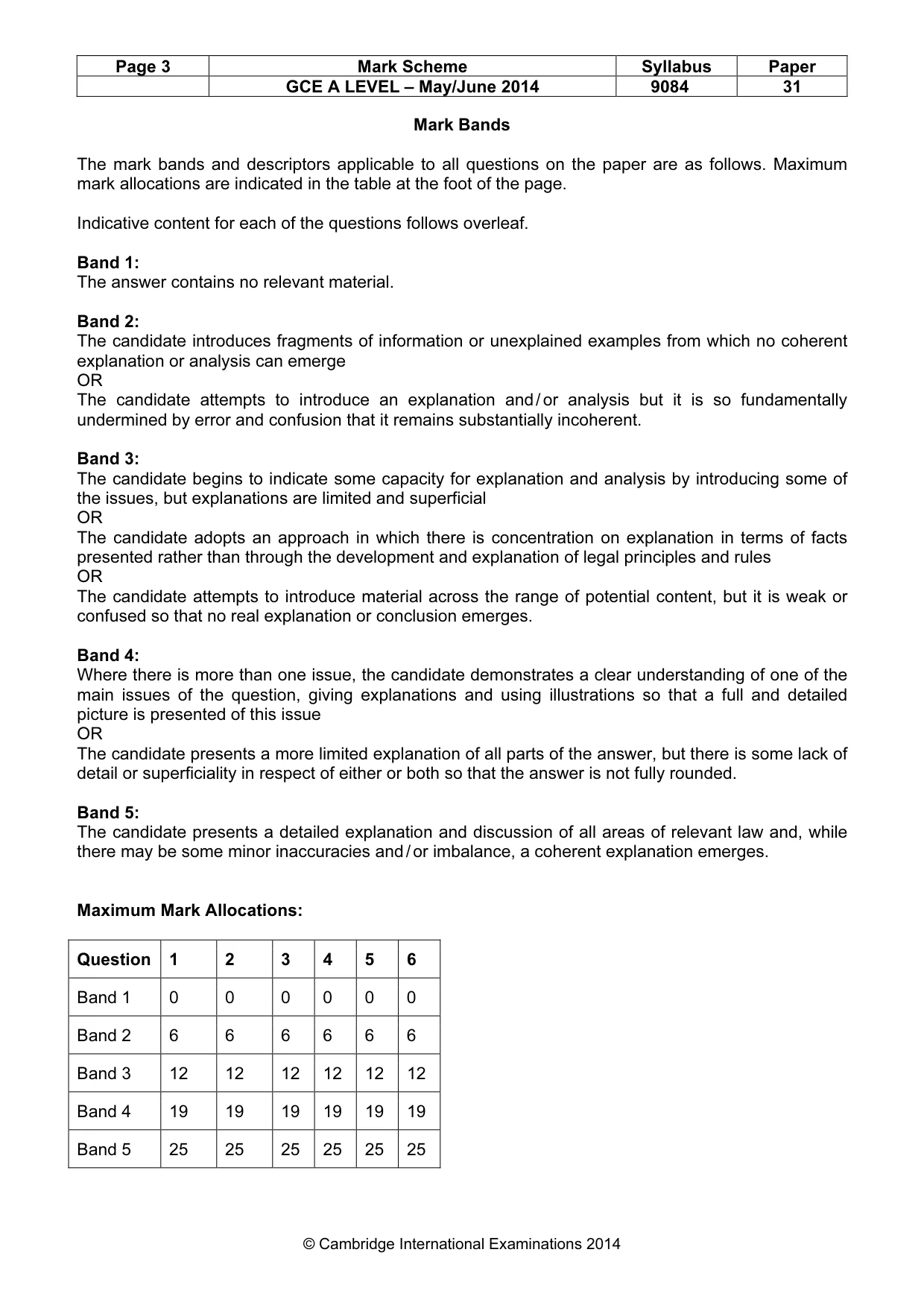
Page 3 Mark Scheme Syllabus Paper GCE A LEVEL – May/June 2014 9084 31 © Cambridge International Examinations 2014 Mark Bands The mark bands and descriptors applicable to all questions on the paper are as follows. Maximum mark allocations are indicated in the table at the foot of the page. Indicative content for each of the questions follows overleaf. Band 1: The answer contains no relevant material. Band 2: The candidate introduces fragments of information or unexplained examples from which no coherent explanation or analysis can emerge OR The candidate attempts to introduce an explanation and / or analysis but it is so fundamentally undermined by error and confusion that it remains substantially incoherent. Band 3: The candidate begins to indicate some capacity for explanation and analysis by introducing some of the issues, but explanations are limited and superficial OR The candidate adopts an approach in which there is concentration on explanation in terms of facts presented rather than through the development and explanation of legal principles and rules OR The candidate attempts to introduce material across the range of potential content, but it is weak or confused so that no real explanation or conclusion emerges. Band 4: Where there is more than one issue, the candidate demonstrates a clear understanding of one of the main issues of the question, giving explanations and using illustrations so that a full and detailed picture is presented of this issue OR The candidate presents a more limited explanation of all parts of the answer, but there is some lack of detail or superficiality in respect of either or both so that the answer is not fully rounded. Band 5: The candidate presents a detailed explanation and discussion of all areas of relevant law and, while there may be some minor inaccuracies and / or imbalance, a coherent explanation emerges. Maximum Mark Allocations: Question 1 2 3 4 5 6 Band 1 0 0 0 0 0 0 Band 2 6 6 6 6 6 6 Band 3 12 12 12 12 12 12 Band 4 19 19 19 19 19 19 Band 5 25 25 25 25 25 25
Mark scheme, page 4
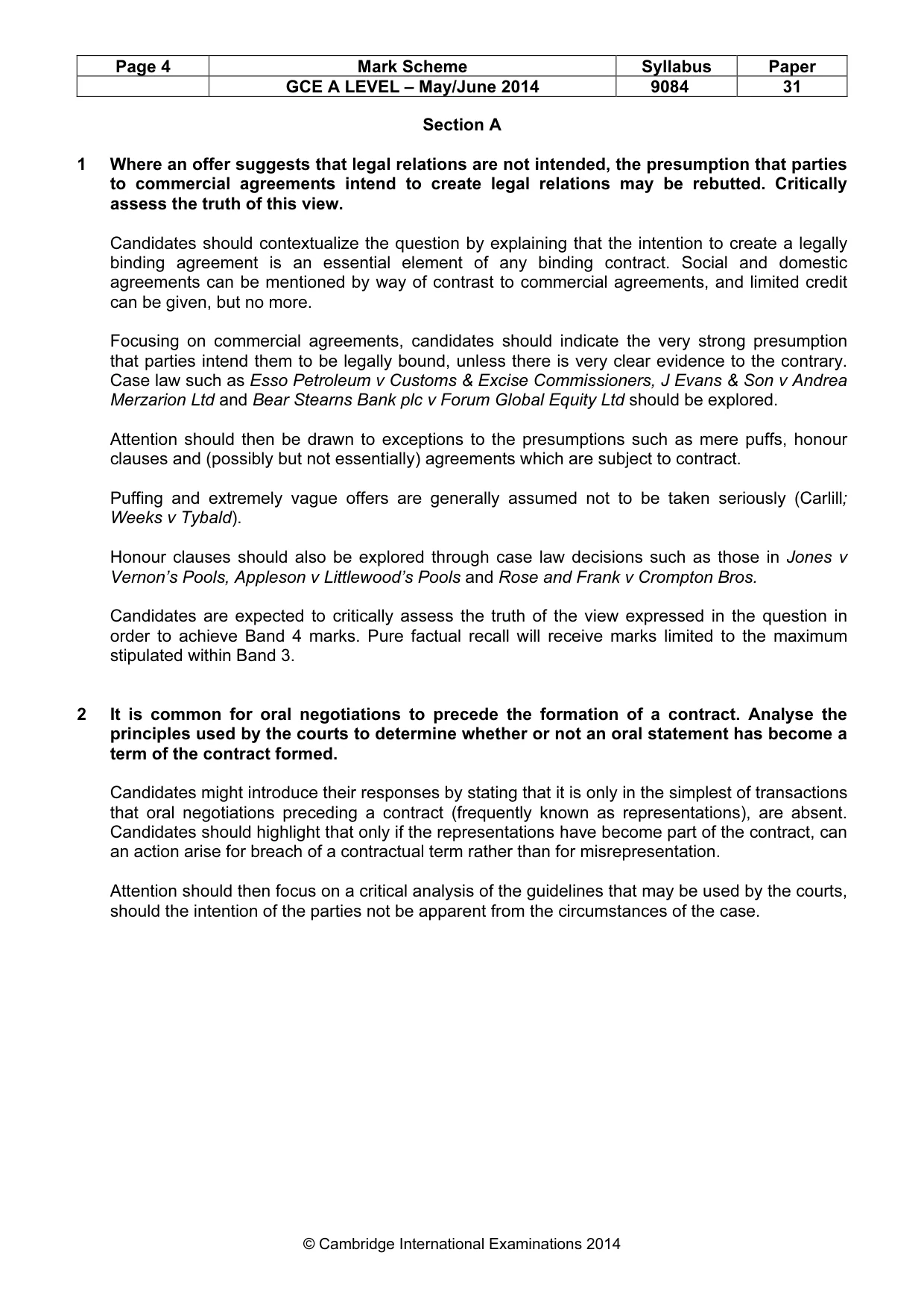
Page 4 Mark Scheme Syllabus Paper GCE A LEVEL – May/June 2014 9084 31 © Cambridge International Examinations 2014 Section A 1 Where an offer suggests that legal relations are not intended, the presumption that parties to commercial agreements intend to create legal relations may be rebutted. Critically assess the truth of this view. Candidates should contextualize the question by explaining that the intention to create a legally binding agreement is an essential element of any binding contract. Social and domestic agreements can be mentioned by way of contrast to commercial agreements, and limited credit can be given, but no more. Focusing on commercial agreements, candidates should indicate the very strong presumption that parties intend them to be legally bound, unless there is very clear evidence to the contrary. Case law such as Esso Petroleum v Customs & Excise Commissioners, J Evans & Son v Andrea Merzarion Ltd and Bear Stearns Bank plc v Forum Global Equity Ltd should be explored. Attention should then be drawn to exceptions to the presumptions such as mere puffs, honour clauses and (possibly but not essentially) agreements which are subject to contract. Puffing and extremely vague offers are generally assumed not to be taken seriously (Carlill; Weeks v Tybald). Honour clauses should also be explored through case law decisions such as those in Jones v Vernon’s Pools, Appleson v Littlewood’s Pools and Rose and Frank v Crompton Bros. Candidates are expected to critically assess the truth of the view expressed in the question in order to achieve Band 4 marks. Pure factual recall will receive marks limited to the maximum stipulated within Band 3. 2 It is common for oral negotiations to precede the formation of a contract. Analyse the principles used by the courts to determine whether or not an oral statement has become a term of the contract formed. Candidates might introduce their responses by stating that it is only in the simplest of transactions that oral negotiations preceding a contract (frequently known as representations), are absent. Candidates should highlight that only if the representations have become part of the contract, can an action arise for breach of a contractual term rather than for misrepresentation. Attention should then focus on a critical analysis of the guidelines that may be used by the courts, should the intention of the parties not be apparent from the circumstances of the case.
Mark scheme, page 5
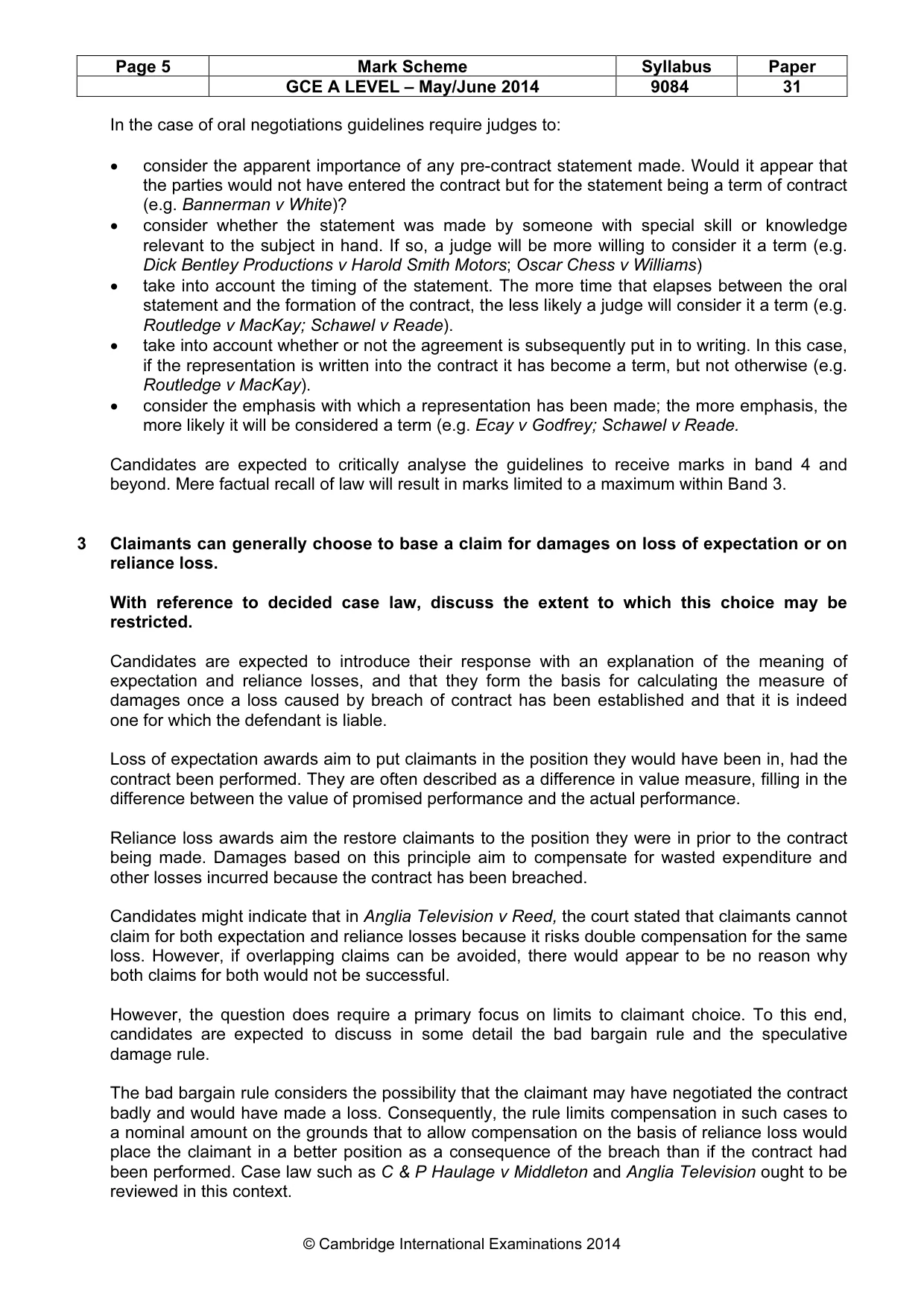
Page 5 Mark Scheme Syllabus Paper GCE A LEVEL – May/June 2014 9084 31 © Cambridge International Examinations 2014 In the case of oral negotiations guidelines require judges to: • consider the apparent importance of any pre-contract statement made. Would it appear that the parties would not have entered the contract but for the statement being a term of contract (e.g. Bannerman v White)? • consider whether the statement was made by someone with special skill or knowledge relevant to the subject in hand. If so, a judge will be more willing to consider it a term (e.g. Dick Bentley Productions v Harold Smith Motors; Oscar Chess v Williams) • take into account the timing of the statement. The more time that elapses between the oral statement and the formation of the contract, the less likely a judge will consider it a term (e.g. Routledge v MacKay; Schawel v Reade). • take into account whether or not the agreement is subsequently put in to writing. In this case, if the representation is written into the contract it has become a term, but not otherwise (e.g. Routledge v MacKay). • consider the emphasis with which a representation has been made; the more emphasis, the more likely it will be considered a term (e.g. Ecay v Godfrey; Schawel v Reade. Candidates are expected to critically analyse the guidelines to receive marks in band 4 and beyond. Mere factual recall of law will result in marks limited to a maximum within Band 3. 3 Claimants can generally choose to base a claim for damages on loss of expectation or on reliance loss. With reference to decided case law, discuss the extent to which this choice may be restricted. Candidates are expected to introduce their response with an explanation of the meaning of expectation and reliance losses, and that they form the basis for calculating the measure of damages once a loss caused by breach of contract has been established and that it is indeed one for which the defendant is liable. Loss of expectation awards aim to put claimants in the position they would have been in, had the contract been performed. They are often described as a difference in value measure, filling in the difference between the value of promised performance and the actual performance. Reliance loss awards aim the restore claimants to the position they were in prior to the contract being made. Damages based on this principle aim to compensate for wasted expenditure and other losses incurred because the contract has been breached. Candidates might indicate that in Anglia Television v Reed, the court stated that claimants cannot claim for both expectation and reliance losses because it risks double compensation for the same loss. However, if overlapping claims can be avoided, there would appear to be no reason why both claims for both would not be successful. However, the question does require a primary focus on limits to claimant choice. To this end, candidates are expected to discuss in some detail the bad bargain rule and the speculative damage rule. The bad bargain rule considers the possibility that the claimant may have negotiated the contract badly and would have made a loss. Consequently, the rule limits compensation in such cases to a nominal amount on the grounds that to allow compensation on the basis of reliance loss would place the claimant in a better position as a consequence of the breach than if the contract had been performed. Case law such as C & P Haulage v Middleton and Anglia Television ought to be reviewed in this context.
Mark scheme, page 6
Page 6 Mark Scheme Syllabus Paper GCE A LEVEL – May/June 2014 9084 31 © Cambridge International Examinations 2014 In instances where losses are almost impossible to calculate and are thus purely speculative, claimants must base their claim on reliance loss principles. However, it would appear from case law (e.g. McRae v Commonwealth Disposals Commission and Sapwell v Bass) that courts seem to be somewhat reluctant to conclude that damages are too speculative, and, are prepared to use a certain amount of guesswork when making awards. All embracing, general responses lacking focus on the question actually posed will be limited to maximum marks as stipulated within Band 3.
Mark scheme, page 7
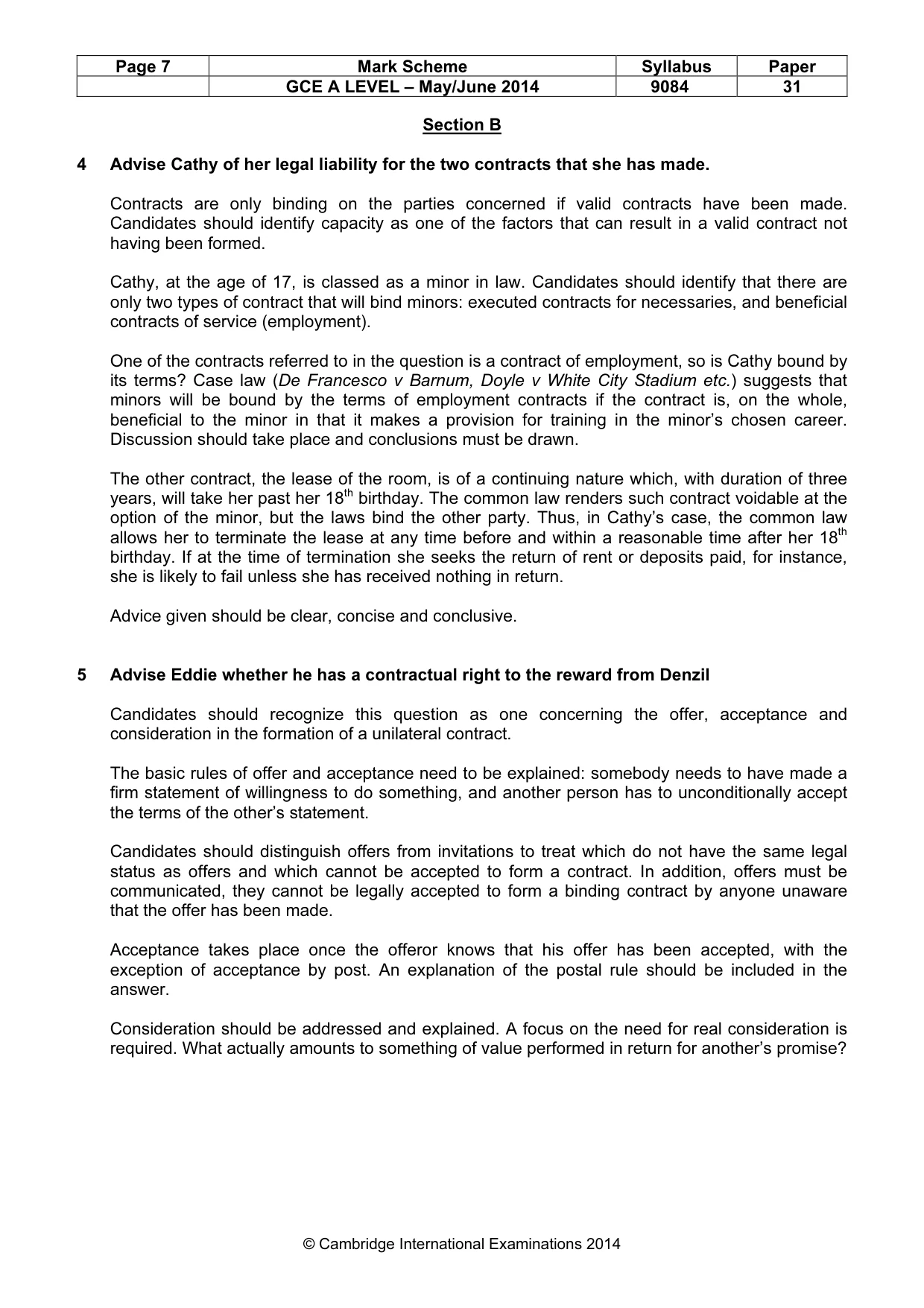
Page 7 Mark Scheme Syllabus Paper GCE A LEVEL – May/June 2014 9084 31 © Cambridge International Examinations 2014 Section B 4 Advise Cathy of her legal liability for the two contracts that she has made. Contracts are only binding on the parties concerned if valid contracts have been made. Candidates should identify capacity as one of the factors that can result in a valid contract not having been formed. Cathy, at the age of 17, is classed as a minor in law. Candidates should identify that there are only two types of contract that will bind minors: executed contracts for necessaries, and beneficial contracts of service (employment). One of the contracts referred to in the question is a contract of employment, so is Cathy bound by its terms? Case law (De Francesco v Barnum, Doyle v White City Stadium etc.) suggests that minors will be bound by the terms of employment contracts if the contract is, on the whole, beneficial to the minor in that it makes a provision for training in the minor’s chosen career. Discussion should take place and conclusions must be drawn. The other contract, the lease of the room, is of a continuing nature which, with duration of three years, will take her past her 18th birthday. The common law renders such contract voidable at the option of the minor, but the laws bind the other party. Thus, in Cathy’s case, the common law allows her to terminate the lease at any time before and within a reasonable time after her 18th birthday. If at the time of termination she seeks the return of rent or deposits paid, for instance, she is likely to fail unless she has received nothing in return. Advice given should be clear, concise and conclusive. 5 Advise Eddie whether he has a contractual right to the reward from Denzil Candidates should recognize this question as one concerning the offer, acceptance and consideration in the formation of a unilateral contract. The basic rules of offer and acceptance need to be explained: somebody needs to have made a firm statement of willingness to do something, and another person has to unconditionally accept the terms of the other’s statement. Candidates should distinguish offers from invitations to treat which do not have the same legal status as offers and which cannot be accepted to form a contract. In addition, offers must be communicated, they cannot be legally accepted to form a binding contract by anyone unaware that the offer has been made. Acceptance takes place once the offeror knows that his offer has been accepted, with the exception of acceptance by post. An explanation of the postal rule should be included in the answer. Consideration should be addressed and explained. A focus on the need for real consideration is required. What actually amounts to something of value performed in return for another’s promise?
Mark scheme, page 8
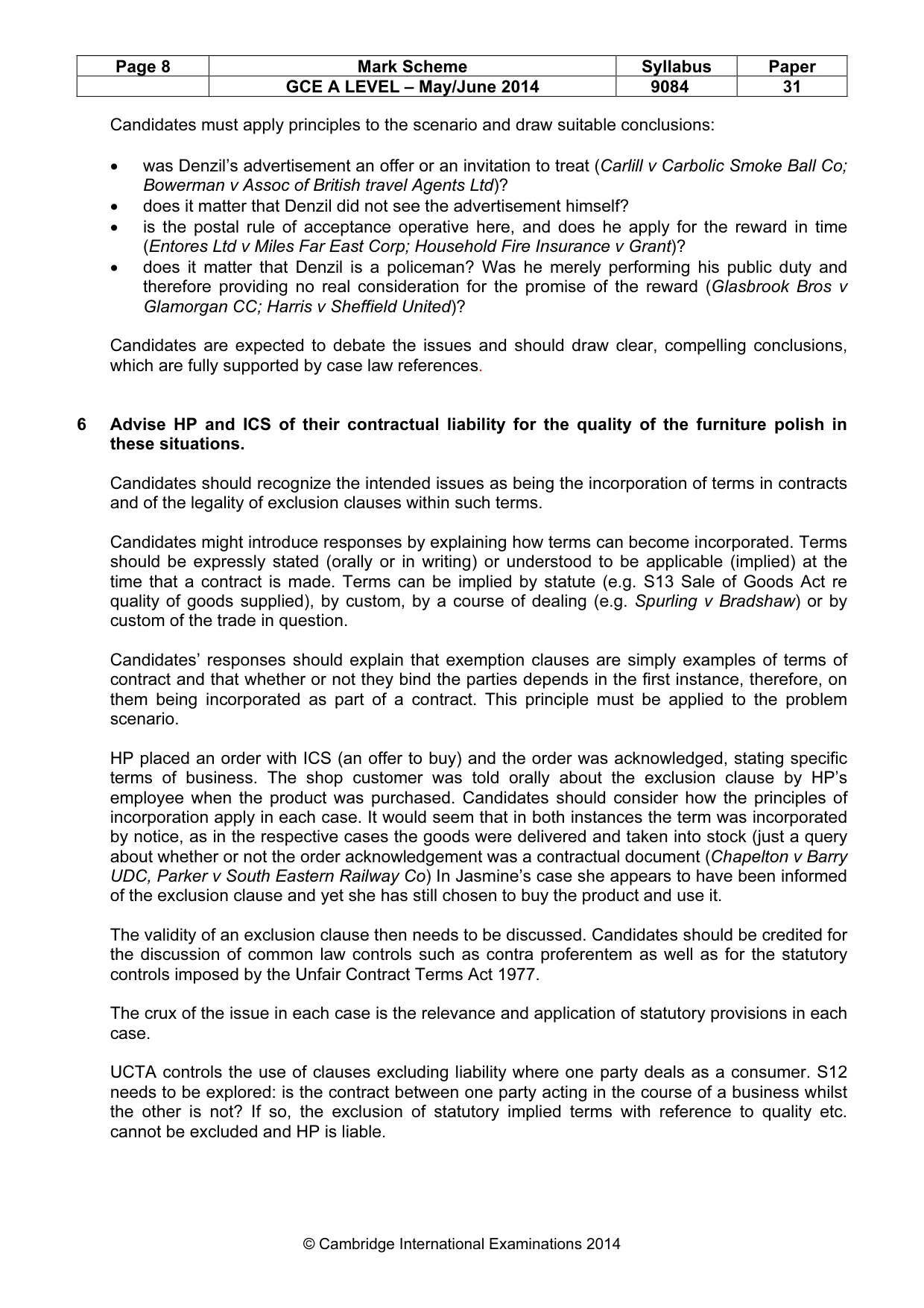
Page 8 Mark Scheme Syllabus Paper GCE A LEVEL – May/June 2014 9084 31 © Cambridge International Examinations 2014 Candidates must apply principles to the scenario and draw suitable conclusions: • was Denzil’s advertisement an offer or an invitation to treat (Carlill v Carbolic Smoke Ball Co; Bowerman v Assoc of British travel Agents Ltd)? • does it matter that Denzil did not see the advertisement himself? • is the postal rule of acceptance operative here, and does he apply for the reward in time (Entores Ltd v Miles Far East Corp; Household Fire Insurance v Grant)? • does it matter that Denzil is a policeman? Was he merely performing his public duty and therefore providing no real consideration for the promise of the reward (Glasbrook Bros v Glamorgan CC; Harris v Sheffield United)? Candidates are expected to debate the issues and should draw clear, compelling conclusions, which are fully supported by case law references. 6 Advise HP and ICS of their contractual liability for the quality of the furniture polish in these situations. Candidates should recognize the intended issues as being the incorporation of terms in contracts and of the legality of exclusion clauses within such terms. Candidates might introduce responses by explaining how terms can become incorporated. Terms should be expressly stated (orally or in writing) or understood to be applicable (implied) at the time that a contract is made. Terms can be implied by statute (e.g. S13 Sale of Goods Act re quality of goods supplied), by custom, by a course of dealing (e.g. Spurling v Bradshaw) or by custom of the trade in question. Candidates’ responses should explain that exemption clauses are simply examples of terms of contract and that whether or not they bind the parties depends in the first instance, therefore, on them being incorporated as part of a contract. This principle must be applied to the problem scenario. HP placed an order with ICS (an offer to buy) and the order was acknowledged, stating specific terms of business. The shop customer was told orally about the exclusion clause by HP’s employee when the product was purchased. Candidates should consider how the principles of incorporation apply in each case. It would seem that in both instances the term was incorporated by notice, as in the respective cases the goods were delivered and taken into stock (just a query about whether or not the order acknowledgement was a contractual document (Chapelton v Barry UDC, Parker v South Eastern Railway Co) In Jasmine’s case she appears to have been informed of the exclusion clause and yet she has still chosen to buy the product and use it. The validity of an exclusion clause then needs to be discussed. Candidates should be credited for the discussion of common law controls such as contra proferentem as well as for the statutory controls imposed by the Unfair Contract Terms Act 1977. The crux of the issue in each case is the relevance and application of statutory provisions in each case. UCTA controls the use of clauses excluding liability where one party deals as a consumer. S12 needs to be explored: is the contract between one party acting in the course of a business whilst the other is not? If so, the exclusion of statutory implied terms with reference to quality etc. cannot be excluded and HP is liable.
Mark scheme, page 9
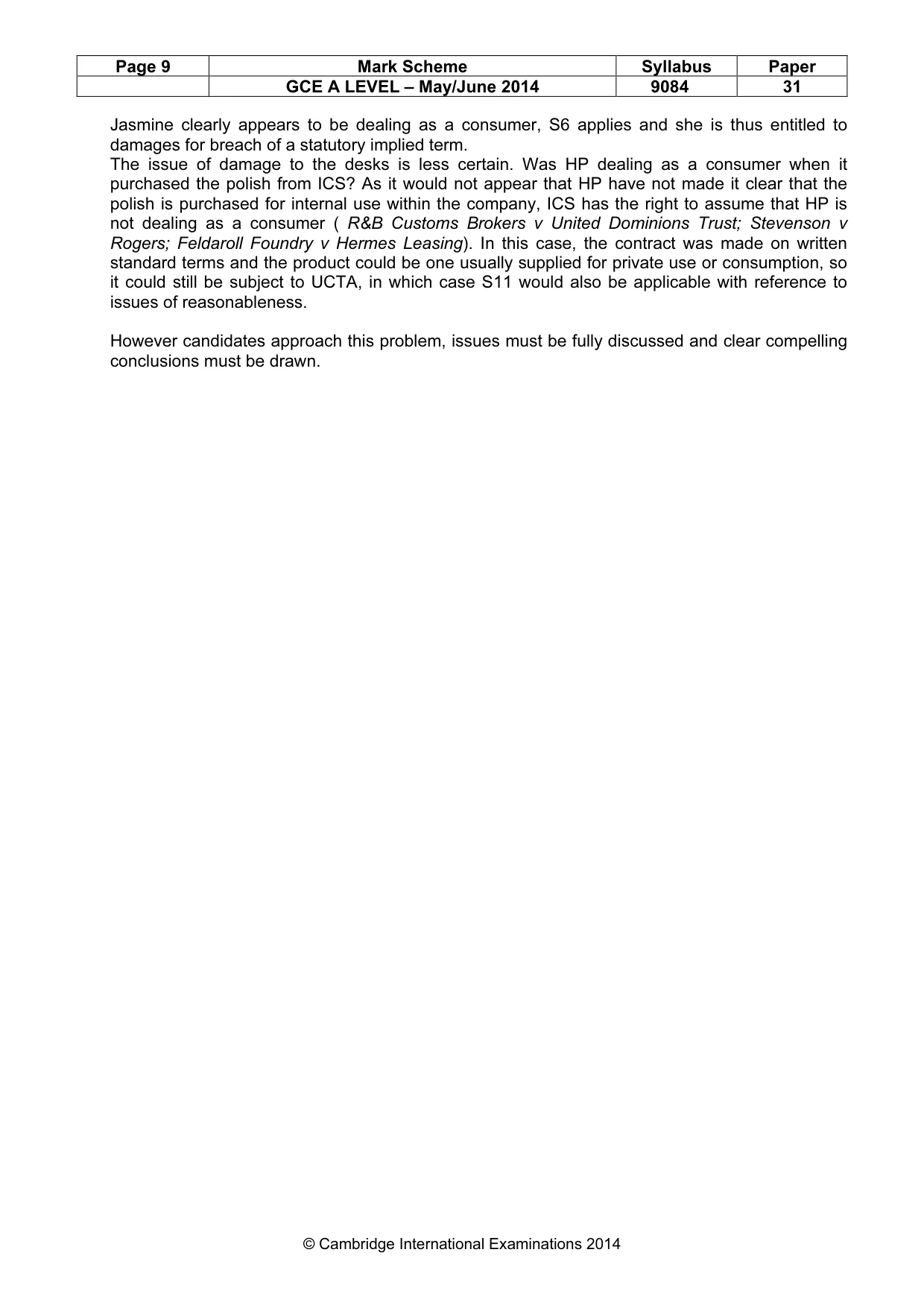
Page 9 Mark Scheme Syllabus Paper GCE A LEVEL – May/June 2014 9084 31 © Cambridge International Examinations 2014 Jasmine clearly appears to be dealing as a consumer, S6 applies and she is thus entitled to damages for breach of a statutory implied term. The issue of damage to the desks is less certain. Was HP dealing as a consumer when it purchased the polish from ICS? As it would not appear that HP have not made it clear that the polish is purchased for internal use within the company, ICS has the right to assume that HP is not dealing as a consumer ( R&B Customs Brokers v United Dominions Trust; Stevenson v Rogers; Feldaroll Foundry v Hermes Leasing). In this case, the contract was made on written standard terms and the product could be one usually supplied for private use or consumption, so it could still be subject to UCTA, in which case S11 would also be applicable with reference to issues of reasonableness. However candidates approach this problem, issues must be fully discussed and clear compelling conclusions must be drawn.
What you needed in this session
Cambridge’s own grade thresholds for 2014 May/June, Paper 3 · Variant 1. A higher threshold means an easier paper — the bar moves with how the cohort did.