Cambridge A Level Law 9084 — 2012 May/June Paper 1 · Variant 3
9084/13/M/J/12 · 75 marks · ≈84 min
The question paper and its mark scheme, free to read here and free to download. This is Cambridge’s own paper, exactly as it was sat.
Question paper2 pages
Mark scheme4 pages
Answers below. Sit the paper first if you are practising.
Paper as text
Question paper, page 1
This document consists of 2 printed pages. DC (RW) 51070/1 © UCLES 2012 [Turn over UNIVERSITY OF CAMBRIDGE INTERNATIONAL EXAMINATIONS General Certificate of Education Advanced Subsidiary Level and Advanced Level * 5 9 1 3 4 7 2 6 4 5 * LAW 9084/13 Paper 1 Structure and Operation of the English Legal System May/June 2012 1 hour 30 minutes Additional Materials: Answer Booklet/Paper READ THESE INSTRUCTIONS FIRST If you have been given an Answer Booklet, follow the instructions on the front cover of the Booklet. Write your Centre number, candidate number and name on all the work you hand in. Write in dark blue or black pen. Do not use staples, paper clips, highlighters, glue or correction fluid. Answer three questions. At the end of the examination, fasten all your work securely together. The number of marks is given in brackets [ ] at the end of each question or part question.
Question paper, page 2
2 9084/13/M/J/12 © UCLES 2012 Permission to reproduce items where third-party owned material protected by copyright is included has been sought and cleared where possible. Every reasonable effort has been made by the publisher (UCLES) to trace copyright holders, but if any items requiring clearance have unwittingly been included, the publisher will be pleased to make amends at the earliest possible opportunity. University of Cambridge International Examinations is part of the Cambridge Assessment Group. Cambridge Assessment is the brand name of University of Cambridge Local Examinations Syndicate (UCLES), which is itself a department of the University of Cambridge. Answer three questions. 1 ‘It is no longer accurate to say that equity varies according to the length of the Chancellor’s foot.’ With reference to decided cases, consider critically the role of equity in modern law. [25] 2 Queenie pays £700 to her neighbour for a second-hand freezer. After a week, it stops working and £400-worth of frozen food is ruined. Explain to Queenie the steps she might take to recover her loss. What are the advantages and disadvantages of the procedures available to her? [25] 3 ‘The defendant’s liberty is in your hands, but in your hands also are the interests of society.’ – Asquith J in R v Commons (1942) Examining the selection and duties of the jury in criminal trials, discuss critically the accuracy of the above statement. [25] 4 Discuss the main bodies and methods which exist for reforming the law. Is there a need for a more unified system and what form might this take? [25] 5 Discuss critically the function and jurisdiction of both the Civil Division and the Criminal Division of the Court of Appeal. [25] 6 In 2009, more than 90 000 people sought to resolve employment disputes by going to the Employment Tribunal. Consider critically how this process works and discuss the advantages and disadvantages of tribunals. [25]
Mark scheme, page 1
UNIVERSITY OF CAMBRIDGE INTERNATIONAL EXAMINATIONS GCE Advanced Subsidiary Level and GCE Advanced Level MARK SCHEME for the May/June 2012 question paper for the guidance of teachers 9084 LAW 9084/13 Paper 1, maximum raw mark 75 This mark scheme is published as an aid to teachers and candidates, to indicate the requirements of the examination. It shows the basis on which Examiners were instructed to award marks. It does not indicate the details of the discussions that took place at an Examiners’ meeting before marking began, which would have considered the acceptability of alternative answers. Mark schemes must be read in conjunction with the question papers and the report on the examination. • Cambridge will not enter into discussions or correspondence in connection with these mark schemes. Cambridge is publishing the mark schemes for the May/June 2012 question papers for most IGCSE, GCE Advanced Level and Advanced Subsidiary Level syllabuses and some Ordinary Level syllabuses.
Mark scheme, page 2
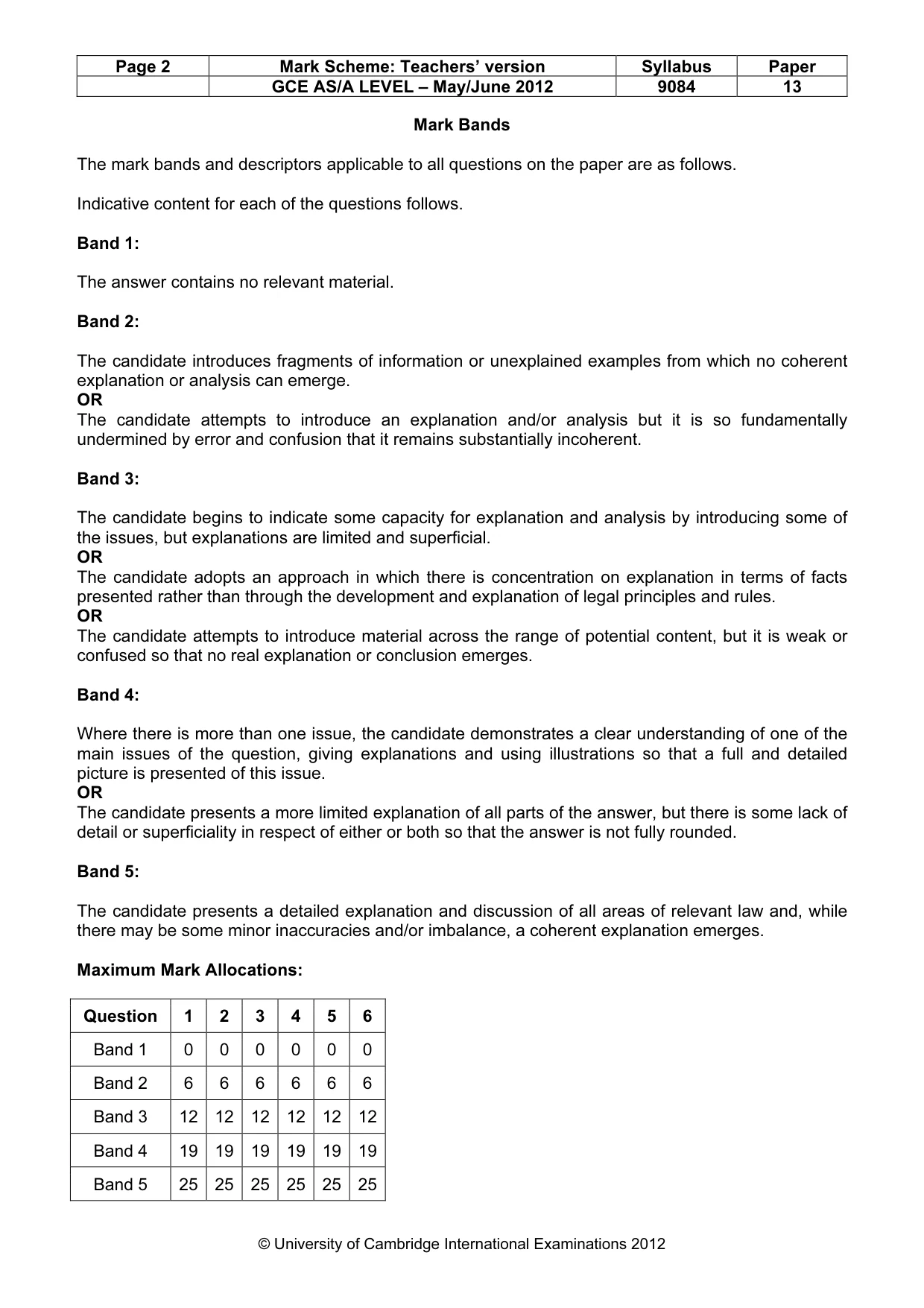
Page 2 Mark Scheme: Teachers’ version Syllabus Paper GCE AS/A LEVEL – May/June 2012 9084 13 © University of Cambridge International Examinations 2012 Mark Bands The mark bands and descriptors applicable to all questions on the paper are as follows. Indicative content for each of the questions follows. Band 1: The answer contains no relevant material. Band 2: The candidate introduces fragments of information or unexplained examples from which no coherent explanation or analysis can emerge. OR The candidate attempts to introduce an explanation and/or analysis but it is so fundamentally undermined by error and confusion that it remains substantially incoherent. Band 3: The candidate begins to indicate some capacity for explanation and analysis by introducing some of the issues, but explanations are limited and superficial. OR The candidate adopts an approach in which there is concentration on explanation in terms of facts presented rather than through the development and explanation of legal principles and rules. OR The candidate attempts to introduce material across the range of potential content, but it is weak or confused so that no real explanation or conclusion emerges. Band 4: Where there is more than one issue, the candidate demonstrates a clear understanding of one of the main issues of the question, giving explanations and using illustrations so that a full and detailed picture is presented of this issue. OR The candidate presents a more limited explanation of all parts of the answer, but there is some lack of detail or superficiality in respect of either or both so that the answer is not fully rounded. Band 5: The candidate presents a detailed explanation and discussion of all areas of relevant law and, while there may be some minor inaccuracies and/or imbalance, a coherent explanation emerges. Maximum Mark Allocations: Question 1 2 3 4 5 6 Band 1 0 0 0 0 0 0 Band 2 6 6 6 6 6 6 Band 3 12 12 12 12 12 12 Band 4 19 19 19 19 19 19 Band 5 25 25 25 25 25 25
Mark scheme, page 3
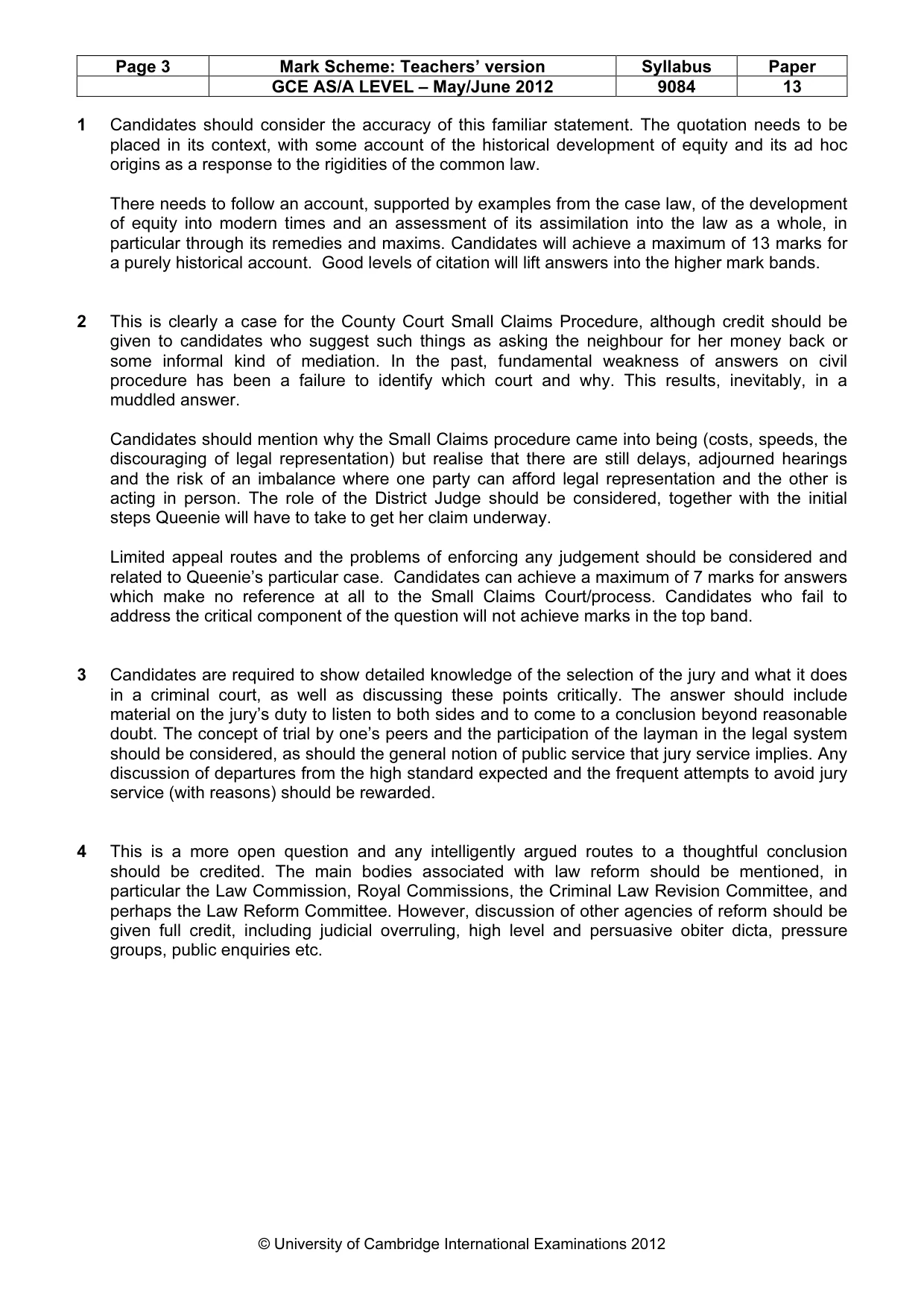
Page 3 Mark Scheme: Teachers’ version Syllabus Paper GCE AS/A LEVEL – May/June 2012 9084 13 © University of Cambridge International Examinations 2012 1 Candidates should consider the accuracy of this familiar statement. The quotation needs to be placed in its context, with some account of the historical development of equity and its ad hoc origins as a response to the rigidities of the common law. There needs to follow an account, supported by examples from the case law, of the development of equity into modern times and an assessment of its assimilation into the law as a whole, in particular through its remedies and maxims. Candidates will achieve a maximum of 13 marks for a purely historical account. Good levels of citation will lift answers into the higher mark bands. 2 This is clearly a case for the County Court Small Claims Procedure, although credit should be given to candidates who suggest such things as asking the neighbour for her money back or some informal kind of mediation. In the past, fundamental weakness of answers on civil procedure has been a failure to identify which court and why. This results, inevitably, in a muddled answer. Candidates should mention why the Small Claims procedure came into being (costs, speeds, the discouraging of legal representation) but realise that there are still delays, adjourned hearings and the risk of an imbalance where one party can afford legal representation and the other is acting in person. The role of the District Judge should be considered, together with the initial steps Queenie will have to take to get her claim underway. Limited appeal routes and the problems of enforcing any judgement should be considered and related to Queenie’s particular case. Candidates can achieve a maximum of 7 marks for answers which make no reference at all to the Small Claims Court/process. Candidates who fail to address the critical component of the question will not achieve marks in the top band. 3 Candidates are required to show detailed knowledge of the selection of the jury and what it does in a criminal court, as well as discussing these points critically. The answer should include material on the jury’s duty to listen to both sides and to come to a conclusion beyond reasonable doubt. The concept of trial by one’s peers and the participation of the layman in the legal system should be considered, as should the general notion of public service that jury service implies. Any discussion of departures from the high standard expected and the frequent attempts to avoid jury service (with reasons) should be rewarded. 4 This is a more open question and any intelligently argued routes to a thoughtful conclusion should be credited. The main bodies associated with law reform should be mentioned, in particular the Law Commission, Royal Commissions, the Criminal Law Revision Committee, and perhaps the Law Reform Committee. However, discussion of other agencies of reform should be given full credit, including judicial overruling, high level and persuasive obiter dicta, pressure groups, public enquiries etc.
Mark scheme, page 4
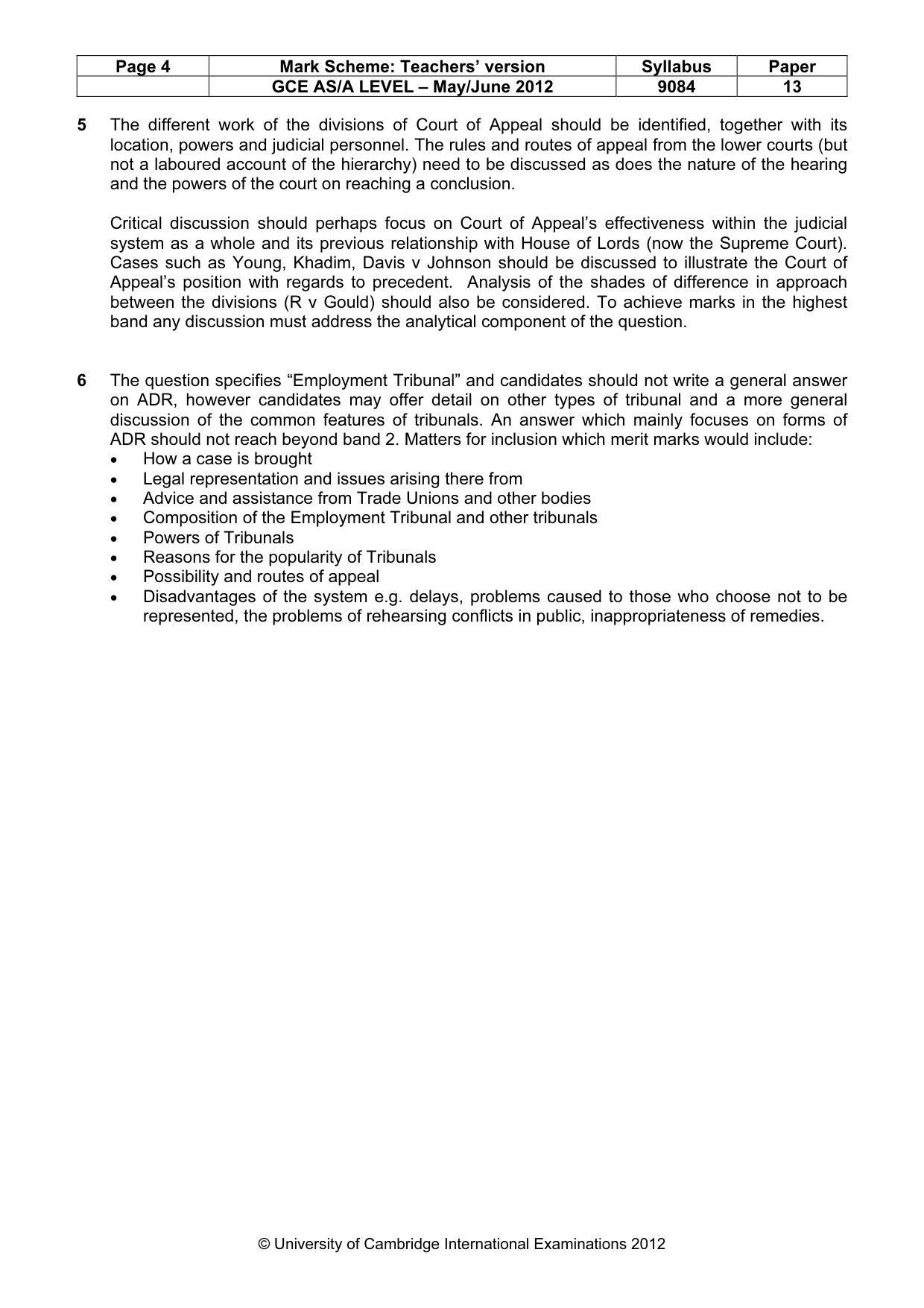
Page 4 Mark Scheme: Teachers’ version Syllabus Paper GCE AS/A LEVEL – May/June 2012 9084 13 © University of Cambridge International Examinations 2012 5 The different work of the divisions of Court of Appeal should be identified, together with its location, powers and judicial personnel. The rules and routes of appeal from the lower courts (but not a laboured account of the hierarchy) need to be discussed as does the nature of the hearing and the powers of the court on reaching a conclusion. Critical discussion should perhaps focus on Court of Appeal’s effectiveness within the judicial system as a whole and its previous relationship with House of Lords (now the Supreme Court). Cases such as Young, Khadim, Davis v Johnson should be discussed to illustrate the Court of Appeal’s position with regards to precedent. Analysis of the shades of difference in approach between the divisions (R v Gould) should also be considered. To achieve marks in the highest band any discussion must address the analytical component of the question. 6 The question specifies “Employment Tribunal” and candidates should not write a general answer on ADR, however candidates may offer detail on other types of tribunal and a more general discussion of the common features of tribunals. An answer which mainly focuses on forms of ADR should not reach beyond band 2. Matters for inclusion which merit marks would include: • How a case is brought • Legal representation and issues arising there from • Advice and assistance from Trade Unions and other bodies • Composition of the Employment Tribunal and other tribunals • Powers of Tribunals • Reasons for the popularity of Tribunals • Possibility and routes of appeal • Disadvantages of the system e.g. delays, problems caused to those who choose not to be represented, the problems of rehearsing conflicts in public, inappropriateness of remedies.
What you needed in this session
Cambridge’s own grade thresholds for 2012 May/June, Paper 1 · Variant 3. A higher threshold means an easier paper — the bar moves with how the cohort did.