Cambridge A Level Law 9084 — 2023 May/June Paper 1 · Variant 3
9084/13/M/J/23 · 75 marks · ≈84 min
The question paper and its mark scheme, free to read here and free to download. This is Cambridge’s own paper, exactly as it was sat.
Question paper4 pages


Mark scheme15 pages
Answers below. Sit the paper first if you are practising.
Paper as text
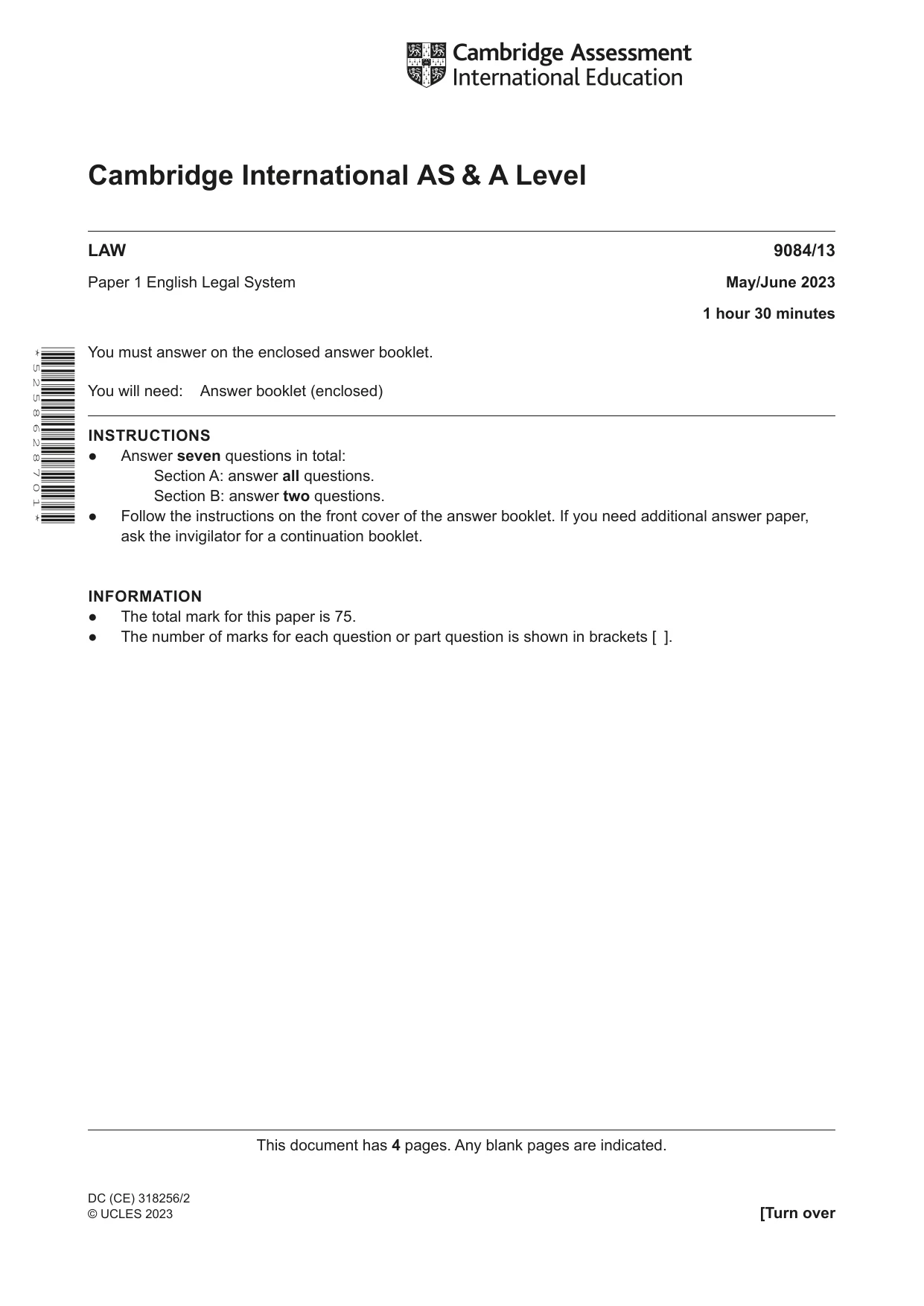
Question paper, page 1
This document has 4 pages. Any blank pages are indicated. [Turn over Cambridge International AS & A Level DC (CE) 318256/2 © UCLES 2023 LAW 9084/13 Paper 1 English Legal System May/June 2023 1 hour 30 minutes You must answer on the enclosed answer booklet. You will need: Answer booklet (enclosed) INSTRUCTIONS ● Answer seven questions in total: Section A: answer all questions. Section B: answer two questions. ● Follow the instructions on the front cover of the answer booklet. If you need additional answer paper, ask the invigilator for a continuation booklet. INFORMATION ● The total mark for this paper is 75. ● The number of marks for each question or part question is shown in brackets [ ]. * 5 2 5 8 6 2 8 7 0 1 *
Question paper, page 2
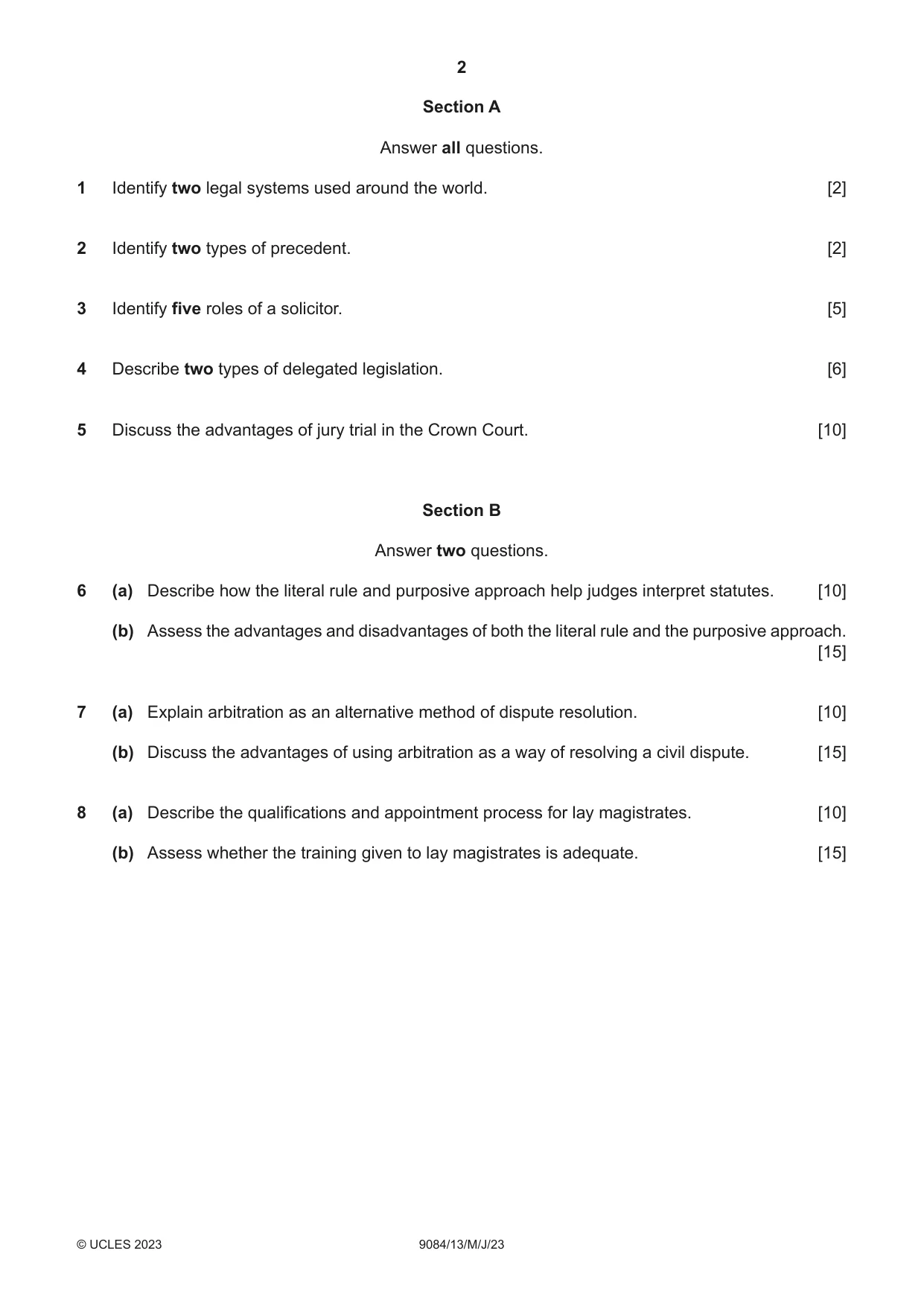
2 9084/13/M/J/23 © UCLES 2023 Section A Answer all questions. 1 Identify two legal systems used around the world. [2] 2 Identify two types of precedent. [2] 3 Identify five roles of a solicitor. [5] 4 Describe two types of delegated legislation. [6] 5 Discuss the advantages of jury trial in the Crown Court. [10] Section B Answer two questions. 6 (a) Describe how the literal rule and purposive approach help judges interpret statutes. [10] (b) Assess the advantages and disadvantages of both the literal rule and the purposive approach. [15] 7 (a) Explain arbitration as an alternative method of dispute resolution. [10] (b) Discuss the advantages of using arbitration as a way of resolving a civil dispute. [15] 8 (a) Describe the qualifications and appointment process for lay magistrates. [10] (b) Assess whether the training given to lay magistrates is adequate. [15]
Question paper, page 3
3 9084/13/M/J/23 © UCLES 2023 BLANK PAGE
Question paper, page 4
4 9084/13/M/J/23 © UCLES 2023 Permission to reproduce items where third-party owned material protected by copyright is included has been sought and cleared where possible. Every reasonable effort has been made by the publisher (UCLES) to trace copyright holders, but if any items requiring clearance have unwittingly been included, the publisher will be pleased to make amends at the earliest possible opportunity. To avoid the issue of disclosure of answer-related information to candidates, all copyright acknowledgements are reproduced online in the Cambridge Assessment International Education Copyright Acknowledgements Booklet. This is produced for each series of examinations and is freely available to download at www.cambridgeinternational.org after the live examination series. Cambridge Assessment International Education is part of Cambridge Assessment. Cambridge Assessment is the brand name of the University of Cambridge Local Examinations Syndicate (UCLES), which is a department of the University of Cambridge. BLANK PAGE
Mark scheme, page 1
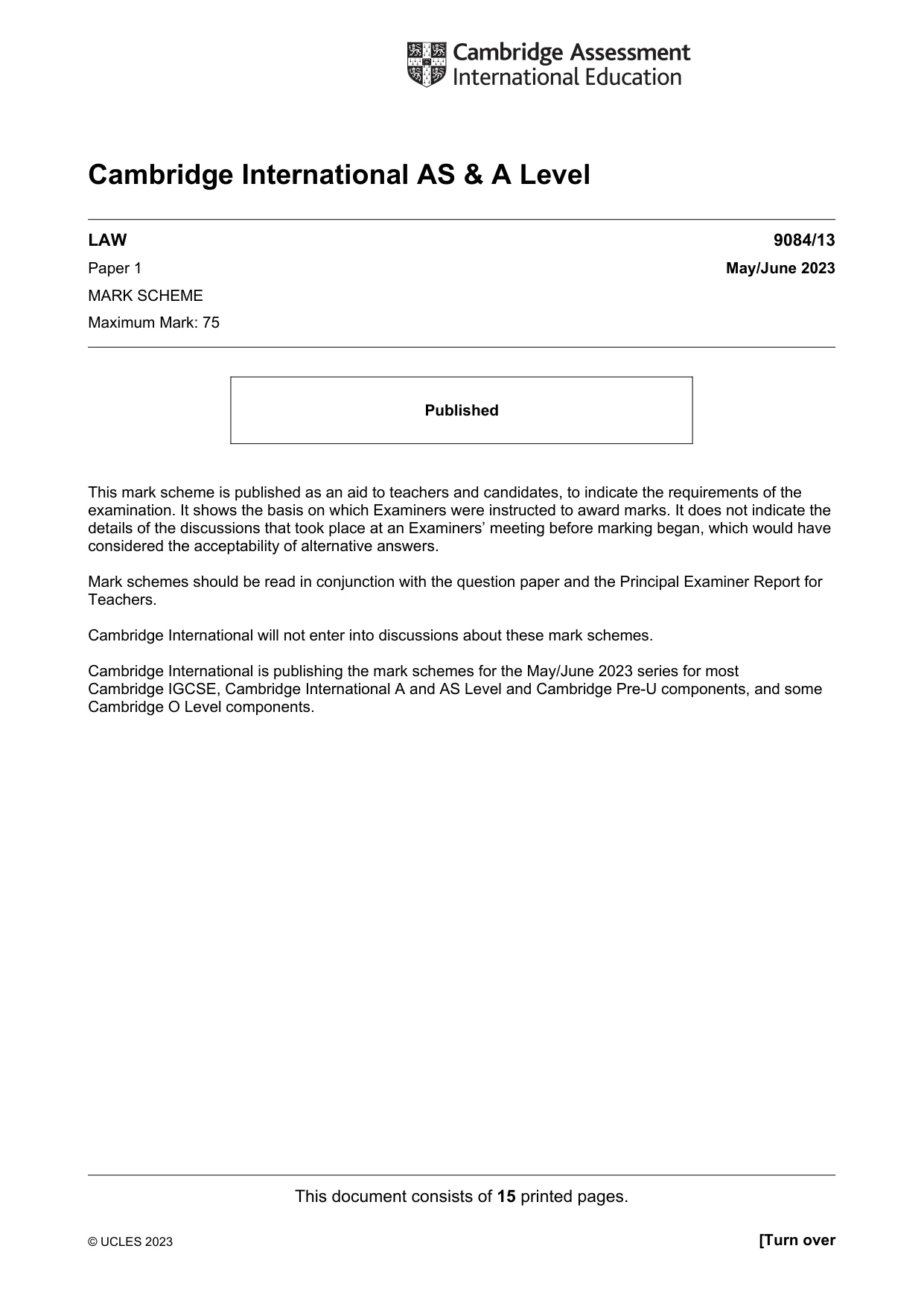
This document consists of 15 printed pages. © UCLES 2023 [Turn over Cambridge International AS & A Level LAW 9084/13 Paper 1 May/June 2023 MARK SCHEME Maximum Mark: 75 Published This mark scheme is published as an aid to teachers and candidates, to indicate the requirements of the examination. It shows the basis on which Examiners were instructed to award marks. It does not indicate the details of the discussions that took place at an Examiners’ meeting before marking began, which would have considered the acceptability of alternative answers. Mark schemes should be read in conjunction with the question paper and the Principal Examiner Report for Teachers. Cambridge International will not enter into discussions about these mark schemes. Cambridge International is publishing the mark schemes for the May/June 2023 series for most Cambridge IGCSE, Cambridge International A and AS Level and Cambridge Pre-U components, and some Cambridge O Level components.
Mark scheme, page 2
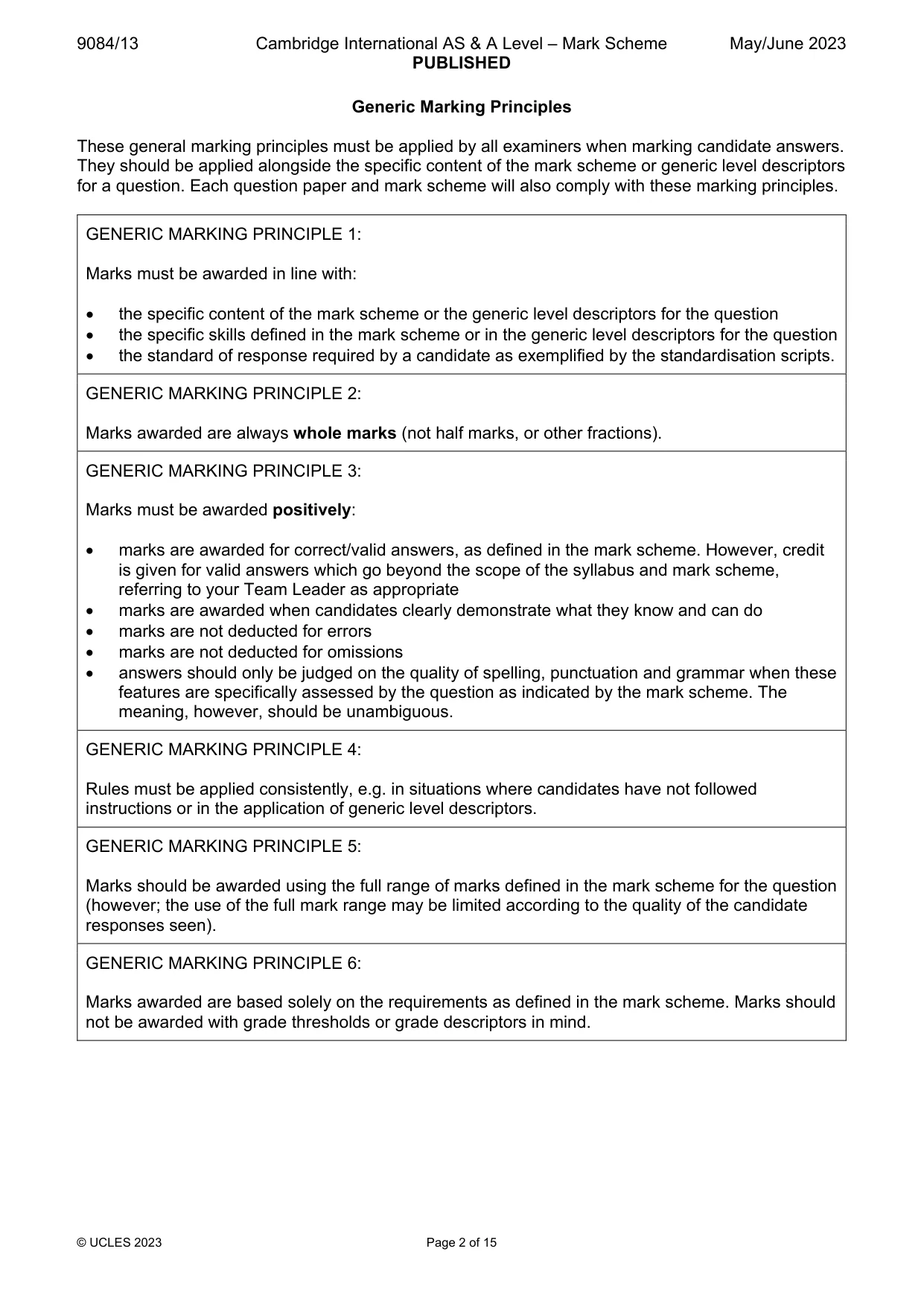
9084/13 Cambridge International AS & A Level – Mark Scheme PUBLISHED May/June 2023 © UCLES 2023 Page 2 of 15 Generic Marking Principles These general marking principles must be applied by all examiners when marking candidate answers. They should be applied alongside the specific content of the mark scheme or generic level descriptors for a question. Each question paper and mark scheme will also comply with these marking principles. GENERIC MARKING PRINCIPLE 1: Marks must be awarded in line with: the specific content of the mark scheme or the generic level descriptors for the question the specific skills defined in the mark scheme or in the generic level descriptors for the question the standard of response required by a candidate as exemplified by the standardisation scripts. GENERIC MARKING PRINCIPLE 2: Marks awarded are always whole marks (not half marks, or other fractions). GENERIC MARKING PRINCIPLE 3: Marks must be awarded positively: marks are awarded for correct/valid answers, as defined in the mark scheme. However, credit is given for valid answers which go beyond the scope of the syllabus and mark scheme, referring to your Team Leader as appropriate marks are awarded when candidates clearly demonstrate what they know and can do marks are not deducted for errors marks are not deducted for omissions answers should only be judged on the quality of spelling, punctuation and grammar when these features are specifically assessed by the question as indicated by the mark scheme. The meaning, however, should be unambiguous. GENERIC MARKING PRINCIPLE 4: Rules must be applied consistently, e.g. in situations where candidates have not followed instructions or in the application of generic level descriptors. GENERIC MARKING PRINCIPLE 5: Marks should be awarded using the full range of marks defined in the mark scheme for the question (however; the use of the full mark range may be limited according to the quality of the candidate responses seen). GENERIC MARKING PRINCIPLE 6: Marks awarded are based solely on the requirements as defined in the mark scheme. Marks should not be awarded with grade thresholds or grade descriptors in mind.
Mark scheme, page 3
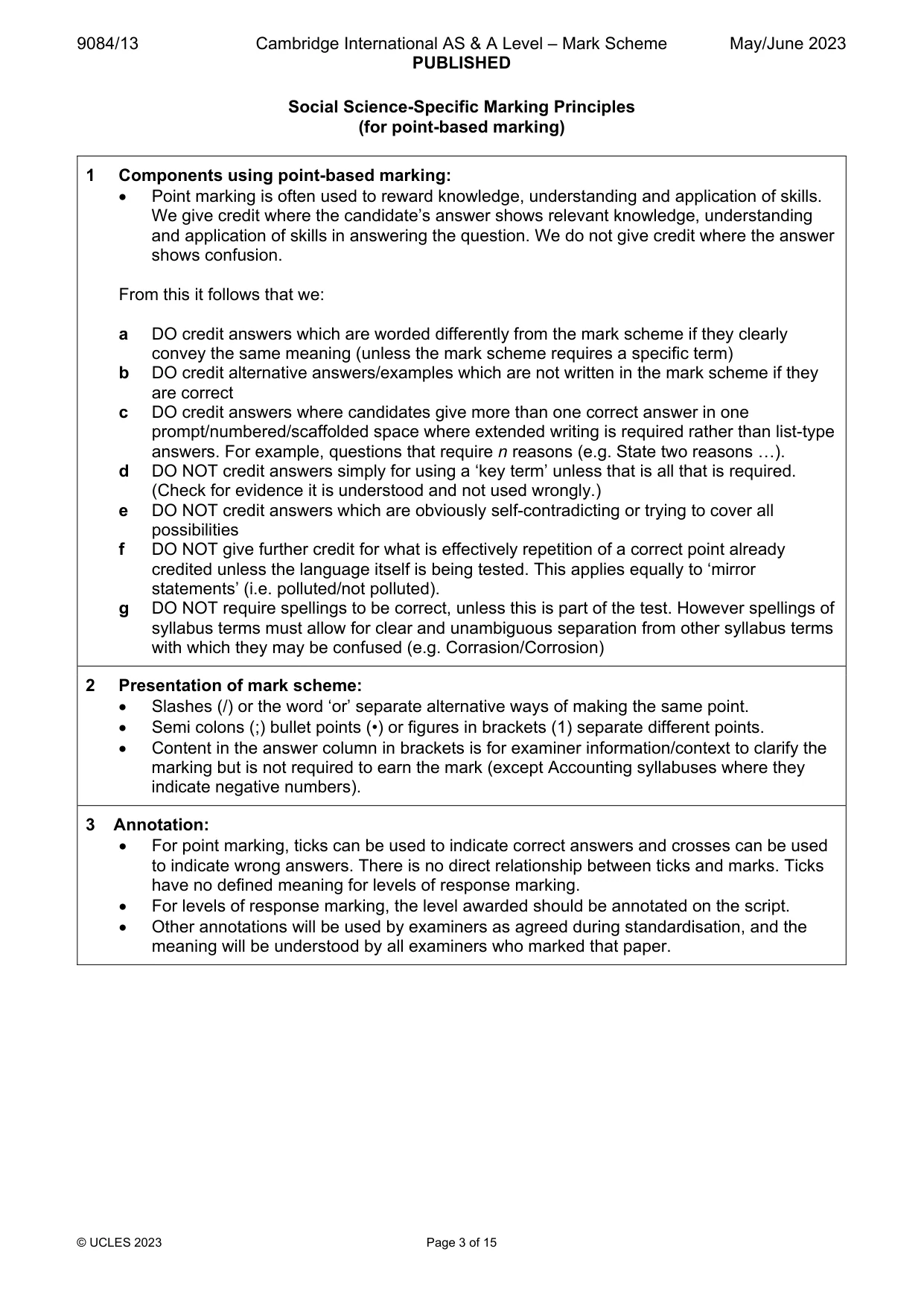
9084/13 Cambridge International AS & A Level – Mark Scheme PUBLISHED May/June 2023 © UCLES 2023 Page 3 of 15 Social Science-Specific Marking Principles (for point-based marking) 1 Components using point-based marking: Point marking is often used to reward knowledge, understanding and application of skills. We give credit where the candidate’s answer shows relevant knowledge, understanding and application of skills in answering the question. We do not give credit where the answer shows confusion. From this it follows that we: a DO credit answers which are worded differently from the mark scheme if they clearly convey the same meaning (unless the mark scheme requires a specific term) b DO credit alternative answers/examples which are not written in the mark scheme if they are correct c DO credit answers where candidates give more than one correct answer in one prompt/numbered/scaffolded space where extended writing is required rather than list-type answers. For example, questions that require n reasons (e.g. State two reasons …). d DO NOT credit answers simply for using a ‘key term’ unless that is all that is required. (Check for evidence it is understood and not used wrongly.) e DO NOT credit answers which are obviously self-contradicting or trying to cover all possibilities f DO NOT give further credit for what is effectively repetition of a correct point already credited unless the language itself is being tested. This applies equally to ‘mirror statements’ (i.e. polluted/not polluted). g DO NOT require spellings to be correct, unless this is part of the test. However spellings of syllabus terms must allow for clear and unambiguous separation from other syllabus terms with which they may be confused (e.g. Corrasion/Corrosion) 2 Presentation of mark scheme: Slashes (/) or the word ‘or’ separate alternative ways of making the same point. Semi colons (;) bullet points (•) or figures in brackets (1) separate different points. Content in the answer column in brackets is for examiner information/context to clarify the marking but is not required to earn the mark (except Accounting syllabuses where they indicate negative numbers). 3 Annotation: For point marking, ticks can be used to indicate correct answers and crosses can be used to indicate wrong answers. There is no direct relationship between ticks and marks. Ticks have no defined meaning for levels of response marking. For levels of response marking, the level awarded should be annotated on the script. Other annotations will be used by examiners as agreed during standardisation, and the meaning will be understood by all examiners who marked that paper.
Mark scheme, page 4
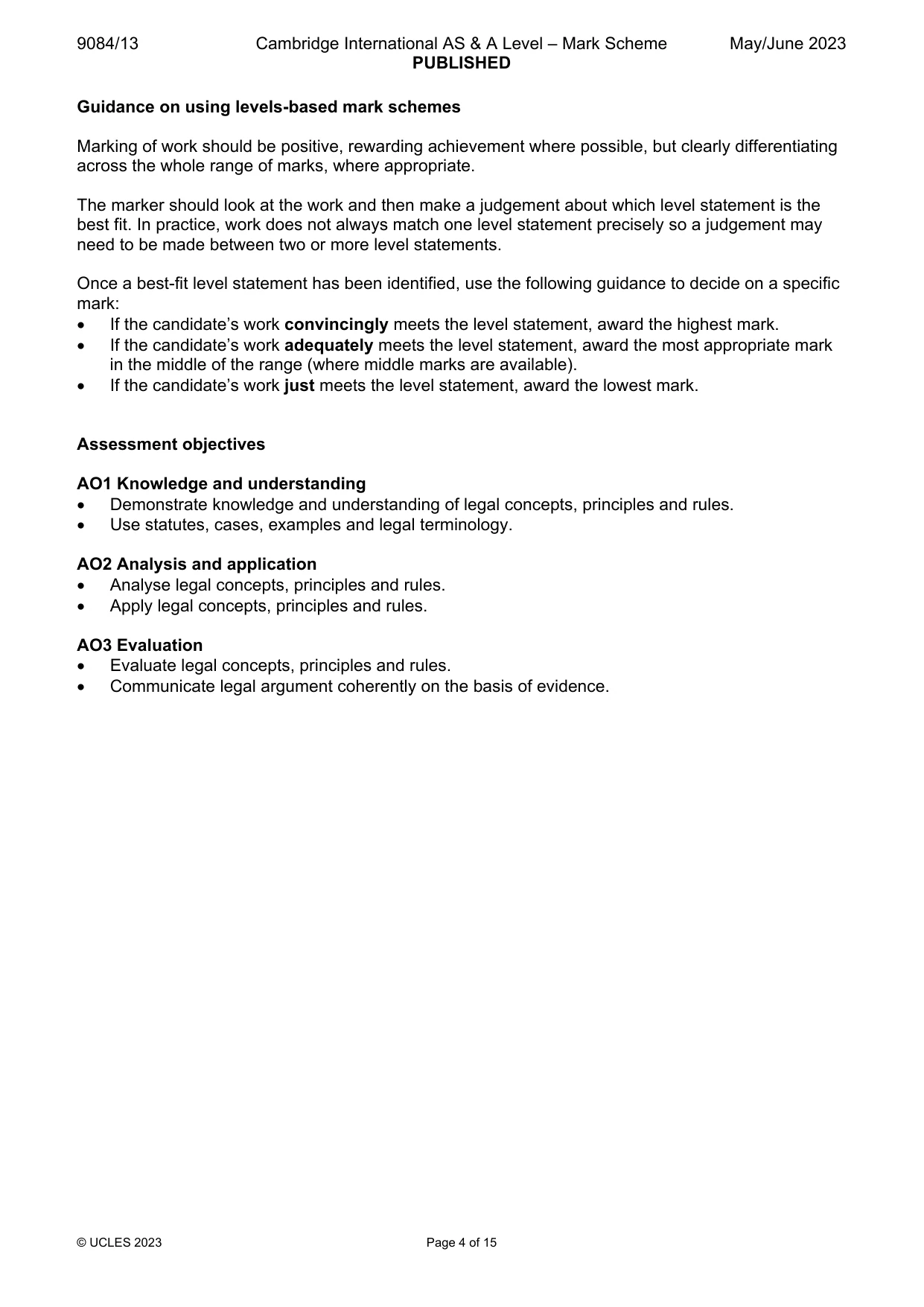
9084/13 Cambridge International AS & A Level – Mark Scheme PUBLISHED May/June 2023 © UCLES 2023 Page 4 of 15 Guidance on using levels-based mark schemes Marking of work should be positive, rewarding achievement where possible, but clearly differentiating across the whole range of marks, where appropriate. The marker should look at the work and then make a judgement about which level statement is the best fit. In practice, work does not always match one level statement precisely so a judgement may need to be made between two or more level statements. Once a best-fit level statement has been identified, use the following guidance to decide on a specific mark: If the candidate’s work convincingly meets the level statement, award the highest mark. If the candidate’s work adequately meets the level statement, award the most appropriate mark in the middle of the range (where middle marks are available). If the candidate’s work just meets the level statement, award the lowest mark. Assessment objectives AO1 Knowledge and understanding Demonstrate knowledge and understanding of legal concepts, principles and rules. Use statutes, cases, examples and legal terminology. AO2 Analysis and application Analyse legal concepts, principles and rules. Apply legal concepts, principles and rules. AO3 Evaluation Evaluate legal concepts, principles and rules. Communicate legal argument coherently on the basis of evidence.
Mark scheme, page 5
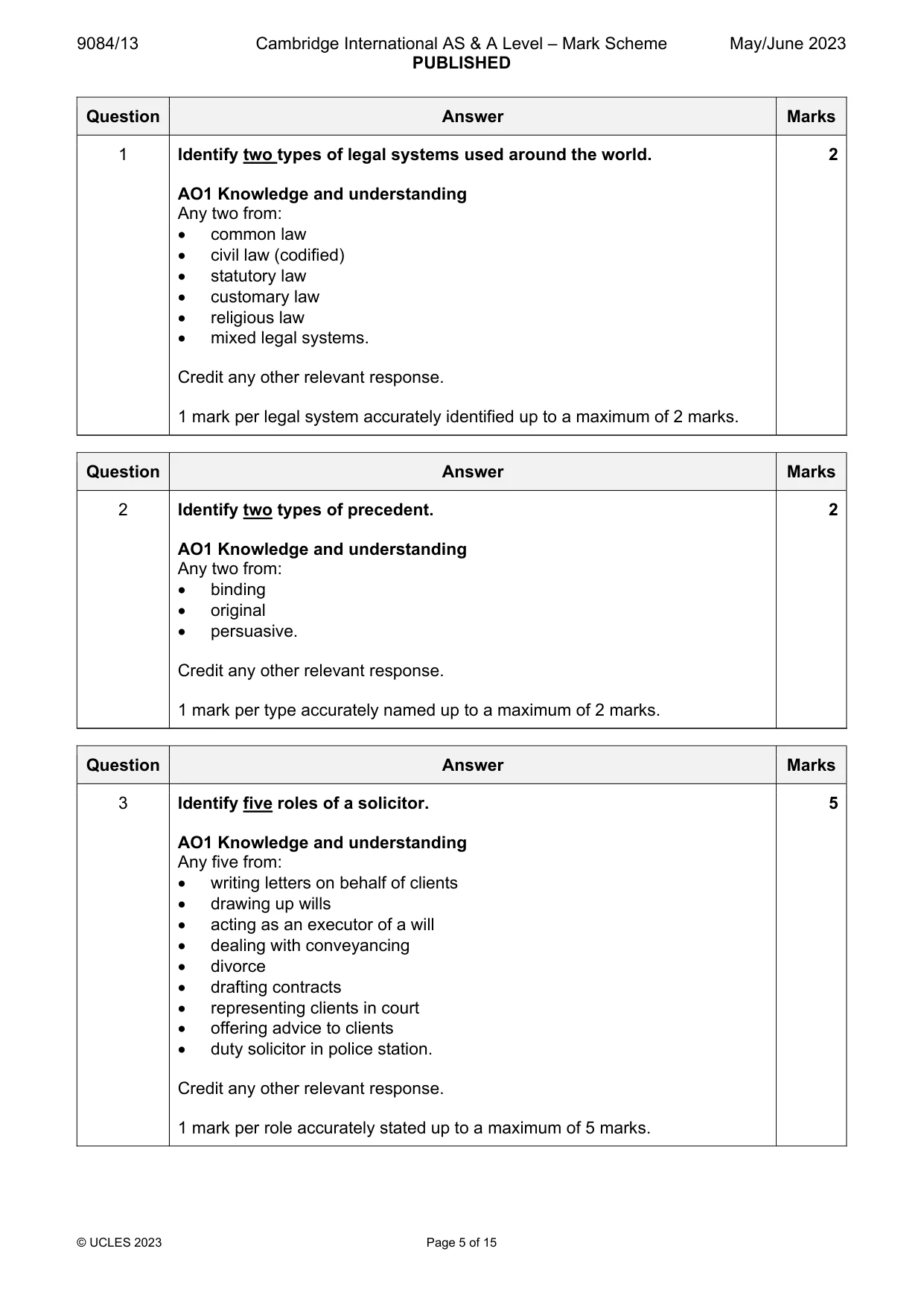
9084/13 Cambridge International AS & A Level – Mark Scheme PUBLISHED May/June 2023 © UCLES 2023 Page 5 of 15 Question Answer Marks 1 Identify two types of legal systems used around the world. AO1 Knowledge and understanding Any two from: common law civil law (codified) statutory law customary law religious law mixed legal systems. Credit any other relevant response. 1 mark per legal system accurately identified up to a maximum of 2 marks. 2 Question Answer Marks 2 Identify two types of precedent. AO1 Knowledge and understanding Any two from: binding original persuasive. Credit any other relevant response. 1 mark per type accurately named up to a maximum of 2 marks. 2 Question Answer Marks 3 Identify five roles of a solicitor. AO1 Knowledge and understanding Any five from: writing letters on behalf of clients drawing up wills acting as an executor of a will dealing with conveyancing divorce drafting contracts representing clients in court offering advice to clients duty solicitor in police station. Credit any other relevant response. 1 mark per role accurately stated up to a maximum of 5 marks. 5
Mark scheme, page 6
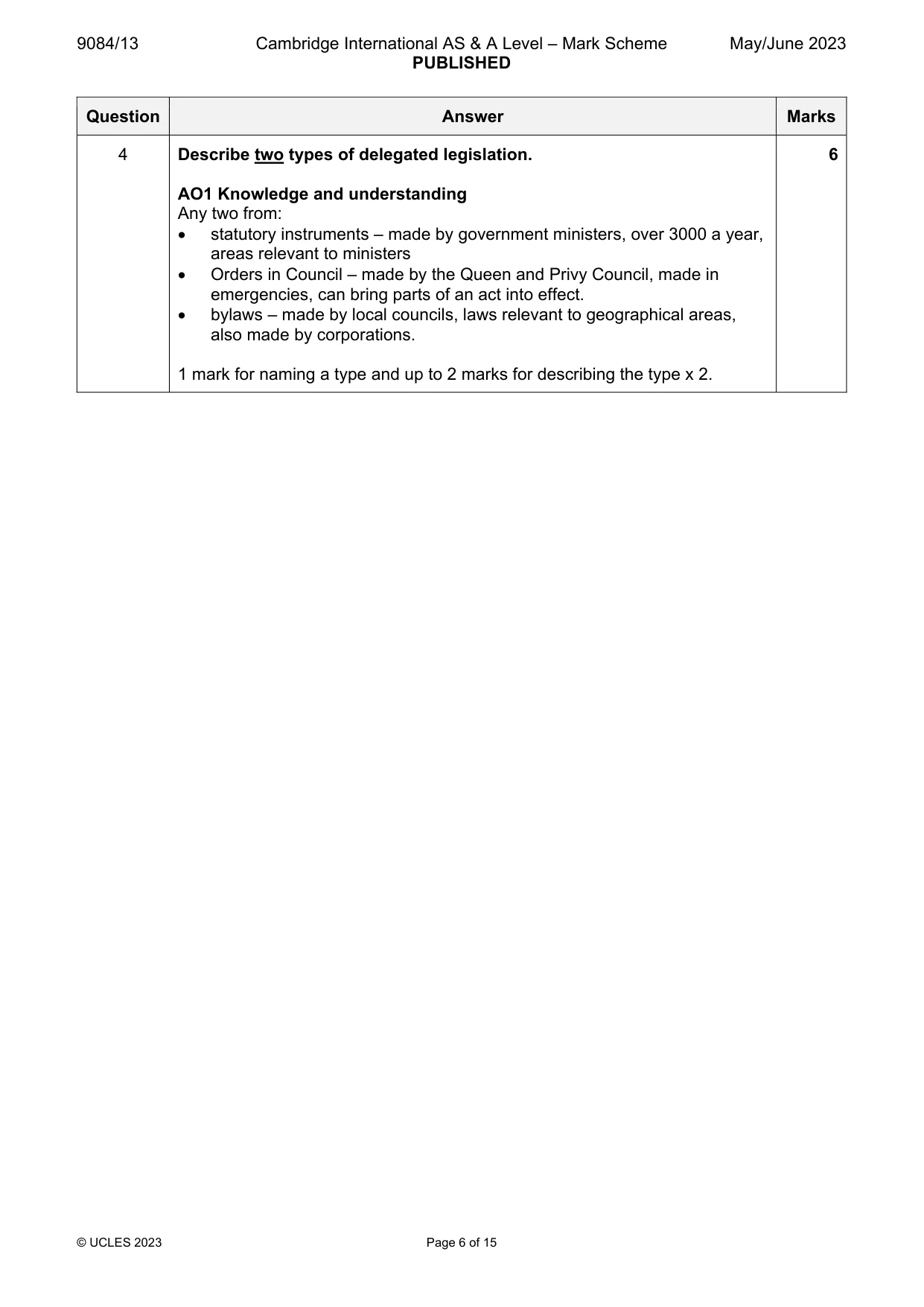
9084/13 Cambridge International AS & A Level – Mark Scheme PUBLISHED May/June 2023 © UCLES 2023 Page 6 of 15 Question Answer Marks 4 Describe two types of delegated legislation. AO1 Knowledge and understanding Any two from: statutory instruments – made by government ministers, over 3000 a year, areas relevant to ministers Orders in Council – made by the Queen and Privy Council, made in emergencies, can bring parts of an act into effect. bylaws – made by local councils, laws relevant to geographical areas, also made by corporations. 1 mark for naming a type and up to 2 marks for describing the type x 2. 6
Mark scheme, page 7
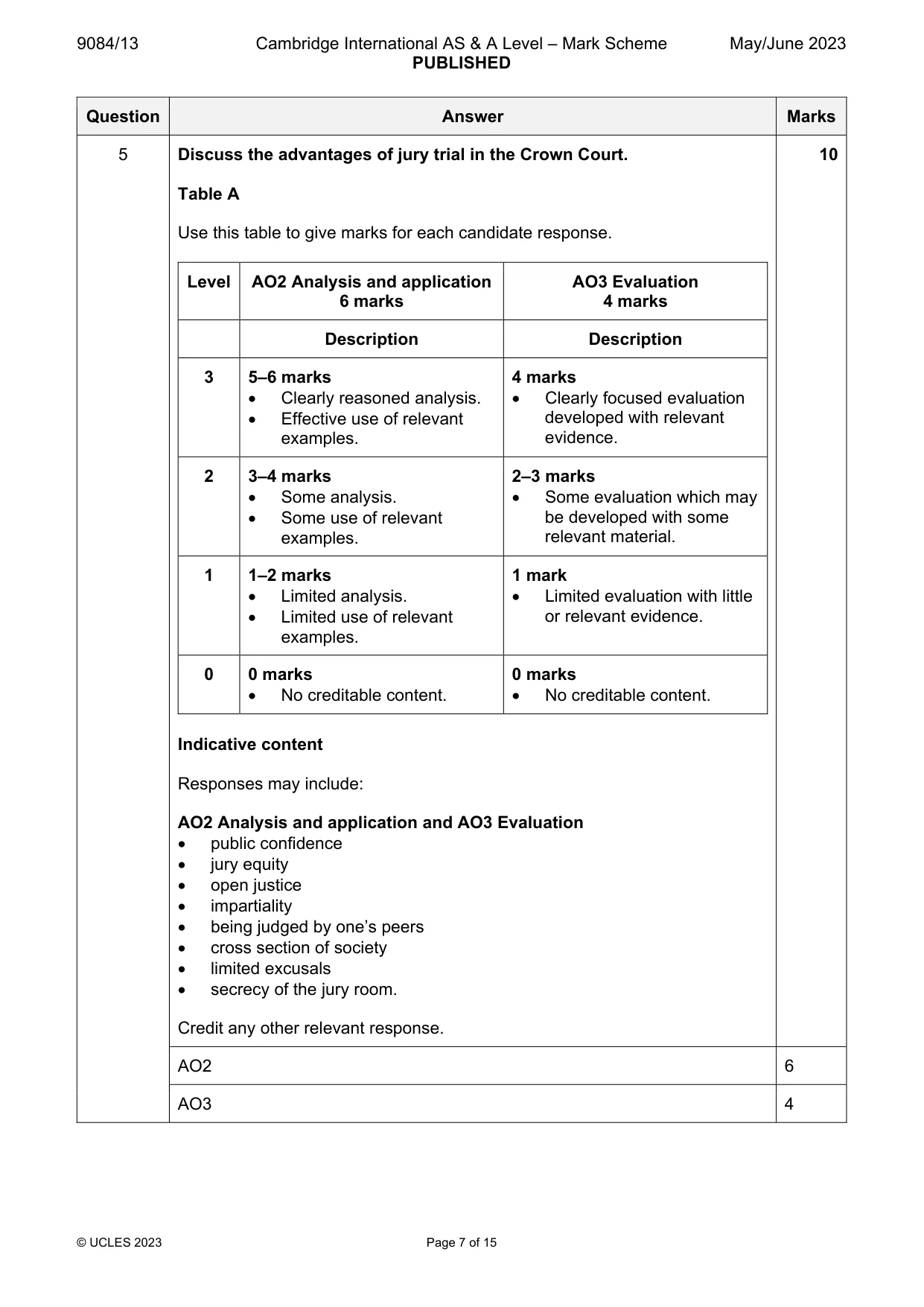
9084/13 Cambridge International AS & A Level – Mark Scheme PUBLISHED May/June 2023 © UCLES 2023 Page 7 of 15 Question Answer Marks 5 Discuss the advantages of jury trial in the Crown Court. Table A Use this table to give marks for each candidate response. Level AO2 Analysis and application 6 marks AO3 Evaluation 4 marks Description Description 3 5–6 marks Clearly reasoned analysis. Effective use of relevant examples. 4 marks Clearly focused evaluation developed with relevant evidence. 2 3–4 marks Some analysis. Some use of relevant examples. 2–3 marks Some evaluation which may be developed with some relevant material. 1 1–2 marks Limited analysis. Limited use of relevant examples. 1 mark Limited evaluation with little or relevant evidence. 0 0 marks No creditable content. 0 marks No creditable content. Indicative content Responses may include: AO2 Analysis and application and AO3 Evaluation public confidence jury equity open justice impartiality being judged by one’s peers cross section of society limited excusals secrecy of the jury room. Credit any other relevant response. 10 AO2 6 AO3 4
Mark scheme, page 8
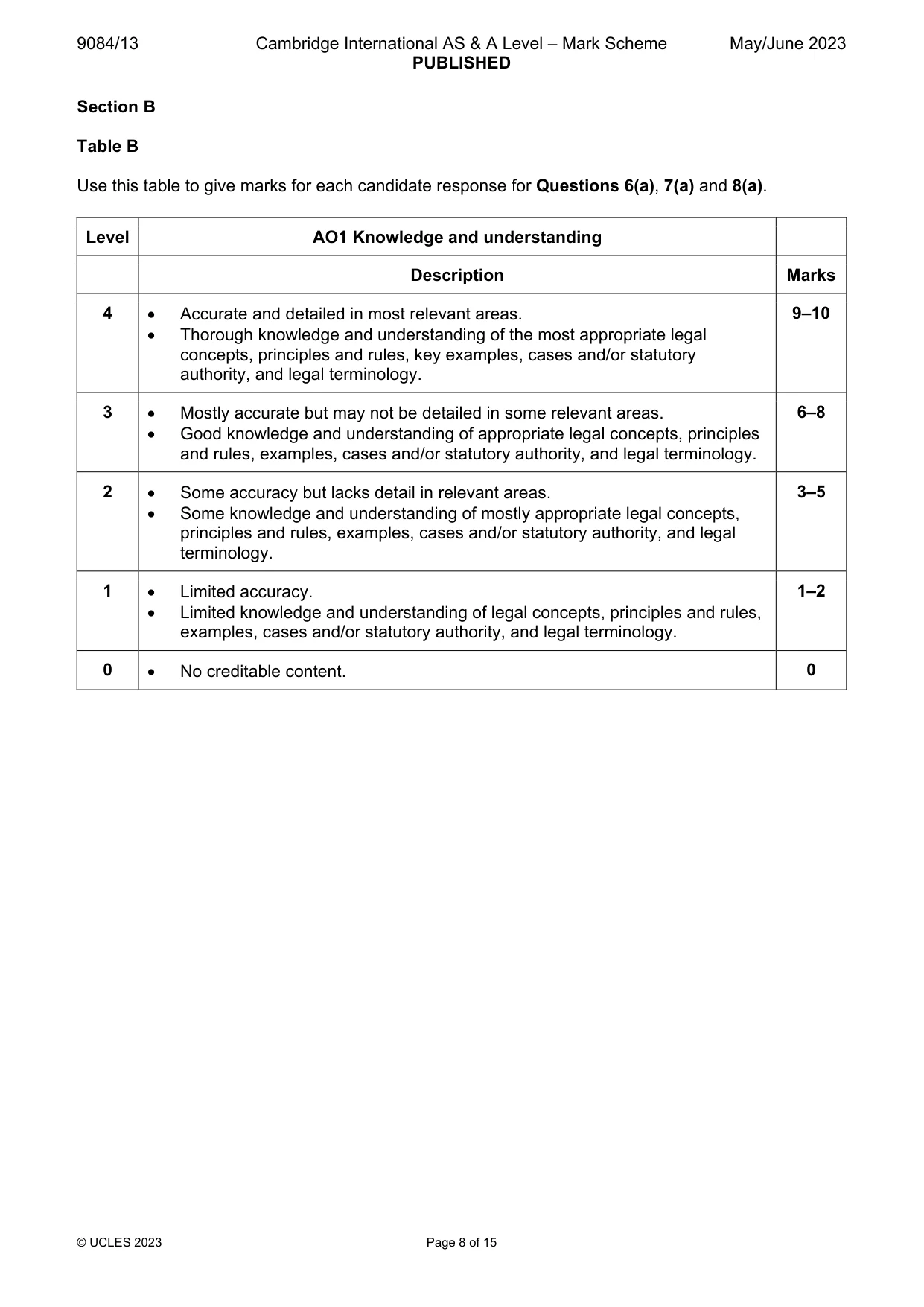
9084/13 Cambridge International AS & A Level – Mark Scheme PUBLISHED May/June 2023 © UCLES 2023 Page 8 of 15 Section B Table B Use this table to give marks for each candidate response for Questions 6(a), 7(a) and 8(a). Level AO1 Knowledge and understanding Description Marks 4 Accurate and detailed in most relevant areas. Thorough knowledge and understanding of the most appropriate legal concepts, principles and rules, key examples, cases and/or statutory authority, and legal terminology. 9–10 3 Mostly accurate but may not be detailed in some relevant areas. Good knowledge and understanding of appropriate legal concepts, principles and rules, examples, cases and/or statutory authority, and legal terminology. 6–8 2 Some accuracy but lacks detail in relevant areas. Some knowledge and understanding of mostly appropriate legal concepts, principles and rules, examples, cases and/or statutory authority, and legal terminology. 3–5 1 Limited accuracy. Limited knowledge and understanding of legal concepts, principles and rules, examples, cases and/or statutory authority, and legal terminology. 1–2 0 No creditable content. 0
Mark scheme, page 9
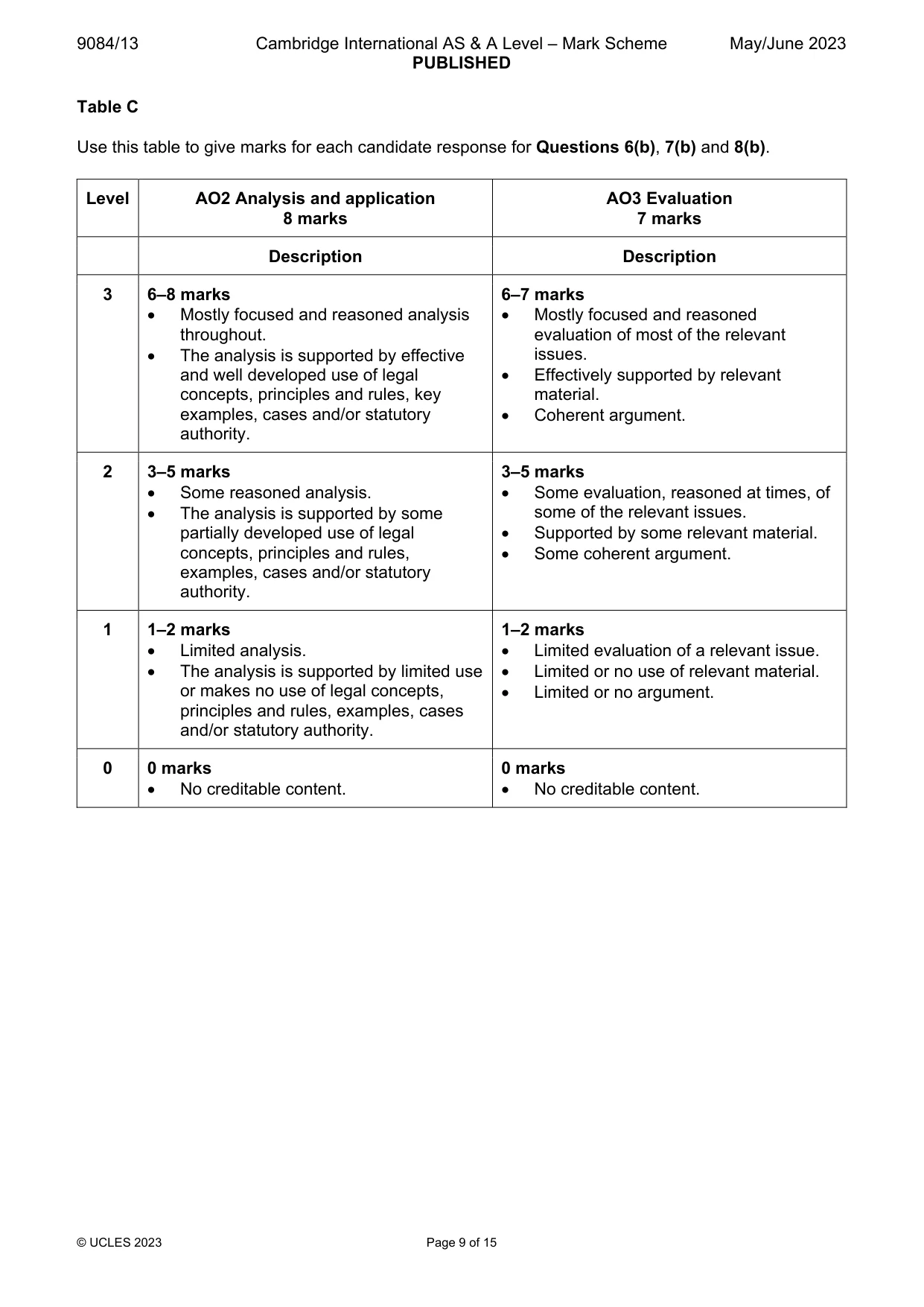
9084/13 Cambridge International AS & A Level – Mark Scheme PUBLISHED May/June 2023 © UCLES 2023 Page 9 of 15 Table C Use this table to give marks for each candidate response for Questions 6(b), 7(b) and 8(b). Level AO2 Analysis and application 8 marks AO3 Evaluation 7 marks Description Description 3 6–8 marks Mostly focused and reasoned analysis throughout. The analysis is supported by effective and well developed use of legal concepts, principles and rules, key examples, cases and/or statutory authority. 6–7 marks Mostly focused and reasoned evaluation of most of the relevant issues. Effectively supported by relevant material. Coherent argument. 2 3–5 marks Some reasoned analysis. The analysis is supported by some partially developed use of legal concepts, principles and rules, examples, cases and/or statutory authority. 3–5 marks Some evaluation, reasoned at times, of some of the relevant issues. Supported by some relevant material. Some coherent argument. 1 1–2 marks Limited analysis. The analysis is supported by limited use or makes no use of legal concepts, principles and rules, examples, cases and/or statutory authority. 1–2 marks Limited evaluation of a relevant issue. Limited or no use of relevant material. Limited or no argument. 0 0 marks No creditable content. 0 marks No creditable content.
Mark scheme, page 10
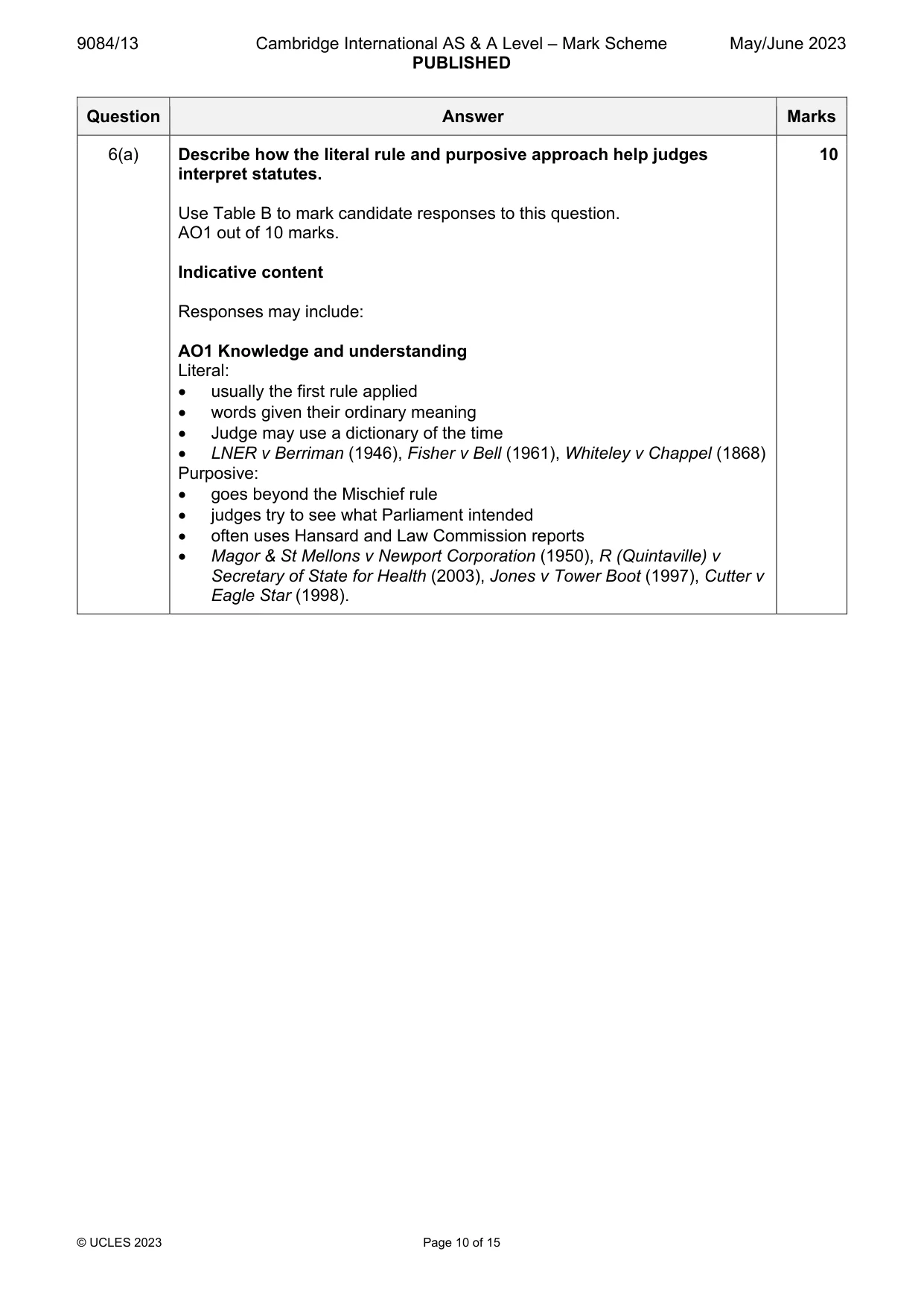
9084/13 Cambridge International AS & A Level – Mark Scheme PUBLISHED May/June 2023 © UCLES 2023 Page 10 of 15 Question Answer Marks 6(a) Describe how the literal rule and purposive approach help judges interpret statutes. Use Table B to mark candidate responses to this question. AO1 out of 10 marks. Indicative content Responses may include: AO1 Knowledge and understanding Literal: usually the first rule applied words given their ordinary meaning Judge may use a dictionary of the time LNER v Berriman (1946), Fisher v Bell (1961), Whiteley v Chappel (1868) Purposive: goes beyond the Mischief rule judges try to see what Parliament intended often uses Hansard and Law Commission reports Magor & St Mellons v Newport Corporation (1950), R (Quintaville) v Secretary of State for Health (2003), Jones v Tower Boot (1997), Cutter v Eagle Star (1998). 10
Mark scheme, page 11
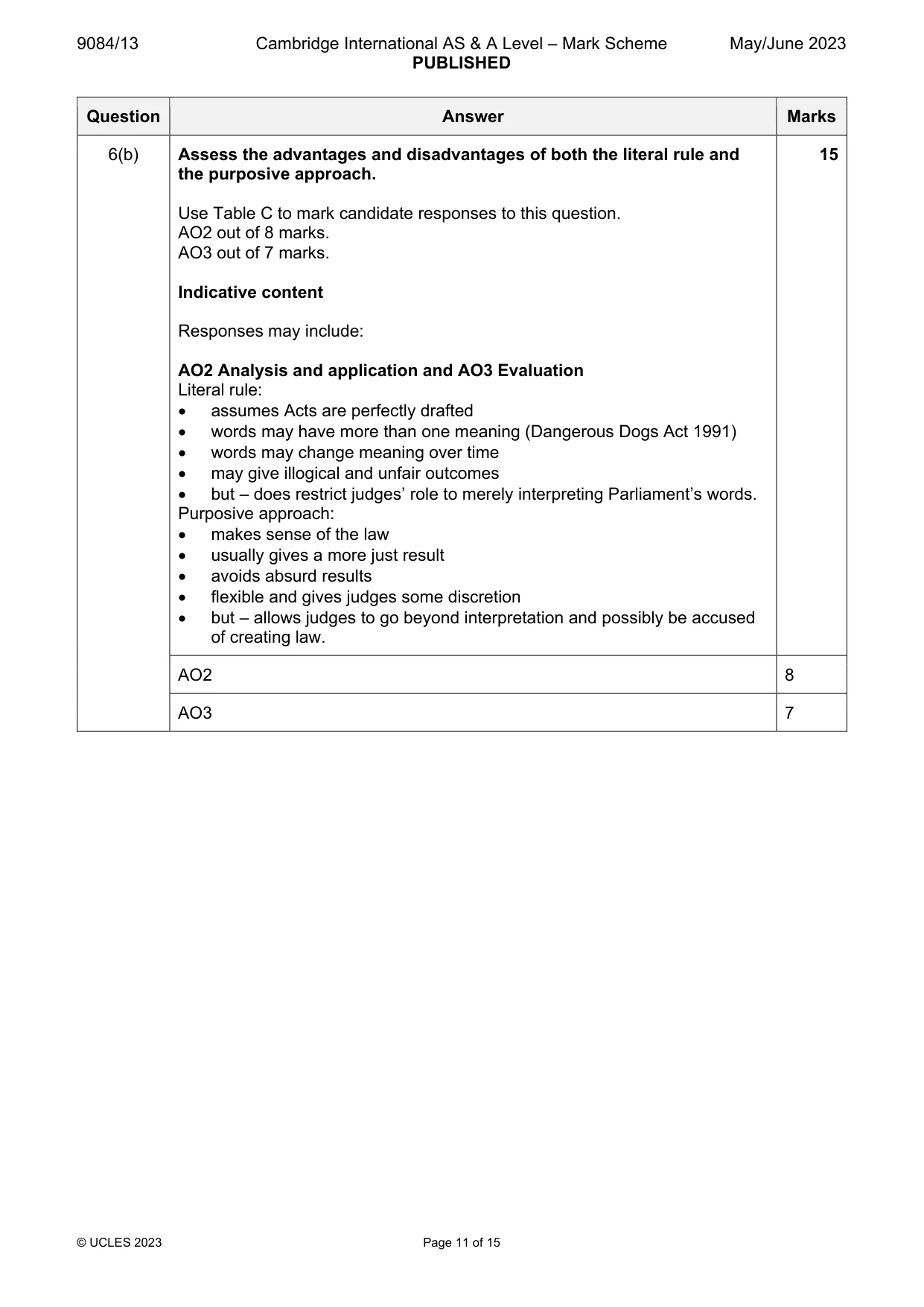
9084/13 Cambridge International AS & A Level – Mark Scheme PUBLISHED May/June 2023 © UCLES 2023 Page 11 of 15 Question Answer Marks 6(b) Assess the advantages and disadvantages of both the literal rule and the purposive approach. Use Table C to mark candidate responses to this question. AO2 out of 8 marks. AO3 out of 7 marks. Indicative content Responses may include: AO2 Analysis and application and AO3 Evaluation Literal rule: assumes Acts are perfectly drafted words may have more than one meaning (Dangerous Dogs Act 1991) words may change meaning over time may give illogical and unfair outcomes but – does restrict judges’ role to merely interpreting Parliament’s words. Purposive approach: makes sense of the law usually gives a more just result avoids absurd results flexible and gives judges some discretion but – allows judges to go beyond interpretation and possibly be accused of creating law. 15 AO2 8 AO3 7
Mark scheme, page 12
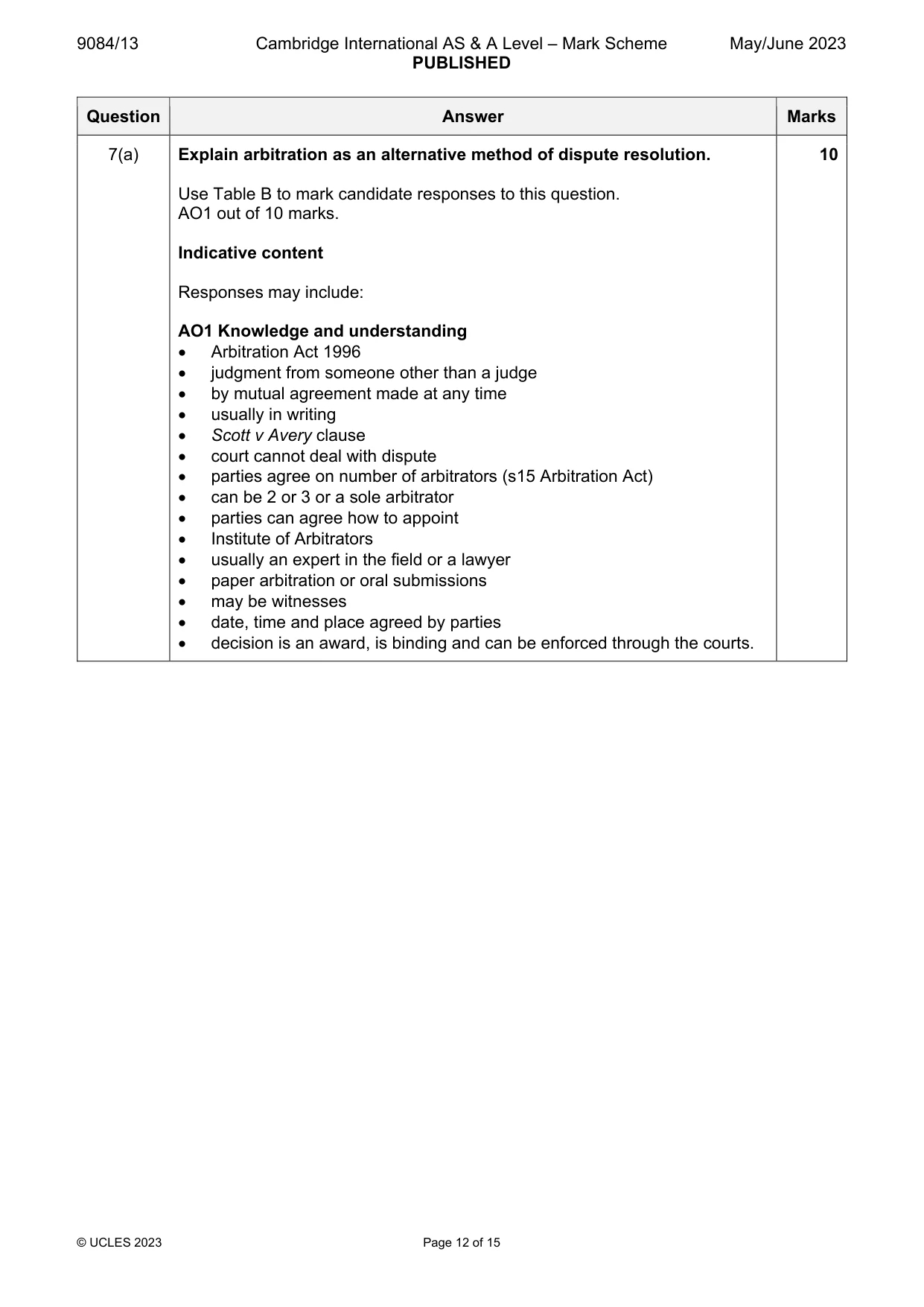
9084/13 Cambridge International AS & A Level – Mark Scheme PUBLISHED May/June 2023 © UCLES 2023 Page 12 of 15 Question Answer Marks 7(a) Explain arbitration as an alternative method of dispute resolution. Use Table B to mark candidate responses to this question. AO1 out of 10 marks. Indicative content Responses may include: AO1 Knowledge and understanding Arbitration Act 1996 judgment from someone other than a judge by mutual agreement made at any time usually in writing Scott v Avery clause court cannot deal with dispute parties agree on number of arbitrators (s15 Arbitration Act) can be 2 or 3 or a sole arbitrator parties can agree how to appoint Institute of Arbitrators usually an expert in the field or a lawyer paper arbitration or oral submissions may be witnesses date, time and place agreed by parties decision is an award, is binding and can be enforced through the courts. 10
Mark scheme, page 13
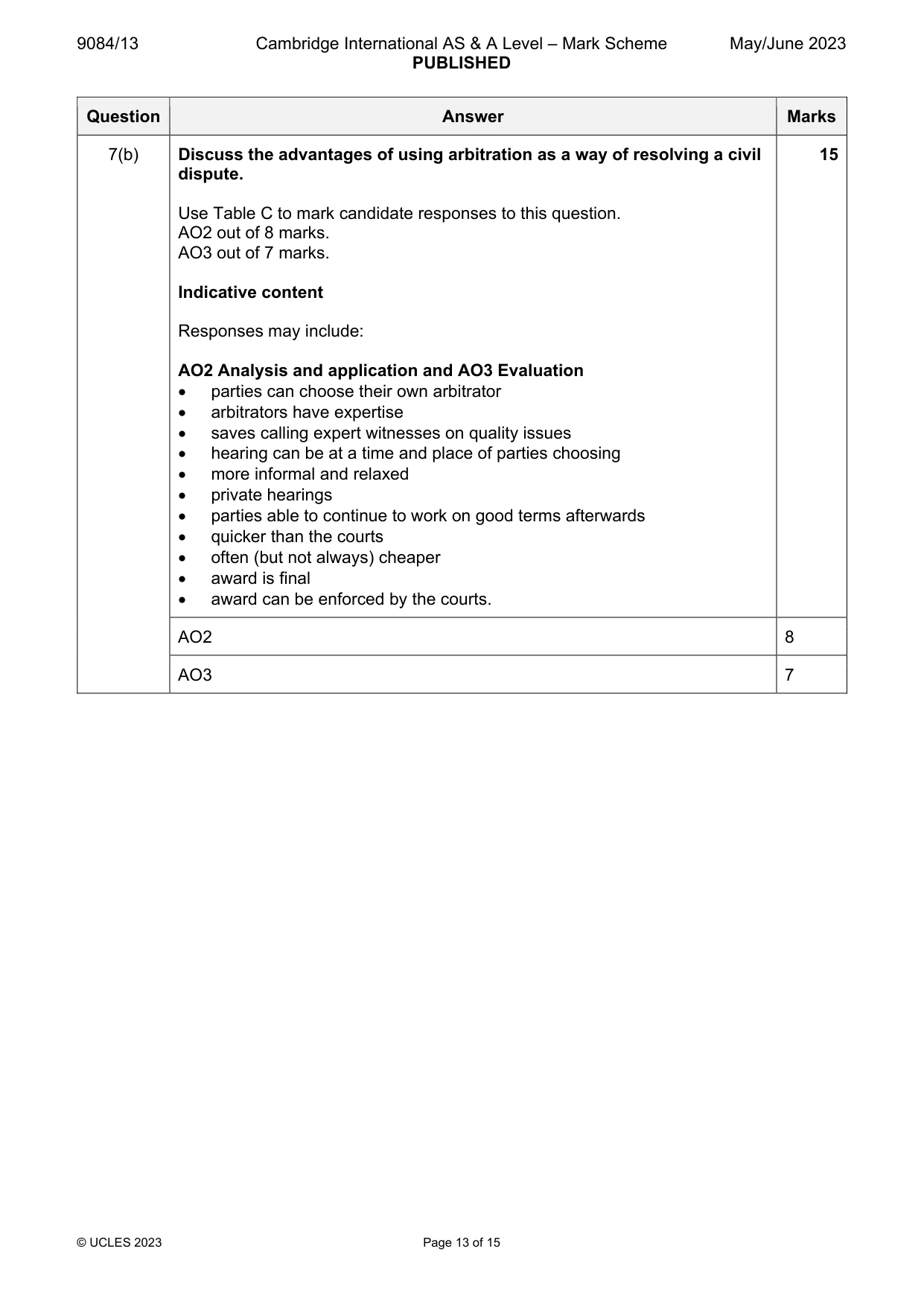
9084/13 Cambridge International AS & A Level – Mark Scheme PUBLISHED May/June 2023 © UCLES 2023 Page 13 of 15 Question Answer Marks 7(b) Discuss the advantages of using arbitration as a way of resolving a civil dispute. Use Table C to mark candidate responses to this question. AO2 out of 8 marks. AO3 out of 7 marks. Indicative content Responses may include: AO2 Analysis and application and AO3 Evaluation parties can choose their own arbitrator arbitrators have expertise saves calling expert witnesses on quality issues hearing can be at a time and place of parties choosing more informal and relaxed private hearings parties able to continue to work on good terms afterwards quicker than the courts often (but not always) cheaper award is final award can be enforced by the courts. 15 AO2 8 AO3 7
Mark scheme, page 14
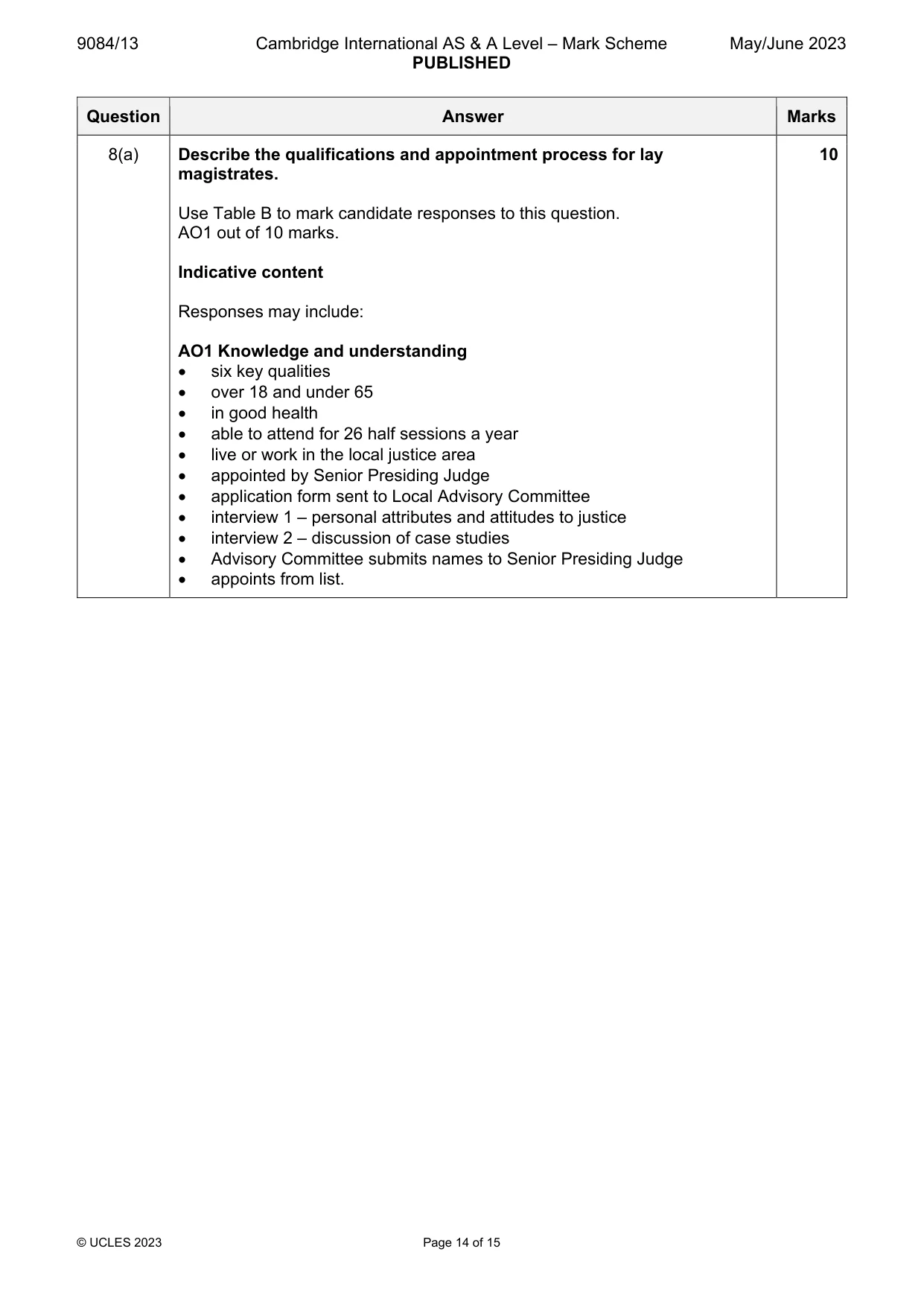
9084/13 Cambridge International AS & A Level – Mark Scheme PUBLISHED May/June 2023 © UCLES 2023 Page 14 of 15 Question Answer Marks 8(a) Describe the qualifications and appointment process for lay magistrates. Use Table B to mark candidate responses to this question. AO1 out of 10 marks. Indicative content Responses may include: AO1 Knowledge and understanding six key qualities over 18 and under 65 in good health able to attend for 26 half sessions a year live or work in the local justice area appointed by Senior Presiding Judge application form sent to Local Advisory Committee interview 1 – personal attributes and attitudes to justice interview 2 – discussion of case studies Advisory Committee submits names to Senior Presiding Judge appoints from list. 10
Mark scheme, page 15
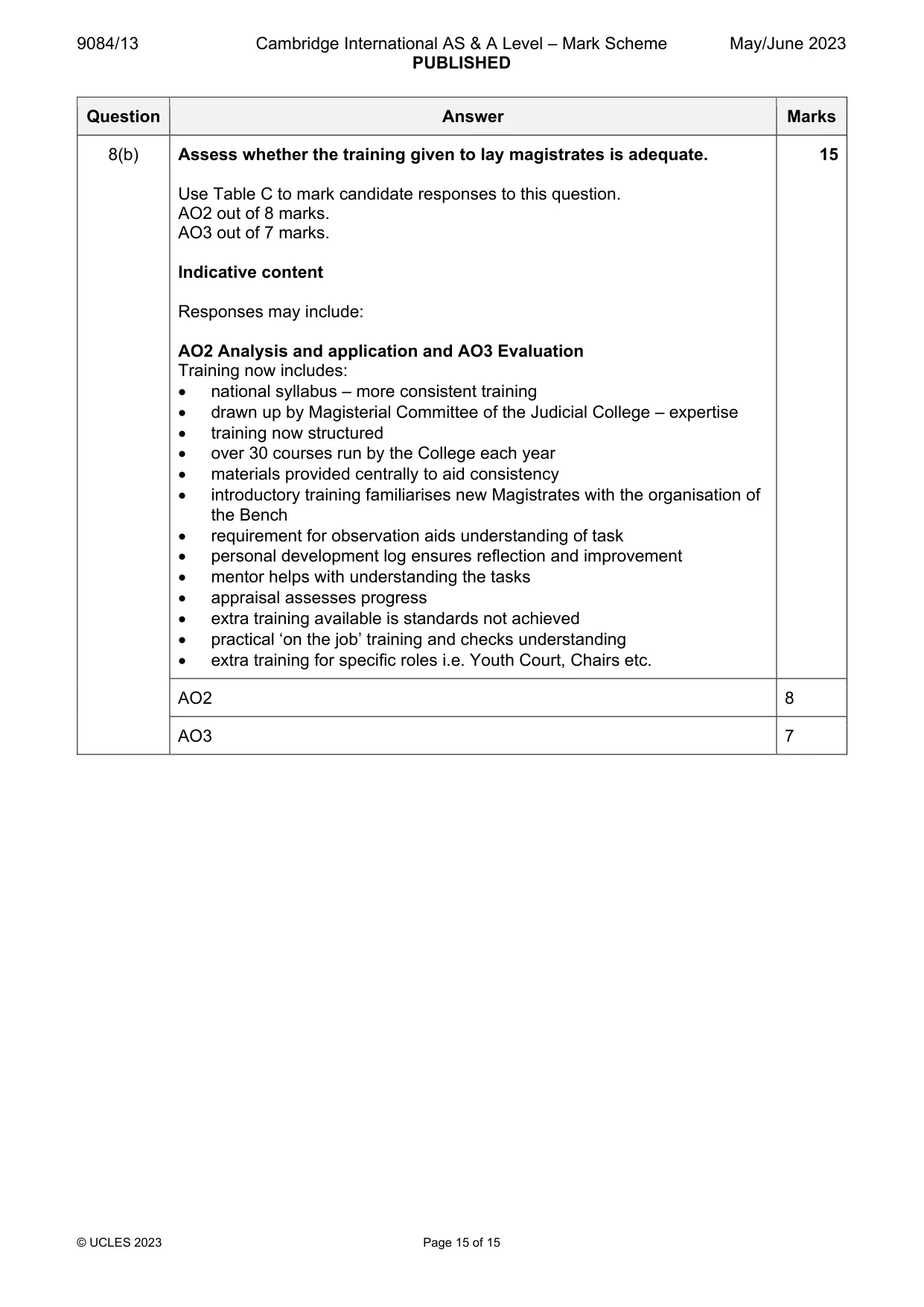
9084/13 Cambridge International AS & A Level – Mark Scheme PUBLISHED May/June 2023 © UCLES 2023 Page 15 of 15 Question Answer Marks 8(b) Assess whether the training given to lay magistrates is adequate. Use Table C to mark candidate responses to this question. AO2 out of 8 marks. AO3 out of 7 marks. Indicative content Responses may include: AO2 Analysis and application and AO3 Evaluation Training now includes: national syllabus – more consistent training drawn up by Magisterial Committee of the Judicial College – expertise training now structured over 30 courses run by the College each year materials provided centrally to aid consistency introductory training familiarises new Magistrates with the organisation of the Bench requirement for observation aids understanding of task personal development log ensures reflection and improvement mentor helps with understanding the tasks appraisal assesses progress extra training available is standards not achieved practical ‘on the job’ training and checks understanding extra training for specific roles i.e. Youth Court, Chairs etc. 15 AO2 8 AO3 7
What you needed in this session
Cambridge’s own grade thresholds for 2023 May/June, Paper 1 · Variant 3. A higher threshold means an easier paper — the bar moves with how the cohort did.