Cambridge A Level Law 9084 — 2012 May/June Paper 1 · Variant 2
9084/12/M/J/12 · 75 marks · ≈84 min
The question paper and its mark scheme, free to read here and free to download. This is Cambridge’s own paper, exactly as it was sat.
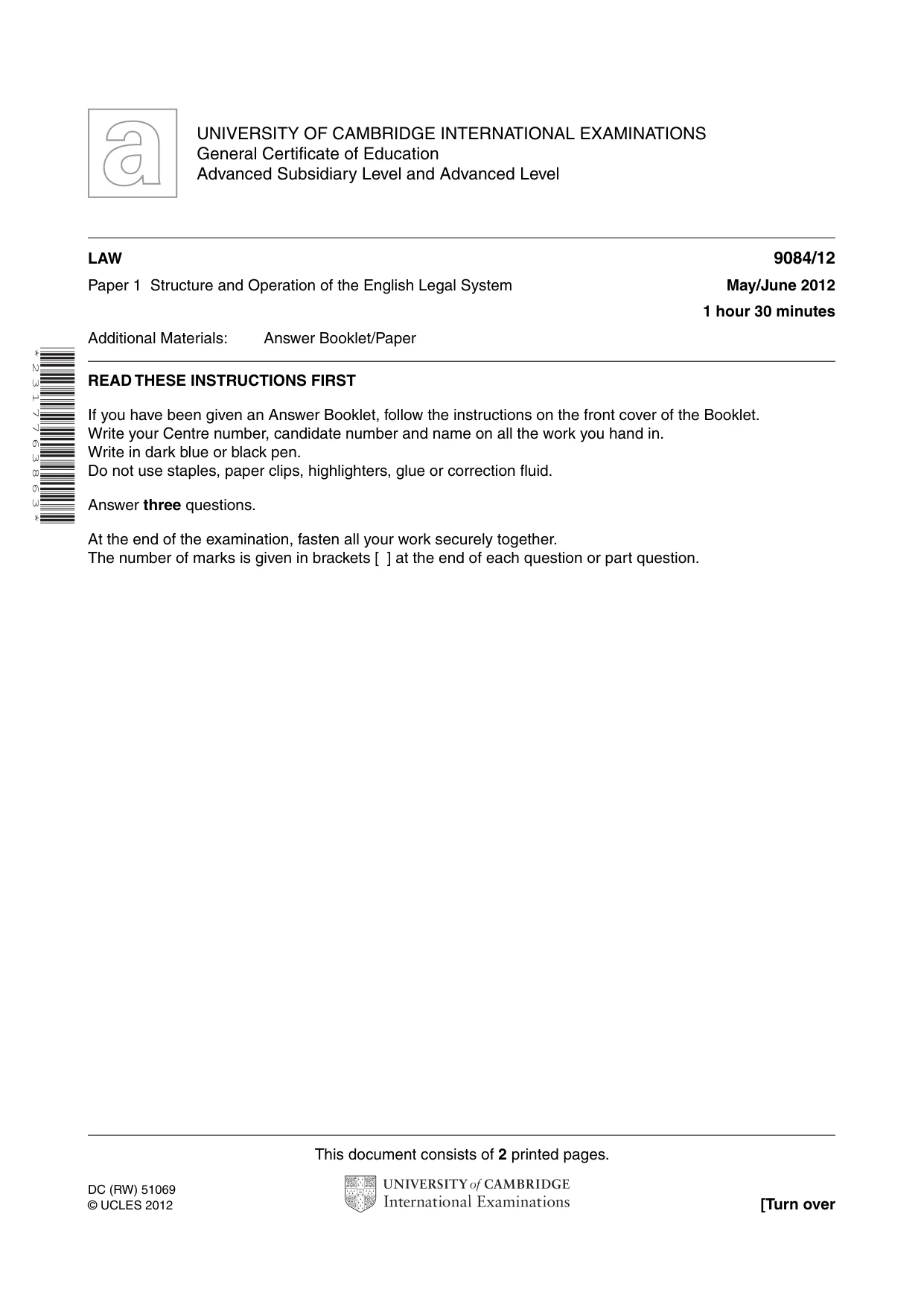
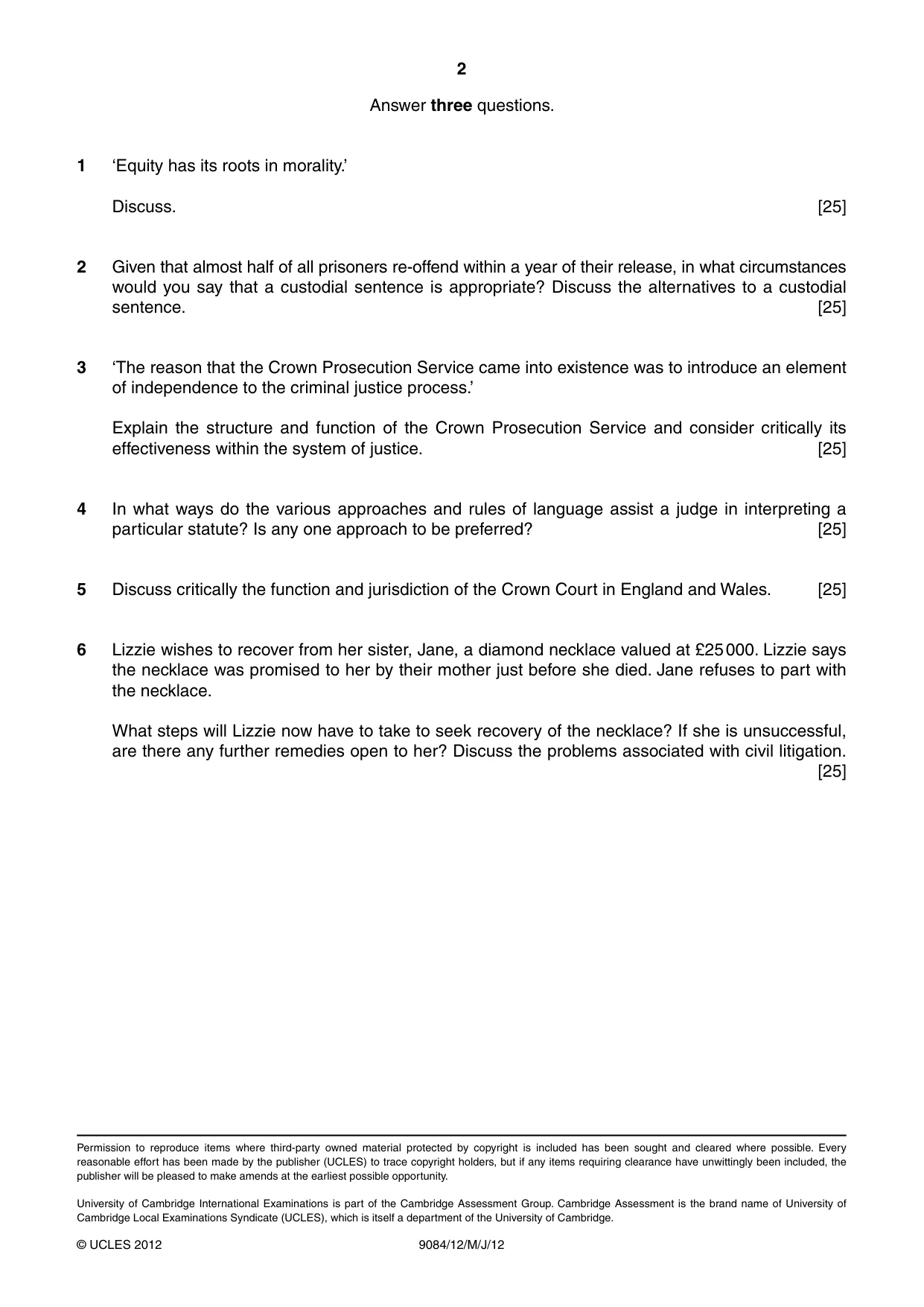
Question paper2 pages
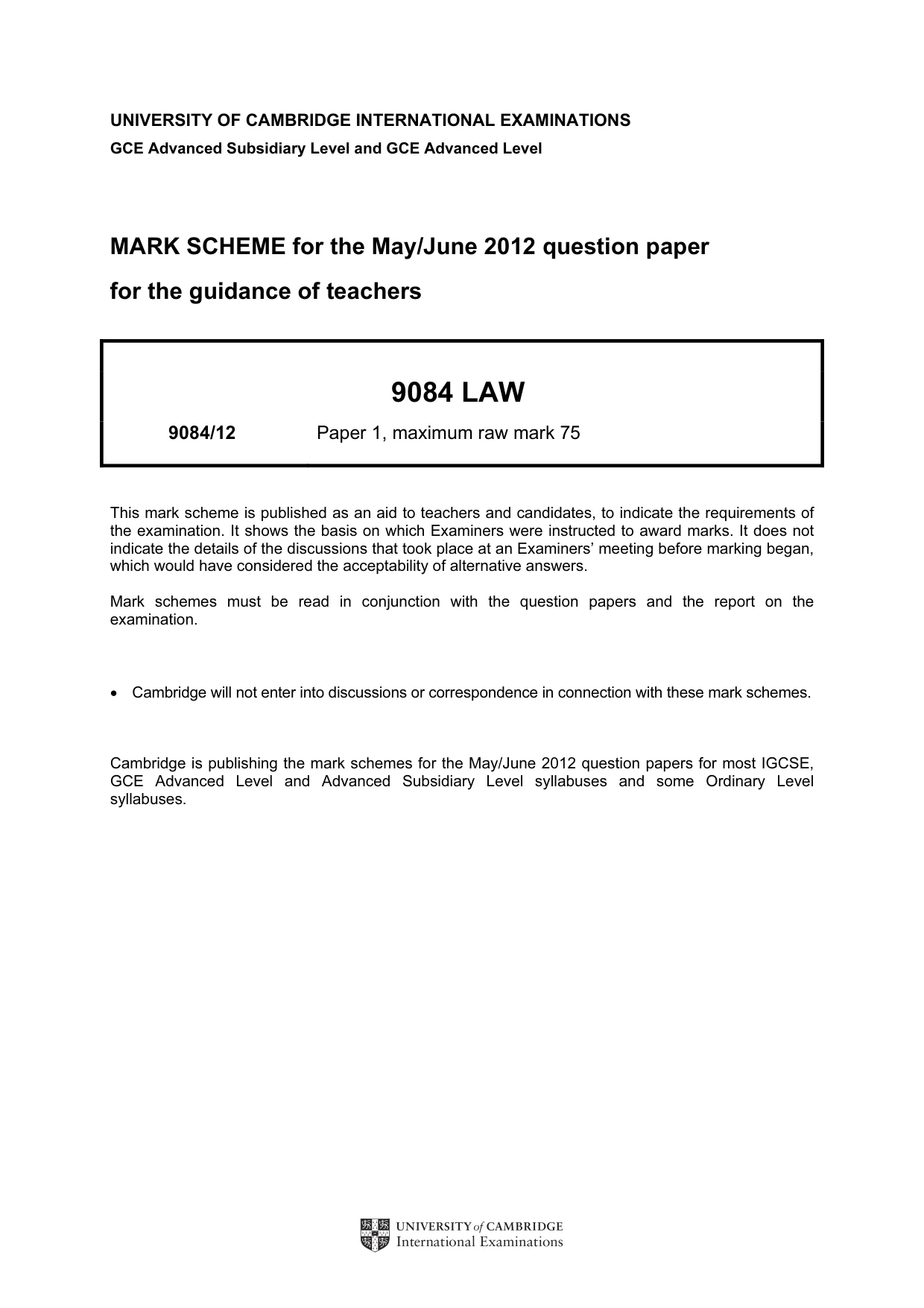
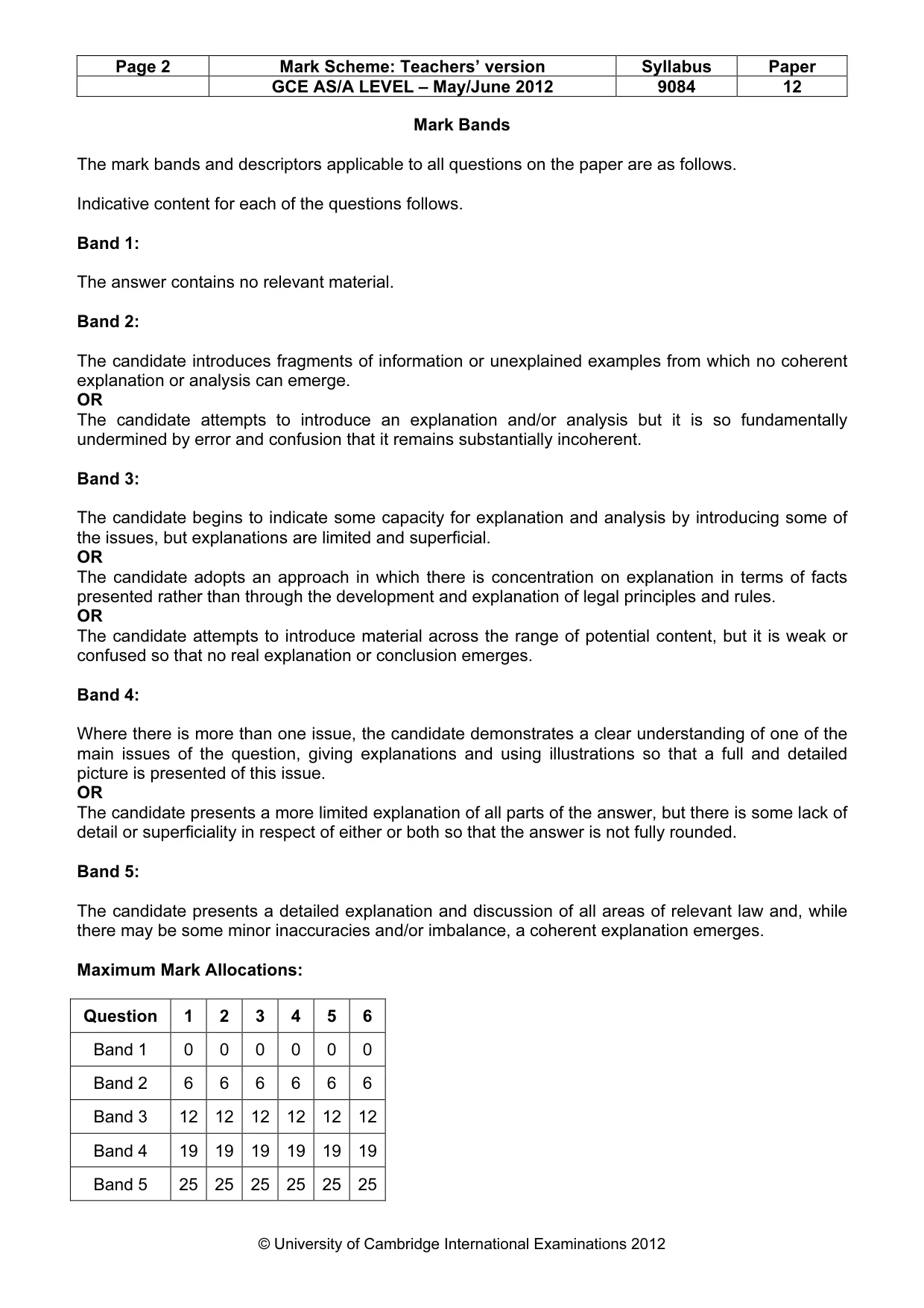
Mark scheme4 pages
Answers below. Sit the paper first if you are practising.
Paper as text
Question paper, page 1
This document consists of 2 printed pages. DC (RW) 51069 © UCLES 2012 [Turn over UNIVERSITY OF CAMBRIDGE INTERNATIONAL EXAMINATIONS General Certificate of Education Advanced Subsidiary Level and Advanced Level * 2 3 1 7 7 6 3 8 6 3 * LAW 9084/12 Paper 1 Structure and Operation of the English Legal System May/June 2012 1 hour 30 minutes Additional Materials: Answer Booklet/Paper READ THESE INSTRUCTIONS FIRST If you have been given an Answer Booklet, follow the instructions on the front cover of the Booklet. Write your Centre number, candidate number and name on all the work you hand in. Write in dark blue or black pen. Do not use staples, paper clips, highlighters, glue or correction fluid. Answer three questions. At the end of the examination, fasten all your work securely together. The number of marks is given in brackets [ ] at the end of each question or part question.
Question paper, page 2
2 9084/12/M/J/12 © UCLES 2012 Permission to reproduce items where third-party owned material protected by copyright is included has been sought and cleared where possible. Every reasonable effort has been made by the publisher (UCLES) to trace copyright holders, but if any items requiring clearance have unwittingly been included, the publisher will be pleased to make amends at the earliest possible opportunity. University of Cambridge International Examinations is part of the Cambridge Assessment Group. Cambridge Assessment is the brand name of University of Cambridge Local Examinations Syndicate (UCLES), which is itself a department of the University of Cambridge. Answer three questions. 1 ‘Equity has its roots in morality.’ Discuss. [25] 2 Given that almost half of all prisoners re-offend within a year of their release, in what circumstances would you say that a custodial sentence is appropriate? Discuss the alternatives to a custodial sentence. [25] 3 ‘The reason that the Crown Prosecution Service came into existence was to introduce an element of independence to the criminal justice process.’ Explain the structure and function of the Crown Prosecution Service and consider critically its effectiveness within the system of justice. [25] 4 In what ways do the various approaches and rules of language assist a judge in interpreting a particular statute? Is any one approach to be preferred? [25] 5 Discuss critically the function and jurisdiction of the Crown Court in England and Wales. [25] 6 Lizzie wishes to recover from her sister, Jane, a diamond necklace valued at £25 000. Lizzie says the necklace was promised to her by their mother just before she died. Jane refuses to part with the necklace. What steps will Lizzie now have to take to seek recovery of the necklace? If she is unsuccessful, are there any further remedies open to her? Discuss the problems associated with civil litigation. [25]
Mark scheme, page 1
UNIVERSITY OF CAMBRIDGE INTERNATIONAL EXAMINATIONS GCE Advanced Subsidiary Level and GCE Advanced Level MARK SCHEME for the May/June 2012 question paper for the guidance of teachers 9084 LAW 9084/12 Paper 1, maximum raw mark 75 This mark scheme is published as an aid to teachers and candidates, to indicate the requirements of the examination. It shows the basis on which Examiners were instructed to award marks. It does not indicate the details of the discussions that took place at an Examiners’ meeting before marking began, which would have considered the acceptability of alternative answers. Mark schemes must be read in conjunction with the question papers and the report on the examination. • Cambridge will not enter into discussions or correspondence in connection with these mark schemes. Cambridge is publishing the mark schemes for the May/June 2012 question papers for most IGCSE, GCE Advanced Level and Advanced Subsidiary Level syllabuses and some Ordinary Level syllabuses.
Mark scheme, page 2
Page 2 Mark Scheme: Teachers’ version Syllabus Paper GCE AS/A LEVEL – May/June 2012 9084 12 © University of Cambridge International Examinations 2012 Mark Bands The mark bands and descriptors applicable to all questions on the paper are as follows. Indicative content for each of the questions follows. Band 1: The answer contains no relevant material. Band 2: The candidate introduces fragments of information or unexplained examples from which no coherent explanation or analysis can emerge. OR The candidate attempts to introduce an explanation and/or analysis but it is so fundamentally undermined by error and confusion that it remains substantially incoherent. Band 3: The candidate begins to indicate some capacity for explanation and analysis by introducing some of the issues, but explanations are limited and superficial. OR The candidate adopts an approach in which there is concentration on explanation in terms of facts presented rather than through the development and explanation of legal principles and rules. OR The candidate attempts to introduce material across the range of potential content, but it is weak or confused so that no real explanation or conclusion emerges. Band 4: Where there is more than one issue, the candidate demonstrates a clear understanding of one of the main issues of the question, giving explanations and using illustrations so that a full and detailed picture is presented of this issue. OR The candidate presents a more limited explanation of all parts of the answer, but there is some lack of detail or superficiality in respect of either or both so that the answer is not fully rounded. Band 5: The candidate presents a detailed explanation and discussion of all areas of relevant law and, while there may be some minor inaccuracies and/or imbalance, a coherent explanation emerges. Maximum Mark Allocations: Question 1 2 3 4 5 6 Band 1 0 0 0 0 0 0 Band 2 6 6 6 6 6 6 Band 3 12 12 12 12 12 12 Band 4 19 19 19 19 19 19 Band 5 25 25 25 25 25 25
Mark scheme, page 3
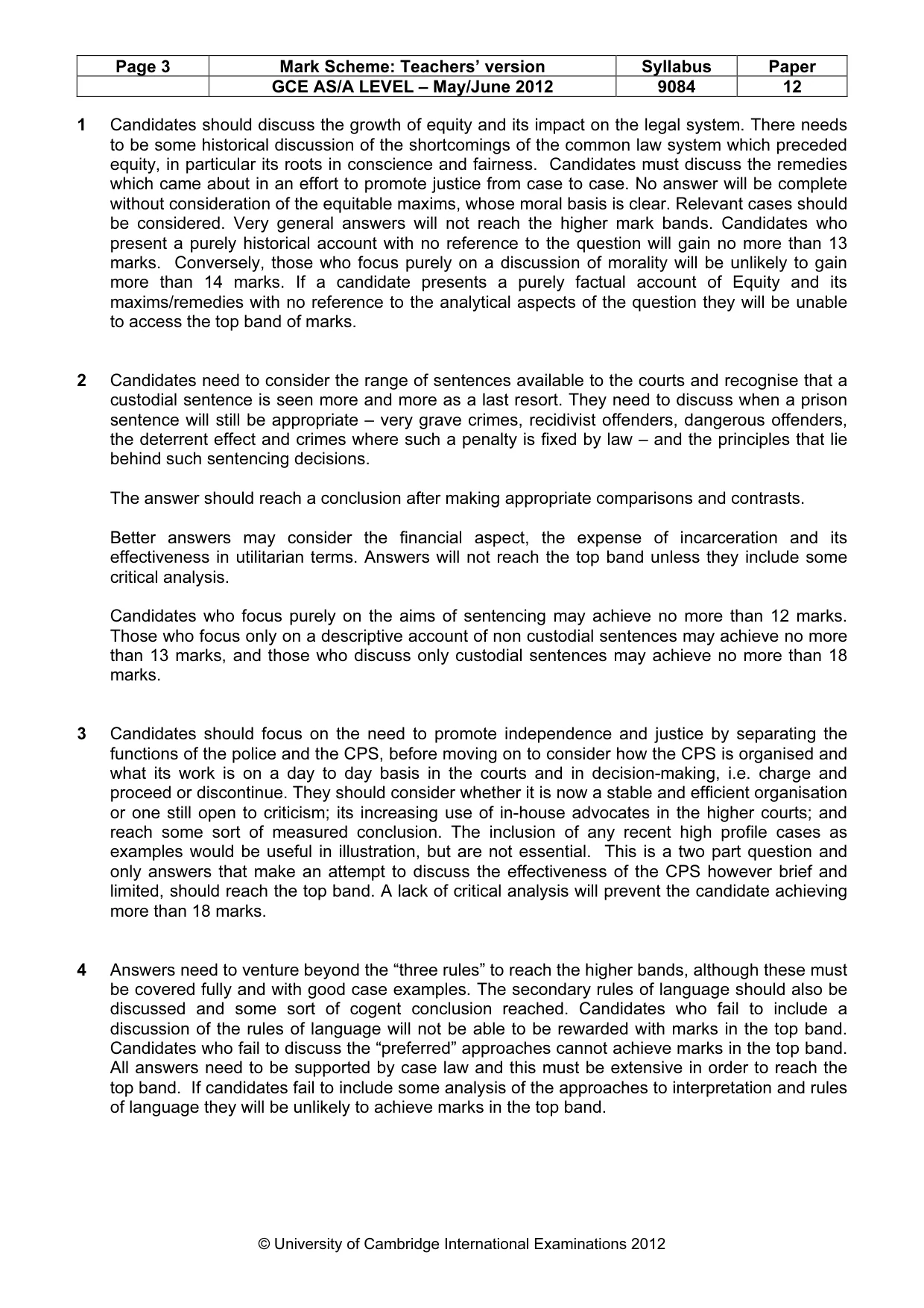
Page 3 Mark Scheme: Teachers’ version Syllabus Paper GCE AS/A LEVEL – May/June 2012 9084 12 © University of Cambridge International Examinations 2012 1 Candidates should discuss the growth of equity and its impact on the legal system. There needs to be some historical discussion of the shortcomings of the common law system which preceded equity, in particular its roots in conscience and fairness. Candidates must discuss the remedies which came about in an effort to promote justice from case to case. No answer will be complete without consideration of the equitable maxims, whose moral basis is clear. Relevant cases should be considered. Very general answers will not reach the higher mark bands. Candidates who present a purely historical account with no reference to the question will gain no more than 13 marks. Conversely, those who focus purely on a discussion of morality will be unlikely to gain more than 14 marks. If a candidate presents a purely factual account of Equity and its maxims/remedies with no reference to the analytical aspects of the question they will be unable to access the top band of marks. 2 Candidates need to consider the range of sentences available to the courts and recognise that a custodial sentence is seen more and more as a last resort. They need to discuss when a prison sentence will still be appropriate – very grave crimes, recidivist offenders, dangerous offenders, the deterrent effect and crimes where such a penalty is fixed by law – and the principles that lie behind such sentencing decisions. The answer should reach a conclusion after making appropriate comparisons and contrasts. Better answers may consider the financial aspect, the expense of incarceration and its effectiveness in utilitarian terms. Answers will not reach the top band unless they include some critical analysis. Candidates who focus purely on the aims of sentencing may achieve no more than 12 marks. Those who focus only on a descriptive account of non custodial sentences may achieve no more than 13 marks, and those who discuss only custodial sentences may achieve no more than 18 marks. 3 Candidates should focus on the need to promote independence and justice by separating the functions of the police and the CPS, before moving on to consider how the CPS is organised and what its work is on a day to day basis in the courts and in decision-making, i.e. charge and proceed or discontinue. They should consider whether it is now a stable and efficient organisation or one still open to criticism; its increasing use of in-house advocates in the higher courts; and reach some sort of measured conclusion. The inclusion of any recent high profile cases as examples would be useful in illustration, but are not essential. This is a two part question and only answers that make an attempt to discuss the effectiveness of the CPS however brief and limited, should reach the top band. A lack of critical analysis will prevent the candidate achieving more than 18 marks. 4 Answers need to venture beyond the “three rules” to reach the higher bands, although these must be covered fully and with good case examples. The secondary rules of language should also be discussed and some sort of cogent conclusion reached. Candidates who fail to include a discussion of the rules of language will not be able to be rewarded with marks in the top band. Candidates who fail to discuss the “preferred” approaches cannot achieve marks in the top band. All answers need to be supported by case law and this must be extensive in order to reach the top band. If candidates fail to include some analysis of the approaches to interpretation and rules of language they will be unlikely to achieve marks in the top band.
Mark scheme, page 4
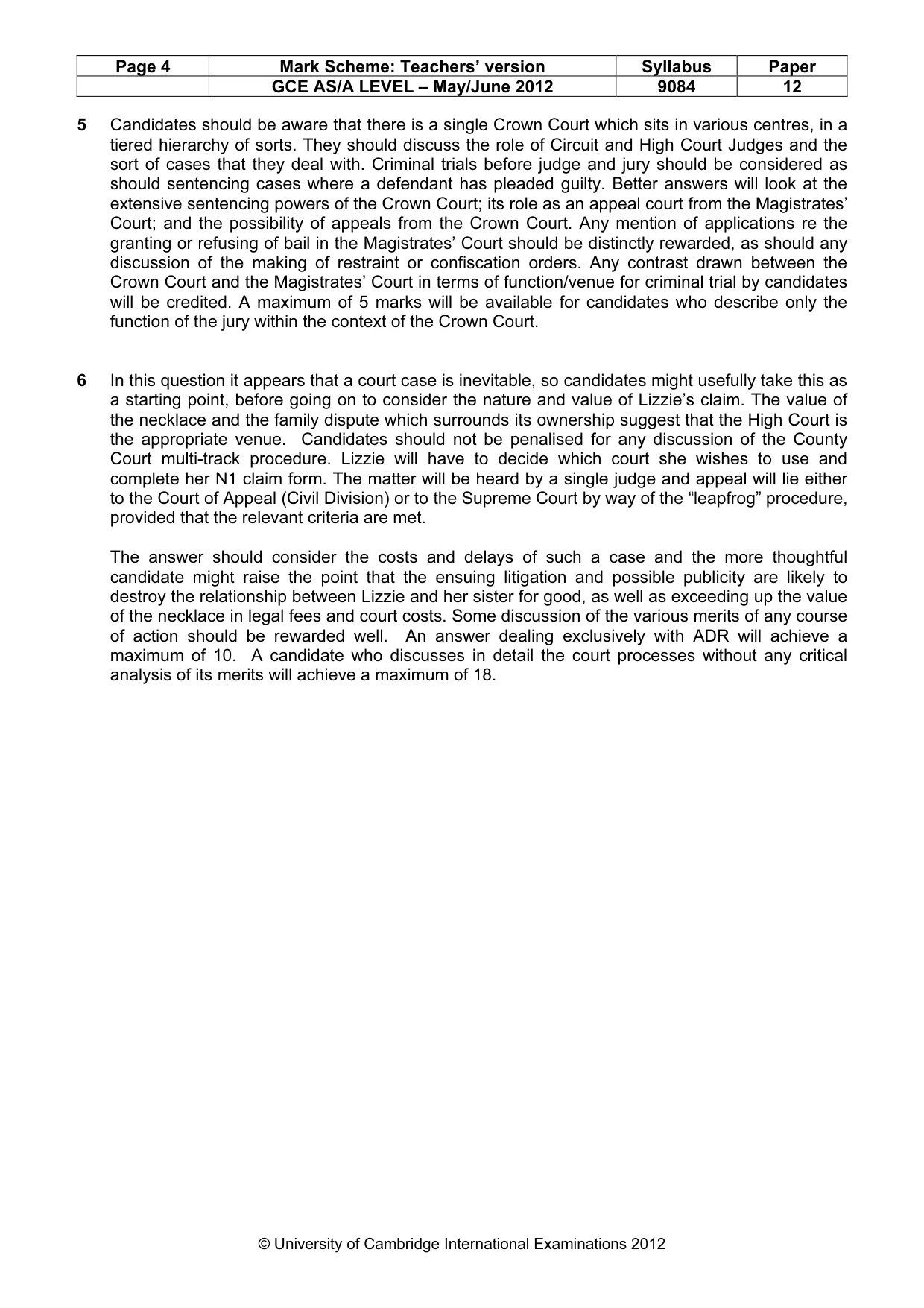
Page 4 Mark Scheme: Teachers’ version Syllabus Paper GCE AS/A LEVEL – May/June 2012 9084 12 © University of Cambridge International Examinations 2012 5 Candidates should be aware that there is a single Crown Court which sits in various centres, in a tiered hierarchy of sorts. They should discuss the role of Circuit and High Court Judges and the sort of cases that they deal with. Criminal trials before judge and jury should be considered as should sentencing cases where a defendant has pleaded guilty. Better answers will look at the extensive sentencing powers of the Crown Court; its role as an appeal court from the Magistrates’ Court; and the possibility of appeals from the Crown Court. Any mention of applications re the granting or refusing of bail in the Magistrates’ Court should be distinctly rewarded, as should any discussion of the making of restraint or confiscation orders. Any contrast drawn between the Crown Court and the Magistrates’ Court in terms of function/venue for criminal trial by candidates will be credited. A maximum of 5 marks will be available for candidates who describe only the function of the jury within the context of the Crown Court. 6 In this question it appears that a court case is inevitable, so candidates might usefully take this as a starting point, before going on to consider the nature and value of Lizzie’s claim. The value of the necklace and the family dispute which surrounds its ownership suggest that the High Court is the appropriate venue. Candidates should not be penalised for any discussion of the County Court multi-track procedure. Lizzie will have to decide which court she wishes to use and complete her N1 claim form. The matter will be heard by a single judge and appeal will lie either to the Court of Appeal (Civil Division) or to the Supreme Court by way of the “leapfrog” procedure, provided that the relevant criteria are met. The answer should consider the costs and delays of such a case and the more thoughtful candidate might raise the point that the ensuing litigation and possible publicity are likely to destroy the relationship between Lizzie and her sister for good, as well as exceeding up the value of the necklace in legal fees and court costs. Some discussion of the various merits of any course of action should be rewarded well. An answer dealing exclusively with ADR will achieve a maximum of 10. A candidate who discusses in detail the court processes without any critical analysis of its merits will achieve a maximum of 18.
What you needed in this session
Cambridge’s own grade thresholds for 2012 May/June, Paper 1 · Variant 2. A higher threshold means an easier paper — the bar moves with how the cohort did.