Cambridge A Level Law 9084 — 2023 Oct/Nov Paper 1 · Variant 3
9084/13/O/N/23 · 75 marks · ≈84 min
The question paper and its mark scheme, free to read here and free to download. This is Cambridge’s own paper, exactly as it was sat.
Question paper4 pages


Mark scheme16 pages
Answers below. Sit the paper first if you are practising.
Paper as text
Question paper, page 1
This document has 4 pages. Any blank pages are indicated. [Turn over Cambridge International AS & A Level DC (AP) 331308 © UCLES 2023 * 4 0 4 0 2 9 0 1 4 4 * LAW 9084/13 Paper 1 English Legal System October/November 2023 1 hour 30 minutes You must answer on the enclosed answer booklet. You will need: Answer booklet (enclosed) INSTRUCTIONS ● Answer seven questions in total: Section A: answer all questions. Section B: answer two questions. ● Follow the instructions on the front cover of the answer booklet. If you need additional answer paper, ask the invigilator for a continuation booklet. INFORMATION ● The total mark for this paper is 75. ● The number of marks for each question or part question is shown in brackets [ ].
Question paper, page 2
2 9084/13/O/N/23 © UCLES 2023 Section A Answer all questions. 1 Identify one legal rule and one moral belief. [2] 2 Identify two bodies which regulate solicitors. [2] 3 Identify five of the key qualities required to become a magistrate. [5] 4 Describe the role of three civil courts. [6] 5 Discuss the advantages of alternative methods of dispute resolution (ADR). [10] Section B Answer two questions. 6 (a) Explain how the influences of political pressure, the media and pressure groups influence Parliament when making law. [10] (b) Assess how successful these influences have been on Parliament when making law. [15] 7 (a) Explain the use of bail in the criminal justice system. [10] (b) Assess whether the use of bail achieves a suitable balance between public safety interests and the rights of a suspect. [15] 8 (a) Explain binding, persuasive and original precedent. [10] (b) Assess how far the doctrine of precedent limits the development of law. [15]
Question paper, page 3
3 9084/13/O/N/23 © UCLES 2023 BLANK PAGE
Question paper, page 4
4 9084/13/O/N/23 © UCLES 2023 Permission to reproduce items where third-party owned material protected by copyright is included has been sought and cleared where possible. Every reasonable effort has been made by the publisher (UCLES) to trace copyright holders, but if any items requiring clearance have unwittingly been included, the publisher will be pleased to make amends at the earliest possible opportunity. To avoid the issue of disclosure of answer-related information to candidates, all copyright acknowledgements are reproduced online in the Cambridge Assessment International Education Copyright Acknowledgements Booklet. This is produced for each series of examinations and is freely available to download at www.cambridgeinternational.org after the live examination series. Cambridge Assessment International Education is part of Cambridge Assessment. Cambridge Assessment is the brand name of the University of Cambridge Local Examinations Syndicate (UCLES), which is a department of the University of Cambridge. BLANK PAGE
Mark scheme, page 1
This document consists of 16 printed pages. © UCLES 2023 [Turn over Cambridge International AS & A Level LAW 9084/13 Paper 1 October/November 2023 MARK SCHEME Maximum Mark: 75 Published This mark scheme is published as an aid to teachers and candidates, to indicate the requirements of the examination. It shows the basis on which Examiners were instructed to award marks. It does not indicate the details of the discussions that took place at an Examiners’ meeting before marking began, which would have considered the acceptability of alternative answers. Mark schemes should be read in conjunction with the question paper and the Principal Examiner Report for Teachers. Cambridge International will not enter into discussions about these mark schemes. Cambridge International is publishing the mark schemes for the October/November 2023 series for most Cambridge IGCSE, Cambridge International A and AS Level components, and some Cambridge O Level components.
Mark scheme, page 2
9084/13 Cambridge International AS & A Level – Mark Scheme PUBLISHED October/November 2023 © UCLES 2023 Page 2 of 16 Generic Marking Principles These general marking principles must be applied by all examiners when marking candidate answers. They should be applied alongside the specific content of the mark scheme or generic level descriptors for a question. Each question paper and mark scheme will also comply with these marking principles. GENERIC MARKING PRINCIPLE 1: Marks must be awarded in line with: • the specific content of the mark scheme or the generic level descriptors for the question • the specific skills defined in the mark scheme or in the generic level descriptors for the question • the standard of response required by a candidate as exemplified by the standardisation scripts. GENERIC MARKING PRINCIPLE 2: Marks awarded are always whole marks (not half marks, or other fractions). GENERIC MARKING PRINCIPLE 3: Marks must be awarded positively: • marks are awarded for correct/valid answers, as defined in the mark scheme. However, credit is given for valid answers which go beyond the scope of the syllabus and mark scheme, referring to your Team Leader as appropriate • marks are awarded when candidates clearly demonstrate what they know and can do • marks are not deducted for errors • marks are not deducted for omissions • answers should only be judged on the quality of spelling, punctuation and grammar when these features are specifically assessed by the question as indicated by the mark scheme. The meaning, however, should be unambiguous. GENERIC MARKING PRINCIPLE 4: Rules must be applied consistently, e.g. in situations where candidates have not followed instructions or in the application of generic level descriptors. GENERIC MARKING PRINCIPLE 5: Marks should be awarded using the full range of marks defined in the mark scheme for the question (however; the use of the full mark range may be limited according to the quality of the candidate responses seen). GENERIC MARKING PRINCIPLE 6: Marks awarded are based solely on the requirements as defined in the mark scheme. Marks should not be awarded with grade thresholds or grade descriptors in mind.
Mark scheme, page 3
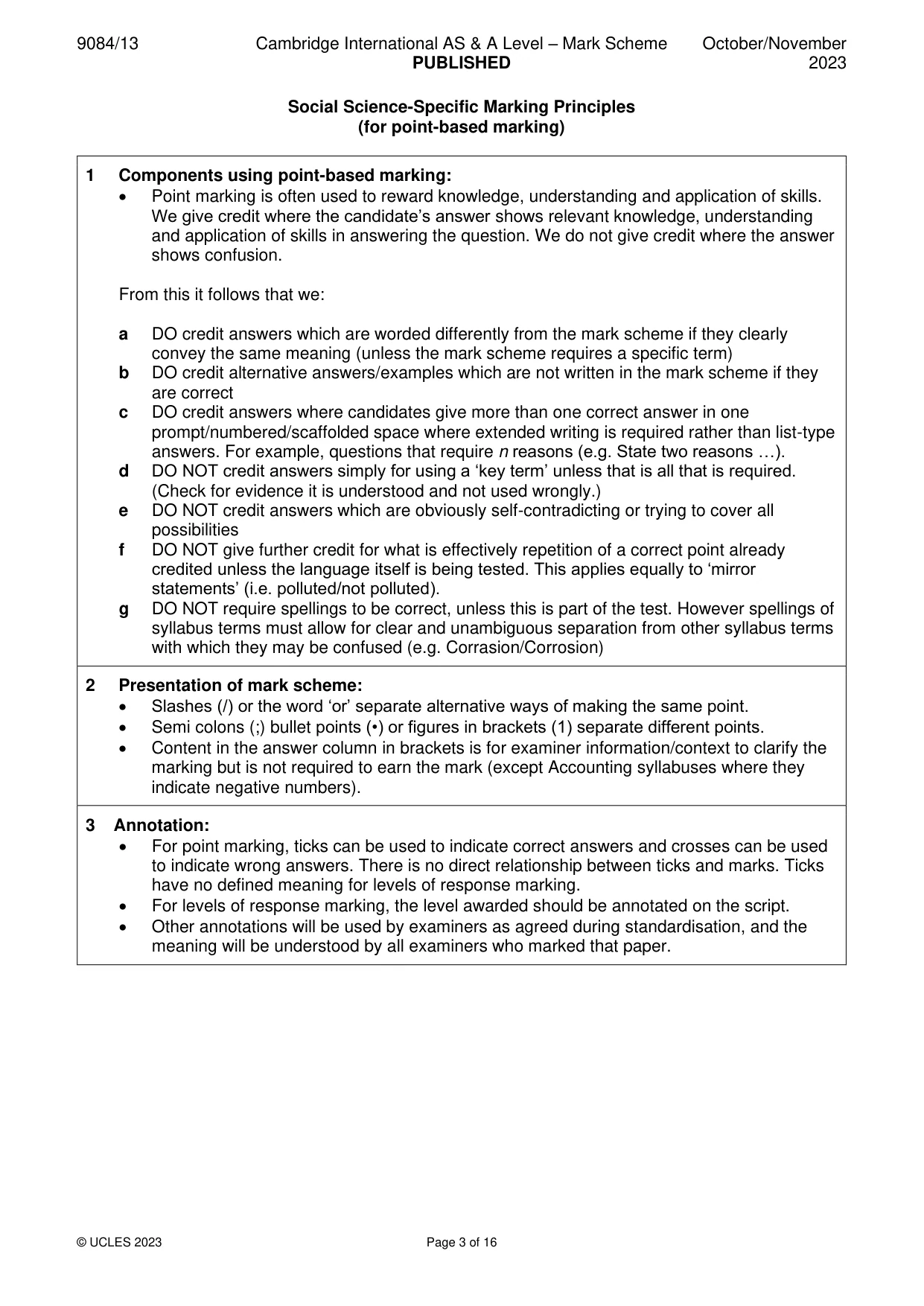
9084/13 Cambridge International AS & A Level – Mark Scheme PUBLISHED October/November 2023 © UCLES 2023 Page 3 of 16 Social Science-Specific Marking Principles (for point-based marking) 1 Components using point-based marking: • Point marking is often used to reward knowledge, understanding and application of skills. We give credit where the candidate’s answer shows relevant knowledge, understanding and application of skills in answering the question. We do not give credit where the answer shows confusion. From this it follows that we: a DO credit answers which are worded differently from the mark scheme if they clearly convey the same meaning (unless the mark scheme requires a specific term) b DO credit alternative answers/examples which are not written in the mark scheme if they are correct c DO credit answers where candidates give more than one correct answer in one prompt/numbered/scaffolded space where extended writing is required rather than list-type answers. For example, questions that require n reasons (e.g. State two reasons …). d DO NOT credit answers simply for using a ‘key term’ unless that is all that is required. (Check for evidence it is understood and not used wrongly.) e DO NOT credit answers which are obviously self-contradicting or trying to cover all possibilities f DO NOT give further credit for what is effectively repetition of a correct point already credited unless the language itself is being tested. This applies equally to ‘mirror statements’ (i.e. polluted/not polluted). g DO NOT require spellings to be correct, unless this is part of the test. However spellings of syllabus terms must allow for clear and unambiguous separation from other syllabus terms with which they may be confused (e.g. Corrasion/Corrosion) 2 Presentation of mark scheme: • Slashes (/) or the word ‘or’ separate alternative ways of making the same point. • Semi colons (;) bullet points (•) or figures in brackets (1) separate different points. • Content in the answer column in brackets is for examiner information/context to clarify the marking but is not required to earn the mark (except Accounting syllabuses where they indicate negative numbers). 3 Annotation: • For point marking, ticks can be used to indicate correct answers and crosses can be used to indicate wrong answers. There is no direct relationship between ticks and marks. Ticks have no defined meaning for levels of response marking. • For levels of response marking, the level awarded should be annotated on the script. • Other annotations will be used by examiners as agreed during standardisation, and the meaning will be understood by all examiners who marked that paper.
Mark scheme, page 4
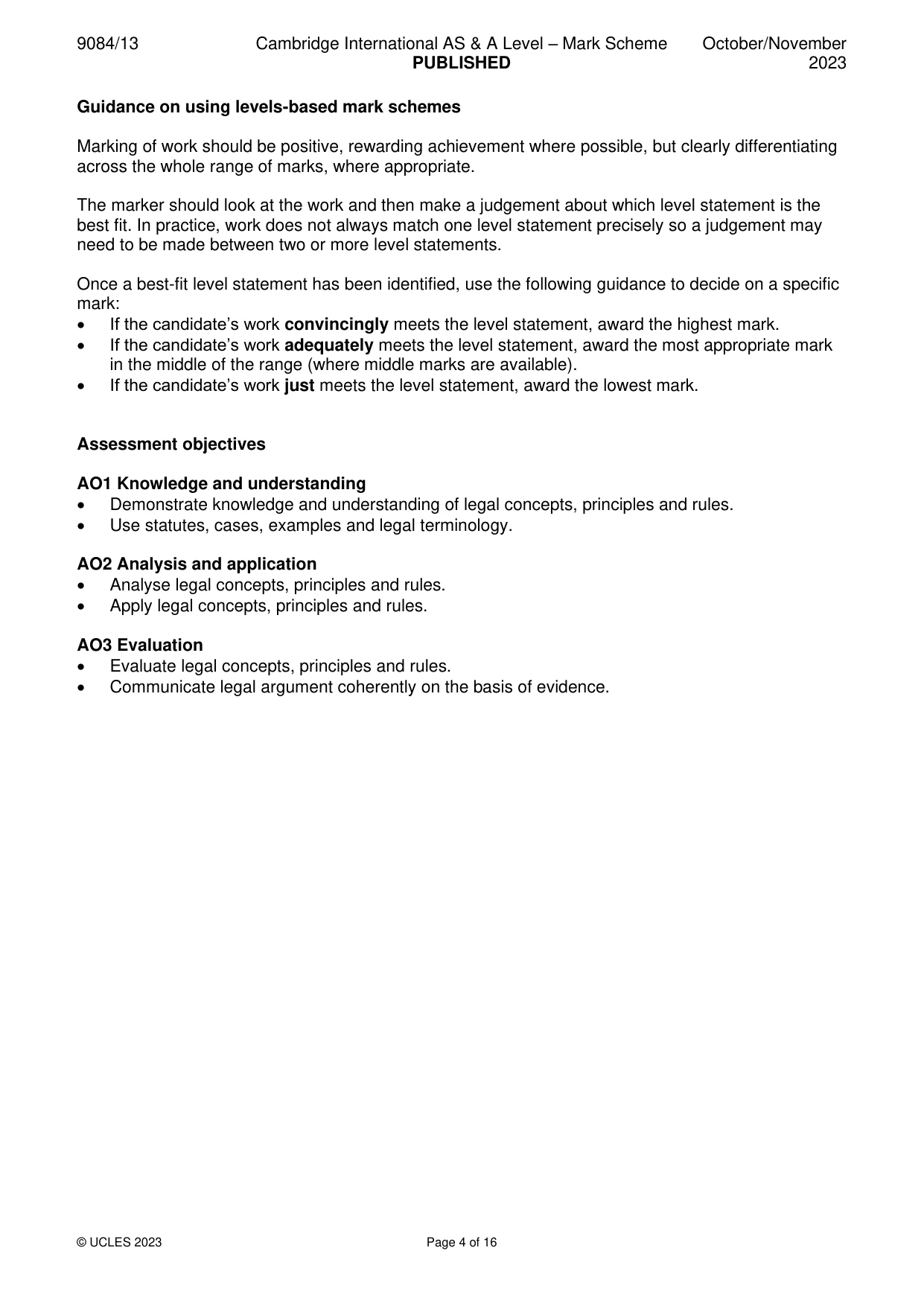
9084/13 Cambridge International AS & A Level – Mark Scheme PUBLISHED October/November 2023 © UCLES 2023 Page 4 of 16 Guidance on using levels-based mark schemes Marking of work should be positive, rewarding achievement where possible, but clearly differentiating across the whole range of marks, where appropriate. The marker should look at the work and then make a judgement about which level statement is the best fit. In practice, work does not always match one level statement precisely so a judgement may need to be made between two or more level statements. Once a best-fit level statement has been identified, use the following guidance to decide on a specific mark: • If the candidate’s work convincingly meets the level statement, award the highest mark. • If the candidate’s work adequately meets the level statement, award the most appropriate mark in the middle of the range (where middle marks are available). • If the candidate’s work just meets the level statement, award the lowest mark. Assessment objectives AO1 Knowledge and understanding • Demonstrate knowledge and understanding of legal concepts, principles and rules. • Use statutes, cases, examples and legal terminology. AO2 Analysis and application • Analyse legal concepts, principles and rules. • Apply legal concepts, principles and rules. AO3 Evaluation • Evaluate legal concepts, principles and rules. • Communicate legal argument coherently on the basis of evidence.
Mark scheme, page 5
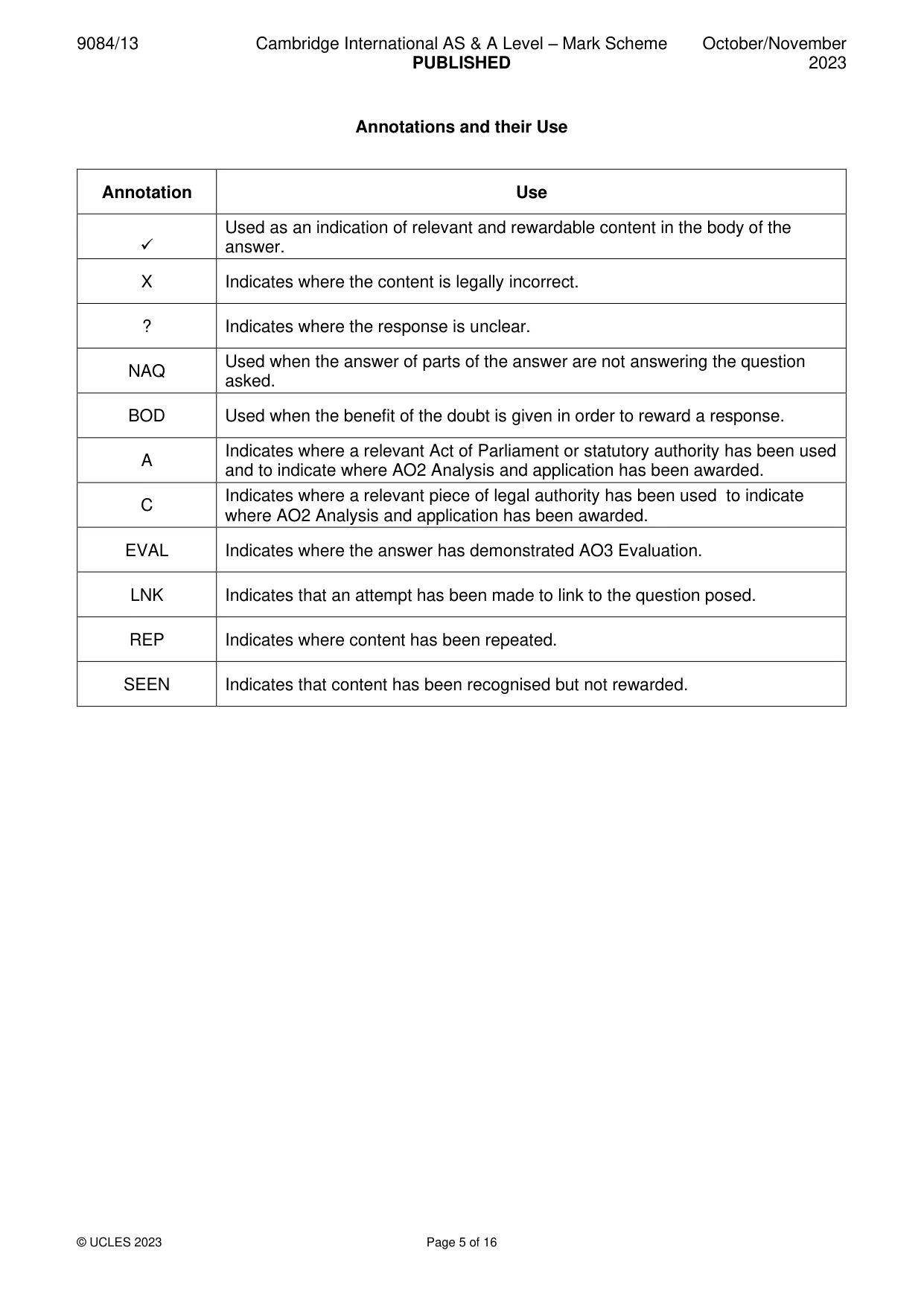
9084/13 Cambridge International AS & A Level – Mark Scheme PUBLISHED October/November 2023 © UCLES 2023 Page 5 of 16 Annotations and their Use Annotation Use ✓ Used as an indication of relevant and rewardable content in the body of the answer. X Indicates where the content is legally incorrect. ? Indicates where the response is unclear. NAQ Used when the answer of parts of the answer are not answering the question asked. BOD Used when the benefit of the doubt is given in order to reward a response. A Indicates where a relevant Act of Parliament or statutory authority has been used and to indicate where AO2 Analysis and application has been awarded. C Indicates where a relevant piece of legal authority has been used to indicate where AO2 Analysis and application has been awarded. EVAL Indicates where the answer has demonstrated AO3 Evaluation. LNK Indicates that an attempt has been made to link to the question posed. REP Indicates where content has been repeated. SEEN Indicates that content has been recognised but not rewarded.
Mark scheme, page 6
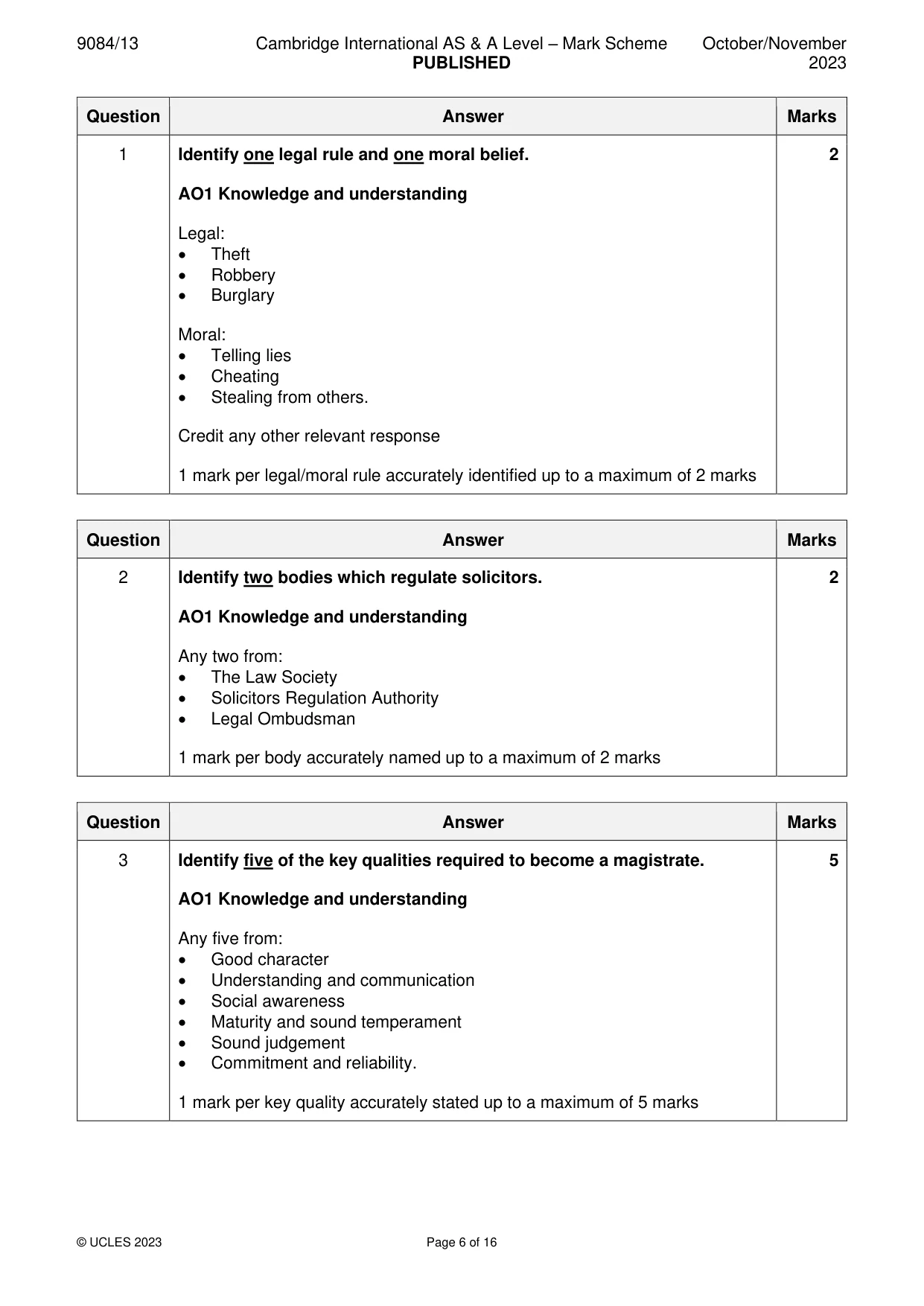
9084/13 Cambridge International AS & A Level – Mark Scheme PUBLISHED October/November 2023 © UCLES 2023 Page 6 of 16 Question Answer Marks 1 Identify one legal rule and one moral belief. AO1 Knowledge and understanding Legal: • Theft • Robbery • Burglary Moral: • Telling lies • Cheating • Stealing from others. Credit any other relevant response 1 mark per legal/moral rule accurately identified up to a maximum of 2 marks 2 Question Answer Marks 2 Identify two bodies which regulate solicitors. AO1 Knowledge and understanding Any two from: • The Law Society • Solicitors Regulation Authority • Legal Ombudsman 1 mark per body accurately named up to a maximum of 2 marks 2 Question Answer Marks 3 Identify five of the key qualities required to become a magistrate. AO1 Knowledge and understanding Any five from: • Good character • Understanding and communication • Social awareness • Maturity and sound temperament • Sound judgement • Commitment and reliability. 1 mark per key quality accurately stated up to a maximum of 5 marks 5
Mark scheme, page 7
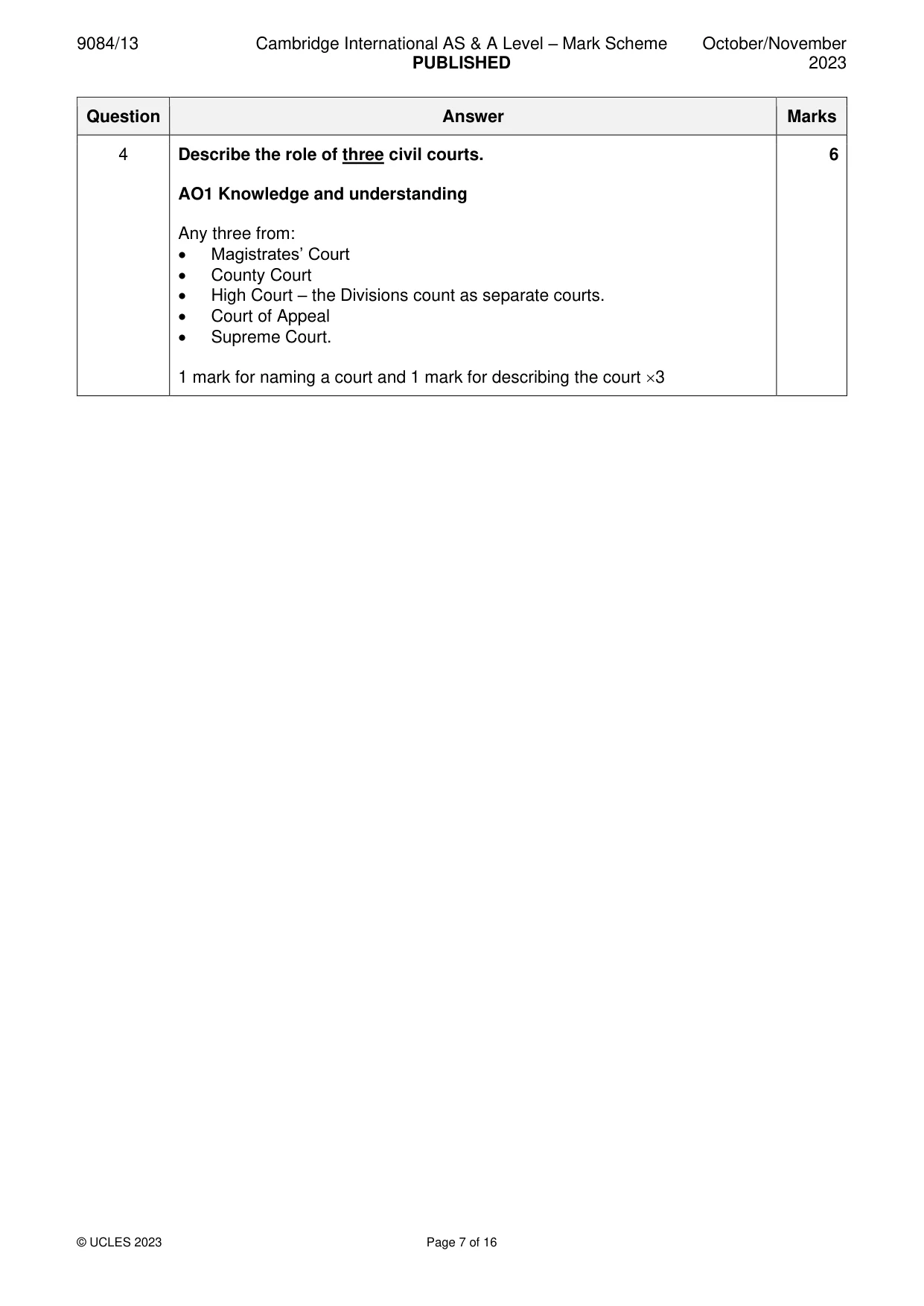
9084/13 Cambridge International AS & A Level – Mark Scheme PUBLISHED October/November 2023 © UCLES 2023 Page 7 of 16 Question Answer Marks 4 Describe the role of three civil courts. AO1 Knowledge and understanding Any three from: • Magistrates’ Court • County Court • High Court – the Divisions count as separate courts. • Court of Appeal • Supreme Court. 1 mark for naming a court and 1 mark for describing the court 3 6
Mark scheme, page 8
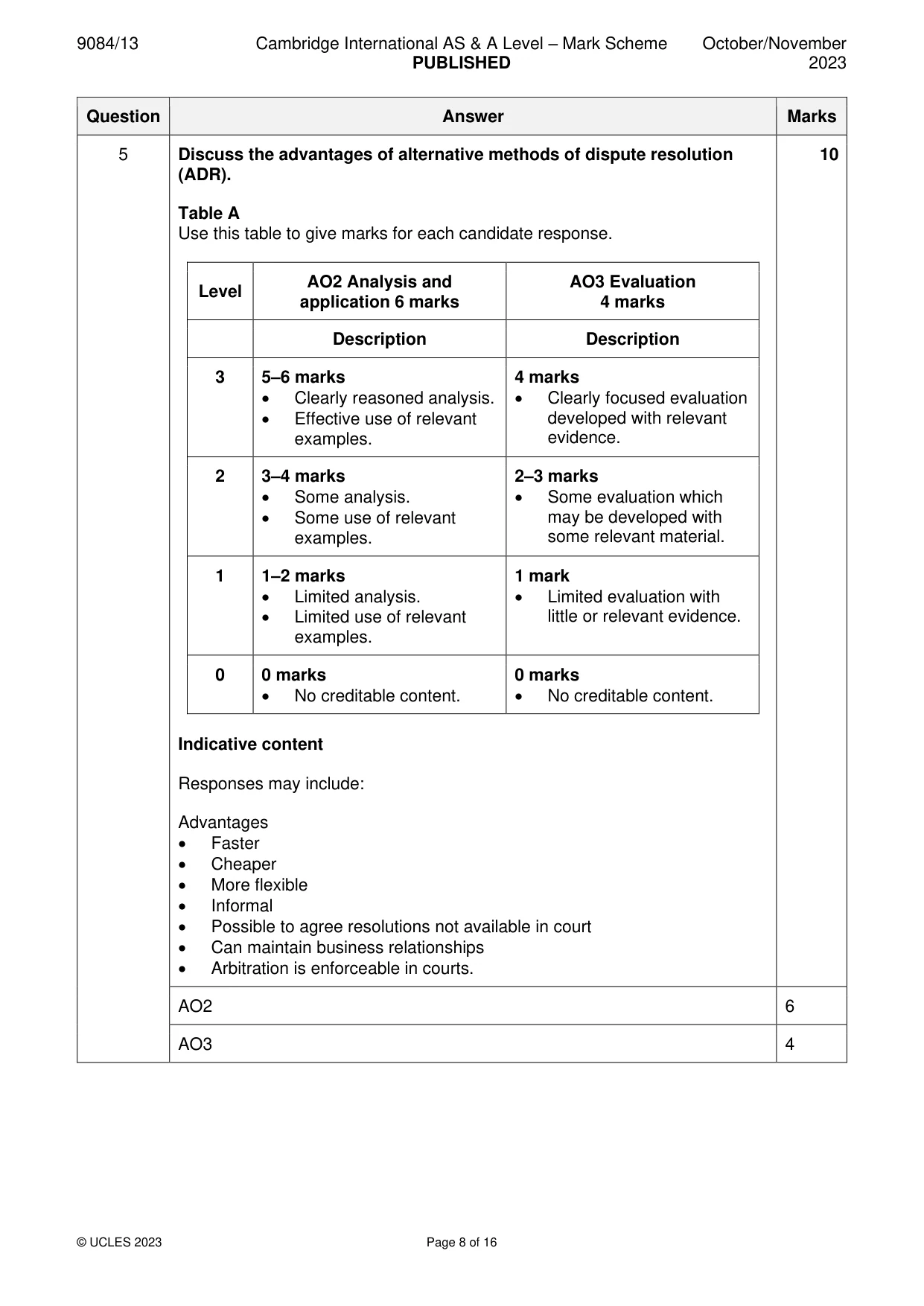
9084/13 Cambridge International AS & A Level – Mark Scheme PUBLISHED October/November 2023 © UCLES 2023 Page 8 of 16 Question Answer Marks 5 Discuss the advantages of alternative methods of dispute resolution (ADR). Table A Use this table to give marks for each candidate response. Level AO2 Analysis and application 6 marks AO3 Evaluation 4 marks Description Description 3 5–6 marks • Clearly reasoned analysis. • Effective use of relevant examples. 4 marks • Clearly focused evaluation developed with relevant evidence. 2 3–4 marks • Some analysis. • Some use of relevant examples. 2–3 marks • Some evaluation which may be developed with some relevant material. 1 1–2 marks • Limited analysis. • Limited use of relevant examples. 1 mark • Limited evaluation with little or relevant evidence. 0 0 marks • No creditable content. 0 marks • No creditable content. Indicative content Responses may include: Advantages • Faster • Cheaper • More flexible • Informal • Possible to agree resolutions not available in court • Can maintain business relationships • Arbitration is enforceable in courts. 10 AO2 6 AO3 4
Mark scheme, page 9
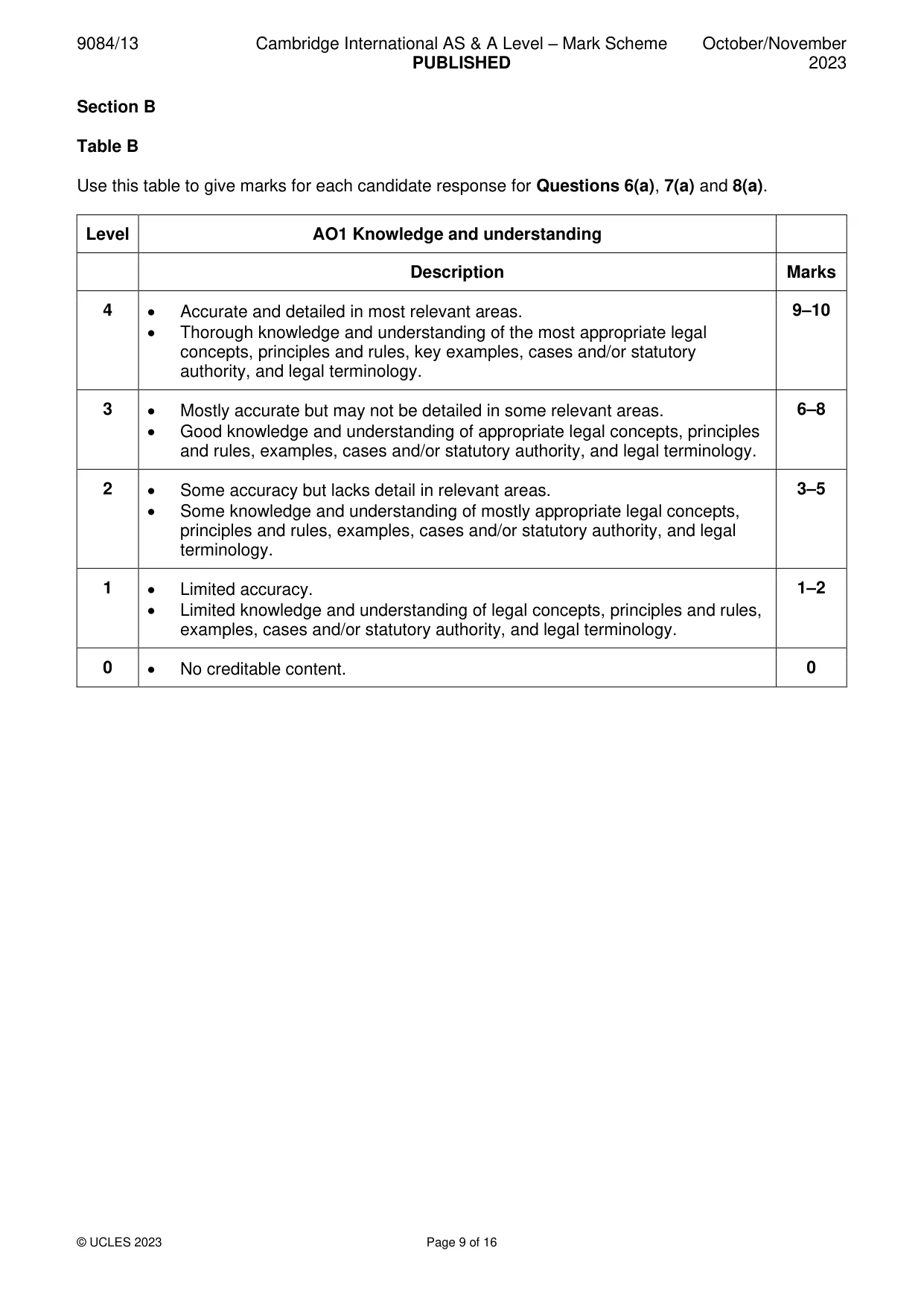
9084/13 Cambridge International AS & A Level – Mark Scheme PUBLISHED October/November 2023 © UCLES 2023 Page 9 of 16 Section B Table B Use this table to give marks for each candidate response for Questions 6(a), 7(a) and 8(a). Level AO1 Knowledge and understanding Description Marks 4 • Accurate and detailed in most relevant areas. • Thorough knowledge and understanding of the most appropriate legal concepts, principles and rules, key examples, cases and/or statutory authority, and legal terminology. 9–10 3 • Mostly accurate but may not be detailed in some relevant areas. • Good knowledge and understanding of appropriate legal concepts, principles and rules, examples, cases and/or statutory authority, and legal terminology. 6–8 2 • Some accuracy but lacks detail in relevant areas. • Some knowledge and understanding of mostly appropriate legal concepts, principles and rules, examples, cases and/or statutory authority, and legal terminology. 3–5 1 • Limited accuracy. • Limited knowledge and understanding of legal concepts, principles and rules, examples, cases and/or statutory authority, and legal terminology. 1–2 0 • No creditable content. 0
Mark scheme, page 10
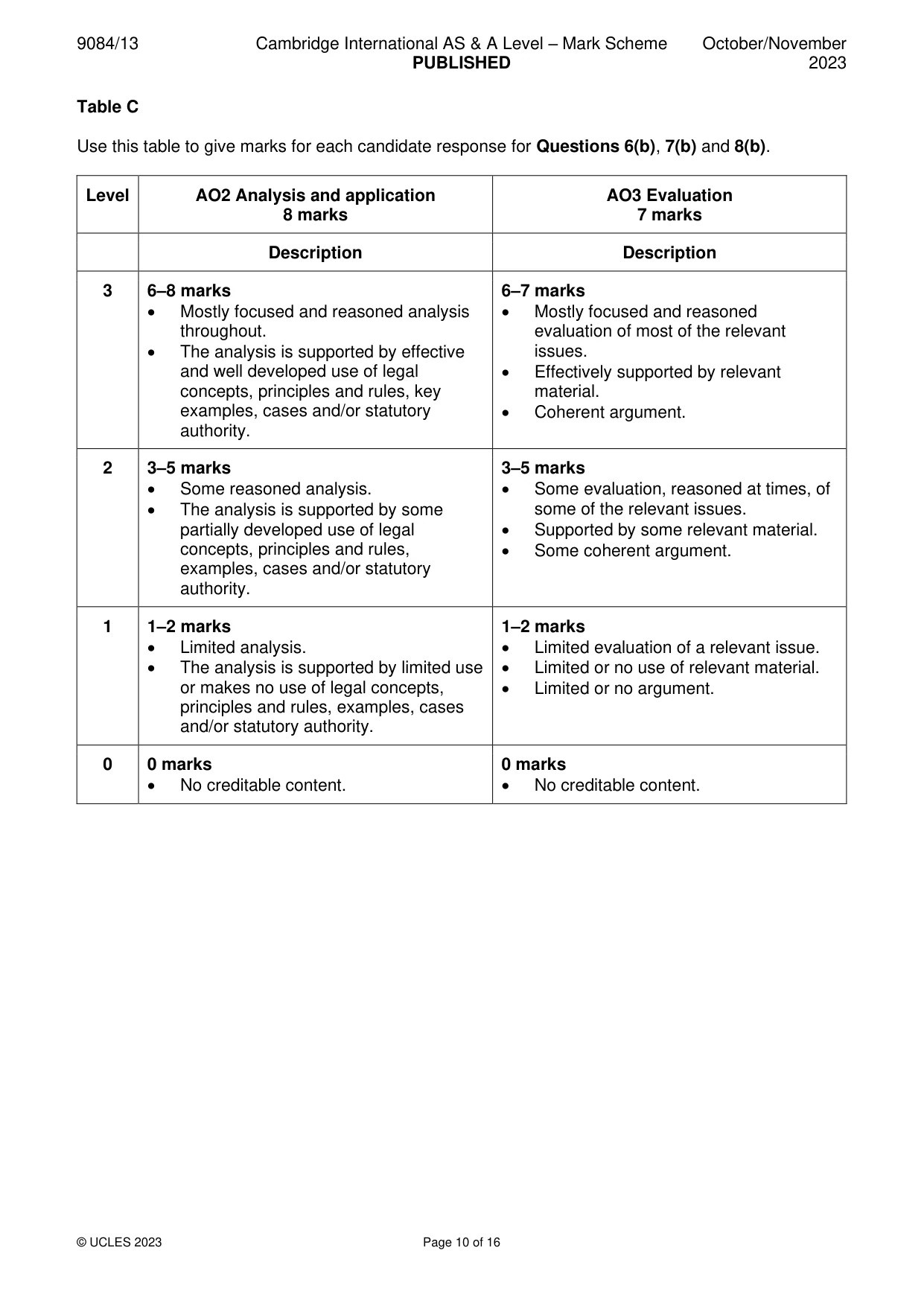
9084/13 Cambridge International AS & A Level – Mark Scheme PUBLISHED October/November 2023 © UCLES 2023 Page 10 of 16 Table C Use this table to give marks for each candidate response for Questions 6(b), 7(b) and 8(b). Level AO2 Analysis and application 8 marks AO3 Evaluation 7 marks Description Description 3 6–8 marks • Mostly focused and reasoned analysis throughout. • The analysis is supported by effective and well developed use of legal concepts, principles and rules, key examples, cases and/or statutory authority. 6–7 marks • Mostly focused and reasoned evaluation of most of the relevant issues. • Effectively supported by relevant material. • Coherent argument. 2 3–5 marks • Some reasoned analysis. • The analysis is supported by some partially developed use of legal concepts, principles and rules, examples, cases and/or statutory authority. 3–5 marks • Some evaluation, reasoned at times, of some of the relevant issues. • Supported by some relevant material. • Some coherent argument. 1 1–2 marks • Limited analysis. • The analysis is supported by limited use or makes no use of legal concepts, principles and rules, examples, cases and/or statutory authority. 1–2 marks • Limited evaluation of a relevant issue. • Limited or no use of relevant material. • Limited or no argument. 0 0 marks • No creditable content. 0 marks • No creditable content.
Mark scheme, page 11
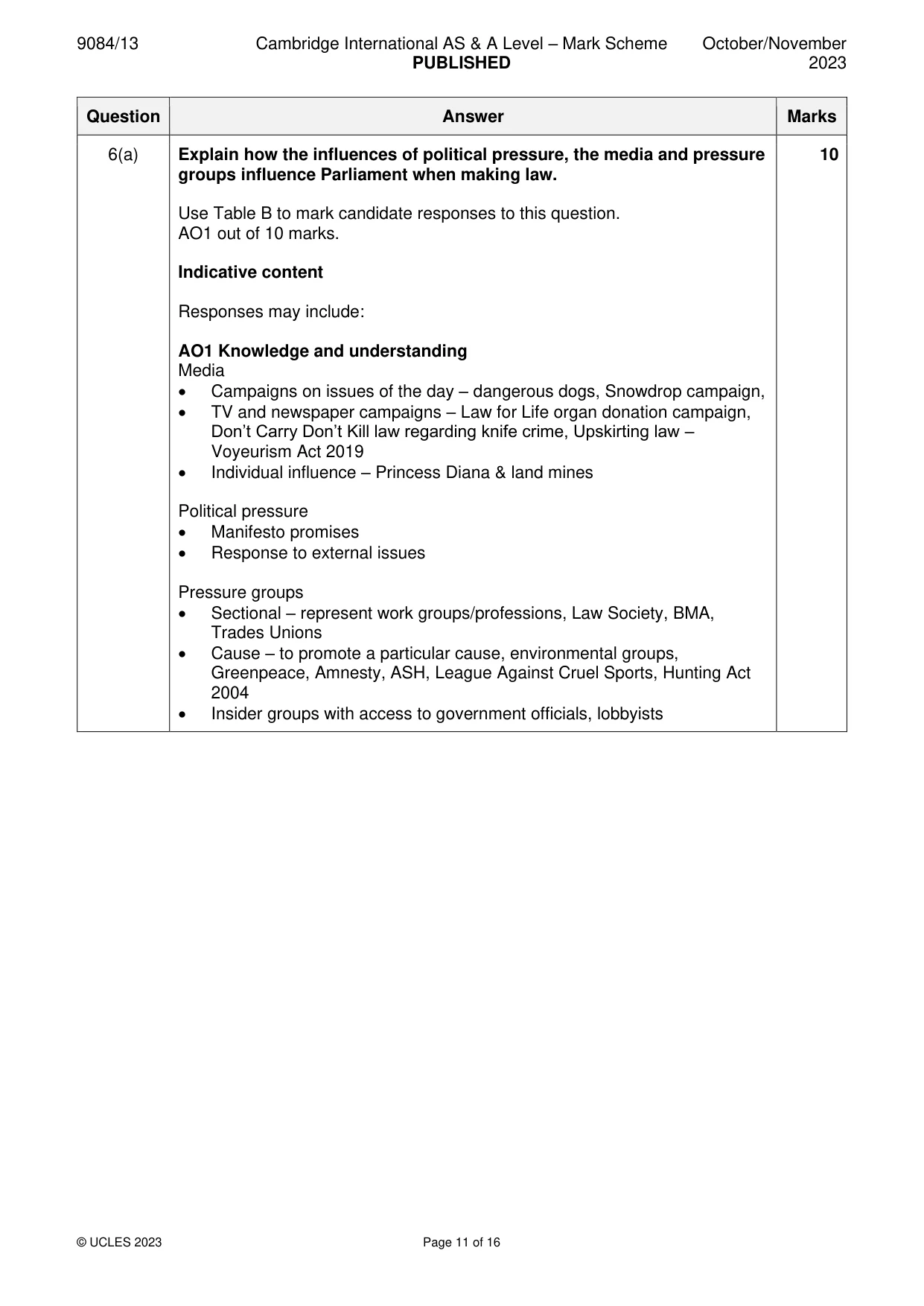
9084/13 Cambridge International AS & A Level – Mark Scheme PUBLISHED October/November 2023 © UCLES 2023 Page 11 of 16 Question Answer Marks 6(a) Explain how the influences of political pressure, the media and pressure groups influence Parliament when making law. Use Table B to mark candidate responses to this question. AO1 out of 10 marks. Indicative content Responses may include: AO1 Knowledge and understanding Media • Campaigns on issues of the day – dangerous dogs, Snowdrop campaign, • TV and newspaper campaigns – Law for Life organ donation campaign, Don’t Carry Don’t Kill law regarding knife crime, Upskirting law – Voyeurism Act 2019 • Individual influence – Princess Diana & land mines Political pressure • Manifesto promises • Response to external issues Pressure groups • Sectional – represent work groups/professions, Law Society, BMA, Trades Unions • Cause – to promote a particular cause, environmental groups, Greenpeace, Amnesty, ASH, League Against Cruel Sports, Hunting Act 2004 • Insider groups with access to government officials, lobbyists 10
Mark scheme, page 12
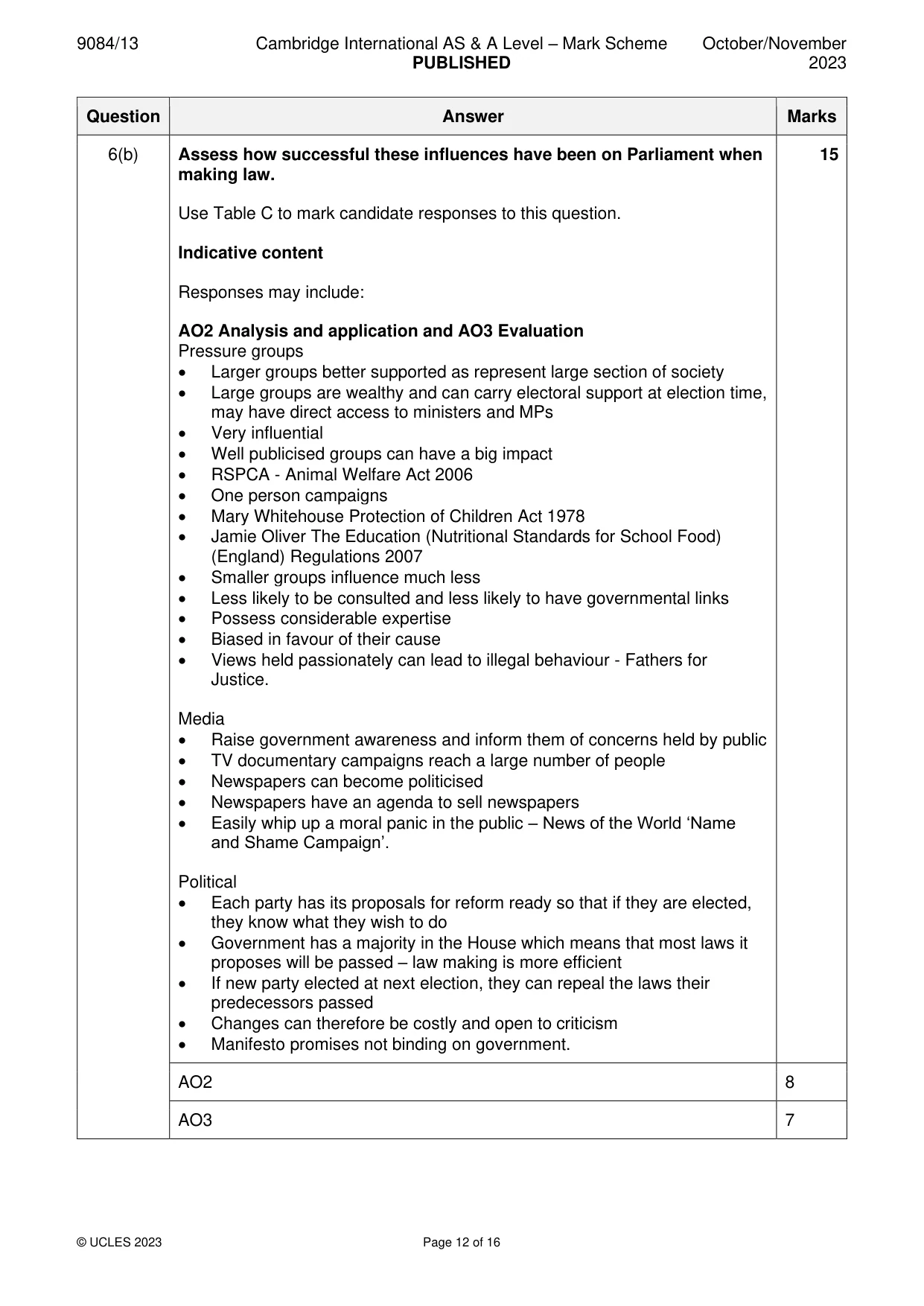
9084/13 Cambridge International AS & A Level – Mark Scheme PUBLISHED October/November 2023 © UCLES 2023 Page 12 of 16 Question Answer Marks 6(b) Assess how successful these influences have been on Parliament when making law. Use Table C to mark candidate responses to this question. Indicative content Responses may include: AO2 Analysis and application and AO3 Evaluation Pressure groups • Larger groups better supported as represent large section of society • Large groups are wealthy and can carry electoral support at election time, may have direct access to ministers and MPs • Very influential • Well publicised groups can have a big impact • RSPCA - Animal Welfare Act 2006 • One person campaigns • Mary Whitehouse Protection of Children Act 1978 • Jamie Oliver The Education (Nutritional Standards for School Food) (England) Regulations 2007 • Smaller groups influence much less • Less likely to be consulted and less likely to have governmental links • Possess considerable expertise • Biased in favour of their cause • Views held passionately can lead to illegal behaviour - Fathers for Justice. Media • Raise government awareness and inform them of concerns held by public • TV documentary campaigns reach a large number of people • Newspapers can become politicised • Newspapers have an agenda to sell newspapers • Easily whip up a moral panic in the public – News of the World ‘Name and Shame Campaign’. Political • Each party has its proposals for reform ready so that if they are elected, they know what they wish to do • Government has a majority in the House which means that most laws it proposes will be passed – law making is more efficient • If new party elected at next election, they can repeal the laws their predecessors passed • Changes can therefore be costly and open to criticism • Manifesto promises not binding on government. 15 AO2 8 AO3 7
Mark scheme, page 13
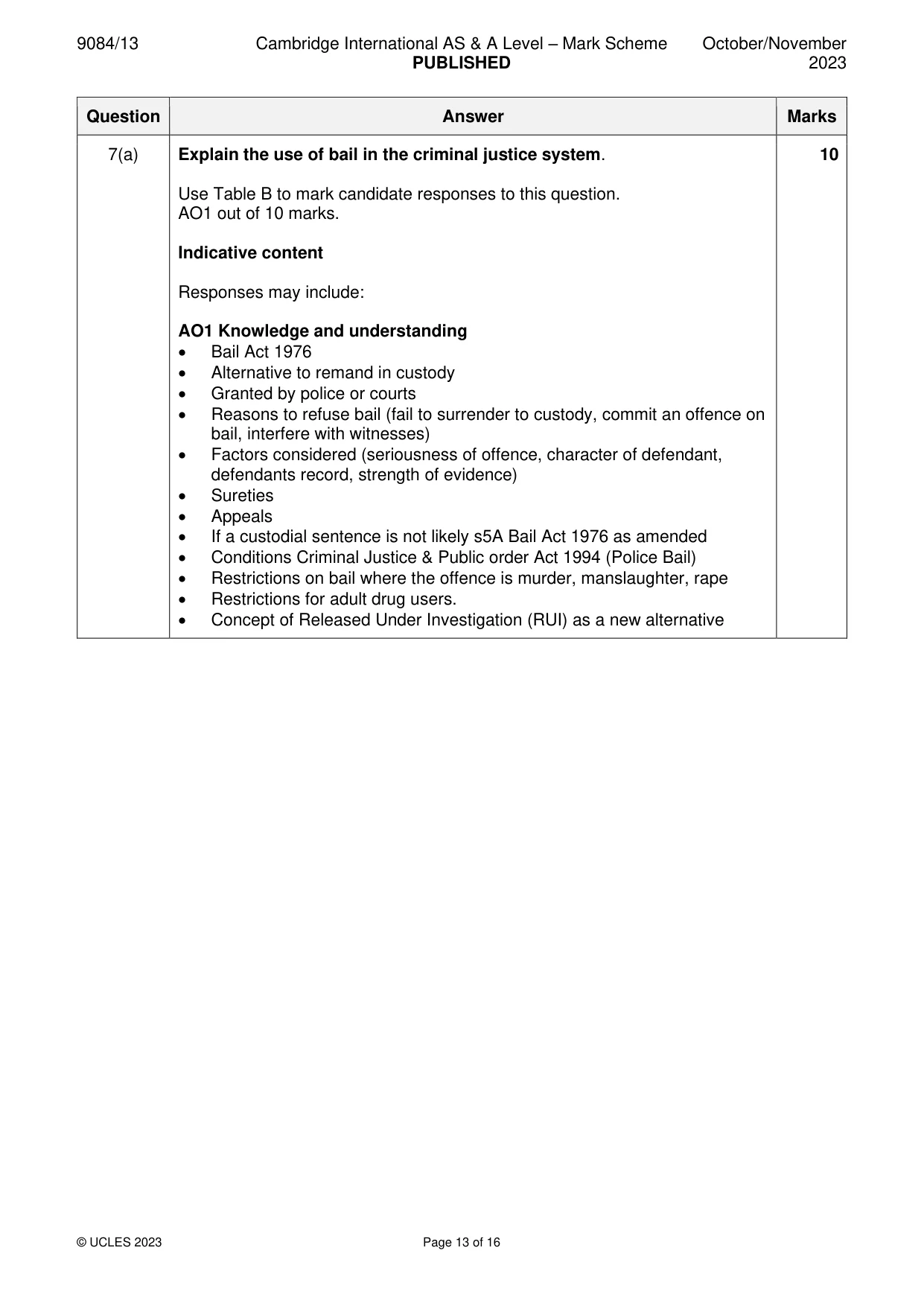
9084/13 Cambridge International AS & A Level – Mark Scheme PUBLISHED October/November 2023 © UCLES 2023 Page 13 of 16 Question Answer Marks 7(a) Explain the use of bail in the criminal justice system. Use Table B to mark candidate responses to this question. AO1 out of 10 marks. Indicative content Responses may include: AO1 Knowledge and understanding • Bail Act 1976 • Alternative to remand in custody • Granted by police or courts • Reasons to refuse bail (fail to surrender to custody, commit an offence on bail, interfere with witnesses) • Factors considered (seriousness of offence, character of defendant, defendants record, strength of evidence) • Sureties • Appeals • If a custodial sentence is not likely s5A Bail Act 1976 as amended • Conditions Criminal Justice & Public order Act 1994 (Police Bail) • Restrictions on bail where the offence is murder, manslaughter, rape • Restrictions for adult drug users. • Concept of Released Under Investigation (RUI) as a new alternative 10
Mark scheme, page 14
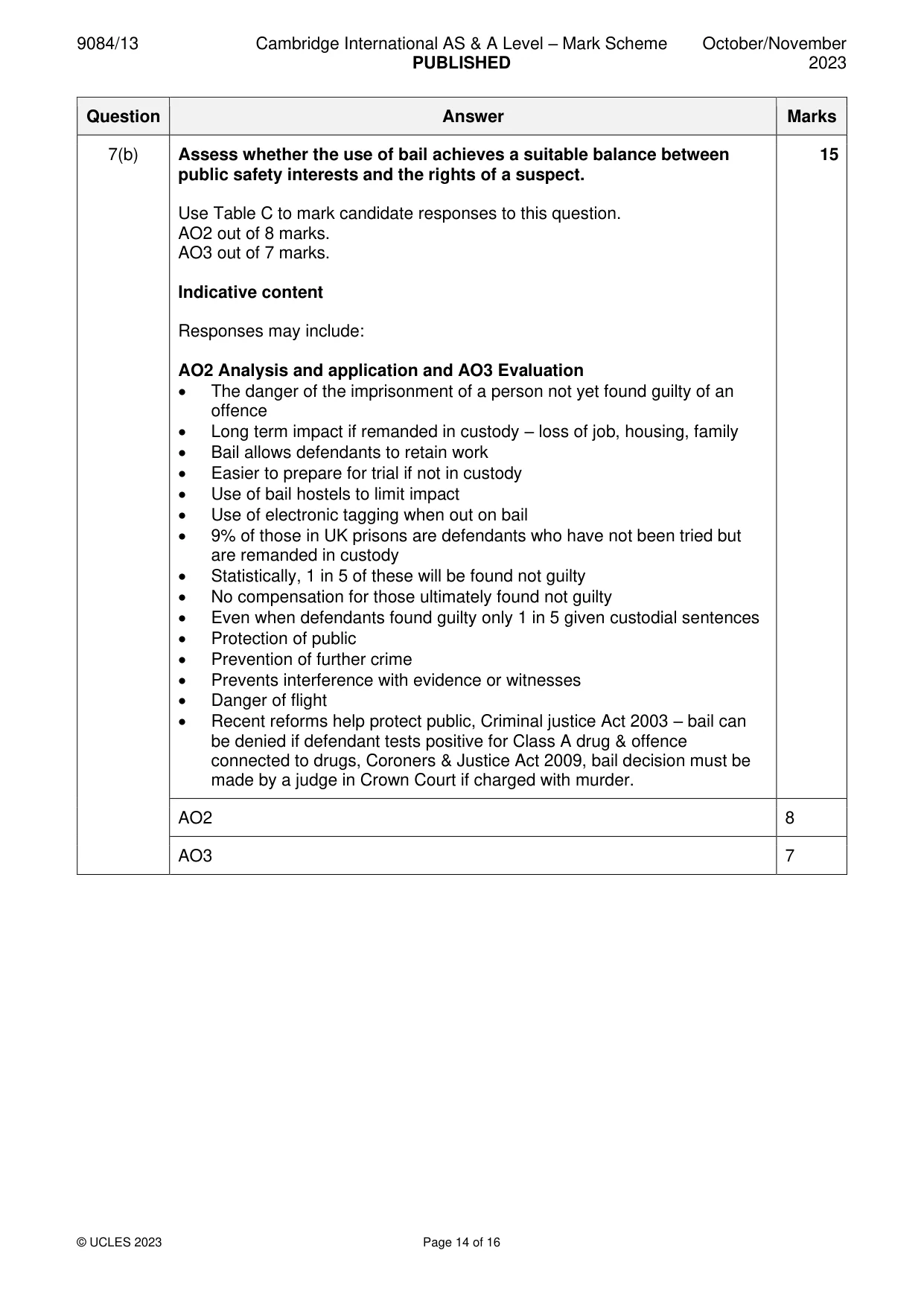
9084/13 Cambridge International AS & A Level – Mark Scheme PUBLISHED October/November 2023 © UCLES 2023 Page 14 of 16 Question Answer Marks 7(b) Assess whether the use of bail achieves a suitable balance between public safety interests and the rights of a suspect. Use Table C to mark candidate responses to this question. AO2 out of 8 marks. AO3 out of 7 marks. Indicative content Responses may include: AO2 Analysis and application and AO3 Evaluation • The danger of the imprisonment of a person not yet found guilty of an offence • Long term impact if remanded in custody – loss of job, housing, family • Bail allows defendants to retain work • Easier to prepare for trial if not in custody • Use of bail hostels to limit impact • Use of electronic tagging when out on bail • 9% of those in UK prisons are defendants who have not been tried but are remanded in custody • Statistically, 1 in 5 of these will be found not guilty • No compensation for those ultimately found not guilty • Even when defendants found guilty only 1 in 5 given custodial sentences • Protection of public • Prevention of further crime • Prevents interference with evidence or witnesses • Danger of flight • Recent reforms help protect public, Criminal justice Act 2003 – bail can be denied if defendant tests positive for Class A drug & offence connected to drugs, Coroners & Justice Act 2009, bail decision must be made by a judge in Crown Court if charged with murder. 15 AO2 8 AO3 7
Mark scheme, page 15
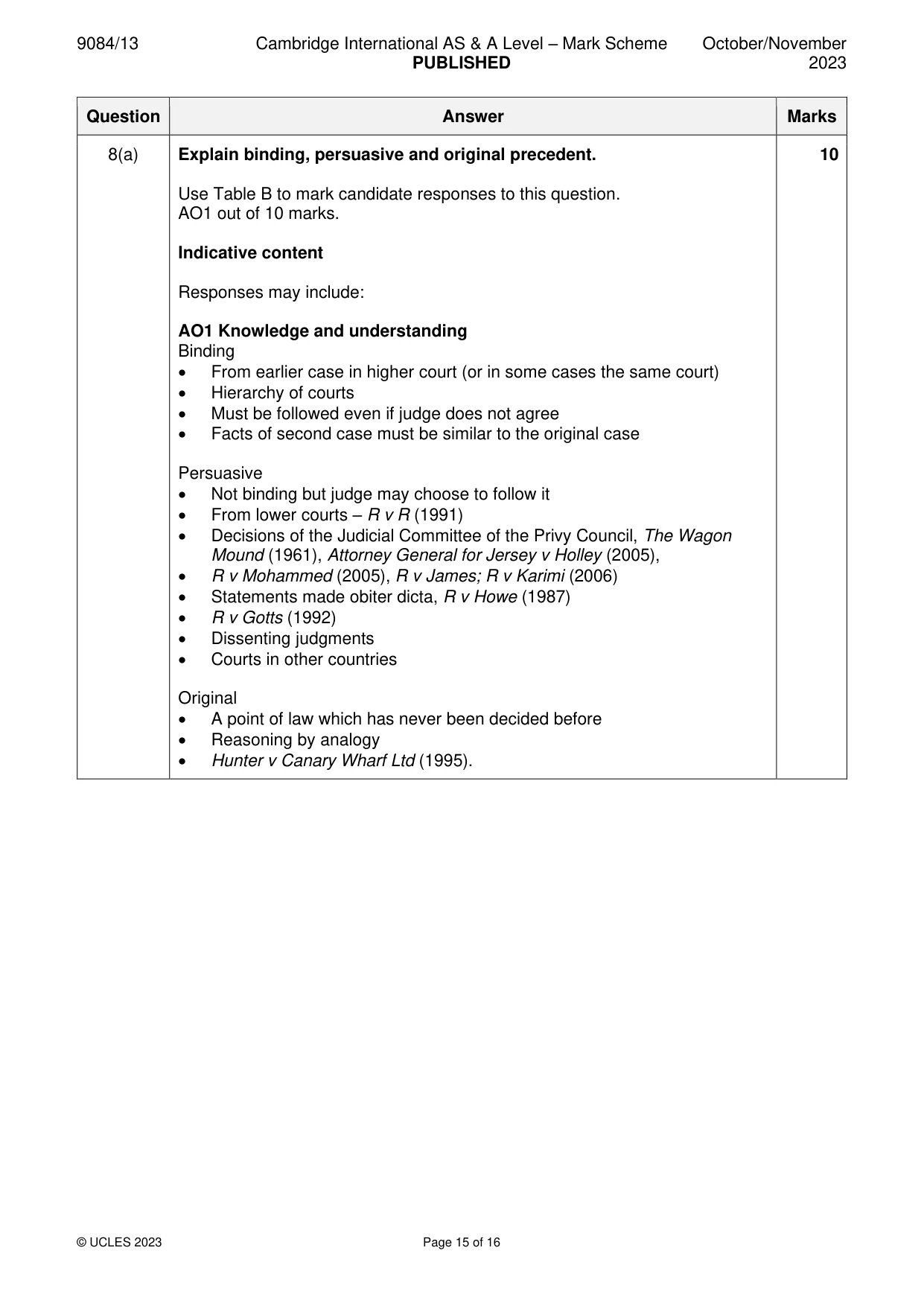
9084/13 Cambridge International AS & A Level – Mark Scheme PUBLISHED October/November 2023 © UCLES 2023 Page 15 of 16 Question Answer Marks 8(a) Explain binding, persuasive and original precedent. Use Table B to mark candidate responses to this question. AO1 out of 10 marks. Indicative content Responses may include: AO1 Knowledge and understanding Binding • From earlier case in higher court (or in some cases the same court) • Hierarchy of courts • Must be followed even if judge does not agree • Facts of second case must be similar to the original case Persuasive • Not binding but judge may choose to follow it • From lower courts – R v R (1991) • Decisions of the Judicial Committee of the Privy Council, The Wagon Mound (1961), Attorney General for Jersey v Holley (2005), • R v Mohammed (2005), R v James; R v Karimi (2006) • Statements made obiter dicta, R v Howe (1987) • R v Gotts (1992) • Dissenting judgments • Courts in other countries Original • A point of law which has never been decided before • Reasoning by analogy • Hunter v Canary Wharf Ltd (1995). 10
Mark scheme, page 16
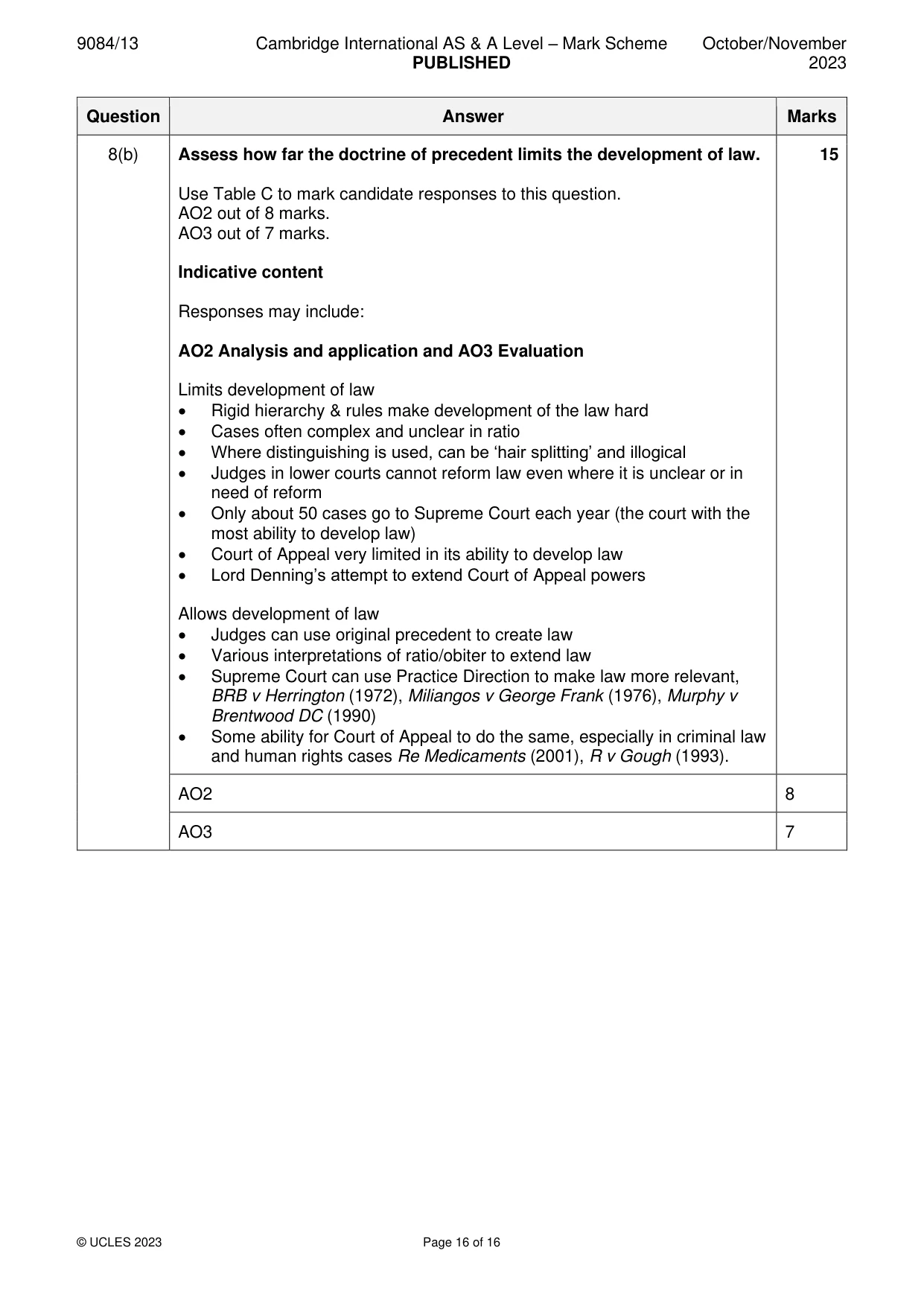
9084/13 Cambridge International AS & A Level – Mark Scheme PUBLISHED October/November 2023 © UCLES 2023 Page 16 of 16 Question Answer Marks 8(b) Assess how far the doctrine of precedent limits the development of law. Use Table C to mark candidate responses to this question. AO2 out of 8 marks. AO3 out of 7 marks. Indicative content Responses may include: AO2 Analysis and application and AO3 Evaluation Limits development of law • Rigid hierarchy & rules make development of the law hard • Cases often complex and unclear in ratio • Where distinguishing is used, can be ‘hair splitting’ and illogical • Judges in lower courts cannot reform law even where it is unclear or in need of reform • Only about 50 cases go to Supreme Court each year (the court with the most ability to develop law) • Court of Appeal very limited in its ability to develop law • Lord Denning’s attempt to extend Court of Appeal powers Allows development of law • Judges can use original precedent to create law • Various interpretations of ratio/obiter to extend law • Supreme Court can use Practice Direction to make law more relevant, BRB v Herrington (1972), Miliangos v George Frank (1976), Murphy v Brentwood DC (1990) • Some ability for Court of Appeal to do the same, especially in criminal law and human rights cases Re Medicaments (2001), R v Gough (1993). 15 AO2 8 AO3 7
What you needed in this session
Cambridge’s own grade thresholds for 2023 Oct/Nov, Paper 1 · Variant 3. A higher threshold means an easier paper — the bar moves with how the cohort did.