Cambridge A Level Law 9084 — 2012 May/June Paper 1 · Variant 1
9084/11/M/J/12 · 75 marks · ≈84 min
The question paper and its mark scheme, free to read here and free to download. This is Cambridge’s own paper, exactly as it was sat.
Question paper2 pages
Mark scheme4 pages
Answers below. Sit the paper first if you are practising.
Paper as text
Question paper, page 1
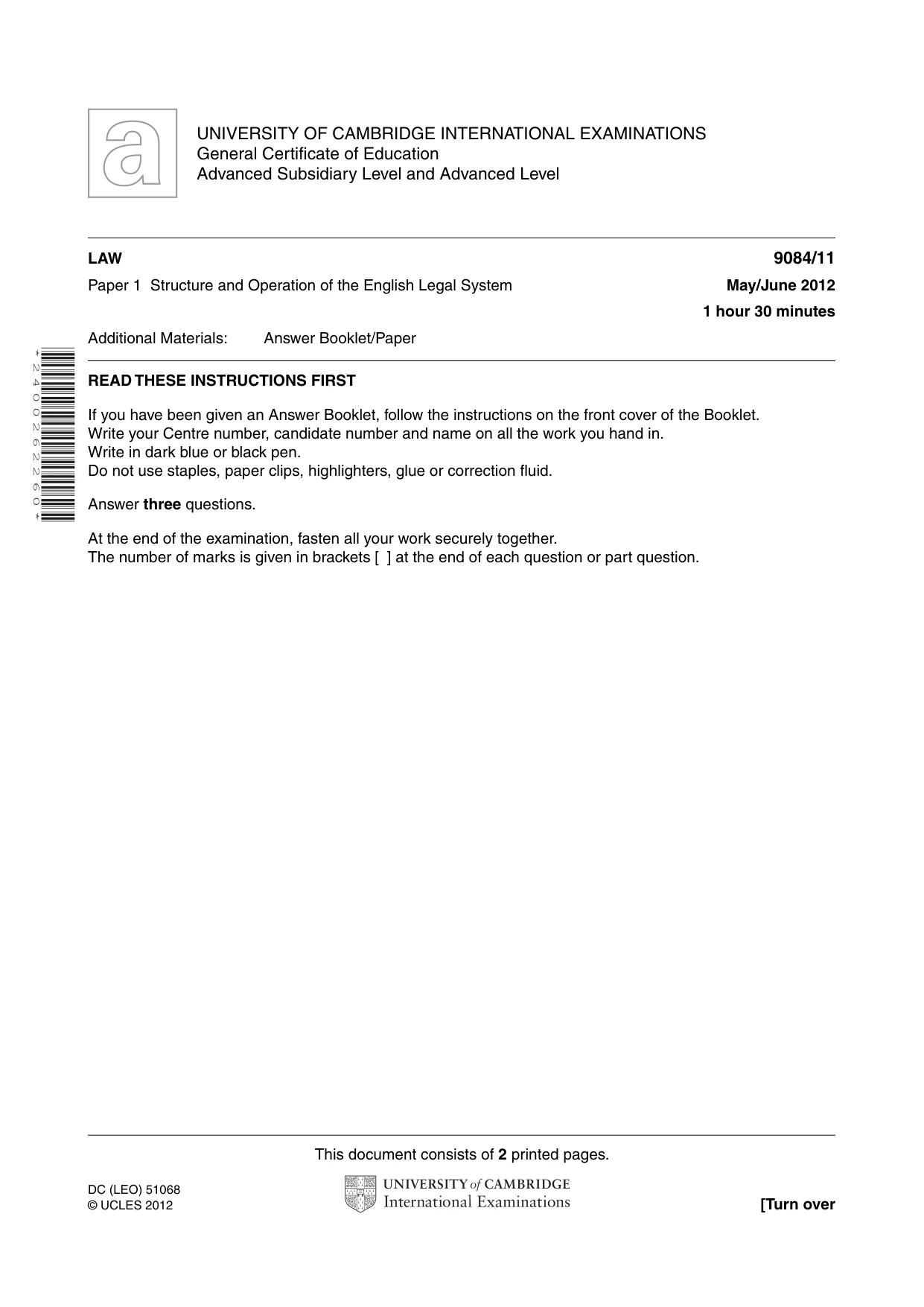
This document consists of 2 printed pages. DC (LEO) 51068 © UCLES 2012 [Turn over UNIVERSITY OF CAMBRIDGE INTERNATIONAL EXAMINATIONS General Certificate of Education Advanced Subsidiary Level and Advanced Level READ THESE INSTRUCTIONS FIRST If you have been given an Answer Booklet, follow the instructions on the front cover of the Booklet. Write your Centre number, candidate number and name on all the work you hand in. Write in dark blue or black pen. Do not use staples, paper clips, highlighters, glue or correction fluid. Answer three questions. At the end of the examination, fasten all your work securely together. The number of marks is given in brackets [ ] at the end of each question or part question. * 2 4 0 0 2 6 2 2 6 0 * LAW 9084/11 Paper 1 Structure and Operation of the English Legal System May/June 2012 1 hour 30 minutes Additional Materials: Answer Booklet/Paper
Question paper, page 2
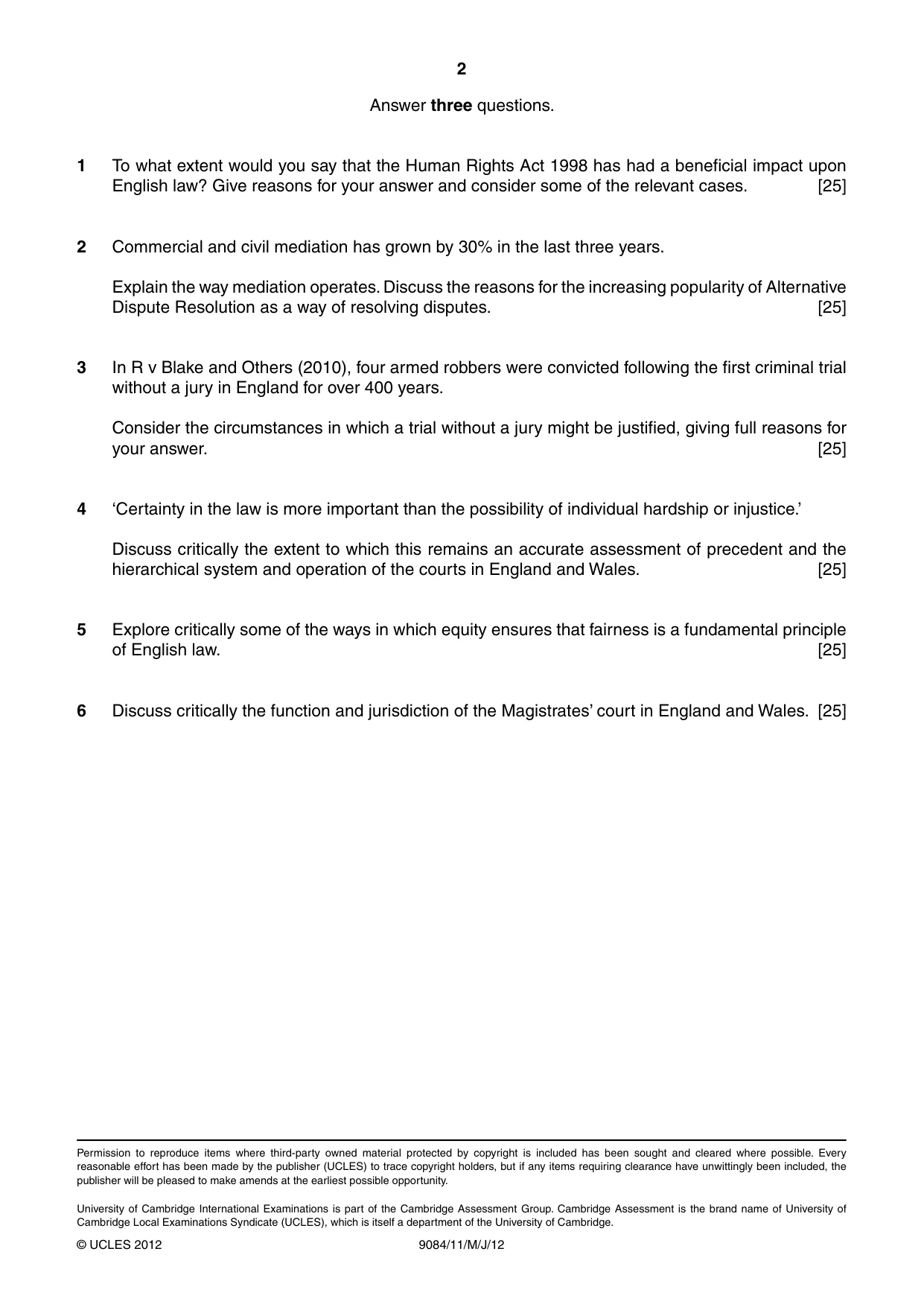
2 9084/11/M/J/12 © UCLES 2012 Answer three questions. 1 To what extent would you say that the Human Rights Act 1998 has had a beneficial impact upon English law? Give reasons for your answer and consider some of the relevant cases. [25] 2 Commercial and civil mediation has grown by 30% in the last three years. Explain the way mediation operates. Discuss the reasons for the increasing popularity of Alternative Dispute Resolution as a way of resolving disputes. [25] 3 In R v Blake and Others (2010), four armed robbers were convicted following the first criminal trial without a jury in England for over 400 years. Consider the circumstances in which a trial without a jury might be justified, giving full reasons for your answer. [25] 4 ‘Certainty in the law is more important than the possibility of individual hardship or injustice.’ Discuss critically the extent to which this remains an accurate assessment of precedent and the hierarchical system and operation of the courts in England and Wales. [25] 5 Explore critically some of the ways in which equity ensures that fairness is a fundamental principle of English law. [25] 6 Discuss critically the function and jurisdiction of the Magistrates’ court in England and Wales. [25] Permission to reproduce items where third-party owned material protected by copyright is included has been sought and cleared where possible. Every reasonable effort has been made by the publisher (UCLES) to trace copyright holders, but if any items requiring clearance have unwittingly been included, the publisher will be pleased to make amends at the earliest possible opportunity. University of Cambridge International Examinations is part of the Cambridge Assessment Group. Cambridge Assessment is the brand name of University of Cambridge Local Examinations Syndicate (UCLES), which is itself a department of the University of Cambridge.
Mark scheme, page 1
UNIVERSITY OF CAMBRIDGE INTERNATIONAL EXAMINATIONS GCE Advanced Subsidiary Level and GCE Advanced Level MARK SCHEME for the May/June 2012 question paper for the guidance of teachers 9084 LAW 9084/11 Paper 1, maximum raw mark 75 This mark scheme is published as an aid to teachers and candidates, to indicate the requirements of the examination. It shows the basis on which Examiners were instructed to award marks. It does not indicate the details of the discussions that took place at an Examiners’ meeting before marking began, which would have considered the acceptability of alternative answers. Mark schemes must be read in conjunction with the question papers and the report on the examination. • Cambridge will not enter into discussions or correspondence in connection with these mark schemes. Cambridge is publishing the mark schemes for the May/June 2012 question papers for most IGCSE, GCE Advanced Level and Advanced Subsidiary Level syllabuses and some Ordinary Level syllabuses.
Mark scheme, page 2
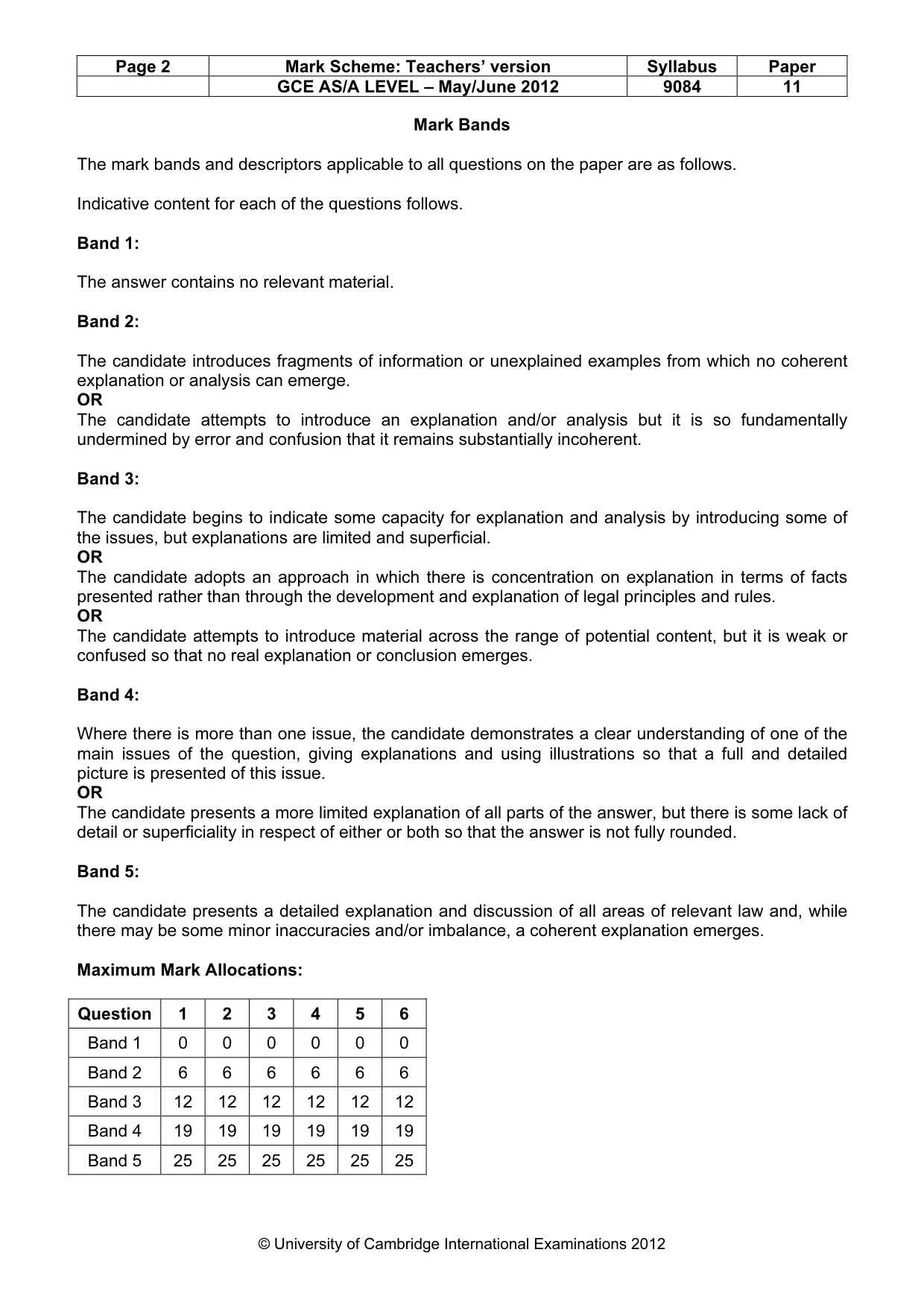
Page 2 Mark Scheme: Teachers’ version Syllabus Paper GCE AS/A LEVEL – May/June 2012 9084 11 © University of Cambridge International Examinations 2012 Mark Bands The mark bands and descriptors applicable to all questions on the paper are as follows. Indicative content for each of the questions follows. Band 1: The answer contains no relevant material. Band 2: The candidate introduces fragments of information or unexplained examples from which no coherent explanation or analysis can emerge. OR The candidate attempts to introduce an explanation and/or analysis but it is so fundamentally undermined by error and confusion that it remains substantially incoherent. Band 3: The candidate begins to indicate some capacity for explanation and analysis by introducing some of the issues, but explanations are limited and superficial. OR The candidate adopts an approach in which there is concentration on explanation in terms of facts presented rather than through the development and explanation of legal principles and rules. OR The candidate attempts to introduce material across the range of potential content, but it is weak or confused so that no real explanation or conclusion emerges. Band 4: Where there is more than one issue, the candidate demonstrates a clear understanding of one of the main issues of the question, giving explanations and using illustrations so that a full and detailed picture is presented of this issue. OR The candidate presents a more limited explanation of all parts of the answer, but there is some lack of detail or superficiality in respect of either or both so that the answer is not fully rounded. Band 5: The candidate presents a detailed explanation and discussion of all areas of relevant law and, while there may be some minor inaccuracies and/or imbalance, a coherent explanation emerges. Maximum Mark Allocations: Question 1 2 3 4 5 6 Band 1 0 0 0 0 0 0 Band 2 6 6 6 6 6 6 Band 3 12 12 12 12 12 12 Band 4 19 19 19 19 19 19 Band 5 25 25 25 25 25 25
Mark scheme, page 3
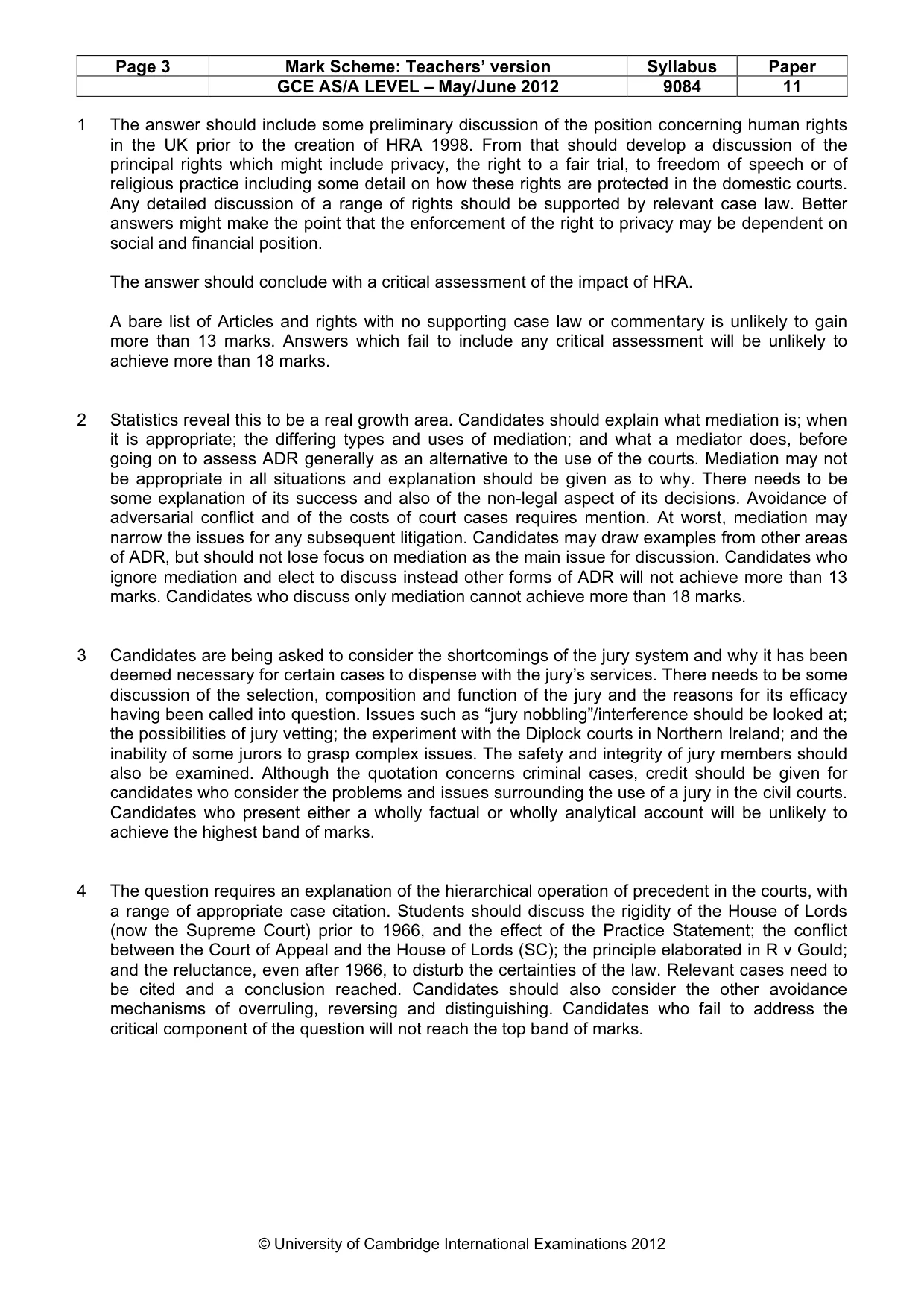
Page 3 Mark Scheme: Teachers’ version Syllabus Paper GCE AS/A LEVEL – May/June 2012 9084 11 © University of Cambridge International Examinations 2012 1 The answer should include some preliminary discussion of the position concerning human rights in the UK prior to the creation of HRA 1998. From that should develop a discussion of the principal rights which might include privacy, the right to a fair trial, to freedom of speech or of religious practice including some detail on how these rights are protected in the domestic courts. Any detailed discussion of a range of rights should be supported by relevant case law. Better answers might make the point that the enforcement of the right to privacy may be dependent on social and financial position. The answer should conclude with a critical assessment of the impact of HRA. A bare list of Articles and rights with no supporting case law or commentary is unlikely to gain more than 13 marks. Answers which fail to include any critical assessment will be unlikely to achieve more than 18 marks. 2 Statistics reveal this to be a real growth area. Candidates should explain what mediation is; when it is appropriate; the differing types and uses of mediation; and what a mediator does, before going on to assess ADR generally as an alternative to the use of the courts. Mediation may not be appropriate in all situations and explanation should be given as to why. There needs to be some explanation of its success and also of the non-legal aspect of its decisions. Avoidance of adversarial conflict and of the costs of court cases requires mention. At worst, mediation may narrow the issues for any subsequent litigation. Candidates may draw examples from other areas of ADR, but should not lose focus on mediation as the main issue for discussion. Candidates who ignore mediation and elect to discuss instead other forms of ADR will not achieve more than 13 marks. Candidates who discuss only mediation cannot achieve more than 18 marks. 3 Candidates are being asked to consider the shortcomings of the jury system and why it has been deemed necessary for certain cases to dispense with the jury’s services. There needs to be some discussion of the selection, composition and function of the jury and the reasons for its efficacy having been called into question. Issues such as “jury nobbling”/interference should be looked at; the possibilities of jury vetting; the experiment with the Diplock courts in Northern Ireland; and the inability of some jurors to grasp complex issues. The safety and integrity of jury members should also be examined. Although the quotation concerns criminal cases, credit should be given for candidates who consider the problems and issues surrounding the use of a jury in the civil courts. Candidates who present either a wholly factual or wholly analytical account will be unlikely to achieve the highest band of marks. 4 The question requires an explanation of the hierarchical operation of precedent in the courts, with a range of appropriate case citation. Students should discuss the rigidity of the House of Lords (now the Supreme Court) prior to 1966, and the effect of the Practice Statement; the conflict between the Court of Appeal and the House of Lords (SC); the principle elaborated in R v Gould; and the reluctance, even after 1966, to disturb the certainties of the law. Relevant cases need to be cited and a conclusion reached. Candidates should also consider the other avoidance mechanisms of overruling, reversing and distinguishing. Candidates who fail to address the critical component of the question will not reach the top band of marks.
Mark scheme, page 4
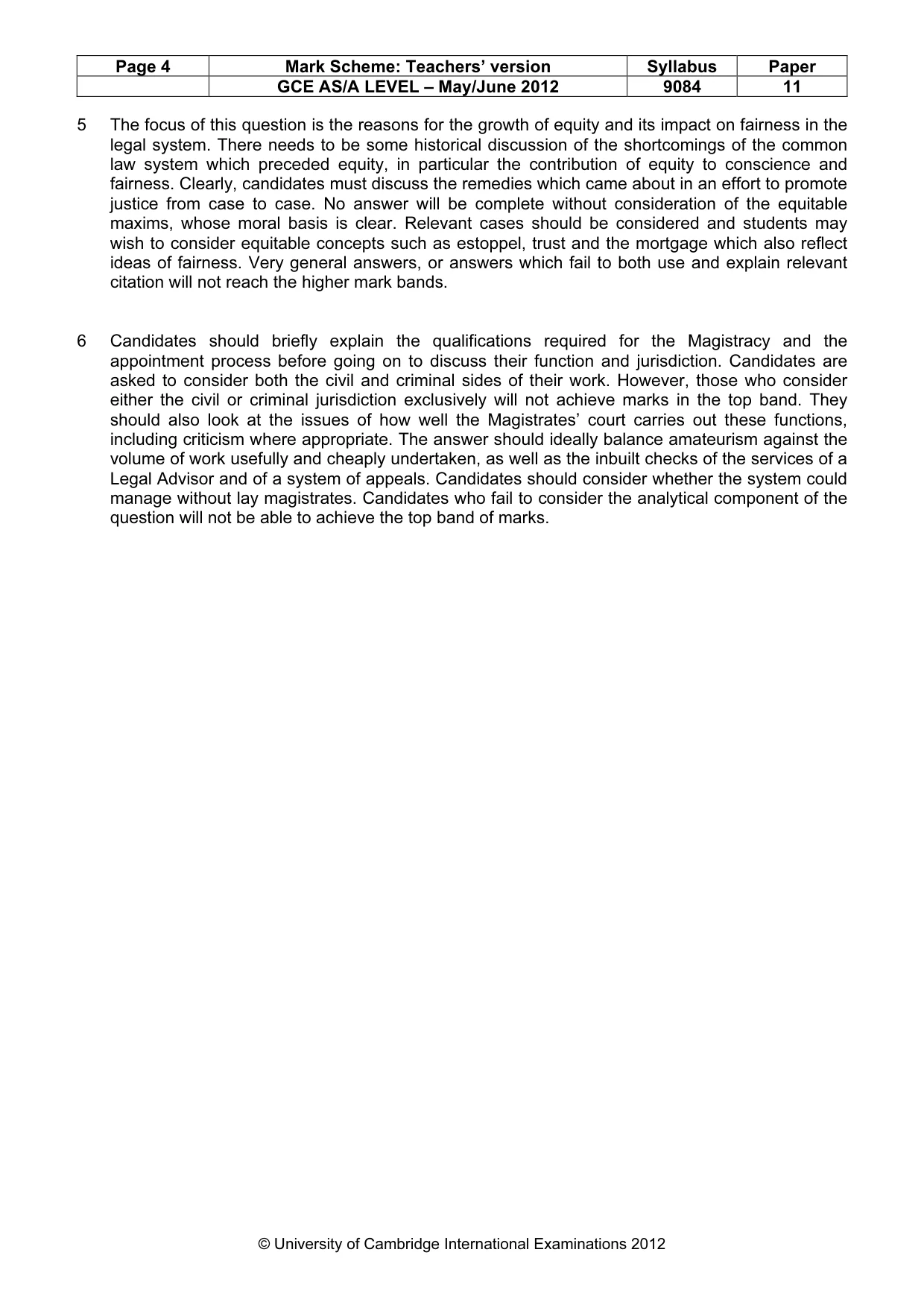
Page 4 Mark Scheme: Teachers’ version Syllabus Paper GCE AS/A LEVEL – May/June 2012 9084 11 © University of Cambridge International Examinations 2012 5 The focus of this question is the reasons for the growth of equity and its impact on fairness in the legal system. There needs to be some historical discussion of the shortcomings of the common law system which preceded equity, in particular the contribution of equity to conscience and fairness. Clearly, candidates must discuss the remedies which came about in an effort to promote justice from case to case. No answer will be complete without consideration of the equitable maxims, whose moral basis is clear. Relevant cases should be considered and students may wish to consider equitable concepts such as estoppel, trust and the mortgage which also reflect ideas of fairness. Very general answers, or answers which fail to both use and explain relevant citation will not reach the higher mark bands. 6 Candidates should briefly explain the qualifications required for the Magistracy and the appointment process before going on to discuss their function and jurisdiction. Candidates are asked to consider both the civil and criminal sides of their work. However, those who consider either the civil or criminal jurisdiction exclusively will not achieve marks in the top band. They should also look at the issues of how well the Magistrates’ court carries out these functions, including criticism where appropriate. The answer should ideally balance amateurism against the volume of work usefully and cheaply undertaken, as well as the inbuilt checks of the services of a Legal Advisor and of a system of appeals. Candidates should consider whether the system could manage without lay magistrates. Candidates who fail to consider the analytical component of the question will not be able to achieve the top band of marks.
What you needed in this session
Cambridge’s own grade thresholds for 2012 May/June, Paper 1 · Variant 1. A higher threshold means an easier paper — the bar moves with how the cohort did.