Cambridge A Level Law 9084 — 2024 May/June Paper 1 · Variant 3
9084/13/M/J/24 · 75 marks · ≈84 min
The question paper and its mark scheme, free to read here and free to download. This is Cambridge’s own paper, exactly as it was sat.
Question paper4 pages


Mark scheme17 pages
Answers below. Sit the paper first if you are practising.
Paper as text
Question paper, page 1
This document has 4 pages. Any blank pages are indicated. [Turn over Cambridge International AS & A Level DC (SK) 330415/1 © UCLES 2024 * 6 0 1 0 9 8 7 0 9 5 * LAW 9084/13 Paper 1 English Legal System May/June 2024 1 hour 30 minutes You must answer on the enclosed answer booklet. You will need: Answer booklet (enclosed) INSTRUCTIONS ● Answer seven questions in total: Section A: answer all questions. Section B: answer two questions. ● Follow the instructions on the front cover of the answer booklet. If you need additional answer paper, ask the invigilator for a continuation booklet. INFORMATION ● The total mark for this paper is 75. ● The number of marks for each question or part question is shown in brackets [ ].
Question paper, page 2
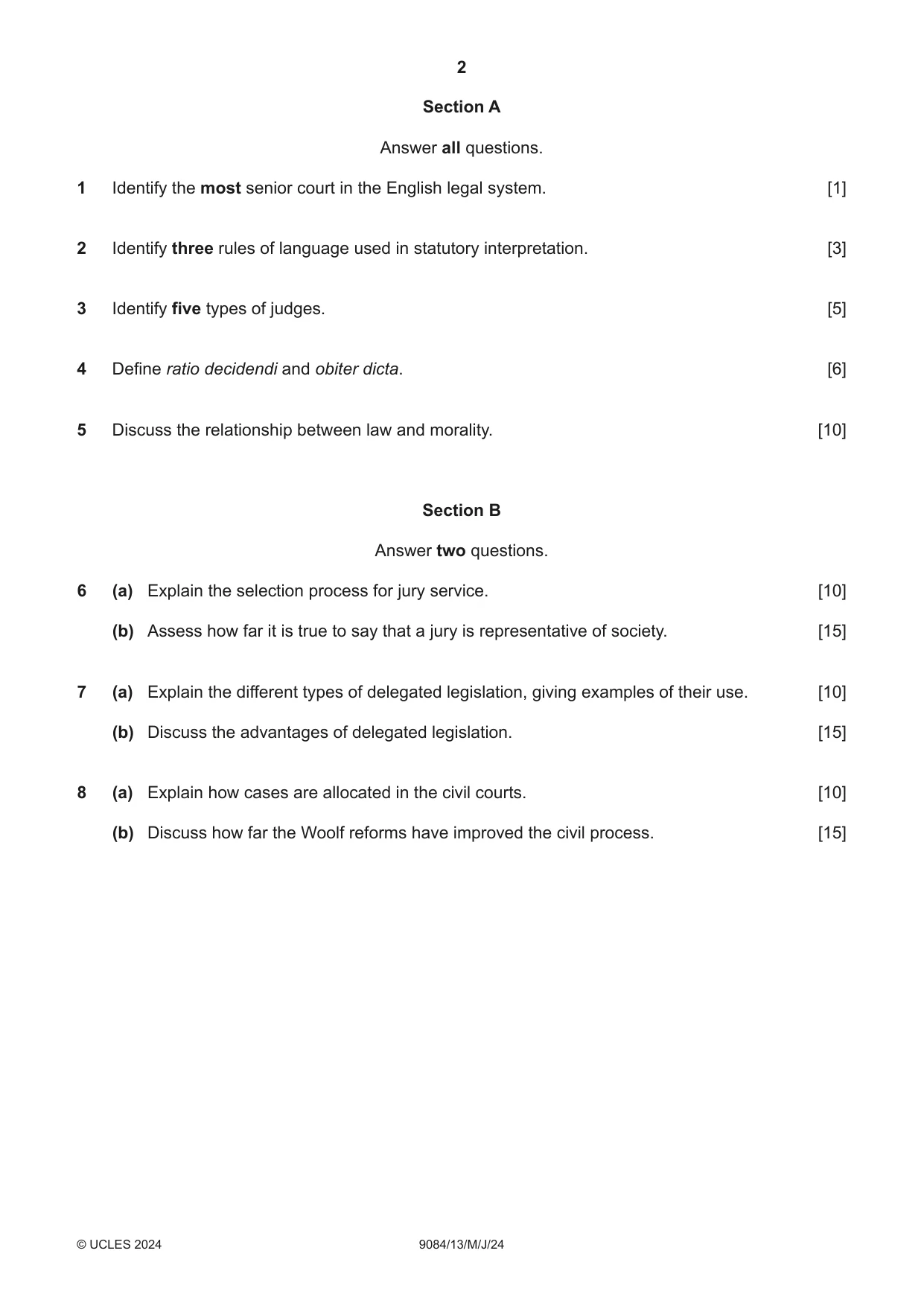
2 9084/13/M/J/24 © UCLES 2024 Section A Answer all questions. 1 Identify the most senior court in the English legal system. [1] 2 Identify three rules of language used in statutory interpretation. [3] 3 Identify five types of judges. [5] 4 Define ratio decidendi and obiter dicta. [6] 5 Discuss the relationship between law and morality. [10] Section B Answer two questions. 6 (a) Explain the selection process for jury service. [10] (b) Assess how far it is true to say that a jury is representative of society. [15] 7 (a) Explain the different types of delegated legislation, giving examples of their use. [10] (b) Discuss the advantages of delegated legislation. [15] 8 (a) Explain how cases are allocated in the civil courts. [10] (b) Discuss how far the Woolf reforms have improved the civil process. [15]
Question paper, page 3
3 9084/13/M/J/24 © UCLES 2024 BLANK PAGE
Question paper, page 4
4 9084/13/M/J/24 © UCLES 2024 Permission to reproduce items where third-party owned material protected by copyright is included has been sought and cleared where possible. Every reasonable effort has been made by the publisher (UCLES) to trace copyright holders, but if any items requiring clearance have unwittingly been included, the publisher will be pleased to make amends at the earliest possible opportunity. To avoid the issue of disclosure of answer-related information to candidates, all copyright acknowledgements are reproduced online in the Cambridge Assessment International Education Copyright Acknowledgements Booklet. This is produced for each series of examinations and is freely available to download at www.cambridgeinternational.org after the live examination series. Cambridge Assessment International Education is part of Cambridge Assessment. Cambridge Assessment is the brand name of the University of Cambridge Local Examinations Syndicate (UCLES), which is a department of the University of Cambridge. BLANK PAGE
Mark scheme, page 1
This document consists of 17 printed pages. © Cambridge University Press & Assessment 2024 [Turn over Cambridge International AS & A Level LAW 9084/13 Paper 1 May/June 2024 MARK SCHEME Maximum Mark: 75 Published This mark scheme is published as an aid to teachers and candidates, to indicate the requirements of the examination. It shows the basis on which Examiners were instructed to award marks. It does not indicate the details of the discussions that took place at an Examiners’ meeting before marking began, which would have considered the acceptability of alternative answers. Mark schemes should be read in conjunction with the question paper and the Principal Examiner Report for Teachers. Cambridge International will not enter into discussions about these mark schemes. Cambridge International is publishing the mark schemes for the May/June 2024 series for most Cambridge IGCSE, Cambridge International A and AS Level and Cambridge Pre-U components, and some Cambridge O Level components.
Mark scheme, page 2
9084/13 Cambridge International AS & A Level – Mark Scheme PUBLISHED May/June 2024 © Cambridge University Press & Assessment 2024 Page 2 of 17 Generic Marking Principles These general marking principles must be applied by all examiners when marking candidate answers. They should be applied alongside the specific content of the mark scheme or generic level descriptions for a question. Each question paper and mark scheme will also comply with these marking principles. GENERIC MARKING PRINCIPLE 1: Marks must be awarded in line with: the specific content of the mark scheme or the generic level descriptors for the question the specific skills defined in the mark scheme or in the generic level descriptors for the question the standard of response required by a candidate as exemplified by the standardisation scripts. GENERIC MARKING PRINCIPLE 2: Marks awarded are always whole marks (not half marks, or other fractions). GENERIC MARKING PRINCIPLE 3: Marks must be awarded positively: marks are awarded for correct/valid answers, as defined in the mark scheme. However, credit is given for valid answers which go beyond the scope of the syllabus and mark scheme, referring to your Team Leader as appropriate marks are awarded when candidates clearly demonstrate what they know and can do marks are not deducted for errors marks are not deducted for omissions answers should only be judged on the quality of spelling, punctuation and grammar when these features are specifically assessed by the question as indicated by the mark scheme. The meaning, however, should be unambiguous. GENERIC MARKING PRINCIPLE 4: Rules must be applied consistently, e.g. in situations where candidates have not followed instructions or in the application of generic level descriptors. GENERIC MARKING PRINCIPLE 5: Marks should be awarded using the full range of marks defined in the mark scheme for the question (however; the use of the full mark range may be limited according to the quality of the candidate responses seen). GENERIC MARKING PRINCIPLE 6: Marks awarded are based solely on the requirements as defined in the mark scheme. Marks should not be awarded with grade thresholds or grade descriptors in mind.
Mark scheme, page 3
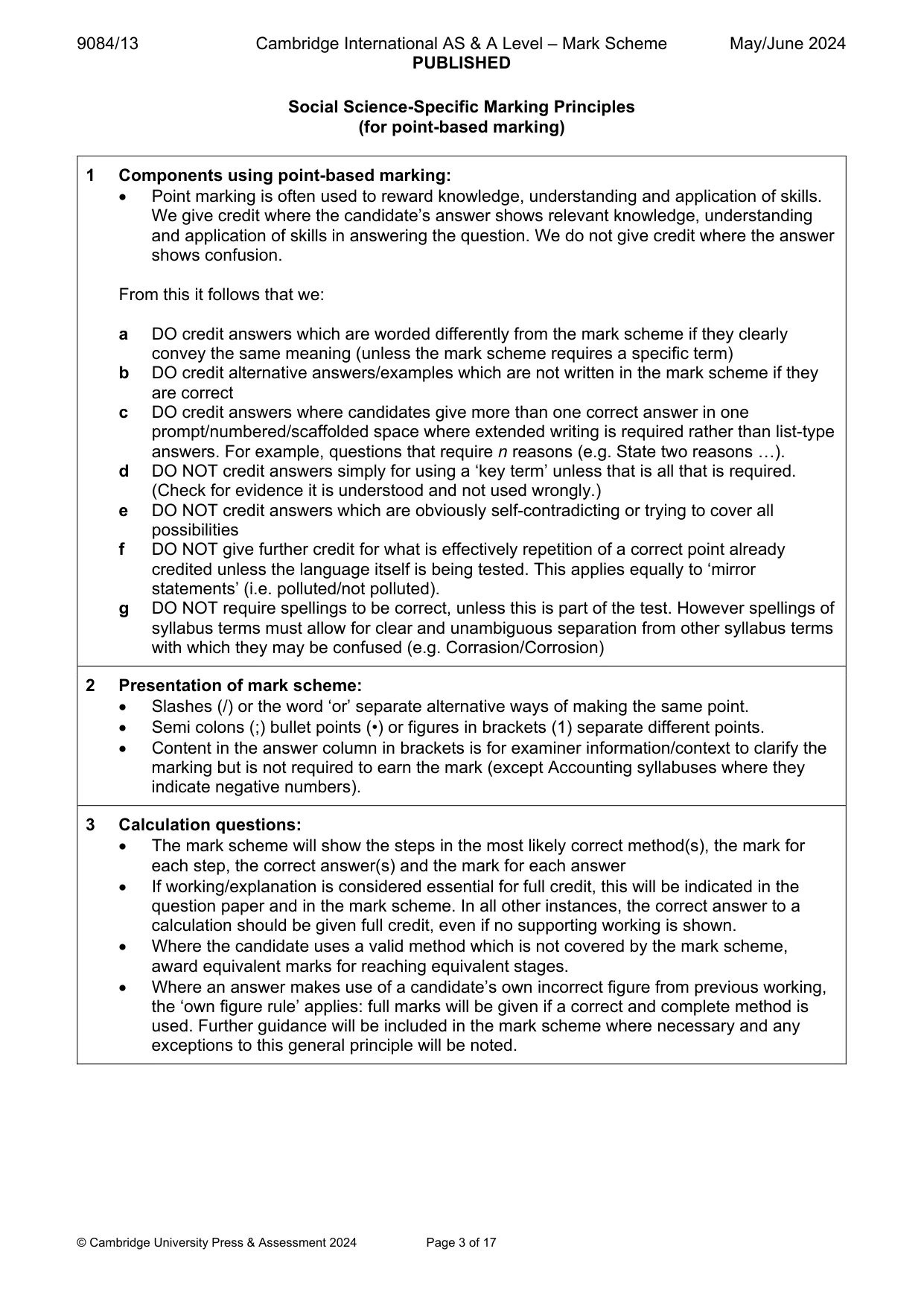
9084/13 Cambridge International AS & A Level – Mark Scheme PUBLISHED May/June 2024 © Cambridge University Press & Assessment 2024 Page 3 of 17 Social Science-Specific Marking Principles (for point-based marking) 1 Components using point-based marking: Point marking is often used to reward knowledge, understanding and application of skills. We give credit where the candidate’s answer shows relevant knowledge, understanding and application of skills in answering the question. We do not give credit where the answer shows confusion. From this it follows that we: a DO credit answers which are worded differently from the mark scheme if they clearly convey the same meaning (unless the mark scheme requires a specific term) b DO credit alternative answers/examples which are not written in the mark scheme if they are correct c DO credit answers where candidates give more than one correct answer in one prompt/numbered/scaffolded space where extended writing is required rather than list-type answers. For example, questions that require n reasons (e.g. State two reasons …). d DO NOT credit answers simply for using a ‘key term’ unless that is all that is required. (Check for evidence it is understood and not used wrongly.) e DO NOT credit answers which are obviously self-contradicting or trying to cover all possibilities f DO NOT give further credit for what is effectively repetition of a correct point already credited unless the language itself is being tested. This applies equally to ‘mirror statements’ (i.e. polluted/not polluted). g DO NOT require spellings to be correct, unless this is part of the test. However spellings of syllabus terms must allow for clear and unambiguous separation from other syllabus terms with which they may be confused (e.g. Corrasion/Corrosion) 2 Presentation of mark scheme: Slashes (/) or the word ‘or’ separate alternative ways of making the same point. Semi colons (;) bullet points (•) or figures in brackets (1) separate different points. Content in the answer column in brackets is for examiner information/context to clarify the marking but is not required to earn the mark (except Accounting syllabuses where they indicate negative numbers). 3 Calculation questions: The mark scheme will show the steps in the most likely correct method(s), the mark for each step, the correct answer(s) and the mark for each answer If working/explanation is considered essential for full credit, this will be indicated in the question paper and in the mark scheme. In all other instances, the correct answer to a calculation should be given full credit, even if no supporting working is shown. Where the candidate uses a valid method which is not covered by the mark scheme, award equivalent marks for reaching equivalent stages. Where an answer makes use of a candidate’s own incorrect figure from previous working, the ‘own figure rule’ applies: full marks will be given if a correct and complete method is used. Further guidance will be included in the mark scheme where necessary and any exceptions to this general principle will be noted.
Mark scheme, page 4
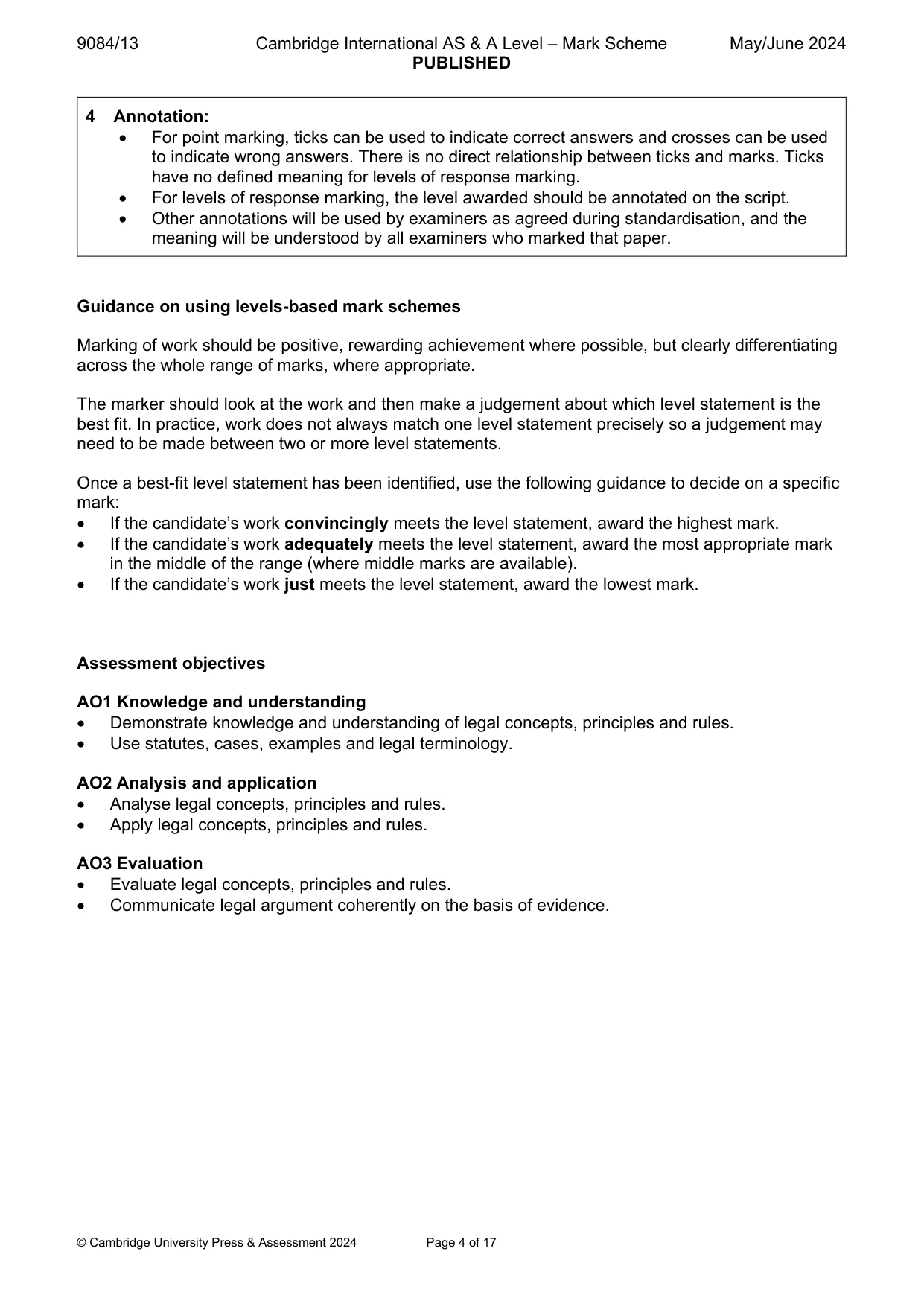
9084/13 Cambridge International AS & A Level – Mark Scheme PUBLISHED May/June 2024 © Cambridge University Press & Assessment 2024 Page 4 of 17 4 Annotation: For point marking, ticks can be used to indicate correct answers and crosses can be used to indicate wrong answers. There is no direct relationship between ticks and marks. Ticks have no defined meaning for levels of response marking. For levels of response marking, the level awarded should be annotated on the script. Other annotations will be used by examiners as agreed during standardisation, and the meaning will be understood by all examiners who marked that paper. Guidance on using levels-based mark schemes Marking of work should be positive, rewarding achievement where possible, but clearly differentiating across the whole range of marks, where appropriate. The marker should look at the work and then make a judgement about which level statement is the best fit. In practice, work does not always match one level statement precisely so a judgement may need to be made between two or more level statements. Once a best-fit level statement has been identified, use the following guidance to decide on a specific mark: If the candidate’s work convincingly meets the level statement, award the highest mark. If the candidate’s work adequately meets the level statement, award the most appropriate mark in the middle of the range (where middle marks are available). If the candidate’s work just meets the level statement, award the lowest mark. Assessment objectives AO1 Knowledge and understanding Demonstrate knowledge and understanding of legal concepts, principles and rules. Use statutes, cases, examples and legal terminology. AO2 Analysis and application Analyse legal concepts, principles and rules. Apply legal concepts, principles and rules. AO3 Evaluation Evaluate legal concepts, principles and rules. Communicate legal argument coherently on the basis of evidence.
Mark scheme, page 5
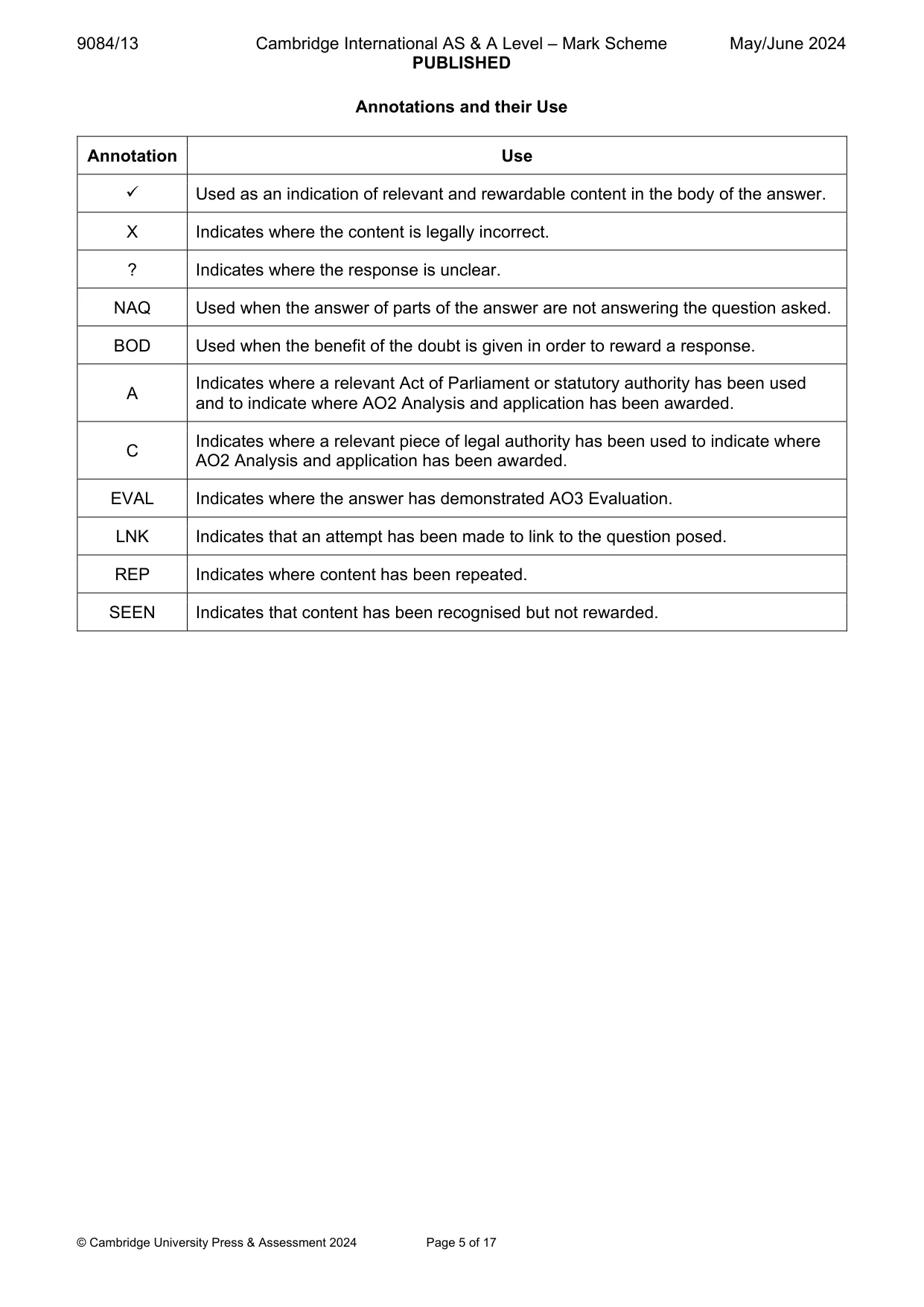
9084/13 Cambridge International AS & A Level – Mark Scheme PUBLISHED May/June 2024 © Cambridge University Press & Assessment 2024 Page 5 of 17 Annotations and their Use Annotation Use Used as an indication of relevant and rewardable content in the body of the answer. X Indicates where the content is legally incorrect. ? Indicates where the response is unclear. NAQ Used when the answer of parts of the answer are not answering the question asked. BOD Used when the benefit of the doubt is given in order to reward a response. A Indicates where a relevant Act of Parliament or statutory authority has been used and to indicate where AO2 Analysis and application has been awarded. C Indicates where a relevant piece of legal authority has been used to indicate where AO2 Analysis and application has been awarded. EVAL Indicates where the answer has demonstrated AO3 Evaluation. LNK Indicates that an attempt has been made to link to the question posed. REP Indicates where content has been repeated. SEEN Indicates that content has been recognised but not rewarded.
Mark scheme, page 6
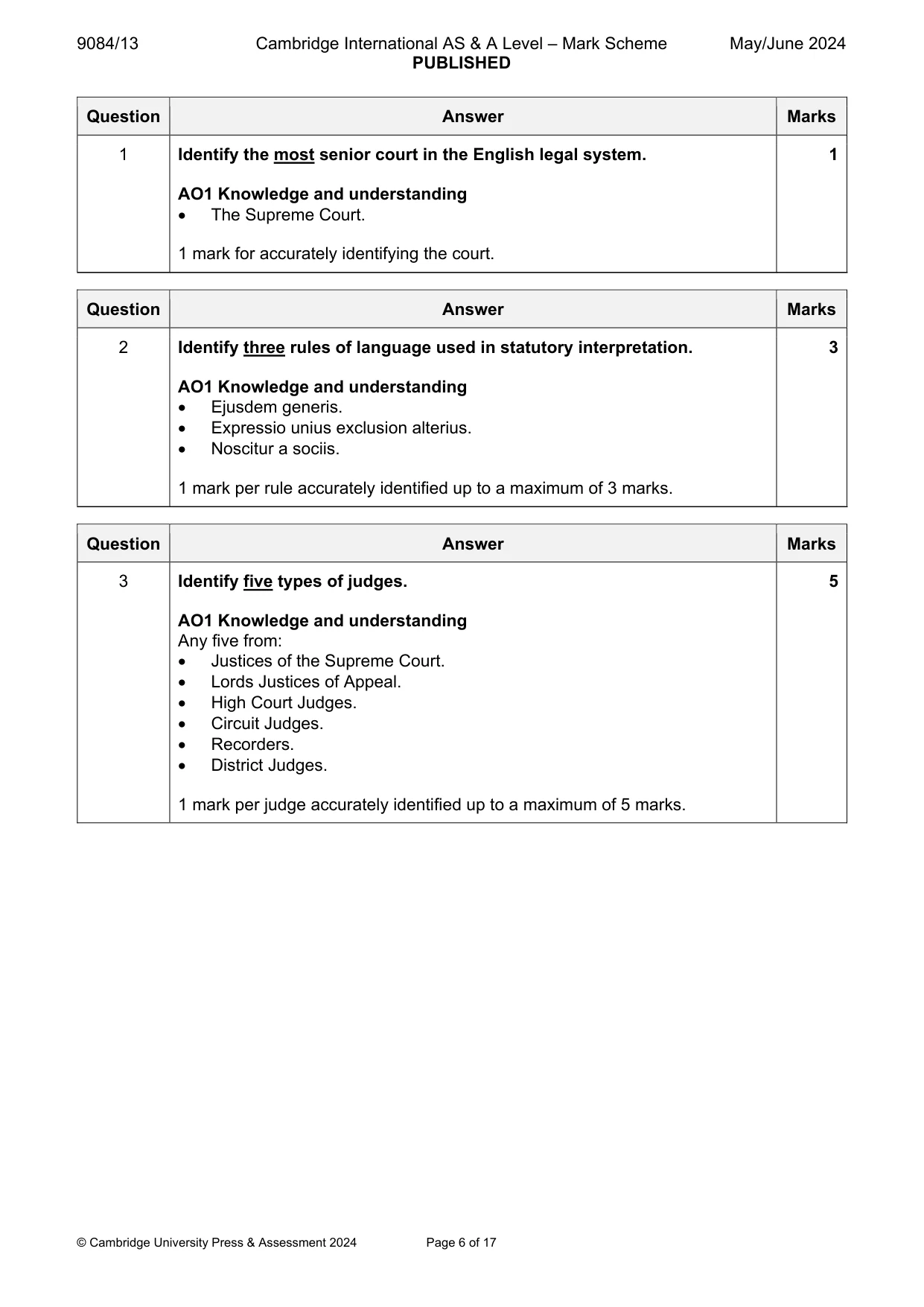
9084/13 Cambridge International AS & A Level – Mark Scheme PUBLISHED May/June 2024 © Cambridge University Press & Assessment 2024 Page 6 of 17 Question Answer Marks 1 Identify the most senior court in the English legal system. AO1 Knowledge and understanding The Supreme Court. 1 mark for accurately identifying the court. 1 Question Answer Marks 2 Identify three rules of language used in statutory interpretation. AO1 Knowledge and understanding Ejusdem generis. Expressio unius exclusion alterius. Noscitur a sociis. 1 mark per rule accurately identified up to a maximum of 3 marks. 3 Question Answer Marks 3 Identify five types of judges. AO1 Knowledge and understanding Any five from: Justices of the Supreme Court. Lords Justices of Appeal. High Court Judges. Circuit Judges. Recorders. District Judges. 1 mark per judge accurately identified up to a maximum of 5 marks. 5
Mark scheme, page 7
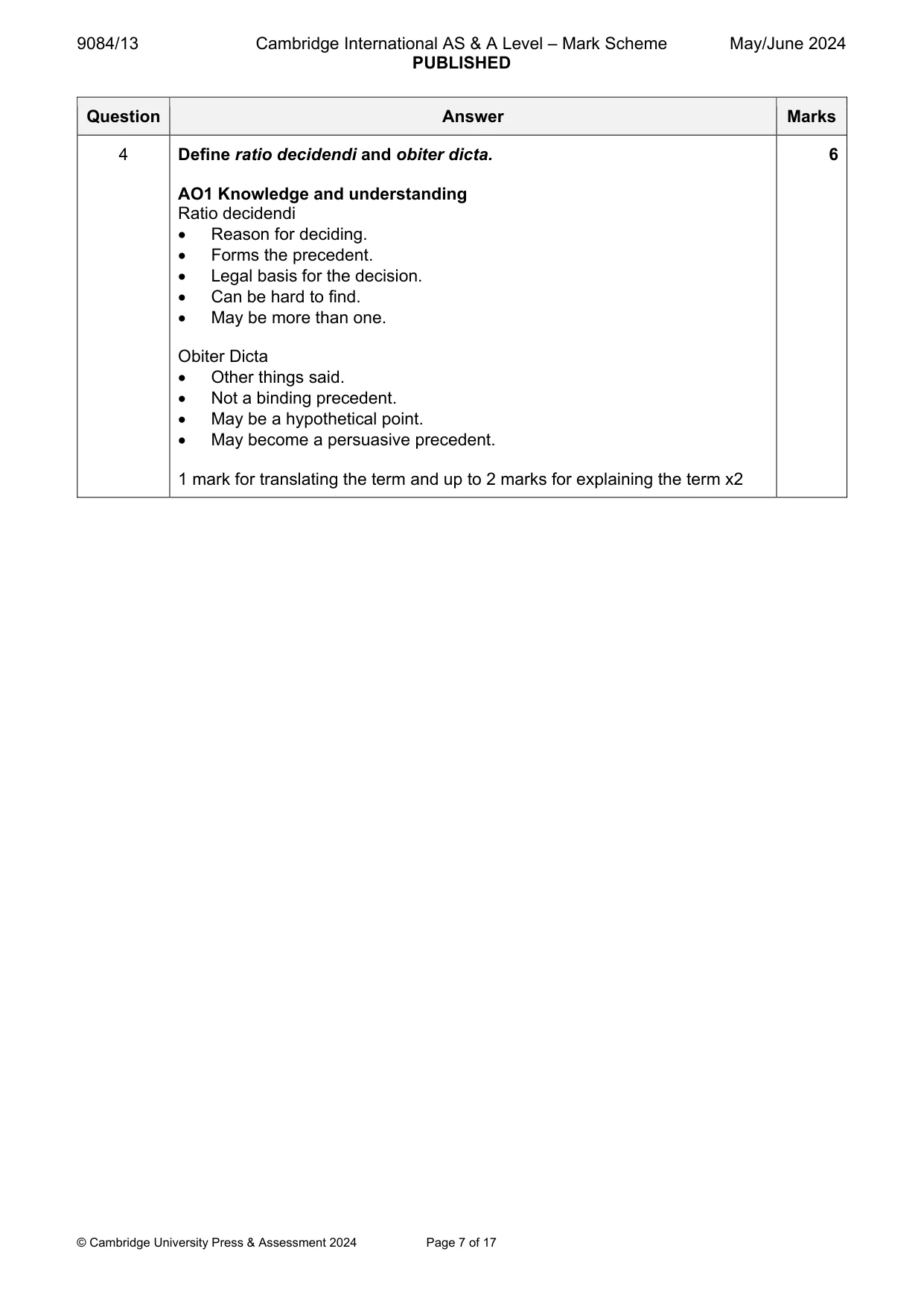
9084/13 Cambridge International AS & A Level – Mark Scheme PUBLISHED May/June 2024 © Cambridge University Press & Assessment 2024 Page 7 of 17 Question Answer Marks 4 Define ratio decidendi and obiter dicta. AO1 Knowledge and understanding Ratio decidendi Reason for deciding. Forms the precedent. Legal basis for the decision. Can be hard to find. May be more than one. Obiter Dicta Other things said. Not a binding precedent. May be a hypothetical point. May become a persuasive precedent. 1 mark for translating the term and up to 2 marks for explaining the term x2 6
Mark scheme, page 8
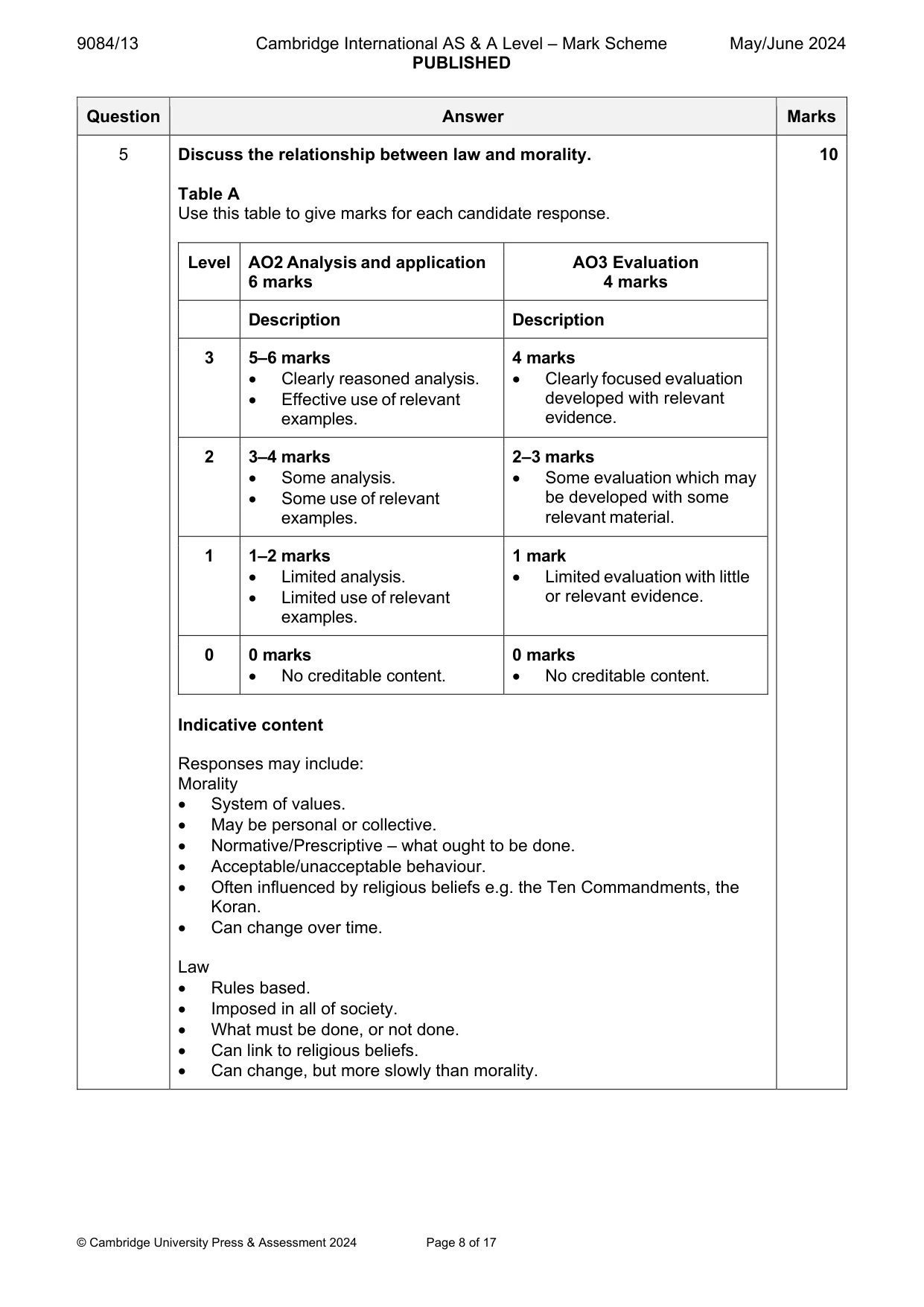
9084/13 Cambridge International AS & A Level – Mark Scheme PUBLISHED May/June 2024 © Cambridge University Press & Assessment 2024 Page 8 of 17 Question Answer Marks 5 Discuss the relationship between law and morality. Table A Use this table to give marks for each candidate response. Level AO2 Analysis and application 6 marks AO3 Evaluation 4 marks Description Description 3 5–6 marks Clearly reasoned analysis. Effective use of relevant examples. 4 marks Clearly focused evaluation developed with relevant evidence. 2 3–4 marks Some analysis. Some use of relevant examples. 2–3 marks Some evaluation which may be developed with some relevant material. 1 1–2 marks Limited analysis. Limited use of relevant examples. 1 mark Limited evaluation with little or relevant evidence. 0 0 marks No creditable content. 0 marks No creditable content. Indicative content Responses may include: Morality System of values. May be personal or collective. Normative/Prescriptive – what ought to be done. Acceptable/unacceptable behaviour. Often influenced by religious beliefs e.g. the Ten Commandments, the Koran. Can change over time. Law Rules based. Imposed in all of society. What must be done, or not done. Can link to religious beliefs. Can change, but more slowly than morality. 10
Mark scheme, page 9
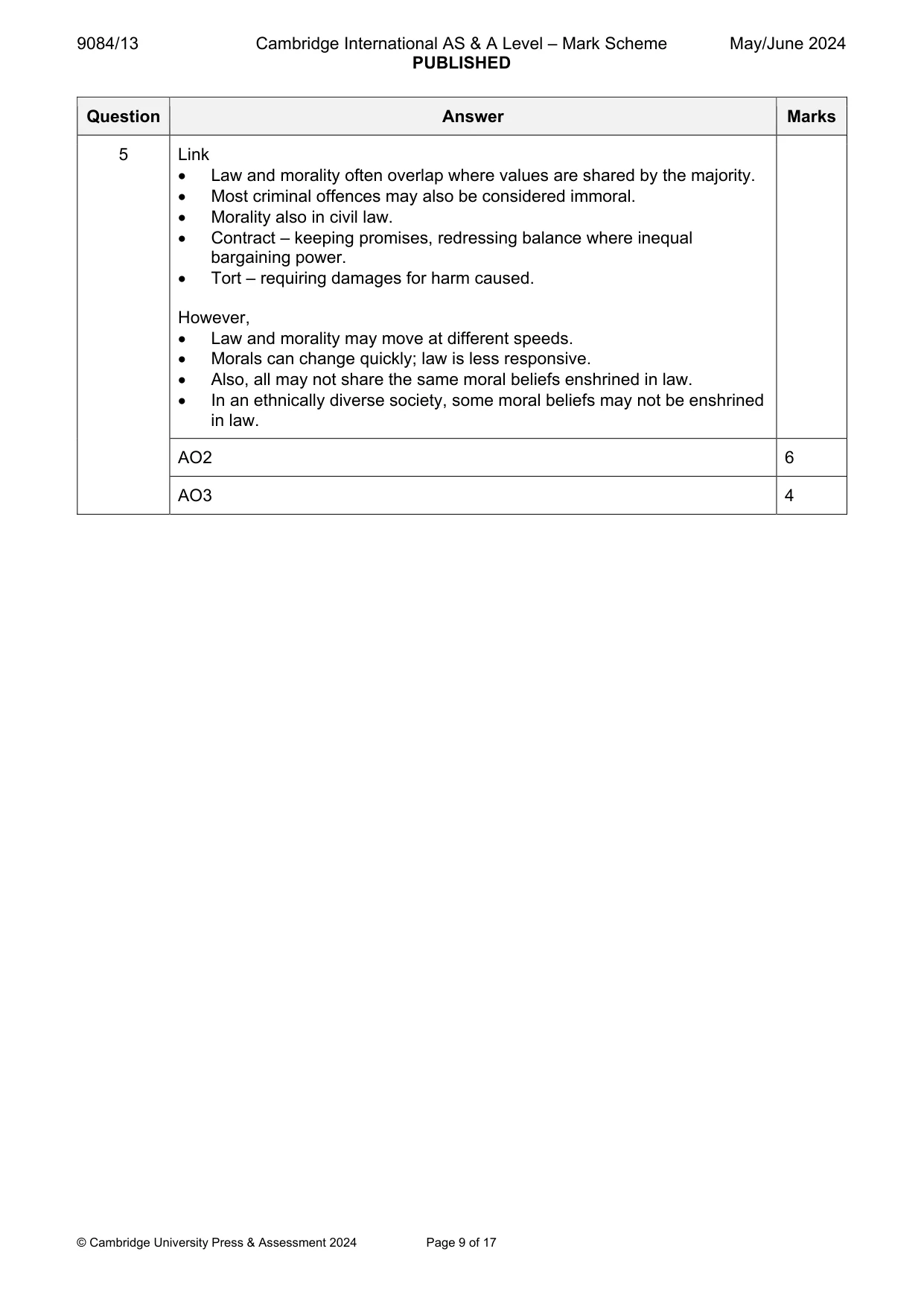
9084/13 Cambridge International AS & A Level – Mark Scheme PUBLISHED May/June 2024 © Cambridge University Press & Assessment 2024 Page 9 of 17 Question Answer Marks 5 Link Law and morality often overlap where values are shared by the majority. Most criminal offences may also be considered immoral. Morality also in civil law. Contract – keeping promises, redressing balance where inequal bargaining power. Tort – requiring damages for harm caused. However, Law and morality may move at different speeds. Morals can change quickly; law is less responsive. Also, all may not share the same moral beliefs enshrined in law. In an ethnically diverse society, some moral beliefs may not be enshrined in law. AO2 6 AO3 4
Mark scheme, page 10
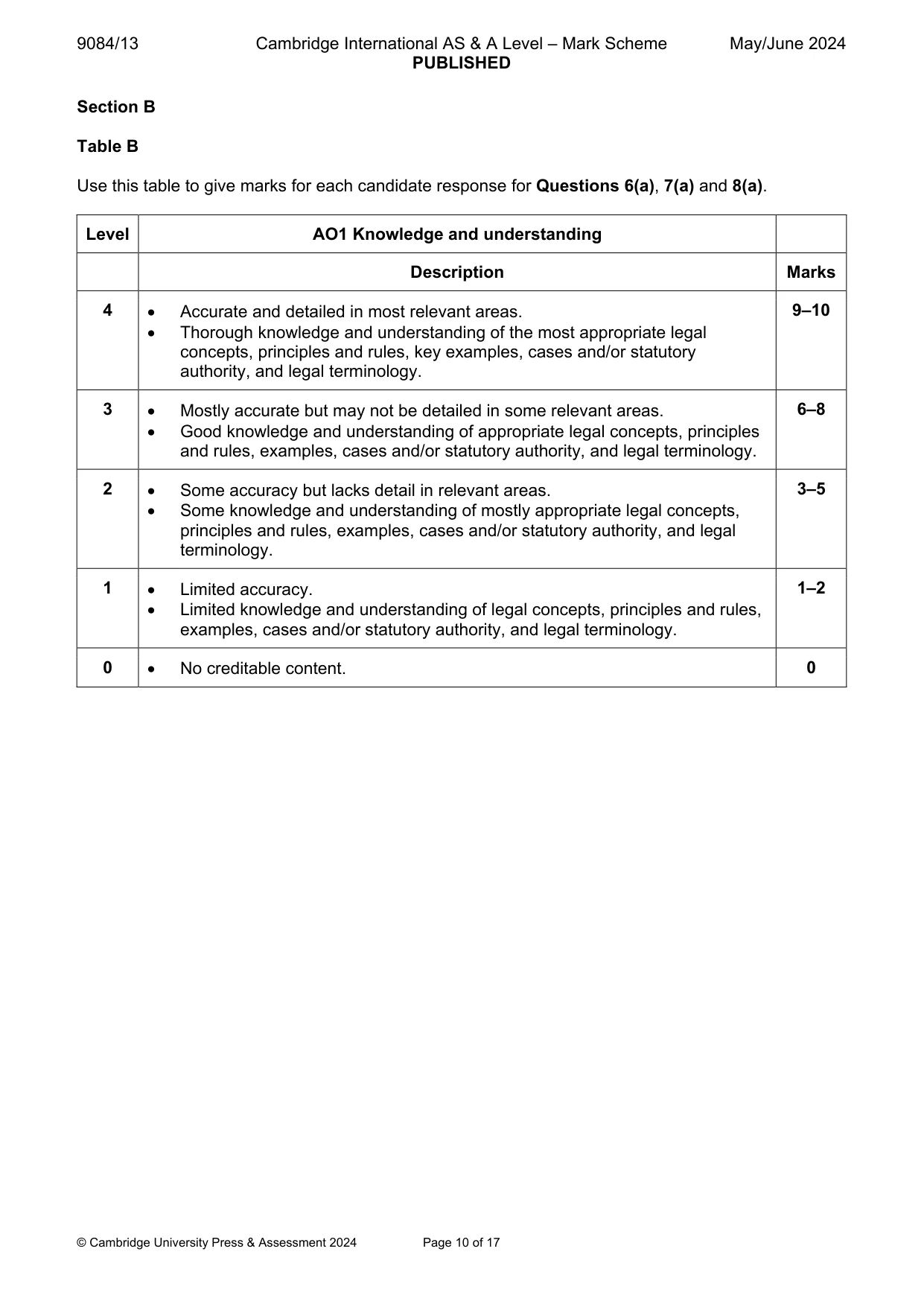
9084/13 Cambridge International AS & A Level – Mark Scheme PUBLISHED May/June 2024 © Cambridge University Press & Assessment 2024 Page 10 of 17 Section B Table B Use this table to give marks for each candidate response for Questions 6(a), 7(a) and 8(a). Level AO1 Knowledge and understanding Description Marks 4 Accurate and detailed in most relevant areas. Thorough knowledge and understanding of the most appropriate legal concepts, principles and rules, key examples, cases and/or statutory authority, and legal terminology. 9–10 3 Mostly accurate but may not be detailed in some relevant areas. Good knowledge and understanding of appropriate legal concepts, principles and rules, examples, cases and/or statutory authority, and legal terminology. 6–8 2 Some accuracy but lacks detail in relevant areas. Some knowledge and understanding of mostly appropriate legal concepts, principles and rules, examples, cases and/or statutory authority, and legal terminology. 3–5 1 Limited accuracy. Limited knowledge and understanding of legal concepts, principles and rules, examples, cases and/or statutory authority, and legal terminology. 1–2 0 No creditable content. 0
Mark scheme, page 11
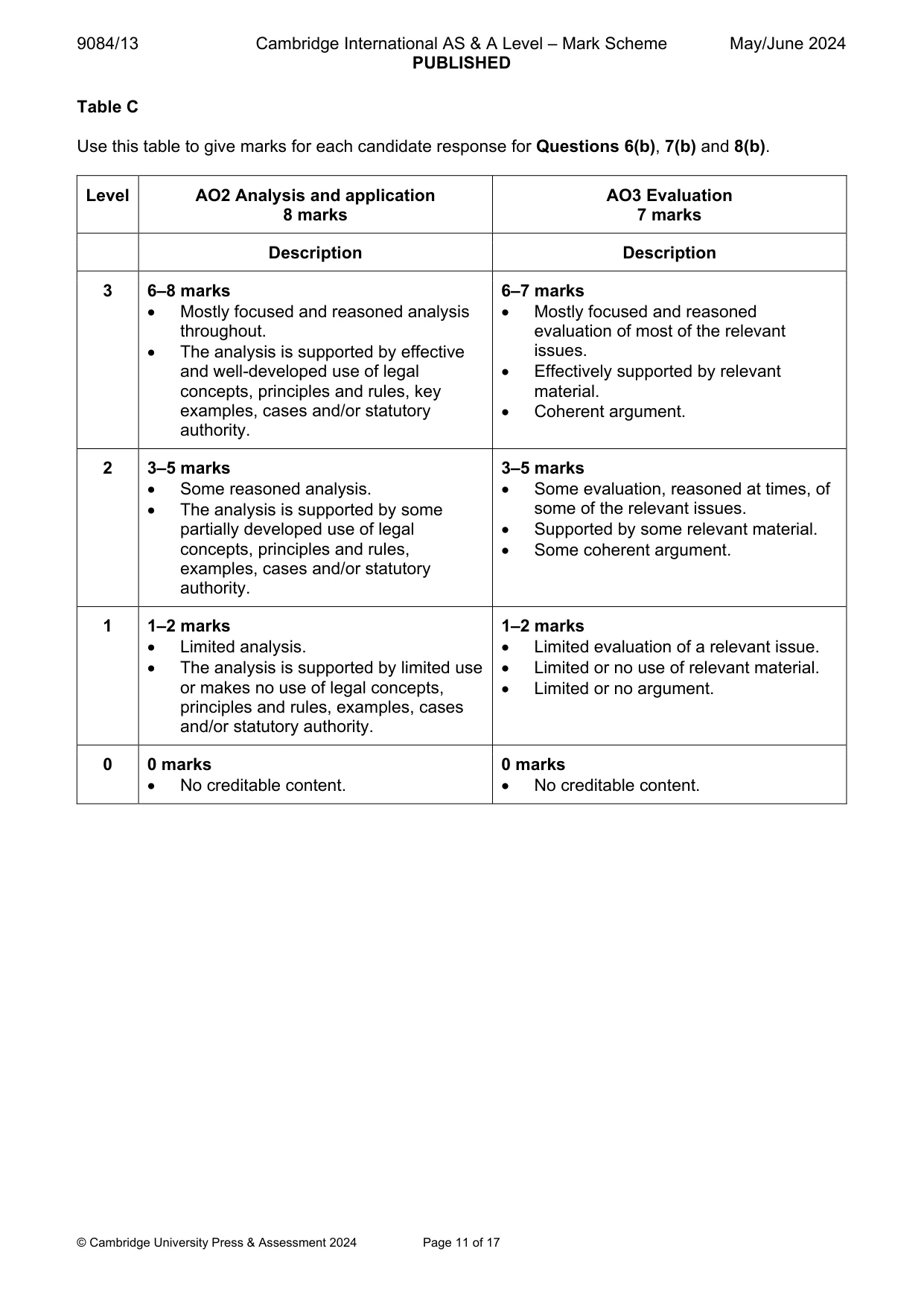
9084/13 Cambridge International AS & A Level – Mark Scheme PUBLISHED May/June 2024 © Cambridge University Press & Assessment 2024 Page 11 of 17 Table C Use this table to give marks for each candidate response for Questions 6(b), 7(b) and 8(b). Level AO2 Analysis and application 8 marks AO3 Evaluation 7 marks Description Description 3 6–8 marks Mostly focused and reasoned analysis throughout. The analysis is supported by effective and well-developed use of legal concepts, principles and rules, key examples, cases and/or statutory authority. 6–7 marks Mostly focused and reasoned evaluation of most of the relevant issues. Effectively supported by relevant material. Coherent argument. 2 3–5 marks Some reasoned analysis. The analysis is supported by some partially developed use of legal concepts, principles and rules, examples, cases and/or statutory authority. 3–5 marks Some evaluation, reasoned at times, of some of the relevant issues. Supported by some relevant material. Some coherent argument. 1 1–2 marks Limited analysis. The analysis is supported by limited use or makes no use of legal concepts, principles and rules, examples, cases and/or statutory authority. 1–2 marks Limited evaluation of a relevant issue. Limited or no use of relevant material. Limited or no argument. 0 0 marks No creditable content. 0 marks No creditable content.
Mark scheme, page 12
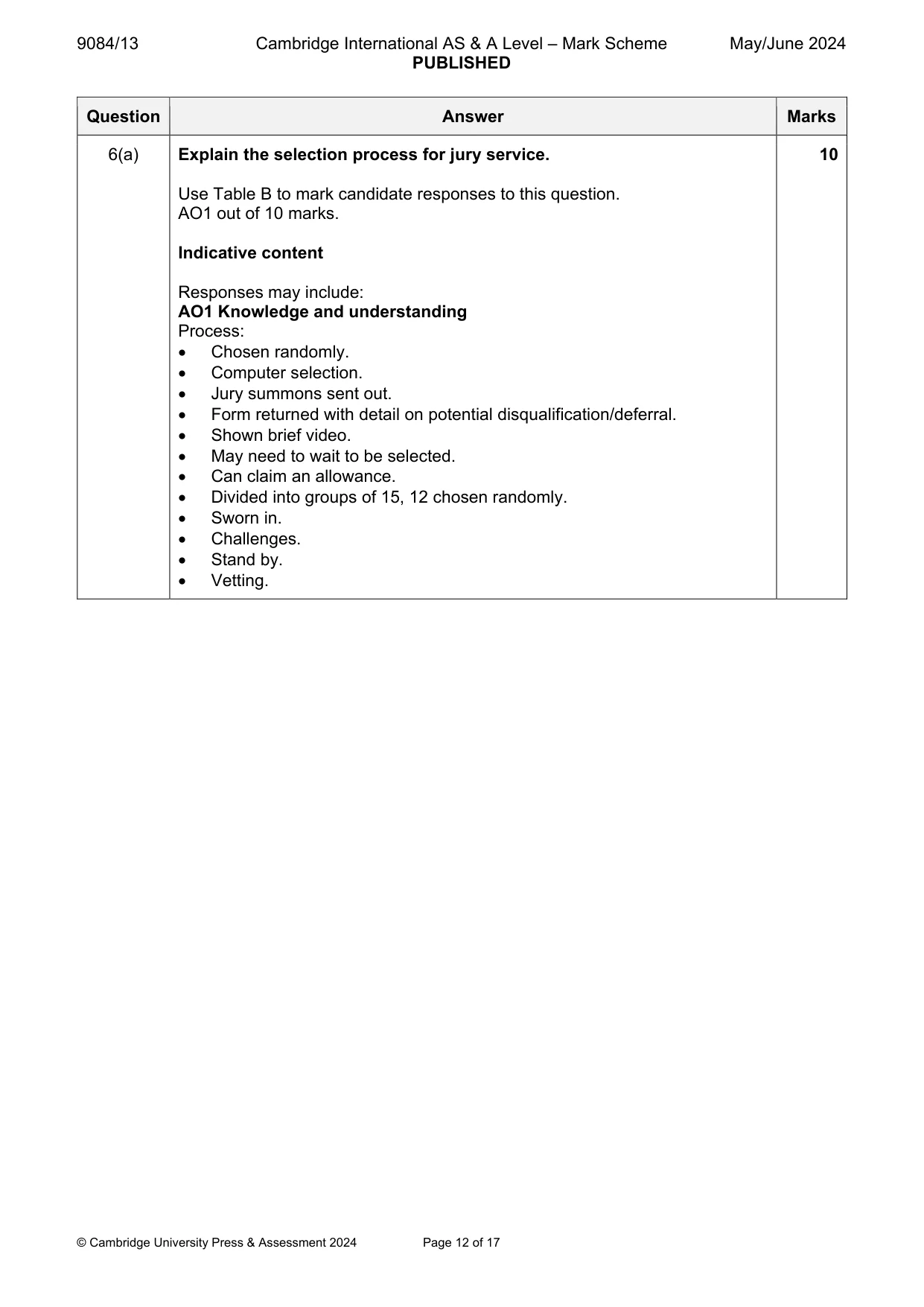
9084/13 Cambridge International AS & A Level – Mark Scheme PUBLISHED May/June 2024 © Cambridge University Press & Assessment 2024 Page 12 of 17 Question Answer Marks 6(a) Explain the selection process for jury service. Use Table B to mark candidate responses to this question. AO1 out of 10 marks. Indicative content Responses may include: AO1 Knowledge and understanding Process: Chosen randomly. Computer selection. Jury summons sent out. Form returned with detail on potential disqualification/deferral. Shown brief video. May need to wait to be selected. Can claim an allowance. Divided into groups of 15, 12 chosen randomly. Sworn in. Challenges. Stand by. Vetting. 10
Mark scheme, page 13
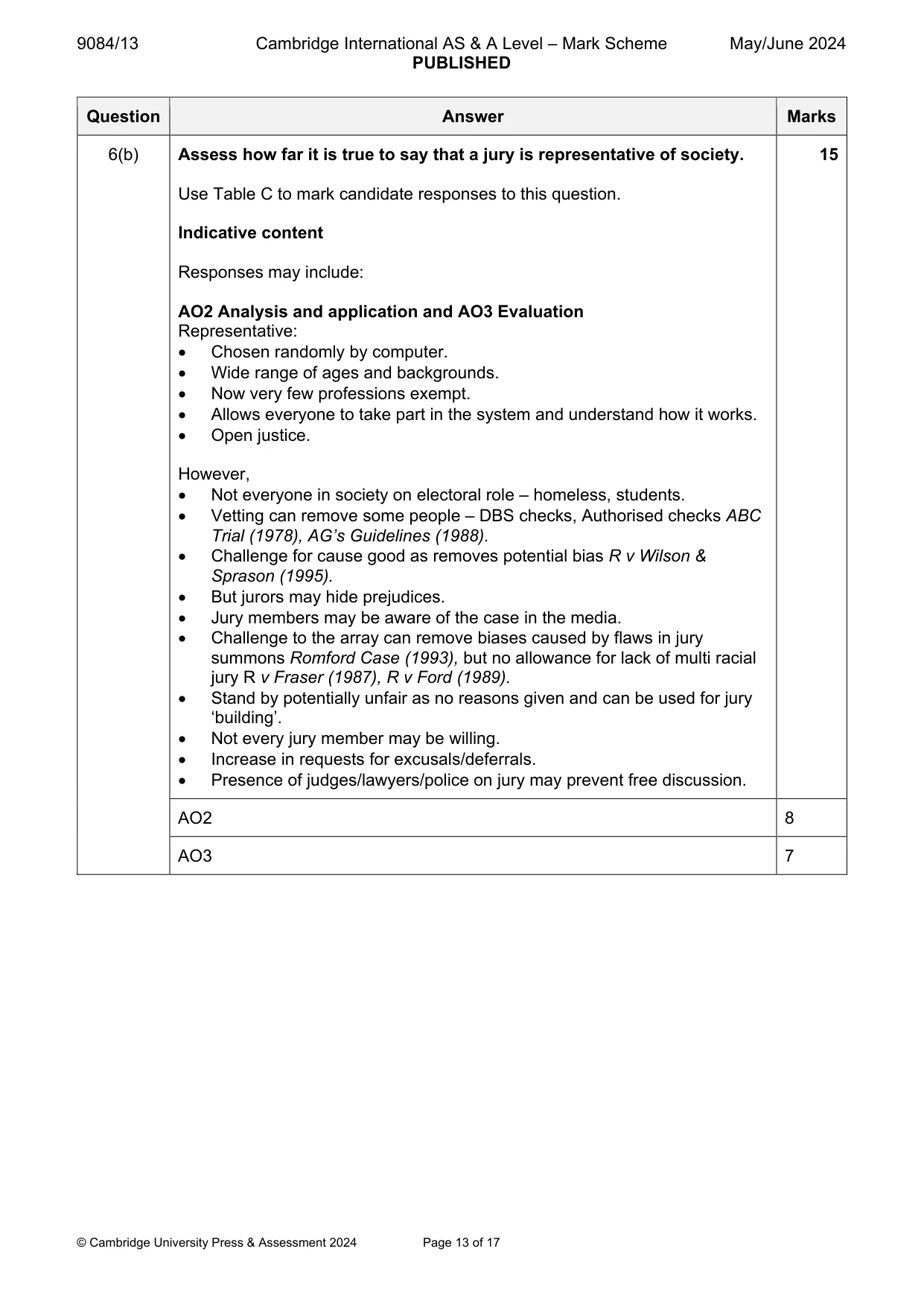
9084/13 Cambridge International AS & A Level – Mark Scheme PUBLISHED May/June 2024 © Cambridge University Press & Assessment 2024 Page 13 of 17 Question Answer Marks 6(b) Assess how far it is true to say that a jury is representative of society. Use Table C to mark candidate responses to this question. Indicative content Responses may include: AO2 Analysis and application and AO3 Evaluation Representative: Chosen randomly by computer. Wide range of ages and backgrounds. Now very few professions exempt. Allows everyone to take part in the system and understand how it works. Open justice. However, Not everyone in society on electoral role – homeless, students. Vetting can remove some people – DBS checks, Authorised checks ABC Trial (1978), AG’s Guidelines (1988). Challenge for cause good as removes potential bias R v Wilson & Sprason (1995). But jurors may hide prejudices. Jury members may be aware of the case in the media. Challenge to the array can remove biases caused by flaws in jury summons Romford Case (1993), but no allowance for lack of multi racial jury R v Fraser (1987), R v Ford (1989). Stand by potentially unfair as no reasons given and can be used for jury ‘building’. Not every jury member may be willing. Increase in requests for excusals/deferrals. Presence of judges/lawyers/police on jury may prevent free discussion. 15 AO2 8 AO3 7
Mark scheme, page 14
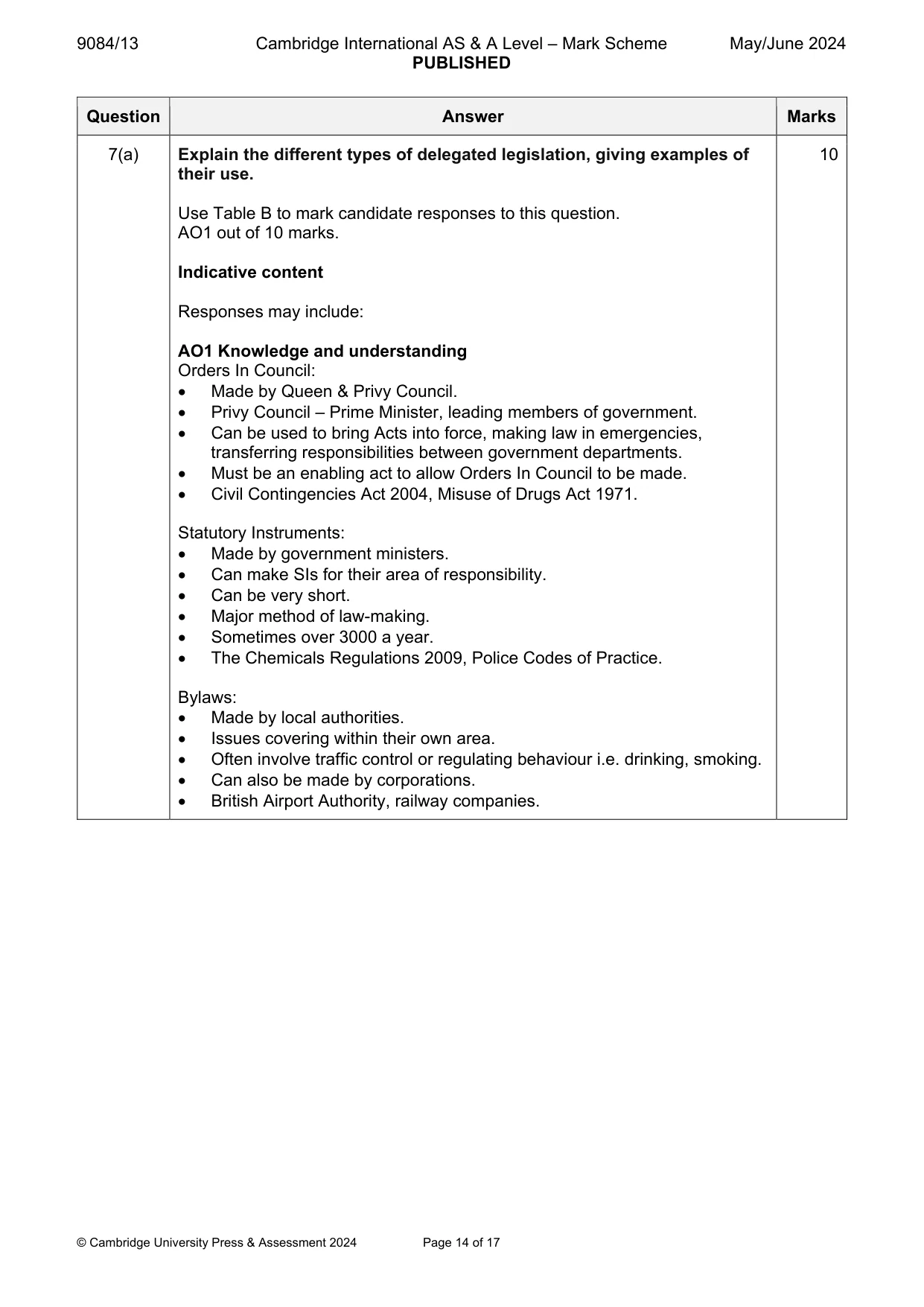
9084/13 Cambridge International AS & A Level – Mark Scheme PUBLISHED May/June 2024 © Cambridge University Press & Assessment 2024 Page 14 of 17 Question Answer Marks 7(a) Explain the different types of delegated legislation, giving examples of their use. Use Table B to mark candidate responses to this question. AO1 out of 10 marks. Indicative content Responses may include: AO1 Knowledge and understanding Orders In Council: Made by Queen & Privy Council. Privy Council – Prime Minister, leading members of government. Can be used to bring Acts into force, making law in emergencies, transferring responsibilities between government departments. Must be an enabling act to allow Orders In Council to be made. Civil Contingencies Act 2004, Misuse of Drugs Act 1971. Statutory Instruments: Made by government ministers. Can make SIs for their area of responsibility. Can be very short. Major method of law-making. Sometimes over 3000 a year. The Chemicals Regulations 2009, Police Codes of Practice. Bylaws: Made by local authorities. Issues covering within their own area. Often involve traffic control or regulating behaviour i.e. drinking, smoking. Can also be made by corporations. British Airport Authority, railway companies. 10
Mark scheme, page 15
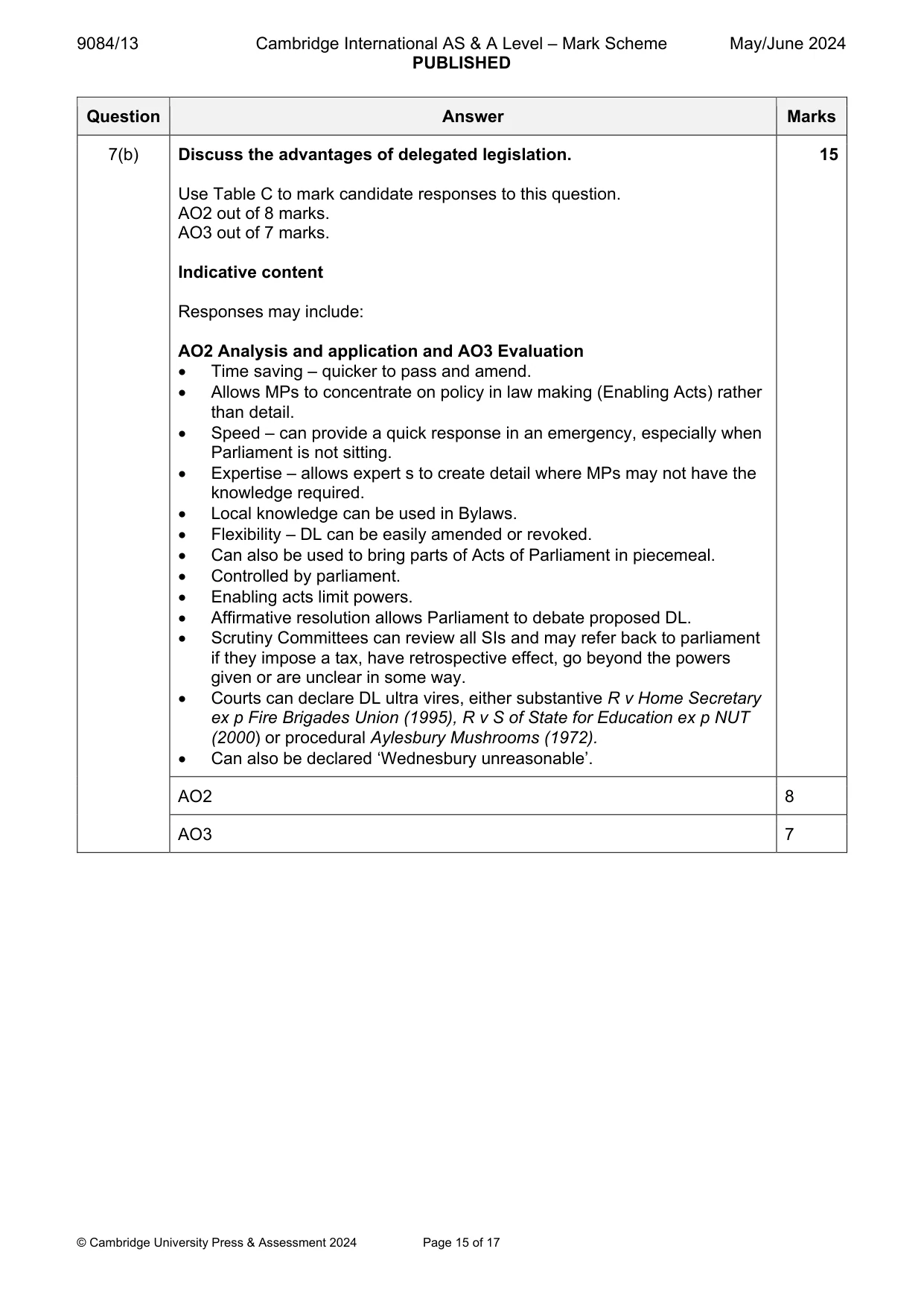
9084/13 Cambridge International AS & A Level – Mark Scheme PUBLISHED May/June 2024 © Cambridge University Press & Assessment 2024 Page 15 of 17 Question Answer Marks 7(b) Discuss the advantages of delegated legislation. Use Table C to mark candidate responses to this question. AO2 out of 8 marks. AO3 out of 7 marks. Indicative content Responses may include: AO2 Analysis and application and AO3 Evaluation Time saving – quicker to pass and amend. Allows MPs to concentrate on policy in law making (Enabling Acts) rather than detail. Speed – can provide a quick response in an emergency, especially when Parliament is not sitting. Expertise – allows expert s to create detail where MPs may not have the knowledge required. Local knowledge can be used in Bylaws. Flexibility – DL can be easily amended or revoked. Can also be used to bring parts of Acts of Parliament in piecemeal. Controlled by parliament. Enabling acts limit powers. Affirmative resolution allows Parliament to debate proposed DL. Scrutiny Committees can review all SIs and may refer back to parliament if they impose a tax, have retrospective effect, go beyond the powers given or are unclear in some way. Courts can declare DL ultra vires, either substantive R v Home Secretary ex p Fire Brigades Union (1995), R v S of State for Education ex p NUT (2000) or procedural Aylesbury Mushrooms (1972). Can also be declared ‘Wednesbury unreasonable’. 15 AO2 8 AO3 7
Mark scheme, page 16
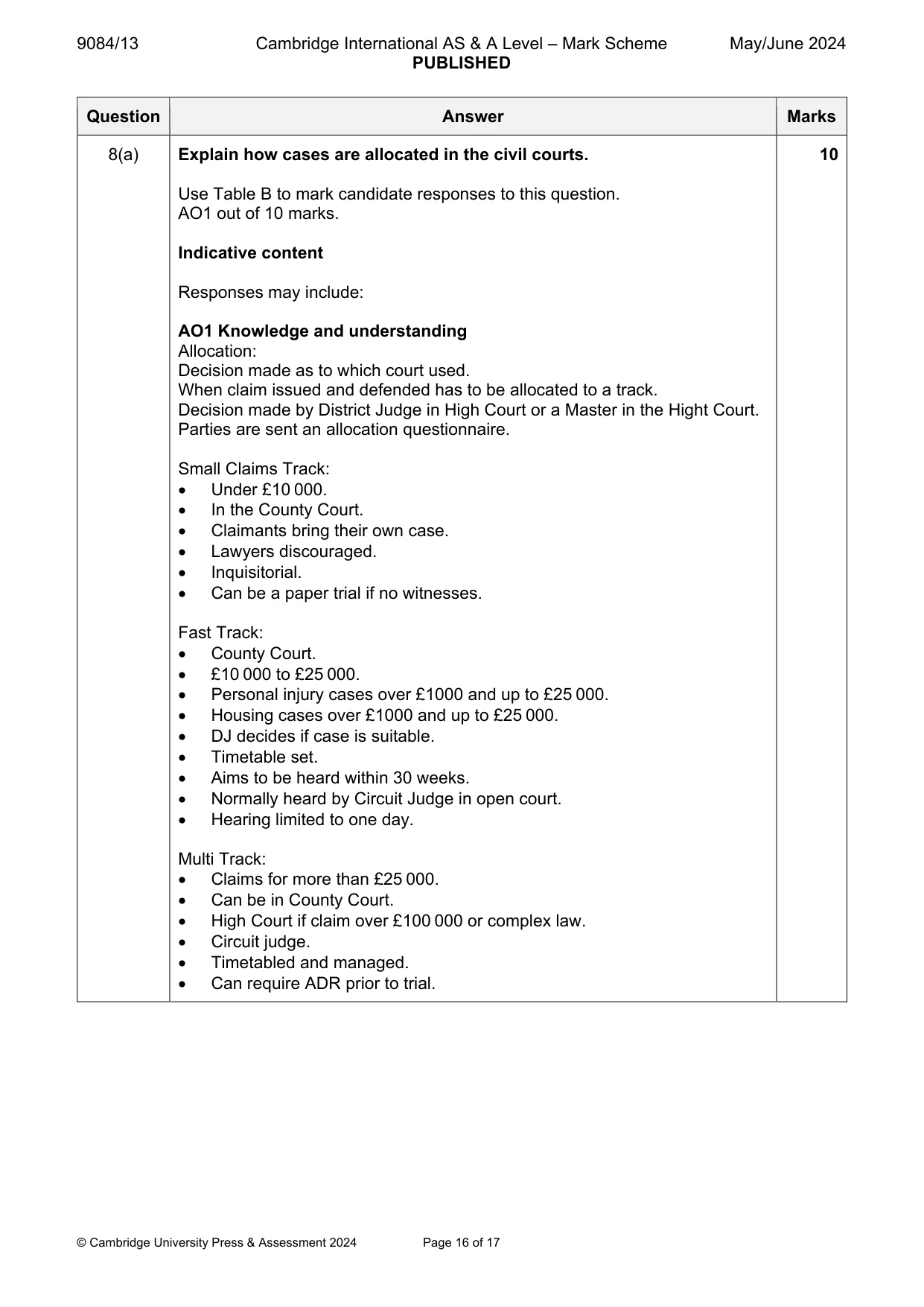
9084/13 Cambridge International AS & A Level – Mark Scheme PUBLISHED May/June 2024 © Cambridge University Press & Assessment 2024 Page 16 of 17 Question Answer Marks 8(a) Explain how cases are allocated in the civil courts. Use Table B to mark candidate responses to this question. AO1 out of 10 marks. Indicative content Responses may include: AO1 Knowledge and understanding Allocation: Decision made as to which court used. When claim issued and defended has to be allocated to a track. Decision made by District Judge in High Court or a Master in the Hight Court. Parties are sent an allocation questionnaire. Small Claims Track: Under £10 000. In the County Court. Claimants bring their own case. Lawyers discouraged. Inquisitorial. Can be a paper trial if no witnesses. Fast Track: County Court. £10 000 to £25 000. Personal injury cases over £1000 and up to £25 000. Housing cases over £1000 and up to £25 000. DJ decides if case is suitable. Timetable set. Aims to be heard within 30 weeks. Normally heard by Circuit Judge in open court. Hearing limited to one day. Multi Track: Claims for more than £25 000. Can be in County Court. High Court if claim over £100 000 or complex law. Circuit judge. Timetabled and managed. Can require ADR prior to trial. 10
Mark scheme, page 17
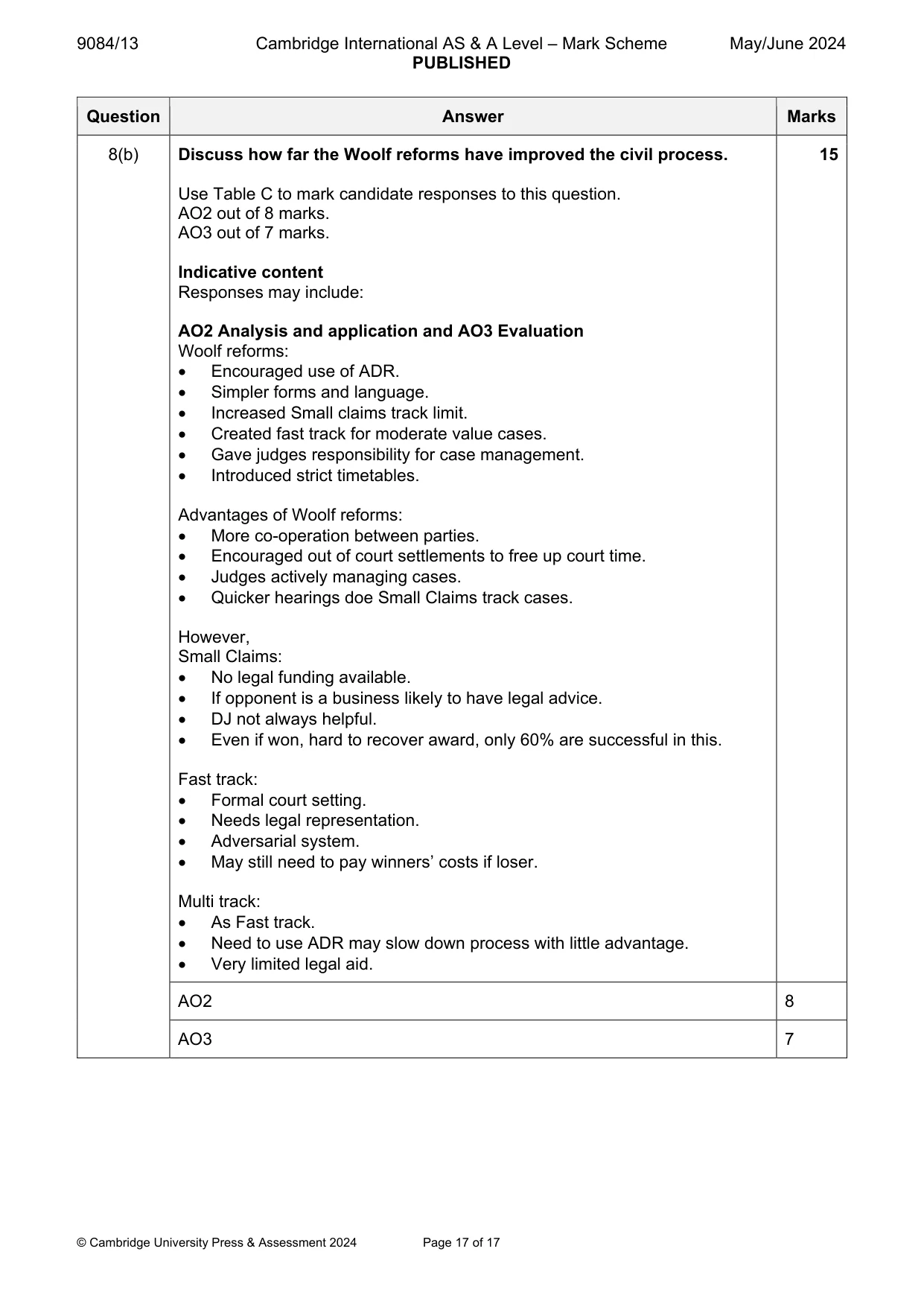
9084/13 Cambridge International AS & A Level – Mark Scheme PUBLISHED May/June 2024 © Cambridge University Press & Assessment 2024 Page 17 of 17 Question Answer Marks 8(b) Discuss how far the Woolf reforms have improved the civil process. Use Table C to mark candidate responses to this question. AO2 out of 8 marks. AO3 out of 7 marks. Indicative content Responses may include: AO2 Analysis and application and AO3 Evaluation Woolf reforms: Encouraged use of ADR. Simpler forms and language. Increased Small claims track limit. Created fast track for moderate value cases. Gave judges responsibility for case management. Introduced strict timetables. Advantages of Woolf reforms: More co-operation between parties. Encouraged out of court settlements to free up court time. Judges actively managing cases. Quicker hearings doe Small Claims track cases. However, Small Claims: No legal funding available. If opponent is a business likely to have legal advice. DJ not always helpful. Even if won, hard to recover award, only 60% are successful in this. Fast track: Formal court setting. Needs legal representation. Adversarial system. May still need to pay winners’ costs if loser. Multi track: As Fast track. Need to use ADR may slow down process with little advantage. Very limited legal aid. 15 AO2 8 AO3 7
What you needed in this session
Cambridge’s own grade thresholds for 2024 May/June, Paper 1 · Variant 3. A higher threshold means an easier paper — the bar moves with how the cohort did.