Cambridge A Level Law 9084 — 2011 May/June Paper 3 · Variant 3
9084/33/M/J/11 · 75 marks · ≈84 min
The question paper and its mark scheme, free to read here and free to download. This is Cambridge’s own paper, exactly as it was sat.
Question paper4 pages

Mark scheme7 pages
Answers below. Sit the paper first if you are practising.
Paper as text
Question paper, page 1
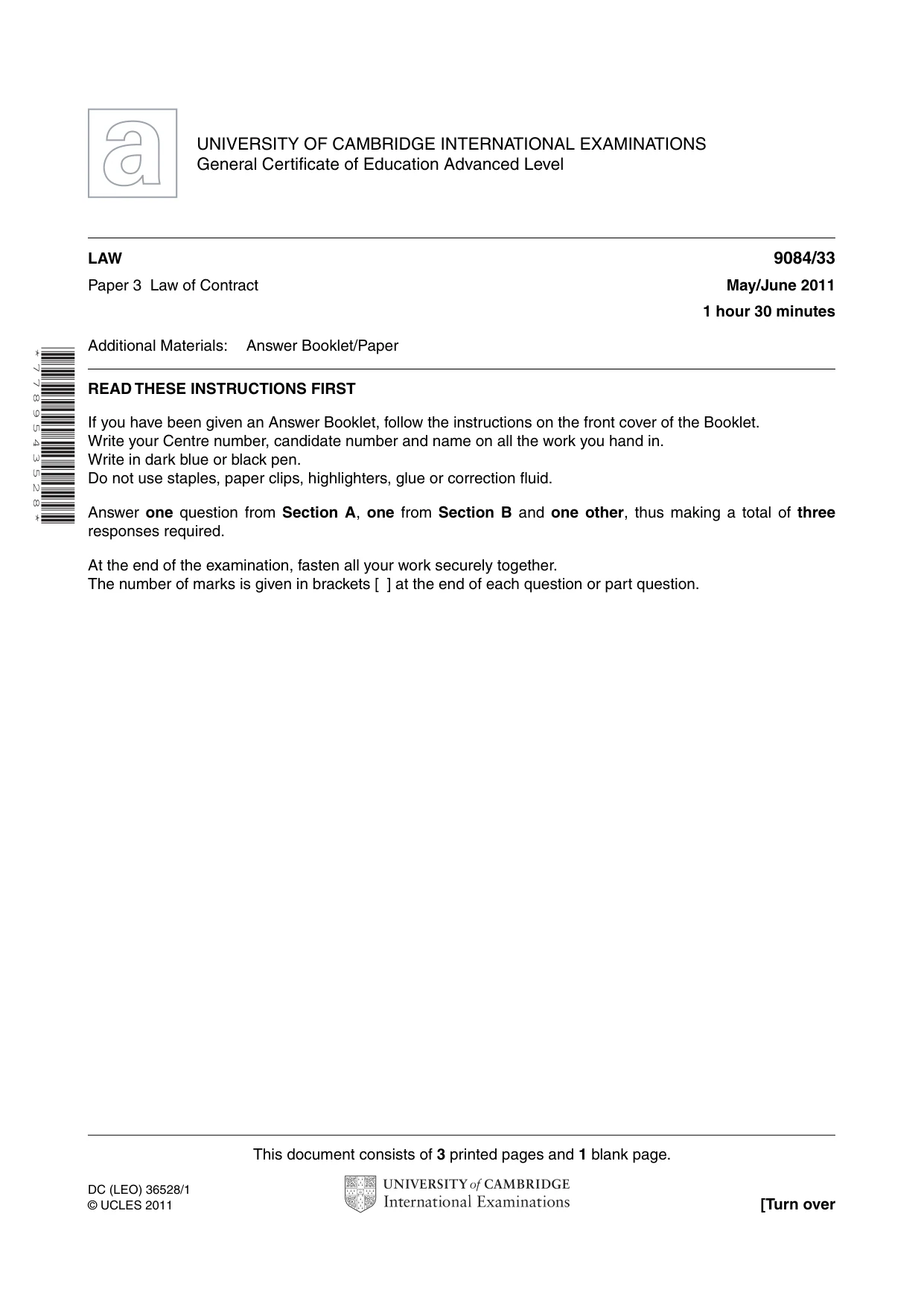
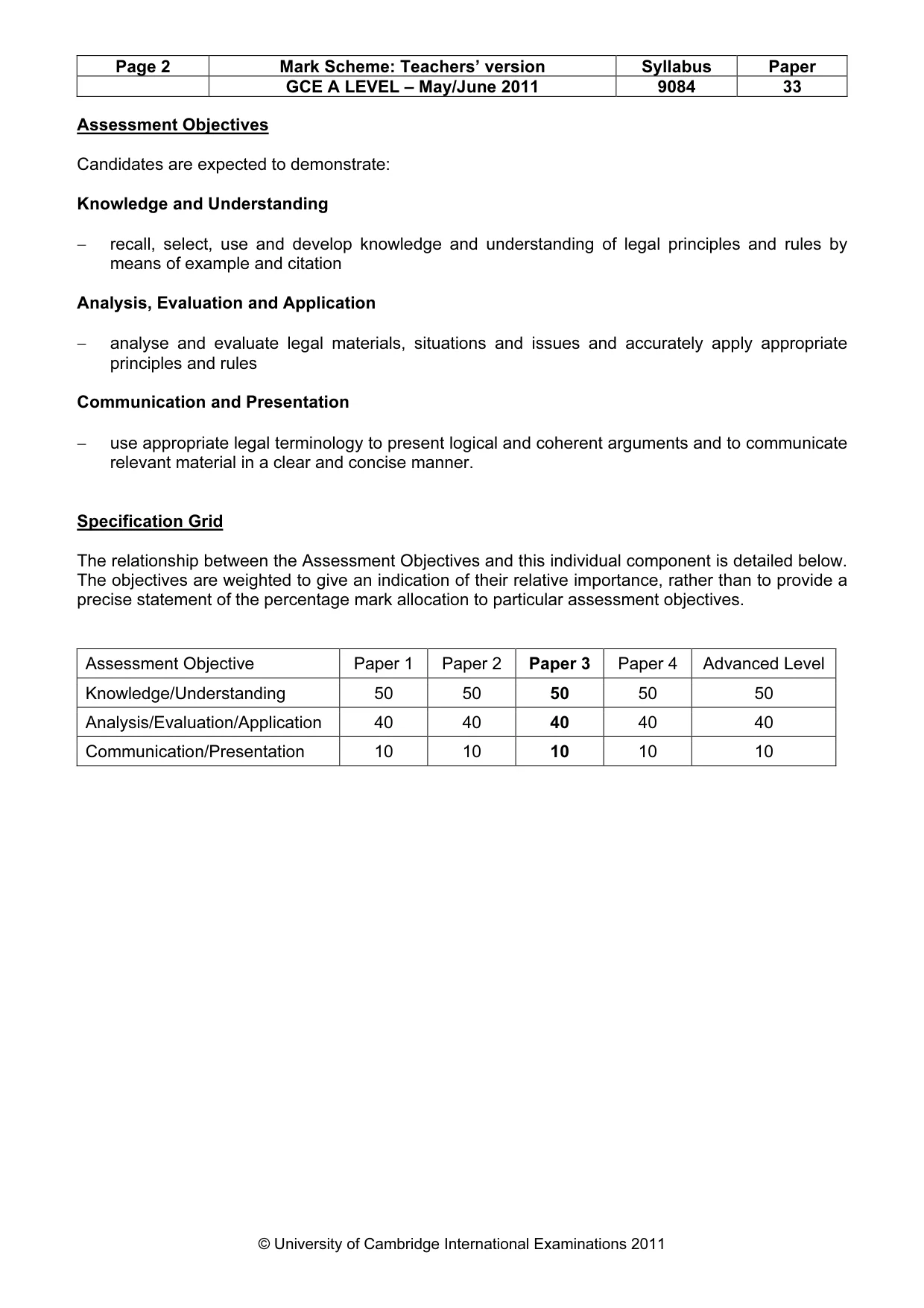
This document consists of 3 printed pages and 1 blank page. DC (LEO) 36528/1 © UCLES 2011 [Turn over UNIVERSITY OF CAMBRIDGE INTERNATIONAL EXAMINATIONS General Certificate of Education Advanced Level * 7 7 8 9 5 4 3 5 2 8 * LAW 9084/33 Paper 3 Law of Contract May/June 2011 1 hour 30 minutes Additional Materials: Answer Booklet/Paper READ THESE INSTRUCTIONS FIRST If you have been given an Answer Booklet, follow the instructions on the front cover of the Booklet. Write your Centre number, candidate number and name on all the work you hand in. Write in dark blue or black pen. Do not use staples, paper clips, highlighters, glue or correction fluid. Answer one question from Section A, one from Section B and one other, thus making a total of three responses required. At the end of the examination, fasten all your work securely together. The number of marks is given in brackets [ ] at the end of each question or part question.
Question paper, page 2
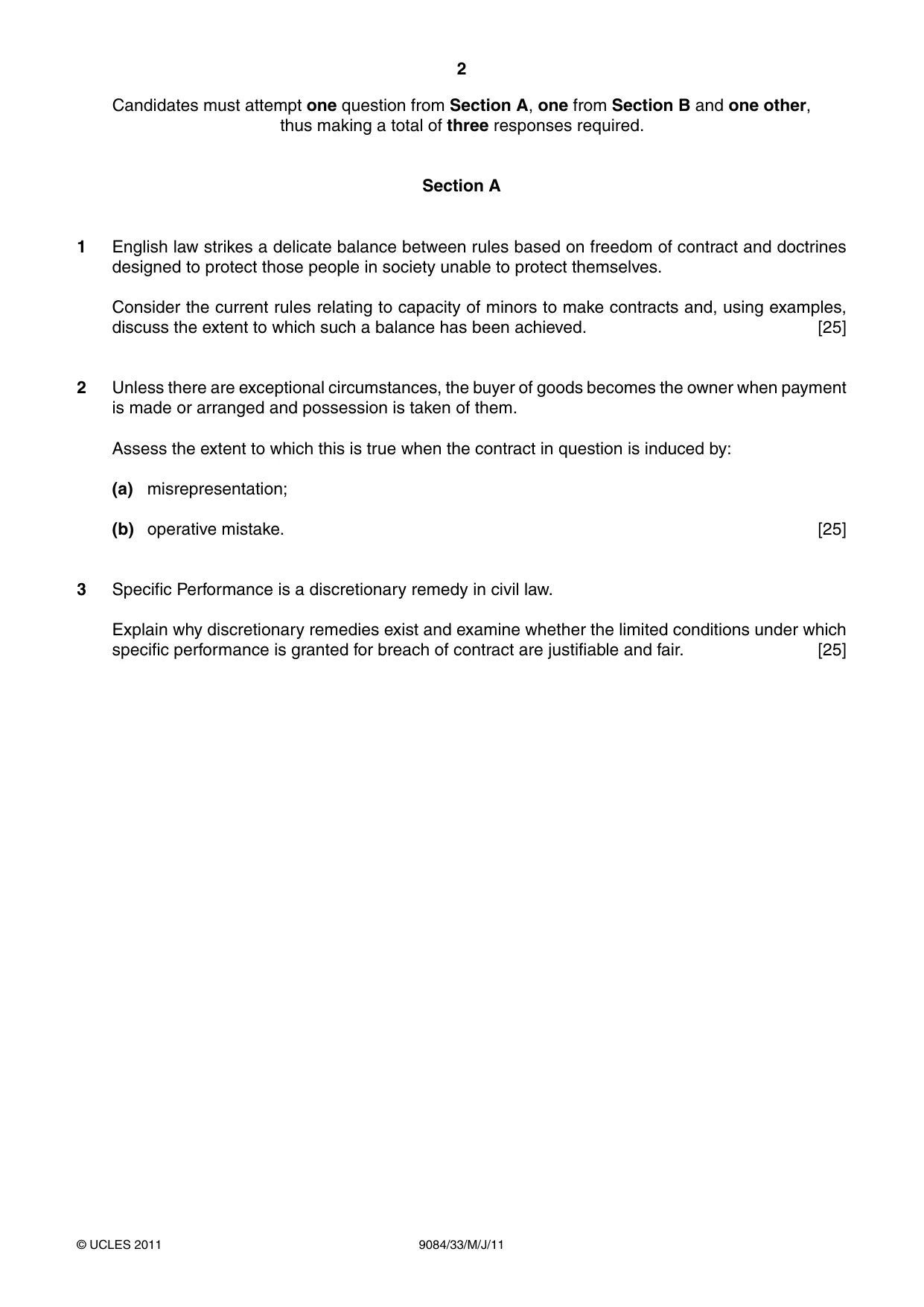
2 9084/33/M/J/11 © UCLES 2011 Candidates must attempt one question from Section A, one from Section B and one other, thus making a total of three responses required. Section A 1 English law strikes a delicate balance between rules based on freedom of contract and doctrines designed to protect those people in society unable to protect themselves. Consider the current rules relating to capacity of minors to make contracts and, using examples, discuss the extent to which such a balance has been achieved. [25] 2 Unless there are exceptional circumstances, the buyer of goods becomes the owner when payment is made or arranged and possession is taken of them. Assess the extent to which this is true when the contract in question is induced by: (a) misrepresentation; (b) operative mistake. [25] 3 Specific Performance is a discretionary remedy in civil law. Explain why discretionary remedies exist and examine whether the limited conditions under which specific performance is granted for breach of contract are justifiable and fair. [25]
Question paper, page 3
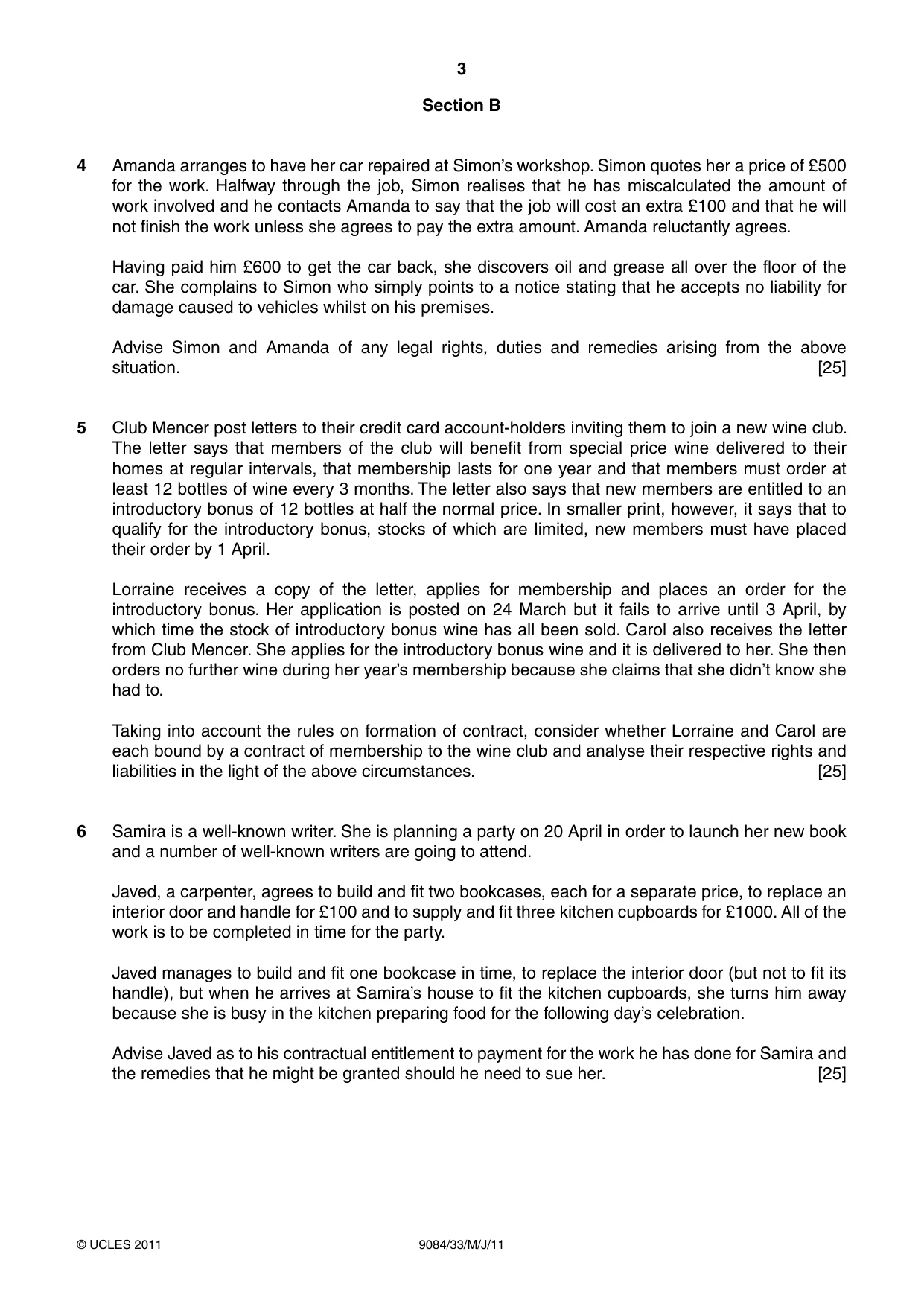
3 9084/33/M/J/11 © UCLES 2011 Section B 4 Amanda arranges to have her car repaired at Simon’s workshop. Simon quotes her a price of £500 for the work. Halfway through the job, Simon realises that he has miscalculated the amount of work involved and he contacts Amanda to say that the job will cost an extra £100 and that he will not finish the work unless she agrees to pay the extra amount. Amanda reluctantly agrees. Having paid him £600 to get the car back, she discovers oil and grease all over the floor of the car. She complains to Simon who simply points to a notice stating that he accepts no liability for damage caused to vehicles whilst on his premises. Advise Simon and Amanda of any legal rights, duties and remedies arising from the above situation. [25] 5 Club Mencer post letters to their credit card account-holders inviting them to join a new wine club. The letter says that members of the club will benefit from special price wine delivered to their homes at regular intervals, that membership lasts for one year and that members must order at least 12 bottles of wine every 3 months. The letter also says that new members are entitled to an introductory bonus of 12 bottles at half the normal price. In smaller print, however, it says that to qualify for the introductory bonus, stocks of which are limited, new members must have placed their order by 1 April. Lorraine receives a copy of the letter, applies for membership and places an order for the introductory bonus. Her application is posted on 24 March but it fails to arrive until 3 April, by which time the stock of introductory bonus wine has all been sold. Carol also receives the letter from Club Mencer. She applies for the introductory bonus wine and it is delivered to her. She then orders no further wine during her year’s membership because she claims that she didn’t know she had to. Taking into account the rules on formation of contract, consider whether Lorraine and Carol are each bound by a contract of membership to the wine club and analyse their respective rights and liabilities in the light of the above circumstances. [25] 6 Samira is a well-known writer. She is planning a party on 20 April in order to launch her new book and a number of well-known writers are going to attend. Javed, a carpenter, agrees to build and fit two bookcases, each for a separate price, to replace an interior door and handle for £100 and to supply and fit three kitchen cupboards for £1000. All of the work is to be completed in time for the party. Javed manages to build and fit one bookcase in time, to replace the interior door (but not to fit its handle), but when he arrives at Samira’s house to fit the kitchen cupboards, she turns him away because she is busy in the kitchen preparing food for the following day’s celebration. Advise Javed as to his contractual entitlement to payment for the work he has done for Samira and the remedies that he might be granted should he need to sue her. [25]
Question paper, page 4
4 9084/33/M/J/11 © UCLES 2011 Permission to reproduce items where third-party owned material protected by copyright is included has been sought and cleared where possible. Every reasonable effort has been made by the publisher (UCLES) to trace copyright holders, but if any items requiring clearance have unwittingly been included, the publisher will be pleased to make amends at the earliest possible opportunity. University of Cambridge International Examinations is part of the Cambridge Assessment Group. Cambridge Assessment is the brand name of University of Cambridge Local Examinations Syndicate (UCLES), which is itself a department of the University of Cambridge. BLANK PAGE
Mark scheme, page 1
UNIVERSITY OF CAMBRIDGE INTERNATIONAL EXAMINATIONS GCE Advanced Level MARK SCHEME for the May/June 2011 question paper for the guidance of teachers 9084 LAW 9084/33 Paper 3, maximum raw mark 75 This mark scheme is published as an aid to teachers and candidates, to indicate the requirements of the examination. It shows the basis on which Examiners were instructed to award marks. It does not indicate the details of the discussions that took place at an Examiners’ meeting before marking began, which would have considered the acceptability of alternative answers. Mark schemes must be read in conjunction with the question papers and the report on the examination. • Cambridge will not enter into discussions or correspondence in connection with these mark schemes. Cambridge is publishing the mark schemes for the May/June 2011 question papers for most IGCSE, GCE Advanced Level and Advanced Subsidiary Level syllabuses and some Ordinary Level syllabuses.
Mark scheme, page 2
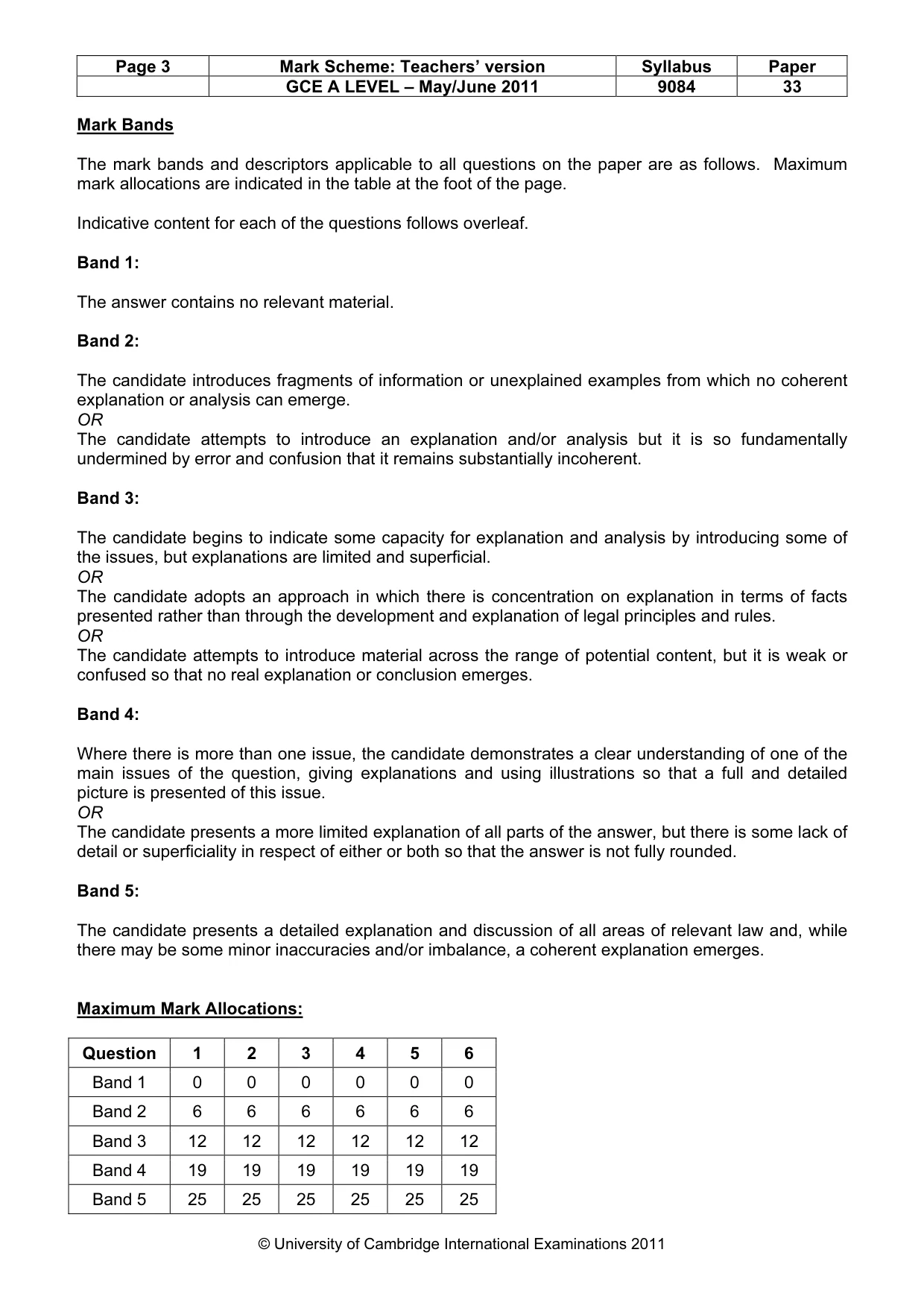
Page 2 Mark Scheme: Teachers’ version Syllabus Paper GCE A LEVEL – May/June 2011 9084 33 © University of Cambridge International Examinations 2011 Assessment Objectives Candidates are expected to demonstrate: Knowledge and Understanding − recall, select, use and develop knowledge and understanding of legal principles and rules by means of example and citation Analysis, Evaluation and Application − analyse and evaluate legal materials, situations and issues and accurately apply appropriate principles and rules Communication and Presentation − use appropriate legal terminology to present logical and coherent arguments and to communicate relevant material in a clear and concise manner. Specification Grid The relationship between the Assessment Objectives and this individual component is detailed below. The objectives are weighted to give an indication of their relative importance, rather than to provide a precise statement of the percentage mark allocation to particular assessment objectives. Assessment Objective Paper 1 Paper 2 Paper 3 Paper 4 Advanced Level Knowledge/Understanding 50 50 50 50 50 Analysis/Evaluation/Application 40 40 40 40 40 Communication/Presentation 10 10 10 10 10
Mark scheme, page 3
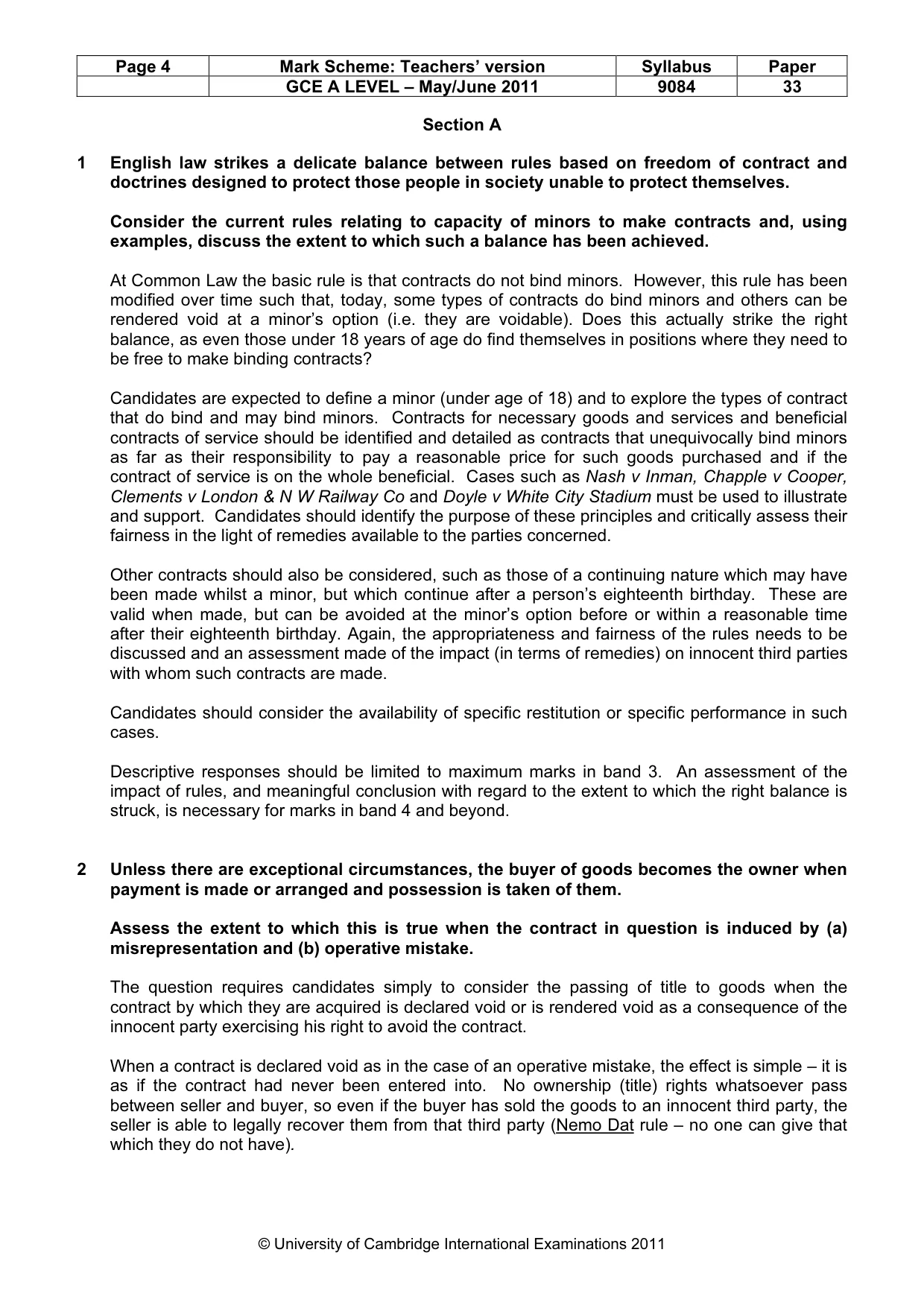
Page 3 Mark Scheme: Teachers’ version Syllabus Paper GCE A LEVEL – May/June 2011 9084 33 © University of Cambridge International Examinations 2011 Mark Bands The mark bands and descriptors applicable to all questions on the paper are as follows. Maximum mark allocations are indicated in the table at the foot of the page. Indicative content for each of the questions follows overleaf. Band 1: The answer contains no relevant material. Band 2: The candidate introduces fragments of information or unexplained examples from which no coherent explanation or analysis can emerge. OR The candidate attempts to introduce an explanation and/or analysis but it is so fundamentally undermined by error and confusion that it remains substantially incoherent. Band 3: The candidate begins to indicate some capacity for explanation and analysis by introducing some of the issues, but explanations are limited and superficial. OR The candidate adopts an approach in which there is concentration on explanation in terms of facts presented rather than through the development and explanation of legal principles and rules. OR The candidate attempts to introduce material across the range of potential content, but it is weak or confused so that no real explanation or conclusion emerges. Band 4: Where there is more than one issue, the candidate demonstrates a clear understanding of one of the main issues of the question, giving explanations and using illustrations so that a full and detailed picture is presented of this issue. OR The candidate presents a more limited explanation of all parts of the answer, but there is some lack of detail or superficiality in respect of either or both so that the answer is not fully rounded. Band 5: The candidate presents a detailed explanation and discussion of all areas of relevant law and, while there may be some minor inaccuracies and/or imbalance, a coherent explanation emerges. Maximum Mark Allocations: Question 1 2 3 4 5 6 Band 1 0 0 0 0 0 0 Band 2 6 6 6 6 6 6 Band 3 12 12 12 12 12 12 Band 4 19 19 19 19 19 19 Band 5 25 25 25 25 25 25
Mark scheme, page 4
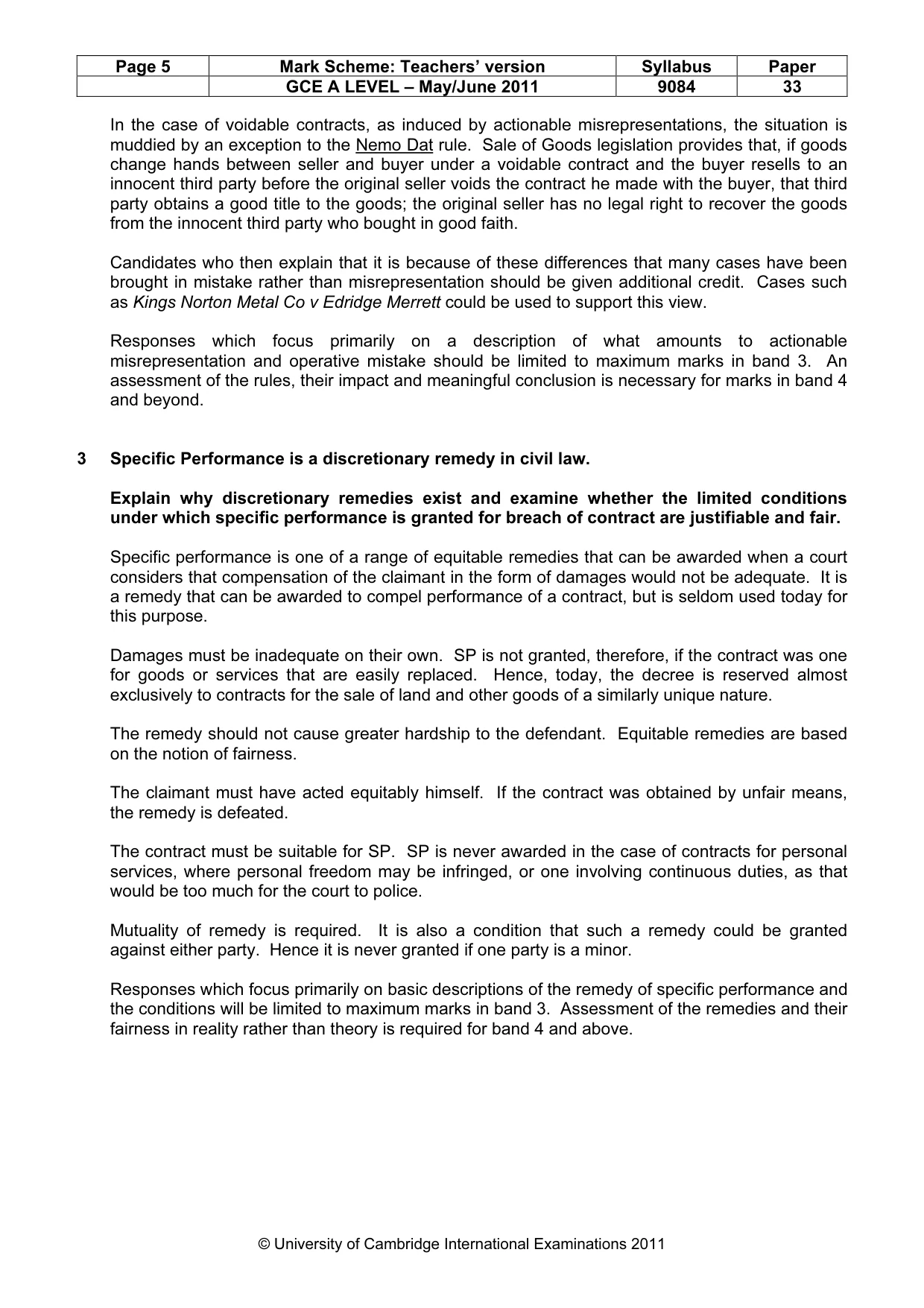
Page 4 Mark Scheme: Teachers’ version Syllabus Paper GCE A LEVEL – May/June 2011 9084 33 © University of Cambridge International Examinations 2011 Section A 1 English law strikes a delicate balance between rules based on freedom of contract and doctrines designed to protect those people in society unable to protect themselves. Consider the current rules relating to capacity of minors to make contracts and, using examples, discuss the extent to which such a balance has been achieved. At Common Law the basic rule is that contracts do not bind minors. However, this rule has been modified over time such that, today, some types of contracts do bind minors and others can be rendered void at a minor’s option (i.e. they are voidable). Does this actually strike the right balance, as even those under 18 years of age do find themselves in positions where they need to be free to make binding contracts? Candidates are expected to define a minor (under age of 18) and to explore the types of contract that do bind and may bind minors. Contracts for necessary goods and services and beneficial contracts of service should be identified and detailed as contracts that unequivocally bind minors as far as their responsibility to pay a reasonable price for such goods purchased and if the contract of service is on the whole beneficial. Cases such as Nash v Inman, Chapple v Cooper, Clements v London & N W Railway Co and Doyle v White City Stadium must be used to illustrate and support. Candidates should identify the purpose of these principles and critically assess their fairness in the light of remedies available to the parties concerned. Other contracts should also be considered, such as those of a continuing nature which may have been made whilst a minor, but which continue after a person’s eighteenth birthday. These are valid when made, but can be avoided at the minor’s option before or within a reasonable time after their eighteenth birthday. Again, the appropriateness and fairness of the rules needs to be discussed and an assessment made of the impact (in terms of remedies) on innocent third parties with whom such contracts are made. Candidates should consider the availability of specific restitution or specific performance in such cases. Descriptive responses should be limited to maximum marks in band 3. An assessment of the impact of rules, and meaningful conclusion with regard to the extent to which the right balance is struck, is necessary for marks in band 4 and beyond. 2 Unless there are exceptional circumstances, the buyer of goods becomes the owner when payment is made or arranged and possession is taken of them. Assess the extent to which this is true when the contract in question is induced by (a) misrepresentation and (b) operative mistake. The question requires candidates simply to consider the passing of title to goods when the contract by which they are acquired is declared void or is rendered void as a consequence of the innocent party exercising his right to avoid the contract. When a contract is declared void as in the case of an operative mistake, the effect is simple – it is as if the contract had never been entered into. No ownership (title) rights whatsoever pass between seller and buyer, so even if the buyer has sold the goods to an innocent third party, the seller is able to legally recover them from that third party (Nemo Dat rule – no one can give that which they do not have).
Mark scheme, page 5
Page 5 Mark Scheme: Teachers’ version Syllabus Paper GCE A LEVEL – May/June 2011 9084 33 © University of Cambridge International Examinations 2011 In the case of voidable contracts, as induced by actionable misrepresentations, the situation is muddied by an exception to the Nemo Dat rule. Sale of Goods legislation provides that, if goods change hands between seller and buyer under a voidable contract and the buyer resells to an innocent third party before the original seller voids the contract he made with the buyer, that third party obtains a good title to the goods; the original seller has no legal right to recover the goods from the innocent third party who bought in good faith. Candidates who then explain that it is because of these differences that many cases have been brought in mistake rather than misrepresentation should be given additional credit. Cases such as Kings Norton Metal Co v Edridge Merrett could be used to support this view. Responses which focus primarily on a description of what amounts to actionable misrepresentation and operative mistake should be limited to maximum marks in band 3. An assessment of the rules, their impact and meaningful conclusion is necessary for marks in band 4 and beyond. 3 Specific Performance is a discretionary remedy in civil law. Explain why discretionary remedies exist and examine whether the limited conditions under which specific performance is granted for breach of contract are justifiable and fair. Specific performance is one of a range of equitable remedies that can be awarded when a court considers that compensation of the claimant in the form of damages would not be adequate. It is a remedy that can be awarded to compel performance of a contract, but is seldom used today for this purpose. Damages must be inadequate on their own. SP is not granted, therefore, if the contract was one for goods or services that are easily replaced. Hence, today, the decree is reserved almost exclusively to contracts for the sale of land and other goods of a similarly unique nature. The remedy should not cause greater hardship to the defendant. Equitable remedies are based on the notion of fairness. The claimant must have acted equitably himself. If the contract was obtained by unfair means, the remedy is defeated. The contract must be suitable for SP. SP is never awarded in the case of contracts for personal services, where personal freedom may be infringed, or one involving continuous duties, as that would be too much for the court to police. Mutuality of remedy is required. It is also a condition that such a remedy could be granted against either party. Hence it is never granted if one party is a minor. Responses which focus primarily on basic descriptions of the remedy of specific performance and the conditions will be limited to maximum marks in band 3. Assessment of the remedies and their fairness in reality rather than theory is required for band 4 and above.
Mark scheme, page 6
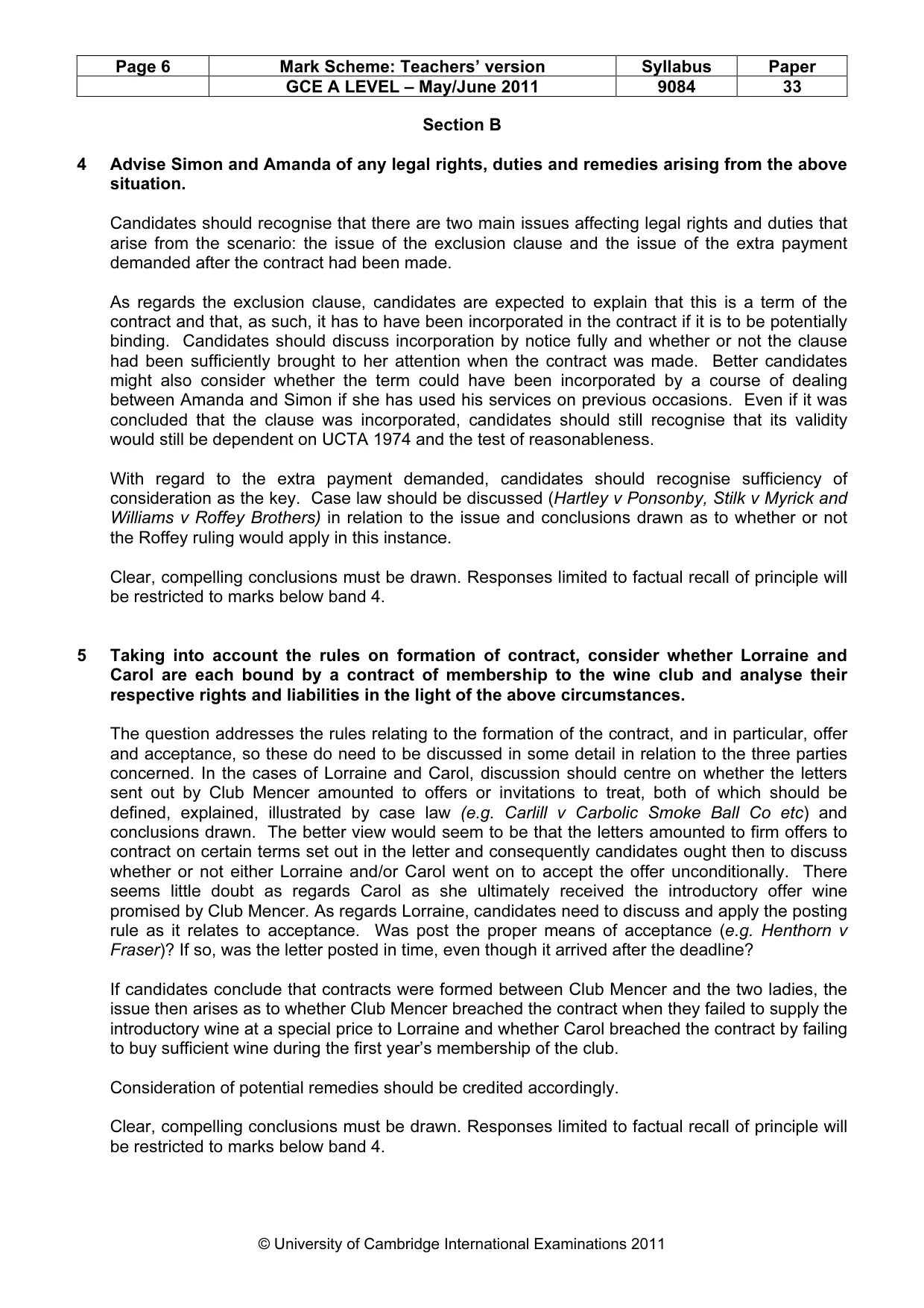
Page 6 Mark Scheme: Teachers’ version Syllabus Paper GCE A LEVEL – May/June 2011 9084 33 © University of Cambridge International Examinations 2011 Section B 4 Advise Simon and Amanda of any legal rights, duties and remedies arising from the above situation. Candidates should recognise that there are two main issues affecting legal rights and duties that arise from the scenario: the issue of the exclusion clause and the issue of the extra payment demanded after the contract had been made. As regards the exclusion clause, candidates are expected to explain that this is a term of the contract and that, as such, it has to have been incorporated in the contract if it is to be potentially binding. Candidates should discuss incorporation by notice fully and whether or not the clause had been sufficiently brought to her attention when the contract was made. Better candidates might also consider whether the term could have been incorporated by a course of dealing between Amanda and Simon if she has used his services on previous occasions. Even if it was concluded that the clause was incorporated, candidates should still recognise that its validity would still be dependent on UCTA 1974 and the test of reasonableness. With regard to the extra payment demanded, candidates should recognise sufficiency of consideration as the key. Case law should be discussed (Hartley v Ponsonby, Stilk v Myrick and Williams v Roffey Brothers) in relation to the issue and conclusions drawn as to whether or not the Roffey ruling would apply in this instance. Clear, compelling conclusions must be drawn. Responses limited to factual recall of principle will be restricted to marks below band 4. 5 Taking into account the rules on formation of contract, consider whether Lorraine and Carol are each bound by a contract of membership to the wine club and analyse their respective rights and liabilities in the light of the above circumstances. The question addresses the rules relating to the formation of the contract, and in particular, offer and acceptance, so these do need to be discussed in some detail in relation to the three parties concerned. In the cases of Lorraine and Carol, discussion should centre on whether the letters sent out by Club Mencer amounted to offers or invitations to treat, both of which should be defined, explained, illustrated by case law (e.g. Carlill v Carbolic Smoke Ball Co etc) and conclusions drawn. The better view would seem to be that the letters amounted to firm offers to contract on certain terms set out in the letter and consequently candidates ought then to discuss whether or not either Lorraine and/or Carol went on to accept the offer unconditionally. There seems little doubt as regards Carol as she ultimately received the introductory offer wine promised by Club Mencer. As regards Lorraine, candidates need to discuss and apply the posting rule as it relates to acceptance. Was post the proper means of acceptance (e.g. Henthorn v Fraser)? If so, was the letter posted in time, even though it arrived after the deadline? If candidates conclude that contracts were formed between Club Mencer and the two ladies, the issue then arises as to whether Club Mencer breached the contract when they failed to supply the introductory wine at a special price to Lorraine and whether Carol breached the contract by failing to buy sufficient wine during the first year’s membership of the club. Consideration of potential remedies should be credited accordingly. Clear, compelling conclusions must be drawn. Responses limited to factual recall of principle will be restricted to marks below band 4.
Mark scheme, page 7
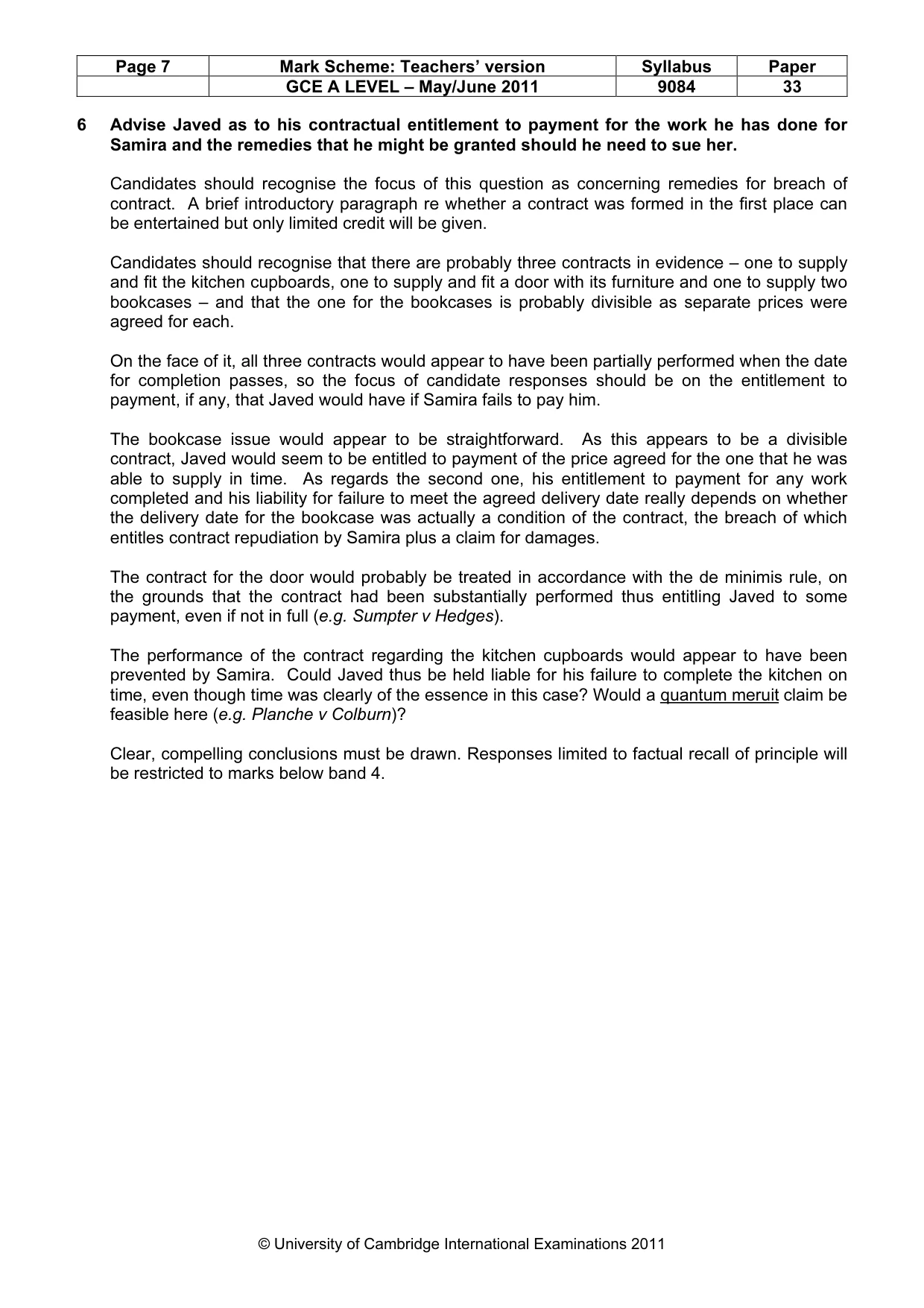
Page 7 Mark Scheme: Teachers’ version Syllabus Paper GCE A LEVEL – May/June 2011 9084 33 © University of Cambridge International Examinations 2011 6 Advise Javed as to his contractual entitlement to payment for the work he has done for Samira and the remedies that he might be granted should he need to sue her. Candidates should recognise the focus of this question as concerning remedies for breach of contract. A brief introductory paragraph re whether a contract was formed in the first place can be entertained but only limited credit will be given. Candidates should recognise that there are probably three contracts in evidence – one to supply and fit the kitchen cupboards, one to supply and fit a door with its furniture and one to supply two bookcases – and that the one for the bookcases is probably divisible as separate prices were agreed for each. On the face of it, all three contracts would appear to have been partially performed when the date for completion passes, so the focus of candidate responses should be on the entitlement to payment, if any, that Javed would have if Samira fails to pay him. The bookcase issue would appear to be straightforward. As this appears to be a divisible contract, Javed would seem to be entitled to payment of the price agreed for the one that he was able to supply in time. As regards the second one, his entitlement to payment for any work completed and his liability for failure to meet the agreed delivery date really depends on whether the delivery date for the bookcase was actually a condition of the contract, the breach of which entitles contract repudiation by Samira plus a claim for damages. The contract for the door would probably be treated in accordance with the de minimis rule, on the grounds that the contract had been substantially performed thus entitling Javed to some payment, even if not in full (e.g. Sumpter v Hedges). The performance of the contract regarding the kitchen cupboards would appear to have been prevented by Samira. Could Javed thus be held liable for his failure to complete the kitchen on time, even though time was clearly of the essence in this case? Would a quantum meruit claim be feasible here (e.g. Planche v Colburn)? Clear, compelling conclusions must be drawn. Responses limited to factual recall of principle will be restricted to marks below band 4.
What you needed in this session
Cambridge’s own grade thresholds for 2011 May/June, Paper 3 · Variant 3. A higher threshold means an easier paper — the bar moves with how the cohort did.