Cambridge A Level Law 9084 — 2011 May/June Paper 3 · Variant 1
9084/31/M/J/11 · 75 marks · ≈84 min
The question paper and its mark scheme, free to read here and free to download. This is Cambridge’s own paper, exactly as it was sat.
Question paper4 pages
Mark scheme7 pages
Answers below. Sit the paper first if you are practising.
Paper as text
Question paper, page 1
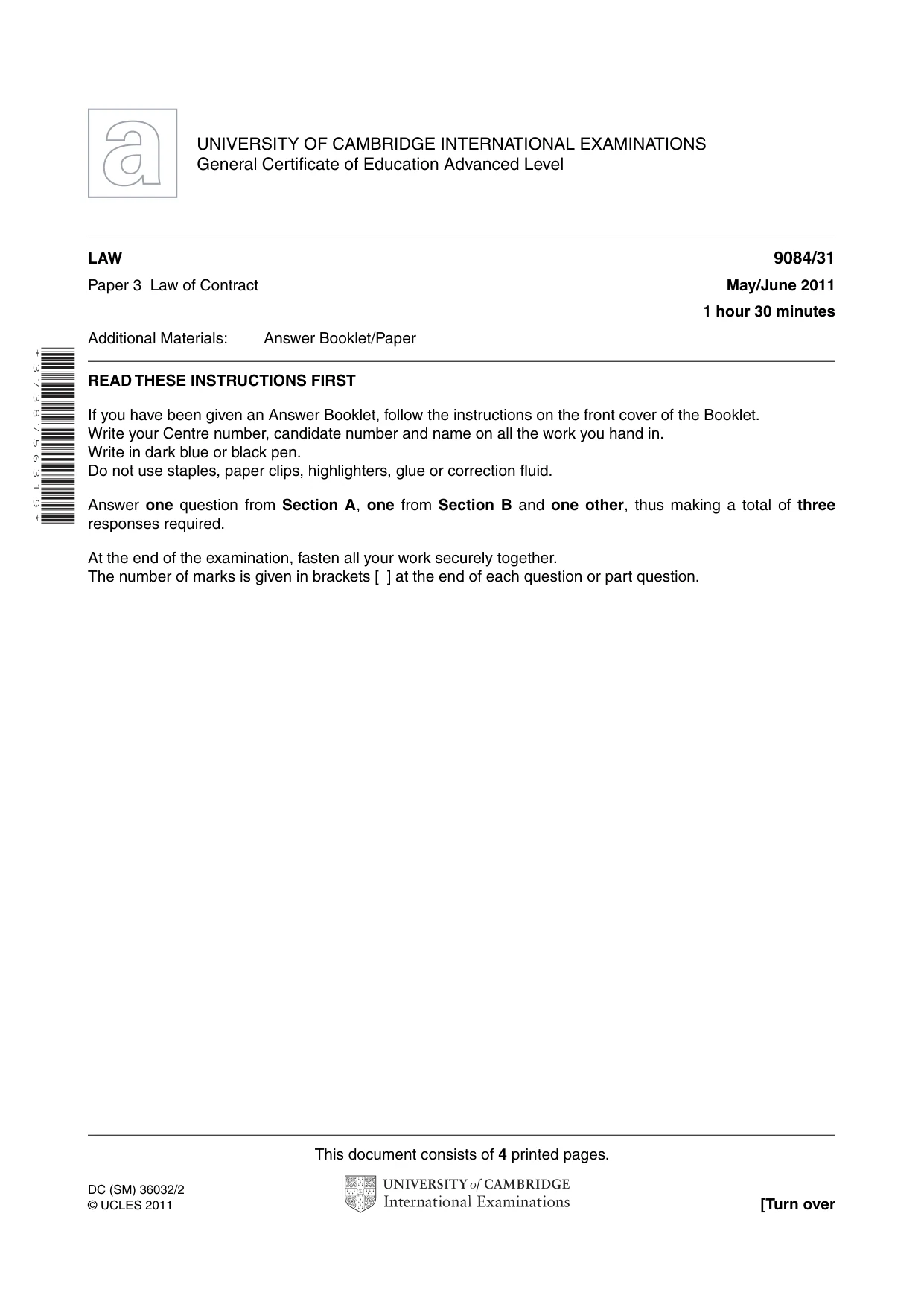
This document consists of 4 printed pages. DC (SM) 36032/2 © UCLES 2011 [Turn over UNIVERSITY OF CAMBRIDGE INTERNATIONAL EXAMINATIONS General Certificate of Education Advanced Level * 3 7 3 8 7 5 6 3 1 9 * LAW 9084/31 Paper 3 Law of Contract May/June 2011 1 hour 30 minutes Additional Materials: Answer Booklet/Paper READ THESE INSTRUCTIONS FIRST If you have been given an Answer Booklet, follow the instructions on the front cover of the Booklet. Write your Centre number, candidate number and name on all the work you hand in. Write in dark blue or black pen. Do not use staples, paper clips, highlighters, glue or correction fluid. Answer one question from Section A, one from Section B and one other, thus making a total of three responses required. At the end of the examination, fasten all your work securely together. The number of marks is given in brackets [ ] at the end of each question or part question.
Question paper, page 2
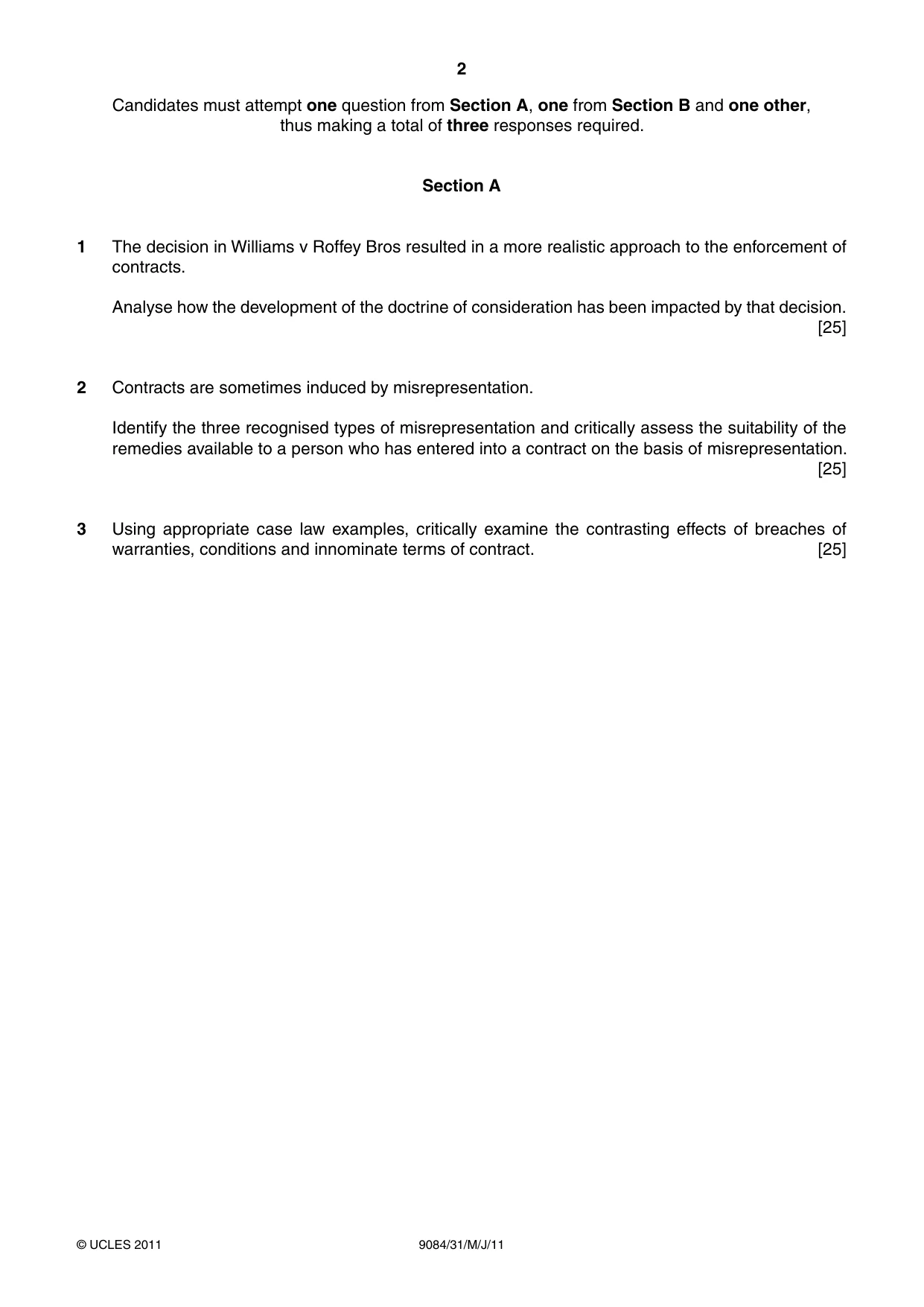
2 9084/31/M/J/11 © UCLES 2011 Candidates must attempt one question from Section A, one from Section B and one other, thus making a total of three responses required. Section A 1 The decision in Williams v Roffey Bros resulted in a more realistic approach to the enforcement of contracts. Analyse how the development of the doctrine of consideration has been impacted by that decision. [25] 2 Contracts are sometimes induced by misrepresentation. Identify the three recognised types of misrepresentation and critically assess the suitability of the remedies available to a person who has entered into a contract on the basis of misrepresentation. [25] 3 Using appropriate case law examples, critically examine the contrasting effects of breaches of warranties, conditions and innominate terms of contract. [25]
Question paper, page 3
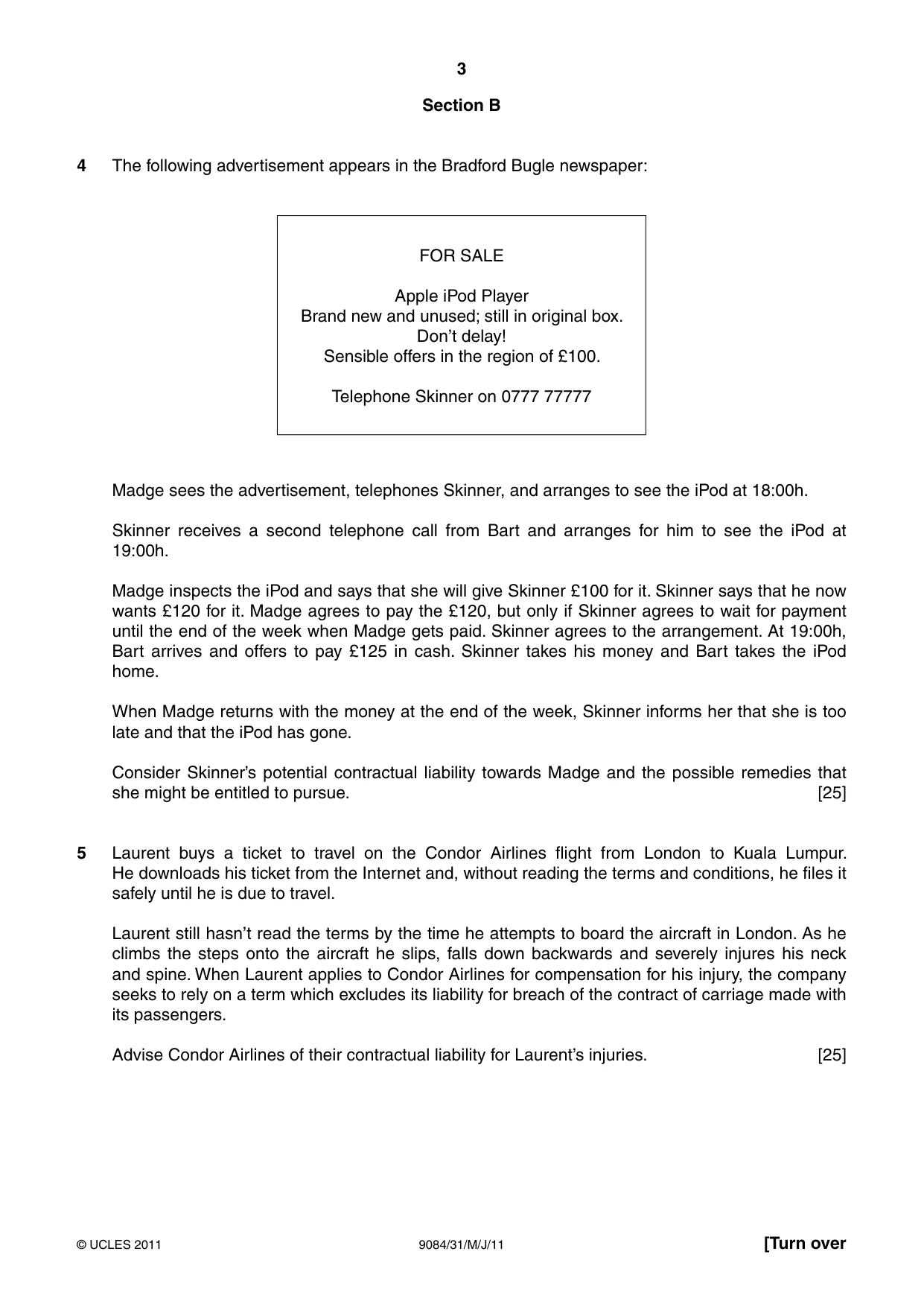
3 9084/31/M/J/11 © UCLES 2011 [Turn over Section B 4 The following advertisement appears in the Bradford Bugle newspaper: FOR SALE Apple iPod Player Brand new and unused; still in original box. Don’t delay! Sensible offers in the region of £100. Telephone Skinner on 0777 77777 Madge sees the advertisement, telephones Skinner, and arranges to see the iPod at 18:00h. Skinner receives a second telephone call from Bart and arranges for him to see the iPod at 19:00h. Madge inspects the iPod and says that she will give Skinner £100 for it. Skinner says that he now wants £120 for it. Madge agrees to pay the £120, but only if Skinner agrees to wait for payment until the end of the week when Madge gets paid. Skinner agrees to the arrangement. At 19:00h, Bart arrives and offers to pay £125 in cash. Skinner takes his money and Bart takes the iPod home. When Madge returns with the money at the end of the week, Skinner informs her that she is too late and that the iPod has gone. Consider Skinner’s potential contractual liability towards Madge and the possible remedies that she might be entitled to pursue. [25] 5 Laurent buys a ticket to travel on the Condor Airlines flight from London to Kuala Lumpur. He downloads his ticket from the Internet and, without reading the terms and conditions, he files it safely until he is due to travel. Laurent still hasn’t read the terms by the time he attempts to board the aircraft in London. As he climbs the steps onto the aircraft he slips, falls down backwards and severely injures his neck and spine. When Laurent applies to Condor Airlines for compensation for his injury, the company seeks to rely on a term which excludes its liability for breach of the contract of carriage made with its passengers. Advise Condor Airlines of their contractual liability for Laurent’s injuries. [25]
Question paper, page 4
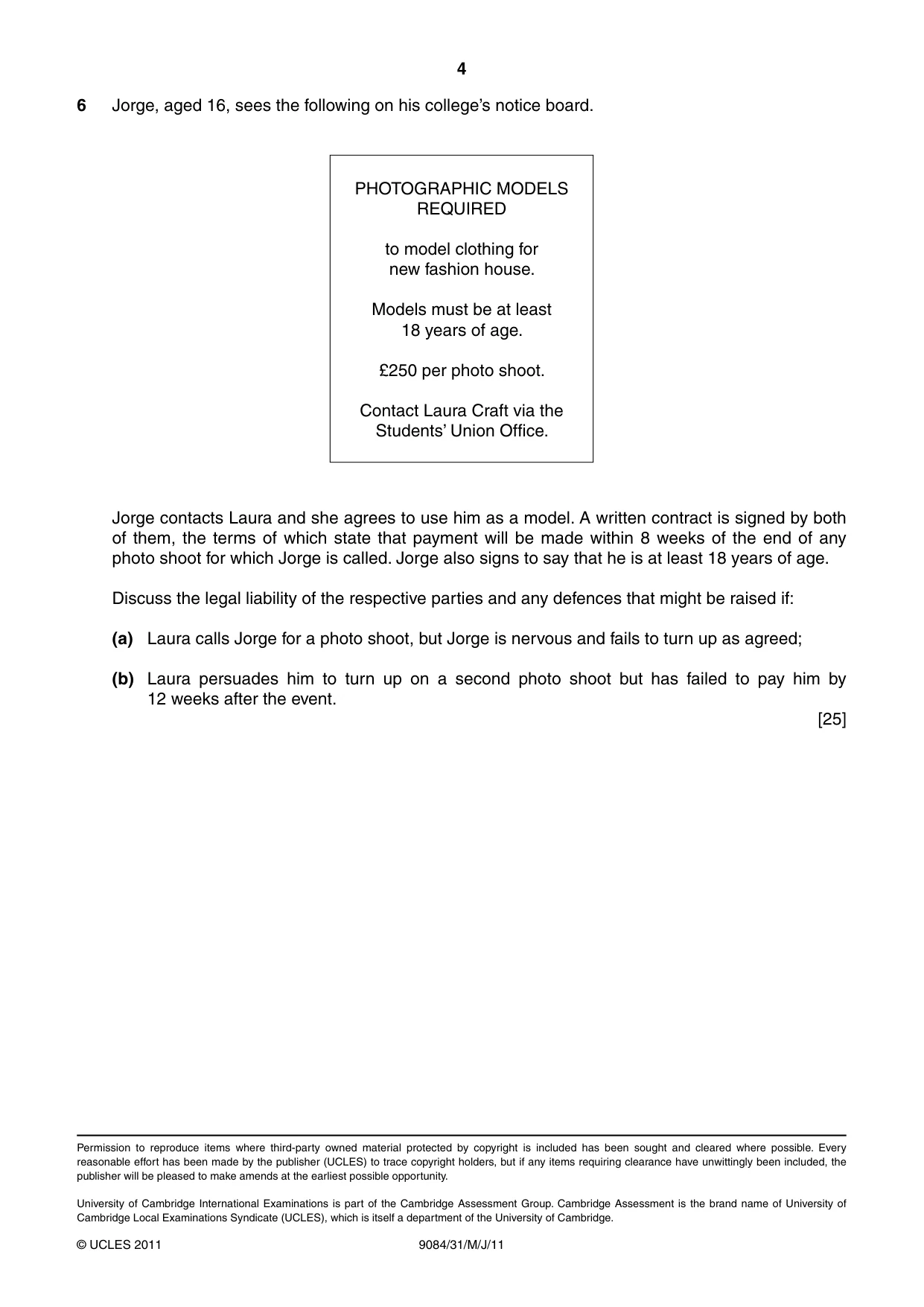
4 9084/31/M/J/11 © UCLES 2011 Permission to reproduce items where third-party owned material protected by copyright is included has been sought and cleared where possible. Every reasonable effort has been made by the publisher (UCLES) to trace copyright holders, but if any items requiring clearance have unwittingly been included, the publisher will be pleased to make amends at the earliest possible opportunity. University of Cambridge International Examinations is part of the Cambridge Assessment Group. Cambridge Assessment is the brand name of University of Cambridge Local Examinations Syndicate (UCLES), which is itself a department of the University of Cambridge. 6 Jorge, aged 16, sees the following on his college’s notice board. PHOTOGRAPHIC MODELS REQUIRED to model clothing for new fashion house. Models must be at least 18 years of age. £250 per photo shoot. Contact Laura Craft via the Students’ Union Office. Jorge contacts Laura and she agrees to use him as a model. A written contract is signed by both of them, the terms of which state that payment will be made within 8 weeks of the end of any photo shoot for which Jorge is called. Jorge also signs to say that he is at least 18 years of age. Discuss the legal liability of the respective parties and any defences that might be raised if: (a) Laura calls Jorge for a photo shoot, but Jorge is nervous and fails to turn up as agreed; (b) Laura persuades him to turn up on a second photo shoot but has failed to pay him by 12 weeks after the event. [25]
Mark scheme, page 1
UNIVERSITY OF CAMBRIDGE INTERNATIONAL EXAMINATIONS GCE Advanced Level MARK SCHEME for the May/June 2011 question paper for the guidance of teachers 9084 LAW 9084/31 Paper 3, maximum raw mark 75 This mark scheme is published as an aid to teachers and candidates, to indicate the requirements of the examination. It shows the basis on which Examiners were instructed to award marks. It does not indicate the details of the discussions that took place at an Examiners’ meeting before marking began, which would have considered the acceptability of alternative answers. Mark schemes must be read in conjunction with the question papers and the report on the examination. • Cambridge will not enter into discussions or correspondence in connection with these mark schemes. Cambridge is publishing the mark schemes for the May/June 2011 question papers for most IGCSE, GCE Advanced Level and Advanced Subsidiary Level syllabuses and some Ordinary Level syllabuses.
Mark scheme, page 2
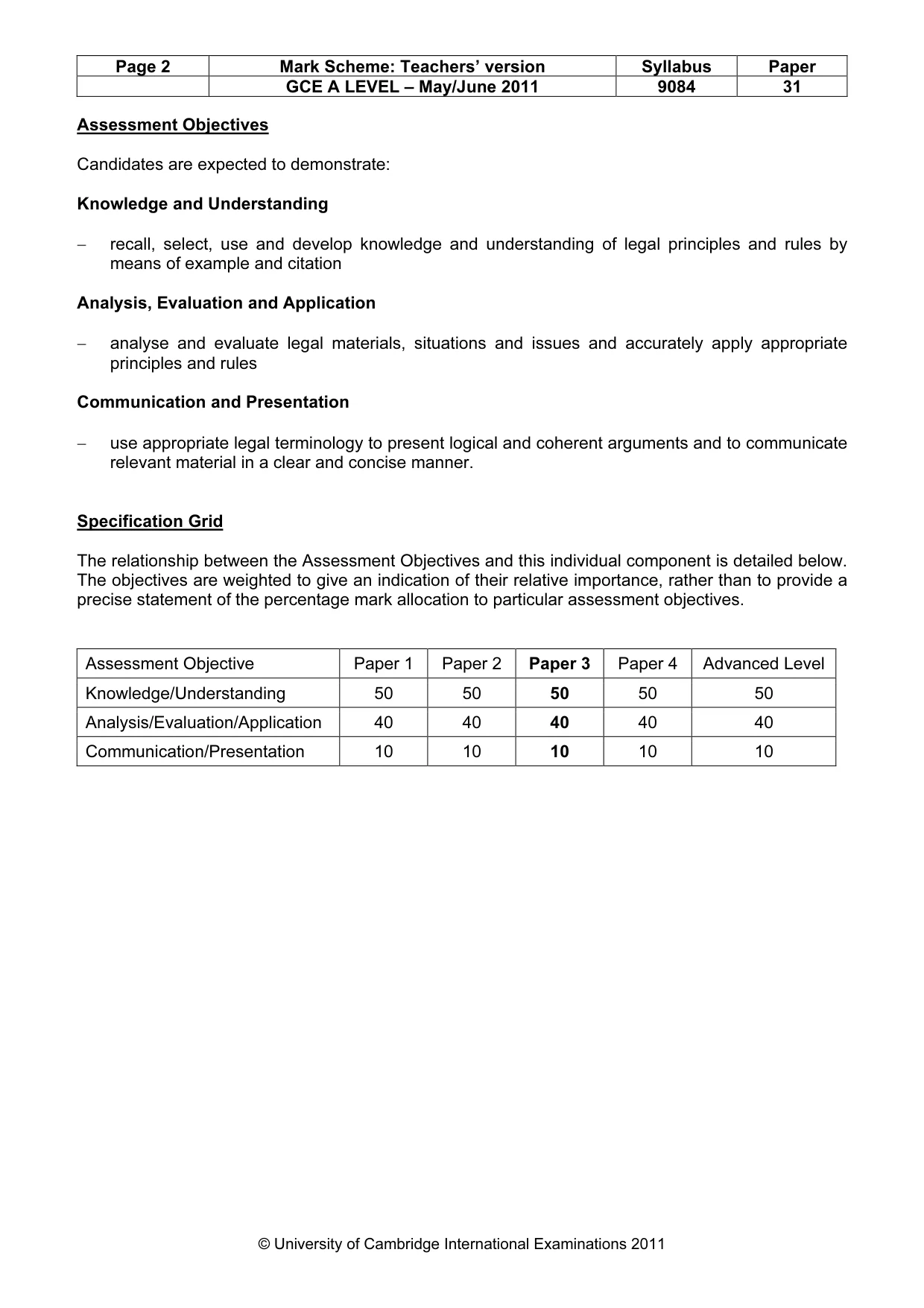
Page 2 Mark Scheme: Teachers’ version Syllabus Paper GCE A LEVEL – May/June 2011 9084 31 © University of Cambridge International Examinations 2011 Assessment Objectives Candidates are expected to demonstrate: Knowledge and Understanding − recall, select, use and develop knowledge and understanding of legal principles and rules by means of example and citation Analysis, Evaluation and Application − analyse and evaluate legal materials, situations and issues and accurately apply appropriate principles and rules Communication and Presentation − use appropriate legal terminology to present logical and coherent arguments and to communicate relevant material in a clear and concise manner. Specification Grid The relationship between the Assessment Objectives and this individual component is detailed below. The objectives are weighted to give an indication of their relative importance, rather than to provide a precise statement of the percentage mark allocation to particular assessment objectives. Assessment Objective Paper 1 Paper 2 Paper 3 Paper 4 Advanced Level Knowledge/Understanding 50 50 50 50 50 Analysis/Evaluation/Application 40 40 40 40 40 Communication/Presentation 10 10 10 10 10
Mark scheme, page 3
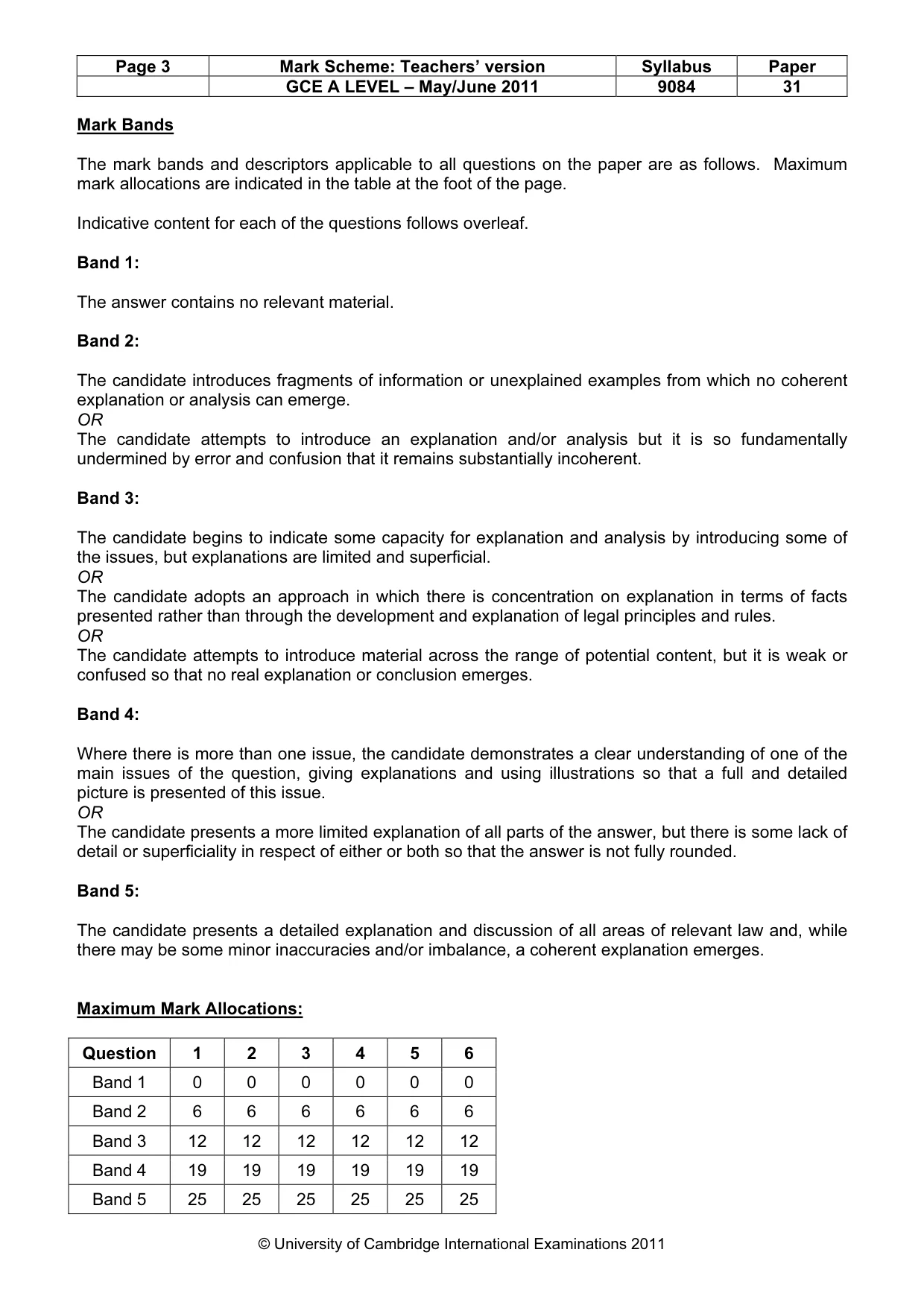
Page 3 Mark Scheme: Teachers’ version Syllabus Paper GCE A LEVEL – May/June 2011 9084 31 © University of Cambridge International Examinations 2011 Mark Bands The mark bands and descriptors applicable to all questions on the paper are as follows. Maximum mark allocations are indicated in the table at the foot of the page. Indicative content for each of the questions follows overleaf. Band 1: The answer contains no relevant material. Band 2: The candidate introduces fragments of information or unexplained examples from which no coherent explanation or analysis can emerge. OR The candidate attempts to introduce an explanation and/or analysis but it is so fundamentally undermined by error and confusion that it remains substantially incoherent. Band 3: The candidate begins to indicate some capacity for explanation and analysis by introducing some of the issues, but explanations are limited and superficial. OR The candidate adopts an approach in which there is concentration on explanation in terms of facts presented rather than through the development and explanation of legal principles and rules. OR The candidate attempts to introduce material across the range of potential content, but it is weak or confused so that no real explanation or conclusion emerges. Band 4: Where there is more than one issue, the candidate demonstrates a clear understanding of one of the main issues of the question, giving explanations and using illustrations so that a full and detailed picture is presented of this issue. OR The candidate presents a more limited explanation of all parts of the answer, but there is some lack of detail or superficiality in respect of either or both so that the answer is not fully rounded. Band 5: The candidate presents a detailed explanation and discussion of all areas of relevant law and, while there may be some minor inaccuracies and/or imbalance, a coherent explanation emerges. Maximum Mark Allocations: Question 1 2 3 4 5 6 Band 1 0 0 0 0 0 0 Band 2 6 6 6 6 6 6 Band 3 12 12 12 12 12 12 Band 4 19 19 19 19 19 19 Band 5 25 25 25 25 25 25
Mark scheme, page 4
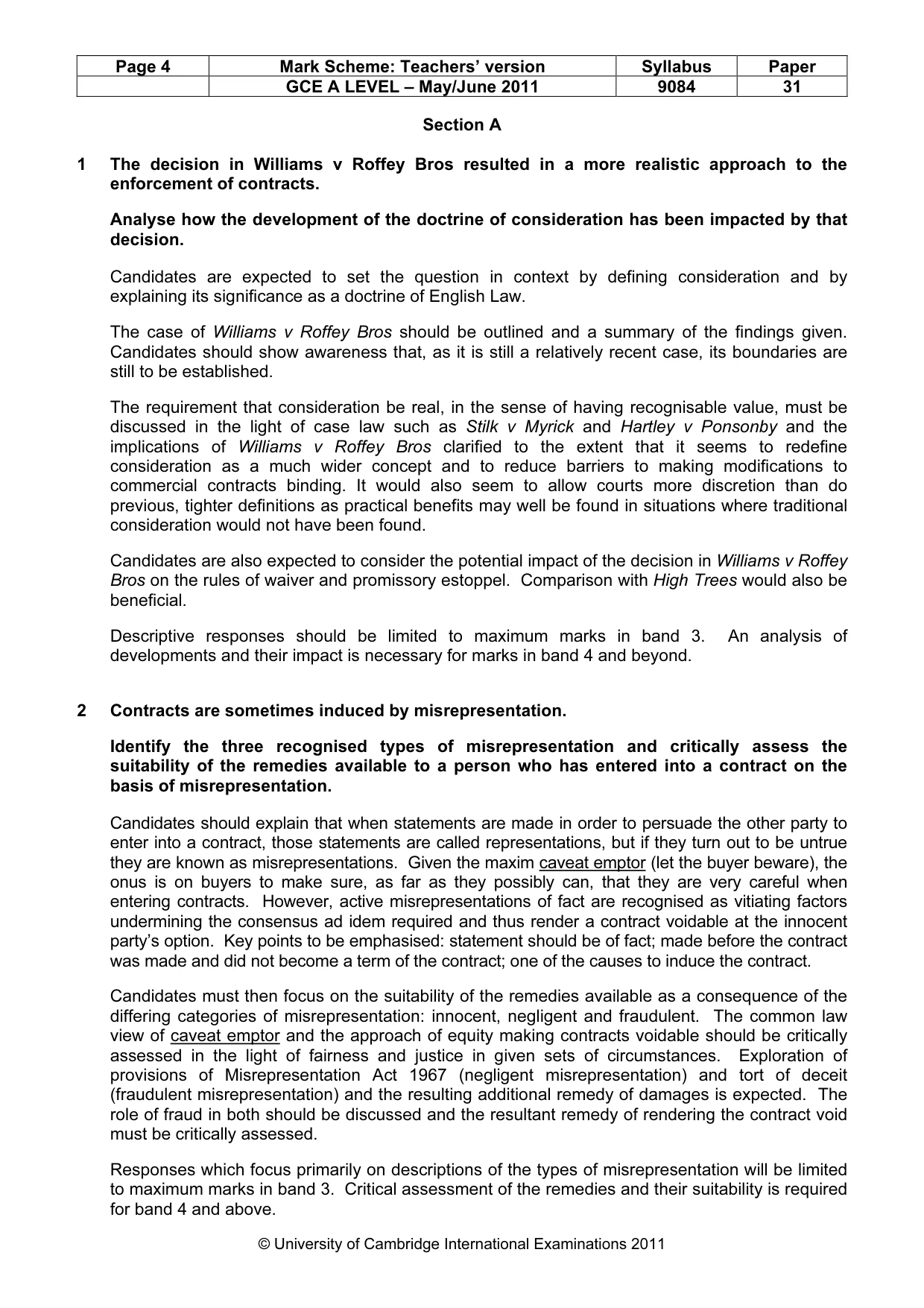
Page 4 Mark Scheme: Teachers’ version Syllabus Paper GCE A LEVEL – May/June 2011 9084 31 © University of Cambridge International Examinations 2011 Section A 1 The decision in Williams v Roffey Bros resulted in a more realistic approach to the enforcement of contracts. Analyse how the development of the doctrine of consideration has been impacted by that decision. Candidates are expected to set the question in context by defining consideration and by explaining its significance as a doctrine of English Law. The case of Williams v Roffey Bros should be outlined and a summary of the findings given. Candidates should show awareness that, as it is still a relatively recent case, its boundaries are still to be established. The requirement that consideration be real, in the sense of having recognisable value, must be discussed in the light of case law such as Stilk v Myrick and Hartley v Ponsonby and the implications of Williams v Roffey Bros clarified to the extent that it seems to redefine consideration as a much wider concept and to reduce barriers to making modifications to commercial contracts binding. It would also seem to allow courts more discretion than do previous, tighter definitions as practical benefits may well be found in situations where traditional consideration would not have been found. Candidates are also expected to consider the potential impact of the decision in Williams v Roffey Bros on the rules of waiver and promissory estoppel. Comparison with High Trees would also be beneficial. Descriptive responses should be limited to maximum marks in band 3. An analysis of developments and their impact is necessary for marks in band 4 and beyond. 2 Contracts are sometimes induced by misrepresentation. Identify the three recognised types of misrepresentation and critically assess the suitability of the remedies available to a person who has entered into a contract on the basis of misrepresentation. Candidates should explain that when statements are made in order to persuade the other party to enter into a contract, those statements are called representations, but if they turn out to be untrue they are known as misrepresentations. Given the maxim caveat emptor (let the buyer beware), the onus is on buyers to make sure, as far as they possibly can, that they are very careful when entering contracts. However, active misrepresentations of fact are recognised as vitiating factors undermining the consensus ad idem required and thus render a contract voidable at the innocent party’s option. Key points to be emphasised: statement should be of fact; made before the contract was made and did not become a term of the contract; one of the causes to induce the contract. Candidates must then focus on the suitability of the remedies available as a consequence of the differing categories of misrepresentation: innocent, negligent and fraudulent. The common law view of caveat emptor and the approach of equity making contracts voidable should be critically assessed in the light of fairness and justice in given sets of circumstances. Exploration of provisions of Misrepresentation Act 1967 (negligent misrepresentation) and tort of deceit (fraudulent misrepresentation) and the resulting additional remedy of damages is expected. The role of fraud in both should be discussed and the resultant remedy of rendering the contract void must be critically assessed. Responses which focus primarily on descriptions of the types of misrepresentation will be limited to maximum marks in band 3. Critical assessment of the remedies and their suitability is required for band 4 and above.
Mark scheme, page 5
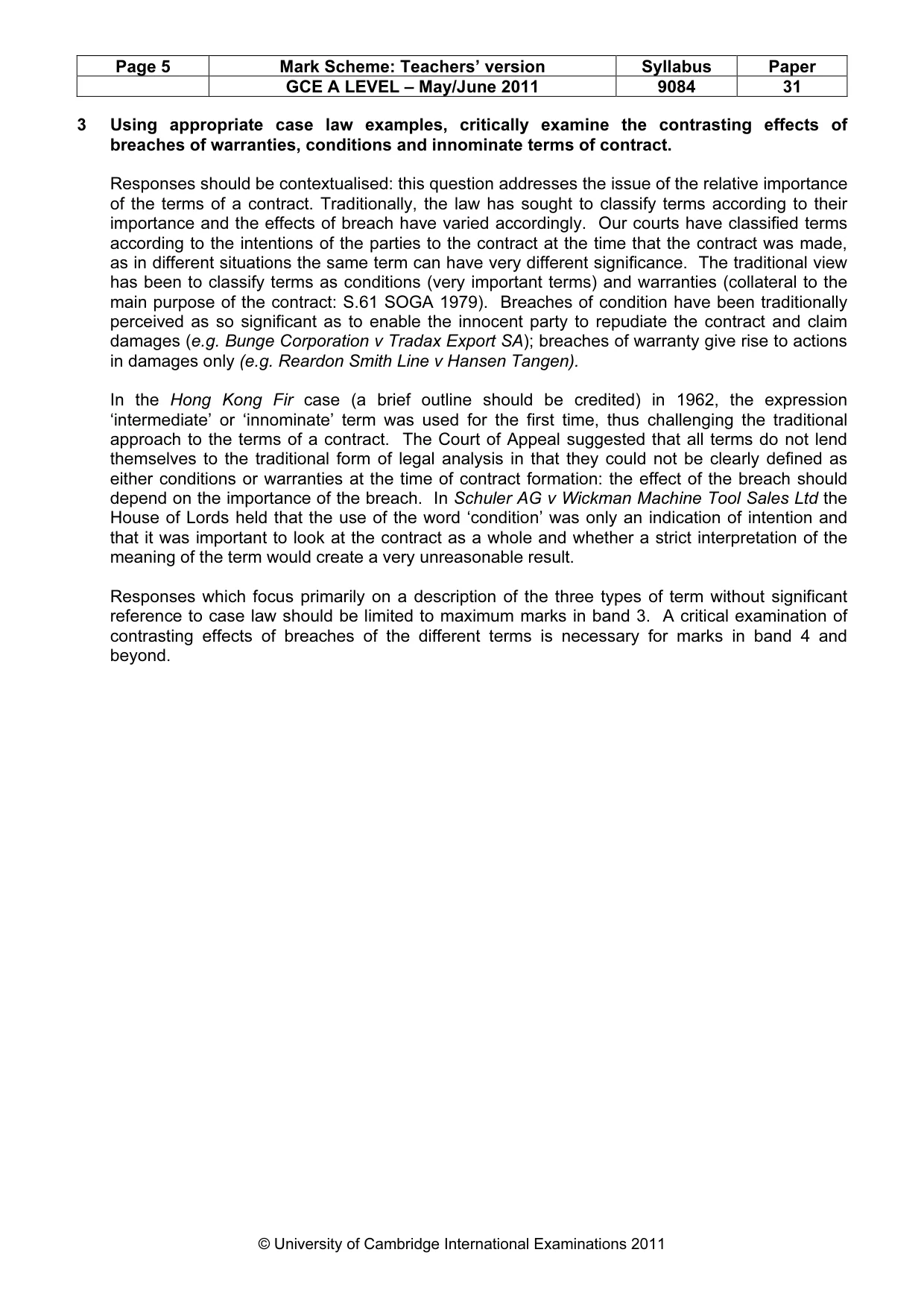
Page 5 Mark Scheme: Teachers’ version Syllabus Paper GCE A LEVEL – May/June 2011 9084 31 © University of Cambridge International Examinations 2011 3 Using appropriate case law examples, critically examine the contrasting effects of breaches of warranties, conditions and innominate terms of contract. Responses should be contextualised: this question addresses the issue of the relative importance of the terms of a contract. Traditionally, the law has sought to classify terms according to their importance and the effects of breach have varied accordingly. Our courts have classified terms according to the intentions of the parties to the contract at the time that the contract was made, as in different situations the same term can have very different significance. The traditional view has been to classify terms as conditions (very important terms) and warranties (collateral to the main purpose of the contract: S.61 SOGA 1979). Breaches of condition have been traditionally perceived as so significant as to enable the innocent party to repudiate the contract and claim damages (e.g. Bunge Corporation v Tradax Export SA); breaches of warranty give rise to actions in damages only (e.g. Reardon Smith Line v Hansen Tangen). In the Hong Kong Fir case (a brief outline should be credited) in 1962, the expression ‘intermediate’ or ‘innominate’ term was used for the first time, thus challenging the traditional approach to the terms of a contract. The Court of Appeal suggested that all terms do not lend themselves to the traditional form of legal analysis in that they could not be clearly defined as either conditions or warranties at the time of contract formation: the effect of the breach should depend on the importance of the breach. In Schuler AG v Wickman Machine Tool Sales Ltd the House of Lords held that the use of the word ‘condition’ was only an indication of intention and that it was important to look at the contract as a whole and whether a strict interpretation of the meaning of the term would create a very unreasonable result. Responses which focus primarily on a description of the three types of term without significant reference to case law should be limited to maximum marks in band 3. A critical examination of contrasting effects of breaches of the different terms is necessary for marks in band 4 and beyond.
Mark scheme, page 6
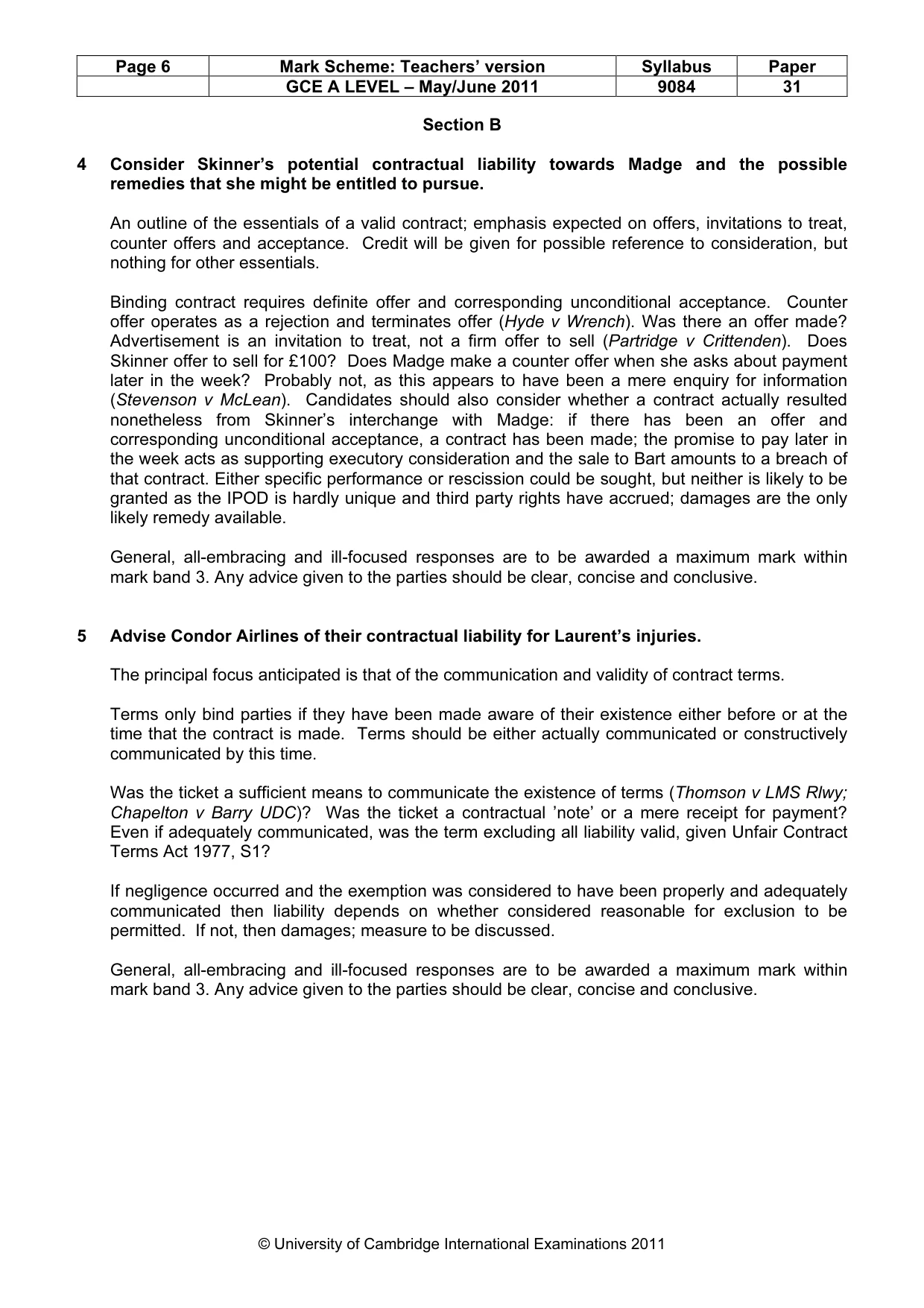
Page 6 Mark Scheme: Teachers’ version Syllabus Paper GCE A LEVEL – May/June 2011 9084 31 © University of Cambridge International Examinations 2011 Section B 4 Consider Skinner’s potential contractual liability towards Madge and the possible remedies that she might be entitled to pursue. An outline of the essentials of a valid contract; emphasis expected on offers, invitations to treat, counter offers and acceptance. Credit will be given for possible reference to consideration, but nothing for other essentials. Binding contract requires definite offer and corresponding unconditional acceptance. Counter offer operates as a rejection and terminates offer (Hyde v Wrench). Was there an offer made? Advertisement is an invitation to treat, not a firm offer to sell (Partridge v Crittenden). Does Skinner offer to sell for £100? Does Madge make a counter offer when she asks about payment later in the week? Probably not, as this appears to have been a mere enquiry for information (Stevenson v McLean). Candidates should also consider whether a contract actually resulted nonetheless from Skinner’s interchange with Madge: if there has been an offer and corresponding unconditional acceptance, a contract has been made; the promise to pay later in the week acts as supporting executory consideration and the sale to Bart amounts to a breach of that contract. Either specific performance or rescission could be sought, but neither is likely to be granted as the IPOD is hardly unique and third party rights have accrued; damages are the only likely remedy available. General, all-embracing and ill-focused responses are to be awarded a maximum mark within mark band 3. Any advice given to the parties should be clear, concise and conclusive. 5 Advise Condor Airlines of their contractual liability for Laurent’s injuries. The principal focus anticipated is that of the communication and validity of contract terms. Terms only bind parties if they have been made aware of their existence either before or at the time that the contract is made. Terms should be either actually communicated or constructively communicated by this time. Was the ticket a sufficient means to communicate the existence of terms (Thomson v LMS Rlwy; Chapelton v Barry UDC)? Was the ticket a contractual ’note’ or a mere receipt for payment? Even if adequately communicated, was the term excluding all liability valid, given Unfair Contract Terms Act 1977, S1? If negligence occurred and the exemption was considered to have been properly and adequately communicated then liability depends on whether considered reasonable for exclusion to be permitted. If not, then damages; measure to be discussed. General, all-embracing and ill-focused responses are to be awarded a maximum mark within mark band 3. Any advice given to the parties should be clear, concise and conclusive.
Mark scheme, page 7
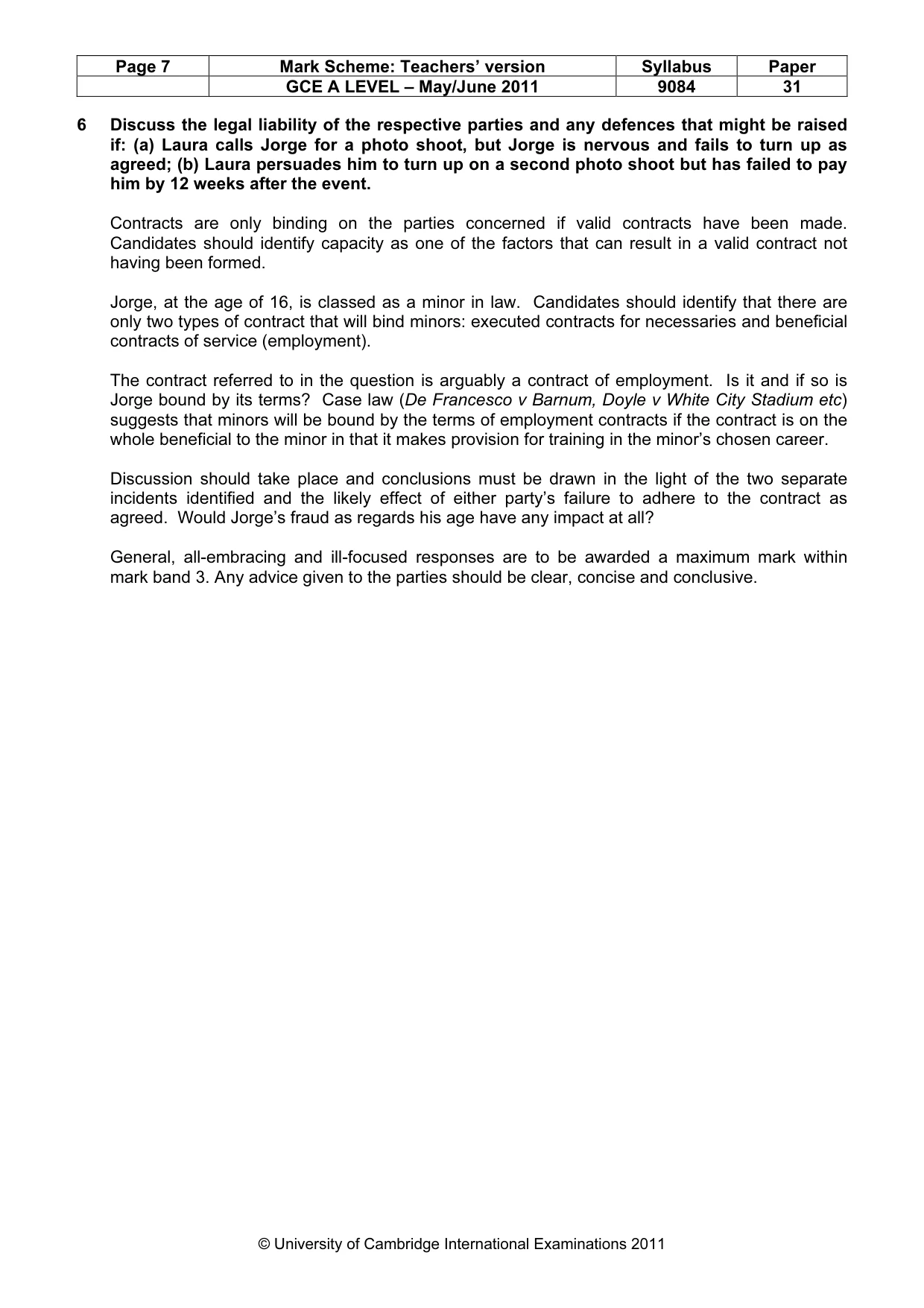
Page 7 Mark Scheme: Teachers’ version Syllabus Paper GCE A LEVEL – May/June 2011 9084 31 © University of Cambridge International Examinations 2011 6 Discuss the legal liability of the respective parties and any defences that might be raised if: (a) Laura calls Jorge for a photo shoot, but Jorge is nervous and fails to turn up as agreed; (b) Laura persuades him to turn up on a second photo shoot but has failed to pay him by 12 weeks after the event. Contracts are only binding on the parties concerned if valid contracts have been made. Candidates should identify capacity as one of the factors that can result in a valid contract not having been formed. Jorge, at the age of 16, is classed as a minor in law. Candidates should identify that there are only two types of contract that will bind minors: executed contracts for necessaries and beneficial contracts of service (employment). The contract referred to in the question is arguably a contract of employment. Is it and if so is Jorge bound by its terms? Case law (De Francesco v Barnum, Doyle v White City Stadium etc) suggests that minors will be bound by the terms of employment contracts if the contract is on the whole beneficial to the minor in that it makes provision for training in the minor’s chosen career. Discussion should take place and conclusions must be drawn in the light of the two separate incidents identified and the likely effect of either party’s failure to adhere to the contract as agreed. Would Jorge’s fraud as regards his age have any impact at all? General, all-embracing and ill-focused responses are to be awarded a maximum mark within mark band 3. Any advice given to the parties should be clear, concise and conclusive.
What you needed in this session
Cambridge’s own grade thresholds for 2011 May/June, Paper 3 · Variant 1. A higher threshold means an easier paper — the bar moves with how the cohort did.