Cambridge A Level Law 9084 — 2011 May/June Paper 1 · Variant 3
9084/13/M/J/11 · 75 marks · ≈84 min
The question paper and its mark scheme, free to read here and free to download. This is Cambridge’s own paper, exactly as it was sat.
Question paper2 pages
Mark scheme4 pages
Answers below. Sit the paper first if you are practising.
Paper as text
Question paper, page 1
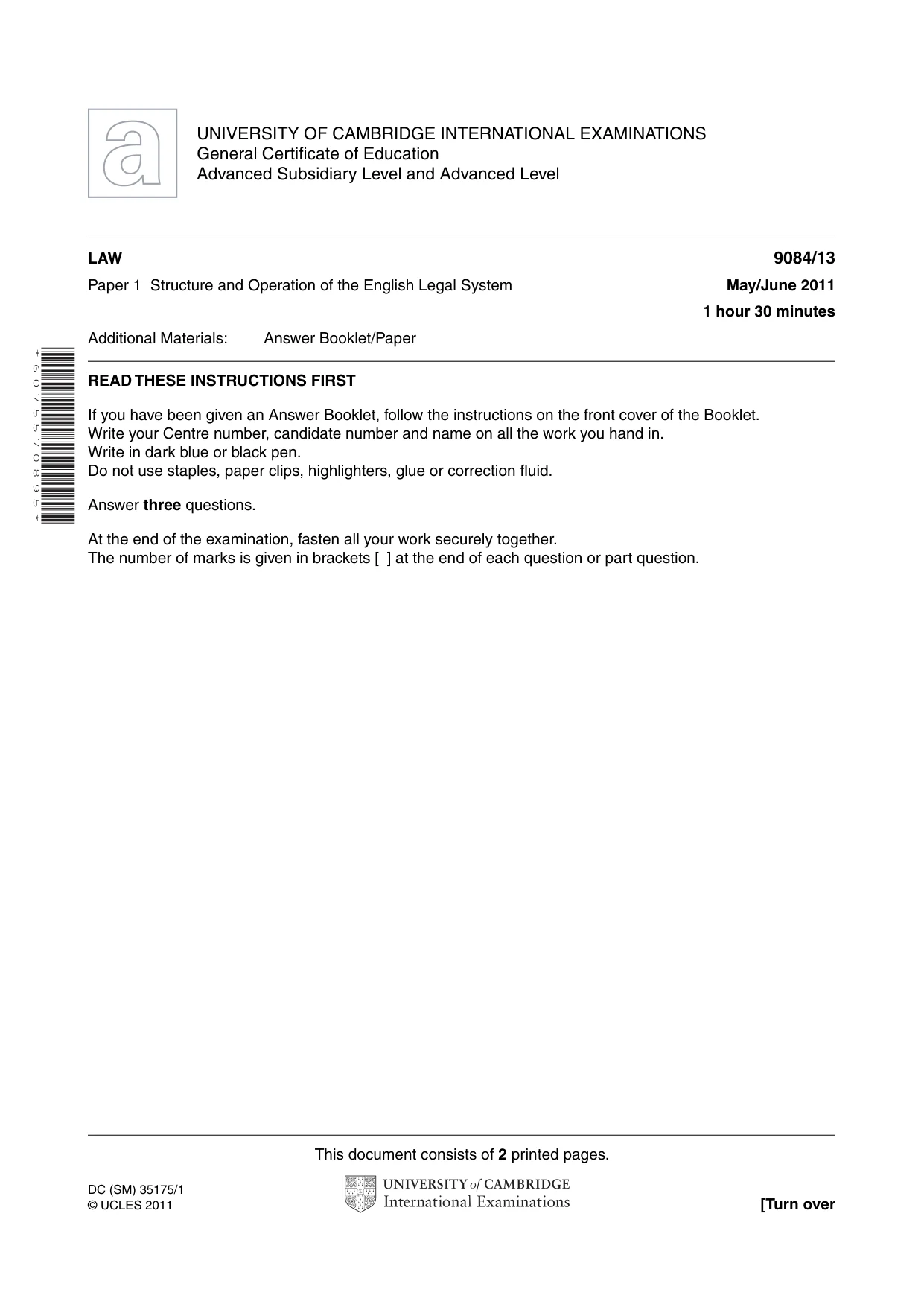
This document consists of 2 printed pages. DC (SM) 35175/1 © UCLES 2011 [Turn over UNIVERSITY OF CAMBRIDGE INTERNATIONAL EXAMINATIONS General Certificate of Education Advanced Subsidiary Level and Advanced Level * 6 0 7 5 5 7 0 8 9 5 * LAW 9084/13 Paper 1 Structure and Operation of the English Legal System May/June 2011 1 hour 30 minutes Additional Materials: Answer Booklet/Paper READ THESE INSTRUCTIONS FIRST If you have been given an Answer Booklet, follow the instructions on the front cover of the Booklet. Write your Centre number, candidate number and name on all the work you hand in. Write in dark blue or black pen. Do not use staples, paper clips, highlighters, glue or correction fluid. Answer three questions. At the end of the examination, fasten all your work securely together. The number of marks is given in brackets [ ] at the end of each question or part question.
Question paper, page 2
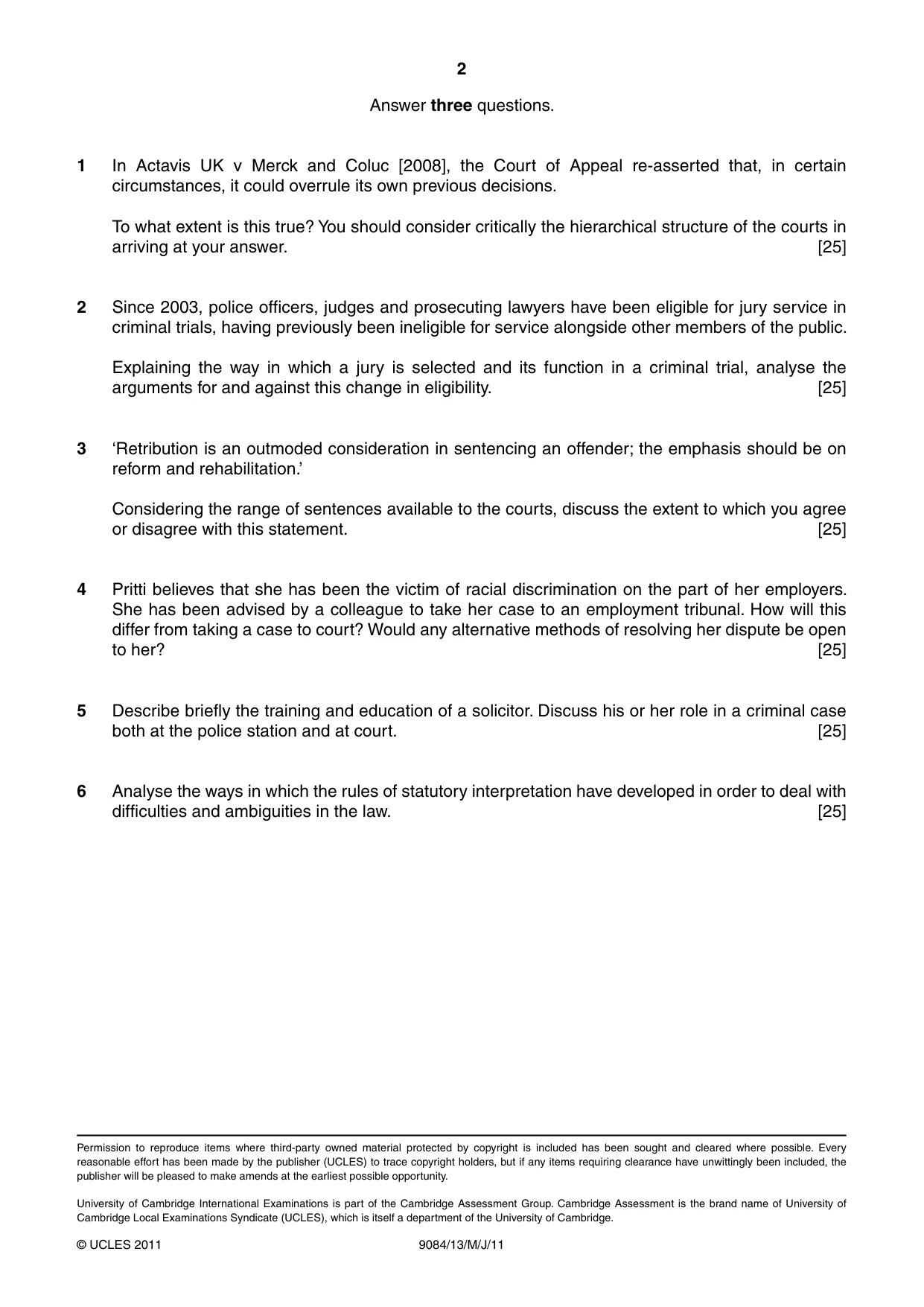
2 9084/13/M/J/11 © UCLES 2011 Permission to reproduce items where third-party owned material protected by copyright is included has been sought and cleared where possible. Every reasonable effort has been made by the publisher (UCLES) to trace copyright holders, but if any items requiring clearance have unwittingly been included, the publisher will be pleased to make amends at the earliest possible opportunity. University of Cambridge International Examinations is part of the Cambridge Assessment Group. Cambridge Assessment is the brand name of University of Cambridge Local Examinations Syndicate (UCLES), which is itself a department of the University of Cambridge. Answer three questions. 1 In Actavis UK v Merck and Coluc [2008], the Court of Appeal re-asserted that, in certain circumstances, it could overrule its own previous decisions. To what extent is this true? You should consider critically the hierarchical structure of the courts in arriving at your answer. [25] 2 Since 2003, police officers, judges and prosecuting lawyers have been eligible for jury service in criminal trials, having previously been ineligible for service alongside other members of the public. Explaining the way in which a jury is selected and its function in a criminal trial, analyse the arguments for and against this change in eligibility. [25] 3 ‘Retribution is an outmoded consideration in sentencing an offender; the emphasis should be on reform and rehabilitation.’ Considering the range of sentences available to the courts, discuss the extent to which you agree or disagree with this statement. [25] 4 Pritti believes that she has been the victim of racial discrimination on the part of her employers. She has been advised by a colleague to take her case to an employment tribunal. How will this differ from taking a case to court? Would any alternative methods of resolving her dispute be open to her? [25] 5 Describe briefly the training and education of a solicitor. Discuss his or her role in a criminal case both at the police station and at court. [25] 6 Analyse the ways in which the rules of statutory interpretation have developed in order to deal with difficulties and ambiguities in the law. [25]
Mark scheme, page 1
UNIVERSITY OF CAMBRIDGE INTERNATIONAL EXAMINATIONS GCE Advanced Subsidiary Level and GCE Advanced Level MARK SCHEME for the May/June 2011 question paper for the guidance of teachers 9084 LAW 9084/13 Paper 1, maximum raw mark 75 This mark scheme is published as an aid to teachers and candidates, to indicate the requirements of the examination. It shows the basis on which Examiners were instructed to award marks. It does not indicate the details of the discussions that took place at an Examiners’ meeting before marking began, which would have considered the acceptability of alternative answers. Mark schemes must be read in conjunction with the question papers and the report on the examination. • Cambridge will not enter into discussions or correspondence in connection with these mark schemes. Cambridge is publishing the mark schemes for the May/June 2011 question papers for most IGCSE, GCE Advanced Level and Advanced Subsidiary Level syllabuses and some Ordinary Level syllabuses.
Mark scheme, page 2
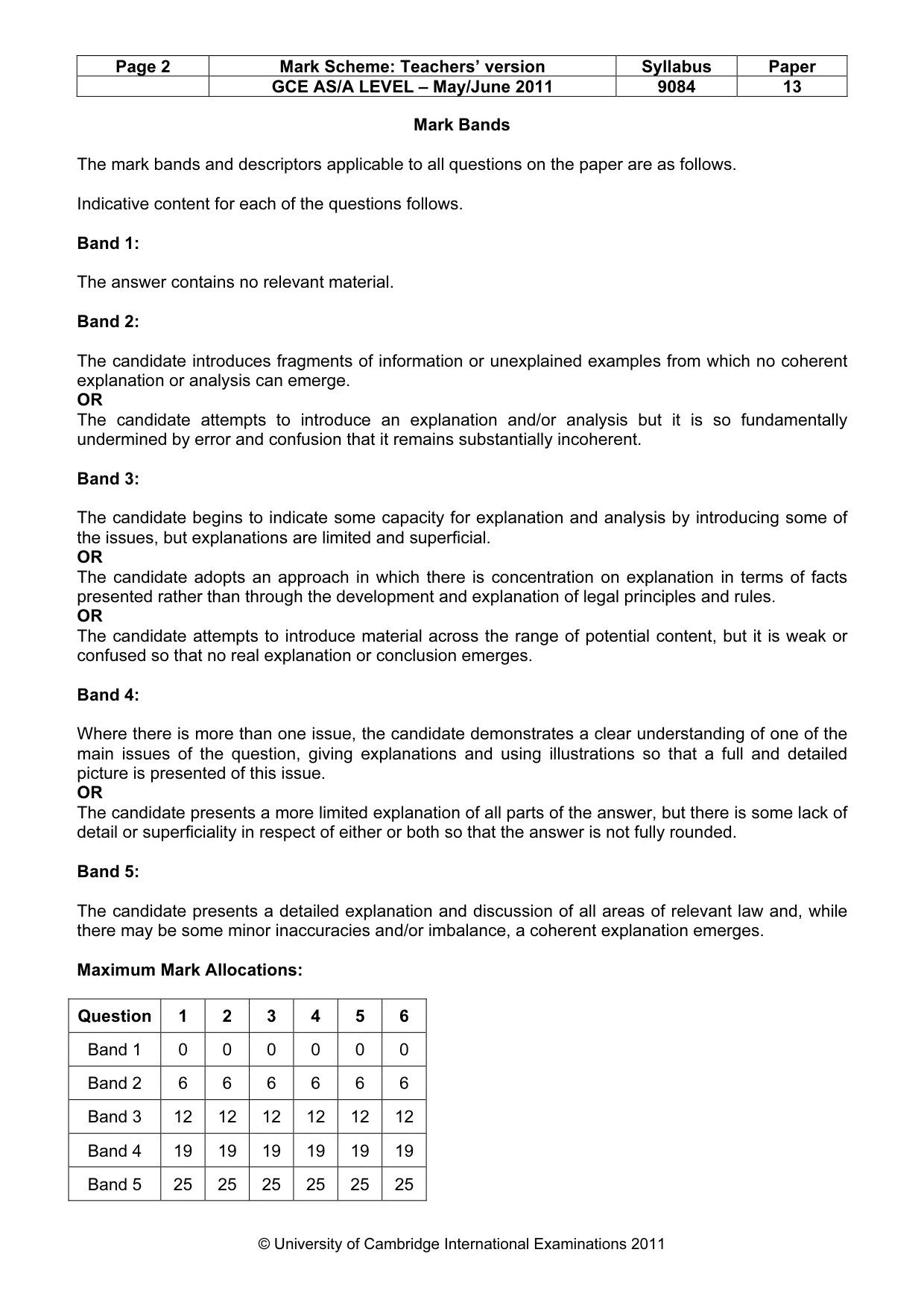
Page 2 Mark Scheme: Teachers’ version Syllabus Paper GCE AS/A LEVEL – May/June 2011 9084 13 © University of Cambridge International Examinations 2011 Mark Bands The mark bands and descriptors applicable to all questions on the paper are as follows. Indicative content for each of the questions follows. Band 1: The answer contains no relevant material. Band 2: The candidate introduces fragments of information or unexplained examples from which no coherent explanation or analysis can emerge. OR The candidate attempts to introduce an explanation and/or analysis but it is so fundamentally undermined by error and confusion that it remains substantially incoherent. Band 3: The candidate begins to indicate some capacity for explanation and analysis by introducing some of the issues, but explanations are limited and superficial. OR The candidate adopts an approach in which there is concentration on explanation in terms of facts presented rather than through the development and explanation of legal principles and rules. OR The candidate attempts to introduce material across the range of potential content, but it is weak or confused so that no real explanation or conclusion emerges. Band 4: Where there is more than one issue, the candidate demonstrates a clear understanding of one of the main issues of the question, giving explanations and using illustrations so that a full and detailed picture is presented of this issue. OR The candidate presents a more limited explanation of all parts of the answer, but there is some lack of detail or superficiality in respect of either or both so that the answer is not fully rounded. Band 5: The candidate presents a detailed explanation and discussion of all areas of relevant law and, while there may be some minor inaccuracies and/or imbalance, a coherent explanation emerges. Maximum Mark Allocations: Question 1 2 3 4 5 6 Band 1 0 0 0 0 0 0 Band 2 6 6 6 6 6 6 Band 3 12 12 12 12 12 12 Band 4 19 19 19 19 19 19 Band 5 25 25 25 25 25 25
Mark scheme, page 3
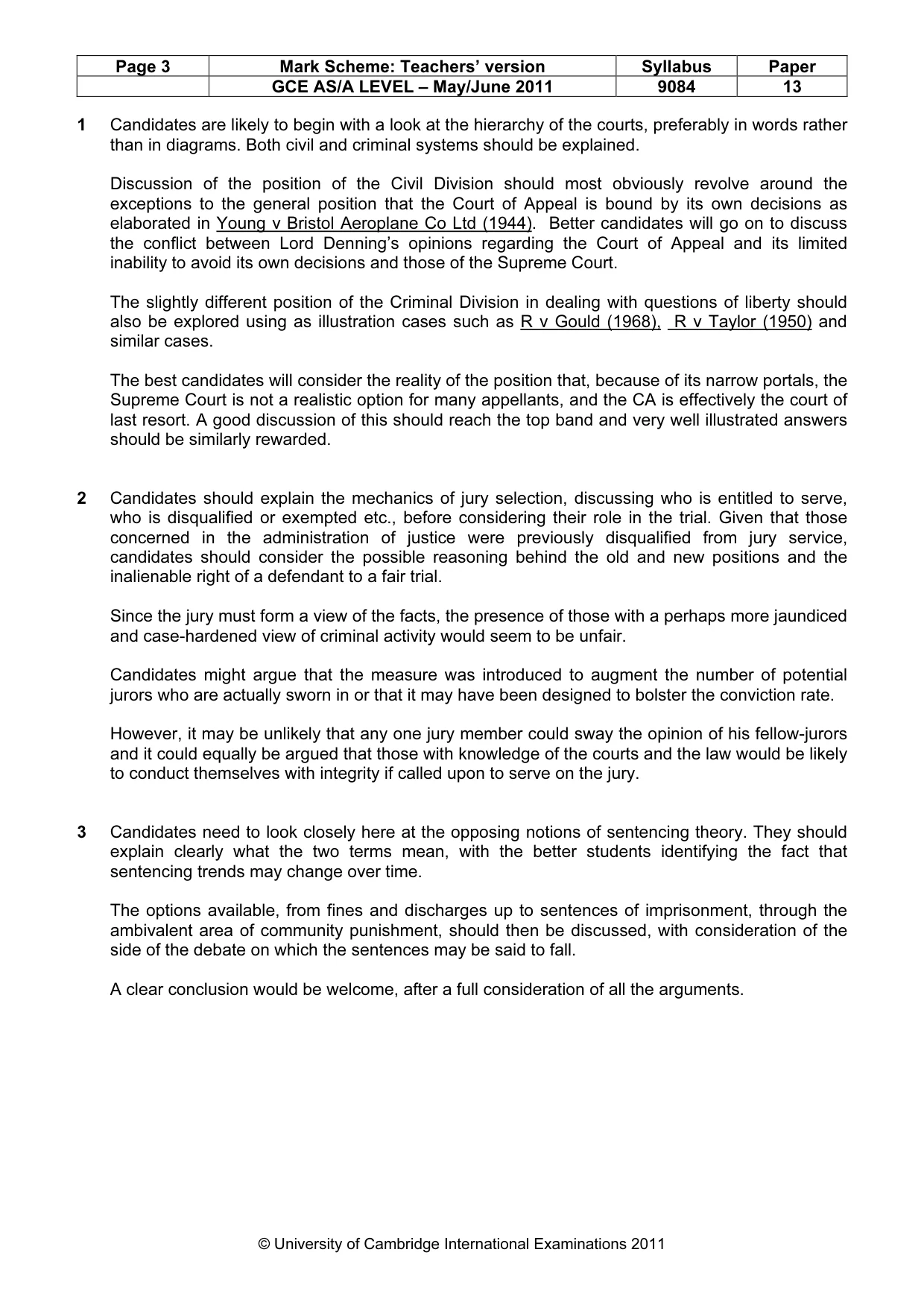
Page 3 Mark Scheme: Teachers’ version Syllabus Paper GCE AS/A LEVEL – May/June 2011 9084 13 © University of Cambridge International Examinations 2011 1 Candidates are likely to begin with a look at the hierarchy of the courts, preferably in words rather than in diagrams. Both civil and criminal systems should be explained. Discussion of the position of the Civil Division should most obviously revolve around the exceptions to the general position that the Court of Appeal is bound by its own decisions as elaborated in Young v Bristol Aeroplane Co Ltd (1944). Better candidates will go on to discuss the conflict between Lord Denning’s opinions regarding the Court of Appeal and its limited inability to avoid its own decisions and those of the Supreme Court. The slightly different position of the Criminal Division in dealing with questions of liberty should also be explored using as illustration cases such as R v Gould (1968), R v Taylor (1950) and similar cases. The best candidates will consider the reality of the position that, because of its narrow portals, the Supreme Court is not a realistic option for many appellants, and the CA is effectively the court of last resort. A good discussion of this should reach the top band and very well illustrated answers should be similarly rewarded. 2 Candidates should explain the mechanics of jury selection, discussing who is entitled to serve, who is disqualified or exempted etc., before considering their role in the trial. Given that those concerned in the administration of justice were previously disqualified from jury service, candidates should consider the possible reasoning behind the old and new positions and the inalienable right of a defendant to a fair trial. Since the jury must form a view of the facts, the presence of those with a perhaps more jaundiced and case-hardened view of criminal activity would seem to be unfair. Candidates might argue that the measure was introduced to augment the number of potential jurors who are actually sworn in or that it may have been designed to bolster the conviction rate. However, it may be unlikely that any one jury member could sway the opinion of his fellow-jurors and it could equally be argued that those with knowledge of the courts and the law would be likely to conduct themselves with integrity if called upon to serve on the jury. 3 Candidates need to look closely here at the opposing notions of sentencing theory. They should explain clearly what the two terms mean, with the better students identifying the fact that sentencing trends may change over time. The options available, from fines and discharges up to sentences of imprisonment, through the ambivalent area of community punishment, should then be discussed, with consideration of the side of the debate on which the sentences may be said to fall. A clear conclusion would be welcome, after a full consideration of all the arguments.
Mark scheme, page 4
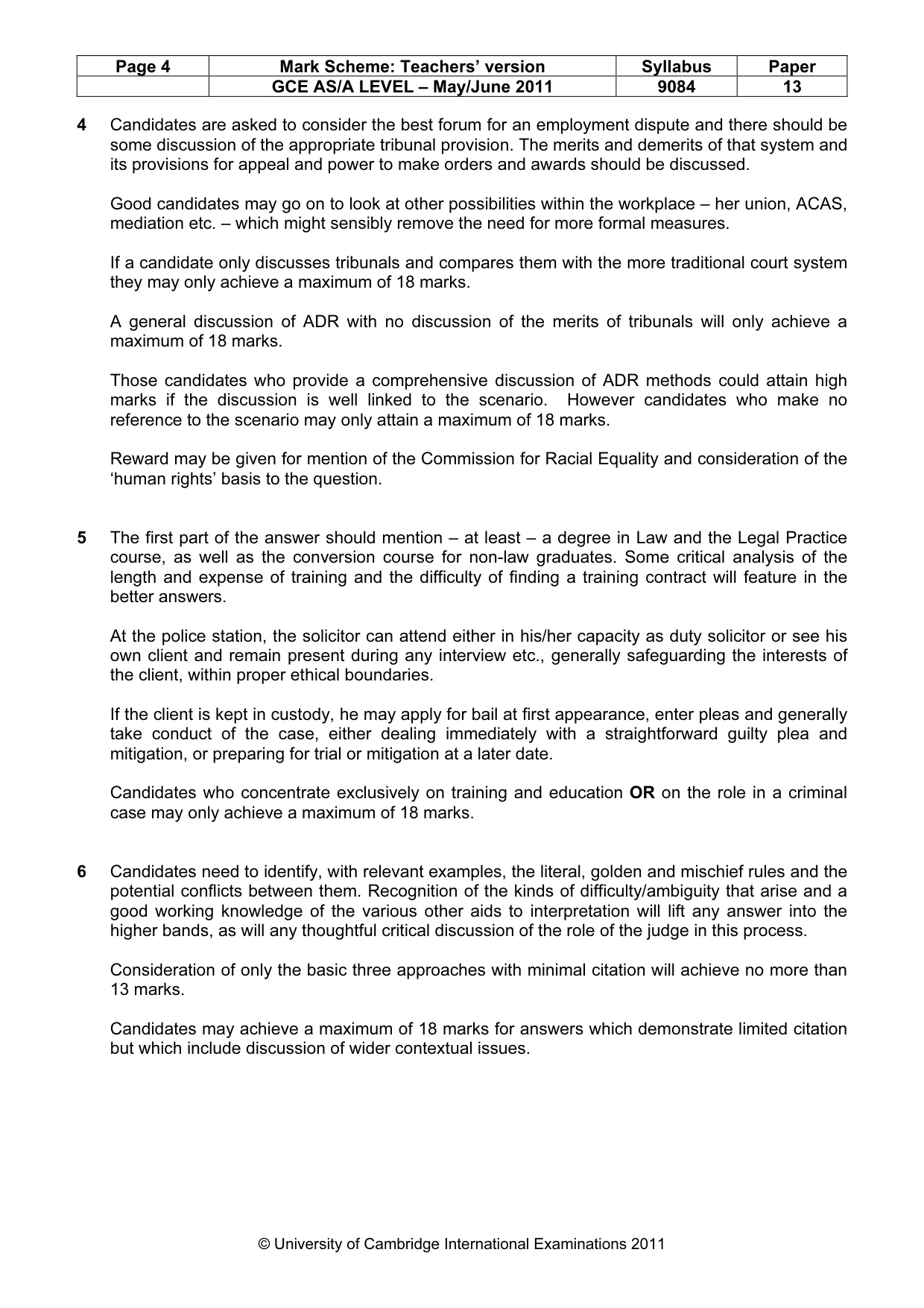
Page 4 Mark Scheme: Teachers’ version Syllabus Paper GCE AS/A LEVEL – May/June 2011 9084 13 © University of Cambridge International Examinations 2011 4 Candidates are asked to consider the best forum for an employment dispute and there should be some discussion of the appropriate tribunal provision. The merits and demerits of that system and its provisions for appeal and power to make orders and awards should be discussed. Good candidates may go on to look at other possibilities within the workplace – her union, ACAS, mediation etc. – which might sensibly remove the need for more formal measures. If a candidate only discusses tribunals and compares them with the more traditional court system they may only achieve a maximum of 18 marks. A general discussion of ADR with no discussion of the merits of tribunals will only achieve a maximum of 18 marks. Those candidates who provide a comprehensive discussion of ADR methods could attain high marks if the discussion is well linked to the scenario. However candidates who make no reference to the scenario may only attain a maximum of 18 marks. Reward may be given for mention of the Commission for Racial Equality and consideration of the ‘human rights’ basis to the question. 5 The first part of the answer should mention – at least – a degree in Law and the Legal Practice course, as well as the conversion course for non-law graduates. Some critical analysis of the length and expense of training and the difficulty of finding a training contract will feature in the better answers. At the police station, the solicitor can attend either in his/her capacity as duty solicitor or see his own client and remain present during any interview etc., generally safeguarding the interests of the client, within proper ethical boundaries. If the client is kept in custody, he may apply for bail at first appearance, enter pleas and generally take conduct of the case, either dealing immediately with a straightforward guilty plea and mitigation, or preparing for trial or mitigation at a later date. Candidates who concentrate exclusively on training and education OR on the role in a criminal case may only achieve a maximum of 18 marks. 6 Candidates need to identify, with relevant examples, the literal, golden and mischief rules and the potential conflicts between them. Recognition of the kinds of difficulty/ambiguity that arise and a good working knowledge of the various other aids to interpretation will lift any answer into the higher bands, as will any thoughtful critical discussion of the role of the judge in this process. Consideration of only the basic three approaches with minimal citation will achieve no more than 13 marks. Candidates may achieve a maximum of 18 marks for answers which demonstrate limited citation but which include discussion of wider contextual issues.
What you needed in this session
Cambridge’s own grade thresholds for 2011 May/June, Paper 1 · Variant 3. A higher threshold means an easier paper — the bar moves with how the cohort did.