Cambridge A Level Law 9084 — 2011 May/June Paper 1 · Variant 2
9084/12/M/J/11 · 75 marks · ≈84 min
The question paper and its mark scheme, free to read here and free to download. This is Cambridge’s own paper, exactly as it was sat.
Question paper2 pages
Mark scheme4 pages
Answers below. Sit the paper first if you are practising.
Paper as text
Question paper, page 1
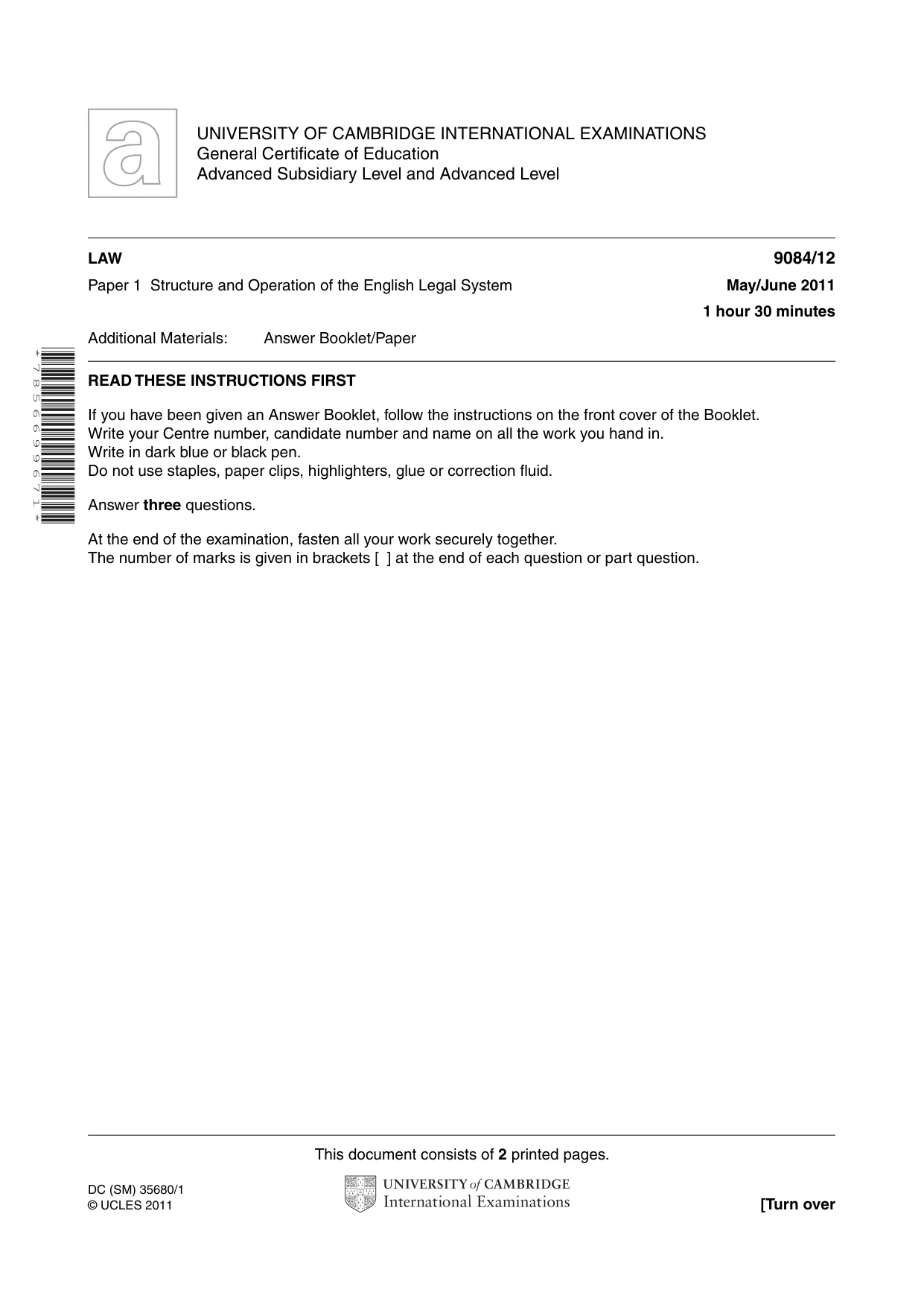
This document consists of 2 printed pages. DC (SM) 35680/1 © UCLES 2011 [Turn over UNIVERSITY OF CAMBRIDGE INTERNATIONAL EXAMINATIONS General Certificate of Education Advanced Subsidiary Level and Advanced Level * 7 8 5 6 6 9 9 6 7 1 * LAW 9084/12 Paper 1 Structure and Operation of the English Legal System May/June 2011 1 hour 30 minutes Additional Materials: Answer Booklet/Paper READ THESE INSTRUCTIONS FIRST If you have been given an Answer Booklet, follow the instructions on the front cover of the Booklet. Write your Centre number, candidate number and name on all the work you hand in. Write in dark blue or black pen. Do not use staples, paper clips, highlighters, glue or correction fluid. Answer three questions. At the end of the examination, fasten all your work securely together. The number of marks is given in brackets [ ] at the end of each question or part question.
Question paper, page 2
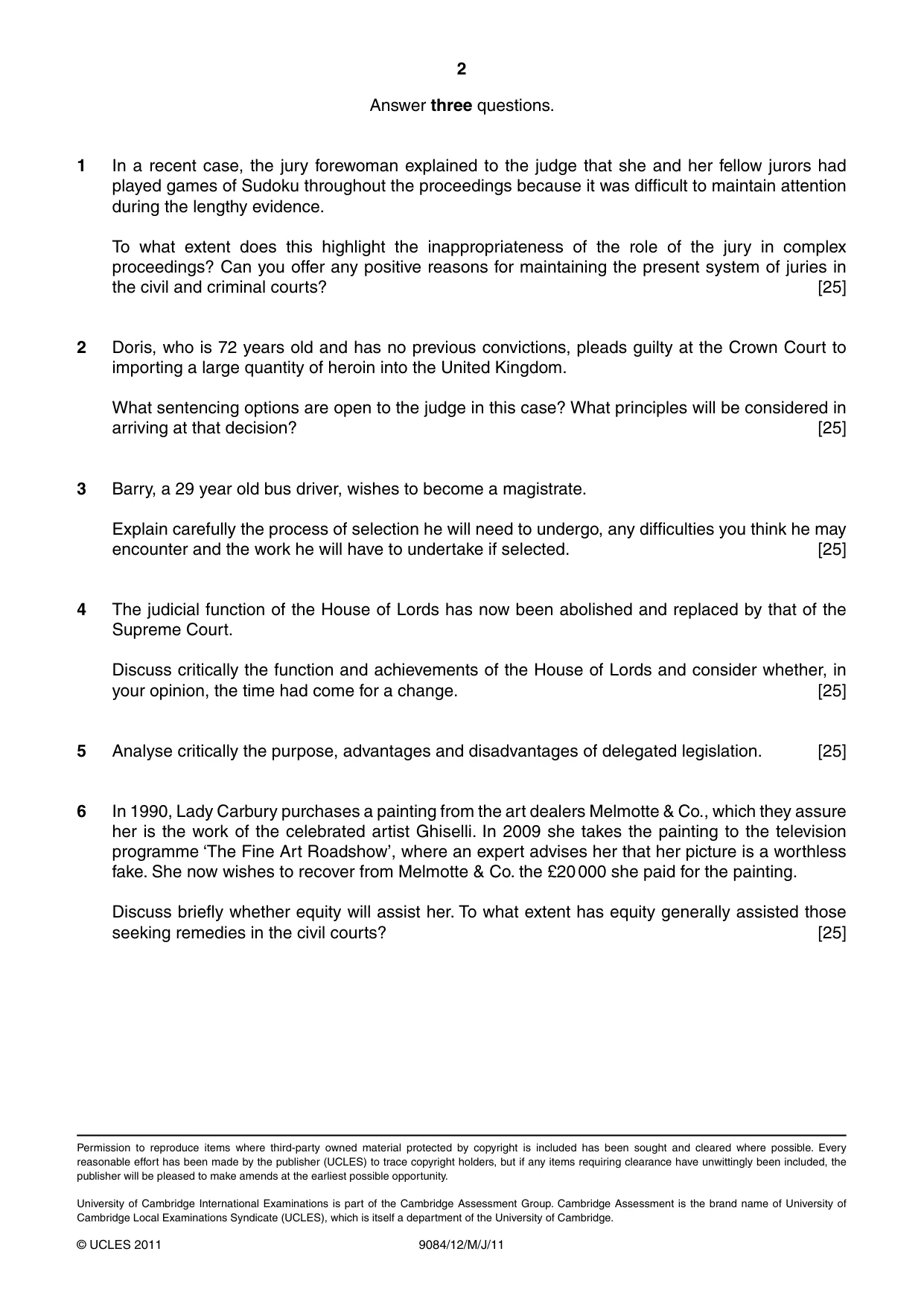
2 9084/12/M/J/11 © UCLES 2011 Permission to reproduce items where third-party owned material protected by copyright is included has been sought and cleared where possible. Every reasonable effort has been made by the publisher (UCLES) to trace copyright holders, but if any items requiring clearance have unwittingly been included, the publisher will be pleased to make amends at the earliest possible opportunity. University of Cambridge International Examinations is part of the Cambridge Assessment Group. Cambridge Assessment is the brand name of University of Cambridge Local Examinations Syndicate (UCLES), which is itself a department of the University of Cambridge. Answer three questions. 1 In a recent case, the jury forewoman explained to the judge that she and her fellow jurors had played games of Sudoku throughout the proceedings because it was difficult to maintain attention during the lengthy evidence. To what extent does this highlight the inappropriateness of the role of the jury in complex proceedings? Can you offer any positive reasons for maintaining the present system of juries in the civil and criminal courts? [25] 2 Doris, who is 72 years old and has no previous convictions, pleads guilty at the Crown Court to importing a large quantity of heroin into the United Kingdom. What sentencing options are open to the judge in this case? What principles will be considered in arriving at that decision? [25] 3 Barry, a 29 year old bus driver, wishes to become a magistrate. Explain carefully the process of selection he will need to undergo, any difficulties you think he may encounter and the work he will have to undertake if selected. [25] 4 The judicial function of the House of Lords has now been abolished and replaced by that of the Supreme Court. Discuss critically the function and achievements of the House of Lords and consider whether, in your opinion, the time had come for a change. [25] 5 Analyse critically the purpose, advantages and disadvantages of delegated legislation. [25] 6 In 1990, Lady Carbury purchases a painting from the art dealers Melmotte & Co., which they assure her is the work of the celebrated artist Ghiselli. In 2009 she takes the painting to the television programme ‘The Fine Art Roadshow’, where an expert advises her that her picture is a worthless fake. She now wishes to recover from Melmotte & Co. the £20 000 she paid for the painting. Discuss briefly whether equity will assist her. To what extent has equity generally assisted those seeking remedies in the civil courts? [25]
Mark scheme, page 1
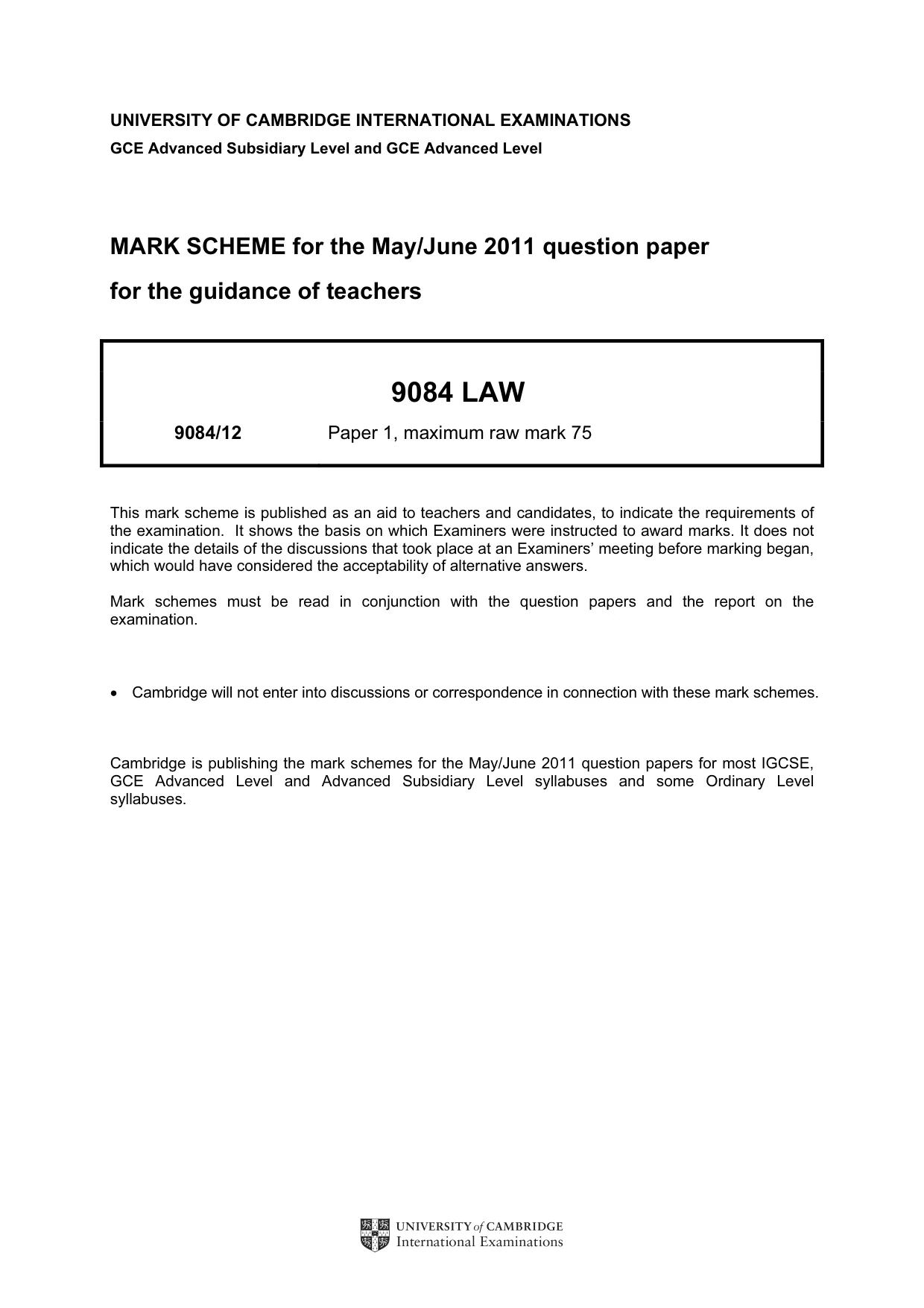
UNIVERSITY OF CAMBRIDGE INTERNATIONAL EXAMINATIONS GCE Advanced Subsidiary Level and GCE Advanced Level MARK SCHEME for the May/June 2011 question paper for the guidance of teachers 9084 LAW 9084/12 Paper 1, maximum raw mark 75 This mark scheme is published as an aid to teachers and candidates, to indicate the requirements of the examination. It shows the basis on which Examiners were instructed to award marks. It does not indicate the details of the discussions that took place at an Examiners’ meeting before marking began, which would have considered the acceptability of alternative answers. Mark schemes must be read in conjunction with the question papers and the report on the examination. • Cambridge will not enter into discussions or correspondence in connection with these mark schemes. Cambridge is publishing the mark schemes for the May/June 2011 question papers for most IGCSE, GCE Advanced Level and Advanced Subsidiary Level syllabuses and some Ordinary Level syllabuses.
Mark scheme, page 2
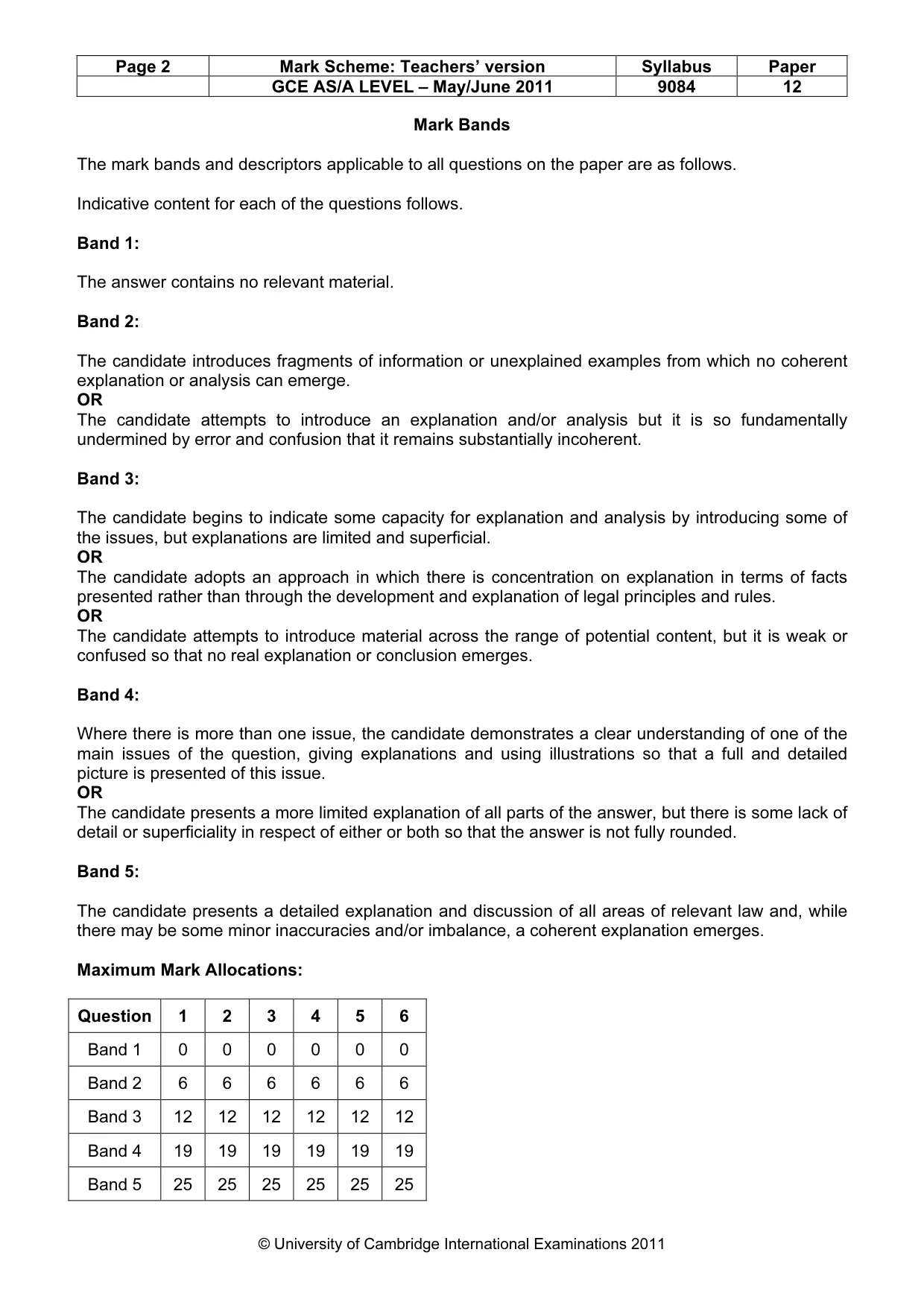
Page 2 Mark Scheme: Teachers’ version Syllabus Paper GCE AS/A LEVEL – May/June 2011 9084 12 © University of Cambridge International Examinations 2011 Mark Bands The mark bands and descriptors applicable to all questions on the paper are as follows. Indicative content for each of the questions follows. Band 1: The answer contains no relevant material. Band 2: The candidate introduces fragments of information or unexplained examples from which no coherent explanation or analysis can emerge. OR The candidate attempts to introduce an explanation and/or analysis but it is so fundamentally undermined by error and confusion that it remains substantially incoherent. Band 3: The candidate begins to indicate some capacity for explanation and analysis by introducing some of the issues, but explanations are limited and superficial. OR The candidate adopts an approach in which there is concentration on explanation in terms of facts presented rather than through the development and explanation of legal principles and rules. OR The candidate attempts to introduce material across the range of potential content, but it is weak or confused so that no real explanation or conclusion emerges. Band 4: Where there is more than one issue, the candidate demonstrates a clear understanding of one of the main issues of the question, giving explanations and using illustrations so that a full and detailed picture is presented of this issue. OR The candidate presents a more limited explanation of all parts of the answer, but there is some lack of detail or superficiality in respect of either or both so that the answer is not fully rounded. Band 5: The candidate presents a detailed explanation and discussion of all areas of relevant law and, while there may be some minor inaccuracies and/or imbalance, a coherent explanation emerges. Maximum Mark Allocations: Question 1 2 3 4 5 6 Band 1 0 0 0 0 0 0 Band 2 6 6 6 6 6 6 Band 3 12 12 12 12 12 12 Band 4 19 19 19 19 19 19 Band 5 25 25 25 25 25 25
Mark scheme, page 3
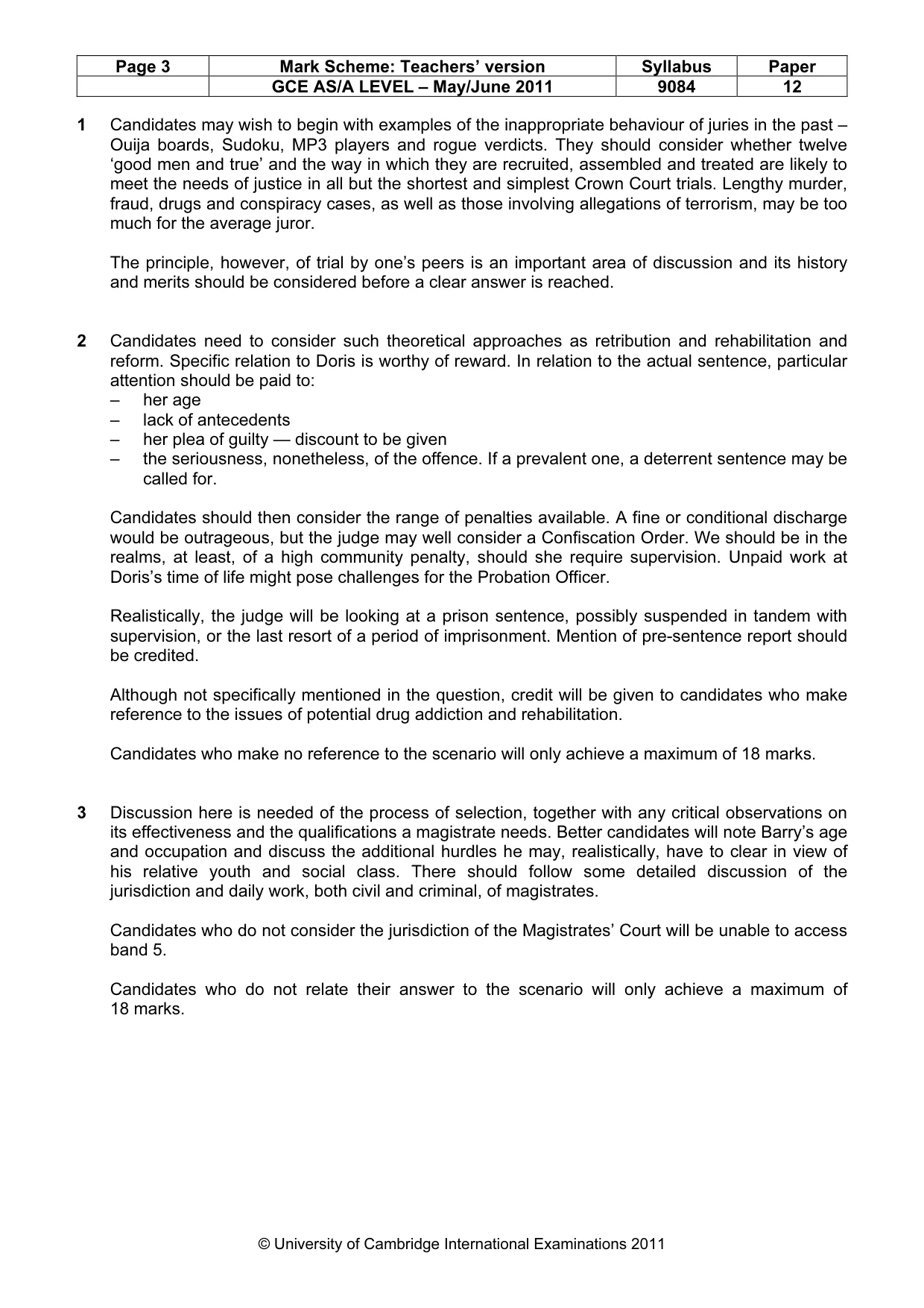
Page 3 Mark Scheme: Teachers’ version Syllabus Paper GCE AS/A LEVEL – May/June 2011 9084 12 © University of Cambridge International Examinations 2011 1 Candidates may wish to begin with examples of the inappropriate behaviour of juries in the past – Ouija boards, Sudoku, MP3 players and rogue verdicts. They should consider whether twelve ‘good men and true’ and the way in which they are recruited, assembled and treated are likely to meet the needs of justice in all but the shortest and simplest Crown Court trials. Lengthy murder, fraud, drugs and conspiracy cases, as well as those involving allegations of terrorism, may be too much for the average juror. The principle, however, of trial by one’s peers is an important area of discussion and its history and merits should be considered before a clear answer is reached. 2 Candidates need to consider such theoretical approaches as retribution and rehabilitation and reform. Specific relation to Doris is worthy of reward. In relation to the actual sentence, particular attention should be paid to: – her age – lack of antecedents – her plea of guilty — discount to be given – the seriousness, nonetheless, of the offence. If a prevalent one, a deterrent sentence may be called for. Candidates should then consider the range of penalties available. A fine or conditional discharge would be outrageous, but the judge may well consider a Confiscation Order. We should be in the realms, at least, of a high community penalty, should she require supervision. Unpaid work at Doris’s time of life might pose challenges for the Probation Officer. Realistically, the judge will be looking at a prison sentence, possibly suspended in tandem with supervision, or the last resort of a period of imprisonment. Mention of pre-sentence report should be credited. Although not specifically mentioned in the question, credit will be given to candidates who make reference to the issues of potential drug addiction and rehabilitation. Candidates who make no reference to the scenario will only achieve a maximum of 18 marks. 3 Discussion here is needed of the process of selection, together with any critical observations on its effectiveness and the qualifications a magistrate needs. Better candidates will note Barry’s age and occupation and discuss the additional hurdles he may, realistically, have to clear in view of his relative youth and social class. There should follow some detailed discussion of the jurisdiction and daily work, both civil and criminal, of magistrates. Candidates who do not consider the jurisdiction of the Magistrates’ Court will be unable to access band 5. Candidates who do not relate their answer to the scenario will only achieve a maximum of 18 marks.
Mark scheme, page 4
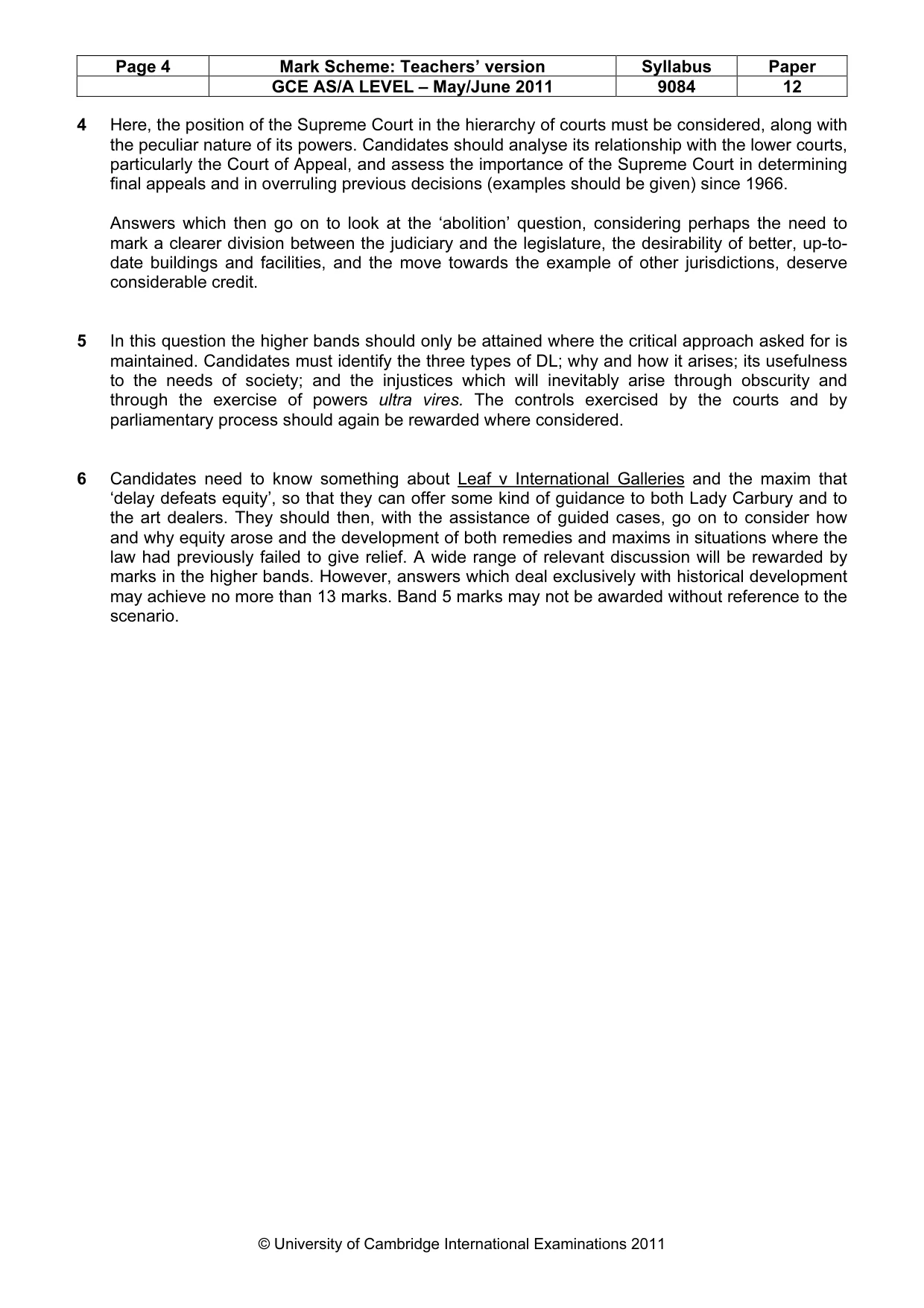
Page 4 Mark Scheme: Teachers’ version Syllabus Paper GCE AS/A LEVEL – May/June 2011 9084 12 © University of Cambridge International Examinations 2011 4 Here, the position of the Supreme Court in the hierarchy of courts must be considered, along with the peculiar nature of its powers. Candidates should analyse its relationship with the lower courts, particularly the Court of Appeal, and assess the importance of the Supreme Court in determining final appeals and in overruling previous decisions (examples should be given) since 1966. Answers which then go on to look at the ‘abolition’ question, considering perhaps the need to mark a clearer division between the judiciary and the legislature, the desirability of better, up-to- date buildings and facilities, and the move towards the example of other jurisdictions, deserve considerable credit. 5 In this question the higher bands should only be attained where the critical approach asked for is maintained. Candidates must identify the three types of DL; why and how it arises; its usefulness to the needs of society; and the injustices which will inevitably arise through obscurity and through the exercise of powers ultra vires. The controls exercised by the courts and by parliamentary process should again be rewarded where considered. 6 Candidates need to know something about Leaf v International Galleries and the maxim that ‘delay defeats equity’, so that they can offer some kind of guidance to both Lady Carbury and to the art dealers. They should then, with the assistance of guided cases, go on to consider how and why equity arose and the development of both remedies and maxims in situations where the law had previously failed to give relief. A wide range of relevant discussion will be rewarded by marks in the higher bands. However, answers which deal exclusively with historical development may achieve no more than 13 marks. Band 5 marks may not be awarded without reference to the scenario.
What you needed in this session
Cambridge’s own grade thresholds for 2011 May/June, Paper 1 · Variant 2. A higher threshold means an easier paper — the bar moves with how the cohort did.