Cambridge A Level Law 9084 — 2011 May/June Paper 1 · Variant 1
9084/11/M/J/11 · 75 marks · ≈84 min
The question paper and its mark scheme, free to read here and free to download. This is Cambridge’s own paper, exactly as it was sat.
Question paper2 pages
Mark scheme4 pages
Answers below. Sit the paper first if you are practising.

Paper as text
Question paper, page 1
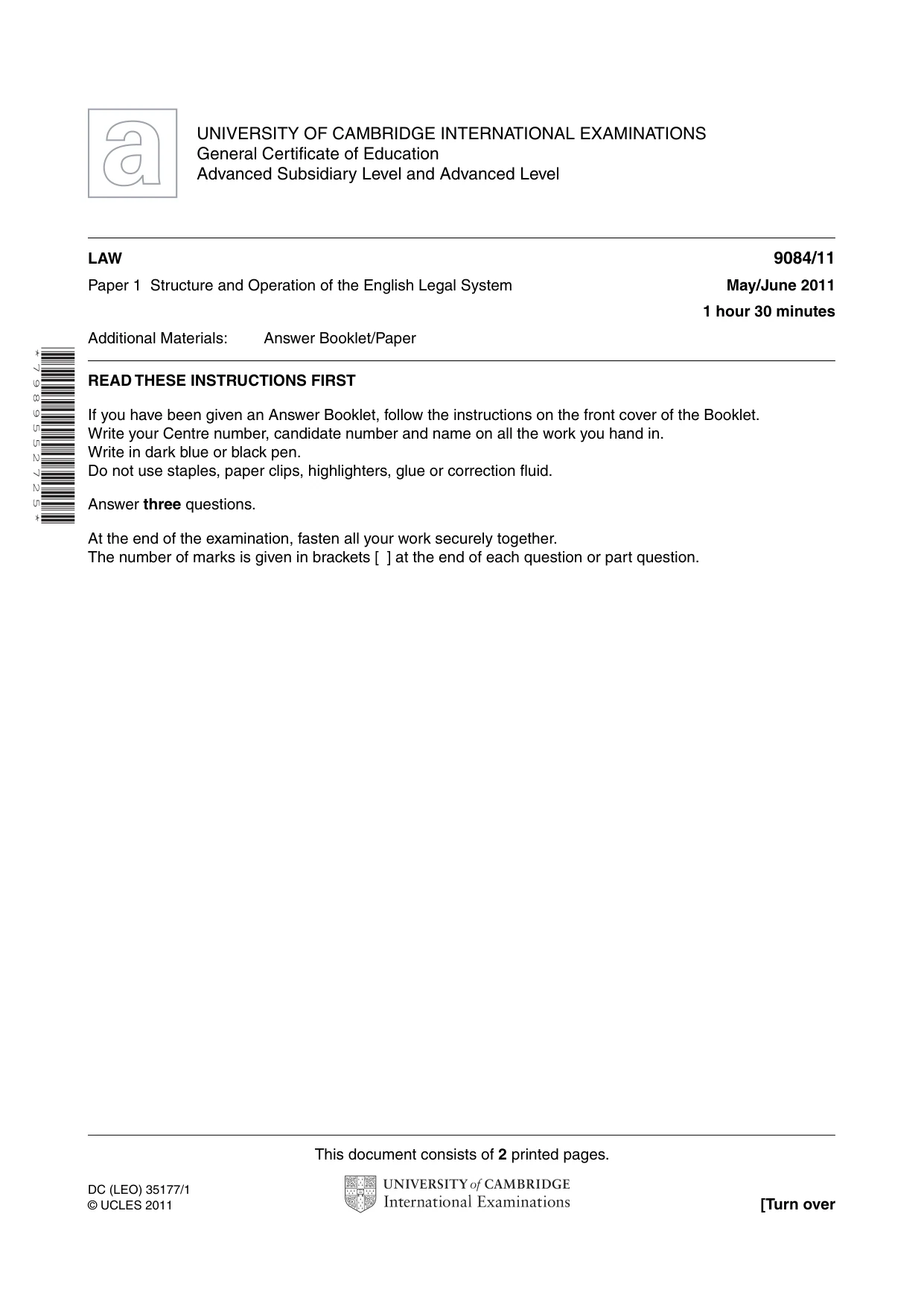
This document consists of 2 printed pages. DC (LEO) 35177/1 © UCLES 2011 [Turn over UNIVERSITY OF CAMBRIDGE INTERNATIONAL EXAMINATIONS General Certificate of Education Advanced Subsidiary Level and Advanced Level READ THESE INSTRUCTIONS FIRST If you have been given an Answer Booklet, follow the instructions on the front cover of the Booklet. Write your Centre number, candidate number and name on all the work you hand in. Write in dark blue or black pen. Do not use staples, paper clips, highlighters, glue or correction fluid. Answer three questions. At the end of the examination, fasten all your work securely together. The number of marks is given in brackets [ ] at the end of each question or part question. * 7 9 8 9 5 5 2 7 2 5 * LAW 9084/11 Paper 1 Structure and Operation of the English Legal System May/June 2011 1 hour 30 minutes Additional Materials: Answer Booklet/Paper
Question paper, page 2
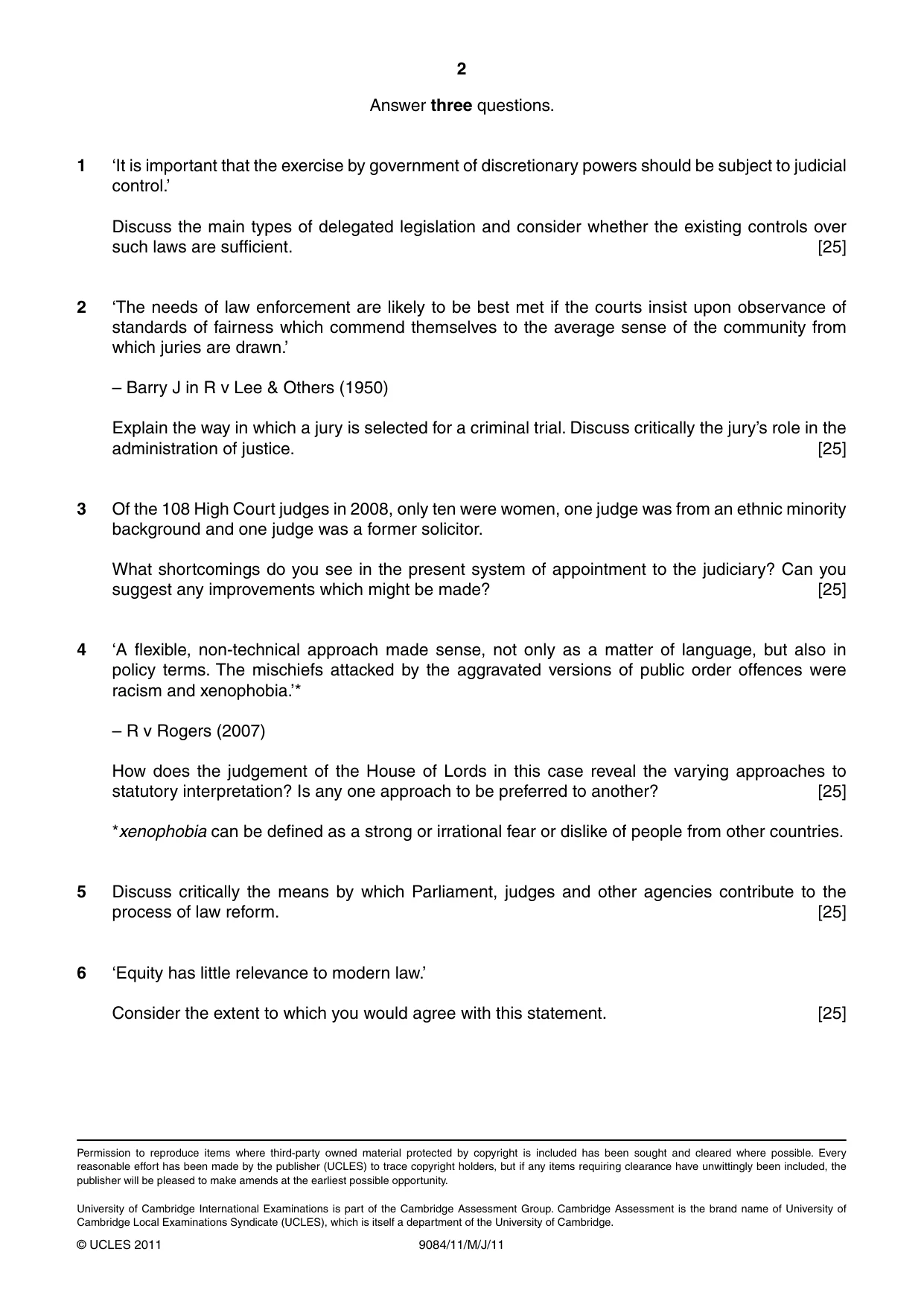
2 9084/11/M/J/11 © UCLES 2011 Answer three questions. 1 ‘It is important that the exercise by government of discretionary powers should be subject to judicial control.’ Discuss the main types of delegated legislation and consider whether the existing controls over such laws are sufficient. [25] 2 ‘The needs of law enforcement are likely to be best met if the courts insist upon observance of standards of fairness which commend themselves to the average sense of the community from which juries are drawn.’ – Barry J in R v Lee & Others (1950) Explain the way in which a jury is selected for a criminal trial. Discuss critically the jury’s role in the administration of justice. [25] 3 Of the 108 High Court judges in 2008, only ten were women, one judge was from an ethnic minority background and one judge was a former solicitor. What shortcomings do you see in the present system of appointment to the judiciary? Can you suggest any improvements which might be made? [25] 4 ‘A flexible, non-technical approach made sense, not only as a matter of language, but also in policy terms. The mischiefs attacked by the aggravated versions of public order offences were racism and xenophobia.’* – R v Rogers (2007) How does the judgement of the House of Lords in this case reveal the varying approaches to statutory interpretation? Is any one approach to be preferred to another? [25] *xenophobia can be defined as a strong or irrational fear or dislike of people from other countries. 5 Discuss critically the means by which Parliament, judges and other agencies contribute to the process of law reform. [25] 6 ‘Equity has little relevance to modern law.’ Consider the extent to which you would agree with this statement. [25] Permission to reproduce items where third-party owned material protected by copyright is included has been sought and cleared where possible. Every reasonable effort has been made by the publisher (UCLES) to trace copyright holders, but if any items requiring clearance have unwittingly been included, the publisher will be pleased to make amends at the earliest possible opportunity. University of Cambridge International Examinations is part of the Cambridge Assessment Group. Cambridge Assessment is the brand name of University of Cambridge Local Examinations Syndicate (UCLES), which is itself a department of the University of Cambridge.
Mark scheme, page 1
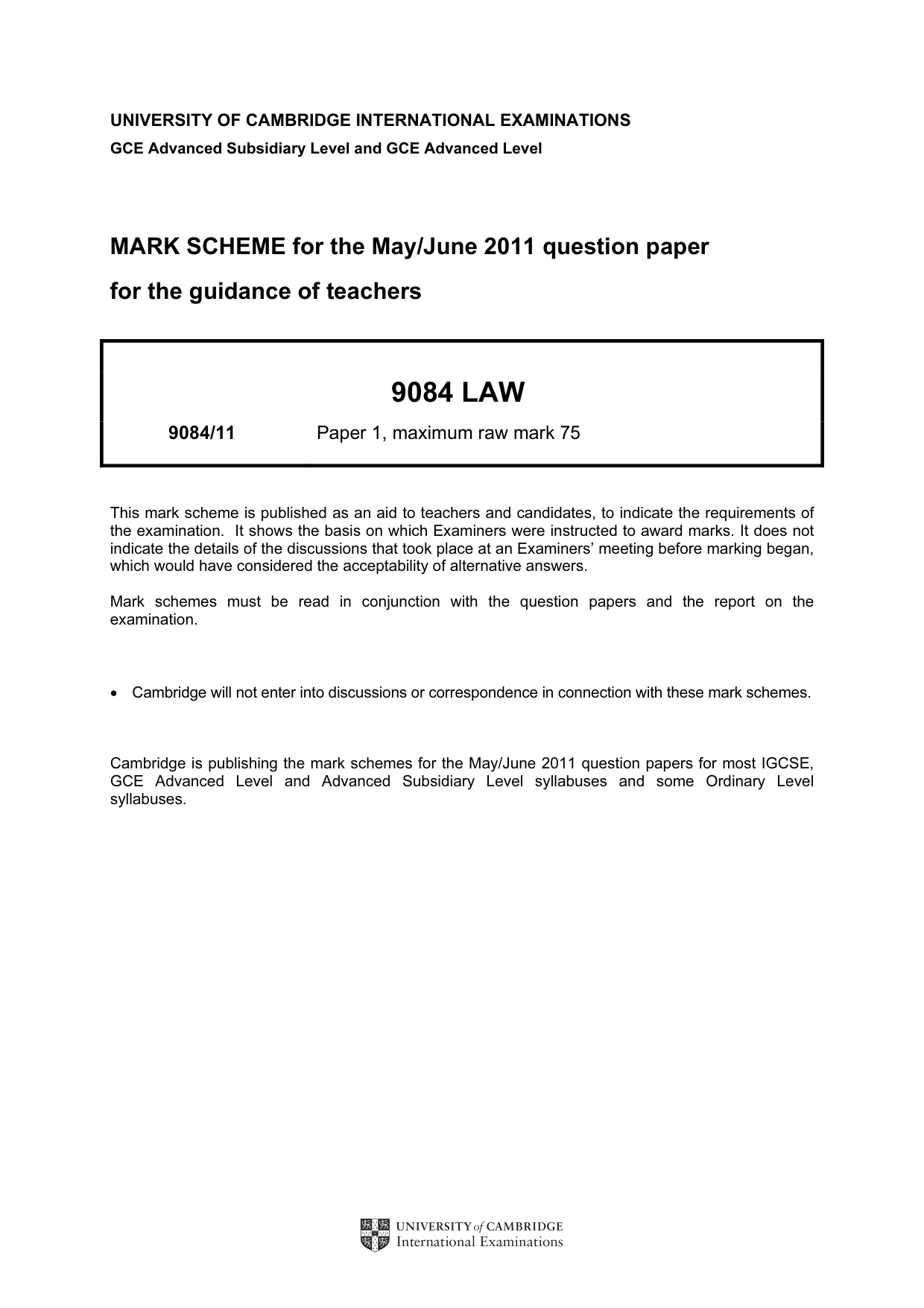
UNIVERSITY OF CAMBRIDGE INTERNATIONAL EXAMINATIONS GCE Advanced Subsidiary Level and GCE Advanced Level MARK SCHEME for the May/June 2011 question paper for the guidance of teachers 9084 LAW 9084/11 Paper 1, maximum raw mark 75 This mark scheme is published as an aid to teachers and candidates, to indicate the requirements of the examination. It shows the basis on which Examiners were instructed to award marks. It does not indicate the details of the discussions that took place at an Examiners’ meeting before marking began, which would have considered the acceptability of alternative answers. Mark schemes must be read in conjunction with the question papers and the report on the examination. • Cambridge will not enter into discussions or correspondence in connection with these mark schemes. Cambridge is publishing the mark schemes for the May/June 2011 question papers for most IGCSE, GCE Advanced Level and Advanced Subsidiary Level syllabuses and some Ordinary Level syllabuses.
Mark scheme, page 2
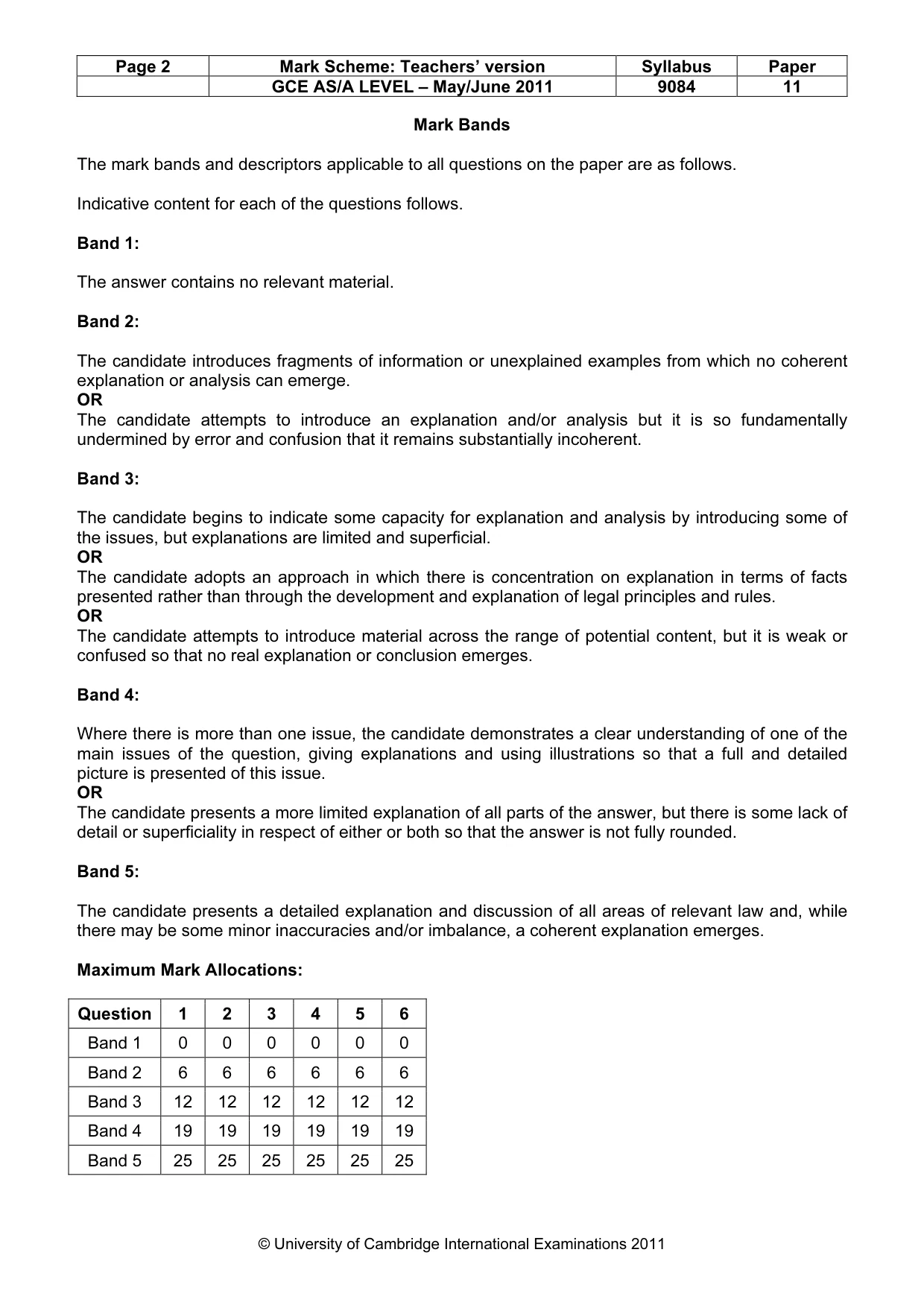
Page 2 Mark Scheme: Teachers’ version Syllabus Paper GCE AS/A LEVEL – May/June 2011 9084 11 © University of Cambridge International Examinations 2011 Mark Bands The mark bands and descriptors applicable to all questions on the paper are as follows. Indicative content for each of the questions follows. Band 1: The answer contains no relevant material. Band 2: The candidate introduces fragments of information or unexplained examples from which no coherent explanation or analysis can emerge. OR The candidate attempts to introduce an explanation and/or analysis but it is so fundamentally undermined by error and confusion that it remains substantially incoherent. Band 3: The candidate begins to indicate some capacity for explanation and analysis by introducing some of the issues, but explanations are limited and superficial. OR The candidate adopts an approach in which there is concentration on explanation in terms of facts presented rather than through the development and explanation of legal principles and rules. OR The candidate attempts to introduce material across the range of potential content, but it is weak or confused so that no real explanation or conclusion emerges. Band 4: Where there is more than one issue, the candidate demonstrates a clear understanding of one of the main issues of the question, giving explanations and using illustrations so that a full and detailed picture is presented of this issue. OR The candidate presents a more limited explanation of all parts of the answer, but there is some lack of detail or superficiality in respect of either or both so that the answer is not fully rounded. Band 5: The candidate presents a detailed explanation and discussion of all areas of relevant law and, while there may be some minor inaccuracies and/or imbalance, a coherent explanation emerges. Maximum Mark Allocations: Question 1 2 3 4 5 6 Band 1 0 0 0 0 0 0 Band 2 6 6 6 6 6 6 Band 3 12 12 12 12 12 12 Band 4 19 19 19 19 19 19 Band 5 25 25 25 25 25 25
Mark scheme, page 3
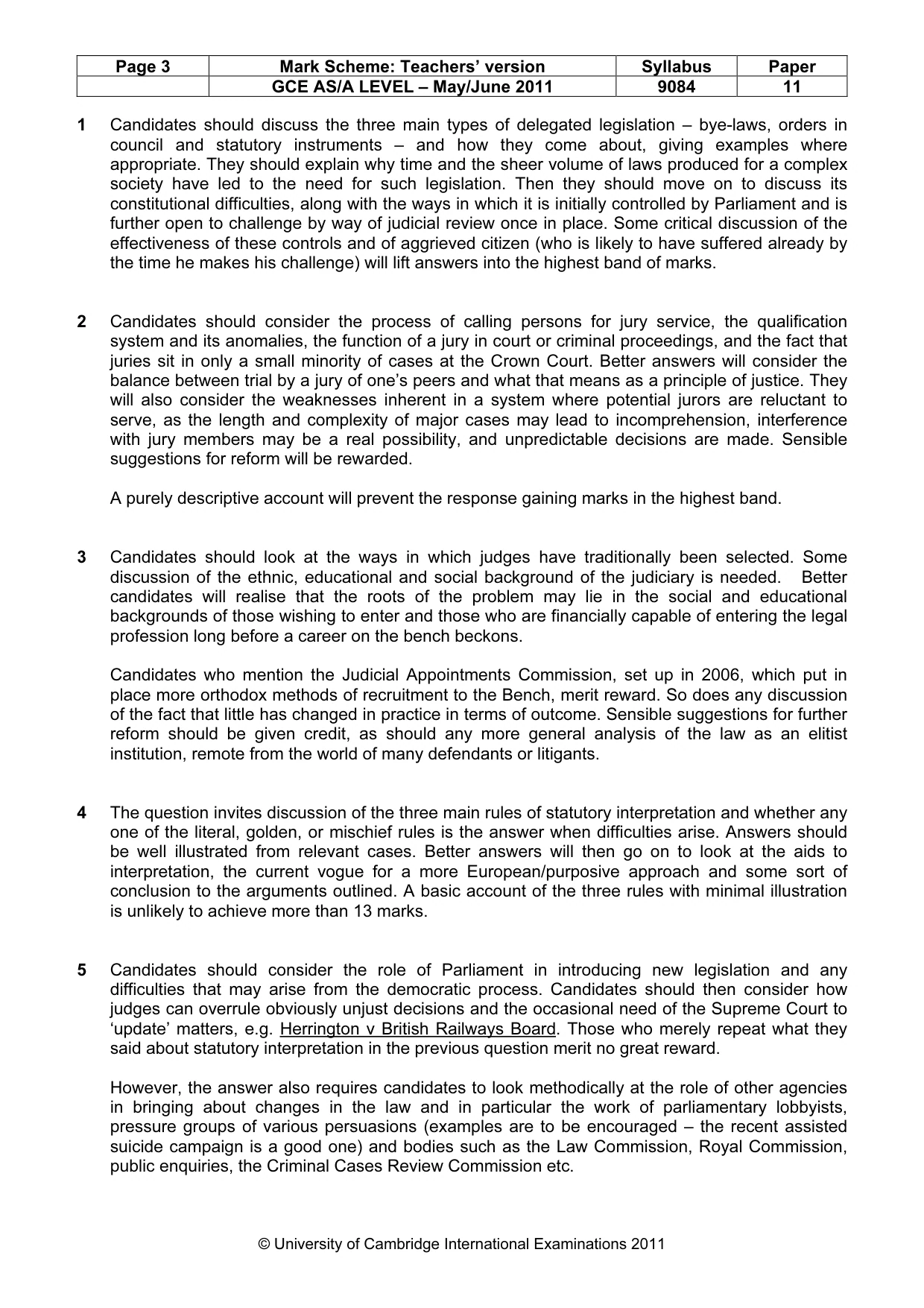
Page 3 Mark Scheme: Teachers’ version Syllabus Paper GCE AS/A LEVEL – May/June 2011 9084 11 © University of Cambridge International Examinations 2011 1 Candidates should discuss the three main types of delegated legislation – bye-laws, orders in council and statutory instruments – and how they come about, giving examples where appropriate. They should explain why time and the sheer volume of laws produced for a complex society have led to the need for such legislation. Then they should move on to discuss its constitutional difficulties, along with the ways in which it is initially controlled by Parliament and is further open to challenge by way of judicial review once in place. Some critical discussion of the effectiveness of these controls and of aggrieved citizen (who is likely to have suffered already by the time he makes his challenge) will lift answers into the highest band of marks. 2 Candidates should consider the process of calling persons for jury service, the qualification system and its anomalies, the function of a jury in court or criminal proceedings, and the fact that juries sit in only a small minority of cases at the Crown Court. Better answers will consider the balance between trial by a jury of one’s peers and what that means as a principle of justice. They will also consider the weaknesses inherent in a system where potential jurors are reluctant to serve, as the length and complexity of major cases may lead to incomprehension, interference with jury members may be a real possibility, and unpredictable decisions are made. Sensible suggestions for reform will be rewarded. A purely descriptive account will prevent the response gaining marks in the highest band. 3 Candidates should look at the ways in which judges have traditionally been selected. Some discussion of the ethnic, educational and social background of the judiciary is needed. Better candidates will realise that the roots of the problem may lie in the social and educational backgrounds of those wishing to enter and those who are financially capable of entering the legal profession long before a career on the bench beckons. Candidates who mention the Judicial Appointments Commission, set up in 2006, which put in place more orthodox methods of recruitment to the Bench, merit reward. So does any discussion of the fact that little has changed in practice in terms of outcome. Sensible suggestions for further reform should be given credit, as should any more general analysis of the law as an elitist institution, remote from the world of many defendants or litigants. 4 The question invites discussion of the three main rules of statutory interpretation and whether any one of the literal, golden, or mischief rules is the answer when difficulties arise. Answers should be well illustrated from relevant cases. Better answers will then go on to look at the aids to interpretation, the current vogue for a more European/purposive approach and some sort of conclusion to the arguments outlined. A basic account of the three rules with minimal illustration is unlikely to achieve more than 13 marks. 5 Candidates should consider the role of Parliament in introducing new legislation and any difficulties that may arise from the democratic process. Candidates should then consider how judges can overrule obviously unjust decisions and the occasional need of the Supreme Court to ‘update’ matters, e.g. Herrington v British Railways Board. Those who merely repeat what they said about statutory interpretation in the previous question merit no great reward. However, the answer also requires candidates to look methodically at the role of other agencies in bringing about changes in the law and in particular the work of parliamentary lobbyists, pressure groups of various persuasions (examples are to be encouraged – the recent assisted suicide campaign is a good one) and bodies such as the Law Commission, Royal Commission, public enquiries, the Criminal Cases Review Commission etc.
Mark scheme, page 4
Page 4 Mark Scheme: Teachers’ version Syllabus Paper GCE AS/A LEVEL – May/June 2011 9084 11 © University of Cambridge International Examinations 2011 6 Weakest candidates will do no more than consider the historical material, concentrating on the ‘Chancellor’s foot’ and the initial creation of Equity. Candidates should then go on to discuss intelligently the range of remedies which improved the position of litigants at the time, e.g. mortgages, trusts, the deserted wife’s equity. An answer should not reach the top bands without discussion of the remedies which grew up in the 20th century, such as the Anton Piller Orders, Mareva injunctions and their successors, along with equitable estoppel. Illustration from case law is also necessary for answers to enter the top two bands.
What you needed in this session
Cambridge’s own grade thresholds for 2011 May/June, Paper 1 · Variant 1. A higher threshold means an easier paper — the bar moves with how the cohort did.