Cambridge A Level Law 9084 — 2010 May/June Paper 3 · Variant 3
9084/33/M/J/10 · 75 marks · ≈84 min
The question paper and its mark scheme, free to read here and free to download. This is Cambridge’s own paper, exactly as it was sat.
Question paper4 pages

Mark scheme8 pages
Answers below. Sit the paper first if you are practising.
Paper as text
Question paper, page 1
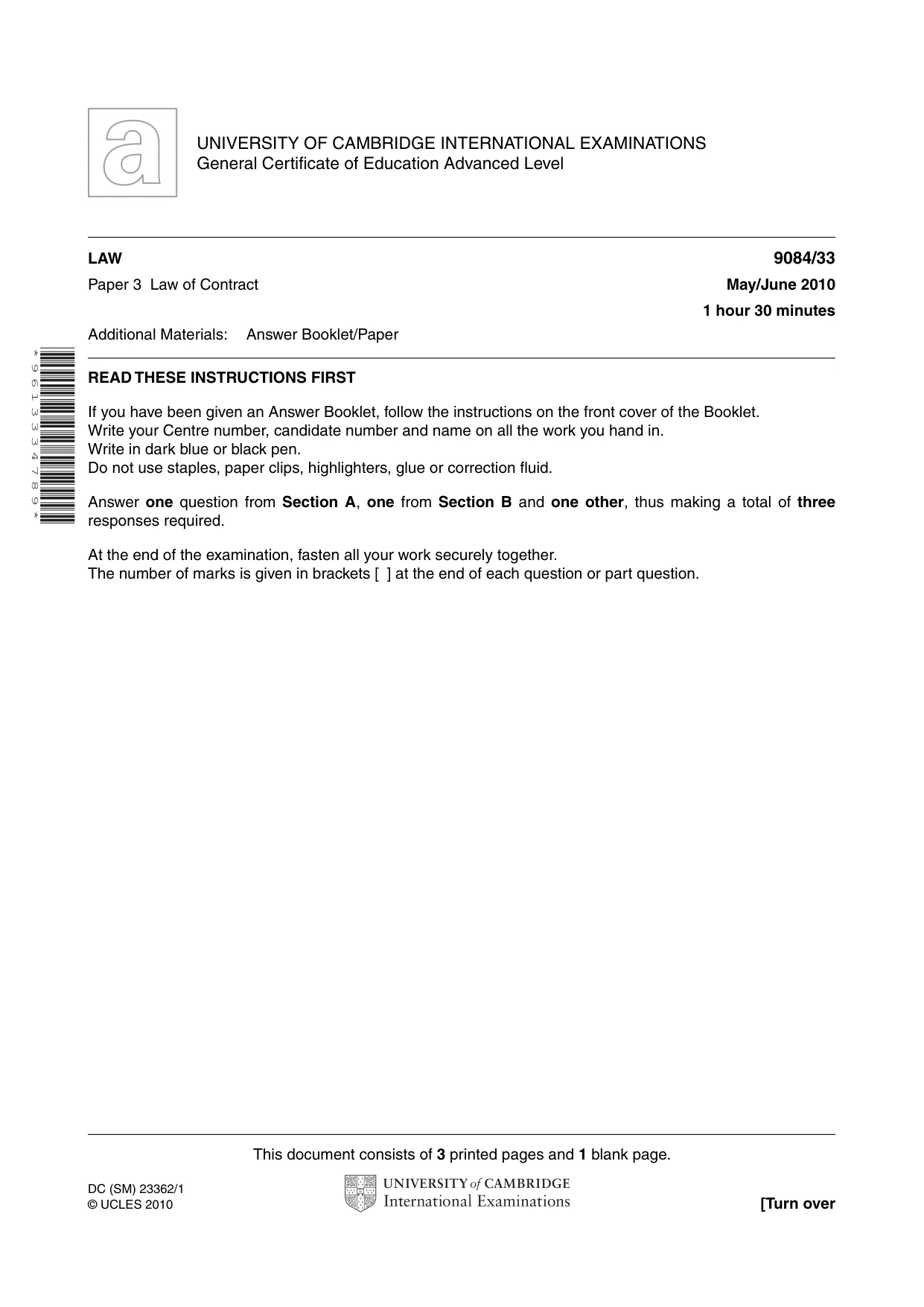
This document consists of 3 printed pages and 1 blank page. DC (SM) 23362/1 © UCLES 2010 [Turn over UNIVERSITY OF CAMBRIDGE INTERNATIONAL EXAMINATIONS General Certificate of Education Advanced Level READ THESE INSTRUCTIONS FIRST If you have been given an Answer Booklet, follow the instructions on the front cover of the Booklet. Write your Centre number, candidate number and name on all the work you hand in. Write in dark blue or black pen. Do not use staples, paper clips, highlighters, glue or correction fluid. Answer one question from Section A, one from Section B and one other, thus making a total of three responses required. At the end of the examination, fasten all your work securely together. The number of marks is given in brackets [ ] at the end of each question or part question. * 9 6 1 3 3 3 4 7 8 9 * LAW 9084/33 Paper 3 Law of Contract May/June 2010 1 hour 30 minutes Additional Materials: Answer Booklet/Paper
Question paper, page 2
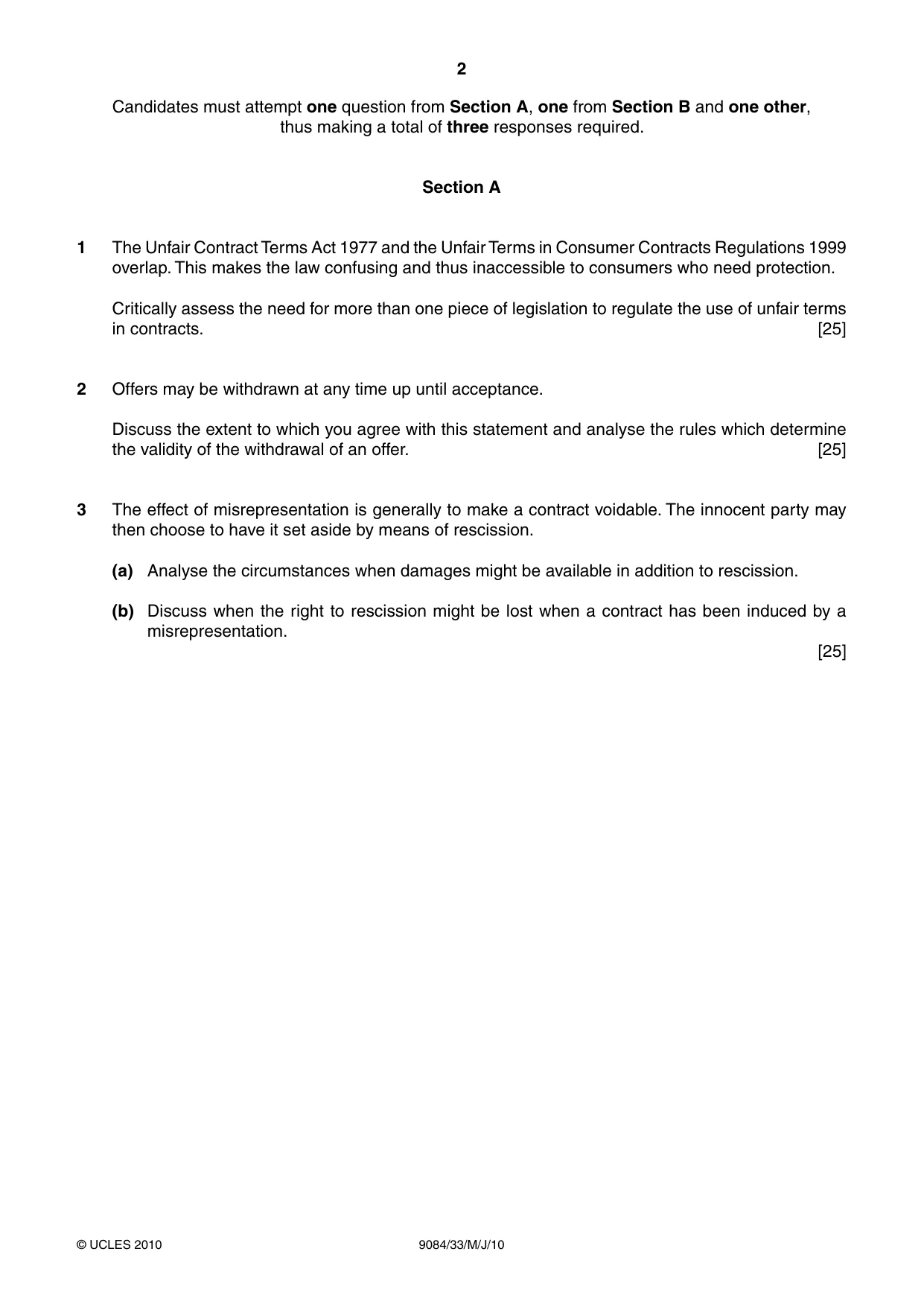
2 9084/33/M/J/10 © UCLES 2010 Candidates must attempt one question from Section A, one from Section B and one other, thus making a total of three responses required. Section A 1 The Unfair Contract Terms Act 1977 and the Unfair Terms in Consumer Contracts Regulations 1999 overlap. This makes the law confusing and thus inaccessible to consumers who need protection. Critically assess the need for more than one piece of legislation to regulate the use of unfair terms in contracts. [25] 2 Offers may be withdrawn at any time up until acceptance. Discuss the extent to which you agree with this statement and analyse the rules which determine the validity of the withdrawal of an offer. [25] 3 The effect of misrepresentation is generally to make a contract voidable. The innocent party may then choose to have it set aside by means of rescission. (a) Analyse the circumstances when damages might be available in addition to rescission. (b) Discuss when the right to rescission might be lost when a contract has been induced by a misrepresentation. [25]
Question paper, page 3
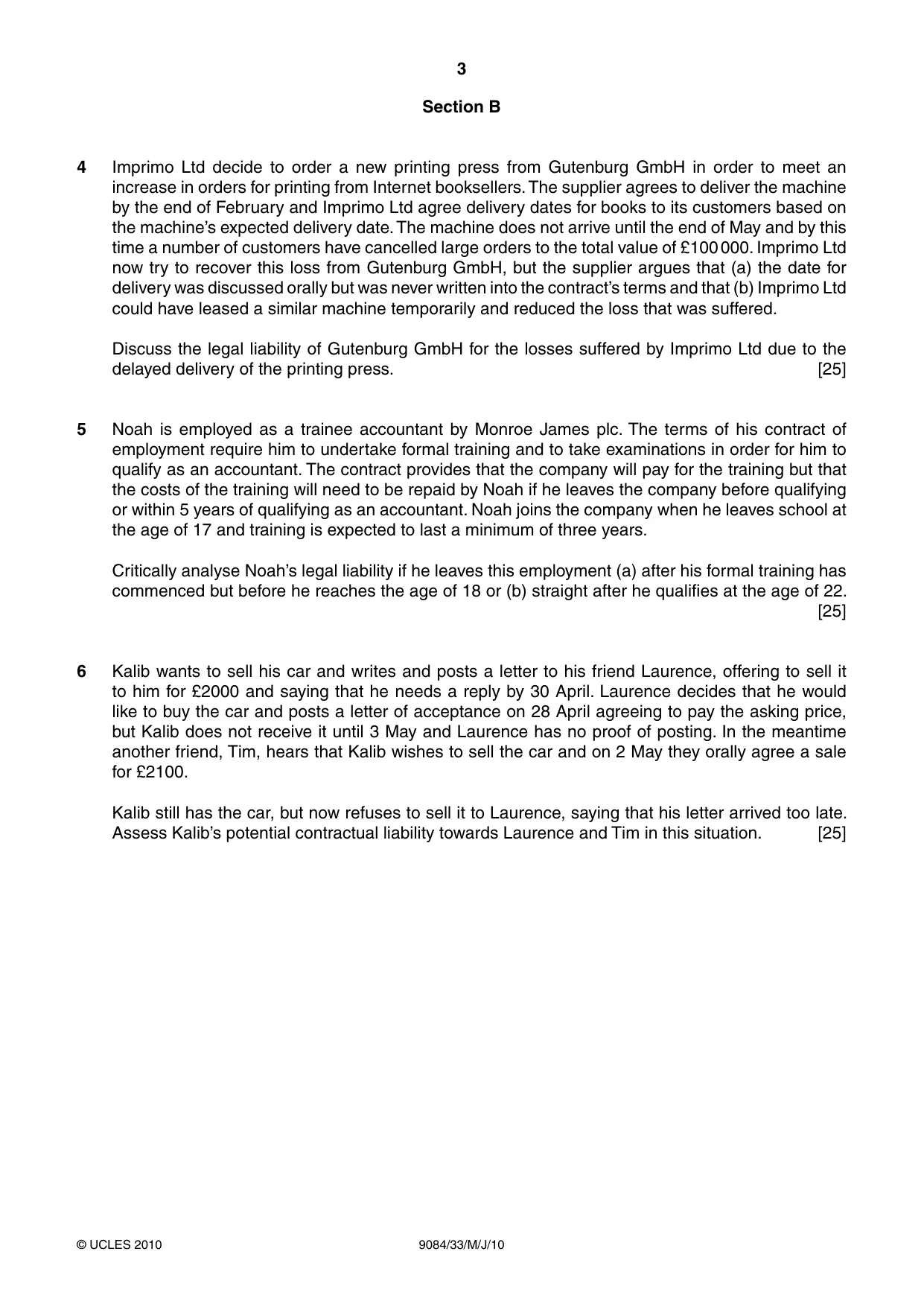
3 9084/33/M/J/10 © UCLES 2010 Section B 4 Imprimo Ltd decide to order a new printing press from Gutenburg GmbH in order to meet an increase in orders for printing from Internet booksellers. The supplier agrees to deliver the machine by the end of February and Imprimo Ltd agree delivery dates for books to its customers based on the machine’s expected delivery date. The machine does not arrive until the end of May and by this time a number of customers have cancelled large orders to the total value of £100 000. Imprimo Ltd now try to recover this loss from Gutenburg GmbH, but the supplier argues that (a) the date for delivery was discussed orally but was never written into the contract’s terms and that (b) Imprimo Ltd could have leased a similar machine temporarily and reduced the loss that was suffered. Discuss the legal liability of Gutenburg GmbH for the losses suffered by Imprimo Ltd due to the delayed delivery of the printing press. [25] 5 Noah is employed as a trainee accountant by Monroe James plc. The terms of his contract of employment require him to undertake formal training and to take examinations in order for him to qualify as an accountant. The contract provides that the company will pay for the training but that the costs of the training will need to be repaid by Noah if he leaves the company before qualifying or within 5 years of qualifying as an accountant. Noah joins the company when he leaves school at the age of 17 and training is expected to last a minimum of three years. Critically analyse Noah’s legal liability if he leaves this employment (a) after his formal training has commenced but before he reaches the age of 18 or (b) straight after he qualifies at the age of 22. [25] 6 Kalib wants to sell his car and writes and posts a letter to his friend Laurence, offering to sell it to him for £2000 and saying that he needs a reply by 30 April. Laurence decides that he would like to buy the car and posts a letter of acceptance on 28 April agreeing to pay the asking price, but Kalib does not receive it until 3 May and Laurence has no proof of posting. In the meantime another friend, Tim, hears that Kalib wishes to sell the car and on 2 May they orally agree a sale for £2100. Kalib still has the car, but now refuses to sell it to Laurence, saying that his letter arrived too late. Assess Kalib’s potential contractual liability towards Laurence and Tim in this situation. [25]
Question paper, page 4
4 9084/33/M/J/10 © UCLES 2010 BLANK PAGE Permission to reproduce items where third-party owned material protected by copyright is included has been sought and cleared where possible. Every reasonable effort has been made by the publisher (UCLES) to trace copyright holders, but if any items requiring clearance have unwittingly been included, the publisher will be pleased to make amends at the earliest possible opportunity. University of Cambridge International Examinations is part of the Cambridge Assessment Group. Cambridge Assessment is the brand name of University of Cambridge Local Examinations Syndicate (UCLES), which is itself a department of the University of Cambridge.
Mark scheme, page 1
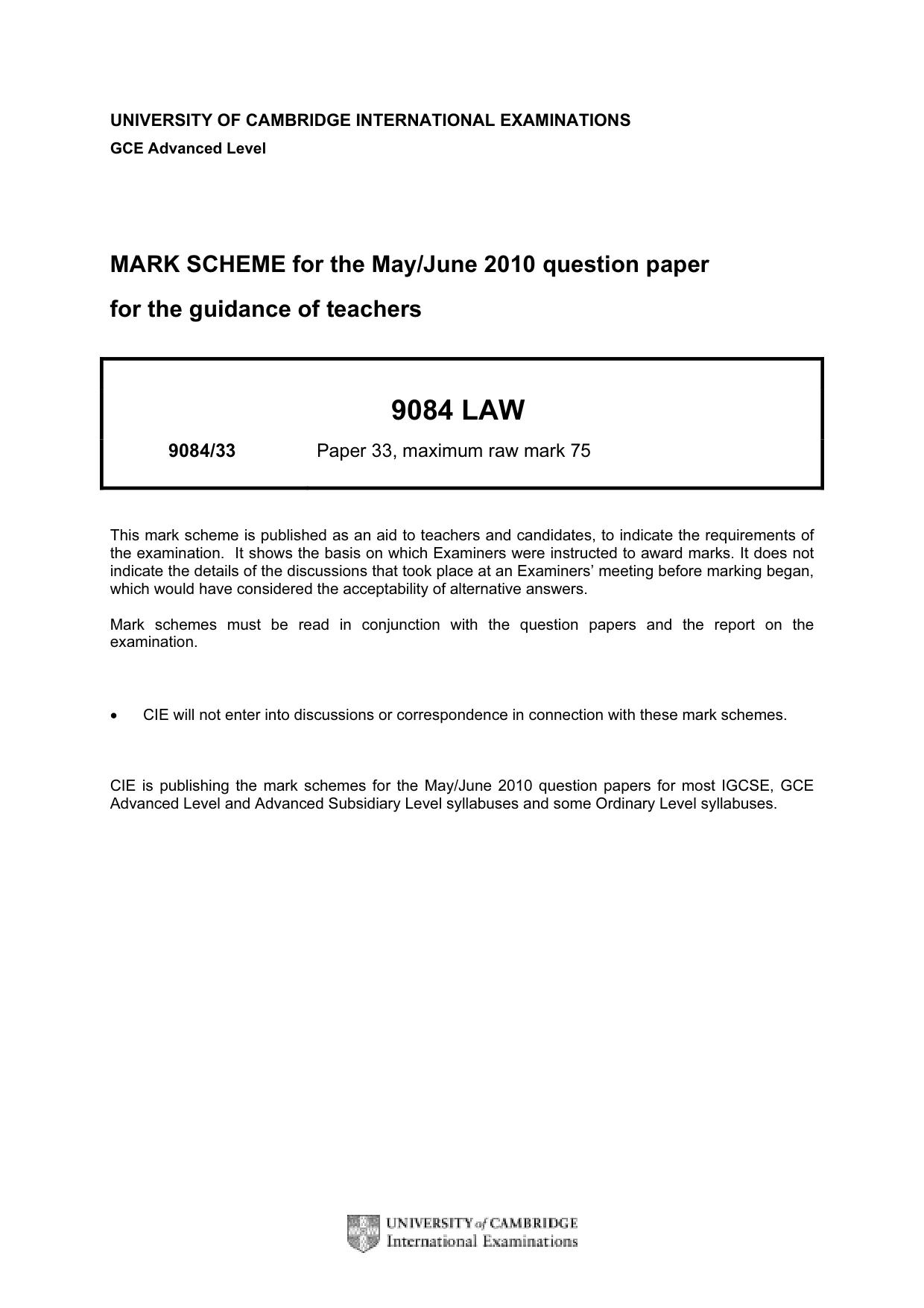
UNIVERSITY OF CAMBRIDGE INTERNATIONAL EXAMINATIONS GCE Advanced Level MARK SCHEME for the May/June 2010 question paper for the guidance of teachers 9084 LAW 9084/33 Paper 33, maximum raw mark 75 This mark scheme is published as an aid to teachers and candidates, to indicate the requirements of the examination. It shows the basis on which Examiners were instructed to award marks. It does not indicate the details of the discussions that took place at an Examiners’ meeting before marking began, which would have considered the acceptability of alternative answers. Mark schemes must be read in conjunction with the question papers and the report on the examination. • CIE will not enter into discussions or correspondence in connection with these mark schemes. CIE is publishing the mark schemes for the May/June 2010 question papers for most IGCSE, GCE Advanced Level and Advanced Subsidiary Level syllabuses and some Ordinary Level syllabuses.
Mark scheme, page 2
Page 2 Mark Scheme: Teachers’ version Syllabus Paper GCE A LEVEL – May/June 2010 9084 33 © UCLES 2010 Assessment Objectives Candidates are expected to demonstrate: Knowledge and Understanding – recall, select, use and develop knowledge and understanding of legal principles and rules by means of example and citation Analysis, Evaluation and Application – analyse and evaluate legal materials, situations and issues and accurately apply appropriate principles and rules Communication and Presentation – use appropriate legal terminology to present logical and coherent argument and to communicate relevant material in a clear and concise manner. Specification Grid The relationship between the Assessment Objectives and this individual component is detailed below. The objectives are weighted to give an indication of their relative importance, rather than to provide a precise statement of the percentage mark allocation to particular assessment objectives. Assessment Objective Paper 1 Paper 2 Paper 3 Paper 4 Advanced Level Knowledge/ Understanding 50 50 50 50 50 Analysis/ Evaluation/ Application 40 40 40 40 40 Communication/ Presentation 10 10 10 10 10
Mark scheme, page 3
Page 3 Mark Scheme: Teachers’ version Syllabus Paper GCE A LEVEL – May/June 2010 9084 33 © UCLES 2010 Mark Bands The mark bands and descriptors applicable to all questions on the paper are as follows. Maximum mark allocations are indicated in the table at the foot of the page. Indicative content for each of the questions follows overleaf. Band 1: The answer contains no relevant material. Band 2: The candidate introduces fragments of information or unexplained examples from which no coherent explanation or analysis can emerge. OR The candidate attempts to introduce an explanation and/or analysis but it is so fundamentally undermined by error and confusion that it remains substantially incoherent. Band 3: The candidate begins to indicate some capacity for explanation and analysis by introducing some of the issues, but explanations are limited and superficial. OR The candidate adopts an approach in which there is concentration on explanation in terms of facts presented rather than through the development and explanation of legal principles and rules. OR The candidate attempts to introduce material across the range of potential content, but it is weak or confused so that no real explanation or conclusion emerges. Band 4: Where there is more than one issue, the candidate demonstrates a clear understanding of one of the main issues of the question, giving explanations and using illustrations so that a full and detailed picture is presented of this issue. OR The candidate presents a more limited explanation of all parts of the answer, but there is some lack of detail or superficiality in respect of either or both so that the answer is not fully rounded. Band 5: The candidate presents a detailed explanation and discussion of all areas of relevant law and, while there may be some minor inaccuracies and/or imbalance, a coherent explanation emerges. Maximum Mark Allocations: Question 1 2 3 4 5 6 Band 1 0 0 0 0 0 0 Band 2 6 6 6 6 6 6 Band 3 12 12 12 12 12 12 Band 4 19 19 19 19 19 19 Band 5 25 25 25 25 25 25
Mark scheme, page 4
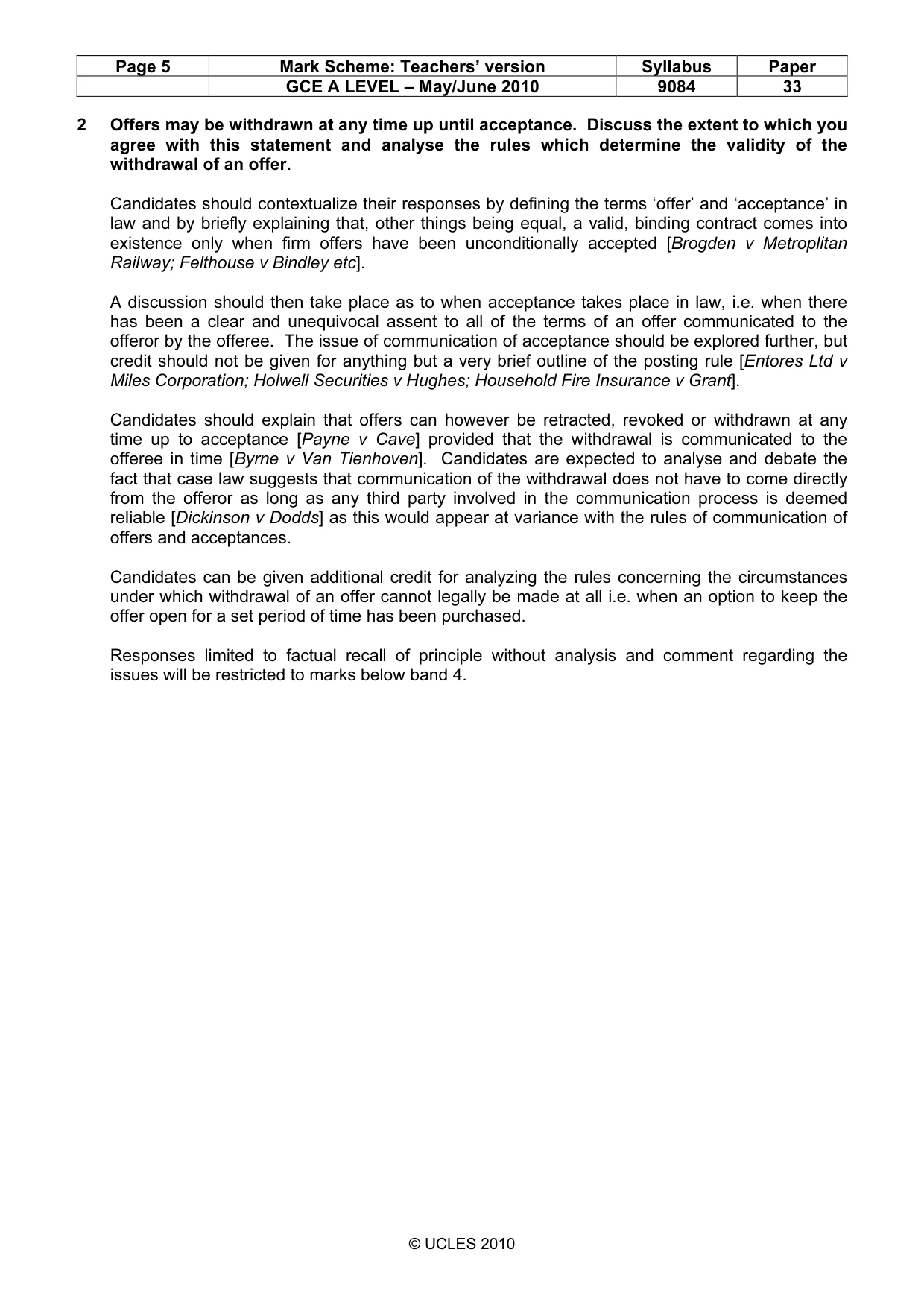
Page 4 Mark Scheme: Teachers’ version Syllabus Paper GCE A LEVEL – May/June 2010 9084 33 © UCLES 2010 Section A 1 The Unfair Contract Terms Act 1977 and the Unfair Terms in Consumer Contracts Regulations 1999 overlap making the law confusing and thus inaccessible to consumers who need protection. Critically assess the need for more than one piece of legislation to regulate the use of unfair terms in contracts. Candidates should introduce their response by explaining why the two pieces of legislation exist: to control the use of clauses limiting or excluding liability for breach of contract (UCTA) and to give effect to the EU Directive on Unfair Terms in Consumer Contracts (1993) and thus provide consumer protection (UTCCR). Candidates should explore areas of overlap UCTA UTCCR Parties protected consumer contracts and business contracts if on written standard terms consumer contracts only Definition of consumer companies can be ‘consumers’ as well as human beings only human beings Types of term covered exemption clauses and those allowing business to change substance of own performance most terms except ‘core’ terms and any individually negotiated Test applied unreasonableness; some terms automatically ineffective unfairness Burden of proof party claiming validity has to show that it satisfies reasonableness test consumer to prove terms unfair Enforcement contracting parties contracting parties or by OFT and conclude whether both statutes are truly necessary and, even if they are, whether or not the law is confused rather than clarified by them. Candidates are expected to critically assess the way in which the law deals with these situations to reach band 4.
Mark scheme, page 5
Page 5 Mark Scheme: Teachers’ version Syllabus Paper GCE A LEVEL – May/June 2010 9084 33 © UCLES 2010 2 Offers may be withdrawn at any time up until acceptance. Discuss the extent to which you agree with this statement and analyse the rules which determine the validity of the withdrawal of an offer. Candidates should contextualize their responses by defining the terms ‘offer’ and ‘acceptance’ in law and by briefly explaining that, other things being equal, a valid, binding contract comes into existence only when firm offers have been unconditionally accepted [Brogden v Metroplitan Railway; Felthouse v Bindley etc]. A discussion should then take place as to when acceptance takes place in law, i.e. when there has been a clear and unequivocal assent to all of the terms of an offer communicated to the offeror by the offeree. The issue of communication of acceptance should be explored further, but credit should not be given for anything but a very brief outline of the posting rule [Entores Ltd v Miles Corporation; Holwell Securities v Hughes; Household Fire Insurance v Grant]. Candidates should explain that offers can however be retracted, revoked or withdrawn at any time up to acceptance [Payne v Cave] provided that the withdrawal is communicated to the offeree in time [Byrne v Van Tienhoven]. Candidates are expected to analyse and debate the fact that case law suggests that communication of the withdrawal does not have to come directly from the offeror as long as any third party involved in the communication process is deemed reliable [Dickinson v Dodds] as this would appear at variance with the rules of communication of offers and acceptances. Candidates can be given additional credit for analyzing the rules concerning the circumstances under which withdrawal of an offer cannot legally be made at all i.e. when an option to keep the offer open for a set period of time has been purchased. Responses limited to factual recall of principle without analysis and comment regarding the issues will be restricted to marks below band 4.
Mark scheme, page 6
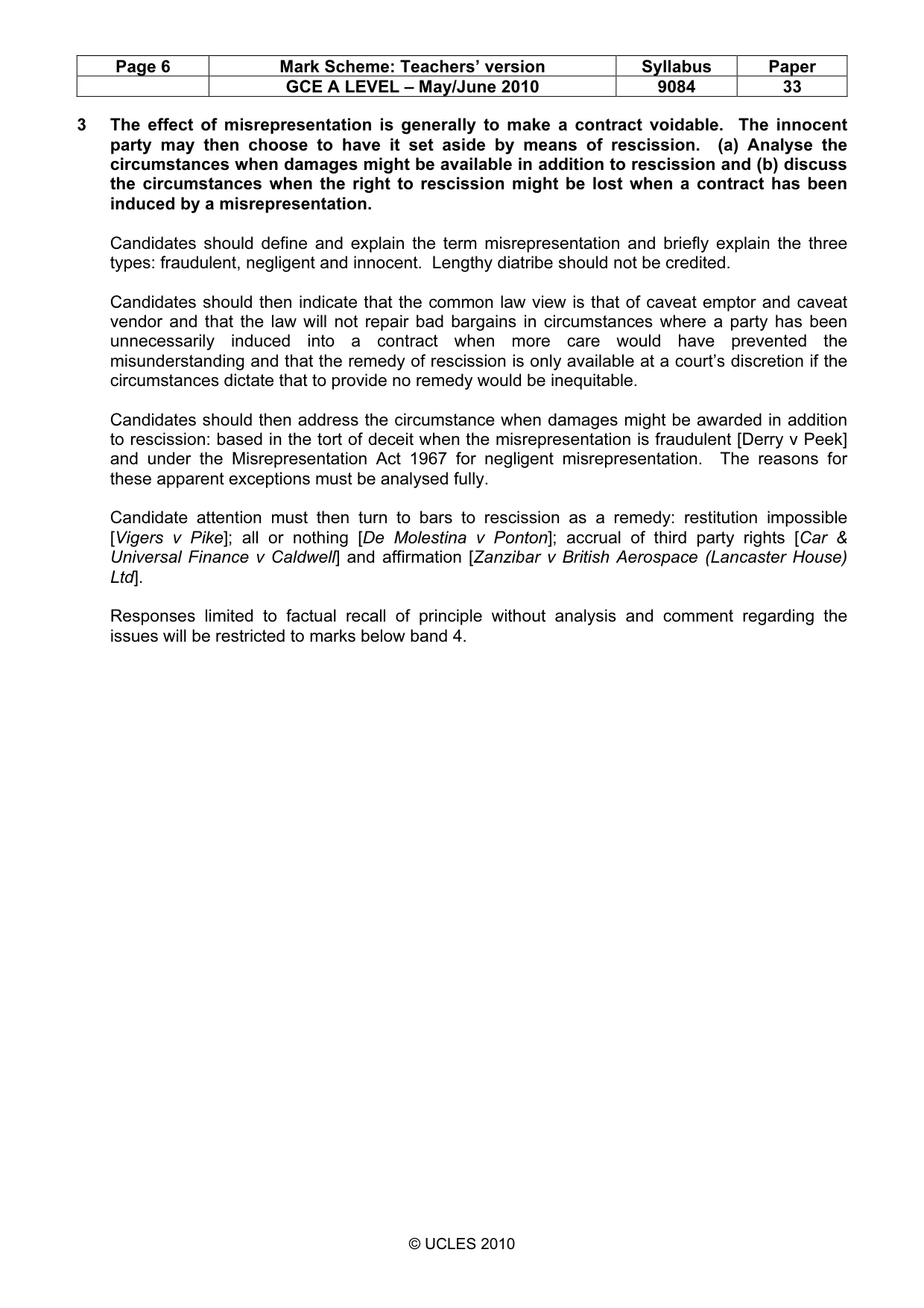
Page 6 Mark Scheme: Teachers’ version Syllabus Paper GCE A LEVEL – May/June 2010 9084 33 © UCLES 2010 3 The effect of misrepresentation is generally to make a contract voidable. The innocent party may then choose to have it set aside by means of rescission. (a) Analyse the circumstances when damages might be available in addition to rescission and (b) discuss the circumstances when the right to rescission might be lost when a contract has been induced by a misrepresentation. Candidates should define and explain the term misrepresentation and briefly explain the three types: fraudulent, negligent and innocent. Lengthy diatribe should not be credited. Candidates should then indicate that the common law view is that of caveat emptor and caveat vendor and that the law will not repair bad bargains in circumstances where a party has been unnecessarily induced into a contract when more care would have prevented the misunderstanding and that the remedy of rescission is only available at a court’s discretion if the circumstances dictate that to provide no remedy would be inequitable. Candidates should then address the circumstance when damages might be awarded in addition to rescission: based in the tort of deceit when the misrepresentation is fraudulent [Derry v Peek] and under the Misrepresentation Act 1967 for negligent misrepresentation. The reasons for these apparent exceptions must be analysed fully. Candidate attention must then turn to bars to rescission as a remedy: restitution impossible [Vigers v Pike]; all or nothing [De Molestina v Ponton]; accrual of third party rights [Car & Universal Finance v Caldwell] and affirmation [Zanzibar v British Aerospace (Lancaster House) Ltd]. Responses limited to factual recall of principle without analysis and comment regarding the issues will be restricted to marks below band 4.
Mark scheme, page 7
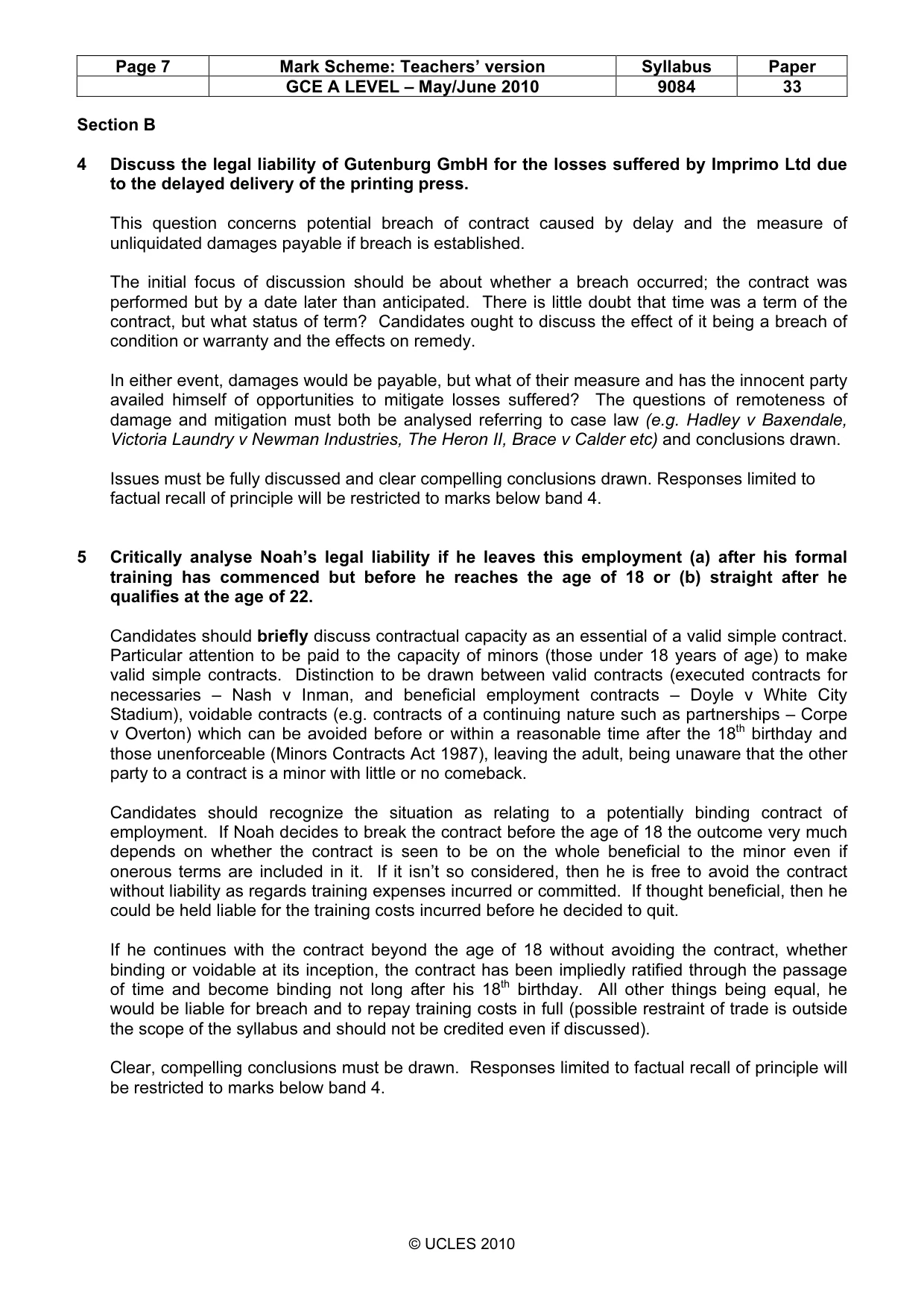
Page 7 Mark Scheme: Teachers’ version Syllabus Paper GCE A LEVEL – May/June 2010 9084 33 © UCLES 2010 Section B 4 Discuss the legal liability of Gutenburg GmbH for the losses suffered by Imprimo Ltd due to the delayed delivery of the printing press. This question concerns potential breach of contract caused by delay and the measure of unliquidated damages payable if breach is established. The initial focus of discussion should be about whether a breach occurred; the contract was performed but by a date later than anticipated. There is little doubt that time was a term of the contract, but what status of term? Candidates ought to discuss the effect of it being a breach of condition or warranty and the effects on remedy. In either event, damages would be payable, but what of their measure and has the innocent party availed himself of opportunities to mitigate losses suffered? The questions of remoteness of damage and mitigation must both be analysed referring to case law (e.g. Hadley v Baxendale, Victoria Laundry v Newman Industries, The Heron II, Brace v Calder etc) and conclusions drawn. Issues must be fully discussed and clear compelling conclusions drawn. Responses limited to factual recall of principle will be restricted to marks below band 4. 5 Critically analyse Noah’s legal liability if he leaves this employment (a) after his formal training has commenced but before he reaches the age of 18 or (b) straight after he qualifies at the age of 22. Candidates should briefly discuss contractual capacity as an essential of a valid simple contract. Particular attention to be paid to the capacity of minors (those under 18 years of age) to make valid simple contracts. Distinction to be drawn between valid contracts (executed contracts for necessaries – Nash v Inman, and beneficial employment contracts – Doyle v White City Stadium), voidable contracts (e.g. contracts of a continuing nature such as partnerships – Corpe v Overton) which can be avoided before or within a reasonable time after the 18th birthday and those unenforceable (Minors Contracts Act 1987), leaving the adult, being unaware that the other party to a contract is a minor with little or no comeback. Candidates should recognize the situation as relating to a potentially binding contract of employment. If Noah decides to break the contract before the age of 18 the outcome very much depends on whether the contract is seen to be on the whole beneficial to the minor even if onerous terms are included in it. If it isn’t so considered, then he is free to avoid the contract without liability as regards training expenses incurred or committed. If thought beneficial, then he could be held liable for the training costs incurred before he decided to quit. If he continues with the contract beyond the age of 18 without avoiding the contract, whether binding or voidable at its inception, the contract has been impliedly ratified through the passage of time and become binding not long after his 18th birthday. All other things being equal, he would be liable for breach and to repay training costs in full (possible restraint of trade is outside the scope of the syllabus and should not be credited even if discussed). Clear, compelling conclusions must be drawn. Responses limited to factual recall of principle will be restricted to marks below band 4.
Mark scheme, page 8
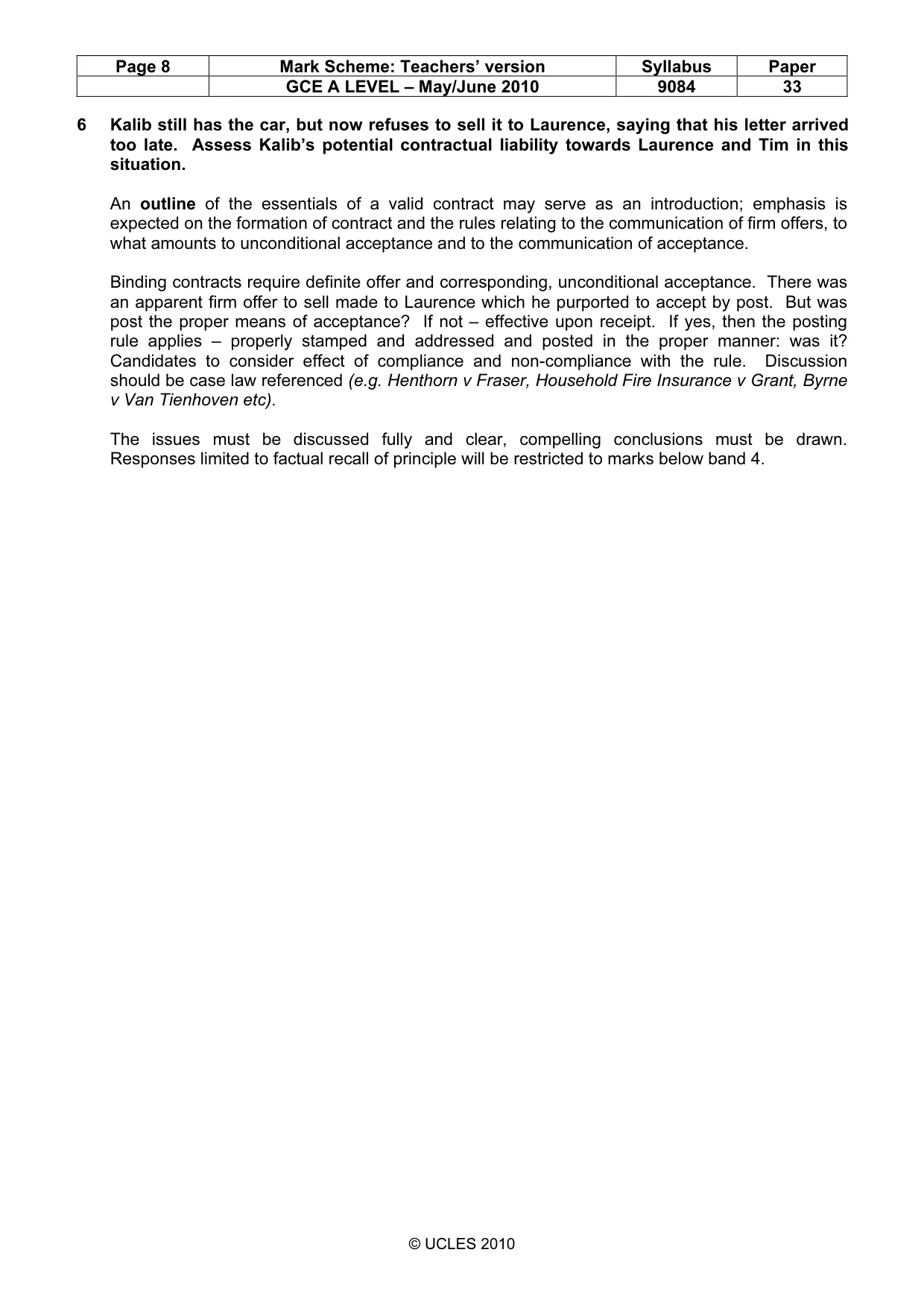
Page 8 Mark Scheme: Teachers’ version Syllabus Paper GCE A LEVEL – May/June 2010 9084 33 © UCLES 2010 6 Kalib still has the car, but now refuses to sell it to Laurence, saying that his letter arrived too late. Assess Kalib’s potential contractual liability towards Laurence and Tim in this situation. An outline of the essentials of a valid contract may serve as an introduction; emphasis is expected on the formation of contract and the rules relating to the communication of firm offers, to what amounts to unconditional acceptance and to the communication of acceptance. Binding contracts require definite offer and corresponding, unconditional acceptance. There was an apparent firm offer to sell made to Laurence which he purported to accept by post. But was post the proper means of acceptance? If not – effective upon receipt. If yes, then the posting rule applies – properly stamped and addressed and posted in the proper manner: was it? Candidates to consider effect of compliance and non-compliance with the rule. Discussion should be case law referenced (e.g. Henthorn v Fraser, Household Fire Insurance v Grant, Byrne v Van Tienhoven etc). The issues must be discussed fully and clear, compelling conclusions must be drawn. Responses limited to factual recall of principle will be restricted to marks below band 4.
What you needed in this session
Cambridge’s own grade thresholds for 2010 May/June, Paper 3 · Variant 3. A higher threshold means an easier paper — the bar moves with how the cohort did.