Cambridge A Level Law 9084 — 2010 May/June Paper 3 · Variant 1
9084/31/M/J/10 · 75 marks · ≈84 min
The question paper and its mark scheme, free to read here and free to download. This is Cambridge’s own paper, exactly as it was sat.
Question paper4 pages

Mark scheme7 pages
Answers below. Sit the paper first if you are practising.
Paper as text
Question paper, page 1
This document consists of 3 printed pages and 1 blank page. DC (CW) 17708/3 © UCLES 2010 [Turn over UNIVERSITY OF CAMBRIDGE INTERNATIONAL EXAMINATIONS General Certificate of Education Advanced Level READ THESE INSTRUCTIONS FIRST If you have been given an Answer Booklet, follow the instructions on the front cover of the Booklet. Write your Centre number, candidate number and name on all the work you hand in. Write in dark blue or black pen. Do not use staples, paper clips, highlighters, glue or correction fluid. Answer one question from Section A, one from Section B and one other, thus making a total of three responses required. At the end of the examination, fasten all your work securely together. The number of marks is given in brackets [ ] at the end of each question or part question. * 9 0 9 5 3 8 3 9 3 8 * LAW 9084/31 Paper 3 Law of Contract May/June 2010 1 hour 30 minutes Additional Materials: Answer Booklet/Paper
Question paper, page 2
2 9084/31/M/J/10 © UCLES 2010 Candidates must attempt one question from Section A, one from Section B and one other, thus making a total of three responses required. Section A 1 Critically assess the extent to which you believe that innominate terms create too much uncertainty in contract law. [25] 2 Analyse critically the circumstances under which and the reasons why a claimant might prefer to use mistake rather than misrepresentation as a basis for an action in contract. [25] 3 One of the remedies available to a claimant is a quantum meruit award. Using decided case law to illustrate your answer, (a) explain what a quantum meruit award is, (b) outline the circumstances under which such awards may be made and (c) critically assess its relative value compared with other remedies. [25]
Question paper, page 3
3 9084/31/M/J/10 © UCLES 2010 Section B 4 Lee asks Stella, who lives in the adjoining house, to feed his dozen cats and keep his garden clean and tidy whilst Lee goes on a six week holiday to Italy. Every day Stella enters Lee’s house to feed the cats and twice a week she waters the plants, mows the lawn and weeds the flower beds. When Lee returns, he is delighted with the state of his garden and promises to give Stella £100 for the work that she has done. Using case law to support your views, consider Stella’s legal position if Lee later refuses to pay her. [25] 5 Amir, Jahangir and Nawab attend a classic car auction advertised by Old Wrecks Ltd. Amir is interested in bidding for a 1955 Jaguar that he sees listed in the auction catalogue, but finds that the car has been withdrawn from the sale. Jahangir bids for a 1947 Rolls Royce. He bids more than he can afford and despite calling out to withdraw his bid, the auctioneer continues the sale and eventually knocks it down to Jahangir as the highest bidder. Nawab bids for a 1960 Daimler but, despite being the highest bidder for the car on the day, the auctioneer refuses to sell him the car because the price that he bid has failed to meet the reserve price set by its owner. Using case law to support your views, consider whether binding contracts were formed between Old Wrecks Ltd and each of the three bidders and identify any potential remedies that might be available to them. [25] 6 Harry buys a ticket to travel on Express Coaches and, without reading it, places it in his wallet for safety and waits for the arrival of the coach. As Harry attempts to board the coach, he slips on the steps, falls and injures his wrist. On arrival he discovers that his suitcase has been damaged when being loaded on to the coach. When Harry applies to Express Coaches for compensation for his injury and for the damage to his suitcase, the company seeks to rely on a clause printed on the back of Harry’s ticket that excludes its liability for breach of the contract of carriage made with its passengers. Consider Express Coaches’ contractual liability for Harry’s losses. [25]
Question paper, page 4
4 9084/31/M/J/10 © UCLES 2010 BLANK PAGE Permission to reproduce items where third-party owned material protected by copyright is included has been sought and cleared where possible. Every reasonable effort has been made by the publisher (UCLES) to trace copyright holders, but if any items requiring clearance have unwittingly been included, the publisher will be pleased to make amends at the earliest possible opportunity. University of Cambridge International Examinations is part of the Cambridge Assessment Group. Cambridge Assessment is the brand name of University of Cambridge Local Examinations Syndicate (UCLES), which is itself a department of the University of Cambridge.
Mark scheme, page 1
UNIVERSITY OF CAMBRIDGE INTERNATIONAL EXAMINATIONS GCE Advanced Level MARK SCHEME for the May/June 2010 question paper for the guidance of teachers 9084 LAW 9084/31 Paper 31, maximum raw mark 75 This mark scheme is published as an aid to teachers and candidates, to indicate the requirements of the examination. It shows the basis on which Examiners were instructed to award marks. It does not indicate the details of the discussions that took place at an Examiners’ meeting before marking began, which would have considered the acceptability of alternative answers. Mark schemes must be read in conjunction with the question papers and the report on the examination. • CIE will not enter into discussions or correspondence in connection with these mark schemes. CIE is publishing the mark schemes for the May/June 2010 question papers for most IGCSE, GCE Advanced Level and Advanced Subsidiary Level syllabuses and some Ordinary Level syllabuses.
Mark scheme, page 2
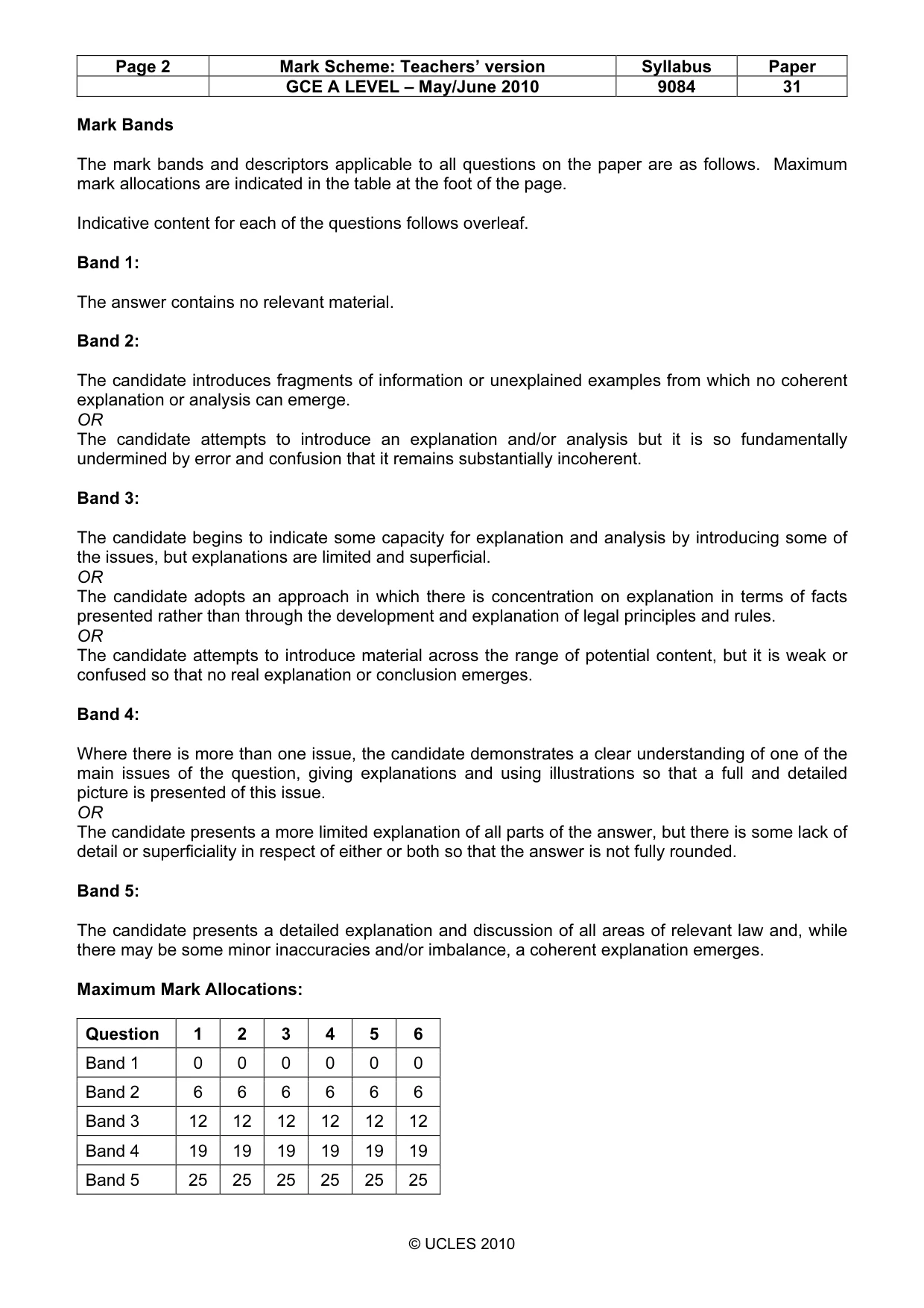
Page 2 Mark Scheme: Teachers’ version Syllabus Paper GCE A LEVEL – May/June 2010 9084 31 © UCLES 2010 Mark Bands The mark bands and descriptors applicable to all questions on the paper are as follows. Maximum mark allocations are indicated in the table at the foot of the page. Indicative content for each of the questions follows overleaf. Band 1: The answer contains no relevant material. Band 2: The candidate introduces fragments of information or unexplained examples from which no coherent explanation or analysis can emerge. OR The candidate attempts to introduce an explanation and/or analysis but it is so fundamentally undermined by error and confusion that it remains substantially incoherent. Band 3: The candidate begins to indicate some capacity for explanation and analysis by introducing some of the issues, but explanations are limited and superficial. OR The candidate adopts an approach in which there is concentration on explanation in terms of facts presented rather than through the development and explanation of legal principles and rules. OR The candidate attempts to introduce material across the range of potential content, but it is weak or confused so that no real explanation or conclusion emerges. Band 4: Where there is more than one issue, the candidate demonstrates a clear understanding of one of the main issues of the question, giving explanations and using illustrations so that a full and detailed picture is presented of this issue. OR The candidate presents a more limited explanation of all parts of the answer, but there is some lack of detail or superficiality in respect of either or both so that the answer is not fully rounded. Band 5: The candidate presents a detailed explanation and discussion of all areas of relevant law and, while there may be some minor inaccuracies and/or imbalance, a coherent explanation emerges. Maximum Mark Allocations: Question 1 2 3 4 5 6 Band 1 0 0 0 0 0 0 Band 2 6 6 6 6 6 6 Band 3 12 12 12 12 12 12 Band 4 19 19 19 19 19 19 Band 5 25 25 25 25 25 25
Mark scheme, page 3
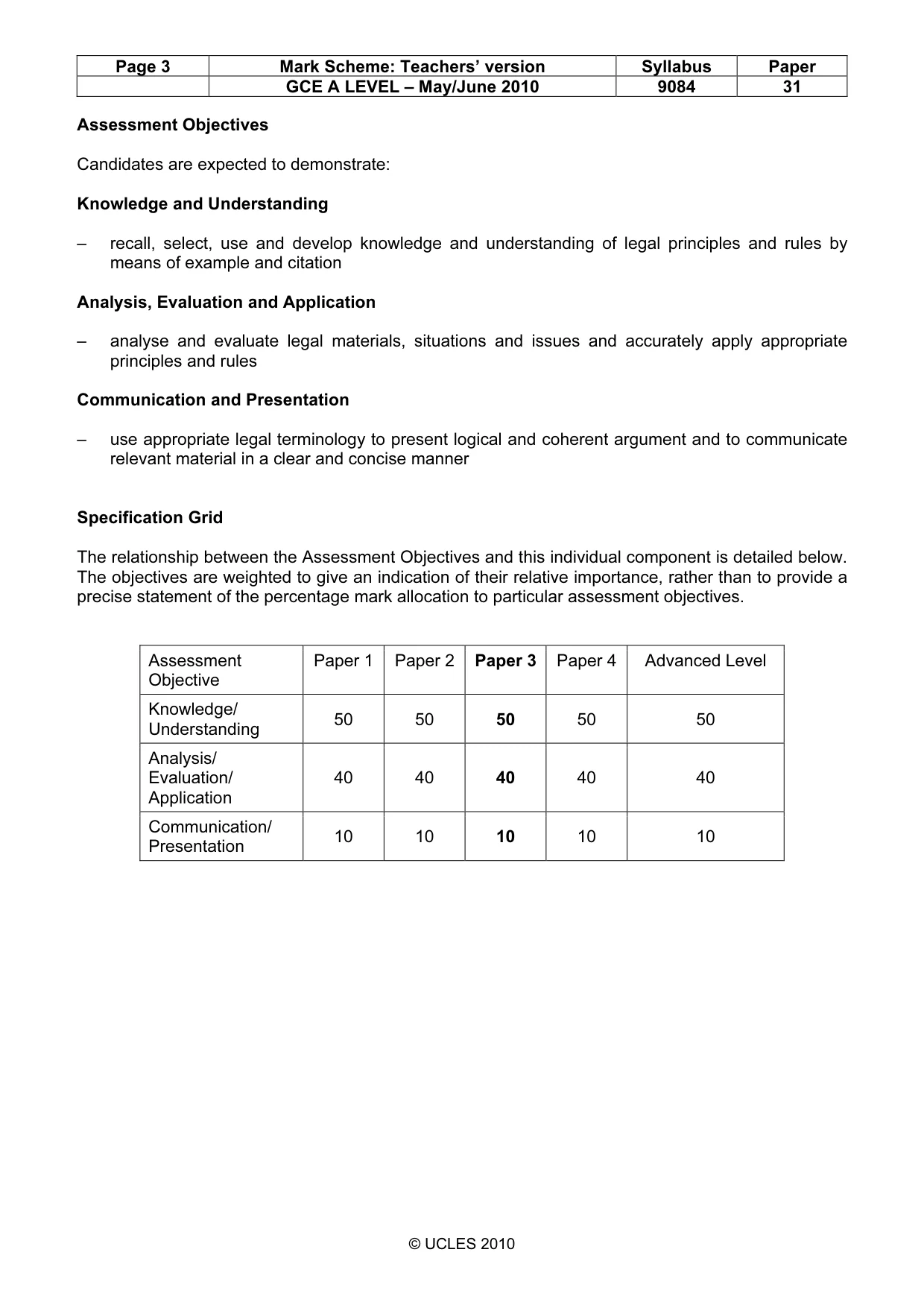
Page 3 Mark Scheme: Teachers’ version Syllabus Paper GCE A LEVEL – May/June 2010 9084 31 © UCLES 2010 Assessment Objectives Candidates are expected to demonstrate: Knowledge and Understanding – recall, select, use and develop knowledge and understanding of legal principles and rules by means of example and citation Analysis, Evaluation and Application – analyse and evaluate legal materials, situations and issues and accurately apply appropriate principles and rules Communication and Presentation – use appropriate legal terminology to present logical and coherent argument and to communicate relevant material in a clear and concise manner Specification Grid The relationship between the Assessment Objectives and this individual component is detailed below. The objectives are weighted to give an indication of their relative importance, rather than to provide a precise statement of the percentage mark allocation to particular assessment objectives. Assessment Objective Paper 1 Paper 2 Paper 3 Paper 4 Advanced Level Knowledge/ Understanding 50 50 50 50 50 Analysis/ Evaluation/ Application 40 40 40 40 40 Communication/ Presentation 10 10 10 10 10
Mark scheme, page 4
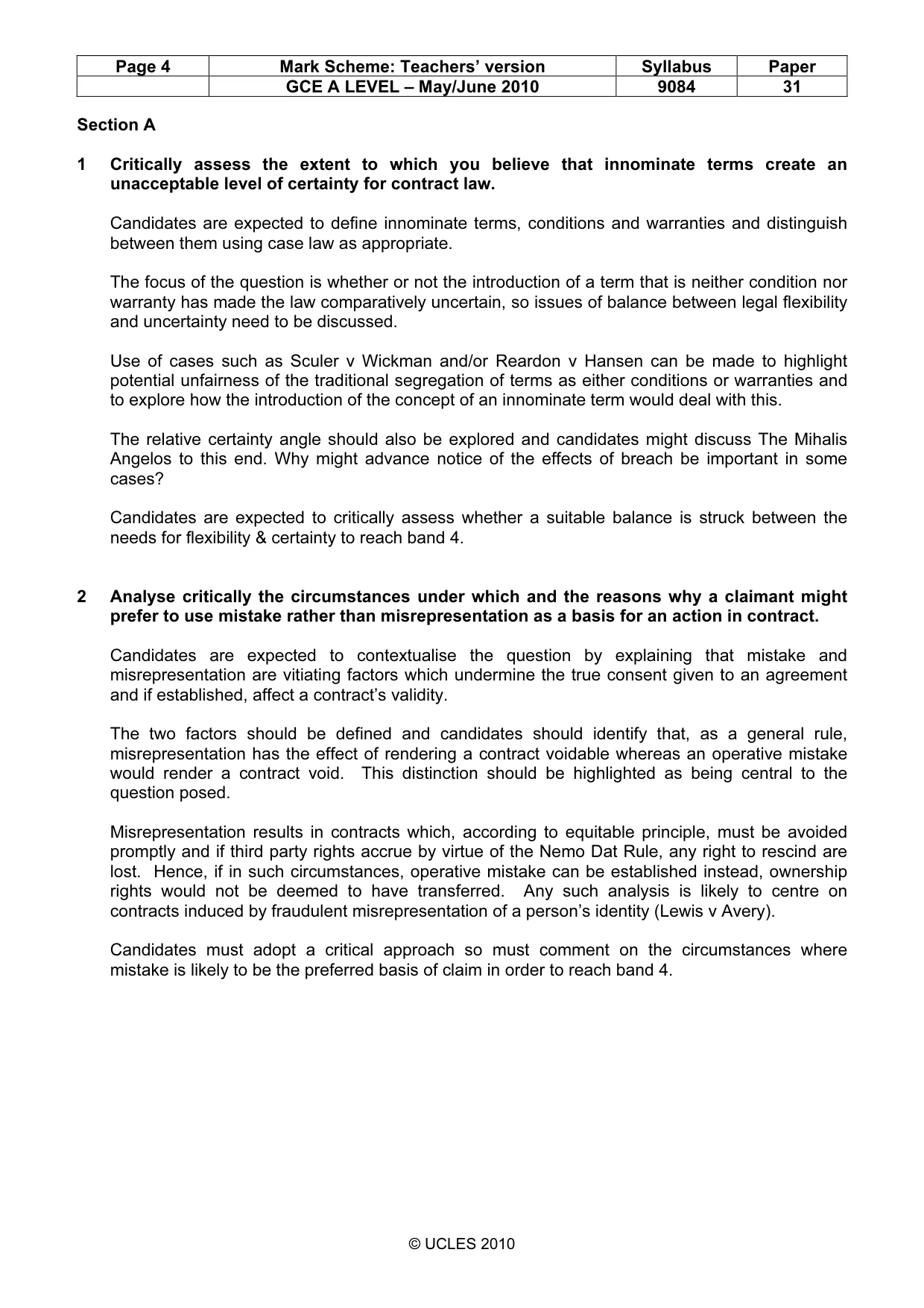
Page 4 Mark Scheme: Teachers’ version Syllabus Paper GCE A LEVEL – May/June 2010 9084 31 © UCLES 2010 Section A 1 Critically assess the extent to which you believe that innominate terms create an unacceptable level of certainty for contract law. Candidates are expected to define innominate terms, conditions and warranties and distinguish between them using case law as appropriate. The focus of the question is whether or not the introduction of a term that is neither condition nor warranty has made the law comparatively uncertain, so issues of balance between legal flexibility and uncertainty need to be discussed. Use of cases such as Sculer v Wickman and/or Reardon v Hansen can be made to highlight potential unfairness of the traditional segregation of terms as either conditions or warranties and to explore how the introduction of the concept of an innominate term would deal with this. The relative certainty angle should also be explored and candidates might discuss The Mihalis Angelos to this end. Why might advance notice of the effects of breach be important in some cases? Candidates are expected to critically assess whether a suitable balance is struck between the needs for flexibility & certainty to reach band 4. 2 Analyse critically the circumstances under which and the reasons why a claimant might prefer to use mistake rather than misrepresentation as a basis for an action in contract. Candidates are expected to contextualise the question by explaining that mistake and misrepresentation are vitiating factors which undermine the true consent given to an agreement and if established, affect a contract’s validity. The two factors should be defined and candidates should identify that, as a general rule, misrepresentation has the effect of rendering a contract voidable whereas an operative mistake would render a contract void. This distinction should be highlighted as being central to the question posed. Misrepresentation results in contracts which, according to equitable principle, must be avoided promptly and if third party rights accrue by virtue of the Nemo Dat Rule, any right to rescind are lost. Hence, if in such circumstances, operative mistake can be established instead, ownership rights would not be deemed to have transferred. Any such analysis is likely to centre on contracts induced by fraudulent misrepresentation of a person’s identity (Lewis v Avery). Candidates must adopt a critical approach so must comment on the circumstances where mistake is likely to be the preferred basis of claim in order to reach band 4.
Mark scheme, page 5
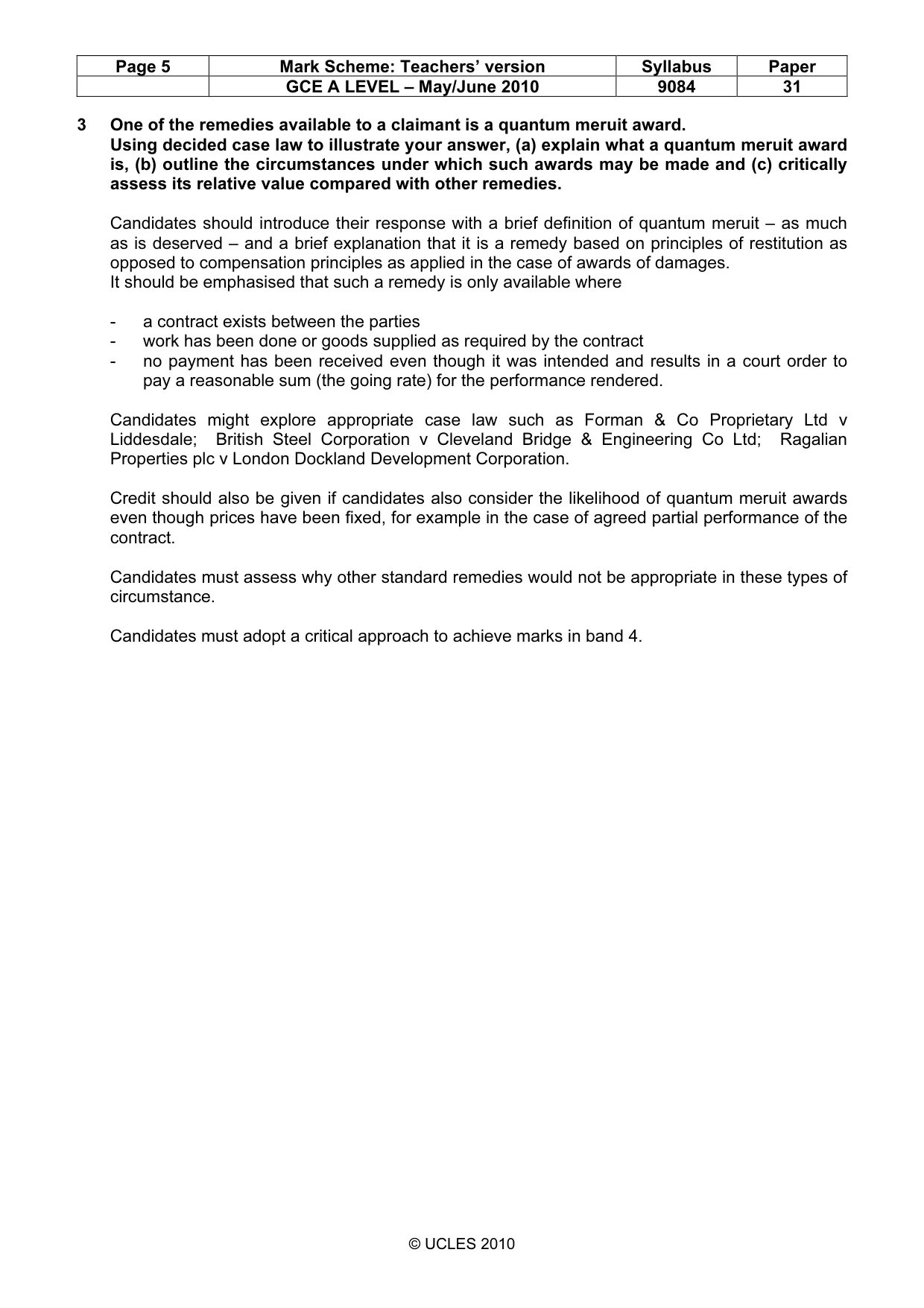
Page 5 Mark Scheme: Teachers’ version Syllabus Paper GCE A LEVEL – May/June 2010 9084 31 © UCLES 2010 3 One of the remedies available to a claimant is a quantum meruit award. Using decided case law to illustrate your answer, (a) explain what a quantum meruit award is, (b) outline the circumstances under which such awards may be made and (c) critically assess its relative value compared with other remedies. Candidates should introduce their response with a brief definition of quantum meruit – as much as is deserved – and a brief explanation that it is a remedy based on principles of restitution as opposed to compensation principles as applied in the case of awards of damages. It should be emphasised that such a remedy is only available where - a contract exists between the parties - work has been done or goods supplied as required by the contract - no payment has been received even though it was intended and results in a court order to pay a reasonable sum (the going rate) for the performance rendered. Candidates might explore appropriate case law such as Forman & Co Proprietary Ltd v Liddesdale; British Steel Corporation v Cleveland Bridge & Engineering Co Ltd; Ragalian Properties plc v London Dockland Development Corporation. Credit should also be given if candidates also consider the likelihood of quantum meruit awards even though prices have been fixed, for example in the case of agreed partial performance of the contract. Candidates must assess why other standard remedies would not be appropriate in these types of circumstance. Candidates must adopt a critical approach to achieve marks in band 4.
Mark scheme, page 6
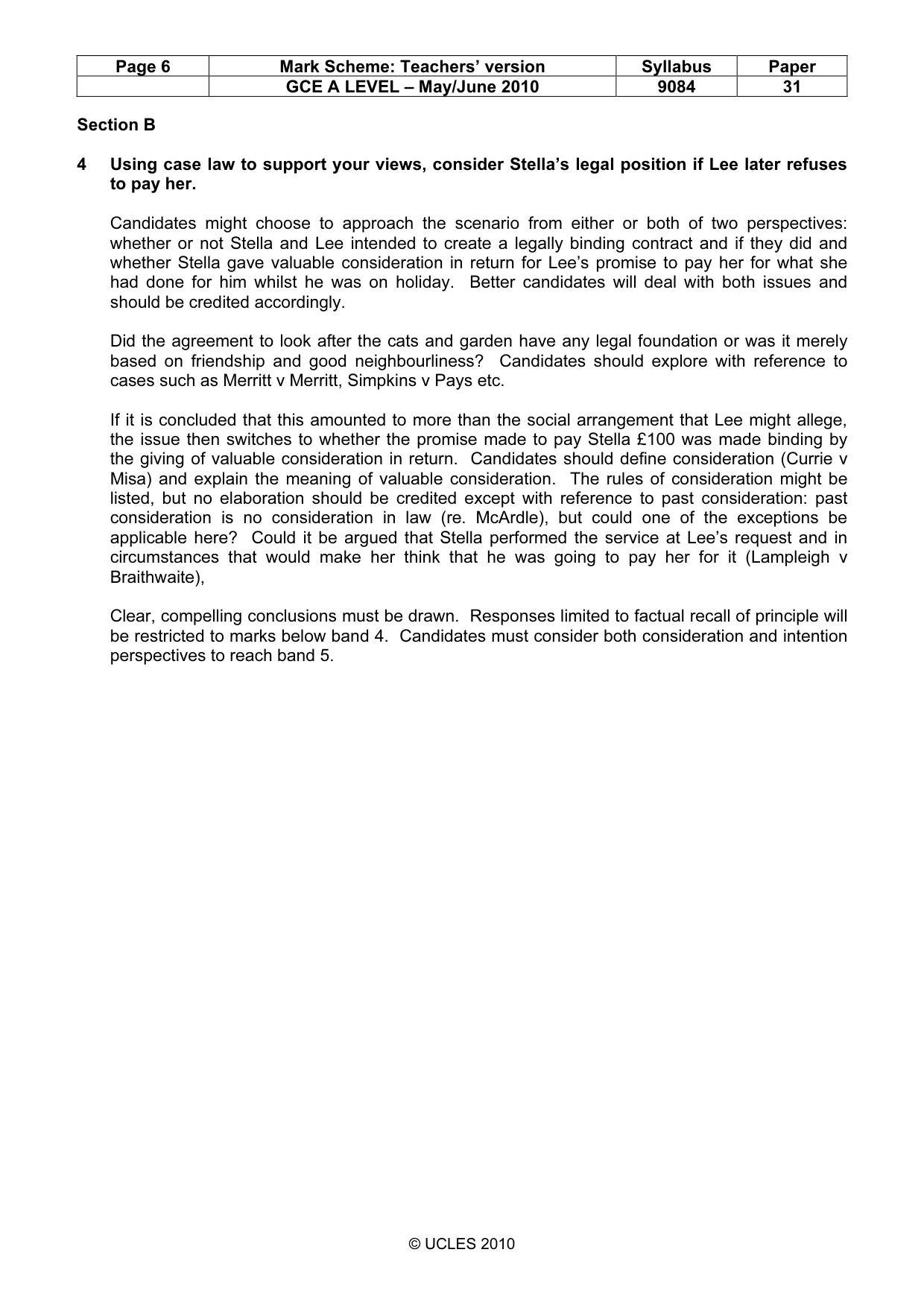
Page 6 Mark Scheme: Teachers’ version Syllabus Paper GCE A LEVEL – May/June 2010 9084 31 © UCLES 2010 Section B 4 Using case law to support your views, consider Stella’s legal position if Lee later refuses to pay her. Candidates might choose to approach the scenario from either or both of two perspectives: whether or not Stella and Lee intended to create a legally binding contract and if they did and whether Stella gave valuable consideration in return for Lee’s promise to pay her for what she had done for him whilst he was on holiday. Better candidates will deal with both issues and should be credited accordingly. Did the agreement to look after the cats and garden have any legal foundation or was it merely based on friendship and good neighbourliness? Candidates should explore with reference to cases such as Merritt v Merritt, Simpkins v Pays etc. If it is concluded that this amounted to more than the social arrangement that Lee might allege, the issue then switches to whether the promise made to pay Stella £100 was made binding by the giving of valuable consideration in return. Candidates should define consideration (Currie v Misa) and explain the meaning of valuable consideration. The rules of consideration might be listed, but no elaboration should be credited except with reference to past consideration: past consideration is no consideration in law (re. McArdle), but could one of the exceptions be applicable here? Could it be argued that Stella performed the service at Lee’s request and in circumstances that would make her think that he was going to pay her for it (Lampleigh v Braithwaite), Clear, compelling conclusions must be drawn. Responses limited to factual recall of principle will be restricted to marks below band 4. Candidates must consider both consideration and intention perspectives to reach band 5.
Mark scheme, page 7
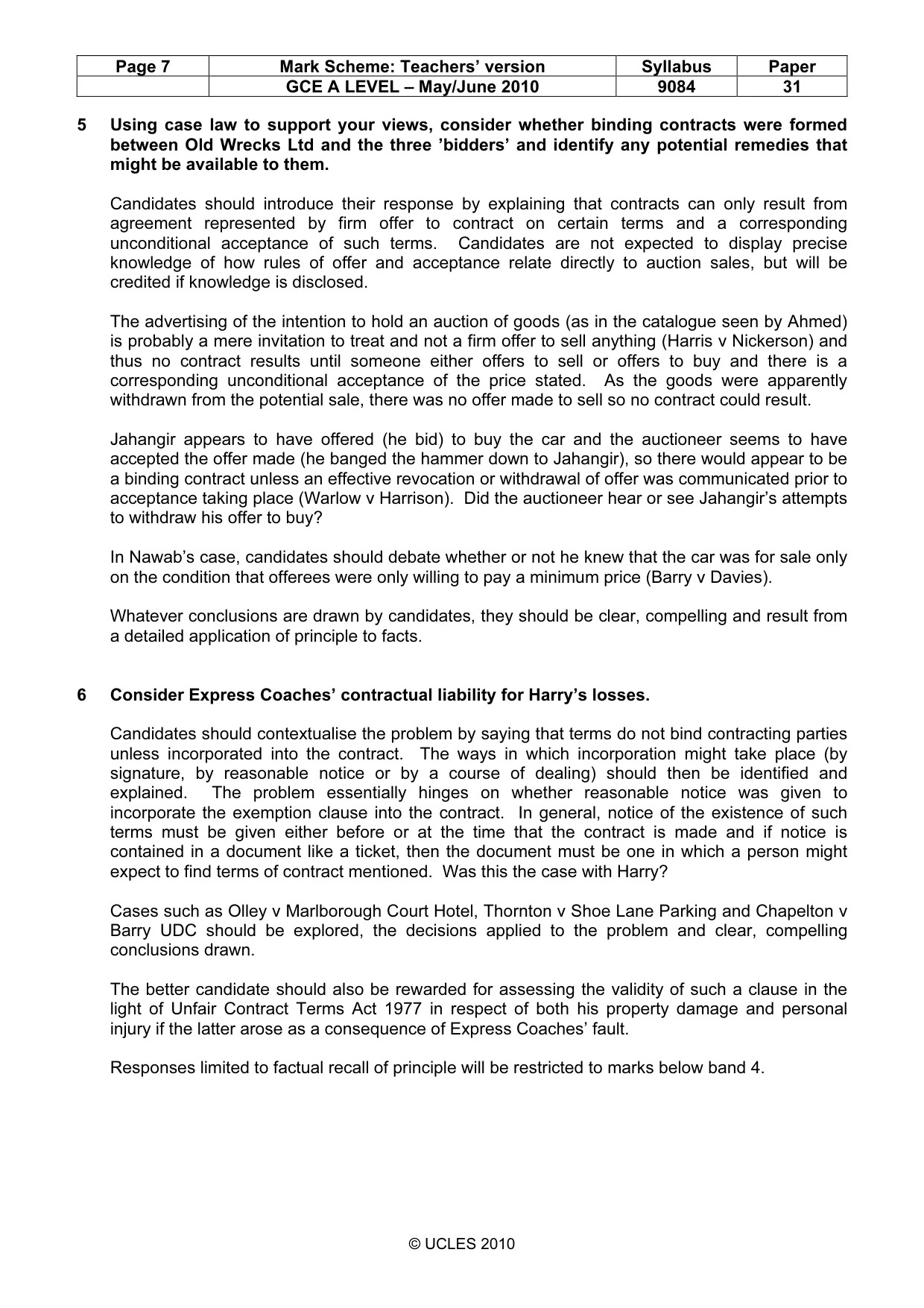
Page 7 Mark Scheme: Teachers’ version Syllabus Paper GCE A LEVEL – May/June 2010 9084 31 © UCLES 2010 5 Using case law to support your views, consider whether binding contracts were formed between Old Wrecks Ltd and the three ’bidders’ and identify any potential remedies that might be available to them. Candidates should introduce their response by explaining that contracts can only result from agreement represented by firm offer to contract on certain terms and a corresponding unconditional acceptance of such terms. Candidates are not expected to display precise knowledge of how rules of offer and acceptance relate directly to auction sales, but will be credited if knowledge is disclosed. The advertising of the intention to hold an auction of goods (as in the catalogue seen by Ahmed) is probably a mere invitation to treat and not a firm offer to sell anything (Harris v Nickerson) and thus no contract results until someone either offers to sell or offers to buy and there is a corresponding unconditional acceptance of the price stated. As the goods were apparently withdrawn from the potential sale, there was no offer made to sell so no contract could result. Jahangir appears to have offered (he bid) to buy the car and the auctioneer seems to have accepted the offer made (he banged the hammer down to Jahangir), so there would appear to be a binding contract unless an effective revocation or withdrawal of offer was communicated prior to acceptance taking place (Warlow v Harrison). Did the auctioneer hear or see Jahangir’s attempts to withdraw his offer to buy? In Nawab’s case, candidates should debate whether or not he knew that the car was for sale only on the condition that offerees were only willing to pay a minimum price (Barry v Davies). Whatever conclusions are drawn by candidates, they should be clear, compelling and result from a detailed application of principle to facts. 6 Consider Express Coaches’ contractual liability for Harry’s losses. Candidates should contextualise the problem by saying that terms do not bind contracting parties unless incorporated into the contract. The ways in which incorporation might take place (by signature, by reasonable notice or by a course of dealing) should then be identified and explained. The problem essentially hinges on whether reasonable notice was given to incorporate the exemption clause into the contract. In general, notice of the existence of such terms must be given either before or at the time that the contract is made and if notice is contained in a document like a ticket, then the document must be one in which a person might expect to find terms of contract mentioned. Was this the case with Harry? Cases such as Olley v Marlborough Court Hotel, Thornton v Shoe Lane Parking and Chapelton v Barry UDC should be explored, the decisions applied to the problem and clear, compelling conclusions drawn. The better candidate should also be rewarded for assessing the validity of such a clause in the light of Unfair Contract Terms Act 1977 in respect of both his property damage and personal injury if the latter arose as a consequence of Express Coaches’ fault. Responses limited to factual recall of principle will be restricted to marks below band 4.
What you needed in this session
Cambridge’s own grade thresholds for 2010 May/June, Paper 3 · Variant 1. A higher threshold means an easier paper — the bar moves with how the cohort did.