Cambridge A Level Islamic Studies 9488 — 2025 May/June Paper 4 · Variant 2
9488/42/M/J/25 · 3 questions · 50 marks · 90 min
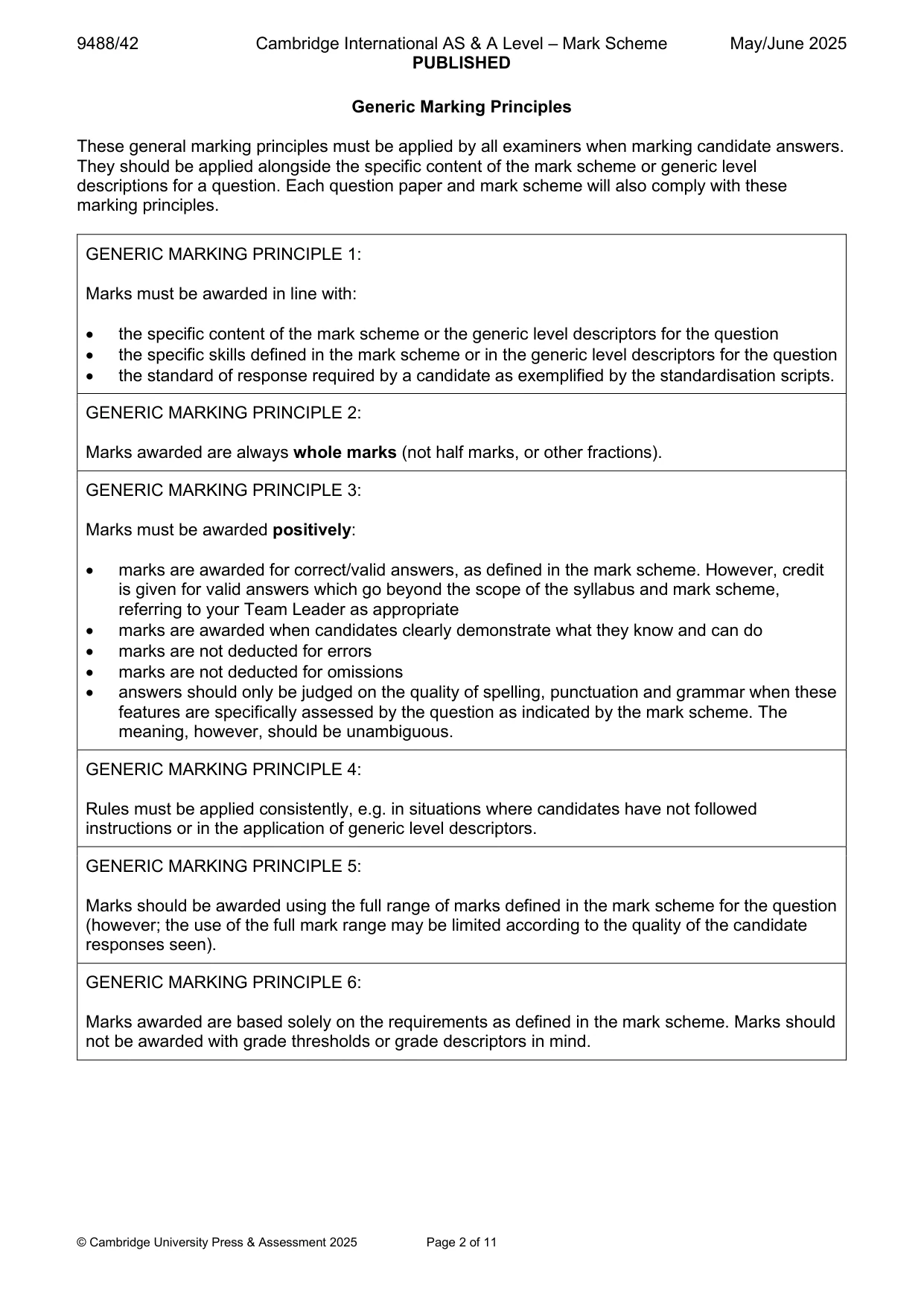
The question paper and its mark scheme, free to read here and free to download. This is Cambridge’s own paper, exactly as it was sat.
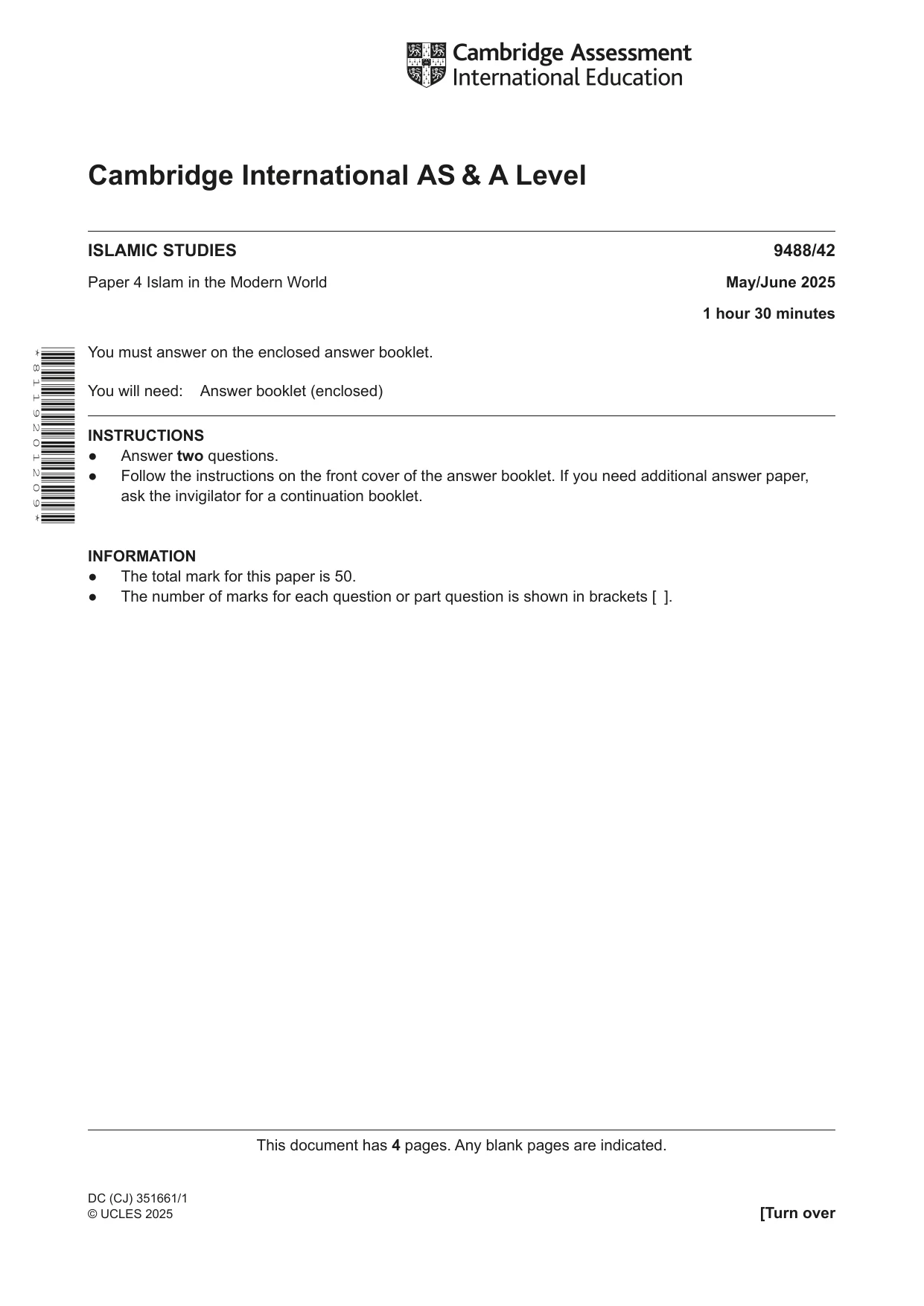
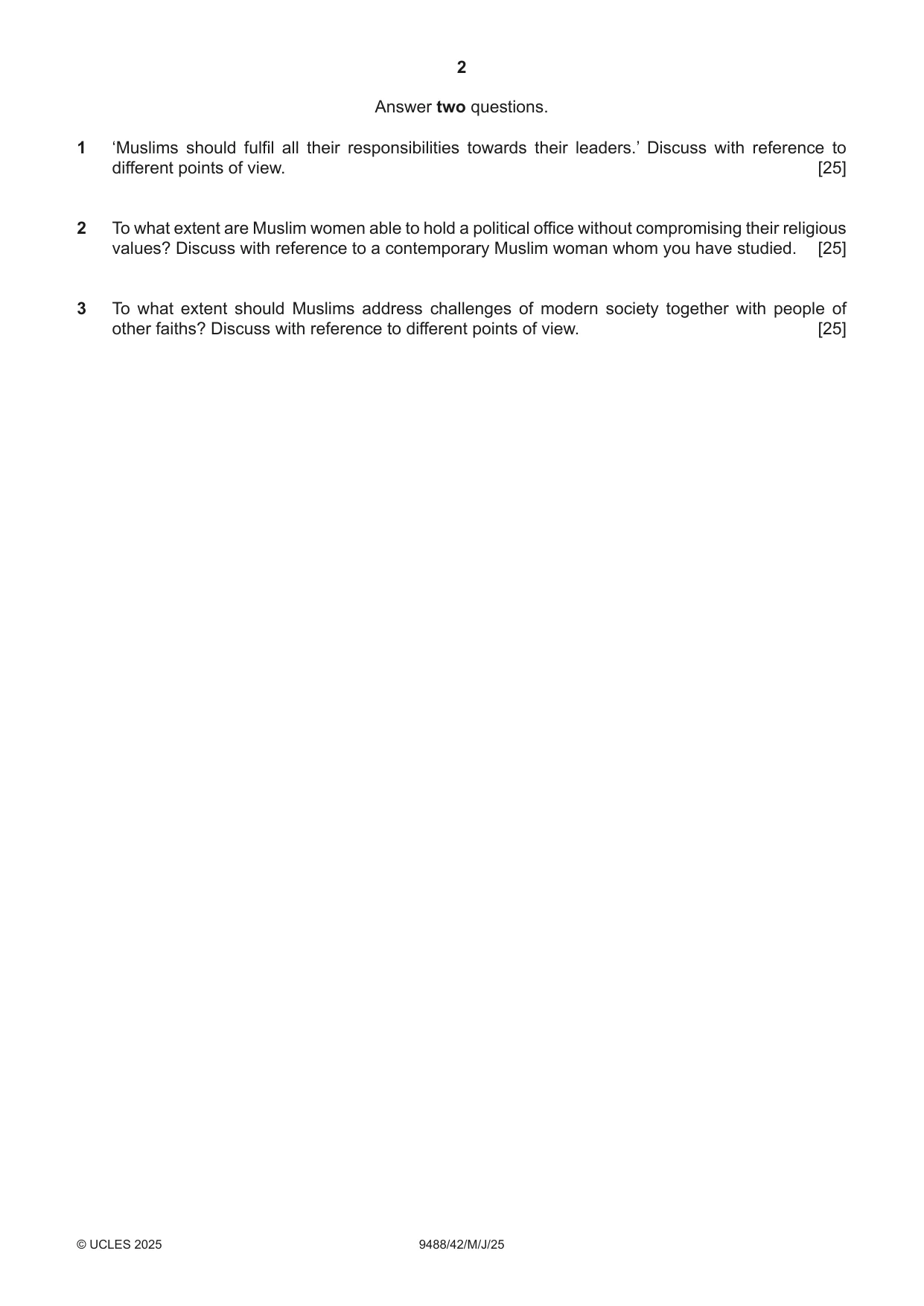
Question paper4 pages

Mark scheme11 pages
Answers below. Sit the paper first if you are practising.
Questions as text
Q1 · ‘Muslims should fulfil all their responsibilities towards their leaders.’ Discuss with…
1 ‘Muslims should fulfil all their responsibilities towards their leaders.’ Discuss with reference to different points of view. [25]
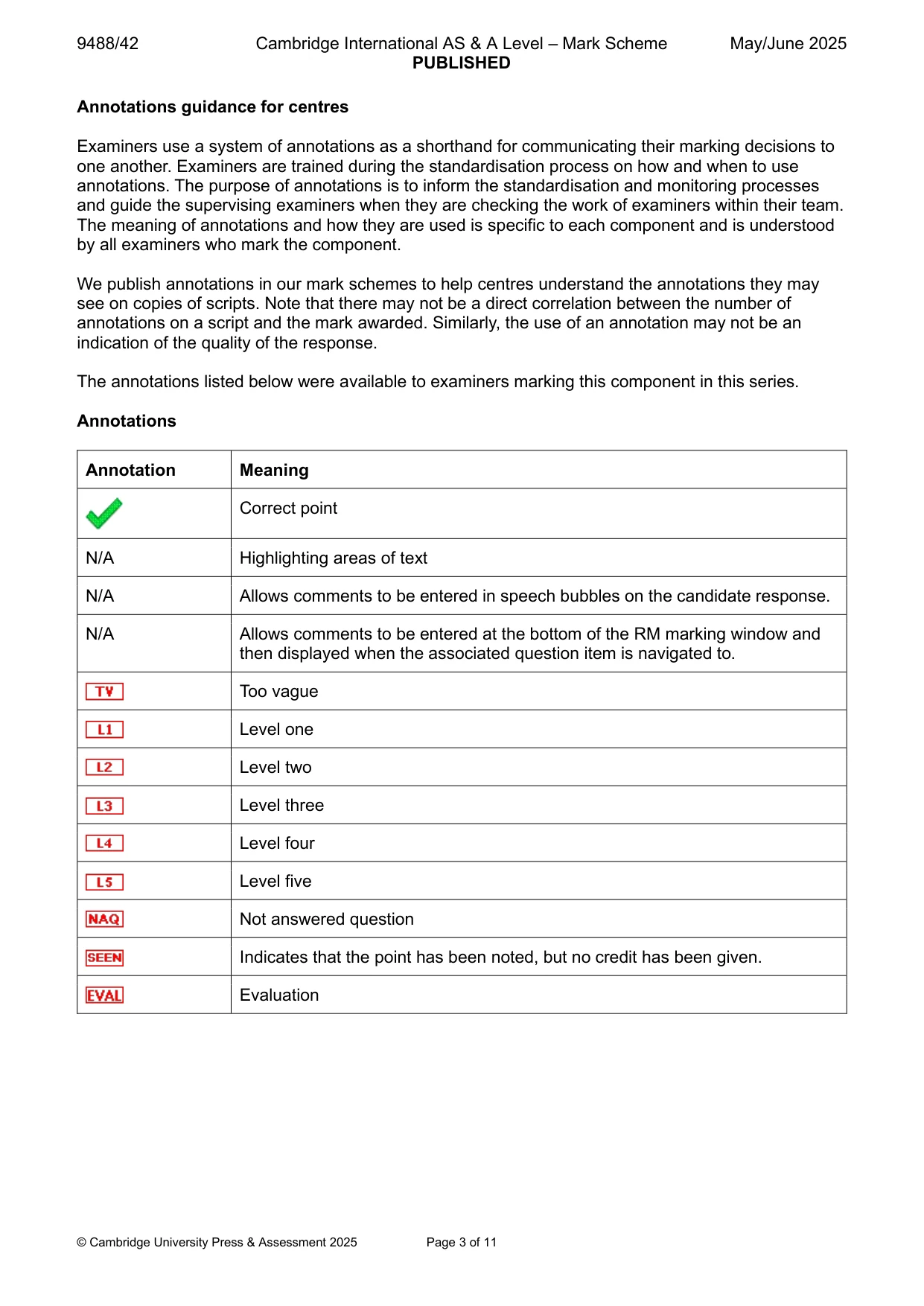
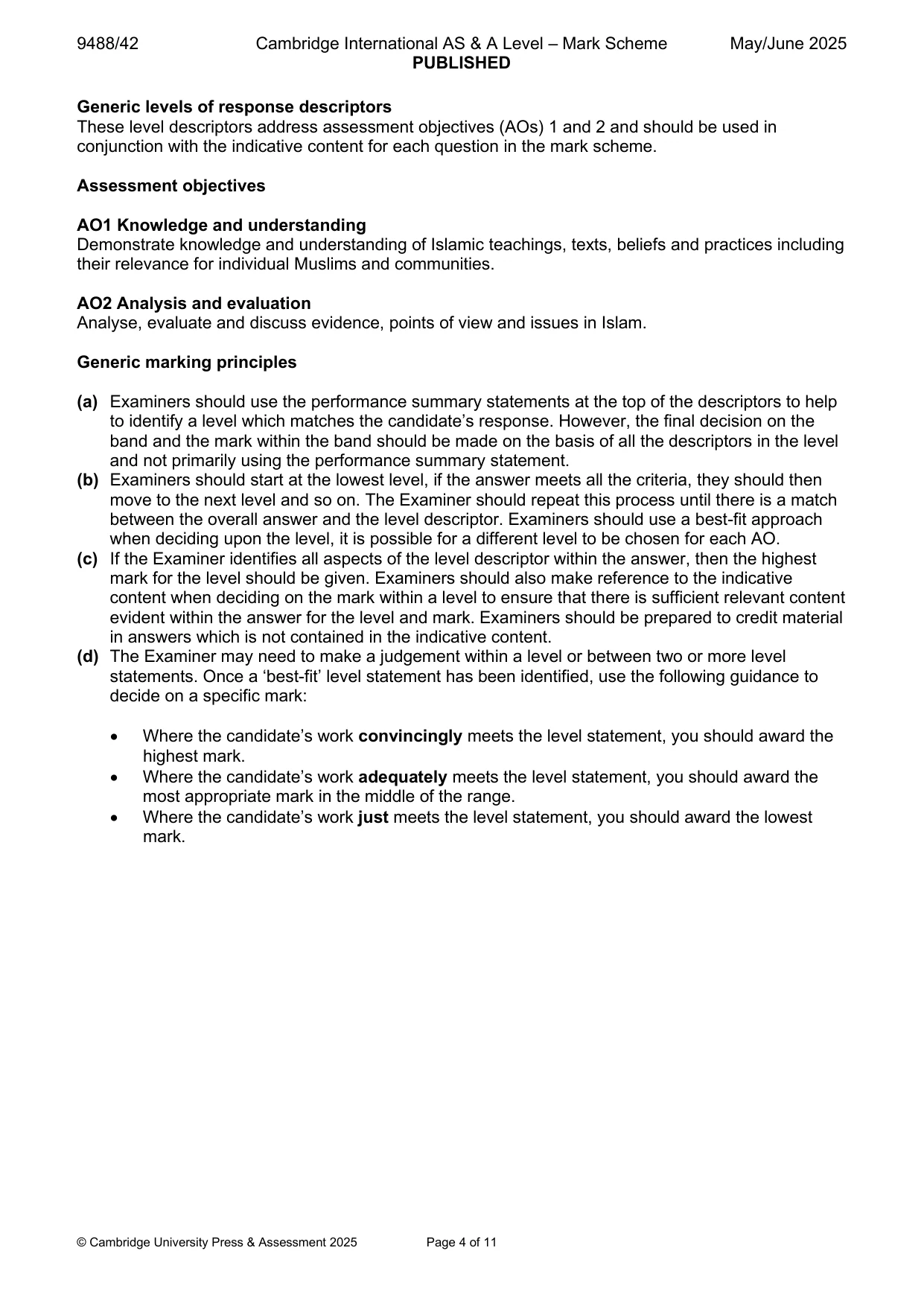
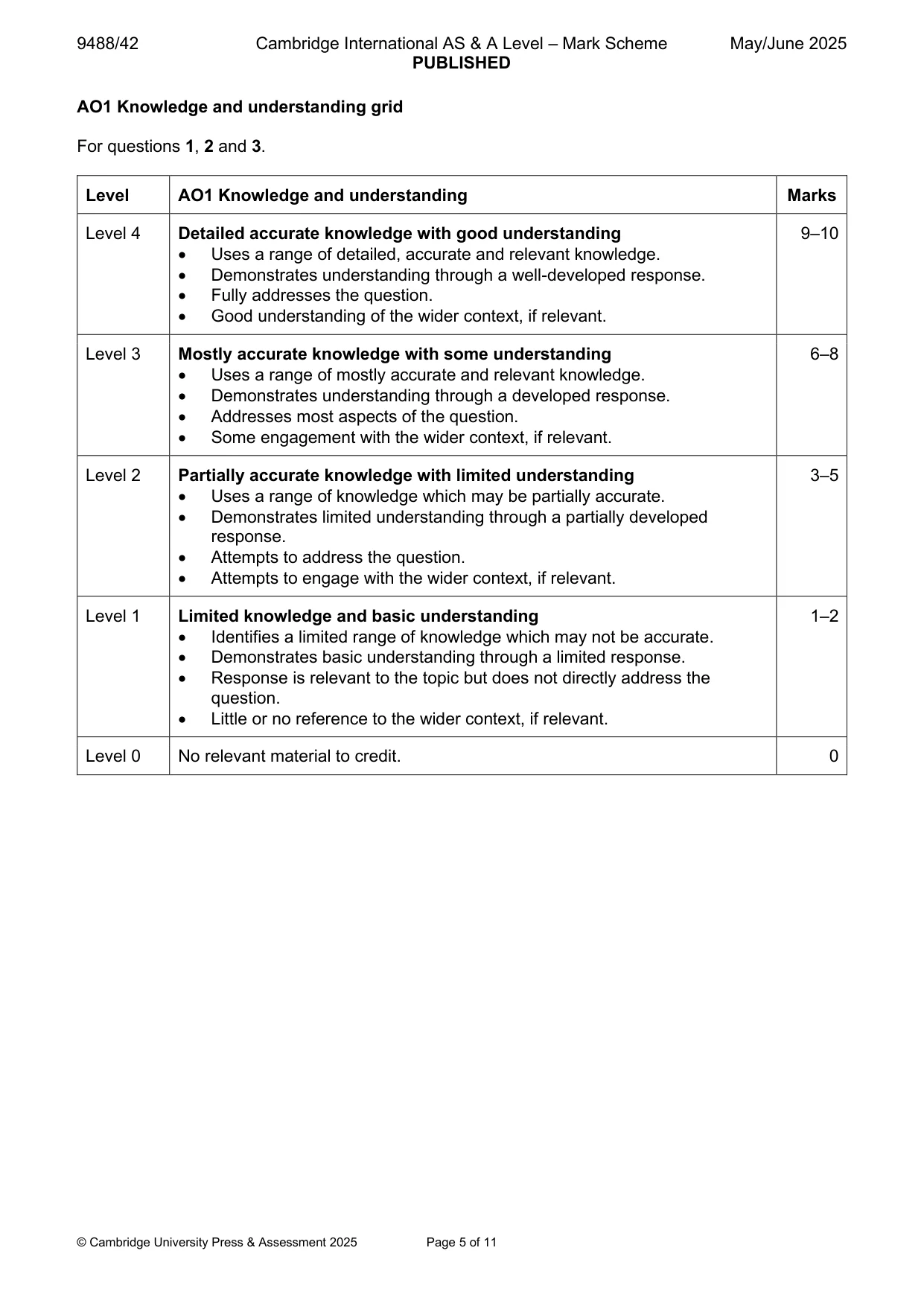
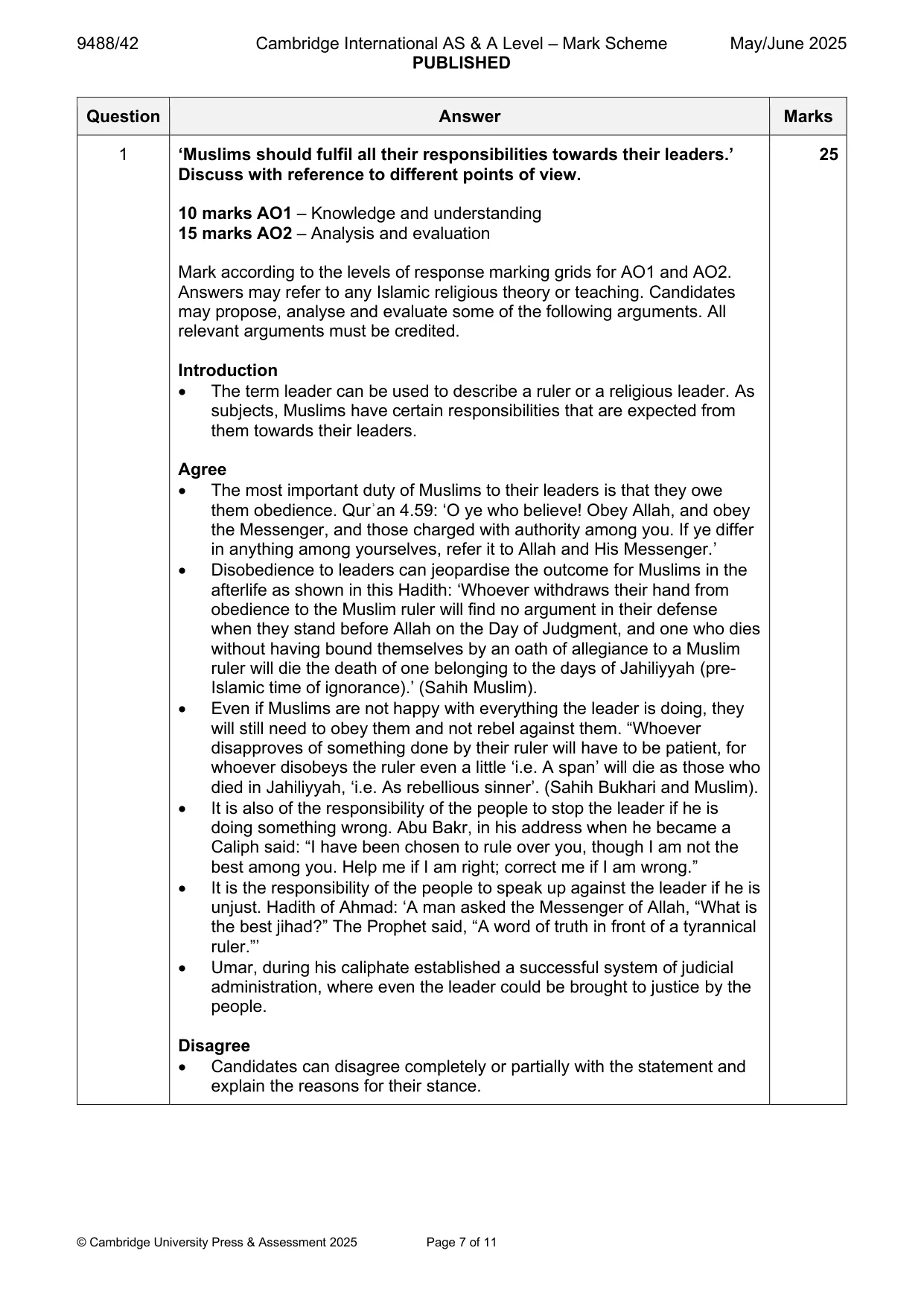
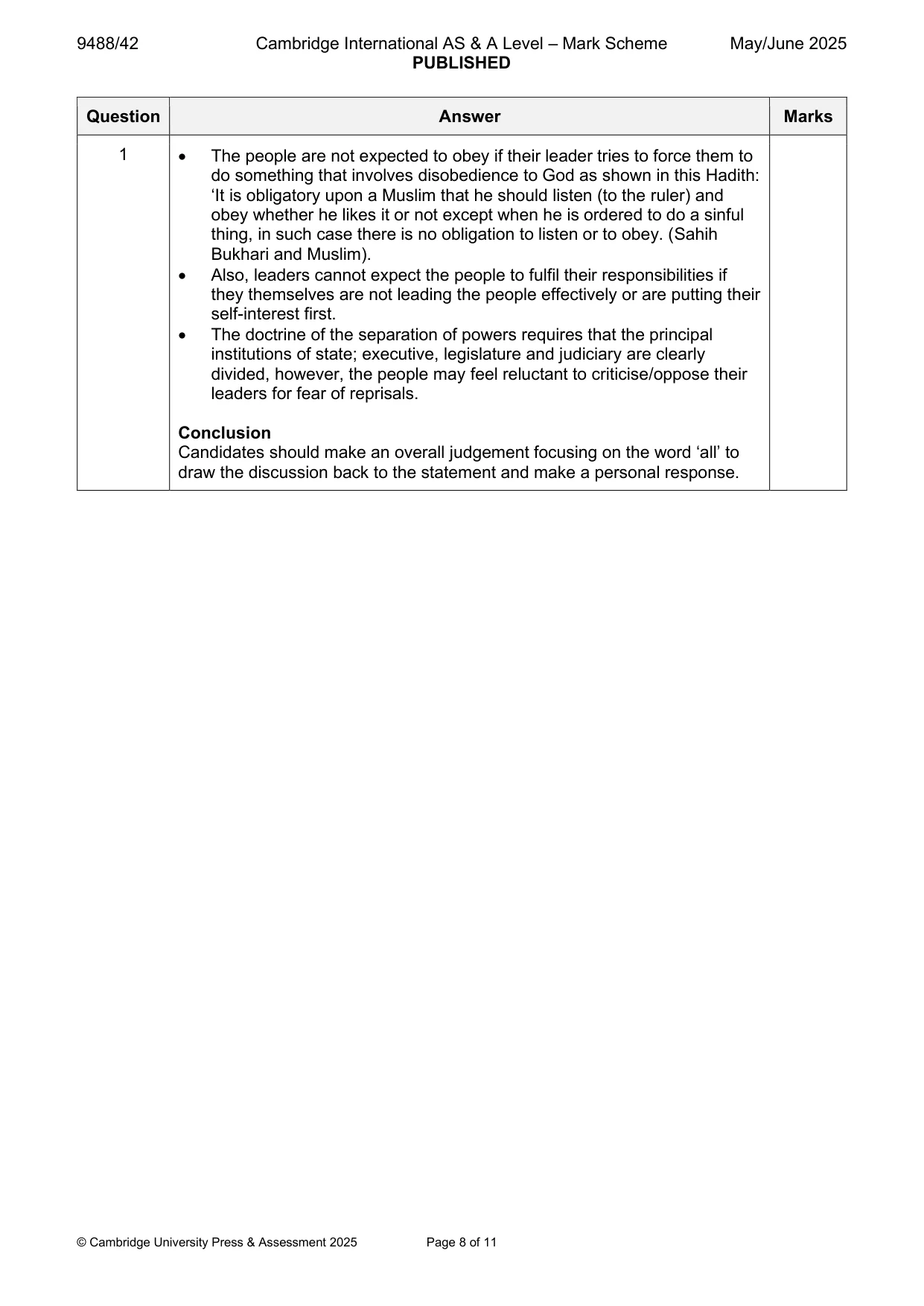
Mark scheme: Question Answer Marks 1 ‘Muslims should fulfil all their responsibilities towards their leaders.’ 25 Discuss with reference to different points of view. 10 marks AO1 – Knowledge and understanding 15 marks AO2 – Analysis and evaluation Mark according to the levels of response marking grids for AO1 and AO2. Answers may refer to any Islamic religious theory or teaching. Candidates may propose, analyse and evaluate some of the following arguments. All relevant arguments must be credited. Introduction • The term leader can be used to describe a ruler or a religious leader. As subjects, Muslims have certain responsibilities that are expected from them towards their leaders. Agree • The most important duty of Muslims to their leaders is that they owe them obedience. Qurʾan 4.59: ‘O ye who believe! Obey Allah, and obey the Messenger, and those charged with authority among you. If ye differ in anything among yourselves, refer it to Allah and His Messenger.’ • Disobedience to leaders can jeopardise the outcome for Muslims in the afterlife as shown in this Hadith: ‘Whoever withdraws their hand from obedience to the Muslim ruler will find no argument in their defense when they stand before Allah on the Day of Judgment, and one who dies without having bound themselves by an oath of allegiance to a Muslim ruler will die the death of one belonging to the days of Jahiliyyah (pre- Islamic time of ignorance).’ (Sahih Muslim). • Even if Muslims are not happy with everything the leader is doing, they will still need to obey them and not rebel against them. “Whoever disapproves of something done by their ruler will have to be patient, for whoever disobeys the ruler even a little ‘i.e. A span’ will die as those who died in Jahiliyyah, ‘i.e. As rebellious sinner’. (Sahih Bukhari and Muslim). • It is also of the responsibility of the people to stop the leader if he is doing something wrong. Abu Bakr, in his address when he became a Caliph said: “I have been chosen to rule over you, though I am not the best among you. Help me if I am right; correct me if I am wrong.” • It is the responsibility of the people to speak up against the leader if he is unjust. Hadith of Ahmad: ‘A man asked the Messenger of Allah, “What is the best jihad?” The Prophet said, “A word of truth in front of a tyrannical ruler.”’ • Umar, during his caliphate established a successful system of judicial administration, where even the leader could be brought to justice by the people. Disagree • Candidates can disagree completely or partially with the statement and explain the reasons for their stance. 1 • The people are not expected to obey if their leader tries to force them to do something that involves disobedience to God as shown in this Hadith: ‘It is obligatory upon a Muslim that he should listen (to the ruler) and obey whether he likes it or not except when he is ordered to do a sinful thing, in such case there is no obligation to listen or to obey. (Sahih Bukhari and Muslim). • Also, leaders cannot expect the people to fulfil their responsibilities if they themselves are not leading the people effectively or are putting their self-interest first. • The doctrine of the separation of powers requires that the principal institutions of state; executive, legislature and judiciary are clearly divided, however, the people may feel reluctant to criticise/oppose their leaders for fear of reprisals. Conclusion Candidates should make an overall judgement focusing on the word ‘all’ to draw the discussion back to the statement and make a personal response.
Q2 · To what extent are Muslim women able to hold a political office without compromising…
2 To what extent are Muslim women able to hold a political office without compromising their religious values? Discuss with reference to a contemporary Muslim woman whom you have studied. [25]
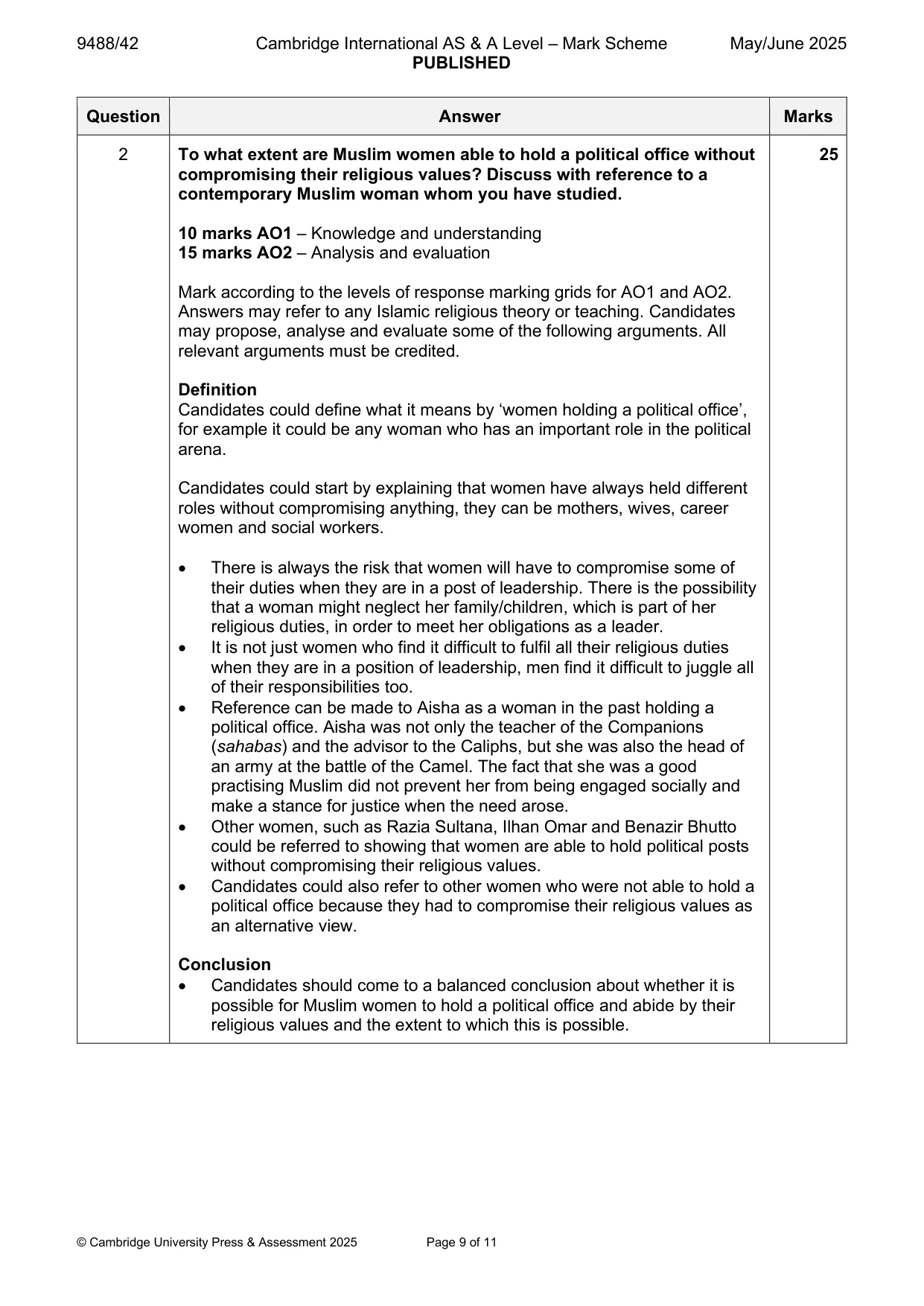
Mark scheme: 2 To what extent are Muslim women able to hold a political office without 25 compromising their religious values? Discuss with reference to a contemporary Muslim woman whom you have studied. 10 marks AO1 – Knowledge and understanding 15 marks AO2 – Analysis and evaluation Mark according to the levels of response marking grids for AO1 and AO2. Answers may refer to any Islamic religious theory or teaching. Candidates may propose, analyse and evaluate some of the following arguments. All relevant arguments must be credited. Definition Candidates could define what it means by ‘women holding a political office’, for example it could be any woman who has an important role in the political arena. Candidates could start by explaining that women have always held different roles without compromising anything, they can be mothers, wives, career women and social workers. • There is always the risk that women will have to compromise some of their duties when they are in a post of leadership. There is the possibility that a woman might neglect her family/children, which is part of her religious duties, in order to meet her obligations as a leader. • It is not just women who find it difficult to fulfil all their religious duties when they are in a position of leadership, men find it difficult to juggle all of their responsibilities too. • Reference can be made to Aisha as a woman in the past holding a political office. Aisha was not only the teacher of the Companions (sahabas) and the advisor to the Caliphs, but she was also the head of an army at the battle of the Camel. The fact that she was a good practising Muslim did not prevent her from being engaged socially and make a stance for justice when the need arose. • Other women, such as Razia Sultana, Ilhan Omar and Benazir Bhutto could be referred to showing that women are able to hold political posts without compromising their religious values. • Candidates could also refer to other women who were not able to hold a political office because they had to compromise their religious values as an alternative view. Conclusion • Candidates should come to a balanced conclusion about whether it is possible for Muslim women to hold a political office and abide by their religious values and the extent to which this is possible.
Q3 · To what extent should Muslims address challenges of modern society together with people…
3 To what extent should Muslims address challenges of modern society together with people of other faiths? Discuss with reference to different points of view. [25]
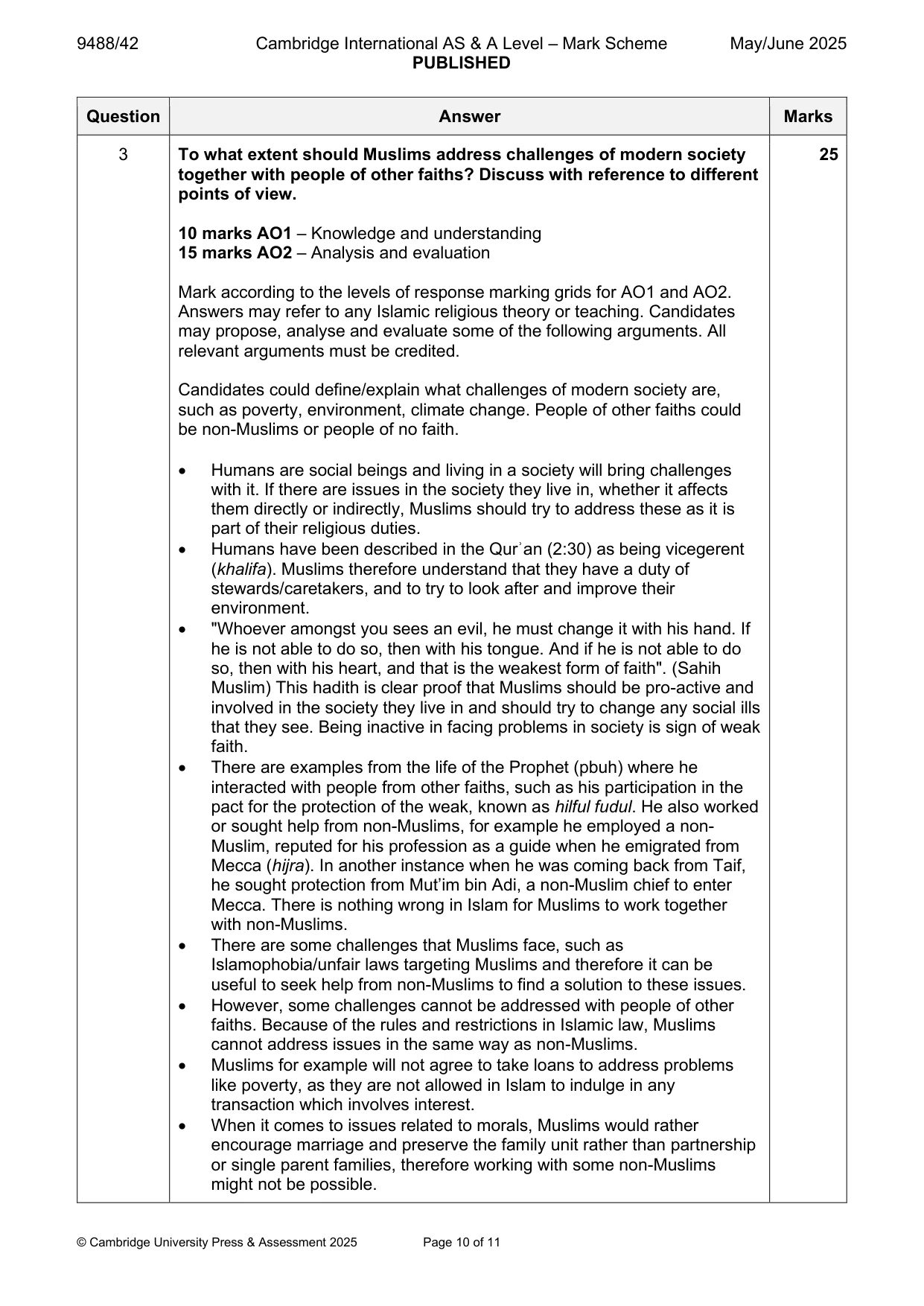
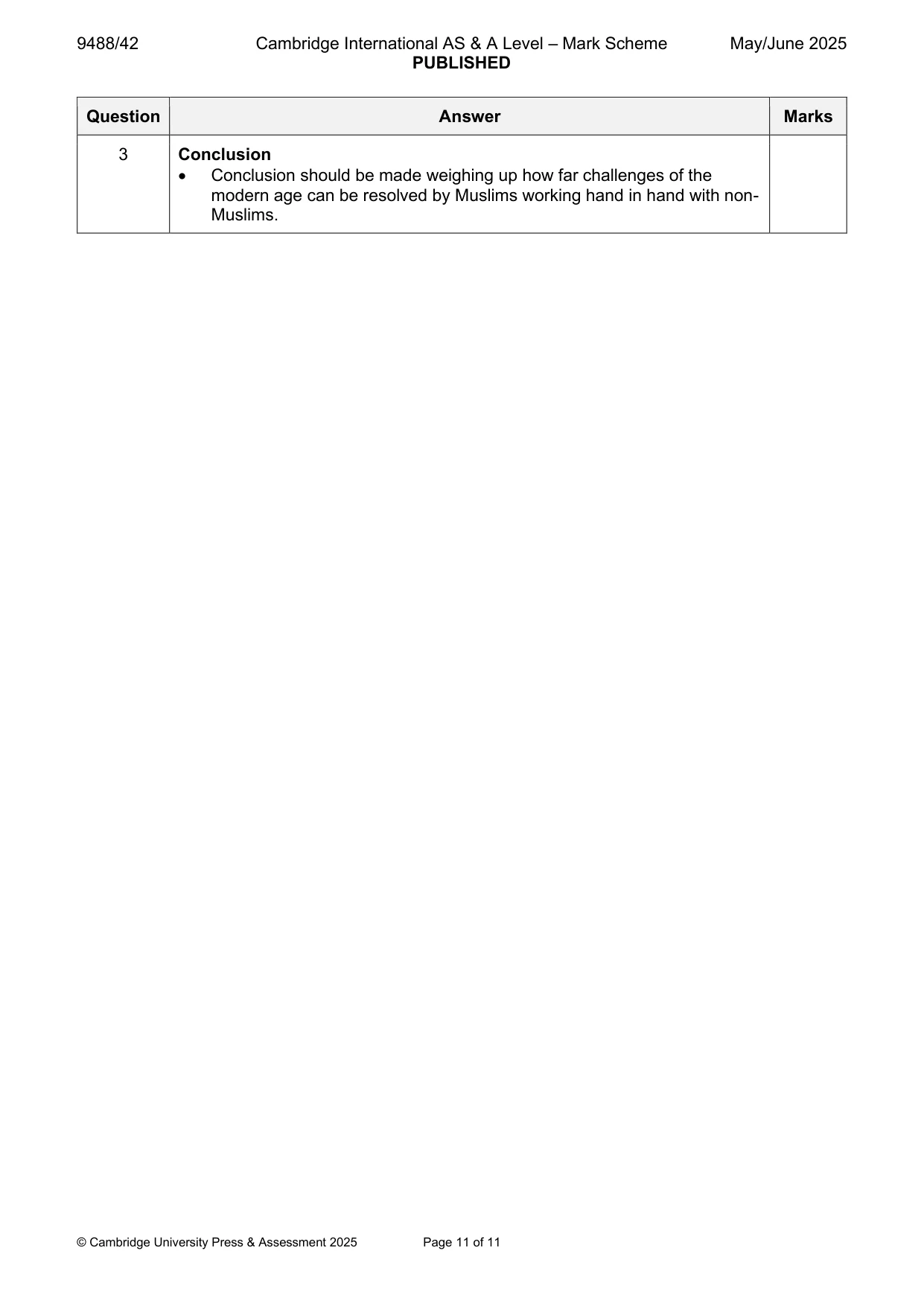
Mark scheme: 3 To what extent should Muslims address challenges of modern society 25 together with people of other faiths? Discuss with reference to different points of view. 10 marks AO1 – Knowledge and understanding 15 marks AO2 – Analysis and evaluation Mark according to the levels of response marking grids for AO1 and AO2. Answers may refer to any Islamic religious theory or teaching. Candidates may propose, analyse and evaluate some of the following arguments. All relevant arguments must be credited. Candidates could define/explain what challenges of modern society are, such as poverty, environment, climate change. People of other faiths could be non-Muslims or people of no faith. • Humans are social beings and living in a society will bring challenges with it. If there are issues in the society they live in, whether it affects them directly or indirectly, Muslims should try to address these as it is part of their religious duties. • Humans have been described in the Qurʾan (2:30) as being vicegerent (khalifa). Muslims therefore understand that they have a duty of stewards/caretakers, and to try to look after and improve their environment. • "Whoever amongst you sees an evil, he must change it with his hand. If he is not able to do so, then with his tongue. And if he is not able to do so, then with his heart, and that is the weakest form of faith". (Sahih Muslim) This hadith is clear proof that Muslims should be pro-active and involved in the society they live in and should try to change any social ills that they see. Being inactive in facing problems in society is sign of weak faith. • There are examples from the life of the Prophet (pbuh) where he interacted with people from other faiths, such as his participation in the pact for the protection of the weak, known as hilful fudul. He also worked or sought help from non-Muslims, for example he employed a non- Muslim, reputed for his profession as a guide when he emigrated from Mecca (hijra). In another instance when he was coming back from Taif, he sought protection from Mut’im bin Adi, a non-Muslim chief to enter Mecca. There is nothing wrong in Islam for Muslims to work together with non-Muslims. • There are some challenges that Muslims face, such as Islamophobia/unfair laws targeting Muslims and therefore it can be useful to seek help from non-Muslims to find a solution to these issues. • However, some challenges cannot be addressed with people of other faiths. Because of the rules and restrictions in Islamic law, Muslims cannot address issues in the same way as non-Muslims. • Muslims for example will not agree to take loans to address problems like poverty, as they are not allowed in Islam to indulge in any transaction which involves interest. • When it comes to issues related to morals, Muslims would rather encourage marriage and preserve the family unit rather than partnership or single parent families, therefore working with some non-Muslims might not be possible. 3 Conclusion • Conclusion should be made weighing up how far challenges of the modern age can be resolved by Muslims working hand in hand with non- Muslims.
What was in this paper
The subtopics covered by these 3 questions, and how many questions each got. Open one in a new tab to see every Cambridge question on it.
What you needed in this session
Cambridge’s own grade thresholds for 2025 May/June, Paper 4 · Variant 2. A higher threshold means an easier paper — the bar moves with how the cohort did.