Cambridge A Level Islamic Studies 9488 — 2022 May/June Paper 4 · Variant 2
9488/42/M/J/22 · 2 questions · 50 marks · ≈56 min
The question paper and its mark scheme, free to read here and free to download. This is Cambridge’s own paper, exactly as it was sat.
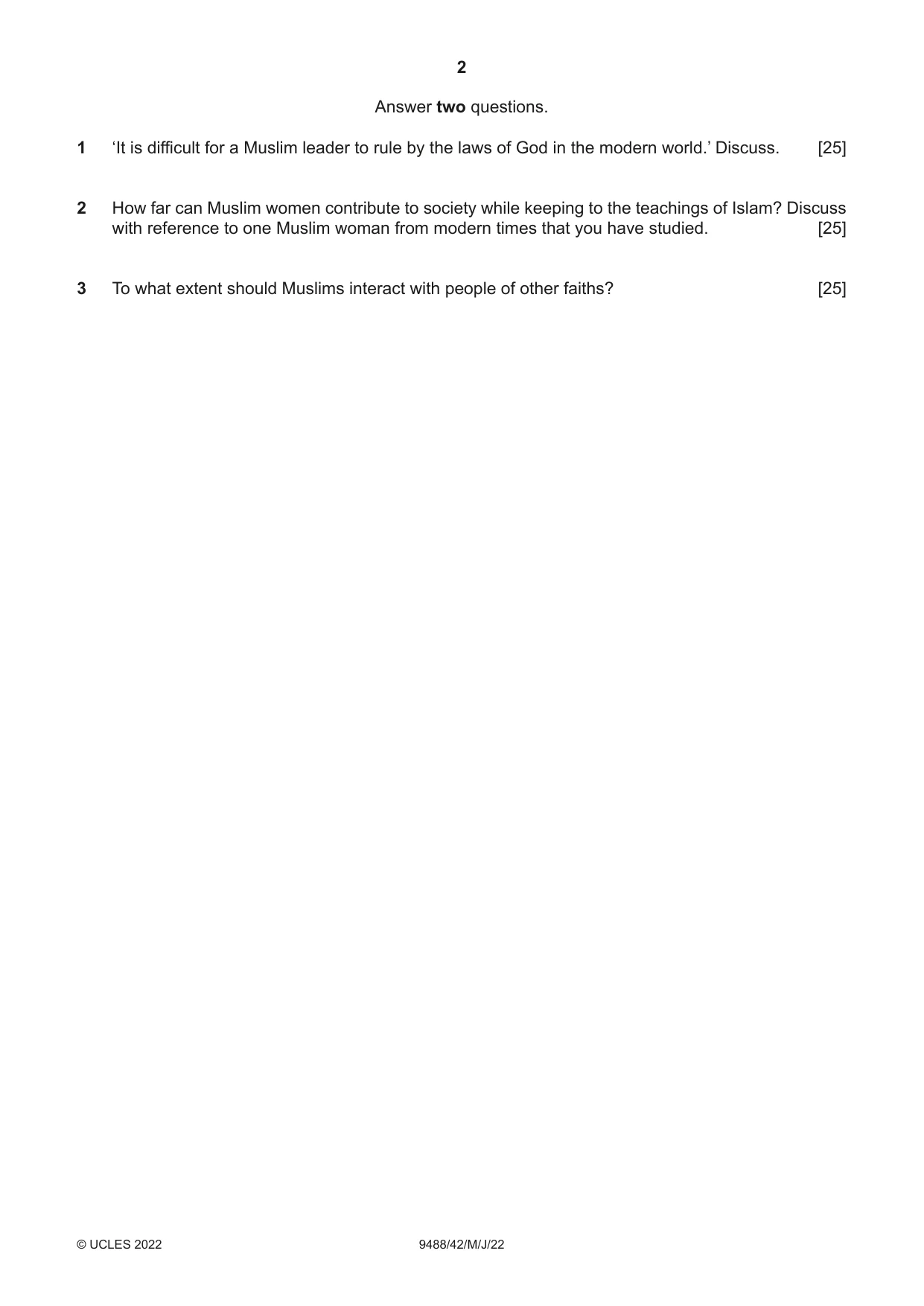
Question paper4 pages

Mark scheme12 pages
Answers below. Sit the paper first if you are practising.
Questions as text
Q1 · ‘It is difficult for a Muslim leader to rule by the laws of God in the modern world.’…
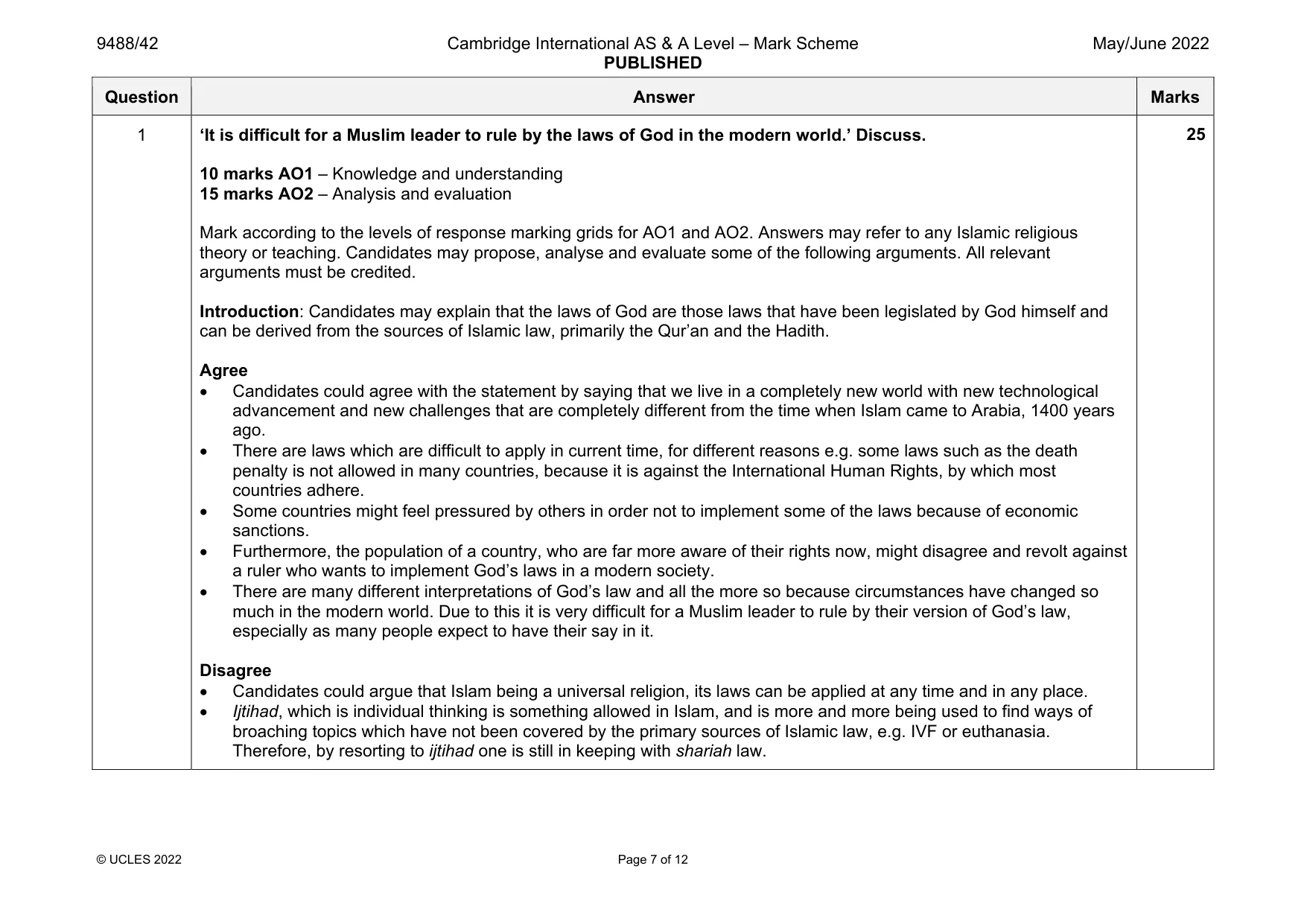
1 ‘It is difficult for a Muslim leader to rule by the laws of God in the modern world.’ Discuss. [25]
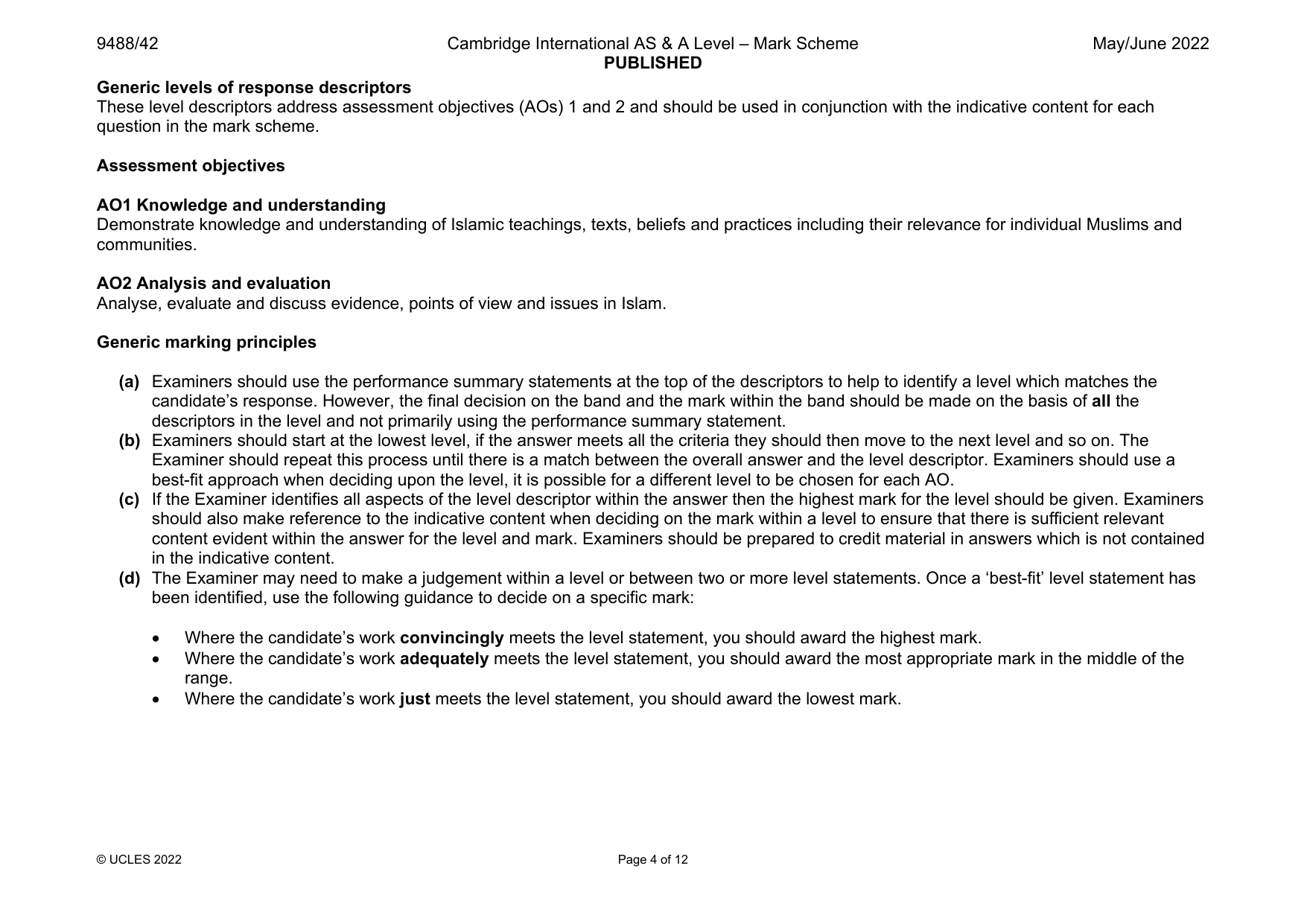
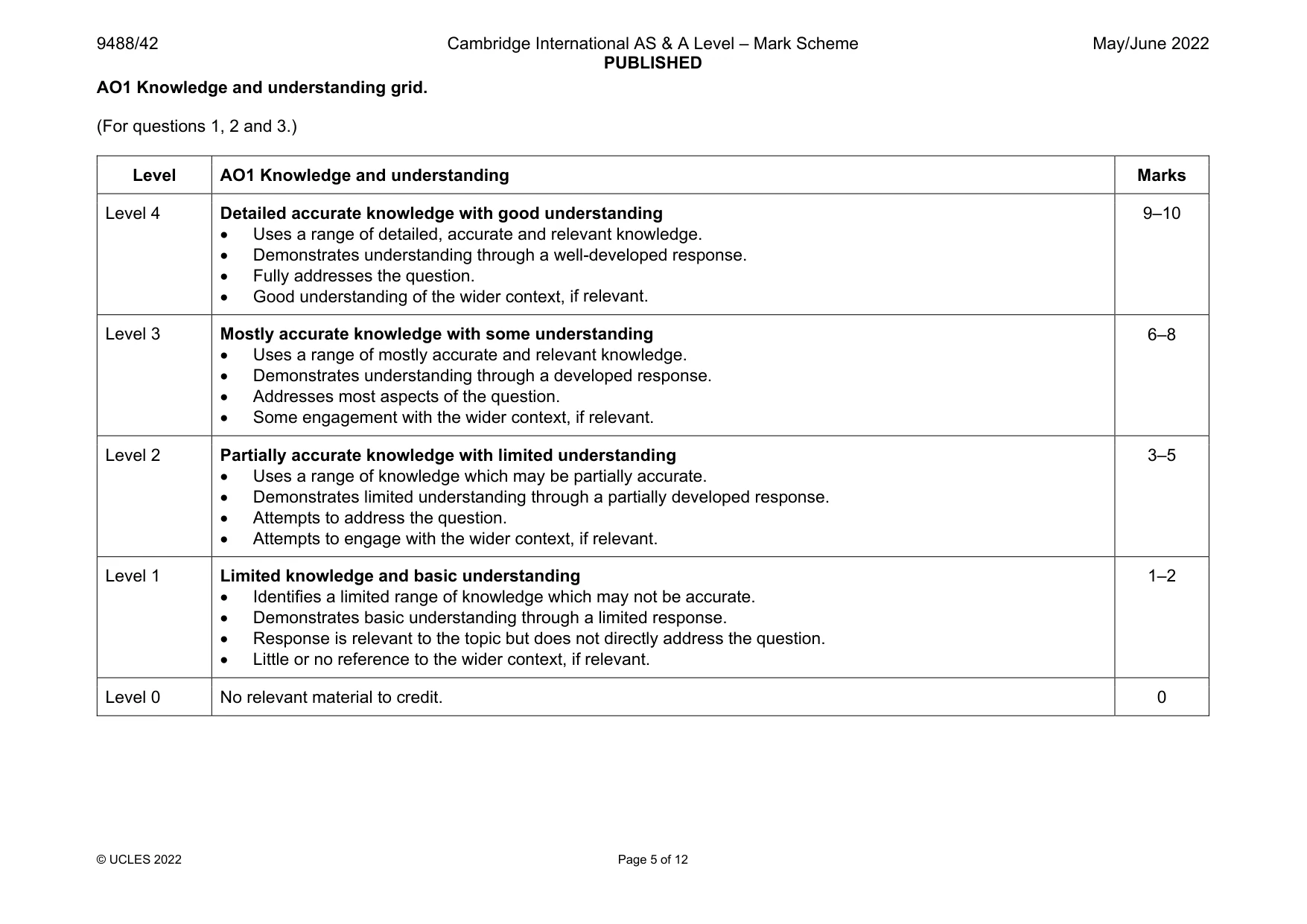
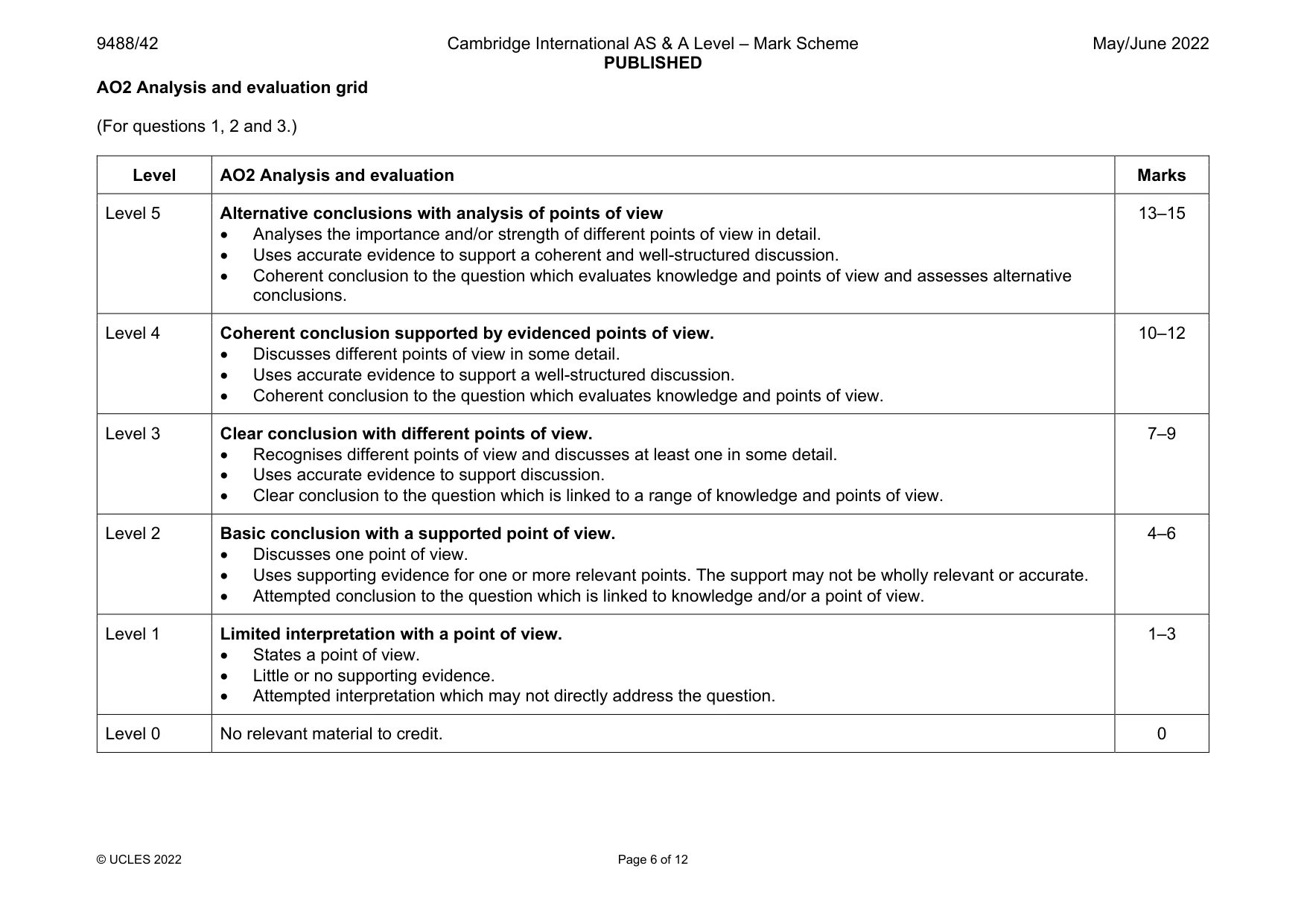
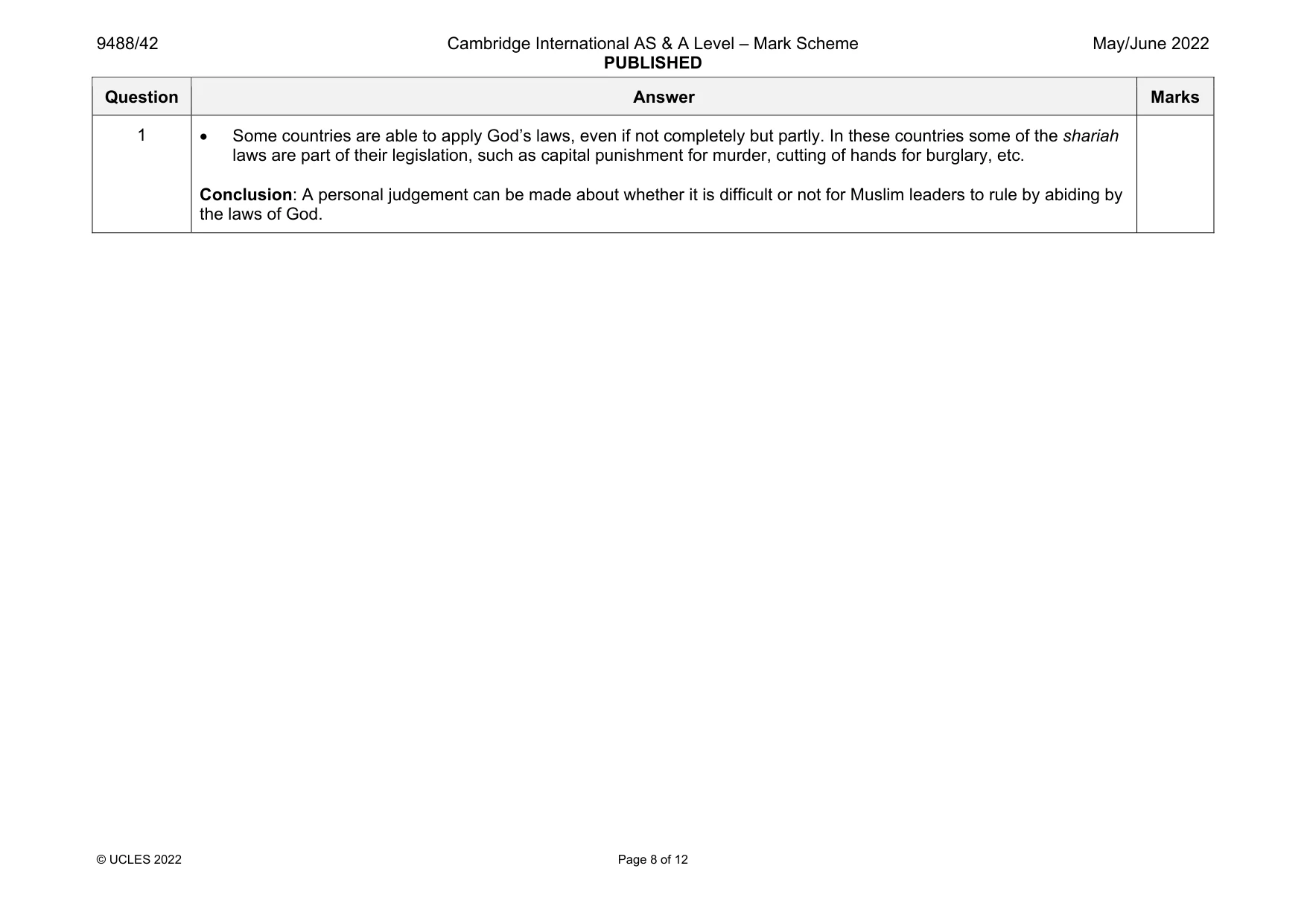
Mark scheme: 1 ‘It is difficult for a Muslim leader to rule by the laws of God in the modern world.’ Discuss. 10 marks AO1 – Knowledge and understanding 15 marks AO2 – Analysis and evaluation Mark according to the levels of response marking grids for AO1 and AO2. Answers may refer to any Islamic religious theory or teaching. Candidates may propose, analyse and evaluate some of the following arguments. All relevant arguments must be credited. Introduction: Candidates may explain that the laws of God are those laws that have been legislated by God himself and can be derived from the sources of Islamic law, primarily the Qur’an and the Hadith. Agree Candidates could agree with the statement by saying that we live in a completely new world with new technological advancement and new challenges that are completely different from the time when Islam came to Arabia, 1400 years ago. There are laws which are difficult to apply in current time, for different reasons e.g. some laws such as the death penalty is not allowed in many countries, because it is against the International Human Rights, by which most countries adhere. Some countries might feel pressured by others in order not to implement some of the laws because of economic sanctions. Furthermore, the population of a country, who are far more aware of their rights now, might disagree and revolt against a ruler who wants to implement God’s laws in a modern society. There are many different interpretations of God’s law and all the more so because circumstances have changed so much in the modern world. Due to this it is very difficult for a Muslim leader to rule by their version of God’s law, especially as many people expect to have their say in it. Disagree Candidates could argue that Islam being a universal religion, its laws can be applied at any time and in any place. Ijtihad, which is individual thinking is something allowed in Islam, and is more and more being used to find ways of broaching topics which have not been covered by the primary sources of Islamic law, e.g. IVF or euthanasia. Therefore, by resorting to ijtihad one is still in keeping with shariah law. Question Answer Marks 1 Some countries are able to apply God’s laws, even if not completely but partly. In these countries some of the shariah laws are part of their legislation, such as capital punishment for murder, cutting of hands for burglary, etc. Conclusion: A personal judgement can be made about whether it is difficult or not for Muslim leaders to rule by abiding by the laws of God.
Q2 · How far can Muslim women contribute to society while keeping to the teachings of Islam?
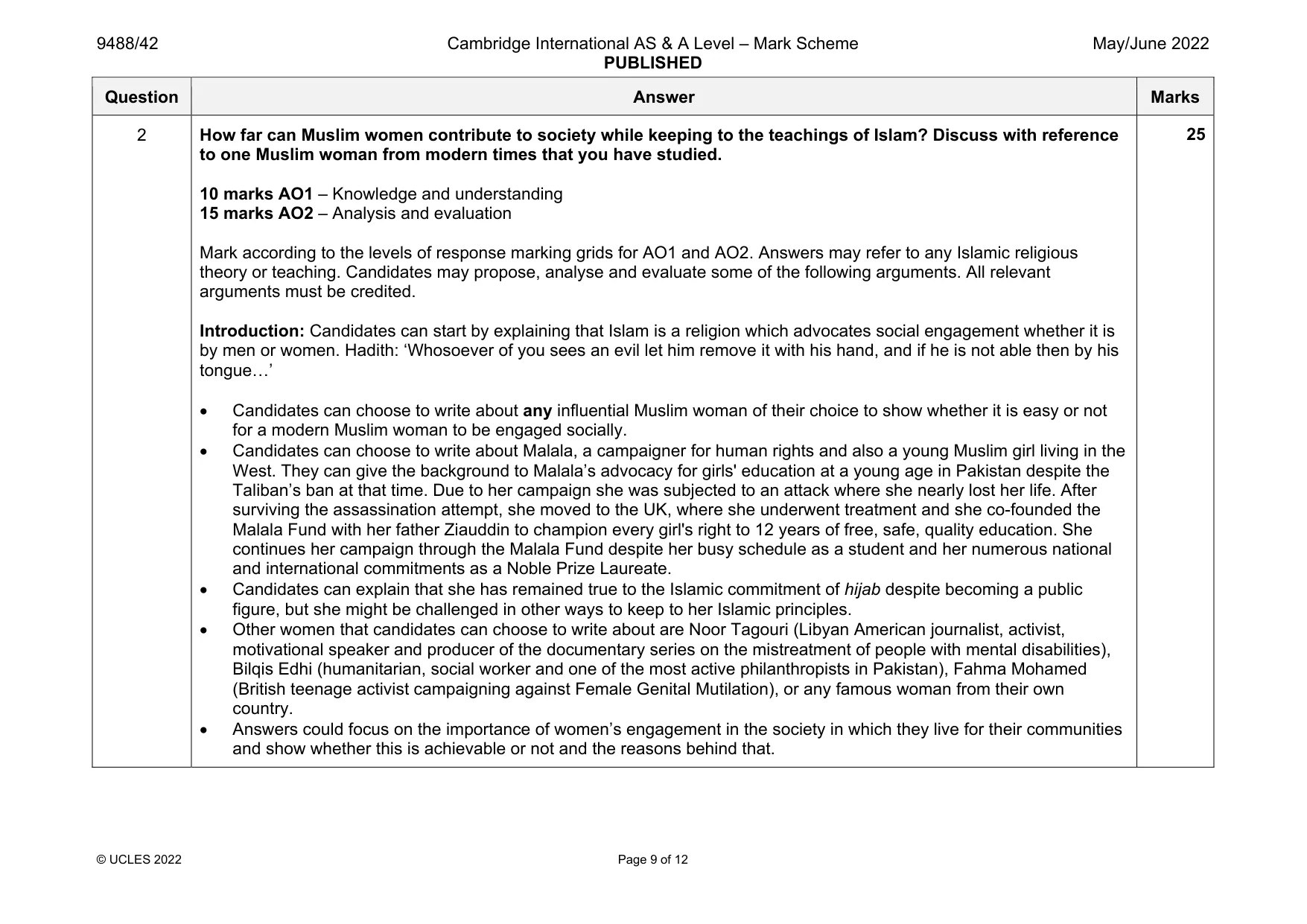
2 How far can Muslim women contribute to society while keeping to the teachings of Islam? Discuss with reference to one Muslim woman from modern times that you have studied. [25]
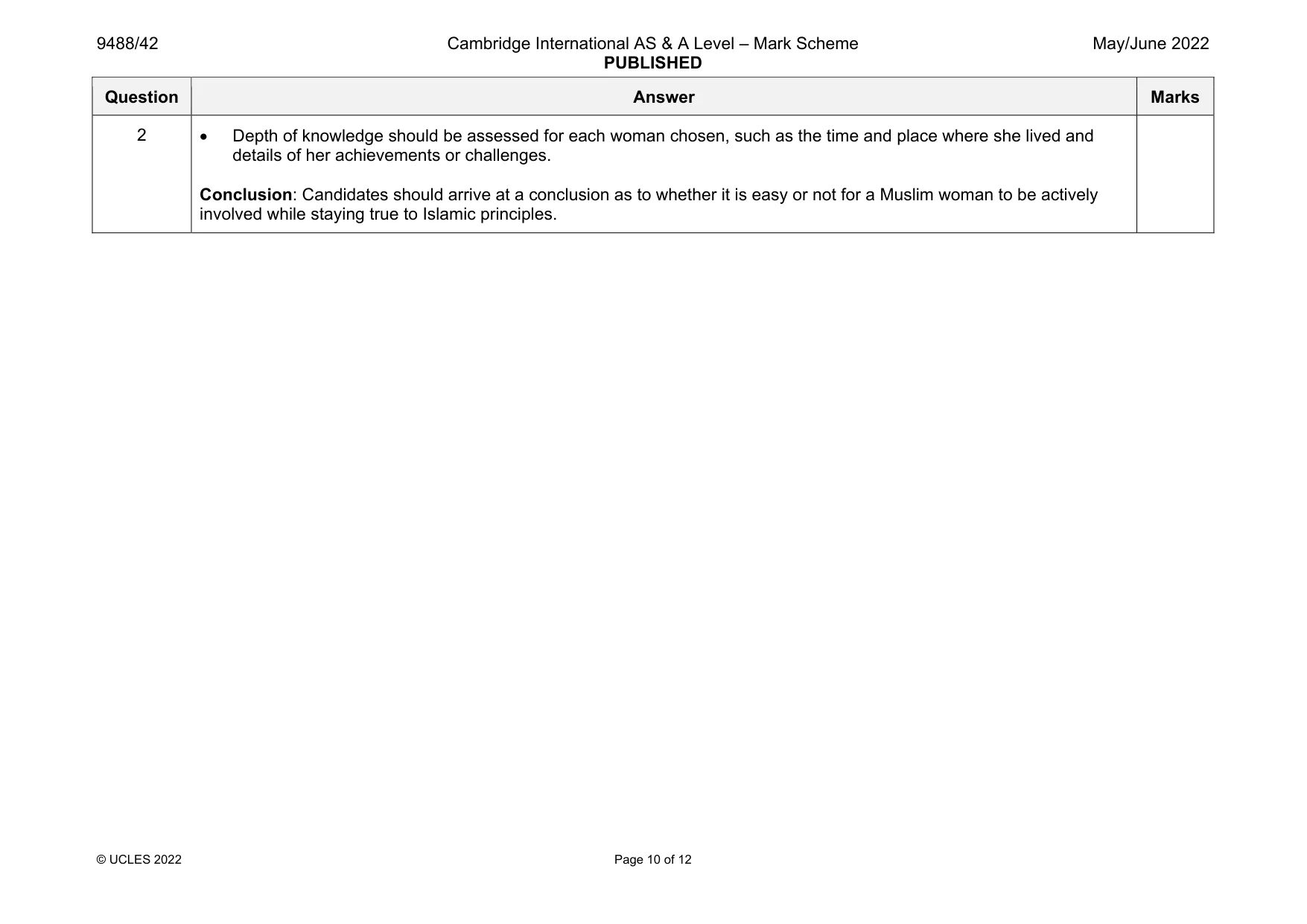
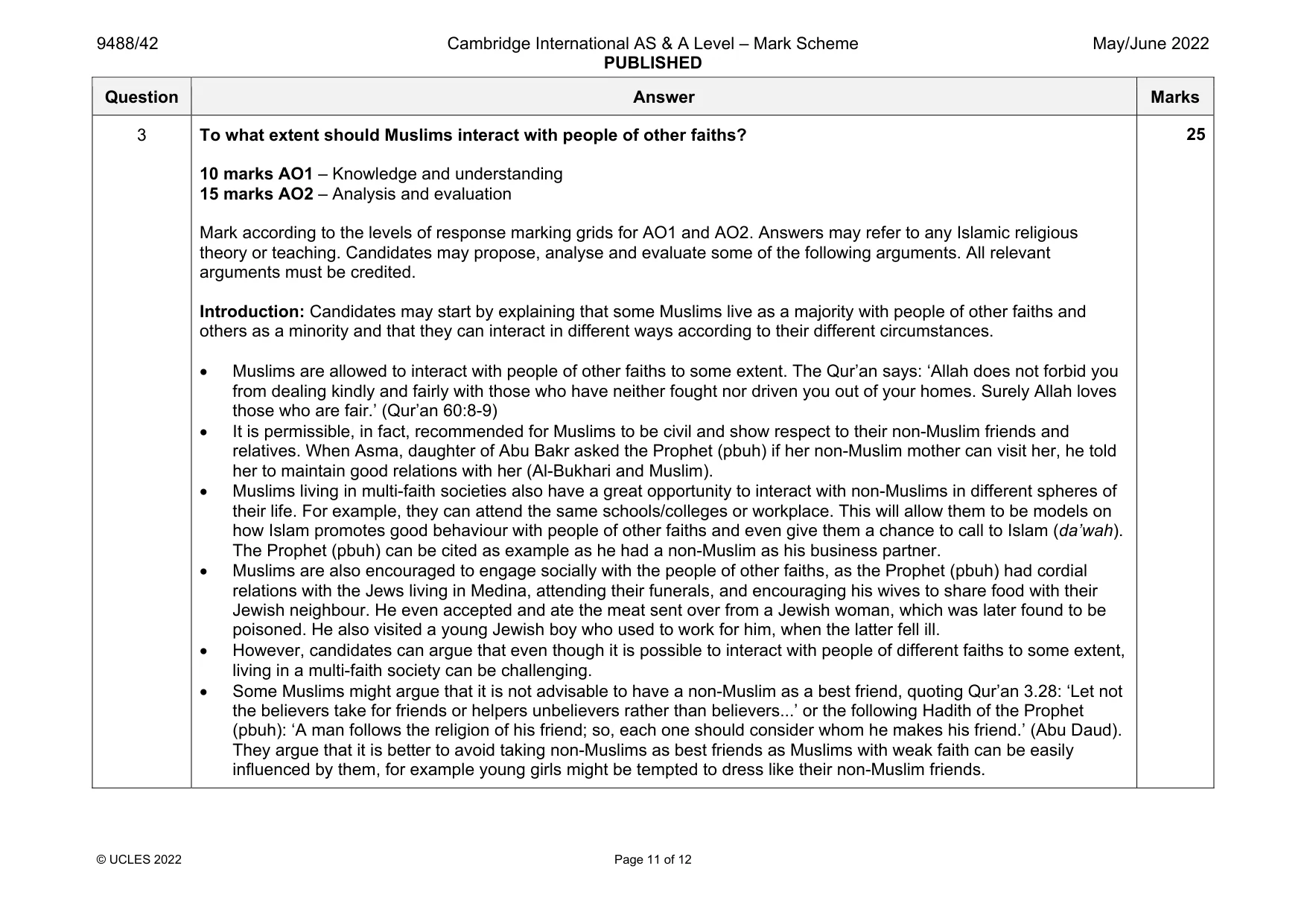
Mark scheme: 2 How far can Muslim women contribute to society while keeping to the teachings of Islam? Discuss with reference to one Muslim woman from modern times that you have studied. 10 marks AO1 – Knowledge and understanding 15 marks AO2 – Analysis and evaluation Mark according to the levels of response marking grids for AO1 and AO2. Answers may refer to any Islamic religious theory or teaching. Candidates may propose, analyse and evaluate some of the following arguments. All relevant arguments must be credited. Introduction: Candidates can start by explaining that Islam is a religion which advocates social engagement whether it is by men or women. Hadith: ‘Whosoever of you sees an evil let him remove it with his hand, and if he is not able then by his tongue…’ Candidates can choose to write about any influential Muslim woman of their choice to show whether it is easy or not for a modern Muslim woman to be engaged socially. Candidates can choose to write about Malala, a campaigner for human rights and also a young Muslim girl living in the West. They can give the background to Malala’s advocacy for girls' education at a young age in Pakistan despite the Taliban’s ban at that time. Due to her campaign she was subjected to an attack where she nearly lost her life. After surviving the assassination attempt, she moved to the UK, where she underwent treatment and she co-founded the Malala Fund with her father Ziauddin to champion every girl's right to 12 years of free, safe, quality education. She continues her campaign through the Malala Fund despite her busy schedule as a student and her numerous national and international commitments as a Noble Prize Laureate. Candidates can explain that she has remained true to the Islamic commitment of hijab despite becoming a public figure, but she might be challenged in other ways to keep to her Islamic principles. Other women that candidates can choose to write about are Noor Tagouri (Libyan American journalist, activist, motivational speaker and producer of the documentary series on the mistreatment of people with mental disabilities), Bilqis Edhi (humanitarian, social worker and one of the most active philanthropists in Pakistan), Fahma Mohamed (British teenage activist campaigning against Female Genital Mutilation), or any famous woman from their own country. Answers could focus on the importance of women’s engagement in the society in which they live for their communities and show whether this is achievable or not and the reasons behind that. Question Answer Marks 2 Depth of knowledge should be assessed for each woman chosen, such as the time and place where she lived and details of her achievements or challenges. Conclusion: Candidates should arrive at a conclusion as to whether it is easy or not for a Muslim woman to be actively involved while staying true to Islamic principles.
What was in this paper
The subtopics covered by these 2 questions, and how many questions each got. Open one in a new tab to see every Cambridge question on it.
What you needed in this session
Cambridge’s own grade thresholds for 2022 May/June, Paper 4 · Variant 2. A higher threshold means an easier paper — the bar moves with how the cohort did.