Cambridge A Level Islamic Studies 9488 — 2023 May/June Paper 4 · Variant 2
9488/42/M/J/23 · 3 questions · 50 marks · ≈56 min
The question paper and its mark scheme, free to read here and free to download. This is Cambridge’s own paper, exactly as it was sat.
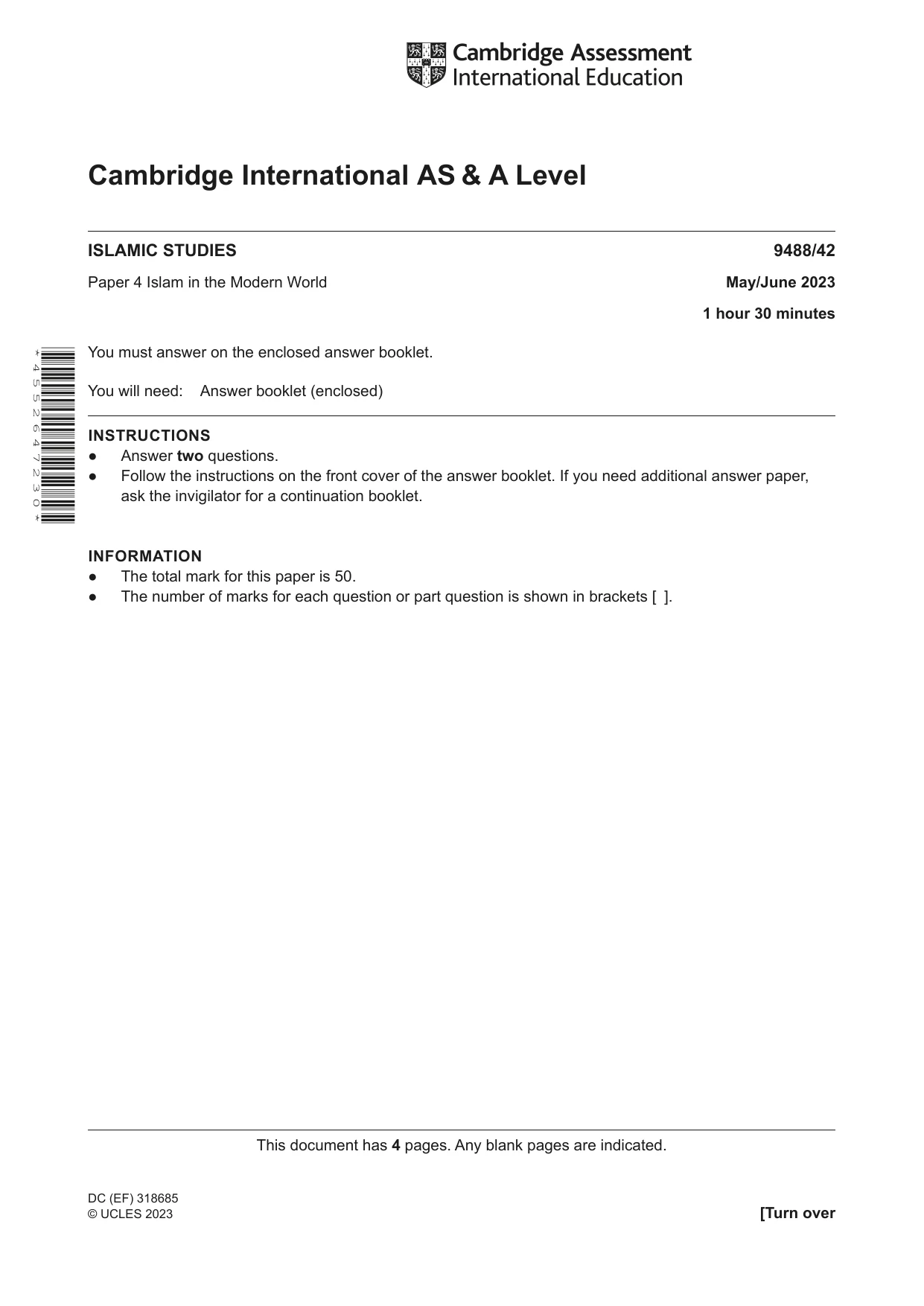
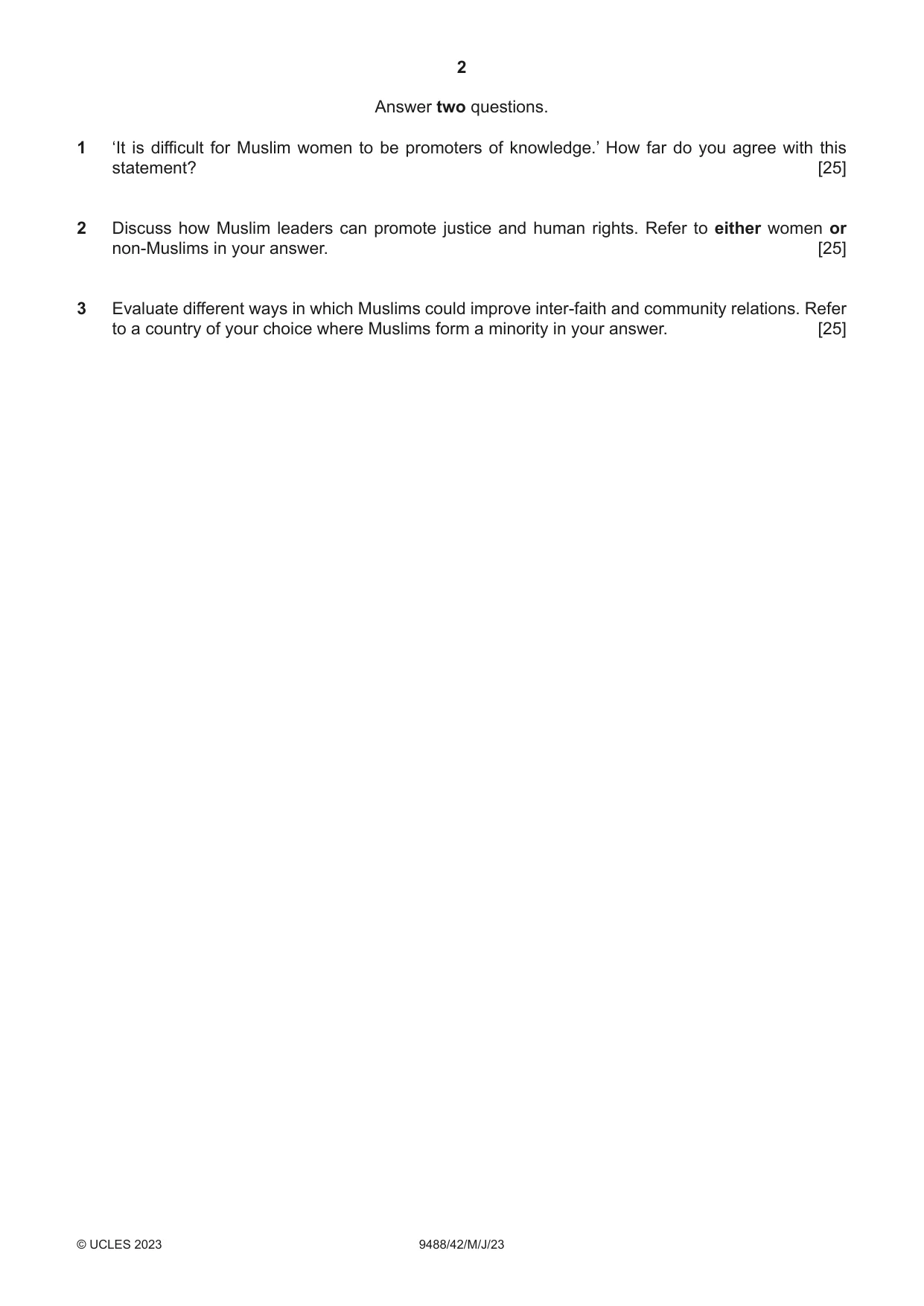
Question paper4 pages


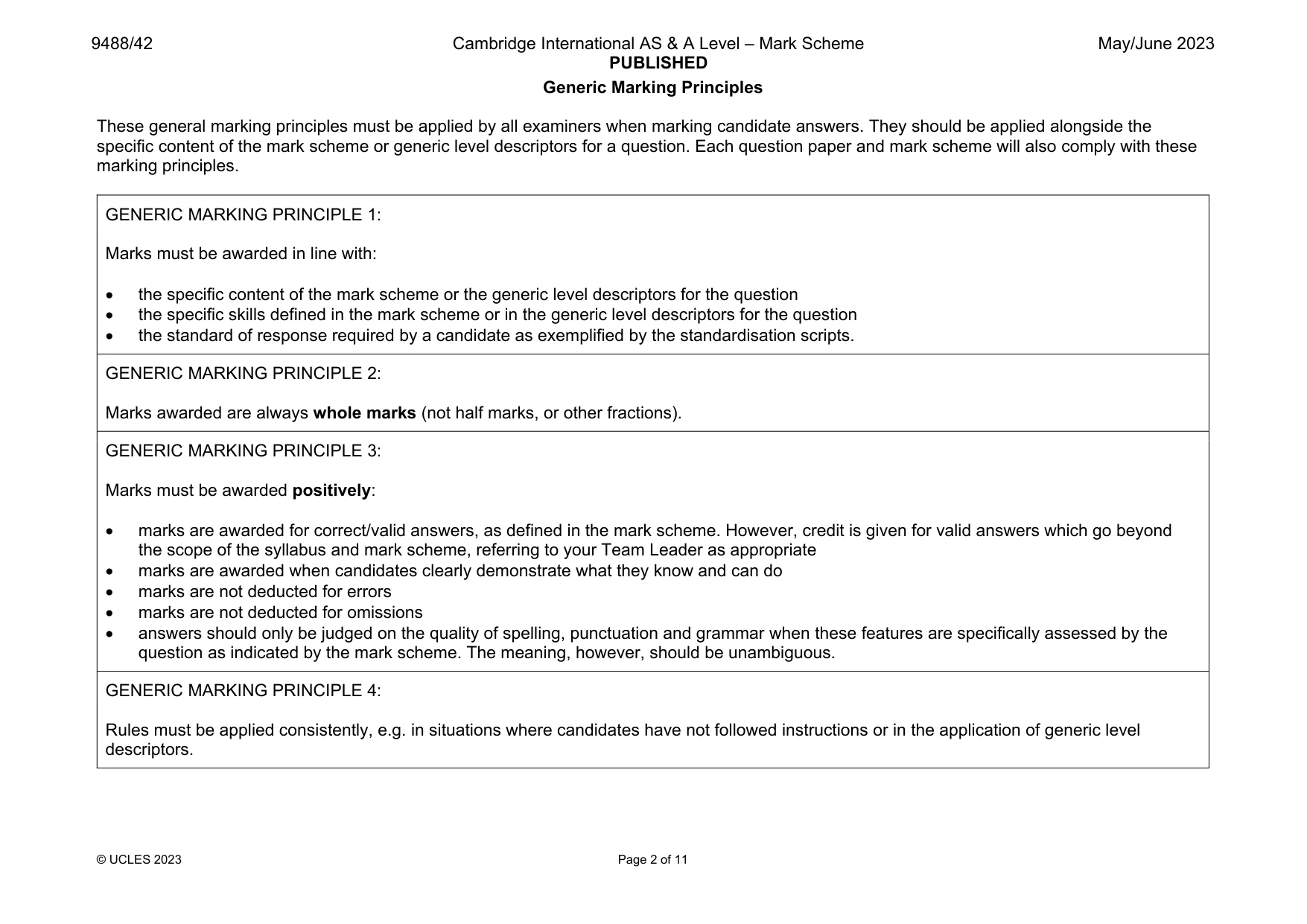
Mark scheme11 pages
Answers below. Sit the paper first if you are practising.
Questions as text
Q1 · ‘It is difficult for Muslim women to be promoters of knowledge.’ How far do you agree…
1 ‘It is difficult for Muslim women to be promoters of knowledge.’ How far do you agree with this statement? [25]
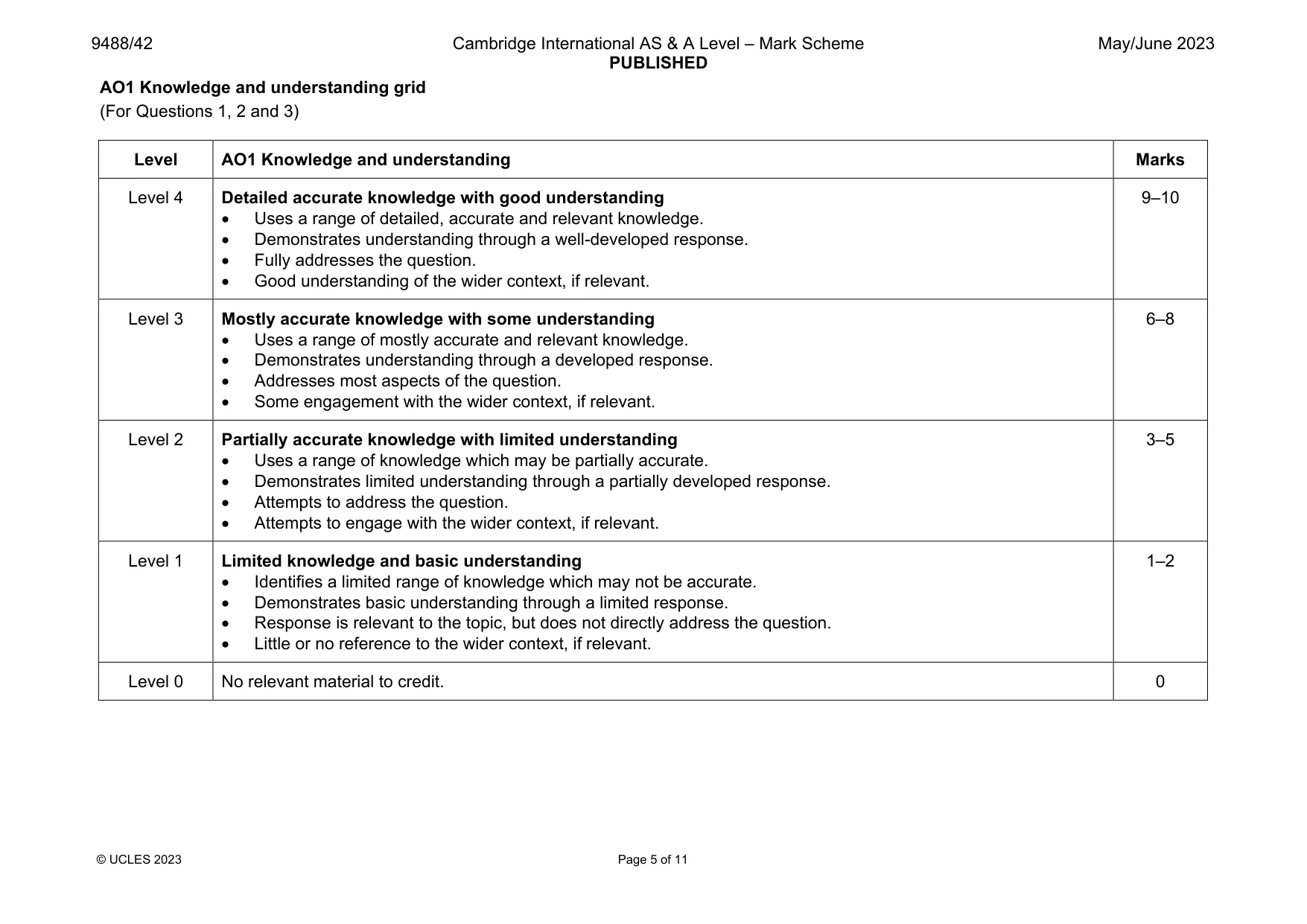
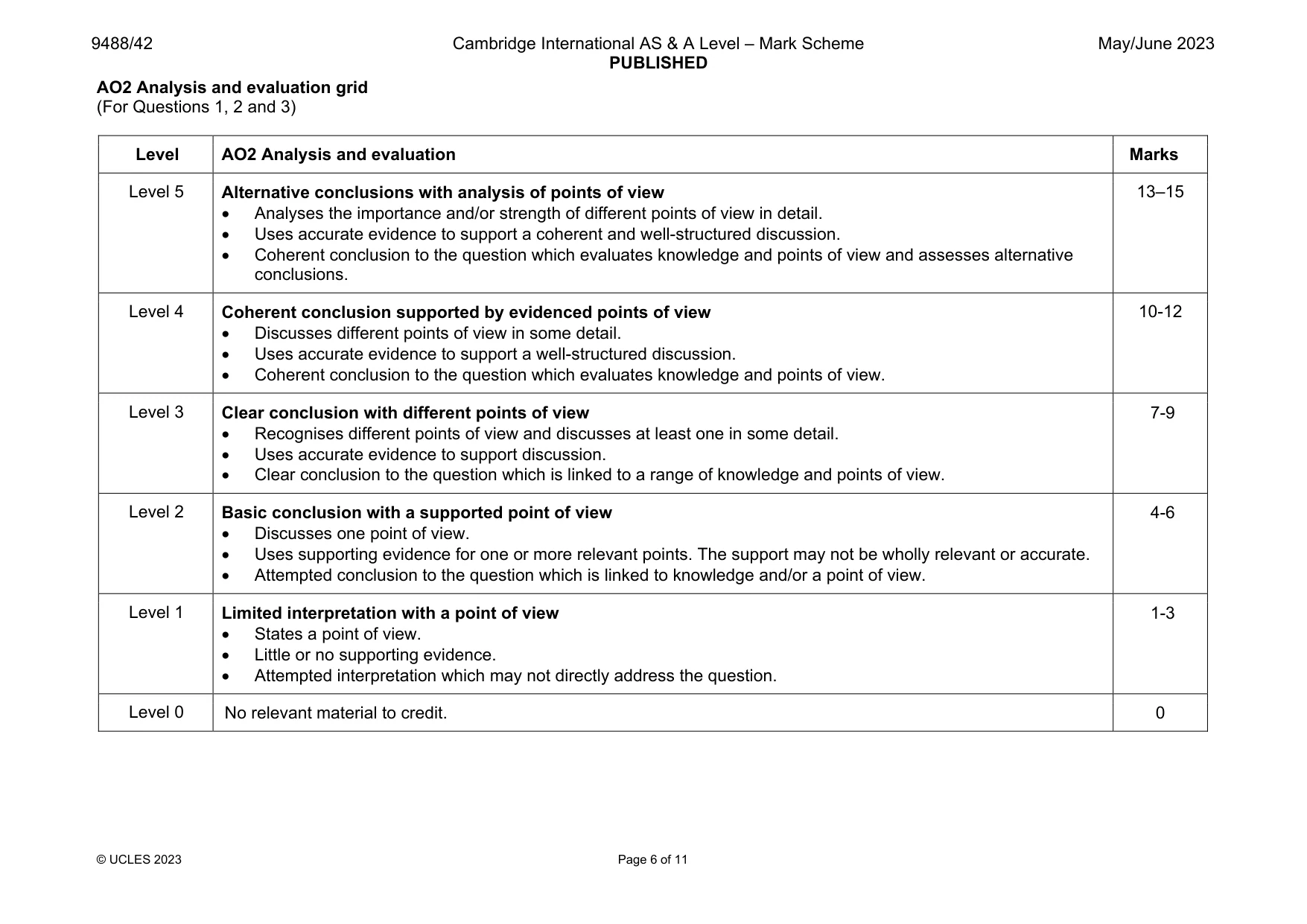
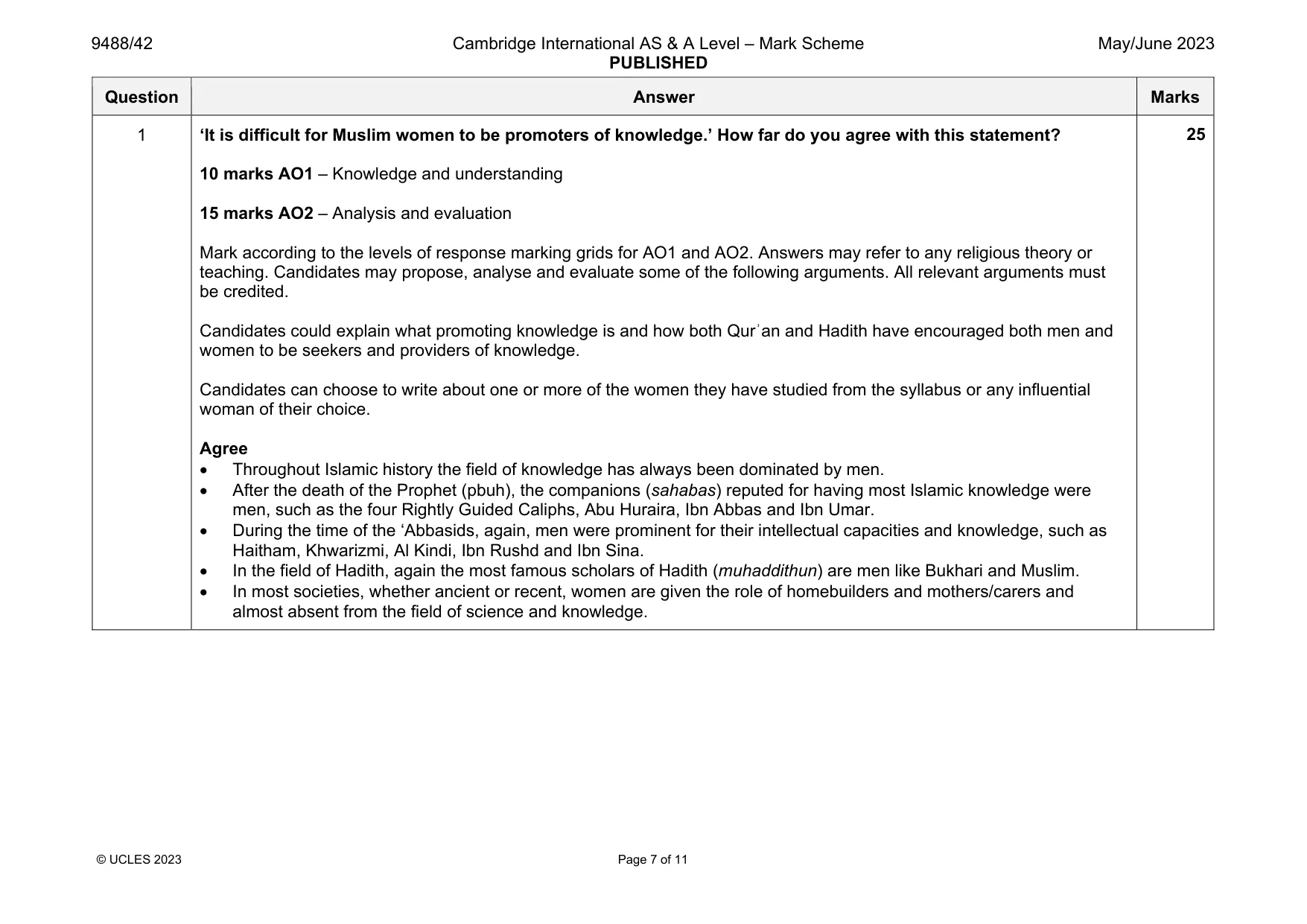
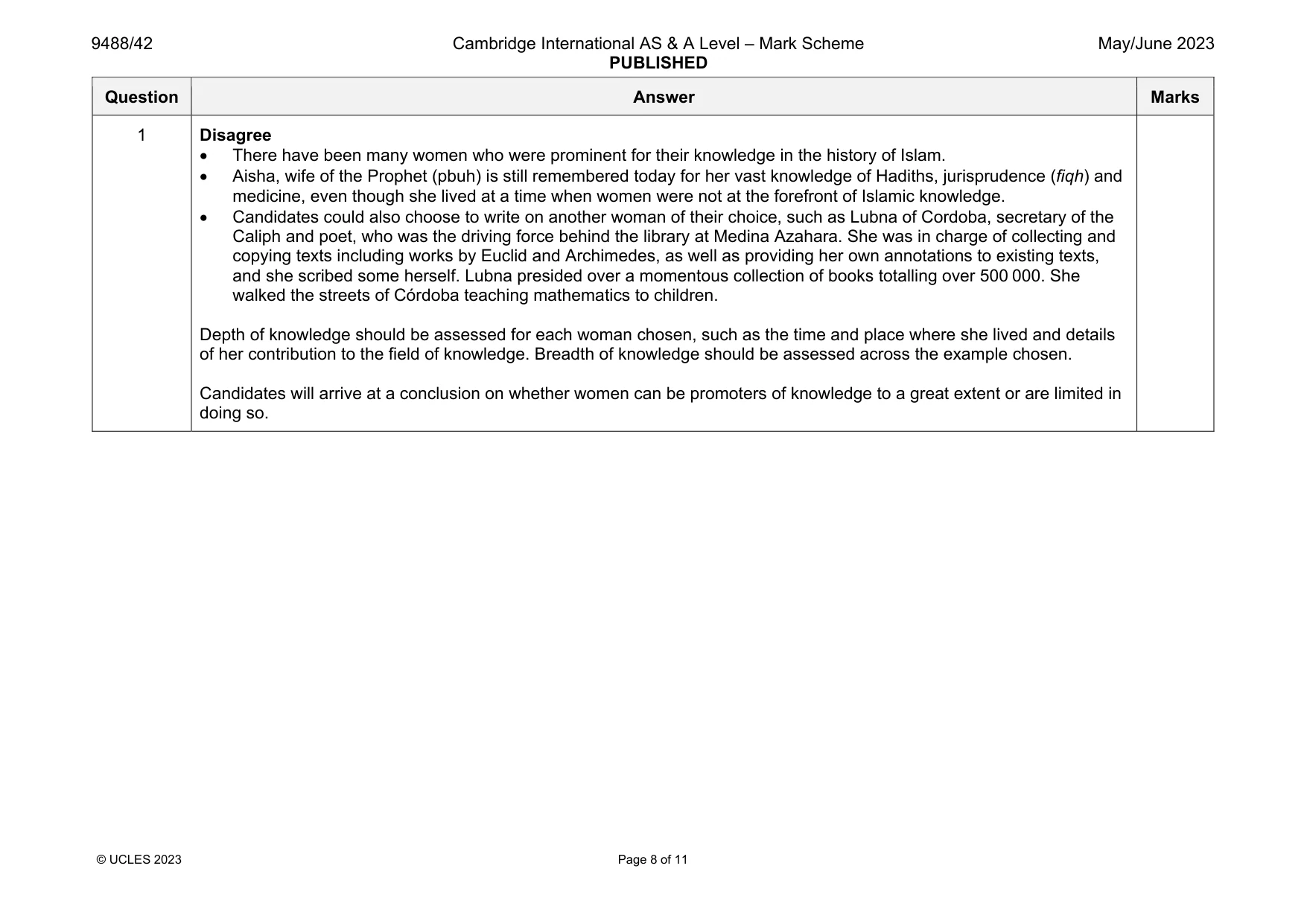
Mark scheme: 1 ‘It is difficult for Muslim women to be promoters of knowledge.’ How far do you agree with this statement? 10 marks AO1 – Knowledge and understanding 15 marks AO2 – Analysis and evaluation Mark according to the levels of response marking grids for AO1 and AO2. Answers may refer to any religious theory or teaching. Candidates may propose, analyse and evaluate some of the following arguments. All relevant arguments must be credited. Candidates could explain what promoting knowledge is and how both Qurʾan and Hadith have encouraged both men and women to be seekers and providers of knowledge. Candidates can choose to write about one or more of the women they have studied from the syllabus or any influential woman of their choice. Agree Throughout Islamic history the field of knowledge has always been dominated by men. After the death of the Prophet (pbuh), the companions (sahabas) reputed for having most Islamic knowledge were men, such as the four Rightly Guided Caliphs, Abu Huraira, Ibn Abbas and Ibn Umar. During the time of the ‘Abbasids, again, men were prominent for their intellectual capacities and knowledge, such as Haitham, Khwarizmi, Al Kindi, Ibn Rushd and Ibn Sina. In the field of Hadith, again the most famous scholars of Hadith (muhaddithun) are men like Bukhari and Muslim. In most societies, whether ancient or recent, women are given the role of homebuilders and mothers/carers and almost absent from the field of science and knowledge. Question Answer Marks 1 Disagree There have been many women who were prominent for their knowledge in the history of Islam. Aisha, wife of the Prophet (pbuh) is still remembered today for her vast knowledge of Hadiths, jurisprudence (fiqh) and medicine, even though she lived at a time when women were not at the forefront of Islamic knowledge. Candidates could also choose to write on another woman of their choice, such as Lubna of Cordoba, secretary of the Caliph and poet, who was the driving force behind the library at Medina Azahara. She was in charge of collecting and copying texts including works by Euclid and Archimedes, as well as providing her own annotations to existing texts, and she scribed some herself. Lubna presided over a momentous collection of books totalling over 500 000. She walked the streets of Córdoba teaching mathematics to children. Depth of knowledge should be assessed for each woman chosen, such as the time and place where she lived and details of her contribution to the field of knowledge. Breadth of knowledge should be assessed across the example chosen. Candidates will arrive at a conclusion on whether women can be promoters of knowledge to a great extent or are limited in doing so.
Q2 · Discuss how Muslim leaders can promote justice and human rights
2 Discuss how Muslim leaders can promote justice and human rights. Refer to either women or non‑Muslims in your answer. [25]
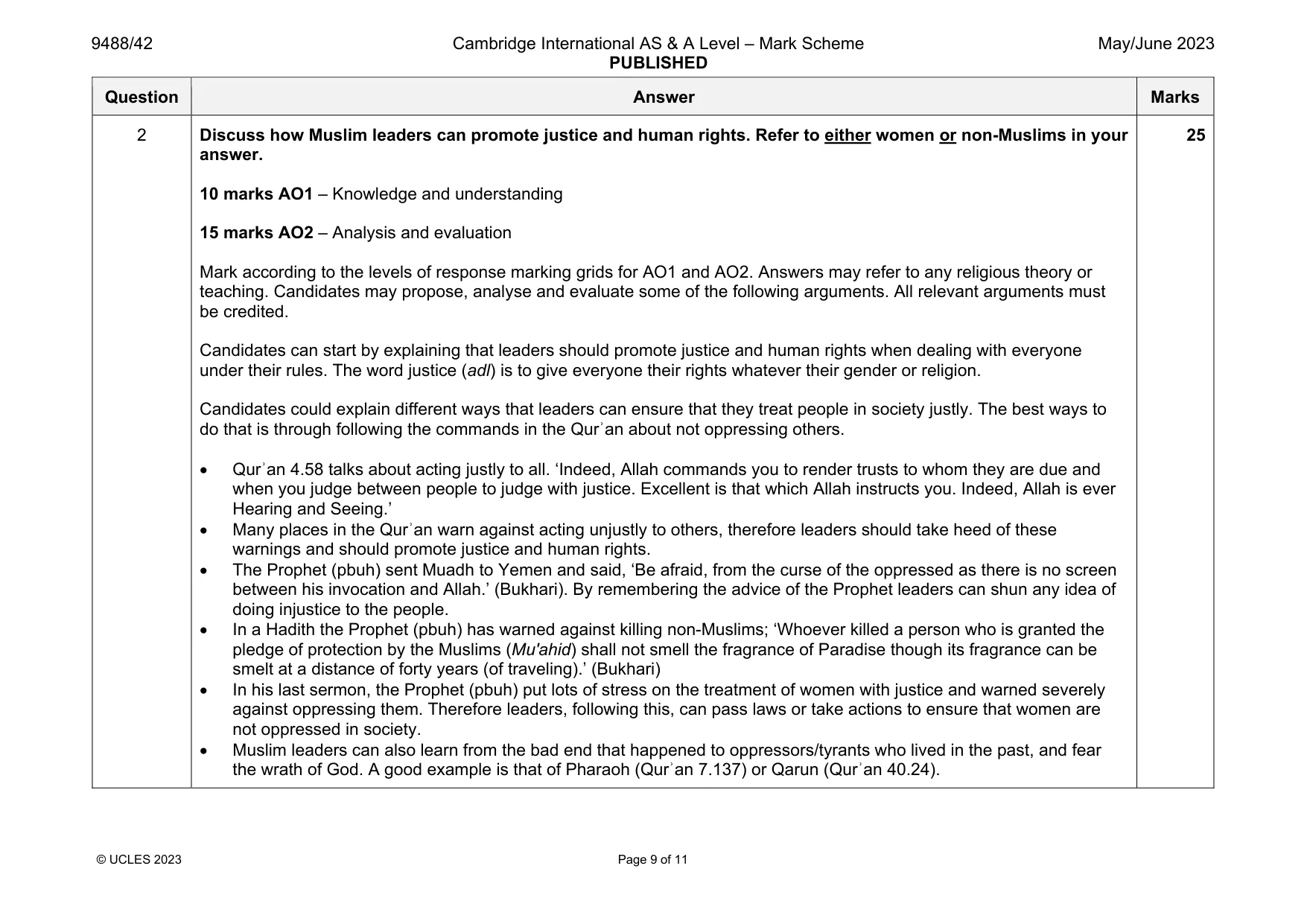
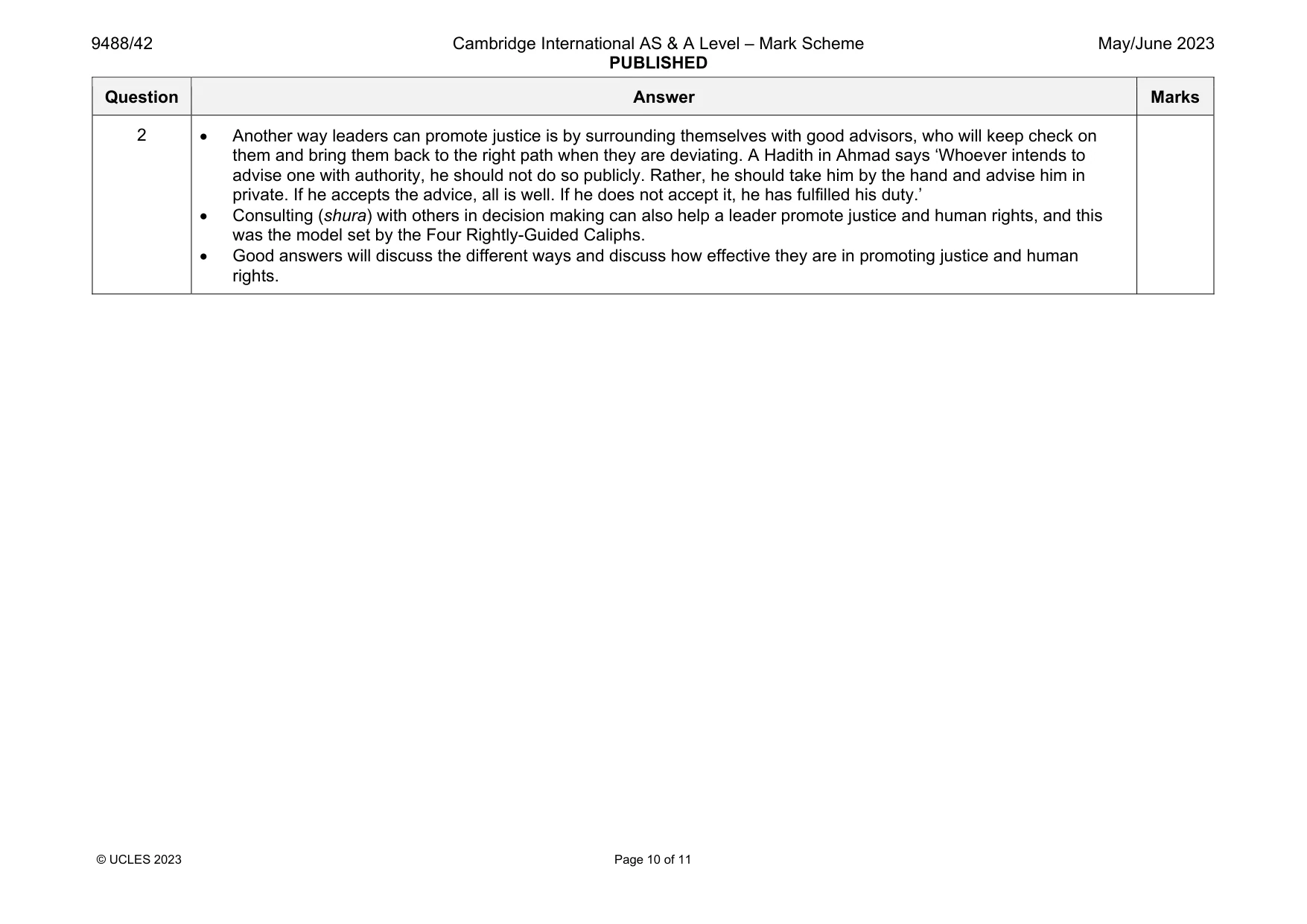
Mark scheme: 2 Discuss how Muslim leaders can promote justice and human rights. Refer to either women or non-Muslims in your answer. 10 marks AO1 – Knowledge and understanding 15 marks AO2 – Analysis and evaluation Mark according to the levels of response marking grids for AO1 and AO2. Answers may refer to any religious theory or teaching. Candidates may propose, analyse and evaluate some of the following arguments. All relevant arguments must be credited. Candidates can start by explaining that leaders should promote justice and human rights when dealing with everyone under their rules. The word justice (adl) is to give everyone their rights whatever their gender or religion. Candidates could explain different ways that leaders can ensure that they treat people in society justly. The best ways to do that is through following the commands in the Qurʾan about not oppressing others. Qurʾan 4.58 talks about acting justly to all. ‘Indeed, Allah commands you to render trusts to whom they are due and when you judge between people to judge with justice. Excellent is that which Allah instructs you. Indeed, Allah is ever Hearing and Seeing.’ Many places in the Qurʾan warn against acting unjustly to others, therefore leaders should take heed of these warnings and should promote justice and human rights. The Prophet (pbuh) sent Muadh to Yemen and said, ‘Be afraid, from the curse of the oppressed as there is no screen between his invocation and Allah.’ (Bukhari). By remembering the advice of the Prophet leaders can shun any idea of doing injustice to the people. In a Hadith the Prophet (pbuh) has warned against killing non-Muslims; ‘Whoever killed a person who is granted the pledge of protection by the Muslims (Mu'ahid) shall not smell the fragrance of Paradise though its fragrance can be smelt at a distance of forty years (of traveling).’ (Bukhari) In his last sermon, the Prophet (pbuh) put lots of stress on the treatment of women with justice and warned severely against oppressing them. Therefore leaders, following this, can pass laws or take actions to ensure that women are not oppressed in society. Muslim leaders can also learn from the bad end that happened to oppressors/tyrants who lived in the past, and fear the wrath of God. A good example is that of Pharaoh (Qurʾan 7.137) or Qarun (Qurʾan 40.24). 25 Question Answer Marks 2 Another way leaders can promote justice is by surrounding themselves with good advisors, who will keep check on them and bring them back to the right path when they are deviating. A Hadith in Ahmad says ‘Whoever intends to advise one with authority, he should not do so publicly. Rather, he should take him by the hand and advise him in private. If he accepts the advice, all is well. If he does not accept it, he has fulfilled his duty.’ Consulting (shura) with others in decision making can also help a leader promote justice and human rights, and this was the model set by the Four Rightly-Guided Caliphs. Good answers will discuss the different ways and discuss how effective they are in promoting justice and human rights.
Q3 · Evaluate different ways in which Muslims could improve inter‑faith and community relations
3 Evaluate different ways in which Muslims could improve inter‑faith and community relations. Refer to a country of your choice where Muslims form a minority in your answer. [25]
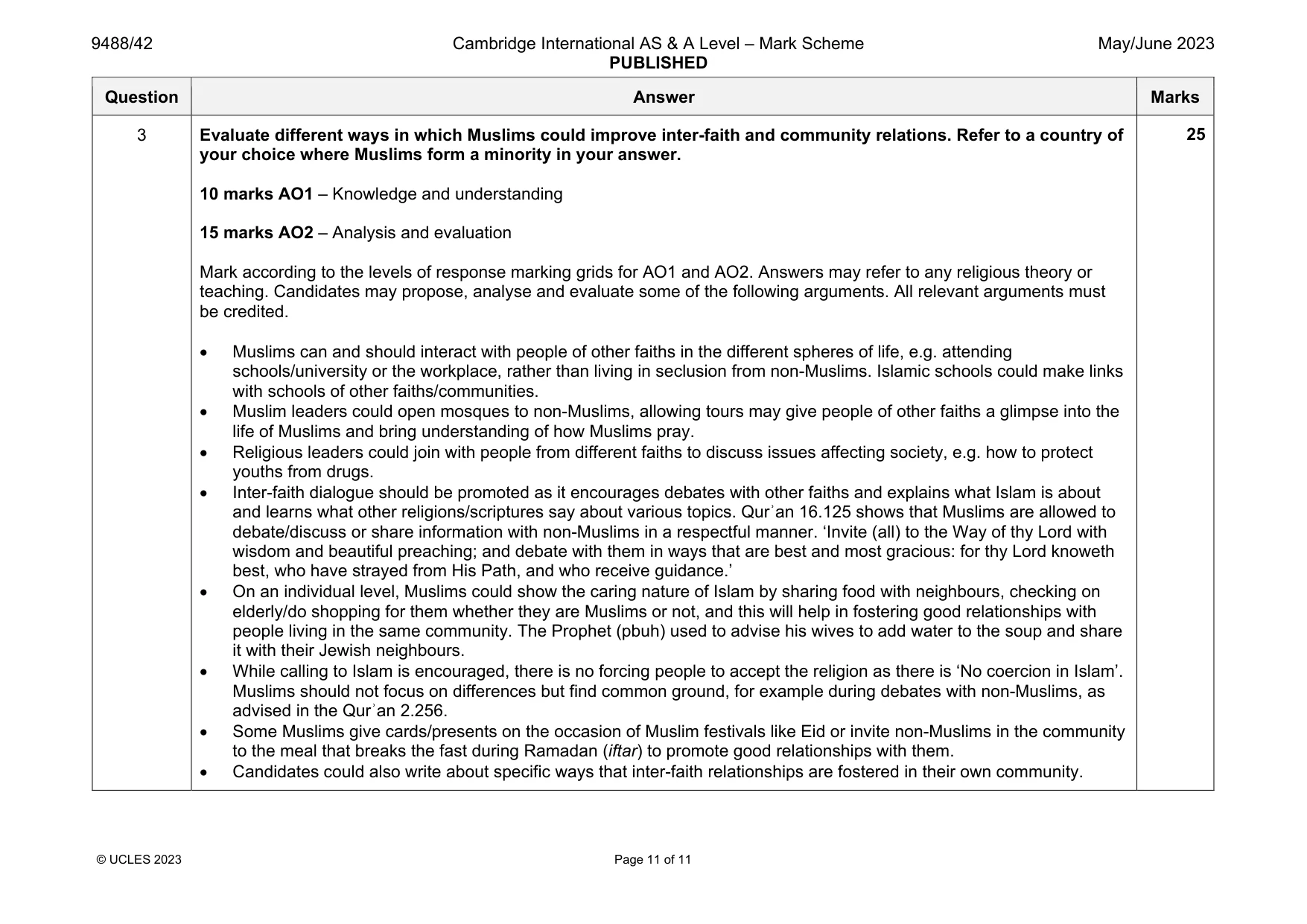
Mark scheme: 3 Evaluate different ways in which Muslims could improve inter-faith and community relations. Refer to a country of your choice where Muslims form a minority in your answer. 10 marks AO1 – Knowledge and understanding 15 marks AO2 – Analysis and evaluation Mark according to the levels of response marking grids for AO1 and AO2. Answers may refer to any religious theory or teaching. Candidates may propose, analyse and evaluate some of the following arguments. All relevant arguments must be credited. Muslims can and should interact with people of other faiths in the different spheres of life, e.g. attending schools/university or the workplace, rather than living in seclusion from non-Muslims. Islamic schools could make links with schools of other faiths/communities. Muslim leaders could open mosques to non-Muslims, allowing tours may give people of other faiths a glimpse into the life of Muslims and bring understanding of how Muslims pray. Religious leaders could join with people from different faiths to discuss issues affecting society, e.g. how to protect youths from drugs. Inter-faith dialogue should be promoted as it encourages debates with other faiths and explains what Islam is about and learns what other religions/scriptures say about various topics. Qurʾan 16.125 shows that Muslims are allowed to debate/discuss or share information with non-Muslims in a respectful manner. ‘Invite (all) to the Way of thy Lord with wisdom and beautiful preaching; and debate with them in ways that are best and most gracious: for thy Lord knoweth best, who have strayed from His Path, and who receive guidance.’ On an individual level, Muslims could show the caring nature of Islam by sharing food with neighbours, checking on elderly/do shopping for them whether they are Muslims or not, and this will help in fostering good relationships with people living in the same community. The Prophet (pbuh) used to advise his wives to add water to the soup and share it with their Jewish neighbours. While calling to Islam is encouraged, there is no forcing people to accept the religion as there is ‘No coercion in Islam’. Muslims should not focus on differences but find common ground, for example during debates with non-Muslims, as advised in the Qurʾan 2.256. Some Muslims give cards/presents on the occasion of Muslim festivals like Eid or invite non-Muslims in the community to the meal that breaks the fast during Ramadan (iftar) to promote good relationships with them. Candidates could also write about specific ways that inter-faith relationships are fostered in their own community.
What was in this paper
The subtopics covered by these 3 questions, and how many questions each got. Open one in a new tab to see every Cambridge question on it.
What you needed in this session
Cambridge’s own grade thresholds for 2023 May/June, Paper 4 · Variant 2. A higher threshold means an easier paper — the bar moves with how the cohort did.