Cambridge A Level Islamic Studies 9488 — 2023 Oct/Nov Paper 4 · Variant 2
9488/42/O/N/23 · 3 questions · 50 marks · ≈56 min
The question paper and its mark scheme, free to read here and free to download. This is Cambridge’s own paper, exactly as it was sat.
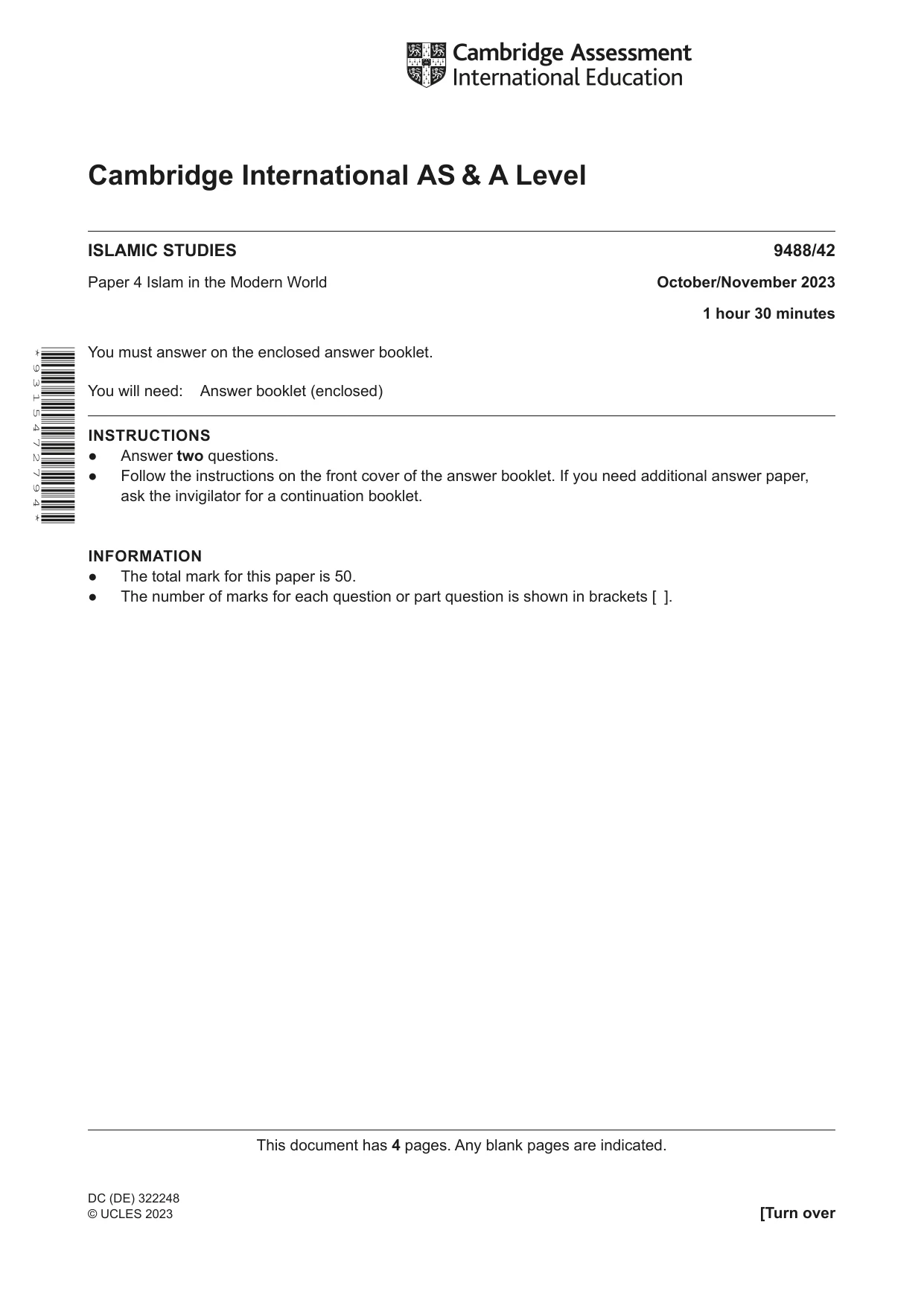
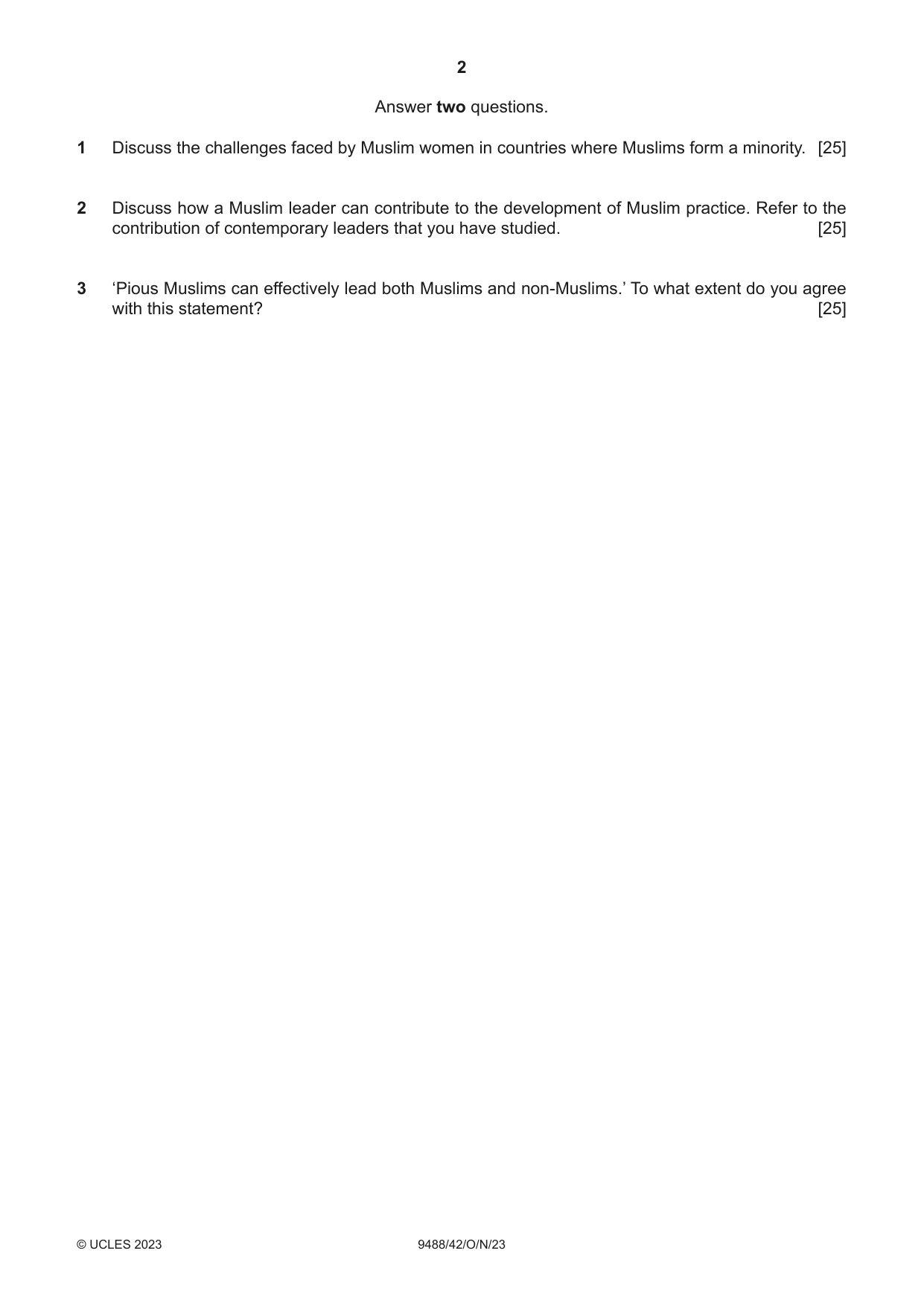
Question paper4 pages


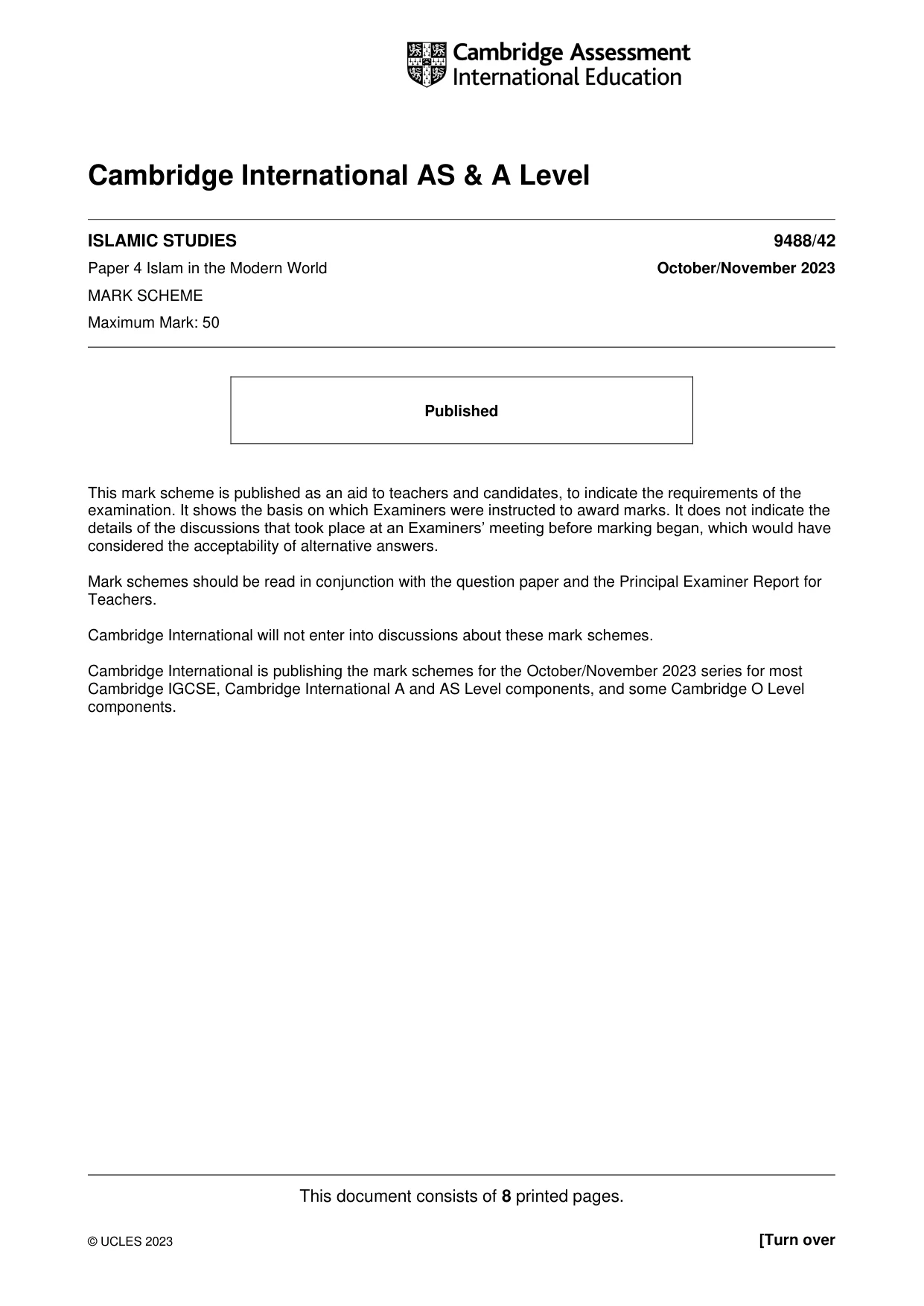
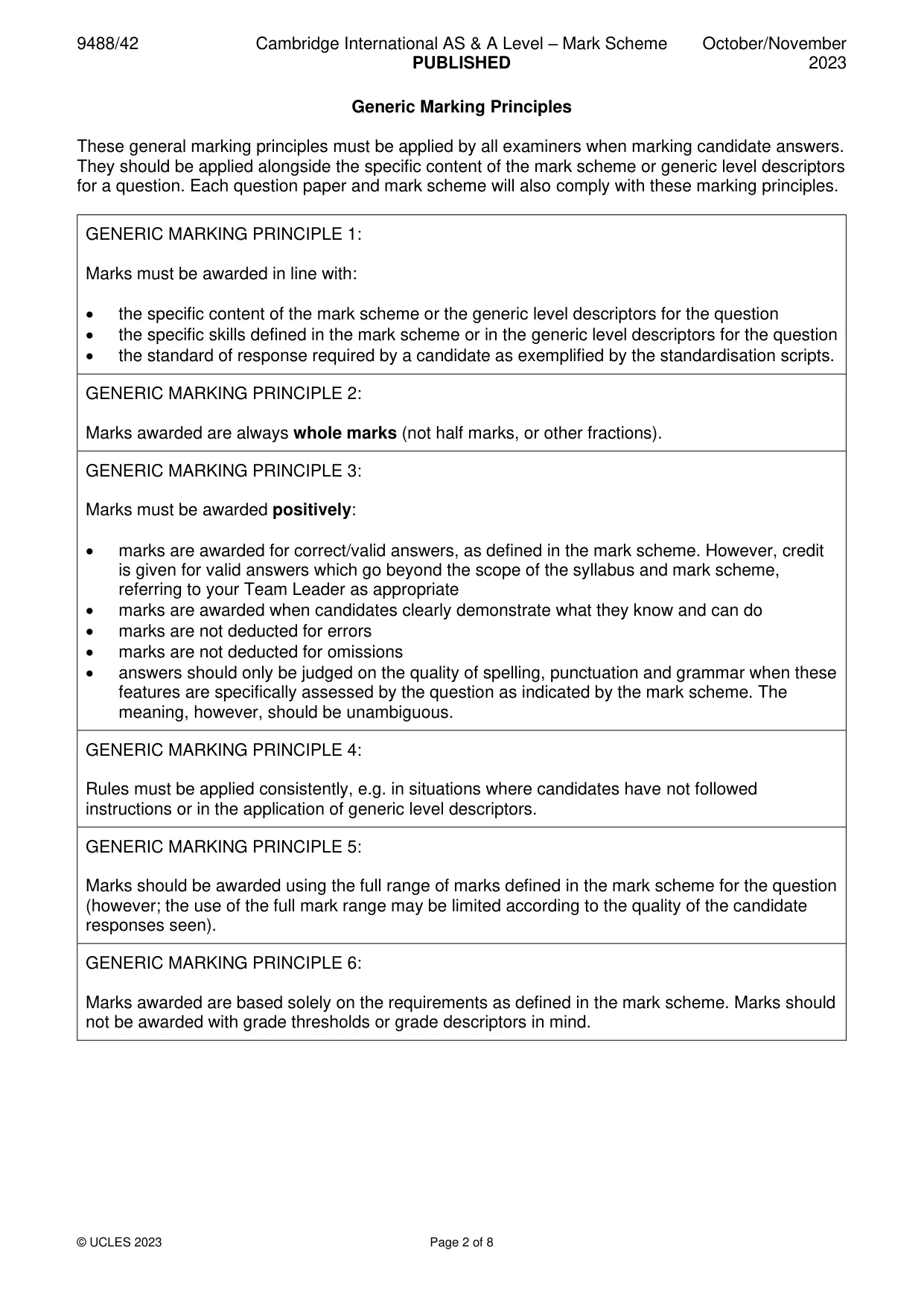
Mark scheme8 pages
Answers below. Sit the paper first if you are practising.
Questions as text
Q1 · Discuss the challenges faced by Muslim women in countries where Muslims form a minority
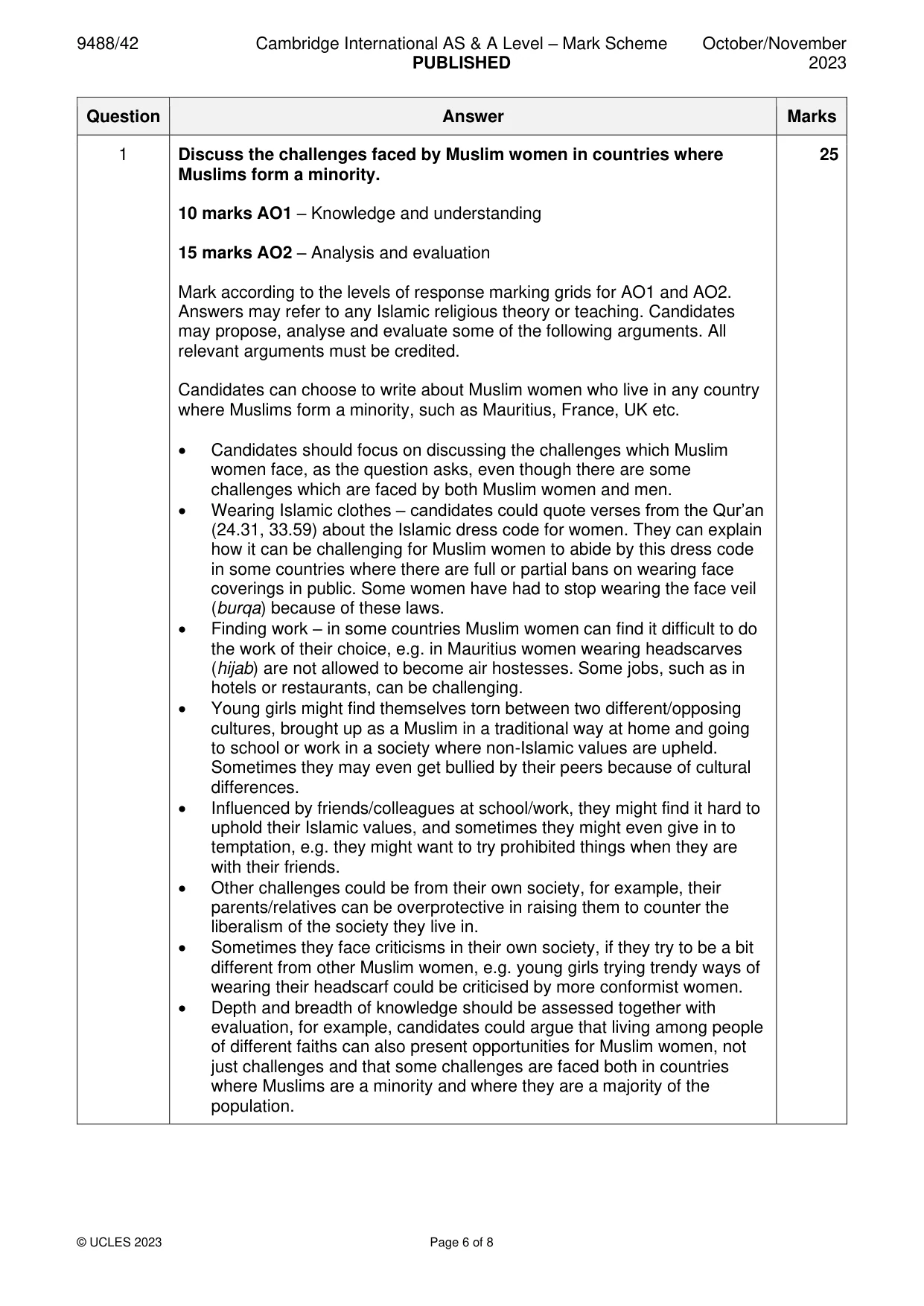
1 Discuss the challenges faced by Muslim women in countries where Muslims form a minority. [25]
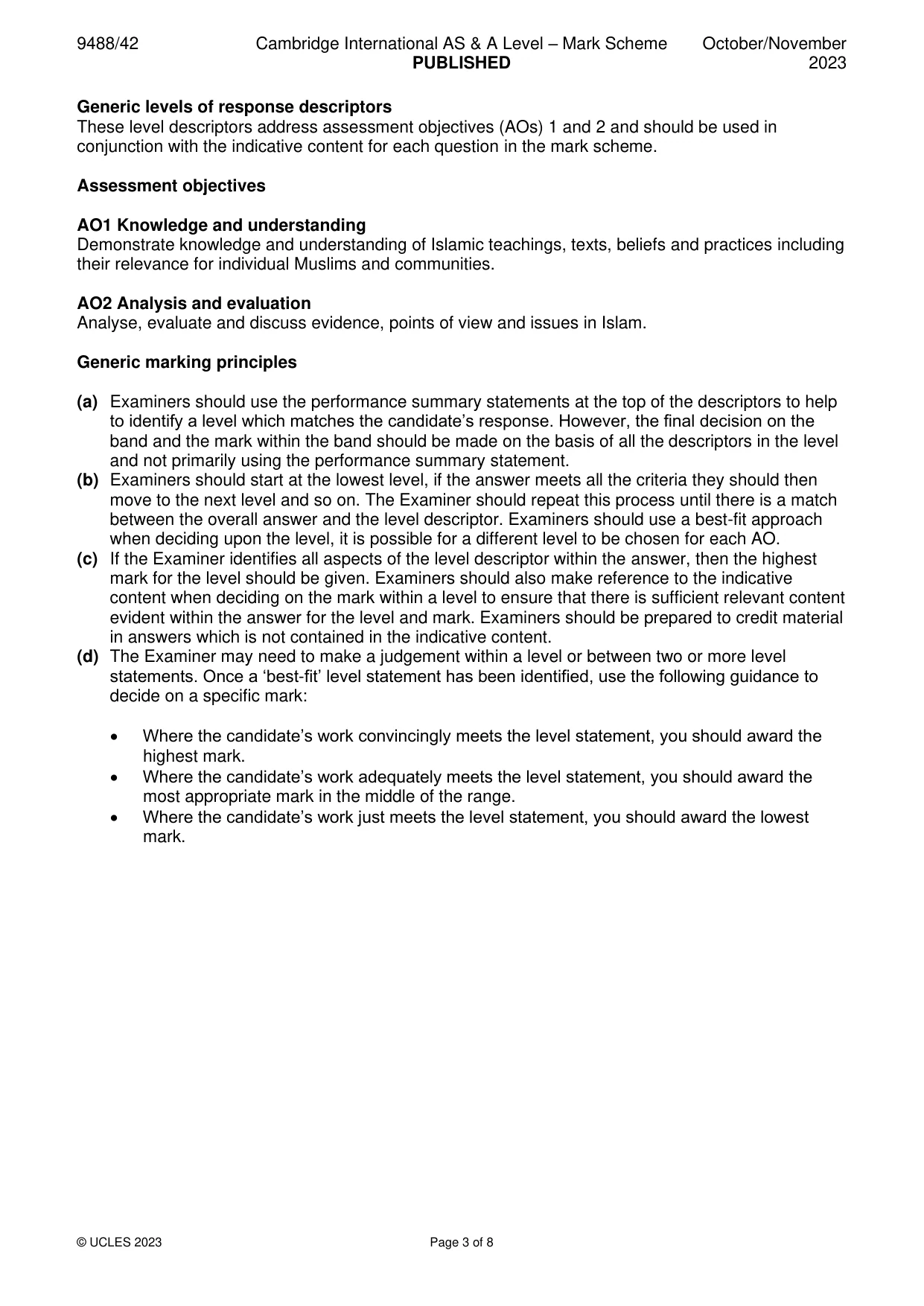
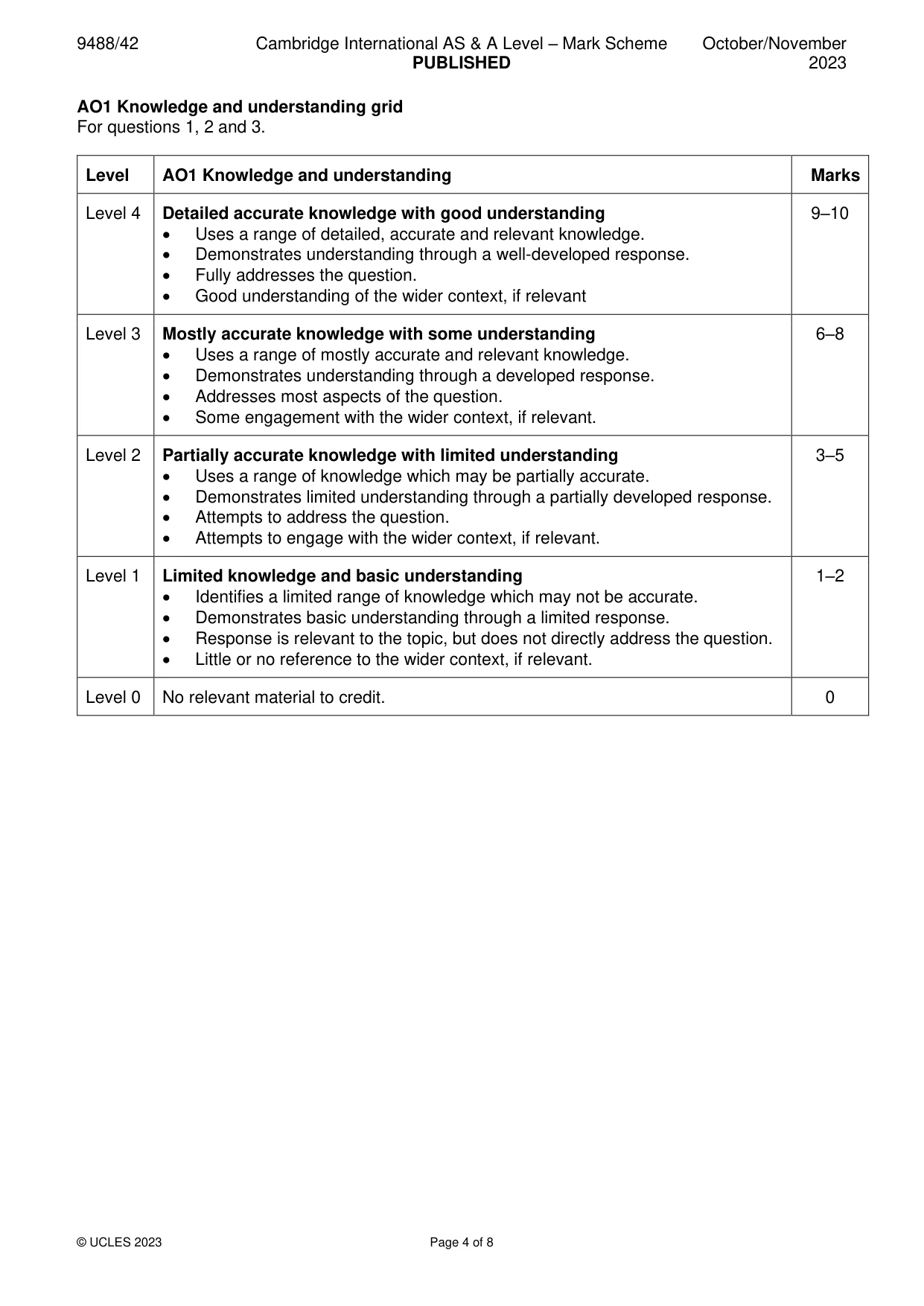
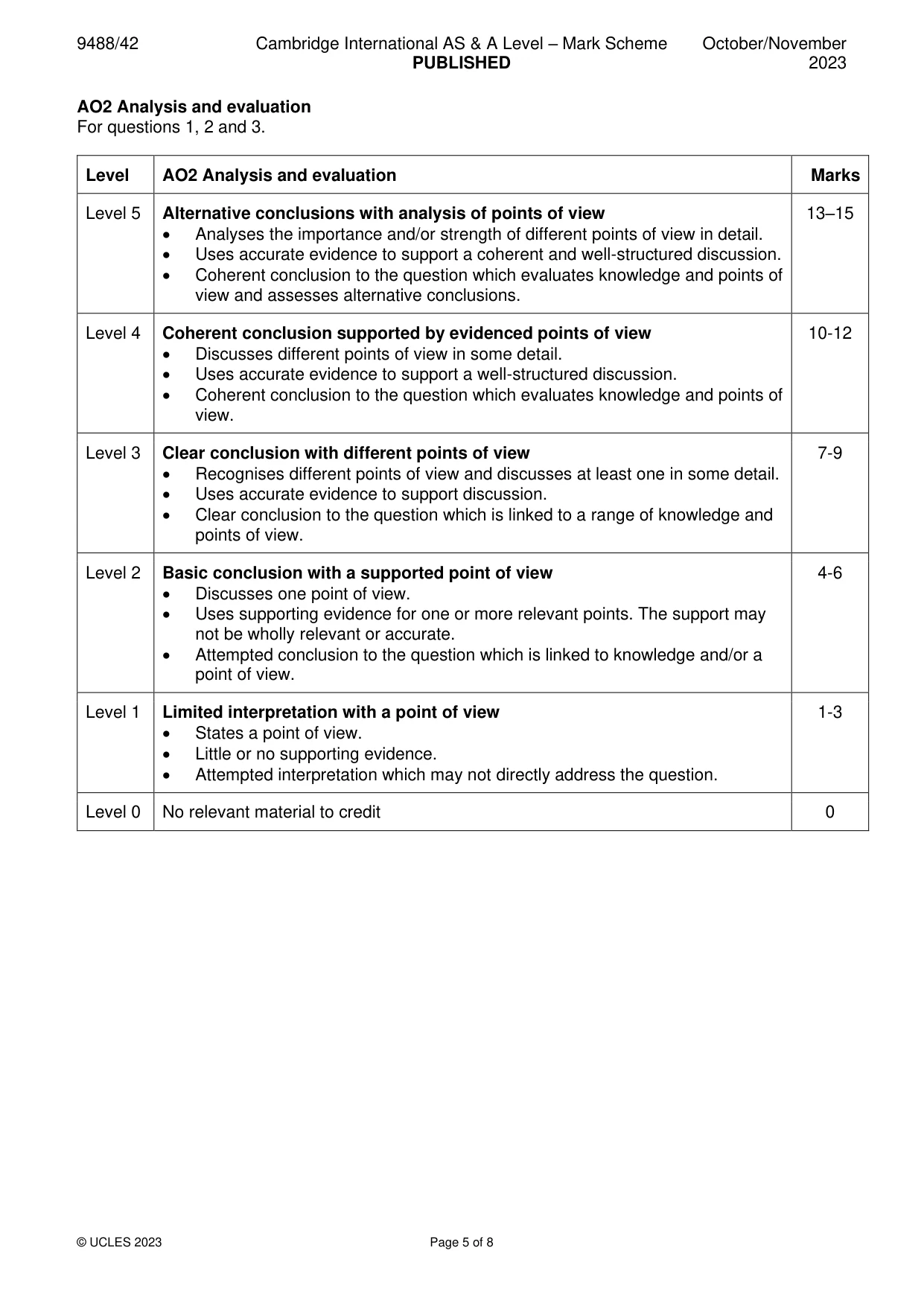
Mark scheme: Question Answer Marks 1 Discuss the challenges faced by Muslim women in countries where 25 Muslims form a minority. 10 marks AO1 – Knowledge and understanding 15 marks AO2 – Analysis and evaluation Mark according to the levels of response marking grids for AO1 and AO2. Answers may refer to any Islamic religious theory or teaching. Candidates may propose, analyse and evaluate some of the following arguments. All relevant arguments must be credited. Candidates can choose to write about Muslim women who live in any country where Muslims form a minority, such as Mauritius, France, UK etc. • Candidates should focus on discussing the challenges which Muslim women face, as the question asks, even though there are some challenges which are faced by both Muslim women and men. • Wearing Islamic clothes – candidates could quote verses from the Qur’an (24.31, 33.59) about the Islamic dress code for women. They can explain how it can be challenging for Muslim women to abide by this dress code in some countries where there are full or partial bans on wearing face coverings in public. Some women have had to stop wearing the face veil (burqa) because of these laws. • Finding work – in some countries Muslim women can find it difficult to do the work of their choice, e.g. in Mauritius women wearing headscarves (hijab) are not allowed to become air hostesses. Some jobs, such as in hotels or restaurants, can be challenging. • Young girls might find themselves torn between two different/opposing cultures, brought up as a Muslim in a traditional way at home and going to school or work in a society where non-Islamic values are upheld. Sometimes they may even get bullied by their peers because of cultural differences. • Influenced by friends/colleagues at school/work, they might find it hard to uphold their Islamic values, and sometimes they might even give in to temptation, e.g. they might want to try prohibited things when they are with their friends. • Other challenges could be from their own society, for example, their parents/relatives can be overprotective in raising them to counter the liberalism of the society they live in. • Sometimes they face criticisms in their own society, if they try to be a bit different from other Muslim women, e.g. young girls trying trendy ways of wearing their headscarf could be criticised by more conformist women. • Depth and breadth of knowledge should be assessed together with evaluation, for example, candidates could argue that living among people of different faiths can also present opportunities for Muslim women, not just challenges and that some challenges are faced both in countries where Muslims are a minority and where they are a majority of the population.
Q2 · Discuss how a Muslim leader can contribute to the development of Muslim practice
2 Discuss how a Muslim leader can contribute to the development of Muslim practice. Refer to the contribution of contemporary leaders that you have studied. [25]
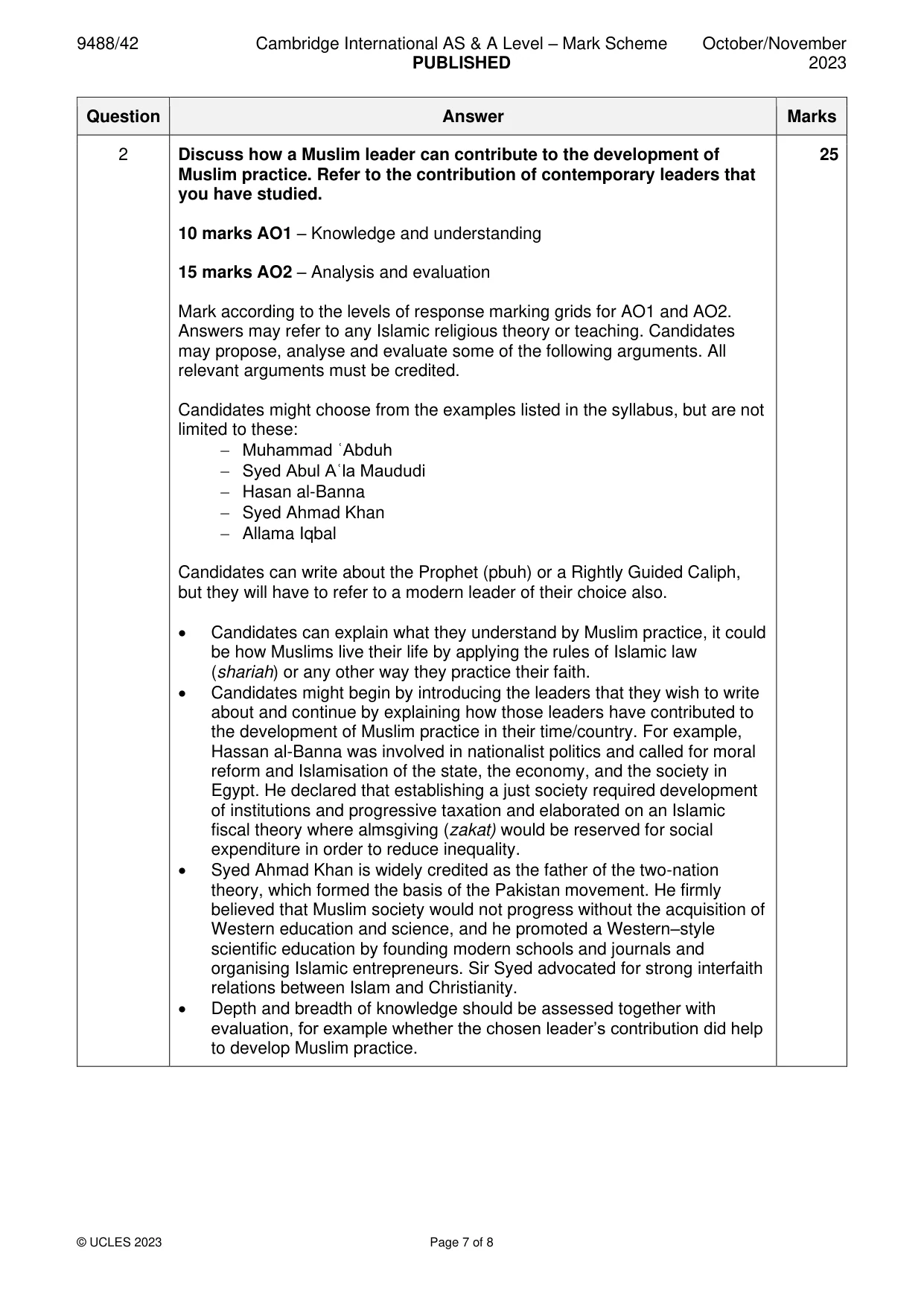
Mark scheme: 2 Discuss how a Muslim leader can contribute to the development of 25 Muslim practice. Refer to the contribution of contemporary leaders that you have studied. 10 marks AO1 – Knowledge and understanding 15 marks AO2 – Analysis and evaluation Mark according to the levels of response marking grids for AO1 and AO2. Answers may refer to any Islamic religious theory or teaching. Candidates may propose, analyse and evaluate some of the following arguments. All relevant arguments must be credited. Candidates might choose from the examples listed in the syllabus, but are not limited to these: − Muhammad ʿAbduh − Syed Abul Aʿla Maududi − Hasan al-Banna − Syed Ahmad Khan − Allama Iqbal Candidates can write about the Prophet (pbuh) or a Rightly Guided Caliph, but they will have to refer to a modern leader of their choice also. • Candidates can explain what they understand by Muslim practice, it could be how Muslims live their life by applying the rules of Islamic law (shariah) or any other way they practice their faith. • Candidates might begin by introducing the leaders that they wish to write about and continue by explaining how those leaders have contributed to the development of Muslim practice in their time/country. For example, Hassan al-Banna was involved in nationalist politics and called for moral reform and Islamisation of the state, the economy, and the society in Egypt. He declared that establishing a just society required development of institutions and progressive taxation and elaborated on an Islamic fiscal theory where almsgiving (zakat) would be reserved for social expenditure in order to reduce inequality. • Syed Ahmad Khan is widely credited as the father of the two-nation theory, which formed the basis of the Pakistan movement. He firmly believed that Muslim society would not progress without the acquisition of Western education and science, and he promoted a Western–style scientific education by founding modern schools and journals and organising Islamic entrepreneurs. Sir Syed advocated for strong interfaith relations between Islam and Christianity. • Depth and breadth of knowledge should be assessed together with evaluation, for example whether the chosen leader’s contribution did help to develop Muslim practice.
Q3 · ‘Pious Muslims can effectively lead both Muslims and non-Muslims.’ To what extent do you…
3 ‘Pious Muslims can effectively lead both Muslims and non-Muslims.’ To what extent do you agree with this statement? [25]
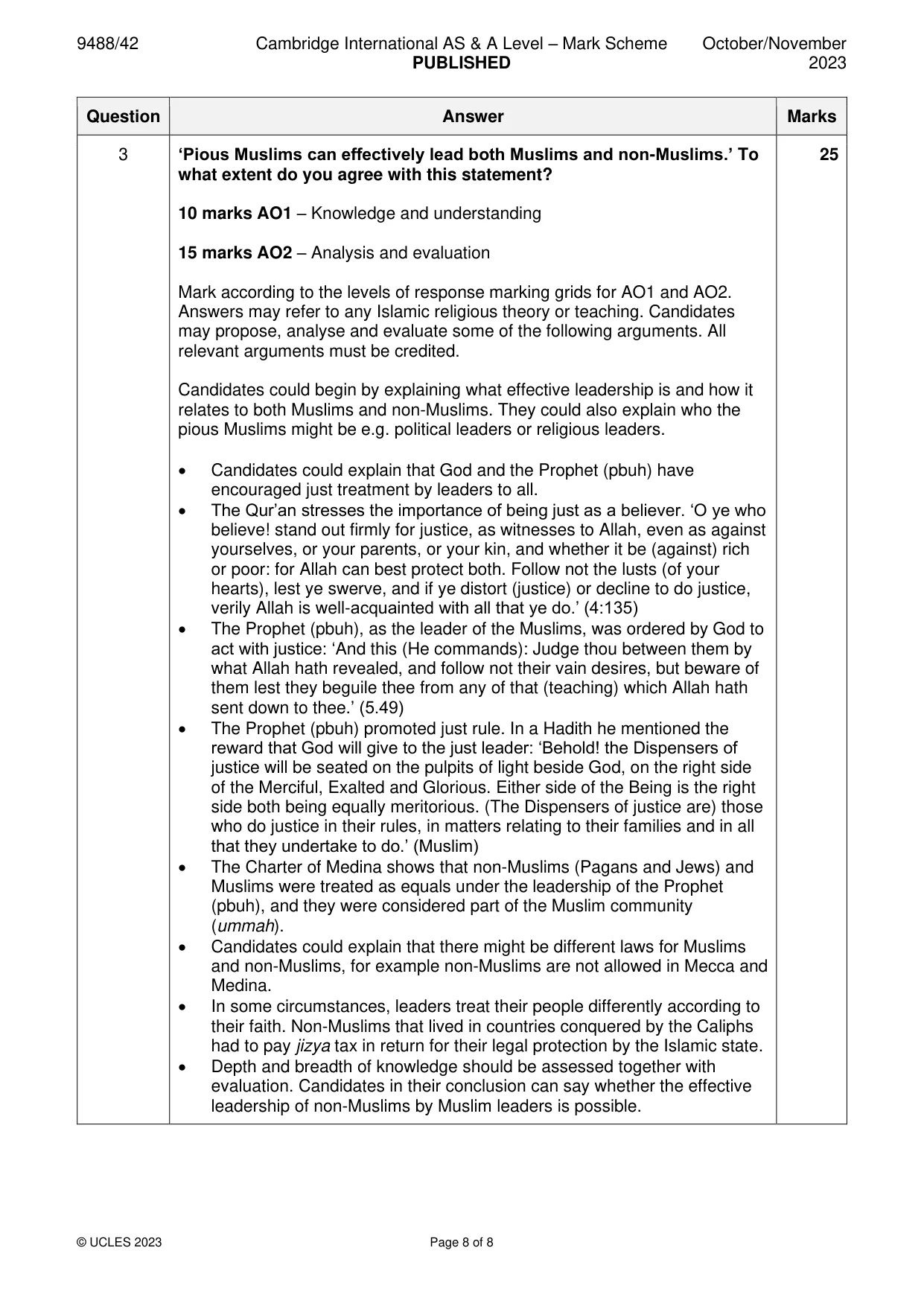
Mark scheme: 3 ‘Pious Muslims can effectively lead both Muslims and non-Muslims.’ To 25 what extent do you agree with this statement? 10 marks AO1 – Knowledge and understanding 15 marks AO2 – Analysis and evaluation Mark according to the levels of response marking grids for AO1 and AO2. Answers may refer to any Islamic religious theory or teaching. Candidates may propose, analyse and evaluate some of the following arguments. All relevant arguments must be credited. Candidates could begin by explaining what effective leadership is and how it relates to both Muslims and non-Muslims. They could also explain who the pious Muslims might be e.g. political leaders or religious leaders. • Candidates could explain that God and the Prophet (pbuh) have encouraged just treatment by leaders to all. • The Qur’an stresses the importance of being just as a believer. ‘O ye who believe! stand out firmly for justice, as witnesses to Allah, even as against yourselves, or your parents, or your kin, and whether it be (against) rich or poor: for Allah can best protect both. Follow not the lusts (of your hearts), lest ye swerve, and if ye distort (justice) or decline to do justice, verily Allah is well-acquainted with all that ye do.’ (4:135) • The Prophet (pbuh), as the leader of the Muslims, was ordered by God to act with justice: ‘And this (He commands): Judge thou between them by what Allah hath revealed, and follow not their vain desires, but beware of them lest they beguile thee from any of that (teaching) which Allah hath sent down to thee.’ (5.49) • The Prophet (pbuh) promoted just rule. In a Hadith he mentioned the reward that God will give to the just leader: ‘Behold! the Dispensers of justice will be seated on the pulpits of light beside God, on the right side of the Merciful, Exalted and Glorious. Either side of the Being is the right side both being equally meritorious. (The Dispensers of justice are) those who do justice in their rules, in matters relating to their families and in all that they undertake to do.’ (Muslim) • The Charter of Medina shows that non-Muslims (Pagans and Jews) and Muslims were treated as equals under the leadership of the Prophet (pbuh), and they were considered part of the Muslim community (ummah). • Candidates could explain that there might be different laws for Muslims and non-Muslims, for example non-Muslims are not allowed in Mecca and Medina. • In some circumstances, leaders treat their people differently according to their faith. Non-Muslims that lived in countries conquered by the Caliphs had to pay jizya tax in return for their legal protection by the Islamic state. • Depth and breadth of knowledge should be assessed together with evaluation. Candidates in their conclusion can say whether the effective leadership of non-Muslims by Muslim leaders is possible.
What was in this paper
The subtopics covered by these 3 questions, and how many questions each got. Open one in a new tab to see every Cambridge question on it.
What you needed in this session
Cambridge’s own grade thresholds for 2023 Oct/Nov, Paper 4 · Variant 2. A higher threshold means an easier paper — the bar moves with how the cohort did.