Cambridge A Level Islamic Studies 9488 — 2022 Oct/Nov Paper 4 · Variant 2
9488/42/O/N/22 · 2 questions · 50 marks · ≈56 min
The question paper and its mark scheme, free to read here and free to download. This is Cambridge’s own paper, exactly as it was sat.
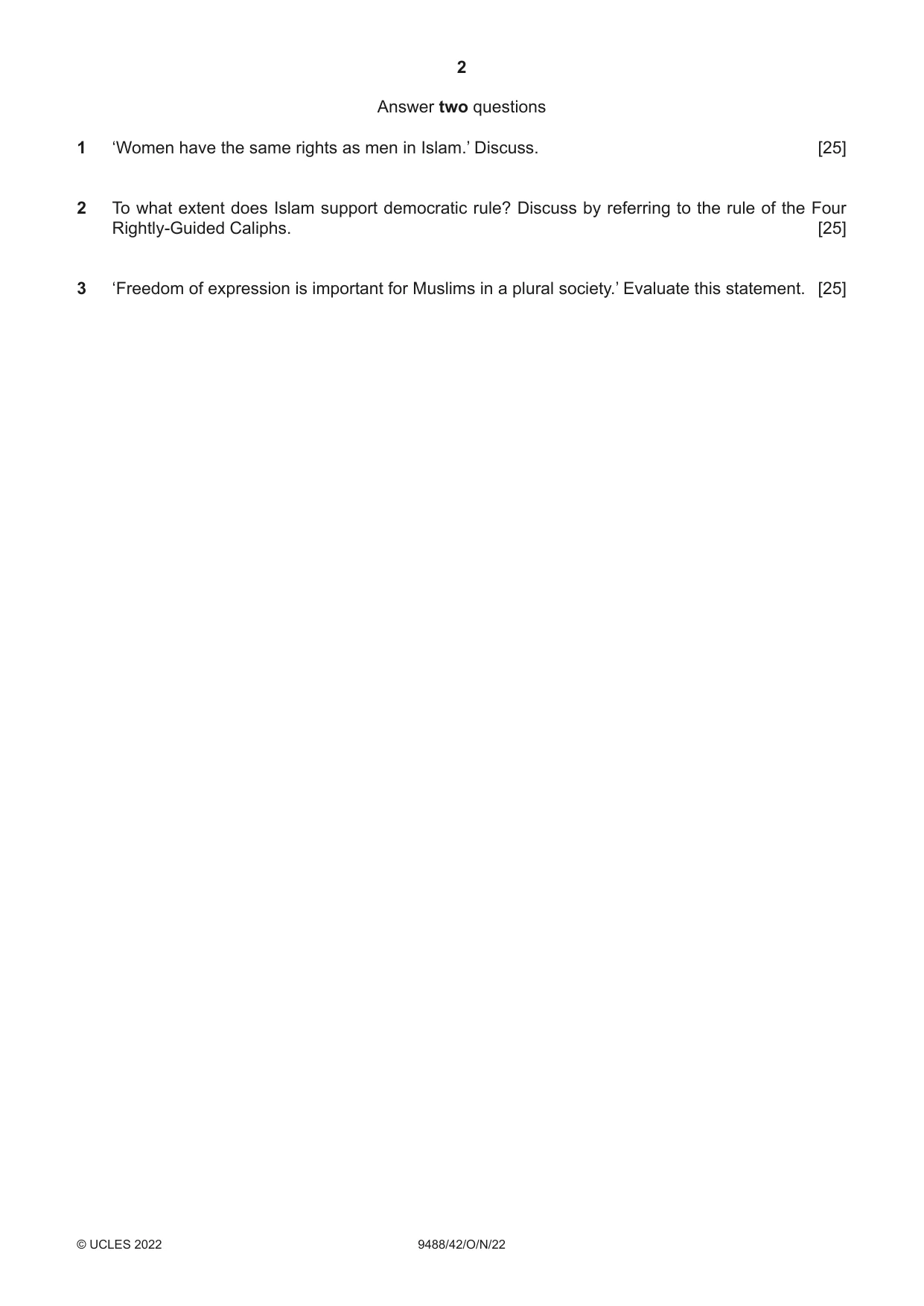
Question paper4 pages

Mark scheme11 pages
Answers below. Sit the paper first if you are practising.
Questions as text
Q1 · ‘Women have the same rights as men in Islam.’ Discuss
1 ‘Women have the same rights as men in Islam.’ Discuss. [25]
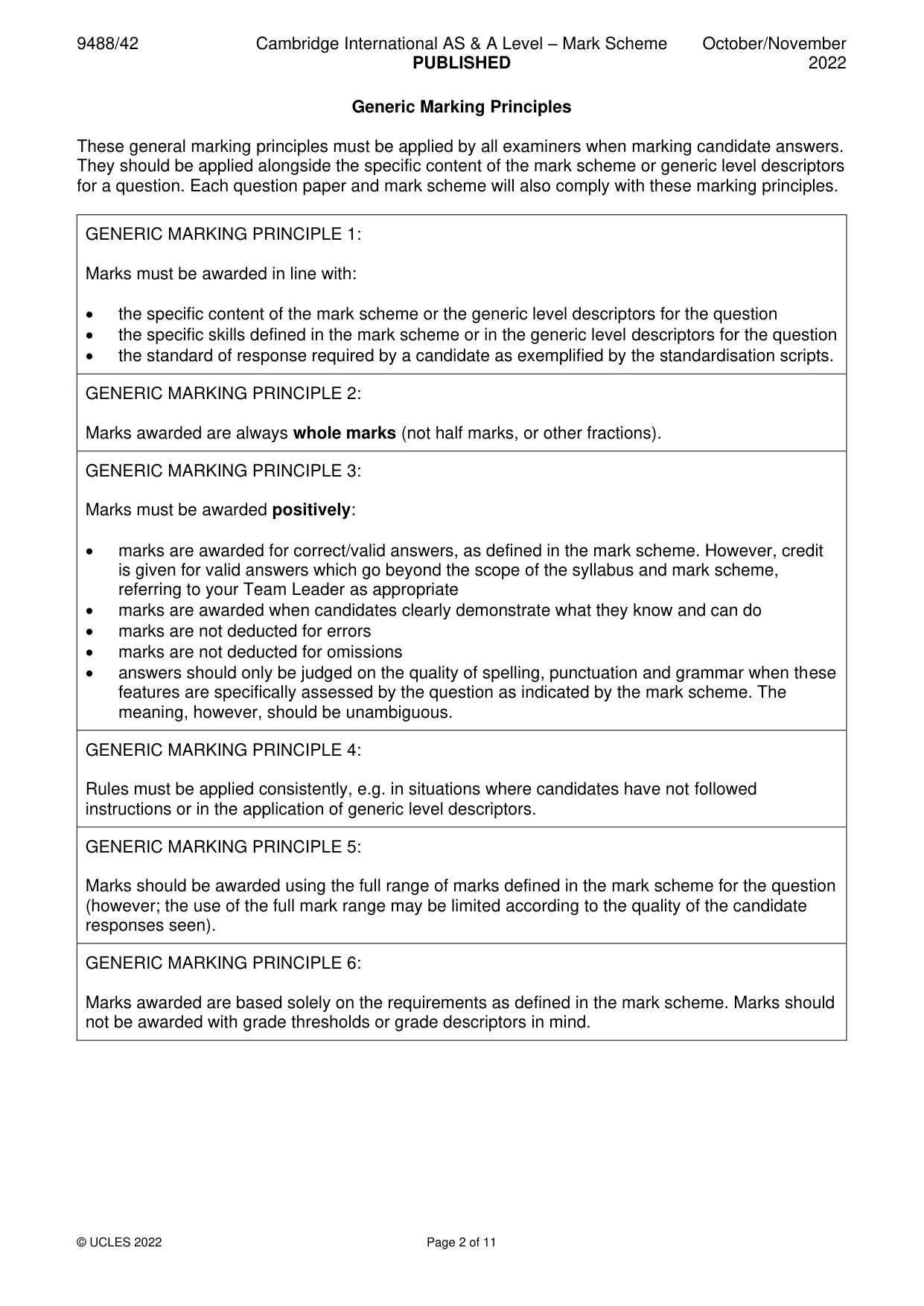
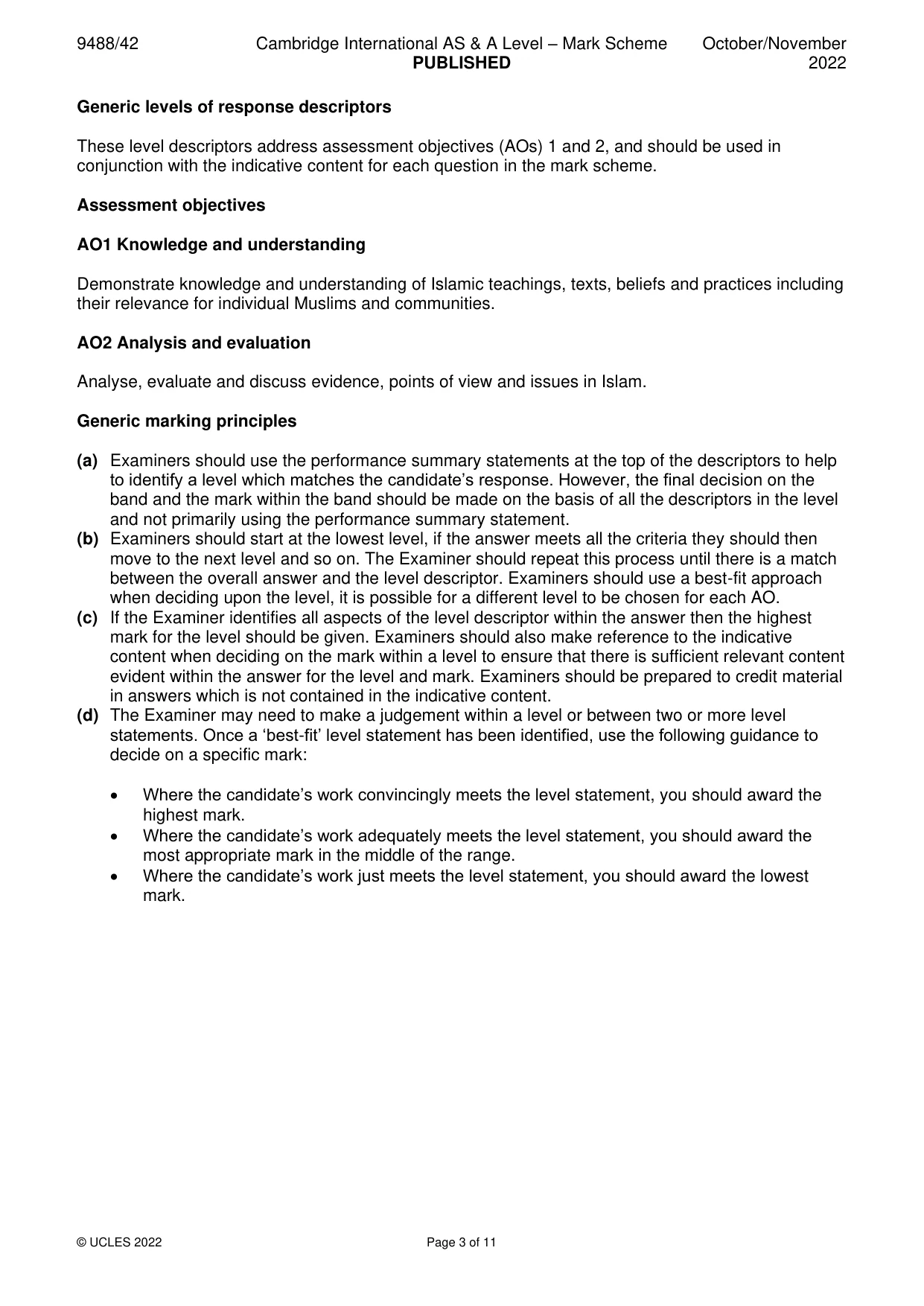
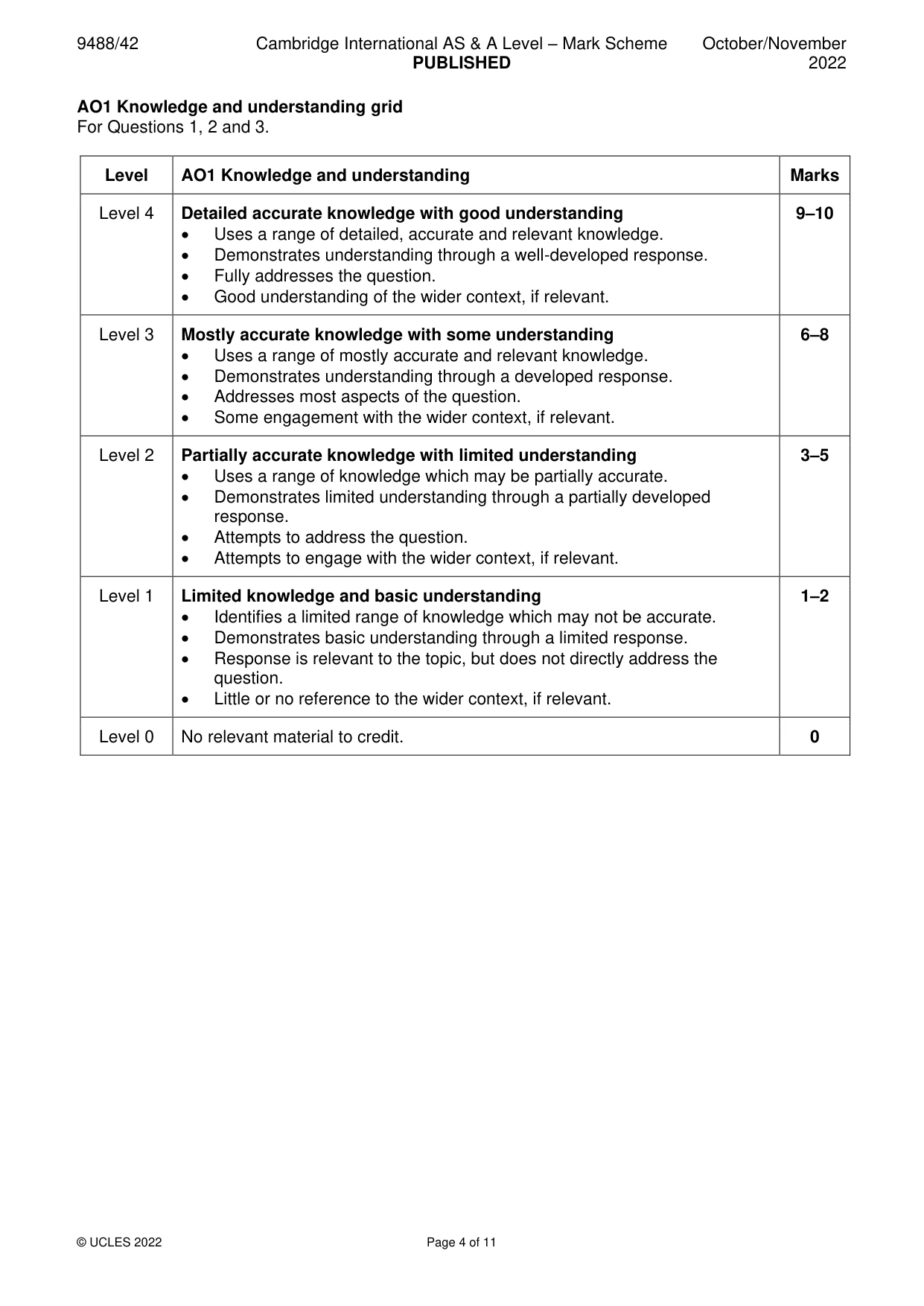
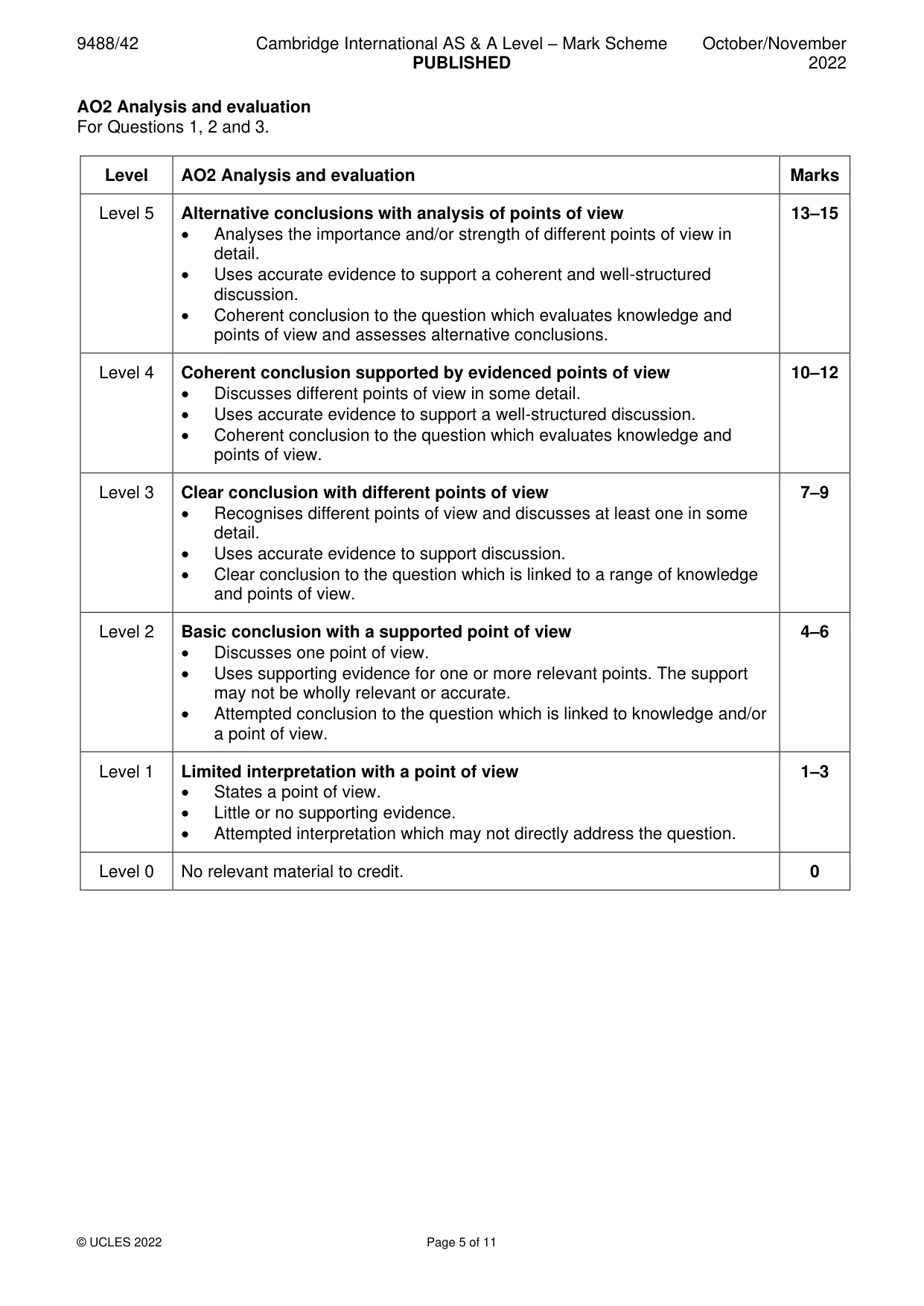
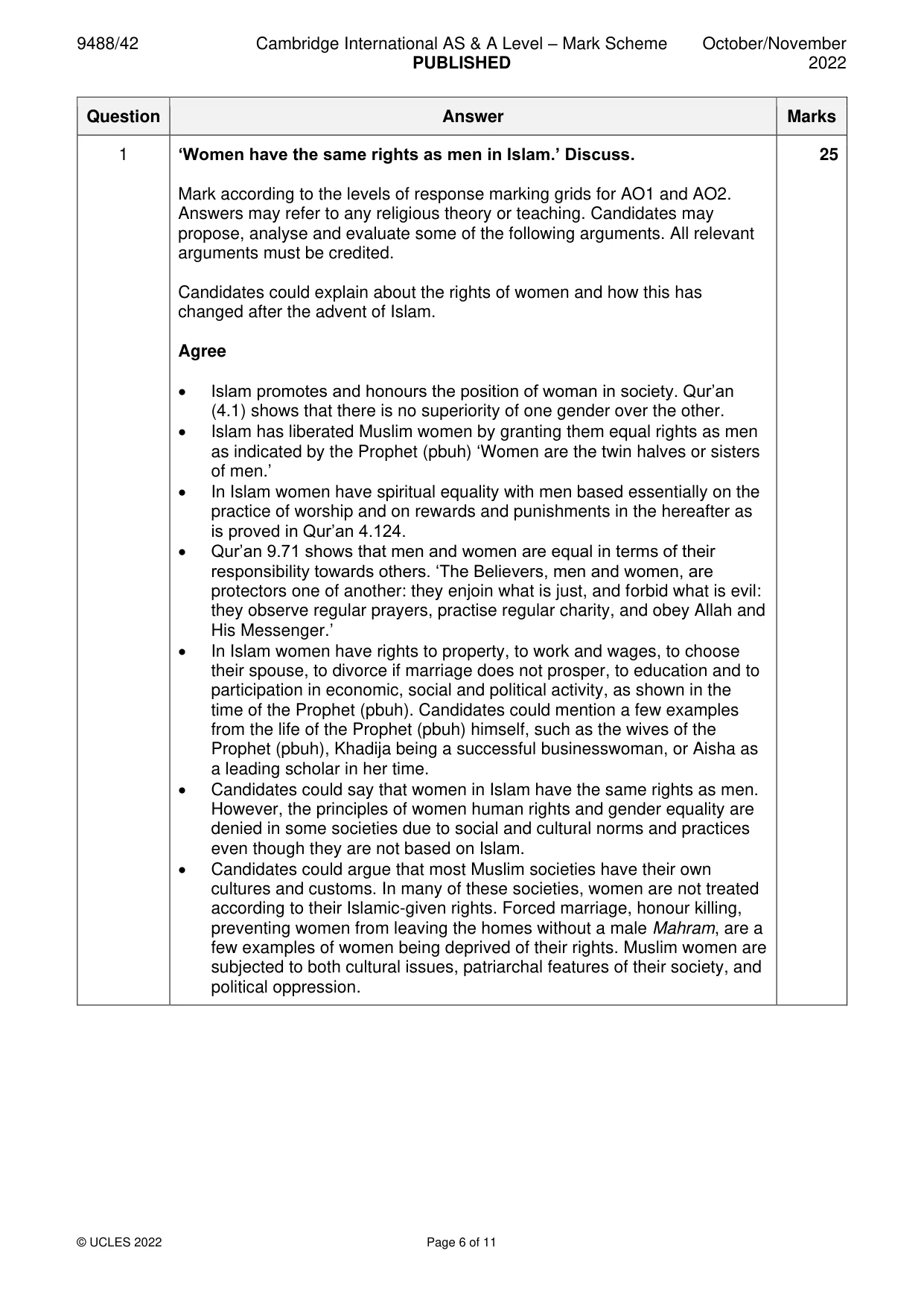
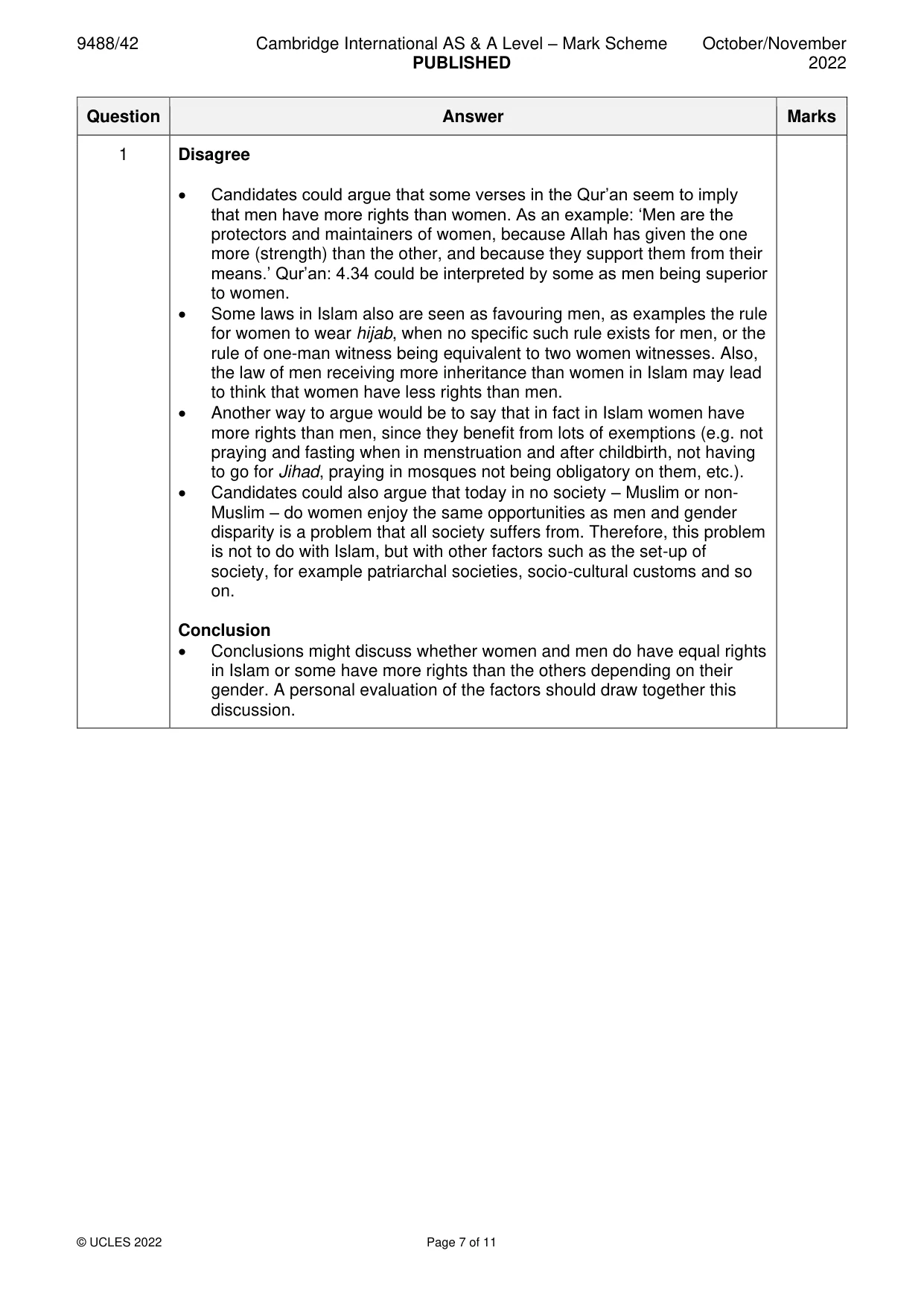
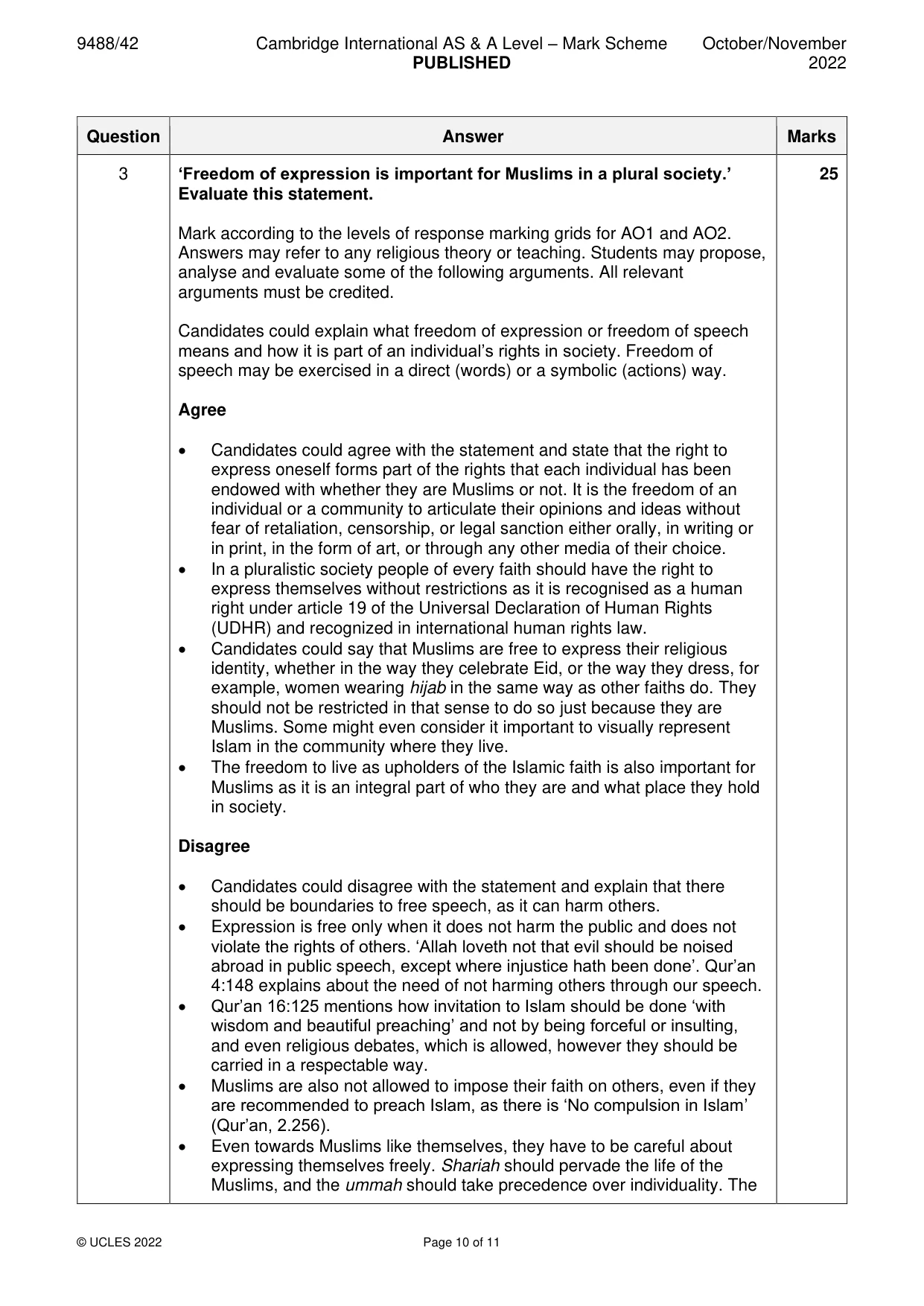
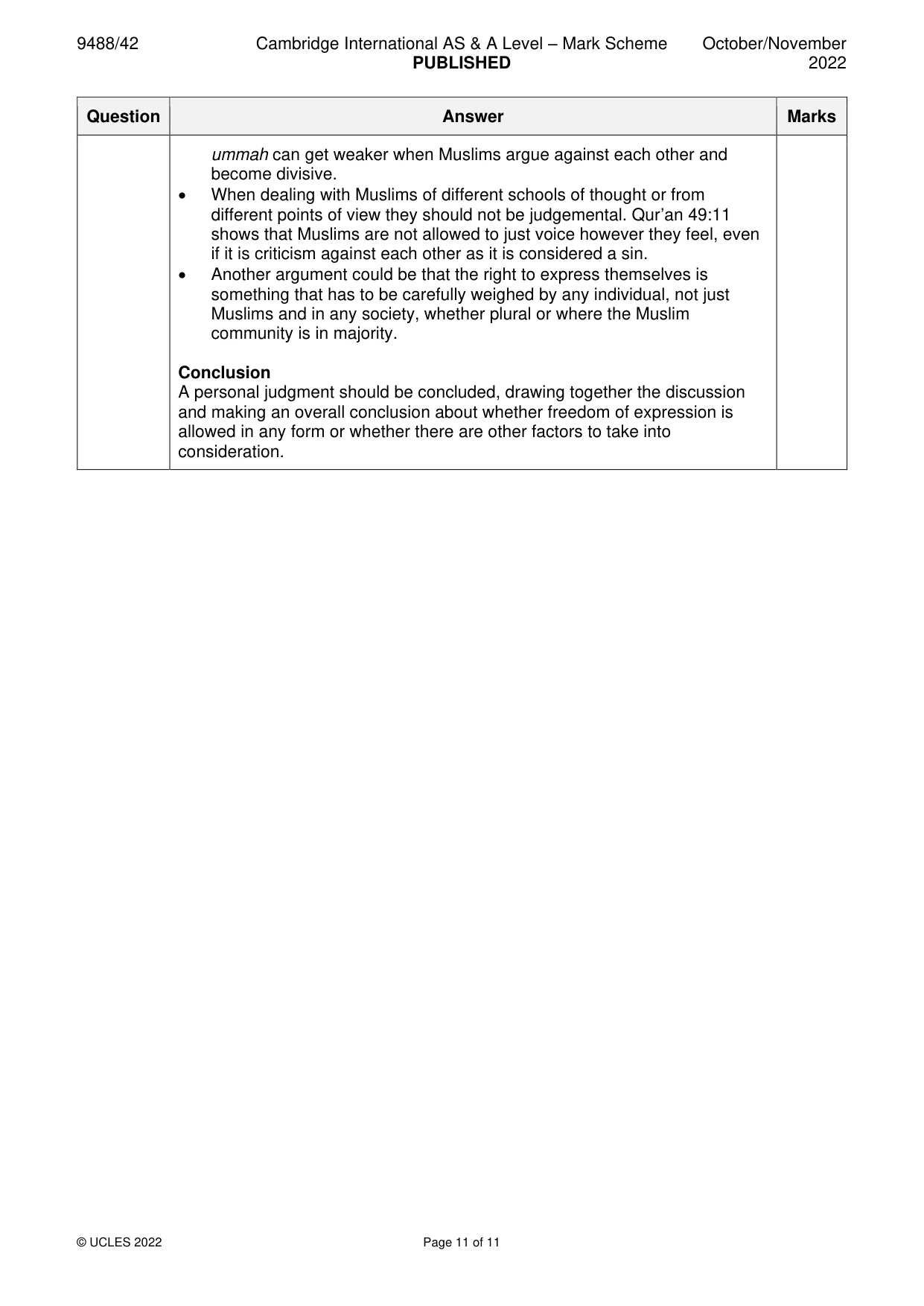
Mark scheme: Question Answer Marks 1 ‘Women have the same rights as men in Islam.’ Discuss. 25 Mark according to the levels of response marking grids for AO1 and AO2. Answers may refer to any religious theory or teaching. Candidates may propose, analyse and evaluate some of the following arguments. All relevant arguments must be credited. Candidates could explain about the rights of women and how this has changed after the advent of Islam. Agree • Islam promotes and honours the position of woman in society. Qur’an (4.1) shows that there is no superiority of one gender over the other. • Islam has liberated Muslim women by granting them equal rights as men as indicated by the Prophet (pbuh) ‘Women are the twin halves or sisters of men.’ • In Islam women have spiritual equality with men based essentially on the practice of worship and on rewards and punishments in the hereafter as is proved in Qur’an 4.124. • Qur’an 9.71 shows that men and women are equal in terms of their responsibility towards others. ‘The Believers, men and women, are protectors one of another: they enjoin what is just, and forbid what is evil: they observe regular prayers, practise regular charity, and obey Allah and His Messenger.’ • In Islam women have rights to property, to work and wages, to choose their spouse, to divorce if marriage does not prosper, to education and to participation in economic, social and political activity, as shown in the time of the Prophet (pbuh). Candidates could mention a few examples from the life of the Prophet (pbuh) himself, such as the wives of the Prophet (pbuh), Khadija being a successful businesswoman, or Aisha as a leading scholar in her time. • Candidates could say that women in Islam have the same rights as men. However, the principles of women human rights and gender equality are denied in some societies due to social and cultural norms and practices even though they are not based on Islam. • Candidates could argue that most Muslim societies have their own cultures and customs. In many of these societies, women are not treated according to their Islamic-given rights. Forced marriage, honour killing, preventing women from leaving the homes without a male Mahram, are a few examples of women being deprived of their rights. Muslim women are subjected to both cultural issues, patriarchal features of their society, and political oppression. 1 Disagree • Candidates could argue that some verses in the Qur’an seem to imply that men have more rights than women. As an example: ‘Men are the protectors and maintainers of women, because Allah has given the one more (strength) than the other, and because they support them from their means.’ Qur’an: 4.34 could be interpreted by some as men being superior to women. • Some laws in Islam also are seen as favouring men, as examples the rule for women to wear hijab, when no specific such rule exists for men, or the rule of one-man witness being equivalent to two women witnesses. Also, the law of men receiving more inheritance than women in Islam may lead to think that women have less rights than men. • Another way to argue would be to say that in fact in Islam women have more rights than men, since they benefit from lots of exemptions (e.g. not praying and fasting when in menstruation and after childbirth, not having to go for Jihad, praying in mosques not being obligatory on them, etc.). • Candidates could also argue that today in no society – Muslim or non- Muslim – do women enjoy the same opportunities as men and gender disparity is a problem that all society suffers from. Therefore, this problem is not to do with Islam, but with other factors such as the set-up of society, for example patriarchal societies, socio-cultural customs and so on. Conclusion • Conclusions might discuss whether women and men do have equal rights in Islam or some have more rights than the others depending on their gender. A personal evaluation of the factors should draw together this discussion.
Q2 · To what extent does Islam support democratic rule?
2 To what extent does Islam support democratic rule? Discuss by referring to the rule of the Four Rightly-Guided Caliphs. [25]
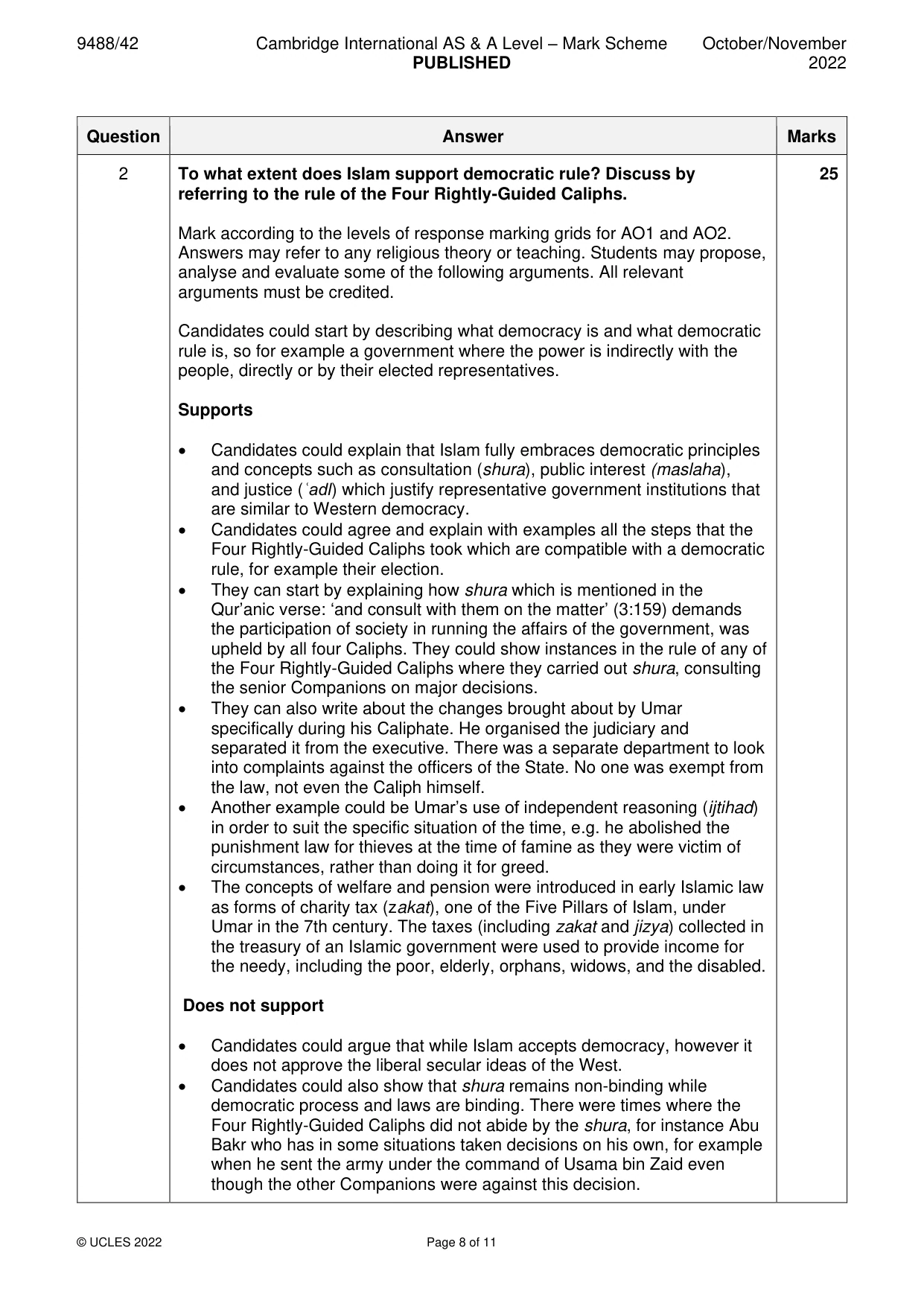
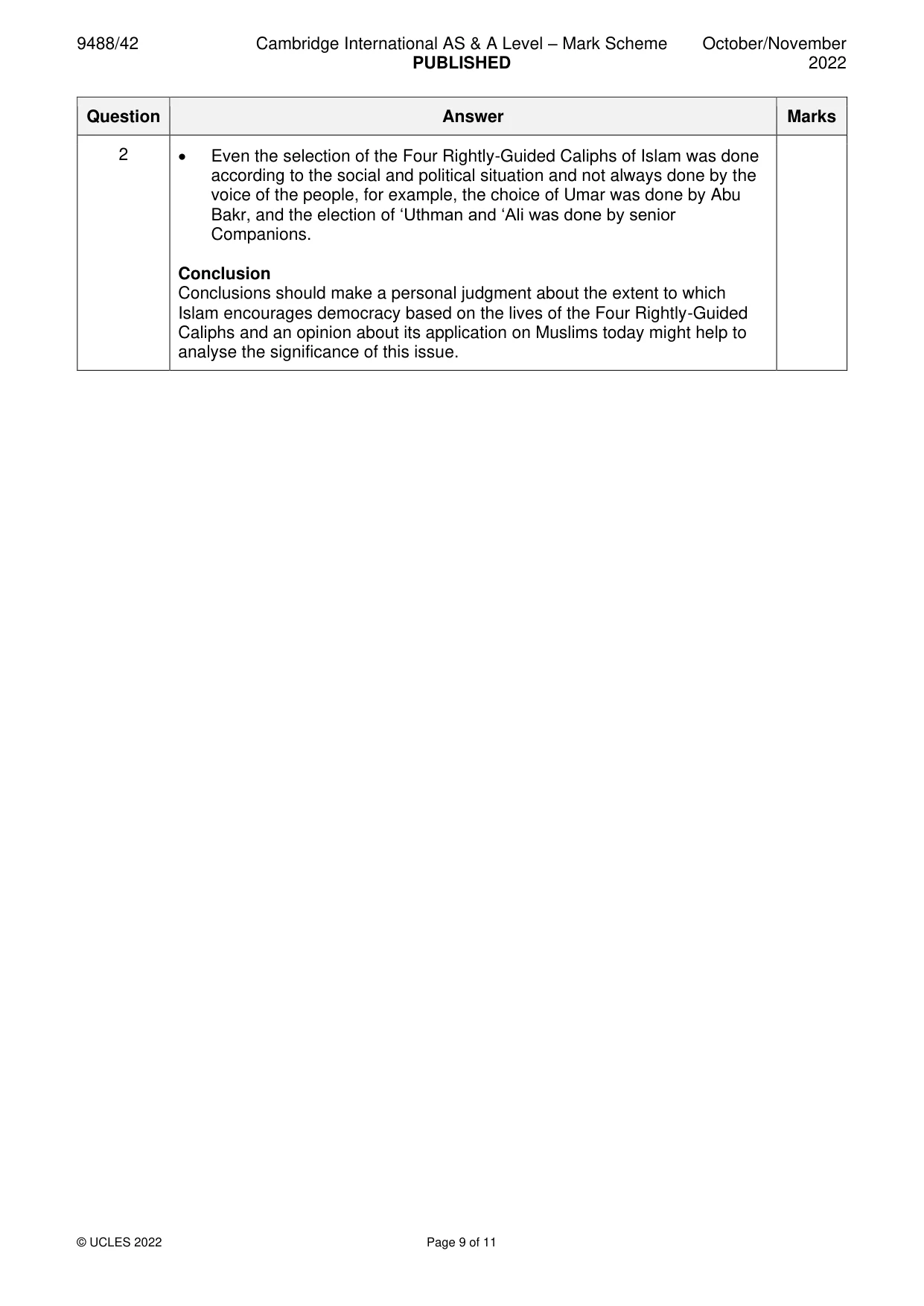
Mark scheme: 2 To what extent does Islam support democratic rule? Discuss by 25 referring to the rule of the Four Rightly-Guided Caliphs. Mark according to the levels of response marking grids for AO1 and AO2. Answers may refer to any religious theory or teaching. Students may propose, analyse and evaluate some of the following arguments. All relevant arguments must be credited. Candidates could start by describing what democracy is and what democratic rule is, so for example a government where the power is indirectly with the people, directly or by their elected representatives. Supports • Candidates could explain that Islam fully embraces democratic principles and concepts such as consultation (shura), public interest (maslaha), and justice (ʿadl) which justify representative government institutions that are similar to Western democracy. • Candidates could agree and explain with examples all the steps that the Four Rightly-Guided Caliphs took which are compatible with a democratic rule, for example their election. • They can start by explaining how shura which is mentioned in the Qur’anic verse: ‘and consult with them on the matter’ (3:159) demands the participation of society in running the affairs of the government, was upheld by all four Caliphs. They could show instances in the rule of any of the Four Rightly-Guided Caliphs where they carried out shura, consulting the senior Companions on major decisions. • They can also write about the changes brought about by Umar specifically during his Caliphate. He organised the judiciary and separated it from the executive. There was a separate department to look into complaints against the officers of the State. No one was exempt from the law, not even the Caliph himself. • Another example could be Umar’s use of independent reasoning (ijtihad) in order to suit the specific situation of the time, e.g. he abolished the punishment law for thieves at the time of famine as they were victim of circumstances, rather than doing it for greed. • The concepts of welfare and pension were introduced in early Islamic law as forms of charity tax (zakat), one of the Five Pillars of Islam, under Umar in the 7th century. The taxes (including zakat and jizya) collected in the treasury of an Islamic government were used to provide income for the needy, including the poor, elderly, orphans, widows, and the disabled. Does not support • Candidates could argue that while Islam accepts democracy, however it does not approve the liberal secular ideas of the West. • Candidates could also show that shura remains non-binding while democratic process and laws are binding. There were times where the Four Rightly-Guided Caliphs did not abide by the shura, for instance Abu Bakr who has in some situations taken decisions on his own, for example when he sent the army under the command of Usama bin Zaid even though the other Companions were against this decision. 2 • Even the selection of the Four Rightly-Guided Caliphs of Islam was done according to the social and political situation and not always done by the voice of the people, for example, the choice of Umar was done by Abu Bakr, and the election of ‘Uthman and ‘Ali was done by senior Companions. Conclusion Conclusions should make a personal judgment about the extent to which Islam encourages democracy based on the lives of the Four Rightly-Guided Caliphs and an opinion about its application on Muslims today might help to analyse the significance of this issue.
What was in this paper
The subtopics covered by these 2 questions, and how many questions each got. Open one in a new tab to see every Cambridge question on it.
What you needed in this session
Cambridge’s own grade thresholds for 2022 Oct/Nov, Paper 4 · Variant 2. A higher threshold means an easier paper — the bar moves with how the cohort did.