Cambridge A Level Islamic Studies 9488 — 2024 Oct/Nov Paper 4 · Variant 2
9488/42/O/N/24 · 3 questions · 50 marks · 90 min
The question paper and its mark scheme, free to read here and free to download. This is Cambridge’s own paper, exactly as it was sat.
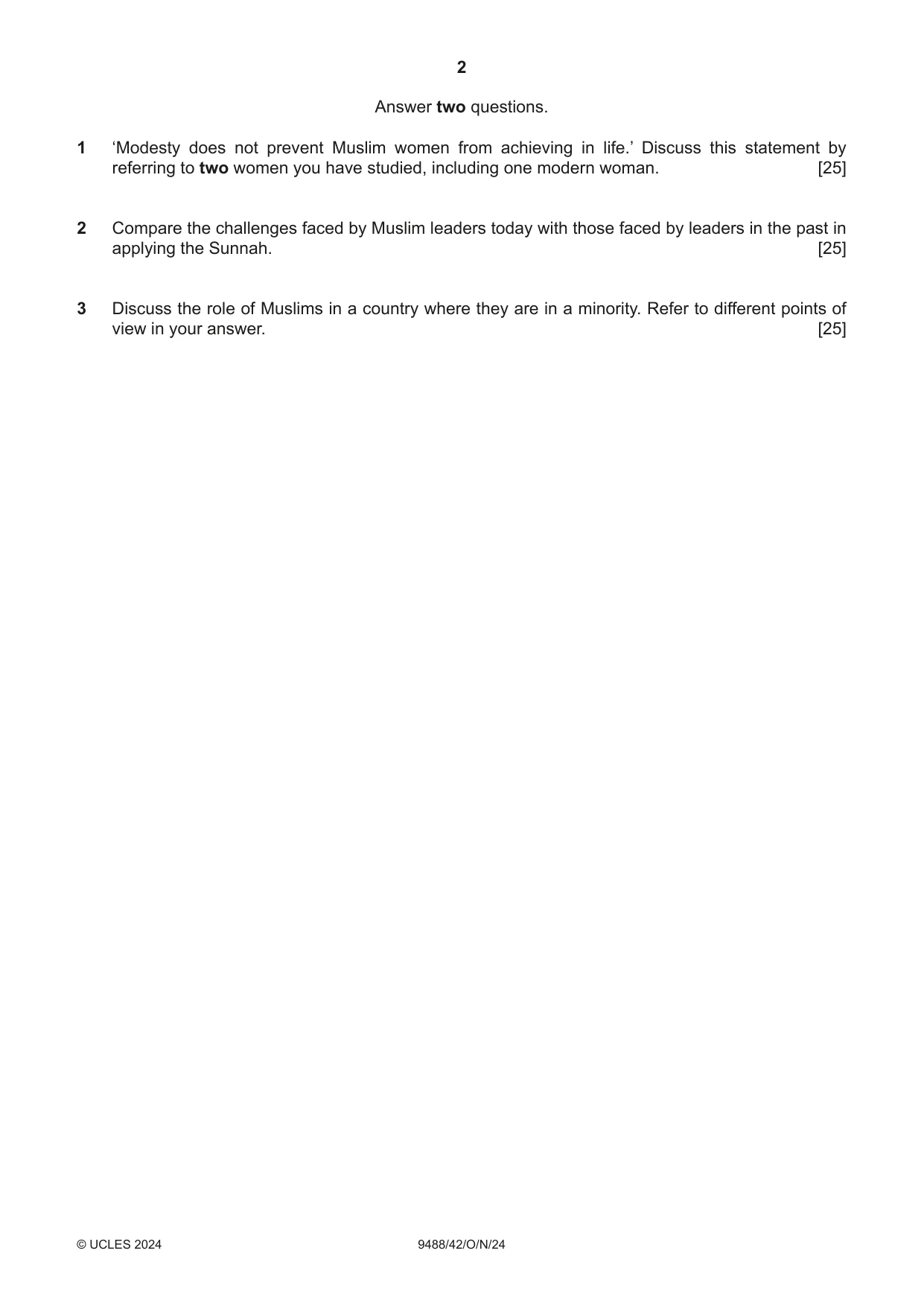
Question paper4 pages

Mark scheme11 pages
Answers below. Sit the paper first if you are practising.
Questions as text
Q1 · ‘Modesty does not prevent Muslim women from achieving in life.’ Discuss this statement by…
1 ‘Modesty does not prevent Muslim women from achieving in life.’ Discuss this statement by referring to two women you have studied, including one modern woman. [25]
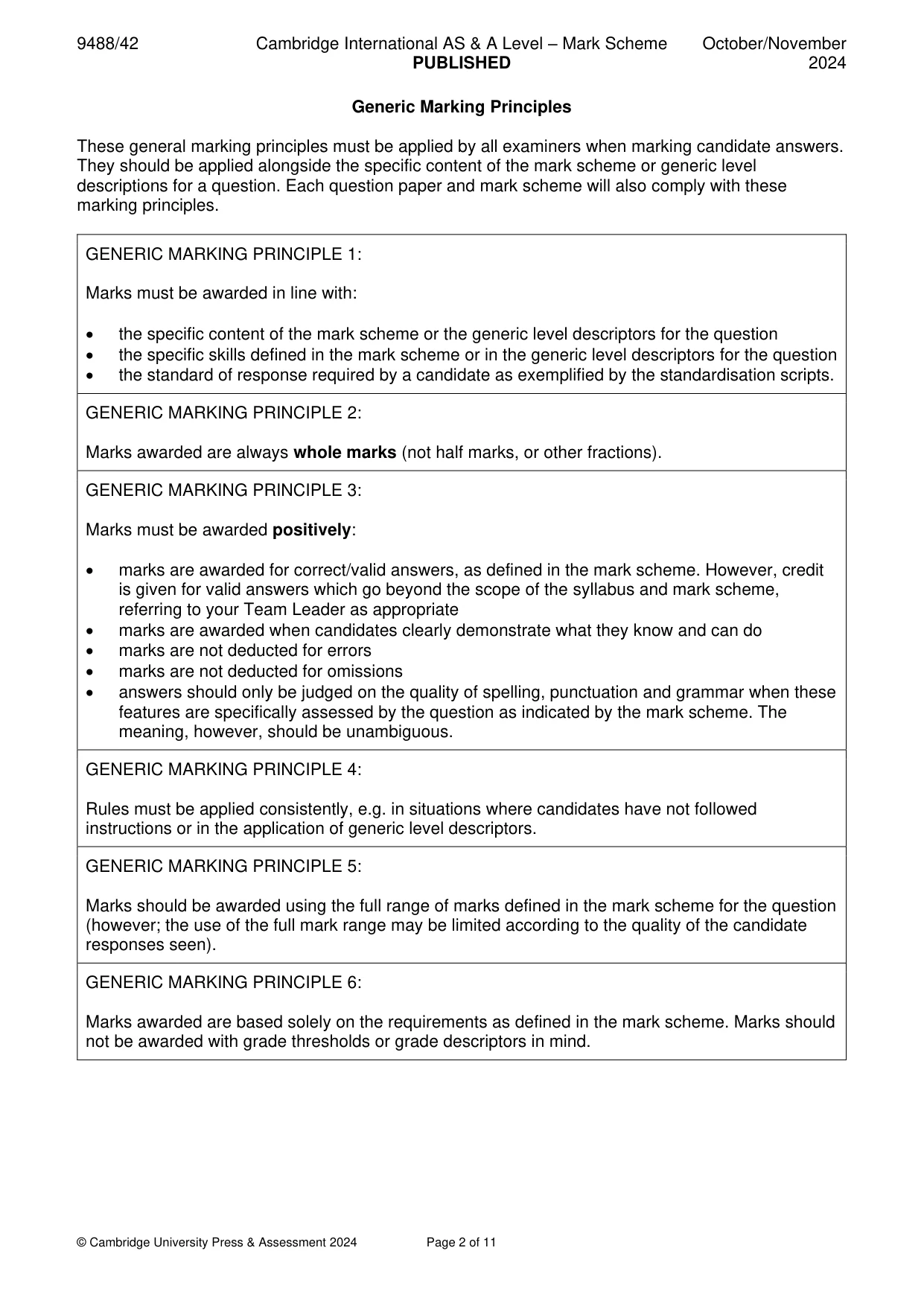
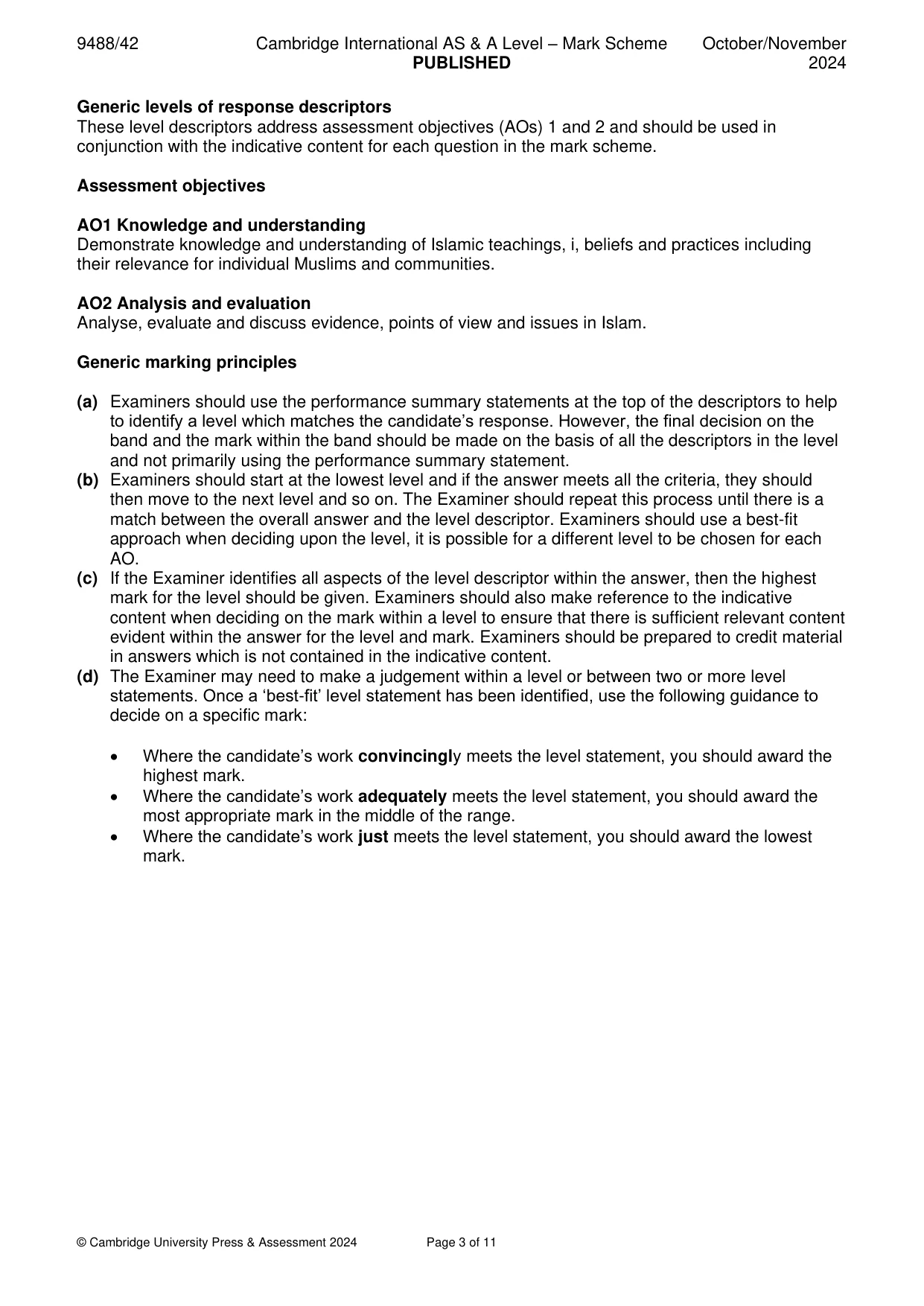
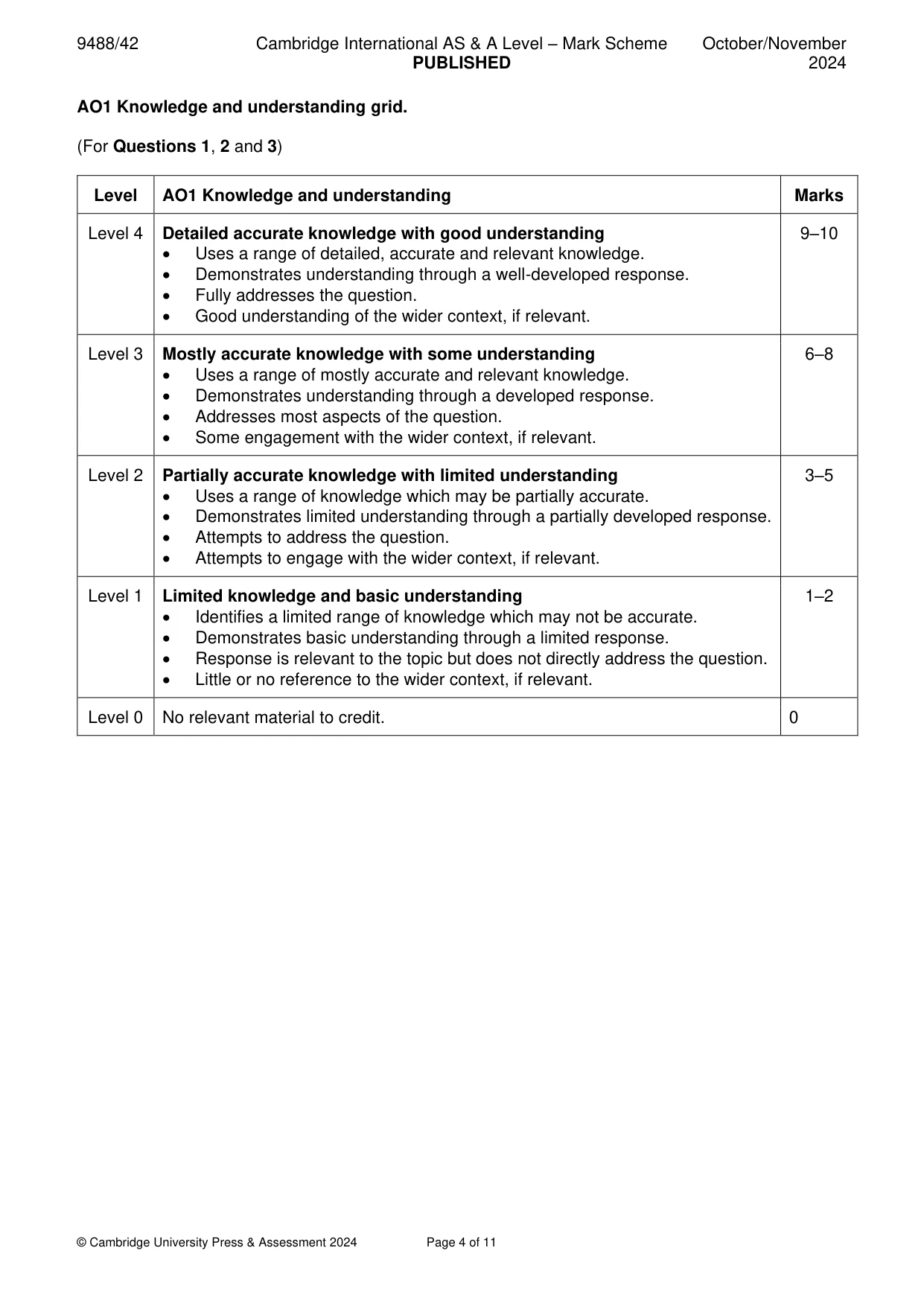
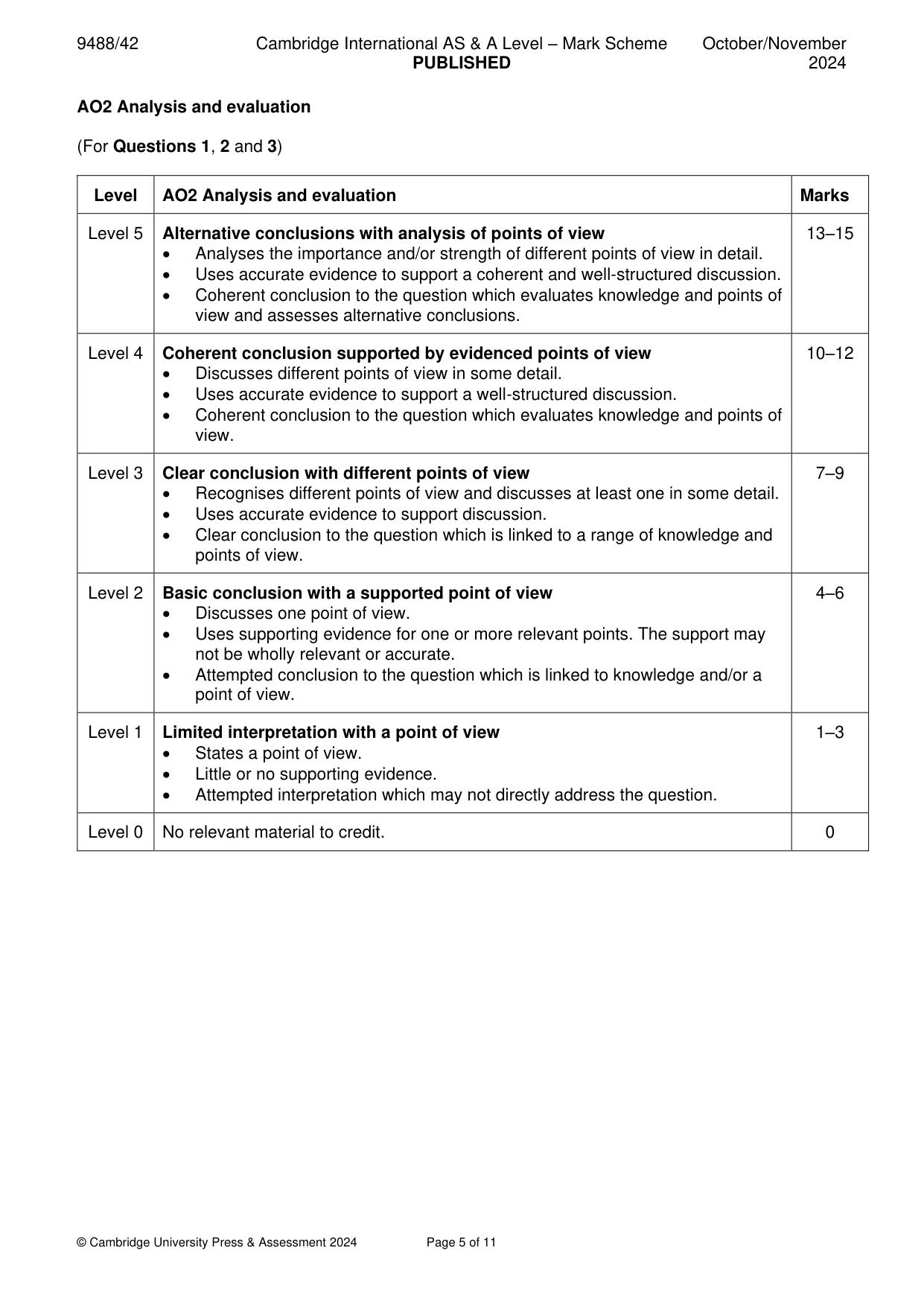
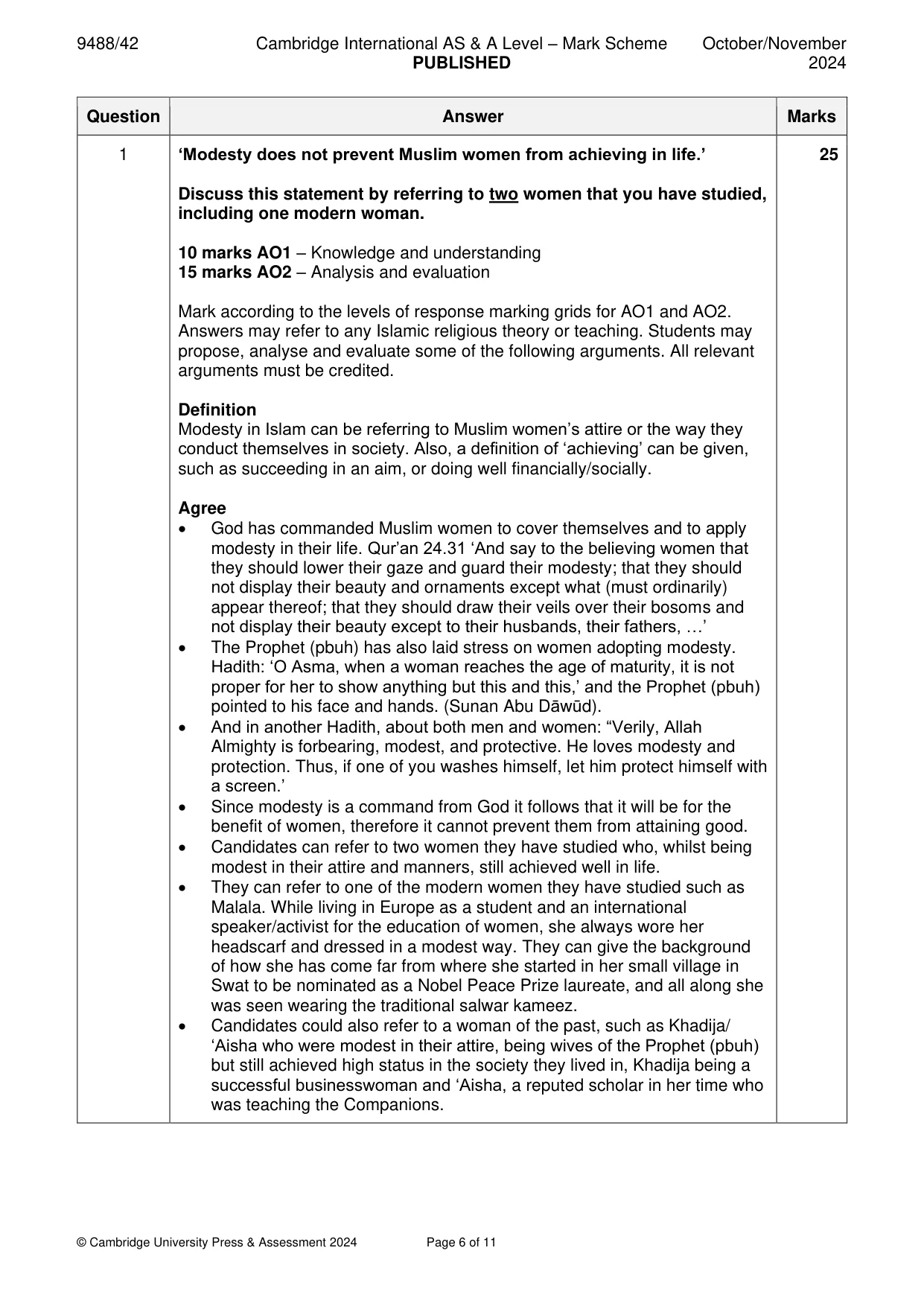
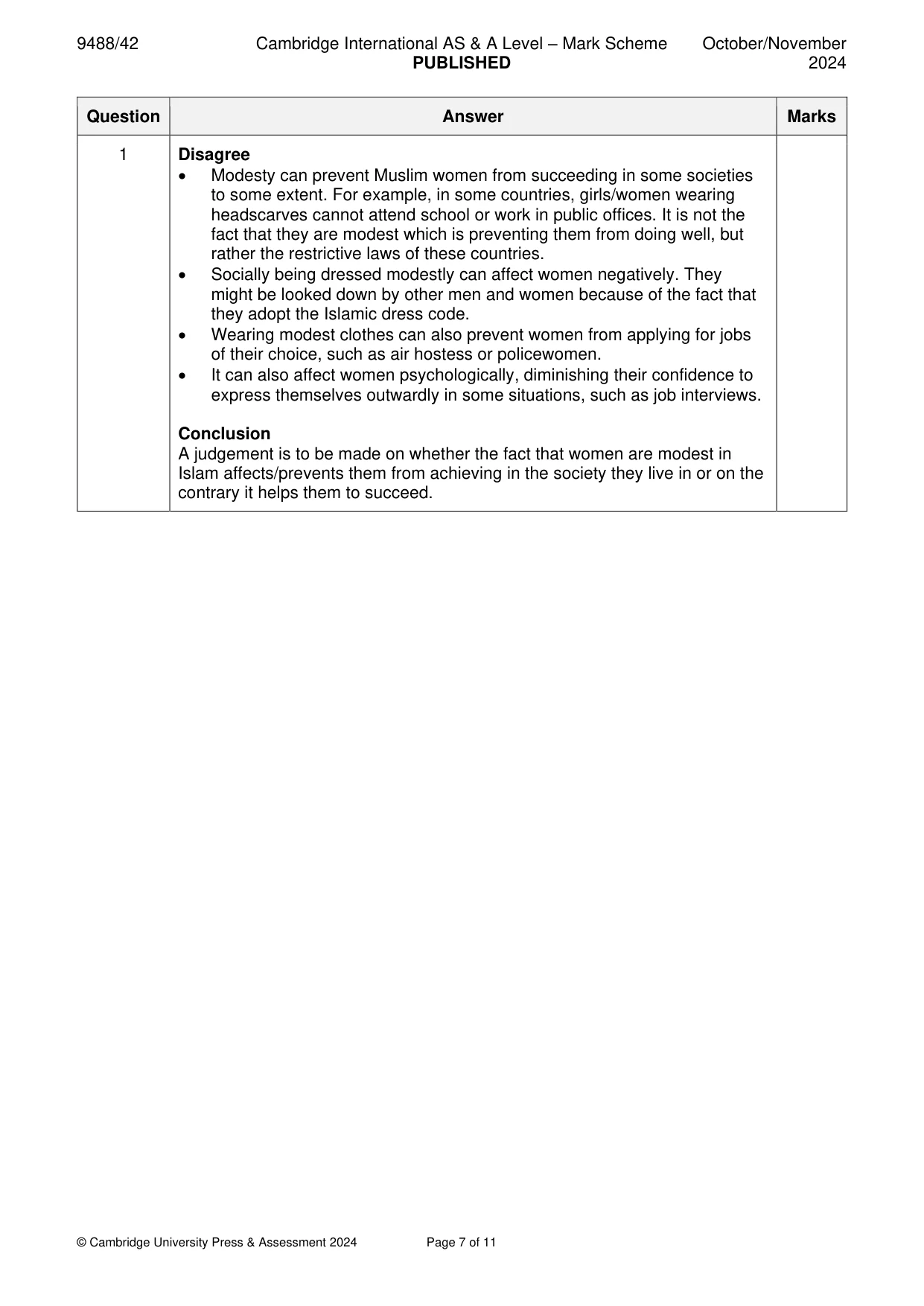
Mark scheme: Question Answer Marks 1 ‘Modesty does not prevent Muslim women from achieving in life.’ 25 Discuss this statement by referring to two women that you have studied, including one modern woman. 10 marks AO1 – Knowledge and understanding 15 marks AO2 – Analysis and evaluation Mark according to the levels of response marking grids for AO1 and AO2. Answers may refer to any Islamic religious theory or teaching. Students may propose, analyse and evaluate some of the following arguments. All relevant arguments must be credited. Definition Modesty in Islam can be referring to Muslim women’s attire or the way they conduct themselves in society. Also, a definition of ‘achieving’ can be given, such as succeeding in an aim, or doing well financially/socially. Agree • God has commanded Muslim women to cover themselves and to apply modesty in their life. Qur’an 24.31 ‘And say to the believing women that they should lower their gaze and guard their modesty; that they should not display their beauty and ornaments except what (must ordinarily) appear thereof; that they should draw their veils over their bosoms and not display their beauty except to their husbands, their fathers, …’ • The Prophet (pbuh) has also laid stress on women adopting modesty. Hadith: ‘O Asma, when a woman reaches the age of maturity, it is not proper for her to show anything but this and this,’ and the Prophet (pbuh) pointed to his face and hands. (Sunan Abu Dāwūd). • And in another Hadith, about both men and women: “Verily, Allah Almighty is forbearing, modest, and protective. He loves modesty and protection. Thus, if one of you washes himself, let him protect himself with a screen.’ • Since modesty is a command from God it follows that it will be for the benefit of women, therefore it cannot prevent them from attaining good. • Candidates can refer to two women they have studied who, whilst being modest in their attire and manners, still achieved well in life. • They can refer to one of the modern women they have studied such as Malala. While living in Europe as a student and an international speaker/activist for the education of women, she always wore her headscarf and dressed in a modest way. They can give the background of how she has come far from where she started in her small village in Swat to be nominated as a Nobel Peace Prize laureate, and all along she was seen wearing the traditional salwar kameez. • Candidates could also refer to a woman of the past, such as Khadija/ ‘Aisha who were modest in their attire, being wives of the Prophet (pbuh) but still achieved high status in the society they lived in, Khadija being a successful businesswoman and ‘Aisha, a reputed scholar in her time who was teaching the Companions. 1 Disagree • Modesty can prevent Muslim women from succeeding in some societies to some extent. For example, in some countries, girls/women wearing headscarves cannot attend school or work in public offices. It is not the fact that they are modest which is preventing them from doing well, but rather the restrictive laws of these countries. • Socially being dressed modestly can affect women negatively. They might be looked down by other men and women because of the fact that they adopt the Islamic dress code. • Wearing modest clothes can also prevent women from applying for jobs of their choice, such as air hostess or policewomen. • It can also affect women psychologically, diminishing their confidence to express themselves outwardly in some situations, such as job interviews. Conclusion A judgement is to be made on whether the fact that women are modest in Islam affects/prevents them from achieving in the society they live in or on the contrary it helps them to succeed.
Q2 · Compare the challenges faced by Muslim leaders today with those faced by leaders in the…
2 Compare the challenges faced by Muslim leaders today with those faced by leaders in the past in applying the Sunnah. [25]
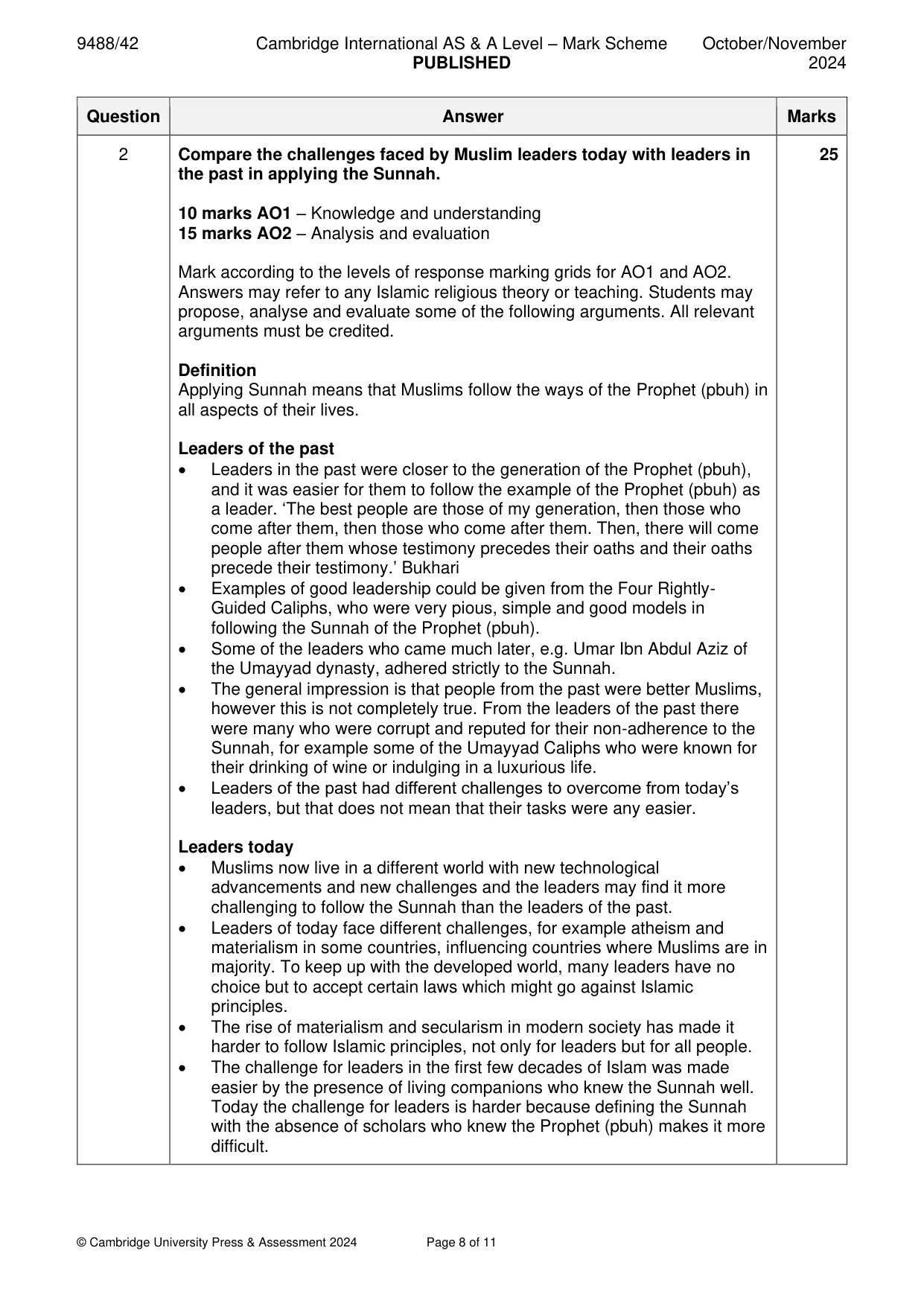
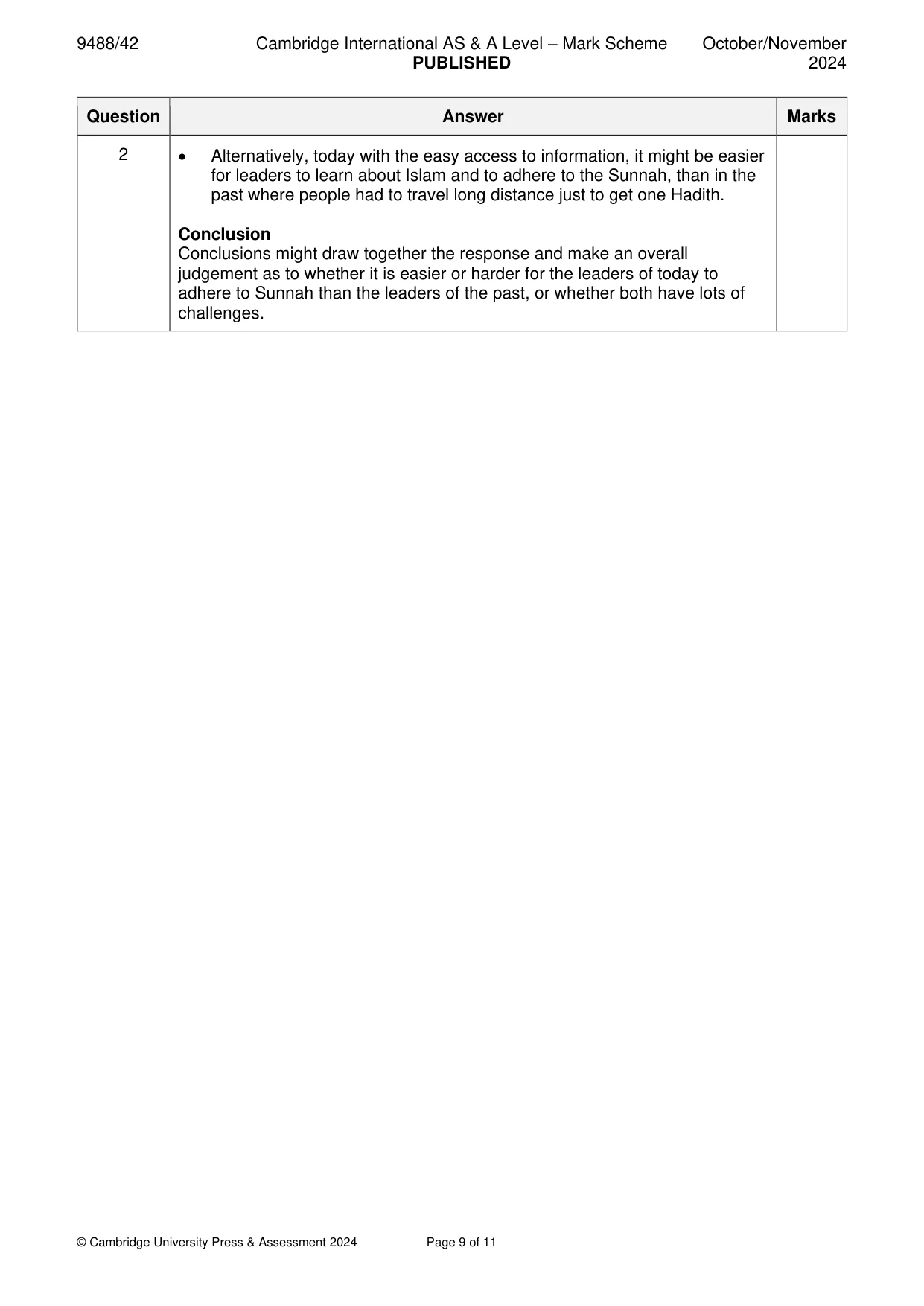
Mark scheme: 2 Compare the challenges faced by Muslim leaders today with leaders in 25 the past in applying the Sunnah. 10 marks AO1 – Knowledge and understanding 15 marks AO2 – Analysis and evaluation Mark according to the levels of response marking grids for AO1 and AO2. Answers may refer to any Islamic religious theory or teaching. Students may propose, analyse and evaluate some of the following arguments. All relevant arguments must be credited. Definition Applying Sunnah means that Muslims follow the ways of the Prophet (pbuh) in all aspects of their lives. Leaders of the past • Leaders in the past were closer to the generation of the Prophet (pbuh), and it was easier for them to follow the example of the Prophet (pbuh) as a leader. ‘The best people are those of my generation, then those who come after them, then those who come after them. Then, there will come people after them whose testimony precedes their oaths and their oaths precede their testimony.’ Bukhari • Examples of good leadership could be given from the Four Rightly- Guided Caliphs, who were very pious, simple and good models in following the Sunnah of the Prophet (pbuh). • Some of the leaders who came much later, e.g. Umar Ibn Abdul Aziz of the Umayyad dynasty, adhered strictly to the Sunnah. • The general impression is that people from the past were better Muslims, however this is not completely true. From the leaders of the past there were many who were corrupt and reputed for their non-adherence to the Sunnah, for example some of the Umayyad Caliphs who were known for their drinking of wine or indulging in a luxurious life. • Leaders of the past had different challenges to overcome from today’s leaders, but that does not mean that their tasks were any easier. Leaders today • Muslims now live in a different world with new technological advancements and new challenges and the leaders may find it more challenging to follow the Sunnah than the leaders of the past. • Leaders of today face different challenges, for example atheism and materialism in some countries, influencing countries where Muslims are in majority. To keep up with the developed world, many leaders have no choice but to accept certain laws which might go against Islamic principles. • The rise of materialism and secularism in modern society has made it harder to follow Islamic principles, not only for leaders but for all people. • The challenge for leaders in the first few decades of Islam was made easier by the presence of living companions who knew the Sunnah well. Today the challenge for leaders is harder because defining the Sunnah with the absence of scholars who knew the Prophet (pbuh) makes it more difficult. 2 • Alternatively, today with the easy access to information, it might be easier for leaders to learn about Islam and to adhere to the Sunnah, than in the past where people had to travel long distance just to get one Hadith. Conclusion Conclusions might draw together the response and make an overall judgement as to whether it is easier or harder for the leaders of today to adhere to Sunnah than the leaders of the past, or whether both have lots of challenges.
Q3 · Discuss the role of Muslims in a country where they are in a minority
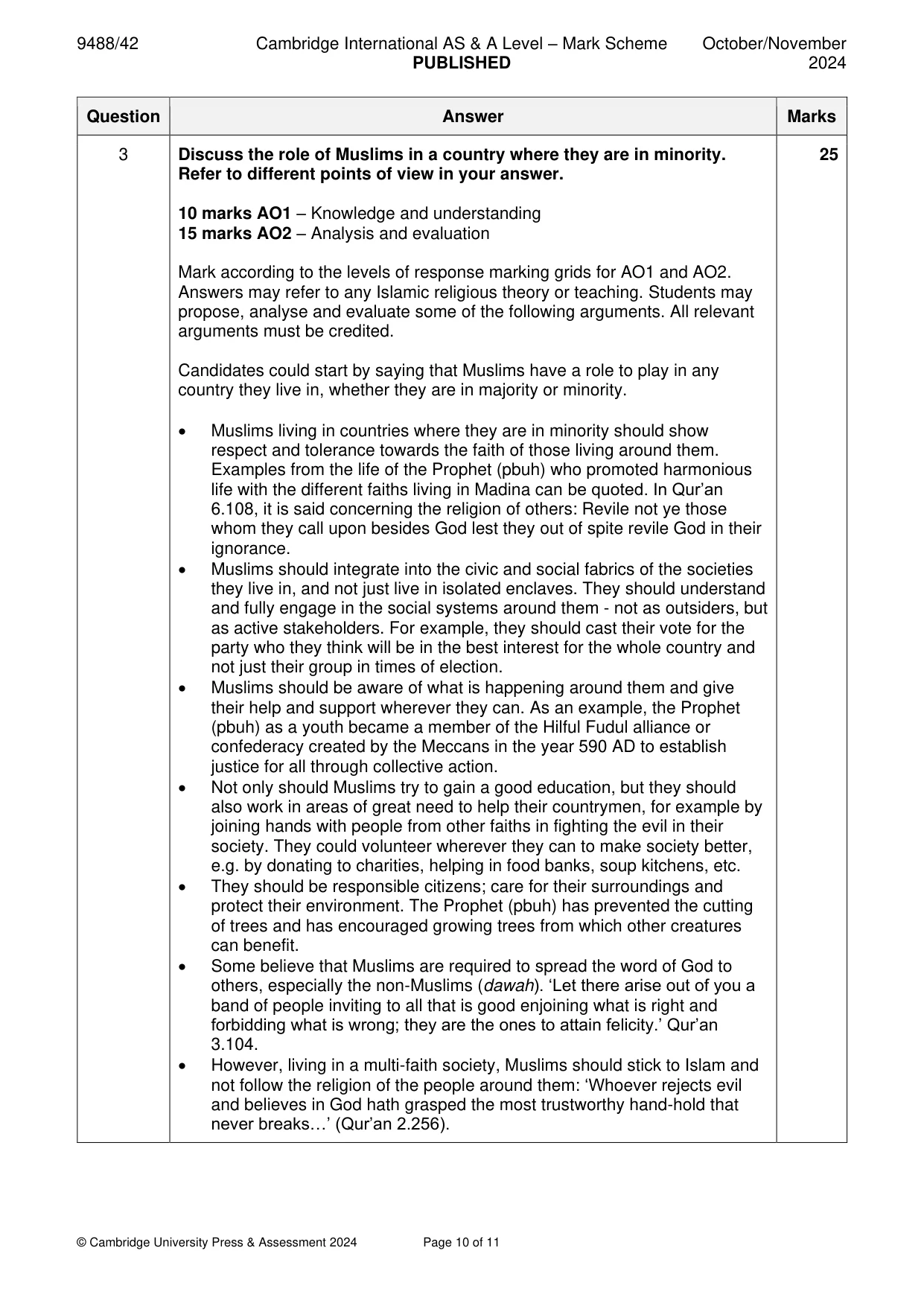
3 Discuss the role of Muslims in a country where they are in a minority. Refer to different points of view in your answer. [25]
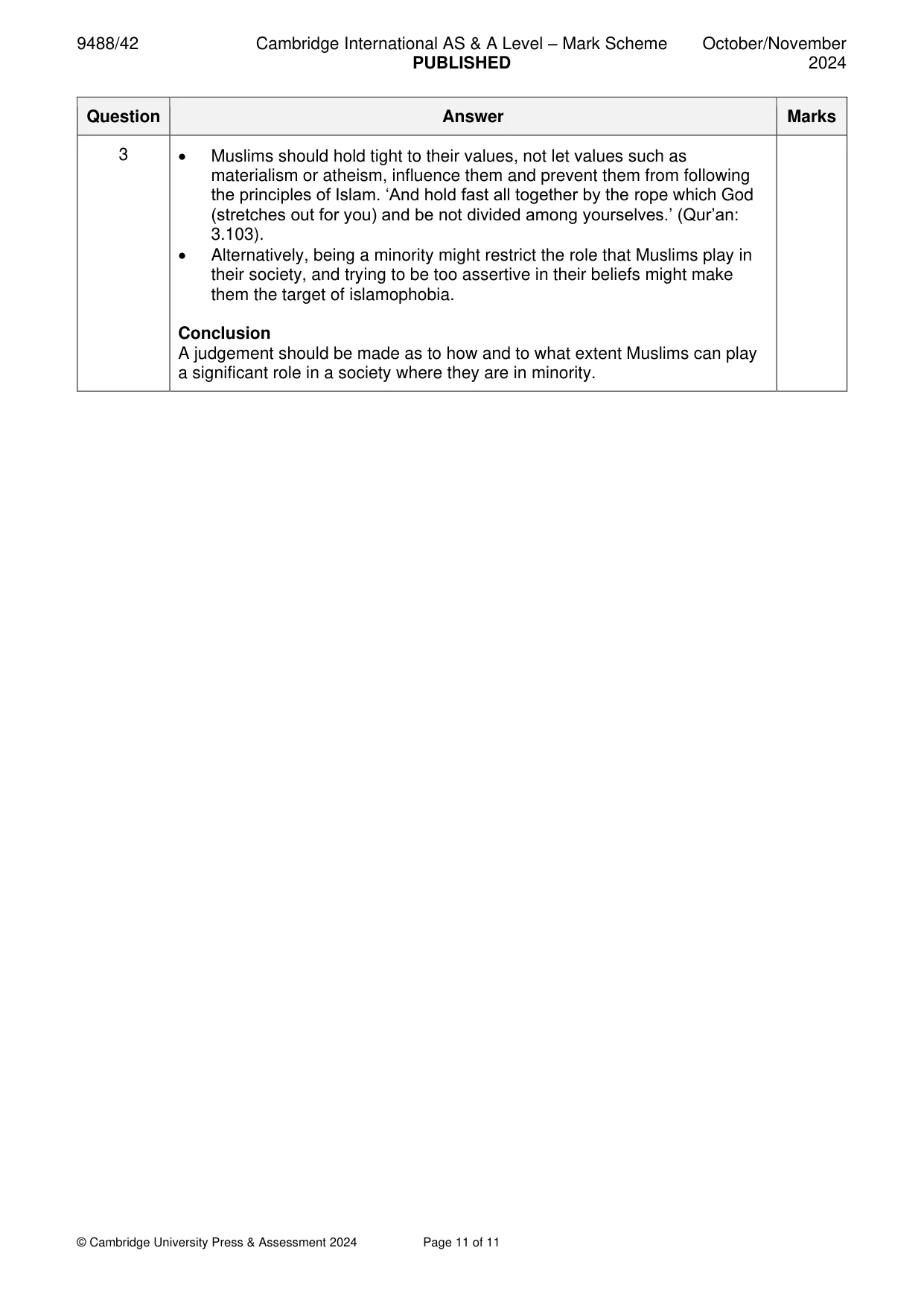
Mark scheme: 3 Discuss the role of Muslims in a country where they are in minority. 25 Refer to different points of view in your answer. 10 marks AO1 – Knowledge and understanding 15 marks AO2 – Analysis and evaluation Mark according to the levels of response marking grids for AO1 and AO2. Answers may refer to any Islamic religious theory or teaching. Students may propose, analyse and evaluate some of the following arguments. All relevant arguments must be credited. Candidates could start by saying that Muslims have a role to play in any country they live in, whether they are in majority or minority. • Muslims living in countries where they are in minority should show respect and tolerance towards the faith of those living around them. Examples from the life of the Prophet (pbuh) who promoted harmonious life with the different faiths living in Madina can be quoted. In Qur’an 6.108, it is said concerning the religion of others: Revile not ye those whom they call upon besides God lest they out of spite revile God in their ignorance. • Muslims should integrate into the civic and social fabrics of the societies they live in, and not just live in isolated enclaves. They should understand and fully engage in the social systems around them - not as outsiders, but as active stakeholders. For example, they should cast their vote for the party who they think will be in the best interest for the whole country and not just their group in times of election. • Muslims should be aware of what is happening around them and give their help and support wherever they can. As an example, the Prophet (pbuh) as a youth became a member of the Hilful Fudul alliance or confederacy created by the Meccans in the year 590 AD to establish justice for all through collective action. • Not only should Muslims try to gain a good education, but they should also work in areas of great need to help their countrymen, for example by joining hands with people from other faiths in fighting the evil in their society. They could volunteer wherever they can to make society better, e.g. by donating to charities, helping in food banks, soup kitchens, etc. • They should be responsible citizens; care for their surroundings and protect their environment. The Prophet (pbuh) has prevented the cutting of trees and has encouraged growing trees from which other creatures can benefit. • Some believe that Muslims are required to spread the word of God to others, especially the non-Muslims (dawah). ‘Let there arise out of you a band of people inviting to all that is good enjoining what is right and forbidding what is wrong; they are the ones to attain felicity.’ Qur’an 3.104. • However, living in a multi-faith society, Muslims should stick to Islam and not follow the religion of the people around them: ‘Whoever rejects evil and believes in God hath grasped the most trustworthy hand-hold that never breaks…’ (Qur’an 2.256). 3 • Muslims should hold tight to their values, not let values such as materialism or atheism, influence them and prevent them from following the principles of Islam. ‘And hold fast all together by the rope which God (stretches out for you) and be not divided among yourselves.’ (Qur’an: 3.103). • Alternatively, being a minority might restrict the role that Muslims play in their society, and trying to be too assertive in their beliefs might make them the target of islamophobia. Conclusion A judgement should be made as to how and to what extent Muslims can play a significant role in a society where they are in minority.
What was in this paper
The subtopics covered by these 3 questions, and how many questions each got. Open one in a new tab to see every Cambridge question on it.
What you needed in this session
Cambridge’s own grade thresholds for 2024 Oct/Nov, Paper 4 · Variant 2. A higher threshold means an easier paper — the bar moves with how the cohort did.