Cambridge A Level Islamic Studies 9488 — 2024 May/June Paper 4 · Variant 2
9488/42/M/J/24 · 3 questions · 50 marks · 90 min
The question paper and its mark scheme, free to read here and free to download. This is Cambridge’s own paper, exactly as it was sat.
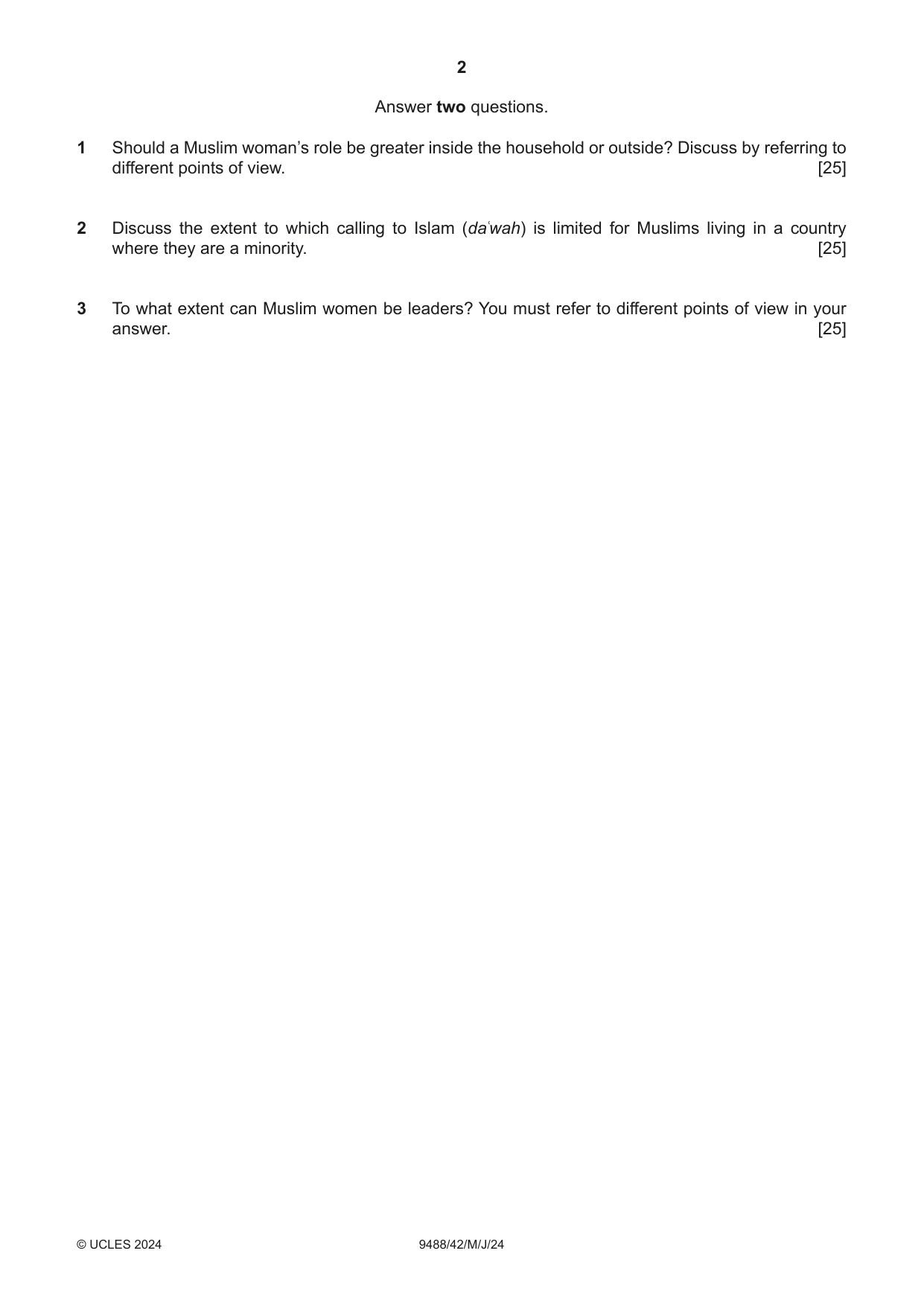
Question paper4 pages

Mark scheme12 pages
Answers below. Sit the paper first if you are practising.
Questions as text
Q1 · Should a Muslim woman’s role be greater inside the household or outside?
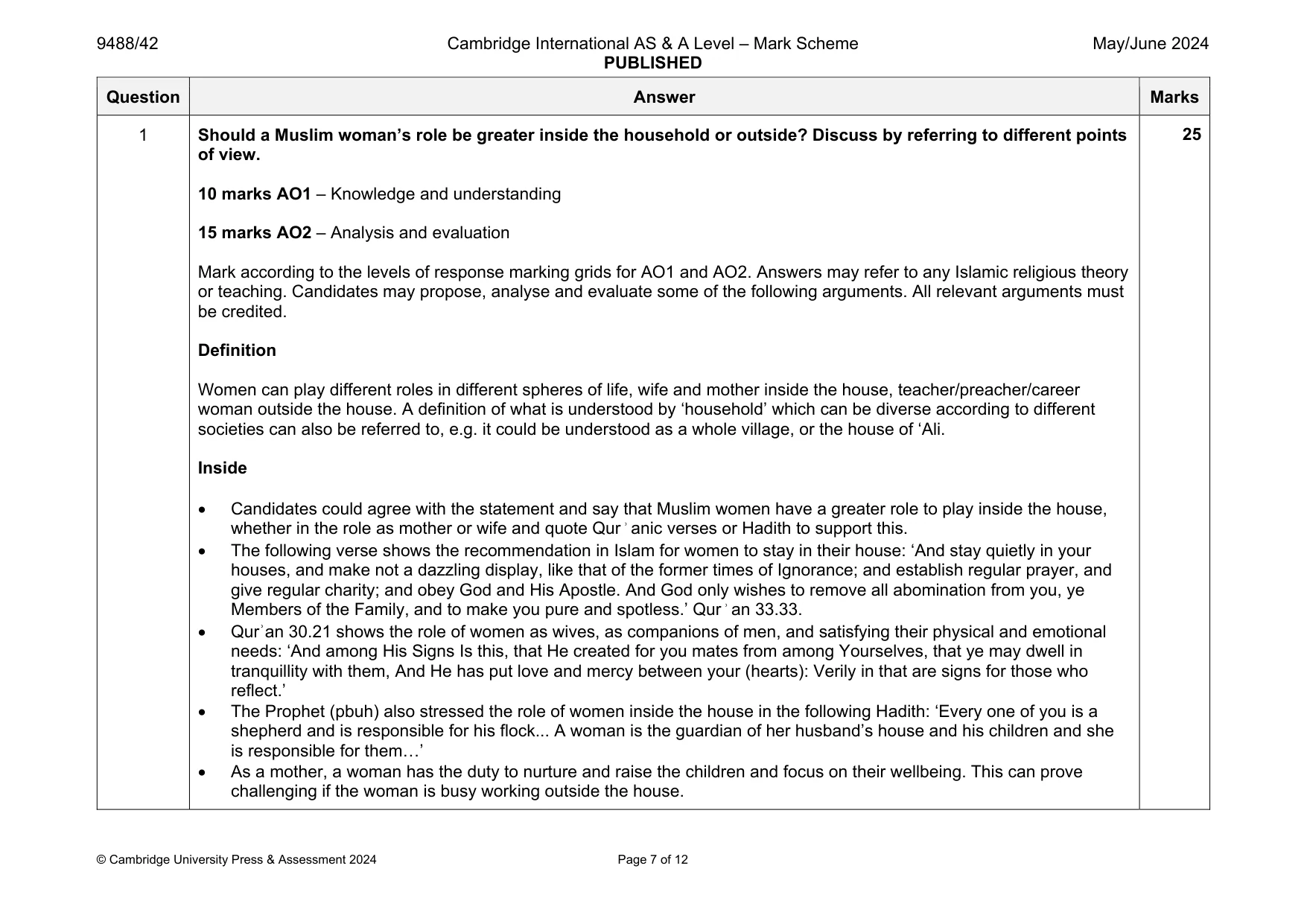
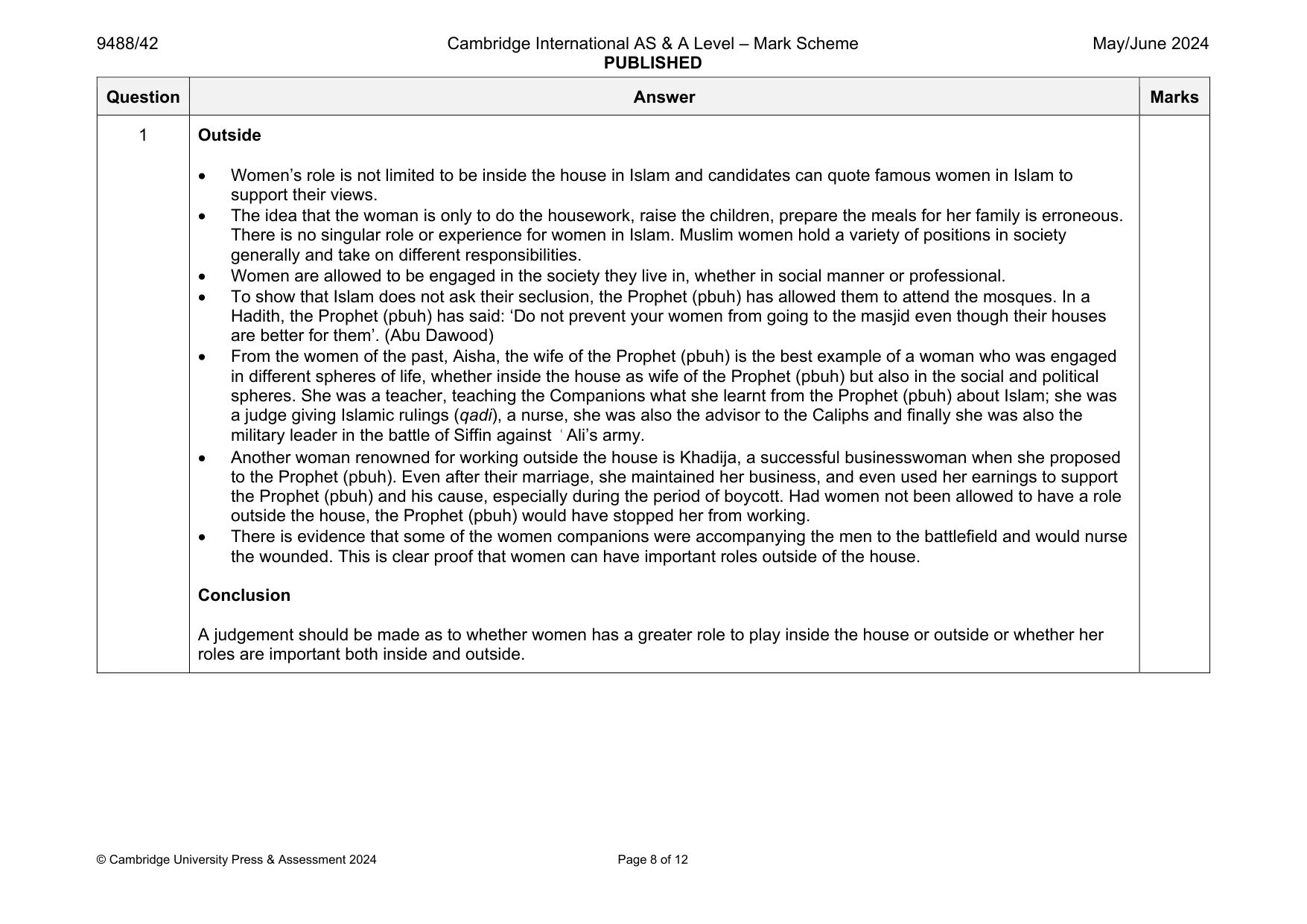
1 Should a Muslim woman’s role be greater inside the household or outside? Discuss by referring to different points of view. [25]
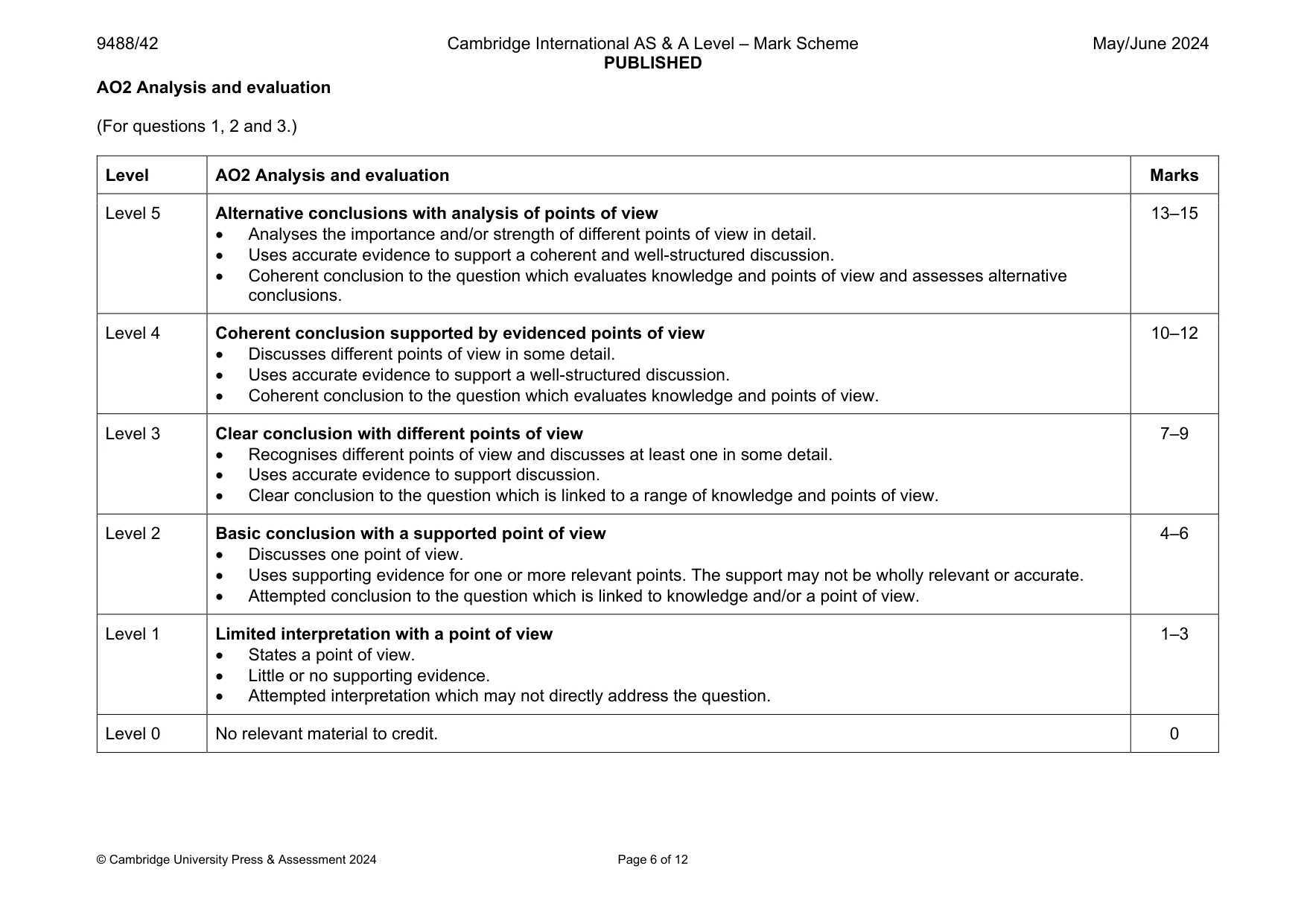
Mark scheme: 1 Should a Muslim woman’s role be greater inside the household or outside? Discuss by referring to different points of view. 10 marks AO1 – Knowledge and understanding 15 marks AO2 – Analysis and evaluation Mark according to the levels of response marking grids for AO1 and AO2. Answers may refer to any Islamic religious theory or teaching. Candidates may propose, analyse and evaluate some of the following arguments. All relevant arguments must be credited. Definition Women can play different roles in different spheres of life, wife and mother inside the house, teacher/preacher/career woman outside the house. A definition of what is understood by ‘household’ which can be diverse according to different societies can also be referred to, e.g. it could be understood as a whole village, or the house of ‘Ali. Inside Candidates could agree with the statement and say that Muslim women have a greater role to play inside the house, whether in the role as mother or wife and quote Qurʾanic verses or Hadith to support this. The following verse shows the recommendation in Islam for women to stay in their house: ‘And stay quietly in your houses, and make not a dazzling display, like that of the former times of Ignorance; and establish regular prayer, and give regular charity; and obey God and His Apostle. And God only wishes to remove all abomination from you, ye Members of the Family, and to make you pure and spotless.’ Qurʾan 33.33. Qurʾan 30.21 shows the role of women as wives, as companions of men, and satisfying their physical and emotional needs: ‘And among His Signs Is this, that He created for you mates from among Yourselves, that ye may dwell in tranquillity with them, And He has put love and mercy between your (hearts): Verily in that are signs for those who reflect.’ The Prophet (pbuh) also stressed the role of women inside the house in the following Hadith: ‘Every one of you is a shepherd and is responsible for his flock... A woman is the guardian of her husband’s house and his children and she is responsible for them…’ As a mother, a woman has the duty to nurture and raise the children and focus on their wellbeing. This can prove challenging if the woman is busy working outside the house. Question Answer Marks 1 Outside Women’s role is not limited to be inside the house in Islam and candidates can quote famous women in Islam to support their views. The idea that the woman is only to do the housework, raise the children, prepare the meals for her family is erroneous. There is no singular role or experience for women in Islam. Muslim women hold a variety of positions in society generally and take on different responsibilities. Women are allowed to be engaged in the society they live in, whether in social manner or professional. To show that Islam does not ask their seclusion, the Prophet (pbuh) has allowed them to attend the mosques. In a Hadith, the Prophet (pbuh) has said: ‘Do not prevent your women from going to the masjid even though their houses are better for them’. (Abu Dawood) From the women of the past, Aisha, the wife of the Prophet (pbuh) is the best example of a woman who was engaged in different spheres of life, whether inside the house as wife of the Prophet (pbuh) but also in the social and political spheres. She was a teacher, teaching the Companions what she learnt from the Prophet (pbuh) about Islam; she was a judge giving Islamic rulings (qadi), a nurse, she was also the advisor to the Caliphs and finally she was also the military leader in the battle of Siffin against ʿAli’s army. Another woman renowned for working outside the house is Khadija, a successful businesswoman when she proposed to the Prophet (pbuh). Even after their marriage, she maintained her business, and even used her earnings to support the Prophet (pbuh) and his cause, especially during the period of boycott. Had women not been allowed to have a role outside the house, the Prophet (pbuh) would have stopped her from working. There is evidence that some of the women companions were accompanying the men to the battlefield and would nurse the wounded. This is clear proof that women can have important roles outside of the house. Conclusion A judgement should be made as to whether women has a greater role to play inside the house or outside or whether her roles are important both inside and outside.
Q2 · Discuss the extent to which calling to Islam (da ͑wah) is limited for Muslims living in a…
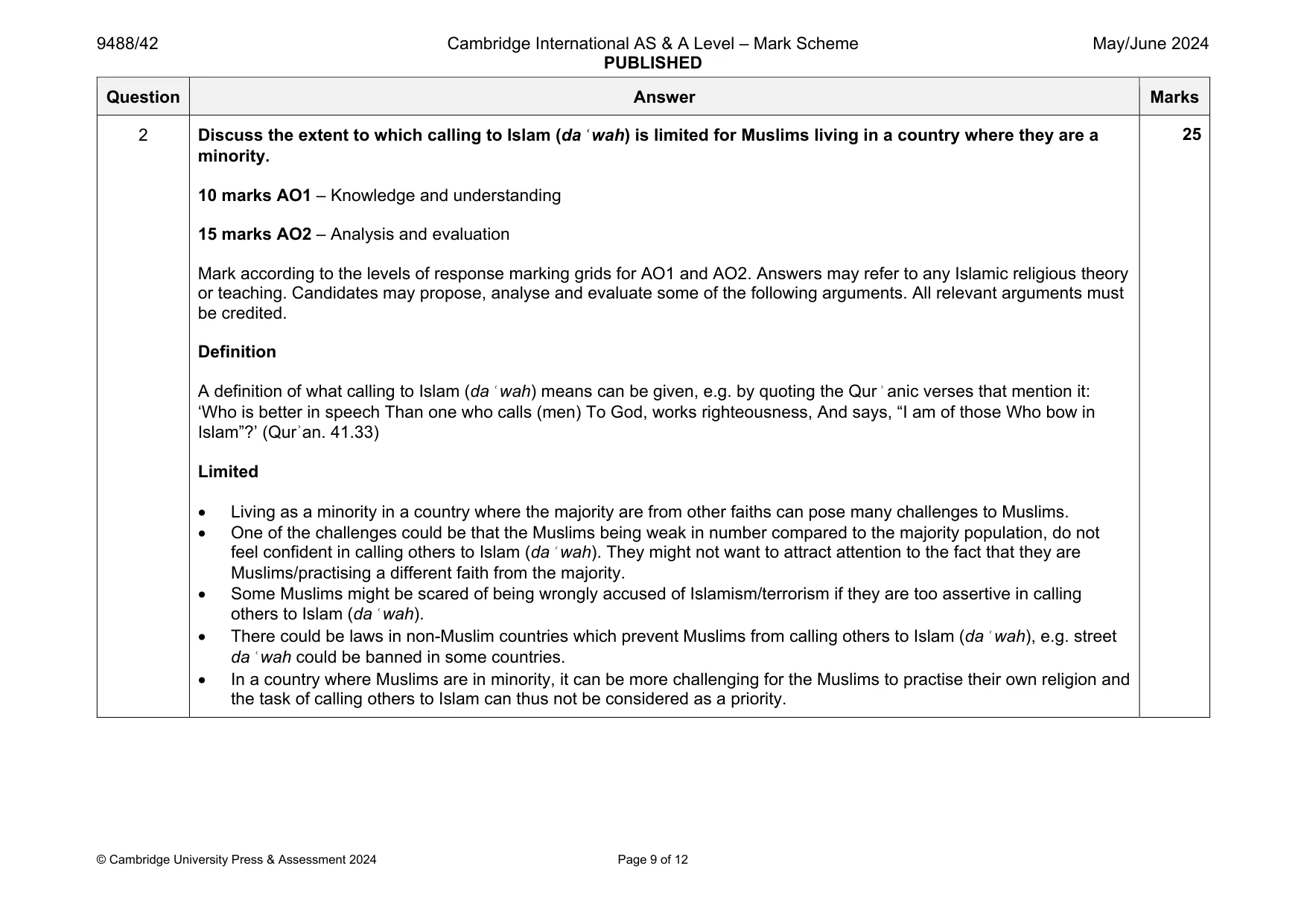
2 Discuss the extent to which calling to Islam (da ͑wah) is limited for Muslims living in a country where they are a minority. [25]
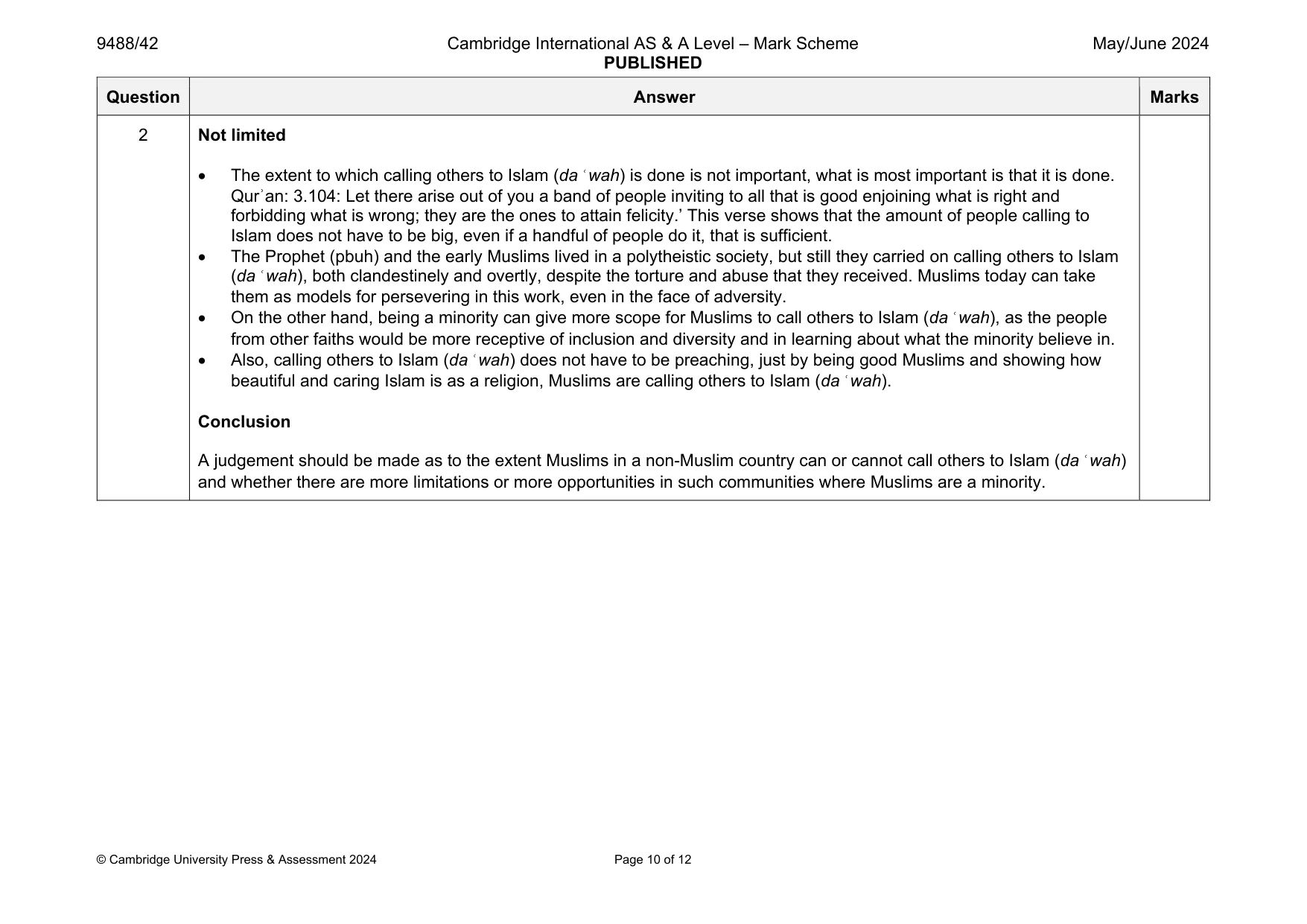
Mark scheme: 2 Discuss the extent to which calling to Islam (daʿwah) is limited for Muslims living in a country where they are a minority. 10 marks AO1 – Knowledge and understanding 15 marks AO2 – Analysis and evaluation Mark according to the levels of response marking grids for AO1 and AO2. Answers may refer to any Islamic religious theory or teaching. Candidates may propose, analyse and evaluate some of the following arguments. All relevant arguments must be credited. Definition A definition of what calling to Islam (daʿwah) means can be given, e.g. by quoting the Qurʾanic verses that mention it: ‘Who is better in speech Than one who calls (men) To God, works righteousness, And says, “I am of those Who bow in Islam”?’ (Qurʾan. 41.33) Limited Living as a minority in a country where the majority are from other faiths can pose many challenges to Muslims. One of the challenges could be that the Muslims being weak in number compared to the majority population, do not feel confident in calling others to Islam (daʿwah). They might not want to attract attention to the fact that they are Muslims/practising a different faith from the majority. Some Muslims might be scared of being wrongly accused of Islamism/terrorism if they are too assertive in calling others to Islam (daʿwah). There could be laws in non-Muslim countries which prevent Muslims from calling others to Islam (daʿwah), e.g. street daʿwah could be banned in some countries. In a country where Muslims are in minority, it can be more challenging for the Muslims to practise their own religion and the task of calling others to Islam can thus not be considered as a priority. Question Answer Marks 2 Not limited The extent to which calling others to Islam (daʿwah) is done is not important, what is most important is that it is done. Qurʾan: 3.104: Let there arise out of you a band of people inviting to all that is good enjoining what is right and forbidding what is wrong; they are the ones to attain felicity.’ This verse shows that the amount of people calling to Islam does not have to be big, even if a handful of people do it, that is sufficient. The Prophet (pbuh) and the early Muslims lived in a polytheistic society, but still they carried on calling others to Islam (daʿwah), both clandestinely and overtly, despite the torture and abuse that they received. Muslims today can take them as models for persevering in this work, even in the face of adversity. On the other hand, being a minority can give more scope for Muslims to call others to Islam (daʿwah), as the people from other faiths would be more receptive of inclusion and diversity and in learning about what the minority believe in. Also, calling others to Islam (daʿwah) does not have to be preaching, just by being good Muslims and showing how beautiful and caring Islam is as a religion, Muslims are calling others to Islam (daʿwah). Conclusion A judgement should be made as to the extent Muslims in a non-Muslim country can or cannot call others to Islam (daʿwah) and whether there are more limitations or more opportunities in such communities where Muslims are a minority.
Q3 · To what extent can Muslim women be leaders?
3 To what extent can Muslim women be leaders? You must refer to different points of view in your answer. [25]
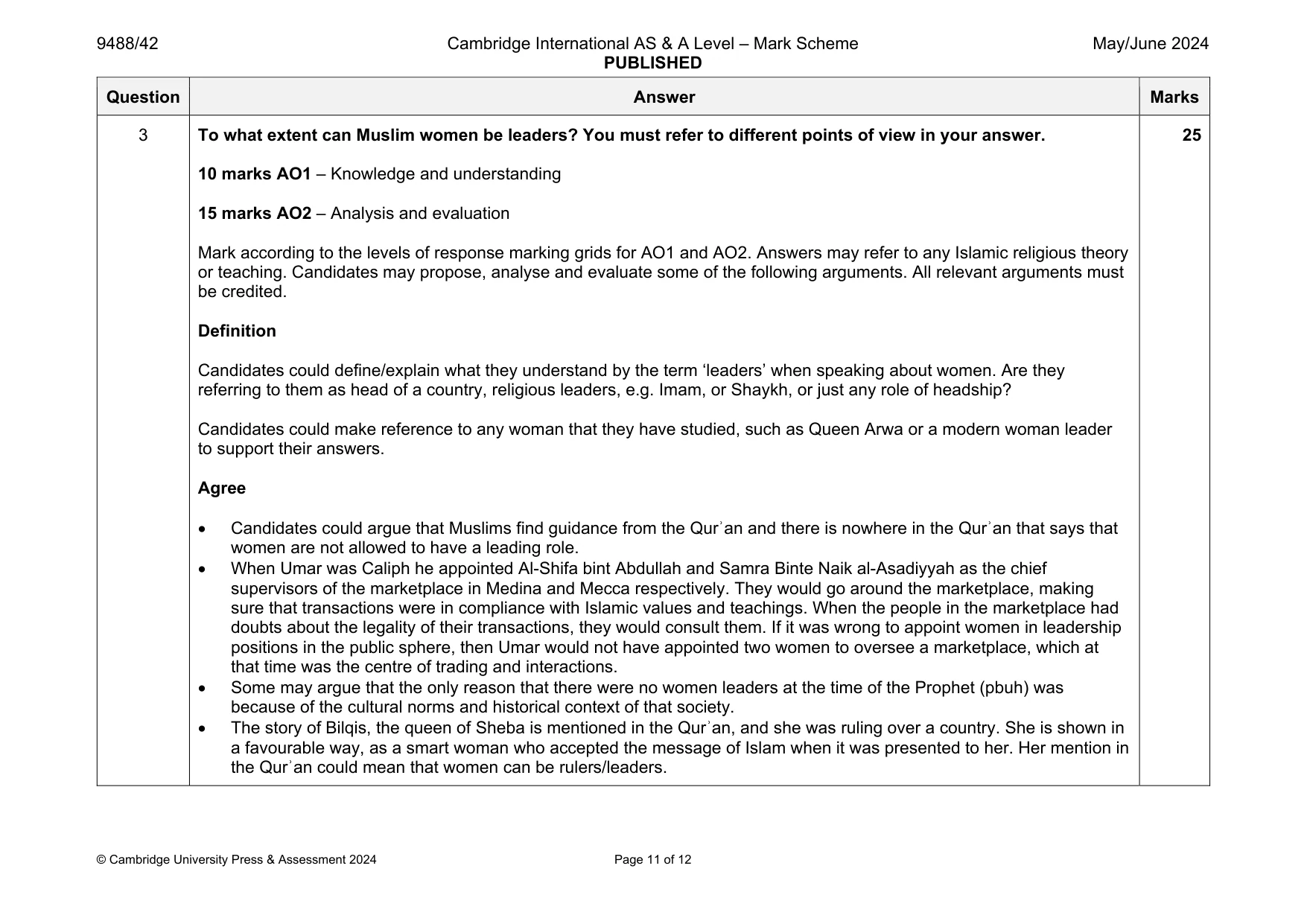
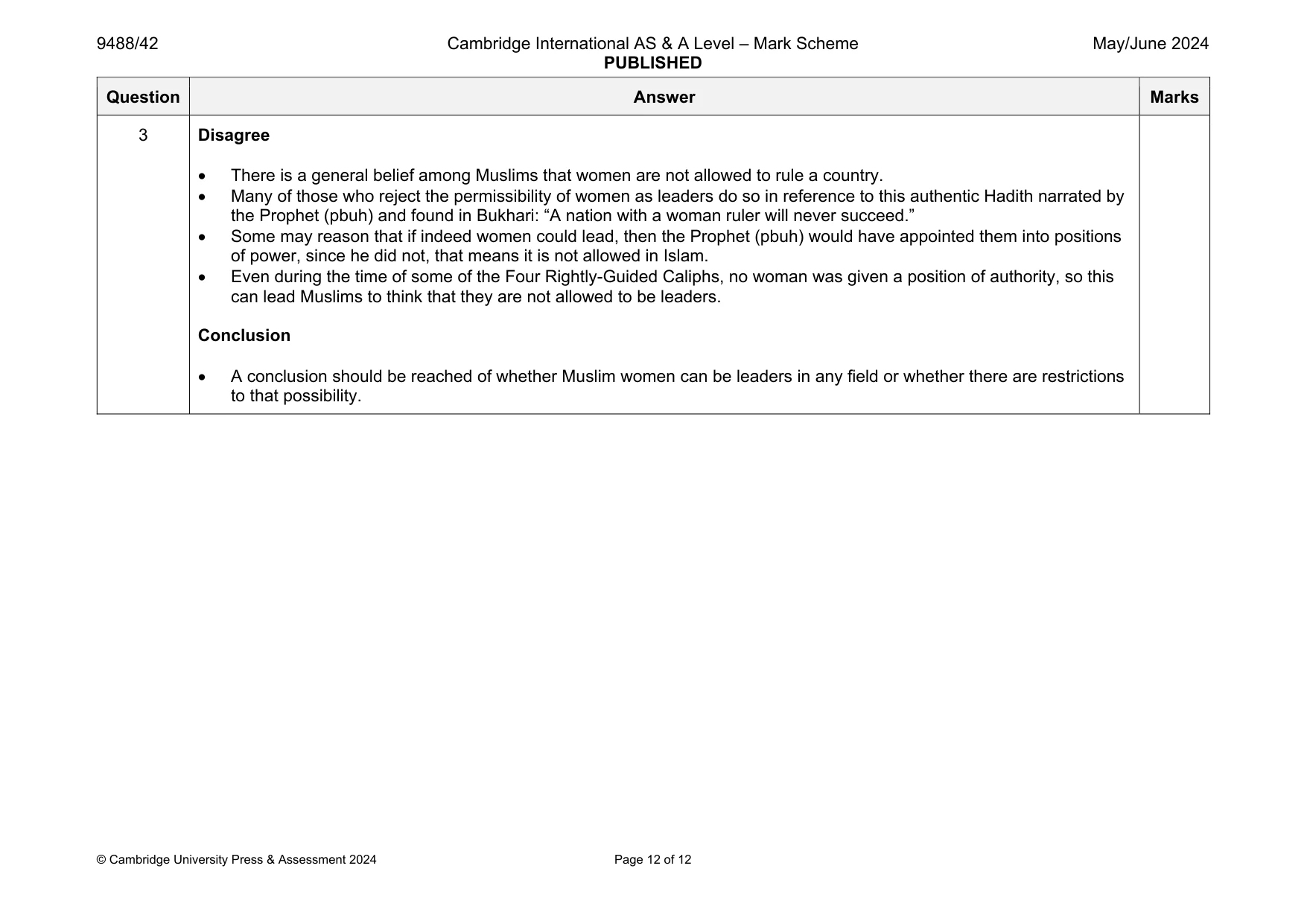
Mark scheme: 3 To what extent can Muslim women be leaders? You must refer to different points of view in your answer. 10 marks AO1 – Knowledge and understanding 15 marks AO2 – Analysis and evaluation Mark according to the levels of response marking grids for AO1 and AO2. Answers may refer to any Islamic religious theory or teaching. Candidates may propose, analyse and evaluate some of the following arguments. All relevant arguments must be credited. Definition Candidates could define/explain what they understand by the term ‘leaders’ when speaking about women. Are they referring to them as head of a country, religious leaders, e.g. Imam, or Shaykh, or just any role of headship? Candidates could make reference to any woman that they have studied, such as Queen Arwa or a modern woman leader to support their answers. Agree Candidates could argue that Muslims find guidance from the Qurʾan and there is nowhere in the Qurʾan that says that women are not allowed to have a leading role. When Umar was Caliph he appointed Al-Shifa bint Abdullah and Samra Binte Naik al-Asadiyyah as the chief supervisors of the marketplace in Medina and Mecca respectively. They would go around the marketplace, making sure that transactions were in compliance with Islamic values and teachings. When the people in the marketplace had doubts about the legality of their transactions, they would consult them. If it was wrong to appoint women in leadership positions in the public sphere, then Umar would not have appointed two women to oversee a marketplace, which at that time was the centre of trading and interactions. Some may argue that the only reason that there were no women leaders at the time of the Prophet (pbuh) was because of the cultural norms and historical context of that society. The story of Bilqis, the queen of Sheba is mentioned in the Qurʾan, and she was ruling over a country. She is shown in a favourable way, as a smart woman who accepted the message of Islam when it was presented to her. Her mention in the Qurʾan could mean that women can be rulers/leaders. 25 Question Answer Marks 3 Disagree There is a general belief among Muslims that women are not allowed to rule a country. Many of those who reject the permissibility of women as leaders do so in reference to this authentic Hadith narrated by the Prophet (pbuh) and found in Bukhari: “A nation with a woman ruler will never succeed.” Some may reason that if indeed women could lead, then the Prophet (pbuh) would have appointed them into positions of power, since he did not, that means it is not allowed in Islam. Even during the time of some of the Four Rightly-Guided Caliphs, no woman was given a position of authority, so this can lead Muslims to think that they are not allowed to be leaders. Conclusion A conclusion should be reached of whether Muslim women can be leaders in any field or whether there are restrictions to that possibility.
What was in this paper
The subtopics covered by these 3 questions, and how many questions each got. Open one in a new tab to see every Cambridge question on it.
What you needed in this session
Cambridge’s own grade thresholds for 2024 May/June, Paper 4 · Variant 2. A higher threshold means an easier paper — the bar moves with how the cohort did.