Cambridge A Level Islamic Studies 9488 — 2025 May/June Paper 3 · Variant 2
9488/32/M/J/25 · 4 questions · 50 marks · 90 min
The question paper and its mark scheme, free to read here and free to download. This is Cambridge’s own paper, exactly as it was sat.
Question paper4 pages
Mark scheme14 pages
Answers below. Sit the paper first if you are practising.
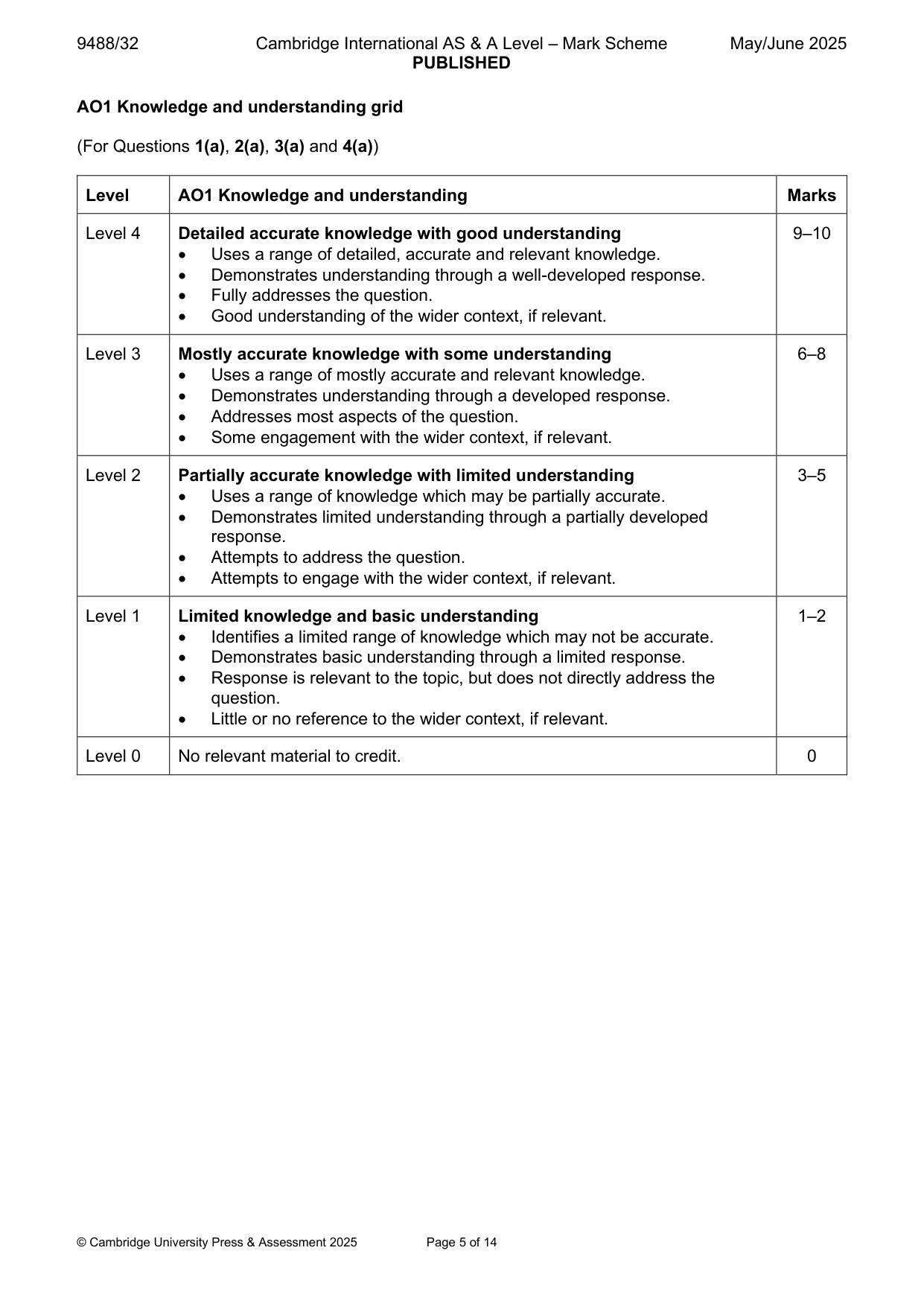
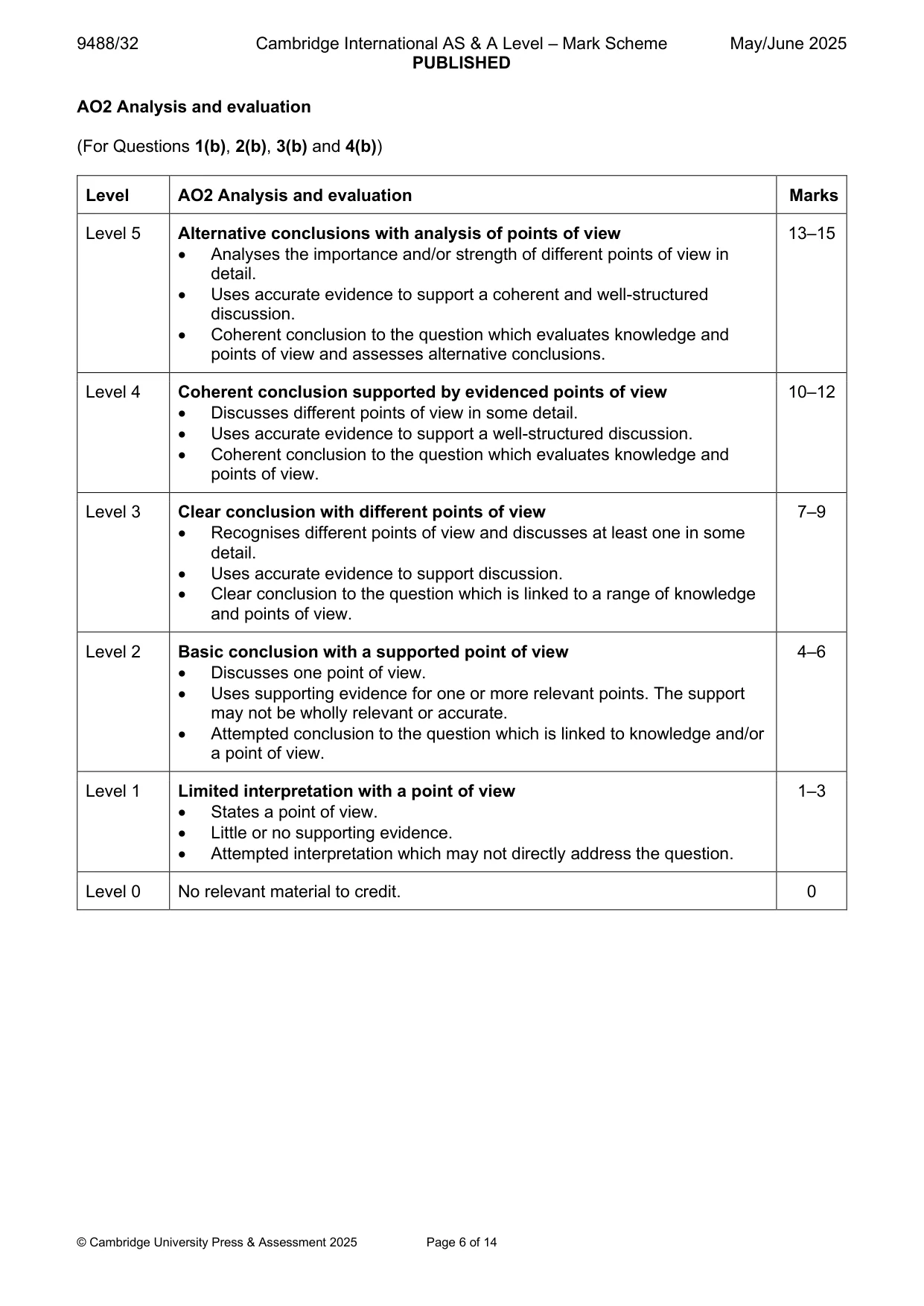
Questions as text
Question 1
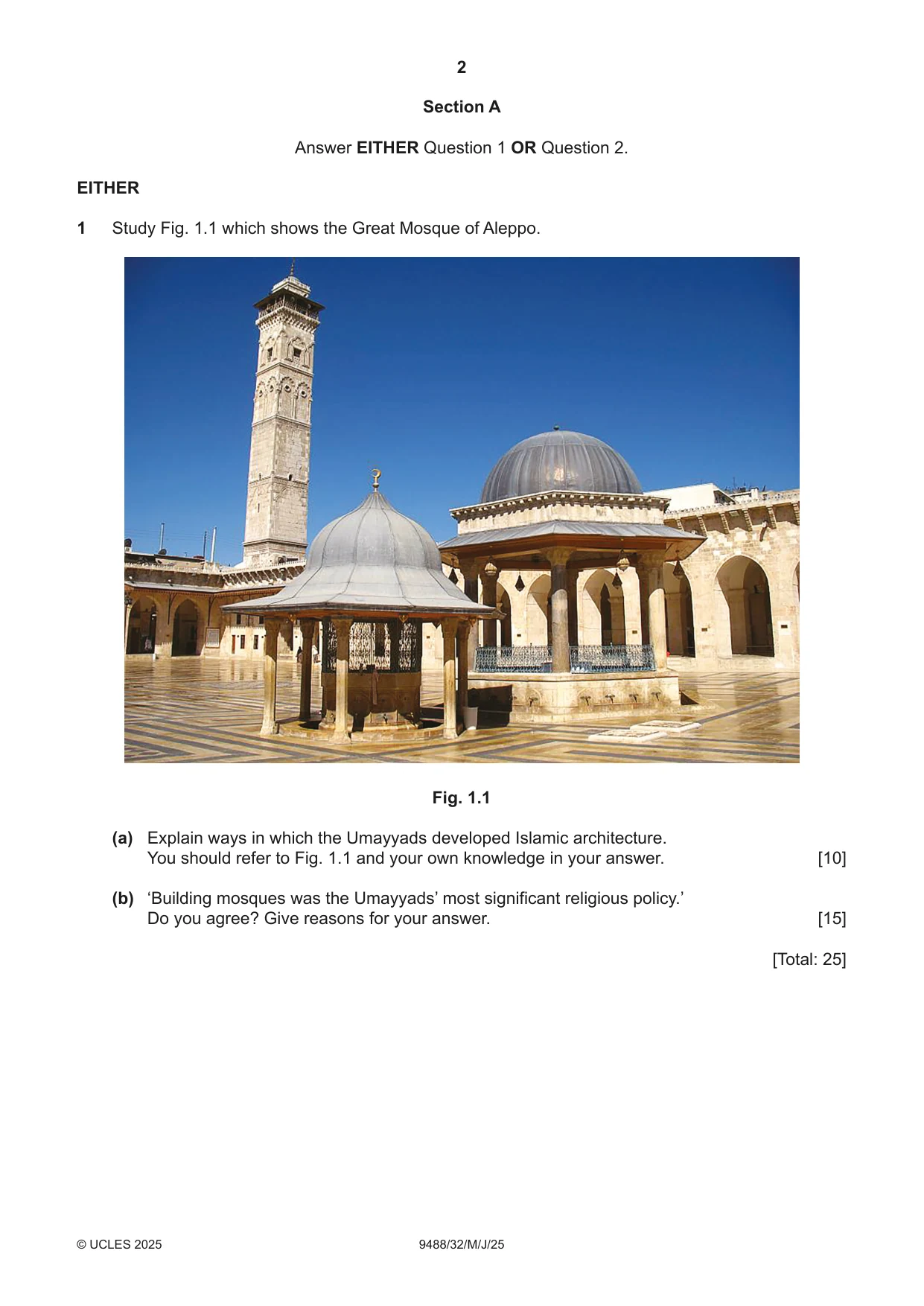
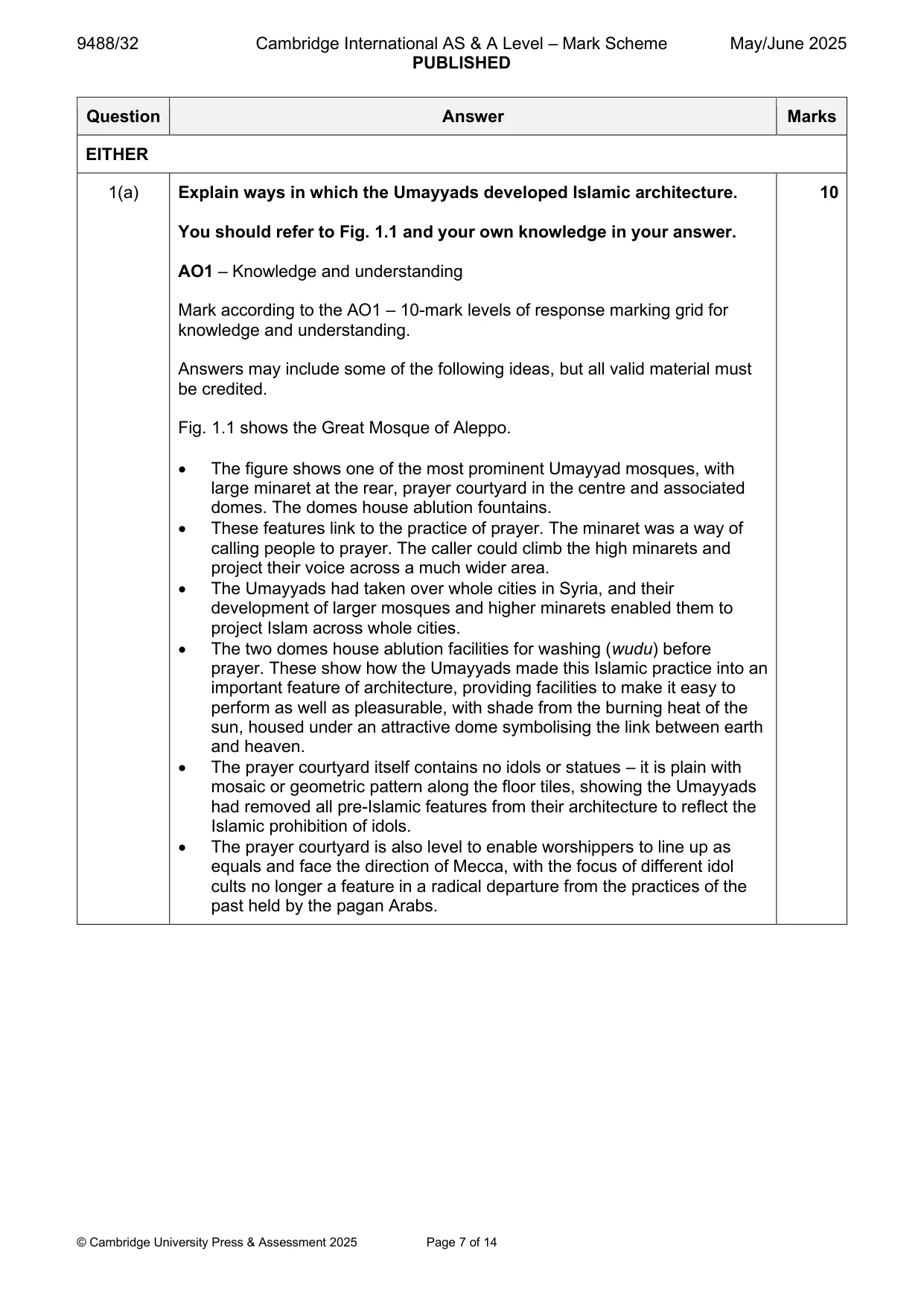
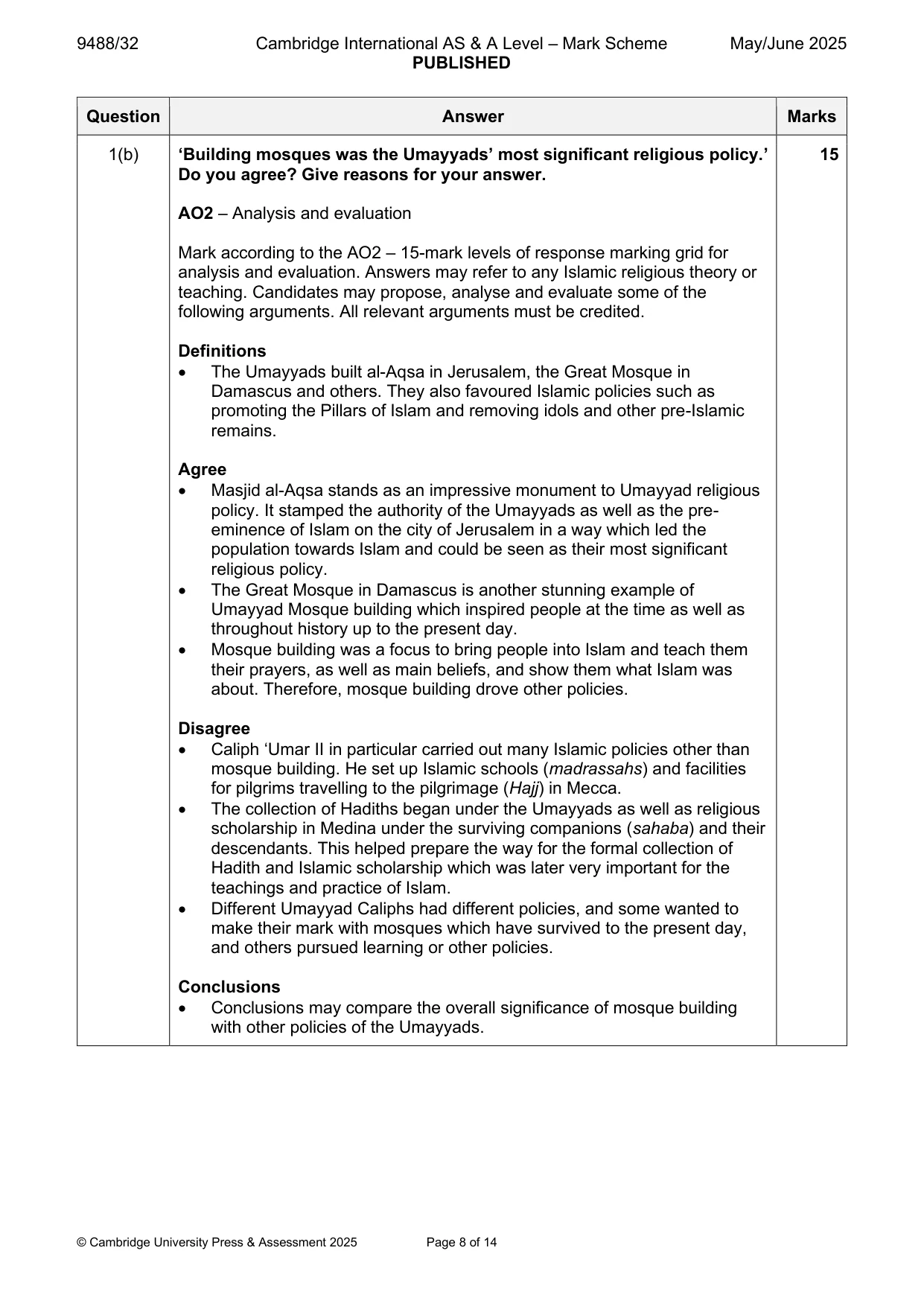
1 Study Fig. 1.1 which shows the Great Mosque of Aleppo. Fig. 1.1 (a) Explain ways in which the Umayyads developed Islamic architecture. You should refer to Fig. 1.1 and your own knowledge in your answer. [10] (b) ‘Building mosques was the Umayyads’ most significant religious policy.’ Do you agree? Give reasons for your answer. [15] [Total: 25] OR
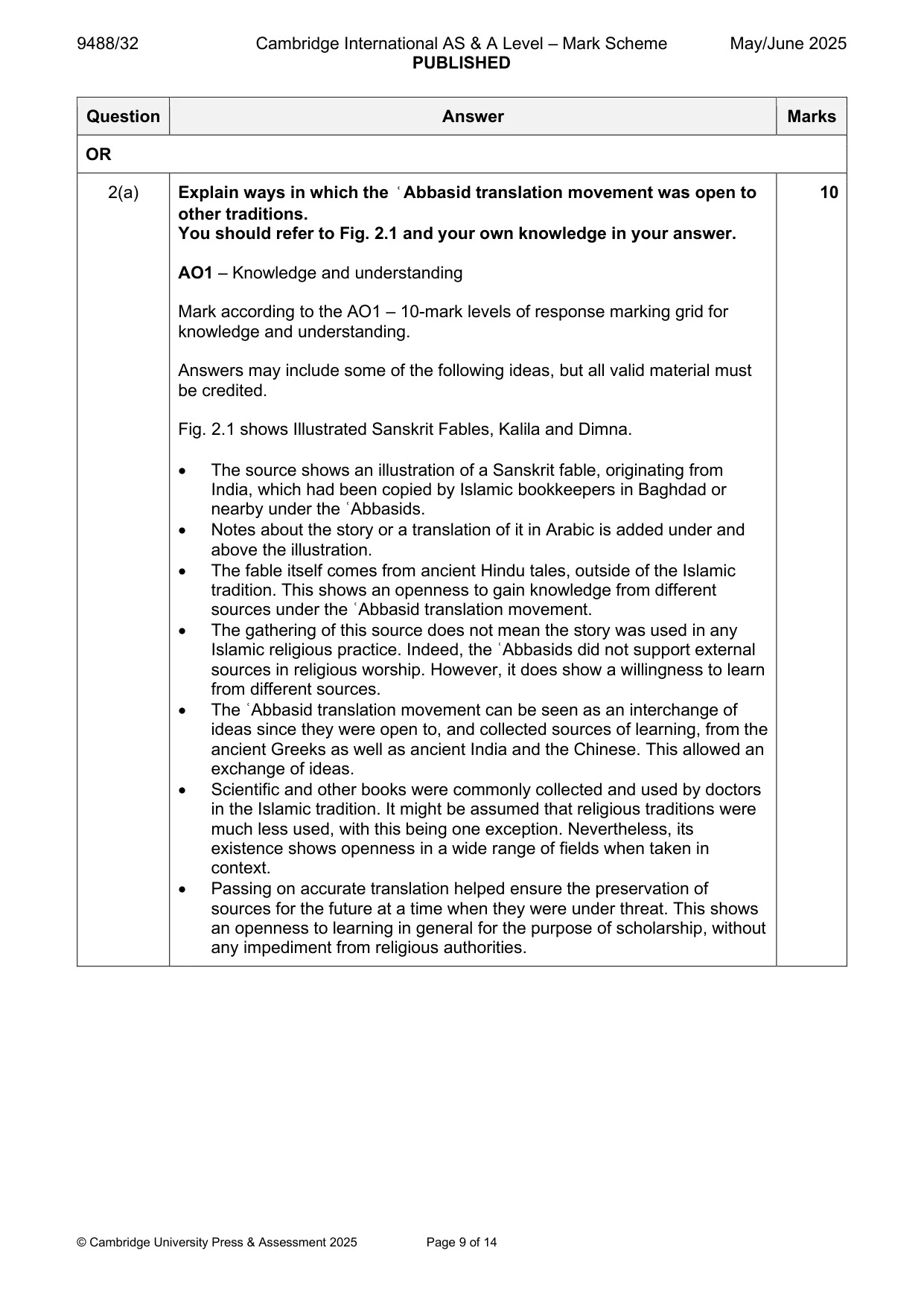
Mark scheme: Question Answer Marks EITHER 1(a) Explain ways in which the Umayyads developed Islamic architecture. 10 You should refer to Fig. 1.1 and your own knowledge in your answer. AO1 – Knowledge and understanding Mark according to the AO1 – 10-mark levels of response marking grid for knowledge and understanding. Answers may include some of the following ideas, but all valid material must be credited. Fig. 1.1 shows the Great Mosque of Aleppo. • The figure shows one of the most prominent Umayyad mosques, with large minaret at the rear, prayer courtyard in the centre and associated domes. The domes house ablution fountains. • These features link to the practice of prayer. The minaret was a way of calling people to prayer. The caller could climb the high minarets and project their voice across a much wider area. • The Umayyads had taken over whole cities in Syria, and their development of larger mosques and higher minarets enabled them to project Islam across whole cities. • The two domes house ablution facilities for washing (wudu) before prayer. These show how the Umayyads made this Islamic practice into an important feature of architecture, providing facilities to make it easy to perform as well as pleasurable, with shade from the burning heat of the sun, housed under an attractive dome symbolising the link between earth and heaven. • The prayer courtyard itself contains no idols or statues – it is plain with mosaic or geometric pattern along the floor tiles, showing the Umayyads had removed all pre-Islamic features from their architecture to reflect the Islamic prohibition of idols. • The prayer courtyard is also level to enable worshippers to line up as equals and face the direction of Mecca, with the focus of different idol cults no longer a feature in a radical departure from the practices of the past held by the pagan Arabs. 1(b) ‘Building mosques was the Umayyads’ most significant religious policy.’ 15 Do you agree? Give reasons for your answer. AO2 – Analysis and evaluation Mark according to the AO2 – 15-mark levels of response marking grid for analysis and evaluation. Answers may refer to any Islamic religious theory or teaching. Candidates may propose, analyse and evaluate some of the following arguments. All relevant arguments must be credited. Definitions • The Umayyads built al-Aqsa in Jerusalem, the Great Mosque in Damascus and others. They also favoured Islamic policies such as promoting the Pillars of Islam and removing idols and other pre-Islamic remains. Agree • Masjid al-Aqsa stands as an impressive monument to Umayyad religious policy. It stamped the authority of the Umayyads as well as the pre- eminence of Islam on the city of Jerusalem in a way which led the population towards Islam and could be seen as their most significant religious policy. • The Great Mosque in Damascus is another stunning example of Umayyad Mosque building which inspired people at the time as well as throughout history up to the present day. • Mosque building was a focus to bring people into Islam and teach them their prayers, as well as main beliefs, and show them what Islam was about. Therefore, mosque building drove other policies. Disagree • Caliph ‘Umar II in particular carried out many Islamic policies other than mosque building. He set up Islamic schools (madrassahs) and facilities for pilgrims travelling to the pilgrimage (Hajj) in Mecca. • The collection of Hadiths began under the Umayyads as well as religious scholarship in Medina under the surviving companions (sahaba) and their descendants. This helped prepare the way for the formal collection of Hadith and Islamic scholarship which was later very important for the teachings and practice of Islam. • Different Umayyad Caliphs had different policies, and some wanted to make their mark with mosques which have survived to the present day, and others pursued learning or other policies. Conclusions • Conclusions may compare the overall significance of mosque building with other policies of the Umayyads.
Question 2
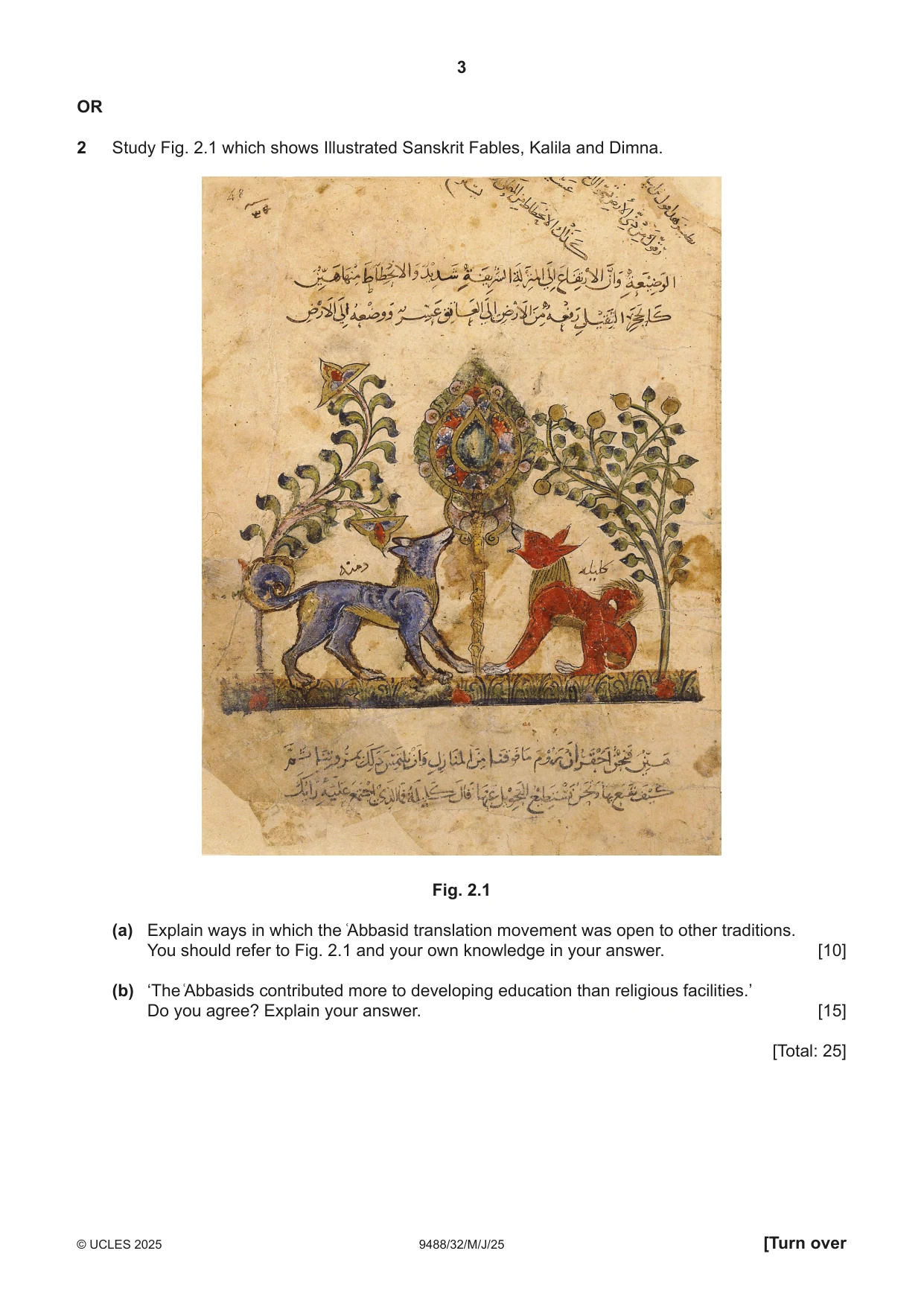
2 Study Fig. 2.1 which shows Illustrated Sanskrit Fables, Kalila and Dimna. Fig. 2.1 (a) Explain ways in which the ͑Abbasid translation movement was open to other traditions. You should refer to Fig. 2.1 and your own knowledge in your answer. [10] (b) ‘The ͑Abbasids contributed more to developing education than religious facilities.’ Do you agree? Explain your answer. [15] [Total: 25]
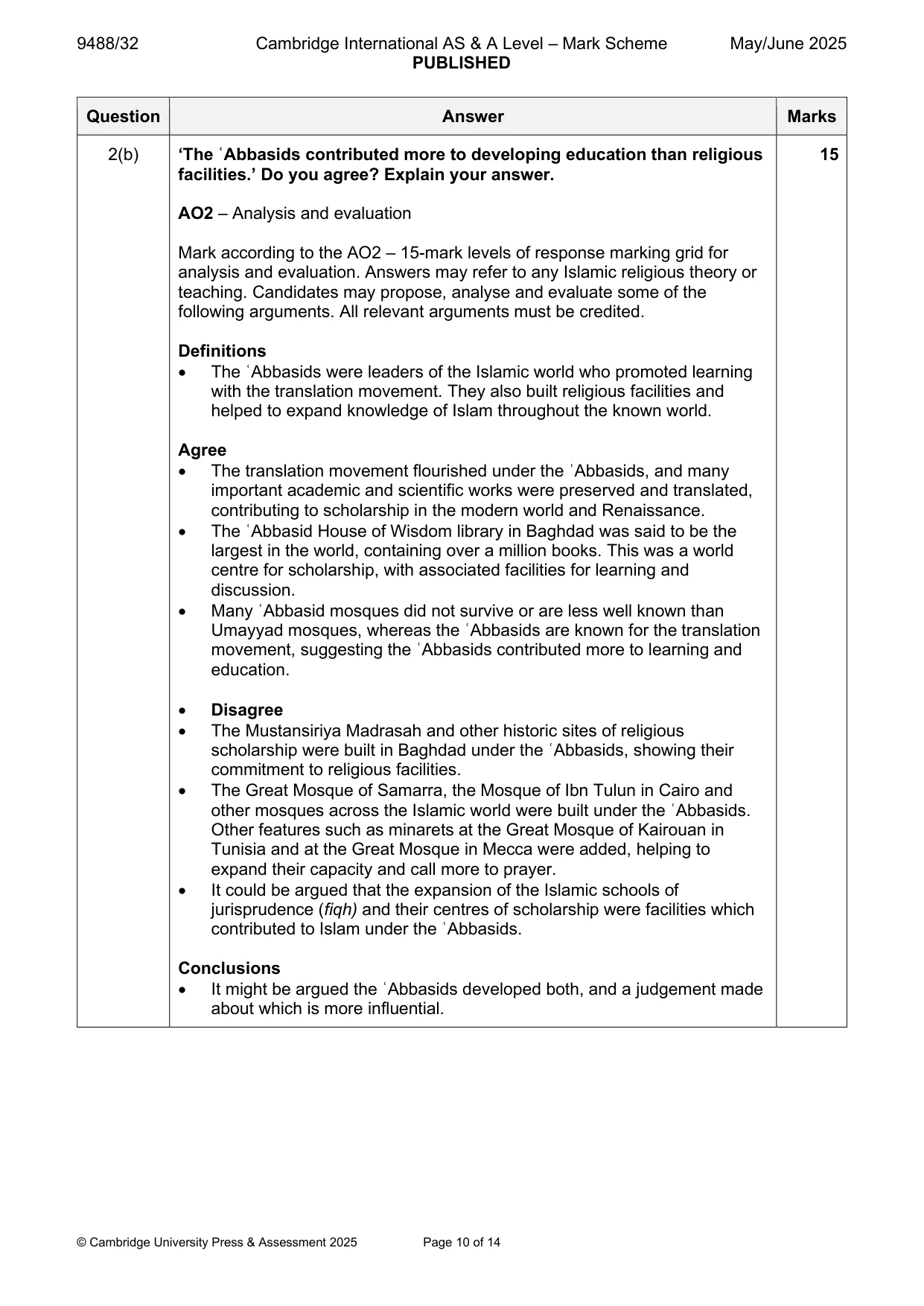
Mark scheme: 2(a) Explain ways in which the ʿAbbasid translation movement was open to 10 other traditions. You should refer to Fig. 2.1 and your own knowledge in your answer. AO1 – Knowledge and understanding Mark according to the AO1 – 10-mark levels of response marking grid for knowledge and understanding. Answers may include some of the following ideas, but all valid material must be credited. Fig. 2.1 shows Illustrated Sanskrit Fables, Kalila and Dimna. • The source shows an illustration of a Sanskrit fable, originating from India, which had been copied by Islamic bookkeepers in Baghdad or nearby under the ʿAbbasids. • Notes about the story or a translation of it in Arabic is added under and above the illustration. • The fable itself comes from ancient Hindu tales, outside of the Islamic tradition. This shows an openness to gain knowledge from different sources under the ʿAbbasid translation movement. • The gathering of this source does not mean the story was used in any Islamic religious practice. Indeed, the ʿAbbasids did not support external sources in religious worship. However, it does show a willingness to learn from different sources. • The ʿAbbasid translation movement can be seen as an interchange of ideas since they were open to, and collected sources of learning, from the ancient Greeks as well as ancient India and the Chinese. This allowed an exchange of ideas. • Scientific and other books were commonly collected and used by doctors in the Islamic tradition. It might be assumed that religious traditions were much less used, with this being one exception. Nevertheless, its existence shows openness in a wide range of fields when taken in context. • Passing on accurate translation helped ensure the preservation of sources for the future at a time when they were under threat. This shows an openness to learning in general for the purpose of scholarship, without any impediment from religious authorities. 2(b) ‘The ʿAbbasids contributed more to developing education than religious 15 facilities.’ Do you agree? Explain your answer. AO2 – Analysis and evaluation Mark according to the AO2 – 15-mark levels of response marking grid for analysis and evaluation. Answers may refer to any Islamic religious theory or teaching. Candidates may propose, analyse and evaluate some of the following arguments. All relevant arguments must be credited. Definitions • The ʿAbbasids were leaders of the Islamic world who promoted learning with the translation movement. They also built religious facilities and helped to expand knowledge of Islam throughout the known world. Agree • The translation movement flourished under the ʿAbbasids, and many important academic and scientific works were preserved and translated, contributing to scholarship in the modern world and Renaissance. • The ʿAbbasid House of Wisdom library in Baghdad was said to be the largest in the world, containing over a million books. This was a world centre for scholarship, with associated facilities for learning and discussion. • Many ʿAbbasid mosques did not survive or are less well known than Umayyad mosques, whereas the ʿAbbasids are known for the translation movement, suggesting the ʿAbbasids contributed more to learning and education. • Disagree • The Mustansiriya Madrasah and other historic sites of religious scholarship were built in Baghdad under the ʿAbbasids, showing their commitment to religious facilities. • The Great Mosque of Samarra, the Mosque of Ibn Tulun in Cairo and other mosques across the Islamic world were built under the ʿAbbasids. Other features such as minarets at the Great Mosque of Kairouan in Tunisia and at the Great Mosque in Mecca were added, helping to expand their capacity and call more to prayer. • It could be argued that the expansion of the Islamic schools of jurisprudence (fiqh) and their centres of scholarship were facilities which contributed to Islam under the ʿAbbasids. Conclusions • It might be argued the ʿAbbasids developed both, and a judgement made about which is more influential.
Q3 · Explain ways Islamic scholars interpret signs in the natural world
3 (a) Explain ways Islamic scholars interpret signs in the natural world. [10] (b) To what extent can the main teachings of Islam be found by looking at signs in the natural world? Explain your answer. [15] [Total: 25] OR
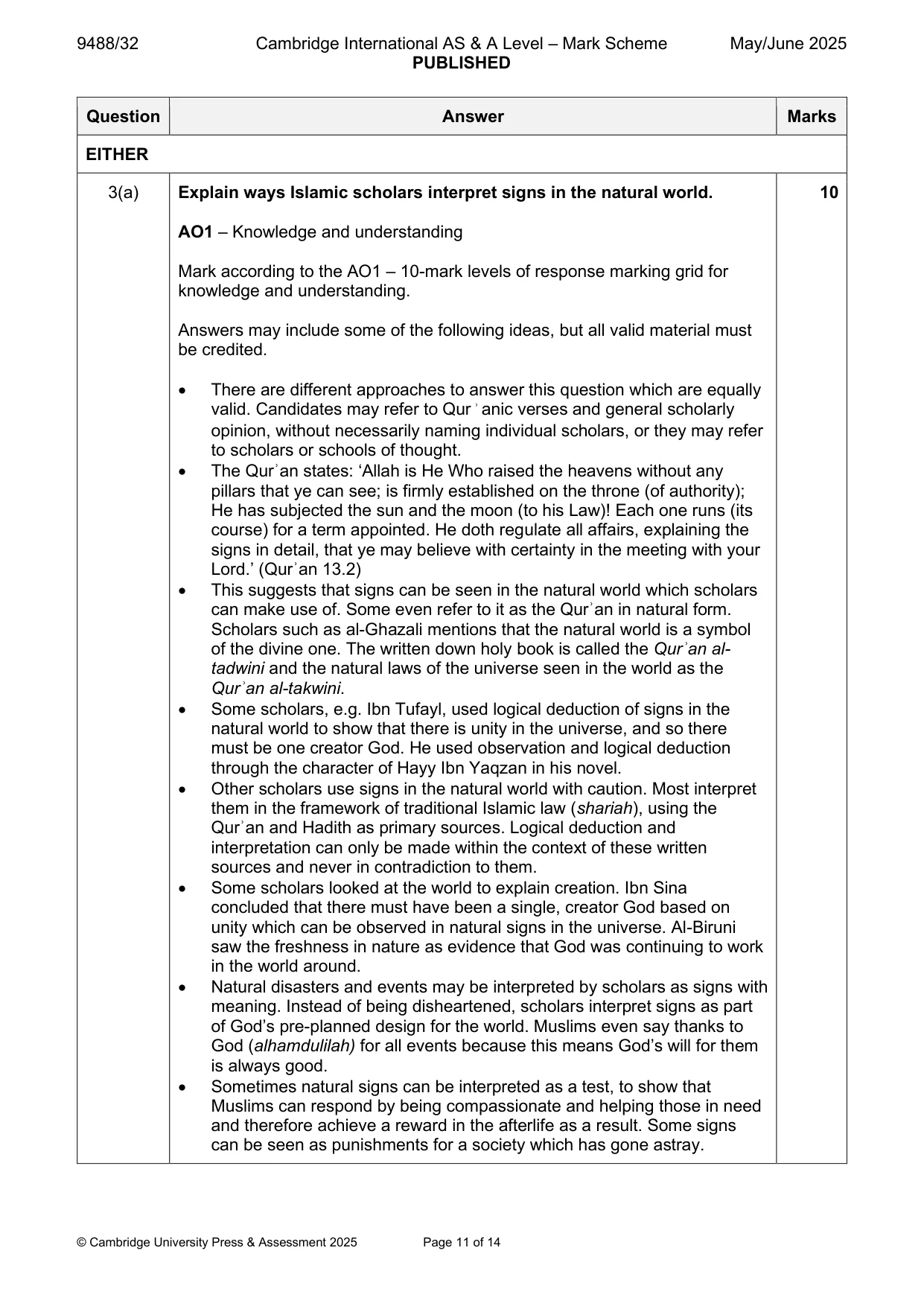
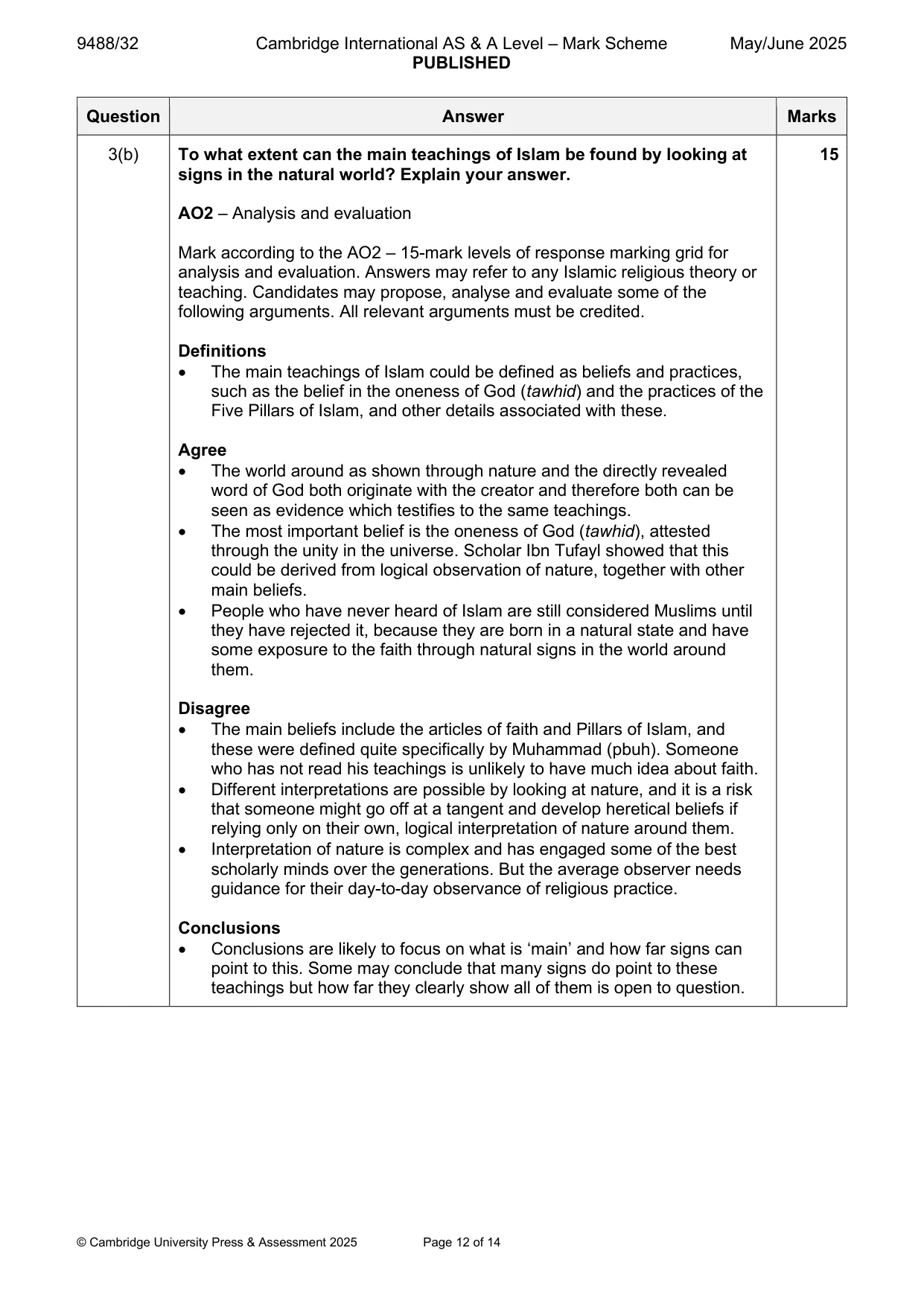
Mark scheme: 3(a) Explain ways Islamic scholars interpret signs in the natural world. 10 AO1 – Knowledge and understanding Mark according to the AO1 – 10-mark levels of response marking grid for knowledge and understanding. Answers may include some of the following ideas, but all valid material must be credited. • There are different approaches to answer this question which are equally valid. Candidates may refer to Qurʾanic verses and general scholarly opinion, without necessarily naming individual scholars, or they may refer to scholars or schools of thought. • The Qurʾan states: ‘Allah is He Who raised the heavens without any pillars that ye can see; is firmly established on the throne (of authority); He has subjected the sun and the moon (to his Law)! Each one runs (its course) for a term appointed. He doth regulate all affairs, explaining the signs in detail, that ye may believe with certainty in the meeting with your Lord.’ (Qurʾan 13.2) • This suggests that signs can be seen in the natural world which scholars can make use of. Some even refer to it as the Qurʾan in natural form. Scholars such as al-Ghazali mentions that the natural world is a symbol of the divine one. The written down holy book is called the Qurʾan al- tadwini and the natural laws of the universe seen in the world as the Qurʾan al-takwini. • Some scholars, e.g. Ibn Tufayl, used logical deduction of signs in the natural world to show that there is unity in the universe, and so there must be one creator God. He used observation and logical deduction through the character of Hayy Ibn Yaqzan in his novel. • Other scholars use signs in the natural world with caution. Most interpret them in the framework of traditional Islamic law (shariah), using the Qurʾan and Hadith as primary sources. Logical deduction and interpretation can only be made within the context of these written sources and never in contradiction to them. • Some scholars looked at the world to explain creation. Ibn Sina concluded that there must have been a single, creator God based on unity which can be observed in natural signs in the universe. Al-Biruni saw the freshness in nature as evidence that God was continuing to work in the world around. • Natural disasters and events may be interpreted by scholars as signs with meaning. Instead of being disheartened, scholars interpret signs as part of God’s pre-planned design for the world. Muslims even say thanks to God (alhamdulilah) for all events because this means God’s will for them is always good. • Sometimes natural signs can be interpreted as a test, to show that Muslims can respond by being compassionate and helping those in need and therefore achieve a reward in the afterlife as a result. Some signs can be seen as punishments for a society which has gone astray. 3(b) To what extent can the main teachings of Islam be found by looking at 15 signs in the natural world? Explain your answer. AO2 – Analysis and evaluation Mark according to the AO2 – 15-mark levels of response marking grid for analysis and evaluation. Answers may refer to any Islamic religious theory or teaching. Candidates may propose, analyse and evaluate some of the following arguments. All relevant arguments must be credited. Definitions • The main teachings of Islam could be defined as beliefs and practices, such as the belief in the oneness of God (tawhid) and the practices of the Five Pillars of Islam, and other details associated with these. Agree • The world around as shown through nature and the directly revealed word of God both originate with the creator and therefore both can be seen as evidence which testifies to the same teachings. • The most important belief is the oneness of God (tawhid), attested through the unity in the universe. Scholar Ibn Tufayl showed that this could be derived from logical observation of nature, together with other main beliefs. • People who have never heard of Islam are still considered Muslims until they have rejected it, because they are born in a natural state and have some exposure to the faith through natural signs in the world around them. Disagree • The main beliefs include the articles of faith and Pillars of Islam, and these were defined quite specifically by Muhammad (pbuh). Someone who has not read his teachings is unlikely to have much idea about faith. • Different interpretations are possible by looking at nature, and it is a risk that someone might go off at a tangent and develop heretical beliefs if relying only on their own, logical interpretation of nature around them. • Interpretation of nature is complex and has engaged some of the best scholarly minds over the generations. But the average observer needs guidance for their day-to-day observance of religious practice. Conclusions • Conclusions are likely to focus on what is ‘main’ and how far signs can point to this. Some may conclude that many signs do point to these teachings but how far they clearly show all of them is open to question.
Q4 · Explain the meaning and function of domes in Islamic architecture
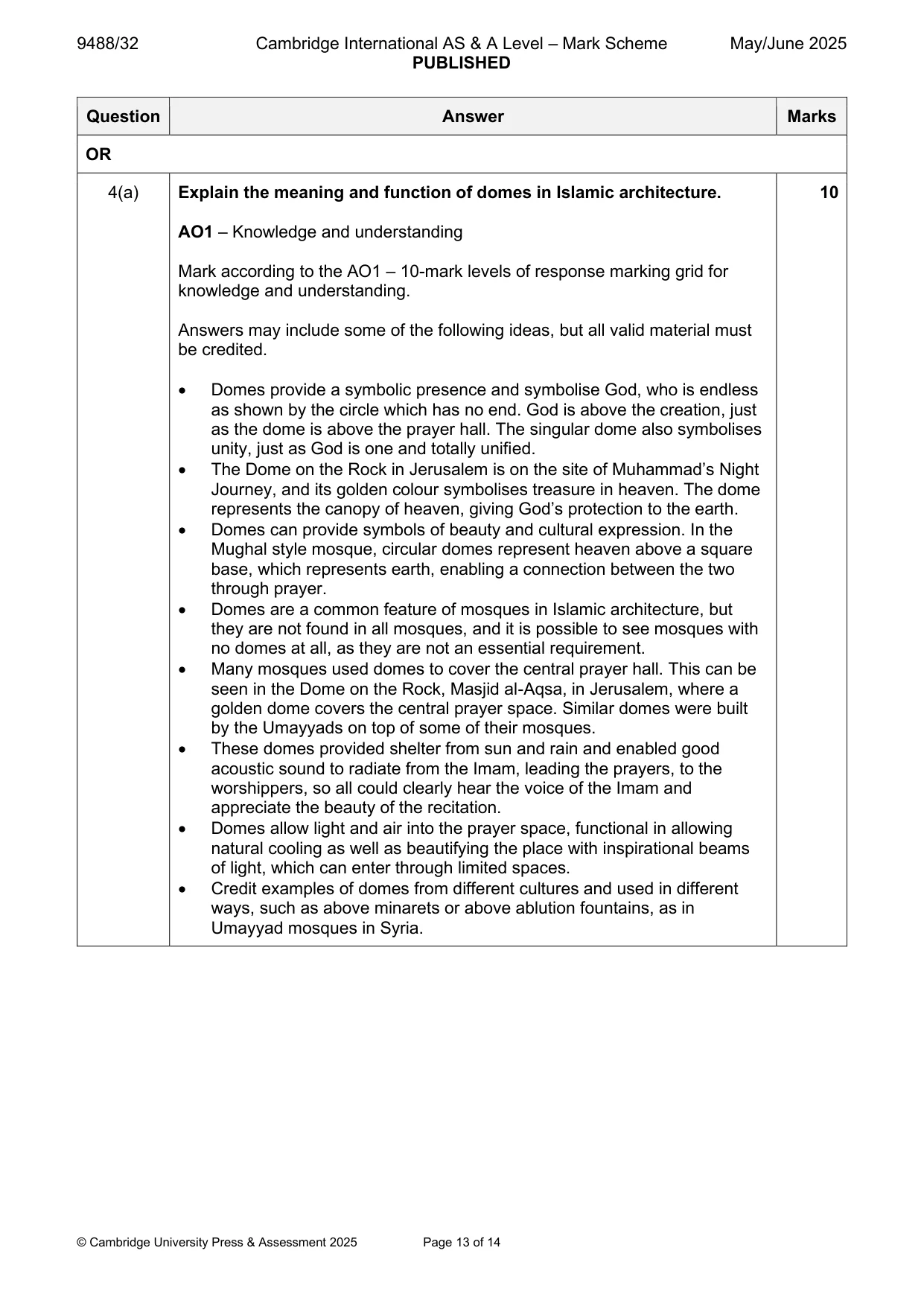
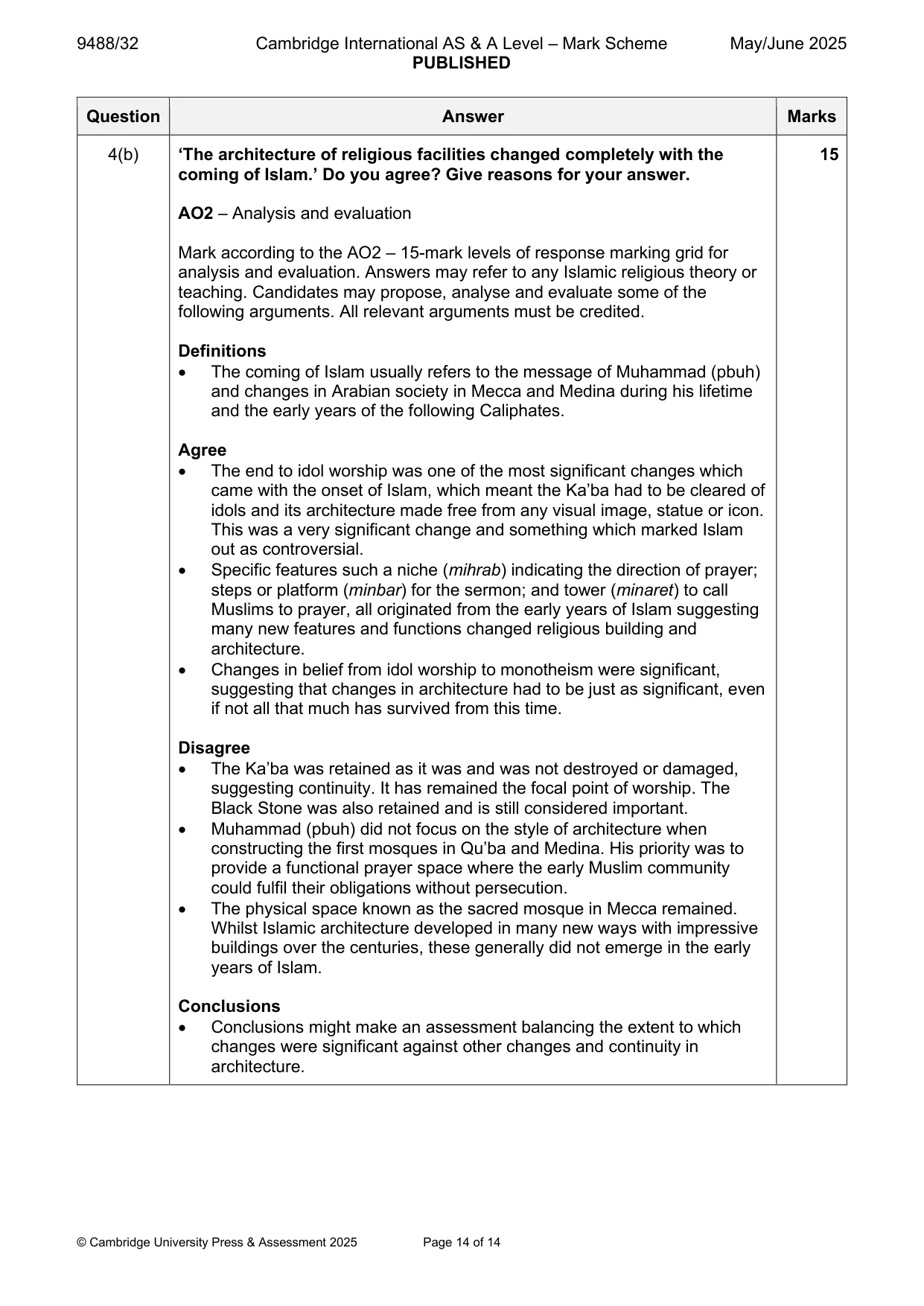
4 (a) Explain the meaning and function of domes in Islamic architecture. [10] (b) ‘The architecture of religious facilities changed completely with the coming of Islam.’ Do you agree? Give reasons for your answer. [15] [Total: 25]
Mark scheme: 4(a) Explain the meaning and function of domes in Islamic architecture. 10 AO1 – Knowledge and understanding Mark according to the AO1 – 10-mark levels of response marking grid for knowledge and understanding. Answers may include some of the following ideas, but all valid material must be credited. • Domes provide a symbolic presence and symbolise God, who is endless as shown by the circle which has no end. God is above the creation, just as the dome is above the prayer hall. The singular dome also symbolises unity, just as God is one and totally unified. • The Dome on the Rock in Jerusalem is on the site of Muhammad’s Night Journey, and its golden colour symbolises treasure in heaven. The dome represents the canopy of heaven, giving God’s protection to the earth. • Domes can provide symbols of beauty and cultural expression. In the Mughal style mosque, circular domes represent heaven above a square base, which represents earth, enabling a connection between the two through prayer. • Domes are a common feature of mosques in Islamic architecture, but they are not found in all mosques, and it is possible to see mosques with no domes at all, as they are not an essential requirement. • Many mosques used domes to cover the central prayer hall. This can be seen in the Dome on the Rock, Masjid al-Aqsa, in Jerusalem, where a golden dome covers the central prayer space. Similar domes were built by the Umayyads on top of some of their mosques. • These domes provided shelter from sun and rain and enabled good acoustic sound to radiate from the Imam, leading the prayers, to the worshippers, so all could clearly hear the voice of the Imam and appreciate the beauty of the recitation. • Domes allow light and air into the prayer space, functional in allowing natural cooling as well as beautifying the place with inspirational beams of light, which can enter through limited spaces. • Credit examples of domes from different cultures and used in different ways, such as above minarets or above ablution fountains, as in Umayyad mosques in Syria. 4(b) ‘The architecture of religious facilities changed completely with the 15 coming of Islam.’ Do you agree? Give reasons for your answer. AO2 – Analysis and evaluation Mark according to the AO2 – 15-mark levels of response marking grid for analysis and evaluation. Answers may refer to any Islamic religious theory or teaching. Candidates may propose, analyse and evaluate some of the following arguments. All relevant arguments must be credited. Definitions • The coming of Islam usually refers to the message of Muhammad (pbuh) and changes in Arabian society in Mecca and Medina during his lifetime and the early years of the following Caliphates. Agree • The end to idol worship was one of the most significant changes which came with the onset of Islam, which meant the Ka’ba had to be cleared of idols and its architecture made free from any visual image, statue or icon. This was a very significant change and something which marked Islam out as controversial. • Specific features such a niche (mihrab) indicating the direction of prayer; steps or platform (minbar) for the sermon; and tower (minaret) to call Muslims to prayer, all originated from the early years of Islam suggesting many new features and functions changed religious building and architecture. • Changes in belief from idol worship to monotheism were significant, suggesting that changes in architecture had to be just as significant, even if not all that much has survived from this time. Disagree • The Ka’ba was retained as it was and was not destroyed or damaged, suggesting continuity. It has remained the focal point of worship. The Black Stone was also retained and is still considered important. • Muhammad (pbuh) did not focus on the style of architecture when constructing the first mosques in Qu’ba and Medina. His priority was to provide a functional prayer space where the early Muslim community could fulfil their obligations without persecution. • The physical space known as the sacred mosque in Mecca remained. Whilst Islamic architecture developed in many new ways with impressive buildings over the centuries, these generally did not emerge in the early years of Islam. Conclusions • Conclusions might make an assessment balancing the extent to which changes were significant against other changes and continuity in architecture.
What was in this paper
The subtopics covered by these 4 questions, and how many questions each got. Open one in a new tab to see every Cambridge question on it.
What you needed in this session
Cambridge’s own grade thresholds for 2025 May/June, Paper 3 · Variant 2. A higher threshold means an easier paper — the bar moves with how the cohort did.