Cambridge A Level Islamic Studies 9488 — 2022 Oct/Nov Paper 3 · Variant 2
9488/32/O/N/22 · 4 questions · 50 marks · ≈56 min
The question paper and its mark scheme, free to read here and free to download. This is Cambridge’s own paper, exactly as it was sat.
Question paper4 pages
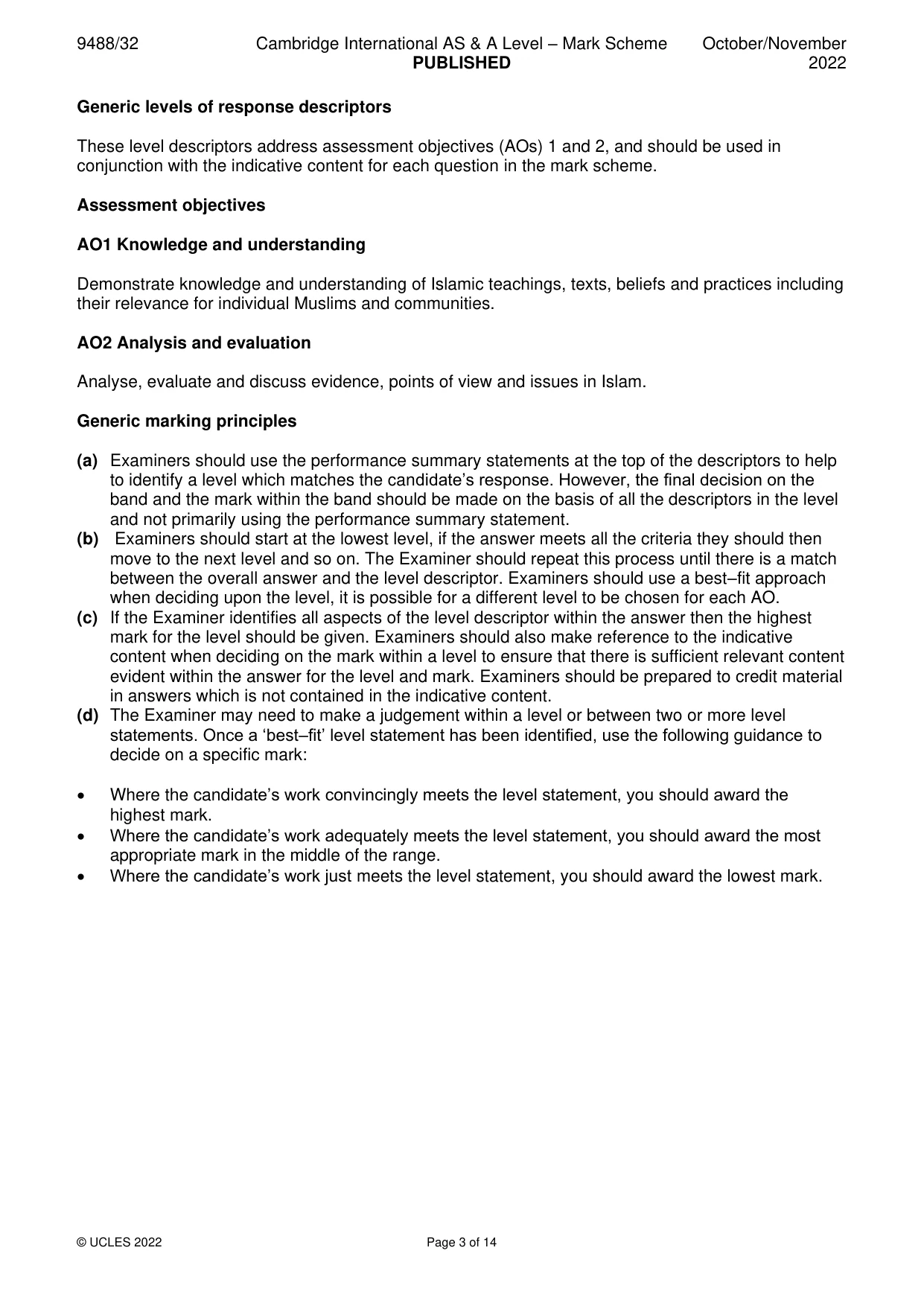
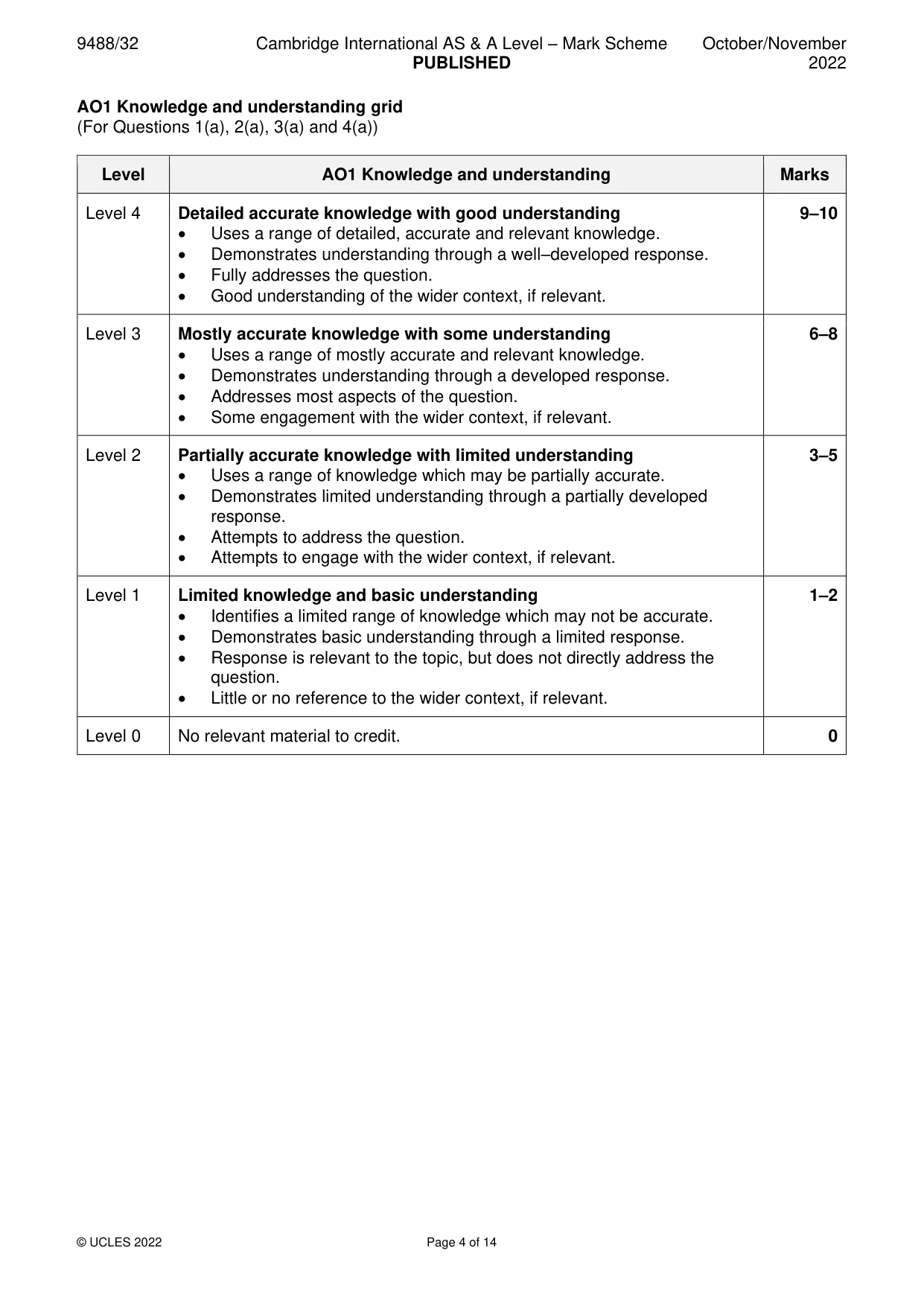
Mark scheme14 pages
Answers below. Sit the paper first if you are practising.
Questions as text
Question 1
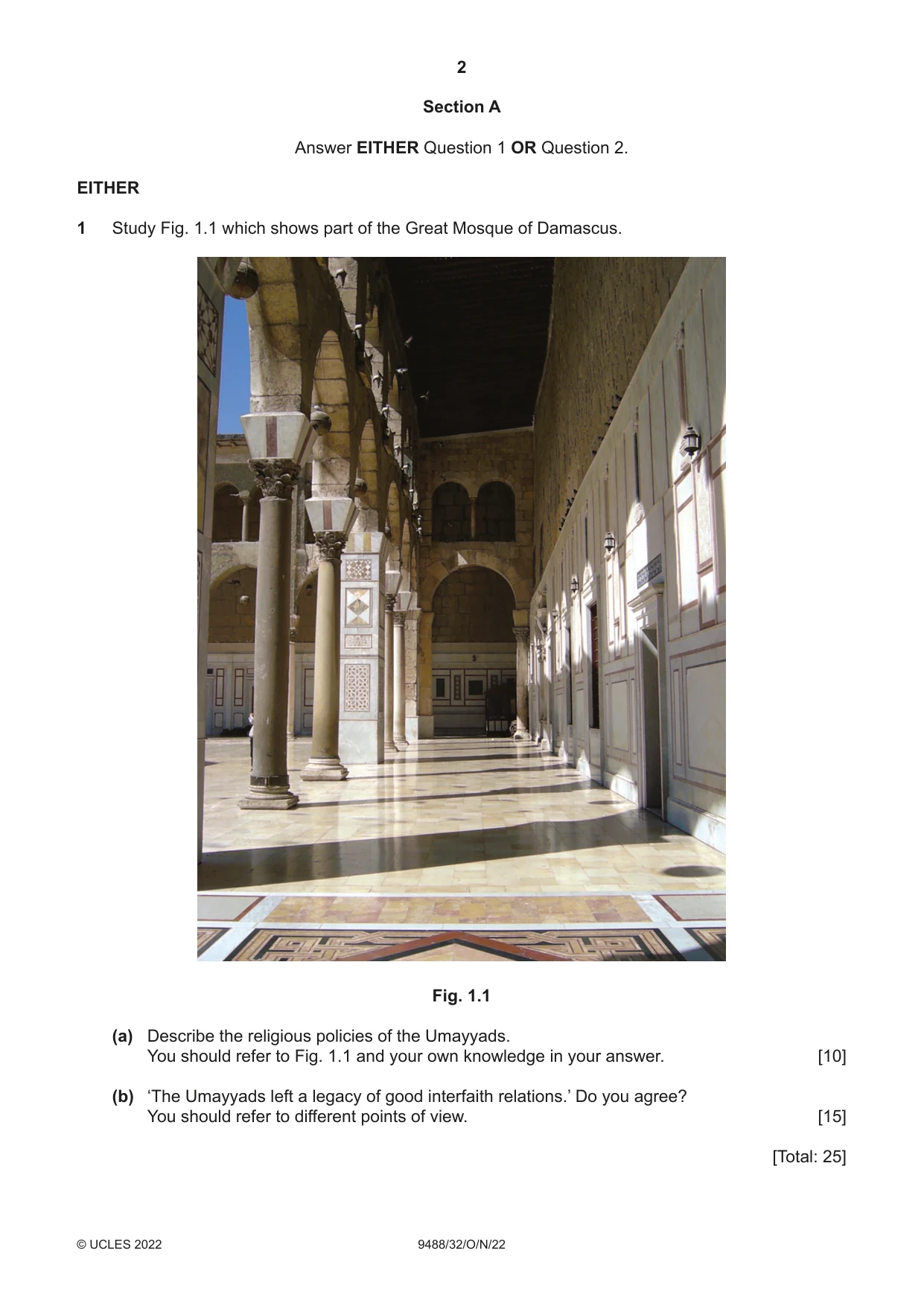
1 Study Fig. 1.1 which shows part of the Great Mosque of Damascus. Fig. 1.1 (a) Describe the religious policies of the Umayyads. You should refer to Fig. 1.1 and your own knowledge in your answer. [10] (b) ‘The Umayyads left a legacy of good interfaith relations.’ Do you agree? You should refer to different points of view. [15] [Total: 25] OR
Mark scheme: Question Answer Marks 1(a) Study Fig. 1.1 which shows part of the Great Mosque of Damascus. 10 Describe the religious policies of the Umayyads. You should refer to Fig. 1.1 and your own knowledge in your answer. Mark according to the AO1 – 10-mark levels of response marking grid for knowledge and understanding. Answers may include some of the following ideas, but all valid material must be credited. • The source shows part of the Great Mosque of Damascus, built by the Umayyads. It can be seen that the rounded column, centre, has a leaf pattern sculptured in the top and is in fact a re–used Roman pillar. Geometrical mosaics can be seen on the square column. The angle of view shows the corner of the mosque which forms a rectangular courtyard. • Candidates might interpret the source to describe the ways in which the Umayyads enacted change and continuity in religious policy. They usually permitted those of other faiths, such as Christians in Damascus, to retain their religion, and they did not think it necessary to destroy all artwork and architecture they found. Hence the decorative columns produced by pagan Romans were retained and re–used. • It could also be said that the presence of mosaic artwork on the square column shows that the Umayyads rejected the idolatry of pre–Islamic Arabia and did not permit any human or animate forms in the decoration of their mosques. This was a clear change from the past. • Candidates might go on to elaborate the theological basis for both continuity and change. Christians and Jews were recognised as fellow ‘peoples of the book’ (ahlul Kitab), so sharing sites regarded as special and incorporating aspects of their art and architecture, such as the columns, was accepted. • Association of other besides God (shirk) is regarded as a great sin in Islam. Therefore, in mosque decoration animate objects, such as people, animals and so on are not used. There are no images and nothing which might be considered an idol. Richly decorated paintings, including human or angelic figures, common in some Roman and pre– Umayyad decorations, have all gone. • Credit responses which describe other aspects of the religious policies of the Umayyads, beginning with the difficult relations with followers of ‘Ali and going on to describe how some Umayyad rulers had different policies. Umar II, for example, was more religious: he banned drinking and bath houses and lived a pious life. • The religious achievements of the Umayyads, such as building great mosques, might be described, as well as the criticisms, such as treating non–Muslims differently with additional tax (jizya) and alleged lax Islamic practice by some, which may have contributed to their downfall. Candidates might give a general overview, or they might focus on two or three points to develop in detail in their responses. 1(b) ‘The Umayyads left a legacy of good interfaith relations.' Do you 15 agree? You should refer to different points of view. Mark according to the AO2 –15-mark levels of response marking grid for analysis and evaluation. Answers may refer to any religious theory or teaching. Students may propose, analyse and evaluate some of the following arguments. All relevant arguments must be credited. Definitions • Introductions might define interfaith relations. This suggests that people of different religions who lived in areas such as Damascus at the time, including Christians, Jews and others (who were called dhimmis), lived peacefully and happily alongside Muslims. Agree • Members of other faiths were not expelled by the Umayyads, indeed many continued to live under Islamic rule. From the start, under Caliph Mu’awiyah, Christians were tolerated and treated well. Mu’awiyah even restored a cathedral after it had been damaged by an earthquake in Edessa. • Some non-Muslims preferred to live under the Islamic Caliphate of the Umayyads than to live even under the Roman Christian Empire / Byzantine Empire, because they felt they were well treated and had better human rights. • Christians and Jews may not have been equally treated, but at least there was a system of tax which also had advantages in that it exempted them from military service. Having an organised, identifiable system encouraged people at a local level to live according to the rules and get along better, more harmoniously, in everyday life. Priests and monks were even exempted from the tax, giving them a measure of respect. • Some Christian officials held high office, such as Sarjun ibn Mansur of Damascus. There were also many Christian and Jewish officials in the Spanish Umayyad Caliphate, which was considered by some as a model of good interfaith relations at a time when they were generally not so harmonious in medieval Europe. Disagree • It could be argued that inequality in the charging of tax on non-Muslims set up differences which mean the system could not be harmonious. Arguments over payment of this tax was a point of weakness for the Umayyads. The system naturally encouraged dhimmis to convert to Islam to avoid paying jizya and pay a lower rate of zakat tax instead. • It could be argued that there were different periods under the individual Caliphs in both Damascus and Spain, and some led to harmonious relations, and some did not. Sometimes Christians helped the Caliph rule as chief ministers (viziers) and sometimes they were expelled and even persecuted. This suggests the description of good relations would not be accurate. Conclusions Conclusions might balance the arguments and make a personal conclusion, referring back to the words ‘good relations’ in the question and make a decision about whether the Umayyad policies in general, overall, can be described as such.
Question 2
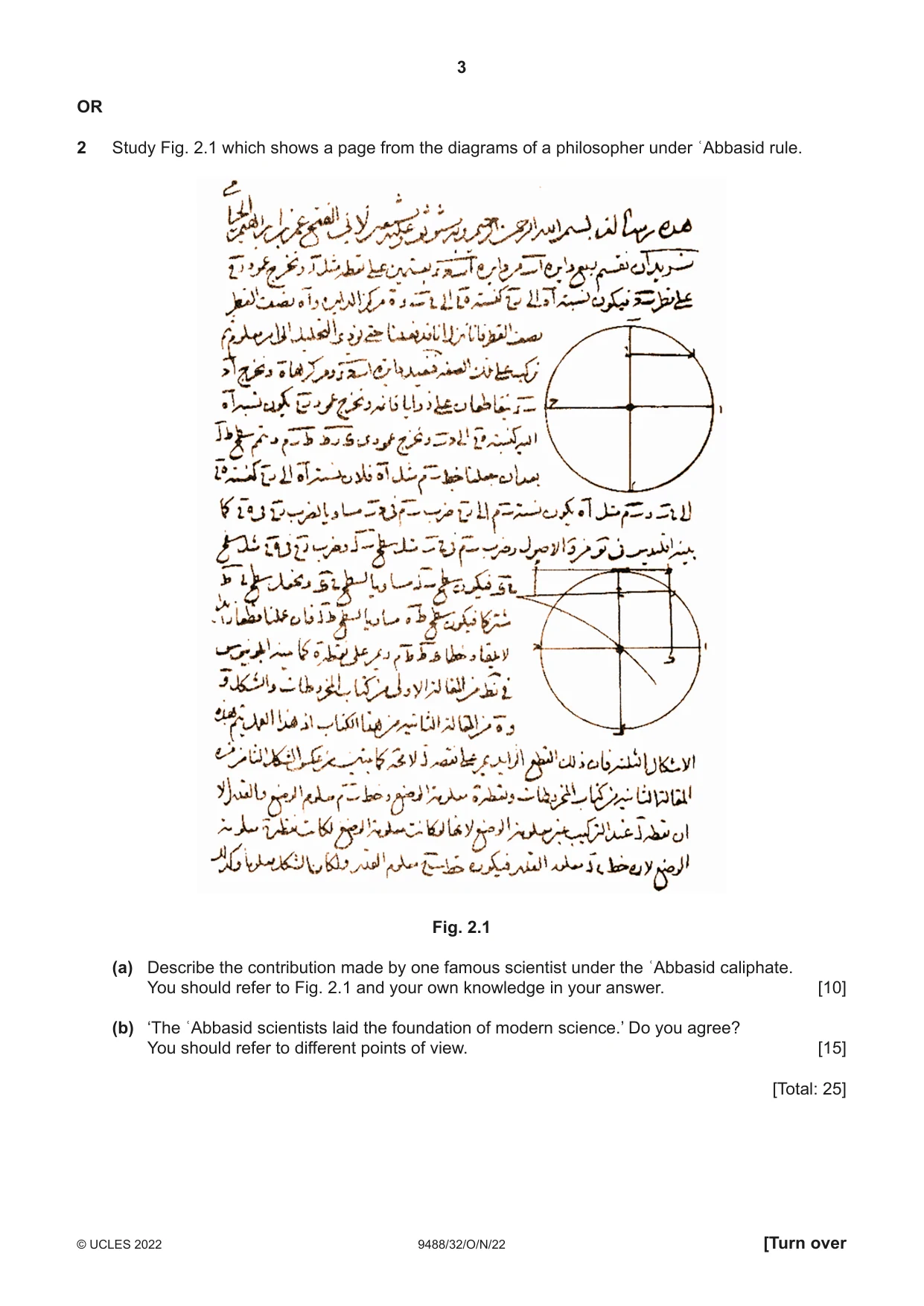
2 Study Fig. 2.1 which shows a page from the diagrams of a philosopher under ʿAbbasid rule. Fig. 2.1 (a) Describe the contribution made by one famous scientist under the ʿAbbasid caliphate. You should refer to Fig. 2.1 and your own knowledge in your answer. [10] (b) ‘The ʿAbbasid scientists laid the foundation of modern science.’ Do you agree? You should refer to different points of view. [15] [Total: 25]
Mark scheme: 2(a) Study Fig. 2.1 which shows a page from the diagrams of a philosopher 10 under ‘Abbasid rule. Describe the contribution made by one famous scientist under the 'Abbasid caliphate. You should refer to Fig. 2.1 and your own knowledge in your answer. Mark according to the AO1 – 10-mark levels of response marking grid for knowledge and understanding. Answers may include some of the following ideas, but all valid material must be credited. • The source shows a page from a writing of Omar Khayyam (1048- 1131), who lived in Persia and wrote several works of mathematics, philosophy, poetry and fiction. The page clearly shows that Arabic was the writing of the day, and geometrical, mathematical diagrams are included. • Muslim scientists and mathematicians built on classical knowledge to develop science and maths. The accuracy, clarity and style of diagram holds more in common with classical and modern mathematical diagrams than was common across much of medieval Europe, showing the importance of Muslims in transmitting and developing knowledge. This knowledge went on to inspire the European enlightenment – in this case the diagrams helped Descartes and developed mathematical approaches to solving quadratic equations. • Candidates could choose any one scientist from ‘Abbasid times. Those named in the syllabus are Al-Khwarizmi, Ibn Sina and Ibn al-Haytham. They could choose one of these or another. The quality of the answer should focus on understanding of the contribution they made. • Al-Khwarizmi was particularly important for the development of algebra. He was influenced by classical scholars including Ptolemy. Al- Khwarizmi developed classical work further by suggesting how to solve equations (similar to the diagrams in the source). He introduced the idea of balancing out both sides of an equation, which was so significant as the basis of modern maths that he became known as the father of algebra. • Ibn Sina wrote many works including the Canon of Medicine, which became the most influential medical textbook for hundreds of years and was translated into Latin for use by European doctors. This was based on the classical scholar, Galen’s work, with added knowledge from Indian and Chinese medicine. As well as an immense volume of knowledge, the book also encouraged good medical practice such as how to test new drugs methodically, observing their results step by step. • Ibn al-Haytham was particularly influential for the development of optics. He developed the work of classical scholars Ptolemy and Aristotle about optics and the workings of the human eye. His understanding of the eye led to advances in medical treatment and to the understanding of rays of light which led to pinhole cameras being produced. 2(b) ‘The 'Abbasid scientists laid the foundation of modern science.' Do 15 you agree? You should refer to different points of view. Mark according to the AO2 –15-mark levels of response marking grid for analysis and evaluation. Answers may refer to any religious theory or teaching. Students may propose, analyse and evaluate some of the following arguments. All relevant arguments must be credited. Definitions • Candidates might define modern science as being objective, evidence based, rational enquiry. Scientists experiment and draw conclusions from their results. ‘Abbasid scientists who may have contributed to this included, most famously Ibn al-Haytham, as well as others who took a similar approach from the ‘Golden Age’ of Islam under the ‘Abbasids. Agree • It could be argued that rational enquiry was much developed by ‘Abbasid scientists. The Golden Age was a time when rationalism was favoured and discussion encouraged, the climate in which knowledge could be explored, leading to developments in science. • Ibn al-Haytham wrote of the scientist: ‘If learning the truth is his goal, he should make himself an enemy of all that he reads and attack it from every side. He should also suspect himself as he performs his critical examination of it, so that he may avoid falling into either prejudice or leniency.’ This has been taken to mean objective scientific enquiry, a radical step forward in the progress of scientific method. • Matthias Schramm has called Ibn al-Haytham the ‘father of modern science’ because of his method of observation which laid the basis for modern scientific enquiry, observation, test and retest to see patterns and make conclusions. He believes this was the most influential development in founding the discipline of science. Disagree • Others might disagree. ‘Abbasid scientists were often philosophers and theologians who were constrained by their beliefs in God: experimentation and rational deduction was always second to revealed belief and therefore science could only go so far. • The writings of influential ‘Abbasid scientists including Ibn Sina, Ibn al- Haytham and Al-Khwarizmi were based on classical sources. Al- Khwarizmi based much of his work on Ptolemy, Ibn Sina on Galen and Ibn al-Haytham followed on from Ptolemy's Optics. This has led some to argue that they passed on classical knowledge about science rather than influenced it significantly. • The scholar G. J. Toomer argues that we should not read into the past modern scientific medicine since the time of the ‘Abbasids ruled was so different from today and included a large amount of superstition and religious based learning. The modern division between religion and science had not yet emerged. Conclusions In conclusion, a balance between ‘Abbasid contributions and that of the Greeks and Romans, and later enlightenment, might be drawn. A personal judgment should be made about the extent to which the ‘Abbasids were significant in developing science overall.
Q3 · Describe how Islamic beliefs and values are expressed in one significant writing
3 (a) Describe how Islamic beliefs and values are expressed in one significant writing. [10] (b) Evaluate how one significant work written by a Muslim might help others to understand more about Islamic beliefs. [15] [Total: 25] OR
Mark scheme: 3(a) Describe how Islamic beliefs and values are expressed in one 10 significant writing. Mark according to the AO1 – 10-mark levels of response marking grid for knowledge and understanding. Answers may include some of the following ideas, but all valid material must be credited. • The works listed for study in the syllabus are: – Ibn Tufayl’s work Hayy ibn Yaqzan – Al-Ghazali’s Incoherence of the Philosophers – Ibn Khaldun’s work on social science, The Muqaddimah – the mystical poetry of Rabiʿa al-ʿAdawiyya – Al-Biruni’s work on comparative religion, History of Religions – a published work chosen by the candidate • Islamic beliefs and values might be focused by the candidate on particular areas according to the focus of the work they have chosen. For example, in Hayy ibn Yaqzan, the logical deduction of belief in a single creator God by the boy Hayy, marooned on a desert island, from his observations of the world around him. This is an example of belief derived through rationalism. • Al-Ghazali makes the point that rationalism has flaws and incoherence and to him, acceptance of revealed belief and mystical, inner experience from Sufi practices are the best way to find Islamic beliefs and values. • Al-Biruni’s work on comparative religion takes an objective, neutral stance towards the Indian religions Biruni observed on his travels. This contrasts with the faith-based, devotional bias of most writers at the time. Al-Biruni’s work is therefore referred to as the first study of comparative religion in the modern sense. • Ibn Khaldun’s work refers to history and social science and he makes the point that objective truth is important in study. He wrote about hadith, dream interpretation and fiqh, particularly the five categories of action as the basis for the beliefs and values of Islamic society. • Good answers might include brief, relevant quotes and explanations from the key word chosen. Better responses will draw out the particular approach to beliefs and values made by the writer and give a clear and full explanation of this in their account. 3(b) Evaluate how one significant work written by a Muslim might help 15 others to understand more about Islamic beliefs. Mark according to the AO2 –15-mark levels of response marking grid for analysis and evaluation. Answers may refer to any religious theory or teaching. Students may propose, analyse and evaluate some of the following arguments. All relevant arguments must be credited. Definitions • The work should be chosen from the list given in part (a). A definition of the Islamic beliefs covered by the work might be included in an introduction, or a very brief outline of the work itself. Understanding of Islamic beliefs • It might be argued that since Islamic beliefs are common to all Muslims, the expression of them is similar. The belief in one, unseen God is expressed by referring to God’s power in the creation of the natural world, and as logically the first cause behind the universe. God creates beauty as signs to support people’s belief in God. These aspects can be found in most of the works given. • The unseen nature of God is also important because the works are ways of expressing and explaining God. The God of Islam cannot be drawn or visually represented. All of these works use words to portray the unseen. The description of characteristics, such as the merciful or other 99 names of God, through God’s characteristics, are common, albeit through different words chosen. • Ibn Tufayl’s work Hayy ibn Yaqzan expresses God through rational language. Al-Ghazali’s Incoherence of the Philosophers criticises this and puts emphasis on mystical experience and acceptance of revelation. • The poetry of Rabiʿa al-ʿAdawiyya also takes a mystical approach. These different ways of approaching religious understanding – rational and mystical – represent different traditions of how Muslims might understand God and could be elaborated on in more detail according to the works chosen by the candidate. • Ibn Khaldun’s work on social science, The Muqaddimah and Al-Biruni’s work on comparative religion, History of Religions represent objective works of enquiry, similar to a modern academic approach and in contrast to a faith-based writing. This way of expressing observed beliefs might be contrasted with the above. Conclusions • A personal conclusion drawing together the ways in which the work might help someone else, be they Muslim or non-Muslim, understand Islamic beliefs, could be made at the end.
Q4 · Explain how Islamic art differs from that of pre-Islamic Arabia
4 (a) Explain how Islamic art differs from that of pre-Islamic Arabia. [10] (b) ‘Muslims should embrace different cultural expressions of Islam through art.’ Do you agree? You should refer to different points of view. [15] [Total: 25]
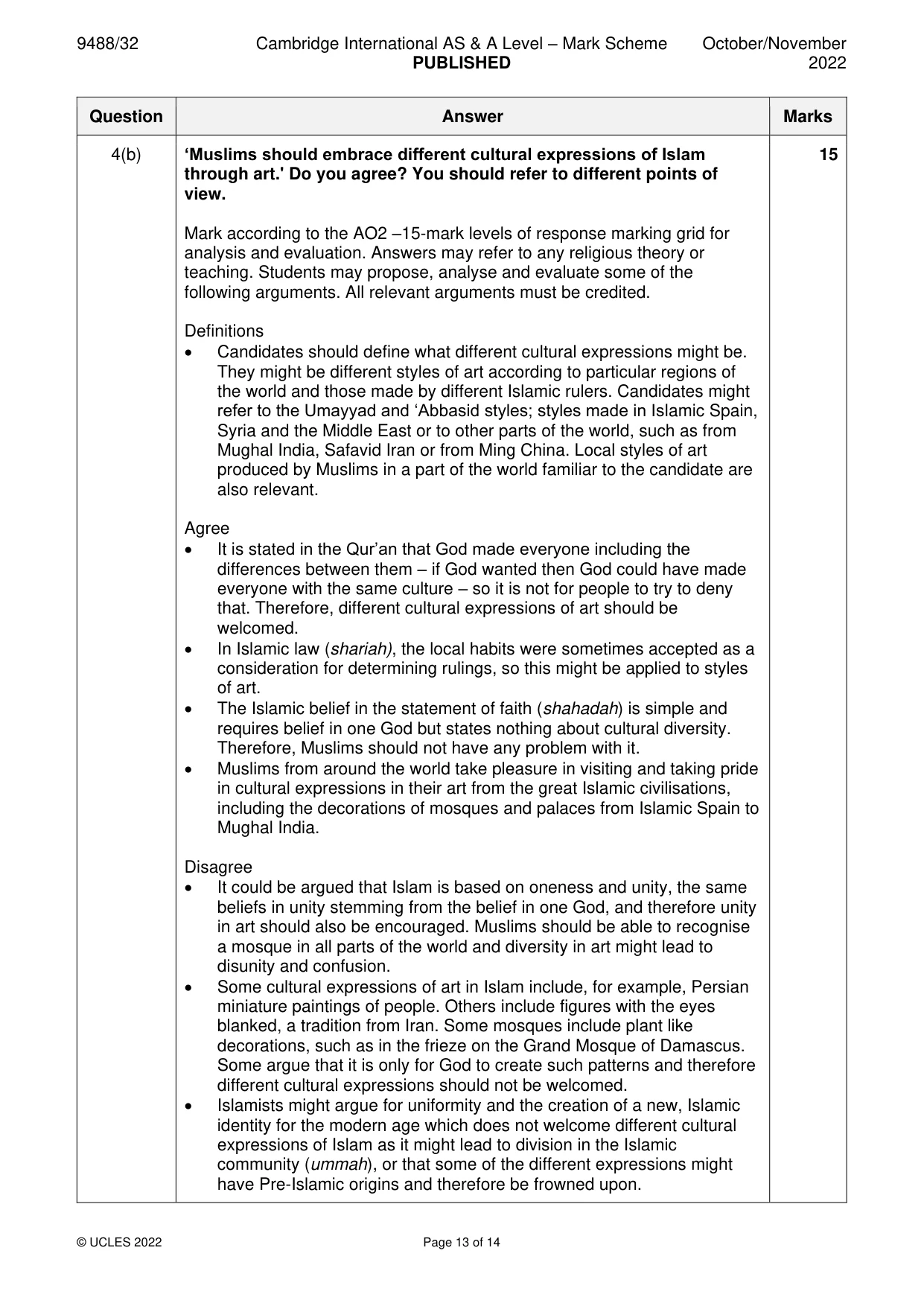
Mark scheme: 4(a) Explain how Islamic art differs from that of Pre-Islamic Arabia. 10 Mark according to the AO1 – 10-mark levels of response marking grid for knowledge and understanding. Answers may include some of the following ideas, but all valid material must be credited. • Candidates might describe the art of Pre-Islamic Arabia. The Ka’ba was filled with idols, include figures of gods such as Hubal. Some of the gods were simply rocks, others statuettes. The idols were venerated, and gifts given to them, since they were believed to be more than just works of art, they had sacred status and there were many superstitious powers attributed to them. • Pre-Islamic art from the area of the Muslim Caliphate might be described. This included Roman columns and arches, Greek figurines and Persian and Zoroastrian towers, rising to the sun God. • Islamic art differed in that all idols were removed from the clearing of the Ka’ba by Muhammad (pbuh) onwards. Islamic art focused on the written word and calligraphy, such as in the early mosque, Al-Aqsa, the Dome of the Rock in Jerusalem, which would have been radically different from the Pre-Islamic idol worshipping temples. • Some aspects of Roman art were included in Al-Aqsa and the Great Mosque of Damascus, including plant-based patterns, which might be regarded as depictions of paradise or simply decorations. Nevertheless, both were different from the way in which the pagans might have used them due to the absence of idols. • Some Pre-Islamic art, such as the Persian tower, was reused in the minaret, showing that not everything was different. Some Umayyad art did include figures on the walls of palaces, and some Mughal art also used figurative painting, although these figures were not considered idols or gods, so the difference was in the purpose of the art and in peoples different understanding of it. • Credit responses which give examples from any aspect of Islamic art and compare this with either the Ka’ba or any other Pre-Islamic place where art might be exhibited, be it in the decoration or architecture. 4(b) ‘Muslims should embrace different cultural expressions of Islam 15 through art.' Do you agree? You should refer to different points of view. Mark according to the AO2 –15-mark levels of response marking grid for analysis and evaluation. Answers may refer to any religious theory or teaching. Students may propose, analyse and evaluate some of the following arguments. All relevant arguments must be credited. Definitions • Candidates should define what different cultural expressions might be. They might be different styles of art according to particular regions of the world and those made by different Islamic rulers. Candidates might refer to the Umayyad and ‘Abbasid styles; styles made in Islamic Spain, Syria and the Middle East or to other parts of the world, such as from Mughal India, Safavid Iran or from Ming China. Local styles of art produced by Muslims in a part of the world familiar to the candidate are also relevant. Agree • It is stated in the Qur’an that God made everyone including the differences between them – if God wanted then God could have made everyone with the same culture – so it is not for people to try to deny that. Therefore, different cultural expressions of art should be welcomed. • In Islamic law (shariah), the local habits were sometimes accepted as a consideration for determining rulings, so this might be applied to styles of art. • The Islamic belief in the statement of faith (shahadah) is simple and requires belief in one God but states nothing about cultural diversity. Therefore, Muslims should not have any problem with it. • Muslims from around the world take pleasure in visiting and taking pride in cultural expressions in their art from the great Islamic civilisations, including the decorations of mosques and palaces from Islamic Spain to Mughal India. Disagree • It could be argued that Islam is based on oneness and unity, the same beliefs in unity stemming from the belief in one God, and therefore unity in art should also be encouraged. Muslims should be able to recognise a mosque in all parts of the world and diversity in art might lead to disunity and confusion. • Some cultural expressions of art in Islam include, for example, Persian miniature paintings of people. Others include figures with the eyes blanked, a tradition from Iran. Some mosques include plant like decorations, such as in the frieze on the Grand Mosque of Damascus. Some argue that it is only for God to create such patterns and therefore different cultural expressions should not be welcomed. • Islamists might argue for uniformity and the creation of a new, Islamic identity for the modern age which does not welcome different cultural expressions of Islam as it might lead to division in the Islamic community (ummah), or that some of the different expressions might have Pre-Islamic origins and therefore be frowned upon. 4(b) Conclusions The importance of the world ‘embraced’ in the question should be a focus for a personal conclusion made by the candidate. This should balance out whether different expressions might be accepted, encouraged, embraced or discouraged for the sake of unity. The significance of the question gives rise to the question of unity in the ummah and whether it required uniformity, or acceptance of diversity.
What was in this paper
The subtopics covered by these 4 questions, and how many questions each got. Open one in a new tab to see every Cambridge question on it.
What you needed in this session
Cambridge’s own grade thresholds for 2022 Oct/Nov, Paper 3 · Variant 2. A higher threshold means an easier paper — the bar moves with how the cohort did.