Cambridge A Level Islamic Studies 9488 — 2024 Oct/Nov Paper 3 · Variant 2
9488/32/O/N/24 · 4 questions · 50 marks · 90 min
The question paper and its mark scheme, free to read here and free to download. This is Cambridge’s own paper, exactly as it was sat.
Question paper4 pages
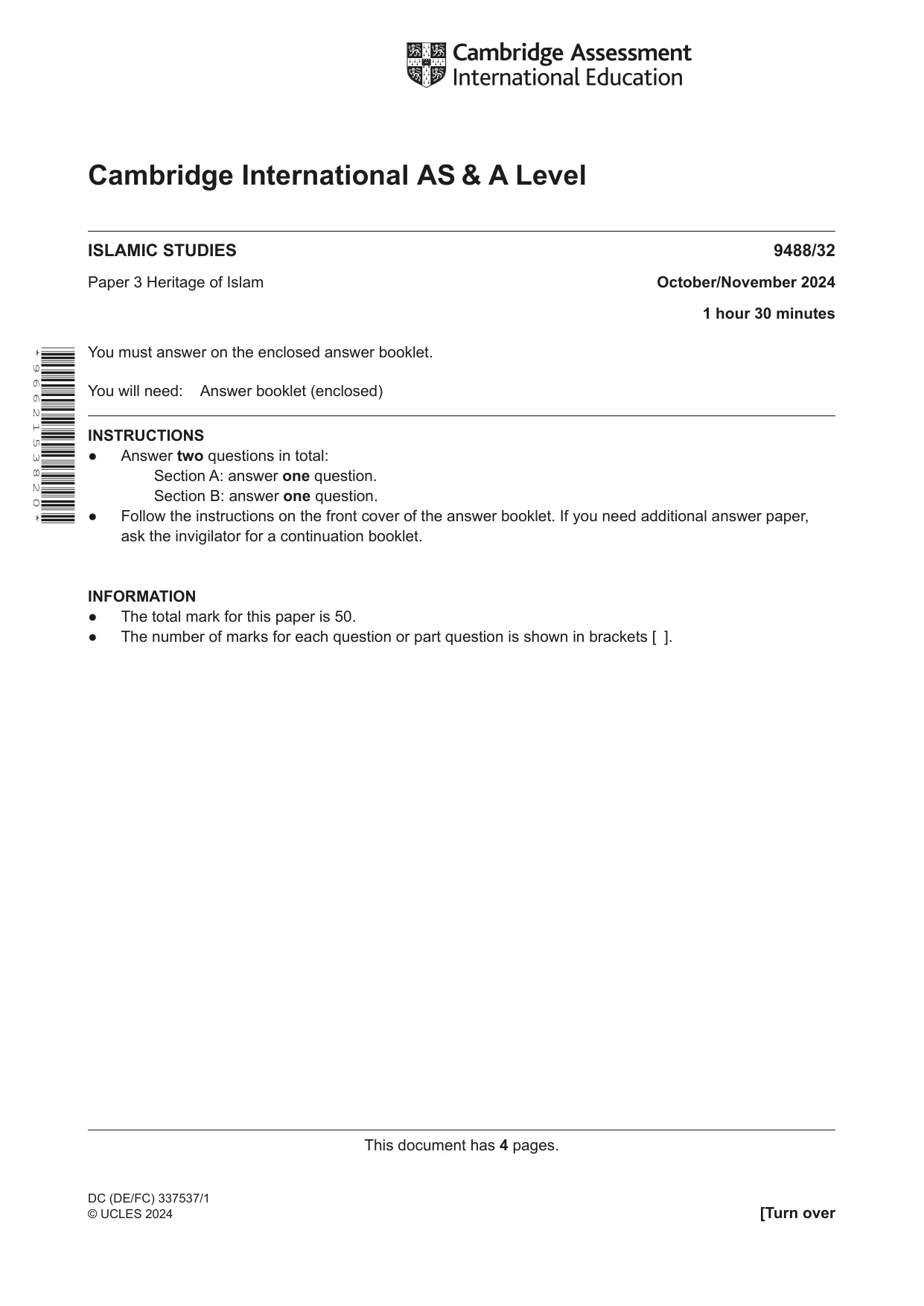
Mark scheme13 pages
Answers below. Sit the paper first if you are practising.
Questions as text
Question 1
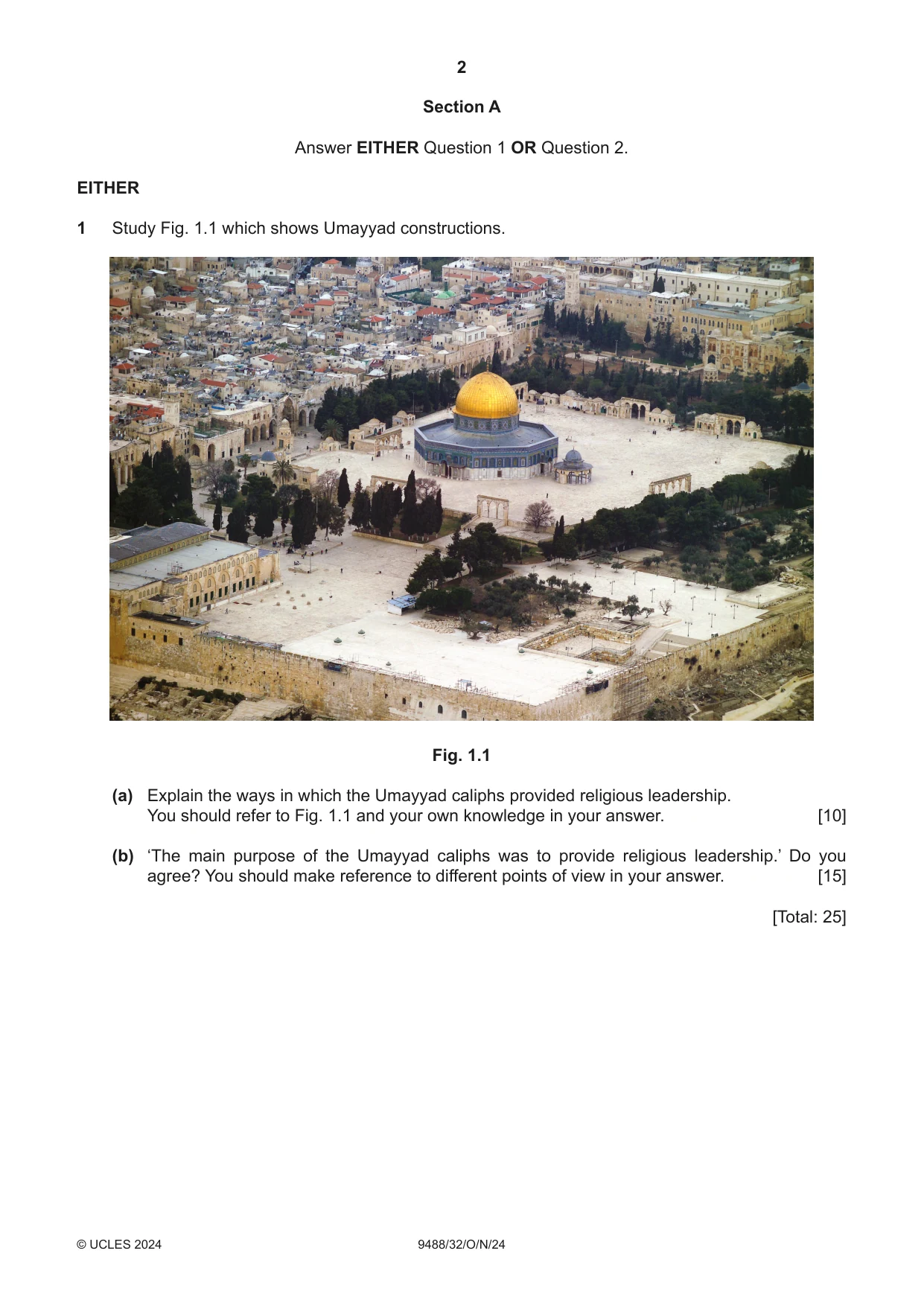
1 Study Fig. 1.1 which shows Umayyad constructions. Fig. 1.1 (a) Explain the ways in which the Umayyad caliphs provided religious leadership. You should refer to Fig. 1.1 and your own knowledge in your answer. [10] (b) ‘The main purpose of the Umayyad caliphs was to provide religious leadership.’ Do you agree? You should make reference to different points of view in your answer. [15] [Total: 25] OR
Mark scheme: Question Answer Marks EITHER 1(a) Explain the ways in which the Umayyad caliphs provided religious 10 leadership. You should refer to Fig. 1.1 and your own knowledge in your answer. AO1 – Knowledge and understanding Mark according to the AO1 – 10-mark levels of response marking grid for knowledge and understanding. Answers may include some of the following ideas, but all valid material must be credited. • The source shows Umayyad constructions. These include the Masjid al- Aqsa, which is a prominent landmark in Jerusalem. • Caliph Abd al Malik wanted to provide religious leadership by showing that Islam was as magnificent as Christianity, which boasted impressive churches in Jerusalem. • The source also shows other buildings, including remains of Roman style columns, and an imposing, fortified wall to the lower end of the picture. • This shows that the Umayyad’s wanted to be seen as inheritors of the monotheistic tradition. They generally tolerated Christians and Jews and gave them rights. As caliph for Muslims, they also provided a degree of leadership for other faiths. • In other ways, some Umayyads set good examples, such as Caliph ‘Umar II, who led a life of piety. He also sponsored scholarship and encouraged the collection of Hadith amongst scholars in Medina. • In expanding the caliphate into new areas, to Jerusalem and much further away, the Umayyads provided leadership of mission (da’wah) to explain Islam to others and promote the faith to others who wanted to join. Some sent letters to other rulers, even as far away as China, inviting rulers to adopt Islam as their faith. • Some caliphs invested in rest houses for travellers to perform the Hajj pilgrimage; expanded mosques and provided religious facilities for their people. The caliph himself often performed the Hajj to set a good example for the people to follow his leadership. • As caliph, the leader began to put inscriptions such as the statement of faith on coins, showing that they were the religious leader of the community, God’s representative on earth. 1(b) ‘The main purpose of the Umayyad caliphs was to provide religious 15 leadership.’ Do you agree? You should make reference to different points of view in your answer. AO2 – Analysis and evaluation Mark according to the AO2 – 15-mark levels of response marking grid for analysis and evaluation. Answers may refer to any Islamic religious theory or teaching. Candidates may propose, analyse and evaluate some of the following arguments. All relevant arguments must be credited. Definitions Definitions of religious and what other sorts of leadership could be explored in an introductory paragraph, setting out how the essay will be approached in the following sections of writing. Agree • The title ‘Caliph’ of ‘Khalifa’ was intended to be understood as God’s representative on earth, following a line of leaders after Muhammad (pbuh), so religious leadership appears a major role in the perception of many Muslims. • People saw caliphs doing religious duties, leading Hajj or prayers, especially Caliph ‘Umar II; or building grand mosques, such as those in Jerusalem and Damascus by Caliphs Abd al Malik and Al-Walid I. • Some Umayyads sponsored the collection of Hadith, learned the Qur’an off by heart and encouraged scholarship in Medina. Out of this grew the Islamic fiqh movements and schools of Madhab or jurisprudence. Disagree • As the Caliphate expanded, the Umayyad caliphs focused more on running practical affairs. There were councils of religious advisors and Qadi, judges, as well as Imams who could see to religious matters. • It could be argued the expansion of the Caliphate, which involved politics, military leadership and other factors, were crucial at this time for the expansion of Islam. • Some Umayyad caliphs became known for less moral affairs, such as Caliph al-Walid II with his desert bath houses. He was less interested in religious leadership. Conclusions • Conclusions should come to an overall judgement about how far religious leadership was the main purpose of the Umayyad caliphs and how far other duties were their main focus. Differences according to different caliphs, as well as the extent that all areas were linked, might be pointed out.
Question 2
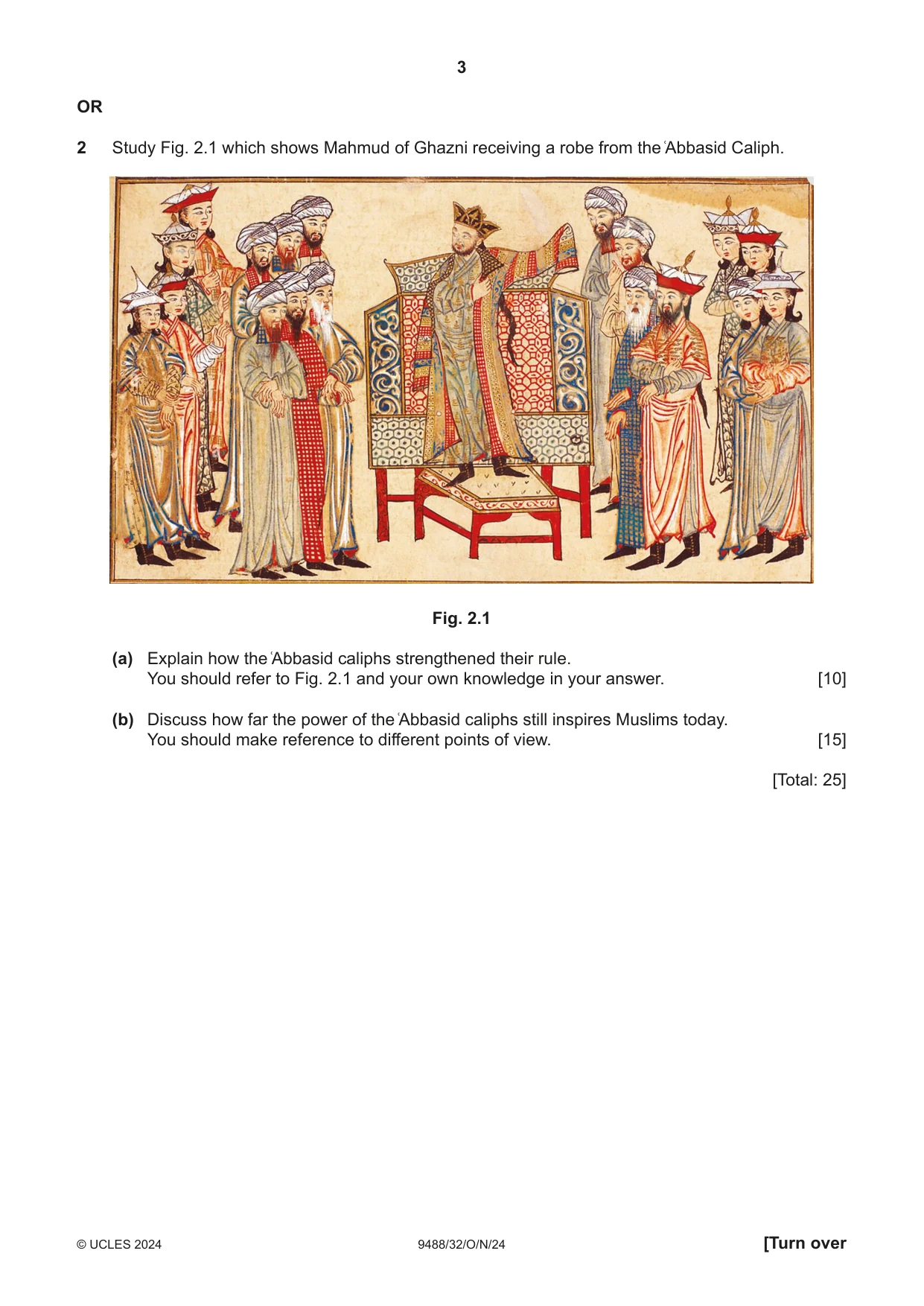
2 Study Fig. 2.1 which shows Mahmud of Ghazni receiving a robe from the ͑Abbasid Caliph. Fig. 2.1 (a) Explain how the ͑Abbasid caliphs strengthened their rule. You should refer to Fig. 2.1 and your own knowledge in your answer. [10] (b) Discuss how far the power of the ͑Abbasid caliphs still inspires Muslims today. You should make reference to different points of view. [15] [Total: 25]
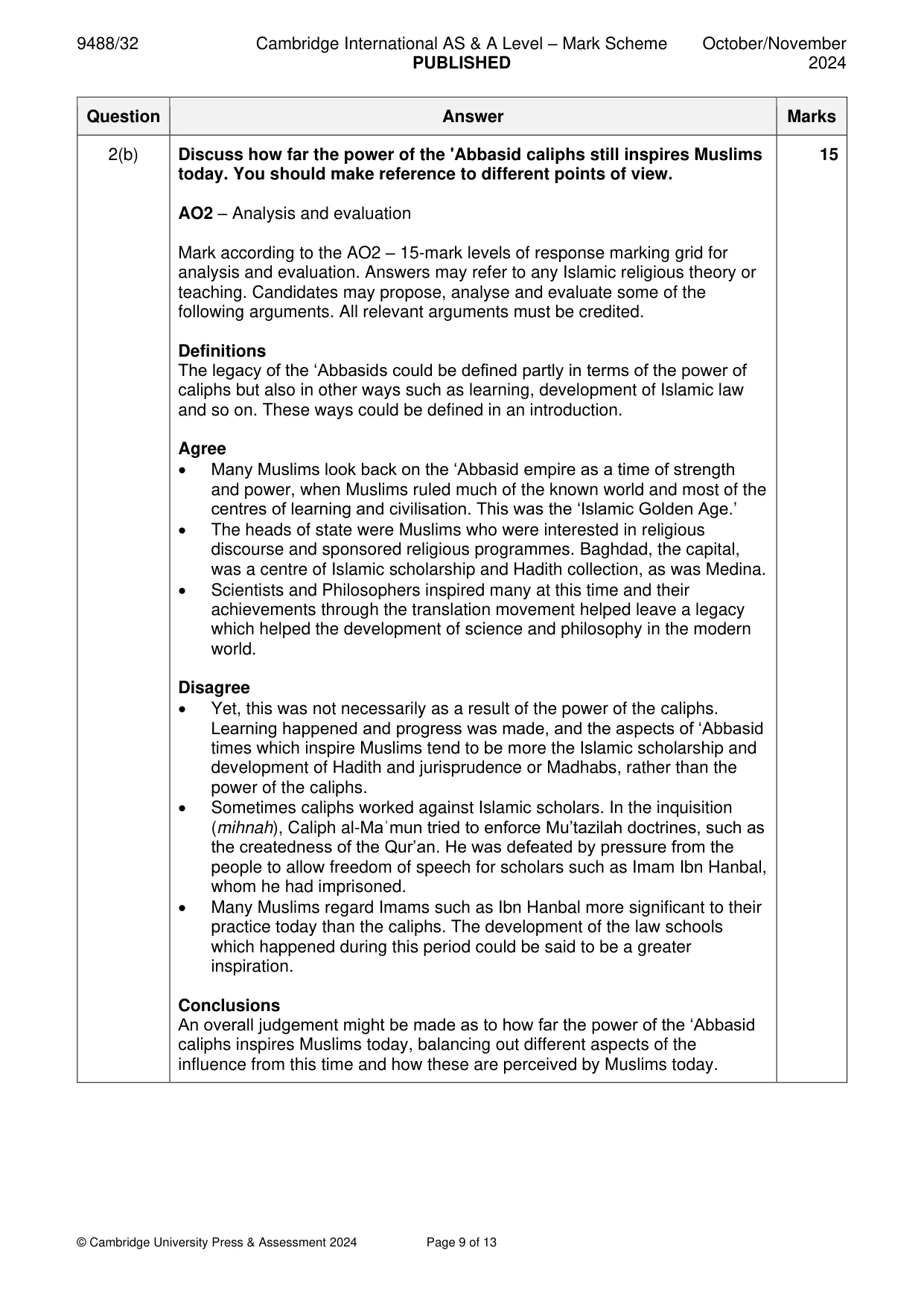
Mark scheme: 2(a) Explain how the 'Abbasid caliphs strengthened their rule. 10 You should refer to Fig. 2.1 and your own knowledge in your answer. AO1 – Knowledge and understanding Mark according to the AO1 – 10-mark levels of response marking grid for knowledge and understanding. Answers may include some of the following ideas, but all valid material must be credited. • The source shows Mahmud of Ghazni receiving a robe from the ‘Abbasid Caliph. This shows how the caliph, a central figure of authority, strengthened his rule by forging good relations with local rulers, who in turn pledged allegiance to him. • Those looking at the picture closely might notice that the caliph is giving a gift to a local ruler and not the other way round. This shows the ‘Abbasid strength became one based on consent: the Caliphate became more of a commonwealth than an empire according to some academic scholars. Power was held and strengthened by agreement. • Several agreements were made with client states to recognise the caliph whilst enjoying a degree of local freedom. The currency was issued in the name of the caliph and trade was widespread, but local rulers could also make their own rules. • Caliph as-Saffah defeated the Umayyads and claimed ancestry from the Prophet (pbuh) and had some support from the Shi’i who felt alienated by the Umayyads although not all Shi’i felt they gained their aims from the ‘Abbasids. • Caliph Al-Mansur moved the capital to Baghdad and included many non- Arabs in government. Baghdad was more central to the expanded lands of the caliphate and the move to broaden officialdom gained support from those who had been excluded under the Umayyads. • Al-Mansur sent forces to Africa as well as mercenaries to help the Tang dynasty in China, cementing his power internationally. 2(b) Discuss how far the power of the 'Abbasid caliphs still inspires Muslims 15 today. You should make reference to different points of view. AO2 – Analysis and evaluation Mark according to the AO2 – 15-mark levels of response marking grid for analysis and evaluation. Answers may refer to any Islamic religious theory or teaching. Candidates may propose, analyse and evaluate some of the following arguments. All relevant arguments must be credited. Definitions The legacy of the ‘Abbasids could be defined partly in terms of the power of caliphs but also in other ways such as learning, development of Islamic law and so on. These ways could be defined in an introduction. Agree • Many Muslims look back on the ‘Abbasid empire as a time of strength and power, when Muslims ruled much of the known world and most of the centres of learning and civilisation. This was the ‘Islamic Golden Age.’ • The heads of state were Muslims who were interested in religious discourse and sponsored religious programmes. Baghdad, the capital, was a centre of Islamic scholarship and Hadith collection, as was Medina. • Scientists and Philosophers inspired many at this time and their achievements through the translation movement helped leave a legacy which helped the development of science and philosophy in the modern world. Disagree • Yet, this was not necessarily as a result of the power of the caliphs. Learning happened and progress was made, and the aspects of ‘Abbasid times which inspire Muslims tend to be more the Islamic scholarship and development of Hadith and jurisprudence or Madhabs, rather than the power of the caliphs. • Sometimes caliphs worked against Islamic scholars. In the inquisition (mihnah), Caliph al-Maʾmun tried to enforce Mu’tazilah doctrines, such as the createdness of the Qur’an. He was defeated by pressure from the people to allow freedom of speech for scholars such as Imam Ibn Hanbal, whom he had imprisoned. • Many Muslims regard Imams such as Ibn Hanbal more significant to their practice today than the caliphs. The development of the law schools which happened during this period could be said to be a greater inspiration. Conclusions An overall judgement might be made as to how far the power of the ‘Abbasid caliphs inspires Muslims today, balancing out different aspects of the influence from this time and how these are perceived by Muslims today.
Q3 · Explain how one significant work written by a Muslim that you have studied might be used…
3 (a) Explain how one significant work written by a Muslim that you have studied might be used to invite people to Islam. [10] (b) ‘It is more effective to use different sources for different people.’ Discuss this statement with regard to ways in which Muslims might explain to others their main beliefs (daʿwah) today. [15] [Total: 25] OR
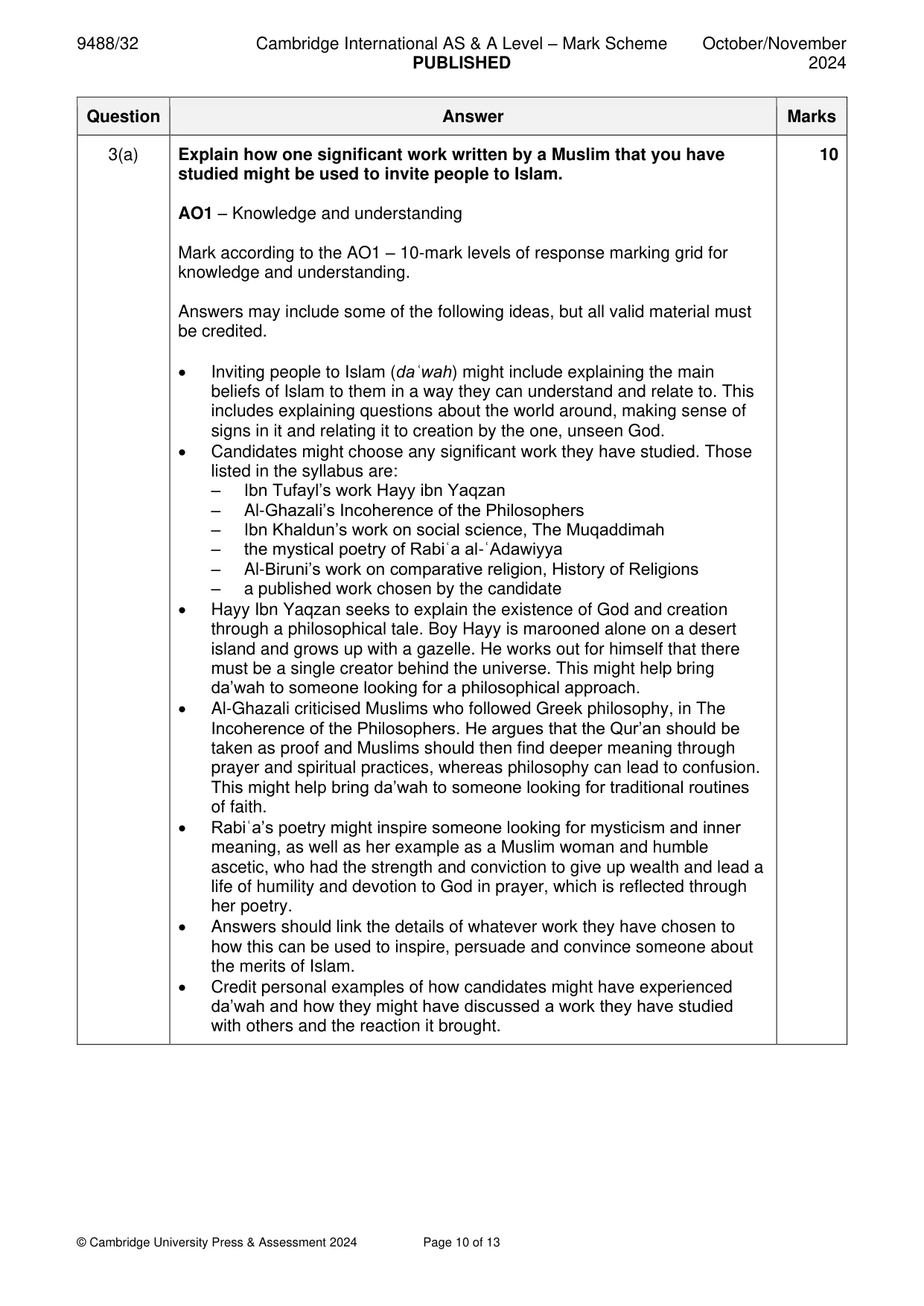
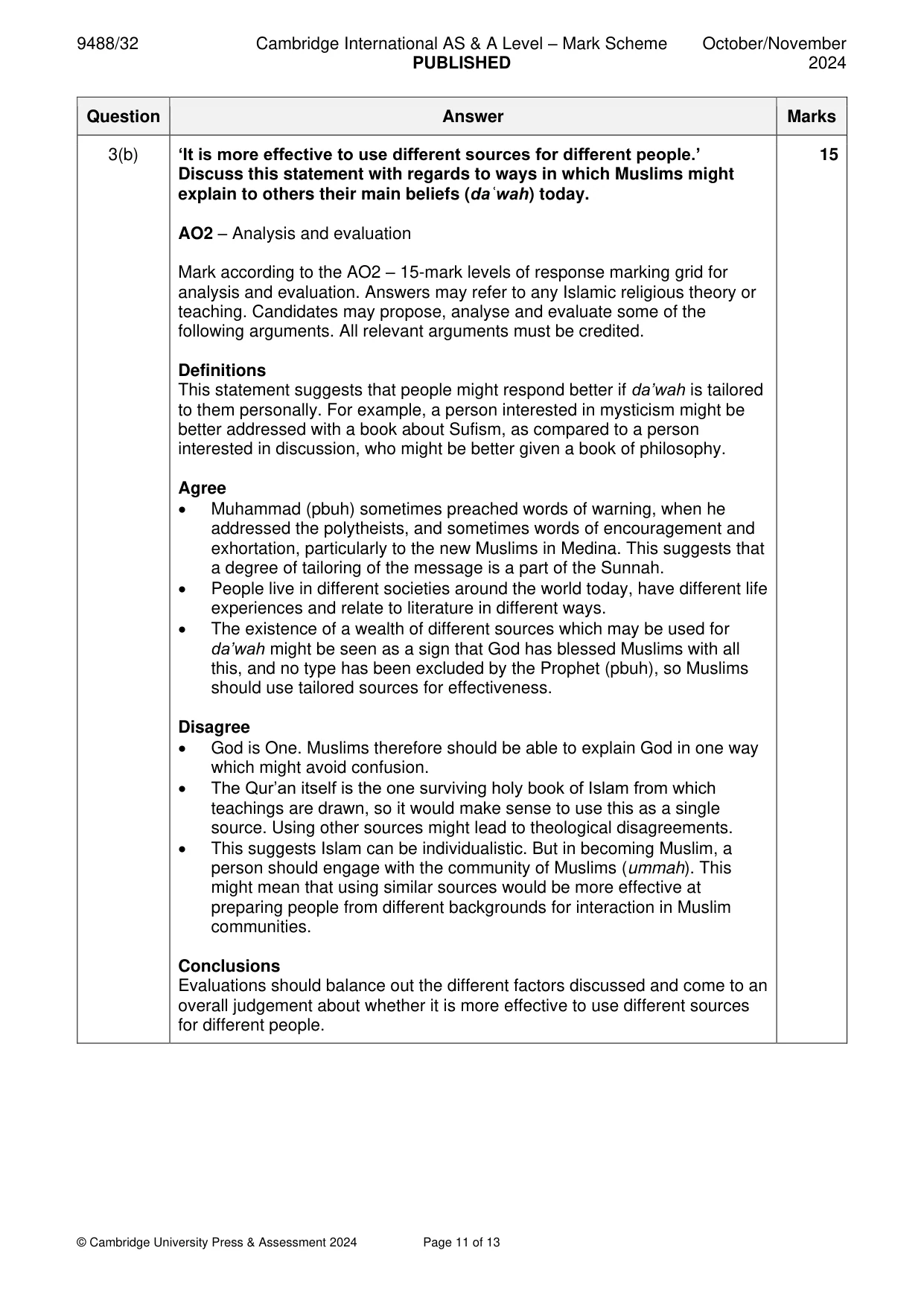
Mark scheme: 3(a) Explain how one significant work written by a Muslim that you have 10 studied might be used to invite people to Islam. AO1 – Knowledge and understanding Mark according to the AO1 – 10-mark levels of response marking grid for knowledge and understanding. Answers may include some of the following ideas, but all valid material must be credited. • Inviting people to Islam (daʿwah) might include explaining the main beliefs of Islam to them in a way they can understand and relate to. This includes explaining questions about the world around, making sense of signs in it and relating it to creation by the one, unseen God. • Candidates might choose any significant work they have studied. Those listed in the syllabus are: – Ibn Tufayl’s work Hayy ibn Yaqzan – Al-Ghazali’s Incoherence of the Philosophers – Ibn Khaldun’s work on social science, The Muqaddimah – the mystical poetry of Rabiʿa al-ʿAdawiyya – Al-Biruni’s work on comparative religion, History of Religions – a published work chosen by the candidate • Hayy Ibn Yaqzan seeks to explain the existence of God and creation through a philosophical tale. Boy Hayy is marooned alone on a desert island and grows up with a gazelle. He works out for himself that there must be a single creator behind the universe. This might help bring da’wah to someone looking for a philosophical approach. • Al-Ghazali criticised Muslims who followed Greek philosophy, in The Incoherence of the Philosophers. He argues that the Qur’an should be taken as proof and Muslims should then find deeper meaning through prayer and spiritual practices, whereas philosophy can lead to confusion. This might help bring da’wah to someone looking for traditional routines of faith. • Rabiʿa’s poetry might inspire someone looking for mysticism and inner meaning, as well as her example as a Muslim woman and humble ascetic, who had the strength and conviction to give up wealth and lead a life of humility and devotion to God in prayer, which is reflected through her poetry. • Answers should link the details of whatever work they have chosen to how this can be used to inspire, persuade and convince someone about the merits of Islam. • Credit personal examples of how candidates might have experienced da’wah and how they might have discussed a work they have studied with others and the reaction it brought. 3(b) ‘It is more effective to use different sources for different people.’ 15 Discuss this statement with regards to ways in which Muslims might explain to others their main beliefs (daʿwah) today. AO2 – Analysis and evaluation Mark according to the AO2 – 15-mark levels of response marking grid for analysis and evaluation. Answers may refer to any Islamic religious theory or teaching. Candidates may propose, analyse and evaluate some of the following arguments. All relevant arguments must be credited. Definitions This statement suggests that people might respond better if da’wah is tailored to them personally. For example, a person interested in mysticism might be better addressed with a book about Sufism, as compared to a person interested in discussion, who might be better given a book of philosophy. Agree • Muhammad (pbuh) sometimes preached words of warning, when he addressed the polytheists, and sometimes words of encouragement and exhortation, particularly to the new Muslims in Medina. This suggests that a degree of tailoring of the message is a part of the Sunnah. • People live in different societies around the world today, have different life experiences and relate to literature in different ways. • The existence of a wealth of different sources which may be used for da’wah might be seen as a sign that God has blessed Muslims with all this, and no type has been excluded by the Prophet (pbuh), so Muslims should use tailored sources for effectiveness. Disagree • God is One. Muslims therefore should be able to explain God in one way which might avoid confusion. • The Qur’an itself is the one surviving holy book of Islam from which teachings are drawn, so it would make sense to use this as a single source. Using other sources might lead to theological disagreements. • This suggests Islam can be individualistic. But in becoming Muslim, a person should engage with the community of Muslims (ummah). This might mean that using similar sources would be more effective at preparing people from different backgrounds for interaction in Muslim communities. Conclusions Evaluations should balance out the different factors discussed and come to an overall judgement about whether it is more effective to use different sources for different people.
Q4 · Explain the meaning of domes and geometrical patterns in Islamic architecture
4 (a) Explain the meaning of domes and geometrical patterns in Islamic architecture. [10] (b) Discuss the effectiveness of Islamic architecture in portraying Muslim beliefs about God. [15] [Total: 25]
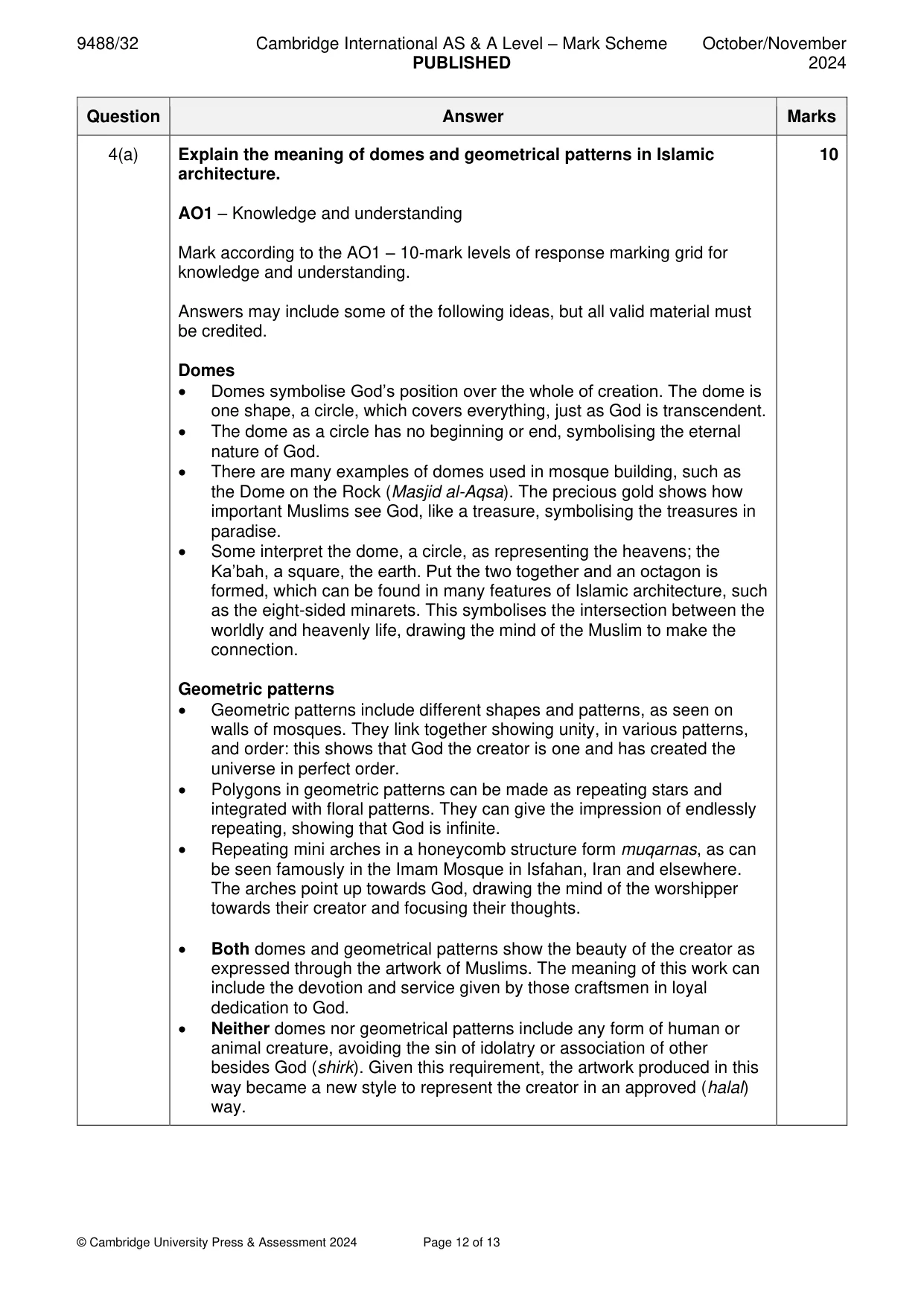
Mark scheme: 4(a) Explain the meaning of domes and geometrical patterns in Islamic 10 architecture. AO1 – Knowledge and understanding Mark according to the AO1 – 10-mark levels of response marking grid for knowledge and understanding. Answers may include some of the following ideas, but all valid material must be credited. Domes • Domes symbolise God’s position over the whole of creation. The dome is one shape, a circle, which covers everything, just as God is transcendent. • The dome as a circle has no beginning or end, symbolising the eternal nature of God. • There are many examples of domes used in mosque building, such as the Dome on the Rock (Masjid al-Aqsa). The precious gold shows how important Muslims see God, like a treasure, symbolising the treasures in paradise. • Some interpret the dome, a circle, as representing the heavens; the Ka’bah, a square, the earth. Put the two together and an octagon is formed, which can be found in many features of Islamic architecture, such as the eight-sided minarets. This symbolises the intersection between the worldly and heavenly life, drawing the mind of the Muslim to make the connection. Geometric patterns • Geometric patterns include different shapes and patterns, as seen on walls of mosques. They link together showing unity, in various patterns, and order: this shows that God the creator is one and has created the universe in perfect order. • Polygons in geometric patterns can be made as repeating stars and integrated with floral patterns. They can give the impression of endlessly repeating, showing that God is infinite. • Repeating mini arches in a honeycomb structure form muqarnas, as can be seen famously in the Imam Mosque in Isfahan, Iran and elsewhere. The arches point up towards God, drawing the mind of the worshipper towards their creator and focusing their thoughts. • Both domes and geometrical patterns show the beauty of the creator as expressed through the artwork of Muslims. The meaning of this work can include the devotion and service given by those craftsmen in loyal dedication to God. • Neither domes nor geometrical patterns include any form of human or animal creature, avoiding the sin of idolatry or association of other besides God (shirk). Given this requirement, the artwork produced in this way became a new style to represent the creator in an approved (halal) way. 4(b) Discuss the effectiveness of Islamic architecture in portraying Muslim 15 beliefs about God. AO2 – Analysis and evaluation Mark according to the AO2 – 15-mark levels of response marking grid for analysis and evaluation. Answers may refer to any Islamic religious theory or teaching. Candidates may propose, analyse and evaluate some of the following arguments. All relevant arguments must be credited. • ‘Effectiveness’ might be defined as something which is practical and successful. How far is Muslim architecture clear and easy to understand, so that Muslims get an idea about Islamic beliefs about God? • Muslim beliefs about God can be summarised in the doctrine of oneness (tawhid). There is one God with no idols or visual representations, in complete contrast to the pagan polytheists which preceded the Muslims in Mecca. • The change in beliefs would have been radical for the first believers, many of whom could not read or write. Muhammad’s clearance of the idols in the Ka’bah showed this change. There was a risk that in time some might reintroduce statues. By using various features of Islamic calligraphy, the categorical denial of partners with God was maintained. • The ninety-nine names of God, representing God’s attributes, are often included in Islamic architecture together with other verses from the Qur’an and beautified as calligraphy. This helps to focus the mind of Muslims on the word of God, the Qur’an, and link belief in one God to one final, unchanging revelation, the Qur’an. It also shows the respect in which it must be held. • Different aspects of God’s characteristics could be linked to different features in Islamic architecture, such as dome with transcendence; minaret pointed upward toward the message and call coming from the heavens; the mihrab or niche in a mosque representing the immanence of God in the inner reaches of heart. • Some features of Islamic architecture were re-used from previous periods, such as the repeating patterns found in mosaics or the arches and columns of the Romans, with modifications made to remove any images. It could be discussed how far this shows the continuity of monotheism and common heritage, particularly with Christians and Jews, and how far this does not effectively communicate differences in beliefs about God. • It could be argued that an individual should not be left to themselves to interpret patterns in architecture. A guide, or reading literature such as the Qur’an alongside, will ensure that the interpretation of those features is not left in doubt and may be more effective than the features on their own. • It might be pointed out that Islamic architecture had taken a variety of different styles in different parts of the world and in different periods, each with their own distinctive way of communicating beliefs within the culture they are rooted. This could be an effective way to explain to locals at the time, in a visual way they would understand.
What was in this paper
The subtopics covered by these 4 questions, and how many questions each got. Open one in a new tab to see every Cambridge question on it.
What you needed in this session
Cambridge’s own grade thresholds for 2024 Oct/Nov, Paper 3 · Variant 2. A higher threshold means an easier paper — the bar moves with how the cohort did.