Cambridge A Level Islamic Studies 9488 — 2023 Oct/Nov Paper 3 · Variant 2
9488/32/O/N/23 · 4 questions · 50 marks · ≈56 min
The question paper and its mark scheme, free to read here and free to download. This is Cambridge’s own paper, exactly as it was sat.
Question paper4 pages
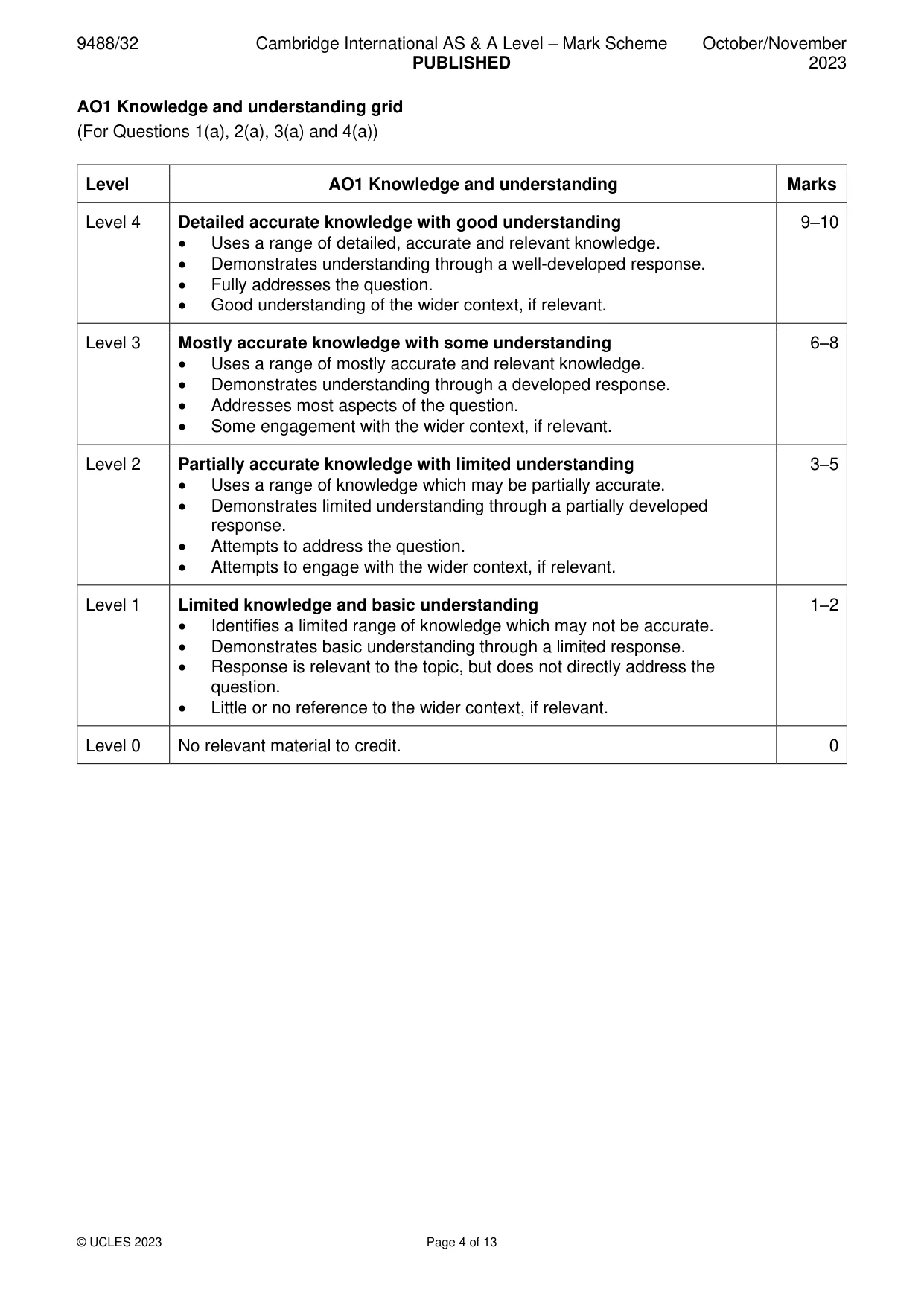
Mark scheme13 pages
Answers below. Sit the paper first if you are practising.
Questions as text
Question 1
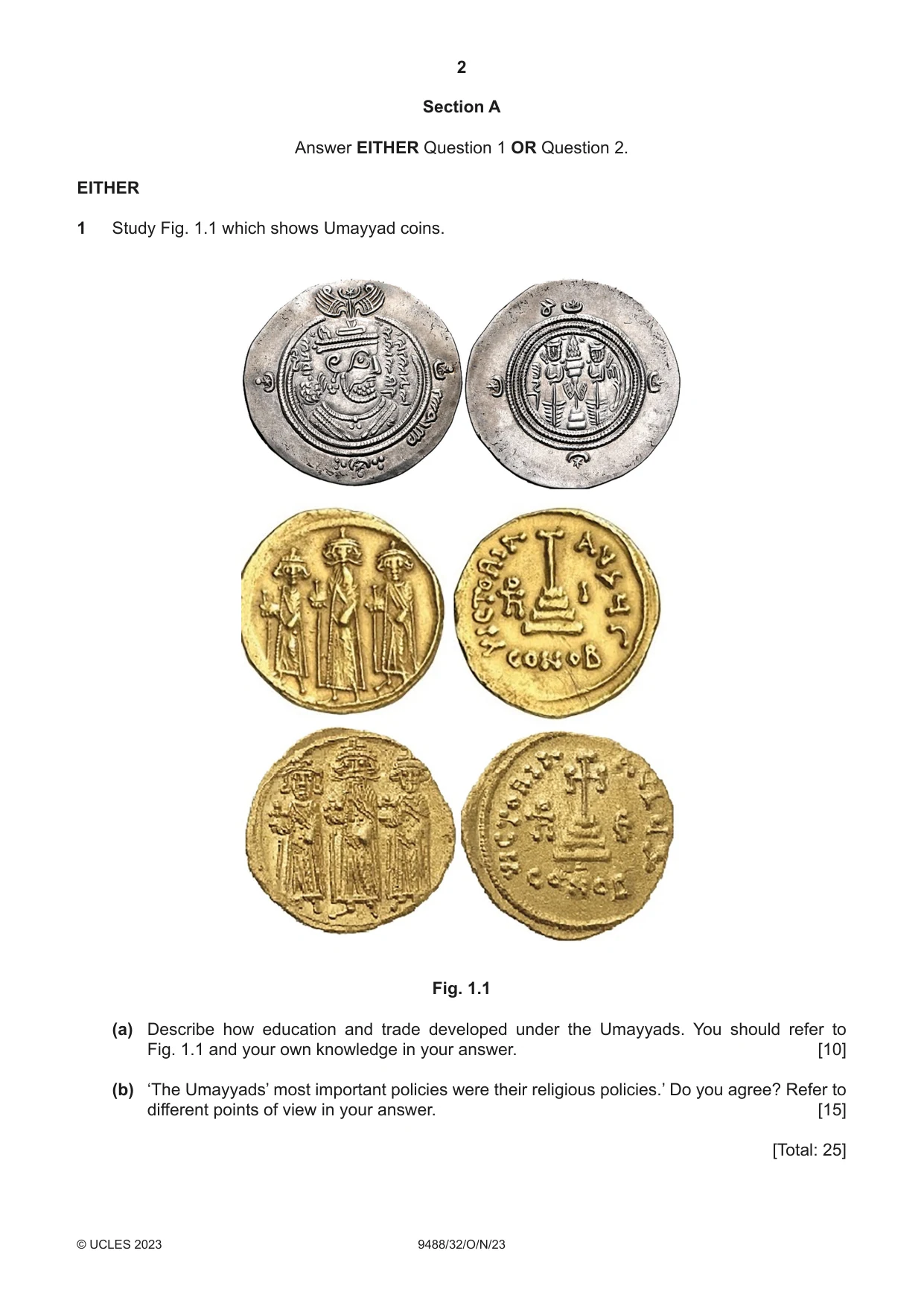
1 Study Fig. 1.1 which shows Umayyad coins. Fig. 1.1 (a) Describe how education and trade developed under the Umayyads. You should refer to Fig. 1.1 and your own knowledge in your answer. [10] (b) ‘The Umayyads’ most important policies were their religious policies.’ Do you agree? Refer to different points of view in your answer. [15] [Total: 25] OR
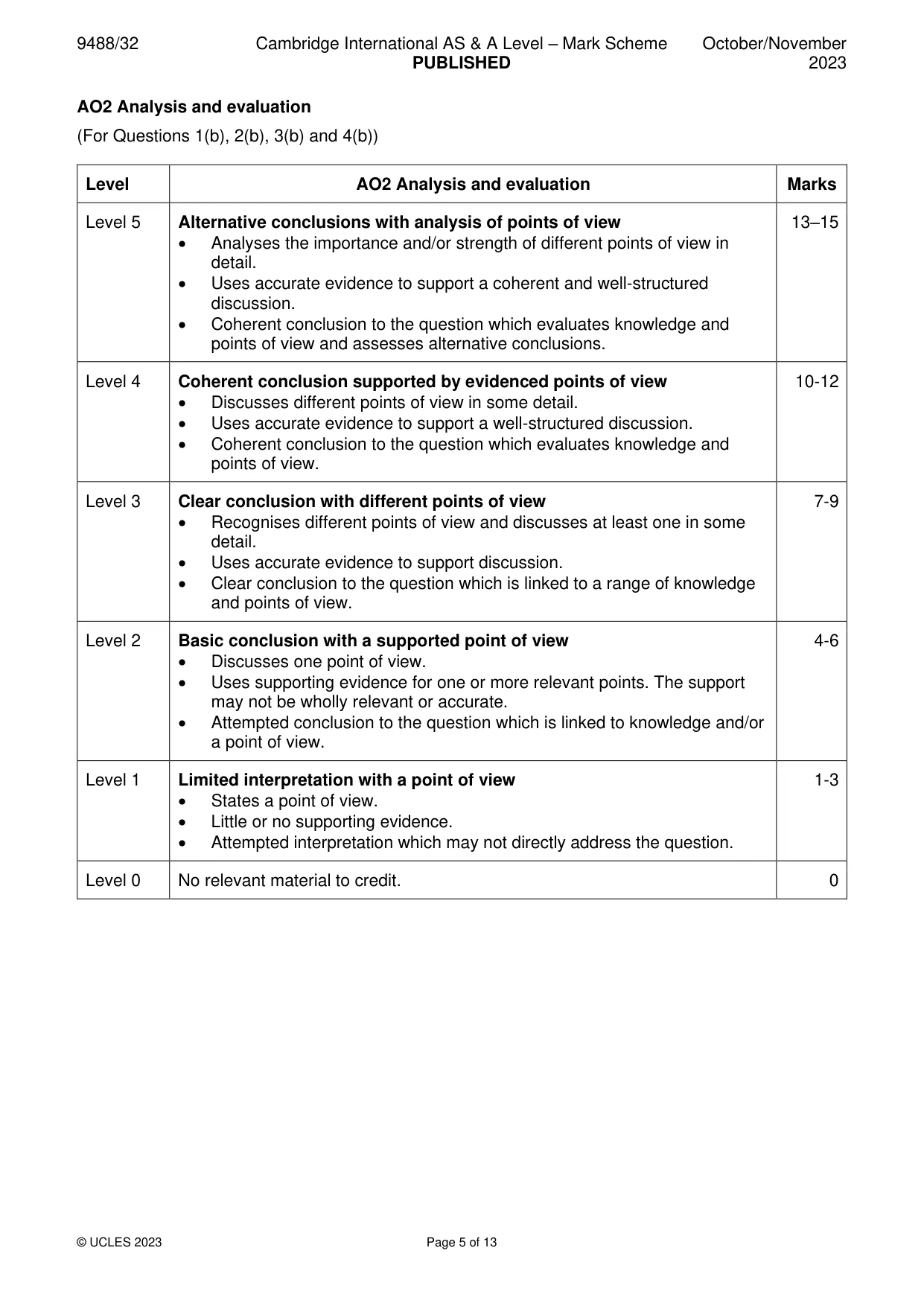
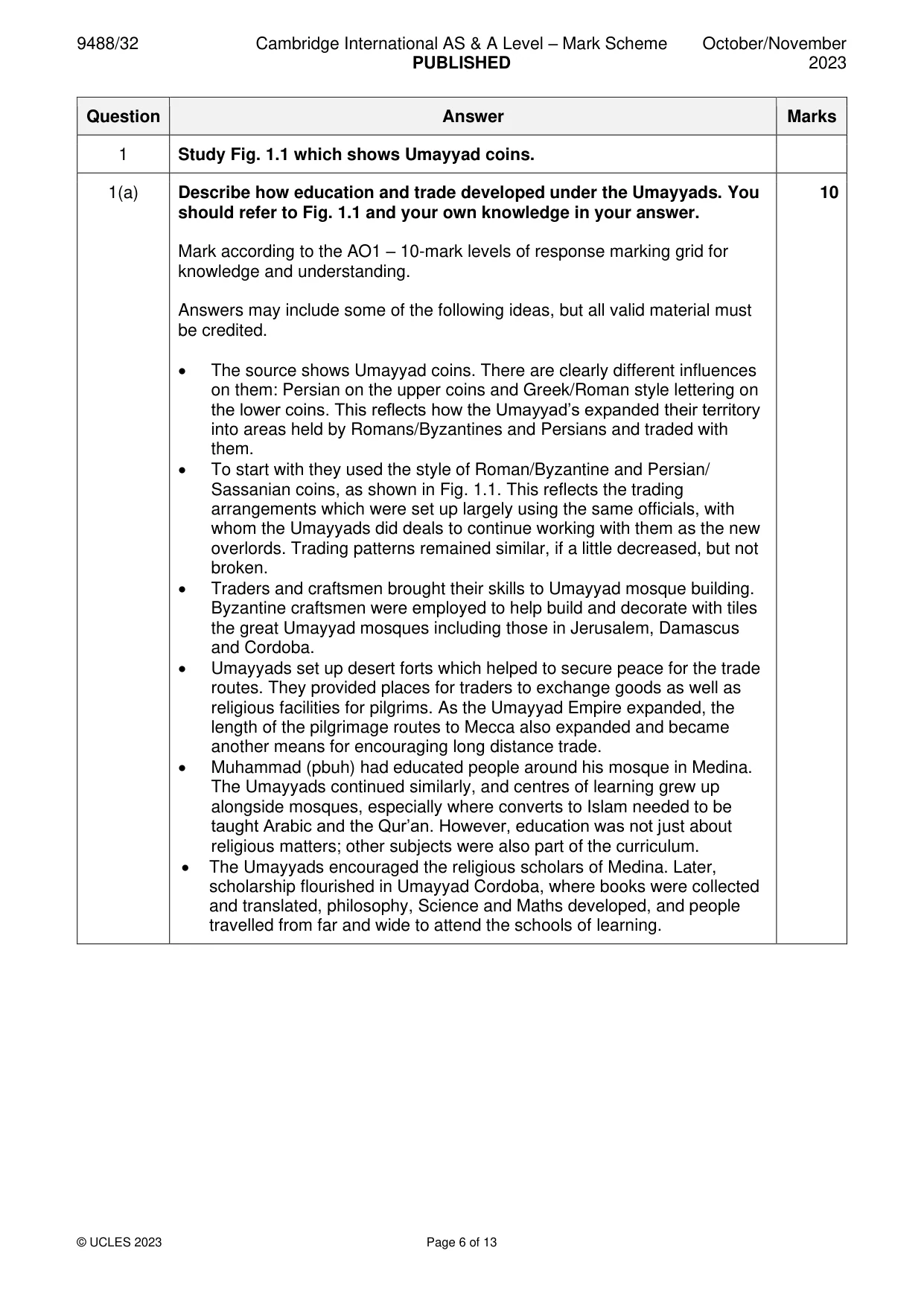
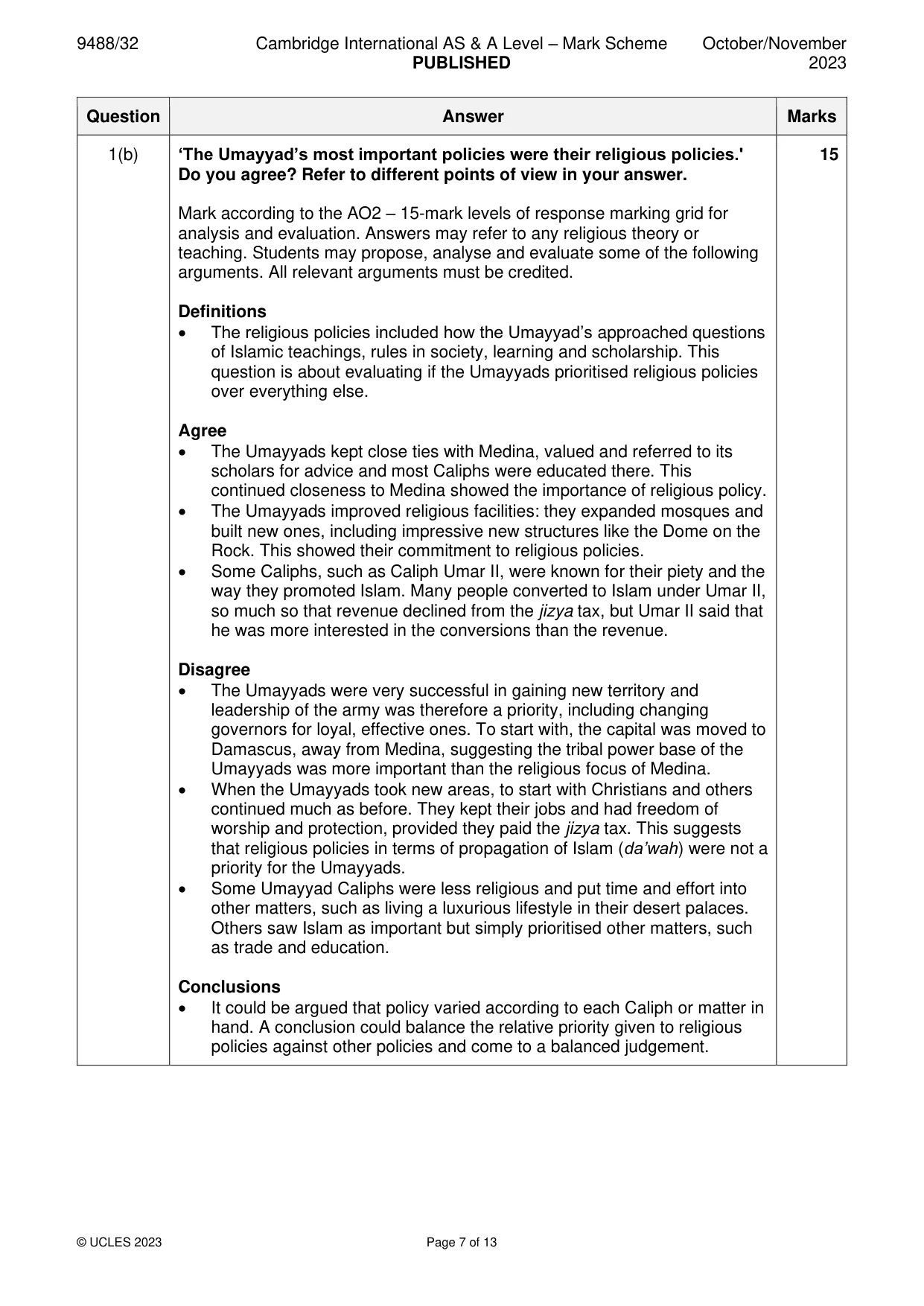
Mark scheme: Question Answer Marks 1 Study Fig. 1.1 which shows Umayyad coins. 1(a) Describe how education and trade developed under the Umayyads. You 10 should refer to Fig. 1.1 and your own knowledge in your answer. Mark according to the AO1 – 10-mark levels of response marking grid for knowledge and understanding. Answers may include some of the following ideas, but all valid material must be credited. • The source shows Umayyad coins. There are clearly different influences on them: Persian on the upper coins and Greek/Roman style lettering on the lower coins. This reflects how the Umayyad’s expanded their territory into areas held by Romans/Byzantines and Persians and traded with them. • To start with they used the style of Roman/Byzantine and Persian/ Sassanian coins, as shown in Fig. 1.1. This reflects the trading arrangements which were set up largely using the same officials, with whom the Umayyads did deals to continue working with them as the new overlords. Trading patterns remained similar, if a little decreased, but not broken. • Traders and craftsmen brought their skills to Umayyad mosque building. Byzantine craftsmen were employed to help build and decorate with tiles the great Umayyad mosques including those in Jerusalem, Damascus and Cordoba. • Umayyads set up desert forts which helped to secure peace for the trade routes. They provided places for traders to exchange goods as well as religious facilities for pilgrims. As the Umayyad Empire expanded, the length of the pilgrimage routes to Mecca also expanded and became another means for encouraging long distance trade. • Muhammad (pbuh) had educated people around his mosque in Medina. The Umayyads continued similarly, and centres of learning grew up alongside mosques, especially where converts to Islam needed to be taught Arabic and the Qur’an. However, education was not just about religious matters; other subjects were also part of the curriculum. • The Umayyads encouraged the religious scholars of Medina. Later, scholarship flourished in Umayyad Cordoba, where books were collected and translated, philosophy, Science and Maths developed, and people travelled from far and wide to attend the schools of learning. 1(b) ‘The Umayyad’s most important policies were their religious policies.' 15 Do you agree? Refer to different points of view in your answer. Mark according to the AO2 – 15-mark levels of response marking grid for analysis and evaluation. Answers may refer to any religious theory or teaching. Students may propose, analyse and evaluate some of the following arguments. All relevant arguments must be credited. Definitions • The religious policies included how the Umayyad’s approached questions of Islamic teachings, rules in society, learning and scholarship. This question is about evaluating if the Umayyads prioritised religious policies over everything else. Agree • The Umayyads kept close ties with Medina, valued and referred to its scholars for advice and most Caliphs were educated there. This continued closeness to Medina showed the importance of religious policy. • The Umayyads improved religious facilities: they expanded mosques and built new ones, including impressive new structures like the Dome on the Rock. This showed their commitment to religious policies. • Some Caliphs, such as Caliph Umar II, were known for their piety and the way they promoted Islam. Many people converted to Islam under Umar II, so much so that revenue declined from the jizya tax, but Umar II said that he was more interested in the conversions than the revenue. Disagree • The Umayyads were very successful in gaining new territory and leadership of the army was therefore a priority, including changing governors for loyal, effective ones. To start with, the capital was moved to Damascus, away from Medina, suggesting the tribal power base of the Umayyads was more important than the religious focus of Medina. • When the Umayyads took new areas, to start with Christians and others continued much as before. They kept their jobs and had freedom of worship and protection, provided they paid the jizya tax. This suggests that religious policies in terms of propagation of Islam (da’wah) were not a priority for the Umayyads. • Some Umayyad Caliphs were less religious and put time and effort into other matters, such as living a luxurious lifestyle in their desert palaces. Others saw Islam as important but simply prioritised other matters, such as trade and education. Conclusions • It could be argued that policy varied according to each Caliph or matter in hand. A conclusion could balance the relative priority given to religious policies against other policies and come to a balanced judgement.
Question 2
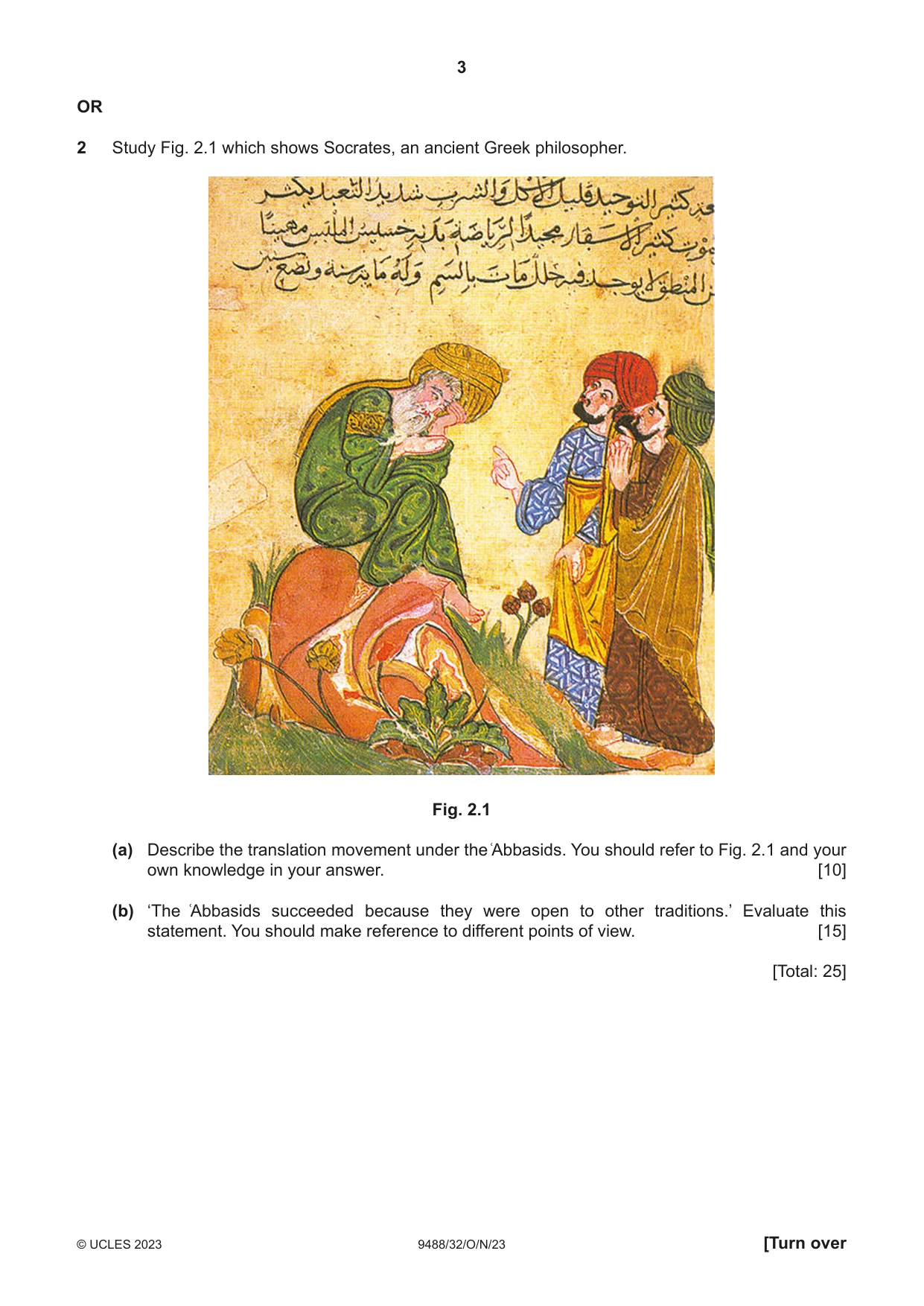
2 Study Fig. 2.1 which shows Socrates, an ancient Greek philosopher. Fig. 2.1 (a) Describe the translation movement under the ͑Abbasids. You should refer to Fig. 2.1 and your own knowledge in your answer. [10] (b) ‘The ͑Abbasids succeeded because they were open to other traditions.’ Evaluate this statement. You should make reference to different points of view. [15] [Total: 25]
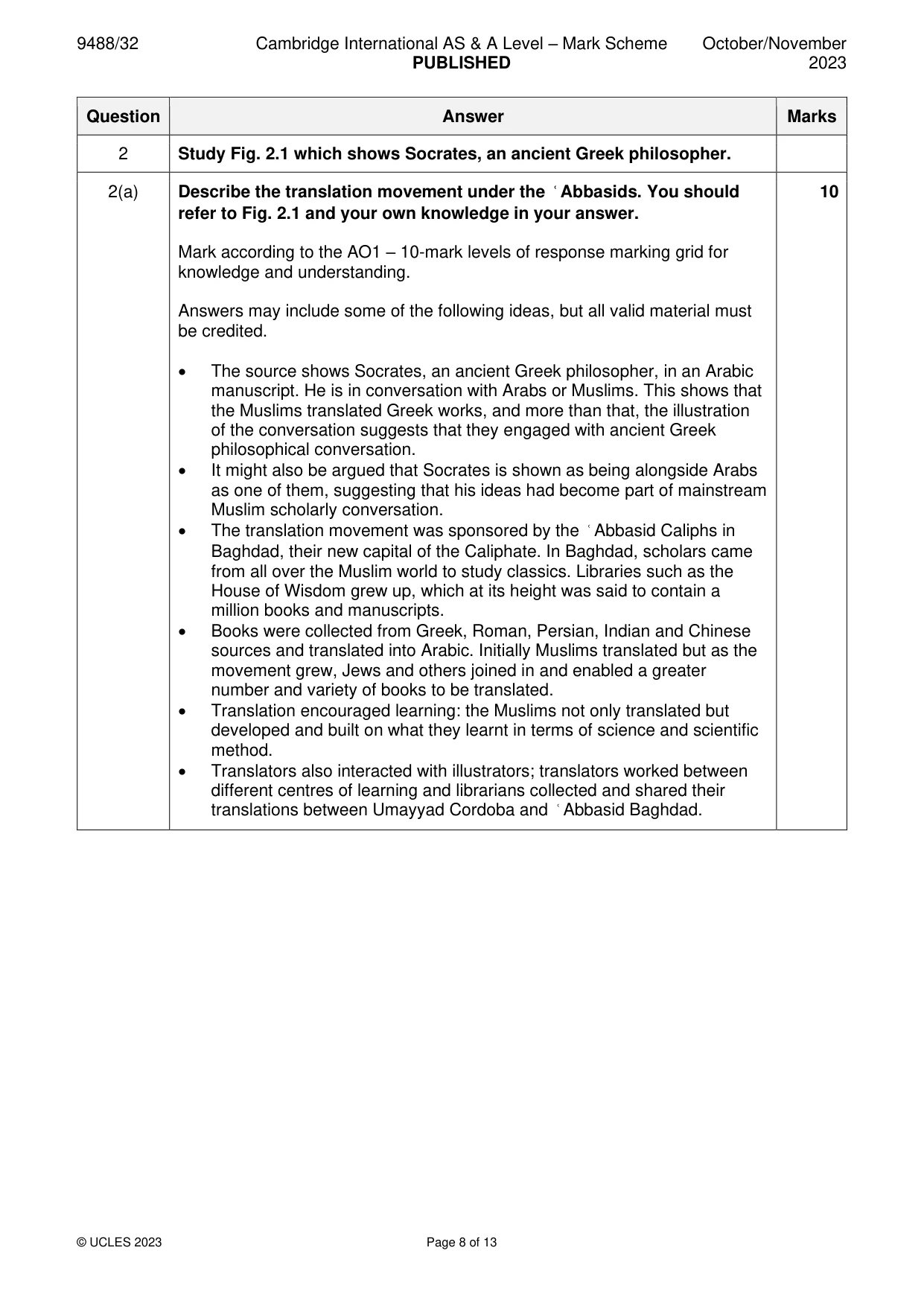
Mark scheme: 2 Study Fig. 2.1 which shows Socrates, an ancient Greek philosopher. 2(a) Describe the translation movement under the ʿAbbasids. You should 10 refer to Fig. 2.1 and your own knowledge in your answer. Mark according to the AO1 – 10-mark levels of response marking grid for knowledge and understanding. Answers may include some of the following ideas, but all valid material must be credited. • The source shows Socrates, an ancient Greek philosopher, in an Arabic manuscript. He is in conversation with Arabs or Muslims. This shows that the Muslims translated Greek works, and more than that, the illustration of the conversation suggests that they engaged with ancient Greek philosophical conversation. • It might also be argued that Socrates is shown as being alongside Arabs as one of them, suggesting that his ideas had become part of mainstream Muslim scholarly conversation. • The translation movement was sponsored by the ʿAbbasid Caliphs in Baghdad, their new capital of the Caliphate. In Baghdad, scholars came from all over the Muslim world to study classics. Libraries such as the House of Wisdom grew up, which at its height was said to contain a million books and manuscripts. • Books were collected from Greek, Roman, Persian, Indian and Chinese sources and translated into Arabic. Initially Muslims translated but as the movement grew, Jews and others joined in and enabled a greater number and variety of books to be translated. • Translation encouraged learning: the Muslims not only translated but developed and built on what they learnt in terms of science and scientific method. • Translators also interacted with illustrators; translators worked between different centres of learning and librarians collected and shared their translations between Umayyad Cordoba and ʿAbbasid Baghdad. 2(b) ‘The ʿAbbasids succeeded because they were open to other traditions.' 15 Evaluate this statement. You should make reference to different points of view. Mark according to the AO2 – 15-mark levels of response marking grid for analysis and evaluation. Answers may refer to any religious theory or teaching. Students may propose, analyse and evaluate some of the following arguments. All relevant arguments must be credited. Definitions • This statement should be defined in terms of what success was for the ʿAbbasids. It could mean leadership, religious policies, number of translations, or the philosophy and learning which flowed from them. Agree • The ʿAbbasids collected vast numbers of manuscripts and could only have done this because they interacted with people from different parts of the known world. If they had not done so, the number of manuscripts would have been fewer. • Baghdad, the ʿAbbasid capital, was a centre of scholarship and philosophical discussion. This showed openness to other traditions which was important in generating the climate in which these discussions could take place. • The ʿAbbasids were open to other traditions in that they appointed prime ministers (viziers), such as the Barmakid family, of Afghan Buddhist heritage; they appointed commanders and leaders in different lands who were not Arabs and who succeeded in gaining the loyalty of locals because they saw that the ʿAbbasids valued people of different backgrounds. • Many of the scientific works produced included openness to learning from ancient Greek and other traditions, which helped ʿAbbasid era scientists and scholars to succeed. Disagree • It could be argued that the ʿAbbasids were not always open to other traditions. The proportion of people who were Muslims increased during ʿAbbasid rule, and Christian scholars rarely visited ʿAbbasid lands. Interaction in scholarly debate was mostly Muslim. • For a while, the ʿAbbasids tried to enforce Mu’tazilah doctrine, to the opposition of many religious scholars including Ahmad ibn Hanbal. This suggests they were not very open, or some of the time they were not tolerant of dissent. • There are many other reasons for ʿAbbasid success including their ability to negotiate with others and to use opportunities to expand their power. They also benefitted from the weakness of their enemies. It could be said that these were more important reasons. Conclusions • The conclusion should come to a personal judgement about the most important reason or reasons for ʿAbbasid success and if this was their openness, and how significant their openness was in relation to that success.
Q3 · Explain how Muslims may find meaning in signs in the natural world
3 (a) Explain how Muslims may find meaning in signs in the natural world. [10] (b) ‘It is easier to learn from signs in the natural world than from revelations.’ To what extent is this true for Muslims? [15] [Total: 25] OR
Mark scheme: 3(a) Explain how Muslims may find meaning in signs in the natural world. 10 Mark according to the AO1 – 10-mark levels of response marking grid for knowledge and understanding. Answers may include some of the following ideas, but all valid material must be credited. • Muslims link everything in everyday life to part of God’s predestined plan, so they see signs in everything. For example, Muslims say thanks to God, alhamdulilah, for food, and after any good news, because it is seen as a good sign that God has given them something for their life. The same is true if they see a beautiful scene in nature: subhanallah for what God has given. • Muslims might see the beauty of the natural world as inspiration for their faith. Signs might make a Muslim thankful for the food and fruits which God has given them and see their provision as a sign of what God has given. • The Qur’an encourages Muslims to look at signs in the natural world and think about them, because they have been sent by God to help Muslims strengthen their beliefs. For example: • He doth regulate all affairs, explaining the signs in detail, that ye may believe with certainty in the meeting with your Lord. Qur’an 13:2, and • Behold! in these things there are signs for people who believe. Qur’an 6:99 • In Qur’an 41:53 it refers to signs in the universe and people’s own bodies. • Muslims might read about the teachings of the philosophers who observed the natural world and its signs, and derived meaning from them, using reasoning. • For example, Ibn Tufayl wrote about deriving belief using signs from the natural world. • Muslim philosopher Ibn Sina wrote on the importance of reasoning. • Muslims are expected to be guardians/viceregents of the world which God has created, so they might interpret environmental problems as signs that humanity has neglected this duty. Such signs might be interpreted as a warning to change polluting ways and take action to preserve the environment. 3(b) ‘It is easier to learn from signs in the natural world than from 15 revelations.' To what extent is this true for Muslims? Mark according to the AO2 – 15-mark levels of response marking grid for analysis and evaluation. Answers may refer to any religious theory or teaching. Students may propose, analyse and evaluate some of the following arguments. All relevant arguments must be credited. Definitions • Signs in the natural world might include the beauty of nature; natural events such as earthquakes and weather storms; eclipses of the moon or sun; and the results of things humans do as manifested in the environment around them. Agree • Revelations may refer specifically to the Qur’an, which contains some verses which are clear and some which may appear less clear (according to the Qur’an itself, Qur’an 3.7). • Experience of the natural world is something all Muslims can do themselves; it is clear and all around. Muslims can see with their own eyes the natural environment and how it is sometimes damaged by human exploitation, and hear of pressing environmental campaigns, which to Muslims are important to preserve God’s created world. • Muslim philosophers such as Ibn Tufayl wrote in his novel Hayy ibn Yaqzan about how the boy Hayy worked out signs from the natural world and derived beliefs from them. He did this without the distractions of corruption from society. This suggests that following signs can be clear. Disagree • The revelation of the Qur’an explains to Muslims the key teachings of their faith, especially the beliefs in the oneness of God, the belief in prophethood and in life after death. These beliefs require definition and elaboration, which means it is better to use the details given in the Qur’an than other sources. • Revelation, particularly the Qur’an, is the first source of Islamic law (shariah) because it is the word of God for Muslims. If it is the first source of Islamic law, then it should also be used as the first source for Muslim individuals for their personal guidance. • There is a danger that if Muslims follow signs alone, they might come to interpretations which are not accepted by mainstream scholars. Therefore, revelations should always be used for guidance, and revelations should set the context in which Muslims look at the natural world for signs. Conclusions • Conclusions will come to a judgement about which way is easiest and for what reasons. The significance of this might be mentioned in the life and practice of Muslims.
Q4 · Explain how Islamic beliefs are expressed through the features of one mosque that you…
4 (a) Explain how Islamic beliefs are expressed through the features of one mosque that you have studied. [10] (b) To what extent do mosques display the same features? Discuss with reference to two mosques which you have studied. [15] [Total: 25]
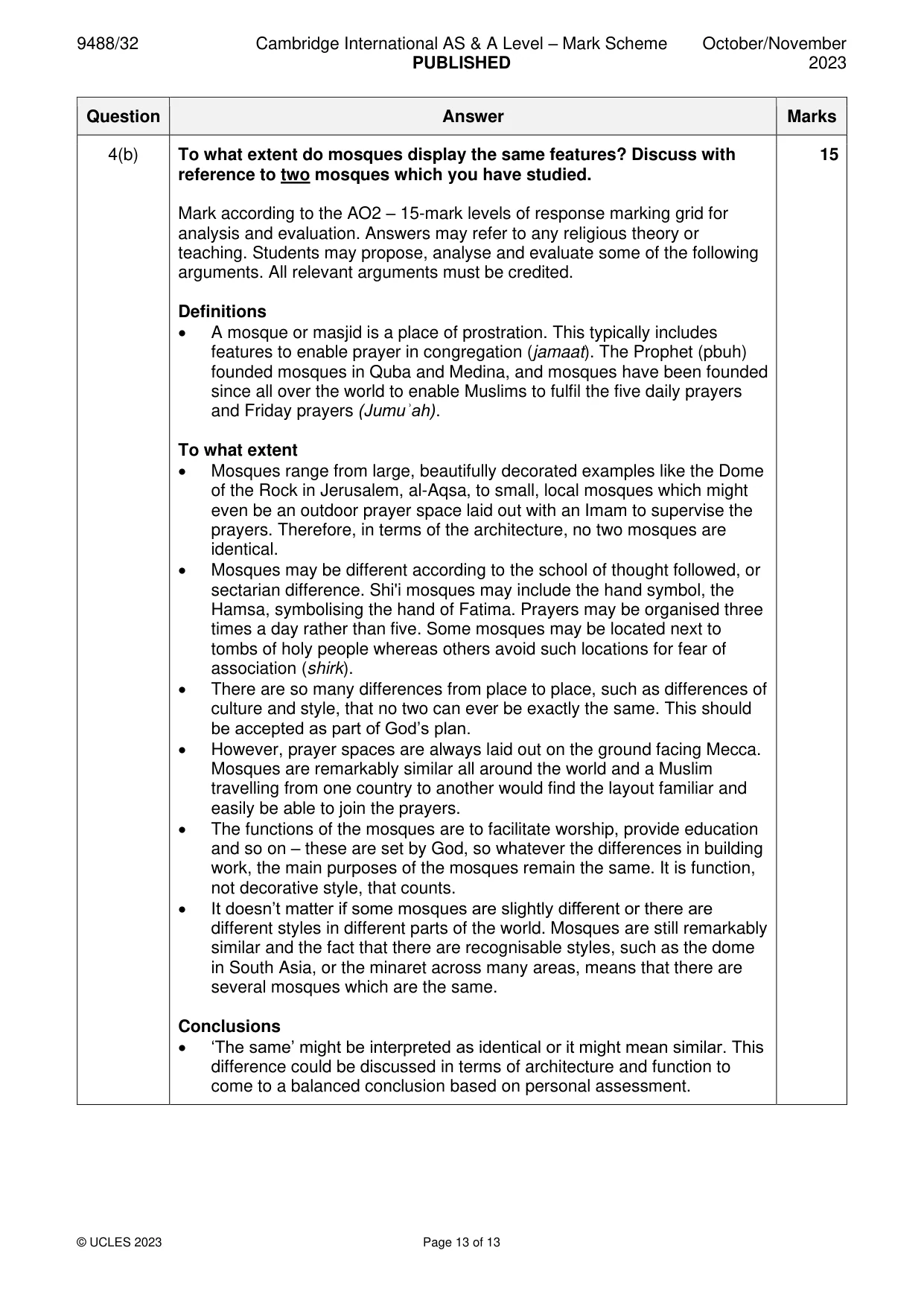
Mark scheme: 4(a) Explain how Islamic beliefs are expressed through the features of one 10 mosque that you have studied. Mark according to the AO1 – 10-mark levels of response marking grid for knowledge and understanding. Answers may include some of the following ideas, but all valid material must be credited. • Mosques listed in the specification for study are: • Timurid Bibi Khanum Mosque, Samarkand • Ottoman Sultan Ahmed Mosque, Istanbul • Mughal Jama Mosque, Delhi • The Great Ming Mosque, Xiʾan • Safavid Shah Mosque, Isfahan • The Great Mosque, Djenne • a mosque, such as a local mosque, chosen by the candidate. • Mosques commonly have prayer mats or spaces for people to prostrate in full submission to God, reflecting the belief in the statement of faith (shahadah), and the belief that God is all-powerful and in control of their lives. • Other features of the mosque include the niche facing the Ka’ba (mihrab); the tower (minaret) for the call to prayer (adhan); and the pulpit (mimbar) for the Friday sermon. These reflect aspects of the Sunnah of Muhammad (pbuh) and the first mosques he built. They show Muslims to follow his perfect example and believe in his prophethood. • Mosques show no icons, idols or figurines, reflecting the belief in the one unseen God. God may be represented through beautiful calligraphy representing words from the Qur’an and sometimes the names of God, to show what God is like, but never any visual representation. This reflects the Islamic belief in the oneness of God (tawhid) and the rejection of all else besides God (shirk), linking back to the time when the Prophet (pbuh) cleared the Ka’ba of idols. • Islamic beliefs in the Qur’an as the word of God can be seen in the reverence given to it in the features of mosques. Not only in the calligraphy, but also in keeping copies in a high, covered place and in the beauty of recitation. A feature of mosques is this beautiful recitation and schools to teach the Qur’an to children. • Symmetry might be used in the design of the mosque to represent unity in the universe, symbolic of the belief in God as creator and in signs of this in the beauty of creation. Examples of symmetry include hexagonal patterns, mosaics and tiles. Some mosques are built around four-sided rectangles and gates/entrances representing the gates into paradise. • Features of the Garden of Paradise may be shown through abstract vines and floral designs, showing the belief in the afterlife. 4(b) To what extent do mosques display the same features? Discuss with 15 reference to two mosques which you have studied. Mark according to the AO2 – 15-mark levels of response marking grid for analysis and evaluation. Answers may refer to any religious theory or teaching. Students may propose, analyse and evaluate some of the following arguments. All relevant arguments must be credited. Definitions • A mosque or masjid is a place of prostration. This typically includes features to enable prayer in congregation (jamaat). The Prophet (pbuh) founded mosques in Quba and Medina, and mosques have been founded since all over the world to enable Muslims to fulfil the five daily prayers and Friday prayers (Jumuʾah). To what extent • Mosques range from large, beautifully decorated examples like the Dome of the Rock in Jerusalem, al-Aqsa, to small, local mosques which might even be an outdoor prayer space laid out with an Imam to supervise the prayers. Therefore, in terms of the architecture, no two mosques are identical. • Mosques may be different according to the school of thought followed, or sectarian difference. Shi'i mosques may include the hand symbol, the Hamsa, symbolising the hand of Fatima. Prayers may be organised three times a day rather than five. Some mosques may be located next to tombs of holy people whereas others avoid such locations for fear of association (shirk). • There are so many differences from place to place, such as differences of culture and style, that no two can ever be exactly the same. This should be accepted as part of God’s plan. • However, prayer spaces are always laid out on the ground facing Mecca. Mosques are remarkably similar all around the world and a Muslim travelling from one country to another would find the layout familiar and easily be able to join the prayers. • The functions of the mosques are to facilitate worship, provide education and so on – these are set by God, so whatever the differences in building work, the main purposes of the mosques remain the same. It is function, not decorative style, that counts. • It doesn’t matter if some mosques are slightly different or there are different styles in different parts of the world. Mosques are still remarkably similar and the fact that there are recognisable styles, such as the dome in South Asia, or the minaret across many areas, means that there are several mosques which are the same. Conclusions • ‘The same’ might be interpreted as identical or it might mean similar. This difference could be discussed in terms of architecture and function to come to a balanced conclusion based on personal assessment.
What was in this paper
The subtopics covered by these 4 questions, and how many questions each got. Open one in a new tab to see every Cambridge question on it.
What you needed in this session
Cambridge’s own grade thresholds for 2023 Oct/Nov, Paper 3 · Variant 2. A higher threshold means an easier paper — the bar moves with how the cohort did.