Cambridge A Level Islamic Studies 9488 — 2024 May/June Paper 3 · Variant 2
9488/32/M/J/24 · 4 questions · 50 marks · 90 min
The question paper and its mark scheme, free to read here and free to download. This is Cambridge’s own paper, exactly as it was sat.
Question paper4 pages
Mark scheme14 pages
Answers below. Sit the paper first if you are practising.
Questions as text
Question 1
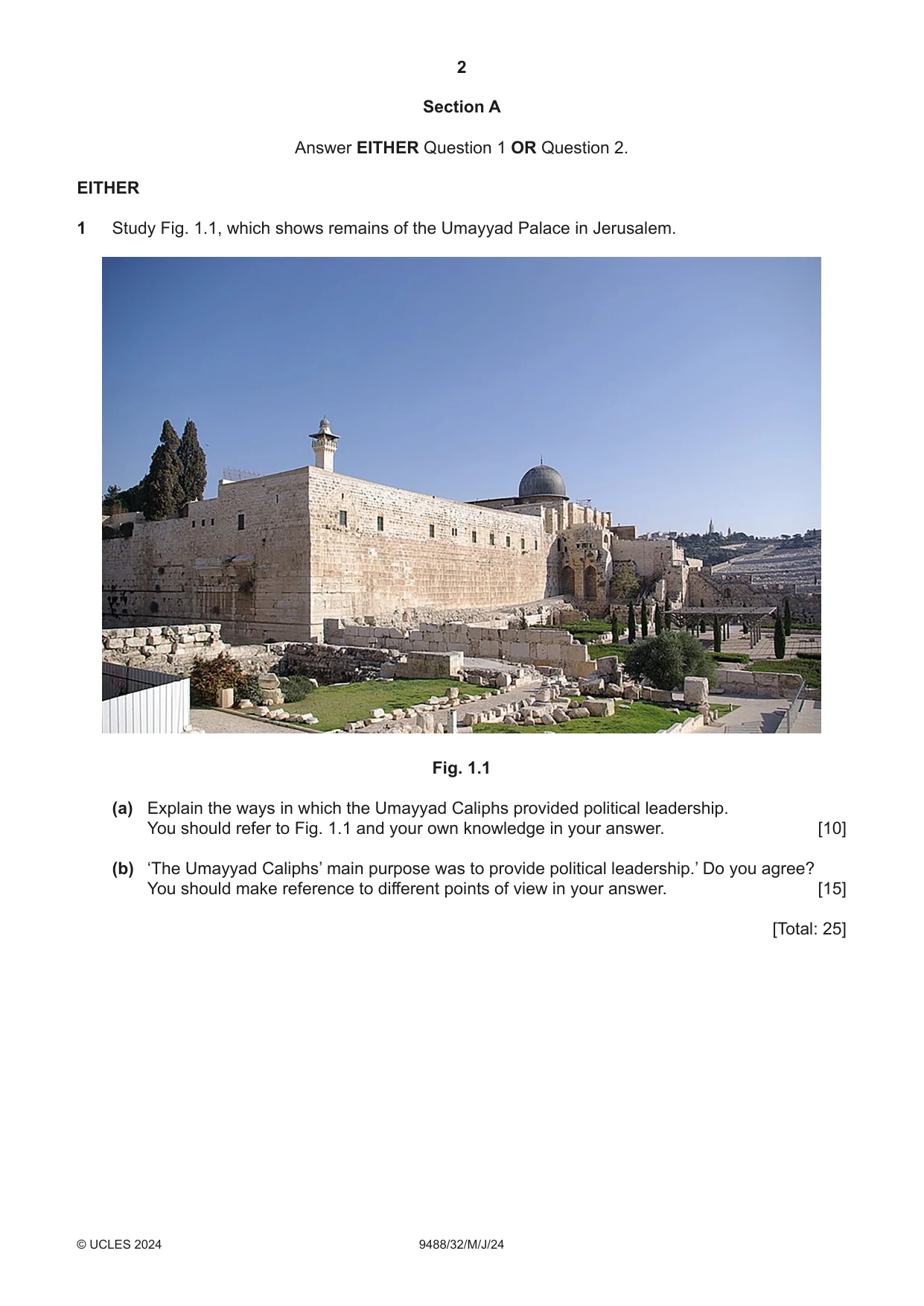
1 Study Fig. 1.1, which shows remains of the Umayyad Palace in Jerusalem. Fig. 1.1 (a) Explain the ways in which the Umayyad Caliphs provided political leadership. You should refer to Fig. 1.1 and your own knowledge in your answer. [10] (b) ‘The Umayyad Caliphs’ main purpose was to provide political leadership.’ Do you agree? You should make reference to different points of view in your answer. [15] [Total: 25] OR
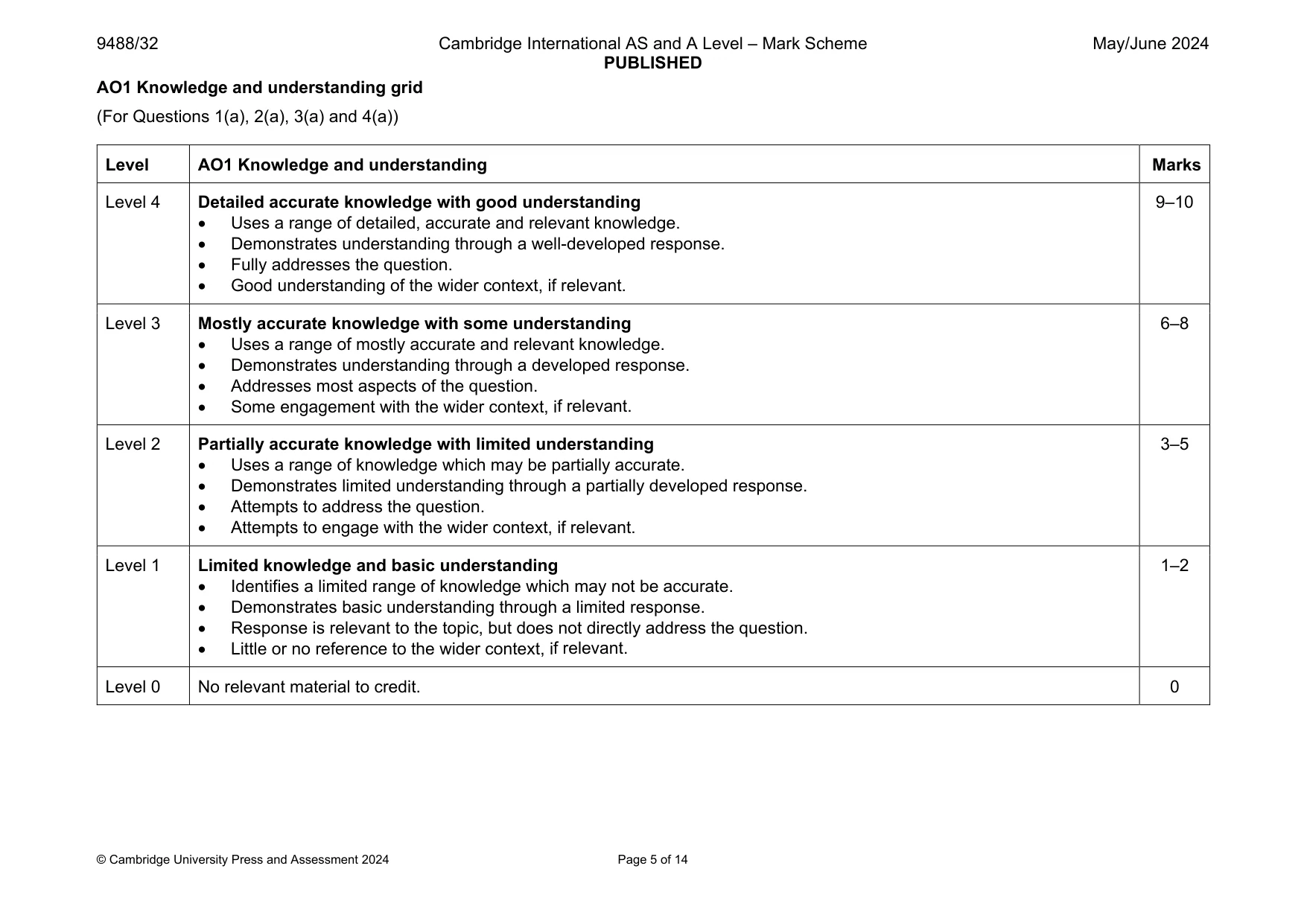
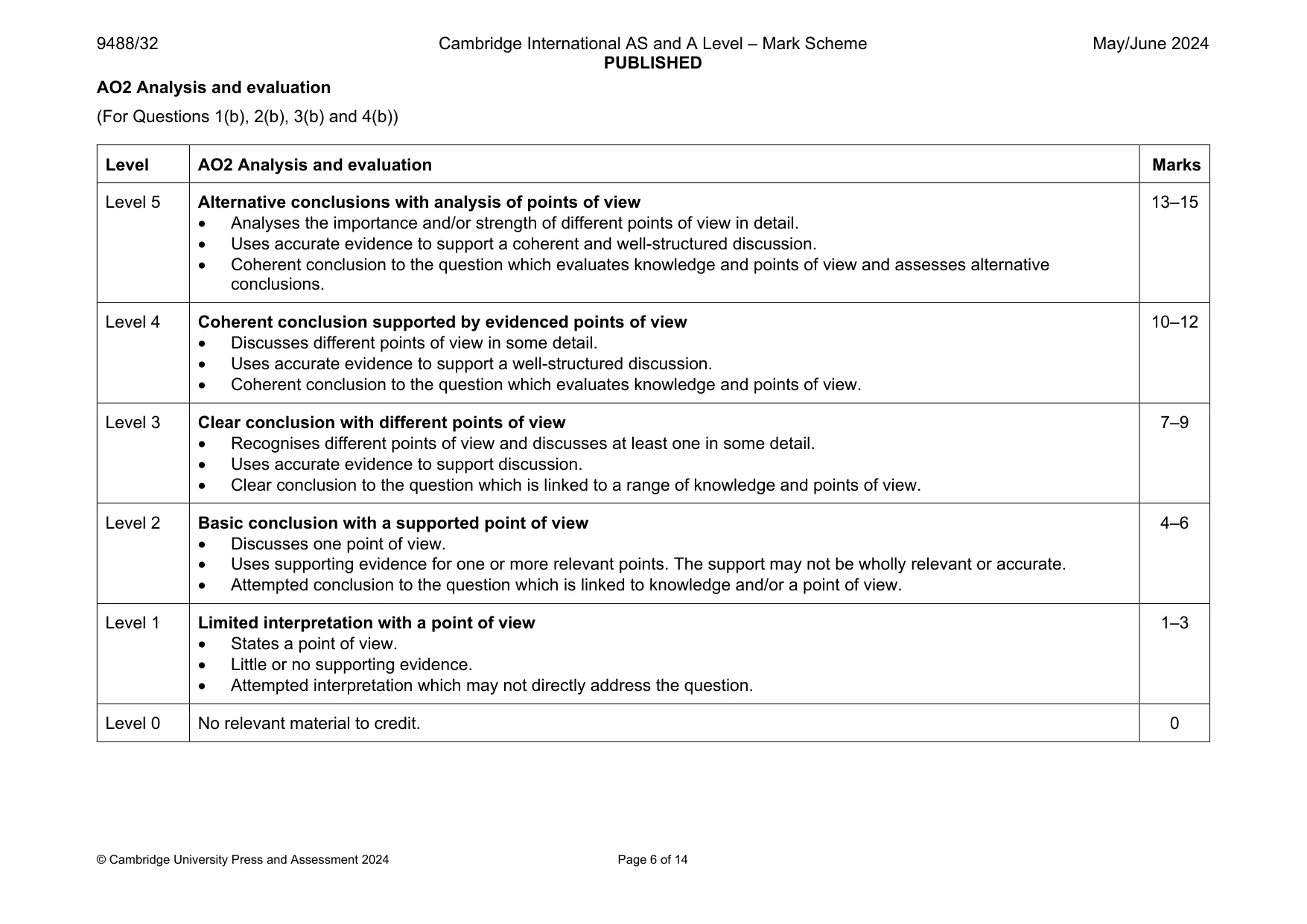
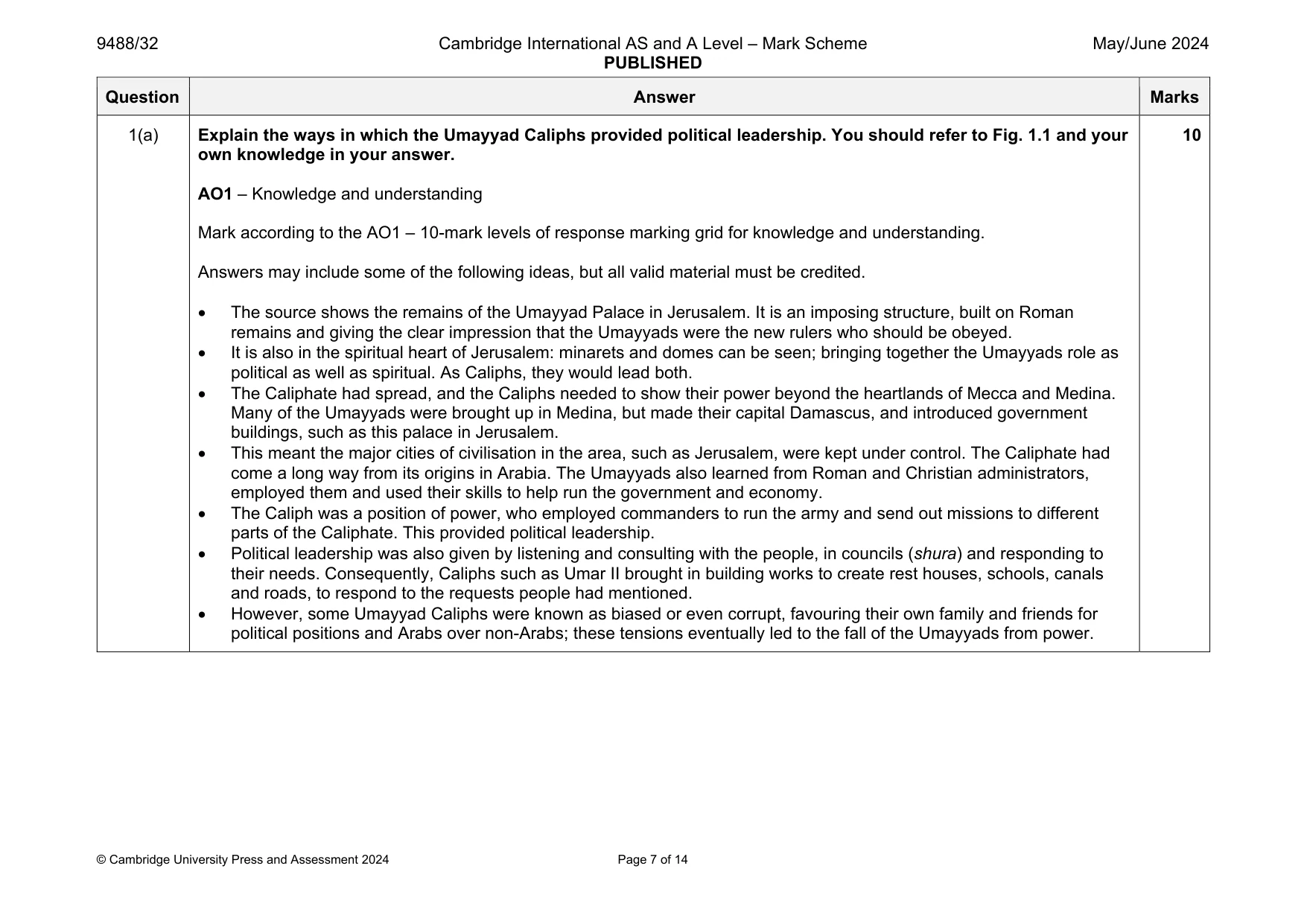
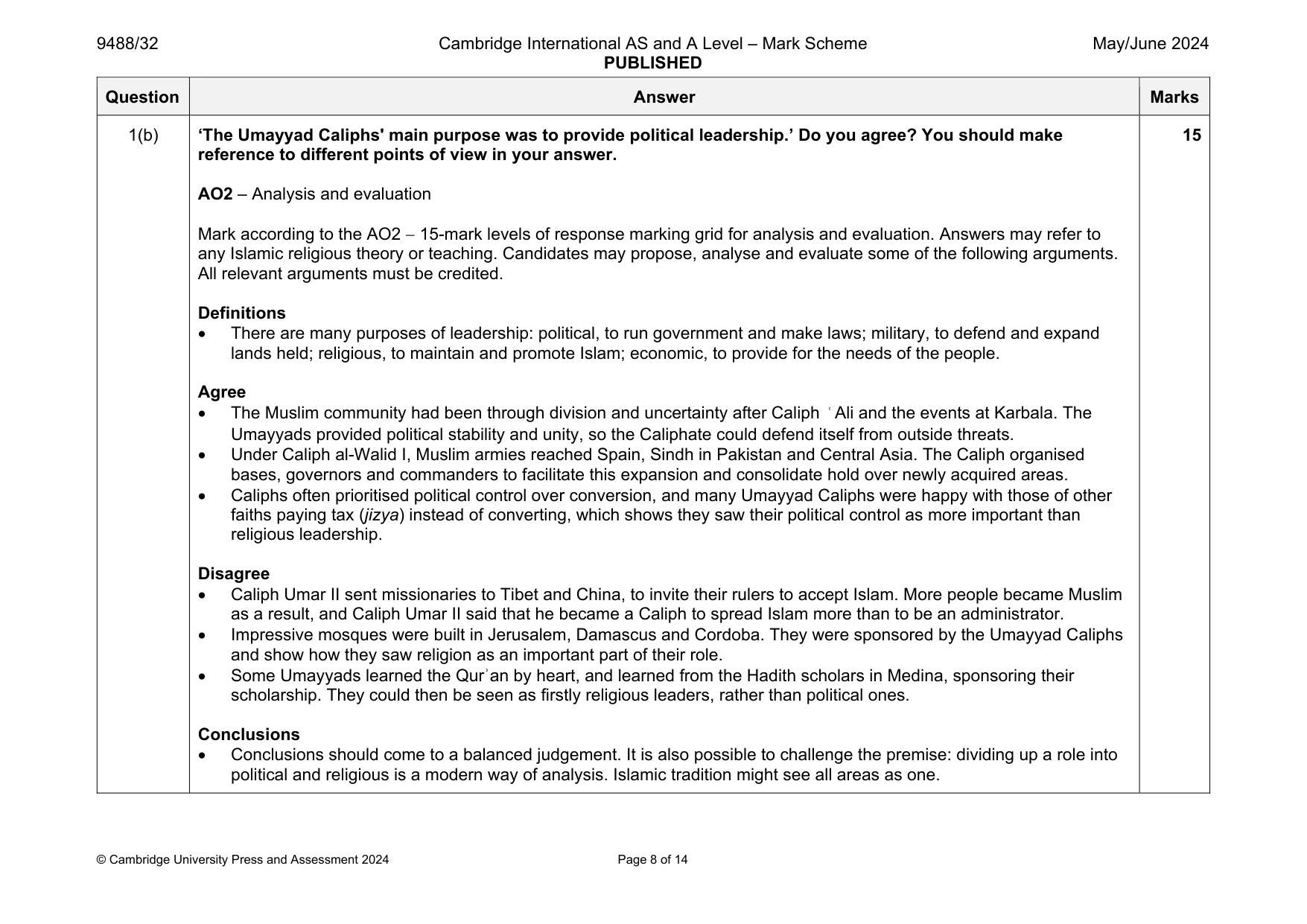
Mark scheme: 1(a) Explain the ways in which the Umayyad Caliphs provided political leadership. You should refer to Fig. 1.1 and your own knowledge in your answer. AO1 – Knowledge and understanding Mark according to the AO1 – 10-mark levels of response marking grid for knowledge and understanding. Answers may include some of the following ideas, but all valid material must be credited. The source shows the remains of the Umayyad Palace in Jerusalem. It is an imposing structure, built on Roman remains and giving the clear impression that the Umayyads were the new rulers who should be obeyed. It is also in the spiritual heart of Jerusalem: minarets and domes can be seen; bringing together the Umayyads role as political as well as spiritual. As Caliphs, they would lead both. The Caliphate had spread, and the Caliphs needed to show their power beyond the heartlands of Mecca and Medina. Many of the Umayyads were brought up in Medina, but made their capital Damascus, and introduced government buildings, such as this palace in Jerusalem. This meant the major cities of civilisation in the area, such as Jerusalem, were kept under control. The Caliphate had come a long way from its origins in Arabia. The Umayyads also learned from Roman and Christian administrators, employed them and used their skills to help run the government and economy. The Caliph was a position of power, who employed commanders to run the army and send out missions to different parts of the Caliphate. This provided political leadership. Political leadership was also given by listening and consulting with the people, in councils (shura) and responding to their needs. Consequently, Caliphs such as Umar II brought in building works to create rest houses, schools, canals and roads, to respond to the requests people had mentioned. However, some Umayyad Caliphs were known as biased or even corrupt, favouring their own family and friends for political positions and Arabs over non-Arabs; these tensions eventually led to the fall of the Umayyads from power. 10 Question Answer Marks 1(b) ‘The Umayyad Caliphs' main purpose was to provide political leadership.’ Do you agree? You should make reference to different points of view in your answer. AO2 – Analysis and evaluation Mark according to the AO2 15-mark levels of response marking grid for analysis and evaluation. Answers may refer to any Islamic religious theory or teaching. Candidates may propose, analyse and evaluate some of the following arguments. All relevant arguments must be credited. Definitions There are many purposes of leadership: political, to run government and make laws; military, to defend and expand lands held; religious, to maintain and promote Islam; economic, to provide for the needs of the people. Agree The Muslim community had been through division and uncertainty after Caliph ʿAli and the events at Karbala. The Umayyads provided political stability and unity, so the Caliphate could defend itself from outside threats. Under Caliph al-Walid I, Muslim armies reached Spain, Sindh in Pakistan and Central Asia. The Caliph organised bases, governors and commanders to facilitate this expansion and consolidate hold over newly acquired areas. Caliphs often prioritised political control over conversion, and many Umayyad Caliphs were happy with those of other faiths paying tax (jizya) instead of converting, which shows they saw their political control as more important than religious leadership. Disagree Caliph Umar II sent missionaries to Tibet and China, to invite their rulers to accept Islam. More people became Muslim as a result, and Caliph Umar II said that he became a Caliph to spread Islam more than to be an administrator. Impressive mosques were built in Jerusalem, Damascus and Cordoba. They were sponsored by the Umayyad Caliphs and show how they saw religion as an important part of their role. Some Umayyads learned the Qurʾan by heart, and learned from the Hadith scholars in Medina, sponsoring their scholarship. They could then be seen as firstly religious leaders, rather than political ones. Conclusions Conclusions should come to a balanced judgement. It is also possible to challenge the premise: dividing up a role into political and religious is a modern way of analysis. Islamic tradition might see all areas as one. 15
Question 2
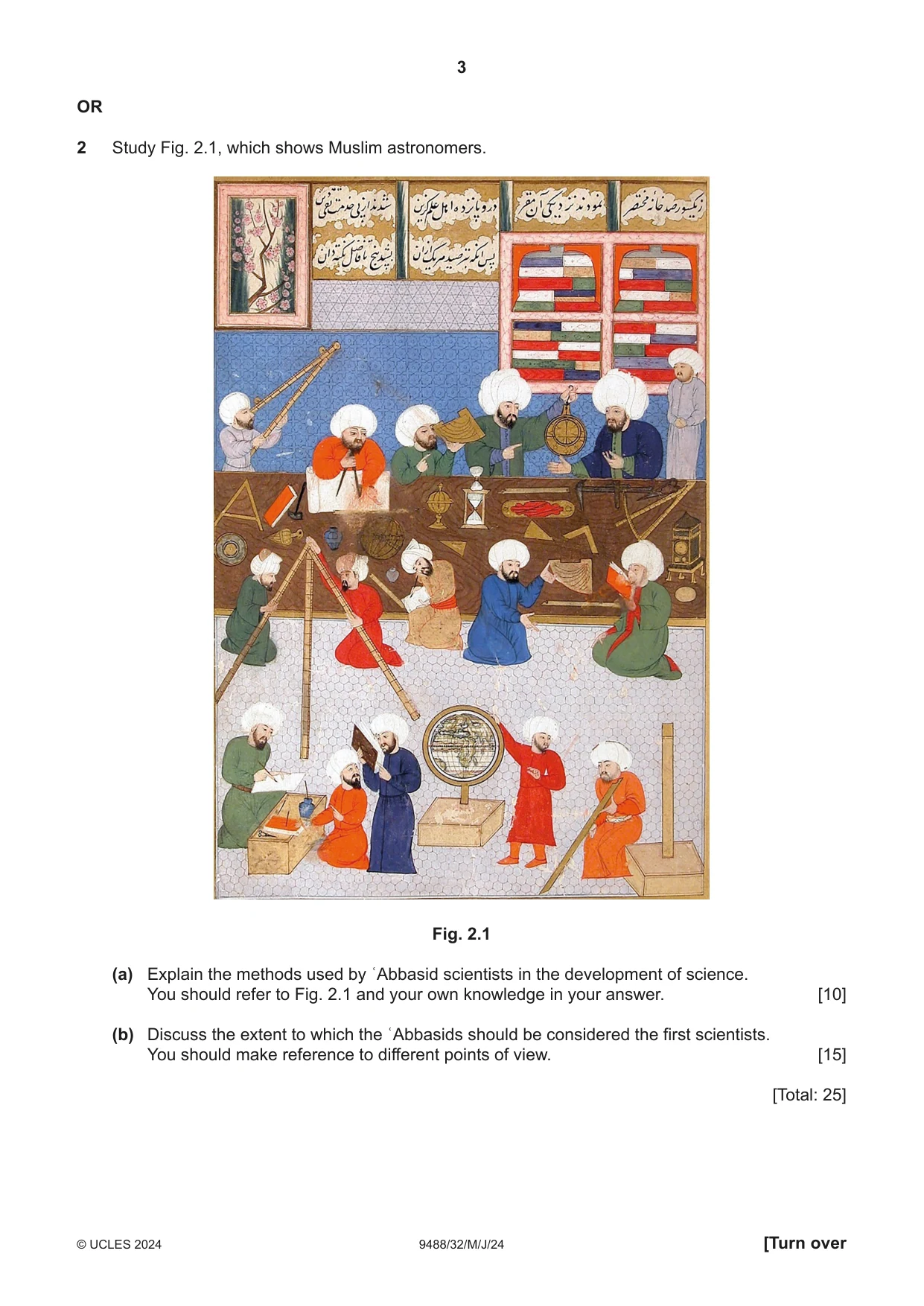
2 Study Fig. 2.1, which shows Muslim astronomers. Fig. 2.1 (a) Explain the methods used by ʿAbbasid scientists in the development of science. You should refer to Fig. 2.1 and your own knowledge in your answer. [10] (b) Discuss the extent to which the ʿAbbasids should be considered the first scientists. You should make reference to different points of view. [15] [Total: 25]
Mark scheme: 2(a) Explain the methods used by ʿAbbasid scientists in the development of science. You should refer to Fig. 2.1 and your own knowledge in your answer. AO1 – Knowledge and understanding Mark according to the AO1 10-mark levels of response marking grid for knowledge and understanding. Answers may include some of the following ideas, but all valid material must be credited. The source shows Muslim astronomers. They are using instruments such as the astrolabe, developed by Muslims to accurately trace the course of the planets. This contrasts with much of the world at this time, who were looking at the stars with astrology and other superstitious notions in mind. Muslim scientists were observing the movements of the stars and using them to predict their future movement, a kind of scientific method based on rational deduction from observed evidence. Various other instruments can be seen, such as for taking measurements of angles. Mention might be made of al- Biruni, who measured the angle to the horizon to calculate, correctly, the circumference of the earth. This shows rational method at work, using logical deduction. Abu Bakr al-Razi observed carefully the illnesses of people and from this was able to distinguish smallpox and measles for the first time. Careful observation, noting of symptoms, was key. Ibn al-Haytham looked for the origin of light, tracing it back to the stars. The method of many ʿAbbasid scientists was to look for origins, which ultimately came from God. Ibn al-Haytham formed theories that light travelled by the quickest route. He designed instruments to test his theory and deducted scientific rules about light and refraction. Most ʿAbbasid scientists combined their work with philosophy, and religious discussion. Their methods did not divorce scientific evidence from Qurʾanic teaching or evidence from religious tradition, which is very different from methods used by scientists today who, even if they have a personal faith, seek to prove science by experiment alone. 10 Question Answer Marks 2(b) Discuss the extent to which the ʿAbbasids should be considered the first scientists. You should make reference to different points of view. AO2 – Analysis and evaluation Mark according to the AO2 15-mark levels of response marking grid for analysis and evaluation. Answers may refer to any Islamic religious theory or teaching. Candidates may propose, analyse and evaluate some of the following arguments. All relevant arguments must be credited. Definitions A definition of scientists and science could be made. This is an academic study using experiments, testing out theories or hypotheses, to derive scientific laws and understanding from observing and repeating what is seen. Agree Professor Jim al-Khalili argues that Muslim scientist Ibn al-Haytham developed scientific method. He questioned everything and did not accept it until he found proof. Other religious thinkers at the time questioned whether the Qurʾan was written by God at all. The context of scholarship in ʿAbbasid Baghdad included discussion, debate and rational deduction – this applied in Islamic circles as well – and created the basis for scientific method to emerge. Many famous scientists emerged during this period, who used scientific method. Abu Bakr al-Razi developed Chemistry; Hunayn ibn Ishaq wrote a work on the eye and Ibn Sina wrote famous medical books. Each could be considered the first scientist in their field. Disagree The ʿAbbasids built on ancient Greek, learned and translated many of their texts. It could be argued that the ʿAbbasids added little to the first scientists who were from the ancient world, and mainly copied their methods. ʿAbbasid science was constrained by beliefs: how the world was created and how things happen could not be explained without reference to God. Modern scientists might argue this is not truly rational or evidence based. The European enlightenment brought an age when true science began, unconstrained by religious dogma. The Umayyads in Spain (al-Andalus) promoted at least as much scientific knowledge as the ʿAbbasids, and should be equally given credit for the development of science. Conclusions A judgement should be made as to how far the ʿAbbasids could be considered the first scientists compared to others, such as ancient Greeks, modern Europeans or Umayyads. 15
Q3 · Explain Islamic philosophers’ use of reasoning about creation
3 (a) Explain Islamic philosophers’ use of reasoning about creation. [10] (b) Discuss the relationship between reasoning about creation and Muslims’ care for the environment. [15] [Total: 25] OR
Mark scheme: 3(a) Explain Islamic philosophers’ use of reasoning about creation. AO1 – Knowledge and understanding Mark according to the AO1 – 10-mark levels of response marking grid for knowledge and understanding. Answers may include some of the following ideas, but all valid material must be credited. The creation of the world, explanation of it and making sense of the issues, was something which occupied philosophers and theologians. Islamic philosophers sought to prove using evidence and rational deduction that the world was created by a supreme being, God. They said that the Qurʾan could be seen both in the book (Qurʾan al-Tadwini) and through signs in the natural world (Qurʾan al-Takwini). Indeed, the Qurʾan itself called Muslims to observe the signs which God had sent, in many verses such as Qurʾan 16.11: ‘With it He produces for you corn, olives, date-palms, grapes and every kind of fruit: verily in this is a sign for those who give thought.’ Ibn Sina argued that God must have existed before everything else to be the first cause of the universe, from which everything followed. As there was one cause, there was unity in the universe. Everything was dependent on this first cause, the ‘necessary existent’. This cause continues to be the ultimate power behind everything which keeps on happening in the world, forever. Al-Biruni saw unity in the world around and felt a sense of freshness, which he interpreted as a sign of God’s power. The newness meant the universe was created within time; time existed before the universe. Ibn Rushd read the Classical philosopher Aristotle and accepted his reasoning. He said that Aristotle had proved the universe was eternal, so scholars should accept this. Ibn Arabi said that the universe was a reflection of God’s attributes, and God was eternal, so the universe was too, going through various phases of expansion and contraction. Ibn Khaldun described a gradual process of creation. He observed similarities between species and suggested that over time they adapted, rather like the theory of evolution. Other philosophers, such as the traditionalist scholar al-Ghazali got frustrated with the discussions of the philosophers. He argued that there was incoherence in their explanations. Furthermore, some warned that the philosophers were using rationalism and ignoring clearly revealed verses in the Qurʾan, which ought to be taken as an authority in their own right, without the need for reasoning. The Qurʾan 21.30 states: ‘The heavens and the earth were joined together (as one Unit of Creation), before We clove them asunder? We made from water every living thing.’ To many, this is similar to the ‘Big Bang’ modern scientific theory, and evidence without need of Islamic philosophers. 10 Question Answer Marks 3(b) Discuss links between reasoning about creation and Muslims’ care for the environment. AO2 – Analysis and evaluation Mark according to the AO2 15-mark levels of response marking grid for analysis and evaluation. Answers may refer to any Islamic religious theory or teaching. Students may propose, analyse and evaluate some of the following arguments. All relevant arguments must be credited. Islamic philosophers and theologians described God as the creator of the world; it followed that the world belongs to God and when dealing with the world, Muslims should therefore respect it and care for it because they are dealing with God’s creation. Several verses of the Qurʾan command Muslims to care for the environment. For example, Qurʾan 2:30 states: ‘Behold, thy Lord said to the angels: ‘I will create a viceregent on earth.’’ Viceregent (khalifah) suggests humankind is caring for what God has created, an agent for God in the world, looking after it for him. It could be argued that it is in people’s interest to care for their environment for selfish reasons: to improve their own neighbourhood and quality of life. But by reasoning about creation, Muslims see this as a duty to God rather than personal, and a duty on which they may be judged in the afterlife by the creator. The Qurʾan mentions that God created in order to provide for humankind’s every need, as a mercy, and that humans cannot make trees grow themselves without God’s help. The Prophet (pbuh) linked tree planting to rewards: the person who plants a tree will have a tree planted for them in paradise. Following Muhammad (pbuh), Caliph Abu Bakr ordered Muslims to protect trees, even whilst in battle. Actions in this world were linked to rewards in the afterlife because of the role of the creator in providing the environment in this world which Muslims need to look after. It could be argued that creation and care for the environment should be seen as separate. The creator has a distinct role and God’s role cannot be mixed with humans. Muslims cannot hope to do even the slightest tasks which only God has the power to. Muslims should also guard against the thinking that they might have the power to change the world that God has made, as this might lead to ideas that the world could be manipulated for the good of people over and above what God has ordained for them. Muslims might distinguish between environmental duty to God, which bring reward, and serving the environment, which might be seen as creating partners beside God (shirk) and be considered un-Islamic. Some might argue that God has made the world for humankind to rightfully exploit within due bounds; as long as Islamic law (shariah) is adhered to, caring for the environment should not be the first concern. 15
Q4 · Choose three features of Islamic art and explain how they might be interpreted
4 (a) Choose three features of Islamic art and explain how they might be interpreted. [10] (b) To what extent is the art of pre-Islamic Arabia different from Islamic art? Give reasons to support your answer. [15] [Total: 25]
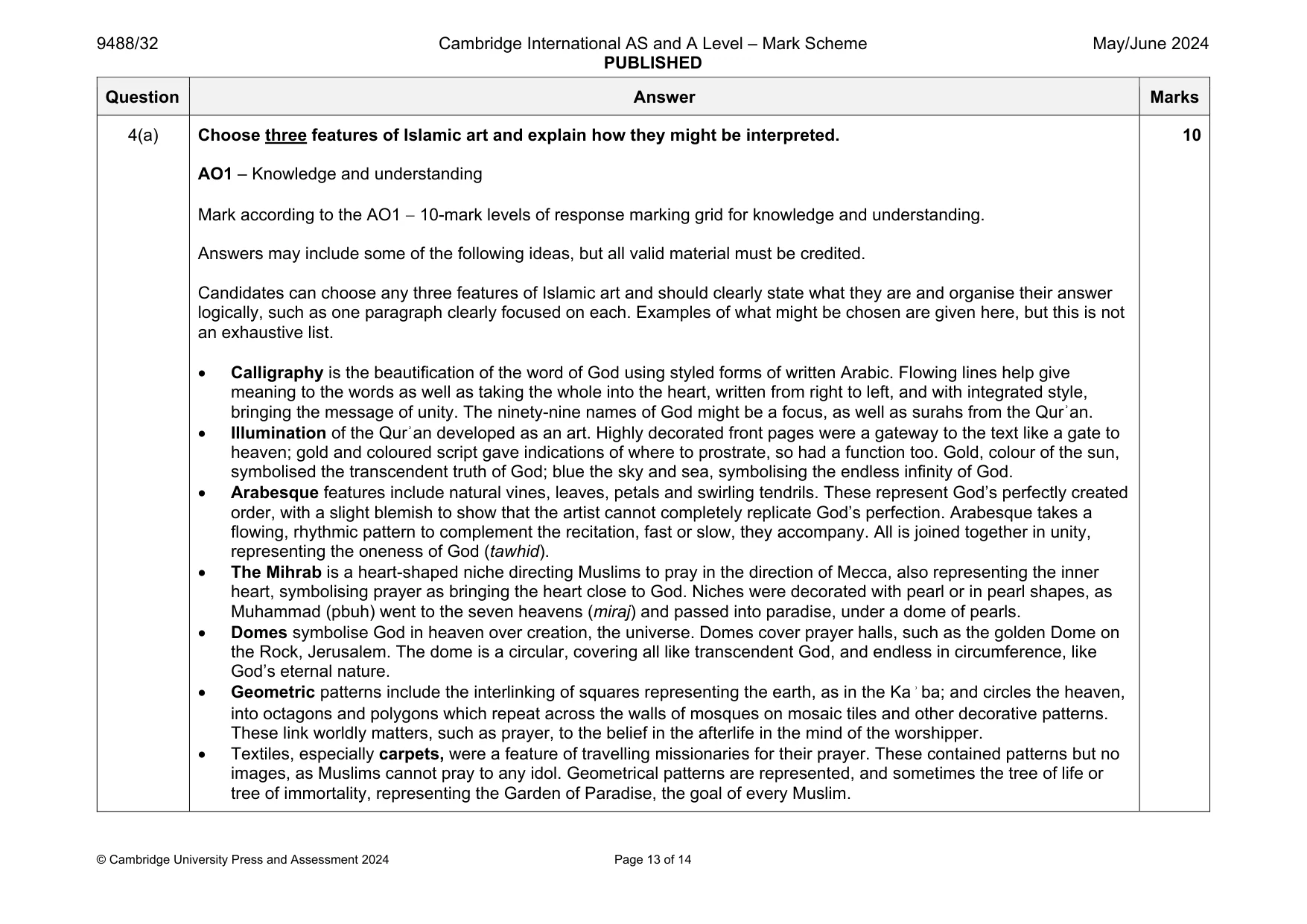
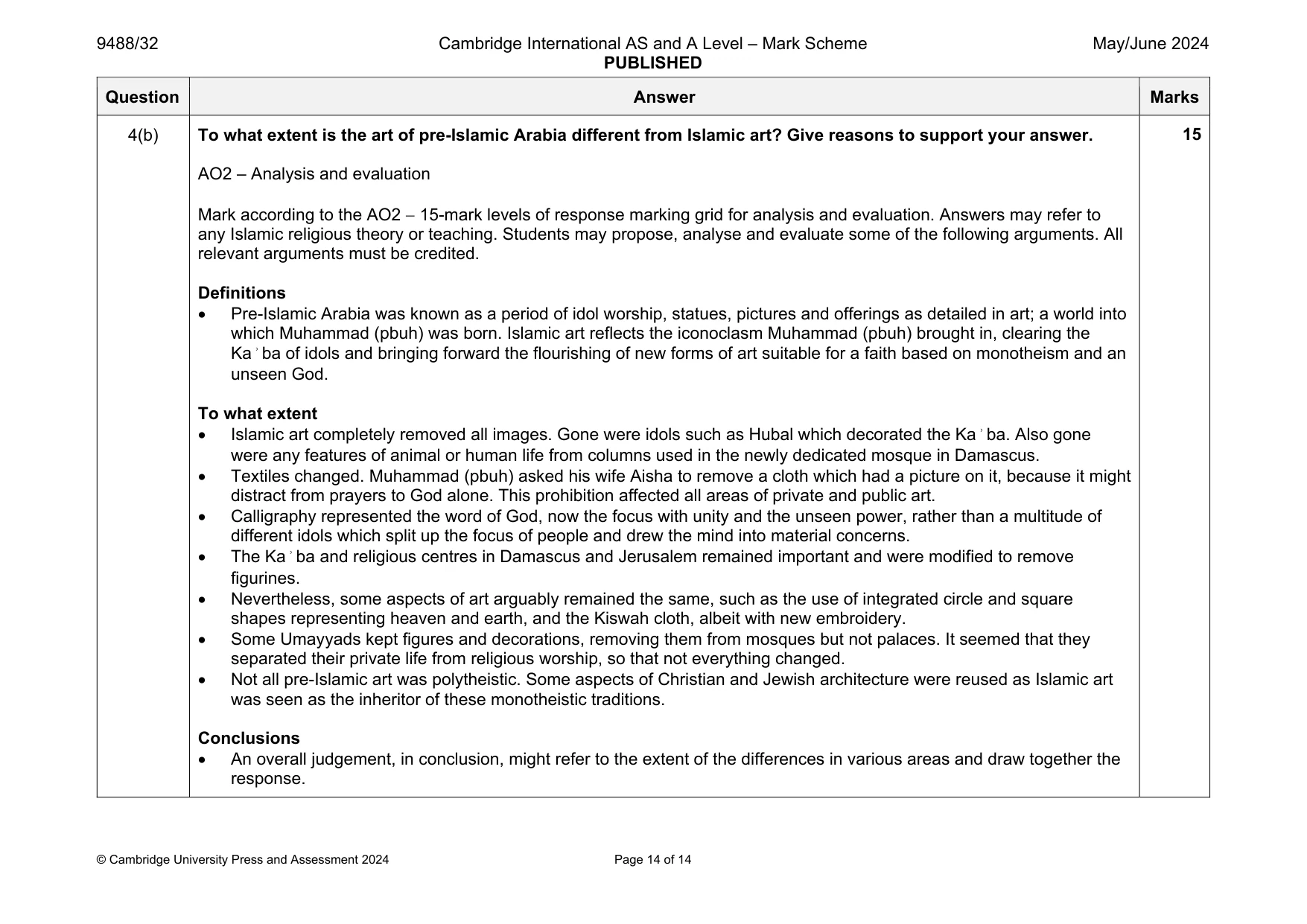
Mark scheme: 4(a) Choose three features of Islamic art and explain how they might be interpreted. AO1 – Knowledge and understanding Mark according to the AO1 10-mark levels of response marking grid for knowledge and understanding. Answers may include some of the following ideas, but all valid material must be credited. Candidates can choose any three features of Islamic art and should clearly state what they are and organise their answer logically, such as one paragraph clearly focused on each. Examples of what might be chosen are given here, but this is not an exhaustive list. Calligraphy is the beautification of the word of God using styled forms of written Arabic. Flowing lines help give meaning to the words as well as taking the whole into the heart, written from right to left, and with integrated style, bringing the message of unity. The ninety-nine names of God might be a focus, as well as surahs from the Qurʾan. Illumination of the Qurʾan developed as an art. Highly decorated front pages were a gateway to the text like a gate to heaven; gold and coloured script gave indications of where to prostrate, so had a function too. Gold, colour of the sun, symbolised the transcendent truth of God; blue the sky and sea, symbolising the endless infinity of God. Arabesque features include natural vines, leaves, petals and swirling tendrils. These represent God’s perfectly created order, with a slight blemish to show that the artist cannot completely replicate God’s perfection. Arabesque takes a flowing, rhythmic pattern to complement the recitation, fast or slow, they accompany. All is joined together in unity, representing the oneness of God (tawhid). The Mihrab is a heart-shaped niche directing Muslims to pray in the direction of Mecca, also representing the inner heart, symbolising prayer as bringing the heart close to God. Niches were decorated with pearl or in pearl shapes, as Muhammad (pbuh) went to the seven heavens (miraj) and passed into paradise, under a dome of pearls. Domes symbolise God in heaven over creation, the universe. Domes cover prayer halls, such as the golden Dome on the Rock, Jerusalem. The dome is a circular, covering all like transcendent God, and endless in circumference, like God’s eternal nature. Geometric patterns include the interlinking of squares representing the earth, as in the Kaʾba; and circles the heaven, into octagons and polygons which repeat across the walls of mosques on mosaic tiles and other decorative patterns. These link worldly matters, such as prayer, to the belief in the afterlife in the mind of the worshipper. Textiles, especially carpets, were a feature of travelling missionaries for their prayer. These contained patterns but no images, as Muslims cannot pray to any idol. Geometrical patterns are represented, and sometimes the tree of life or tree of immortality, representing the Garden of Paradise, the goal of every Muslim. 10 Question Answer Marks 4(b) To what extent is the art of pre-Islamic Arabia different from Islamic art? Give reasons to support your answer. AO2 – Analysis and evaluation Mark according to the AO2 15-mark levels of response marking grid for analysis and evaluation. Answers may refer to any Islamic religious theory or teaching. Students may propose, analyse and evaluate some of the following arguments. All relevant arguments must be credited. Definitions Pre-Islamic Arabia was known as a period of idol worship, statues, pictures and offerings as detailed in art; a world into which Muhammad (pbuh) was born. Islamic art reflects the iconoclasm Muhammad (pbuh) brought in, clearing the Kaʾba of idols and bringing forward the flourishing of new forms of art suitable for a faith based on monotheism and an unseen God. To what extent Islamic art completely removed all images. Gone were idols such as Hubal which decorated the Kaʾba. Also gone were any features of animal or human life from columns used in the newly dedicated mosque in Damascus. Textiles changed. Muhammad (pbuh) asked his wife Aisha to remove a cloth which had a picture on it, because it might distract from prayers to God alone. This prohibition affected all areas of private and public art. Calligraphy represented the word of God, now the focus with unity and the unseen power, rather than a multitude of different idols which split up the focus of people and drew the mind into material concerns. The Kaʾba and religious centres in Damascus and Jerusalem remained important and were modified to remove figurines. Nevertheless, some aspects of art arguably remained the same, such as the use of integrated circle and square shapes representing heaven and earth, and the Kiswah cloth, albeit with new embroidery. Some Umayyads kept figures and decorations, removing them from mosques but not palaces. It seemed that they separated their private life from religious worship, so that not everything changed. Not all pre-Islamic art was polytheistic. Some aspects of Christian and Jewish architecture were reused as Islamic art was seen as the inheritor of these monotheistic traditions. Conclusions An overall judgement, in conclusion, might refer to the extent of the differences in various areas and draw together the response. 15
What was in this paper
The subtopics covered by these 4 questions, and how many questions each got. Open one in a new tab to see every Cambridge question on it.
What you needed in this session
Cambridge’s own grade thresholds for 2024 May/June, Paper 3 · Variant 2. A higher threshold means an easier paper — the bar moves with how the cohort did.