Cambridge A Level Islamic Studies 9488 — 2023 May/June Paper 3 · Variant 2
9488/32/M/J/23 · 4 questions · 50 marks · ≈56 min
The question paper and its mark scheme, free to read here and free to download. This is Cambridge’s own paper, exactly as it was sat.
Question paper4 pages
Mark scheme14 pages
Answers below. Sit the paper first if you are practising.
Questions as text
Question 1
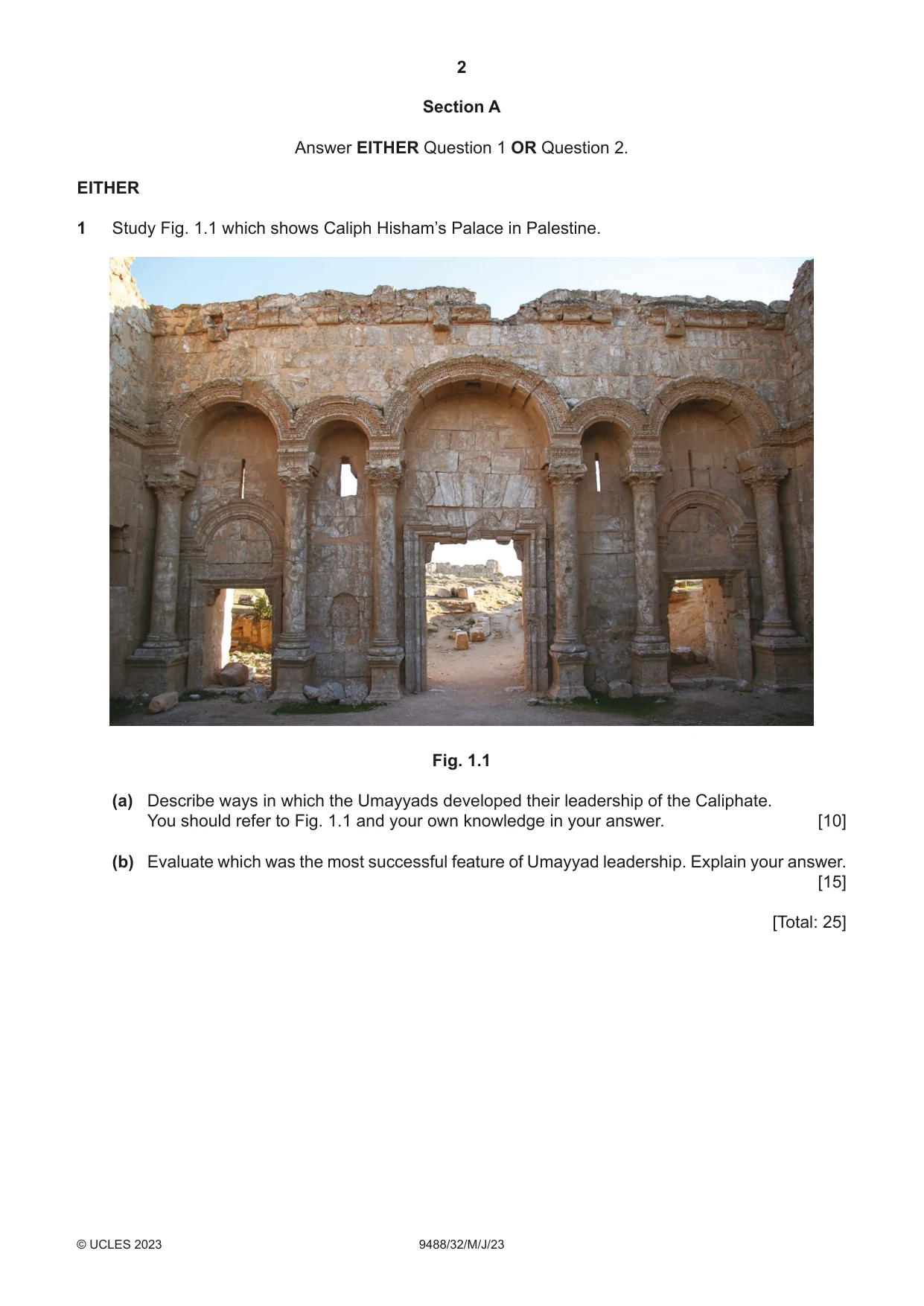
1 Study Fig. 1.1 which shows Caliph Hisham’s Palace in Palestine. Fig. 1.1 (a) Describe ways in which the Umayyads developed their leadership of the Caliphate. You should refer to Fig. 1.1 and your own knowledge in your answer. [10] (b) Evaluate which was the most successful feature of Umayyad leadership. Explain your answer. [15] [Total: 25] OR
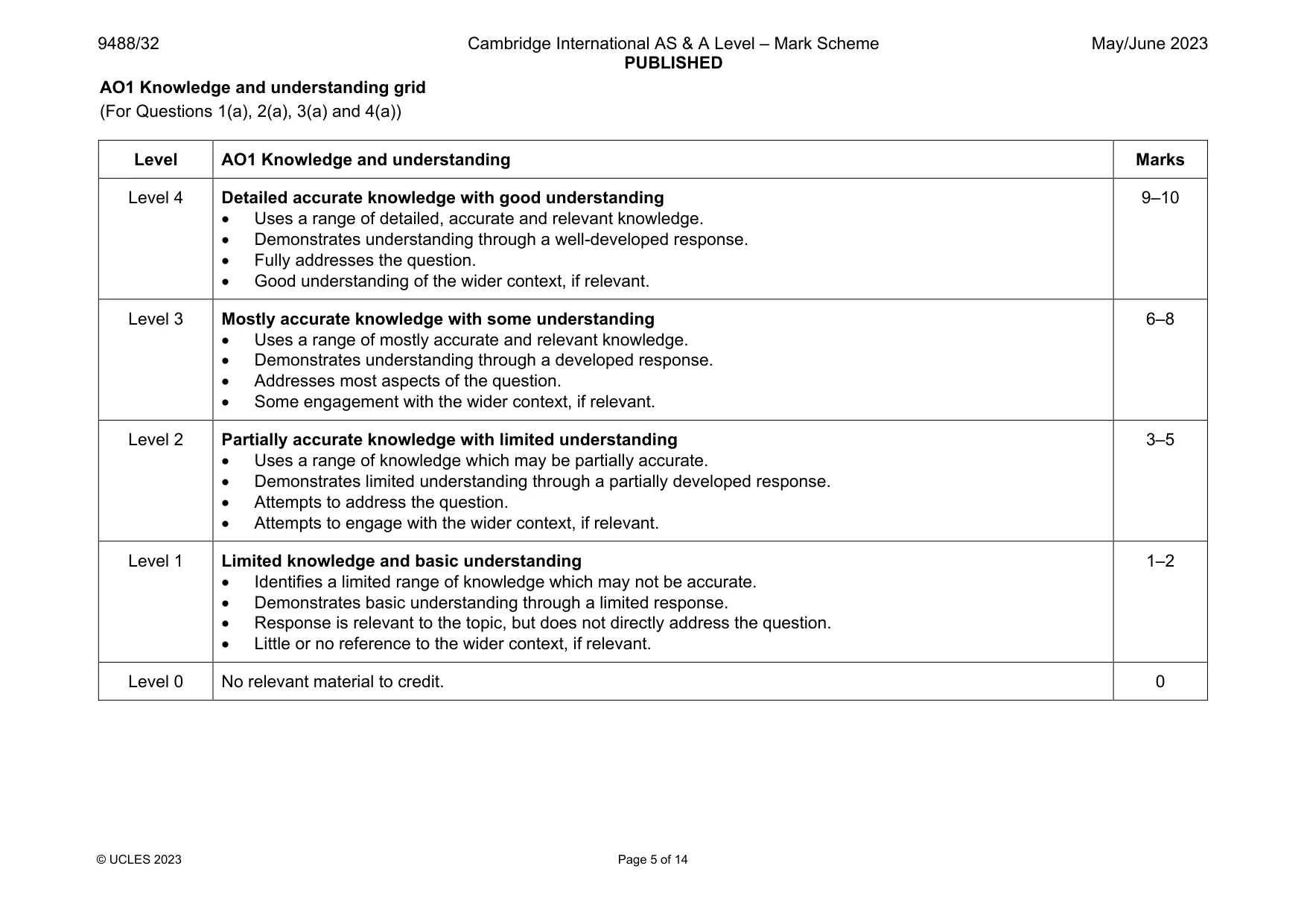
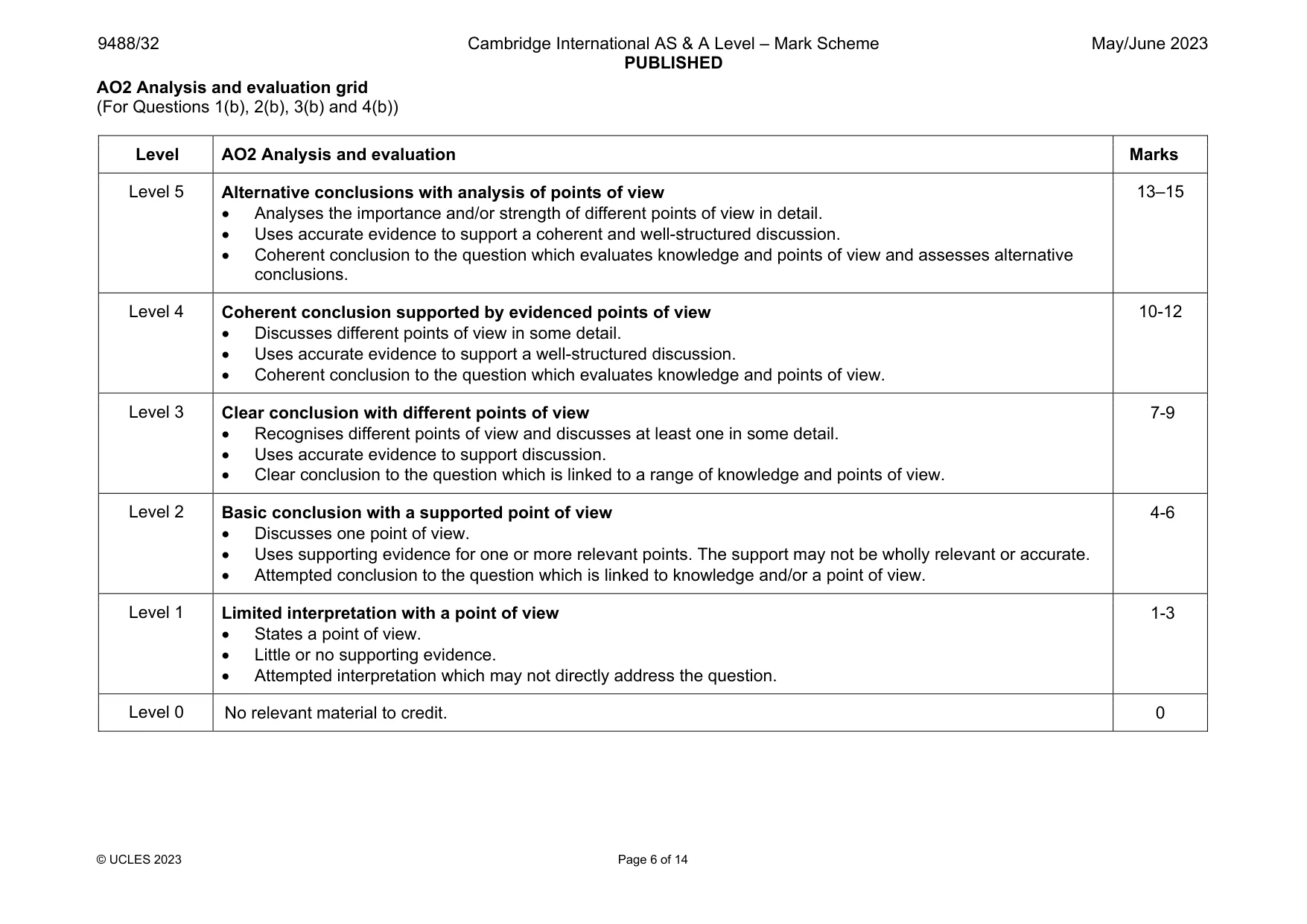
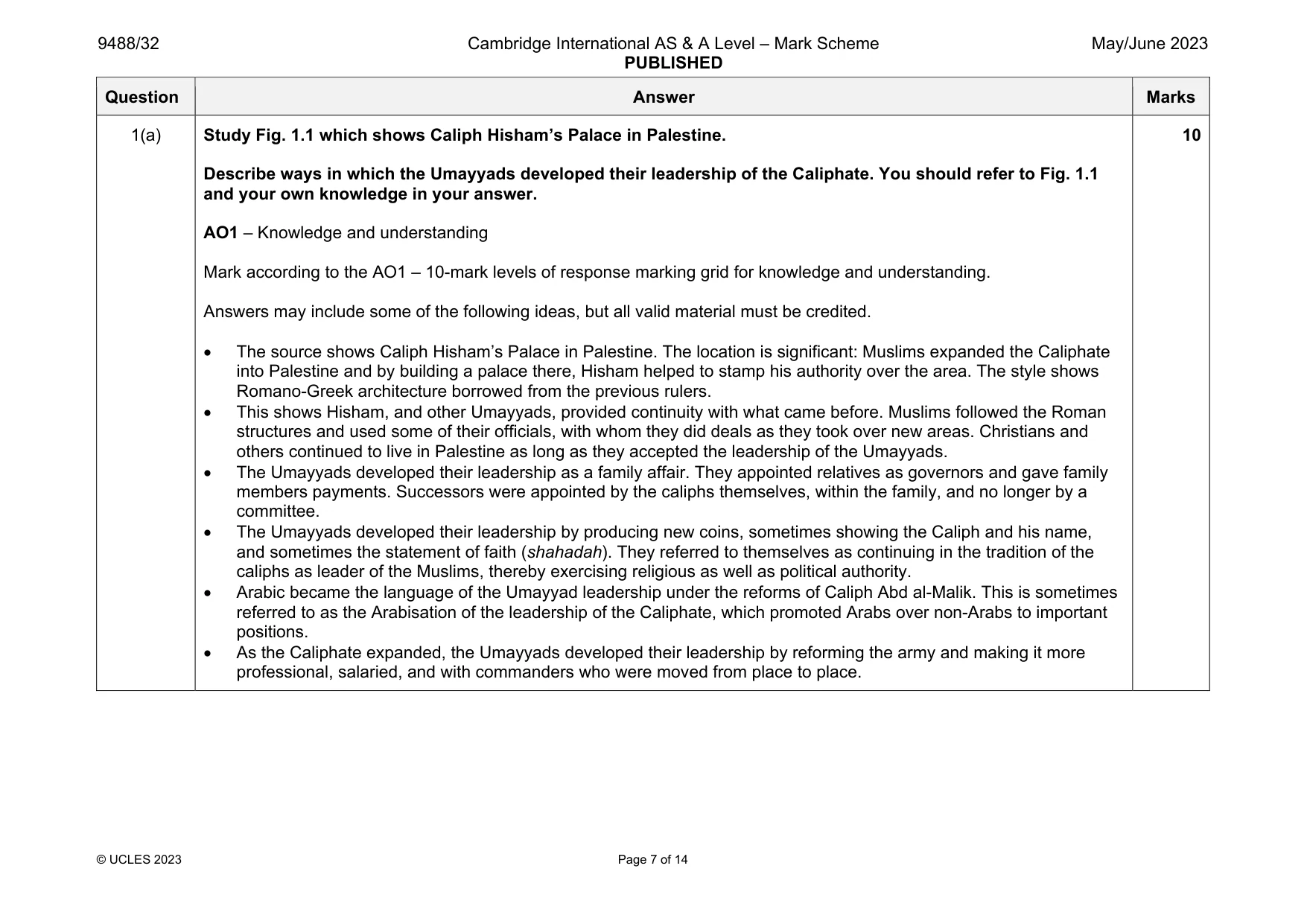
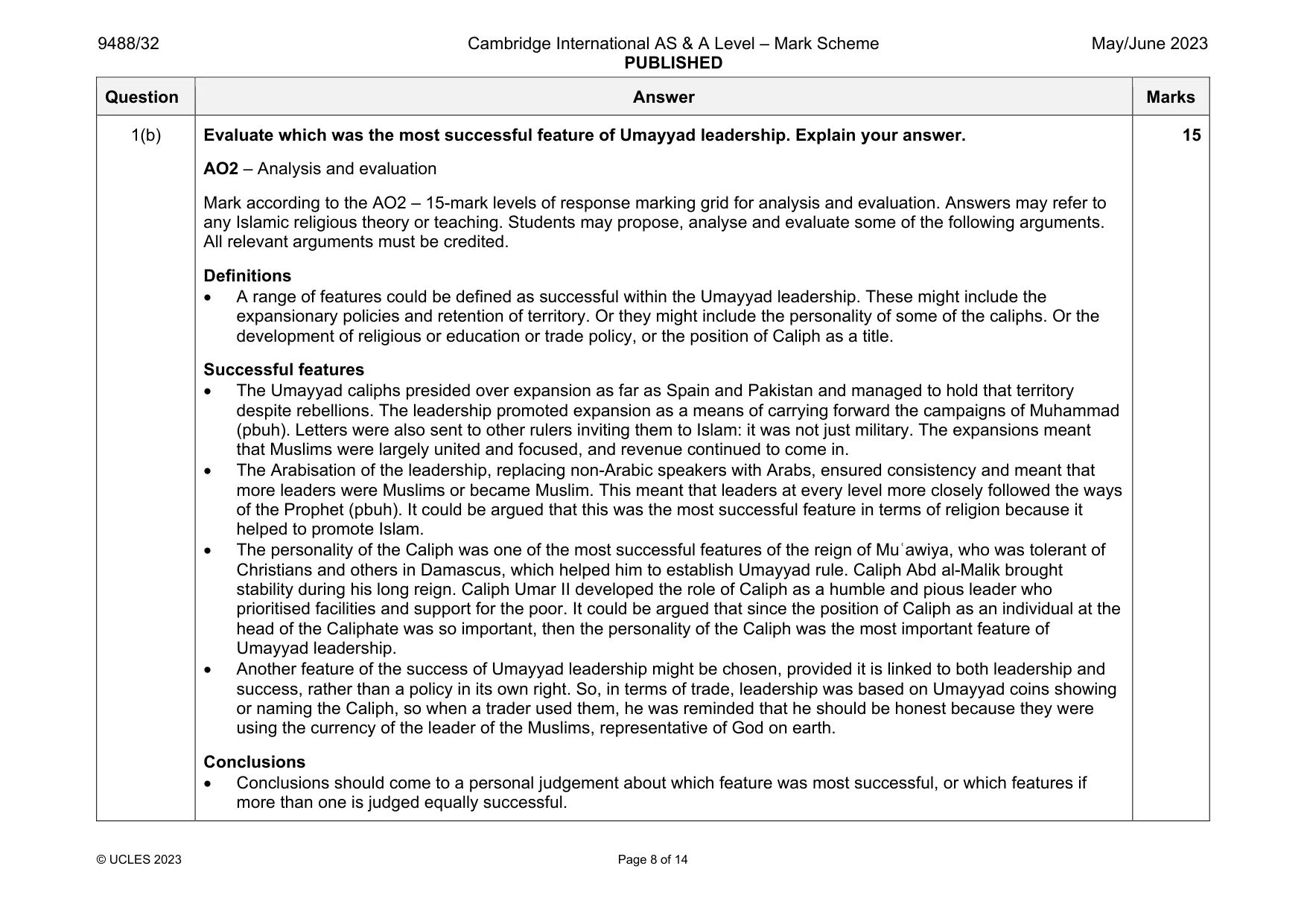
Mark scheme: 1(a) Study Fig. 1.1 which shows Caliph Hisham’s Palace in Palestine. Describe ways in which the Umayyads developed their leadership of the Caliphate. You should refer to Fig. 1.1 and your own knowledge in your answer. AO1 – Knowledge and understanding Mark according to the AO1 – 10-mark levels of response marking grid for knowledge and understanding. Answers may include some of the following ideas, but all valid material must be credited. The source shows Caliph Hisham’s Palace in Palestine. The location is significant: Muslims expanded the Caliphate into Palestine and by building a palace there, Hisham helped to stamp his authority over the area. The style shows Romano-Greek architecture borrowed from the previous rulers. This shows Hisham, and other Umayyads, provided continuity with what came before. Muslims followed the Roman structures and used some of their officials, with whom they did deals as they took over new areas. Christians and others continued to live in Palestine as long as they accepted the leadership of the Umayyads. The Umayyads developed their leadership as a family affair. They appointed relatives as governors and gave family members payments. Successors were appointed by the caliphs themselves, within the family, and no longer by a committee. The Umayyads developed their leadership by producing new coins, sometimes showing the Caliph and his name, and sometimes the statement of faith (shahadah). They referred to themselves as continuing in the tradition of the caliphs as leader of the Muslims, thereby exercising religious as well as political authority. Arabic became the language of the Umayyad leadership under the reforms of Caliph Abd al-Malik. This is sometimes referred to as the Arabisation of the leadership of the Caliphate, which promoted Arabs over non-Arabs to important positions. As the Caliphate expanded, the Umayyads developed their leadership by reforming the army and making it more professional, salaried, and with commanders who were moved from place to place. 10 Question Answer Marks 1(b) Evaluate which was the most successful feature of Umayyad leadership. Explain your answer. AO2 – Analysis and evaluation Mark according to the AO2 – 15-mark levels of response marking grid for analysis and evaluation. Answers may refer to any Islamic religious theory or teaching. Students may propose, analyse and evaluate some of the following arguments. All relevant arguments must be credited. Definitions A range of features could be defined as successful within the Umayyad leadership. These might include the expansionary policies and retention of territory. Or they might include the personality of some of the caliphs. Or the development of religious or education or trade policy, or the position of Caliph as a title. Successful features The Umayyad caliphs presided over expansion as far as Spain and Pakistan and managed to hold that territory despite rebellions. The leadership promoted expansion as a means of carrying forward the campaigns of Muhammad (pbuh). Letters were also sent to other rulers inviting them to Islam: it was not just military. The expansions meant that Muslims were largely united and focused, and revenue continued to come in. The Arabisation of the leadership, replacing non-Arabic speakers with Arabs, ensured consistency and meant that more leaders were Muslims or became Muslim. This meant that leaders at every level more closely followed the ways of the Prophet (pbuh). It could be argued that this was the most successful feature in terms of religion because it helped to promote Islam. The personality of the Caliph was one of the most successful features of the reign of Muʿawiya, who was tolerant of Christians and others in Damascus, which helped him to establish Umayyad rule. Caliph Abd al-Malik brought stability during his long reign. Caliph Umar II developed the role of Caliph as a humble and pious leader who prioritised facilities and support for the poor. It could be argued that since the position of Caliph as an individual at the head of the Caliphate was so important, then the personality of the Caliph was the most important feature of Umayyad leadership. Another feature of the success of Umayyad leadership might be chosen, provided it is linked to both leadership and success, rather than a policy in its own right. So, in terms of trade, leadership was based on Umayyad coins showing or naming the Caliph, so when a trader used them, he was reminded that he should be honest because they were using the currency of the leader of the Muslims, representative of God on earth. Conclusions Conclusions should come to a personal judgement about which feature was most successful, or which features if more than one is judged equally successful. 15
Question 2
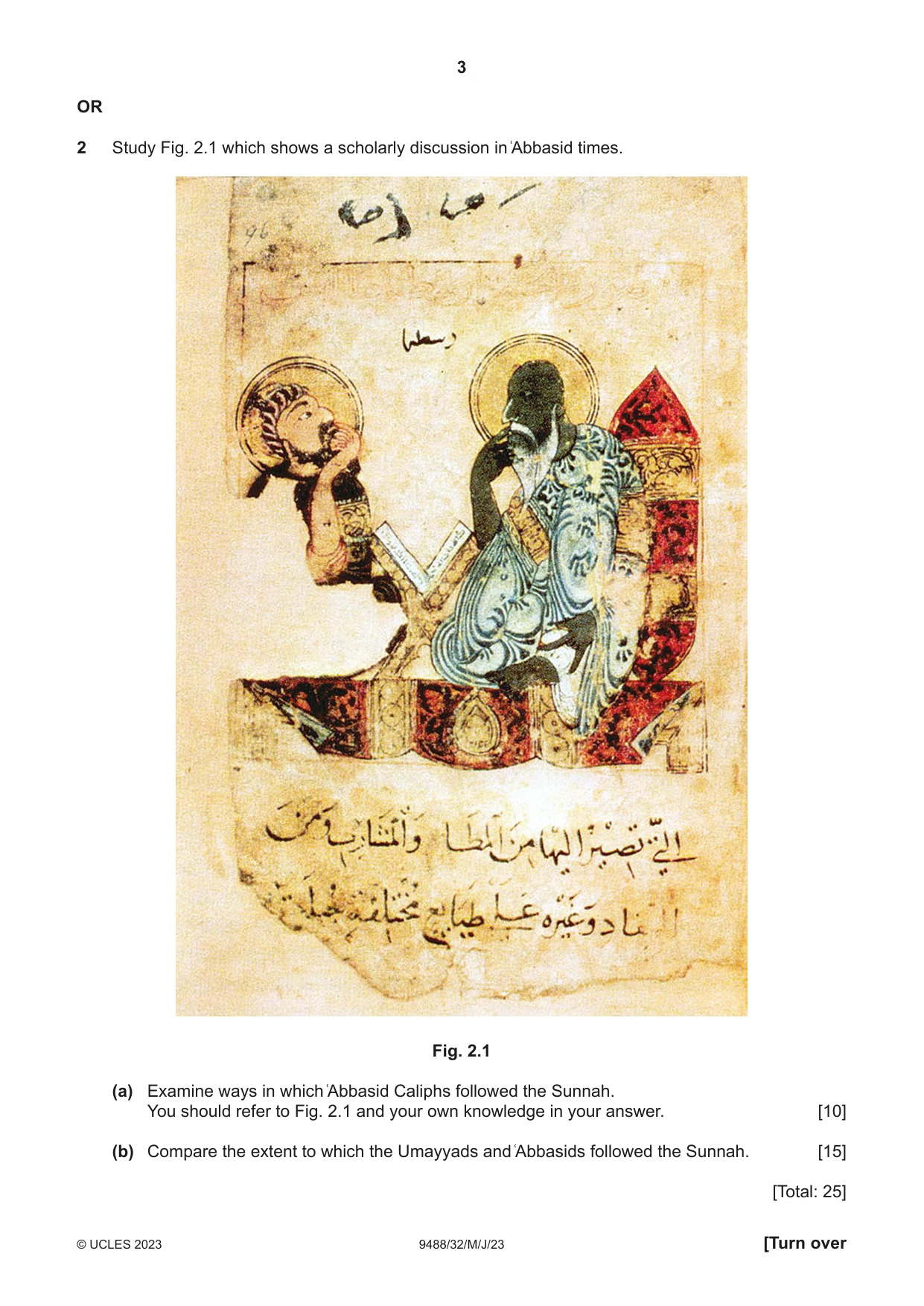
2 Study Fig. 2.1 which shows a scholarly discussion in ͑Abbasid times. Fig. 2.1 (a) Examine ways in which ͑Abbasid Caliphs followed the Sunnah. You should refer to Fig. 2.1 and your own knowledge in your answer. [10] (b) Compare the extent to which the Umayyads and ͑Abbasids followed the Sunnah. [15] [Total: 25]
Mark scheme: 2(a) Study Fig. 2.1 which shows a scholarly discussion in ʿAbbasid times. Examine ways in which ʿAbbasid Caliphs followed the Sunnah. You should refer to Fig. 2.1 and your own knowledge in your answer. AO1 – Knowledge and understanding Mark according to the AO1 – 10-mark levels of response marking grid for knowledge and understanding. Answers may include some of the following ideas, but all valid material must be credited. The source shows a discussion between scholars of different backgrounds (shown by different colours). They look deep in thought, shown by their expressions and their hands by their faces. Intense conversations about the Sunnah often happened under the ʿAbbasids. Specifically, Hadith scholarship flourished in ʿAbbasid times. The great Hadith collector Bukhari was able to collect Hadith during early ʿAbbasid times, and many other scholars worked on understanding the Hadith and forming the schools of thought and jurisprudence. The ʿAbbasid Caliphs developed their own image as the leaders, sometimes referring to the title Caliph as meaning God’s deputy on earth (Khalifah). They put the statement of faith (shahadah) on their coins, and sponsored learning to show the importance of following the Sunnah. ʿAbbasid Caliphs also often led the pilgrimage (Hajj), which was a display of honour in which a large caravan of thousands of people would follow the Caliph all the way to Mecca. It was a visual display of piety. Caliphs also sponsored improvements to religious facilities, mosques, orphanages and charitable donations along the pilgrim routes. The caliphs appointed local officials who were told to ensure the Sunnah of fairness in using weights and measures was used; and judges (qadi) to make fair judgements between the people, to see that they were following the Sunnah according to legal opinion. The extent to which each ʿAbbasid Caliph followed the Sunnah in terms of whether they said their prayers or followed the Five Pillars and other matters, varied between different caliphs. 10 Question Answer Marks 2(b) Compare the extent to which the Umayyads and ʿAbbasids followed the Sunnah. AO2 – Analysis and evaluation Mark according to the AO2 – 15-mark levels of response marking grid for analysis and evaluation. Answers may refer to any Islamic religious theory or teaching. Students may propose, analyse and evaluate some of the following arguments. All relevant arguments must be credited. Definitions The Sunnah should be defined, including examples of Muhammad (pbuh) in terms of religious practice and leadership of communities, following his example as leader of Medina. To what extent ʿAbbasid Caliph Harun al-Rashid led Friday prayers in the mosque in Baghdad and performed the pilgrimage (Hajj) on several occasions. He and other ʿAbbasids saw their role as a religious as well as political one so wanted to show their people that they followed the Sunnah closely. Umayyad leaders were sometimes criticised for extravagance and lax standards of morality, especially in their desert forts where wine was said to be plentiful. This was against the teaching of Islam which prohibited alcohol. Study of the Sunnah flourished under the ʿAbbasids with the Hadith collectors and the schools of jurisprudence. These had started to form under the Umayyads but became much more developed under the ʿAbbasids. This enabled people to follow the Sunnah more closely. The extent to which the ʿAbbasids or Umayyads followed the Sunnah depended on the character of individual caliphs. Some Umayyads, such as Caliph Umar II, were pious and followed the Sunnah closely, praying devoutly and reading the Qurʾan in his personal practice. The Umayyads promoted and took advice from religious scholars in Medina. This was because the religious community in Medina had preserved the traditions of the Sunnah, passed on by many of the companions (sahaba) who lived there. The ʿAbbasid rulers, particularly Caliph al-Ma’mun, promoted Muʾtazilah doctrines. This was opposed by the Hadith scholars who said that he was not closely following Islamic doctrines as passed down through the Sunnah. This suggests that at times it was the ʿAbbasids who were not as close at following the Sunnah as the Umayyads. Conclusions In conclusion, candidates should make a personal judgement about which leadership more closely followed the Sunnah and summarise the most important reasons for their judgement. 15
Q3 · Explain the main features of Islamic philosophy (falsafah)
3 (a) Explain the main features of Islamic philosophy (falsafah). [10] (b) Compare Islamic philosophy (falsafah) with the philosophy of the Greeks. [15] [Total: 25] OR
Mark scheme: 3(a) Explain the main features of Islamic philosophy (falsafah). AO1 – Knowledge and understanding Mark according to the AO1 – 10-mark levels of response marking grid for knowledge and understanding. Answers may include some of the following ideas, but all valid material must be credited. Islamic philosophy (falsafah) used reasoning and logic to address key questions, such as the origins of the universe, what causes events to happen, definitions of truth, how to use logic, make an argument and so on. The Islamic philosophy movement grew out of the translation movement in Baghdad under the ʿAbbasids. Many Islamic philosophers commented on ancient Greek philosophers, especially Aristotle, and based their ideas on his work. Islamic philosophers agreed with theologians about the main beliefs of Islam, such as the oneness of God. A key feature of the philosophers was that they derived such beliefs through observation and logical deduction, independently of revealed text. Islamic philosophers attempted to explain questions about the origin of the universe in rational ways, by referring to the need for a first cause, and by references in the Qurʾan referring to movement of the spheres which logically require a first cause. However, not all saw it like that, and some thought the universe was eternal. Islamic philosophers distinguished between a person’s body and soul and argued that the soul was separated at death and resurrected in the afterlife, whereas theologians argued for the bodily resurrection. Further questions about essence and existence were discussed in relation to any person or objects qualities. Science was another focus of the Islamic philosophers. Their emphasis on observation of signs and logical deduction from them promoted scientific method, particularly through the work of Ibn al-Haytham. ‘Islamic’ philosophy in some ways was about questions of truth and logic and not necessarily ‘Islamic’ – some other religions were also part of the movement under the ʿAbbasids. In other ways it was ‘Islamic’ in that it was bound by what was deemed acceptable under the definitions made by Islamic theologians at the time, based on their interpretations of the Qurʾan and Sunnah. Question Answer Marks 3(b) Compare Islamic philosophy (falsafah) with the philosophy of the Greeks. AO2 – Analysis and evaluation Mark according to the AO2 – 15-mark levels of response marking grid for analysis and evaluation. Answers may refer to any Islamic religious theory or teaching. Students may propose, analyse and evaluate some of the following arguments. All relevant arguments must be credited. Definitions Ancient Greek philosophy was defined by writers such as Plato and Aristotle. Islamic philosophy was defined by writers such as al-Farabi, Ibn Sina and Ibn Rushd. Similarities Islamic and Greek philosophers used reasoned argument and logic to make their case, especially drawing on the tradition of using evidence drawn from Aristotle. Some, such as Muslim philosopher Ibn Sina used it in varying ways, but the tradition of putting a case was common to both. Islamic and Greek philosophers were both very much influenced by Aristotle and his ideas about causation, essence and existence, particularly as applied to the origins of things. Both Islamic and Greek philosophers were multi-disciplinary and addressed wider fields of study ranging from science to questions of philosophy; use of language and hypothesis to test an argument; and addressed many of the same questions in similar ways. Differences Islamic philosophy was bound by the belief in the oneness of God, and other beliefs as defined by theologians. Despite some philosophers using their own reasoning, most justified their logic with reference to the Qurʾan. Most Islamic philosophers, though not all, disagreed with Greek ideas about the eternity of the universe, because they argued there must have been a first cause, God, who was outside of time. If God was not outside and above the universe, then that would limit God, an idea which was unacceptable to Islamic theologians. Greek philosophy was part of mainstream thought for society as a whole, whereas many Muslim philosophers concluded that the philosopher was the exception who might need to develop thought as a recluse whereas most people in society should follow religious laws as philosophy was beyond them. Conclusions Conclusions might sum up the most important differences and make an evaluation about how far they were similar and how far different. A note about the significance of this might be mentioned. 15
Q4 · Examine the importance of architecture for Muslims
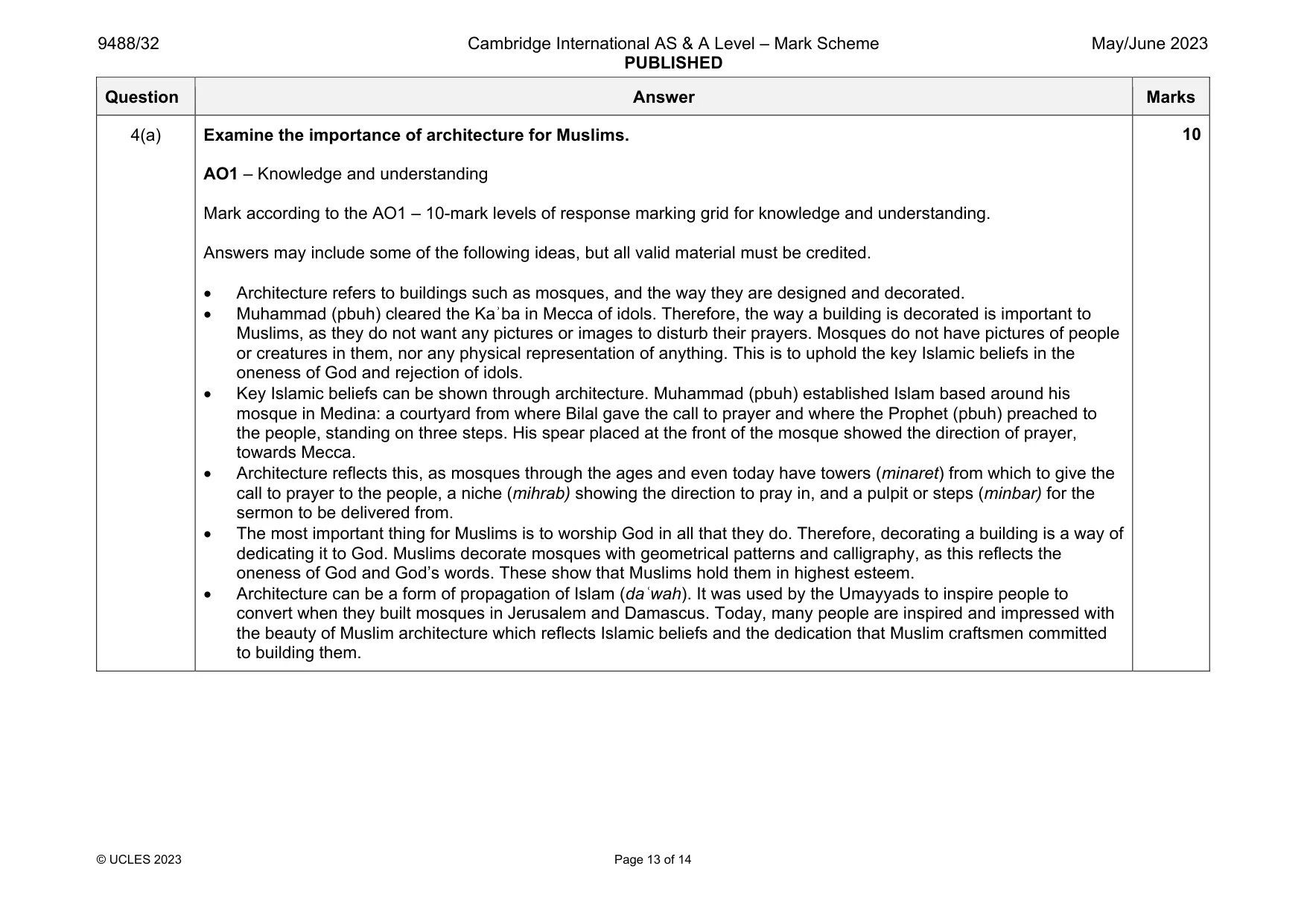
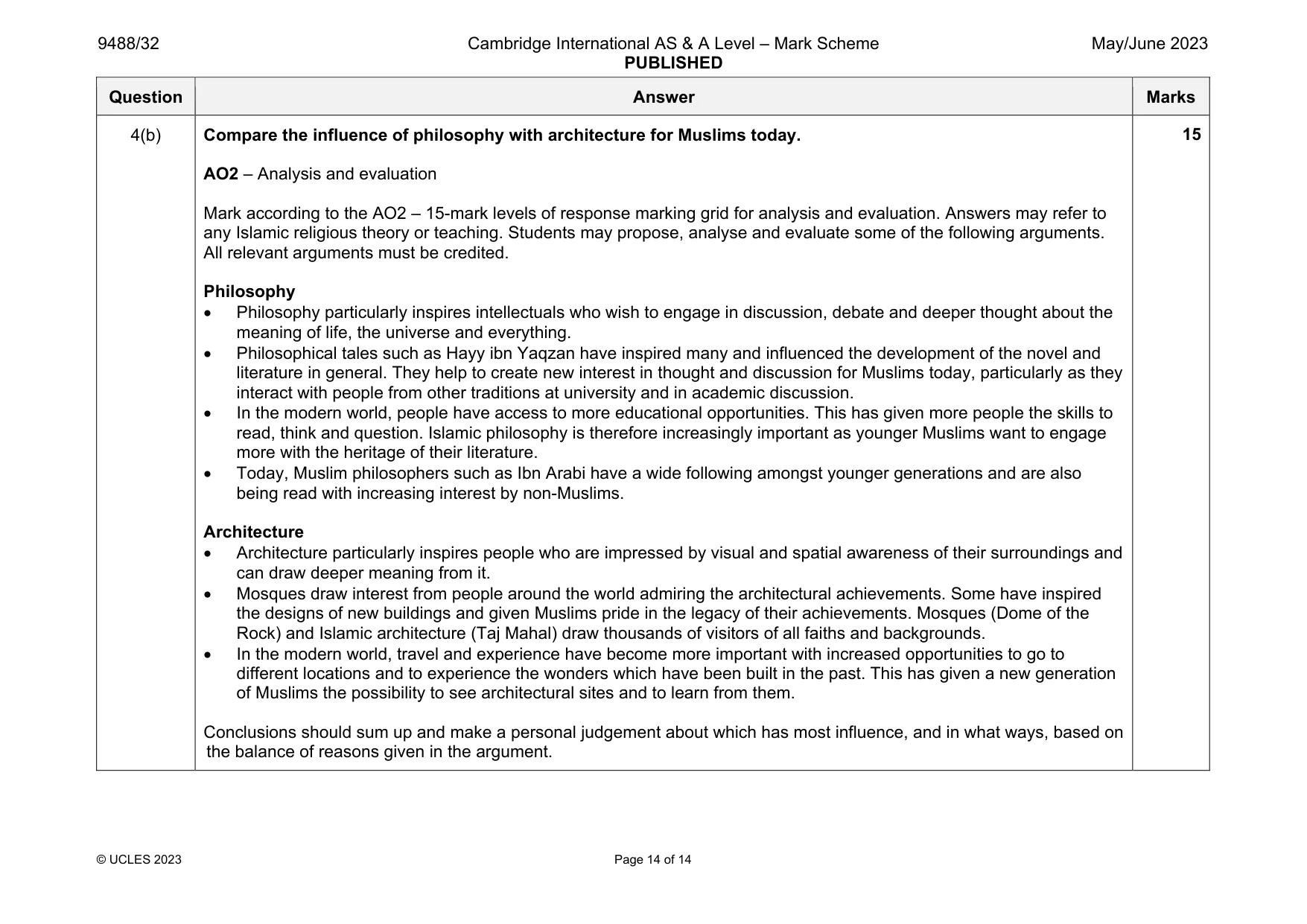
4 (a) Examine the importance of architecture for Muslims. [10] (b) Compare the influence of philosophy with architecture for Muslims today. [15] [Total: 25]
Mark scheme: 4(a) Examine the importance of architecture for Muslims. AO1 – Knowledge and understanding Mark according to the AO1 – 10-mark levels of response marking grid for knowledge and understanding. Answers may include some of the following ideas, but all valid material must be credited. Architecture refers to buildings such as mosques, and the way they are designed and decorated. Muhammad (pbuh) cleared the Kaʾba in Mecca of idols. Therefore, the way a building is decorated is important to Muslims, as they do not want any pictures or images to disturb their prayers. Mosques do not have pictures of people or creatures in them, nor any physical representation of anything. This is to uphold the key Islamic beliefs in the oneness of God and rejection of idols. Key Islamic beliefs can be shown through architecture. Muhammad (pbuh) established Islam based around his mosque in Medina: a courtyard from where Bilal gave the call to prayer and where the Prophet (pbuh) preached to the people, standing on three steps. His spear placed at the front of the mosque showed the direction of prayer, towards Mecca. Architecture reflects this, as mosques through the ages and even today have towers (minaret) from which to give the call to prayer to the people, a niche (mihrab) showing the direction to pray in, and a pulpit or steps (minbar) for the sermon to be delivered from. The most important thing for Muslims is to worship God in all that they do. Therefore, decorating a building is a way of dedicating it to God. Muslims decorate mosques with geometrical patterns and calligraphy, as this reflects the oneness of God and God’s words. These show that Muslims hold them in highest esteem. Architecture can be a form of propagation of Islam (daʿwah). It was used by the Umayyads to inspire people to convert when they built mosques in Jerusalem and Damascus. Today, many people are inspired and impressed with the beauty of Muslim architecture which reflects Islamic beliefs and the dedication that Muslim craftsmen committed to building them. Question Answer Marks 4(b) Compare the influence of philosophy with architecture for Muslims today. AO2 – Analysis and evaluation Mark according to the AO2 – 15-mark levels of response marking grid for analysis and evaluation. Answers may refer to any Islamic religious theory or teaching. Students may propose, analyse and evaluate some of the following arguments. All relevant arguments must be credited. Philosophy Philosophy particularly inspires intellectuals who wish to engage in discussion, debate and deeper thought about the meaning of life, the universe and everything. Philosophical tales such as Hayy ibn Yaqzan have inspired many and influenced the development of the novel and literature in general. They help to create new interest in thought and discussion for Muslims today, particularly as they interact with people from other traditions at university and in academic discussion. In the modern world, people have access to more educational opportunities. This has given more people the skills to read, think and question. Islamic philosophy is therefore increasingly important as younger Muslims want to engage more with the heritage of their literature. Today, Muslim philosophers such as Ibn Arabi have a wide following amongst younger generations and are also being read with increasing interest by non-Muslims. Architecture Architecture particularly inspires people who are impressed by visual and spatial awareness of their surroundings and can draw deeper meaning from it. Mosques draw interest from people around the world admiring the architectural achievements. Some have inspired the designs of new buildings and given Muslims pride in the legacy of their achievements. Mosques (Dome of the Rock) and Islamic architecture (Taj Mahal) draw thousands of visitors of all faiths and backgrounds. In the modern world, travel and experience have become more important with increased opportunities to go to different locations and to experience the wonders which have been built in the past. This has given a new generation of Muslims the possibility to see architectural sites and to learn from them. Conclusions should sum up and make a personal judgement about which has most influence, and in what ways, based on the balance of reasons given in the argument. 15
What was in this paper
The subtopics covered by these 4 questions, and how many questions each got. Open one in a new tab to see every Cambridge question on it.
What you needed in this session
Cambridge’s own grade thresholds for 2023 May/June, Paper 3 · Variant 2. A higher threshold means an easier paper — the bar moves with how the cohort did.