Cambridge A Level Islamic Studies 9488 — 2022 May/June Paper 3 · Variant 2
9488/32/M/J/22 · 4 questions · 50 marks · ≈56 min
The question paper and its mark scheme, free to read here and free to download. This is Cambridge’s own paper, exactly as it was sat.
Question paper4 pages
Mark scheme15 pages
Answers below. Sit the paper first if you are practising.
Questions as text
Question 1
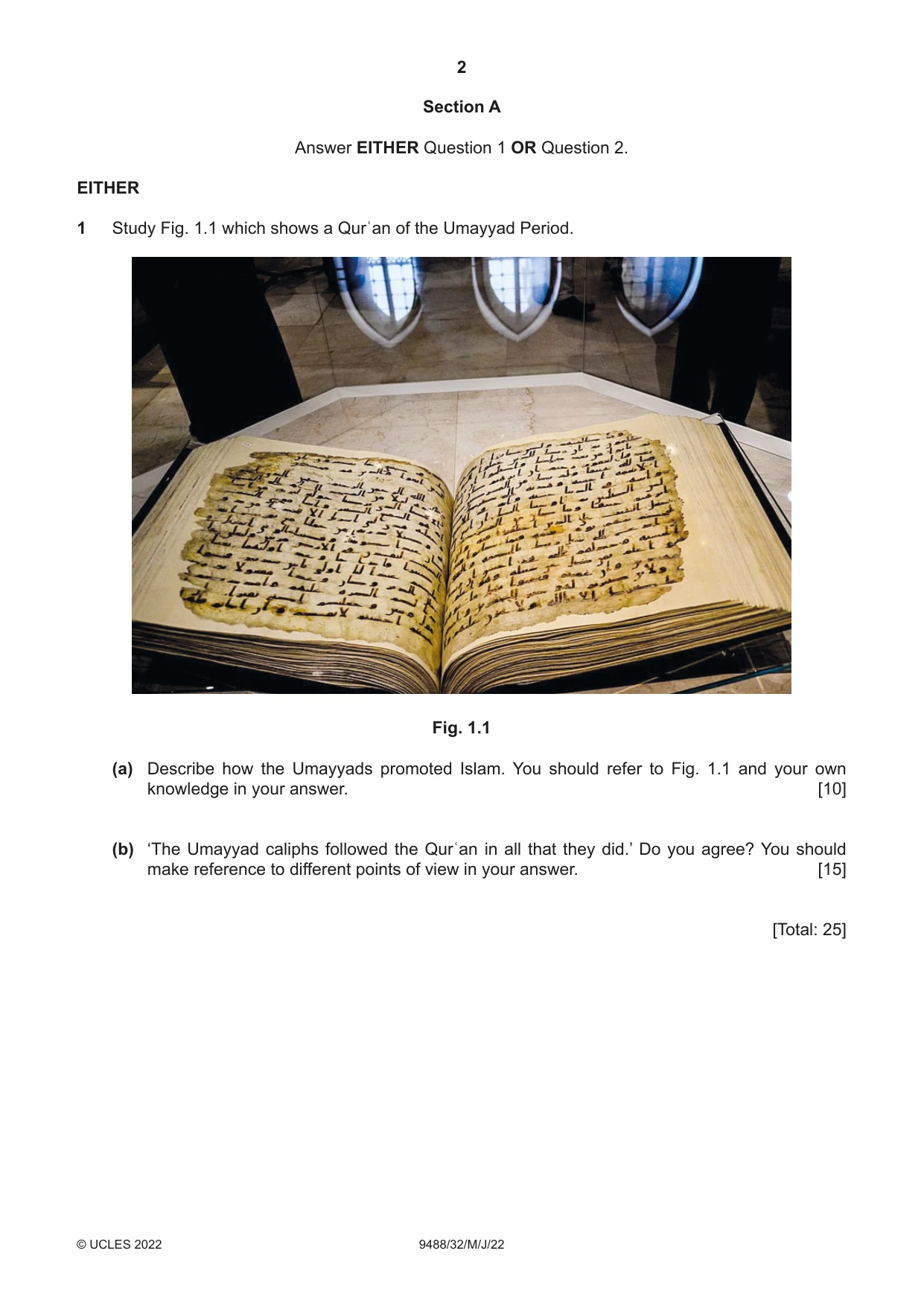
1 Study Fig. 1.1 which shows a Qurʿan of the Umayyad Period. Fig. 1.1 (a) Describe how the Umayyads promoted Islam. You should refer to Fig. 1.1 and your own knowledge in your answer. [10] (b) ‘The Umayyad caliphs followed the Qurʿan in all that they did.’ Do you agree? You should make reference to different points of view in your answer. [15] [Total: 25] OR
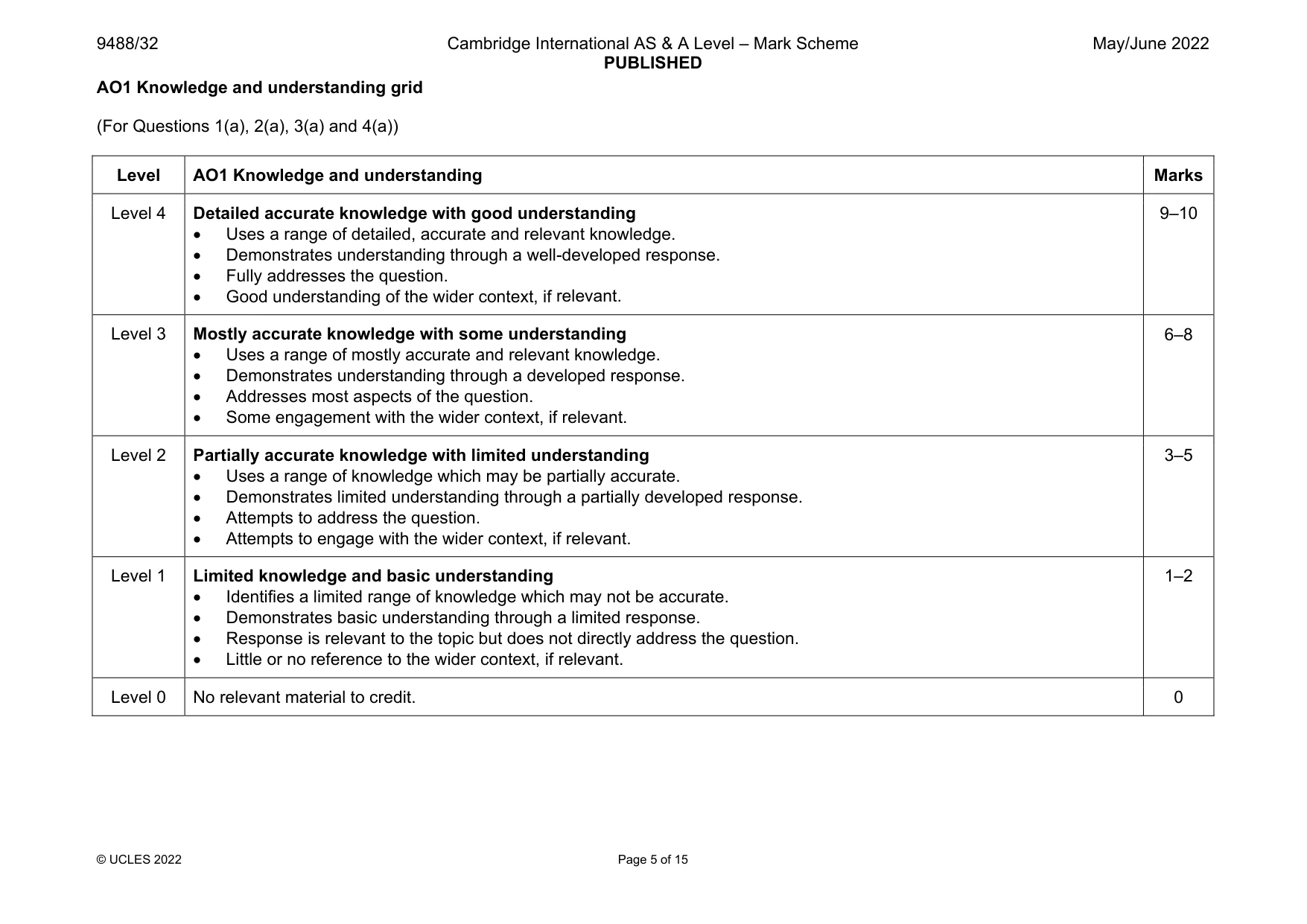
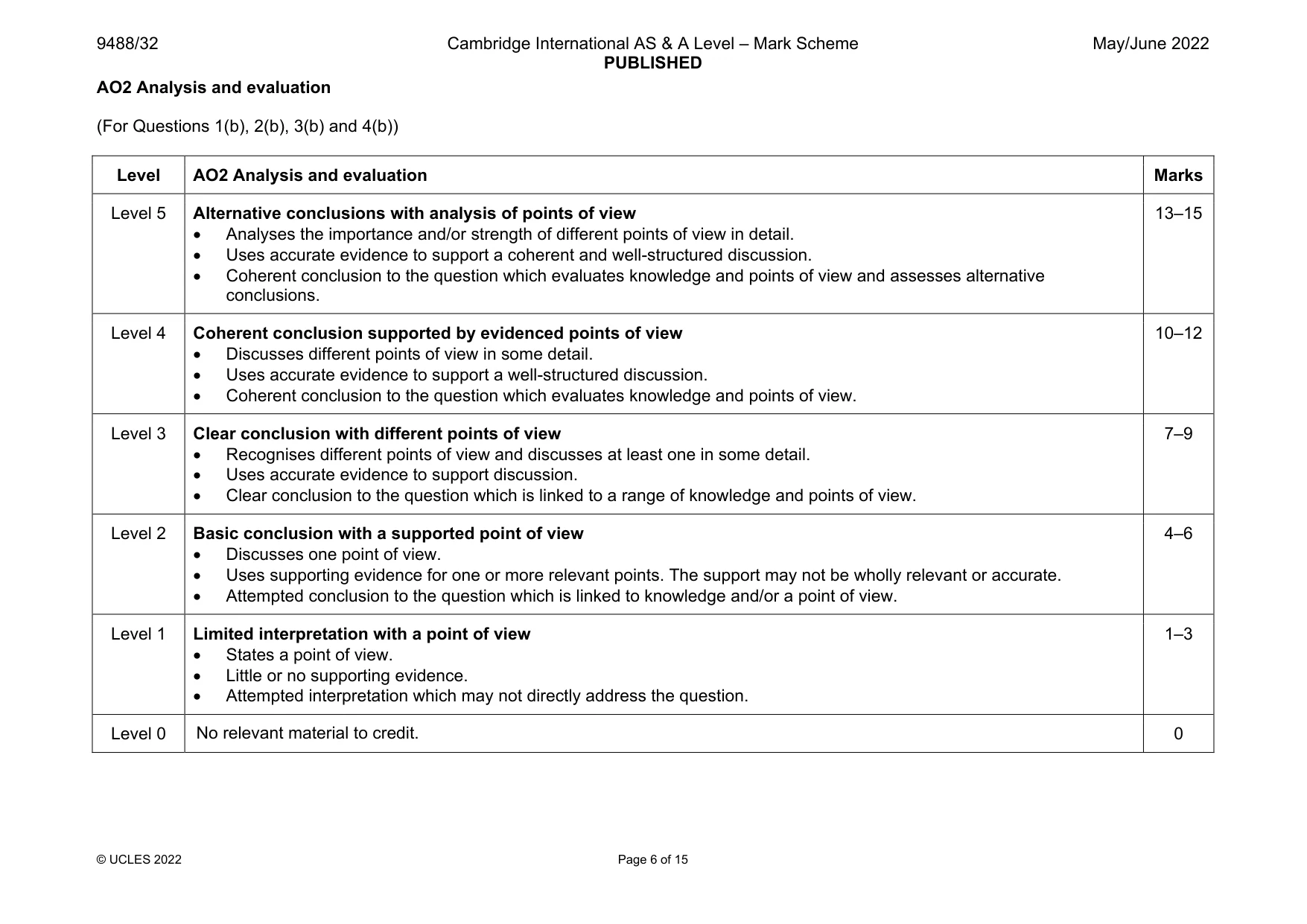
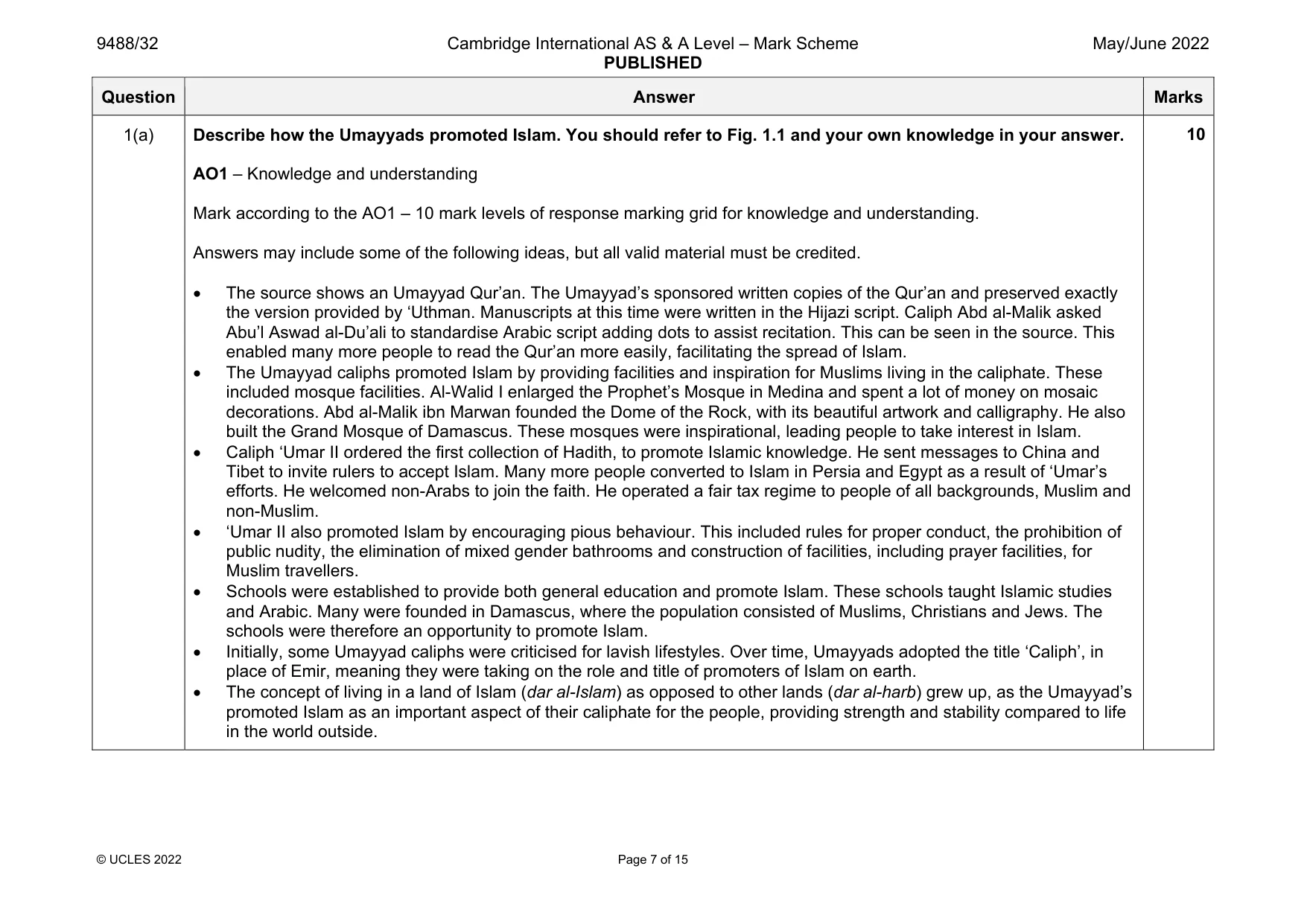
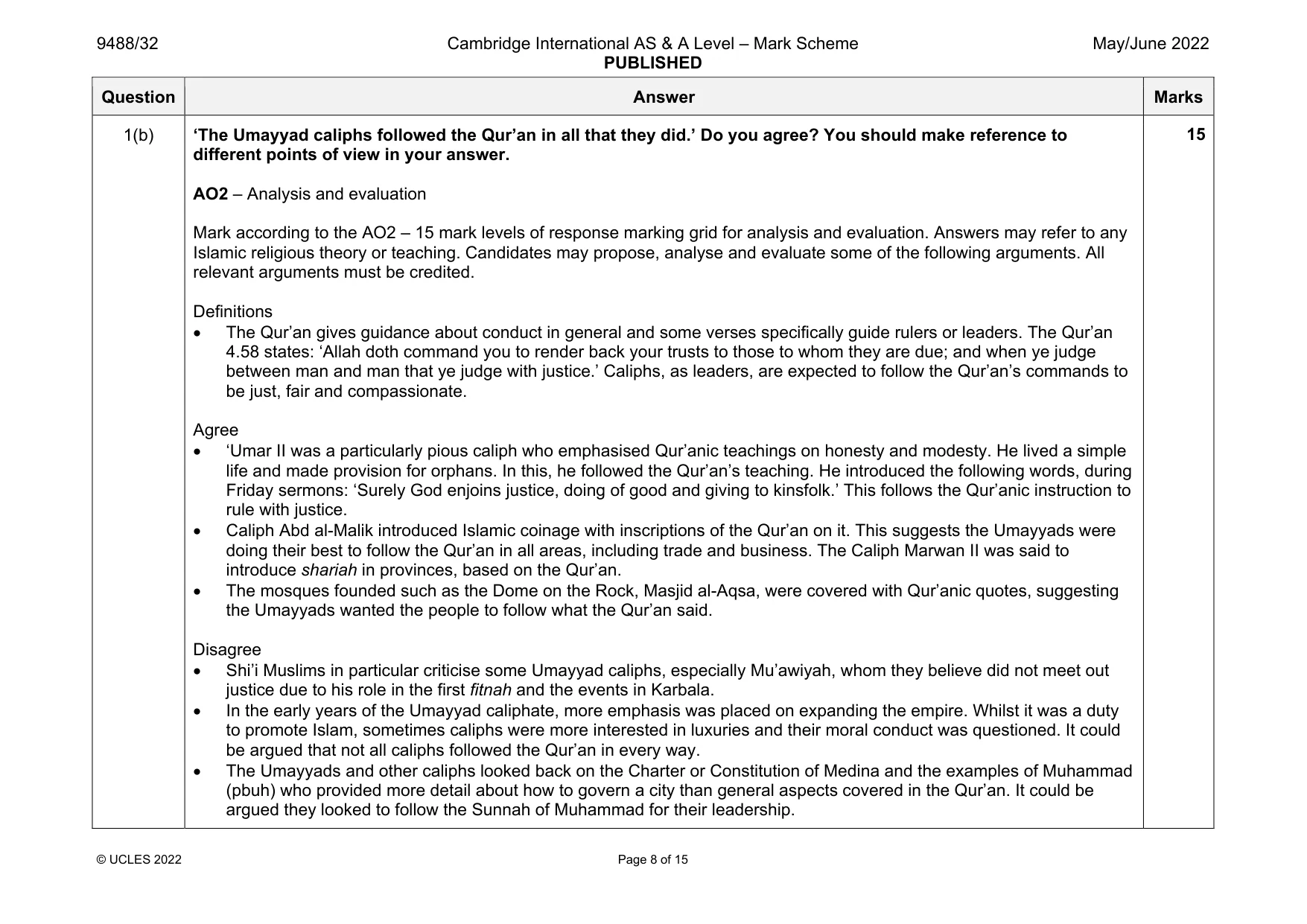
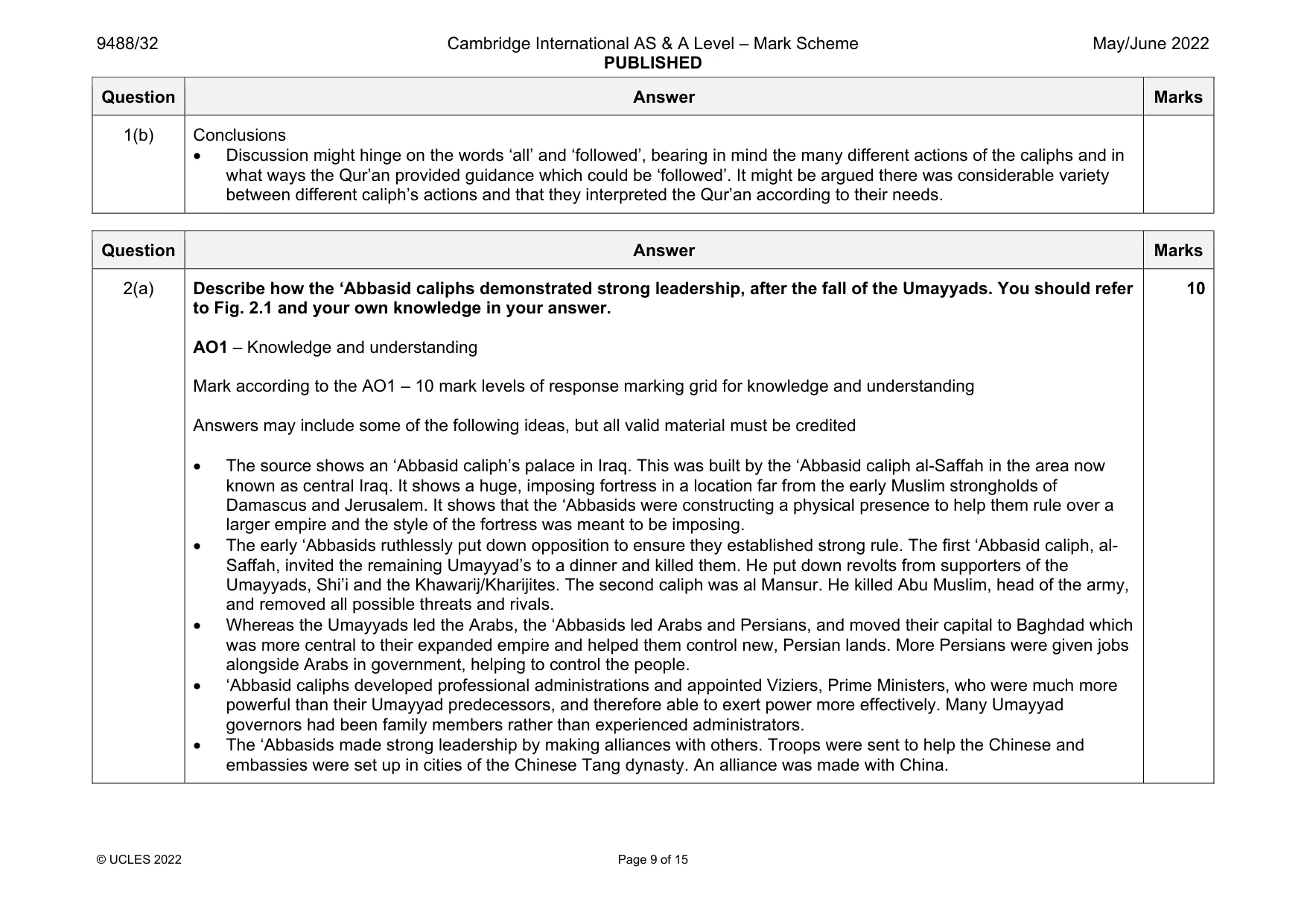
Mark scheme: 1(a) Describe how the Umayyads promoted Islam. You should refer to Fig. 1.1 and your own knowledge in your answer. AO1 – Knowledge and understanding Mark according to the AO1 – 10 mark levels of response marking grid for knowledge and understanding. Answers may include some of the following ideas, but all valid material must be credited. The source shows an Umayyad Qur’an. The Umayyad’s sponsored written copies of the Qur’an and preserved exactly the version provided by ‘Uthman. Manuscripts at this time were written in the Hijazi script. Caliph Abd al-Malik asked Abu’l Aswad al-Du’ali to standardise Arabic script adding dots to assist recitation. This can be seen in the source. This enabled many more people to read the Qur’an more easily, facilitating the spread of Islam. The Umayyad caliphs promoted Islam by providing facilities and inspiration for Muslims living in the caliphate. These included mosque facilities. Al-Walid I enlarged the Prophet’s Mosque in Medina and spent a lot of money on mosaic decorations. Abd al-Malik ibn Marwan founded the Dome of the Rock, with its beautiful artwork and calligraphy. He also built the Grand Mosque of Damascus. These mosques were inspirational, leading people to take interest in Islam. Caliph ‘Umar II ordered the first collection of Hadith, to promote Islamic knowledge. He sent messages to China and Tibet to invite rulers to accept Islam. Many more people converted to Islam in Persia and Egypt as a result of ‘Umar’s efforts. He welcomed non-Arabs to join the faith. He operated a fair tax regime to people of all backgrounds, Muslim and non-Muslim. ‘Umar II also promoted Islam by encouraging pious behaviour. This included rules for proper conduct, the prohibition of public nudity, the elimination of mixed gender bathrooms and construction of facilities, including prayer facilities, for Muslim travellers. Schools were established to provide both general education and promote Islam. These schools taught Islamic studies and Arabic. Many were founded in Damascus, where the population consisted of Muslims, Christians and Jews. The schools were therefore an opportunity to promote Islam. Initially, some Umayyad caliphs were criticised for lavish lifestyles. Over time, Umayyads adopted the title ‘Caliph’, in place of Emir, meaning they were taking on the role and title of promoters of Islam on earth. The concept of living in a land of Islam (dar al-Islam) as opposed to other lands (dar al-harb) grew up, as the Umayyad’s promoted Islam as an important aspect of their caliphate for the people, providing strength and stability compared to life in the world outside. Question Answer Marks 1(b) ‘The Umayyad caliphs followed the Qur’an in all that they did.’ Do you agree? You should make reference to different points of view in your answer. AO2 – Analysis and evaluation Mark according to the AO2 – 15 mark levels of response marking grid for analysis and evaluation. Answers may refer to any Islamic religious theory or teaching. Candidates may propose, analyse and evaluate some of the following arguments. All relevant arguments must be credited. Definitions The Qur’an gives guidance about conduct in general and some verses specifically guide rulers or leaders. The Qur’an 4.58 states: ‘Allah doth command you to render back your trusts to those to whom they are due; and when ye judge between man and man that ye judge with justice.’ Caliphs, as leaders, are expected to follow the Qur’an’s commands to be just, fair and compassionate. Agree ‘Umar II was a particularly pious caliph who emphasised Qur’anic teachings on honesty and modesty. He lived a simple life and made provision for orphans. In this, he followed the Qur’an’s teaching. He introduced the following words, during Friday sermons: ‘Surely God enjoins justice, doing of good and giving to kinsfolk.’ This follows the Qur’anic instruction to rule with justice. Caliph Abd al-Malik introduced Islamic coinage with inscriptions of the Qur’an on it. This suggests the Umayyads were doing their best to follow the Qur’an in all areas, including trade and business. The Caliph Marwan II was said to introduce shariah in provinces, based on the Qur’an. The mosques founded such as the Dome on the Rock, Masjid al-Aqsa, were covered with Qur’anic quotes, suggesting the Umayyads wanted the people to follow what the Qur’an said. Disagree Shi’i Muslims in particular criticise some Umayyad caliphs, especially Mu’awiyah, whom they believe did not meet out justice due to his role in the first fitnah and the events in Karbala. In the early years of the Umayyad caliphate, more emphasis was placed on expanding the empire. Whilst it was a duty to promote Islam, sometimes caliphs were more interested in luxuries and their moral conduct was questioned. It could be argued that not all caliphs followed the Qur’an in every way. The Umayyads and other caliphs looked back on the Charter or Constitution of Medina and the examples of Muhammad (pbuh) who provided more detail about how to govern a city than general aspects covered in the Qur’an. It could be argued they looked to follow the Sunnah of Muhammad for their leadership. 15 Question Answer Marks 1(b) Conclusions Discussion might hinge on the words ‘all’ and ‘followed’, bearing in mind the many different actions of the caliphs and in what ways the Qur’an provided guidance which could be ‘followed’. It might be argued there was considerable variety between different caliph’s actions and that they interpreted the Qur’an according to their needs.
Question 2
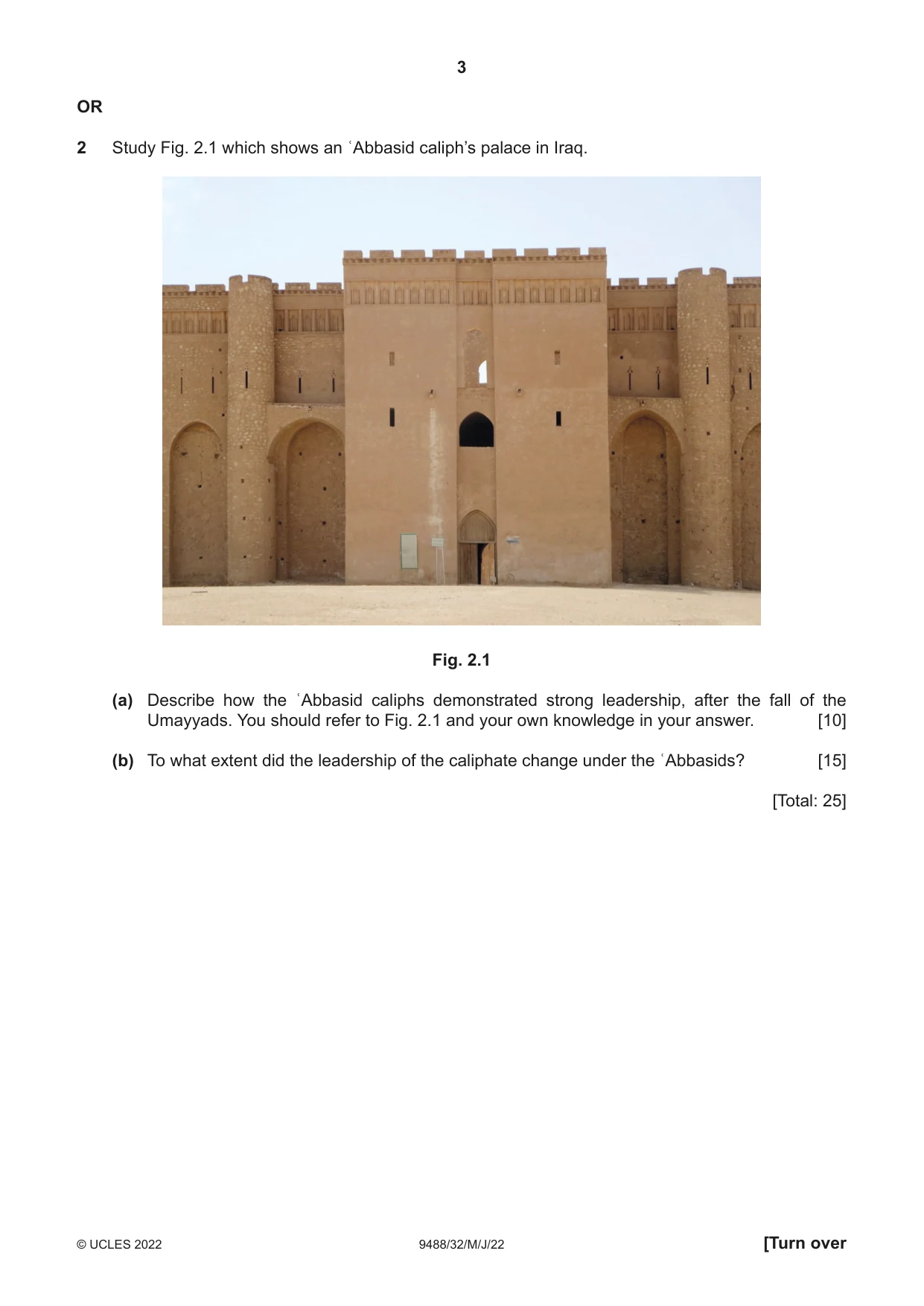
2 Study Fig. 2.1 which shows an ʿAbbasid caliph’s palace in Iraq. Fig. 2.1 (a) Describe how the ʿAbbasid caliphs demonstrated strong leadership, after the fall of the Umayyads. You should refer to Fig. 2.1 and your own knowledge in your answer. [10] (b) To what extent did the leadership of the caliphate change under the ʿAbbasids? [15] [Total: 25]
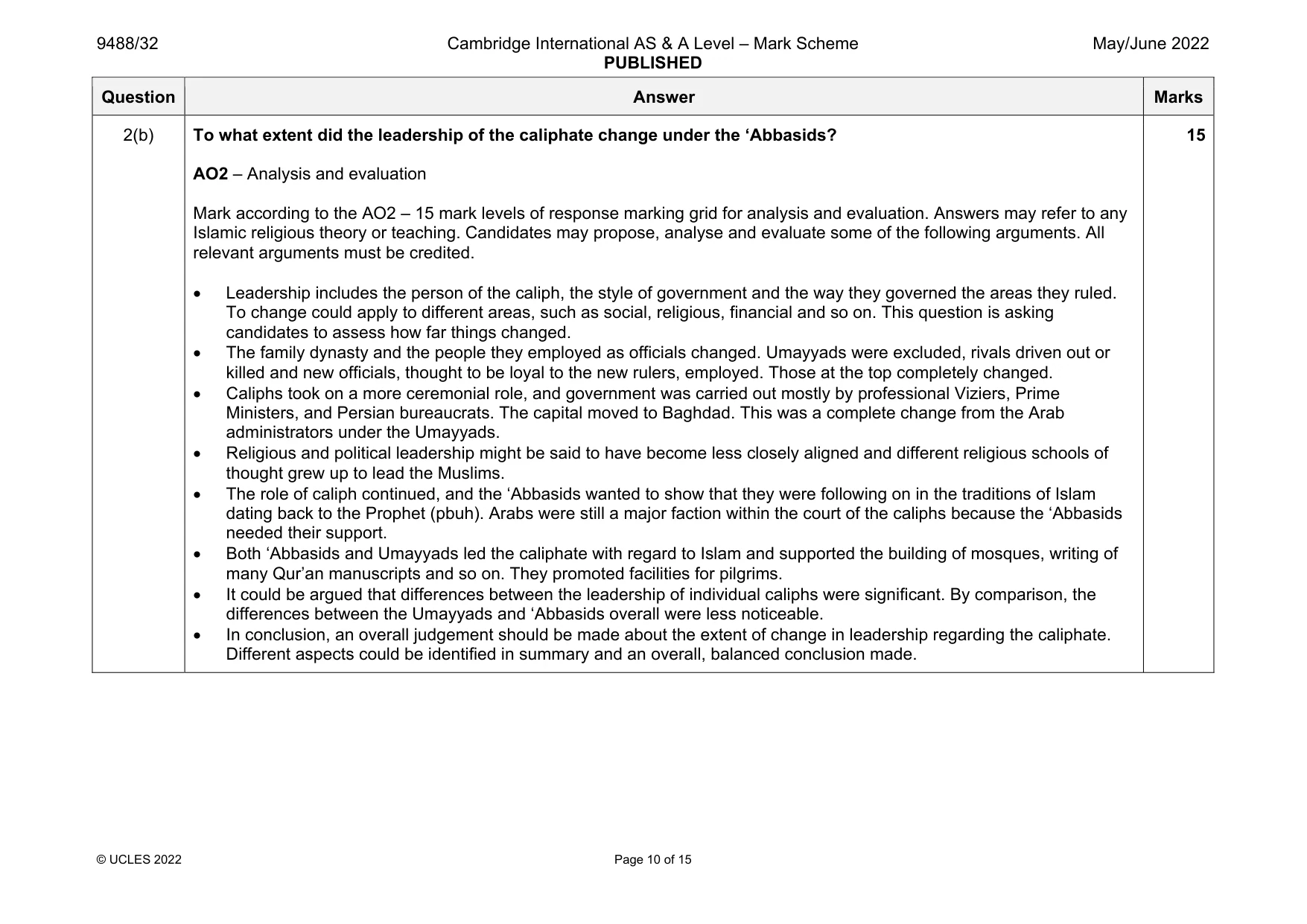
Mark scheme: 2(a) Describe how the ‘Abbasid caliphs demonstrated strong leadership, after the fall of the Umayyads. You should refer to Fig. 2.1 and your own knowledge in your answer. AO1 – Knowledge and understanding Mark according to the AO1 – 10 mark levels of response marking grid for knowledge and understanding Answers may include some of the following ideas, but all valid material must be credited The source shows an ‘Abbasid caliph’s palace in Iraq. This was built by the ‘Abbasid caliph al-Saffah in the area now known as central Iraq. It shows a huge, imposing fortress in a location far from the early Muslim strongholds of Damascus and Jerusalem. It shows that the ‘Abbasids were constructing a physical presence to help them rule over a larger empire and the style of the fortress was meant to be imposing. The early ‘Abbasids ruthlessly put down opposition to ensure they established strong rule. The first ‘Abbasid caliph, al- Saffah, invited the remaining Umayyad’s to a dinner and killed them. He put down revolts from supporters of the Umayyads, Shi’i and the Khawarij/Kharijites. The second caliph was al Mansur. He killed Abu Muslim, head of the army, and removed all possible threats and rivals. Whereas the Umayyads led the Arabs, the ‘Abbasids led Arabs and Persians, and moved their capital to Baghdad which was more central to their expanded empire and helped them control new, Persian lands. More Persians were given jobs alongside Arabs in government, helping to control the people. ‘Abbasid caliphs developed professional administrations and appointed Viziers, Prime Ministers, who were much more powerful than their Umayyad predecessors, and therefore able to exert power more effectively. Many Umayyad governors had been family members rather than experienced administrators. The ‘Abbasids made strong leadership by making alliances with others. Troops were sent to help the Chinese and embassies were set up in cities of the Chinese Tang dynasty. An alliance was made with China. Question Answer Marks 2(b) To what extent did the leadership of the caliphate change under the ‘Abbasids? AO2 – Analysis and evaluation Mark according to the AO2 – 15 mark levels of response marking grid for analysis and evaluation. Answers may refer to any Islamic religious theory or teaching. Candidates may propose, analyse and evaluate some of the following arguments. All relevant arguments must be credited. Leadership includes the person of the caliph, the style of government and the way they governed the areas they ruled. To change could apply to different areas, such as social, religious, financial and so on. This question is asking candidates to assess how far things changed. The family dynasty and the people they employed as officials changed. Umayyads were excluded, rivals driven out or killed and new officials, thought to be loyal to the new rulers, employed. Those at the top completely changed. Caliphs took on a more ceremonial role, and government was carried out mostly by professional Viziers, Prime Ministers, and Persian bureaucrats. The capital moved to Baghdad. This was a complete change from the Arab administrators under the Umayyads. Religious and political leadership might be said to have become less closely aligned and different religious schools of thought grew up to lead the Muslims. The role of caliph continued, and the ‘Abbasids wanted to show that they were following on in the traditions of Islam dating back to the Prophet (pbuh). Arabs were still a major faction within the court of the caliphs because the ‘Abbasids needed their support. Both ‘Abbasids and Umayyads led the caliphate with regard to Islam and supported the building of mosques, writing of many Qur’an manuscripts and so on. They promoted facilities for pilgrims. It could be argued that differences between the leadership of individual caliphs were significant. By comparison, the differences between the Umayyads and ‘Abbasids overall were less noticeable. In conclusion, an overall judgement should be made about the extent of change in leadership regarding the caliphate. Different aspects could be identified in summary and an overall, balanced conclusion made. 15
Q3 · Explain how one significant writing, that you have studied, could express Islamic beliefs
3 (a) Explain how one significant writing, that you have studied, could express Islamic beliefs. [10] (b) Discuss the different ways in which Muslims might explain their main beliefs to others (daʿwah). [15] [Total: 25] OR
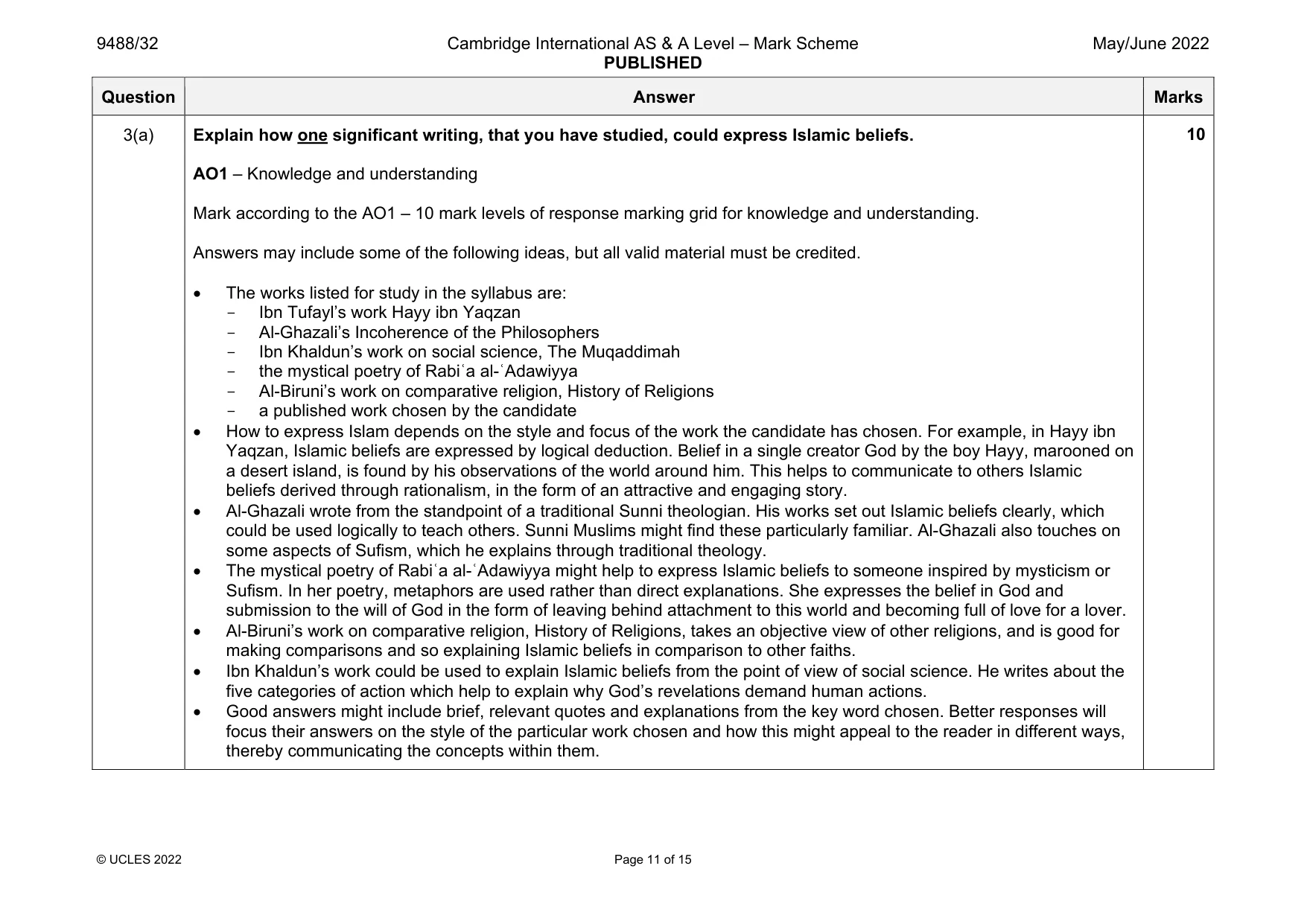
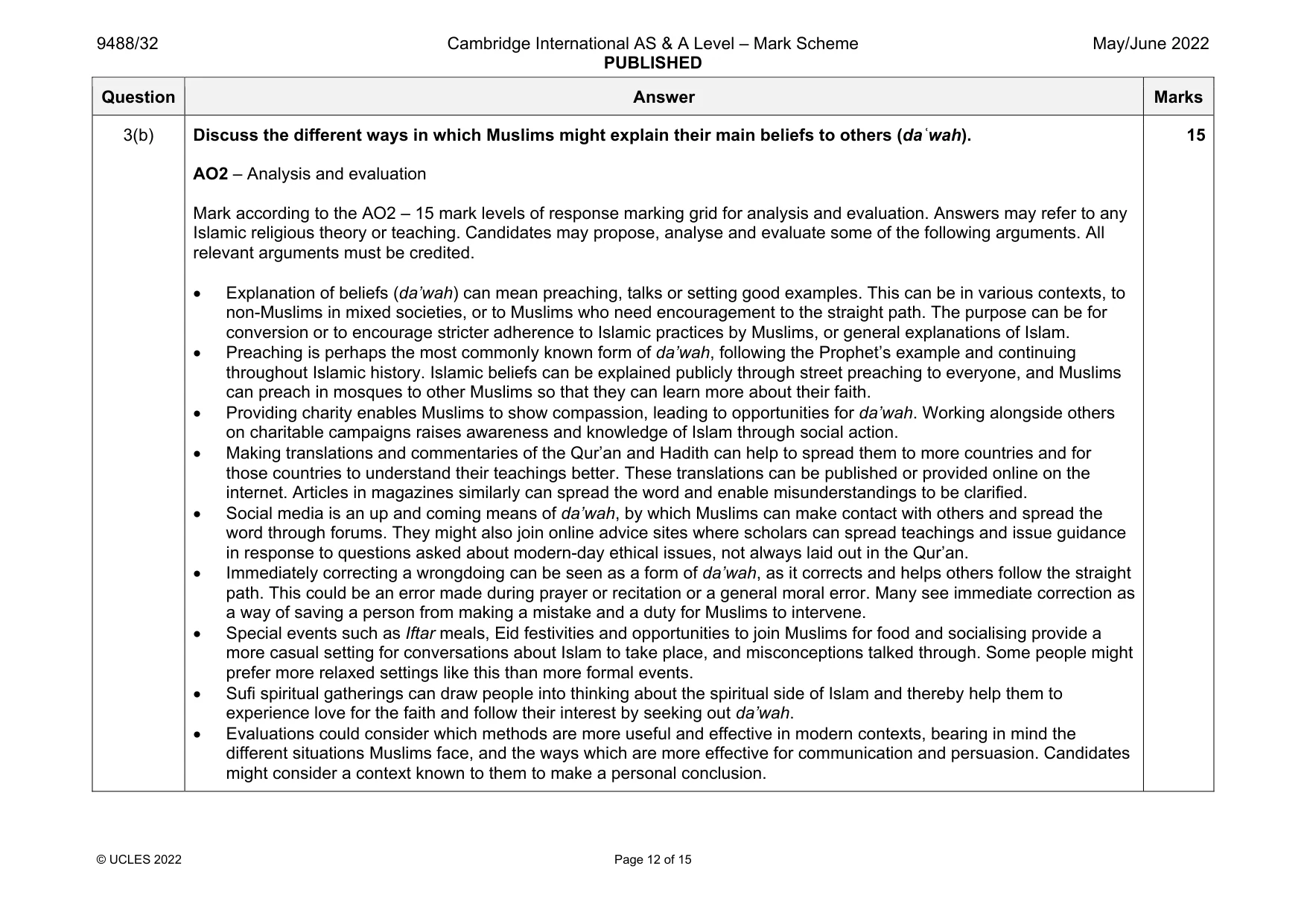
Mark scheme: 3(a) Explain how one significant writing, that you have studied, could express Islamic beliefs. AO1 – Knowledge and understanding Mark according to the AO1 – 10 mark levels of response marking grid for knowledge and understanding. Answers may include some of the following ideas, but all valid material must be credited. The works listed for study in the syllabus are: - Ibn Tufayl’s work Hayy ibn Yaqzan - Al-Ghazali’s Incoherence of the Philosophers - Ibn Khaldun’s work on social science, The Muqaddimah - the mystical poetry of Rabiʿa al-ʿAdawiyya - Al-Biruni’s work on comparative religion, History of Religions - a published work chosen by the candidate How to express Islam depends on the style and focus of the work the candidate has chosen. For example, in Hayy ibn Yaqzan, Islamic beliefs are expressed by logical deduction. Belief in a single creator God by the boy Hayy, marooned on a desert island, is found by his observations of the world around him. This helps to communicate to others Islamic beliefs derived through rationalism, in the form of an attractive and engaging story. Al-Ghazali wrote from the standpoint of a traditional Sunni theologian. His works set out Islamic beliefs clearly, which could be used logically to teach others. Sunni Muslims might find these particularly familiar. Al-Ghazali also touches on some aspects of Sufism, which he explains through traditional theology. The mystical poetry of Rabiʿa al-ʿAdawiyya might help to express Islamic beliefs to someone inspired by mysticism or Sufism. In her poetry, metaphors are used rather than direct explanations. She expresses the belief in God and submission to the will of God in the form of leaving behind attachment to this world and becoming full of love for a lover. Al-Biruni’s work on comparative religion, History of Religions, takes an objective view of other religions, and is good for making comparisons and so explaining Islamic beliefs in comparison to other faiths. Ibn Khaldun’s work could be used to explain Islamic beliefs from the point of view of social science. He writes about the five categories of action which help to explain why God’s revelations demand human actions. Good answers might include brief, relevant quotes and explanations from the key word chosen. Better responses will focus their answers on the style of the particular work chosen and how this might appeal to the reader in different ways, thereby communicating the concepts within them. Question Answer Marks 3(b) Discuss the different ways in which Muslims might explain their main beliefs to others (daʿwah). AO2 – Analysis and evaluation Mark according to the AO2 – 15 mark levels of response marking grid for analysis and evaluation. Answers may refer to any Islamic religious theory or teaching. Candidates may propose, analyse and evaluate some of the following arguments. All relevant arguments must be credited. Explanation of beliefs (da’wah) can mean preaching, talks or setting good examples. This can be in various contexts, to non-Muslims in mixed societies, or to Muslims who need encouragement to the straight path. The purpose can be for conversion or to encourage stricter adherence to Islamic practices by Muslims, or general explanations of Islam. Preaching is perhaps the most commonly known form of da’wah, following the Prophet’s example and continuing throughout Islamic history. Islamic beliefs can be explained publicly through street preaching to everyone, and Muslims can preach in mosques to other Muslims so that they can learn more about their faith. Providing charity enables Muslims to show compassion, leading to opportunities for da’wah. Working alongside others on charitable campaigns raises awareness and knowledge of Islam through social action. Making translations and commentaries of the Qur’an and Hadith can help to spread them to more countries and for those countries to understand their teachings better. These translations can be published or provided online on the internet. Articles in magazines similarly can spread the word and enable misunderstandings to be clarified. Social media is an up and coming means of da’wah, by which Muslims can make contact with others and spread the word through forums. They might also join online advice sites where scholars can spread teachings and issue guidance in response to questions asked about modern-day ethical issues, not always laid out in the Qur’an. Immediately correcting a wrongdoing can be seen as a form of da’wah, as it corrects and helps others follow the straight path. This could be an error made during prayer or recitation or a general moral error. Many see immediate correction as a way of saving a person from making a mistake and a duty for Muslims to intervene. Special events such as Iftar meals, Eid festivities and opportunities to join Muslims for food and socialising provide a more casual setting for conversations about Islam to take place, and misconceptions talked through. Some people might prefer more relaxed settings like this than more formal events. Sufi spiritual gatherings can draw people into thinking about the spiritual side of Islam and thereby help them to experience love for the faith and follow their interest by seeking out da’wah. Evaluations could consider which methods are more useful and effective in modern contexts, bearing in mind the different situations Muslims face, and the ways which are more effective for communication and persuasion. Candidates might consider a context known to them to make a personal conclusion. 15
Q4 · Explain how beliefs about the afterlife are reflected in Islamic gardens
4 (a) Explain how beliefs about the afterlife are reflected in Islamic gardens. [10] (b) ‘Gardens are the easiest way for Muslims to understand paradise.’ Evaluate this statement. [15] [Total: 25]
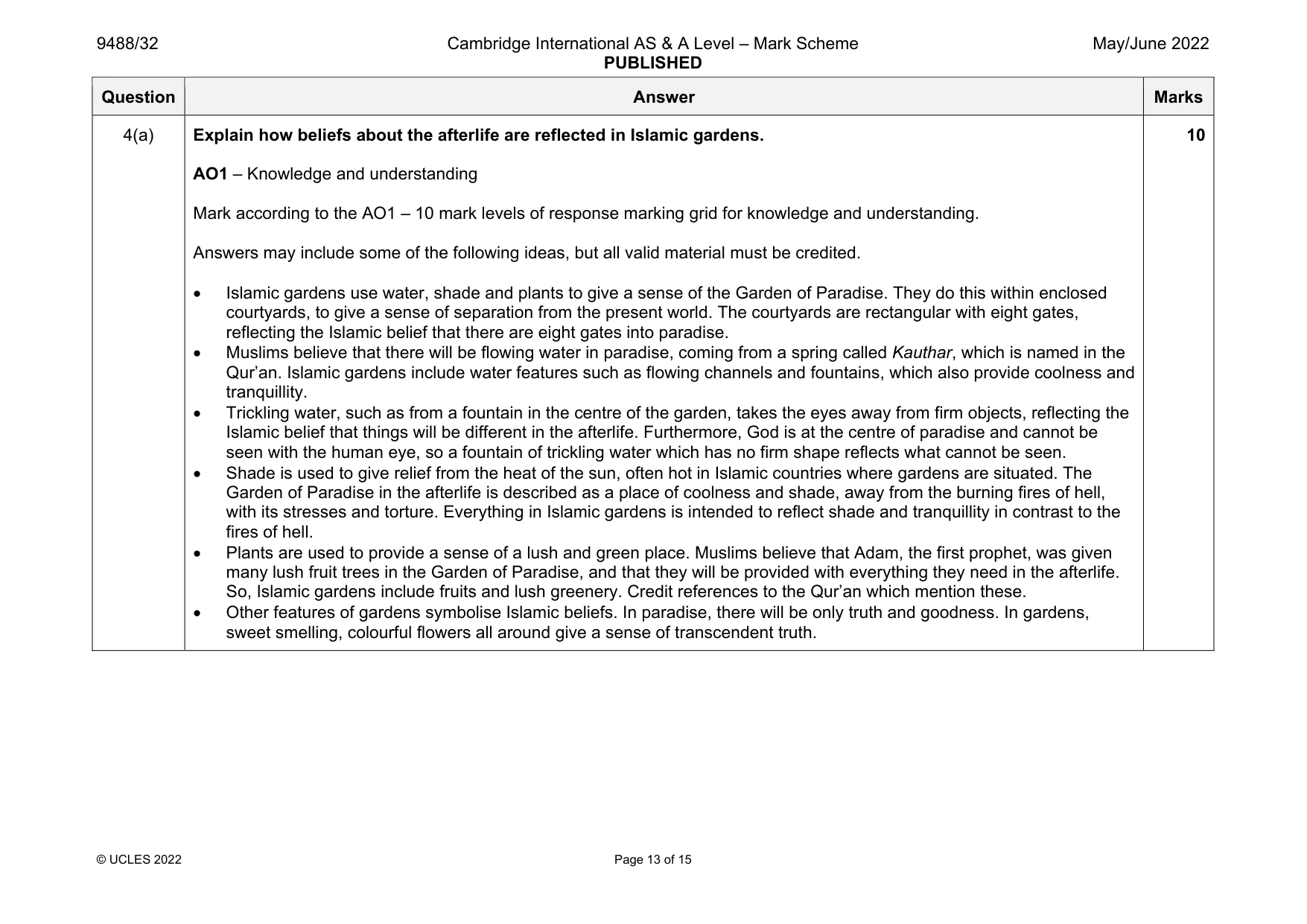
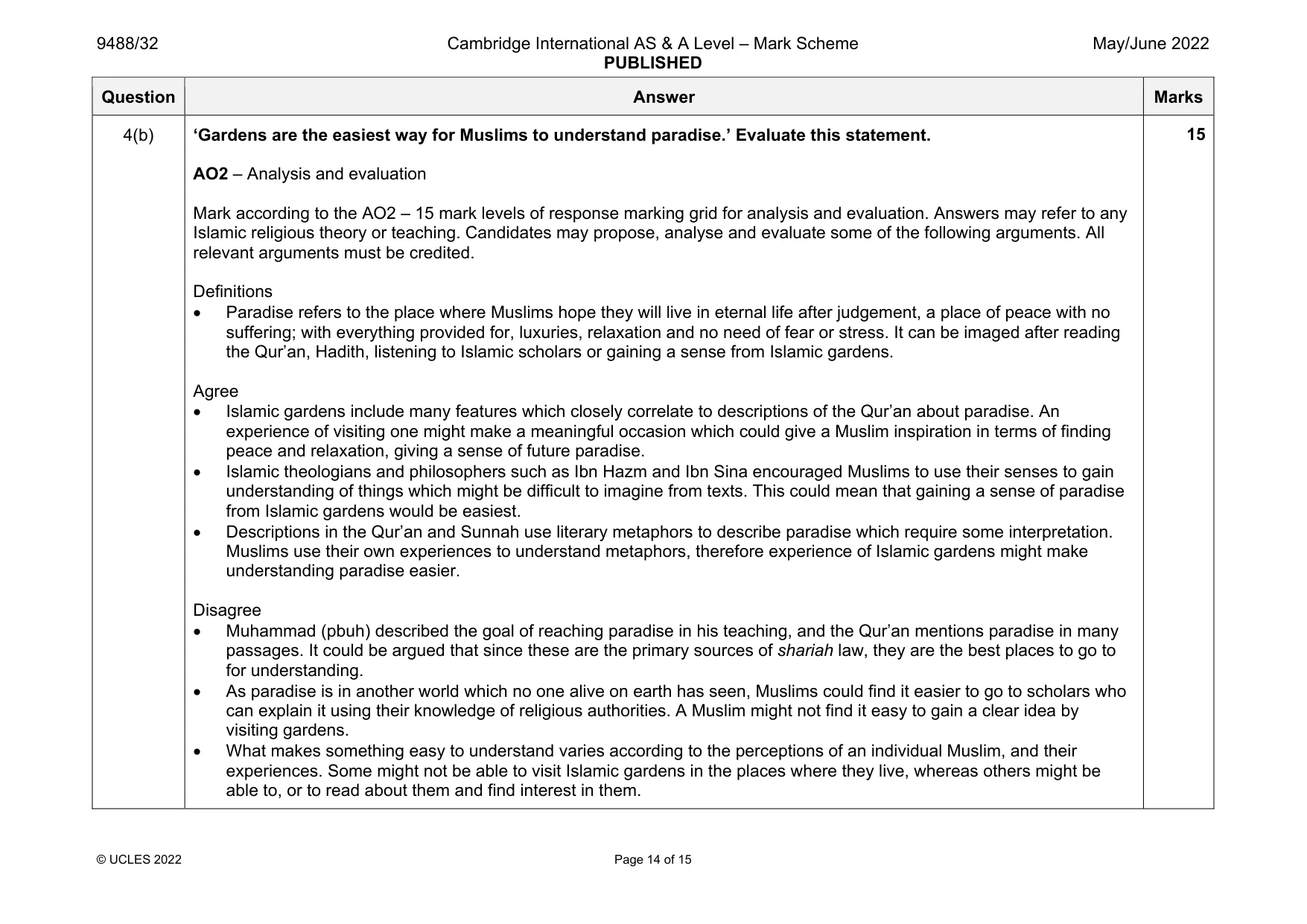
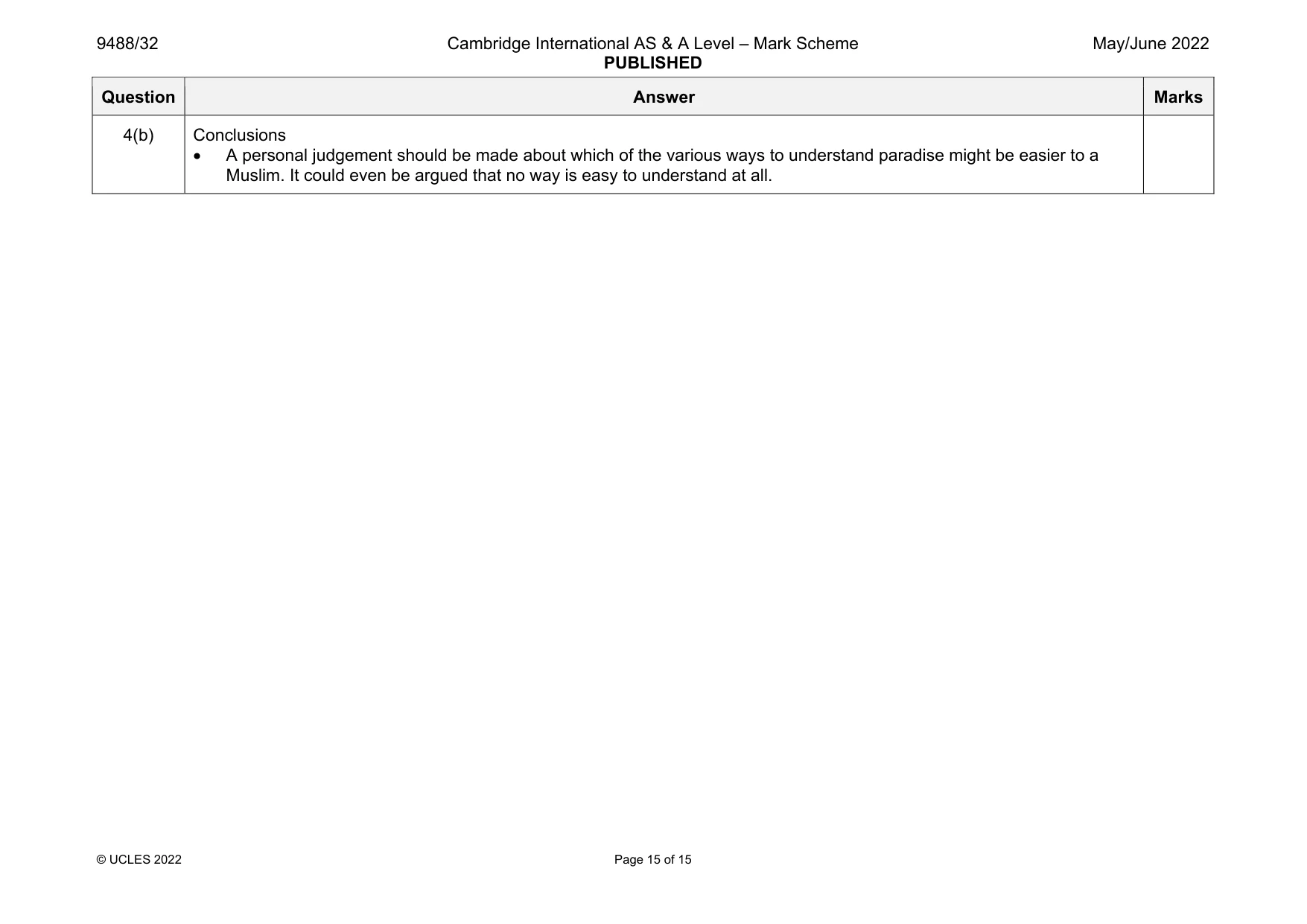
Mark scheme: 4(a) Explain how beliefs about the afterlife are reflected in Islamic gardens. AO1 – Knowledge and understanding Mark according to the AO1 – 10 mark levels of response marking grid for knowledge and understanding. Answers may include some of the following ideas, but all valid material must be credited. Islamic gardens use water, shade and plants to give a sense of the Garden of Paradise. They do this within enclosed courtyards, to give a sense of separation from the present world. The courtyards are rectangular with eight gates, reflecting the Islamic belief that there are eight gates into paradise. Muslims believe that there will be flowing water in paradise, coming from a spring called Kauthar, which is named in the Qur’an. Islamic gardens include water features such as flowing channels and fountains, which also provide coolness and tranquillity. Trickling water, such as from a fountain in the centre of the garden, takes the eyes away from firm objects, reflecting the Islamic belief that things will be different in the afterlife. Furthermore, God is at the centre of paradise and cannot be seen with the human eye, so a fountain of trickling water which has no firm shape reflects what cannot be seen. Shade is used to give relief from the heat of the sun, often hot in Islamic countries where gardens are situated. The Garden of Paradise in the afterlife is described as a place of coolness and shade, away from the burning fires of hell, with its stresses and torture. Everything in Islamic gardens is intended to reflect shade and tranquillity in contrast to the fires of hell. Plants are used to provide a sense of a lush and green place. Muslims believe that Adam, the first prophet, was given many lush fruit trees in the Garden of Paradise, and that they will be provided with everything they need in the afterlife. So, Islamic gardens include fruits and lush greenery. Credit references to the Qur’an which mention these. Other features of gardens symbolise Islamic beliefs. In paradise, there will be only truth and goodness. In gardens, sweet smelling, colourful flowers all around give a sense of transcendent truth. 10 Question Answer Marks 4(b) ‘Gardens are the easiest way for Muslims to understand paradise.’ Evaluate this statement. AO2 – Analysis and evaluation Mark according to the AO2 – 15 mark levels of response marking grid for analysis and evaluation. Answers may refer to any Islamic religious theory or teaching. Candidates may propose, analyse and evaluate some of the following arguments. All relevant arguments must be credited. Definitions Paradise refers to the place where Muslims hope they will live in eternal life after judgement, a place of peace with no suffering; with everything provided for, luxuries, relaxation and no need of fear or stress. It can be imaged after reading the Qur’an, Hadith, listening to Islamic scholars or gaining a sense from Islamic gardens. Agree Islamic gardens include many features which closely correlate to descriptions of the Qur’an about paradise. An experience of visiting one might make a meaningful occasion which could give a Muslim inspiration in terms of finding peace and relaxation, giving a sense of future paradise. Islamic theologians and philosophers such as Ibn Hazm and Ibn Sina encouraged Muslims to use their senses to gain understanding of things which might be difficult to imagine from texts. This could mean that gaining a sense of paradise from Islamic gardens would be easiest. Descriptions in the Qur’an and Sunnah use literary metaphors to describe paradise which require some interpretation. Muslims use their own experiences to understand metaphors, therefore experience of Islamic gardens might make understanding paradise easier. Disagree Muhammad (pbuh) described the goal of reaching paradise in his teaching, and the Qur’an mentions paradise in many passages. It could be argued that since these are the primary sources of shariah law, they are the best places to go to for understanding. As paradise is in another world which no one alive on earth has seen, Muslims could find it easier to go to scholars who can explain it using their knowledge of religious authorities. A Muslim might not find it easy to gain a clear idea by visiting gardens. What makes something easy to understand varies according to the perceptions of an individual Muslim, and their experiences. Some might not be able to visit Islamic gardens in the places where they live, whereas others might be able to, or to read about them and find interest in them. 15 Question Answer Marks 4(b) Conclusions A personal judgement should be made about which of the various ways to understand paradise might be easier to a Muslim. It could even be argued that no way is easy to understand at all.
What was in this paper
The subtopics covered by these 4 questions, and how many questions each got. Open one in a new tab to see every Cambridge question on it.
What you needed in this session
Cambridge’s own grade thresholds for 2022 May/June, Paper 3 · Variant 2. A higher threshold means an easier paper — the bar moves with how the cohort did.