Cambridge A Level Islamic Studies 9488 — 2025 May/June Paper 2 · Variant 2
9488/22/M/J/25 · 4 questions · 50 marks · 90 min
The question paper and its mark scheme, free to read here and free to download. This is Cambridge’s own paper, exactly as it was sat.
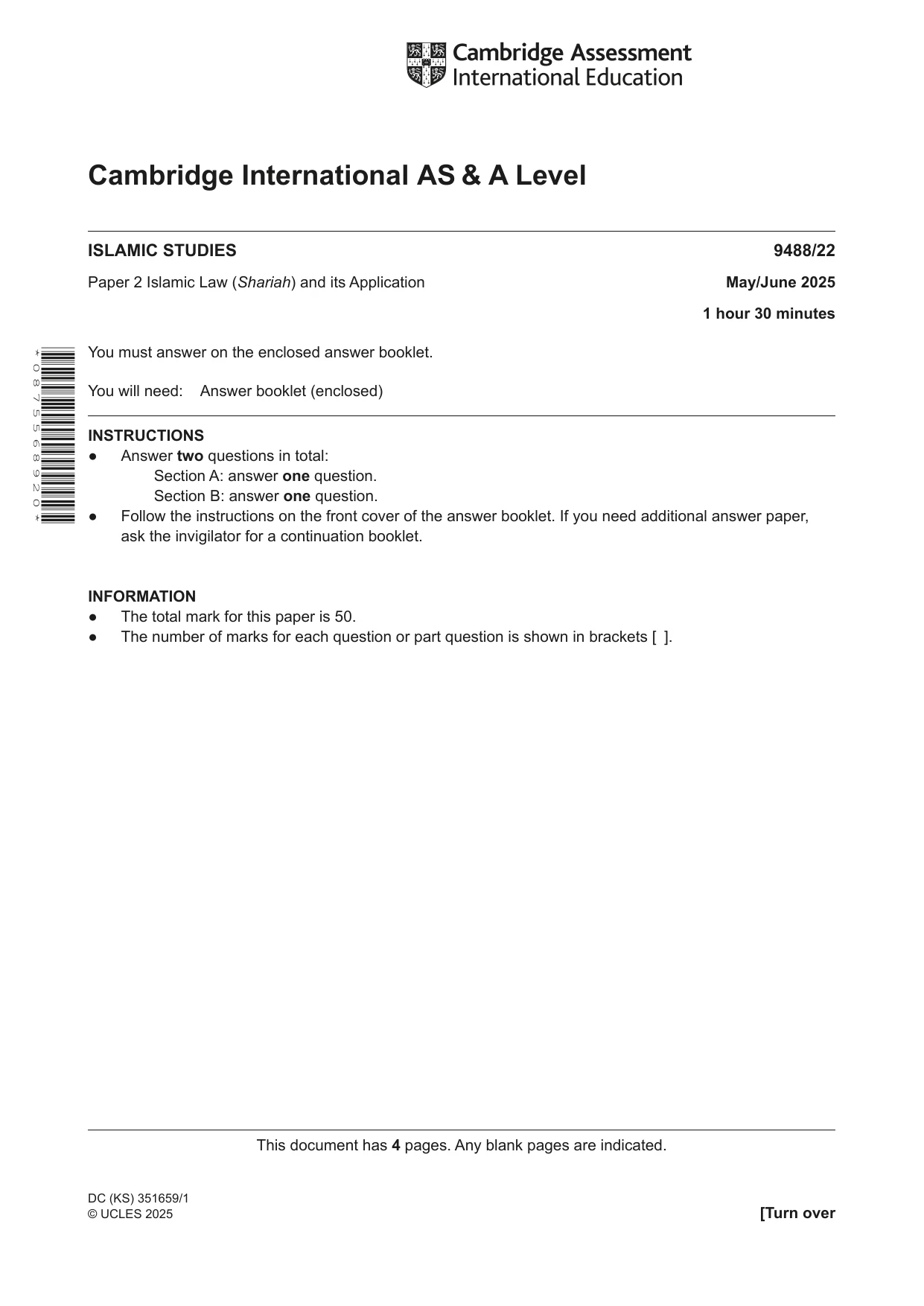
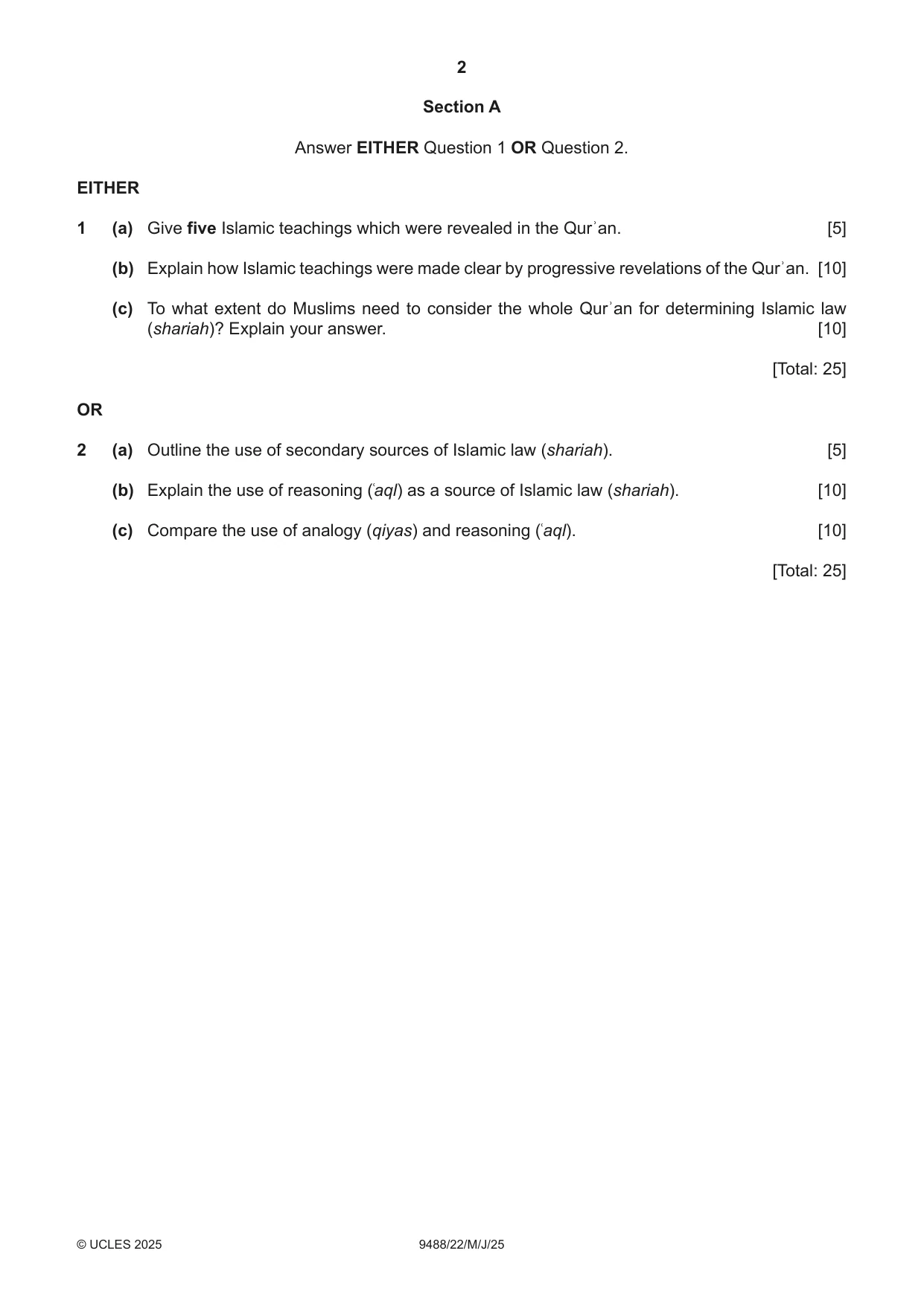
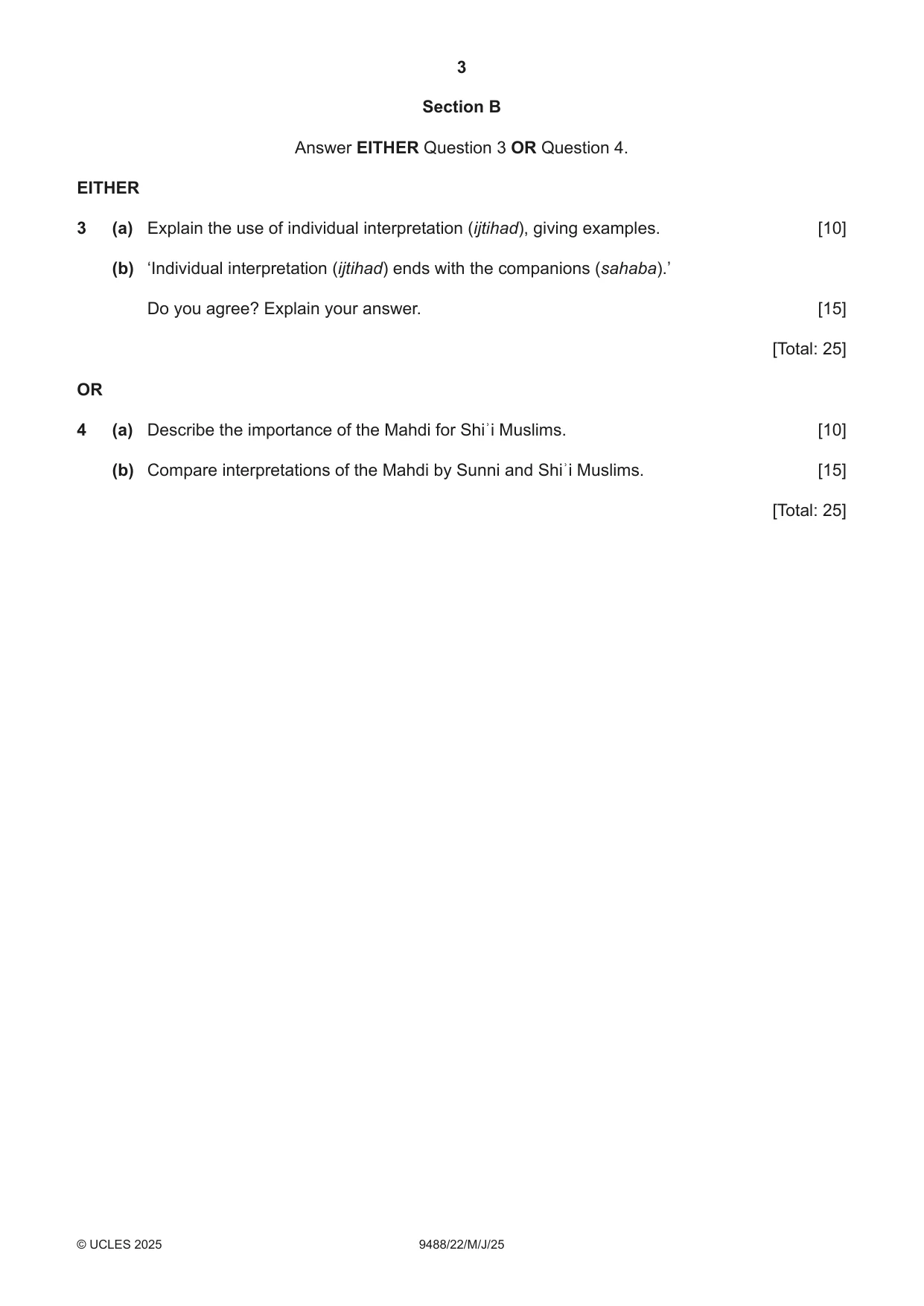
Question paper4 pages

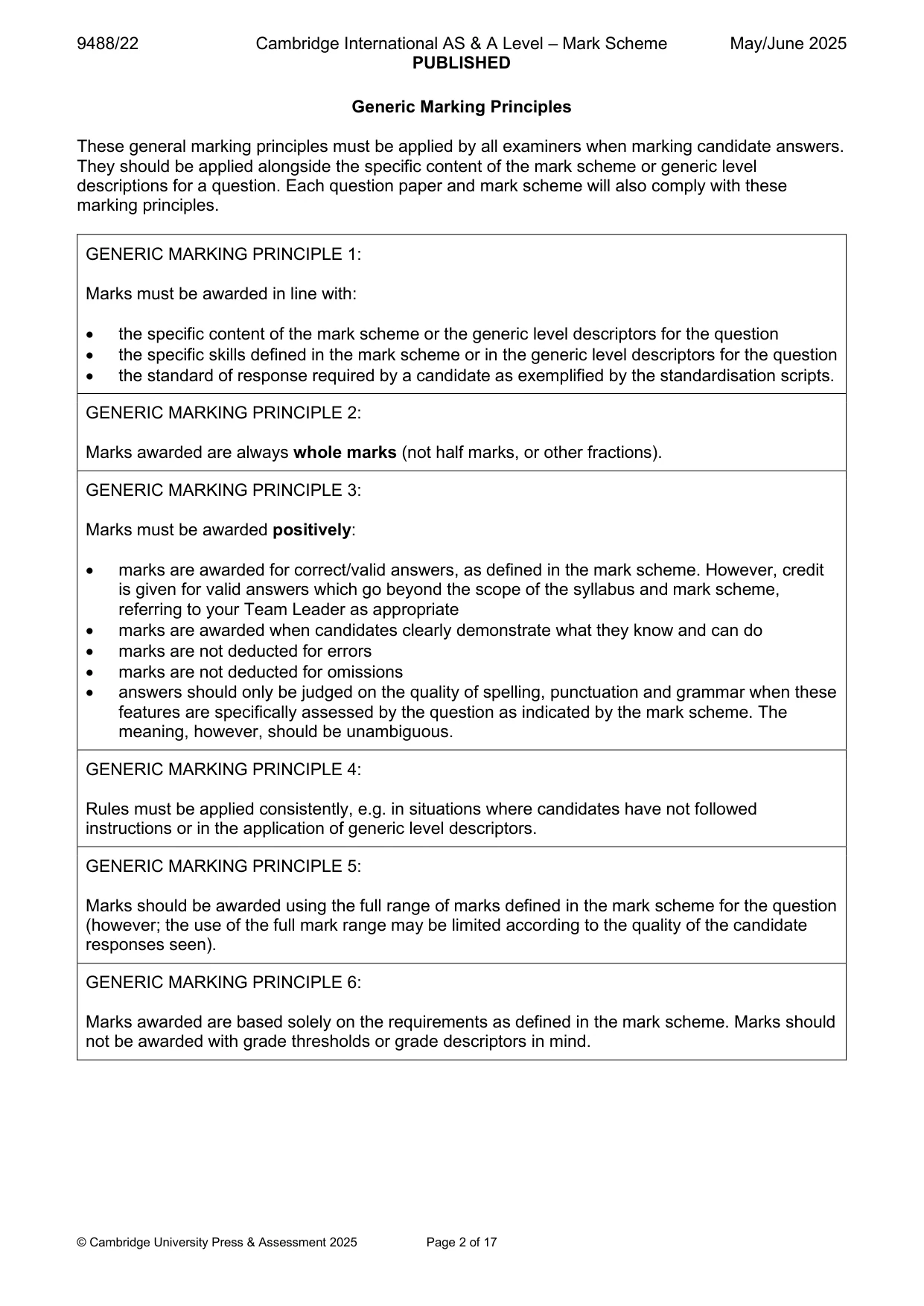
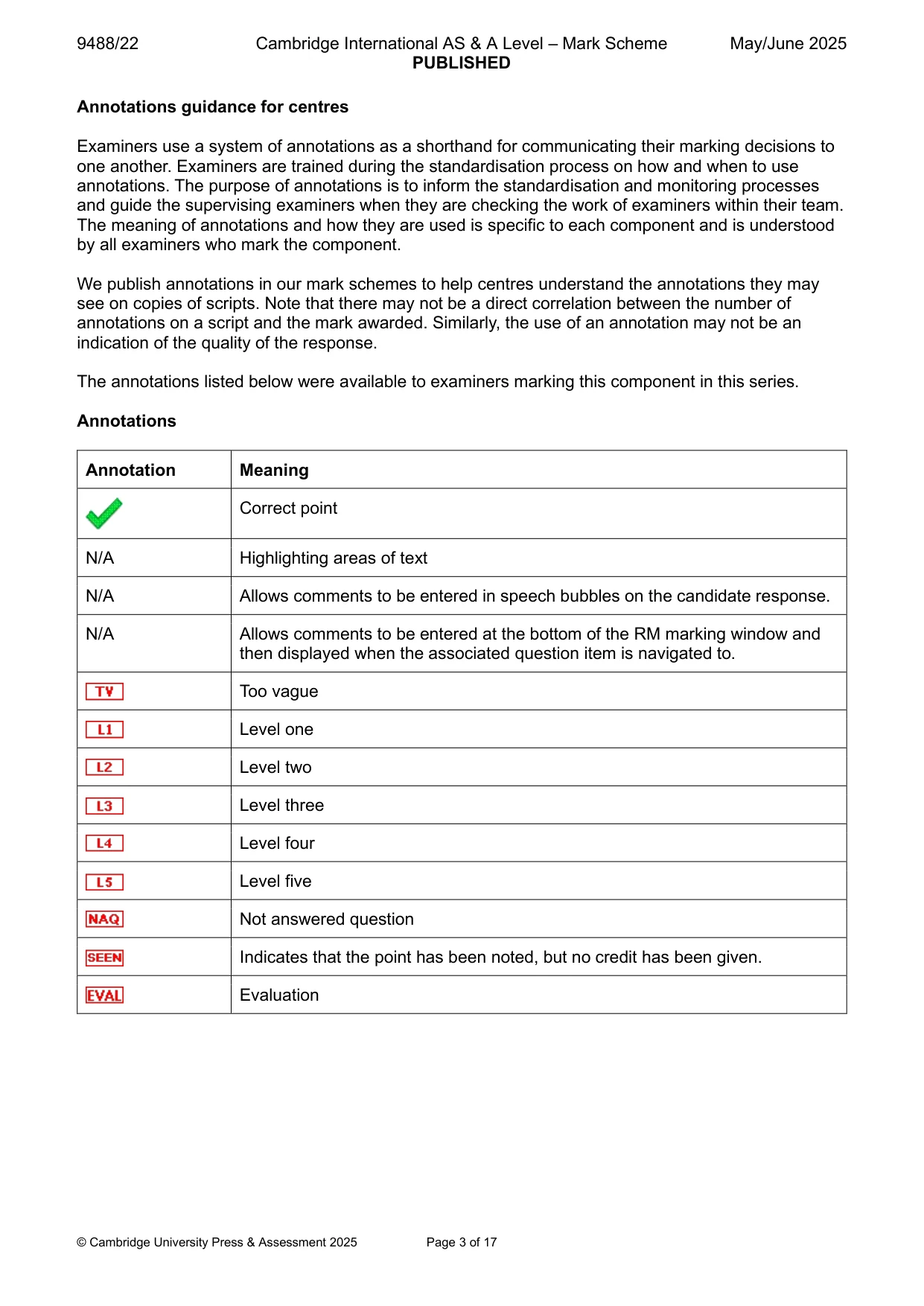
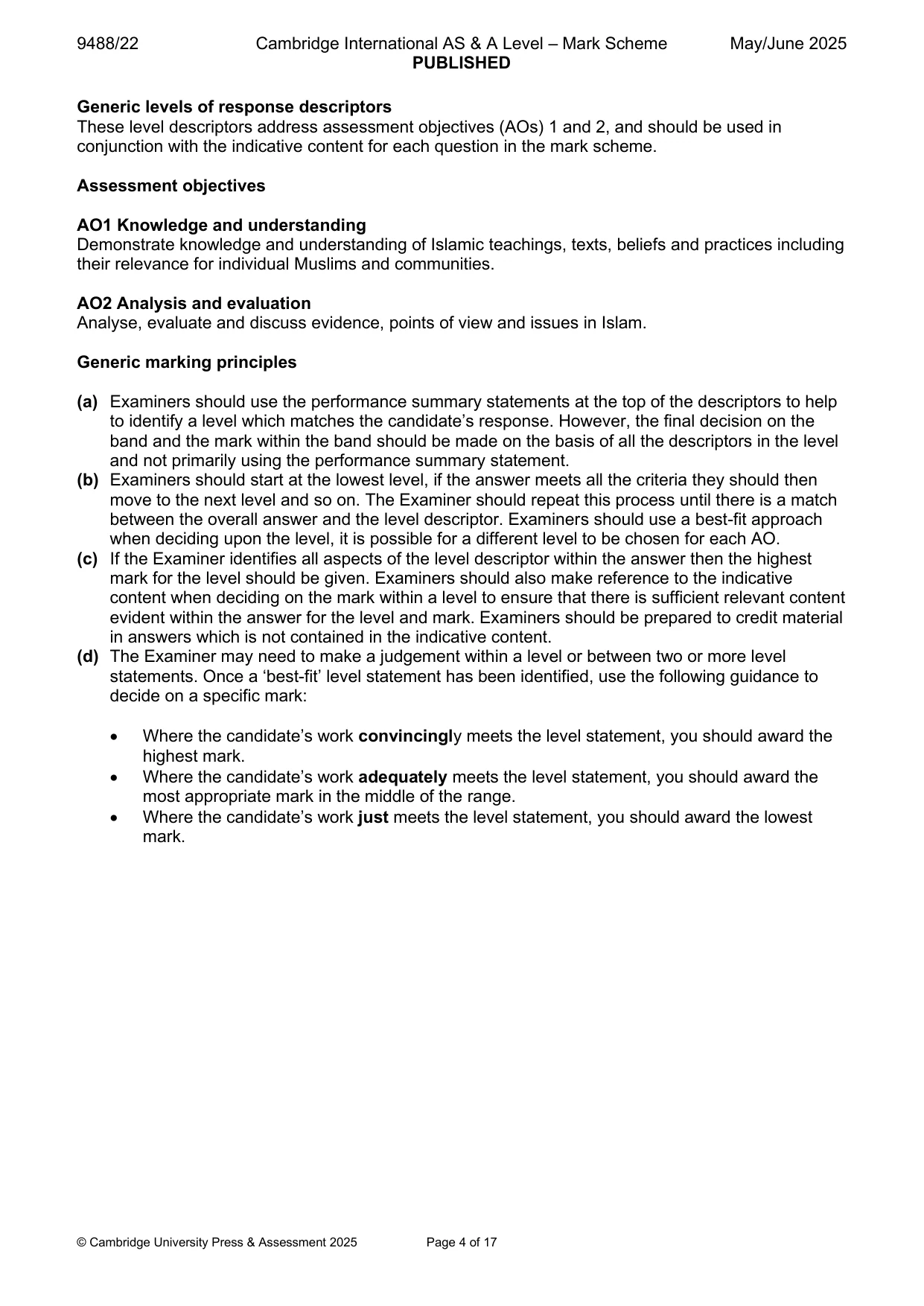
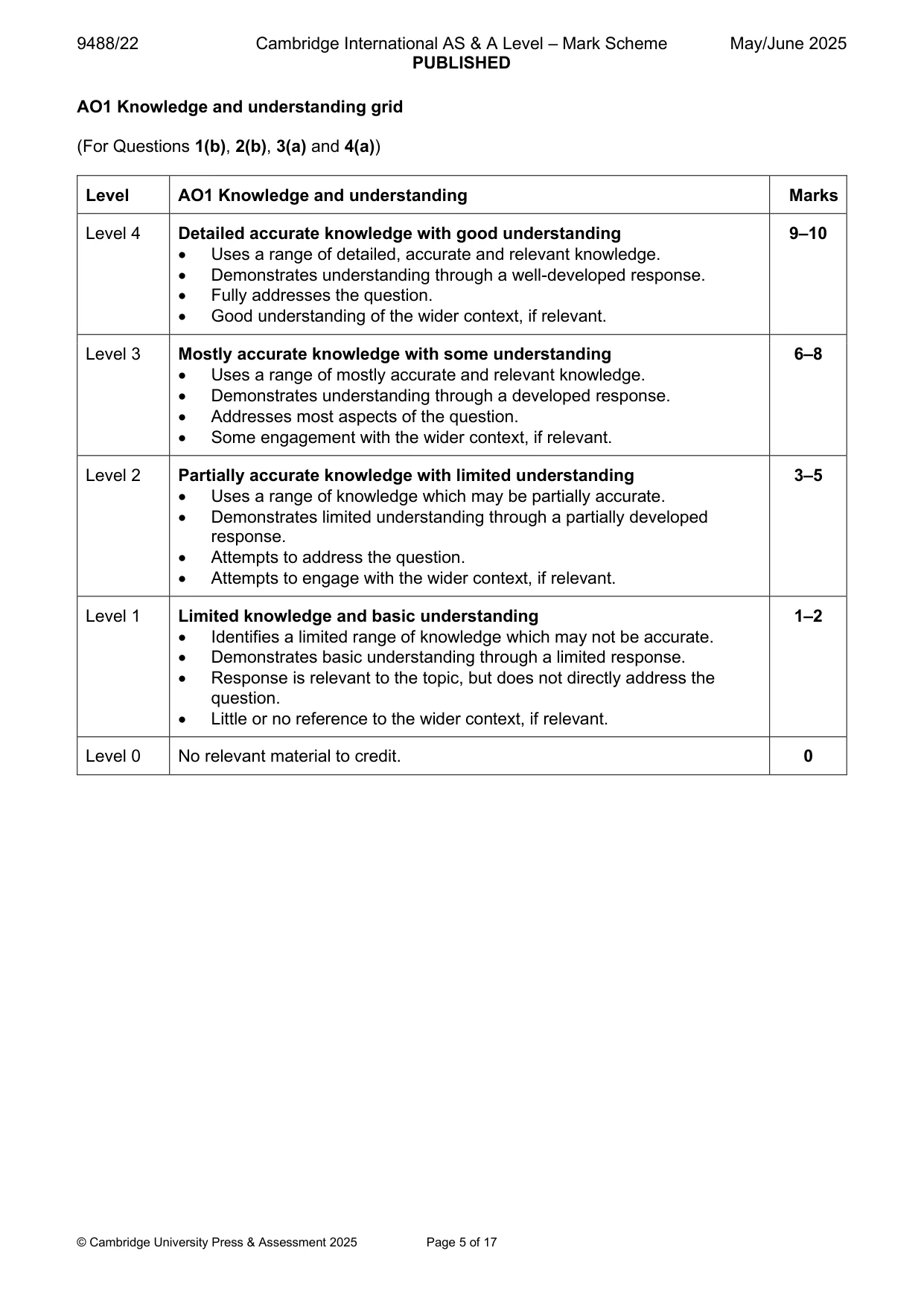
Mark scheme17 pages
Answers below. Sit the paper first if you are practising.
Questions as text
Q1 · Give five Islamic teachings which were revealed in the Qurʾan
1 (a) Give five Islamic teachings which were revealed in the Qurʾan. [5] (b) Explain how Islamic teachings were made clear by progressive revelations of the Qurʾan. [10] (c) To what extent do Muslims need to consider the whole Qurʾan for determining Islamic law (shariah)? Explain your answer. [10] [Total: 25] OR
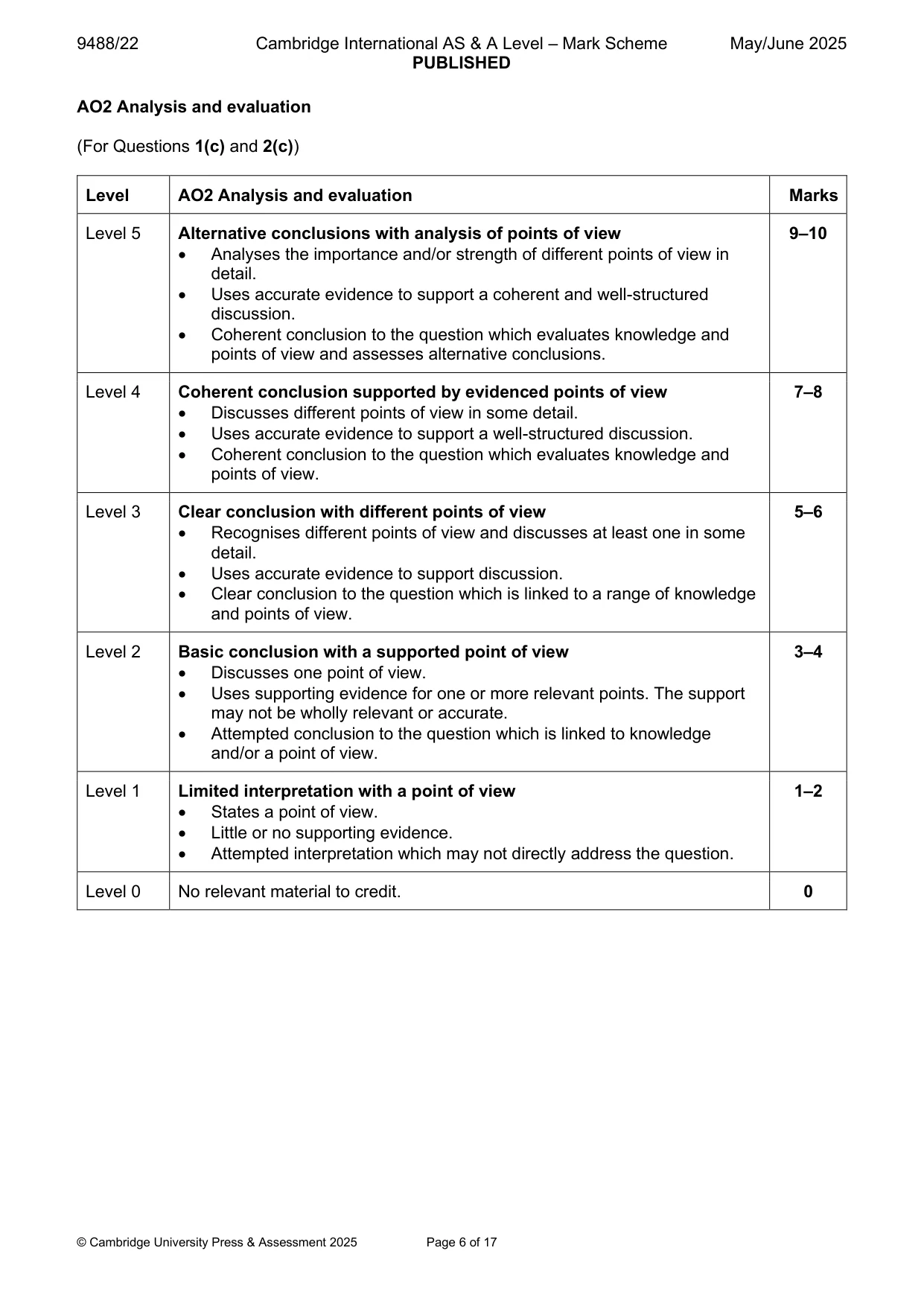
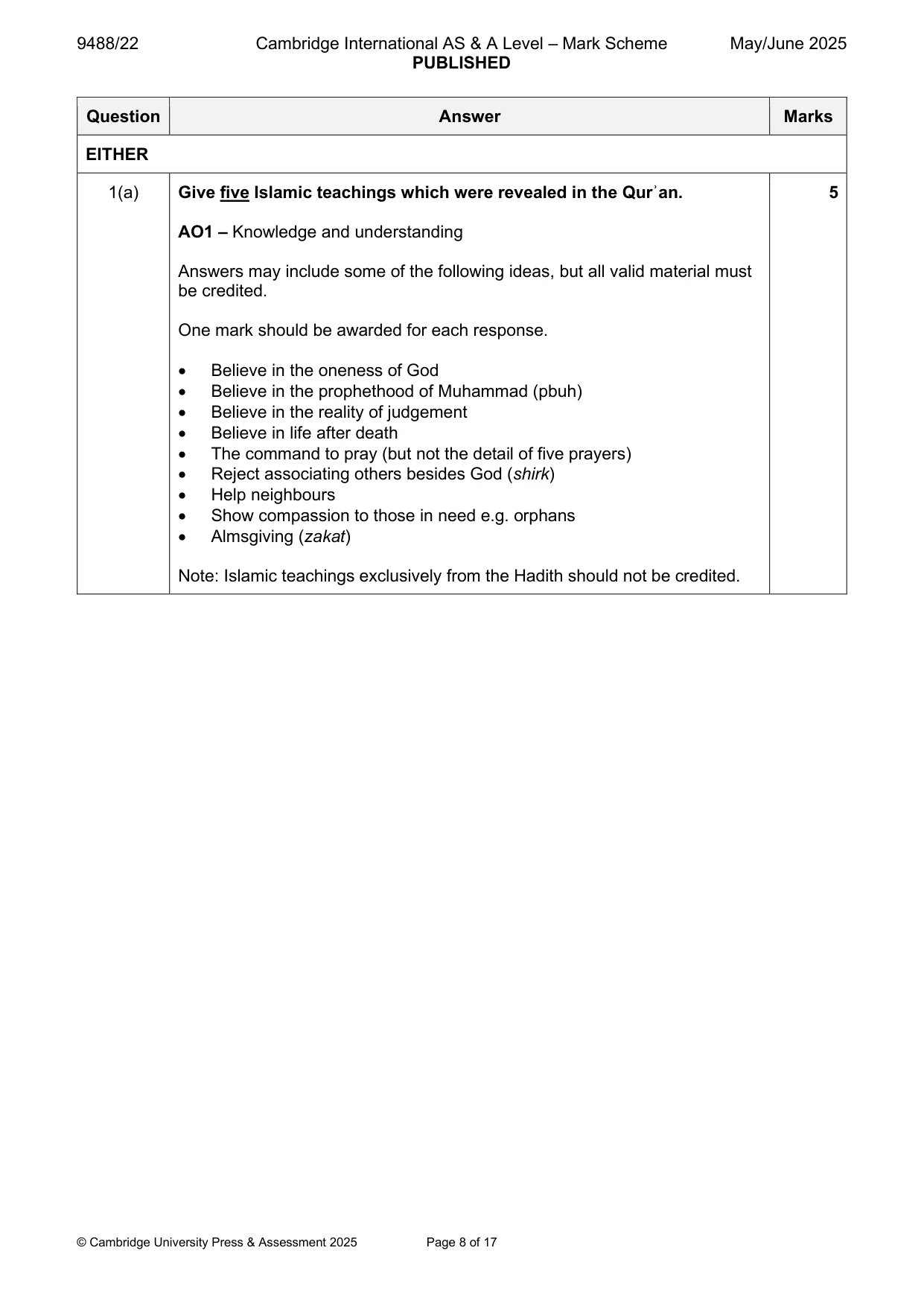
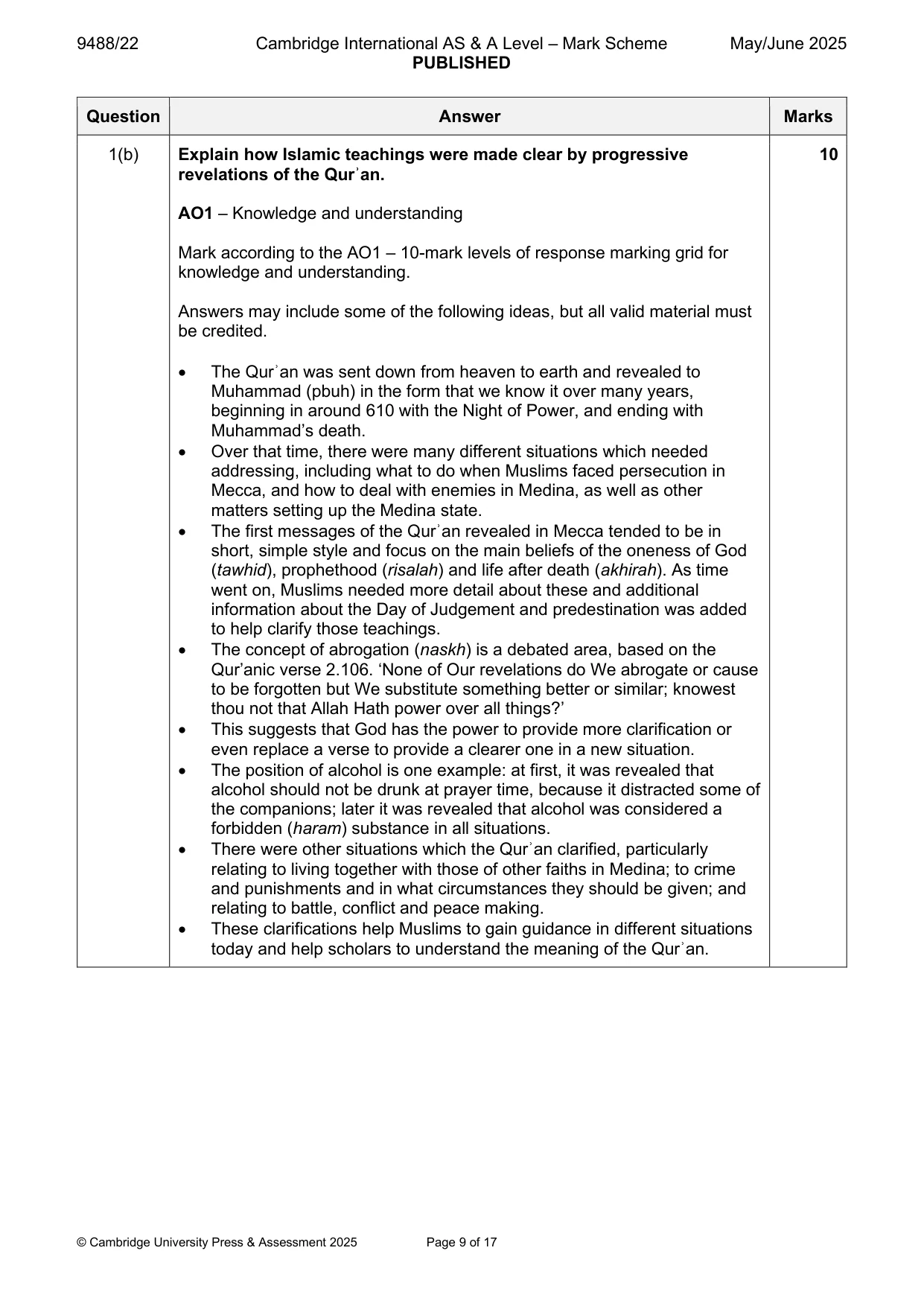
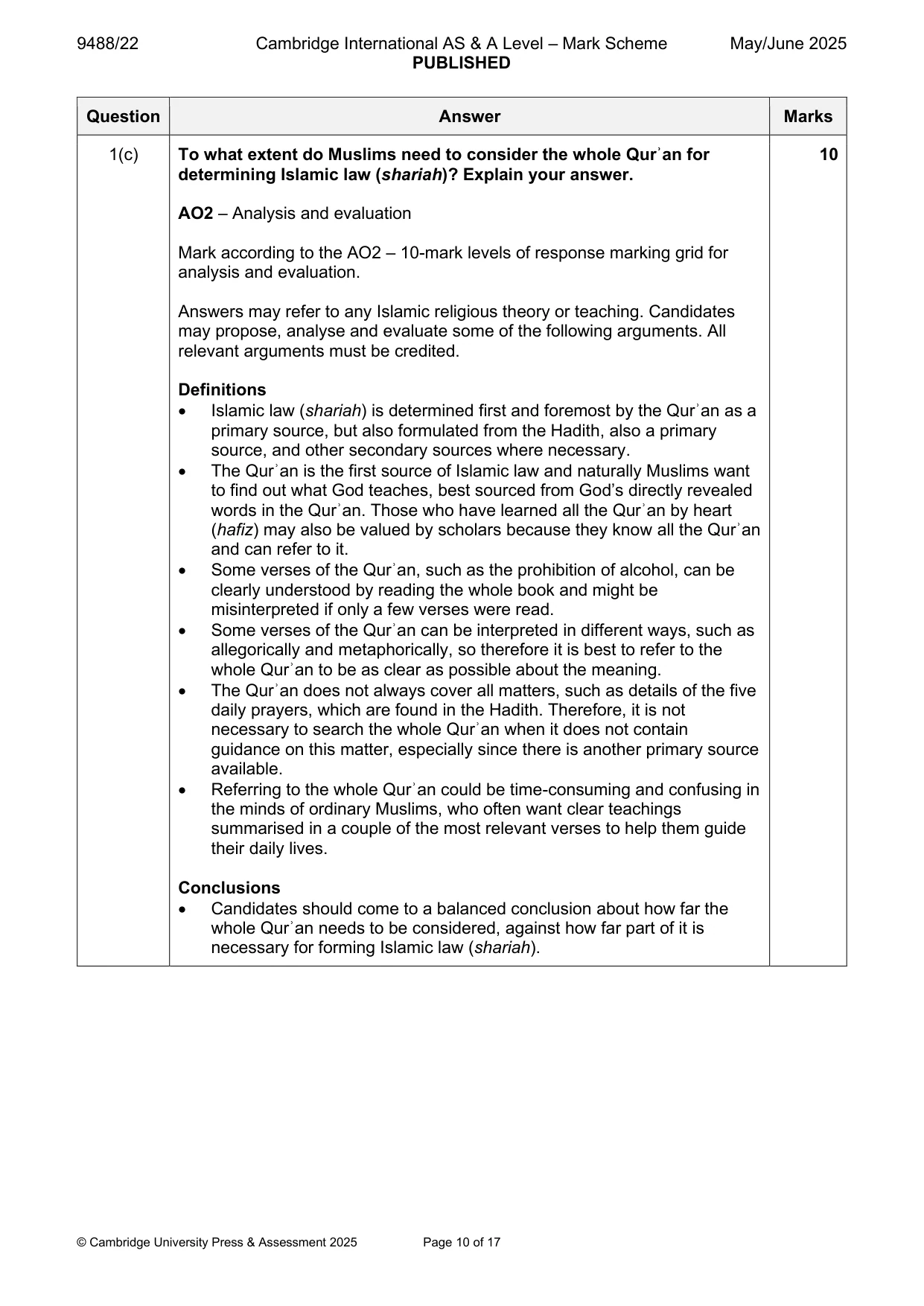
Mark scheme: Question Answer Marks EITHER 1(a) Give five Islamic teachings which were revealed in the Qurʾan. 5 AO1 – Knowledge and understanding Answers may include some of the following ideas, but all valid material must be credited. One mark should be awarded for each response. • Believe in the oneness of God • Believe in the prophethood of Muhammad (pbuh) • Believe in the reality of judgement • Believe in life after death • The command to pray (but not the detail of five prayers) • Reject associating others besides God (shirk) • Help neighbours • Show compassion to those in need e.g. orphans • Almsgiving (zakat) Note: Islamic teachings exclusively from the Hadith should not be credited. 1(b) Explain how Islamic teachings were made clear by progressive 10 revelations of the Qurʾan. AO1 – Knowledge and understanding Mark according to the AO1 – 10-mark levels of response marking grid for knowledge and understanding. Answers may include some of the following ideas, but all valid material must be credited. • The Qurʾan was sent down from heaven to earth and revealed to Muhammad (pbuh) in the form that we know it over many years, beginning in around 610 with the Night of Power, and ending with Muhammad’s death. • Over that time, there were many different situations which needed addressing, including what to do when Muslims faced persecution in Mecca, and how to deal with enemies in Medina, as well as other matters setting up the Medina state. • The first messages of the Qurʾan revealed in Mecca tended to be in short, simple style and focus on the main beliefs of the oneness of God (tawhid), prophethood (risalah) and life after death (akhirah). As time went on, Muslims needed more detail about these and additional information about the Day of Judgement and predestination was added to help clarify those teachings. • The concept of abrogation (naskh) is a debated area, based on the Qur’anic verse 2.106. ‘None of Our revelations do We abrogate or cause to be forgotten but We substitute something better or similar; knowest thou not that Allah Hath power over all things?’ • This suggests that God has the power to provide more clarification or even replace a verse to provide a clearer one in a new situation. • The position of alcohol is one example: at first, it was revealed that alcohol should not be drunk at prayer time, because it distracted some of the companions; later it was revealed that alcohol was considered a forbidden (haram) substance in all situations. • There were other situations which the Qurʾan clarified, particularly relating to living together with those of other faiths in Medina; to crime and punishments and in what circumstances they should be given; and relating to battle, conflict and peace making. • These clarifications help Muslims to gain guidance in different situations today and help scholars to understand the meaning of the Qurʾan. 1(c) To what extent do Muslims need to consider the whole Qurʾan for 10 determining Islamic law (shariah)? Explain your answer. AO2 – Analysis and evaluation Mark according to the AO2 – 10-mark levels of response marking grid for analysis and evaluation. Answers may refer to any Islamic religious theory or teaching. Candidates may propose, analyse and evaluate some of the following arguments. All relevant arguments must be credited. Definitions • Islamic law (shariah) is determined first and foremost by the Qurʾan as a primary source, but also formulated from the Hadith, also a primary source, and other secondary sources where necessary. • The Qurʾan is the first source of Islamic law and naturally Muslims want to find out what God teaches, best sourced from God’s directly revealed words in the Qurʾan. Those who have learned all the Qurʾan by heart (hafiz) may also be valued by scholars because they know all the Qurʾan and can refer to it. • Some verses of the Qurʾan, such as the prohibition of alcohol, can be clearly understood by reading the whole book and might be misinterpreted if only a few verses were read. • Some verses of the Qurʾan can be interpreted in different ways, such as allegorically and metaphorically, so therefore it is best to refer to the whole Qurʾan to be as clear as possible about the meaning. • The Qurʾan does not always cover all matters, such as details of the five daily prayers, which are found in the Hadith. Therefore, it is not necessary to search the whole Qurʾan when it does not contain guidance on this matter, especially since there is another primary source available. • Referring to the whole Qurʾan could be time-consuming and confusing in the minds of ordinary Muslims, who often want clear teachings summarised in a couple of the most relevant verses to help them guide their daily lives. Conclusions • Candidates should come to a balanced conclusion about how far the whole Qurʾan needs to be considered, against how far part of it is necessary for forming Islamic law (shariah).
Q2 · Outline the use of secondary sources of Islamic law (shariah)
2 (a) Outline the use of secondary sources of Islamic law (shariah). [5] (b) Explain the use of reasoning (͑aql) as a source of Islamic law (shariah). [10] (c) Compare the use of analogy (qiyas) and reasoning (͑aql). [10] [Total: 25]
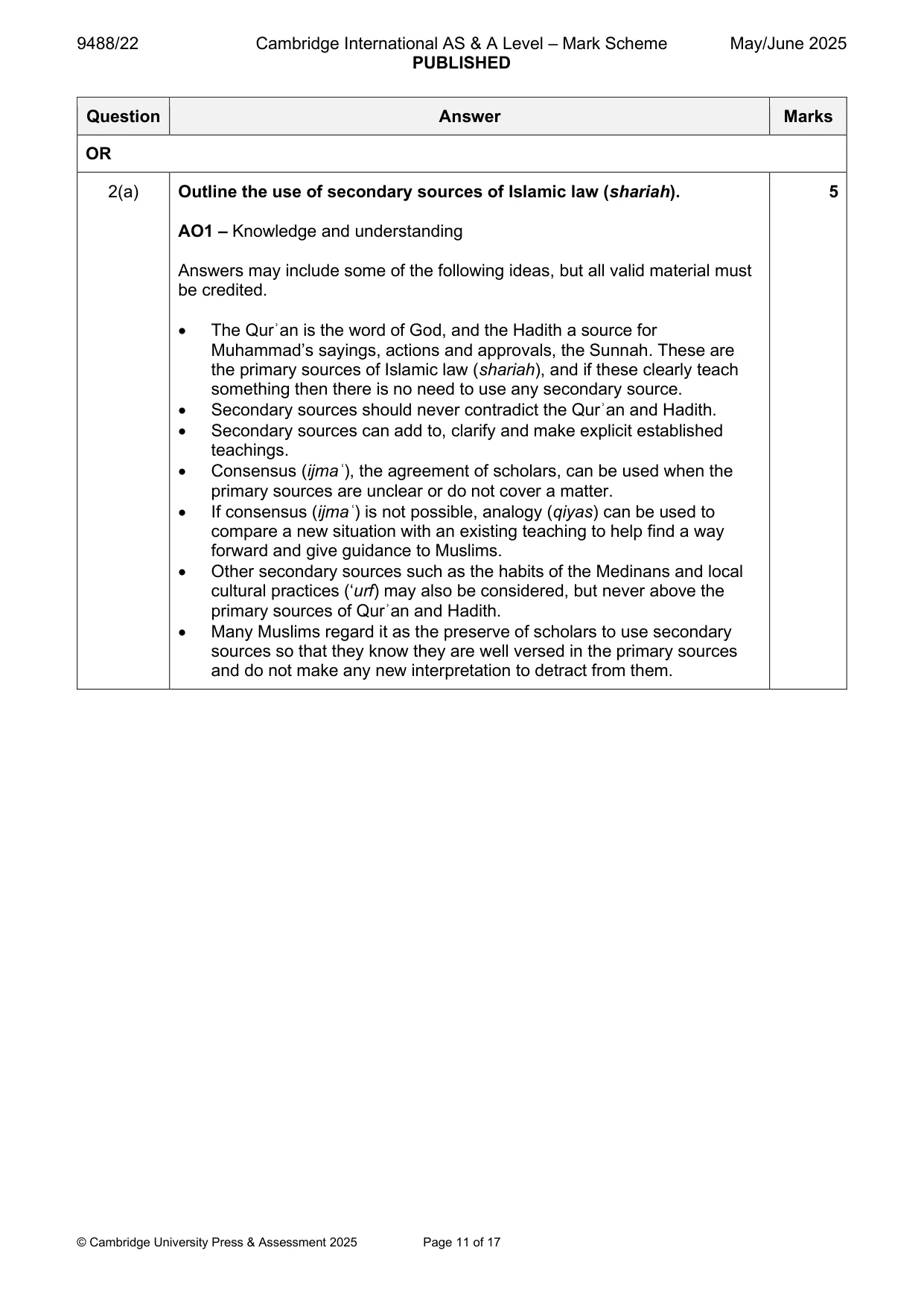
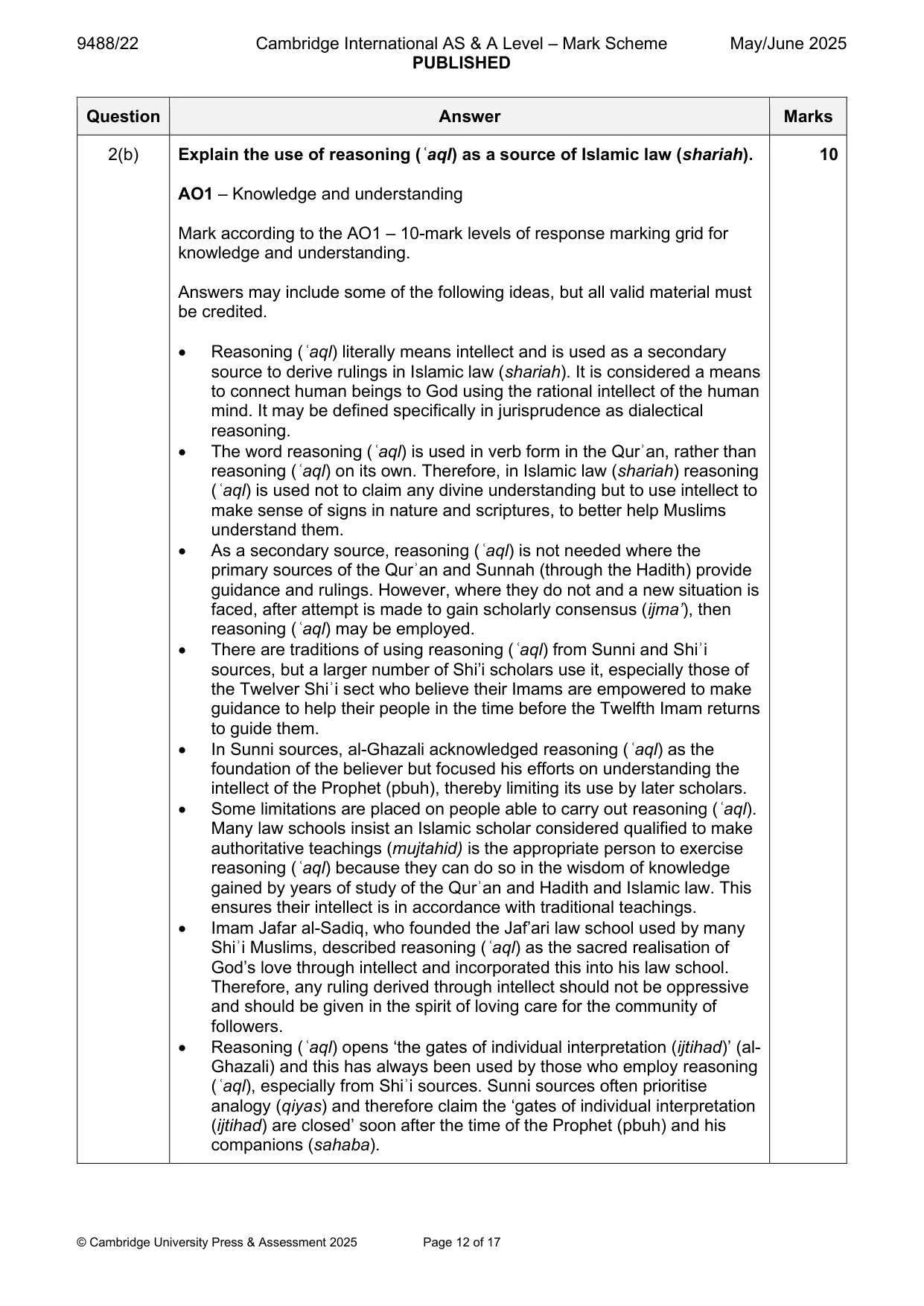
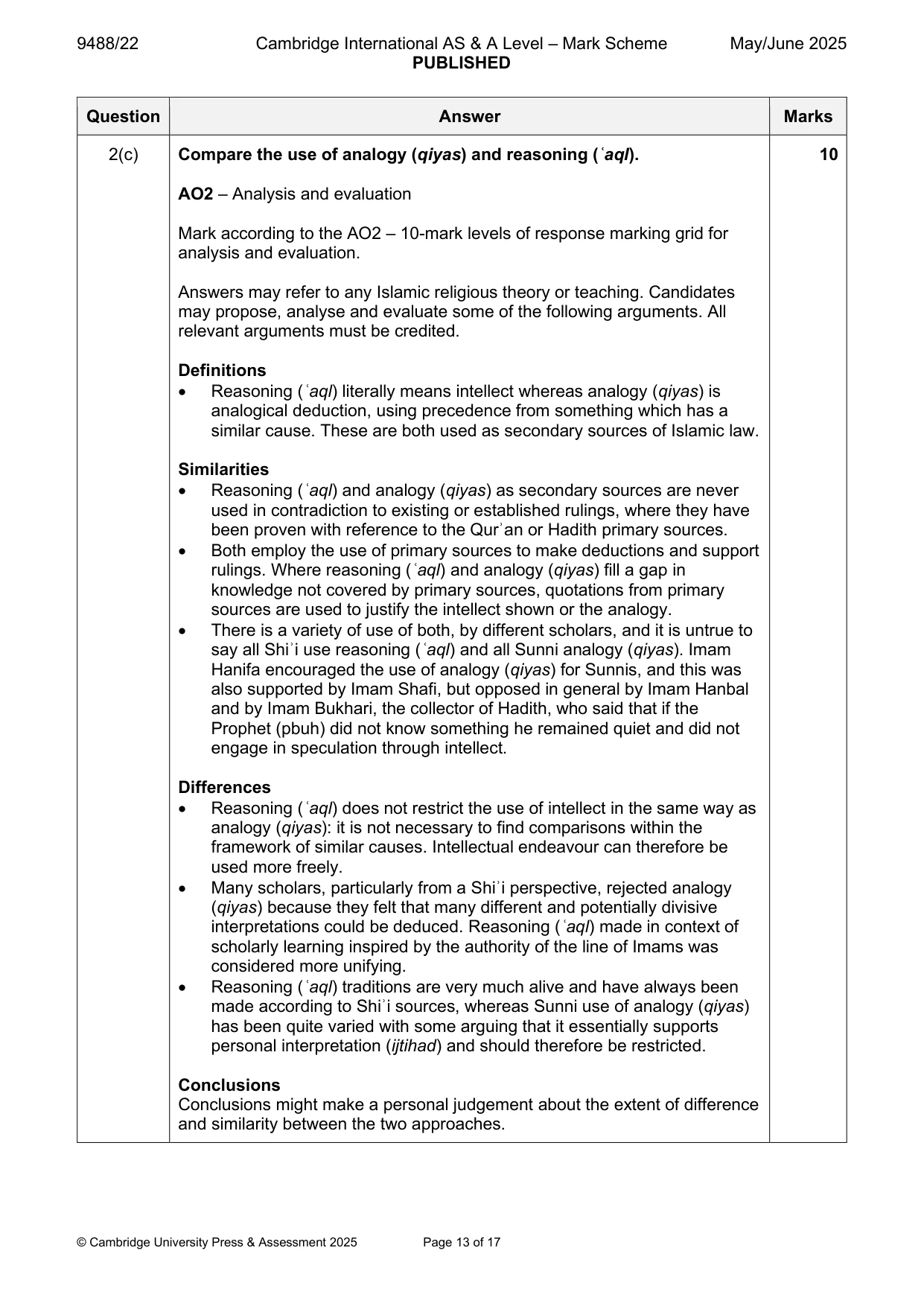
Mark scheme: 2(a) Outline the use of secondary sources of Islamic law (shariah). 5 AO1 – Knowledge and understanding Answers may include some of the following ideas, but all valid material must be credited. • The Qurʾan is the word of God, and the Hadith a source for Muhammad’s sayings, actions and approvals, the Sunnah. These are the primary sources of Islamic law (shariah), and if these clearly teach something then there is no need to use any secondary source. • Secondary sources should never contradict the Qurʾan and Hadith. • Secondary sources can add to, clarify and make explicit established teachings. • Consensus (ijmaʿ), the agreement of scholars, can be used when the primary sources are unclear or do not cover a matter. • If consensus (ijmaʿ) is not possible, analogy (qiyas) can be used to compare a new situation with an existing teaching to help find a way forward and give guidance to Muslims. • Other secondary sources such as the habits of the Medinans and local cultural practices (‘urf) may also be considered, but never above the primary sources of Qurʾan and Hadith. • Many Muslims regard it as the preserve of scholars to use secondary sources so that they know they are well versed in the primary sources and do not make any new interpretation to detract from them. 2(b) Explain the use of reasoning (ʿaql) as a source of Islamic law (shariah). 10 AO1 – Knowledge and understanding Mark according to the AO1 – 10-mark levels of response marking grid for knowledge and understanding. Answers may include some of the following ideas, but all valid material must be credited. • Reasoning (ʿaql) literally means intellect and is used as a secondary source to derive rulings in Islamic law (shariah). It is considered a means to connect human beings to God using the rational intellect of the human mind. It may be defined specifically in jurisprudence as dialectical reasoning. • The word reasoning (ʿaql) is used in verb form in the Qurʾan, rather than reasoning (ʿaql) on its own. Therefore, in Islamic law (shariah) reasoning (ʿaql) is used not to claim any divine understanding but to use intellect to make sense of signs in nature and scriptures, to better help Muslims understand them. • As a secondary source, reasoning (ʿaql) is not needed where the primary sources of the Qurʾan and Sunnah (through the Hadith) provide guidance and rulings. However, where they do not and a new situation is faced, after attempt is made to gain scholarly consensus (ijma’), then reasoning (ʿaql) may be employed. • There are traditions of using reasoning (ʿaql) from Sunni and Shiʾi sources, but a larger number of Shi’i scholars use it, especially those of the Twelver Shiʾi sect who believe their Imams are empowered to make guidance to help their people in the time before the Twelfth Imam returns to guide them. • In Sunni sources, al-Ghazali acknowledged reasoning (ʿaql) as the foundation of the believer but focused his efforts on understanding the intellect of the Prophet (pbuh), thereby limiting its use by later scholars. • Some limitations are placed on people able to carry out reasoning (ʿaql). Many law schools insist an Islamic scholar considered qualified to make authoritative teachings (mujtahid) is the appropriate person to exercise reasoning (ʿaql) because they can do so in the wisdom of knowledge gained by years of study of the Qurʾan and Hadith and Islamic law. This ensures their intellect is in accordance with traditional teachings. • Imam Jafar al-Sadiq, who founded the Jaf’ari law school used by many Shiʾi Muslims, described reasoning (ʿaql) as the sacred realisation of God’s love through intellect and incorporated this into his law school. Therefore, any ruling derived through intellect should not be oppressive and should be given in the spirit of loving care for the community of followers. • Reasoning (ʿaql) opens ‘the gates of individual interpretation (ijtihad)’ (al- Ghazali) and this has always been used by those who employ reasoning (ʿaql), especially from Shiʾi sources. Sunni sources often prioritise analogy (qiyas) and therefore claim the ‘gates of individual interpretation (ijtihad) are closed’ soon after the time of the Prophet (pbuh) and his companions (sahaba). 2(c) Compare the use of analogy (qiyas) and reasoning (ʿaql). 10 AO2 – Analysis and evaluation Mark according to the AO2 – 10-mark levels of response marking grid for analysis and evaluation. Answers may refer to any Islamic religious theory or teaching. Candidates may propose, analyse and evaluate some of the following arguments. All relevant arguments must be credited. Definitions • Reasoning (ʿaql) literally means intellect whereas analogy (qiyas) is analogical deduction, using precedence from something which has a similar cause. These are both used as secondary sources of Islamic law. Similarities • Reasoning (ʿaql) and analogy (qiyas) as secondary sources are never used in contradiction to existing or established rulings, where they have been proven with reference to the Qurʾan or Hadith primary sources. • Both employ the use of primary sources to make deductions and support rulings. Where reasoning (ʿaql) and analogy (qiyas) fill a gap in knowledge not covered by primary sources, quotations from primary sources are used to justify the intellect shown or the analogy. • There is a variety of use of both, by different scholars, and it is untrue to say all Shiʾi use reasoning (ʿaql) and all Sunni analogy (qiyas). Imam Hanifa encouraged the use of analogy (qiyas) for Sunnis, and this was also supported by Imam Shafi, but opposed in general by Imam Hanbal and by Imam Bukhari, the collector of Hadith, who said that if the Prophet (pbuh) did not know something he remained quiet and did not engage in speculation through intellect. Differences • Reasoning (ʿaql) does not restrict the use of intellect in the same way as analogy (qiyas): it is not necessary to find comparisons within the framework of similar causes. Intellectual endeavour can therefore be used more freely. • Many scholars, particularly from a Shiʾi perspective, rejected analogy (qiyas) because they felt that many different and potentially divisive interpretations could be deduced. Reasoning (ʿaql) made in context of scholarly learning inspired by the authority of the line of Imams was considered more unifying. • Reasoning (ʿaql) traditions are very much alive and have always been made according to Shiʾi sources, whereas Sunni use of analogy (qiyas) has been quite varied with some arguing that it essentially supports personal interpretation (ijtihad) and should therefore be restricted. Conclusions Conclusions might make a personal judgement about the extent of difference and similarity between the two approaches.
Q3 · Explain the use of individual interpretation (ijtihad), giving examples
3 (a) Explain the use of individual interpretation (ijtihad), giving examples. [10] (b) ‘Individual interpretation (ijtihad) ends with the companions (sahaba).’ Do you agree? Explain your answer. [15] [Total: 25] OR
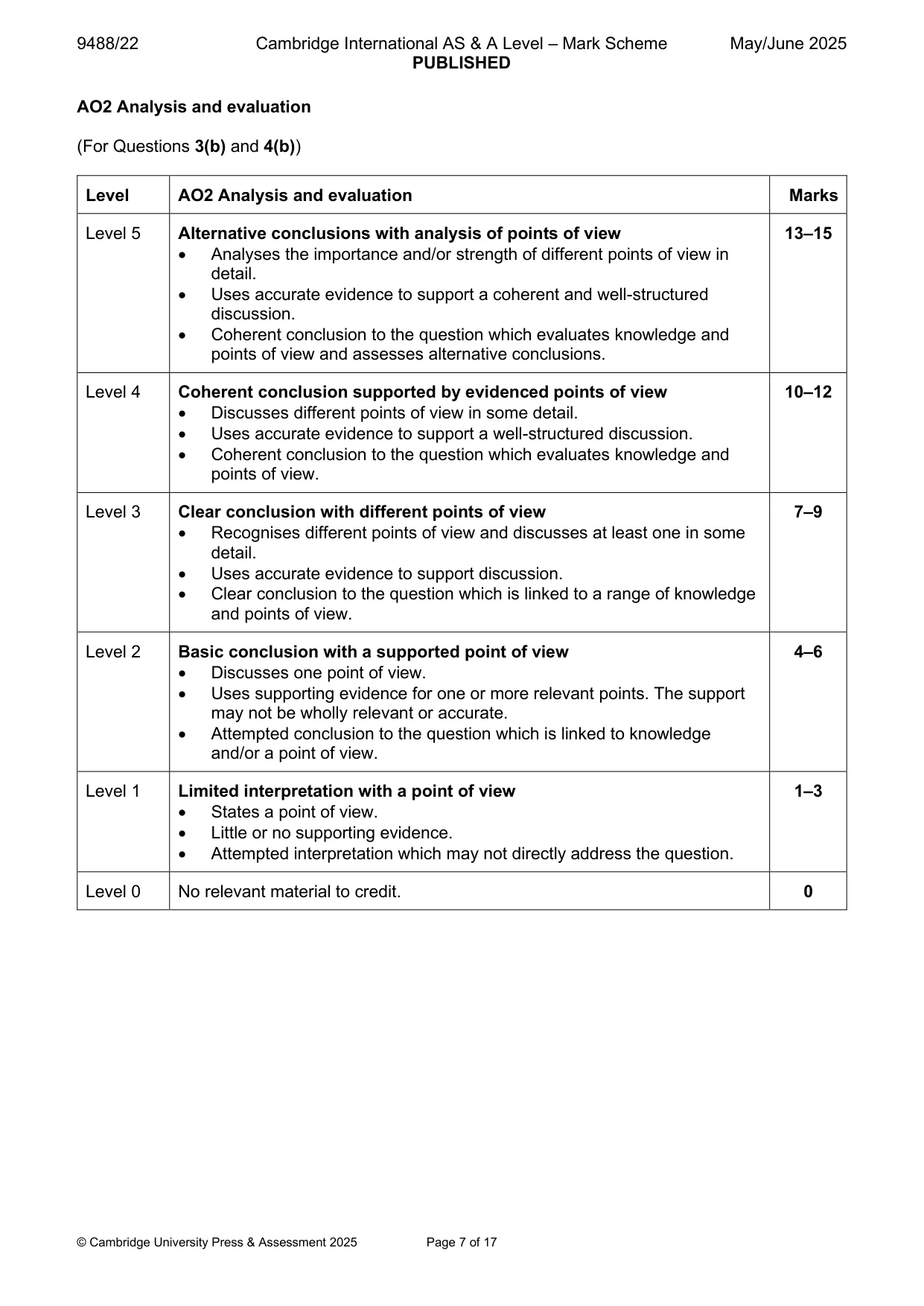
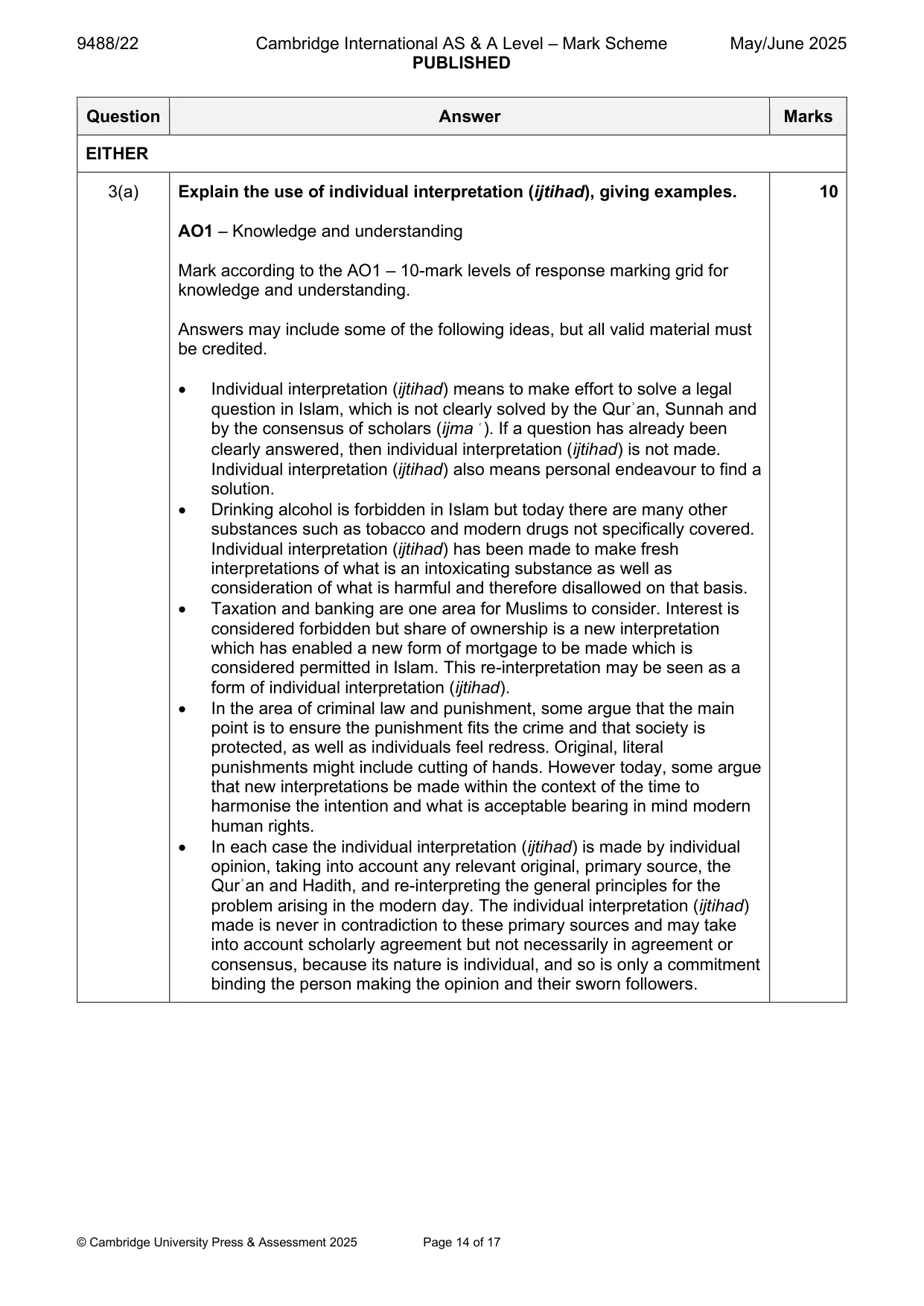
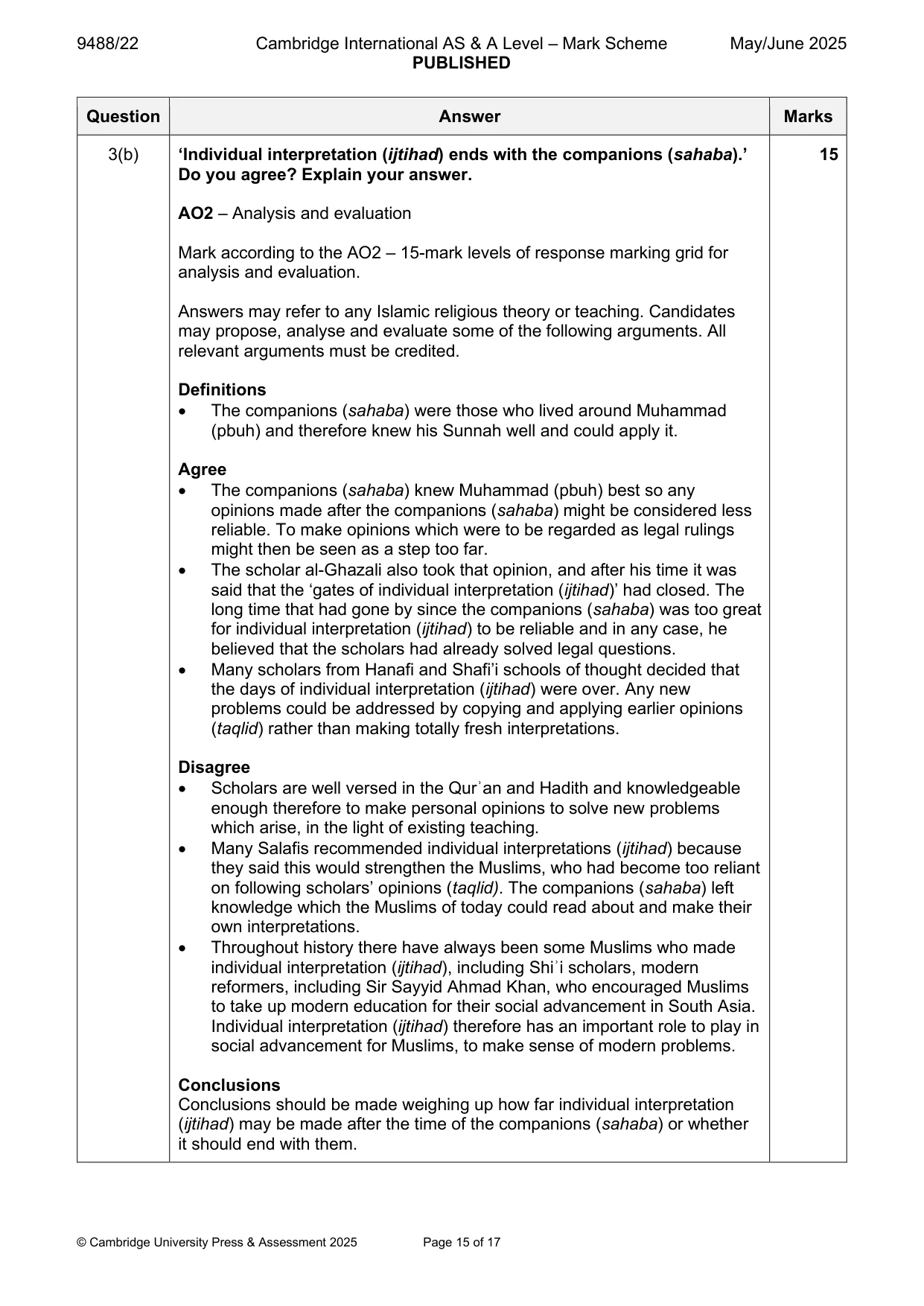
Mark scheme: 3(a) Explain the use of individual interpretation (ijtihad), giving examples. 10 AO1 – Knowledge and understanding Mark according to the AO1 – 10-mark levels of response marking grid for knowledge and understanding. Answers may include some of the following ideas, but all valid material must be credited. • Individual interpretation (ijtihad) means to make effort to solve a legal question in Islam, which is not clearly solved by the Qurʾan, Sunnah and by the consensus of scholars (ijmaʿ). If a question has already been clearly answered, then individual interpretation (ijtihad) is not made. Individual interpretation (ijtihad) also means personal endeavour to find a solution. • Drinking alcohol is forbidden in Islam but today there are many other substances such as tobacco and modern drugs not specifically covered. Individual interpretation (ijtihad) has been made to make fresh interpretations of what is an intoxicating substance as well as consideration of what is harmful and therefore disallowed on that basis. • Taxation and banking are one area for Muslims to consider. Interest is considered forbidden but share of ownership is a new interpretation which has enabled a new form of mortgage to be made which is considered permitted in Islam. This re-interpretation may be seen as a form of individual interpretation (ijtihad). • In the area of criminal law and punishment, some argue that the main point is to ensure the punishment fits the crime and that society is protected, as well as individuals feel redress. Original, literal punishments might include cutting of hands. However today, some argue that new interpretations be made within the context of the time to harmonise the intention and what is acceptable bearing in mind modern human rights. • In each case the individual interpretation (ijtihad) is made by individual opinion, taking into account any relevant original, primary source, the Qurʾan and Hadith, and re-interpreting the general principles for the problem arising in the modern day. The individual interpretation (ijtihad) made is never in contradiction to these primary sources and may take into account scholarly agreement but not necessarily in agreement or consensus, because its nature is individual, and so is only a commitment binding the person making the opinion and their sworn followers. 3(b) ‘Individual interpretation (ijtihad) ends with the companions (sahaba).’ 15 Do you agree? Explain your answer. AO2 – Analysis and evaluation Mark according to the AO2 – 15-mark levels of response marking grid for analysis and evaluation. Answers may refer to any Islamic religious theory or teaching. Candidates may propose, analyse and evaluate some of the following arguments. All relevant arguments must be credited. Definitions • The companions (sahaba) were those who lived around Muhammad (pbuh) and therefore knew his Sunnah well and could apply it. Agree • The companions (sahaba) knew Muhammad (pbuh) best so any opinions made after the companions (sahaba) might be considered less reliable. To make opinions which were to be regarded as legal rulings might then be seen as a step too far. • The scholar al-Ghazali also took that opinion, and after his time it was said that the ‘gates of individual interpretation (ijtihad)’ had closed. The long time that had gone by since the companions (sahaba) was too great for individual interpretation (ijtihad) to be reliable and in any case, he believed that the scholars had already solved legal questions. • Many scholars from Hanafi and Shafi’i schools of thought decided that the days of individual interpretation (ijtihad) were over. Any new problems could be addressed by copying and applying earlier opinions (taqlid) rather than making totally fresh interpretations. Disagree • Scholars are well versed in the Qurʾan and Hadith and knowledgeable enough therefore to make personal opinions to solve new problems which arise, in the light of existing teaching. • Many Salafis recommended individual interpretations (ijtihad) because they said this would strengthen the Muslims, who had become too reliant on following scholars’ opinions (taqlid). The companions (sahaba) left knowledge which the Muslims of today could read about and make their own interpretations. • Throughout history there have always been some Muslims who made individual interpretation (ijtihad), including Shiʾi scholars, modern reformers, including Sir Sayyid Ahmad Khan, who encouraged Muslims to take up modern education for their social advancement in South Asia. Individual interpretation (ijtihad) therefore has an important role to play in social advancement for Muslims, to make sense of modern problems. Conclusions Conclusions should be made weighing up how far individual interpretation (ijtihad) may be made after the time of the companions (sahaba) or whether it should end with them.
Q4 · Describe the importance of the Mahdi for Shiʾi Muslims
4 (a) Describe the importance of the Mahdi for Shiʾi Muslims. [10] (b) Compare interpretations of the Mahdi by Sunni and Shiʾi Muslims. [15] [Total: 25]
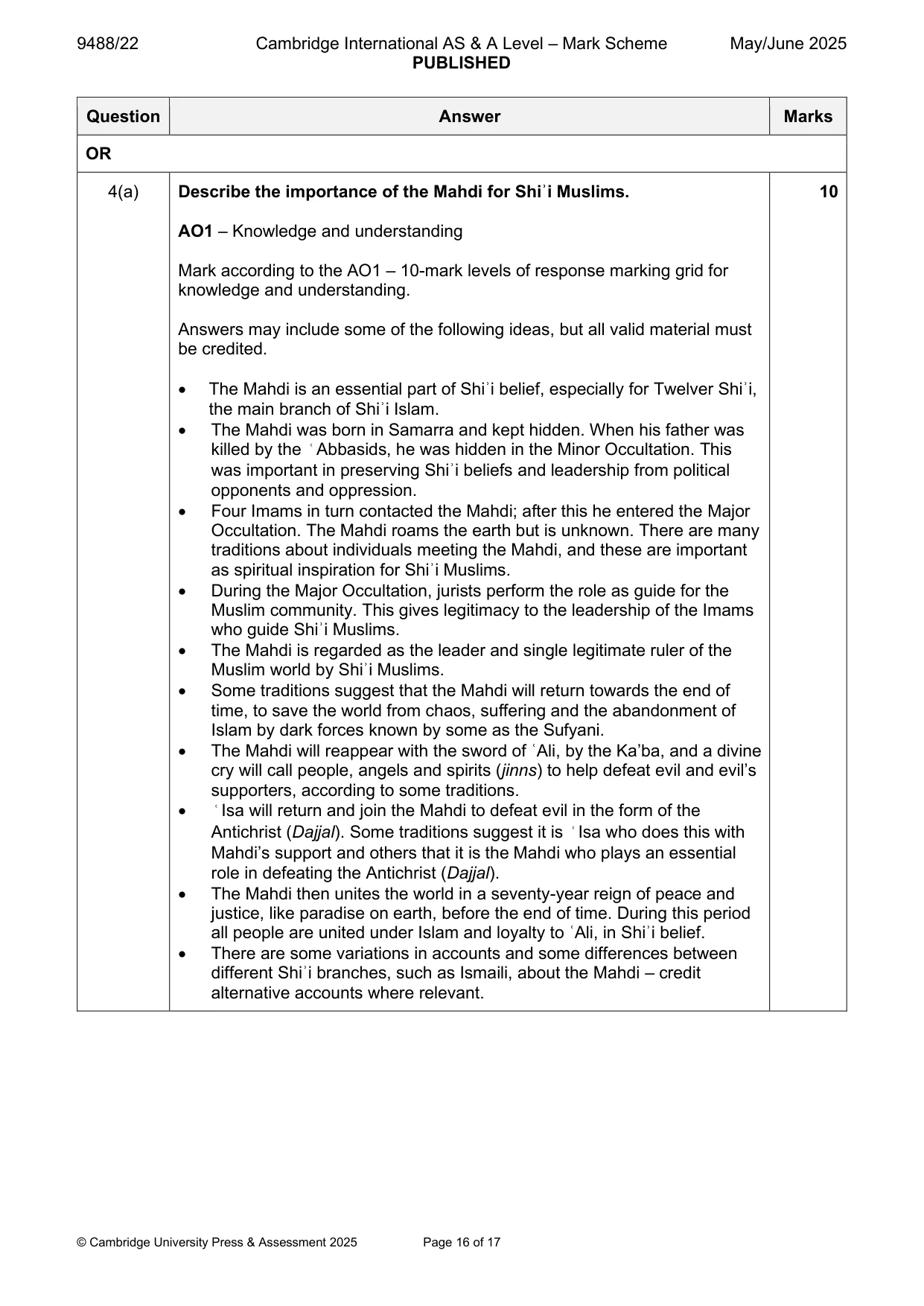
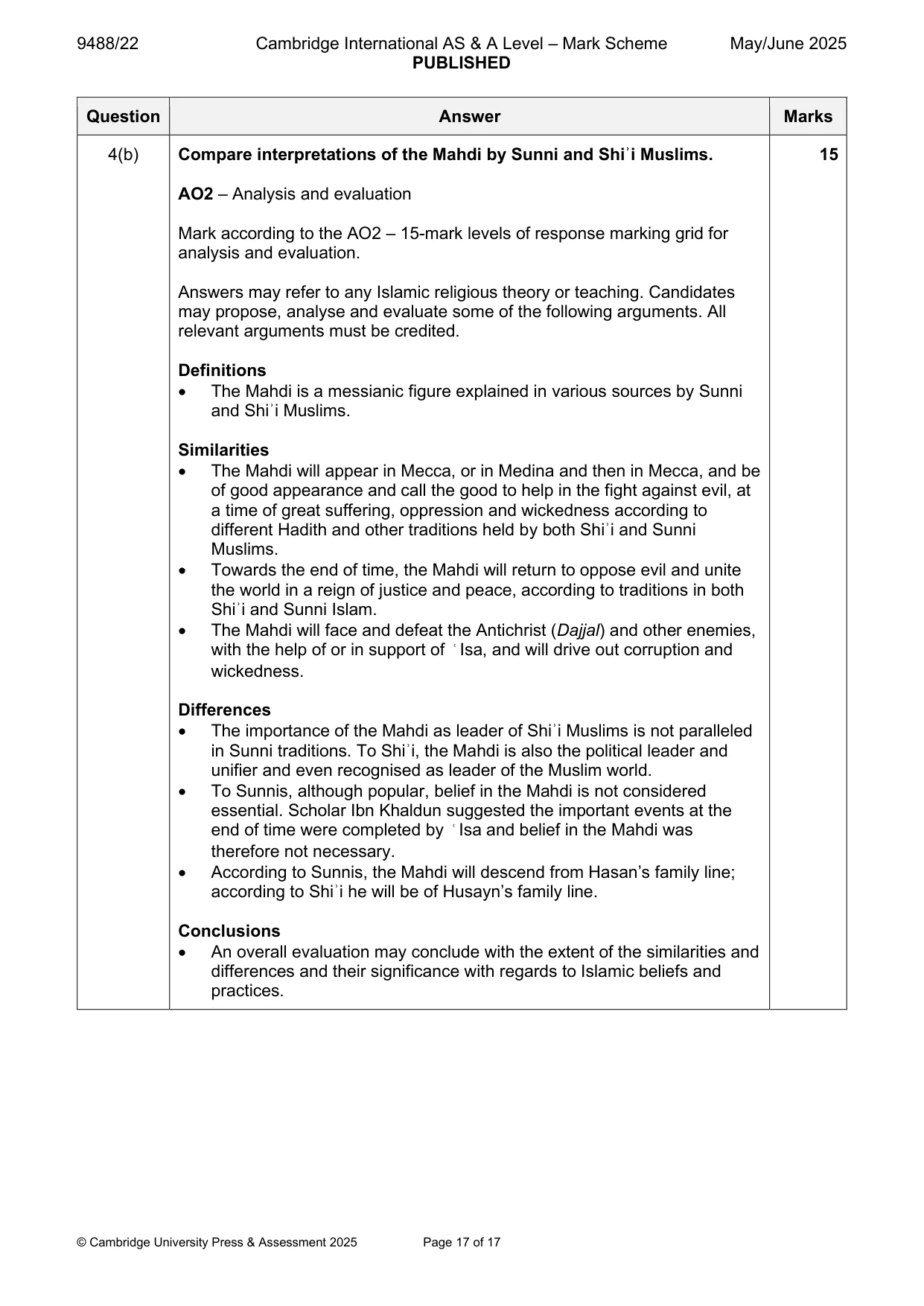
Mark scheme: 4(a) Describe the importance of the Mahdi for Shiʾi Muslims. 10 AO1 – Knowledge and understanding Mark according to the AO1 – 10-mark levels of response marking grid for knowledge and understanding. Answers may include some of the following ideas, but all valid material must be credited. • The Mahdi is an essential part of Shiʾi belief, especially for Twelver Shiʾi, the main branch of Shiʾi Islam. • The Mahdi was born in Samarra and kept hidden. When his father was killed by the ʿAbbasids, he was hidden in the Minor Occultation. This was important in preserving Shiʾi beliefs and leadership from political opponents and oppression. • Four Imams in turn contacted the Mahdi; after this he entered the Major Occultation. The Mahdi roams the earth but is unknown. There are many traditions about individuals meeting the Mahdi, and these are important as spiritual inspiration for Shiʾi Muslims. • During the Major Occultation, jurists perform the role as guide for the Muslim community. This gives legitimacy to the leadership of the Imams who guide Shiʾi Muslims. • The Mahdi is regarded as the leader and single legitimate ruler of the Muslim world by Shiʾi Muslims. • Some traditions suggest that the Mahdi will return towards the end of time, to save the world from chaos, suffering and the abandonment of Islam by dark forces known by some as the Sufyani. • The Mahdi will reappear with the sword of ʿAli, by the Ka’ba, and a divine cry will call people, angels and spirits (jinns) to help defeat evil and evil’s supporters, according to some traditions. • ʿIsa will return and join the Mahdi to defeat evil in the form of the Antichrist (Dajjal). Some traditions suggest it is ʿIsa who does this with Mahdi’s support and others that it is the Mahdi who plays an essential role in defeating the Antichrist (Dajjal). • The Mahdi then unites the world in a seventy-year reign of peace and justice, like paradise on earth, before the end of time. During this period all people are united under Islam and loyalty to ʿAli, in Shiʾi belief. • There are some variations in accounts and some differences between different Shiʾi branches, such as Ismaili, about the Mahdi – credit alternative accounts where relevant. 4(b) Compare interpretations of the Mahdi by Sunni and Shiʾi Muslims. 15 AO2 – Analysis and evaluation Mark according to the AO2 – 15-mark levels of response marking grid for analysis and evaluation. Answers may refer to any Islamic religious theory or teaching. Candidates may propose, analyse and evaluate some of the following arguments. All relevant arguments must be credited. Definitions • The Mahdi is a messianic figure explained in various sources by Sunni and Shiʾi Muslims. Similarities • The Mahdi will appear in Mecca, or in Medina and then in Mecca, and be of good appearance and call the good to help in the fight against evil, at a time of great suffering, oppression and wickedness according to different Hadith and other traditions held by both Shiʾi and Sunni Muslims. • Towards the end of time, the Mahdi will return to oppose evil and unite the world in a reign of justice and peace, according to traditions in both Shiʾi and Sunni Islam. • The Mahdi will face and defeat the Antichrist (Dajjal) and other enemies, with the help of or in support of ʿIsa, and will drive out corruption and wickedness. Differences • The importance of the Mahdi as leader of Shiʾi Muslims is not paralleled in Sunni traditions. To Shiʾi, the Mahdi is also the political leader and unifier and even recognised as leader of the Muslim world. • To Sunnis, although popular, belief in the Mahdi is not considered essential. Scholar Ibn Khaldun suggested the important events at the end of time were completed by ʿIsa and belief in the Mahdi was therefore not necessary. • According to Sunnis, the Mahdi will descend from Hasan’s family line; according to Shiʾi he will be of Husayn’s family line. Conclusions • An overall evaluation may conclude with the extent of the similarities and differences and their significance with regards to Islamic beliefs and practices.
What was in this paper
The subtopics covered by these 4 questions, and how many questions each got. Open one in a new tab to see every Cambridge question on it.
What you needed in this session
Cambridge’s own grade thresholds for 2025 May/June, Paper 2 · Variant 2. A higher threshold means an easier paper — the bar moves with how the cohort did.