Cambridge A Level Islamic Studies 9488 — 2022 Oct/Nov Paper 2 · Variant 2
9488/22/O/N/22 · 4 questions · 50 marks · ≈56 min
The question paper and its mark scheme, free to read here and free to download. This is Cambridge’s own paper, exactly as it was sat.
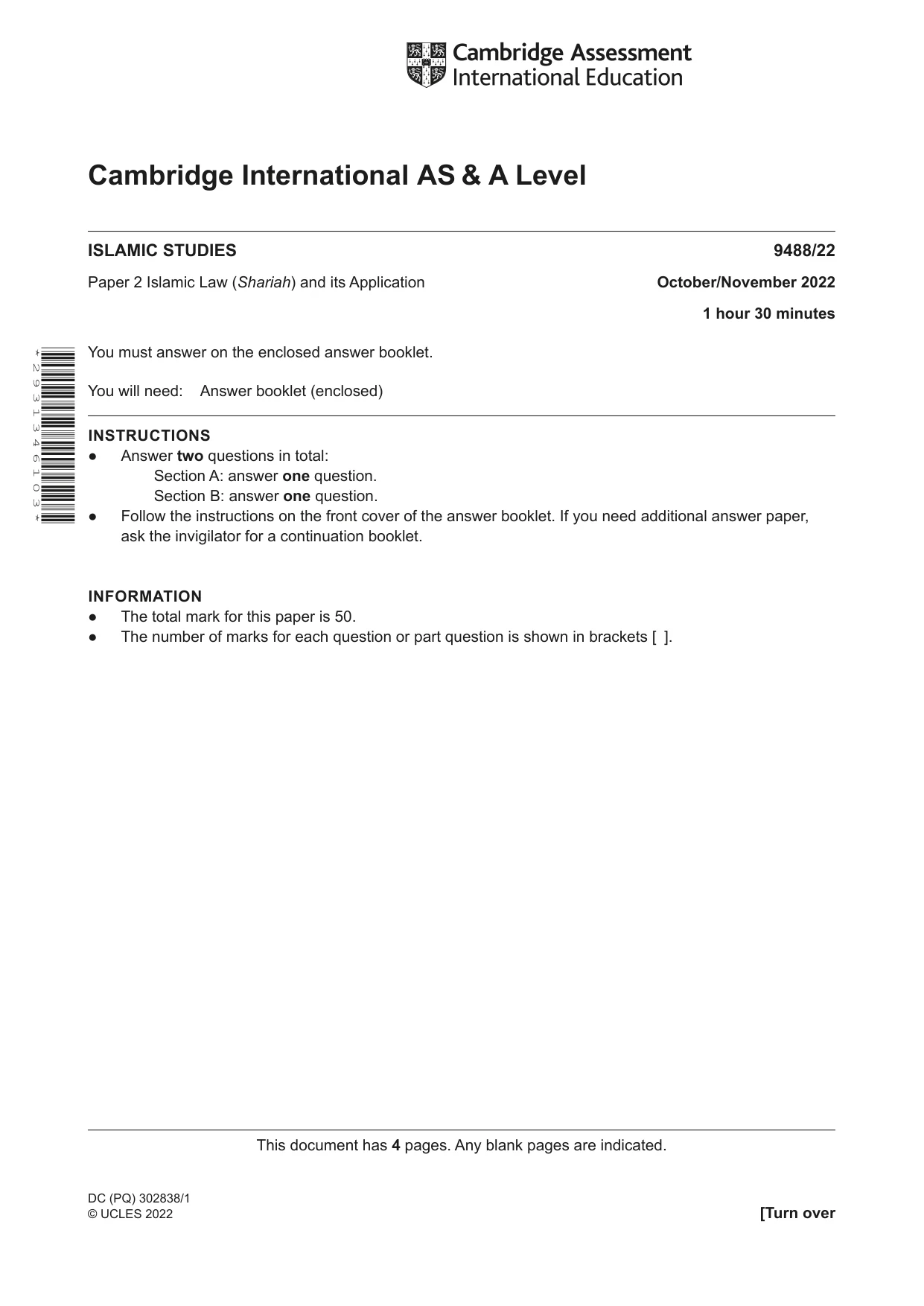
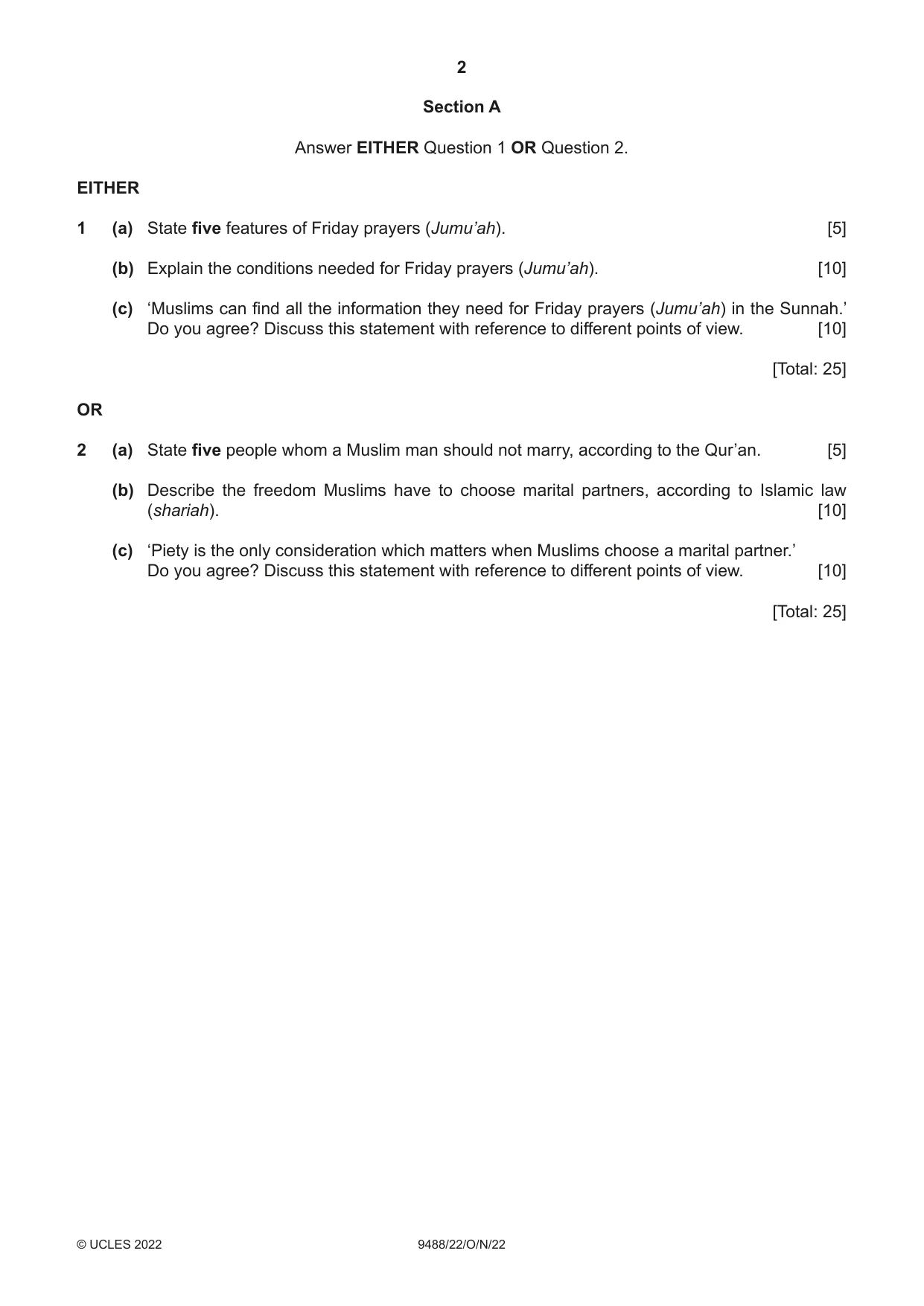
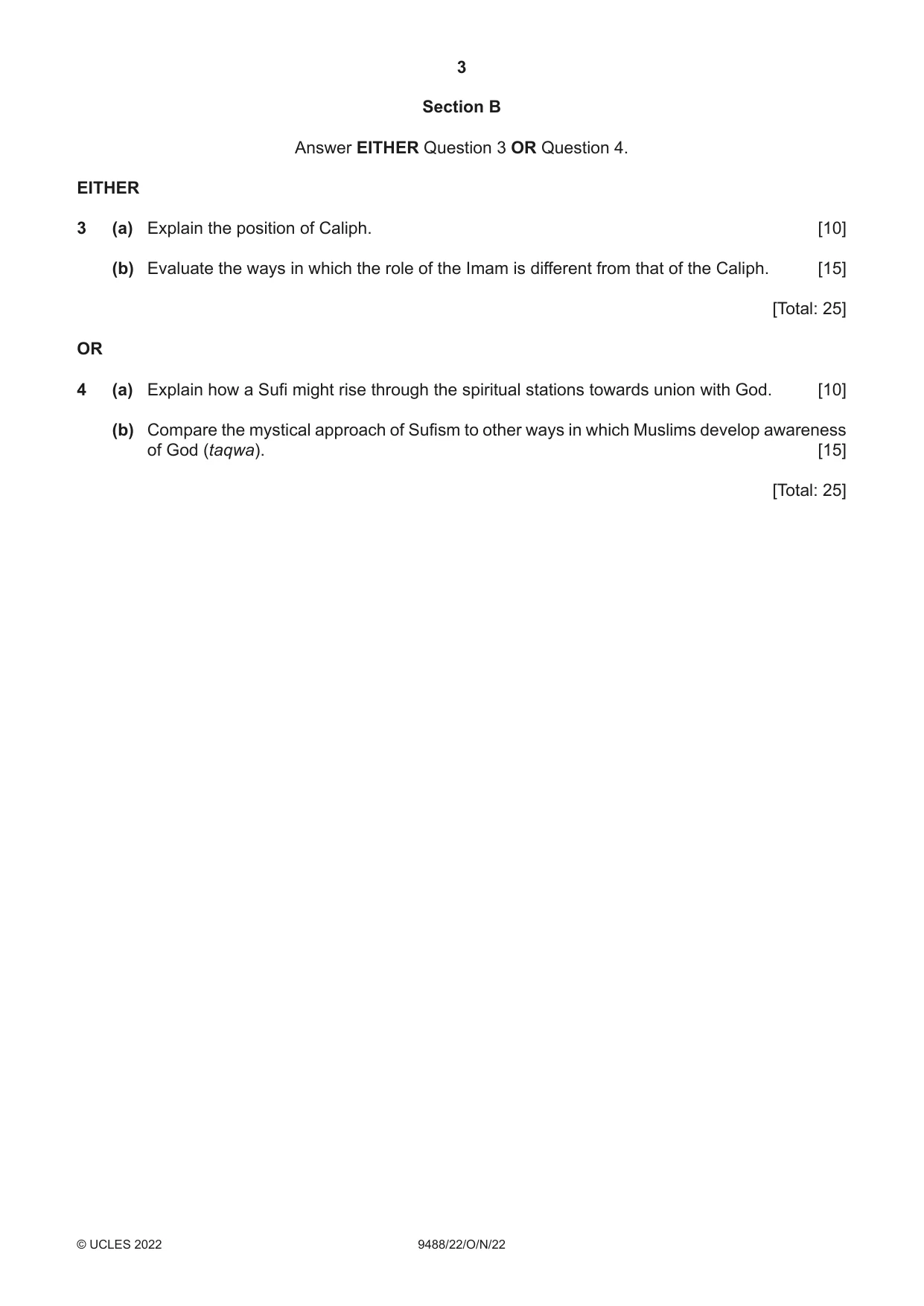
Question paper4 pages

Mark scheme19 pages
Answers below. Sit the paper first if you are practising.
Questions as text
Q1 · State five features of Friday prayers (Jumu’ah)
1 (a) State five features of Friday prayers (Jumu’ah). [5] (b) Explain the conditions needed for Friday prayers (Jumu’ah). [10] (c) ‘Muslims can find all the information they need for Friday prayers (Jumu’ah) in the Sunnah.’ Do you agree? Discuss this statement with reference to different points of view. [10] [Total: 25] OR
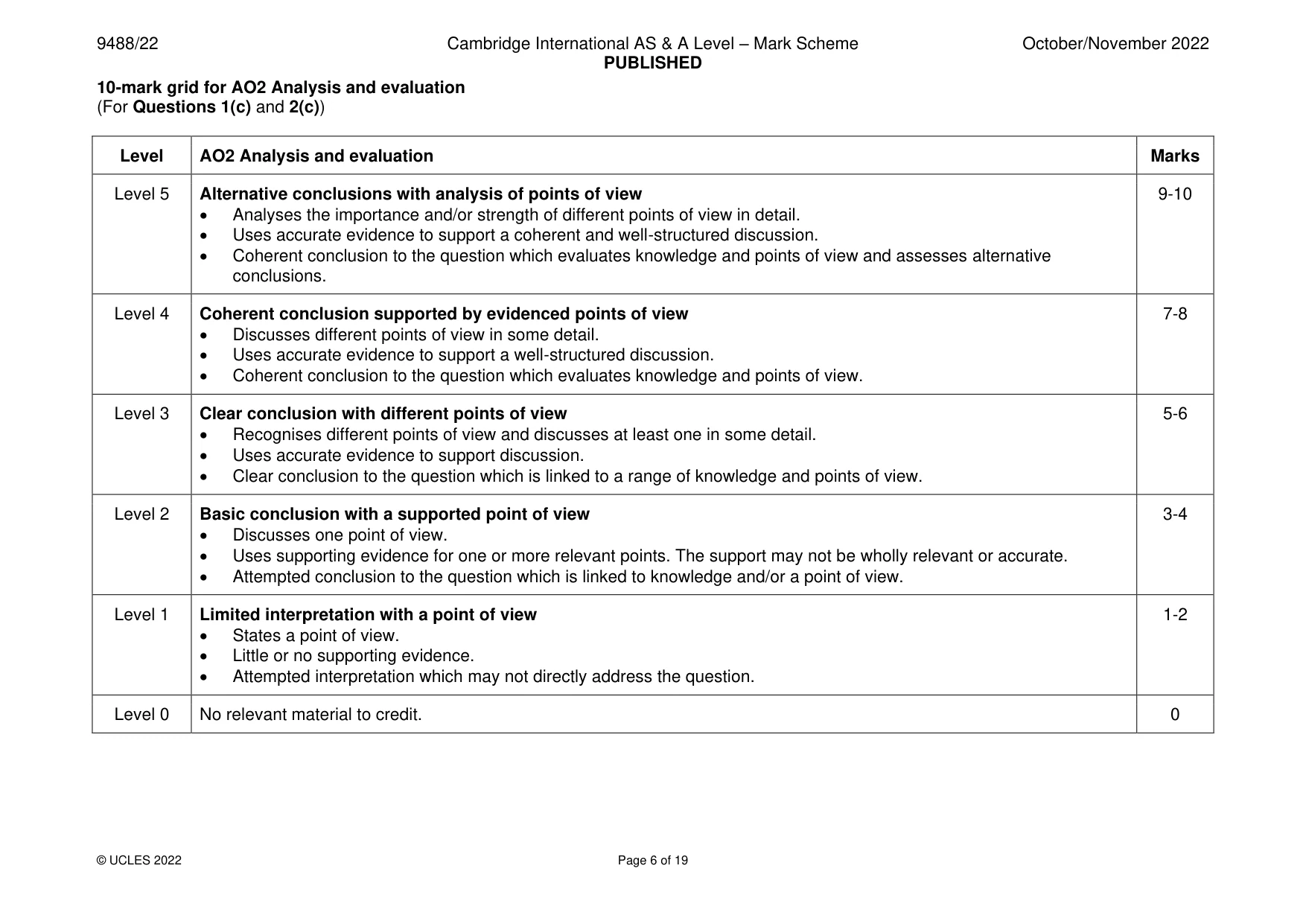
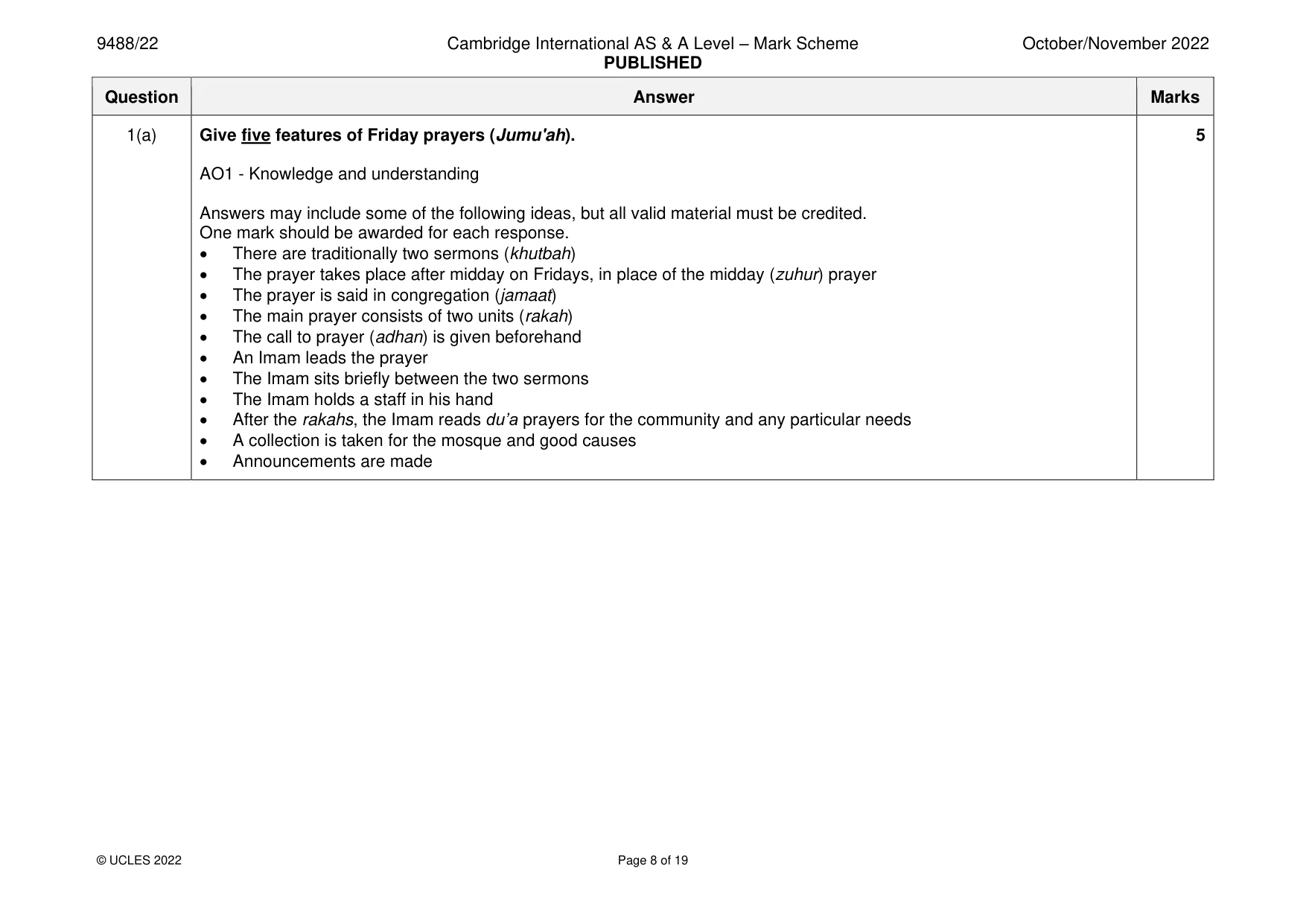
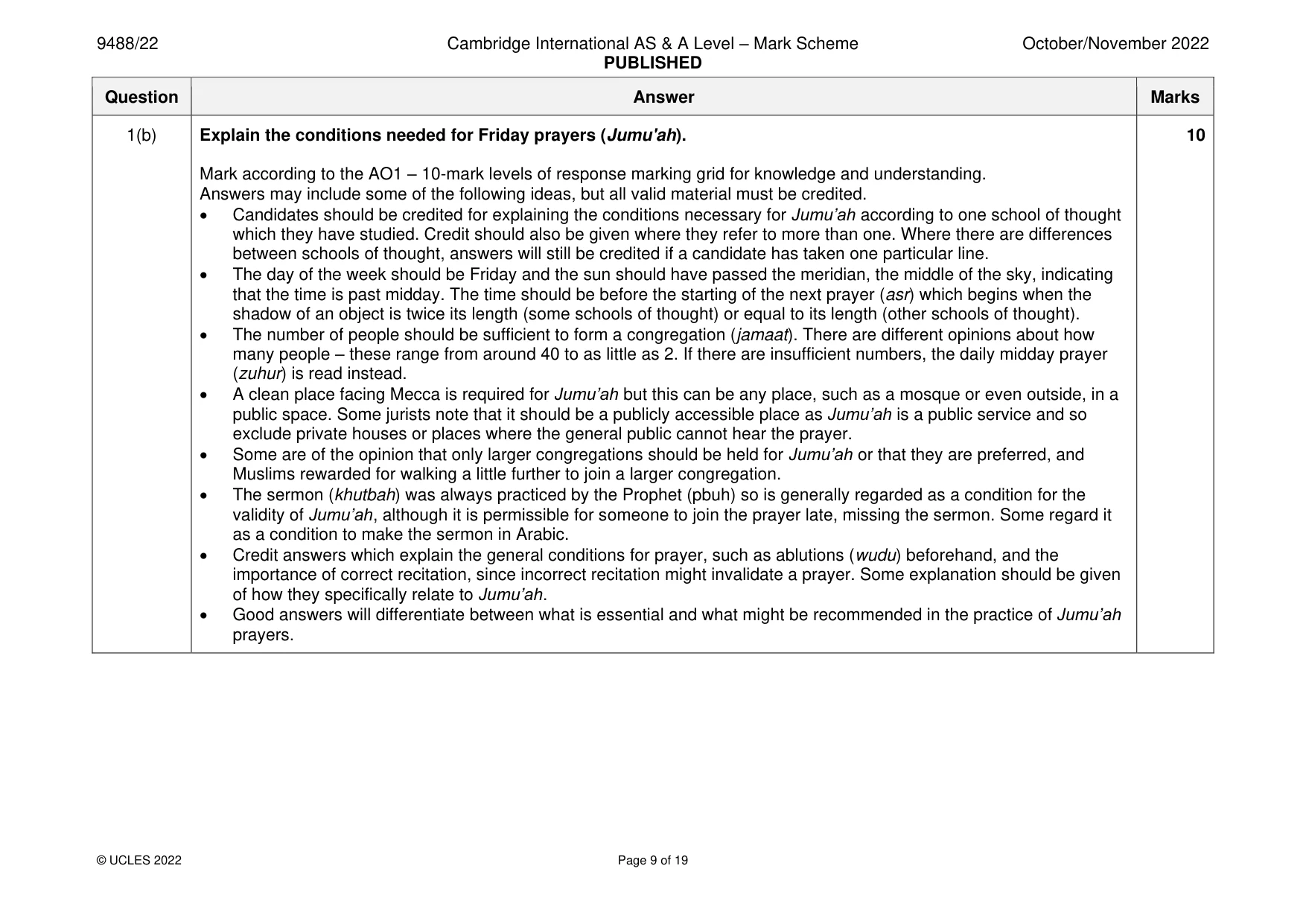
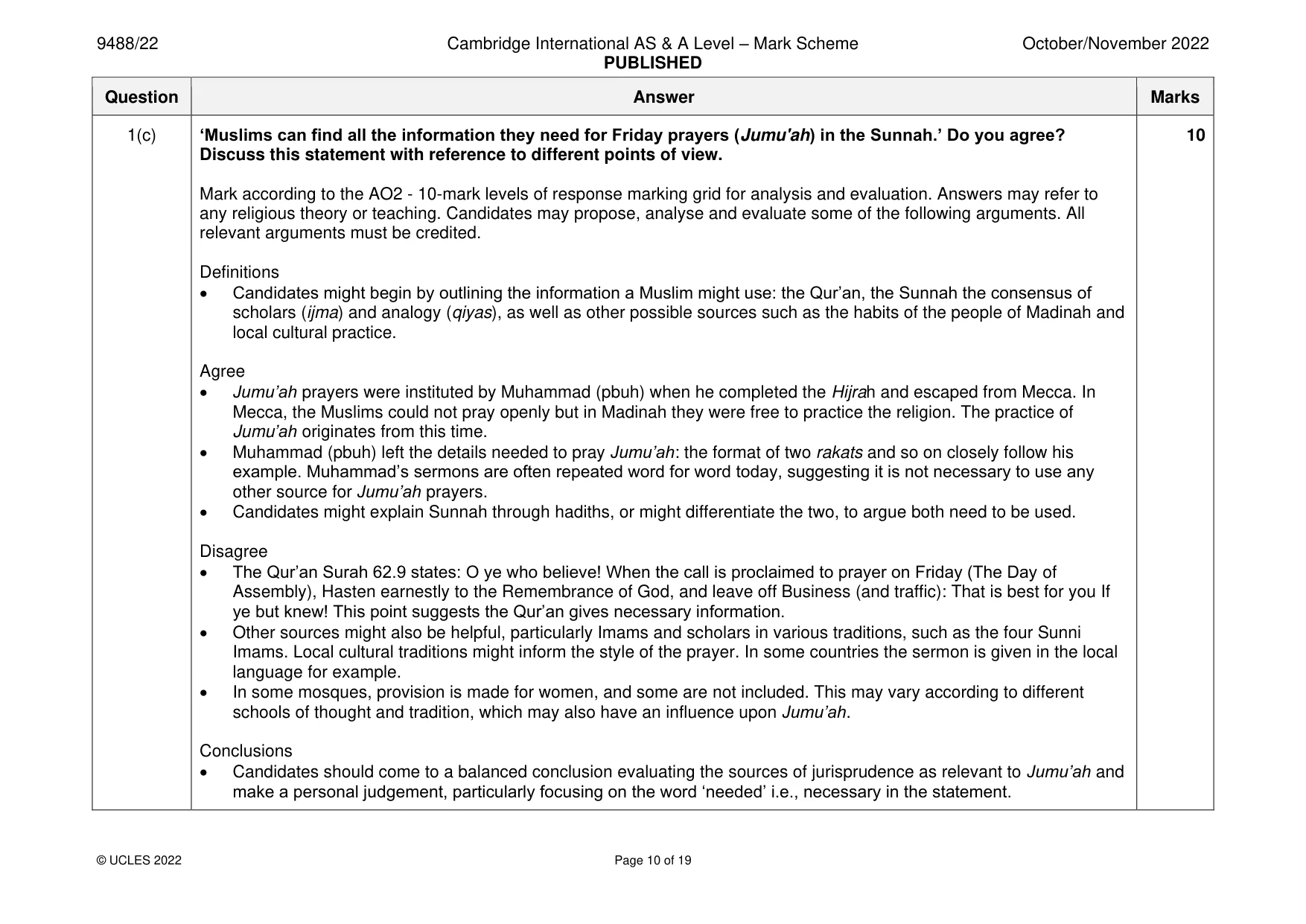
Mark scheme: Question Answer Marks 1(a) Give five features of Friday prayers (Jumu'ah). 5 AO1 - Knowledge and understanding Answers may include some of the following ideas, but all valid material must be credited. One mark should be awarded for each response. • There are traditionally two sermons (khutbah) • The prayer takes place after midday on Fridays, in place of the midday (zuhur) prayer • The prayer is said in congregation (jamaat) • The main prayer consists of two units (rakah) • The call to prayer (adhan) is given beforehand • An Imam leads the prayer • The Imam sits briefly between the two sermons • The Imam holds a staff in his hand • After the rakahs, the Imam reads du’a prayers for the community and any particular needs • A collection is taken for the mosque and good causes • Announcements are made 1(b) Explain the conditions needed for Friday prayers (Jumu'ah). 10 Mark according to the AO1 – 10-mark levels of response marking grid for knowledge and understanding. Answers may include some of the following ideas, but all valid material must be credited. • Candidates should be credited for explaining the conditions necessary for Jumu’ah according to one school of thought which they have studied. Credit should also be given where they refer to more than one. Where there are differences between schools of thought, answers will still be credited if a candidate has taken one particular line. • The day of the week should be Friday and the sun should have passed the meridian, the middle of the sky, indicating that the time is past midday. The time should be before the starting of the next prayer (asr) which begins when the shadow of an object is twice its length (some schools of thought) or equal to its length (other schools of thought). • The number of people should be sufficient to form a congregation (jamaat). There are different opinions about how many people – these range from around 40 to as little as 2. If there are insufficient numbers, the daily midday prayer (zuhur) is read instead. • A clean place facing Mecca is required for Jumu’ah but this can be any place, such as a mosque or even outside, in a public space. Some jurists note that it should be a publicly accessible place as Jumu’ah is a public service and so exclude private houses or places where the general public cannot hear the prayer. • Some are of the opinion that only larger congregations should be held for Jumu’ah or that they are preferred, and Muslims rewarded for walking a little further to join a larger congregation. • The sermon (khutbah) was always practiced by the Prophet (pbuh) so is generally regarded as a condition for the validity of Jumu’ah, although it is permissible for someone to join the prayer late, missing the sermon. Some regard it as a condition to make the sermon in Arabic. • Credit answers which explain the general conditions for prayer, such as ablutions (wudu) beforehand, and the importance of correct recitation, since incorrect recitation might invalidate a prayer. Some explanation should be given of how they specifically relate to Jumu’ah. • Good answers will differentiate between what is essential and what might be recommended in the practice of Jumu’ah prayers. 1(c) ‘Muslims can find all the information they need for Friday prayers (Jumu'ah) in the Sunnah.’ Do you agree? 10 Discuss this statement with reference to different points of view. Mark according to the AO2 - 10-mark levels of response marking grid for analysis and evaluation. Answers may refer to any religious theory or teaching. Candidates may propose, analyse and evaluate some of the following arguments. All relevant arguments must be credited. Definitions • Candidates might begin by outlining the information a Muslim might use: the Qur’an, the Sunnah the consensus of scholars (ijma) and analogy (qiyas), as well as other possible sources such as the habits of the people of Madinah and local cultural practice. Agree • Jumu’ah prayers were instituted by Muhammad (pbuh) when he completed the Hijrah and escaped from Mecca. In Mecca, the Muslims could not pray openly but in Madinah they were free to practice the religion. The practice of Jumu’ah originates from this time. • Muhammad (pbuh) left the details needed to pray Jumu’ah: the format of two rakats and so on closely follow his example. Muhammad’s sermons are often repeated word for word today, suggesting it is not necessary to use any other source for Jumu’ah prayers. • Candidates might explain Sunnah through hadiths, or might differentiate the two, to argue both need to be used. Disagree • The Qur’an Surah 62.9 states: O ye who believe! When the call is proclaimed to prayer on Friday (The Day of Assembly), Hasten earnestly to the Remembrance of God, and leave off Business (and traffic): That is best for you If ye but knew! This point suggests the Qur’an gives necessary information. • Other sources might also be helpful, particularly Imams and scholars in various traditions, such as the four Sunni Imams. Local cultural traditions might inform the style of the prayer. In some countries the sermon is given in the local language for example. • In some mosques, provision is made for women, and some are not included. This may vary according to different schools of thought and tradition, which may also have an influence upon Jumu’ah. Conclusions • Candidates should come to a balanced conclusion evaluating the sources of jurisprudence as relevant to Jumu’ah and make a personal judgement, particularly focusing on the word ‘needed’ i.e., necessary in the statement.
Q2 · State five people whom a Muslim man should not marry, according to the Qur’an
2 (a) State five people whom a Muslim man should not marry, according to the Qur’an. [5] (b) Describe the freedom Muslims have to choose marital partners, according to Islamic law (shariah). [10] (c) ‘Piety is the only consideration which matters when Muslims choose a marital partner.’ Do you agree? Discuss this statement with reference to different points of view. [10] [Total: 25]
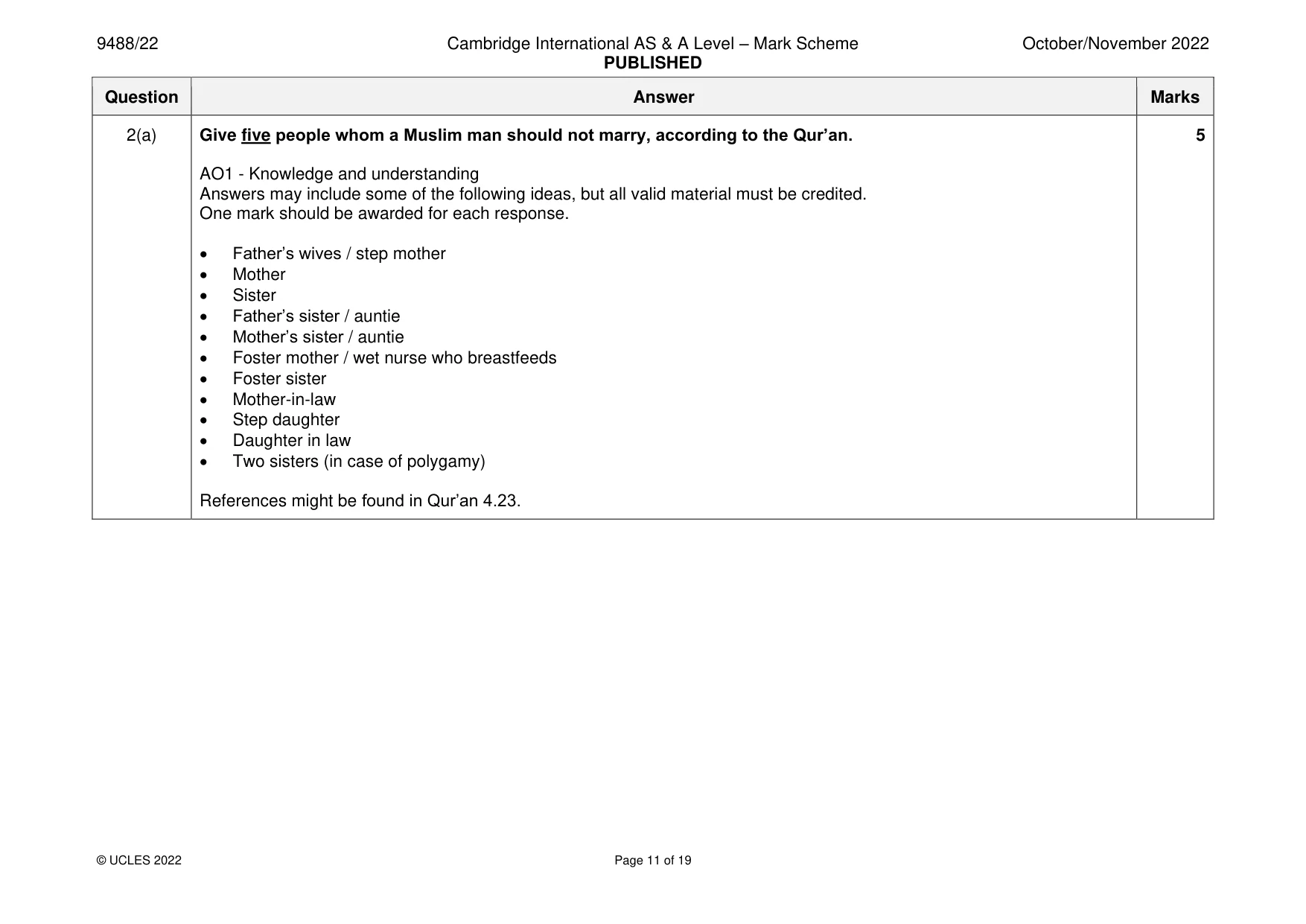
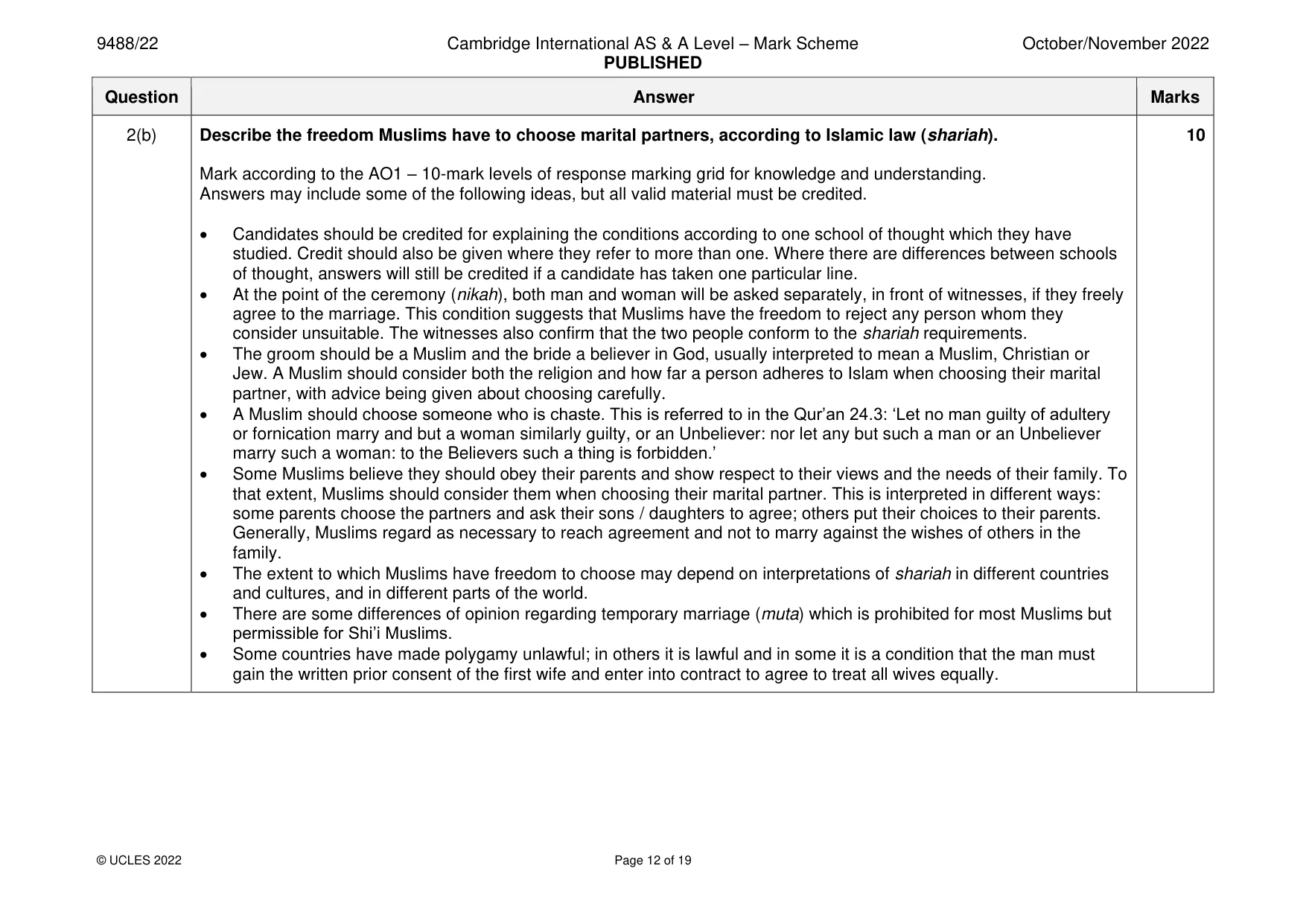
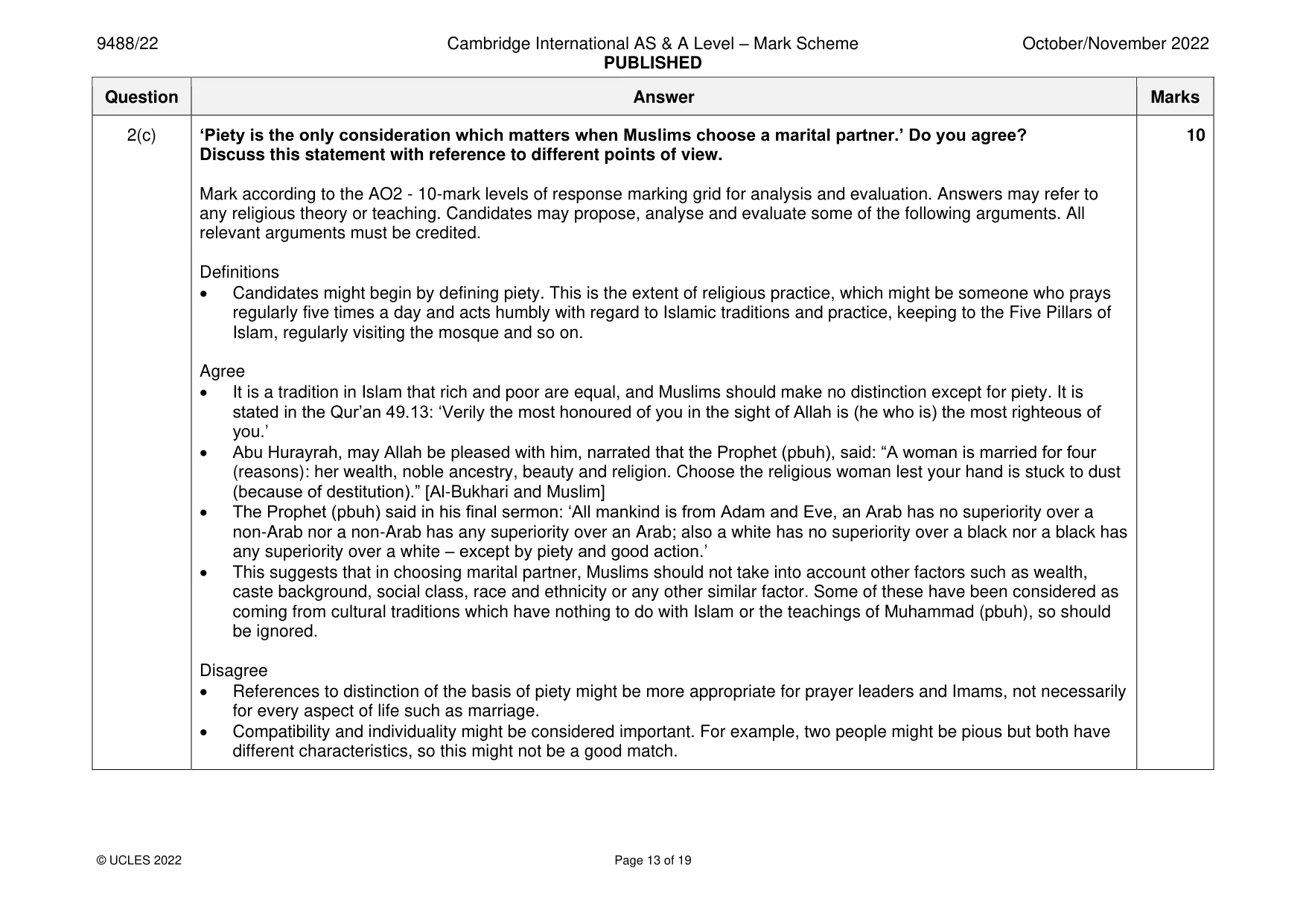
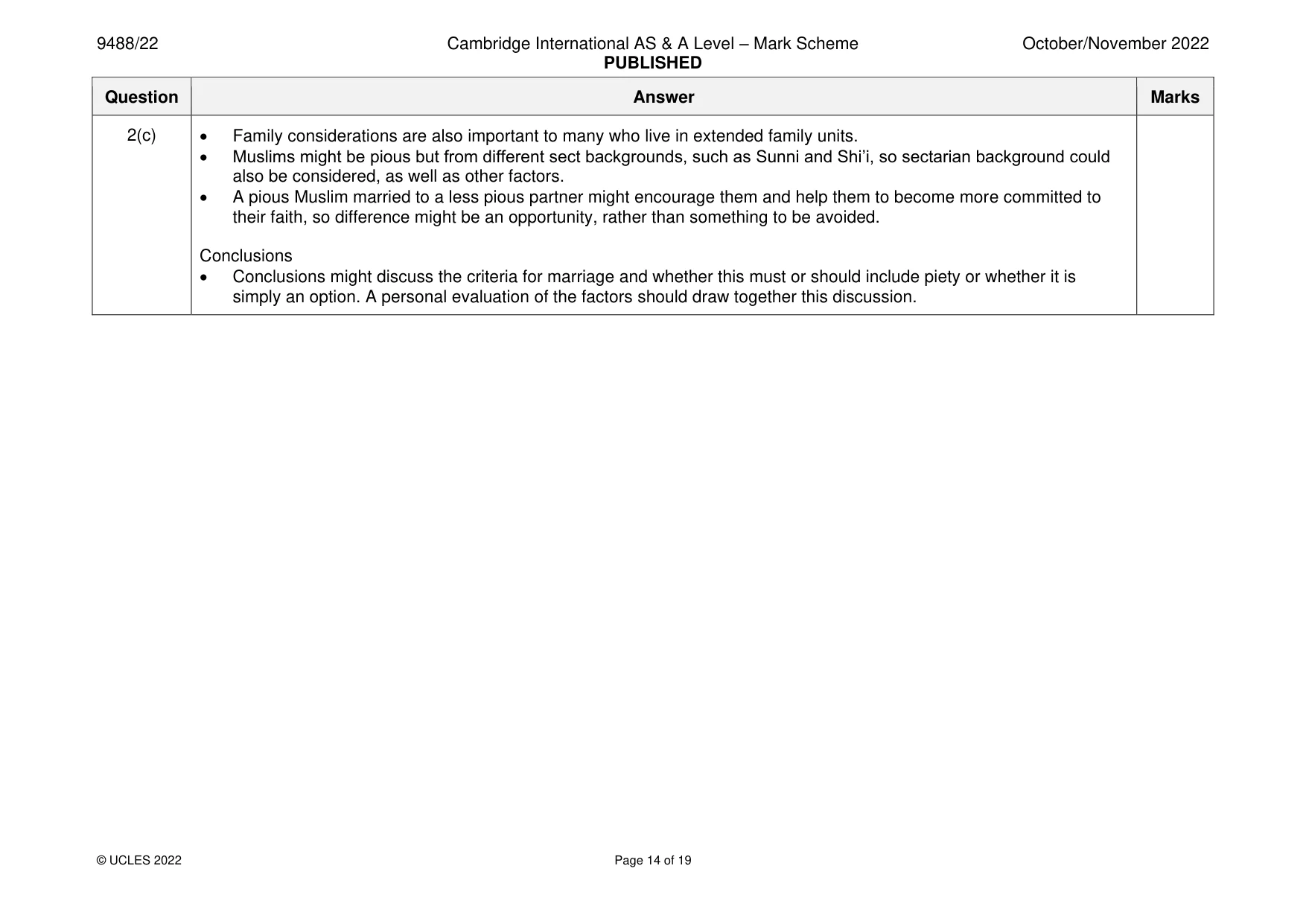
Mark scheme: 2(a) Give five people whom a Muslim man should not marry, according to the Qur’an. 5 AO1 - Knowledge and understanding Answers may include some of the following ideas, but all valid material must be credited. One mark should be awarded for each response. • Father’s wives / step mother • Mother • Sister • Father’s sister / auntie • Mother’s sister / auntie • Foster mother / wet nurse who breastfeeds • Foster sister • Mother-in-law • Step daughter • Daughter in law • Two sisters (in case of polygamy) References might be found in Qur’an 4.23. 2(b) Describe the freedom Muslims have to choose marital partners, according to Islamic law (shariah). 10 Mark according to the AO1 – 10-mark levels of response marking grid for knowledge and understanding. Answers may include some of the following ideas, but all valid material must be credited. • Candidates should be credited for explaining the conditions according to one school of thought which they have studied. Credit should also be given where they refer to more than one. Where there are differences between schools of thought, answers will still be credited if a candidate has taken one particular line. • At the point of the ceremony (nikah), both man and woman will be asked separately, in front of witnesses, if they freely agree to the marriage. This condition suggests that Muslims have the freedom to reject any person whom they consider unsuitable. The witnesses also confirm that the two people conform to the shariah requirements. • The groom should be a Muslim and the bride a believer in God, usually interpreted to mean a Muslim, Christian or Jew. A Muslim should consider both the religion and how far a person adheres to Islam when choosing their marital partner, with advice being given about choosing carefully. • A Muslim should choose someone who is chaste. This is referred to in the Qur’an 24.3: ‘Let no man guilty of adultery or fornication marry and but a woman similarly guilty, or an Unbeliever: nor let any but such a man or an Unbeliever marry such a woman: to the Believers such a thing is forbidden.’ • Some Muslims believe they should obey their parents and show respect to their views and the needs of their family. To that extent, Muslims should consider them when choosing their marital partner. This is interpreted in different ways: some parents choose the partners and ask their sons / daughters to agree; others put their choices to their parents. Generally, Muslims regard as necessary to reach agreement and not to marry against the wishes of others in the family. • The extent to which Muslims have freedom to choose may depend on interpretations of shariah in different countries and cultures, and in different parts of the world. • There are some differences of opinion regarding temporary marriage (muta) which is prohibited for most Muslims but permissible for Shi’i Muslims. • Some countries have made polygamy unlawful; in others it is lawful and in some it is a condition that the man must gain the written prior consent of the first wife and enter into contract to agree to treat all wives equally. 2(c) ‘Piety is the only consideration which matters when Muslims choose a marital partner.’ Do you agree? 10 Discuss this statement with reference to different points of view. Mark according to the AO2 - 10-mark levels of response marking grid for analysis and evaluation. Answers may refer to any religious theory or teaching. Candidates may propose, analyse and evaluate some of the following arguments. All relevant arguments must be credited. Definitions • Candidates might begin by defining piety. This is the extent of religious practice, which might be someone who prays regularly five times a day and acts humbly with regard to Islamic traditions and practice, keeping to the Five Pillars of Islam, regularly visiting the mosque and so on. Agree • It is a tradition in Islam that rich and poor are equal, and Muslims should make no distinction except for piety. It is stated in the Qur’an 49.13: ‘Verily the most honoured of you in the sight of Allah is (he who is) the most righteous of you.’ • Abu Hurayrah, may Allah be pleased with him, narrated that the Prophet (pbuh), said: “A woman is married for four (reasons): her wealth, noble ancestry, beauty and religion. Choose the religious woman lest your hand is stuck to dust (because of destitution).” [Al-Bukhari and Muslim] • The Prophet (pbuh) said in his final sermon: ‘All mankind is from Adam and Eve, an Arab has no superiority over a non-Arab nor a non-Arab has any superiority over an Arab; also a white has no superiority over a black nor a black has any superiority over a white – except by piety and good action.’ • This suggests that in choosing marital partner, Muslims should not take into account other factors such as wealth, caste background, social class, race and ethnicity or any other similar factor. Some of these have been considered as coming from cultural traditions which have nothing to do with Islam or the teachings of Muhammad (pbuh), so should be ignored. Disagree • References to distinction of the basis of piety might be more appropriate for prayer leaders and Imams, not necessarily for every aspect of life such as marriage. • Compatibility and individuality might be considered important. For example, two people might be pious but both have different characteristics, so this might not be a good match. 2(c) • Family considerations are also important to many who live in extended family units. • Muslims might be pious but from different sect backgrounds, such as Sunni and Shi’i, so sectarian background could also be considered, as well as other factors. • A pious Muslim married to a less pious partner might encourage them and help them to become more committed to their faith, so difference might be an opportunity, rather than something to be avoided. Conclusions • Conclusions might discuss the criteria for marriage and whether this must or should include piety or whether it is simply an option. A personal evaluation of the factors should draw together this discussion.
Q3 · Explain the position of Caliph
3 (a) Explain the position of Caliph. [10] (b) Evaluate the ways in which the role of the Imam is different from that of the Caliph. [15] [Total: 25] OR
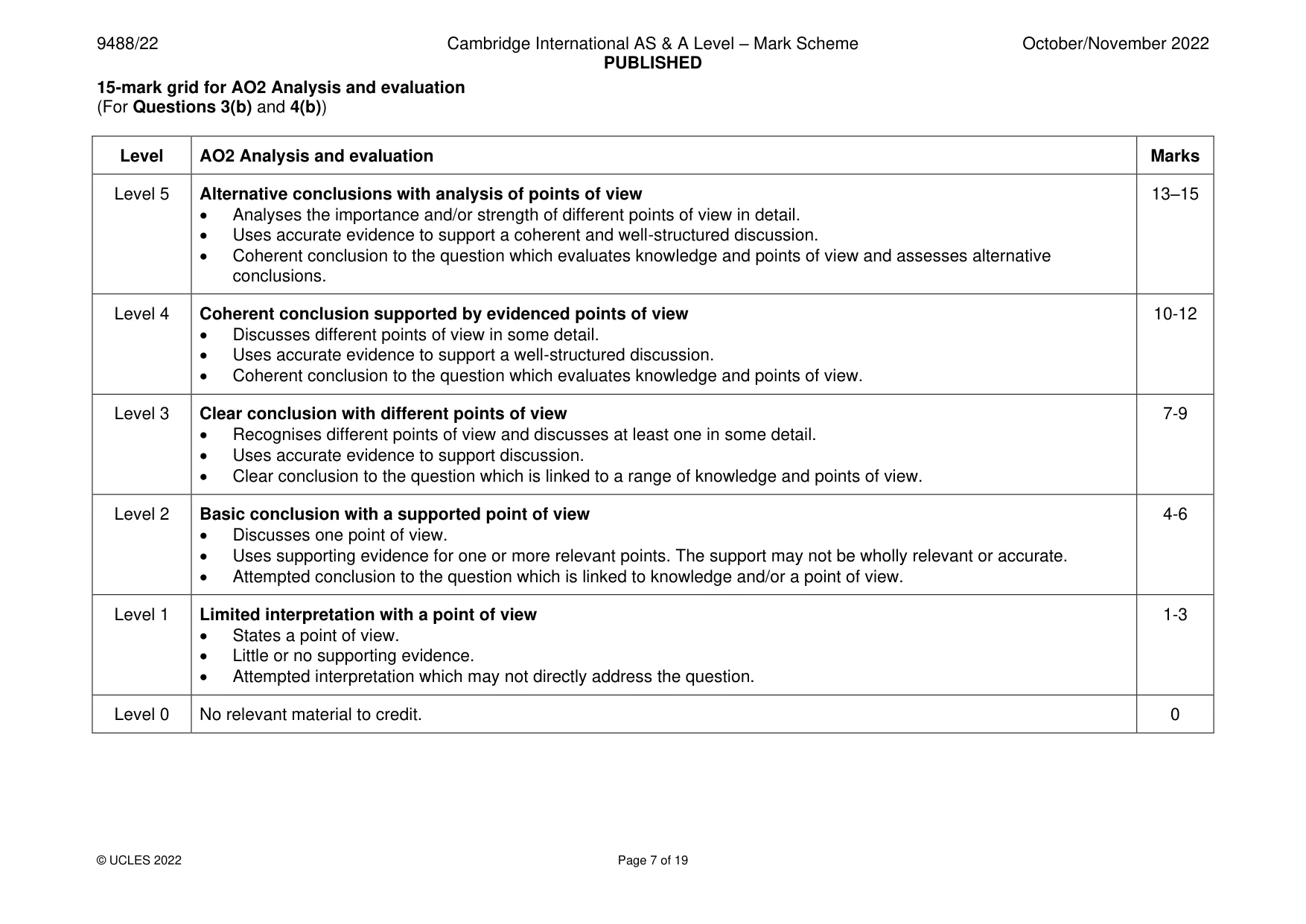
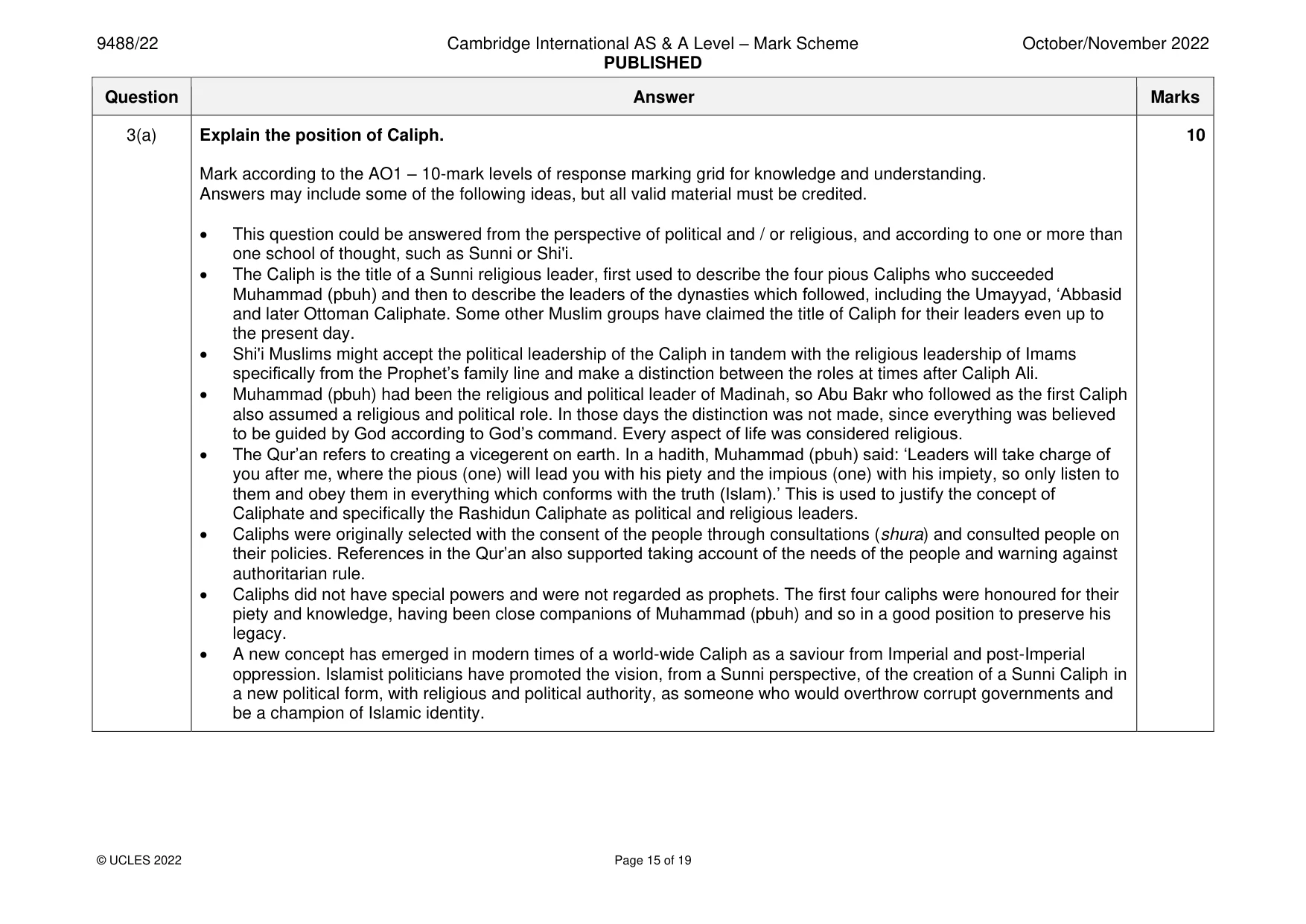
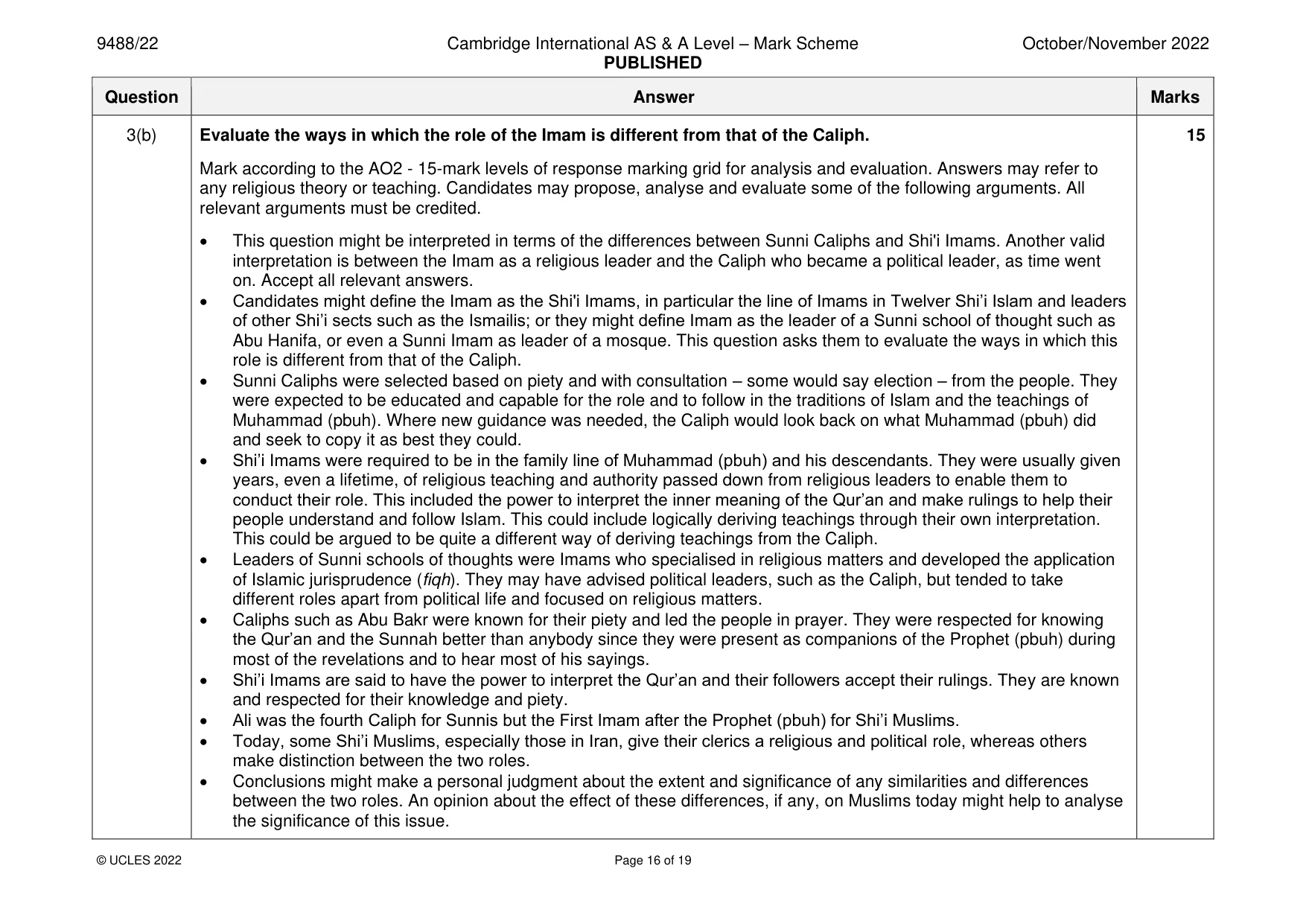
Mark scheme: 3(a) Explain the position of Caliph. 10 Mark according to the AO1 – 10-mark levels of response marking grid for knowledge and understanding. Answers may include some of the following ideas, but all valid material must be credited. • This question could be answered from the perspective of political and / or religious, and according to one or more than one school of thought, such as Sunni or Shi'i. • The Caliph is the title of a Sunni religious leader, first used to describe the four pious Caliphs who succeeded Muhammad (pbuh) and then to describe the leaders of the dynasties which followed, including the Umayyad, ‘Abbasid and later Ottoman Caliphate. Some other Muslim groups have claimed the title of Caliph for their leaders even up to the present day. • Shi'i Muslims might accept the political leadership of the Caliph in tandem with the religious leadership of Imams specifically from the Prophet’s family line and make a distinction between the roles at times after Caliph Ali. • Muhammad (pbuh) had been the religious and political leader of Madinah, so Abu Bakr who followed as the first Caliph also assumed a religious and political role. In those days the distinction was not made, since everything was believed to be guided by God according to God’s command. Every aspect of life was considered religious. • The Qur’an refers to creating a vicegerent on earth. In a hadith, Muhammad (pbuh) said: ‘Leaders will take charge of you after me, where the pious (one) will lead you with his piety and the impious (one) with his impiety, so only listen to them and obey them in everything which conforms with the truth (Islam).’ This is used to justify the concept of Caliphate and specifically the Rashidun Caliphate as political and religious leaders. • Caliphs were originally selected with the consent of the people through consultations (shura) and consulted people on their policies. References in the Qur’an also supported taking account of the needs of the people and warning against authoritarian rule. • Caliphs did not have special powers and were not regarded as prophets. The first four caliphs were honoured for their piety and knowledge, having been close companions of Muhammad (pbuh) and so in a good position to preserve his legacy. • A new concept has emerged in modern times of a world-wide Caliph as a saviour from Imperial and post-Imperial oppression. Islamist politicians have promoted the vision, from a Sunni perspective, of the creation of a Sunni Caliph in a new political form, with religious and political authority, as someone who would overthrow corrupt governments and be a champion of Islamic identity. 3(b) Evaluate the ways in which the role of the Imam is different from that of the Caliph. 15 Mark according to the AO2 - 15-mark levels of response marking grid for analysis and evaluation. Answers may refer to any religious theory or teaching. Candidates may propose, analyse and evaluate some of the following arguments. All relevant arguments must be credited. • This question might be interpreted in terms of the differences between Sunni Caliphs and Shi'i Imams. Another valid interpretation is between the Imam as a religious leader and the Caliph who became a political leader, as time went on. Accept all relevant answers. • Candidates might define the Imam as the Shi'i Imams, in particular the line of Imams in Twelver Shi’i Islam and leaders of other Shi’i sects such as the Ismailis; or they might define Imam as the leader of a Sunni school of thought such as Abu Hanifa, or even a Sunni Imam as leader of a mosque. This question asks them to evaluate the ways in which this role is different from that of the Caliph. • Sunni Caliphs were selected based on piety and with consultation – some would say election – from the people. They were expected to be educated and capable for the role and to follow in the traditions of Islam and the teachings of Muhammad (pbuh). Where new guidance was needed, the Caliph would look back on what Muhammad (pbuh) did and seek to copy it as best they could. • Shi’i Imams were required to be in the family line of Muhammad (pbuh) and his descendants. They were usually given years, even a lifetime, of religious teaching and authority passed down from religious leaders to enable them to conduct their role. This included the power to interpret the inner meaning of the Qur’an and make rulings to help their people understand and follow Islam. This could include logically deriving teachings through their own interpretation. This could be argued to be quite a different way of deriving teachings from the Caliph. • Leaders of Sunni schools of thoughts were Imams who specialised in religious matters and developed the application of Islamic jurisprudence (fiqh). They may have advised political leaders, such as the Caliph, but tended to take different roles apart from political life and focused on religious matters. • Caliphs such as Abu Bakr were known for their piety and led the people in prayer. They were respected for knowing the Qur’an and the Sunnah better than anybody since they were present as companions of the Prophet (pbuh) during most of the revelations and to hear most of his sayings. • Shi’i Imams are said to have the power to interpret the Qur’an and their followers accept their rulings. They are known and respected for their knowledge and piety. • Ali was the fourth Caliph for Sunnis but the First Imam after the Prophet (pbuh) for Shi’i Muslims. • Today, some Shi’i Muslims, especially those in Iran, give their clerics a religious and political role, whereas others make distinction between the two roles. • Conclusions might make a personal judgment about the extent and significance of any similarities and differences between the two roles. An opinion about the effect of these differences, if any, on Muslims today might help to analyse the significance of this issue.
Q4 · Explain how a Sufi might rise through the spiritual stations towards union with God
4 (a) Explain how a Sufi might rise through the spiritual stations towards union with God. [10] (b) Compare the mystical approach of Sufism to other ways in which Muslims develop awareness of God (taqwa). [15] [Total: 25]
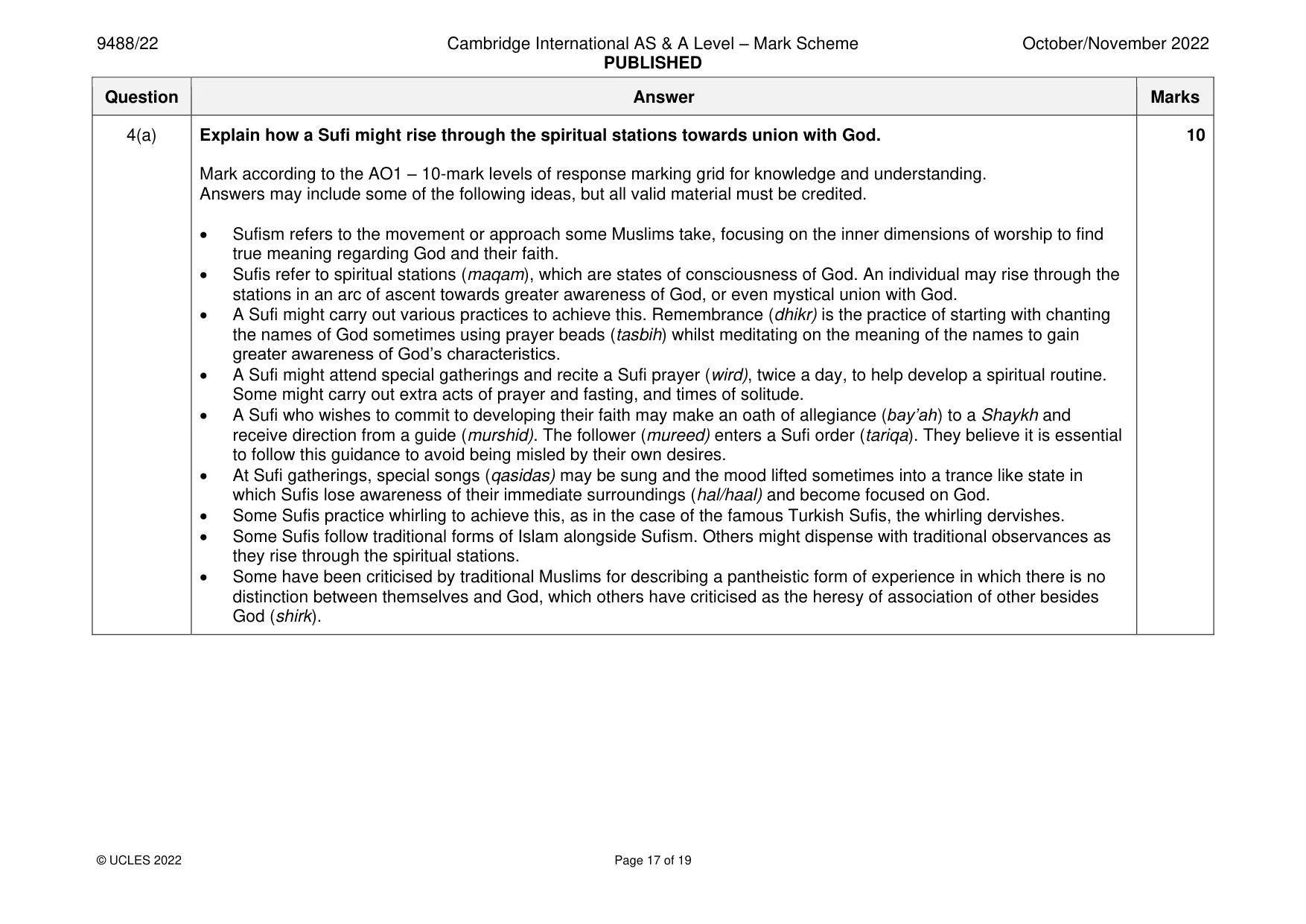
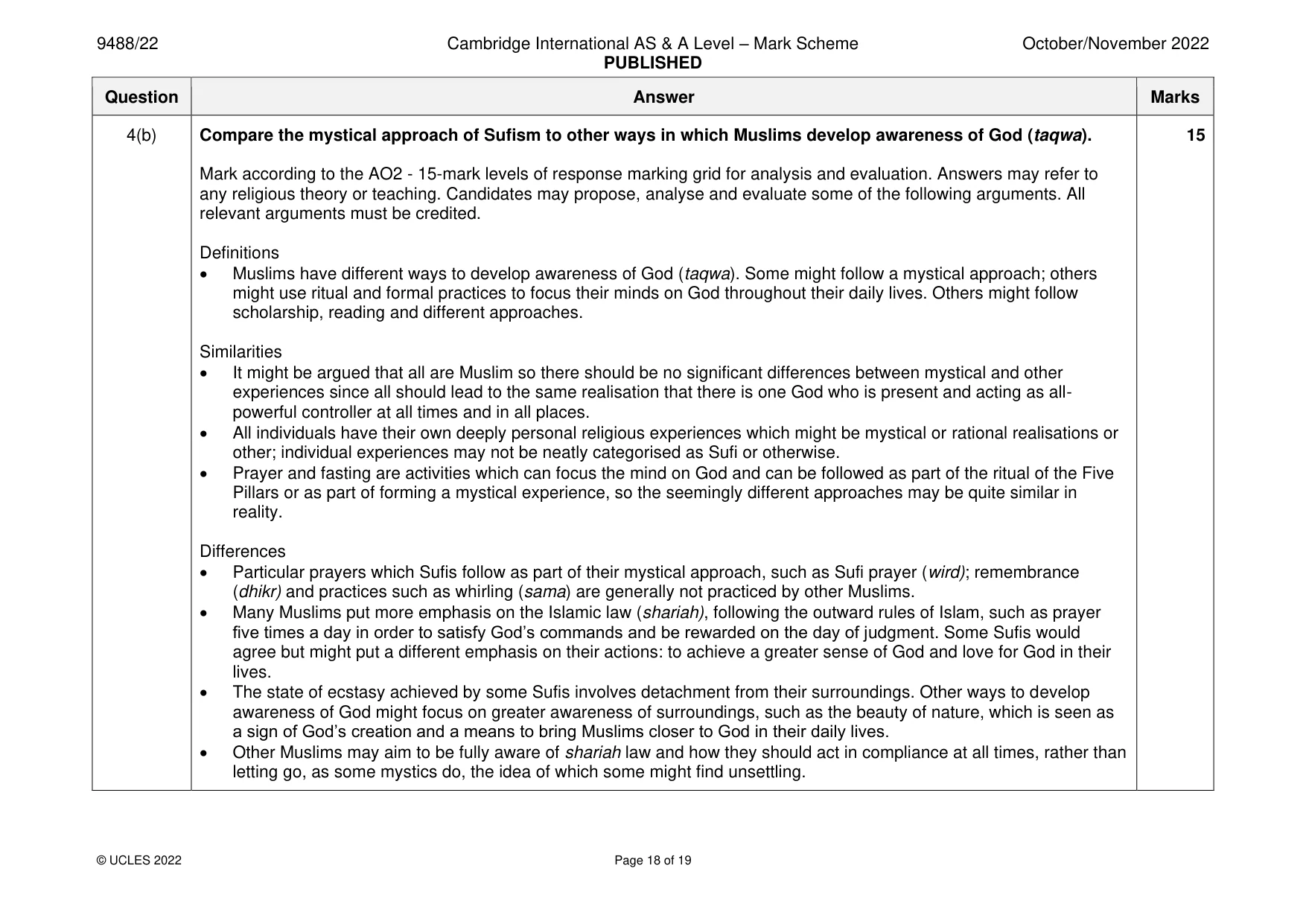
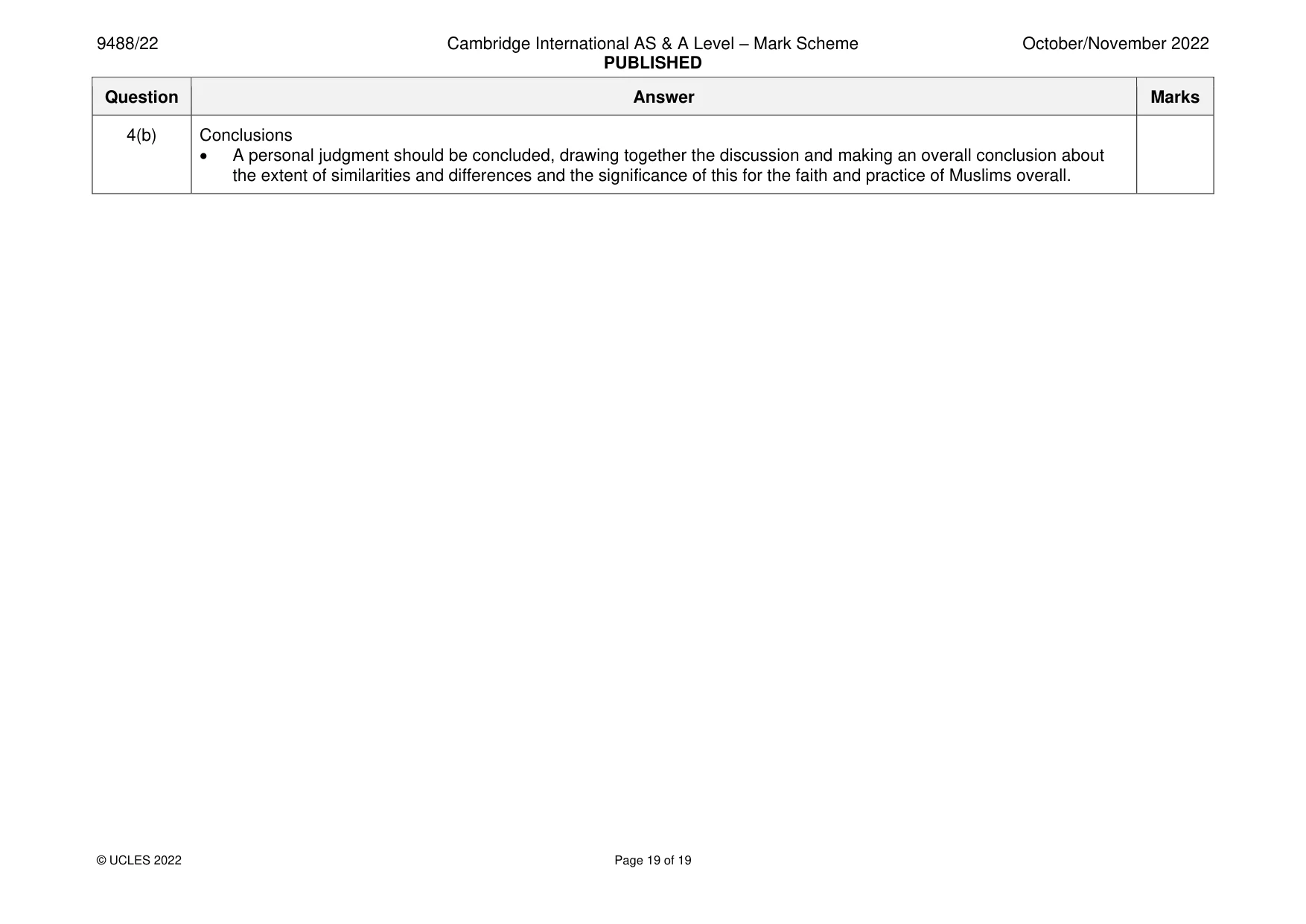
Mark scheme: 4(a) Explain how a Sufi might rise through the spiritual stations towards union with God. 10 Mark according to the AO1 – 10-mark levels of response marking grid for knowledge and understanding. Answers may include some of the following ideas, but all valid material must be credited. • Sufism refers to the movement or approach some Muslims take, focusing on the inner dimensions of worship to find true meaning regarding God and their faith. • Sufis refer to spiritual stations (maqam), which are states of consciousness of God. An individual may rise through the stations in an arc of ascent towards greater awareness of God, or even mystical union with God. • A Sufi might carry out various practices to achieve this. Remembrance (dhikr) is the practice of starting with chanting the names of God sometimes using prayer beads (tasbih) whilst meditating on the meaning of the names to gain greater awareness of God’s characteristics. • A Sufi might attend special gatherings and recite a Sufi prayer (wird), twice a day, to help develop a spiritual routine. Some might carry out extra acts of prayer and fasting, and times of solitude. • A Sufi who wishes to commit to developing their faith may make an oath of allegiance (bay’ah) to a Shaykh and receive direction from a guide (murshid). The follower (mureed) enters a Sufi order (tariqa). They believe it is essential to follow this guidance to avoid being misled by their own desires. • At Sufi gatherings, special songs (qasidas) may be sung and the mood lifted sometimes into a trance like state in which Sufis lose awareness of their immediate surroundings (hal/haal) and become focused on God. • Some Sufis practice whirling to achieve this, as in the case of the famous Turkish Sufis, the whirling dervishes. • Some Sufis follow traditional forms of Islam alongside Sufism. Others might dispense with traditional observances as they rise through the spiritual stations. • Some have been criticised by traditional Muslims for describing a pantheistic form of experience in which there is no distinction between themselves and God, which others have criticised as the heresy of association of other besides God (shirk). 4(b) Compare the mystical approach of Sufism to other ways in which Muslims develop awareness of God (taqwa). 15 Mark according to the AO2 - 15-mark levels of response marking grid for analysis and evaluation. Answers may refer to any religious theory or teaching. Candidates may propose, analyse and evaluate some of the following arguments. All relevant arguments must be credited. Definitions • Muslims have different ways to develop awareness of God (taqwa). Some might follow a mystical approach; others might use ritual and formal practices to focus their minds on God throughout their daily lives. Others might follow scholarship, reading and different approaches. Similarities • It might be argued that all are Muslim so there should be no significant differences between mystical and other experiences since all should lead to the same realisation that there is one God who is present and acting as all- powerful controller at all times and in all places. • All individuals have their own deeply personal religious experiences which might be mystical or rational realisations or other; individual experiences may not be neatly categorised as Sufi or otherwise. • Prayer and fasting are activities which can focus the mind on God and can be followed as part of the ritual of the Five Pillars or as part of forming a mystical experience, so the seemingly different approaches may be quite similar in reality. Differences • Particular prayers which Sufis follow as part of their mystical approach, such as Sufi prayer (wird); remembrance (dhikr) and practices such as whirling (sama) are generally not practiced by other Muslims. • Many Muslims put more emphasis on the Islamic law (shariah), following the outward rules of Islam, such as prayer five times a day in order to satisfy God’s commands and be rewarded on the day of judgment. Some Sufis would agree but might put a different emphasis on their actions: to achieve a greater sense of God and love for God in their lives. • The state of ecstasy achieved by some Sufis involves detachment from their surroundings. Other ways to develop awareness of God might focus on greater awareness of surroundings, such as the beauty of nature, which is seen as a sign of God’s creation and a means to bring Muslims closer to God in their daily lives. • Other Muslims may aim to be fully aware of shariah law and how they should act in compliance at all times, rather than letting go, as some mystics do, the idea of which some might find unsettling. 4(b) Conclusions • A personal judgment should be concluded, drawing together the discussion and making an overall conclusion about the extent of similarities and differences and the significance of this for the faith and practice of Muslims overall.
What was in this paper
The subtopics covered by these 4 questions, and how many questions each got. Open one in a new tab to see every Cambridge question on it.
What you needed in this session
Cambridge’s own grade thresholds for 2022 Oct/Nov, Paper 2 · Variant 2. A higher threshold means an easier paper — the bar moves with how the cohort did.