Cambridge A Level Islamic Studies 9488 — 2024 May/June Paper 2 · Variant 2
9488/22/M/J/24 · 4 questions · 50 marks · 90 min
The question paper and its mark scheme, free to read here and free to download. This is Cambridge’s own paper, exactly as it was sat.
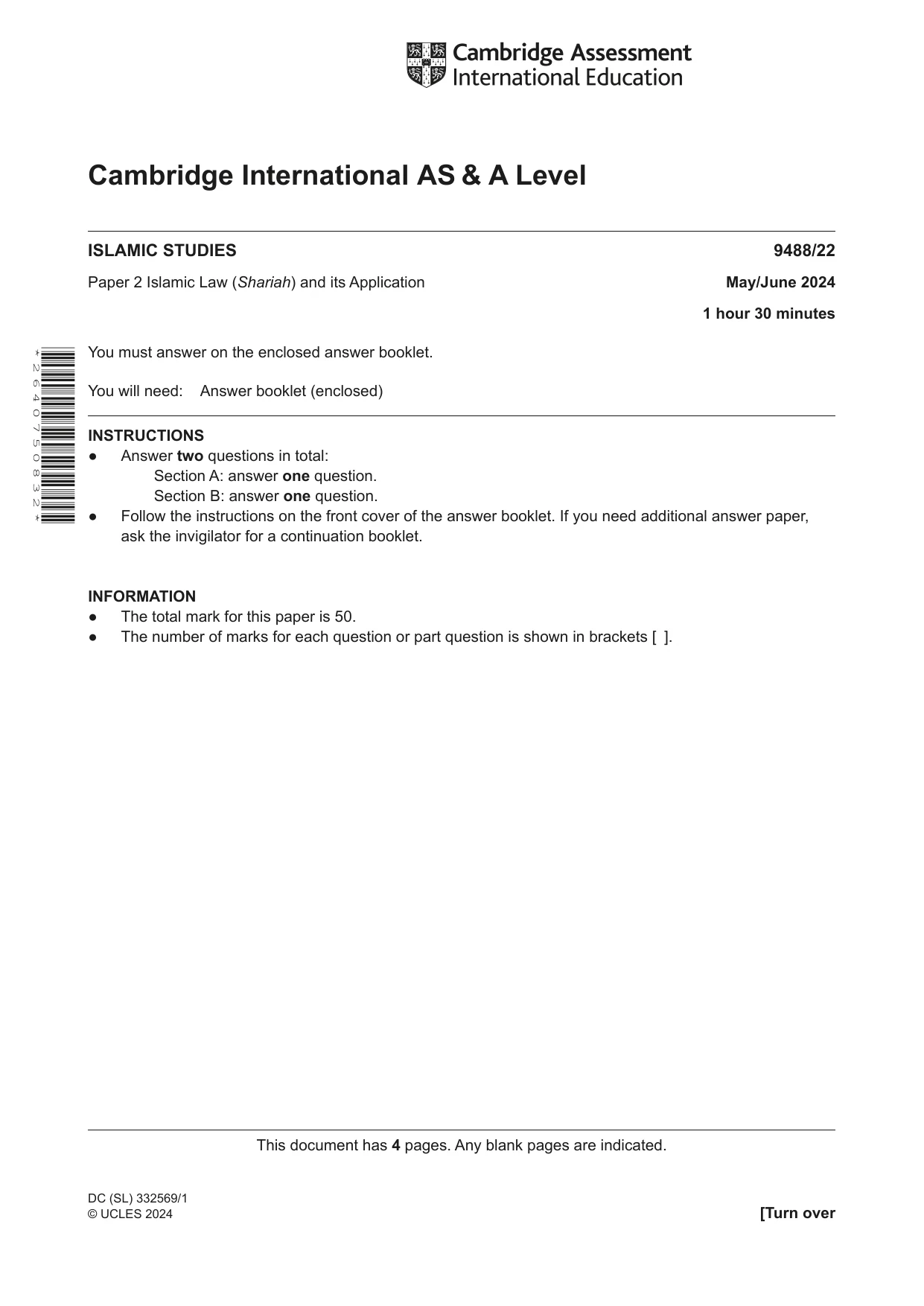
Question paper4 pages

Mark scheme17 pages
Answers below. Sit the paper first if you are practising.
Questions as text
Q1 · Outline the requirements for places where Muslims may pray
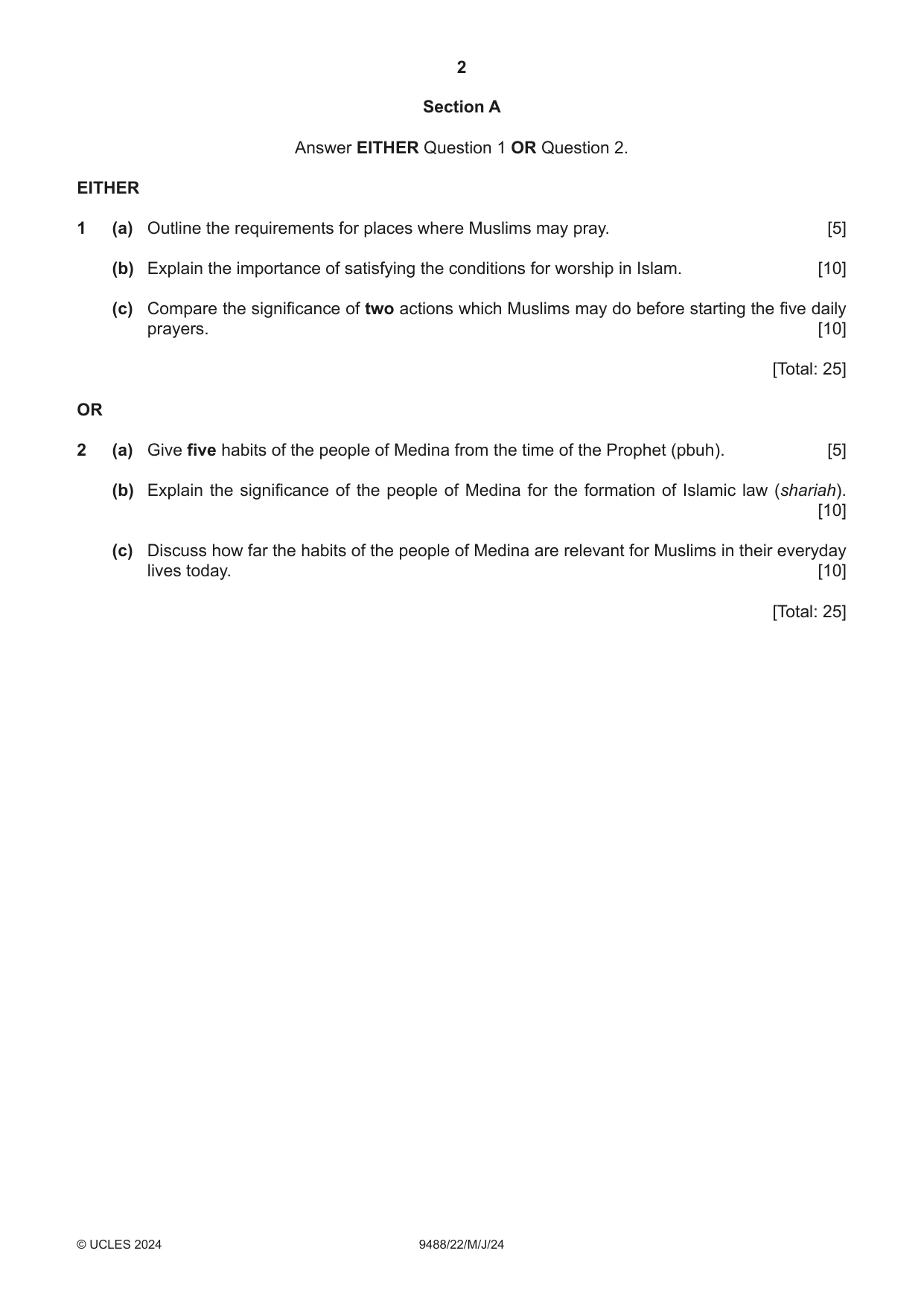
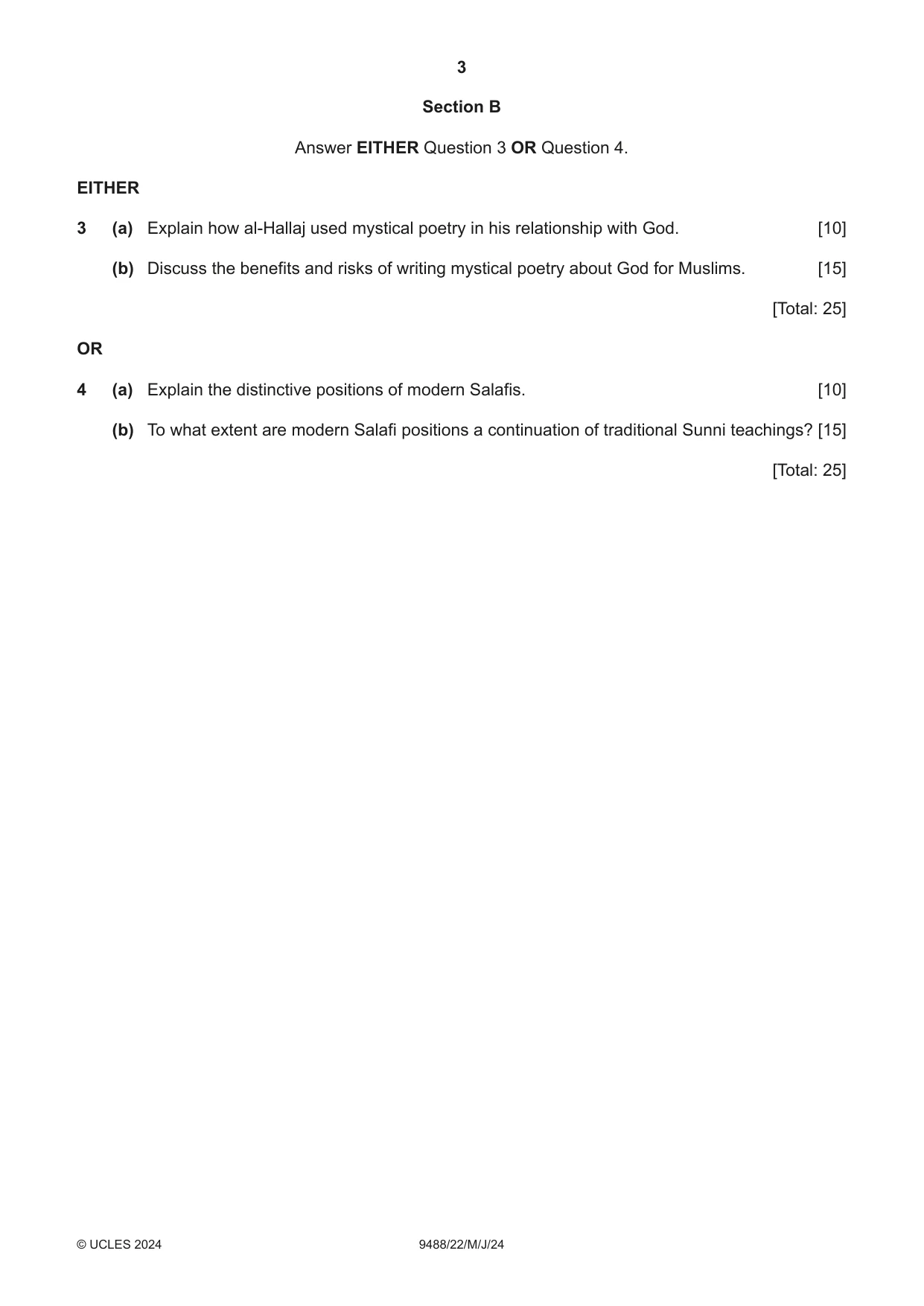
1 (a) Outline the requirements for places where Muslims may pray. [5] (b) Explain the importance of satisfying the conditions for worship in Islam. [10] (c) Compare the significance of two actions which Muslims may do before starting the five daily prayers. [10] [Total: 25] OR
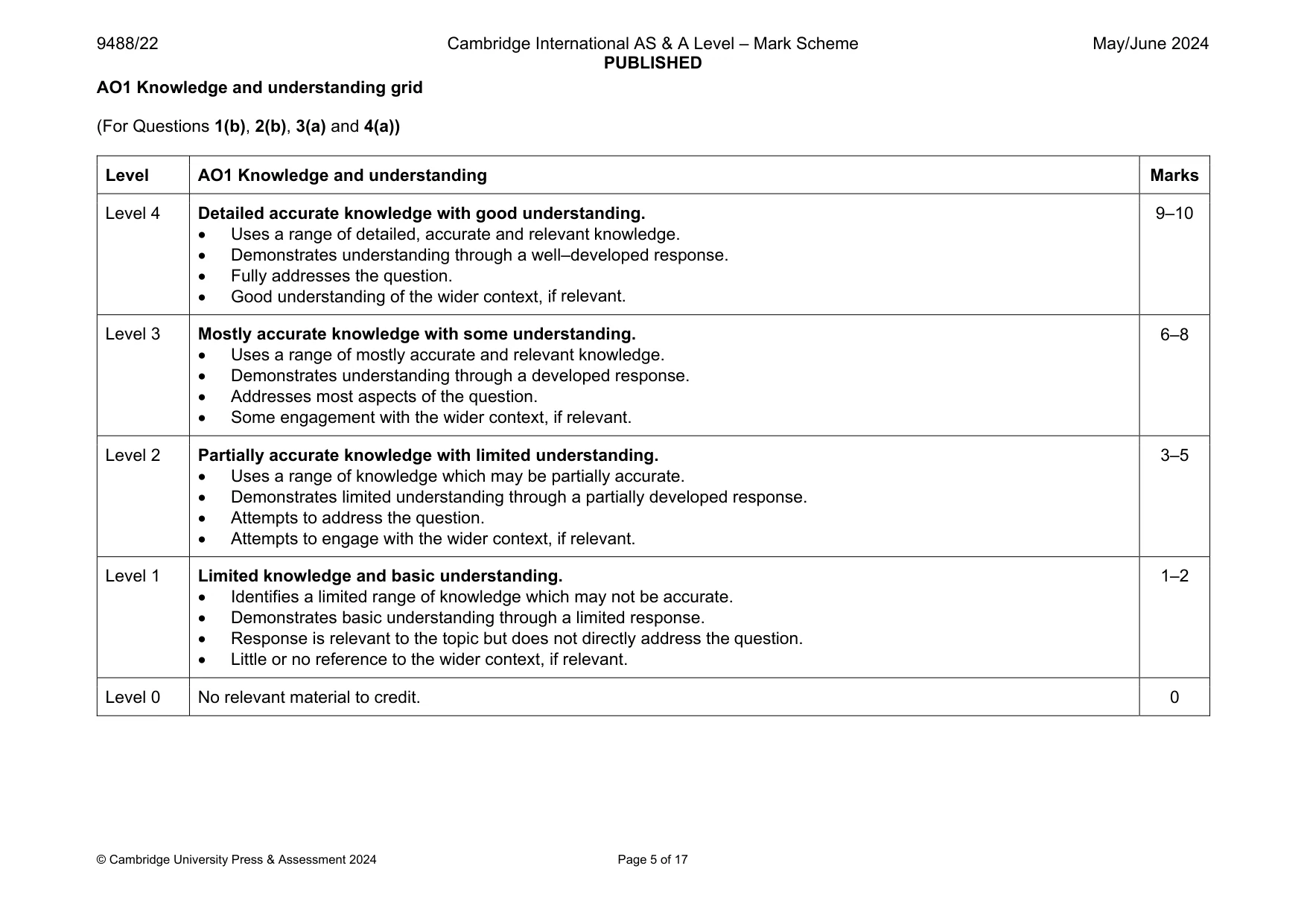
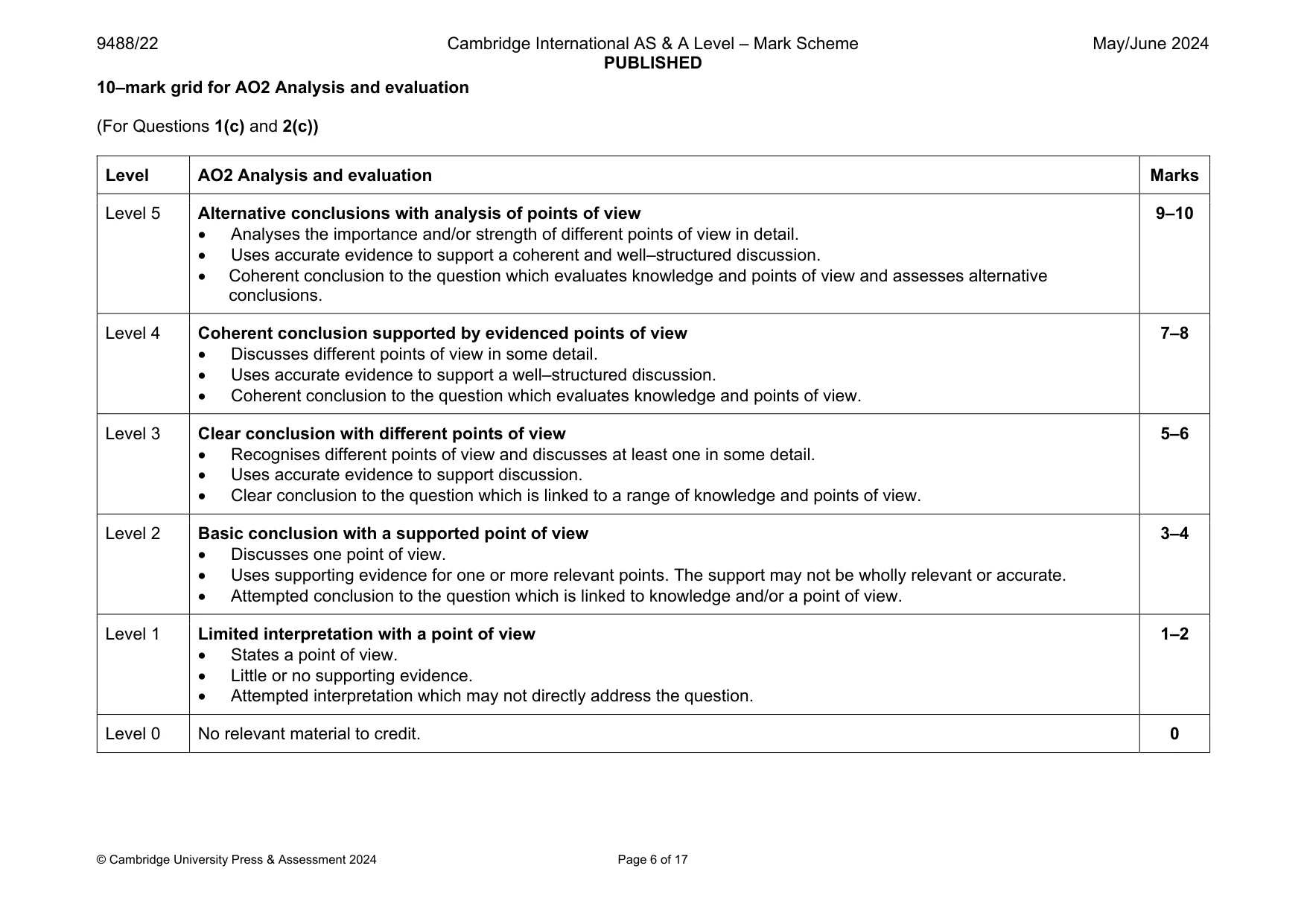
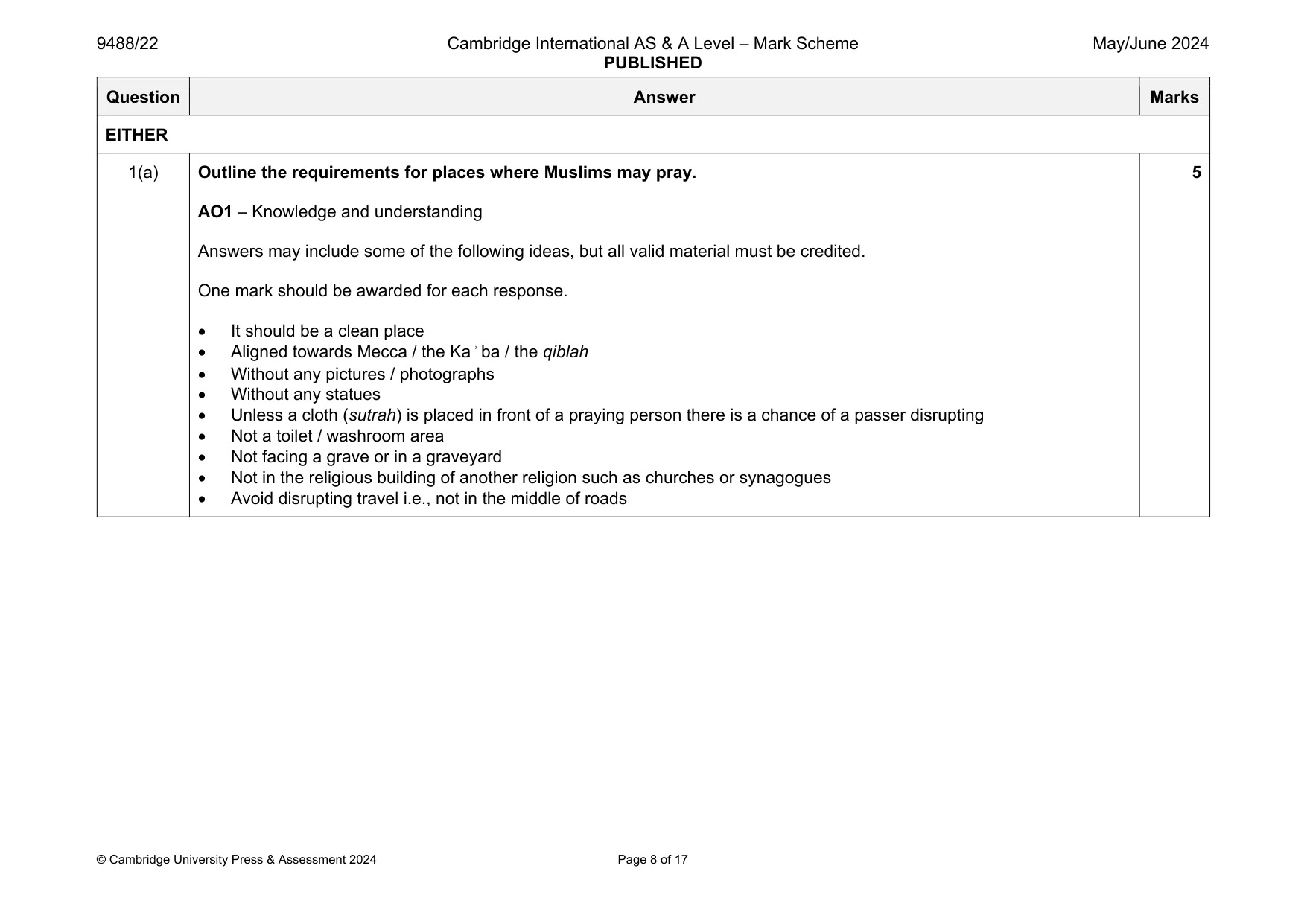
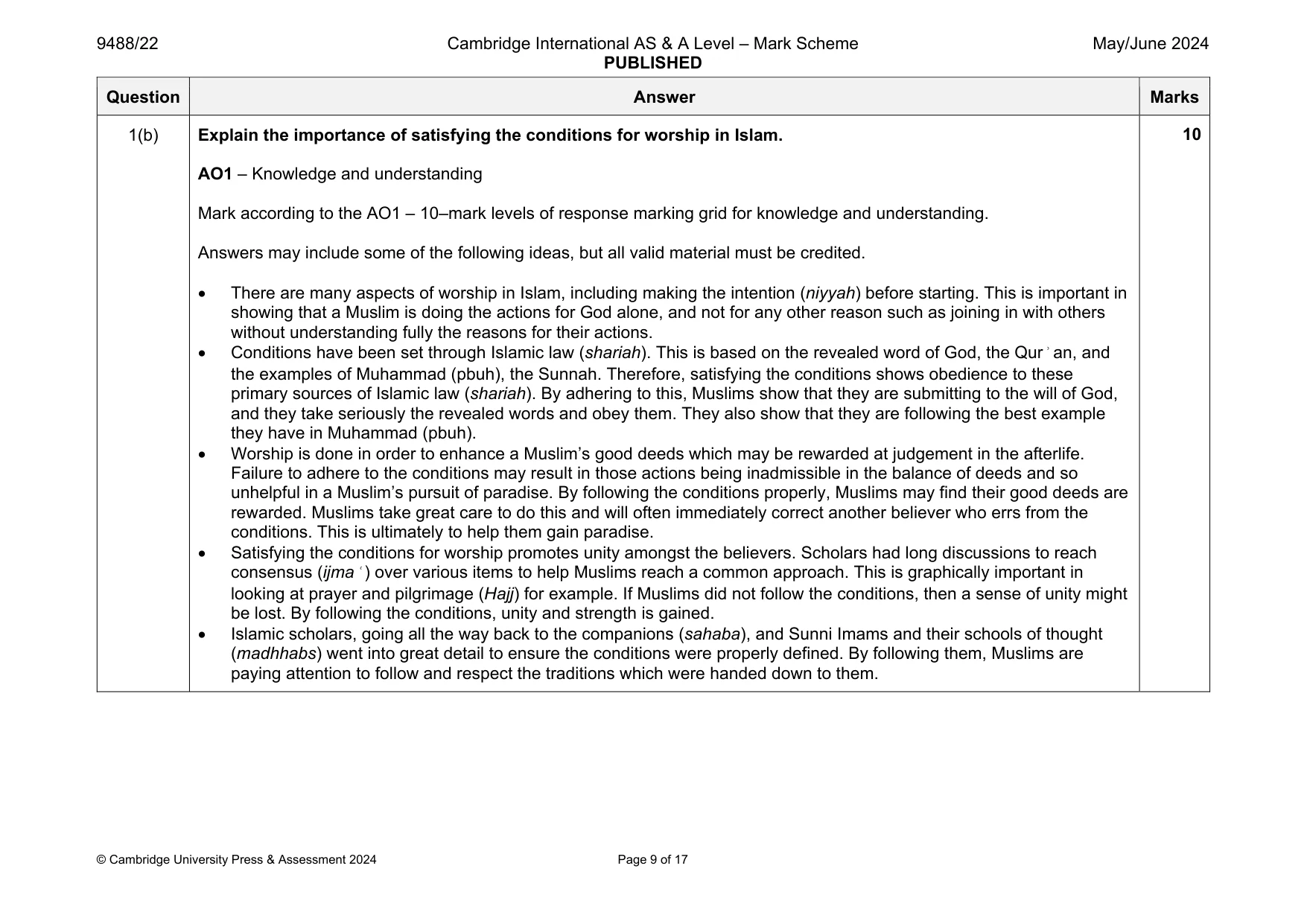
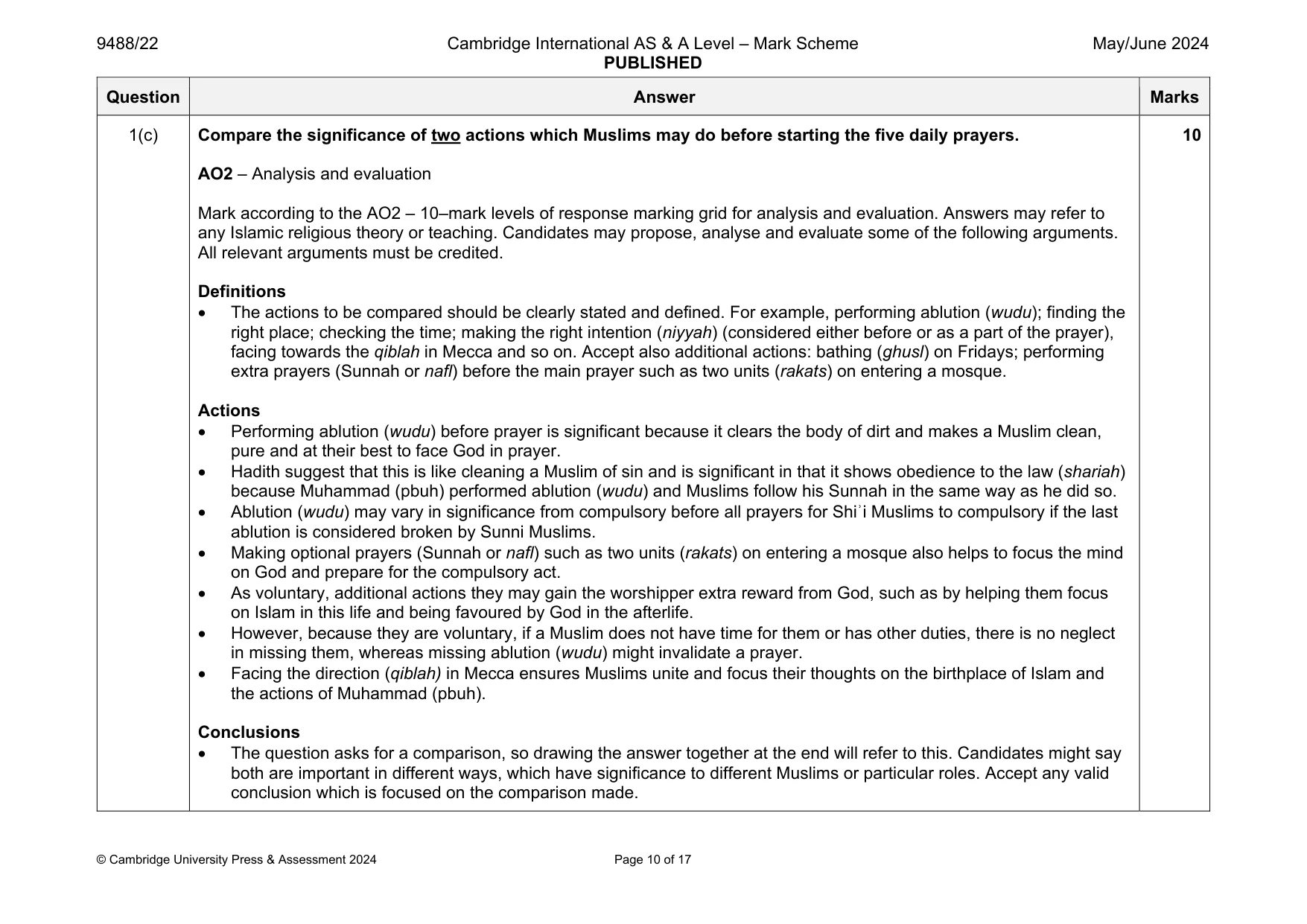
Mark scheme: 1(a) Outline the requirements for places where Muslims may pray. AO1 – Knowledge and understanding Answers may include some of the following ideas, but all valid material must be credited. One mark should be awarded for each response. It should be a clean place Aligned towards Mecca / the Kaʾba / the qiblah Without any pictures / photographs Without any statues Unless a cloth (sutrah) is placed in front of a praying person there is a chance of a passer disrupting Not a toilet / washroom area Not facing a grave or in a graveyard Not in the religious building of another religion such as churches or synagogues Avoid disrupting travel i.e., not in the middle of roads Question Answer Marks 1(b) Explain the importance of satisfying the conditions for worship in Islam. AO1 – Knowledge and understanding Mark according to the AO1 – 10–mark levels of response marking grid for knowledge and understanding. Answers may include some of the following ideas, but all valid material must be credited. There are many aspects of worship in Islam, including making the intention (niyyah) before starting. This is important in showing that a Muslim is doing the actions for God alone, and not for any other reason such as joining in with others without understanding fully the reasons for their actions. Conditions have been set through Islamic law (shariah). This is based on the revealed word of God, the Qurʾan, and the examples of Muhammad (pbuh), the Sunnah. Therefore, satisfying the conditions shows obedience to these primary sources of Islamic law (shariah). By adhering to this, Muslims show that they are submitting to the will of God, and they take seriously the revealed words and obey them. They also show that they are following the best example they have in Muhammad (pbuh). Worship is done in order to enhance a Muslim’s good deeds which may be rewarded at judgement in the afterlife. Failure to adhere to the conditions may result in those actions being inadmissible in the balance of deeds and so unhelpful in a Muslim’s pursuit of paradise. By following the conditions properly, Muslims may find their good deeds are rewarded. Muslims take great care to do this and will often immediately correct another believer who errs from the conditions. This is ultimately to help them gain paradise. Satisfying the conditions for worship promotes unity amongst the believers. Scholars had long discussions to reach consensus (ijmaʿ) over various items to help Muslims reach a common approach. This is graphically important in looking at prayer and pilgrimage (Hajj) for example. If Muslims did not follow the conditions, then a sense of unity might be lost. By following the conditions, unity and strength is gained. Islamic scholars, going all the way back to the companions (sahaba), and Sunni Imams and their schools of thought (madhhabs) went into great detail to ensure the conditions were properly defined. By following them, Muslims are paying attention to follow and respect the traditions which were handed down to them. 10 Question Answer Marks 1(c) Compare the significance of two actions which Muslims may do before starting the five daily prayers. AO2 – Analysis and evaluation Mark according to the AO2 – 10–mark levels of response marking grid for analysis and evaluation. Answers may refer to any Islamic religious theory or teaching. Candidates may propose, analyse and evaluate some of the following arguments. All relevant arguments must be credited. Definitions The actions to be compared should be clearly stated and defined. For example, performing ablution (wudu); finding the right place; checking the time; making the right intention (niyyah) (considered either before or as a part of the prayer), facing towards the qiblah in Mecca and so on. Accept also additional actions: bathing (ghusl) on Fridays; performing extra prayers (Sunnah or nafl) before the main prayer such as two units (rakats) on entering a mosque. Actions Performing ablution (wudu) before prayer is significant because it clears the body of dirt and makes a Muslim clean, pure and at their best to face God in prayer. Hadith suggest that this is like cleaning a Muslim of sin and is significant in that it shows obedience to the law (shariah) because Muhammad (pbuh) performed ablution (wudu) and Muslims follow his Sunnah in the same way as he did so. Ablution (wudu) may vary in significance from compulsory before all prayers for Shiʾi Muslims to compulsory if the last ablution is considered broken by Sunni Muslims. Making optional prayers (Sunnah or nafl) such as two units (rakats) on entering a mosque also helps to focus the mind on God and prepare for the compulsory act. As voluntary, additional actions they may gain the worshipper extra reward from God, such as by helping them focus on Islam in this life and being favoured by God in the afterlife. However, because they are voluntary, if a Muslim does not have time for them or has other duties, there is no neglect in missing them, whereas missing ablution (wudu) might invalidate a prayer. Facing the direction (qiblah) in Mecca ensures Muslims unite and focus their thoughts on the birthplace of Islam and the actions of Muhammad (pbuh). Conclusions The question asks for a comparison, so drawing the answer together at the end will refer to this. Candidates might say both are important in different ways, which have significance to different Muslims or particular roles. Accept any valid conclusion which is focused on the comparison made. 10
Q2 · Give five habits of the people of Medina from the time of the Prophet (pbuh)
2 (a) Give five habits of the people of Medina from the time of the Prophet (pbuh). [5] (b) Explain the significance of the people of Medina for the formation of Islamic law (shariah). [10] (c) Discuss how far the habits of the people of Medina are relevant for Muslims in their everyday lives today. [10] [Total: 25]
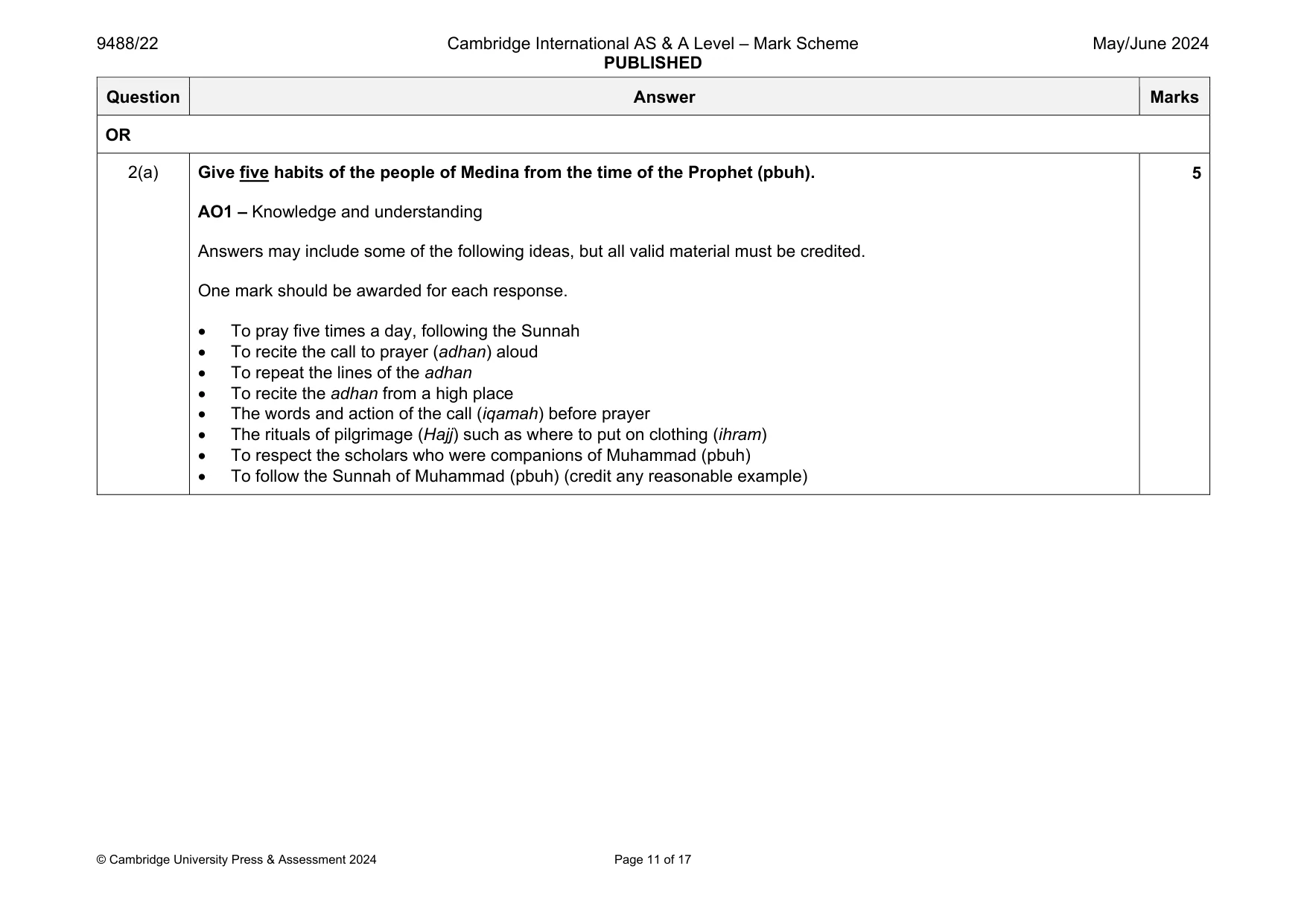
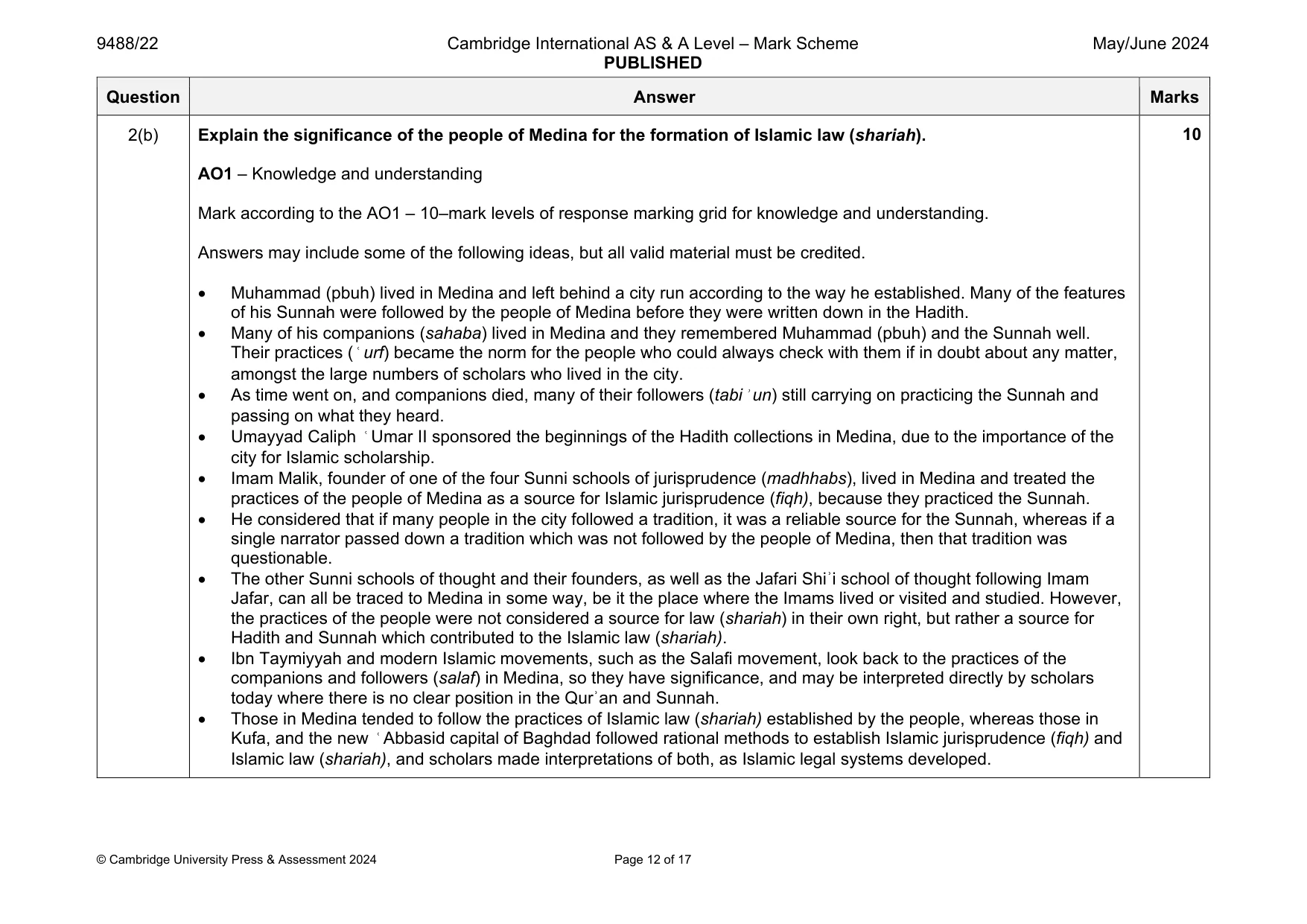
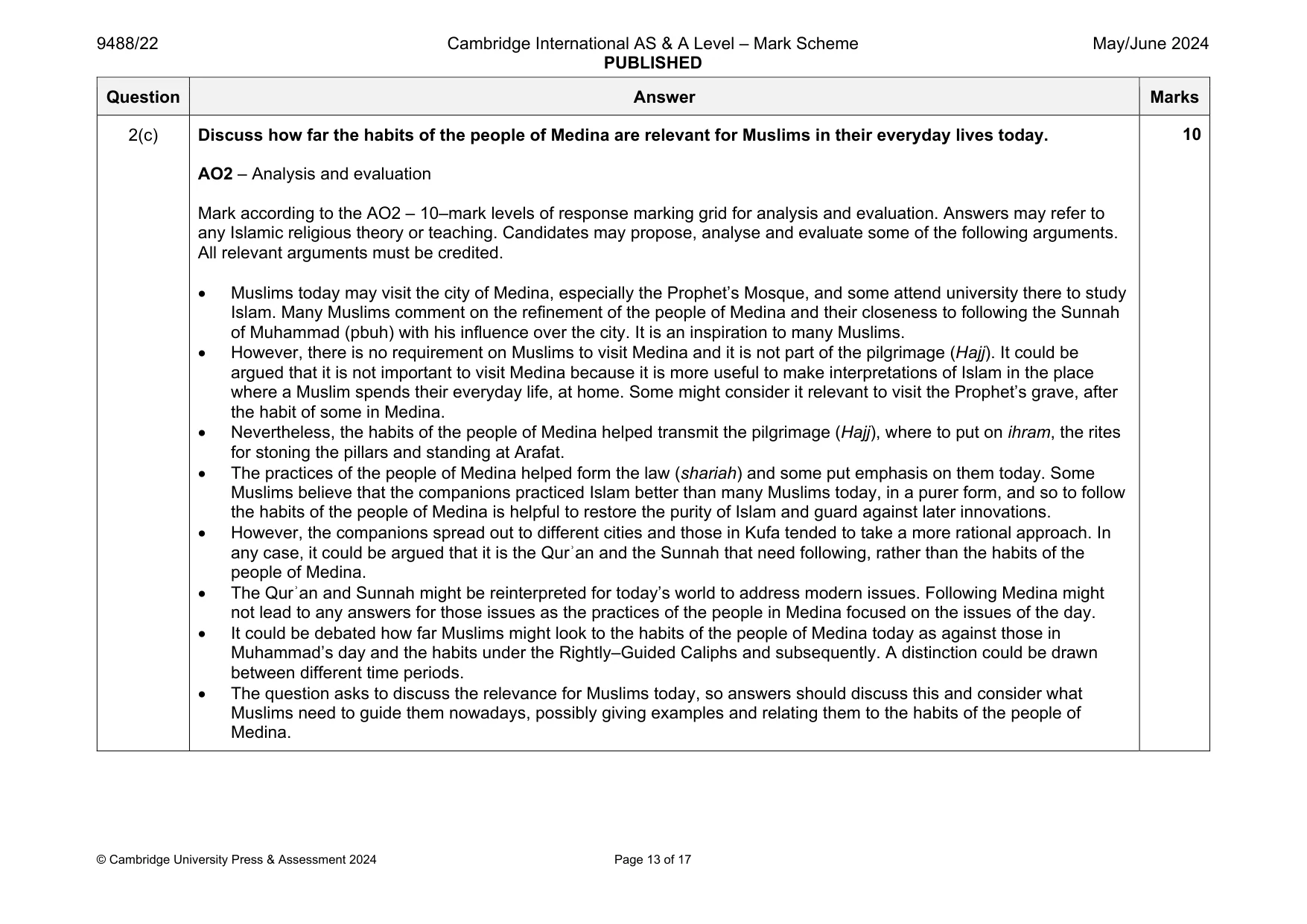
Mark scheme: 2(a) Give five habits of the people of Medina from the time of the Prophet (pbuh). AO1 – Knowledge and understanding Answers may include some of the following ideas, but all valid material must be credited. One mark should be awarded for each response. To pray five times a day, following the Sunnah To recite the call to prayer (adhan) aloud To repeat the lines of the adhan To recite the adhan from a high place The words and action of the call (iqamah) before prayer The rituals of pilgrimage (Hajj) such as where to put on clothing (ihram) To respect the scholars who were companions of Muhammad (pbuh) To follow the Sunnah of Muhammad (pbuh) (credit any reasonable example) 5 Question Answer Marks 2(b) Explain the significance of the people of Medina for the formation of Islamic law (shariah). AO1 – Knowledge and understanding Mark according to the AO1 – 10–mark levels of response marking grid for knowledge and understanding. Answers may include some of the following ideas, but all valid material must be credited. Muhammad (pbuh) lived in Medina and left behind a city run according to the way he established. Many of the features of his Sunnah were followed by the people of Medina before they were written down in the Hadith. Many of his companions (sahaba) lived in Medina and they remembered Muhammad (pbuh) and the Sunnah well. Their practices (ʿurf) became the norm for the people who could always check with them if in doubt about any matter, amongst the large numbers of scholars who lived in the city. As time went on, and companions died, many of their followers (tabiʾun) still carrying on practicing the Sunnah and passing on what they heard. Umayyad Caliph ʿUmar II sponsored the beginnings of the Hadith collections in Medina, due to the importance of the city for Islamic scholarship. Imam Malik, founder of one of the four Sunni schools of jurisprudence (madhhabs), lived in Medina and treated the practices of the people of Medina as a source for Islamic jurisprudence (fiqh), because they practiced the Sunnah. He considered that if many people in the city followed a tradition, it was a reliable source for the Sunnah, whereas if a single narrator passed down a tradition which was not followed by the people of Medina, then that tradition was questionable. The other Sunni schools of thought and their founders, as well as the Jafari Shiʾi school of thought following Imam Jafar, can all be traced to Medina in some way, be it the place where the Imams lived or visited and studied. However, the practices of the people were not considered a source for law (shariah) in their own right, but rather a source for Hadith and Sunnah which contributed to the Islamic law (shariah). Ibn Taymiyyah and modern Islamic movements, such as the Salafi movement, look back to the practices of the companions and followers (salaf) in Medina, so they have significance, and may be interpreted directly by scholars today where there is no clear position in the Qurʾan and Sunnah. Those in Medina tended to follow the practices of Islamic law (shariah) established by the people, whereas those in Kufa, and the new ʿAbbasid capital of Baghdad followed rational methods to establish Islamic jurisprudence (fiqh) and Islamic law (shariah), and scholars made interpretations of both, as Islamic legal systems developed. 10 Question Answer Marks 2(c) Discuss how far the habits of the people of Medina are relevant for Muslims in their everyday lives today. AO2 – Analysis and evaluation Mark according to the AO2 – 10–mark levels of response marking grid for analysis and evaluation. Answers may refer to any Islamic religious theory or teaching. Candidates may propose, analyse and evaluate some of the following arguments. All relevant arguments must be credited. Muslims today may visit the city of Medina, especially the Prophet’s Mosque, and some attend university there to study Islam. Many Muslims comment on the refinement of the people of Medina and their closeness to following the Sunnah of Muhammad (pbuh) with his influence over the city. It is an inspiration to many Muslims. However, there is no requirement on Muslims to visit Medina and it is not part of the pilgrimage (Hajj). It could be argued that it is not important to visit Medina because it is more useful to make interpretations of Islam in the place where a Muslim spends their everyday life, at home. Some might consider it relevant to visit the Prophet’s grave, after the habit of some in Medina. Nevertheless, the habits of the people of Medina helped transmit the pilgrimage (Hajj), where to put on ihram, the rites for stoning the pillars and standing at Arafat. The practices of the people of Medina helped form the law (shariah) and some put emphasis on them today. Some Muslims believe that the companions practiced Islam better than many Muslims today, in a purer form, and so to follow the habits of the people of Medina is helpful to restore the purity of Islam and guard against later innovations. However, the companions spread out to different cities and those in Kufa tended to take a more rational approach. In any case, it could be argued that it is the Qurʾan and the Sunnah that need following, rather than the habits of the people of Medina. The Qurʾan and Sunnah might be reinterpreted for today’s world to address modern issues. Following Medina might not lead to any answers for those issues as the practices of the people in Medina focused on the issues of the day. It could be debated how far Muslims might look to the habits of the people of Medina today as against those in Muhammad’s day and the habits under the Rightly–Guided Caliphs and subsequently. A distinction could be drawn between different time periods. The question asks to discuss the relevance for Muslims today, so answers should discuss this and consider what Muslims need to guide them nowadays, possibly giving examples and relating them to the habits of the people of Medina. 10
Q3 · Explain how al-Hallaj used mystical poetry in his relationship with God
3 (a) Explain how al-Hallaj used mystical poetry in his relationship with God. [10] (b) Discuss the benefits and risks of writing mystical poetry about God for Muslims. [15] [Total: 25] OR
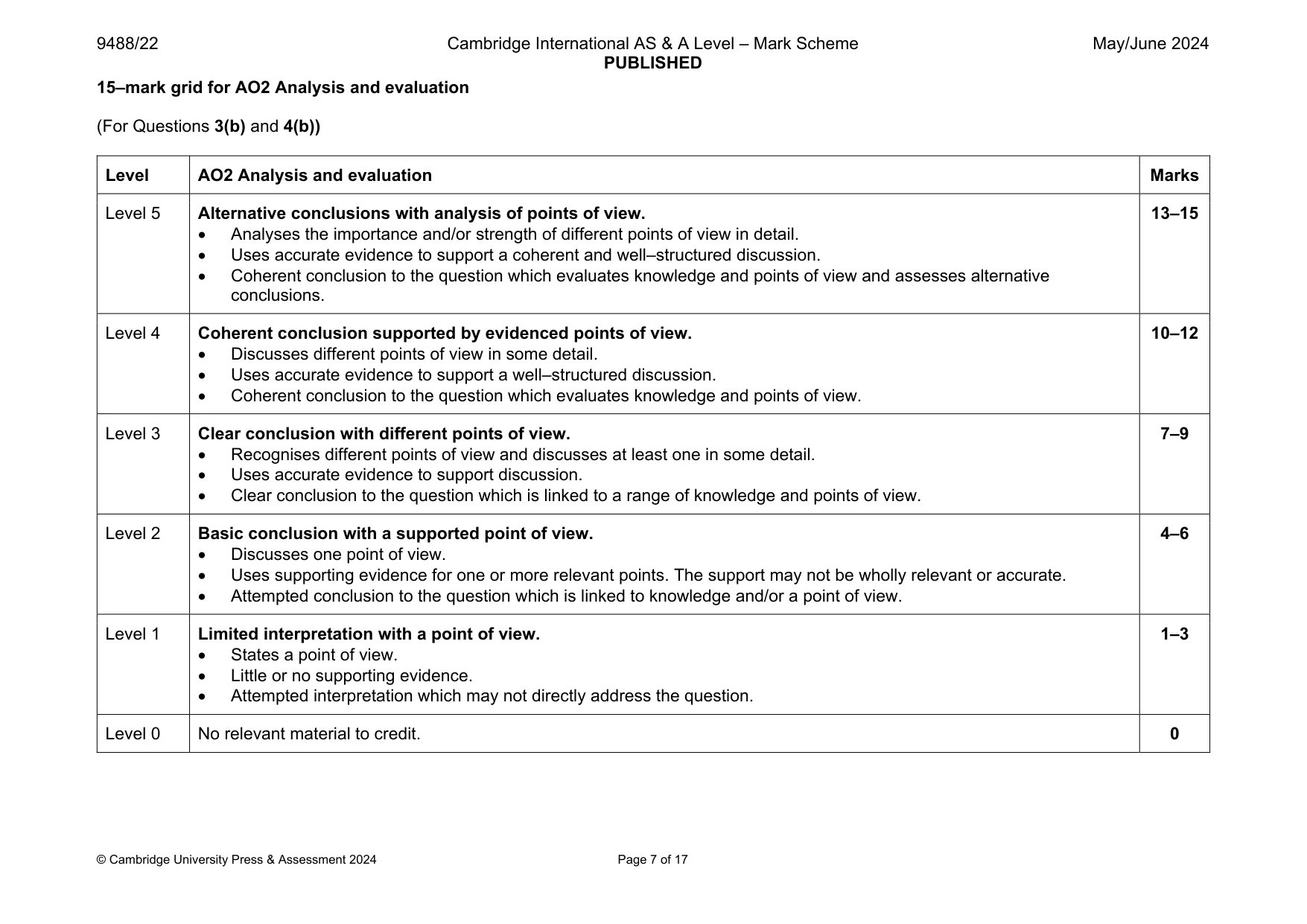
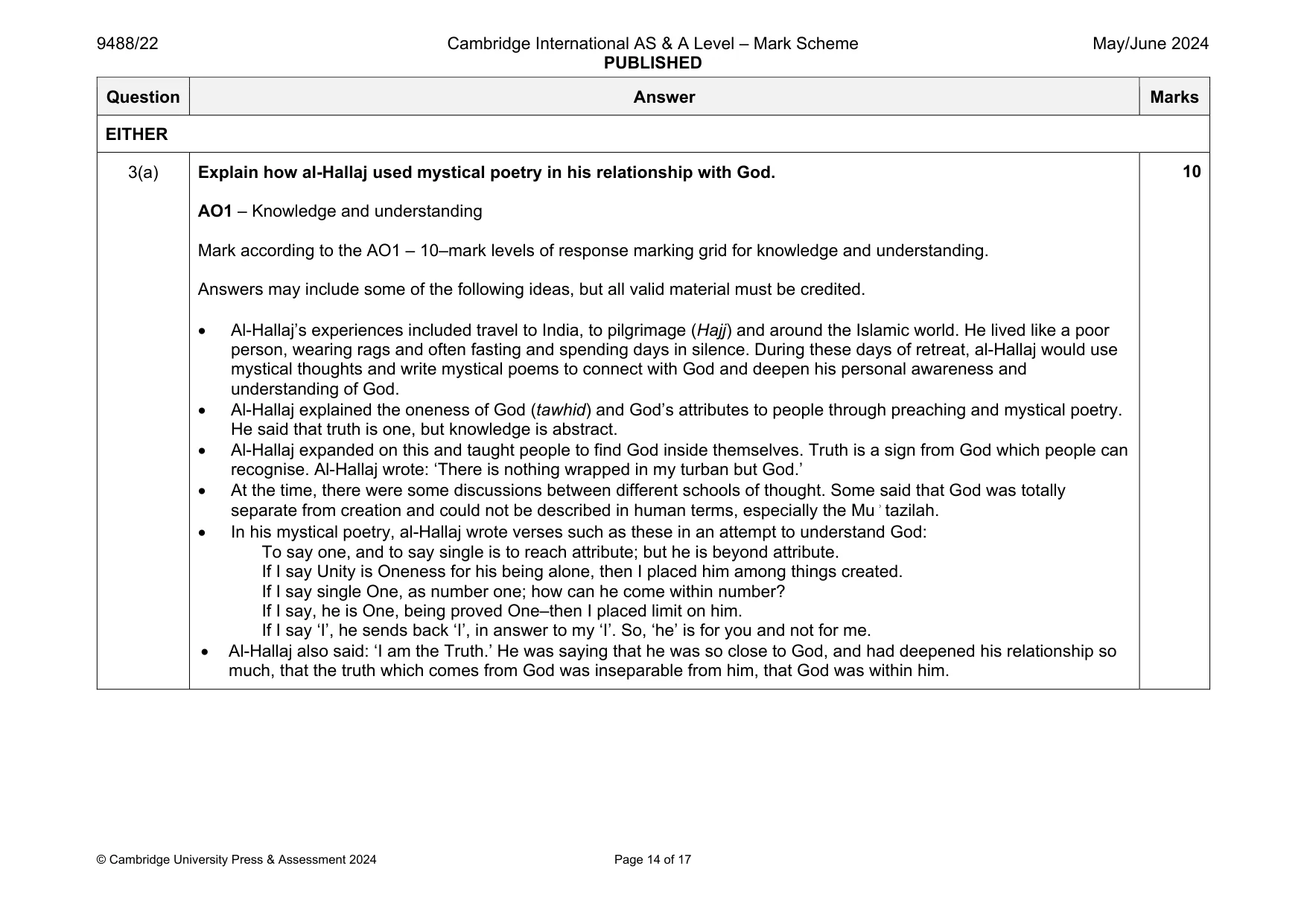
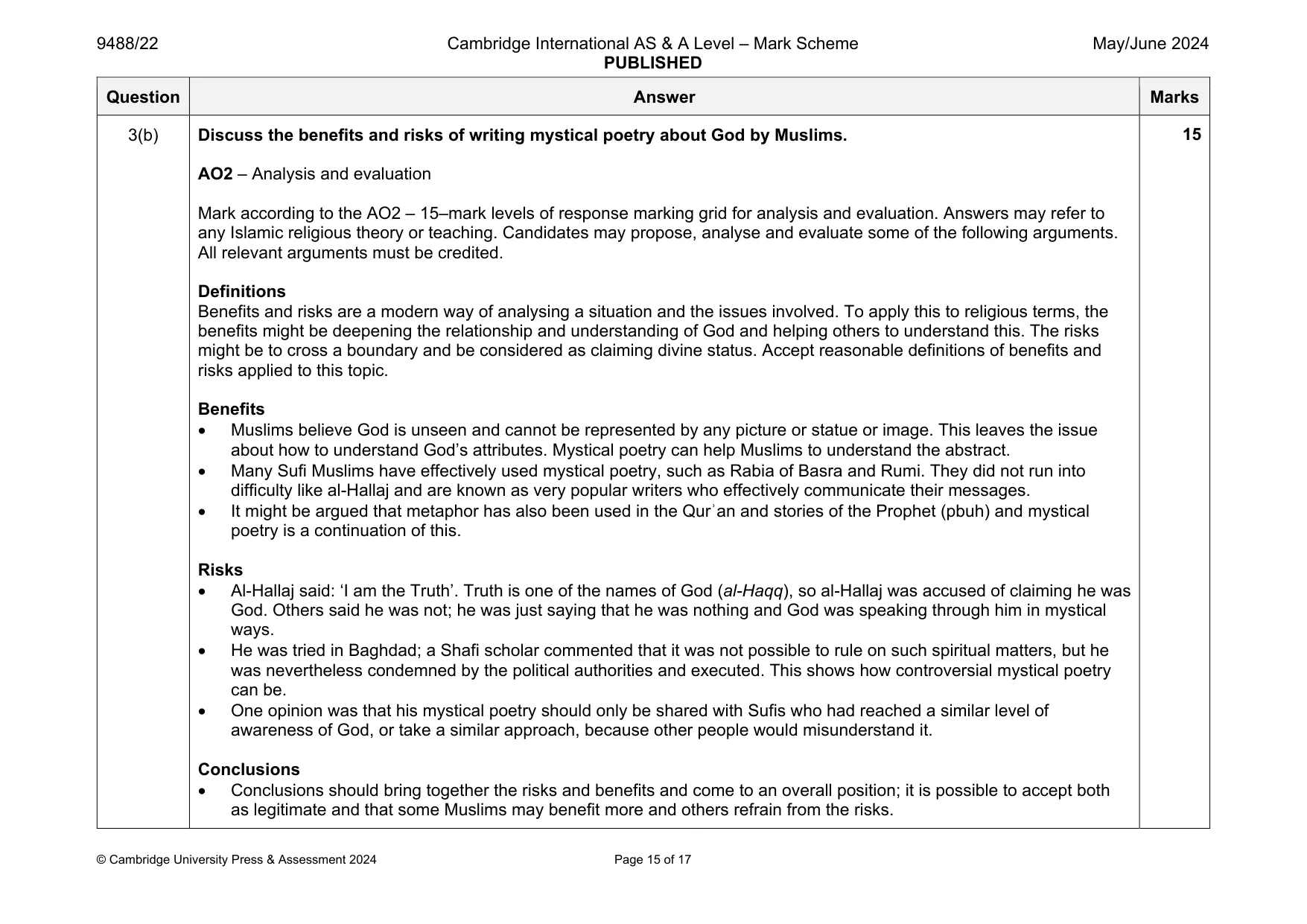
Mark scheme: 3(a) Explain how al-Hallaj used mystical poetry in his relationship with God. AO1 – Knowledge and understanding Mark according to the AO1 – 10–mark levels of response marking grid for knowledge and understanding. Answers may include some of the following ideas, but all valid material must be credited. Al-Hallaj’s experiences included travel to India, to pilgrimage (Hajj) and around the Islamic world. He lived like a poor person, wearing rags and often fasting and spending days in silence. During these days of retreat, al-Hallaj would use mystical thoughts and write mystical poems to connect with God and deepen his personal awareness and understanding of God. Al-Hallaj explained the oneness of God (tawhid) and God’s attributes to people through preaching and mystical poetry. He said that truth is one, but knowledge is abstract. Al-Hallaj expanded on this and taught people to find God inside themselves. Truth is a sign from God which people can recognise. Al-Hallaj wrote: ‘There is nothing wrapped in my turban but God.’ At the time, there were some discussions between different schools of thought. Some said that God was totally separate from creation and could not be described in human terms, especially the Muʾtazilah. In his mystical poetry, al-Hallaj wrote verses such as these in an attempt to understand God: To say one, and to say single is to reach attribute; but he is beyond attribute. If I say Unity is Oneness for his being alone, then I placed him among things created. If I say single One, as number one; how can he come within number? If I say, he is One, being proved One–then I placed limit on him. If I say ‘I’, he sends back ‘I’, in answer to my ‘I’. So, ‘he’ is for you and not for me. Al-Hallaj also said: ‘I am the Truth.’ He was saying that he was so close to God, and had deepened his relationship so much, that the truth which comes from God was inseparable from him, that God was within him. Question Answer Marks 3(b) Discuss the benefits and risks of writing mystical poetry about God by Muslims. AO2 – Analysis and evaluation Mark according to the AO2 – 15–mark levels of response marking grid for analysis and evaluation. Answers may refer to any Islamic religious theory or teaching. Candidates may propose, analyse and evaluate some of the following arguments. All relevant arguments must be credited. Definitions Benefits and risks are a modern way of analysing a situation and the issues involved. To apply this to religious terms, the benefits might be deepening the relationship and understanding of God and helping others to understand this. The risks might be to cross a boundary and be considered as claiming divine status. Accept reasonable definitions of benefits and risks applied to this topic. Benefits Muslims believe God is unseen and cannot be represented by any picture or statue or image. This leaves the issue about how to understand God’s attributes. Mystical poetry can help Muslims to understand the abstract. Many Sufi Muslims have effectively used mystical poetry, such as Rabia of Basra and Rumi. They did not run into difficulty like al-Hallaj and are known as very popular writers who effectively communicate their messages. It might be argued that metaphor has also been used in the Qurʾan and stories of the Prophet (pbuh) and mystical poetry is a continuation of this. Risks Al-Hallaj said: ‘I am the Truth’. Truth is one of the names of God (al-Haqq), so al-Hallaj was accused of claiming he was God. Others said he was not; he was just saying that he was nothing and God was speaking through him in mystical ways. He was tried in Baghdad; a Shafi scholar commented that it was not possible to rule on such spiritual matters, but he was nevertheless condemned by the political authorities and executed. This shows how controversial mystical poetry can be. One opinion was that his mystical poetry should only be shared with Sufis who had reached a similar level of awareness of God, or take a similar approach, because other people would misunderstand it. Conclusions Conclusions should bring together the risks and benefits and come to an overall position; it is possible to accept both as legitimate and that some Muslims may benefit more and others refrain from the risks. 15
Q4 · Explain the distinctive positions of modern Salafis
4 (a) Explain the distinctive positions of modern Salafis. [10] (b) To what extent are modern Salafi positions a continuation of traditional Sunni teachings? [15] [Total: 25]
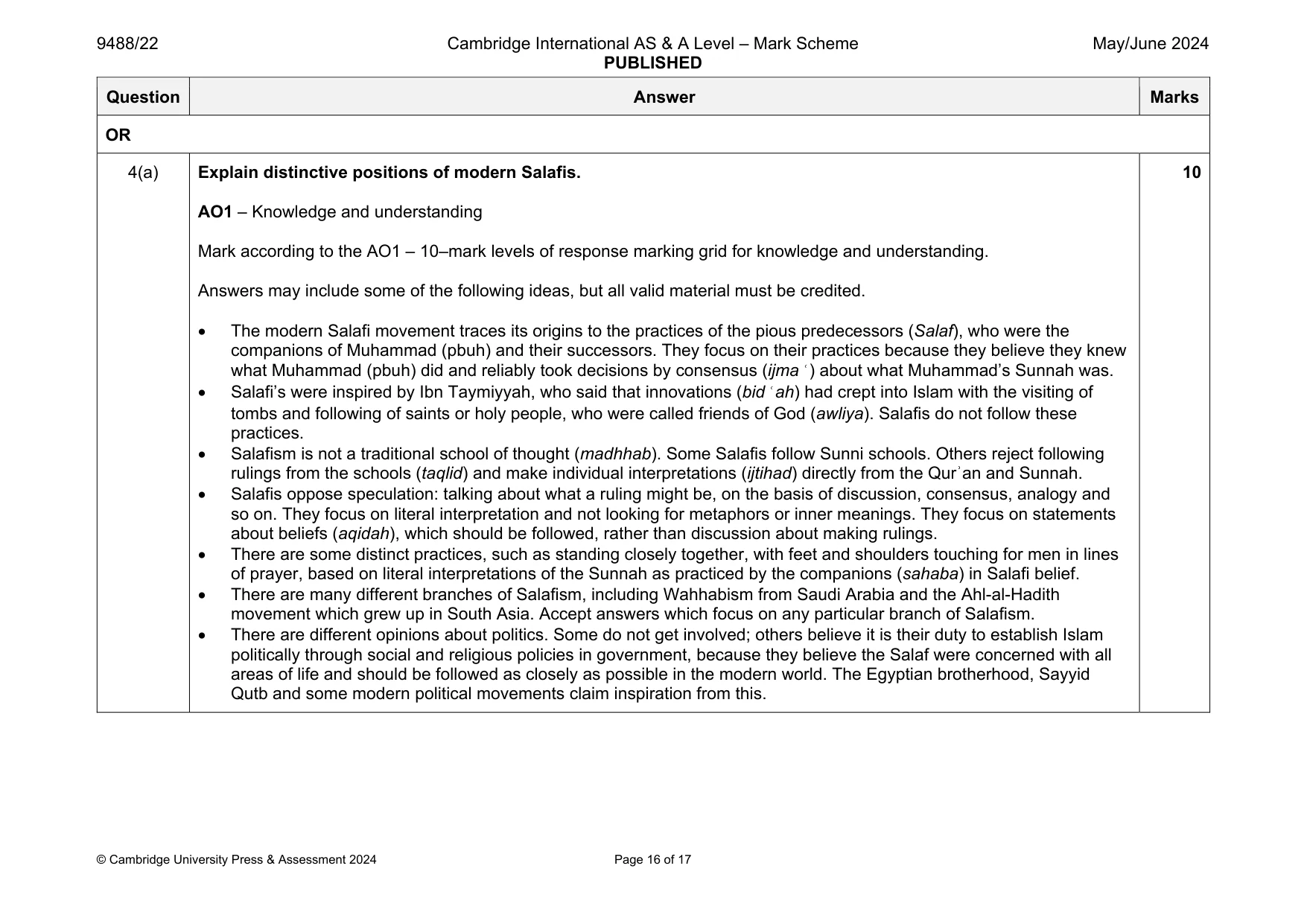
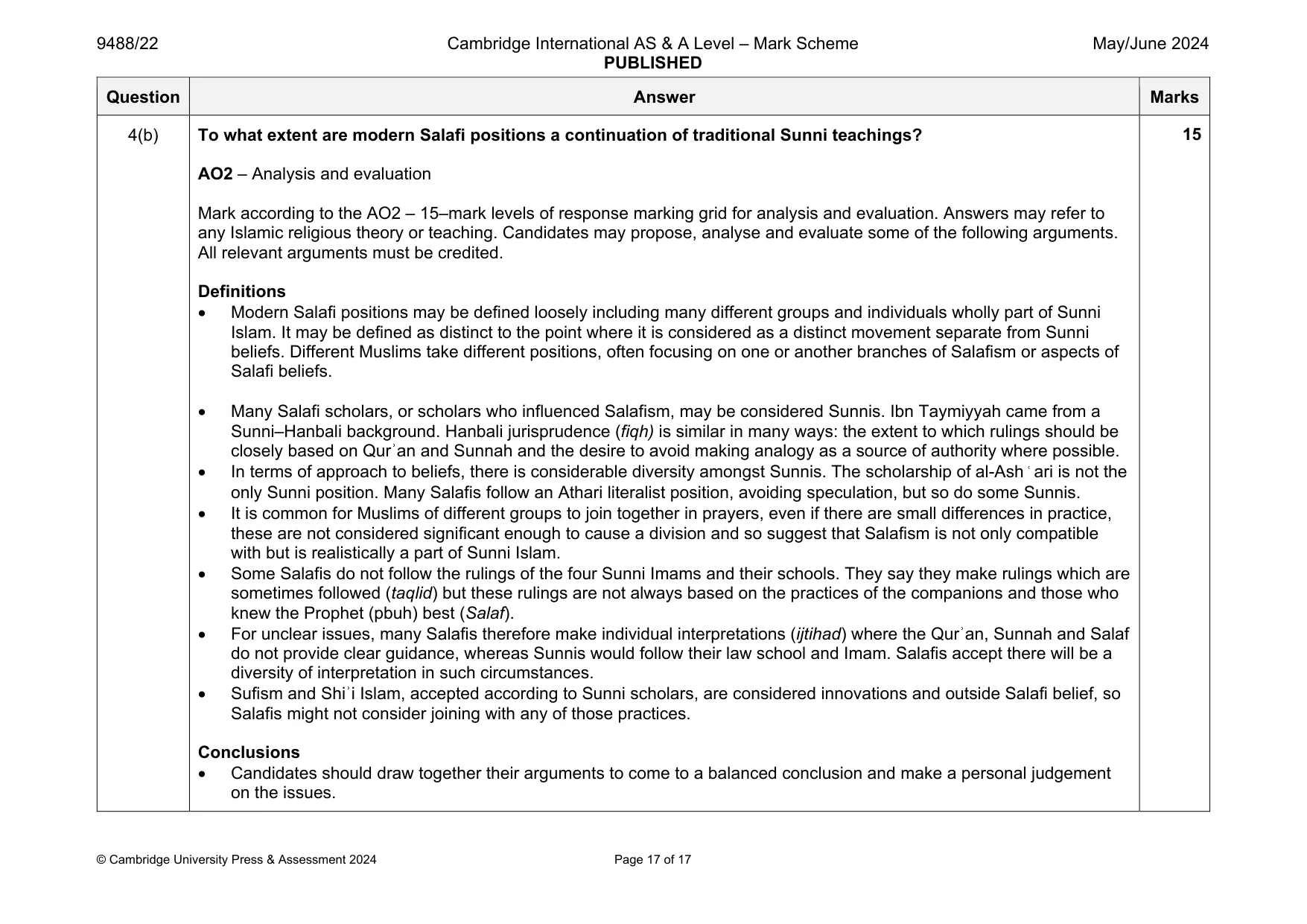
Mark scheme: 4(a) Explain distinctive positions of modern Salafis. AO1 – Knowledge and understanding Mark according to the AO1 – 10–mark levels of response marking grid for knowledge and understanding. Answers may include some of the following ideas, but all valid material must be credited. The modern Salafi movement traces its origins to the practices of the pious predecessors (Salaf), who were the companions of Muhammad (pbuh) and their successors. They focus on their practices because they believe they knew what Muhammad (pbuh) did and reliably took decisions by consensus (ijmaʿ) about what Muhammad’s Sunnah was. Salafi’s were inspired by Ibn Taymiyyah, who said that innovations (bidʿah) had crept into Islam with the visiting of tombs and following of saints or holy people, who were called friends of God (awliya). Salafis do not follow these practices. Salafism is not a traditional school of thought (madhhab). Some Salafis follow Sunni schools. Others reject following rulings from the schools (taqlid) and make individual interpretations (ijtihad) directly from the Qurʾan and Sunnah. Salafis oppose speculation: talking about what a ruling might be, on the basis of discussion, consensus, analogy and so on. They focus on literal interpretation and not looking for metaphors or inner meanings. They focus on statements about beliefs (aqidah), which should be followed, rather than discussion about making rulings. There are some distinct practices, such as standing closely together, with feet and shoulders touching for men in lines of prayer, based on literal interpretations of the Sunnah as practiced by the companions (sahaba) in Salafi belief. There are many different branches of Salafism, including Wahhabism from Saudi Arabia and the Ahl-al-Hadith movement which grew up in South Asia. Accept answers which focus on any particular branch of Salafism. There are different opinions about politics. Some do not get involved; others believe it is their duty to establish Islam politically through social and religious policies in government, because they believe the Salaf were concerned with all areas of life and should be followed as closely as possible in the modern world. The Egyptian brotherhood, Sayyid Qutb and some modern political movements claim inspiration from this. Question Answer Marks 4(b) To what extent are modern Salafi positions a continuation of traditional Sunni teachings? AO2 – Analysis and evaluation Mark according to the AO2 – 15–mark levels of response marking grid for analysis and evaluation. Answers may refer to any Islamic religious theory or teaching. Candidates may propose, analyse and evaluate some of the following arguments. All relevant arguments must be credited. Definitions Modern Salafi positions may be defined loosely including many different groups and individuals wholly part of Sunni Islam. It may be defined as distinct to the point where it is considered as a distinct movement separate from Sunni beliefs. Different Muslims take different positions, often focusing on one or another branches of Salafism or aspects of Salafi beliefs. Many Salafi scholars, or scholars who influenced Salafism, may be considered Sunnis. Ibn Taymiyyah came from a Sunni–Hanbali background. Hanbali jurisprudence (fiqh) is similar in many ways: the extent to which rulings should be closely based on Qurʾan and Sunnah and the desire to avoid making analogy as a source of authority where possible. In terms of approach to beliefs, there is considerable diversity amongst Sunnis. The scholarship of al-Ashʿari is not the only Sunni position. Many Salafis follow an Athari literalist position, avoiding speculation, but so do some Sunnis. It is common for Muslims of different groups to join together in prayers, even if there are small differences in practice, these are not considered significant enough to cause a division and so suggest that Salafism is not only compatible with but is realistically a part of Sunni Islam. Some Salafis do not follow the rulings of the four Sunni Imams and their schools. They say they make rulings which are sometimes followed (taqlid) but these rulings are not always based on the practices of the companions and those who knew the Prophet (pbuh) best (Salaf). For unclear issues, many Salafis therefore make individual interpretations (ijtihad) where the Qurʾan, Sunnah and Salaf do not provide clear guidance, whereas Sunnis would follow their law school and Imam. Salafis accept there will be a diversity of interpretation in such circumstances. Sufism and Shiʾi Islam, accepted according to Sunni scholars, are considered innovations and outside Salafi belief, so Salafis might not consider joining with any of those practices. Conclusions Candidates should draw together their arguments to come to a balanced conclusion and make a personal judgement on the issues. 15
What was in this paper
The subtopics covered by these 4 questions, and how many questions each got. Open one in a new tab to see every Cambridge question on it.
What you needed in this session
Cambridge’s own grade thresholds for 2024 May/June, Paper 2 · Variant 2. A higher threshold means an easier paper — the bar moves with how the cohort did.