Cambridge A Level Islamic Studies 9488 — 2023 Oct/Nov Paper 2 · Variant 2
9488/22/O/N/23 · 4 questions · 50 marks · ≈56 min
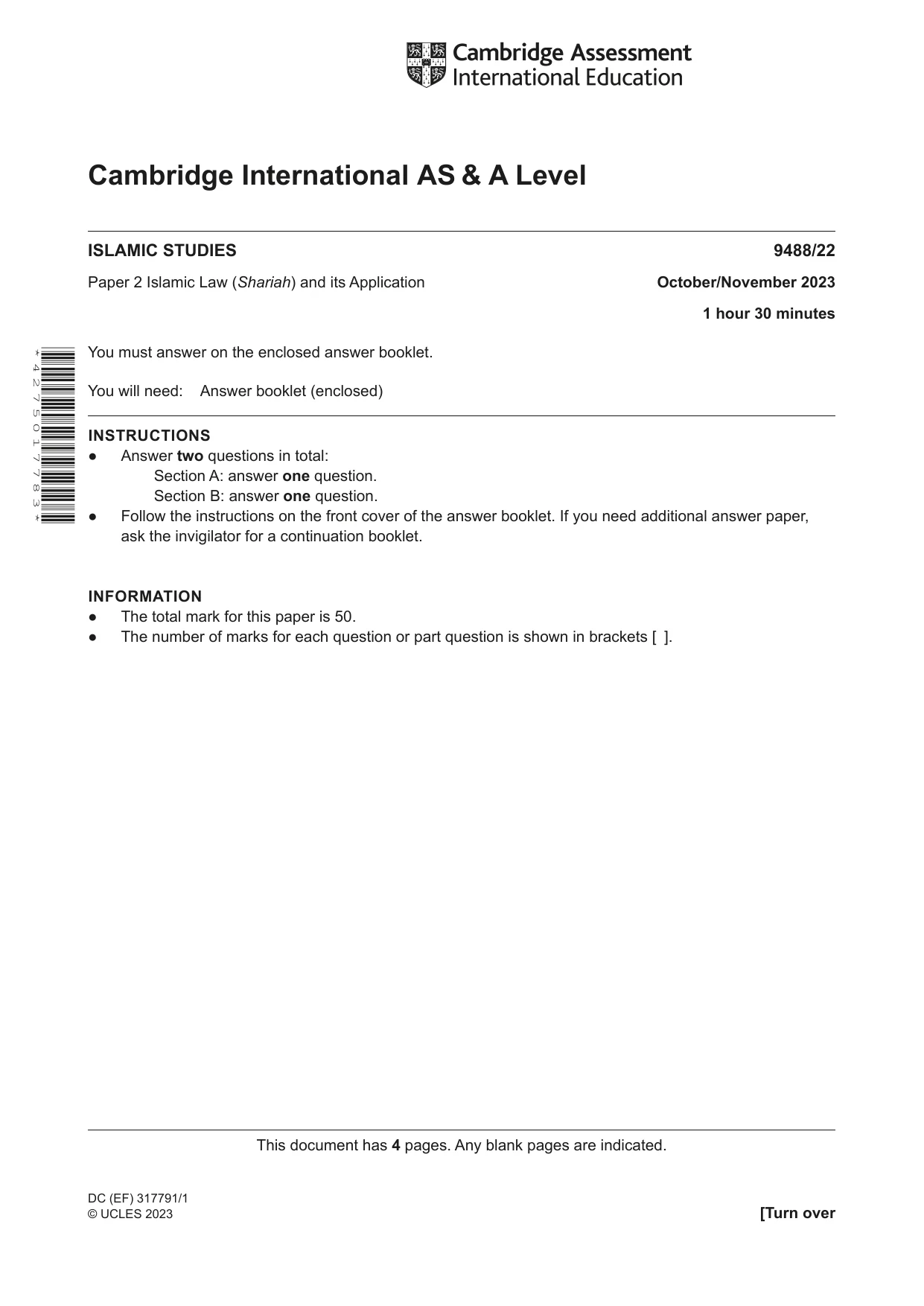
The question paper and its mark scheme, free to read here and free to download. This is Cambridge’s own paper, exactly as it was sat.
Question paper4 pages
Mark scheme15 pages
Answers below. Sit the paper first if you are practising.
Questions as text
Q1 · Give five examples of interest (riba)
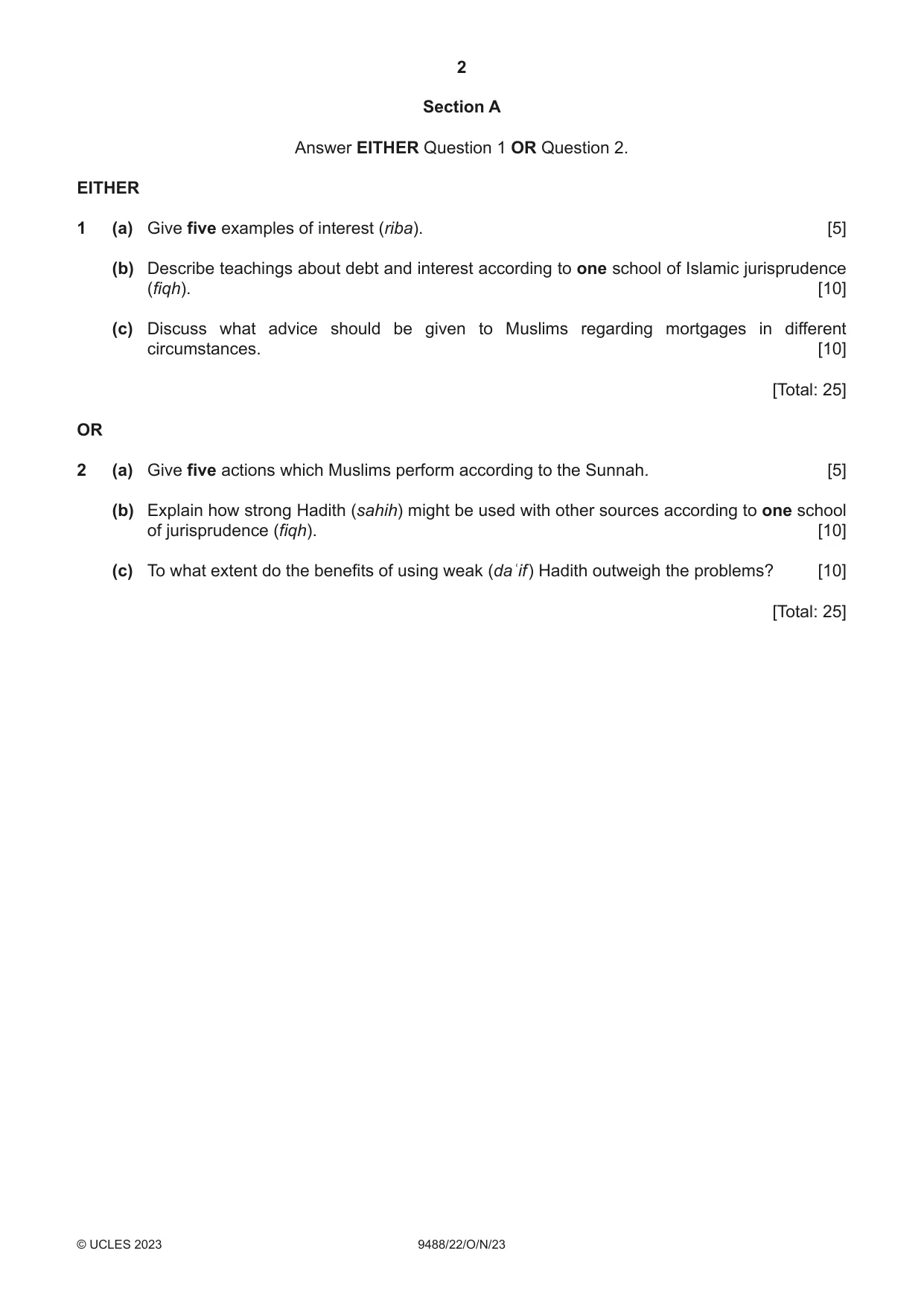
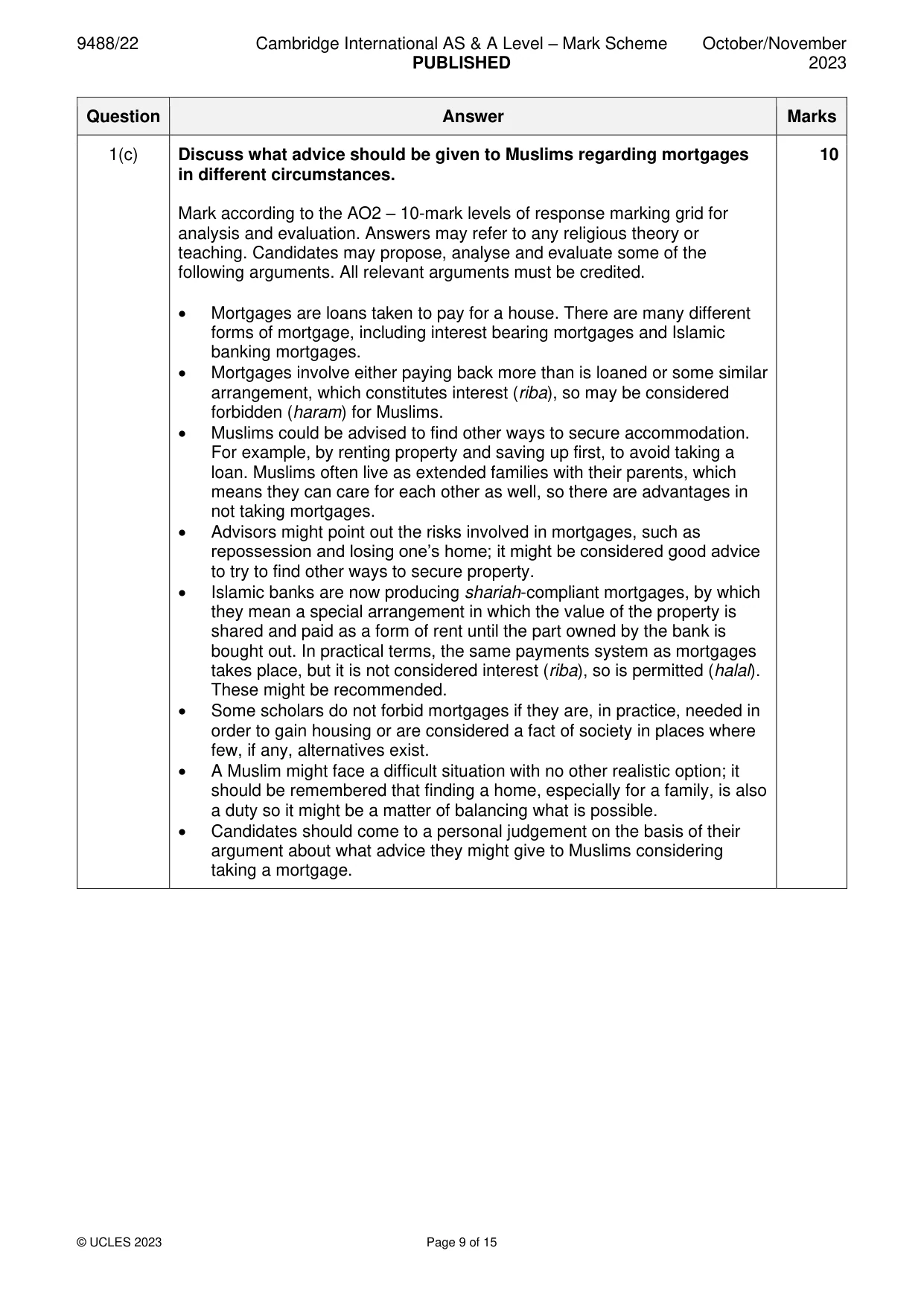
1 (a) Give five examples of interest (riba). [5] (b) Describe teachings about debt and interest according to one school of Islamic jurisprudence (fiqh). [10] (c) Discuss what advice should be given to Muslims regarding mortgages in different circumstances. [10] [Total: 25] OR
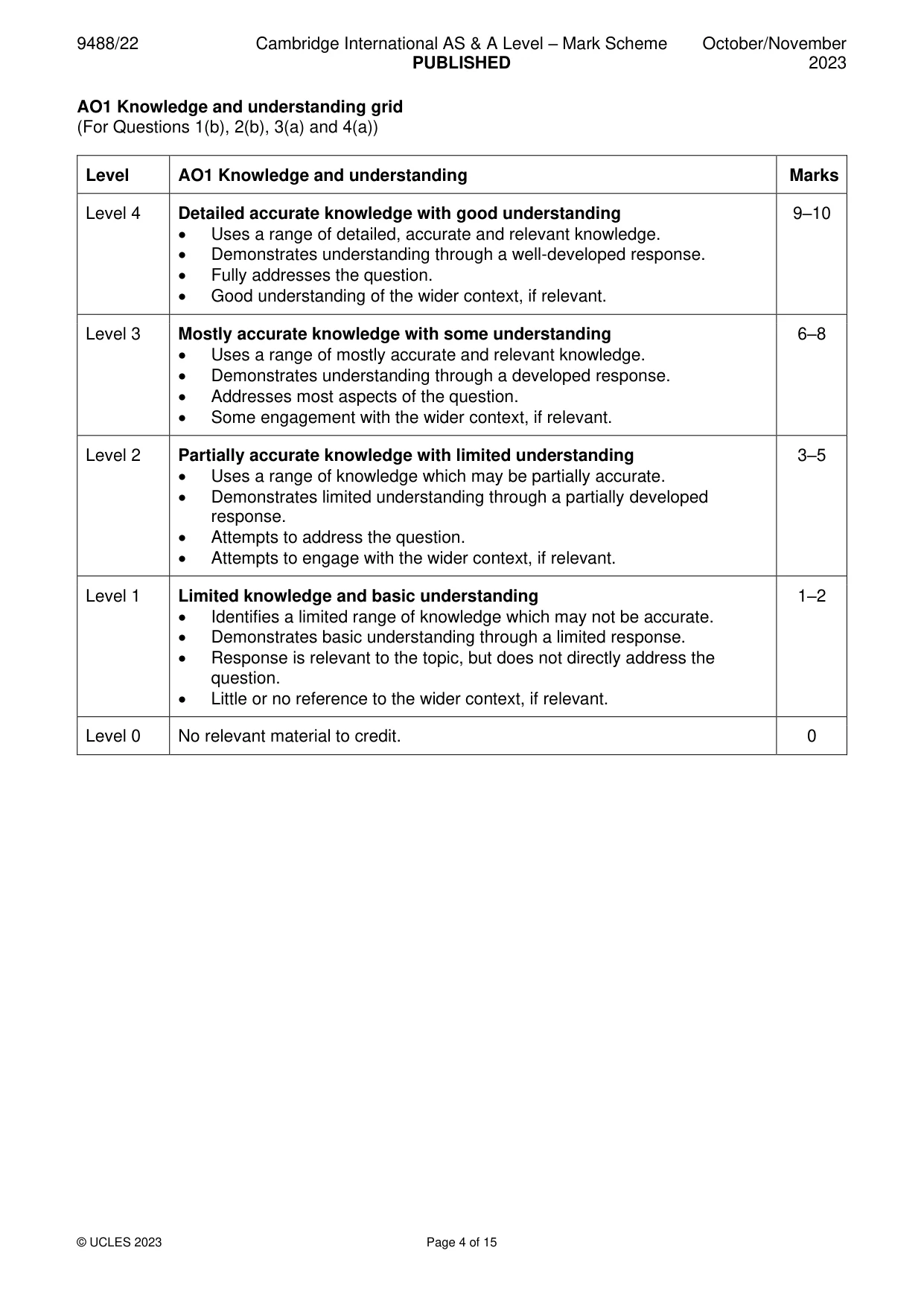
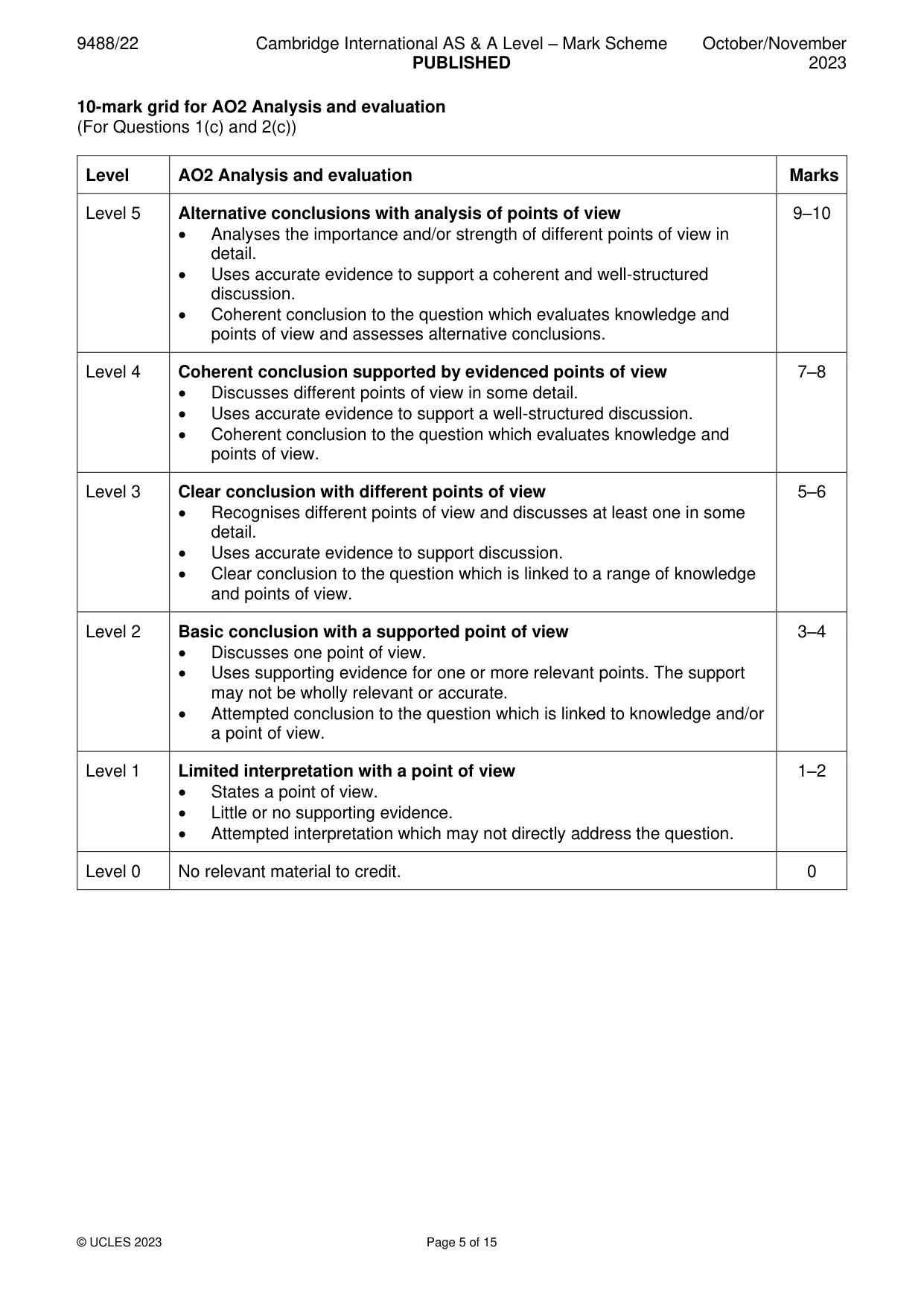
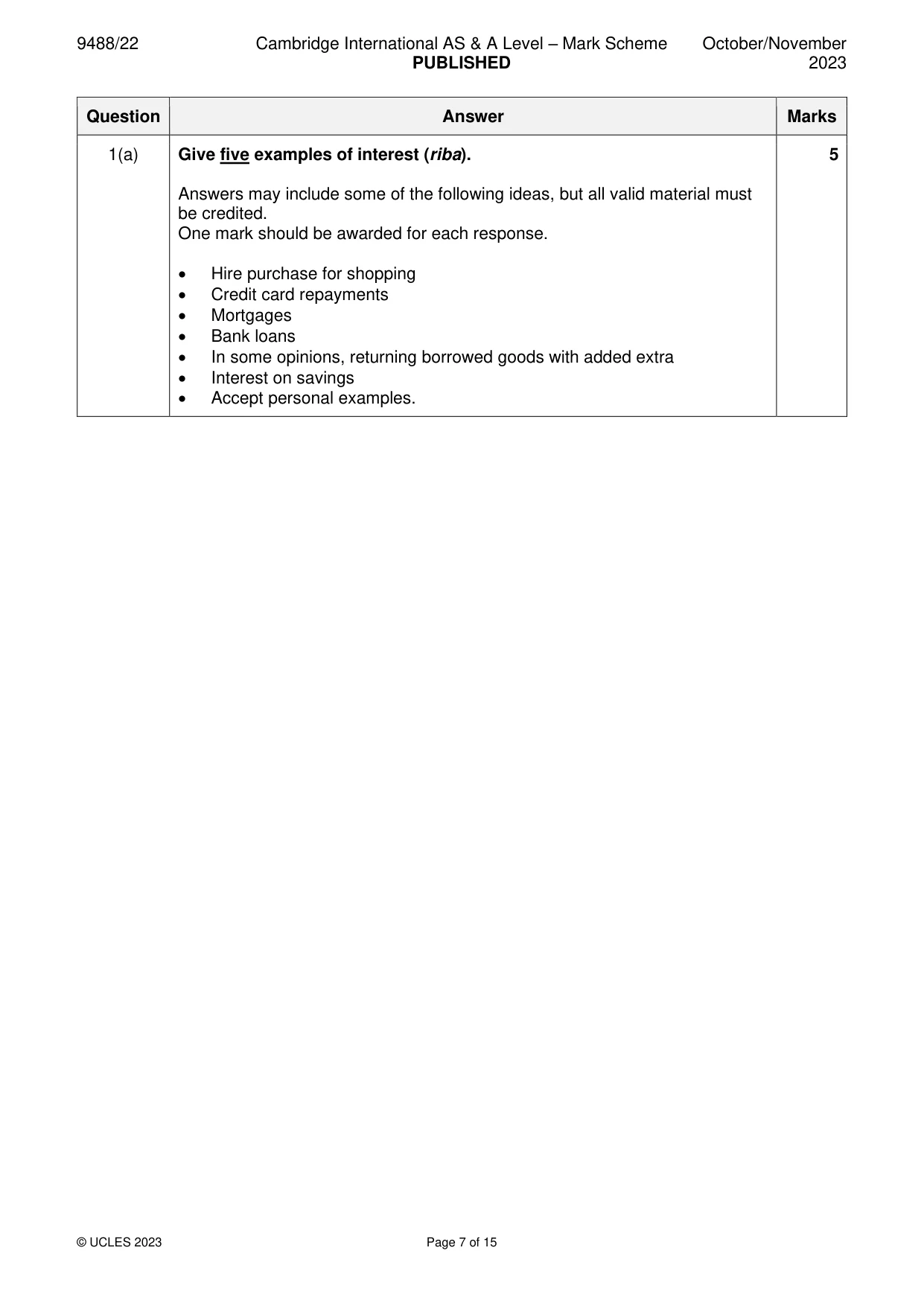
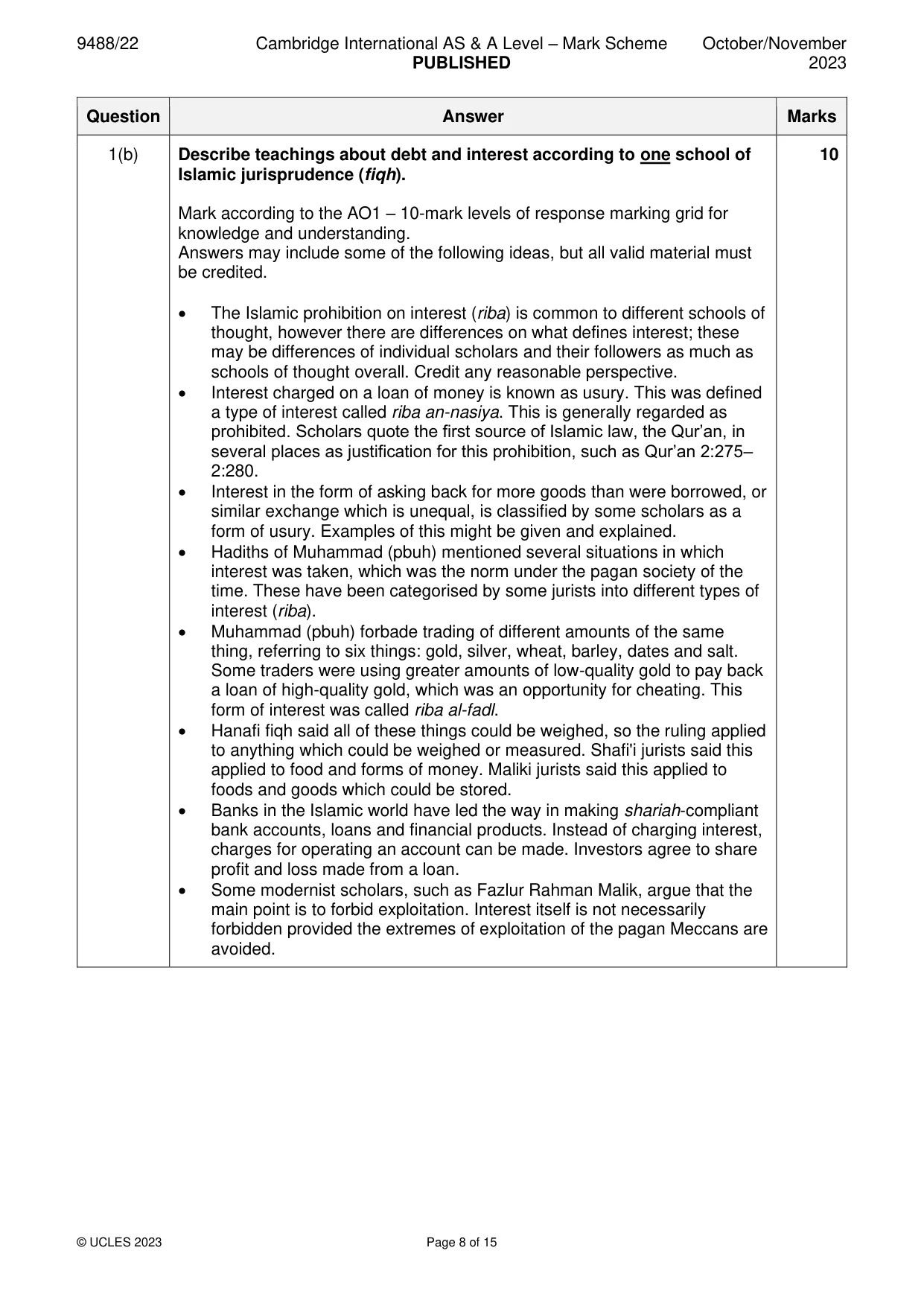
Mark scheme: Question Answer Marks 1(a) Give five examples of interest (riba). 5 Answers may include some of the following ideas, but all valid material must be credited. One mark should be awarded for each response. • Hire purchase for shopping • Credit card repayments • Mortgages • Bank loans • In some opinions, returning borrowed goods with added extra • Interest on savings • Accept personal examples. 1(b) Describe teachings about debt and interest according to one school of 10 Islamic jurisprudence (fiqh). Mark according to the AO1 – 10-mark levels of response marking grid for knowledge and understanding. Answers may include some of the following ideas, but all valid material must be credited. • The Islamic prohibition on interest (riba) is common to different schools of thought, however there are differences on what defines interest; these may be differences of individual scholars and their followers as much as schools of thought overall. Credit any reasonable perspective. • Interest charged on a loan of money is known as usury. This was defined a type of interest called riba an-nasiya. This is generally regarded as prohibited. Scholars quote the first source of Islamic law, the Qur’an, in several places as justification for this prohibition, such as Qur’an 2:275– 2:280. • Interest in the form of asking back for more goods than were borrowed, or similar exchange which is unequal, is classified by some scholars as a form of usury. Examples of this might be given and explained. • Hadiths of Muhammad (pbuh) mentioned several situations in which interest was taken, which was the norm under the pagan society of the time. These have been categorised by some jurists into different types of interest (riba). • Muhammad (pbuh) forbade trading of different amounts of the same thing, referring to six things: gold, silver, wheat, barley, dates and salt. Some traders were using greater amounts of low-quality gold to pay back a loan of high-quality gold, which was an opportunity for cheating. This form of interest was called riba al-fadl. • Hanafi fiqh said all of these things could be weighed, so the ruling applied to anything which could be weighed or measured. Shafi'i jurists said this applied to food and forms of money. Maliki jurists said this applied to foods and goods which could be stored. • Banks in the Islamic world have led the way in making shariah-compliant bank accounts, loans and financial products. Instead of charging interest, charges for operating an account can be made. Investors agree to share profit and loss made from a loan. • Some modernist scholars, such as Fazlur Rahman Malik, argue that the main point is to forbid exploitation. Interest itself is not necessarily forbidden provided the extremes of exploitation of the pagan Meccans are avoided. 1(c) Discuss what advice should be given to Muslims regarding mortgages 10 in different circumstances. Mark according to the AO2 – 10-mark levels of response marking grid for analysis and evaluation. Answers may refer to any religious theory or teaching. Candidates may propose, analyse and evaluate some of the following arguments. All relevant arguments must be credited. • Mortgages are loans taken to pay for a house. There are many different forms of mortgage, including interest bearing mortgages and Islamic banking mortgages. • Mortgages involve either paying back more than is loaned or some similar arrangement, which constitutes interest (riba), so may be considered forbidden (haram) for Muslims. • Muslims could be advised to find other ways to secure accommodation. For example, by renting property and saving up first, to avoid taking a loan. Muslims often live as extended families with their parents, which means they can care for each other as well, so there are advantages in not taking mortgages. • Advisors might point out the risks involved in mortgages, such as repossession and losing one’s home; it might be considered good advice to try to find other ways to secure property. • Islamic banks are now producing shariah-compliant mortgages, by which they mean a special arrangement in which the value of the property is shared and paid as a form of rent until the part owned by the bank is bought out. In practical terms, the same payments system as mortgages takes place, but it is not considered interest (riba), so is permitted (halal). These might be recommended. • Some scholars do not forbid mortgages if they are, in practice, needed in order to gain housing or are considered a fact of society in places where few, if any, alternatives exist. • A Muslim might face a difficult situation with no other realistic option; it should be remembered that finding a home, especially for a family, is also a duty so it might be a matter of balancing what is possible. • Candidates should come to a personal judgement on the basis of their argument about what advice they might give to Muslims considering taking a mortgage.
Q2 · Give five actions which Muslims perform according to the Sunnah
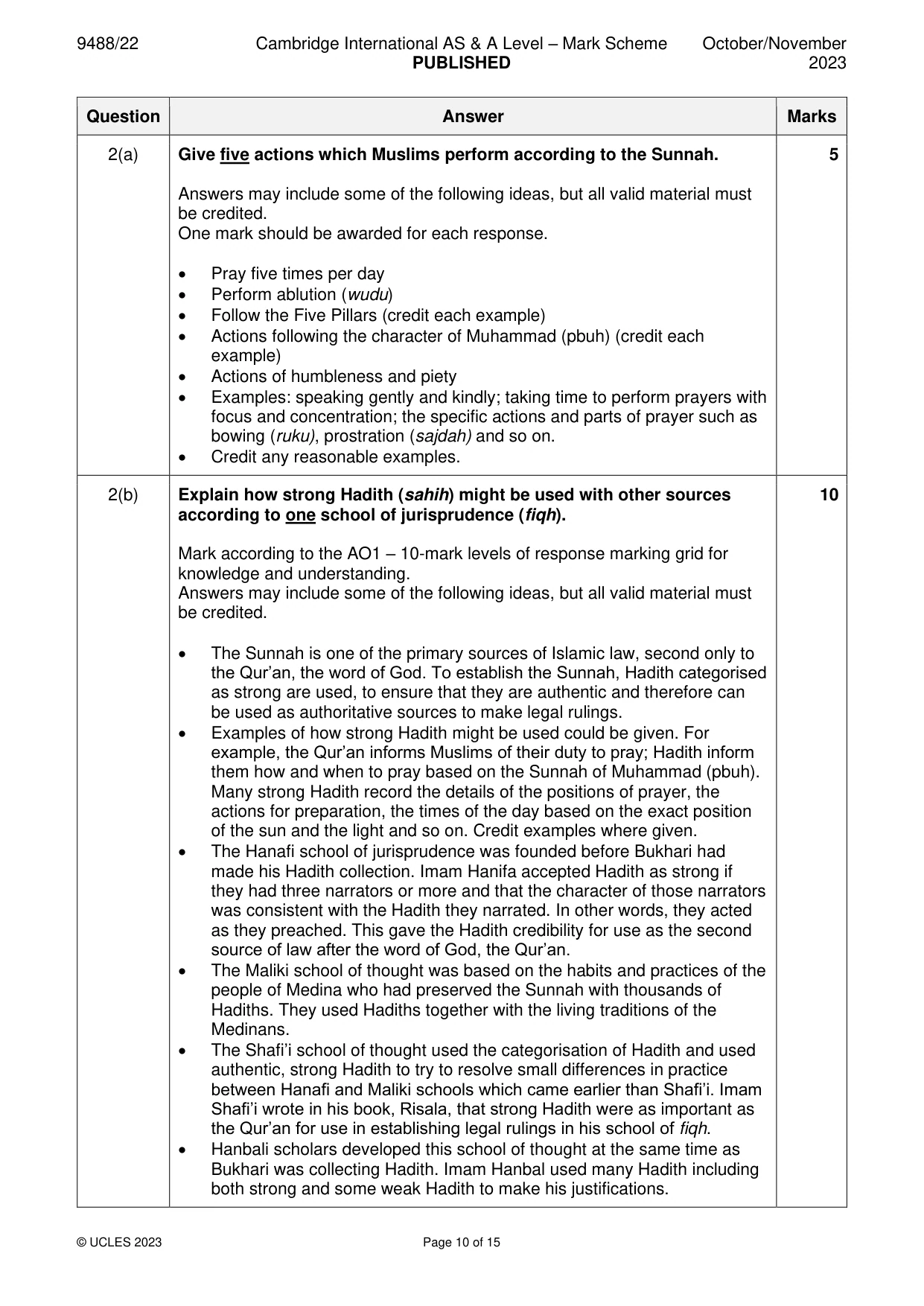
2 (a) Give five actions which Muslims perform according to the Sunnah. [5] (b) Explain how strong Hadith (sahih) might be used with other sources according to one school of jurisprudence (fiqh). [10] (c) To what extent do the benefits of using weak (daʿif ) Hadith outweigh the problems? [10] [Total: 25]
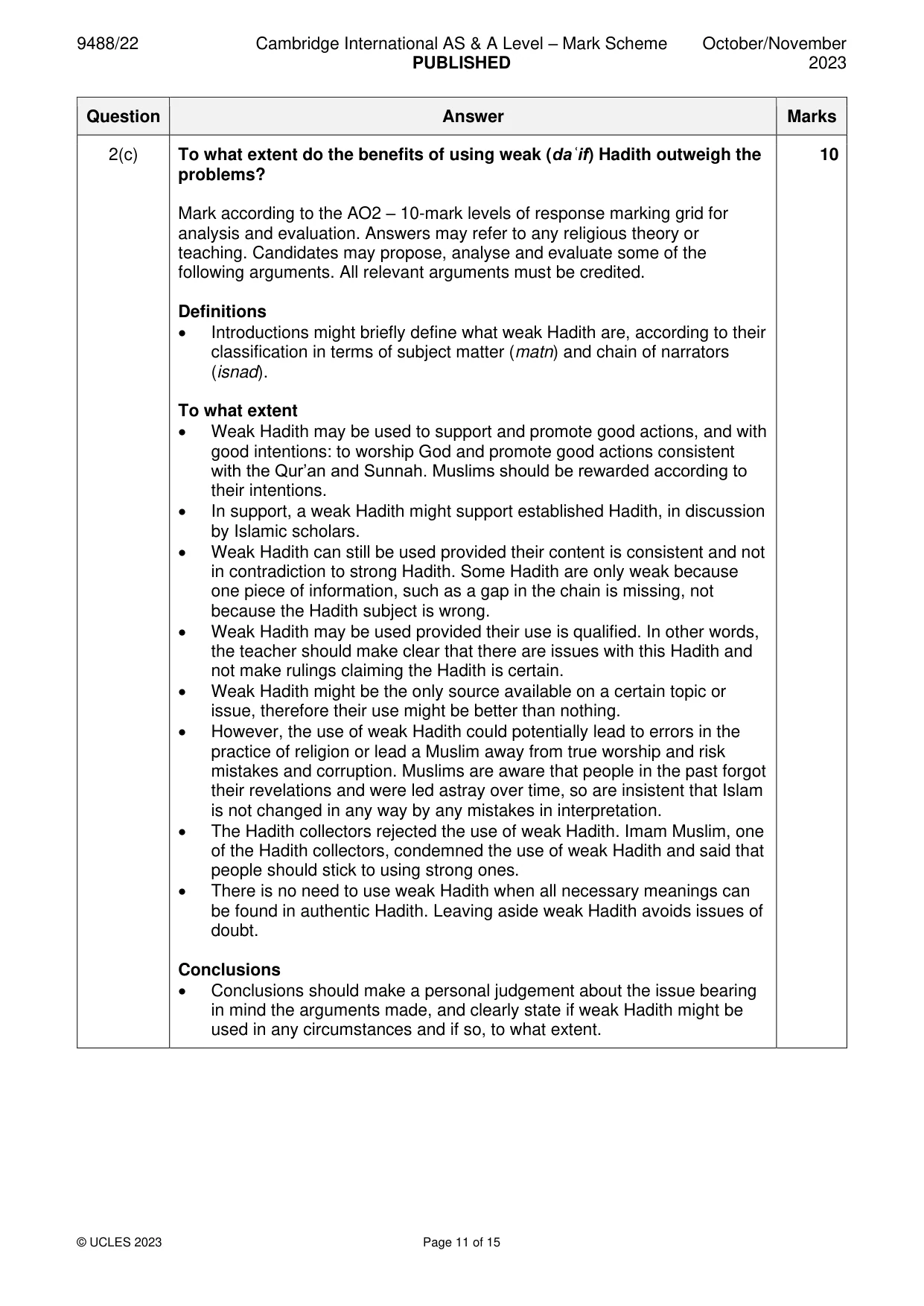
Mark scheme: 2(a) Give five actions which Muslims perform according to the Sunnah. 5 Answers may include some of the following ideas, but all valid material must be credited. One mark should be awarded for each response. • Pray five times per day • Perform ablution (wudu) • Follow the Five Pillars (credit each example) • Actions following the character of Muhammad (pbuh) (credit each example) • Actions of humbleness and piety • Examples: speaking gently and kindly; taking time to perform prayers with focus and concentration; the specific actions and parts of prayer such as bowing (ruku), prostration (sajdah) and so on. • Credit any reasonable examples. 2(b) Explain how strong Hadith (sahih) might be used with other sources 10 according to one school of jurisprudence (fiqh). Mark according to the AO1 – 10-mark levels of response marking grid for knowledge and understanding. Answers may include some of the following ideas, but all valid material must be credited. • The Sunnah is one of the primary sources of Islamic law, second only to the Qur’an, the word of God. To establish the Sunnah, Hadith categorised as strong are used, to ensure that they are authentic and therefore can be used as authoritative sources to make legal rulings. • Examples of how strong Hadith might be used could be given. For example, the Qur’an informs Muslims of their duty to pray; Hadith inform them how and when to pray based on the Sunnah of Muhammad (pbuh). Many strong Hadith record the details of the positions of prayer, the actions for preparation, the times of the day based on the exact position of the sun and the light and so on. Credit examples where given. • The Hanafi school of jurisprudence was founded before Bukhari had made his Hadith collection. Imam Hanifa accepted Hadith as strong if they had three narrators or more and that the character of those narrators was consistent with the Hadith they narrated. In other words, they acted as they preached. This gave the Hadith credibility for use as the second source of law after the word of God, the Qur’an. • The Maliki school of thought was based on the habits and practices of the people of Medina who had preserved the Sunnah with thousands of Hadiths. They used Hadiths together with the living traditions of the Medinans. • The Shafi’i school of thought used the categorisation of Hadith and used authentic, strong Hadith to try to resolve small differences in practice between Hanafi and Maliki schools which came earlier than Shafi’i. Imam Shafi’i wrote in his book, Risala, that strong Hadith were as important as the Qur’an for use in establishing legal rulings in his school of fiqh. • Hanbali scholars developed this school of thought at the same time as Bukhari was collecting Hadith. Imam Hanbal used many Hadith including both strong and some weak Hadith to make his justifications. 2(c) To what extent do the benefits of using weak (daʿif) Hadith outweigh the 10 problems? Mark according to the AO2 – 10-mark levels of response marking grid for analysis and evaluation. Answers may refer to any religious theory or teaching. Candidates may propose, analyse and evaluate some of the following arguments. All relevant arguments must be credited. Definitions • Introductions might briefly define what weak Hadith are, according to their classification in terms of subject matter (matn) and chain of narrators (isnad). To what extent • Weak Hadith may be used to support and promote good actions, and with good intentions: to worship God and promote good actions consistent with the Qur’an and Sunnah. Muslims should be rewarded according to their intentions. • In support, a weak Hadith might support established Hadith, in discussion by Islamic scholars. • Weak Hadith can still be used provided their content is consistent and not in contradiction to strong Hadith. Some Hadith are only weak because one piece of information, such as a gap in the chain is missing, not because the Hadith subject is wrong. • Weak Hadith may be used provided their use is qualified. In other words, the teacher should make clear that there are issues with this Hadith and not make rulings claiming the Hadith is certain. • Weak Hadith might be the only source available on a certain topic or issue, therefore their use might be better than nothing. • However, the use of weak Hadith could potentially lead to errors in the practice of religion or lead a Muslim away from true worship and risk mistakes and corruption. Muslims are aware that people in the past forgot their revelations and were led astray over time, so are insistent that Islam is not changed in any way by any mistakes in interpretation. • The Hadith collectors rejected the use of weak Hadith. Imam Muslim, one of the Hadith collectors, condemned the use of weak Hadith and said that people should stick to using strong ones. • There is no need to use weak Hadith when all necessary meanings can be found in authentic Hadith. Leaving aside weak Hadith avoids issues of doubt. Conclusions • Conclusions should make a personal judgement about the issue bearing in mind the arguments made, and clearly state if weak Hadith might be used in any circumstances and if so, to what extent.
Q3 · Explain why Muslims believe the Qurʾan originated with God
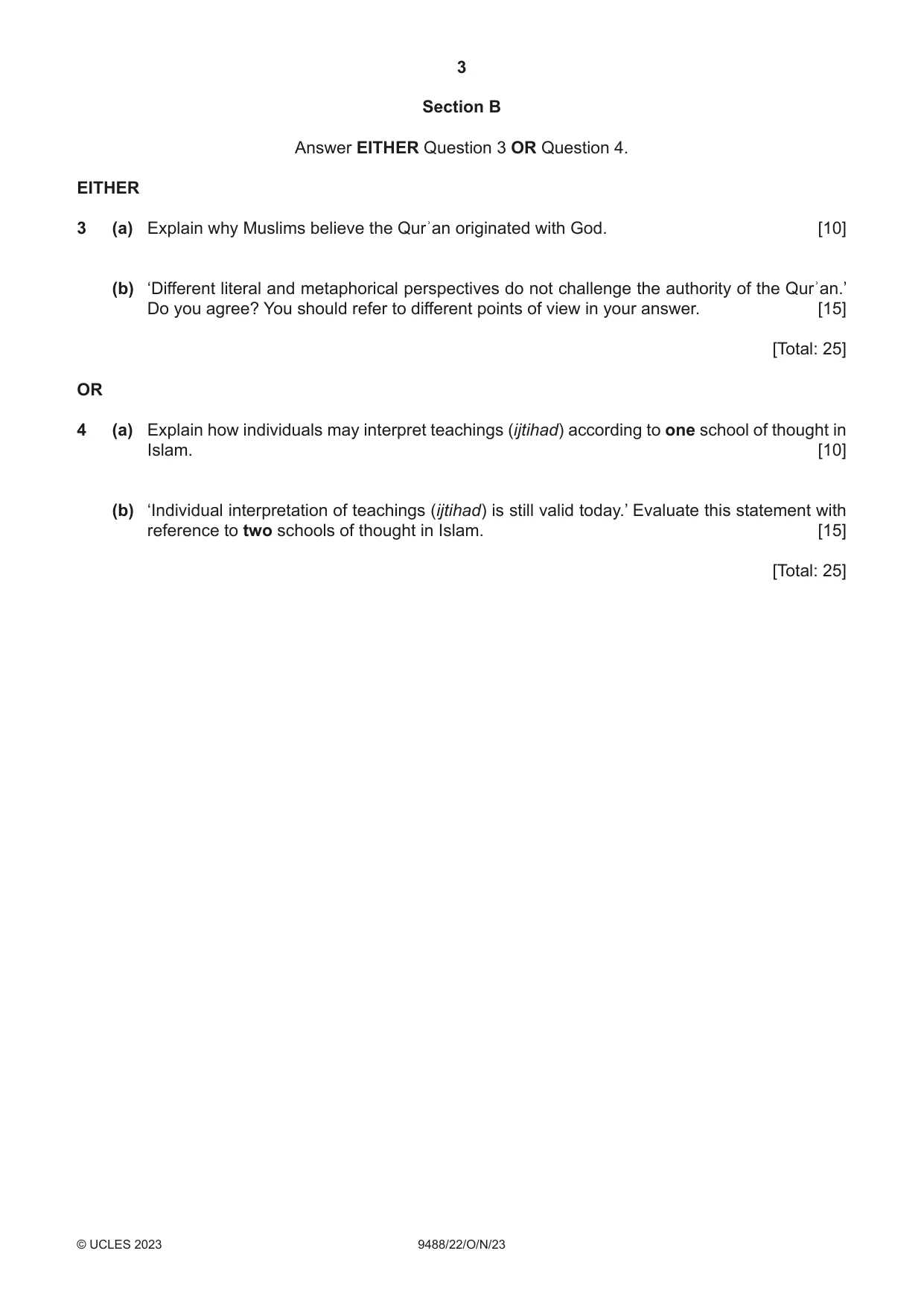
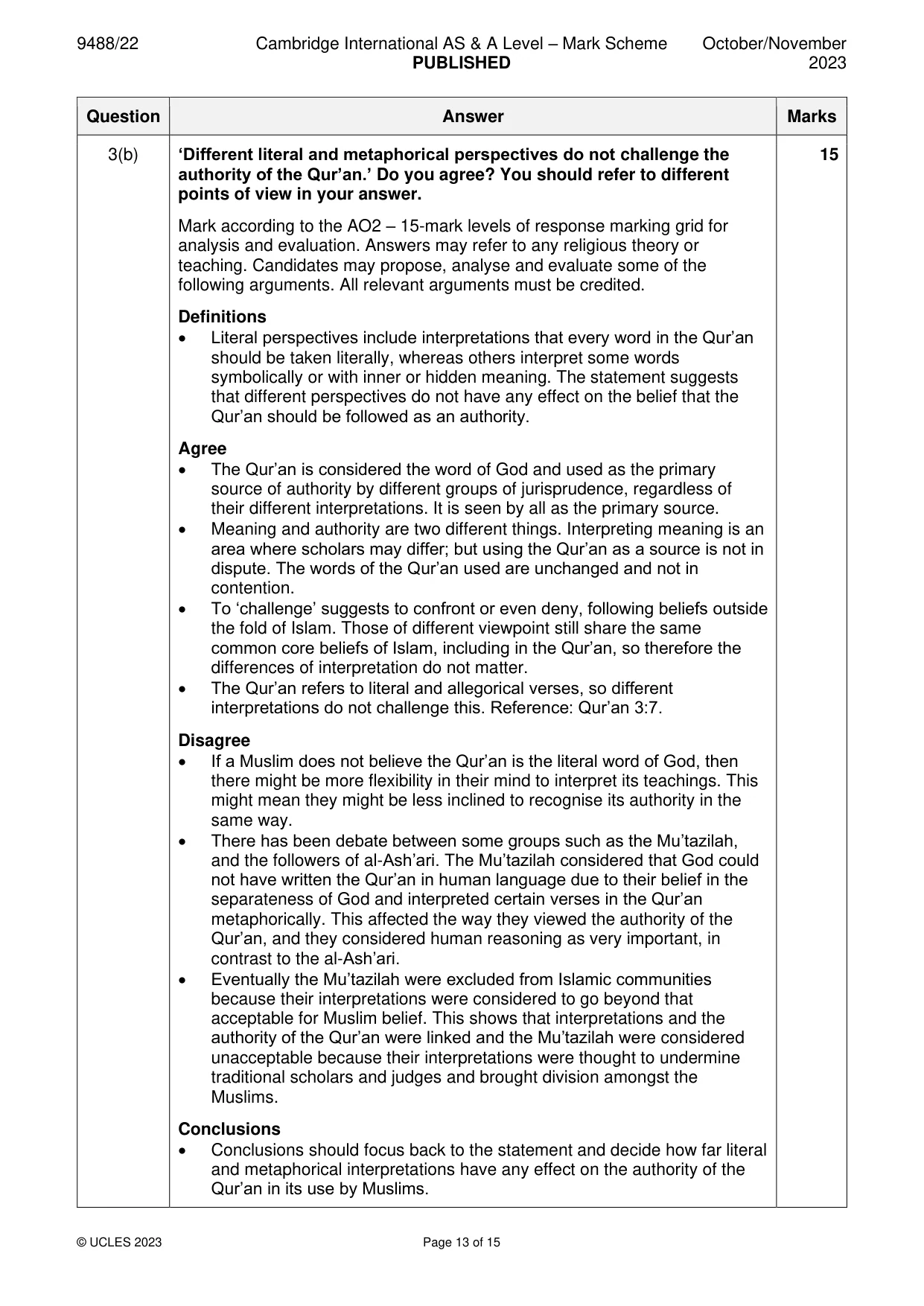
3 (a) Explain why Muslims believe the Qurʾan originated with God. [10] (b) ‘Different literal and metaphorical perspectives do not challenge the authority of the Qurʾan.’ Do you agree? You should refer to different points of view in your answer. [15] [Total: 25] OR
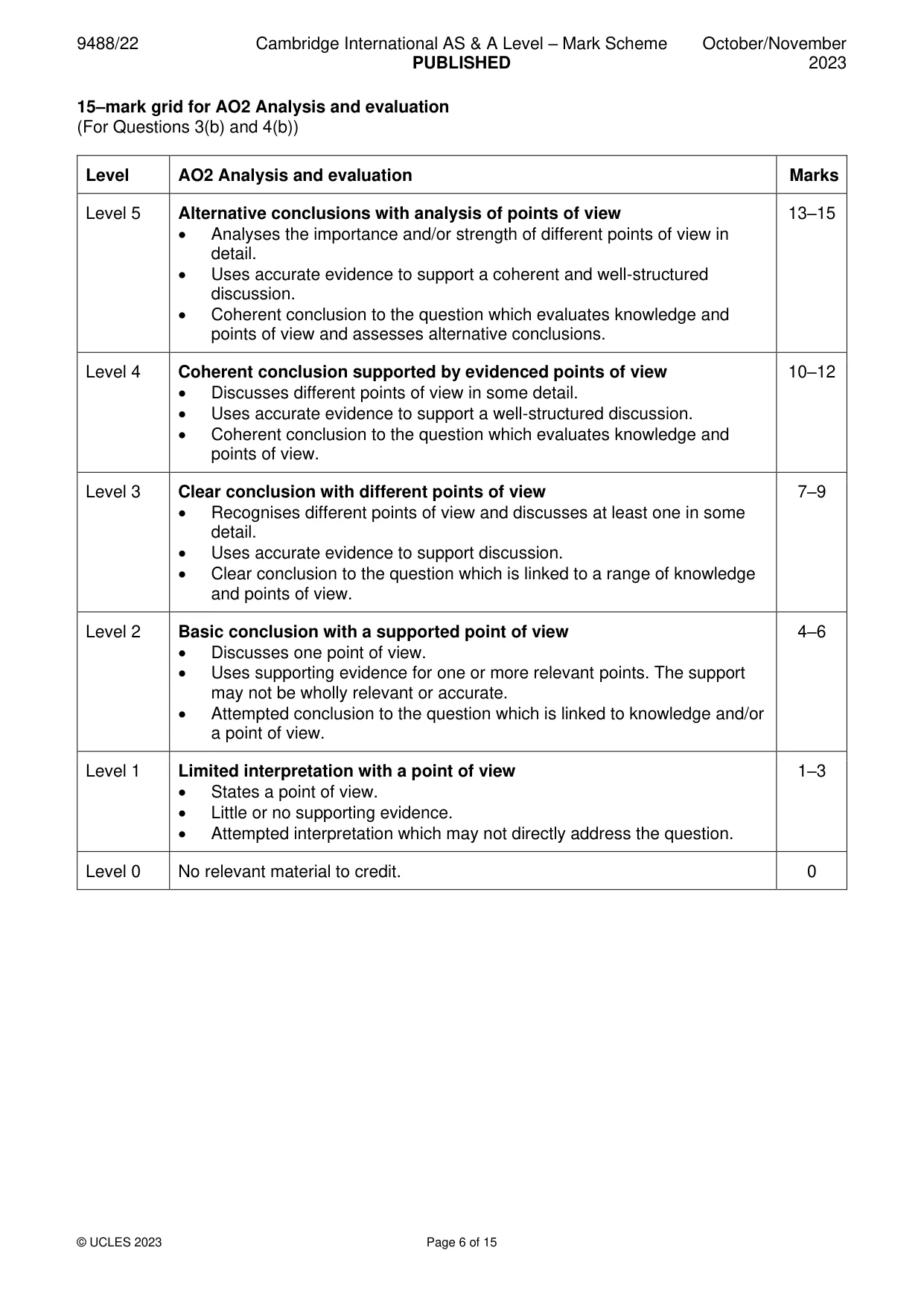
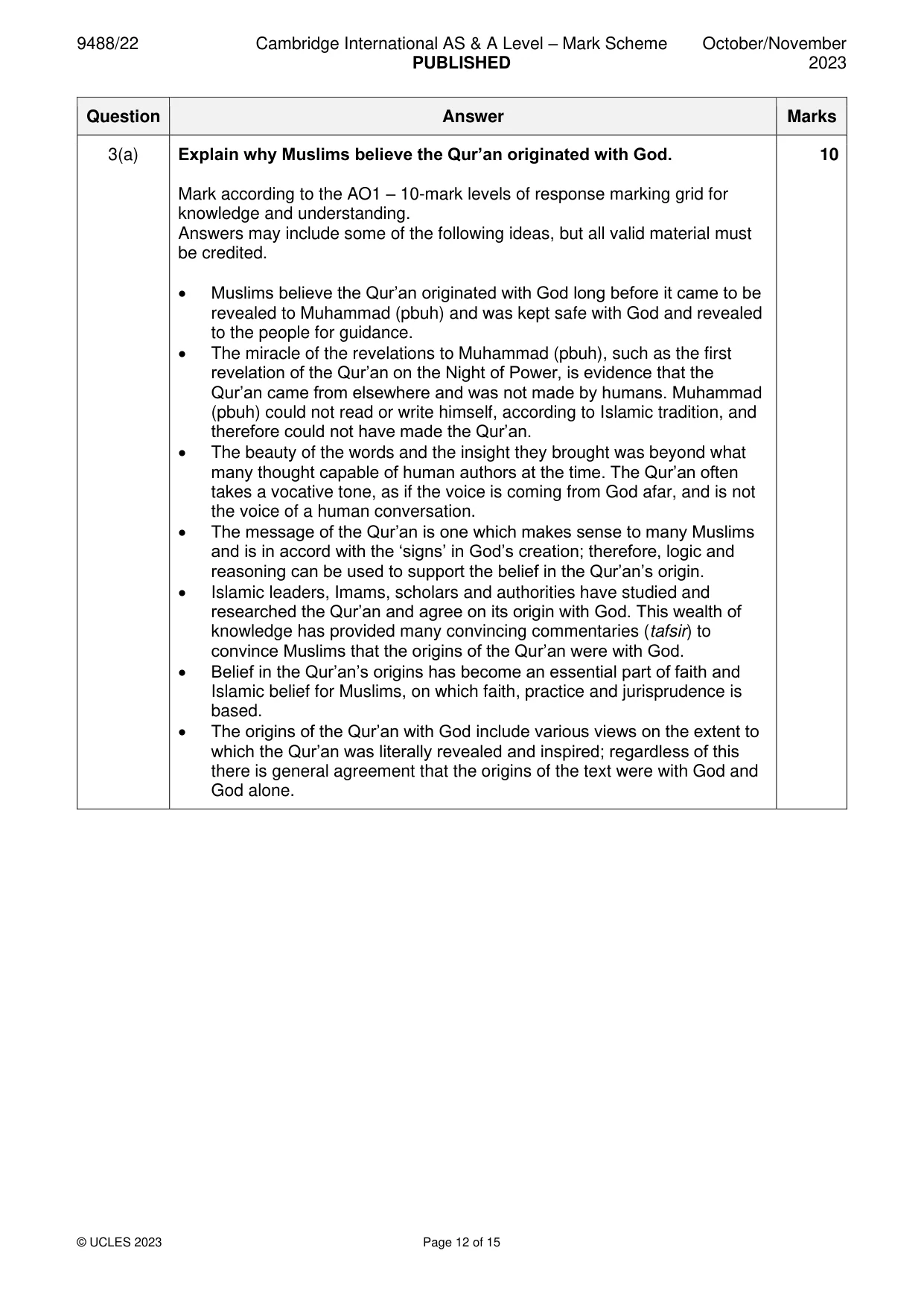
Mark scheme: 3(a) Explain why Muslims believe the Qur’an originated with God. 10 Mark according to the AO1 – 10-mark levels of response marking grid for knowledge and understanding. Answers may include some of the following ideas, but all valid material must be credited. • Muslims believe the Qur’an originated with God long before it came to be revealed to Muhammad (pbuh) and was kept safe with God and revealed to the people for guidance. • The miracle of the revelations to Muhammad (pbuh), such as the first revelation of the Qur’an on the Night of Power, is evidence that the Qur’an came from elsewhere and was not made by humans. Muhammad (pbuh) could not read or write himself, according to Islamic tradition, and therefore could not have made the Qur’an. • The beauty of the words and the insight they brought was beyond what many thought capable of human authors at the time. The Qur’an often takes a vocative tone, as if the voice is coming from God afar, and is not the voice of a human conversation. • The message of the Qur’an is one which makes sense to many Muslims and is in accord with the ‘signs’ in God’s creation; therefore, logic and reasoning can be used to support the belief in the Qur’an’s origin. • Islamic leaders, Imams, scholars and authorities have studied and researched the Qur’an and agree on its origin with God. This wealth of knowledge has provided many convincing commentaries (tafsir) to convince Muslims that the origins of the Qur’an were with God. • Belief in the Qur’an’s origins has become an essential part of faith and Islamic belief for Muslims, on which faith, practice and jurisprudence is based. • The origins of the Qur’an with God include various views on the extent to which the Qur’an was literally revealed and inspired; regardless of this there is general agreement that the origins of the text were with God and God alone. 3(b) ‘Different literal and metaphorical perspectives do not challenge the 15 authority of the Qur’an.’ Do you agree? You should refer to different points of view in your answer. Mark according to the AO2 – 15-mark levels of response marking grid for analysis and evaluation. Answers may refer to any religious theory or teaching. Candidates may propose, analyse and evaluate some of the following arguments. All relevant arguments must be credited. Definitions • Literal perspectives include interpretations that every word in the Qur’an should be taken literally, whereas others interpret some words symbolically or with inner or hidden meaning. The statement suggests that different perspectives do not have any effect on the belief that the Qur’an should be followed as an authority. Agree • The Qur’an is considered the word of God and used as the primary source of authority by different groups of jurisprudence, regardless of their different interpretations. It is seen by all as the primary source. • Meaning and authority are two different things. Interpreting meaning is an area where scholars may differ; but using the Qur’an as a source is not in dispute. The words of the Qur’an used are unchanged and not in contention. • To ‘challenge’ suggests to confront or even deny, following beliefs outside the fold of Islam. Those of different viewpoint still share the same common core beliefs of Islam, including in the Qur’an, so therefore the differences of interpretation do not matter. • The Qur’an refers to literal and allegorical verses, so different interpretations do not challenge this. Reference: Qur’an 3:7. Disagree • If a Muslim does not believe the Qur’an is the literal word of God, then there might be more flexibility in their mind to interpret its teachings. This might mean they might be less inclined to recognise its authority in the same way. • There has been debate between some groups such as the Mu’tazilah, and the followers of al-Ash’ari. The Mu’tazilah considered that God could not have written the Qur’an in human language due to their belief in the separateness of God and interpreted certain verses in the Qur’an metaphorically. This affected the way they viewed the authority of the Qur’an, and they considered human reasoning as very important, in contrast to the al-Ash’ari. • Eventually the Mu’tazilah were excluded from Islamic communities because their interpretations were considered to go beyond that acceptable for Muslim belief. This shows that interpretations and the authority of the Qur’an were linked and the Mu’tazilah were considered unacceptable because their interpretations were thought to undermine traditional scholars and judges and brought division amongst the Muslims. Conclusions • Conclusions should focus back to the statement and decide how far literal and metaphorical interpretations have any effect on the authority of the Qur’an in its use by Muslims.
Q4 · Explain how individuals may interpret teachings (ijtihad) according to one school of…
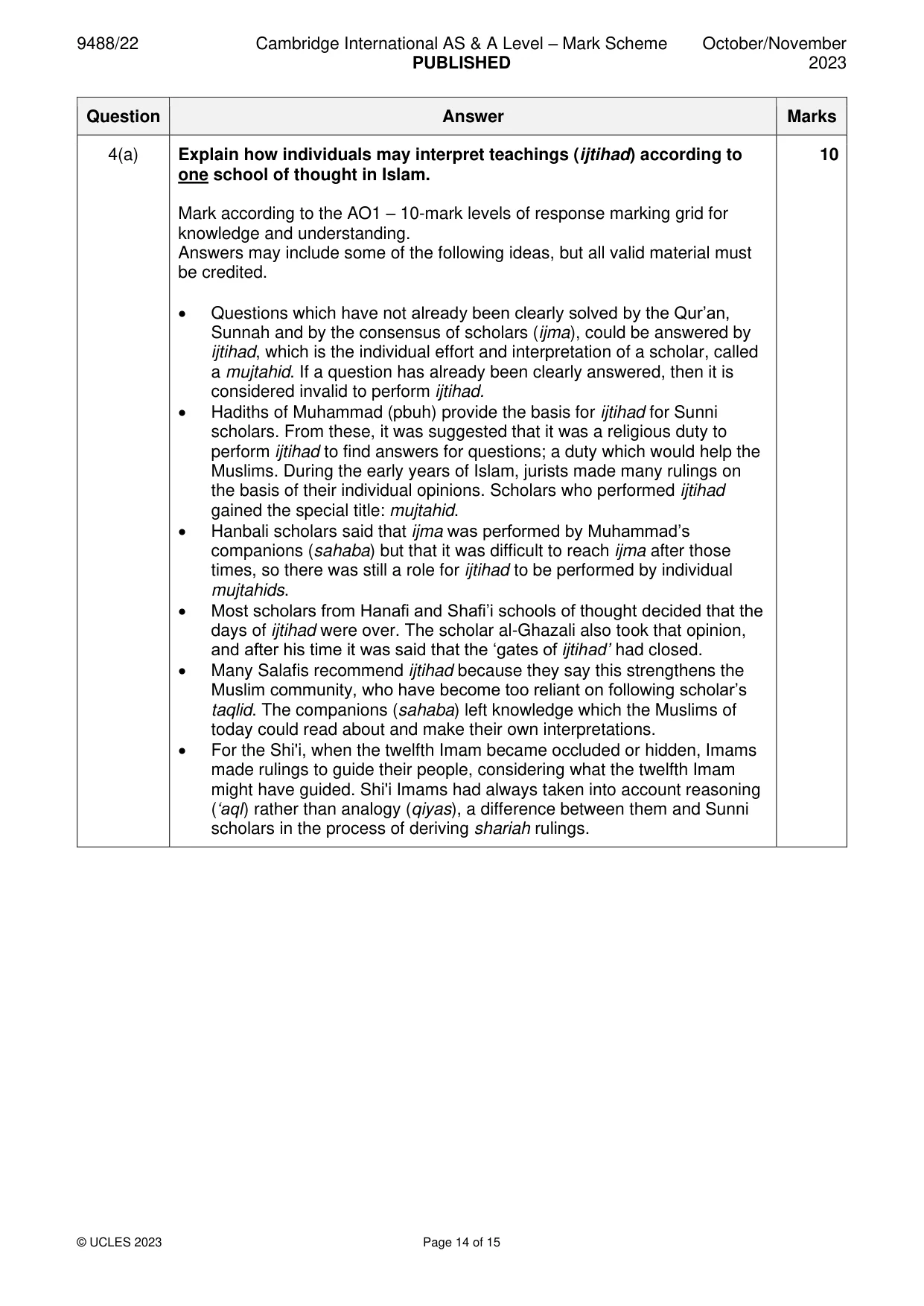
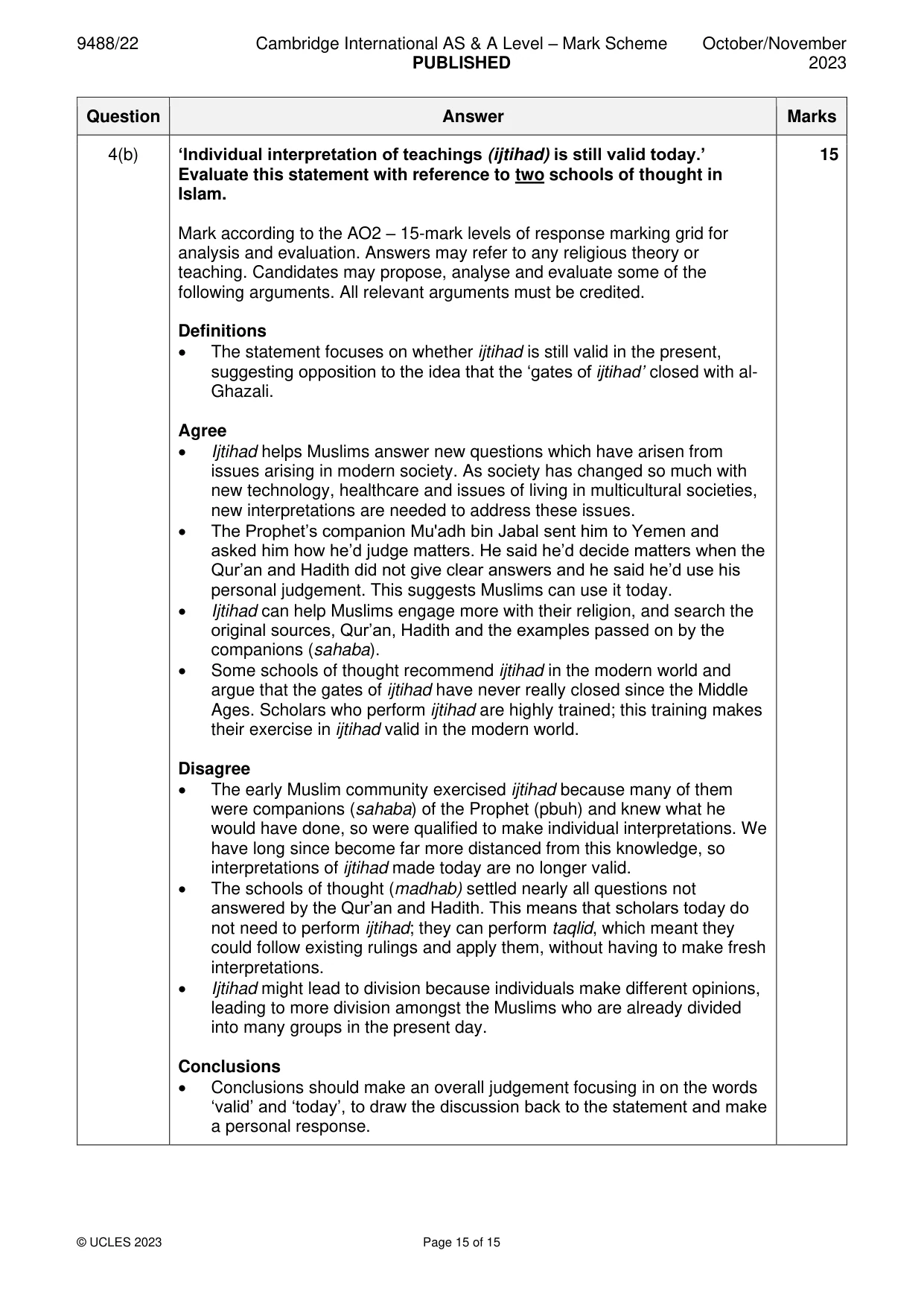
4 (a) Explain how individuals may interpret teachings (ijtihad) according to one school of thought in Islam. [10] (b) ‘Individual interpretation of teachings (ijtihad) is still valid today.’ Evaluate this statement with reference to two schools of thought in Islam. [15] [Total: 25]
Mark scheme: 4(a) Explain how individuals may interpret teachings (ijtihad) according to 10 one school of thought in Islam. Mark according to the AO1 – 10-mark levels of response marking grid for knowledge and understanding. Answers may include some of the following ideas, but all valid material must be credited. • Questions which have not already been clearly solved by the Qur’an, Sunnah and by the consensus of scholars (ijma), could be answered by ijtihad, which is the individual effort and interpretation of a scholar, called a mujtahid. If a question has already been clearly answered, then it is considered invalid to perform ijtihad. • Hadiths of Muhammad (pbuh) provide the basis for ijtihad for Sunni scholars. From these, it was suggested that it was a religious duty to perform ijtihad to find answers for questions; a duty which would help the Muslims. During the early years of Islam, jurists made many rulings on the basis of their individual opinions. Scholars who performed ijtihad gained the special title: mujtahid. • Hanbali scholars said that ijma was performed by Muhammad’s companions (sahaba) but that it was difficult to reach ijma after those times, so there was still a role for ijtihad to be performed by individual mujtahids. • Most scholars from Hanafi and Shafi’i schools of thought decided that the days of ijtihad were over. The scholar al-Ghazali also took that opinion, and after his time it was said that the ‘gates of ijtihad’ had closed. • Many Salafis recommend ijtihad because they say this strengthens the Muslim community, who have become too reliant on following scholar’s taqlid. The companions (sahaba) left knowledge which the Muslims of today could read about and make their own interpretations. • For the Shi'i, when the twelfth Imam became occluded or hidden, Imams made rulings to guide their people, considering what the twelfth Imam might have guided. Shi'i Imams had always taken into account reasoning (‘aql) rather than analogy (qiyas), a difference between them and Sunni scholars in the process of deriving shariah rulings. 4(b) ‘Individual interpretation of teachings (ijtihad) is still valid today.’ 15 Evaluate this statement with reference to two schools of thought in Islam. Mark according to the AO2 – 15-mark levels of response marking grid for analysis and evaluation. Answers may refer to any religious theory or teaching. Candidates may propose, analyse and evaluate some of the following arguments. All relevant arguments must be credited. Definitions • The statement focuses on whether ijtihad is still valid in the present, suggesting opposition to the idea that the ‘gates of ijtihad’ closed with al- Ghazali. Agree • Ijtihad helps Muslims answer new questions which have arisen from issues arising in modern society. As society has changed so much with new technology, healthcare and issues of living in multicultural societies, new interpretations are needed to address these issues. • The Prophet’s companion Mu'adh bin Jabal sent him to Yemen and asked him how he’d judge matters. He said he’d decide matters when the Qur’an and Hadith did not give clear answers and he said he’d use his personal judgement. This suggests Muslims can use it today. • Ijtihad can help Muslims engage more with their religion, and search the original sources, Qur’an, Hadith and the examples passed on by the companions (sahaba). • Some schools of thought recommend ijtihad in the modern world and argue that the gates of ijtihad have never really closed since the Middle Ages. Scholars who perform ijtihad are highly trained; this training makes their exercise in ijtihad valid in the modern world. Disagree • The early Muslim community exercised ijtihad because many of them were companions (sahaba) of the Prophet (pbuh) and knew what he would have done, so were qualified to make individual interpretations. We have long since become far more distanced from this knowledge, so interpretations of ijtihad made today are no longer valid. • The schools of thought (madhab) settled nearly all questions not answered by the Qur’an and Hadith. This means that scholars today do not need to perform ijtihad; they can perform taqlid, which meant they could follow existing rulings and apply them, without having to make fresh interpretations. • Ijtihad might lead to division because individuals make different opinions, leading to more division amongst the Muslims who are already divided into many groups in the present day. Conclusions • Conclusions should make an overall judgement focusing in on the words ‘valid’ and ‘today’, to draw the discussion back to the statement and make a personal response.
What was in this paper
The subtopics covered by these 4 questions, and how many questions each got. Open one in a new tab to see every Cambridge question on it.
What you needed in this session
Cambridge’s own grade thresholds for 2023 Oct/Nov, Paper 2 · Variant 2. A higher threshold means an easier paper — the bar moves with how the cohort did.