Cambridge A Level Islamic Studies 9488 — 2024 Oct/Nov Paper 2 · Variant 2
9488/22/O/N/24 · 4 questions · 50 marks · 90 min
The question paper and its mark scheme, free to read here and free to download. This is Cambridge’s own paper, exactly as it was sat.
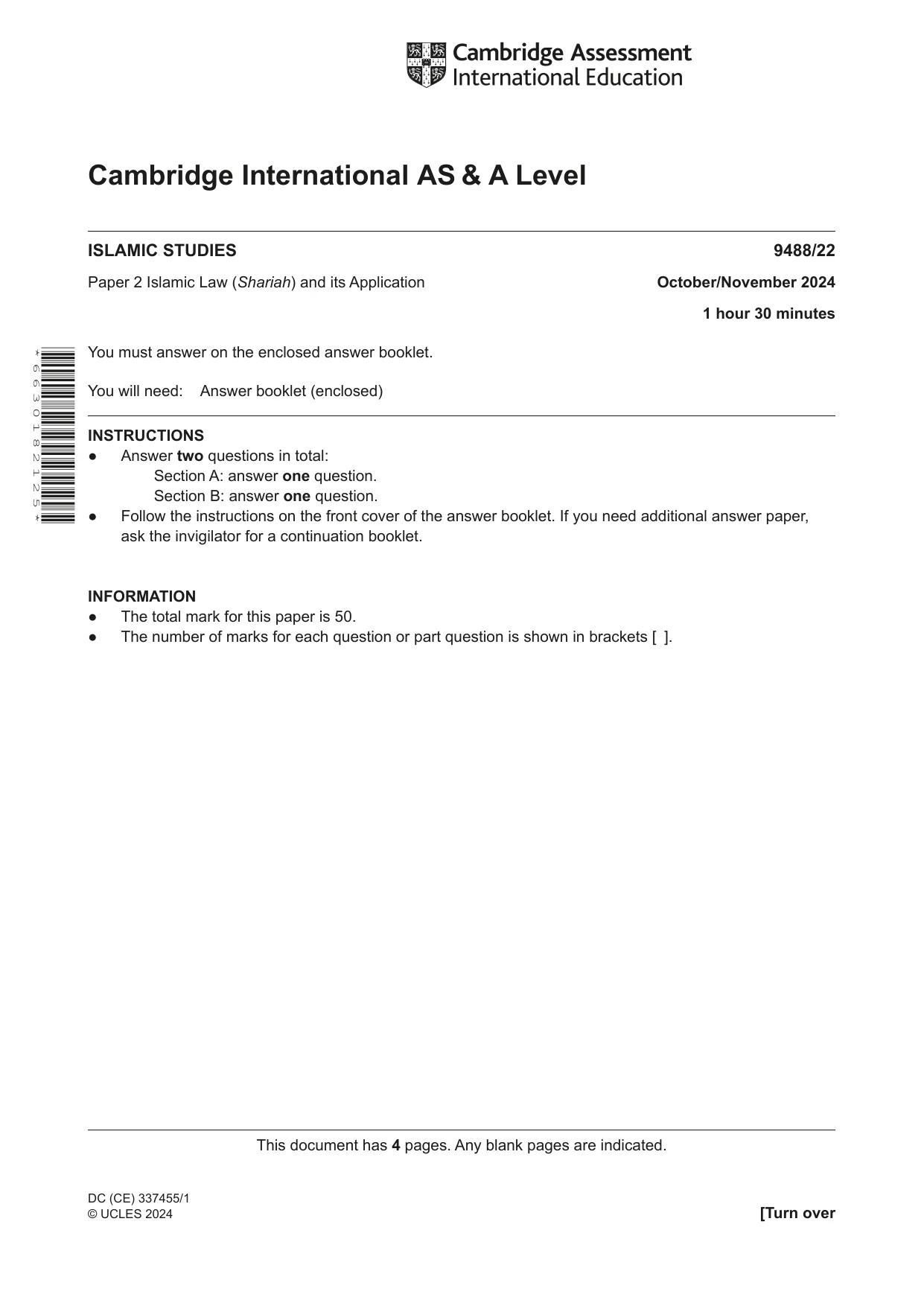
Question paper4 pages

Mark scheme16 pages
Answers below. Sit the paper first if you are practising.
Questions as text
Q1 · Briefly describe the day of a marriage (nikah)
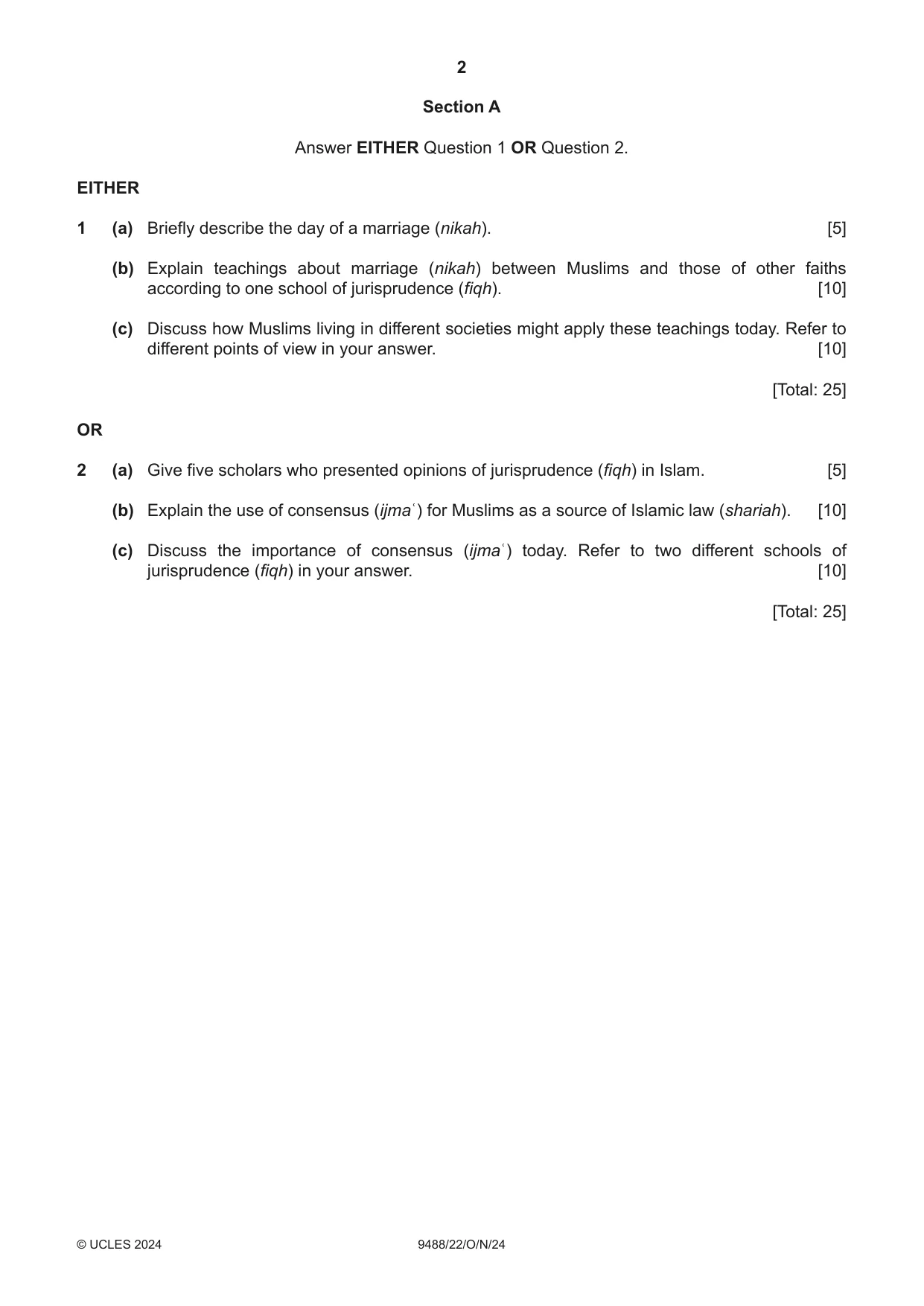
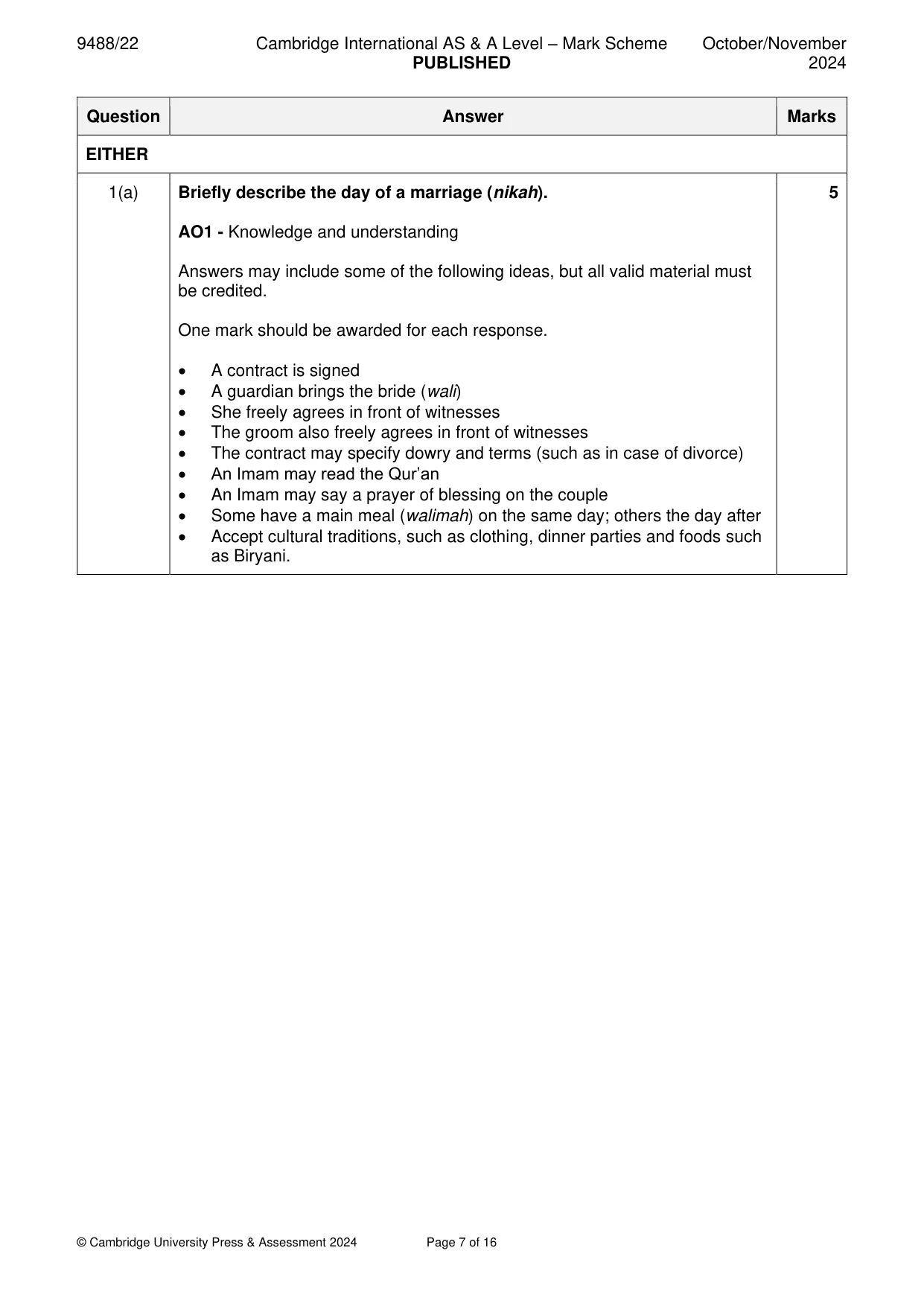
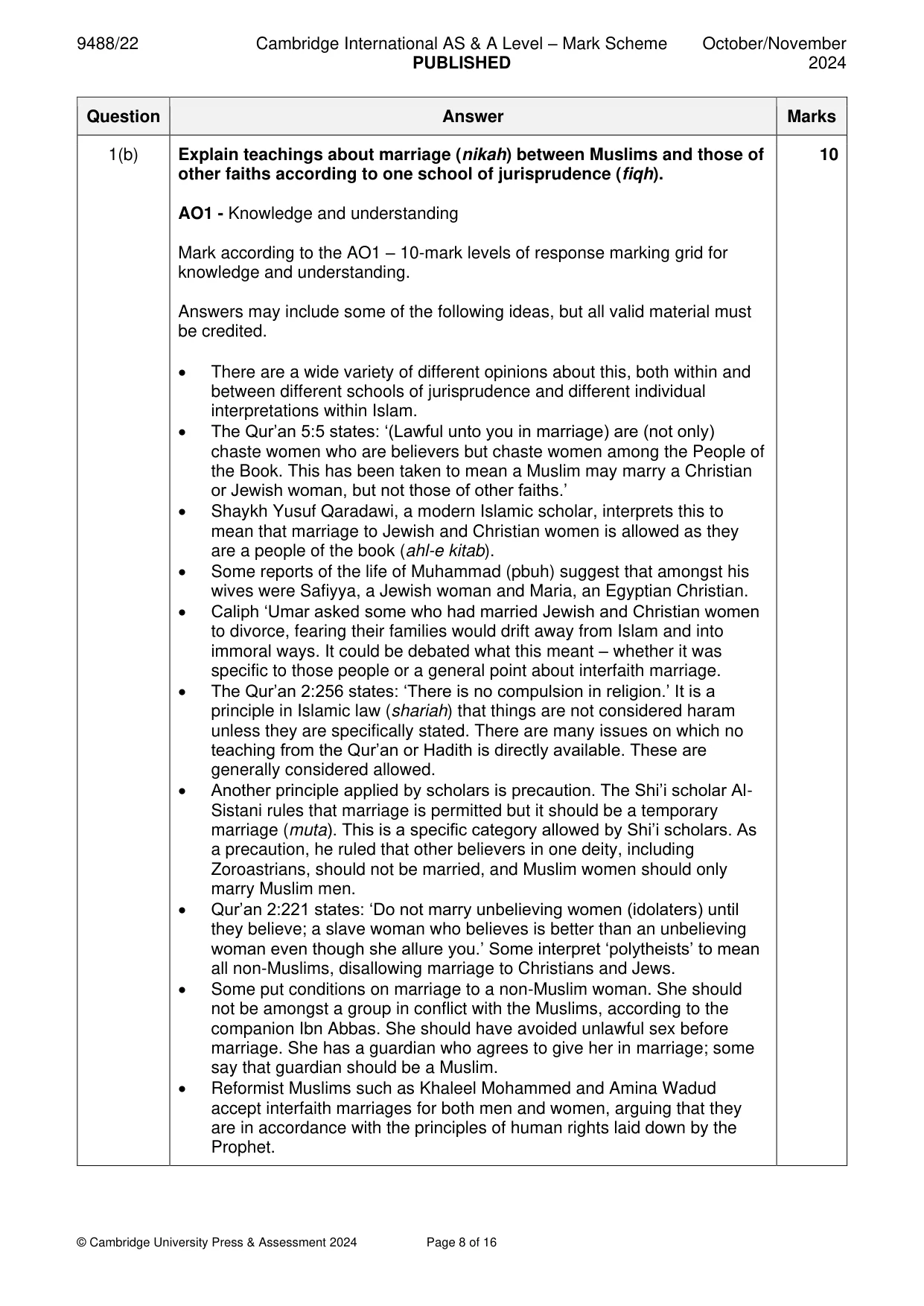
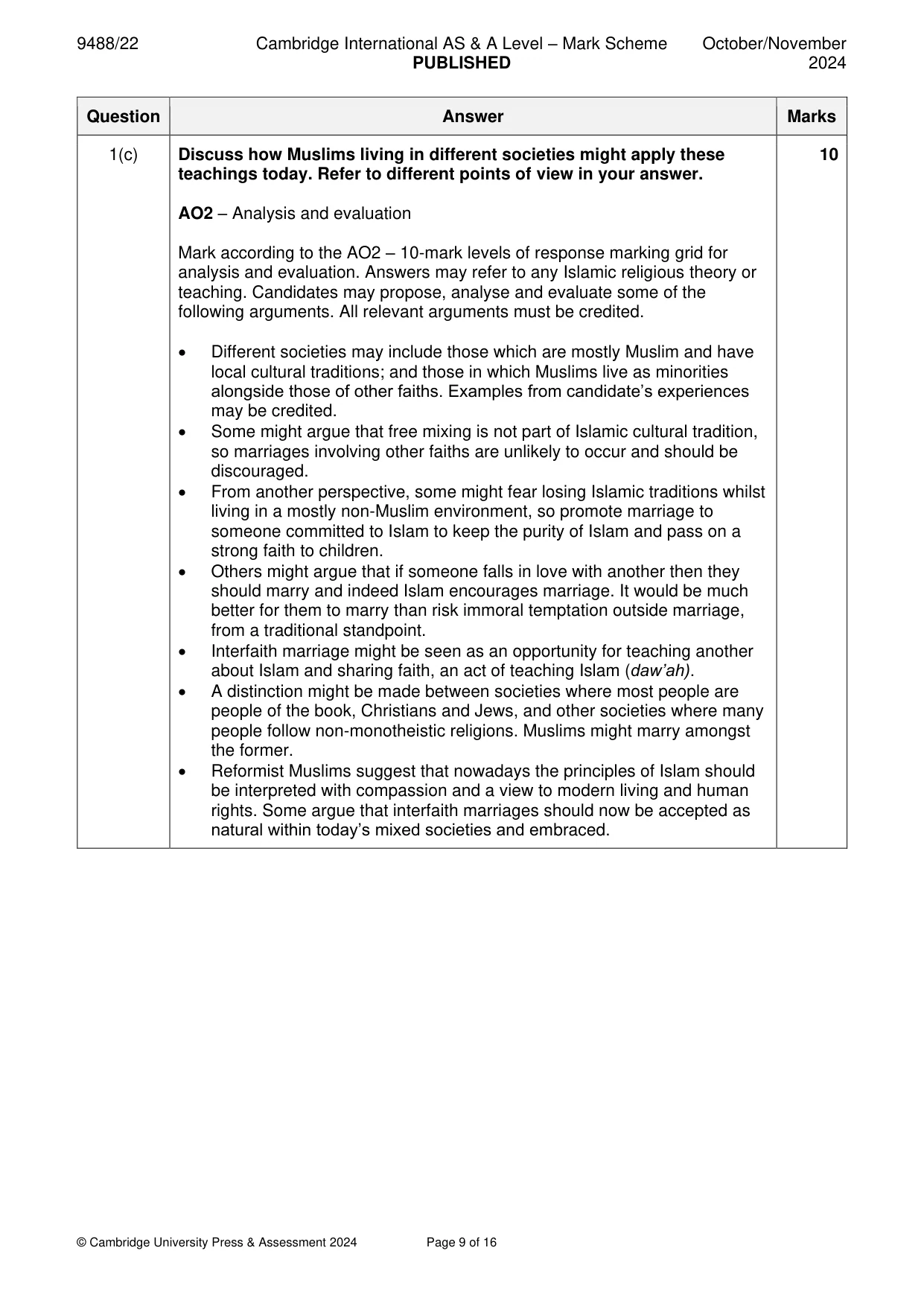
1 (a) Briefly describe the day of a marriage (nikah). [5] (b) Explain teachings about marriage (nikah) between Muslims and those of other faiths according to one school of jurisprudence (fiqh). [10] (c) Discuss how Muslims living in different societies might apply these teachings today. Refer to different points of view in your answer. [10] [Total: 25] OR
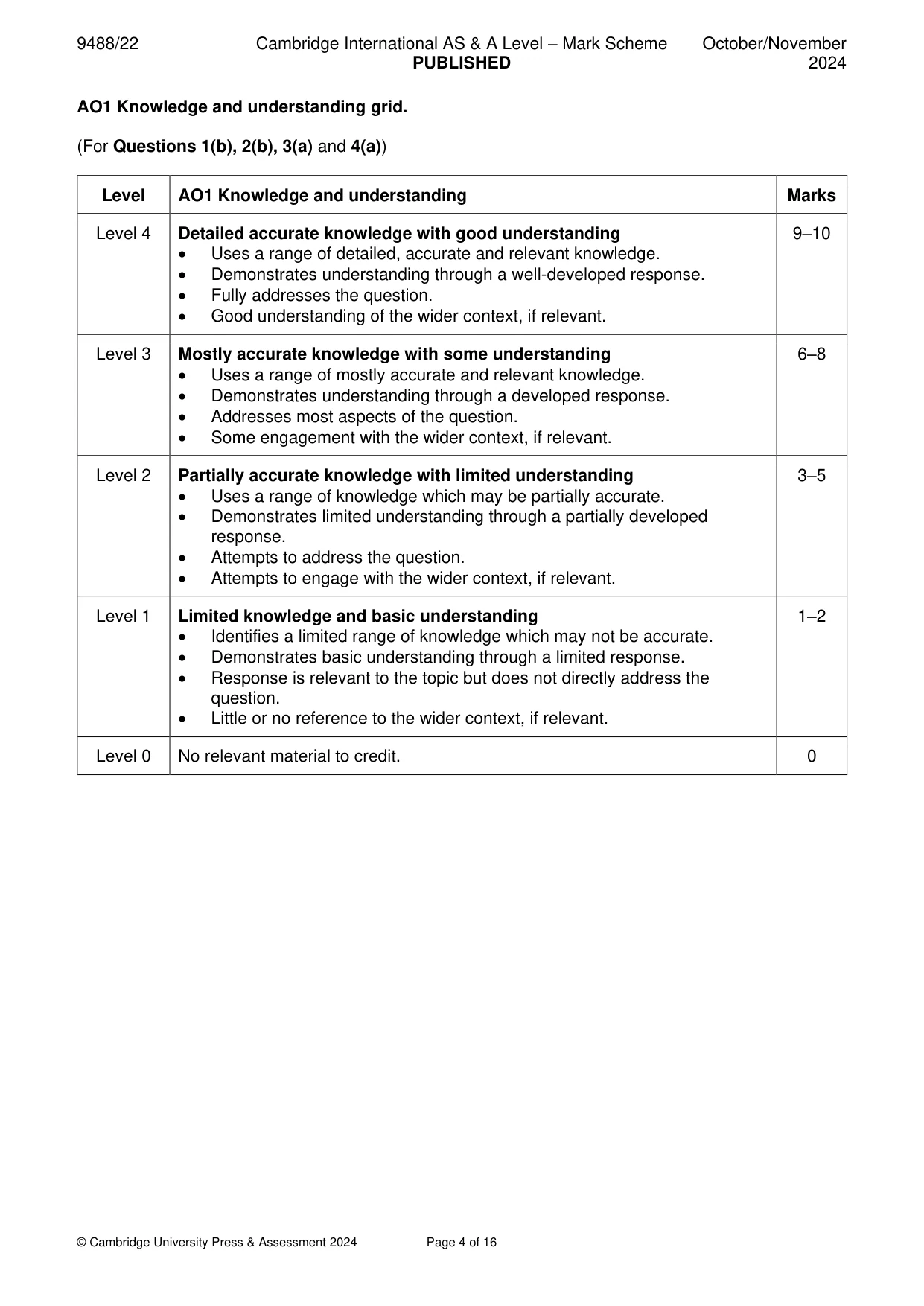
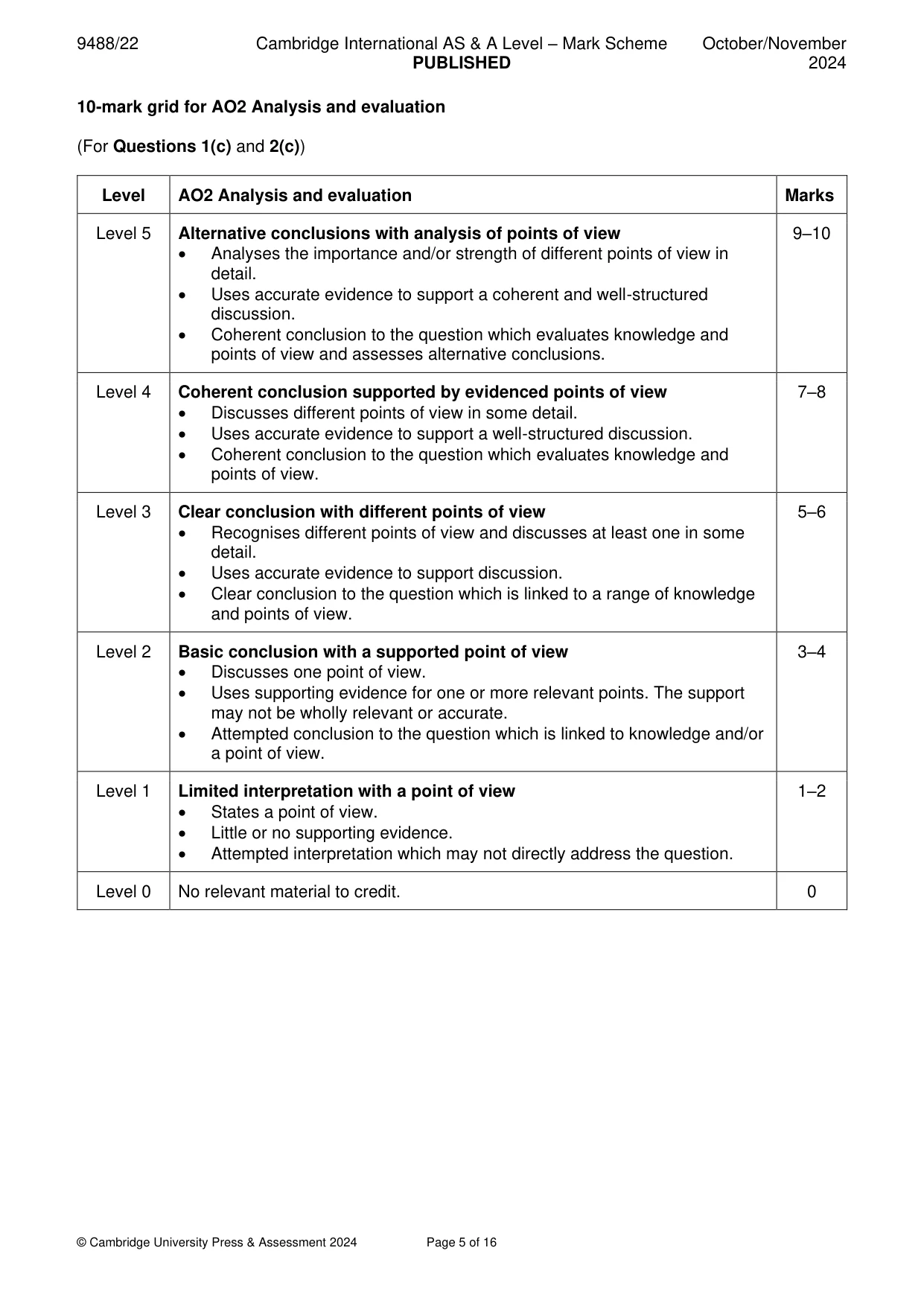
Mark scheme: Question Answer Marks EITHER 1(a) Briefly describe the day of a marriage (nikah). 5 AO1 - Knowledge and understanding Answers may include some of the following ideas, but all valid material must be credited. One mark should be awarded for each response. • A contract is signed • A guardian brings the bride (wali) • She freely agrees in front of witnesses • The groom also freely agrees in front of witnesses • The contract may specify dowry and terms (such as in case of divorce) • An Imam may read the Qur’an • An Imam may say a prayer of blessing on the couple • Some have a main meal (walimah) on the same day; others the day after • Accept cultural traditions, such as clothing, dinner parties and foods such as Biryani. 1(b) Explain teachings about marriage (nikah) between Muslims and those of 10 other faiths according to one school of jurisprudence (fiqh). AO1 - Knowledge and understanding Mark according to the AO1 – 10-mark levels of response marking grid for knowledge and understanding. Answers may include some of the following ideas, but all valid material must be credited. • There are a wide variety of different opinions about this, both within and between different schools of jurisprudence and different individual interpretations within Islam. • The Qur’an 5:5 states: ‘(Lawful unto you in marriage) are (not only) chaste women who are believers but chaste women among the People of the Book. This has been taken to mean a Muslim may marry a Christian or Jewish woman, but not those of other faiths.’ • Shaykh Yusuf Qaradawi, a modern Islamic scholar, interprets this to mean that marriage to Jewish and Christian women is allowed as they are a people of the book (ahl-e kitab). • Some reports of the life of Muhammad (pbuh) suggest that amongst his wives were Safiyya, a Jewish woman and Maria, an Egyptian Christian. • Caliph ‘Umar asked some who had married Jewish and Christian women to divorce, fearing their families would drift away from Islam and into immoral ways. It could be debated what this meant – whether it was specific to those people or a general point about interfaith marriage. • The Qur’an 2:256 states: ‘There is no compulsion in religion.’ It is a principle in Islamic law (shariah) that things are not considered haram unless they are specifically stated. There are many issues on which no teaching from the Qur’an or Hadith is directly available. These are generally considered allowed. • Another principle applied by scholars is precaution. The Shi’i scholar Al- Sistani rules that marriage is permitted but it should be a temporary marriage (muta). This is a specific category allowed by Shi’i scholars. As a precaution, he ruled that other believers in one deity, including Zoroastrians, should not be married, and Muslim women should only marry Muslim men. • Qur’an 2:221 states: ‘Do not marry unbelieving women (idolaters) until they believe; a slave woman who believes is better than an unbelieving woman even though she allure you.’ Some interpret ‘polytheists’ to mean all non-Muslims, disallowing marriage to Christians and Jews. • Some put conditions on marriage to a non-Muslim woman. She should not be amongst a group in conflict with the Muslims, according to the companion Ibn Abbas. She should have avoided unlawful sex before marriage. She has a guardian who agrees to give her in marriage; some say that guardian should be a Muslim. • Reformist Muslims such as Khaleel Mohammed and Amina Wadud accept interfaith marriages for both men and women, arguing that they are in accordance with the principles of human rights laid down by the Prophet. 1(c) Discuss how Muslims living in different societies might apply these 10 teachings today. Refer to different points of view in your answer. AO2 – Analysis and evaluation Mark according to the AO2 – 10-mark levels of response marking grid for analysis and evaluation. Answers may refer to any Islamic religious theory or teaching. Candidates may propose, analyse and evaluate some of the following arguments. All relevant arguments must be credited. • Different societies may include those which are mostly Muslim and have local cultural traditions; and those in which Muslims live as minorities alongside those of other faiths. Examples from candidate’s experiences may be credited. • Some might argue that free mixing is not part of Islamic cultural tradition, so marriages involving other faiths are unlikely to occur and should be discouraged. • From another perspective, some might fear losing Islamic traditions whilst living in a mostly non-Muslim environment, so promote marriage to someone committed to Islam to keep the purity of Islam and pass on a strong faith to children. • Others might argue that if someone falls in love with another then they should marry and indeed Islam encourages marriage. It would be much better for them to marry than risk immoral temptation outside marriage, from a traditional standpoint. • Interfaith marriage might be seen as an opportunity for teaching another about Islam and sharing faith, an act of teaching Islam (daw’ah). • A distinction might be made between societies where most people are people of the book, Christians and Jews, and other societies where many people follow non-monotheistic religions. Muslims might marry amongst the former. • Reformist Muslims suggest that nowadays the principles of Islam should be interpreted with compassion and a view to modern living and human rights. Some argue that interfaith marriages should now be accepted as natural within today’s mixed societies and embraced.
Q2 · Give five scholars who presented opinions of jurisprudence (fiqh) in Islam
2 (a) Give five scholars who presented opinions of jurisprudence (fiqh) in Islam. [5] (b) Explain the use of consensus (ijmaʿ) for Muslims as a source of Islamic law (shariah). [10] (c) Discuss the importance of consensus (ijmaʿ) today. Refer to two different schools of jurisprudence (fiqh) in your answer. [10] [Total: 25]
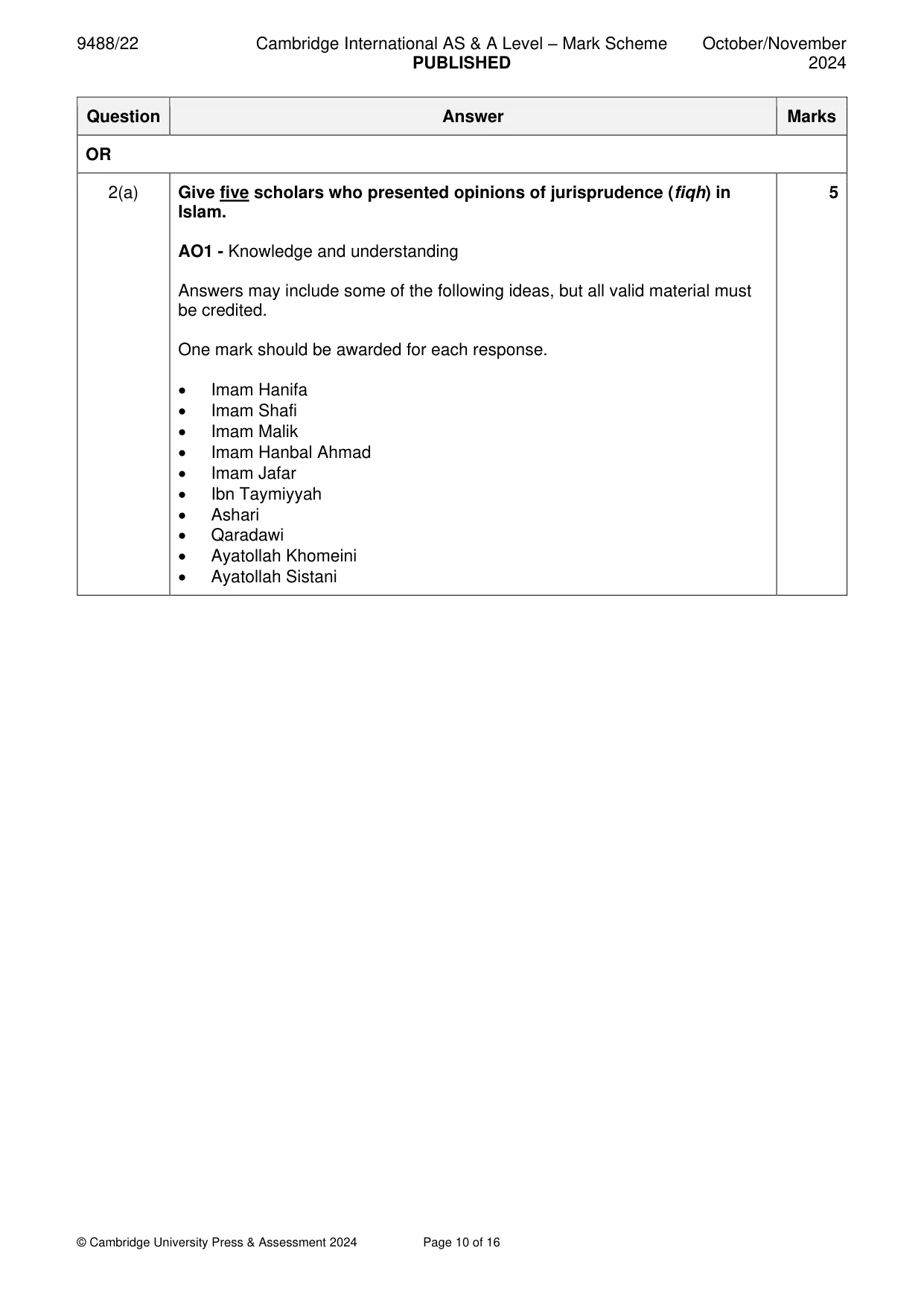
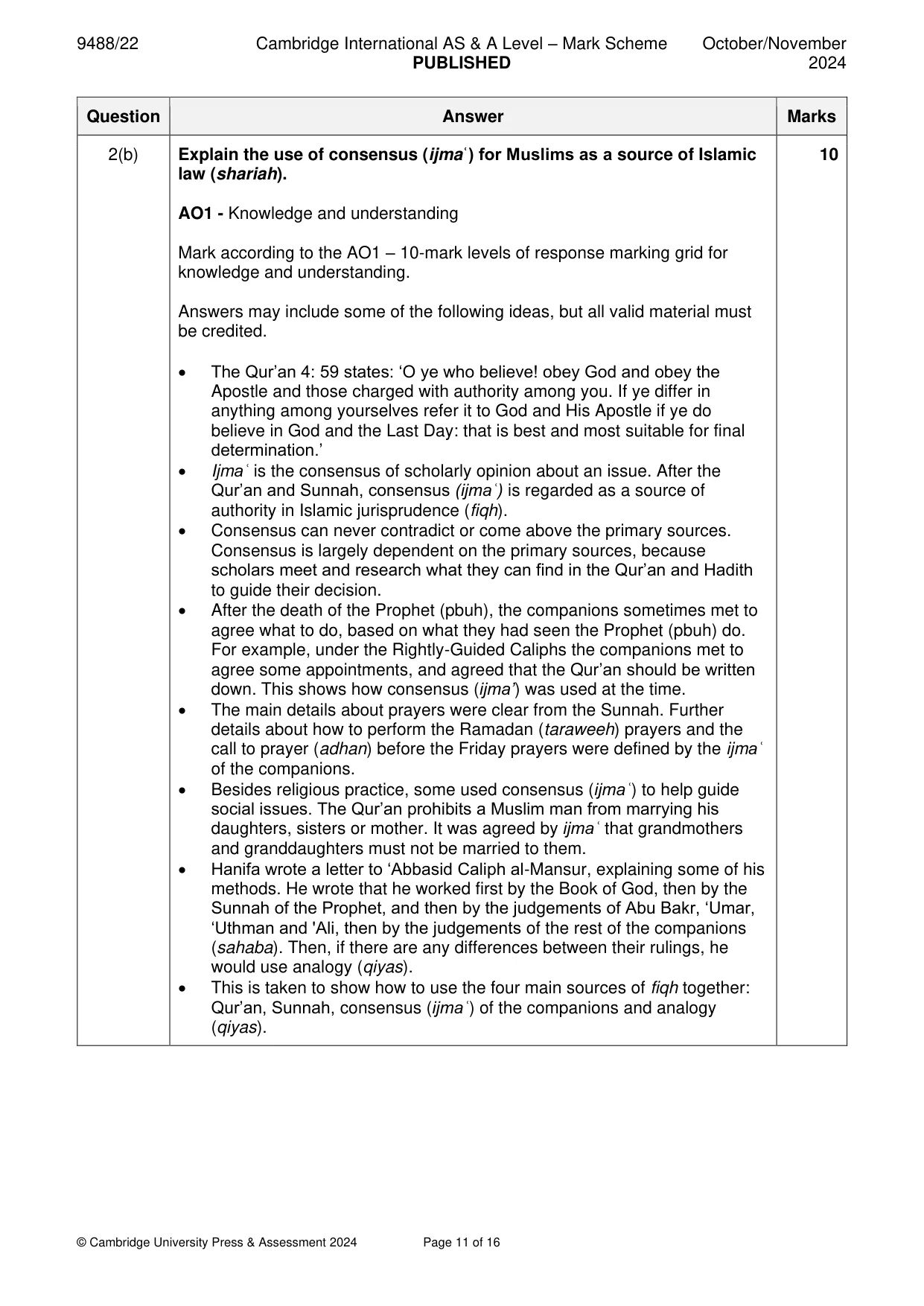
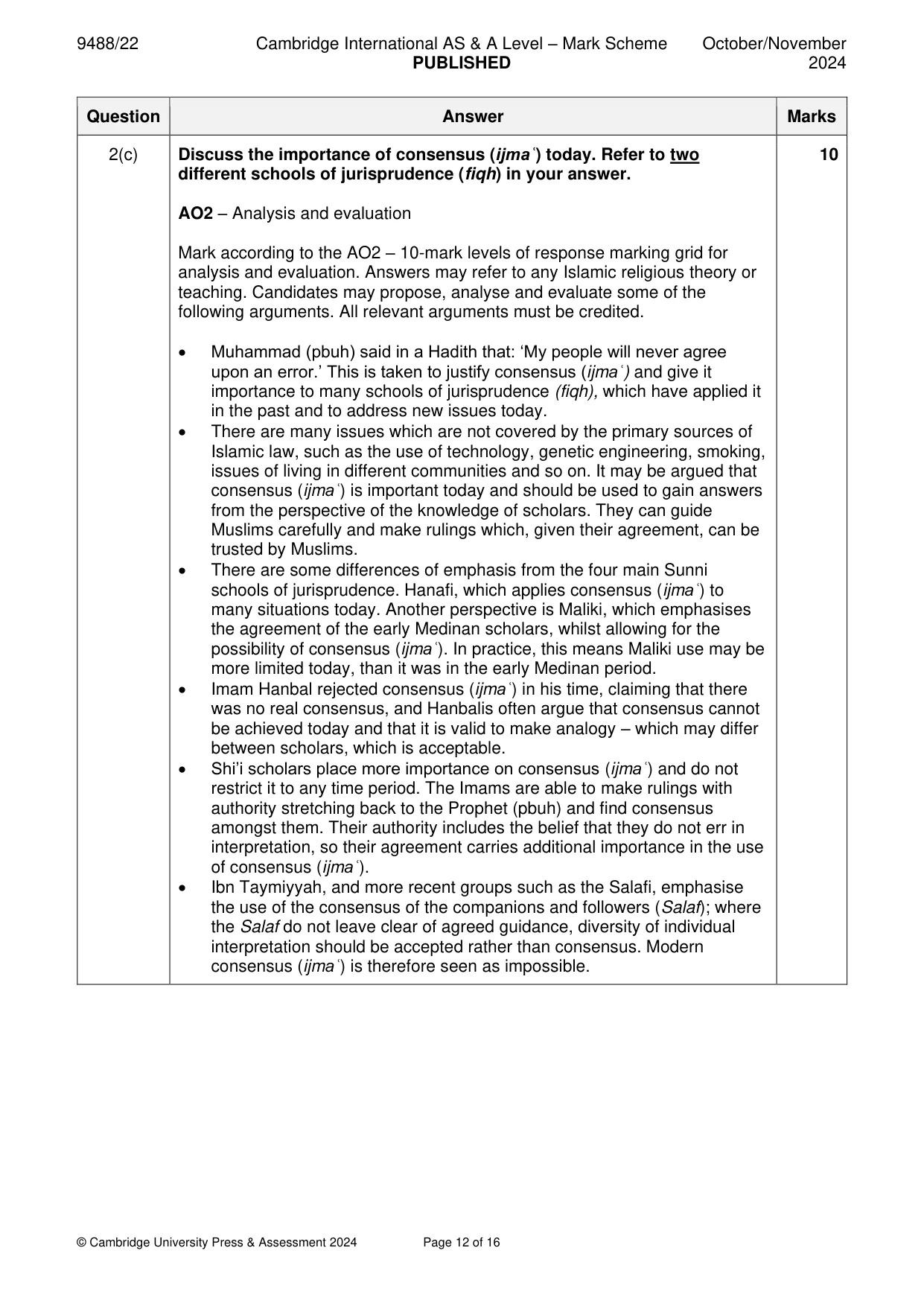
Mark scheme: 2(a) Give five scholars who presented opinions of jurisprudence (fiqh) in 5 Islam. AO1 - Knowledge and understanding Answers may include some of the following ideas, but all valid material must be credited. One mark should be awarded for each response. • Imam Hanifa • Imam Shafi • Imam Malik • Imam Hanbal Ahmad • Imam Jafar • Ibn Taymiyyah • Ashari • Qaradawi • Ayatollah Khomeini • Ayatollah Sistani 2(b) Explain the use of consensus (ijmaʿ) for Muslims as a source of Islamic 10 law (shariah). AO1 - Knowledge and understanding Mark according to the AO1 – 10-mark levels of response marking grid for knowledge and understanding. Answers may include some of the following ideas, but all valid material must be credited. • The Qur’an 4: 59 states: ‘O ye who believe! obey God and obey the Apostle and those charged with authority among you. If ye differ in anything among yourselves refer it to God and His Apostle if ye do believe in God and the Last Day: that is best and most suitable for final determination.’ • Ijmaʿ is the consensus of scholarly opinion about an issue. After the Qur’an and Sunnah, consensus (ijmaʿ) is regarded as a source of authority in Islamic jurisprudence (fiqh). • Consensus can never contradict or come above the primary sources. Consensus is largely dependent on the primary sources, because scholars meet and research what they can find in the Qur’an and Hadith to guide their decision. • After the death of the Prophet (pbuh), the companions sometimes met to agree what to do, based on what they had seen the Prophet (pbuh) do. For example, under the Rightly-Guided Caliphs the companions met to agree some appointments, and agreed that the Qur’an should be written down. This shows how consensus (ijma’) was used at the time. • The main details about prayers were clear from the Sunnah. Further details about how to perform the Ramadan (taraweeh) prayers and the call to prayer (adhan) before the Friday prayers were defined by the ijmaʿ of the companions. • Besides religious practice, some used consensus (ijmaʿ) to help guide social issues. The Qur’an prohibits a Muslim man from marrying his daughters, sisters or mother. It was agreed by ijmaʿ that grandmothers and granddaughters must not be married to them. • Hanifa wrote a letter to ‘Abbasid Caliph al-Mansur, explaining some of his methods. He wrote that he worked first by the Book of God, then by the Sunnah of the Prophet, and then by the judgements of Abu Bakr, ‘Umar, ‘Uthman and 'Ali, then by the judgements of the rest of the companions (sahaba). Then, if there are any differences between their rulings, he would use analogy (qiyas). • This is taken to show how to use the four main sources of fiqh together: Qur’an, Sunnah, consensus (ijmaʿ) of the companions and analogy (qiyas). 2(c) Discuss the importance of consensus (ijmaʿ) today. Refer to two 10 different schools of jurisprudence (fiqh) in your answer. AO2 – Analysis and evaluation Mark according to the AO2 – 10-mark levels of response marking grid for analysis and evaluation. Answers may refer to any Islamic religious theory or teaching. Candidates may propose, analyse and evaluate some of the following arguments. All relevant arguments must be credited. • Muhammad (pbuh) said in a Hadith that: ‘My people will never agree upon an error.’ This is taken to justify consensus (ijmaʿ) and give it importance to many schools of jurisprudence (fiqh), which have applied it in the past and to address new issues today. • There are many issues which are not covered by the primary sources of Islamic law, such as the use of technology, genetic engineering, smoking, issues of living in different communities and so on. It may be argued that consensus (ijmaʿ) is important today and should be used to gain answers from the perspective of the knowledge of scholars. They can guide Muslims carefully and make rulings which, given their agreement, can be trusted by Muslims. • There are some differences of emphasis from the four main Sunni schools of jurisprudence. Hanafi, which applies consensus (ijmaʿ) to many situations today. Another perspective is Maliki, which emphasises the agreement of the early Medinan scholars, whilst allowing for the possibility of consensus (ijmaʿ). In practice, this means Maliki use may be more limited today, than it was in the early Medinan period. • Imam Hanbal rejected consensus (ijmaʿ) in his time, claiming that there was no real consensus, and Hanbalis often argue that consensus cannot be achieved today and that it is valid to make analogy – which may differ between scholars, which is acceptable. • Shi’i scholars place more importance on consensus (ijmaʿ) and do not restrict it to any time period. The Imams are able to make rulings with authority stretching back to the Prophet (pbuh) and find consensus amongst them. Their authority includes the belief that they do not err in interpretation, so their agreement carries additional importance in the use of consensus (ijmaʿ). • Ibn Taymiyyah, and more recent groups such as the Salafi, emphasise the use of the consensus of the companions and followers (Salaf); where the Salaf do not leave clear of agreed guidance, diversity of individual interpretation should be accepted rather than consensus. Modern consensus (ijmaʿ) is therefore seen as impossible.
Q3 · Explain how Sunni Imams are appointed
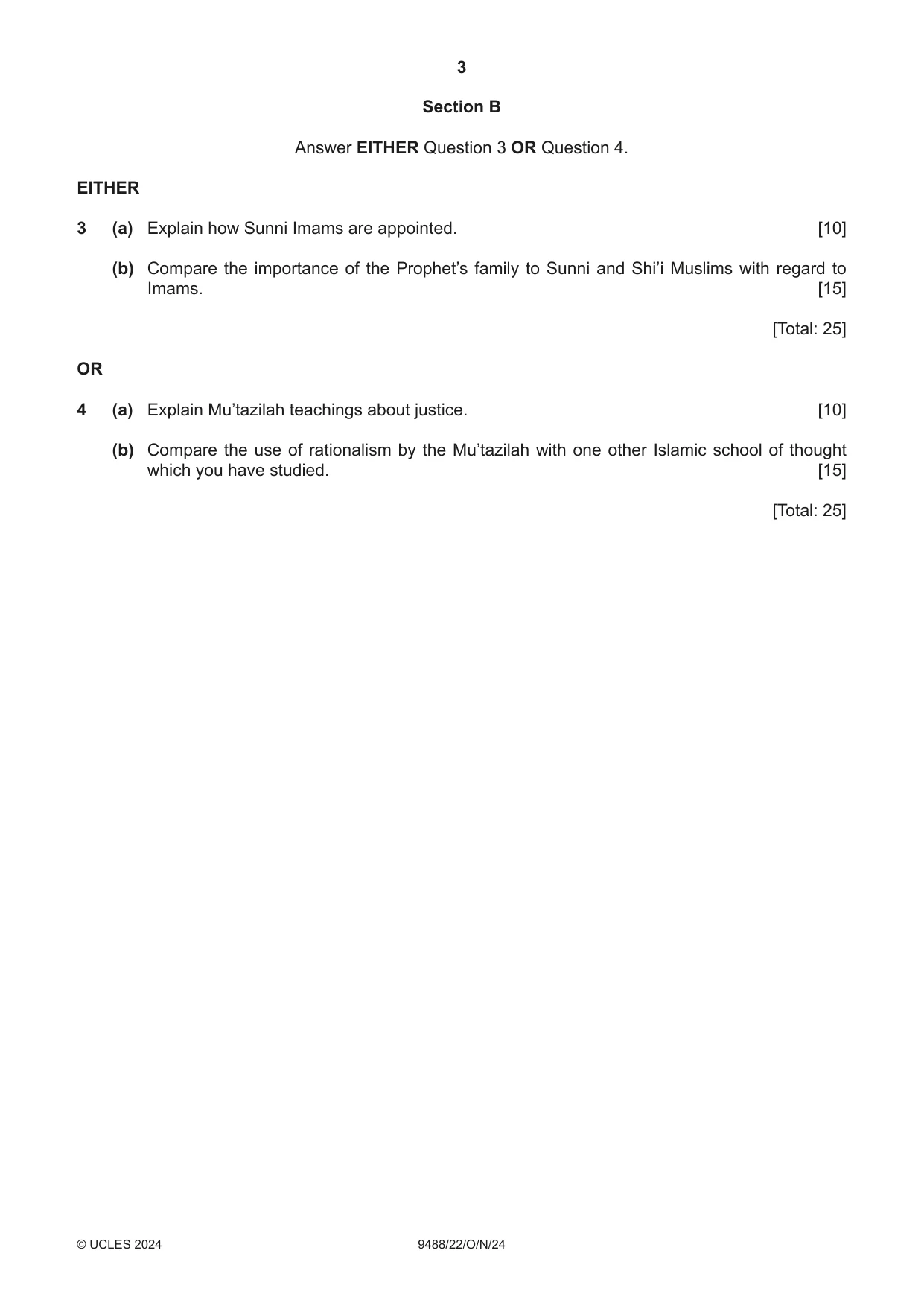
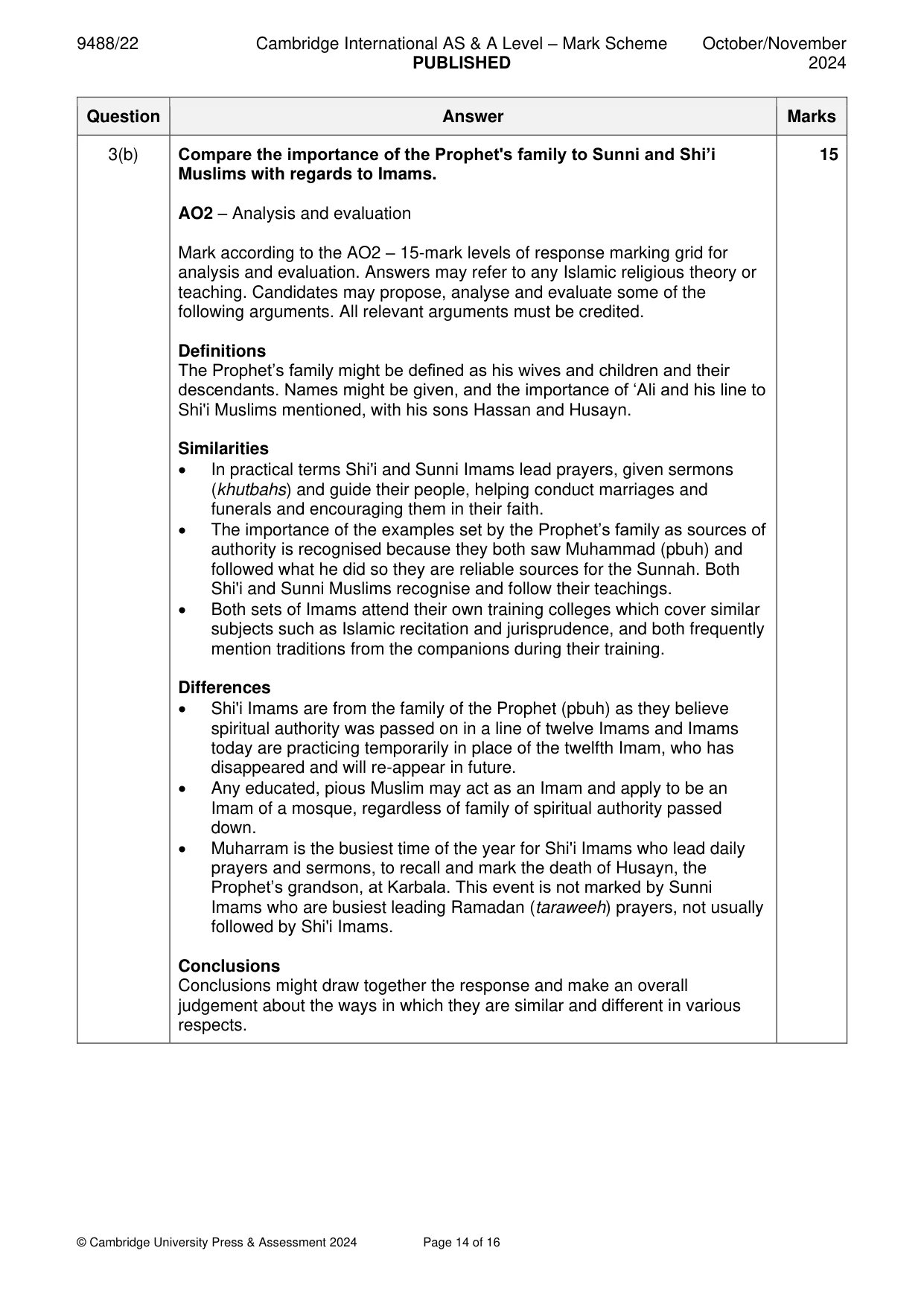
3 (a) Explain how Sunni Imams are appointed. [10] (b) Compare the importance of the Prophet’s family to Sunni and Shi’i Muslims with regard to Imams. [15] [Total: 25] OR
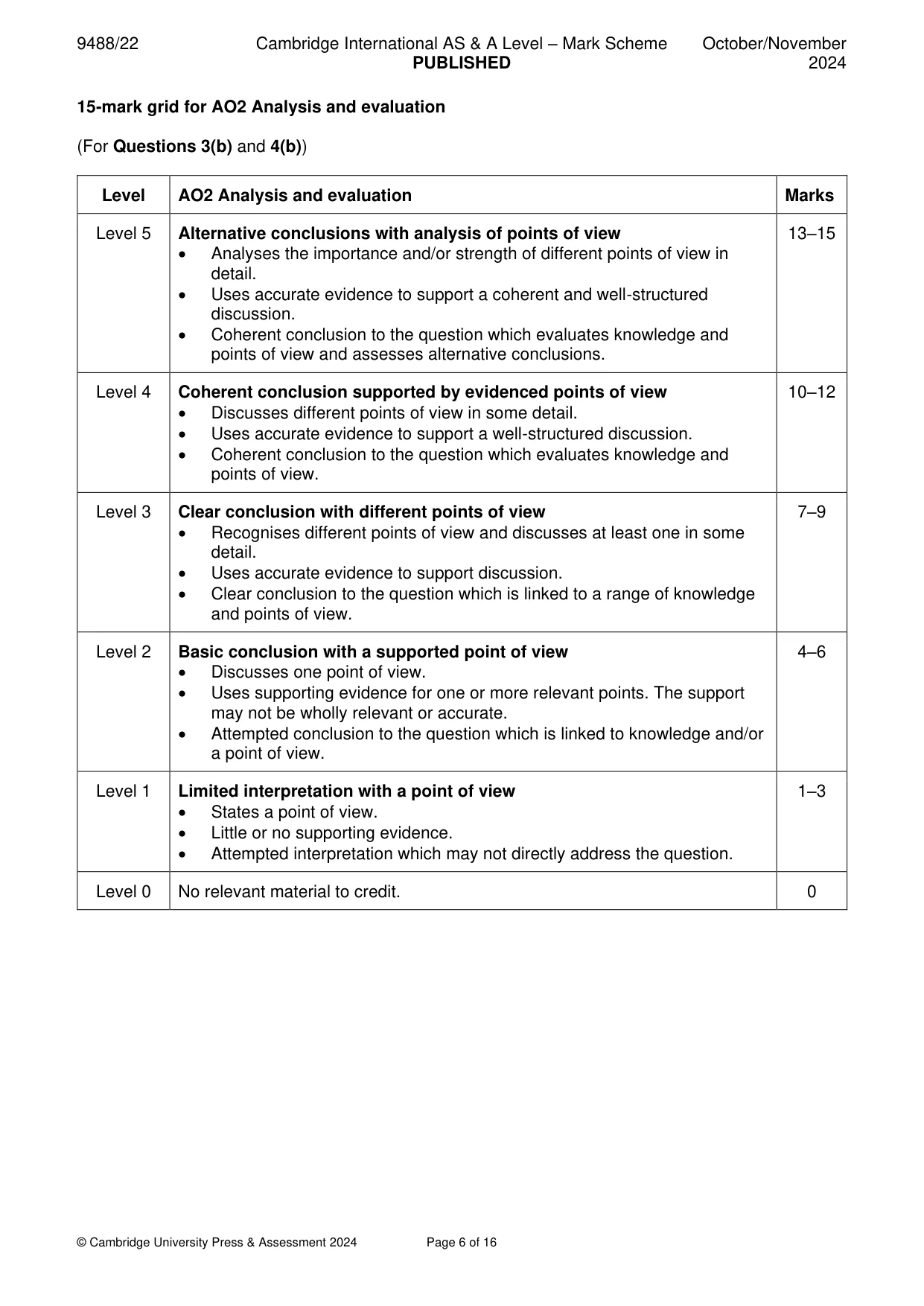
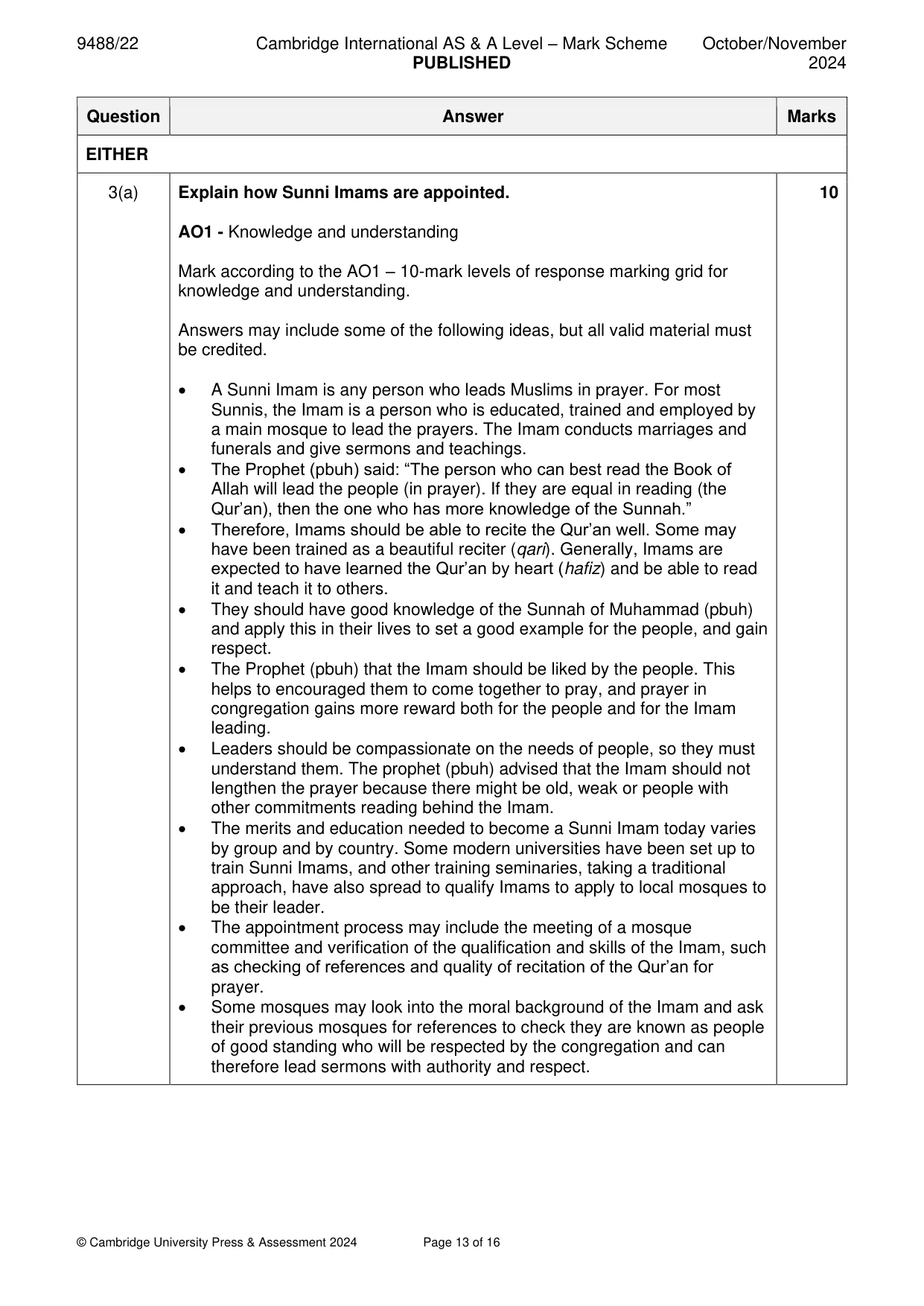
Mark scheme: 3(a) Explain how Sunni Imams are appointed. 10 AO1 - Knowledge and understanding Mark according to the AO1 – 10-mark levels of response marking grid for knowledge and understanding. Answers may include some of the following ideas, but all valid material must be credited. • A Sunni Imam is any person who leads Muslims in prayer. For most Sunnis, the Imam is a person who is educated, trained and employed by a main mosque to lead the prayers. The Imam conducts marriages and funerals and give sermons and teachings. • The Prophet (pbuh) said: “The person who can best read the Book of Allah will lead the people (in prayer). If they are equal in reading (the Qur’an), then the one who has more knowledge of the Sunnah.” • Therefore, Imams should be able to recite the Qur’an well. Some may have been trained as a beautiful reciter (qari). Generally, Imams are expected to have learned the Qur’an by heart (hafiz) and be able to read it and teach it to others. • They should have good knowledge of the Sunnah of Muhammad (pbuh) and apply this in their lives to set a good example for the people, and gain respect. • The Prophet (pbuh) that the Imam should be liked by the people. This helps to encouraged them to come together to pray, and prayer in congregation gains more reward both for the people and for the Imam leading. • Leaders should be compassionate on the needs of people, so they must understand them. The prophet (pbuh) advised that the Imam should not lengthen the prayer because there might be old, weak or people with other commitments reading behind the Imam. • The merits and education needed to become a Sunni Imam today varies by group and by country. Some modern universities have been set up to train Sunni Imams, and other training seminaries, taking a traditional approach, have also spread to qualify Imams to apply to local mosques to be their leader. • The appointment process may include the meeting of a mosque committee and verification of the qualification and skills of the Imam, such as checking of references and quality of recitation of the Qur’an for prayer. • Some mosques may look into the moral background of the Imam and ask their previous mosques for references to check they are known as people of good standing who will be respected by the congregation and can therefore lead sermons with authority and respect. 3(b) Compare the importance of the Prophet's family to Sunni and Shi’i 15 Muslims with regards to Imams. AO2 – Analysis and evaluation Mark according to the AO2 – 15-mark levels of response marking grid for analysis and evaluation. Answers may refer to any Islamic religious theory or teaching. Candidates may propose, analyse and evaluate some of the following arguments. All relevant arguments must be credited. Definitions The Prophet’s family might be defined as his wives and children and their descendants. Names might be given, and the importance of ‘Ali and his line to Shi'i Muslims mentioned, with his sons Hassan and Husayn. Similarities • In practical terms Shi'i and Sunni Imams lead prayers, given sermons (khutbahs) and guide their people, helping conduct marriages and funerals and encouraging them in their faith. • The importance of the examples set by the Prophet’s family as sources of authority is recognised because they both saw Muhammad (pbuh) and followed what he did so they are reliable sources for the Sunnah. Both Shi'i and Sunni Muslims recognise and follow their teachings. • Both sets of Imams attend their own training colleges which cover similar subjects such as Islamic recitation and jurisprudence, and both frequently mention traditions from the companions during their training. Differences • Shi'i Imams are from the family of the Prophet (pbuh) as they believe spiritual authority was passed on in a line of twelve Imams and Imams today are practicing temporarily in place of the twelfth Imam, who has disappeared and will re-appear in future. • Any educated, pious Muslim may act as an Imam and apply to be an Imam of a mosque, regardless of family of spiritual authority passed down. • Muharram is the busiest time of the year for Shi'i Imams who lead daily prayers and sermons, to recall and mark the death of Husayn, the Prophet’s grandson, at Karbala. This event is not marked by Sunni Imams who are busiest leading Ramadan (taraweeh) prayers, not usually followed by Shi'i Imams. Conclusions Conclusions might draw together the response and make an overall judgement about the ways in which they are similar and different in various respects.
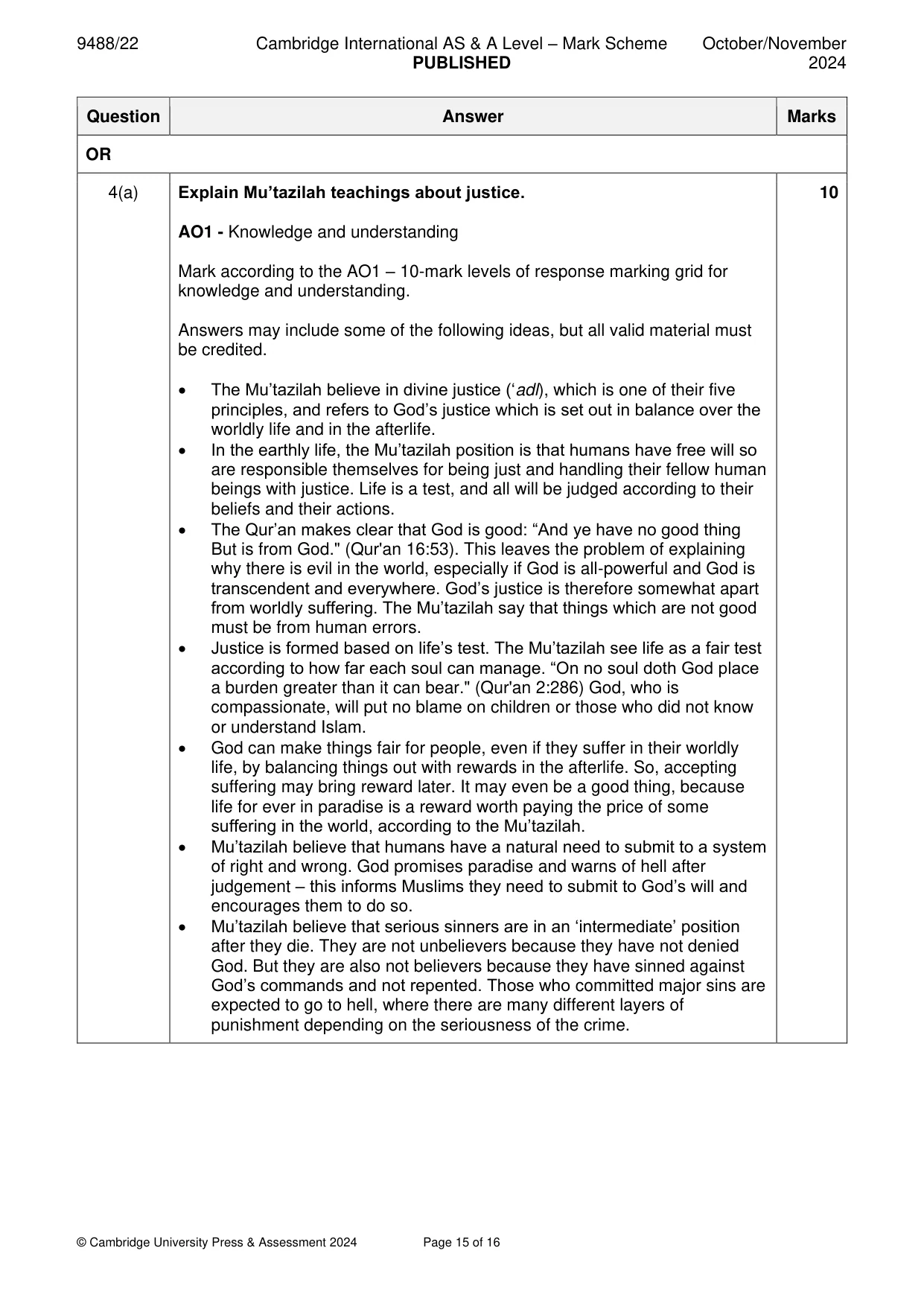
Q4 · Explain Mu’tazilah teachings about justice
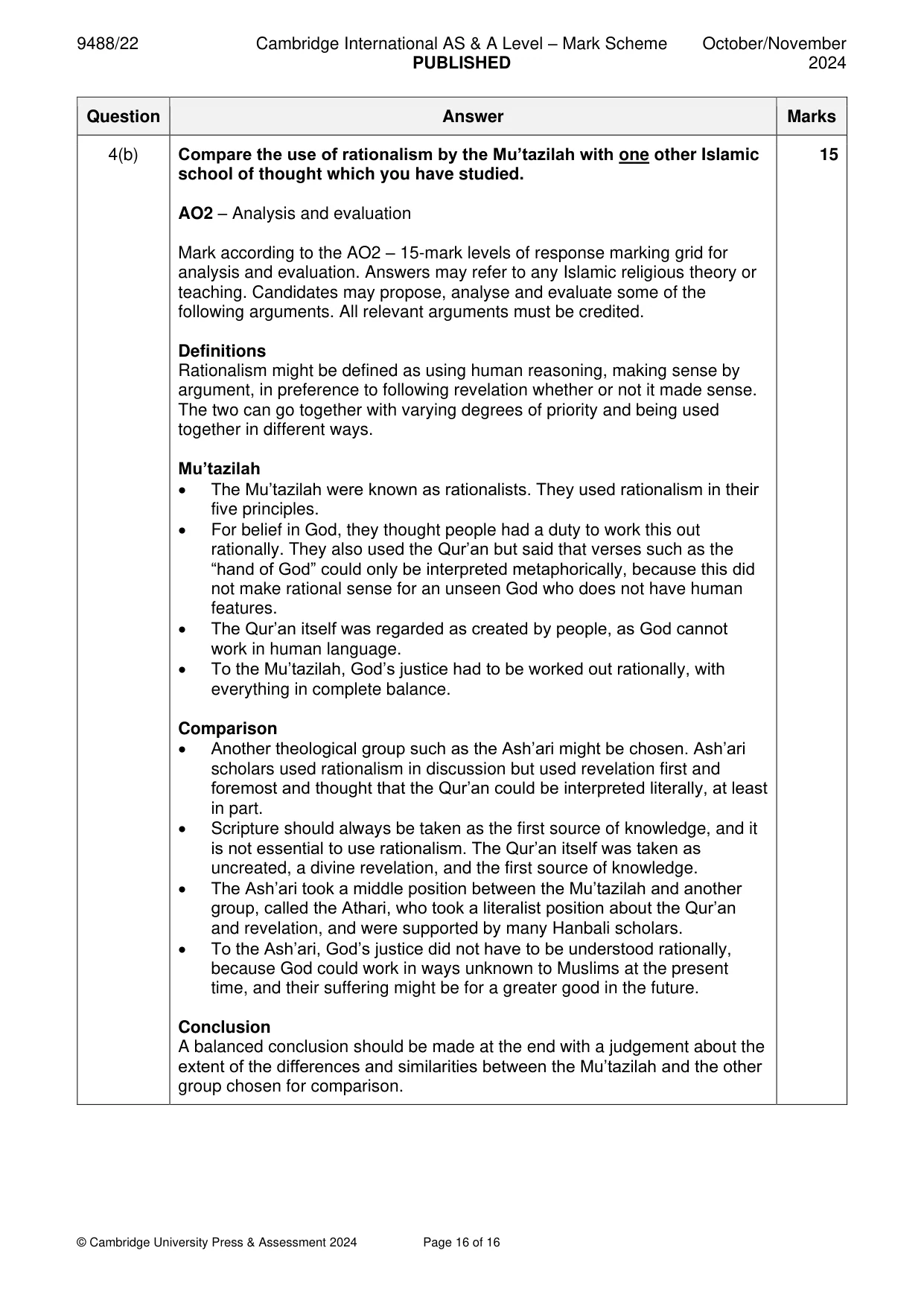
4 (a) Explain Mu’tazilah teachings about justice. [10] (b) Compare the use of rationalism by the Mu’tazilah with one other Islamic school of thought which you have studied. [15] [Total: 25]
Mark scheme: 4(a) Explain Mu’tazilah teachings about justice. 10 AO1 - Knowledge and understanding Mark according to the AO1 – 10-mark levels of response marking grid for knowledge and understanding. Answers may include some of the following ideas, but all valid material must be credited. • The Mu’tazilah believe in divine justice (‘adl), which is one of their five principles, and refers to God’s justice which is set out in balance over the worldly life and in the afterlife. • In the earthly life, the Mu’tazilah position is that humans have free will so are responsible themselves for being just and handling their fellow human beings with justice. Life is a test, and all will be judged according to their beliefs and their actions. • The Qur’an makes clear that God is good: “And ye have no good thing But is from God." (Qur'an 16:53). This leaves the problem of explaining why there is evil in the world, especially if God is all-powerful and God is transcendent and everywhere. God’s justice is therefore somewhat apart from worldly suffering. The Mu’tazilah say that things which are not good must be from human errors. • Justice is formed based on life’s test. The Mu’tazilah see life as a fair test according to how far each soul can manage. “On no soul doth God place a burden greater than it can bear." (Qur'an 2:286) God, who is compassionate, will put no blame on children or those who did not know or understand Islam. • God can make things fair for people, even if they suffer in their worldly life, by balancing things out with rewards in the afterlife. So, accepting suffering may bring reward later. It may even be a good thing, because life for ever in paradise is a reward worth paying the price of some suffering in the world, according to the Mu’tazilah. • Mu’tazilah believe that humans have a natural need to submit to a system of right and wrong. God promises paradise and warns of hell after judgement – this informs Muslims they need to submit to God’s will and encourages them to do so. • Mu’tazilah believe that serious sinners are in an ‘intermediate’ position after they die. They are not unbelievers because they have not denied God. But they are also not believers because they have sinned against God’s commands and not repented. Those who committed major sins are expected to go to hell, where there are many different layers of punishment depending on the seriousness of the crime. 4(b) Compare the use of rationalism by the Mu’tazilah with one other Islamic 15 school of thought which you have studied. AO2 – Analysis and evaluation Mark according to the AO2 – 15-mark levels of response marking grid for analysis and evaluation. Answers may refer to any Islamic religious theory or teaching. Candidates may propose, analyse and evaluate some of the following arguments. All relevant arguments must be credited. Definitions Rationalism might be defined as using human reasoning, making sense by argument, in preference to following revelation whether or not it made sense. The two can go together with varying degrees of priority and being used together in different ways. Mu’tazilah • The Mu’tazilah were known as rationalists. They used rationalism in their five principles. • For belief in God, they thought people had a duty to work this out rationally. They also used the Qur’an but said that verses such as the “hand of God” could only be interpreted metaphorically, because this did not make rational sense for an unseen God who does not have human features. • The Qur’an itself was regarded as created by people, as God cannot work in human language. • To the Mu’tazilah, God’s justice had to be worked out rationally, with everything in complete balance. Comparison • Another theological group such as the Ash’ari might be chosen. Ash’ari scholars used rationalism in discussion but used revelation first and foremost and thought that the Qur’an could be interpreted literally, at least in part. • Scripture should always be taken as the first source of knowledge, and it is not essential to use rationalism. The Qur’an itself was taken as uncreated, a divine revelation, and the first source of knowledge. • The Ash’ari took a middle position between the Mu’tazilah and another group, called the Athari, who took a literalist position about the Qur’an and revelation, and were supported by many Hanbali scholars. • To the Ash’ari, God’s justice did not have to be understood rationally, because God could work in ways unknown to Muslims at the present time, and their suffering might be for a greater good in the future. Conclusion A balanced conclusion should be made at the end with a judgement about the extent of the differences and similarities between the Mu’tazilah and the other group chosen for comparison.
What was in this paper
The subtopics covered by these 4 questions, and how many questions each got. Open one in a new tab to see every Cambridge question on it.
What you needed in this session
Cambridge’s own grade thresholds for 2024 Oct/Nov, Paper 2 · Variant 2. A higher threshold means an easier paper — the bar moves with how the cohort did.