Cambridge A Level Islamic Studies 9488 — 2023 May/June Paper 2 · Variant 2
9488/22/M/J/23 · 4 questions · 50 marks · ≈56 min
The question paper and its mark scheme, free to read here and free to download. This is Cambridge’s own paper, exactly as it was sat.
Question paper4 pages

Mark scheme18 pages
Answers below. Sit the paper first if you are practising.
Questions as text
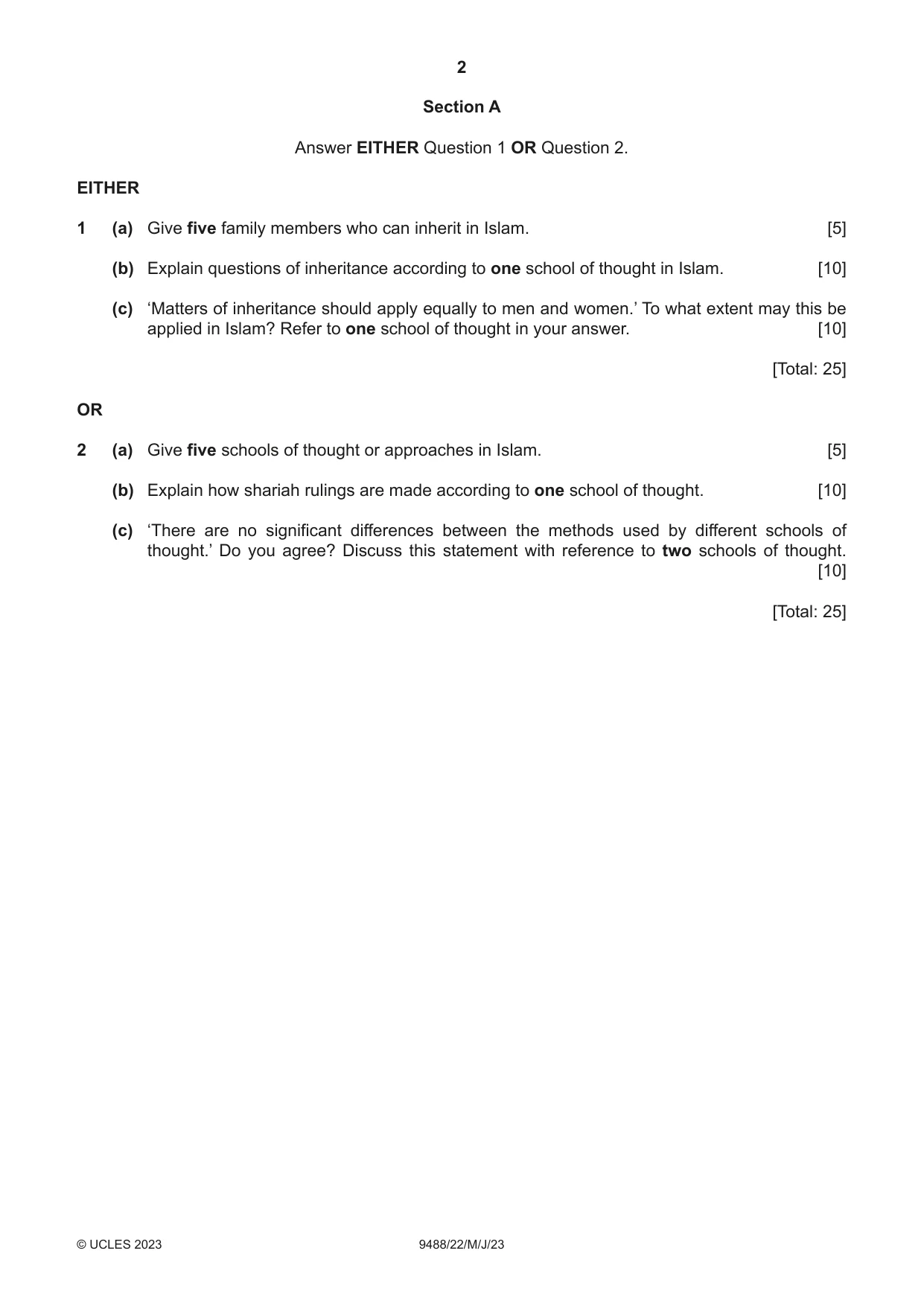
Q1 · Give five family members who can inherit in Islam
1 (a) Give five family members who can inherit in Islam. [5] (b) Explain questions of inheritance according to one school of thought in Islam. [10] (c) ‘Matters of inheritance should apply equally to men and women.’ To what extent may this be applied in Islam? Refer to one school of thought in your answer. [10] [Total: 25] OR
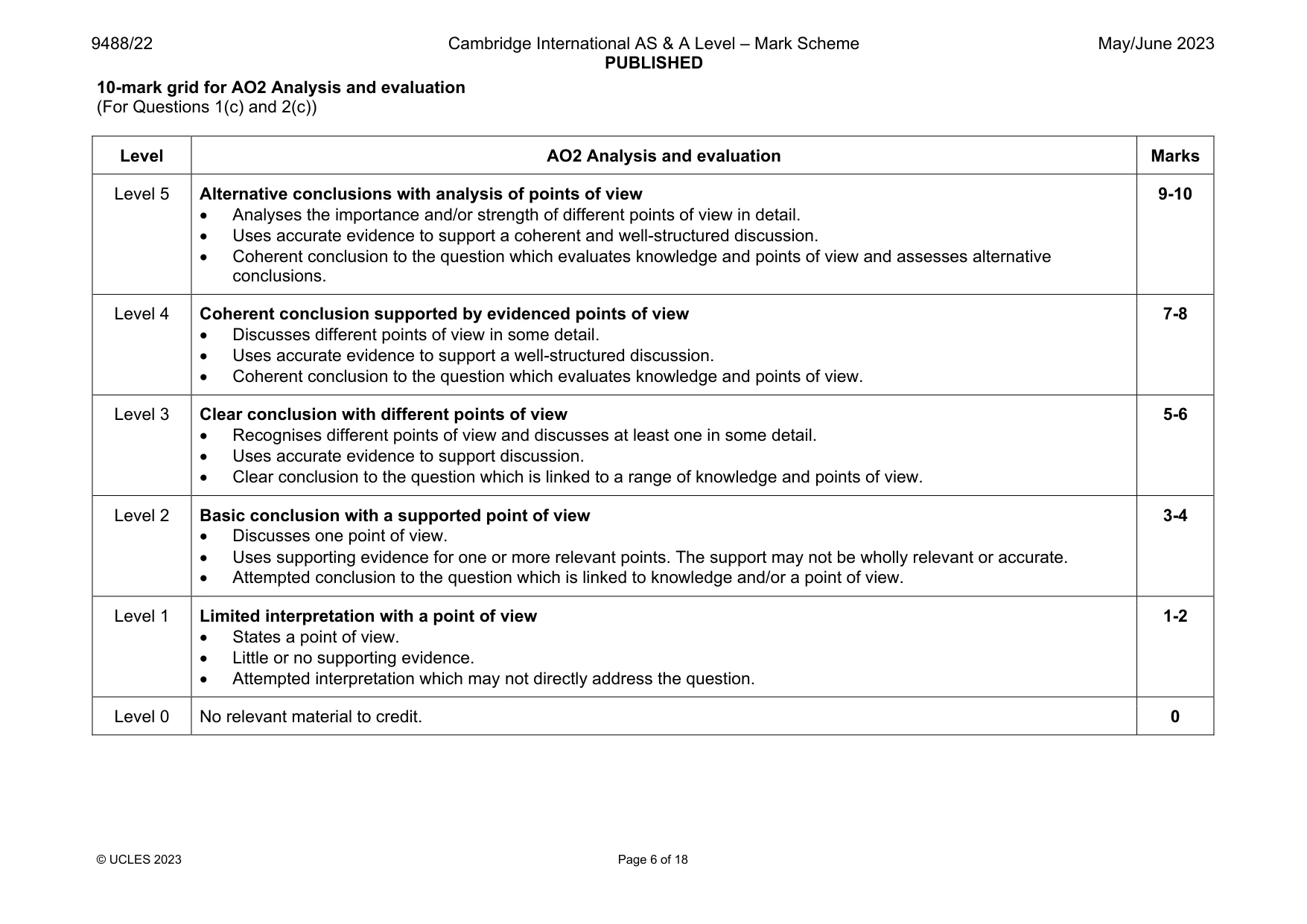
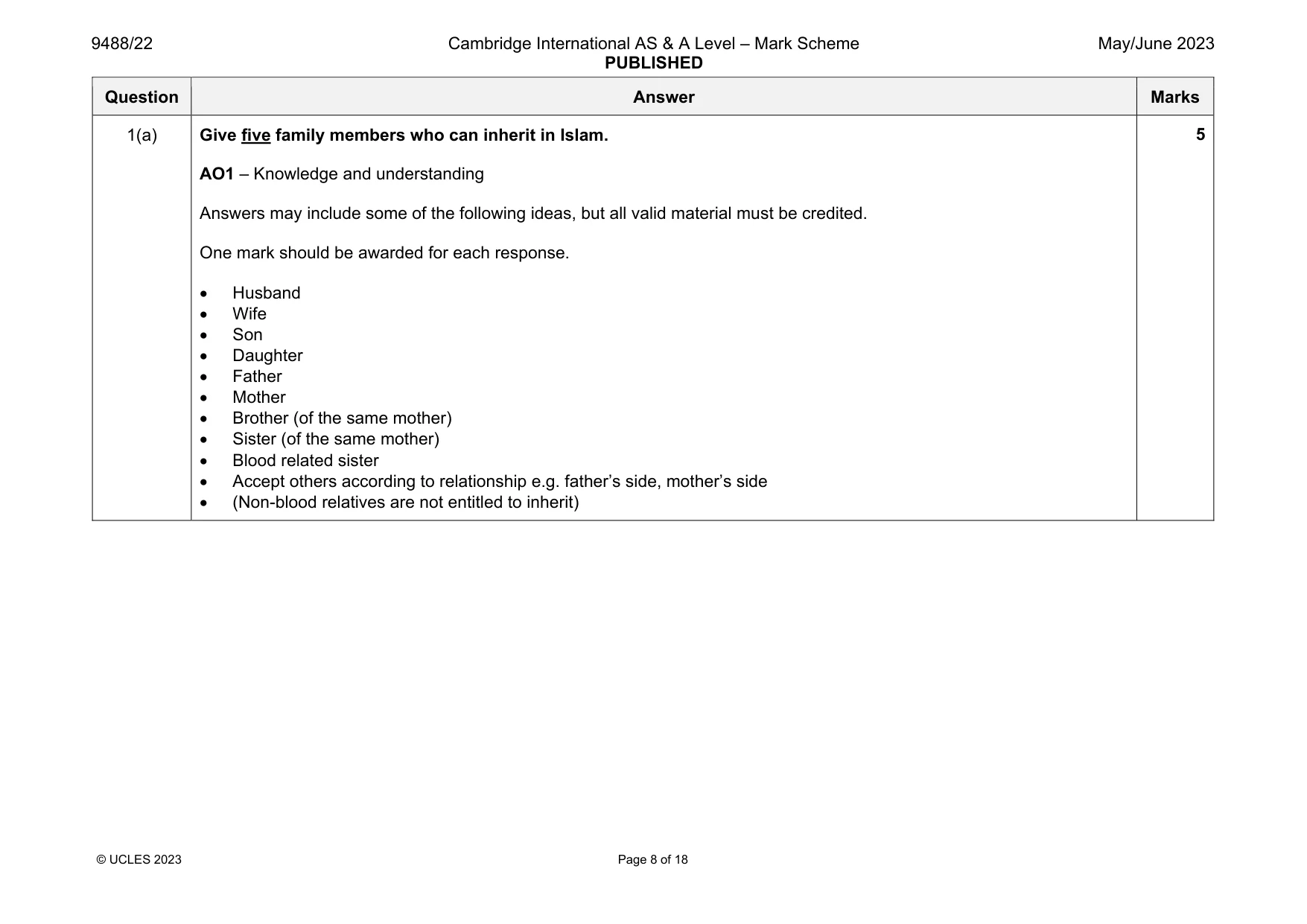
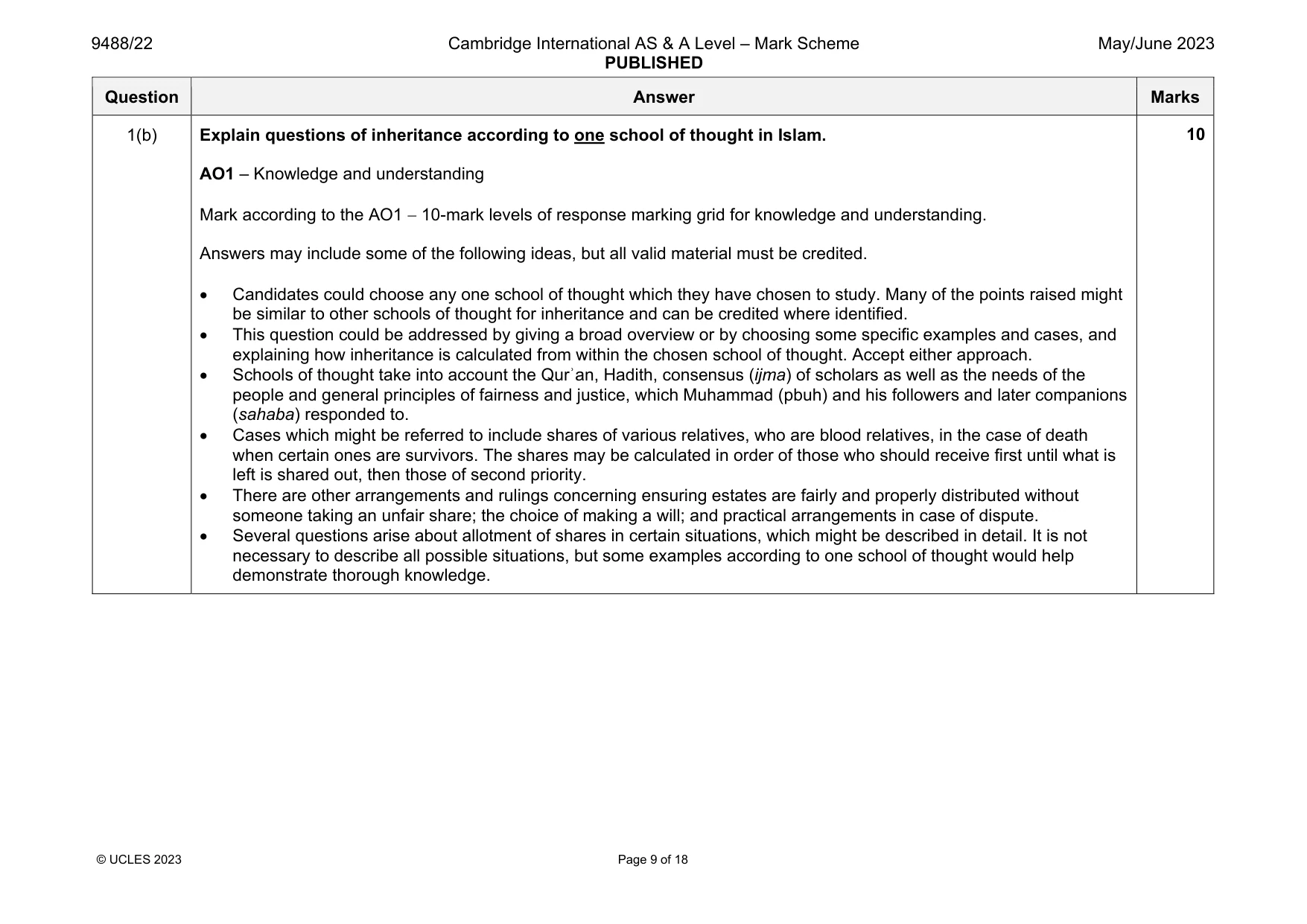
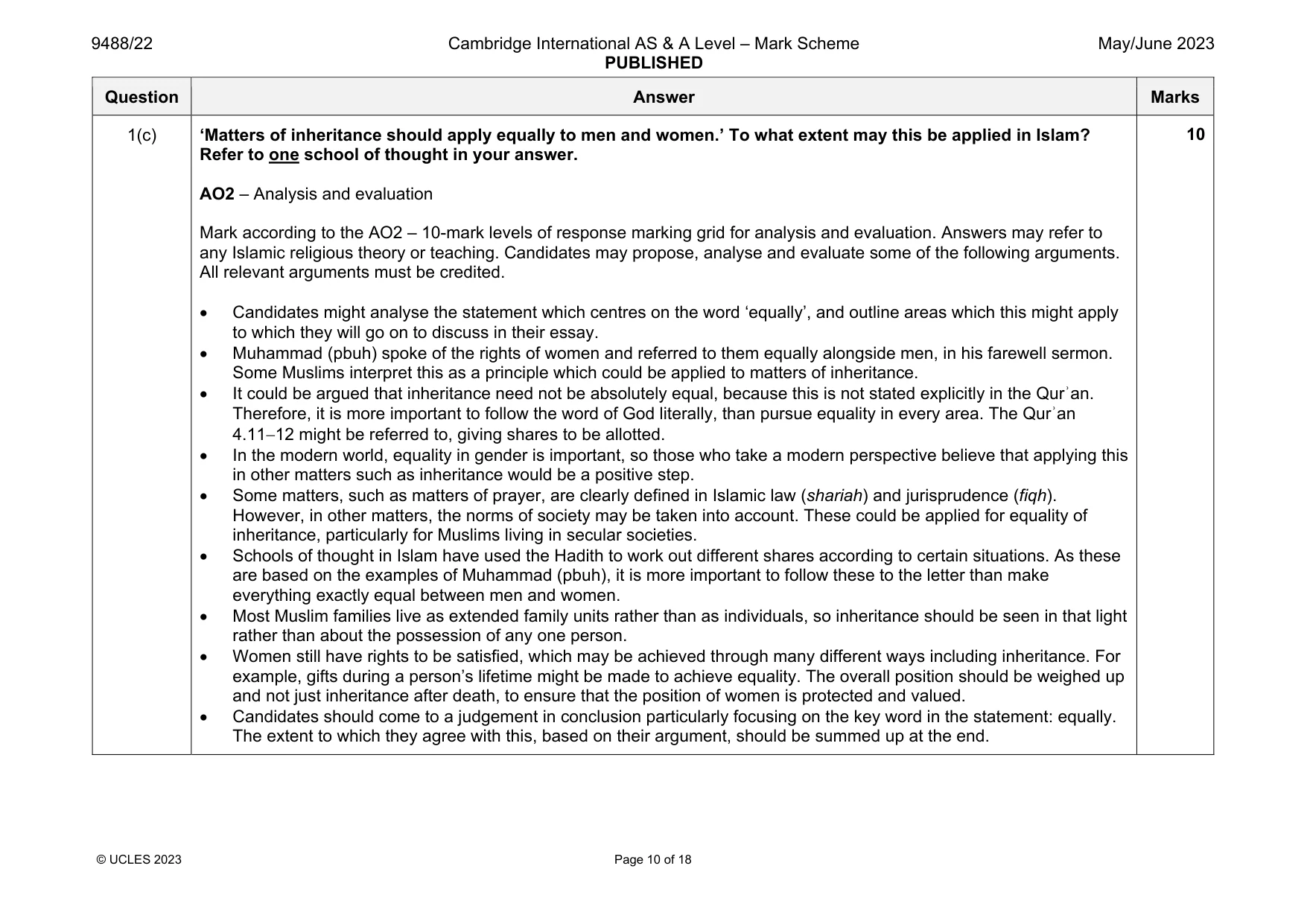
Mark scheme: 1(a) Give five family members who can inherit in Islam. AO1 – Knowledge and understanding Answers may include some of the following ideas, but all valid material must be credited. One mark should be awarded for each response. Husband Wife Son Daughter Father Mother Brother (of the same mother) Sister (of the same mother) Blood related sister Accept others according to relationship e.g. father’s side, mother’s side (Non-blood relatives are not entitled to inherit) Question Answer Marks 1(b) Explain questions of inheritance according to one school of thought in Islam. AO1 – Knowledge and understanding Mark according to the AO1 10-mark levels of response marking grid for knowledge and understanding. Answers may include some of the following ideas, but all valid material must be credited. Candidates could choose any one school of thought which they have chosen to study. Many of the points raised might be similar to other schools of thought for inheritance and can be credited where identified. This question could be addressed by giving a broad overview or by choosing some specific examples and cases, and explaining how inheritance is calculated from within the chosen school of thought. Accept either approach. Schools of thought take into account the Qurʾan, Hadith, consensus (ijma) of scholars as well as the needs of the people and general principles of fairness and justice, which Muhammad (pbuh) and his followers and later companions (sahaba) responded to. Cases which might be referred to include shares of various relatives, who are blood relatives, in the case of death when certain ones are survivors. The shares may be calculated in order of those who should receive first until what is left is shared out, then those of second priority. There are other arrangements and rulings concerning ensuring estates are fairly and properly distributed without someone taking an unfair share; the choice of making a will; and practical arrangements in case of dispute. Several questions arise about allotment of shares in certain situations, which might be described in detail. It is not necessary to describe all possible situations, but some examples according to one school of thought would help demonstrate thorough knowledge. 10 Question Answer Marks 1(c) ‘Matters of inheritance should apply equally to men and women.’ To what extent may this be applied in Islam? Refer to one school of thought in your answer. AO2 – Analysis and evaluation Mark according to the AO2 – 10-mark levels of response marking grid for analysis and evaluation. Answers may refer to any Islamic religious theory or teaching. Candidates may propose, analyse and evaluate some of the following arguments. All relevant arguments must be credited. Candidates might analyse the statement which centres on the word ‘equally’, and outline areas which this might apply to which they will go on to discuss in their essay. Muhammad (pbuh) spoke of the rights of women and referred to them equally alongside men, in his farewell sermon. Some Muslims interpret this as a principle which could be applied to matters of inheritance. It could be argued that inheritance need not be absolutely equal, because this is not stated explicitly in the Qurʾan. Therefore, it is more important to follow the word of God literally, than pursue equality in every area. The Qurʾan 4.1112 might be referred to, giving shares to be allotted. In the modern world, equality in gender is important, so those who take a modern perspective believe that applying this in other matters such as inheritance would be a positive step. Some matters, such as matters of prayer, are clearly defined in Islamic law (shariah) and jurisprudence (fiqh). However, in other matters, the norms of society may be taken into account. These could be applied for equality of inheritance, particularly for Muslims living in secular societies. Schools of thought in Islam have used the Hadith to work out different shares according to certain situations. As these are based on the examples of Muhammad (pbuh), it is more important to follow these to the letter than make everything exactly equal between men and women. Most Muslim families live as extended family units rather than as individuals, so inheritance should be seen in that light rather than about the possession of any one person. Women still have rights to be satisfied, which may be achieved through many different ways including inheritance. For example, gifts during a person’s lifetime might be made to achieve equality. The overall position should be weighed up and not just inheritance after death, to ensure that the position of women is protected and valued. Candidates should come to a judgement in conclusion particularly focusing on the key word in the statement: equally. The extent to which they agree with this, based on their argument, should be summed up at the end. 10
Q2 · Give five schools of thought or approaches in Islam
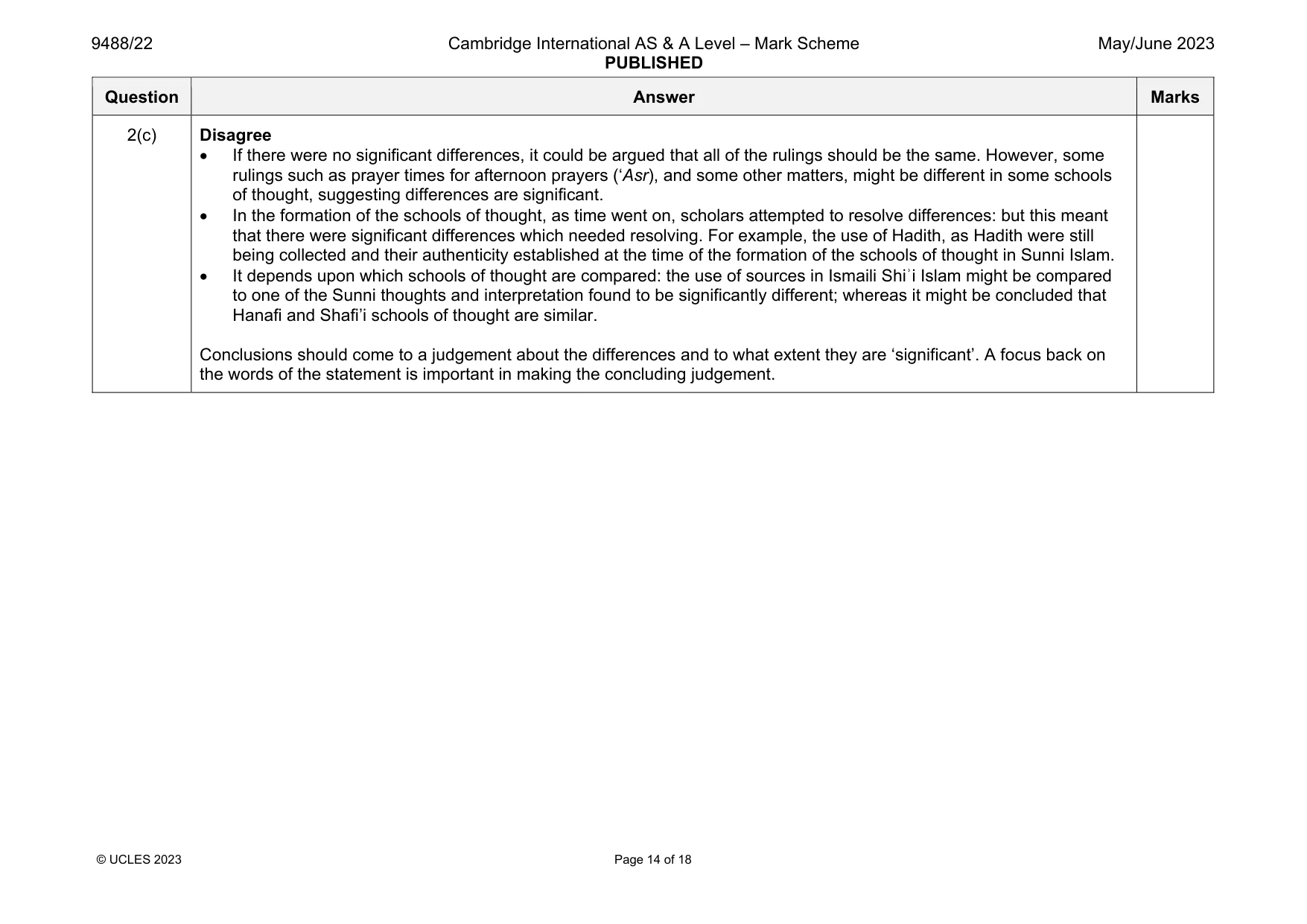
2 (a) Give five schools of thought or approaches in Islam. [5] (b) Explain how shariah rulings are made according to one school of thought. [10] (c) ‘There are no significant differences between the methods used by different schools of thought.’ Do you agree? Discuss this statement with reference to two schools of thought. [10] [Total: 25]
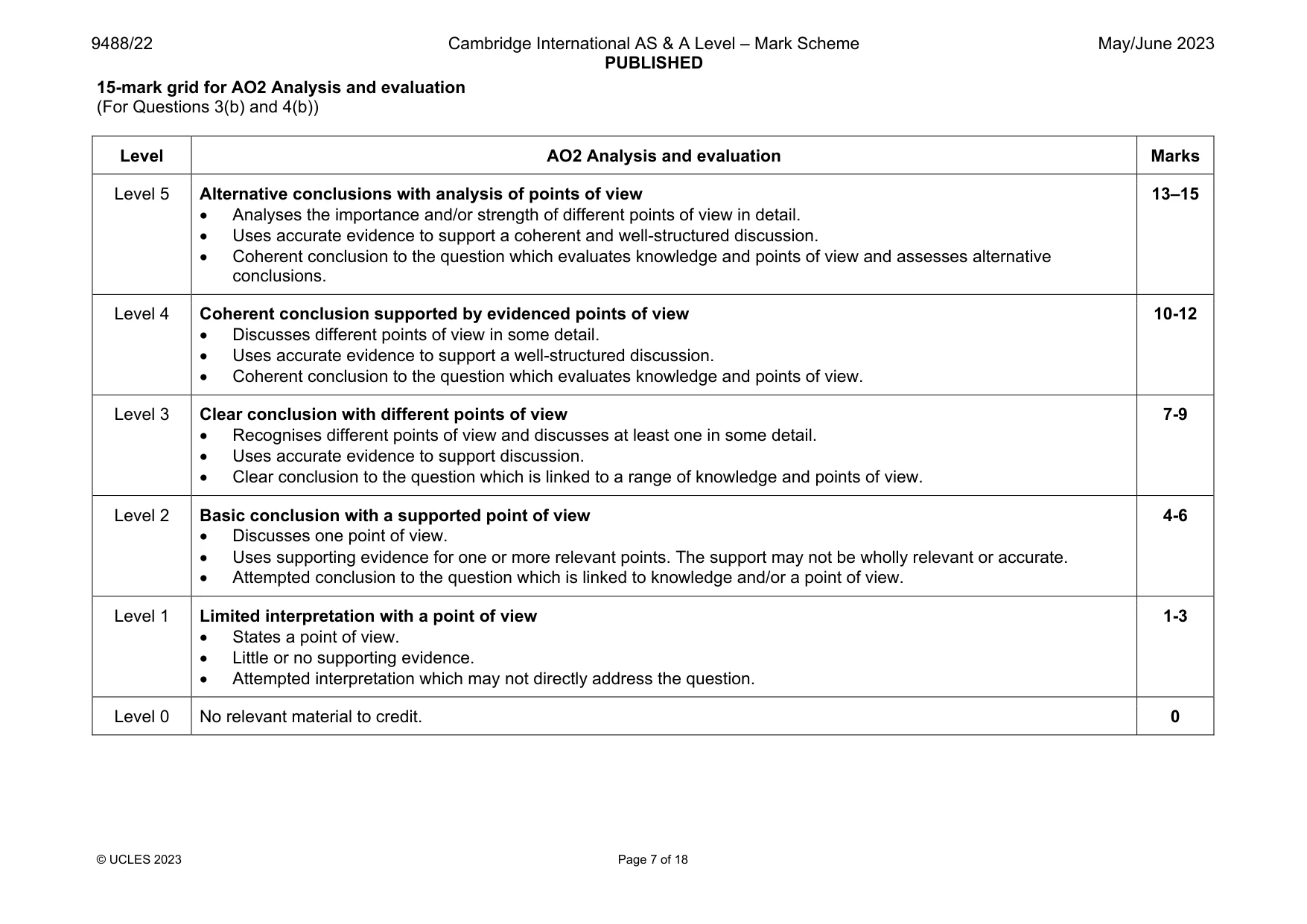
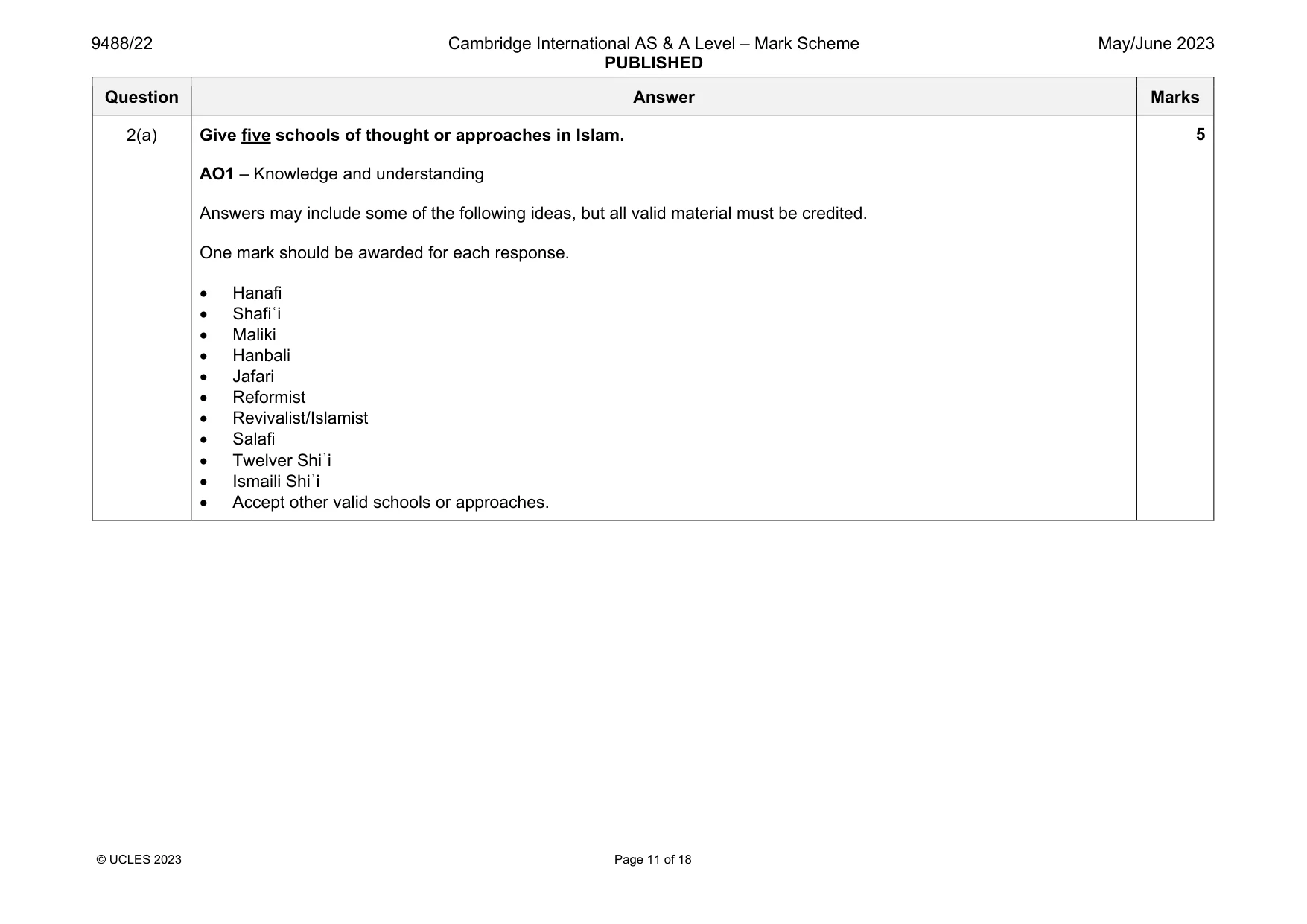
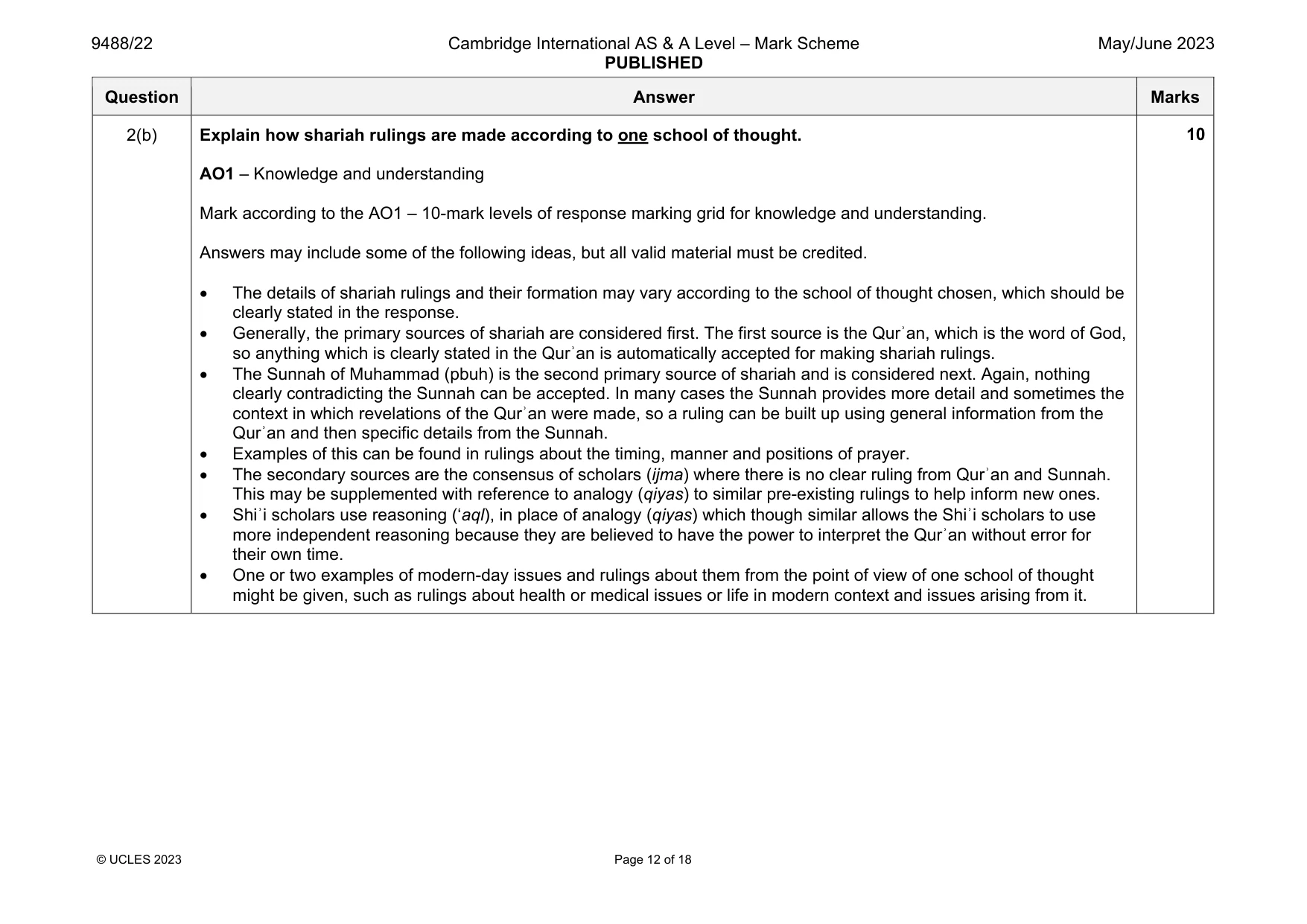
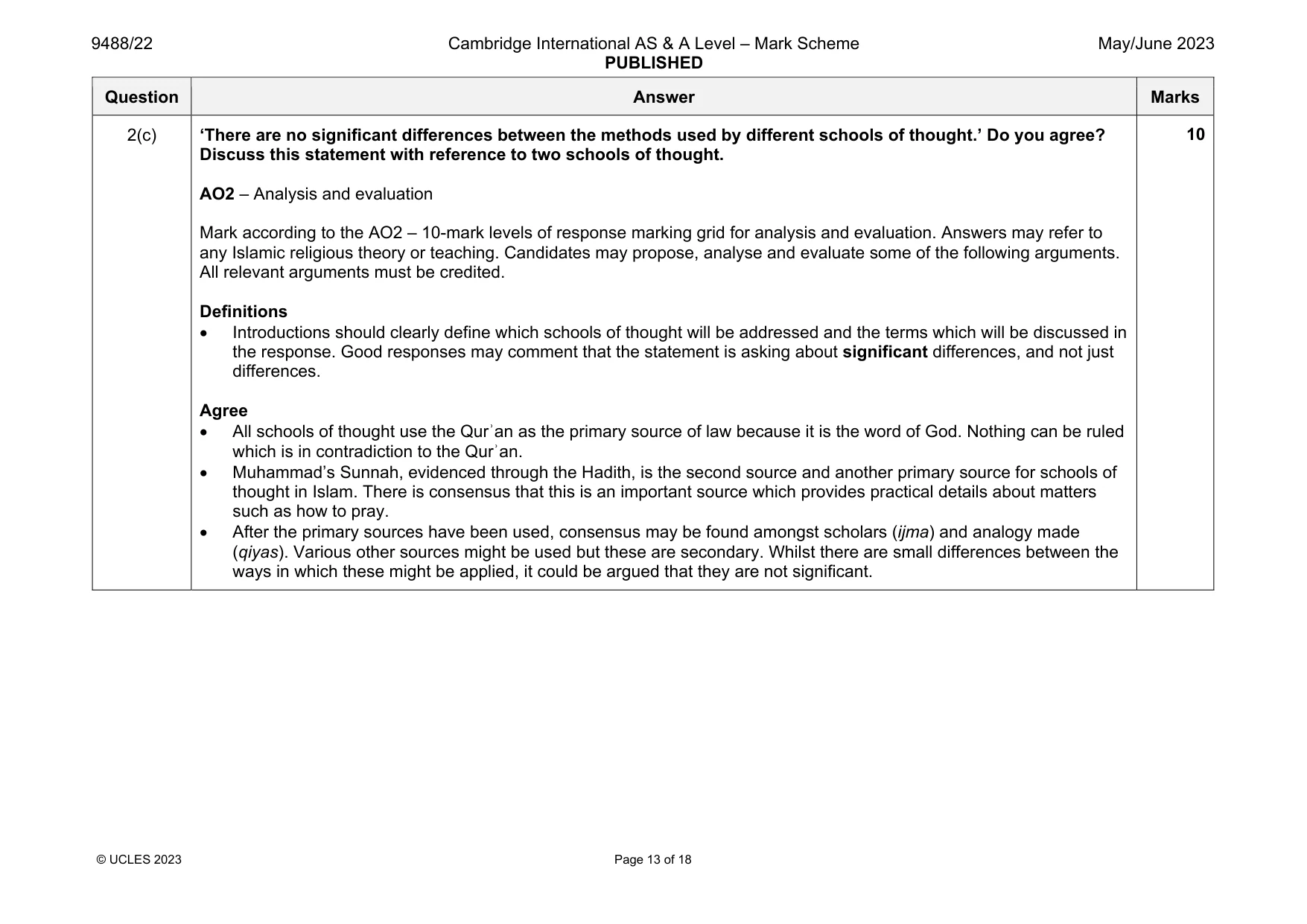
Mark scheme: 2(a) Give five schools of thought or approaches in Islam. AO1 – Knowledge and understanding Answers may include some of the following ideas, but all valid material must be credited. One mark should be awarded for each response. Hanafi Shafiʿi Maliki Hanbali Jafari Reformist Revivalist/Islamist Salafi Twelver Shiʾi Ismaili Shiʾi Accept other valid schools or approaches. Question Answer Marks 2(b) Explain how shariah rulings are made according to one school of thought. AO1 – Knowledge and understanding Mark according to the AO1 – 10-mark levels of response marking grid for knowledge and understanding. Answers may include some of the following ideas, but all valid material must be credited. The details of shariah rulings and their formation may vary according to the school of thought chosen, which should be clearly stated in the response. Generally, the primary sources of shariah are considered first. The first source is the Qurʾan, which is the word of God, so anything which is clearly stated in the Qurʾan is automatically accepted for making shariah rulings. The Sunnah of Muhammad (pbuh) is the second primary source of shariah and is considered next. Again, nothing clearly contradicting the Sunnah can be accepted. In many cases the Sunnah provides more detail and sometimes the context in which revelations of the Qurʾan were made, so a ruling can be built up using general information from the Qurʾan and then specific details from the Sunnah. Examples of this can be found in rulings about the timing, manner and positions of prayer. The secondary sources are the consensus of scholars (ijma) where there is no clear ruling from Qurʾan and Sunnah. This may be supplemented with reference to analogy (qiyas) to similar pre-existing rulings to help inform new ones. Shiʾi scholars use reasoning (‘aql), in place of analogy (qiyas) which though similar allows the Shiʾi scholars to use more independent reasoning because they are believed to have the power to interpret the Qurʾan without error for their own time. One or two examples of modern-day issues and rulings about them from the point of view of one school of thought might be given, such as rulings about health or medical issues or life in modern context and issues arising from it. 10 Question Answer Marks 2(c) ‘There are no significant differences between the methods used by different schools of thought.’ Do you agree? Discuss this statement with reference to two schools of thought. AO2 – Analysis and evaluation Mark according to the AO2 – 10-mark levels of response marking grid for analysis and evaluation. Answers may refer to any Islamic religious theory or teaching. Candidates may propose, analyse and evaluate some of the following arguments. All relevant arguments must be credited. Definitions Introductions should clearly define which schools of thought will be addressed and the terms which will be discussed in the response. Good responses may comment that the statement is asking about significant differences, and not just differences. Agree All schools of thought use the Qurʾan as the primary source of law because it is the word of God. Nothing can be ruled which is in contradiction to the Qurʾan. Muhammad’s Sunnah, evidenced through the Hadith, is the second source and another primary source for schools of thought in Islam. There is consensus that this is an important source which provides practical details about matters such as how to pray. After the primary sources have been used, consensus may be found amongst scholars (ijma) and analogy made (qiyas). Various other sources might be used but these are secondary. Whilst there are small differences between the ways in which these might be applied, it could be argued that they are not significant. 10 Question Answer Marks 2(c) Disagree If there were no significant differences, it could be argued that all of the rulings should be the same. However, some rulings such as prayer times for afternoon prayers (‘Asr), and some other matters, might be different in some schools of thought, suggesting differences are significant. In the formation of the schools of thought, as time went on, scholars attempted to resolve differences: but this meant that there were significant differences which needed resolving. For example, the use of Hadith, as Hadith were still being collected and their authenticity established at the time of the formation of the schools of thought in Sunni Islam. It depends upon which schools of thought are compared: the use of sources in Ismaili Shiʾi Islam might be compared to one of the Sunni thoughts and interpretation found to be significantly different; whereas it might be concluded that Hanafi and Shafi’i schools of thought are similar. Conclusions should come to a judgement about the differences and to what extent they are ‘significant’. A focus back on the words of the statement is important in making the concluding judgement.
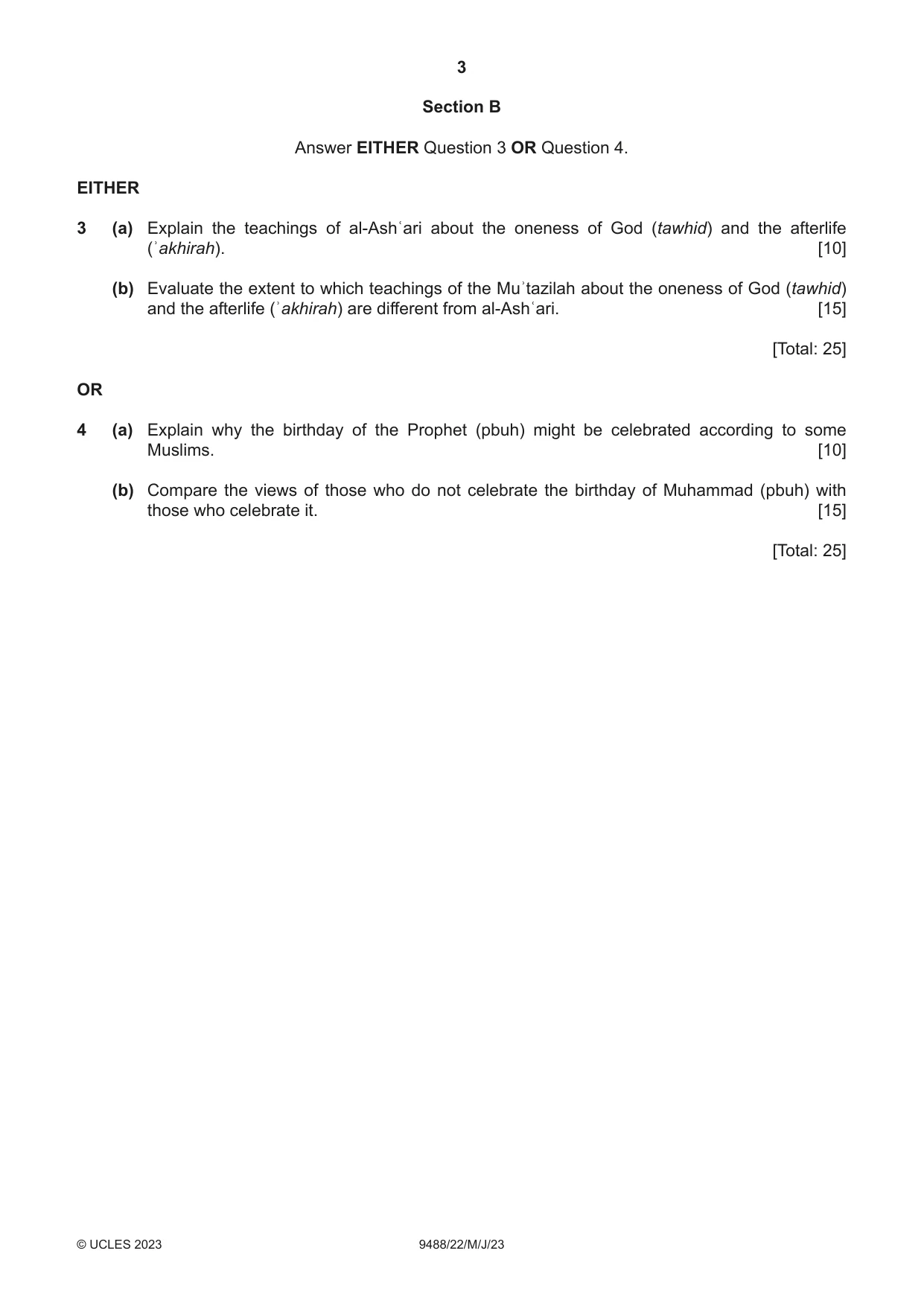
Q3 · Explain the teachings of al-Ashʿari about the oneness of God (tawhid) and the afterlife…
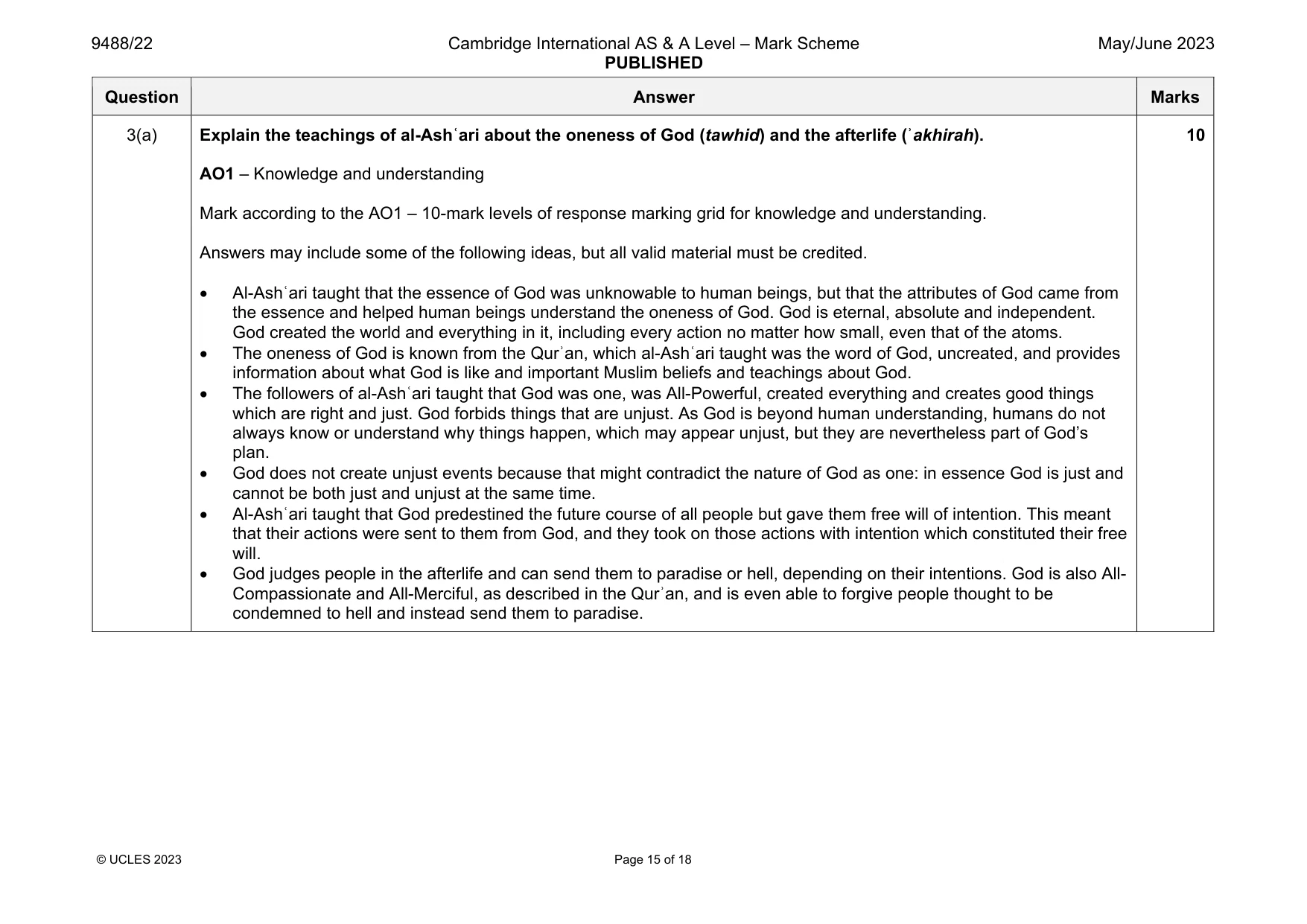
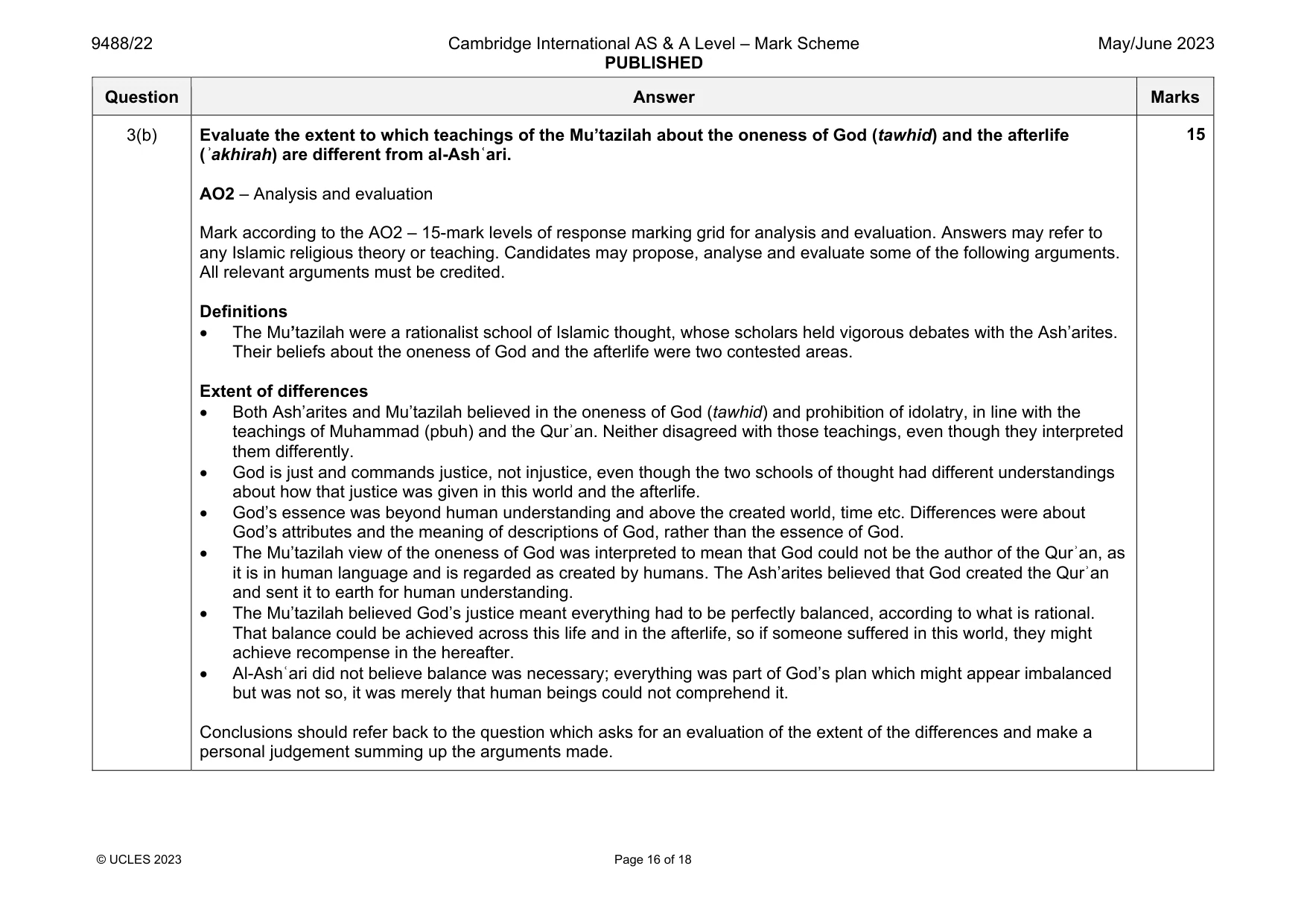
3 (a) Explain the teachings of al-Ashʿari about the oneness of God (tawhid) and the afterlife (ʾakhirah). [10] (b) Evaluate the extent to which teachings of the Muʾtazilah about the oneness of God (tawhid) and the afterlife (ʾakhirah) are different from al-Ashʿari. [15] [Total: 25] OR
Mark scheme: 3(a) Explain the teachings of al-Ashʿari about the oneness of God (tawhid) and the afterlife (ʾakhirah). AO1 – Knowledge and understanding Mark according to the AO1 – 10-mark levels of response marking grid for knowledge and understanding. Answers may include some of the following ideas, but all valid material must be credited. Al-Ashʿari taught that the essence of God was unknowable to human beings, but that the attributes of God came from the essence and helped human beings understand the oneness of God. God is eternal, absolute and independent. God created the world and everything in it, including every action no matter how small, even that of the atoms. The oneness of God is known from the Qurʾan, which al-Ashʿari taught was the word of God, uncreated, and provides information about what God is like and important Muslim beliefs and teachings about God. The followers of al-Ashʿari taught that God was one, was All-Powerful, created everything and creates good things which are right and just. God forbids things that are unjust. As God is beyond human understanding, humans do not always know or understand why things happen, which may appear unjust, but they are nevertheless part of God’s plan. God does not create unjust events because that might contradict the nature of God as one: in essence God is just and cannot be both just and unjust at the same time. Al-Ashʿari taught that God predestined the future course of all people but gave them free will of intention. This meant that their actions were sent to them from God, and they took on those actions with intention which constituted their free will. God judges people in the afterlife and can send them to paradise or hell, depending on their intentions. God is also All- Compassionate and All-Merciful, as described in the Qurʾan, and is even able to forgive people thought to be condemned to hell and instead send them to paradise. 10 Question Answer Marks 3(b) Evaluate the extent to which teachings of the Mu’tazilah about the oneness of God (tawhid) and the afterlife (ʾakhirah) are different from al-Ashʿari. AO2 – Analysis and evaluation Mark according to the AO2 – 15-mark levels of response marking grid for analysis and evaluation. Answers may refer to any Islamic religious theory or teaching. Candidates may propose, analyse and evaluate some of the following arguments. All relevant arguments must be credited. Definitions The Mu’tazilah were a rationalist school of Islamic thought, whose scholars held vigorous debates with the Ash’arites. Their beliefs about the oneness of God and the afterlife were two contested areas. Extent of differences Both Ash’arites and Mu’tazilah believed in the oneness of God (tawhid) and prohibition of idolatry, in line with the teachings of Muhammad (pbuh) and the Qurʾan. Neither disagreed with those teachings, even though they interpreted them differently. God is just and commands justice, not injustice, even though the two schools of thought had different understandings about how that justice was given in this world and the afterlife. God’s essence was beyond human understanding and above the created world, time etc. Differences were about God’s attributes and the meaning of descriptions of God, rather than the essence of God. The Mu’tazilah view of the oneness of God was interpreted to mean that God could not be the author of the Qurʾan, as it is in human language and is regarded as created by humans. The Ash’arites believed that God created the Qurʾan and sent it to earth for human understanding. The Mu’tazilah believed God’s justice meant everything had to be perfectly balanced, according to what is rational. That balance could be achieved across this life and in the afterlife, so if someone suffered in this world, they might achieve recompense in the hereafter. Al-Ashʿari did not believe balance was necessary; everything was part of God’s plan which might appear imbalanced but was not so, it was merely that human beings could not comprehend it. Conclusions should refer back to the question which asks for an evaluation of the extent of the differences and make a personal judgement summing up the arguments made. 15
Q4 · Explain why the birthday of the Prophet (pbuh) might be celebrated according to some…
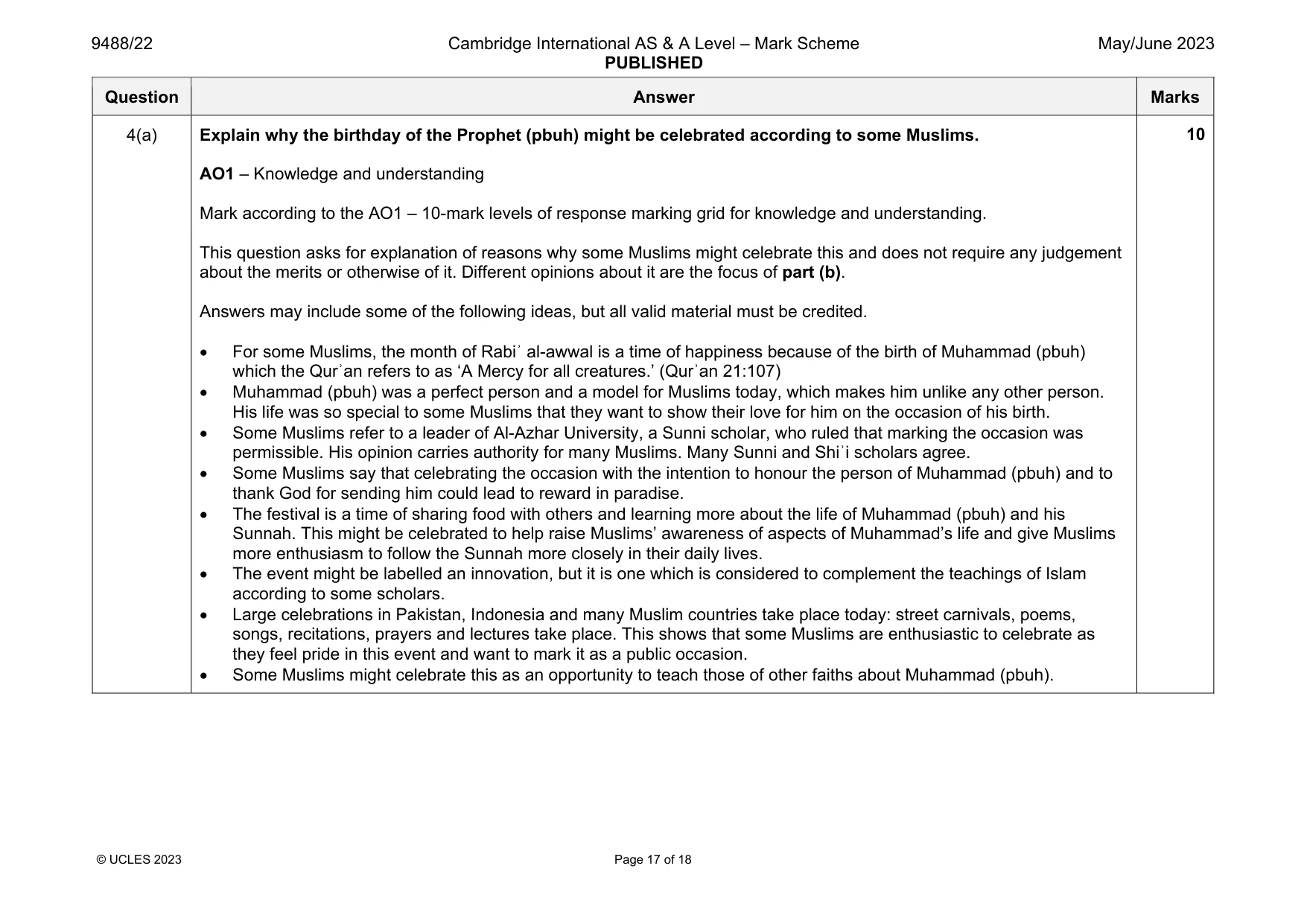
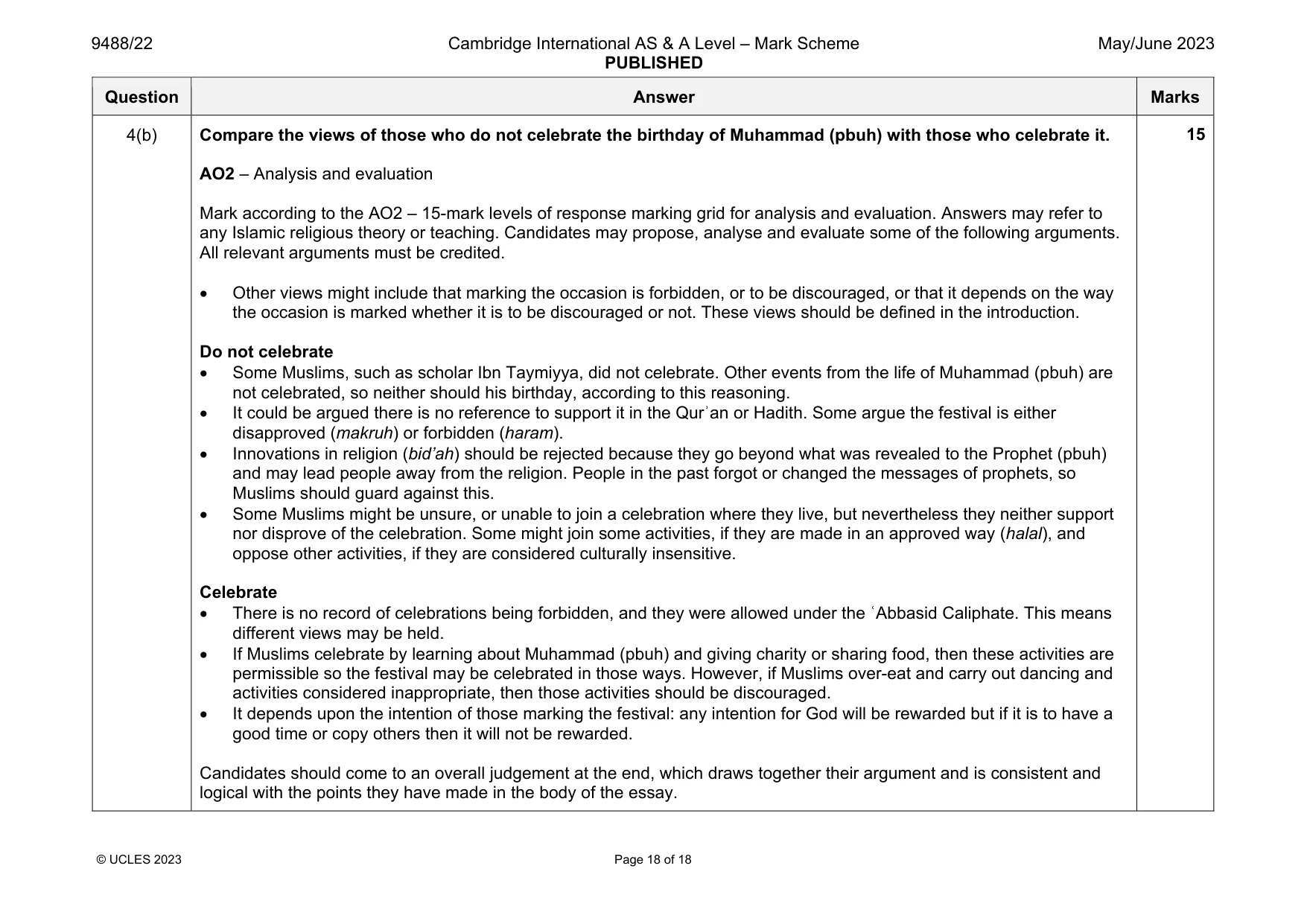
4 (a) Explain why the birthday of the Prophet (pbuh) might be celebrated according to some Muslims. [10] (b) Compare the views of those who do not celebrate the birthday of Muhammad (pbuh) with those who celebrate it. [15] [Total: 25]
Mark scheme: 4(a) Explain why the birthday of the Prophet (pbuh) might be celebrated according to some Muslims. AO1 – Knowledge and understanding Mark according to the AO1 – 10-mark levels of response marking grid for knowledge and understanding. This question asks for explanation of reasons why some Muslims might celebrate this and does not require any judgement about the merits or otherwise of it. Different opinions about it are the focus of part (b). Answers may include some of the following ideas, but all valid material must be credited. For some Muslims, the month of Rabiʾ al-awwal is a time of happiness because of the birth of Muhammad (pbuh) which the Qurʾan refers to as ‘A Mercy for all creatures.’ (Qurʾan 21:107) Muhammad (pbuh) was a perfect person and a model for Muslims today, which makes him unlike any other person. His life was so special to some Muslims that they want to show their love for him on the occasion of his birth. Some Muslims refer to a leader of Al-Azhar University, a Sunni scholar, who ruled that marking the occasion was permissible. His opinion carries authority for many Muslims. Many Sunni and Shiʾi scholars agree. Some Muslims say that celebrating the occasion with the intention to honour the person of Muhammad (pbuh) and to thank God for sending him could lead to reward in paradise. The festival is a time of sharing food with others and learning more about the life of Muhammad (pbuh) and his Sunnah. This might be celebrated to help raise Muslims’ awareness of aspects of Muhammad’s life and give Muslims more enthusiasm to follow the Sunnah more closely in their daily lives. The event might be labelled an innovation, but it is one which is considered to complement the teachings of Islam according to some scholars. Large celebrations in Pakistan, Indonesia and many Muslim countries take place today: street carnivals, poems, songs, recitations, prayers and lectures take place. This shows that some Muslims are enthusiastic to celebrate as they feel pride in this event and want to mark it as a public occasion. Some Muslims might celebrate this as an opportunity to teach those of other faiths about Muhammad (pbuh). Question Answer Marks 4(b) Compare the views of those who do not celebrate the birthday of Muhammad (pbuh) with those who celebrate it. AO2 – Analysis and evaluation Mark according to the AO2 – 15-mark levels of response marking grid for analysis and evaluation. Answers may refer to any Islamic religious theory or teaching. Candidates may propose, analyse and evaluate some of the following arguments. All relevant arguments must be credited. Other views might include that marking the occasion is forbidden, or to be discouraged, or that it depends on the way the occasion is marked whether it is to be discouraged or not. These views should be defined in the introduction. Do not celebrate Some Muslims, such as scholar Ibn Taymiyya, did not celebrate. Other events from the life of Muhammad (pbuh) are not celebrated, so neither should his birthday, according to this reasoning. It could be argued there is no reference to support it in the Qurʾan or Hadith. Some argue the festival is either disapproved (makruh) or forbidden (haram). Innovations in religion (bid’ah) should be rejected because they go beyond what was revealed to the Prophet (pbuh) and may lead people away from the religion. People in the past forgot or changed the messages of prophets, so Muslims should guard against this. Some Muslims might be unsure, or unable to join a celebration where they live, but nevertheless they neither support nor disprove of the celebration. Some might join some activities, if they are made in an approved way (halal), and oppose other activities, if they are considered culturally insensitive. Celebrate There is no record of celebrations being forbidden, and they were allowed under the ʿAbbasid Caliphate. This means different views may be held. If Muslims celebrate by learning about Muhammad (pbuh) and giving charity or sharing food, then these activities are permissible so the festival may be celebrated in those ways. However, if Muslims over-eat and carry out dancing and activities considered inappropriate, then those activities should be discouraged. It depends upon the intention of those marking the festival: any intention for God will be rewarded but if it is to have a good time or copy others then it will not be rewarded. Candidates should come to an overall judgement at the end, which draws together their argument and is consistent and logical with the points they have made in the body of the essay. 15
What was in this paper
The subtopics covered by these 4 questions, and how many questions each got. Open one in a new tab to see every Cambridge question on it.
What you needed in this session
Cambridge’s own grade thresholds for 2023 May/June, Paper 2 · Variant 2. A higher threshold means an easier paper — the bar moves with how the cohort did.