Cambridge A Level Islamic Studies 9488 — 2025 May/June Paper 1 · Variant 2
9488/12/M/J/25 · 50 marks · 90 min
The question paper and its mark scheme, free to read here and free to download. This is Cambridge’s own paper, exactly as it was sat.
Question paper4 pages

Mark scheme15 pages
Answers below. Sit the paper first if you are practising.
Paper as text
Question paper, page 1
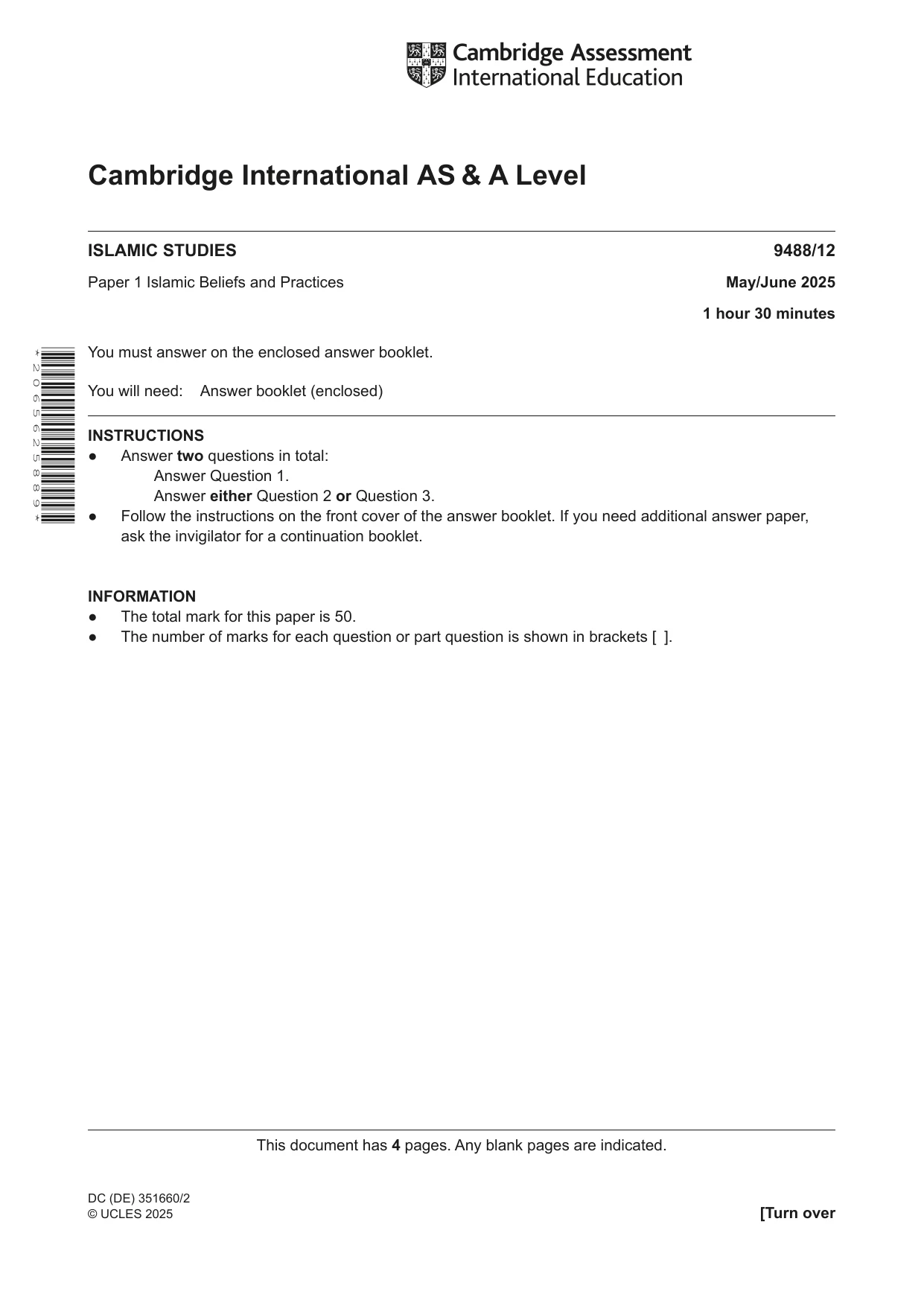
This document has 4 pages. Any blank pages are indicated. [Turn over * 2 0 6 5 6 2 5 8 8 9 * Cambridge International AS & A Level DC (DE) 351660/2 © UCLES 2025 ISLAMIC STUDIES 9488/12 Paper 1 Islamic Beliefs and Practices May/June 2025 1 hour 30 minutes You must answer on the enclosed answer booklet. You will need: Answer booklet (enclosed) INSTRUCTIONS ● Answer two questions in total: Answer Question 1. Answer either Question 2 or Question 3. ● Follow the instructions on the front cover of the answer booklet. If you need additional answer paper, ask the invigilator for a continuation booklet. INFORMATION ● The total mark for this paper is 50. ● The number of marks for each question or part question is shown in brackets [ ].
Question paper, page 2
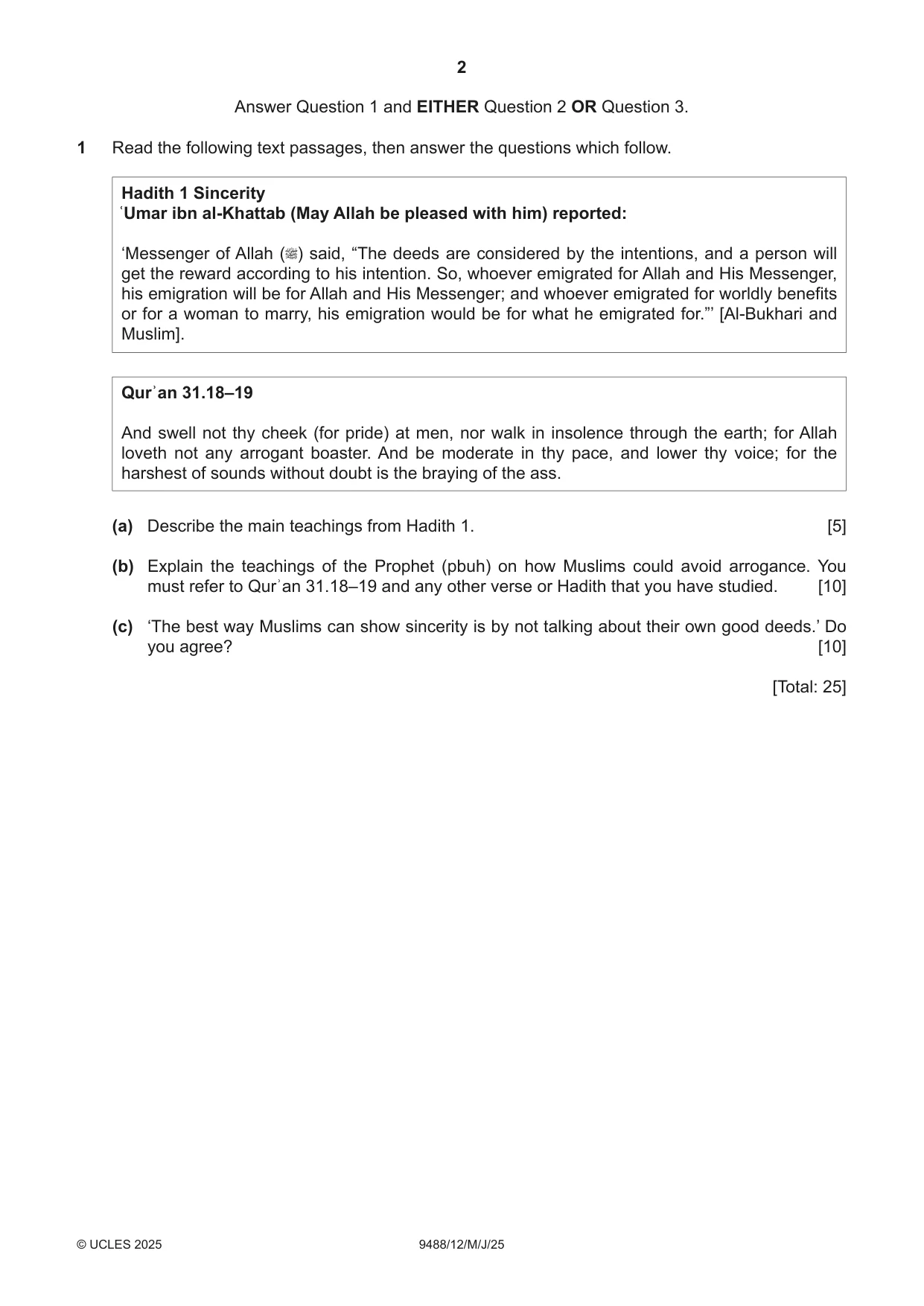
2 9488/12/M/J/25 © UCLES 2025 Answer Question 1 and EITHER Question 2 OR Question 3. 1 Read the following text passages, then answer the questions which follow. Hadith 1 Sincerity ͑ Umar ibn al-Khattab (May Allah be pleased with him) reported: ‘Messenger of Allah (ﷺ) said, “The deeds are considered by the intentions, and a person will get the reward according to his intention. So, whoever emigrated for Allah and His Messenger, his emigration will be for Allah and His Messenger; and whoever emigrated for worldly benefits or for a woman to marry, his emigration would be for what he emigrated for.”’ [Al-Bukhari and Muslim]. Qurʾan 31.18–19 And swell not thy cheek (for pride) at men, nor walk in insolence through the earth; for Allah loveth not any arrogant boaster. And be moderate in thy pace, and lower thy voice; for the harshest of sounds without doubt is the braying of the ass. (a) Describe the main teachings from Hadith 1. [5] (b) Explain the teachings of the Prophet (pbuh) on how Muslims could avoid arrogance. You must refer to Qurʾan 31.18–19 and any other verse or Hadith that you have studied. [10] (c) ‘The best way Muslims can show sincerity is by not talking about their own good deeds.’ Do you agree? [10] [Total: 25]
Question paper, page 3
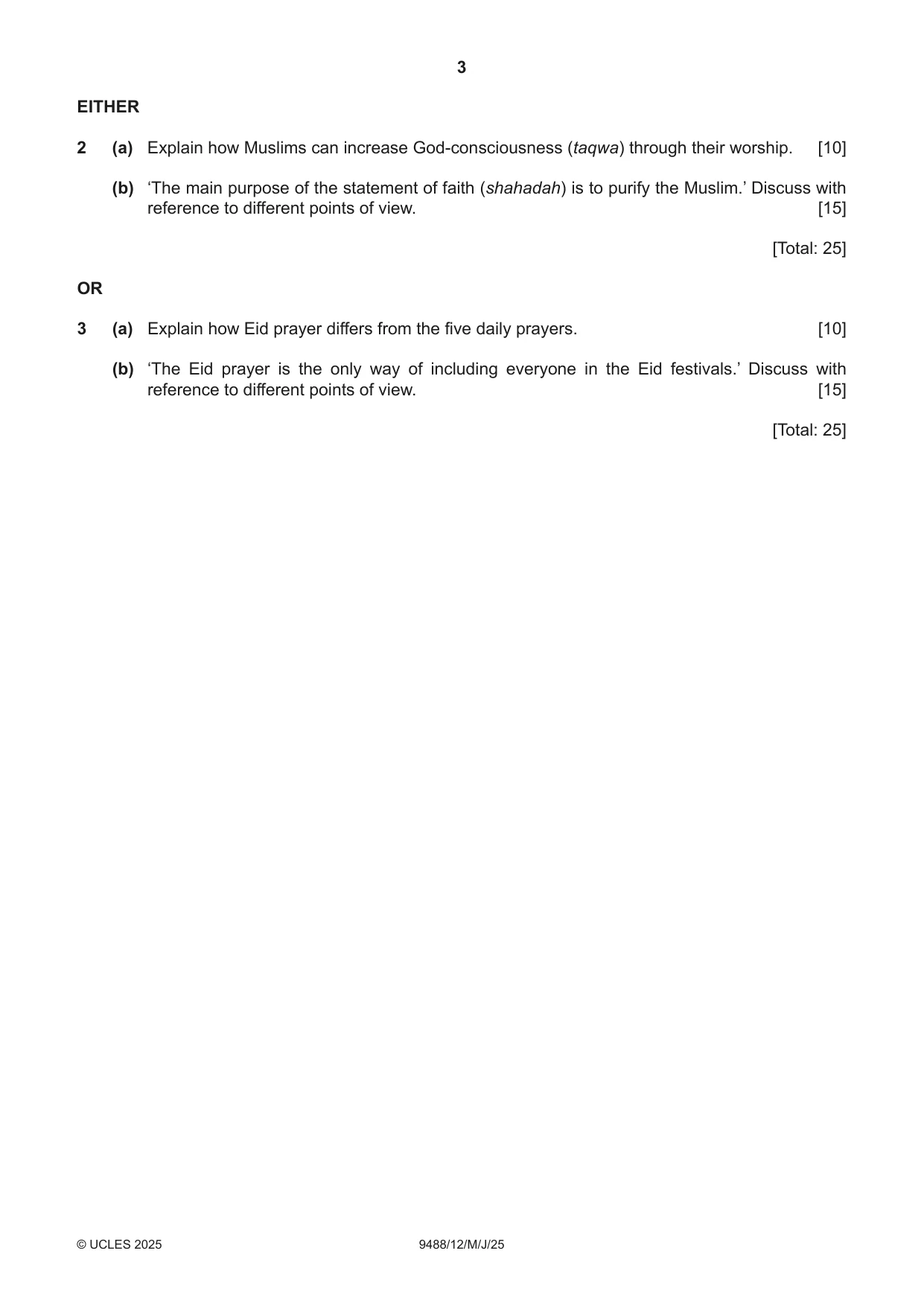
3 9488/12/M/J/25 © UCLES 2025 EITHER 2 (a) Explain how Muslims can increase God-consciousness (taqwa) through their worship. [10] (b) ‘The main purpose of the statement of faith (shahadah) is to purify the Muslim.’ Discuss with reference to different points of view. [15] [Total: 25] OR 3 (a) Explain how Eid prayer differs from the five daily prayers. [10] (b) ‘The Eid prayer is the only way of including everyone in the Eid festivals.’ Discuss with reference to different points of view. [15] [Total: 25]
Question paper, page 4
4 9488/12/M/J/25 © UCLES 2025 Permission to reproduce items where third-party owned material protected by copyright is included has been sought and cleared where possible. Every reasonable effort has been made by the publisher (UCLES) to trace copyright holders, but if any items requiring clearance have unwittingly been included, the publisher will be pleased to make amends at the earliest possible opportunity. To avoid the issue of disclosure of answer-related information to candidates, all copyright acknowledgements are reproduced online in the Cambridge Assessment International Education Copyright Acknowledgements Booklet. This is produced for each series of examinations and is freely available to download at www.cambridgeinternational.org after the live examination series. Cambridge Assessment International Education is part of Cambridge Assessment. Cambridge Assessment is the brand name of the University of Cambridge Local Examinations Syndicate (UCLES), which is a department of the University of Cambridge. BLANK PAGE
Mark scheme, page 1
This document consists of 15 printed pages. © Cambridge University Press & Assessment 2025 [Turn over Cambridge International AS & A Level ISLAMIC STUDIES 9488/12 Paper 1 Islamic Beliefs and Practices May/June 2025 MARK SCHEME Maximum Mark: 50 Published This mark scheme is published as an aid to teachers and candidates, to indicate the requirements of the examination. It shows the basis on which Examiners were instructed to award marks. It does not indicate the details of the discussions that took place at an Examiners’ meeting before marking began, which would have considered the acceptability of alternative answers. Mark schemes should be read in conjunction with the question paper and the Principal Examiner Report for Teachers. Cambridge International will not enter into discussions about these mark schemes. Cambridge International is publishing the mark schemes for the May/June 2025 series for most Cambridge IGCSE, Cambridge International A and AS Level components, and some Cambridge O Level components.
Mark scheme, page 2
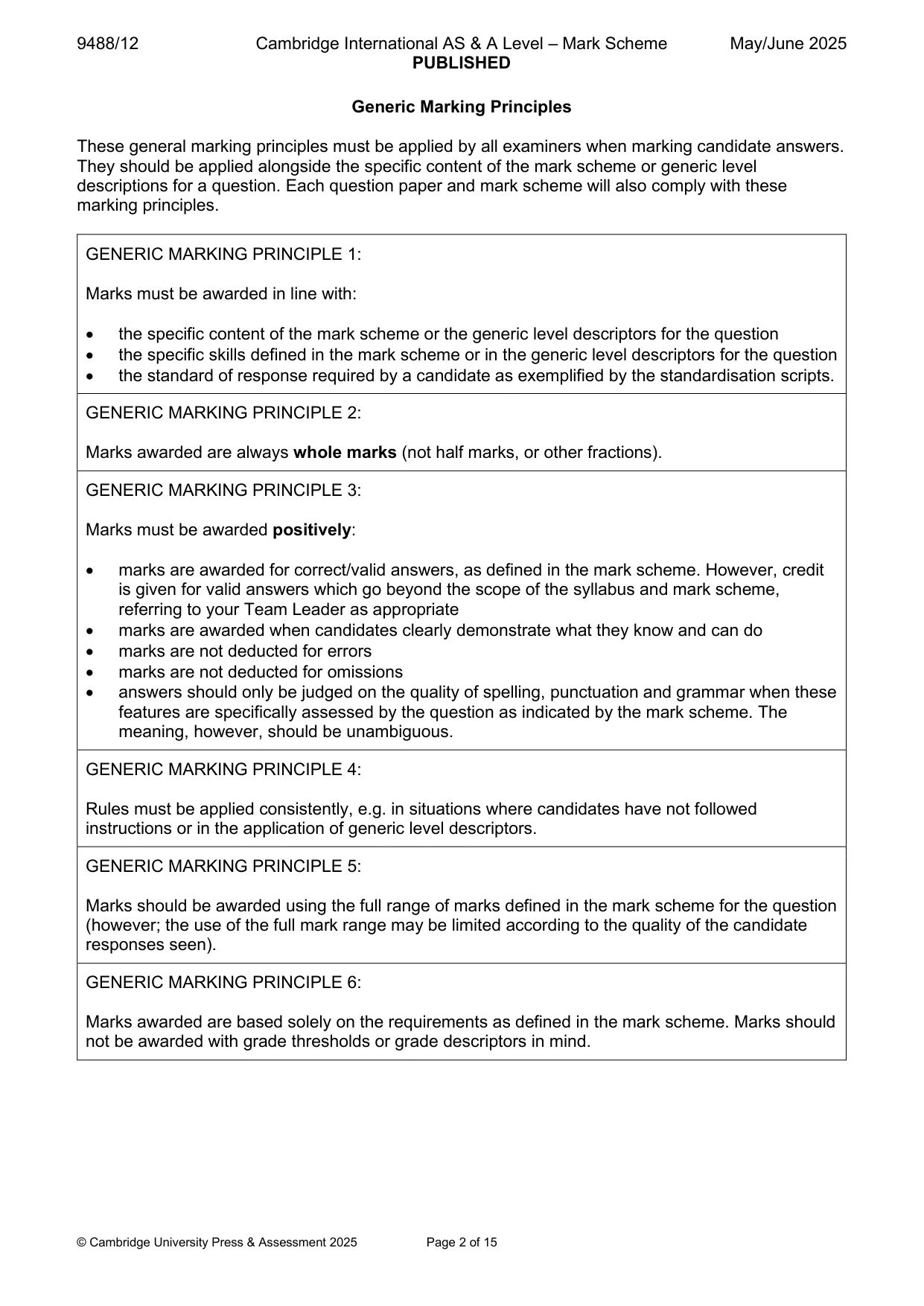
9488/12 Cambridge International AS & A Level – Mark Scheme PUBLISHED May/June 2025 © Cambridge University Press & Assessment 2025 Page 2 of 15 Generic Marking Principles These general marking principles must be applied by all examiners when marking candidate answers. They should be applied alongside the specific content of the mark scheme or generic level descriptions for a question. Each question paper and mark scheme will also comply with these marking principles. GENERIC MARKING PRINCIPLE 1: Marks must be awarded in line with: • the specific content of the mark scheme or the generic level descriptors for the question • the specific skills defined in the mark scheme or in the generic level descriptors for the question • the standard of response required by a candidate as exemplified by the standardisation scripts. GENERIC MARKING PRINCIPLE 2: Marks awarded are always whole marks (not half marks, or other fractions). GENERIC MARKING PRINCIPLE 3: Marks must be awarded positively: • marks are awarded for correct/valid answers, as defined in the mark scheme. However, credit is given for valid answers which go beyond the scope of the syllabus and mark scheme, referring to your Team Leader as appropriate • marks are awarded when candidates clearly demonstrate what they know and can do • marks are not deducted for errors • marks are not deducted for omissions • answers should only be judged on the quality of spelling, punctuation and grammar when these features are specifically assessed by the question as indicated by the mark scheme. The meaning, however, should be unambiguous. GENERIC MARKING PRINCIPLE 4: Rules must be applied consistently, e.g. in situations where candidates have not followed instructions or in the application of generic level descriptors. GENERIC MARKING PRINCIPLE 5: Marks should be awarded using the full range of marks defined in the mark scheme for the question (however; the use of the full mark range may be limited according to the quality of the candidate responses seen). GENERIC MARKING PRINCIPLE 6: Marks awarded are based solely on the requirements as defined in the mark scheme. Marks should not be awarded with grade thresholds or grade descriptors in mind.
Mark scheme, page 3
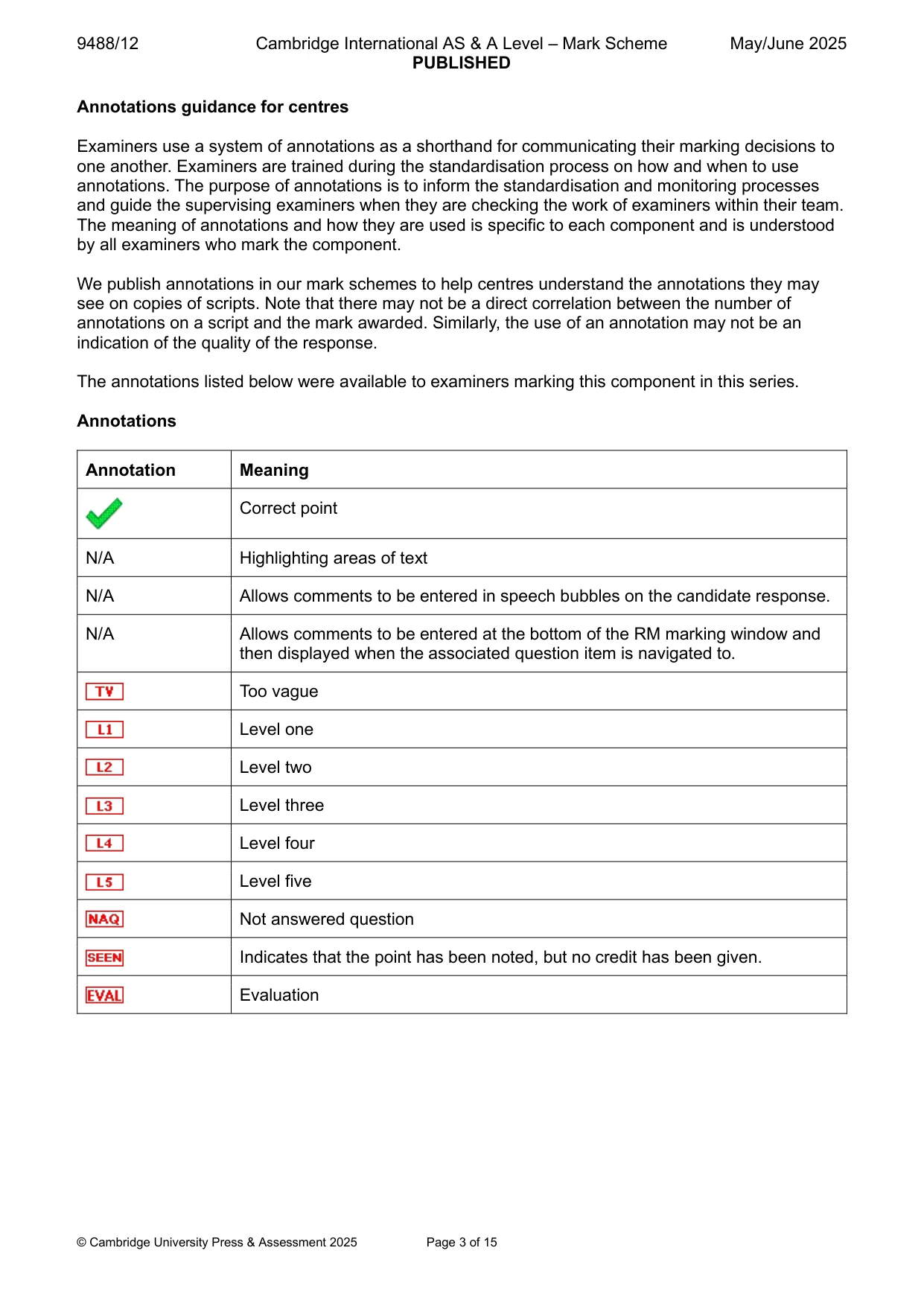
9488/12 Cambridge International AS & A Level – Mark Scheme PUBLISHED May/June 2025 © Cambridge University Press & Assessment 2025 Page 3 of 15 Annotations guidance for centres Examiners use a system of annotations as a shorthand for communicating their marking decisions to one another. Examiners are trained during the standardisation process on how and when to use annotations. The purpose of annotations is to inform the standardisation and monitoring processes and guide the supervising examiners when they are checking the work of examiners within their team. The meaning of annotations and how they are used is specific to each component and is understood by all examiners who mark the component. We publish annotations in our mark schemes to help centres understand the annotations they may see on copies of scripts. Note that there may not be a direct correlation between the number of annotations on a script and the mark awarded. Similarly, the use of an annotation may not be an indication of the quality of the response. The annotations listed below were available to examiners marking this component in this series. Annotations Annotation Meaning Correct point N/A Highlighting areas of text N/A Allows comments to be entered in speech bubbles on the candidate response. N/A Allows comments to be entered at the bottom of the RM marking window and then displayed when the associated question item is navigated to. Too vague Level one Level two Level three Level four Level five Not answered question Indicates that the point has been noted, but no credit has been given. Evaluation
Mark scheme, page 4
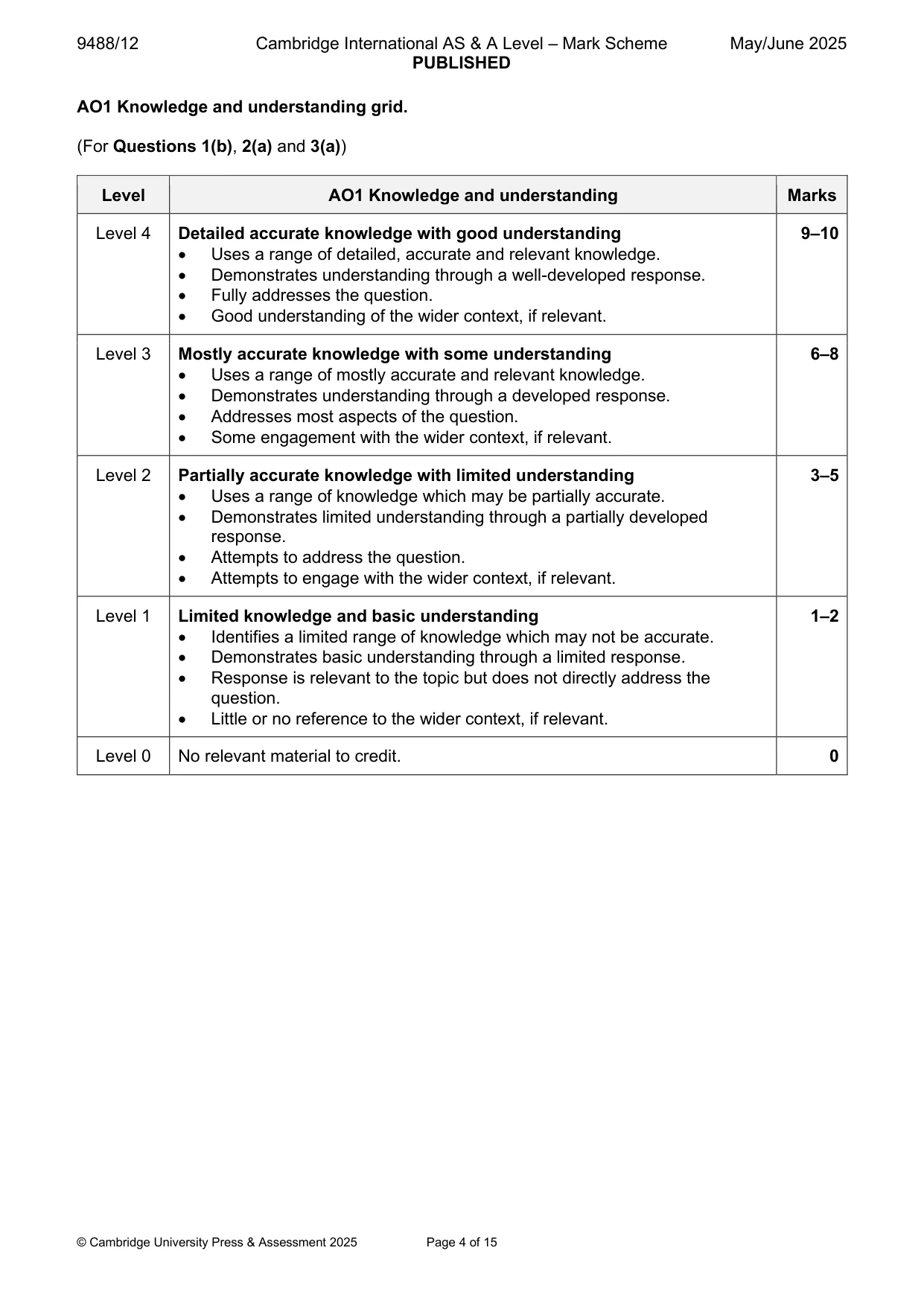
9488/12 Cambridge International AS & A Level – Mark Scheme PUBLISHED May/June 2025 © Cambridge University Press & Assessment 2025 Page 4 of 15 AO1 Knowledge and understanding grid. (For Questions 1(b), 2(a) and 3(a)) Level AO1 Knowledge and understanding Marks Level 4 Detailed accurate knowledge with good understanding • Uses a range of detailed, accurate and relevant knowledge. • Demonstrates understanding through a well-developed response. • Fully addresses the question. • Good understanding of the wider context, if relevant. 9–10 Level 3 Mostly accurate knowledge with some understanding • Uses a range of mostly accurate and relevant knowledge. • Demonstrates understanding through a developed response. • Addresses most aspects of the question. • Some engagement with the wider context, if relevant. 6–8 Level 2 Partially accurate knowledge with limited understanding • Uses a range of knowledge which may be partially accurate. • Demonstrates limited understanding through a partially developed response. • Attempts to address the question. • Attempts to engage with the wider context, if relevant. 3–5 Level 1 Limited knowledge and basic understanding • Identifies a limited range of knowledge which may not be accurate. • Demonstrates basic understanding through a limited response. • Response is relevant to the topic but does not directly address the question. • Little or no reference to the wider context, if relevant. 1–2 Level 0 No relevant material to credit. 0
Mark scheme, page 5
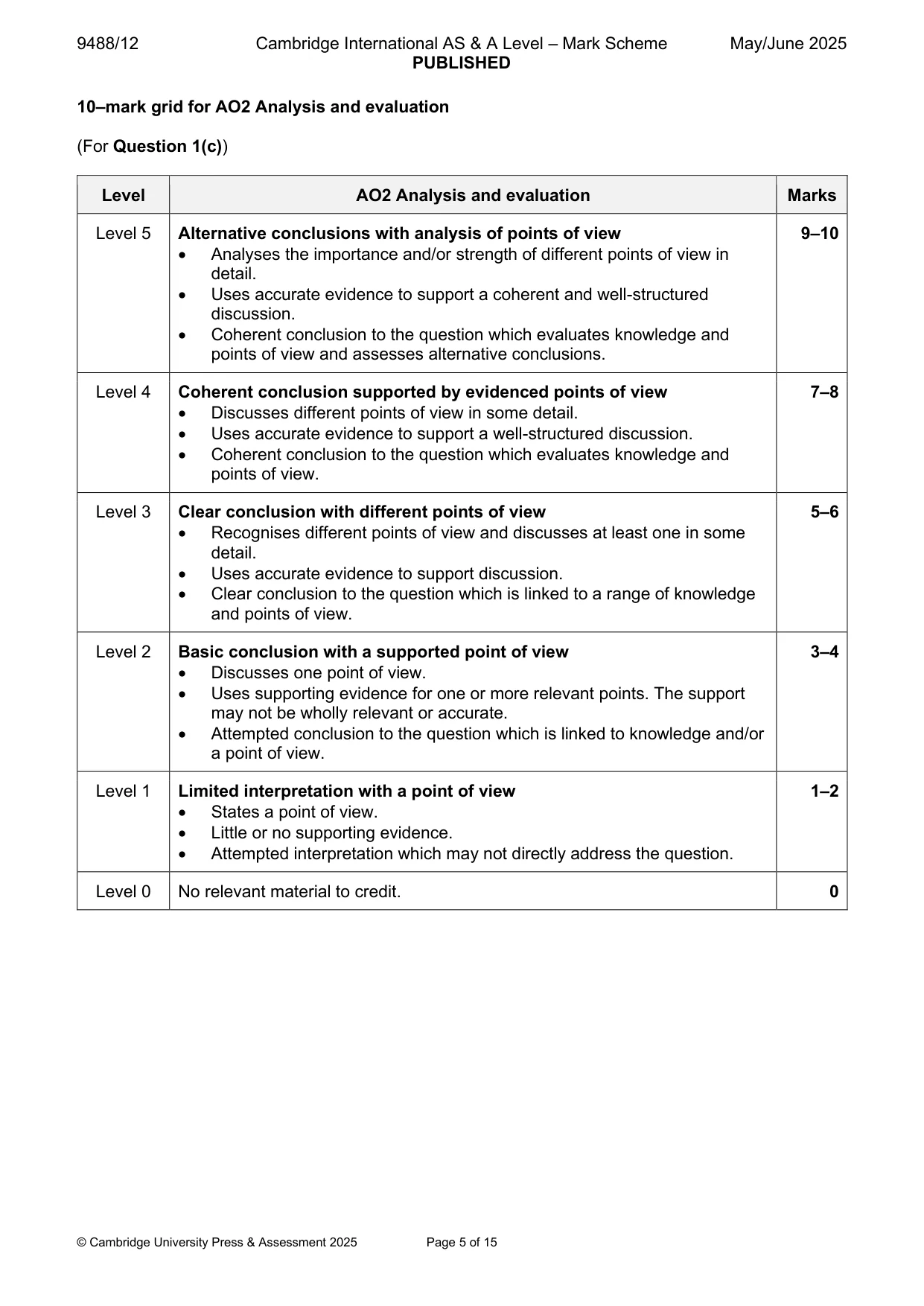
9488/12 Cambridge International AS & A Level – Mark Scheme PUBLISHED May/June 2025 © Cambridge University Press & Assessment 2025 Page 5 of 15 10–mark grid for AO2 Analysis and evaluation (For Question 1(c)) Level AO2 Analysis and evaluation Marks Level 5 Alternative conclusions with analysis of points of view • Analyses the importance and/or strength of different points of view in detail. • Uses accurate evidence to support a coherent and well-structured discussion. • Coherent conclusion to the question which evaluates knowledge and points of view and assesses alternative conclusions. 9–10 Level 4 Coherent conclusion supported by evidenced points of view • Discusses different points of view in some detail. • Uses accurate evidence to support a well-structured discussion. • Coherent conclusion to the question which evaluates knowledge and points of view. 7–8 Level 3 Clear conclusion with different points of view • Recognises different points of view and discusses at least one in some detail. • Uses accurate evidence to support discussion. • Clear conclusion to the question which is linked to a range of knowledge and points of view. 5–6 Level 2 Basic conclusion with a supported point of view • Discusses one point of view. • Uses supporting evidence for one or more relevant points. The support may not be wholly relevant or accurate. • Attempted conclusion to the question which is linked to knowledge and/or a point of view. 3–4 Level 1 Limited interpretation with a point of view • States a point of view. • Little or no supporting evidence. • Attempted interpretation which may not directly address the question. 1–2 Level 0 No relevant material to credit. 0
Mark scheme, page 6
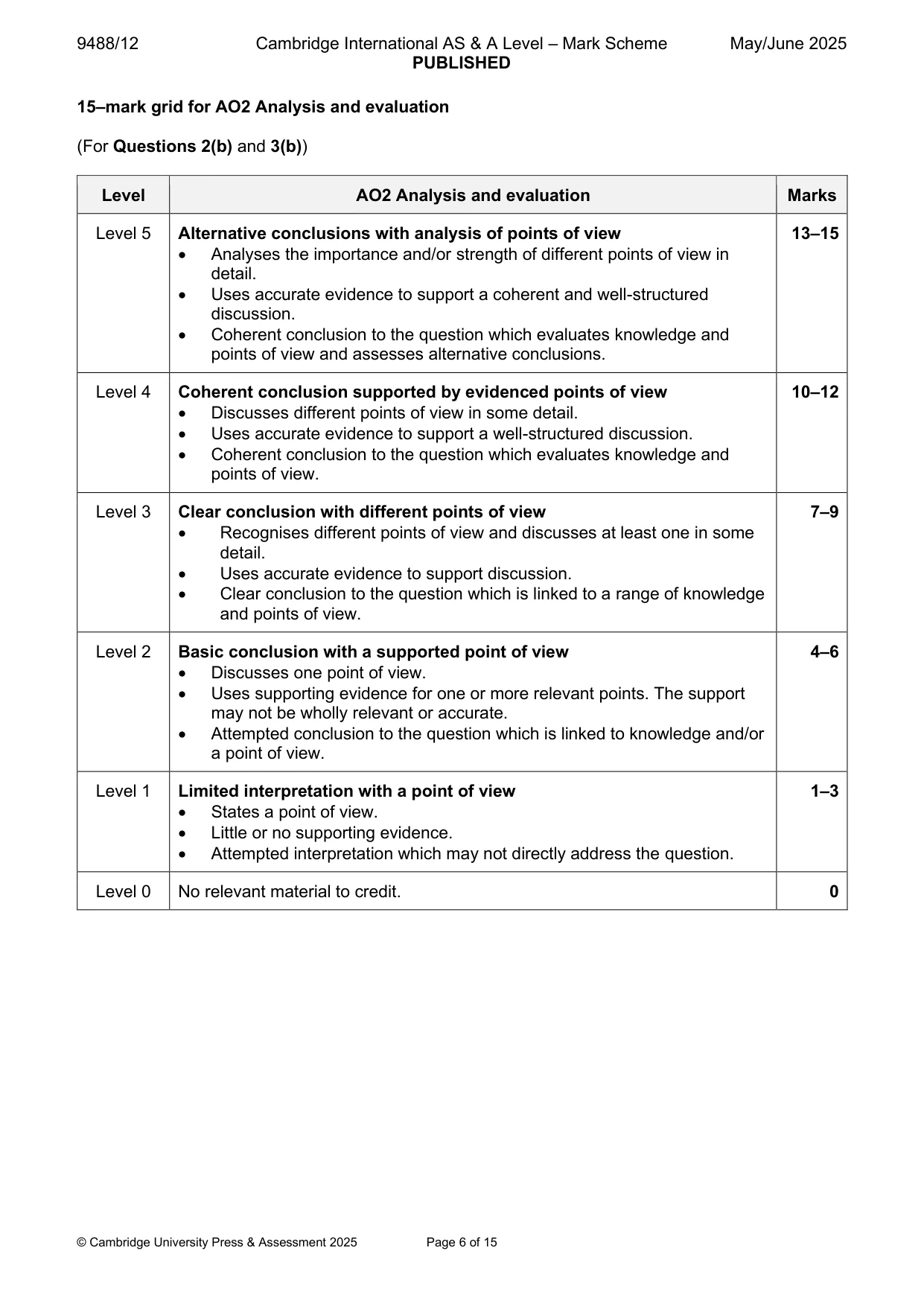
9488/12 Cambridge International AS & A Level – Mark Scheme PUBLISHED May/June 2025 © Cambridge University Press & Assessment 2025 Page 6 of 15 15–mark grid for AO2 Analysis and evaluation (For Questions 2(b) and 3(b)) Level AO2 Analysis and evaluation Marks Level 5 Alternative conclusions with analysis of points of view • Analyses the importance and/or strength of different points of view in detail. • Uses accurate evidence to support a coherent and well-structured discussion. • Coherent conclusion to the question which evaluates knowledge and points of view and assesses alternative conclusions. 13–15 Level 4 Coherent conclusion supported by evidenced points of view • Discusses different points of view in some detail. • Uses accurate evidence to support a well-structured discussion. • Coherent conclusion to the question which evaluates knowledge and points of view. 10–12 Level 3 Clear conclusion with different points of view • Recognises different points of view and discusses at least one in some detail. • Uses accurate evidence to support discussion. • Clear conclusion to the question which is linked to a range of knowledge and points of view. 7–9 Level 2 Basic conclusion with a supported point of view • Discusses one point of view. • Uses supporting evidence for one or more relevant points. The support may not be wholly relevant or accurate. • Attempted conclusion to the question which is linked to knowledge and/or a point of view. 4–6 Level 1 Limited interpretation with a point of view • States a point of view. • Little or no supporting evidence. • Attempted interpretation which may not directly address the question. 1–3 Level 0 No relevant material to credit. 0
Mark scheme, page 7
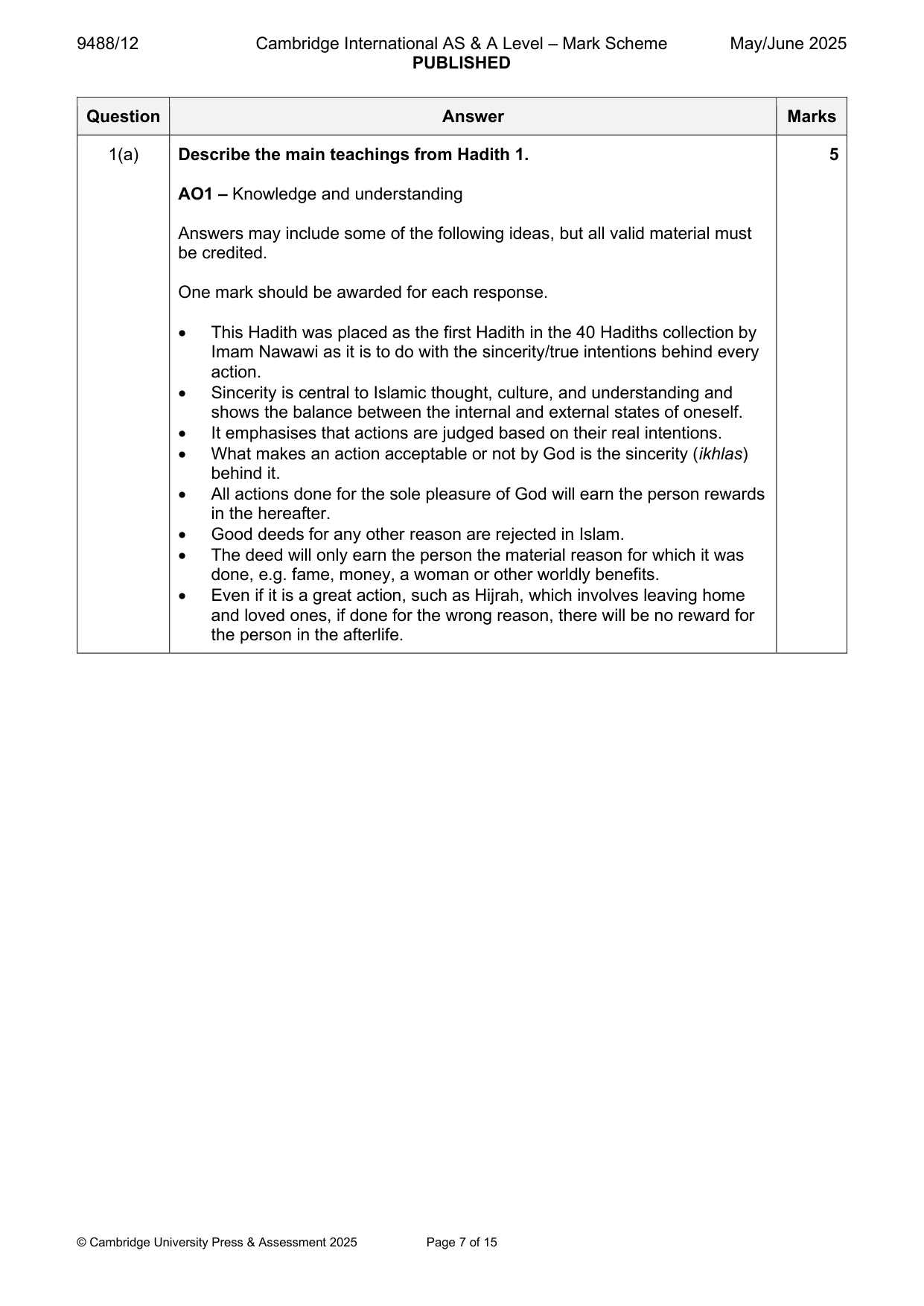
9488/12 Cambridge International AS & A Level – Mark Scheme PUBLISHED May/June 2025 © Cambridge University Press & Assessment 2025 Page 7 of 15 Question Answer Marks 1(a) Describe the main teachings from Hadith 1. AO1 – Knowledge and understanding Answers may include some of the following ideas, but all valid material must be credited. One mark should be awarded for each response. • This Hadith was placed as the first Hadith in the 40 Hadiths collection by Imam Nawawi as it is to do with the sincerity/true intentions behind every action. • Sincerity is central to Islamic thought, culture, and understanding and shows the balance between the internal and external states of oneself. • It emphasises that actions are judged based on their real intentions. • What makes an action acceptable or not by God is the sincerity (ikhlas) behind it. • All actions done for the sole pleasure of God will earn the person rewards in the hereafter. • Good deeds for any other reason are rejected in Islam. • The deed will only earn the person the material reason for which it was done, e.g. fame, money, a woman or other worldly benefits. • Even if it is a great action, such as Hijrah, which involves leaving home and loved ones, if done for the wrong reason, there will be no reward for the person in the afterlife. 5
Mark scheme, page 8
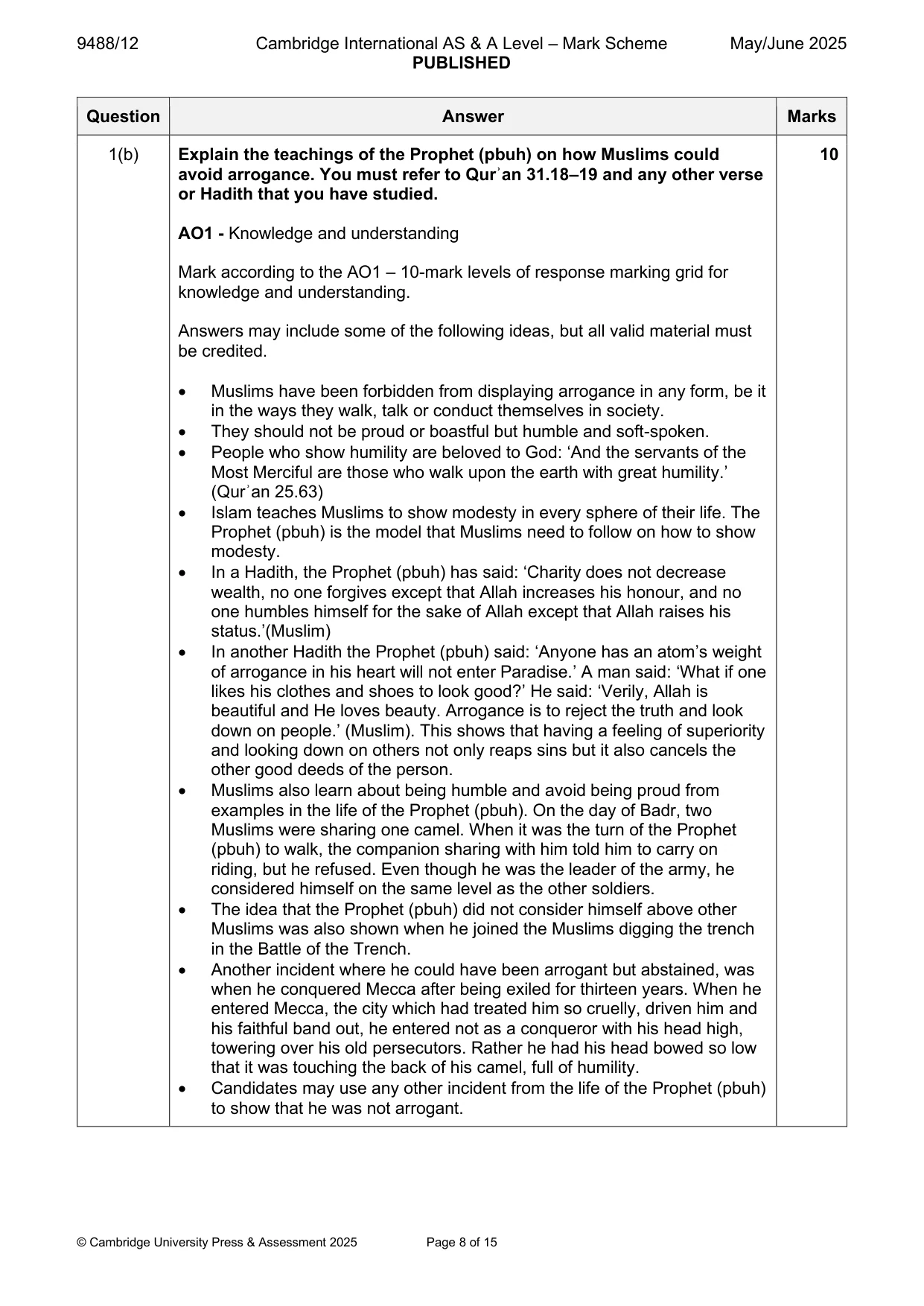
9488/12 Cambridge International AS & A Level – Mark Scheme PUBLISHED May/June 2025 © Cambridge University Press & Assessment 2025 Page 8 of 15 Question Answer Marks 1(b) Explain the teachings of the Prophet (pbuh) on how Muslims could avoid arrogance. You must refer to Qurʾan 31.18–19 and any other verse or Hadith that you have studied. AO1 - Knowledge and understanding Mark according to the AO1 – 10-mark levels of response marking grid for knowledge and understanding. Answers may include some of the following ideas, but all valid material must be credited. • Muslims have been forbidden from displaying arrogance in any form, be it in the ways they walk, talk or conduct themselves in society. • They should not be proud or boastful but humble and soft-spoken. • People who show humility are beloved to God: ‘And the servants of the Most Merciful are those who walk upon the earth with great humility.’ (Qurʾan 25.63) • Islam teaches Muslims to show modesty in every sphere of their life. The Prophet (pbuh) is the model that Muslims need to follow on how to show modesty. • In a Hadith, the Prophet (pbuh) has said: ‘Charity does not decrease wealth, no one forgives except that Allah increases his honour, and no one humbles himself for the sake of Allah except that Allah raises his status.’(Muslim) • In another Hadith the Prophet (pbuh) said: ‘Anyone has an atom’s weight of arrogance in his heart will not enter Paradise.’ A man said: ‘What if one likes his clothes and shoes to look good?’ He said: ‘Verily, Allah is beautiful and He loves beauty. Arrogance is to reject the truth and look down on people.’ (Muslim). This shows that having a feeling of superiority and looking down on others not only reaps sins but it also cancels the other good deeds of the person. • Muslims also learn about being humble and avoid being proud from examples in the life of the Prophet (pbuh). On the day of Badr, two Muslims were sharing one camel. When it was the turn of the Prophet (pbuh) to walk, the companion sharing with him told him to carry on riding, but he refused. Even though he was the leader of the army, he considered himself on the same level as the other soldiers. • The idea that the Prophet (pbuh) did not consider himself above other Muslims was also shown when he joined the Muslims digging the trench in the Battle of the Trench. • Another incident where he could have been arrogant but abstained, was when he conquered Mecca after being exiled for thirteen years. When he entered Mecca, the city which had treated him so cruelly, driven him and his faithful band out, he entered not as a conqueror with his head high, towering over his old persecutors. Rather he had his head bowed so low that it was touching the back of his camel, full of humility. • Candidates may use any other incident from the life of the Prophet (pbuh) to show that he was not arrogant. 10
Mark scheme, page 9
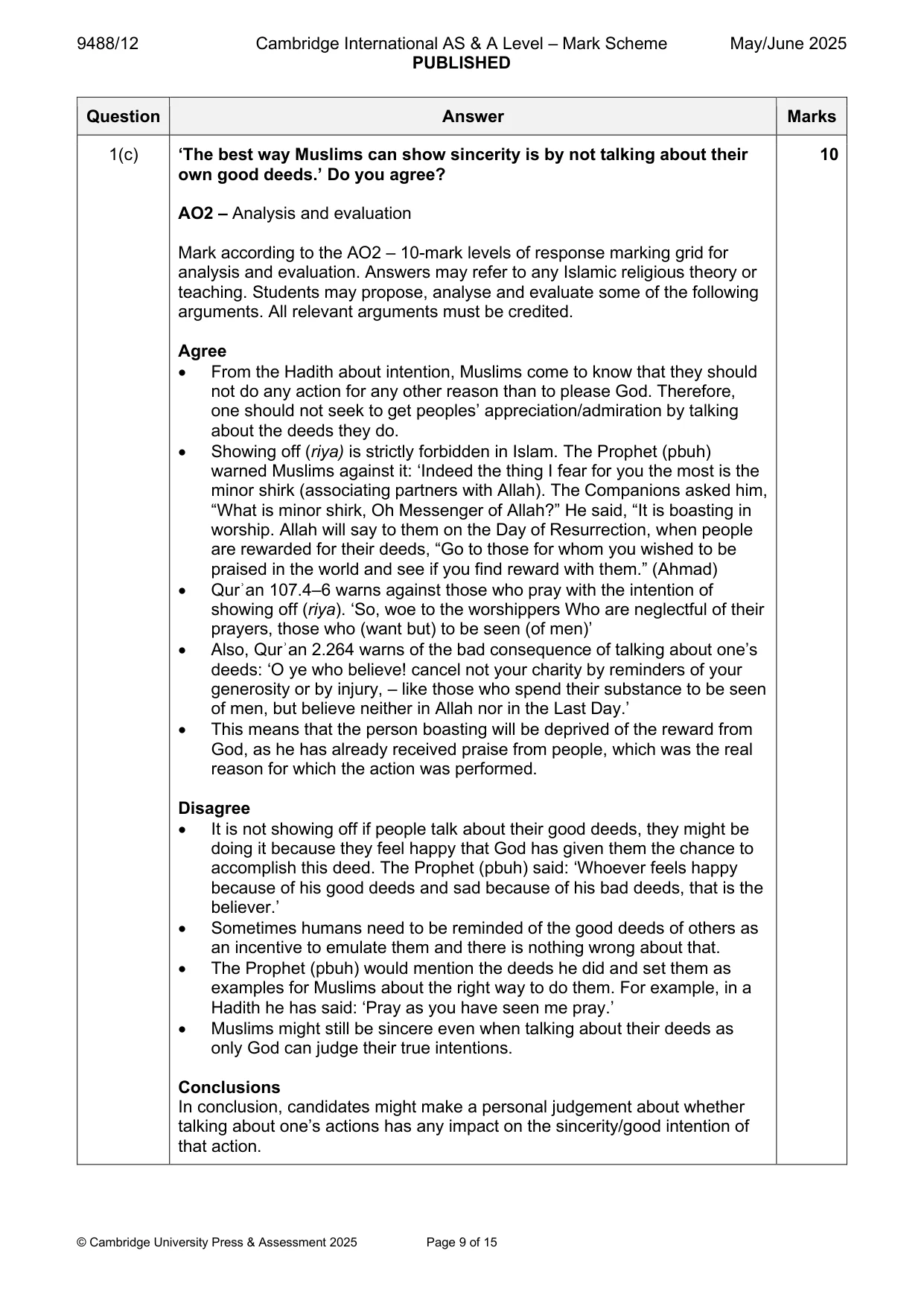
9488/12 Cambridge International AS & A Level – Mark Scheme PUBLISHED May/June 2025 © Cambridge University Press & Assessment 2025 Page 9 of 15 Question Answer Marks 1(c) ‘The best way Muslims can show sincerity is by not talking about their own good deeds.’ Do you agree? AO2 – Analysis and evaluation Mark according to the AO2 – 10-mark levels of response marking grid for analysis and evaluation. Answers may refer to any Islamic religious theory or teaching. Students may propose, analyse and evaluate some of the following arguments. All relevant arguments must be credited. Agree • From the Hadith about intention, Muslims come to know that they should not do any action for any other reason than to please God. Therefore, one should not seek to get peoples’ appreciation/admiration by talking about the deeds they do. • Showing off (riya) is strictly forbidden in Islam. The Prophet (pbuh) warned Muslims against it: ‘Indeed the thing I fear for you the most is the minor shirk (associating partners with Allah). The Companions asked him, “What is minor shirk, Oh Messenger of Allah?” He said, “It is boasting in worship. Allah will say to them on the Day of Resurrection, when people are rewarded for their deeds, “Go to those for whom you wished to be praised in the world and see if you find reward with them.” (Ahmad) • Qurʾan 107.4–6 warns against those who pray with the intention of showing off (riya). ‘So, woe to the worshippers Who are neglectful of their prayers, those who (want but) to be seen (of men)’ • Also, Qurʾan 2.264 warns of the bad consequence of talking about one’s deeds: ‘O ye who believe! cancel not your charity by reminders of your generosity or by injury, – like those who spend their substance to be seen of men, but believe neither in Allah nor in the Last Day.’ • This means that the person boasting will be deprived of the reward from God, as he has already received praise from people, which was the real reason for which the action was performed. Disagree • It is not showing off if people talk about their good deeds, they might be doing it because they feel happy that God has given them the chance to accomplish this deed. The Prophet (pbuh) said: ‘Whoever feels happy because of his good deeds and sad because of his bad deeds, that is the believer.’ • Sometimes humans need to be reminded of the good deeds of others as an incentive to emulate them and there is nothing wrong about that. • The Prophet (pbuh) would mention the deeds he did and set them as examples for Muslims about the right way to do them. For example, in a Hadith he has said: ‘Pray as you have seen me pray.’ • Muslims might still be sincere even when talking about their deeds as only God can judge their true intentions. Conclusions In conclusion, candidates might make a personal judgement about whether talking about one’s actions has any impact on the sincerity/good intention of that action. 10
Mark scheme, page 10
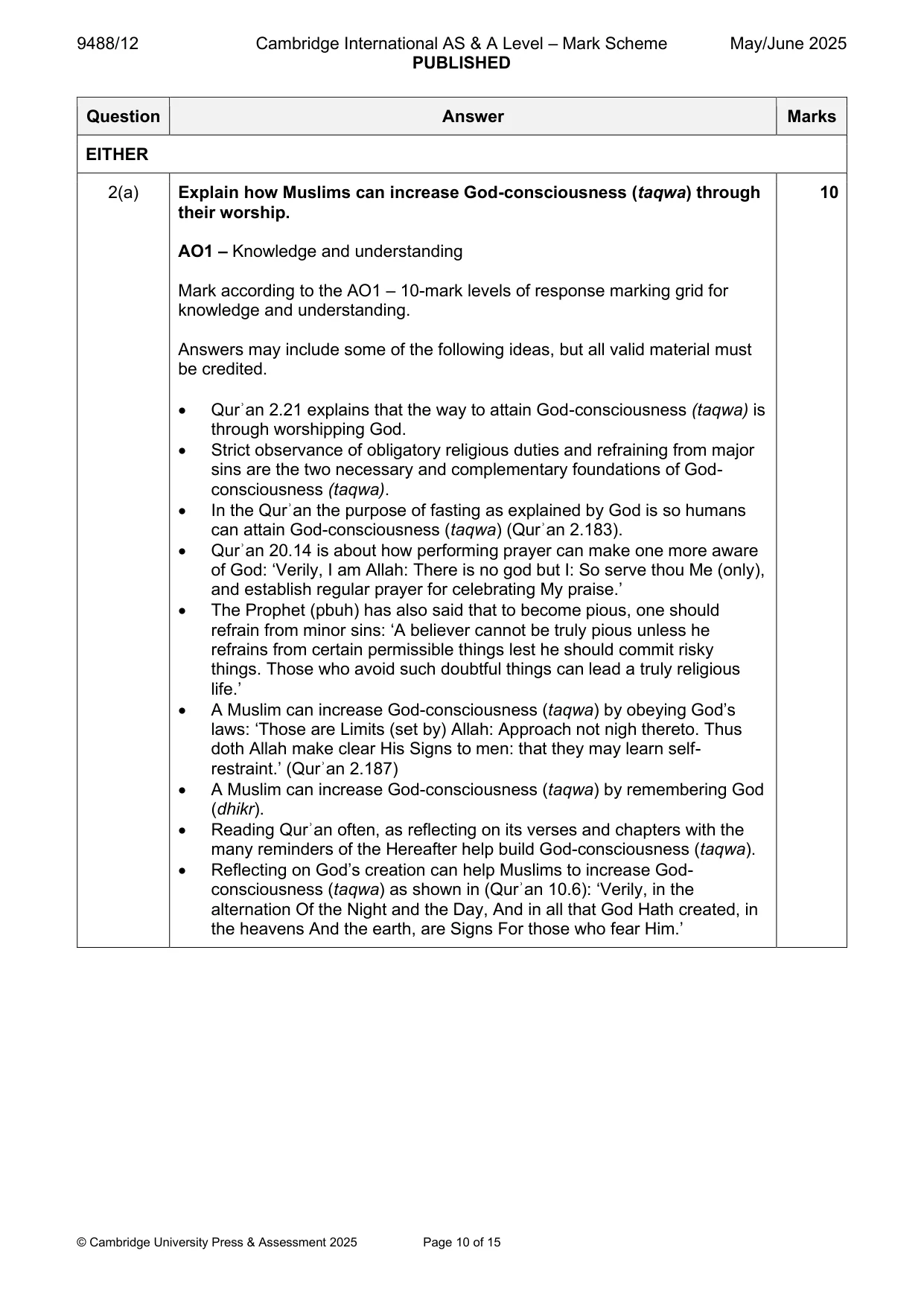
9488/12 Cambridge International AS & A Level – Mark Scheme PUBLISHED May/June 2025 © Cambridge University Press & Assessment 2025 Page 10 of 15 Question Answer Marks EITHER 2(a) Explain how Muslims can increase God-consciousness (taqwa) through their worship. AO1 – Knowledge and understanding Mark according to the AO1 – 10-mark levels of response marking grid for knowledge and understanding. Answers may include some of the following ideas, but all valid material must be credited. • Qurʾan 2.21 explains that the way to attain God-consciousness (taqwa) is through worshipping God. • Strict observance of obligatory religious duties and refraining from major sins are the two necessary and complementary foundations of God- consciousness (taqwa). • In the Qurʾan the purpose of fasting as explained by God is so humans can attain God-consciousness (taqwa) (Qurʾan 2.183). • Qurʾan 20.14 is about how performing prayer can make one more aware of God: ‘Verily, I am Allah: There is no god but I: So serve thou Me (only), and establish regular prayer for celebrating My praise.’ • The Prophet (pbuh) has also said that to become pious, one should refrain from minor sins: ‘A believer cannot be truly pious unless he refrains from certain permissible things lest he should commit risky things. Those who avoid such doubtful things can lead a truly religious life.’ • A Muslim can increase God-consciousness (taqwa) by obeying God’s laws: ‘Those are Limits (set by) Allah: Approach not nigh thereto. Thus doth Allah make clear His Signs to men: that they may learn self- restraint.’ (Qurʾan 2.187) • A Muslim can increase God-consciousness (taqwa) by remembering God (dhikr). • Reading Qurʾan often, as reflecting on its verses and chapters with the many reminders of the Hereafter help build God-consciousness (taqwa). • Reflecting on God’s creation can help Muslims to increase God- consciousness (taqwa) as shown in (Qurʾan 10.6): ‘Verily, in the alternation Of the Night and the Day, And in all that God Hath created, in the heavens And the earth, are Signs For those who fear Him.’ 10
Mark scheme, page 11
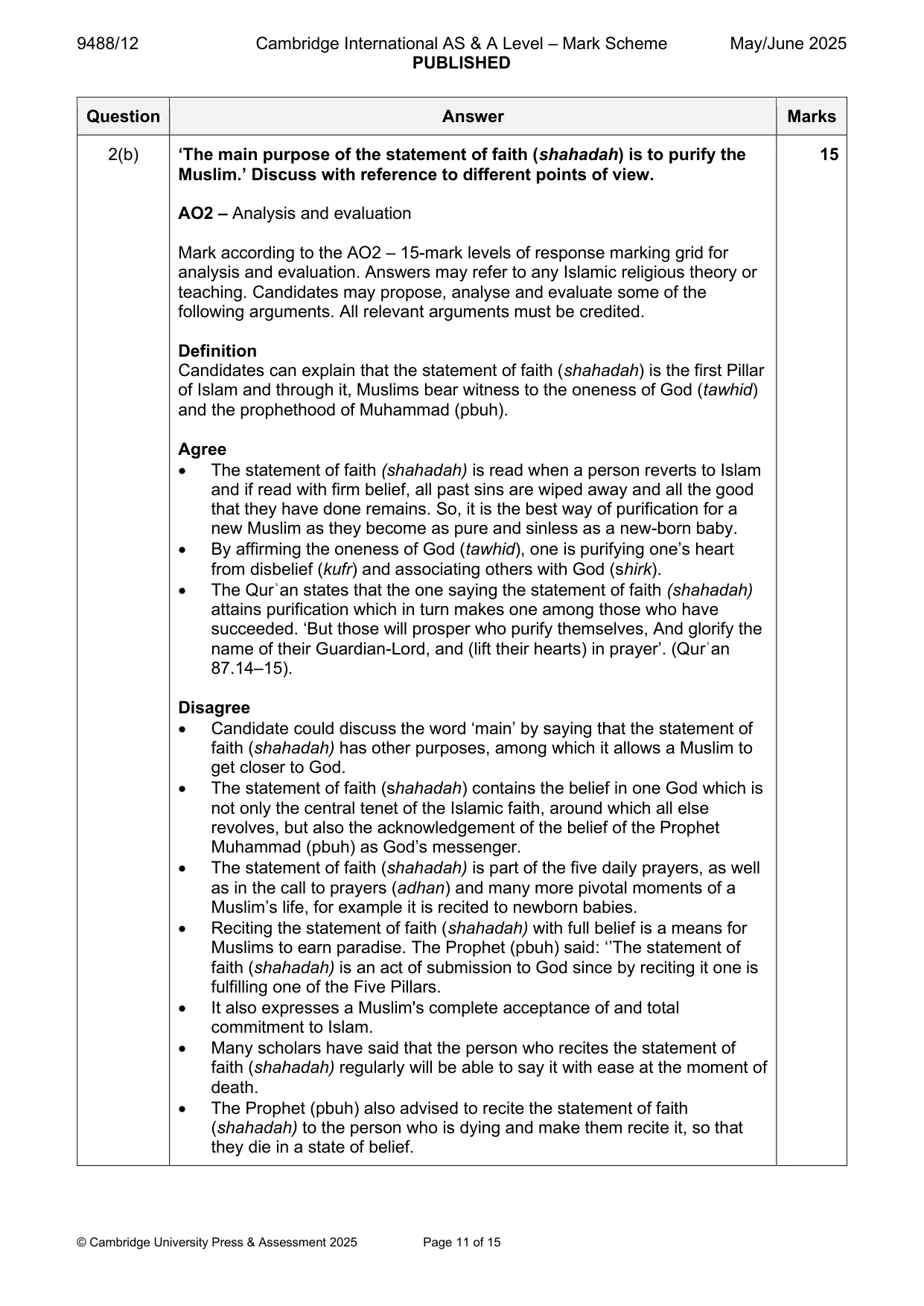
9488/12 Cambridge International AS & A Level – Mark Scheme PUBLISHED May/June 2025 © Cambridge University Press & Assessment 2025 Page 11 of 15 Question Answer Marks 2(b) ‘The main purpose of the statement of faith (shahadah) is to purify the Muslim.’ Discuss with reference to different points of view. AO2 – Analysis and evaluation Mark according to the AO2 – 15-mark levels of response marking grid for analysis and evaluation. Answers may refer to any Islamic religious theory or teaching. Candidates may propose, analyse and evaluate some of the following arguments. All relevant arguments must be credited. Definition Candidates can explain that the statement of faith (shahadah) is the first Pillar of Islam and through it, Muslims bear witness to the oneness of God (tawhid) and the prophethood of Muhammad (pbuh). Agree • The statement of faith (shahadah) is read when a person reverts to Islam and if read with firm belief, all past sins are wiped away and all the good that they have done remains. So, it is the best way of purification for a new Muslim as they become as pure and sinless as a new-born baby. • By affirming the oneness of God (tawhid), one is purifying one’s heart from disbelief (kufr) and associating others with God (shirk). • The Qurʾan states that the one saying the statement of faith (shahadah) attains purification which in turn makes one among those who have succeeded. ‘But those will prosper who purify themselves, And glorify the name of their Guardian-Lord, and (lift their hearts) in prayer’. (Qurʾan 87.14–15). Disagree • Candidate could discuss the word ‘main’ by saying that the statement of faith (shahadah) has other purposes, among which it allows a Muslim to get closer to God. • The statement of faith (shahadah) contains the belief in one God which is not only the central tenet of the Islamic faith, around which all else revolves, but also the acknowledgement of the belief of the Prophet Muhammad (pbuh) as God’s messenger. • The statement of faith (shahadah) is part of the five daily prayers, as well as in the call to prayers (adhan) and many more pivotal moments of a Muslim’s life, for example it is recited to newborn babies. • Reciting the statement of faith (shahadah) with full belief is a means for Muslims to earn paradise. The Prophet (pbuh) said: ‘’The statement of faith (shahadah) is an act of submission to God since by reciting it one is fulfilling one of the Five Pillars. • It also expresses a Muslim's complete acceptance of and total commitment to Islam. • Many scholars have said that the person who recites the statement of faith (shahadah) regularly will be able to say it with ease at the moment of death. • The Prophet (pbuh) also advised to recite the statement of faith (shahadah) to the person who is dying and make them recite it, so that they die in a state of belief. 15
Mark scheme, page 12
9488/12 Cambridge International AS & A Level – Mark Scheme PUBLISHED May/June 2025 © Cambridge University Press & Assessment 2025 Page 12 of 15 Question Answer Marks 2(b) Conclusion Conclusions should come to a decision about whether there are other purposes to the declaration of the statement of faith other than just to purify a Muslim and which could be the main one.
Mark scheme, page 13
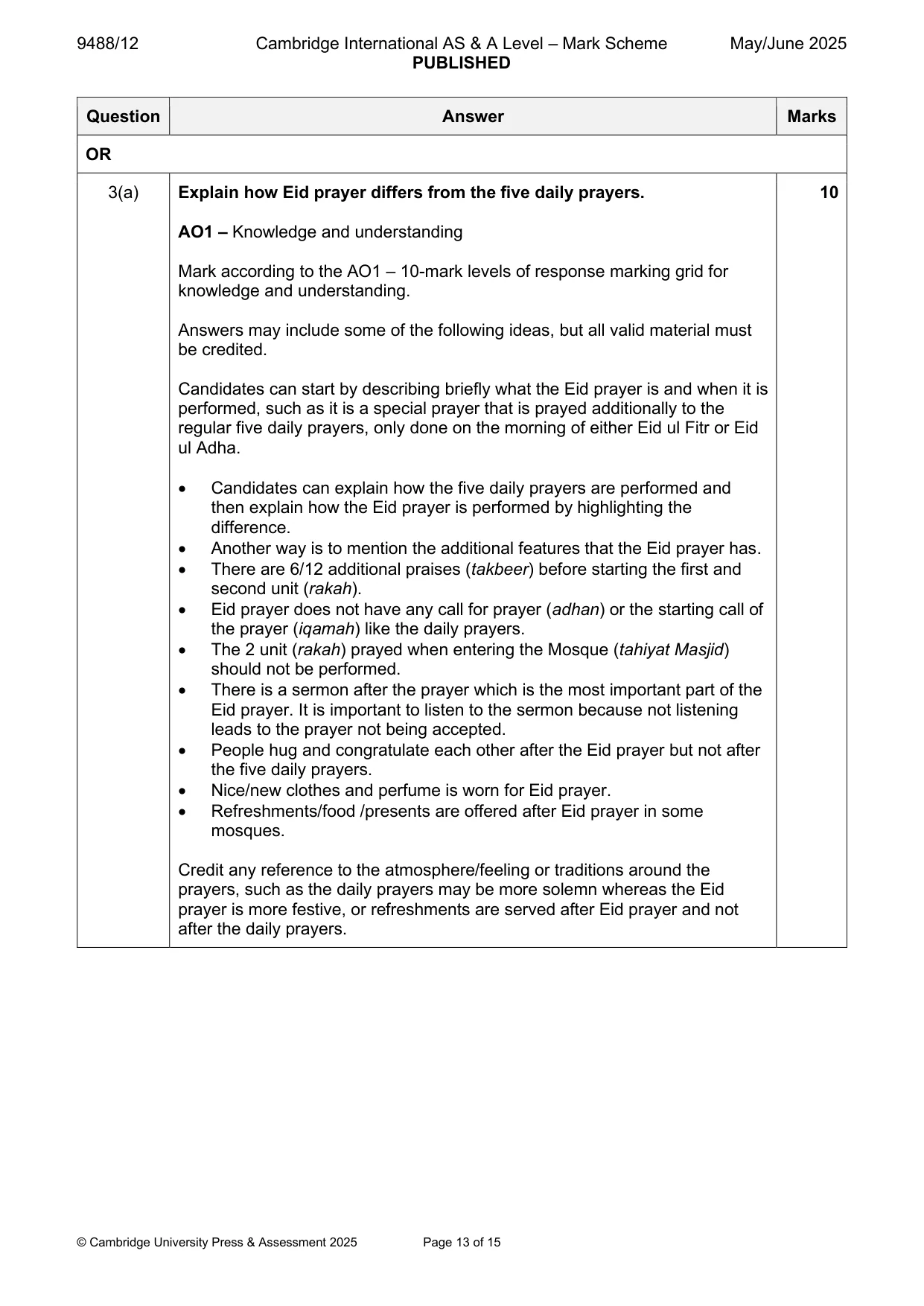
9488/12 Cambridge International AS & A Level – Mark Scheme PUBLISHED May/June 2025 © Cambridge University Press & Assessment 2025 Page 13 of 15 Question Answer Marks OR 3(a) Explain how Eid prayer differs from the five daily prayers. AO1 – Knowledge and understanding Mark according to the AO1 – 10-mark levels of response marking grid for knowledge and understanding. Answers may include some of the following ideas, but all valid material must be credited. Candidates can start by describing briefly what the Eid prayer is and when it is performed, such as it is a special prayer that is prayed additionally to the regular five daily prayers, only done on the morning of either Eid ul Fitr or Eid ul Adha. • Candidates can explain how the five daily prayers are performed and then explain how the Eid prayer is performed by highlighting the difference. • Another way is to mention the additional features that the Eid prayer has. • There are 6/12 additional praises (takbeer) before starting the first and second unit (rakah). • Eid prayer does not have any call for prayer (adhan) or the starting call of the prayer (iqamah) like the daily prayers. • The 2 unit (rakah) prayed when entering the Mosque (tahiyat Masjid) should not be performed. • There is a sermon after the prayer which is the most important part of the Eid prayer. It is important to listen to the sermon because not listening leads to the prayer not being accepted. • People hug and congratulate each other after the Eid prayer but not after the five daily prayers. • Nice/new clothes and perfume is worn for Eid prayer. • Refreshments/food /presents are offered after Eid prayer in some mosques. Credit any reference to the atmosphere/feeling or traditions around the prayers, such as the daily prayers may be more solemn whereas the Eid prayer is more festive, or refreshments are served after Eid prayer and not after the daily prayers. 10
Mark scheme, page 14
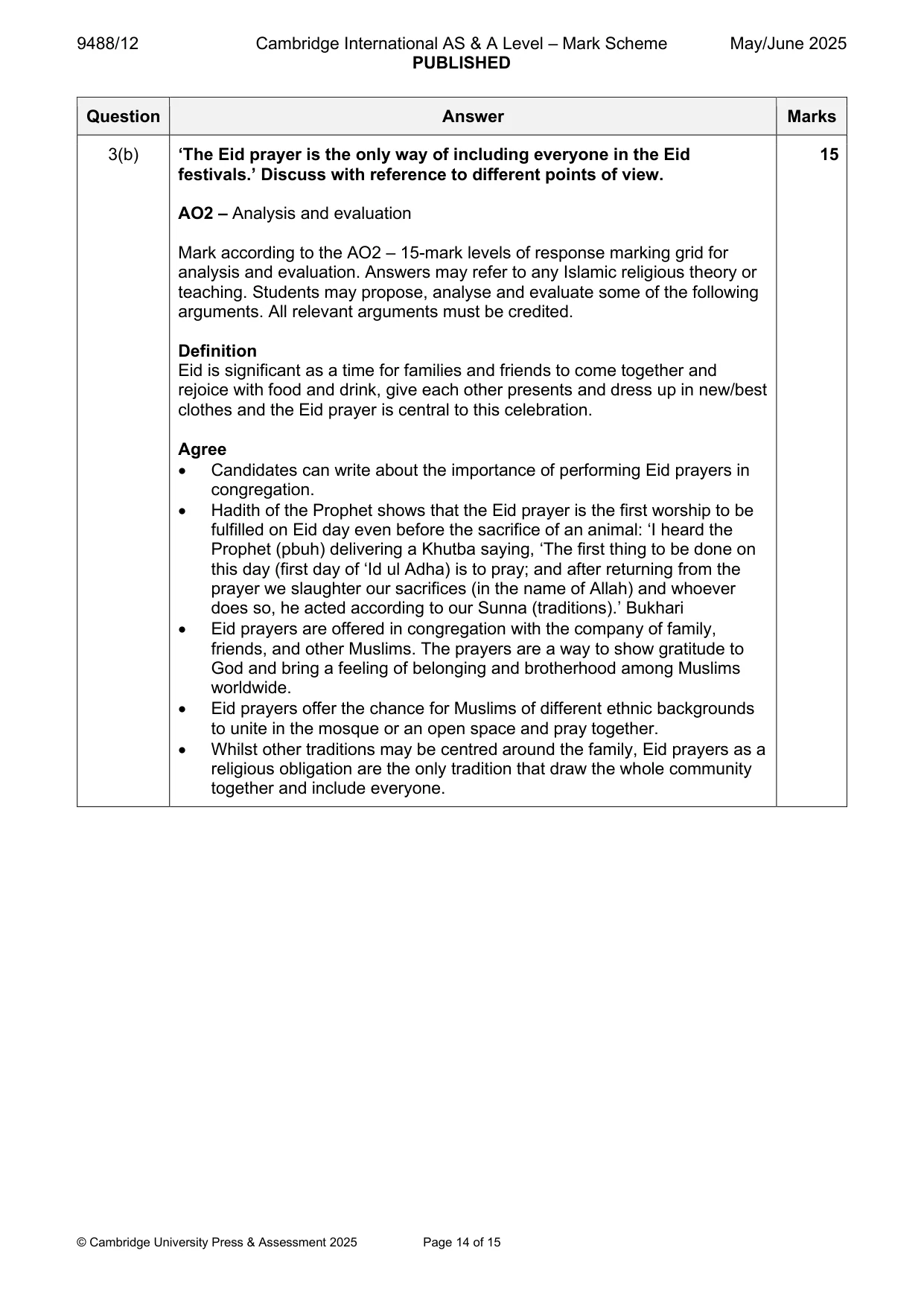
9488/12 Cambridge International AS & A Level – Mark Scheme PUBLISHED May/June 2025 © Cambridge University Press & Assessment 2025 Page 14 of 15 Question Answer Marks 3(b) ‘The Eid prayer is the only way of including everyone in the Eid festivals.’ Discuss with reference to different points of view. AO2 – Analysis and evaluation Mark according to the AO2 – 15-mark levels of response marking grid for analysis and evaluation. Answers may refer to any Islamic religious theory or teaching. Students may propose, analyse and evaluate some of the following arguments. All relevant arguments must be credited. Definition Eid is significant as a time for families and friends to come together and rejoice with food and drink, give each other presents and dress up in new/best clothes and the Eid prayer is central to this celebration. Agree • Candidates can write about the importance of performing Eid prayers in congregation. • Hadith of the Prophet shows that the Eid prayer is the first worship to be fulfilled on Eid day even before the sacrifice of an animal: ‘I heard the Prophet (pbuh) delivering a Khutba saying, ‘The first thing to be done on this day (first day of ‘Id ul Adha) is to pray; and after returning from the prayer we slaughter our sacrifices (in the name of Allah) and whoever does so, he acted according to our Sunna (traditions).’ Bukhari • Eid prayers are offered in congregation with the company of family, friends, and other Muslims. The prayers are a way to show gratitude to God and bring a feeling of belonging and brotherhood among Muslims worldwide. • Eid prayers offer the chance for Muslims of different ethnic backgrounds to unite in the mosque or an open space and pray together. • Whilst other traditions may be centred around the family, Eid prayers as a religious obligation are the only tradition that draw the whole community together and include everyone. 15
Mark scheme, page 15
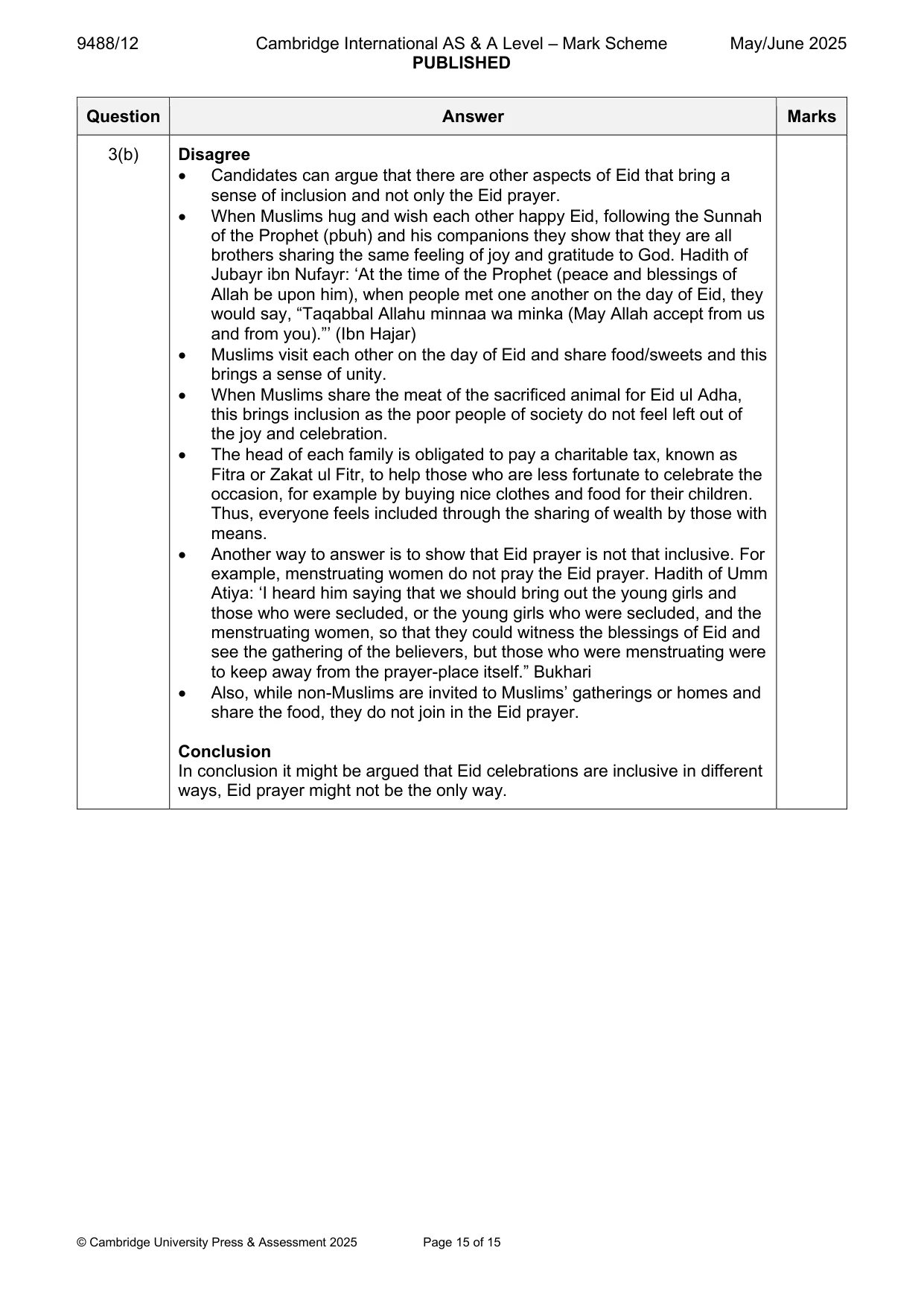
9488/12 Cambridge International AS & A Level – Mark Scheme PUBLISHED May/June 2025 © Cambridge University Press & Assessment 2025 Page 15 of 15 Question Answer Marks 3(b) Disagree • Candidates can argue that there are other aspects of Eid that bring a sense of inclusion and not only the Eid prayer. • When Muslims hug and wish each other happy Eid, following the Sunnah of the Prophet (pbuh) and his companions they show that they are all brothers sharing the same feeling of joy and gratitude to God. Hadith of Jubayr ibn Nufayr: ‘At the time of the Prophet (peace and blessings of Allah be upon him), when people met one another on the day of Eid, they would say, “Taqabbal Allahu minnaa wa minka (May Allah accept from us and from you).”’ (Ibn Hajar) • Muslims visit each other on the day of Eid and share food/sweets and this brings a sense of unity. • When Muslims share the meat of the sacrificed animal for Eid ul Adha, this brings inclusion as the poor people of society do not feel left out of the joy and celebration. • The head of each family is obligated to pay a charitable tax, known as Fitra or Zakat ul Fitr, to help those who are less fortunate to celebrate the occasion, for example by buying nice clothes and food for their children. Thus, everyone feels included through the sharing of wealth by those with means. • Another way to answer is to show that Eid prayer is not that inclusive. For example, menstruating women do not pray the Eid prayer. Hadith of Umm Atiya: ‘I heard him saying that we should bring out the young girls and those who were secluded, or the young girls who were secluded, and the menstruating women, so that they could witness the blessings of Eid and see the gathering of the believers, but those who were menstruating were to keep away from the prayer-place itself.” Bukhari • Also, while non-Muslims are invited to Muslims’ gatherings or homes and share the food, they do not join in the Eid prayer. Conclusion In conclusion it might be argued that Eid celebrations are inclusive in different ways, Eid prayer might not be the only way.
What you needed in this session
Cambridge’s own grade thresholds for 2025 May/June, Paper 1 · Variant 2. A higher threshold means an easier paper — the bar moves with how the cohort did.