Cambridge A Level Islamic Studies 9488 — 2023 Oct/Nov Paper 1 · Variant 2
9488/12/O/N/23 · 50 marks · ≈56 min
The question paper and its mark scheme, free to read here and free to download. This is Cambridge’s own paper, exactly as it was sat.
Question paper4 pages

Mark scheme15 pages
Answers below. Sit the paper first if you are practising.
Paper as text
Question paper, page 1
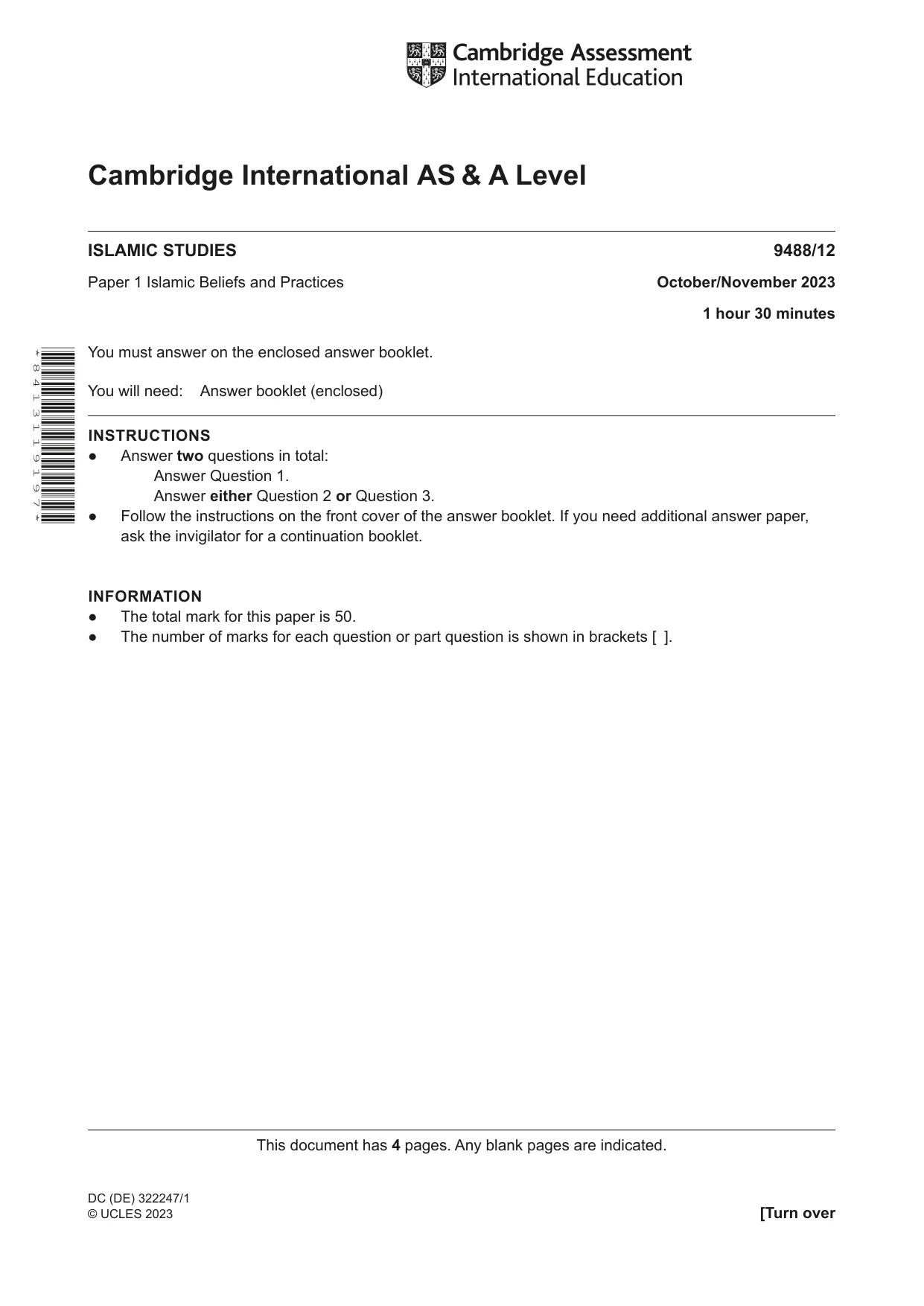
This document has 4 pages. Any blank pages are indicated. [Turn over * 8 4 1 3 1 1 9 1 9 7 * Cambridge International AS & A Level DC (DE) 322247/1 © UCLES 2023 ISLAMIC STUDIES 9488/12 Paper 1 Islamic Beliefs and Practices October/November 2023 1 hour 30 minutes You must answer on the enclosed answer booklet. You will need: Answer booklet (enclosed) INSTRUCTIONS ● Answer two questions in total: Answer Question 1. Answer either Question 2 or Question 3. ● Follow the instructions on the front cover of the answer booklet. If you need additional answer paper, ask the invigilator for a continuation booklet. INFORMATION ● The total mark for this paper is 50. ● The number of marks for each question or part question is shown in brackets [ ].
Question paper, page 2
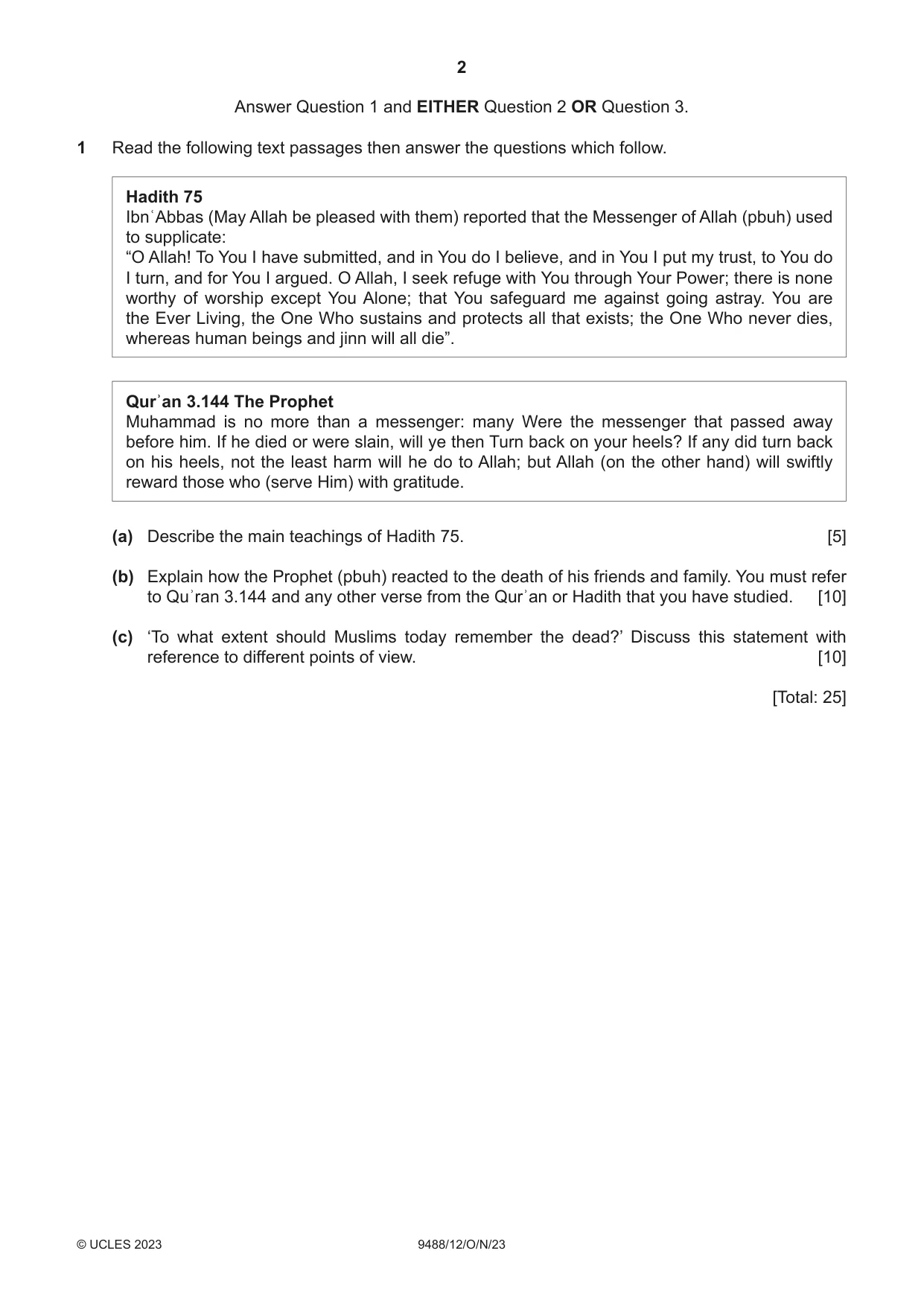
2 9488/12/O/N/23 © UCLES 2023 Answer Question 1 and EITHER Question 2 OR Question 3. 1 Read the following text passages then answer the questions which follow. Hadith 75 IbnʿAbbas (May Allah be pleased with them) reported that the Messenger of Allah (pbuh) used to supplicate: “O Allah! To You I have submitted, and in You do I believe, and in You I put my trust, to You do I turn, and for You I argued. O Allah, I seek refuge with You through Your Power; there is none worthy of worship except You Alone; that You safeguard me against going astray. You are the Ever Living, the One Who sustains and protects all that exists; the One Who never dies, whereas human beings and jinn will all die”. Qurʾan 3.144 The Prophet Muhammad is no more than a messenger: many Were the messenger that passed away before him. If he died or were slain, will ye then Turn back on your heels? If any did turn back on his heels, not the least harm will he do to Allah; but Allah (on the other hand) will swiftly reward those who (serve Him) with gratitude. (a) Describe the main teachings of Hadith 75. [5] (b) Explain how the Prophet (pbuh) reacted to the death of his friends and family. You must refer to Quʾran 3.144 and any other verse from the Qurʾan or Hadith that you have studied. [10] (c) ‘To what extent should Muslims today remember the dead?’ Discuss this statement with reference to different points of view. [10] [Total: 25]
Question paper, page 3
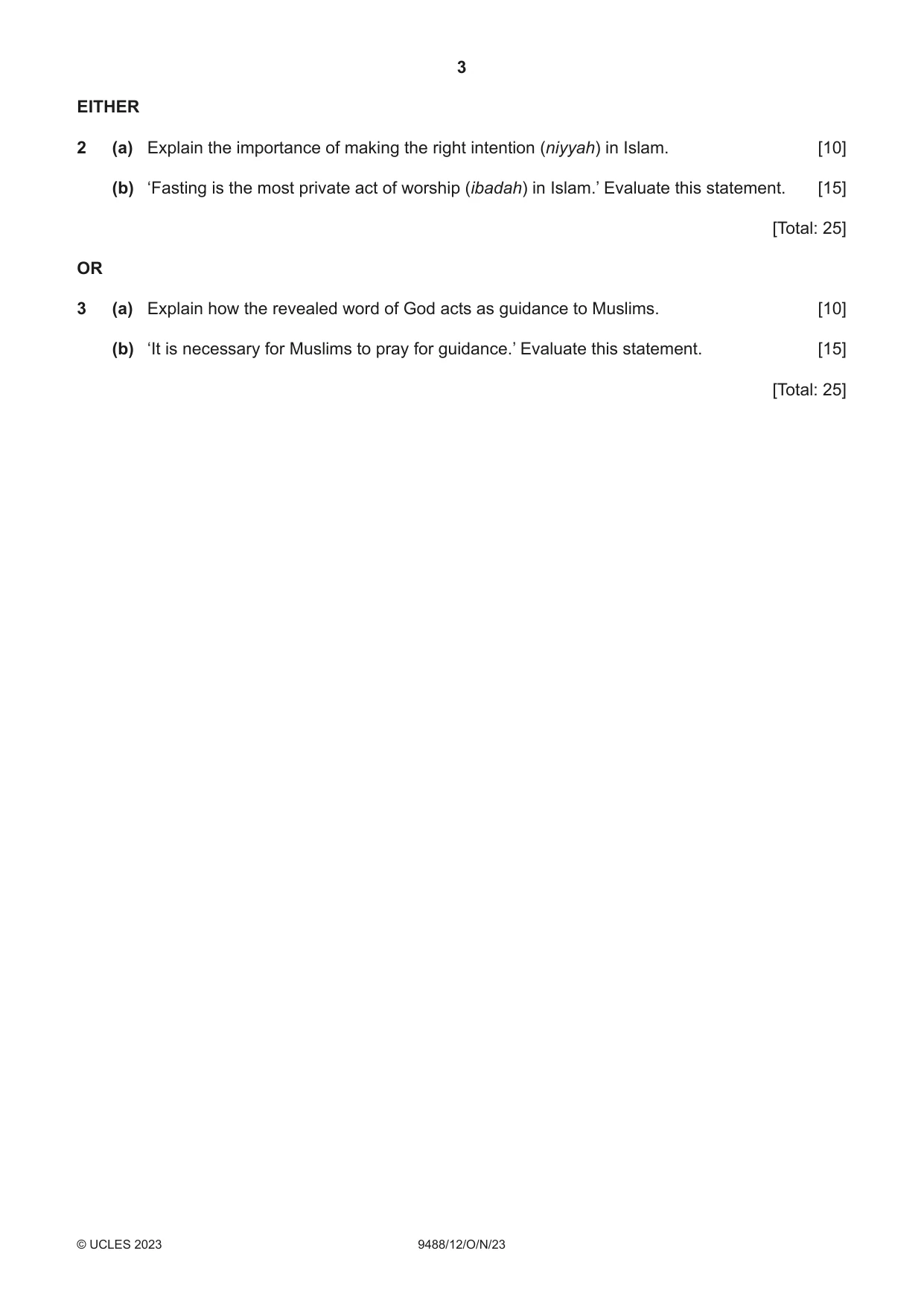
3 9488/12/O/N/23 © UCLES 2023 EITHER 2 (a) Explain the importance of making the right intention (niyyah) in Islam. [10] (b) ‘Fasting is the most private act of worship (ibadah) in Islam.’ Evaluate this statement. [15] [Total: 25] OR 3 (a) Explain how the revealed word of God acts as guidance to Muslims. [10] (b) ‘It is necessary for Muslims to pray for guidance.’ Evaluate this statement. [15] [Total: 25]
Question paper, page 4
4 9488/12/O/N/23 © UCLES 2023 Permission to reproduce items where third-party owned material protected by copyright is included has been sought and cleared where possible. Every reasonable effort has been made by the publisher (UCLES) to trace copyright holders, but if any items requiring clearance have unwittingly been included, the publisher will be pleased to make amends at the earliest possible opportunity. To avoid the issue of disclosure of answer-related information to candidates, all copyright acknowledgements are reproduced online in the Cambridge Assessment International Education Copyright Acknowledgements Booklet. This is produced for each series of examinations and is freely available to download at www.cambridgeinternational.org after the live examination series. Cambridge Assessment International Education is part of Cambridge Assessment. Cambridge Assessment is the brand name of the University of Cambridge Local Examinations Syndicate (UCLES), which is a department of the University of Cambridge. BLANK PAGE
Mark scheme, page 1
This document consists of 15 printed pages. © UCLES 2023 [Turn over Cambridge International AS & A Level ISLAMIC STUDIES 9488/12 Paper 1 Islamic Beliefs and Practices October/November 2023 MARK SCHEME Maximum Mark: 50 Published This mark scheme is published as an aid to teachers and candidates, to indicate the requirements of the examination. It shows the basis on which Examiners were instructed to award marks. It does not indicate the details of the discussions that took place at an Examiners’ meeting before marking began, which would have considered the acceptability of alternative answers. Mark schemes should be read in conjunction with the question paper and the Principal Examiner Report for Teachers. Cambridge International will not enter into discussions about these mark schemes. Cambridge International is publishing the mark schemes for the October/November 2023 series for most Cambridge IGCSE, Cambridge International A and AS Level components, and some Cambridge O Level components.
Mark scheme, page 2
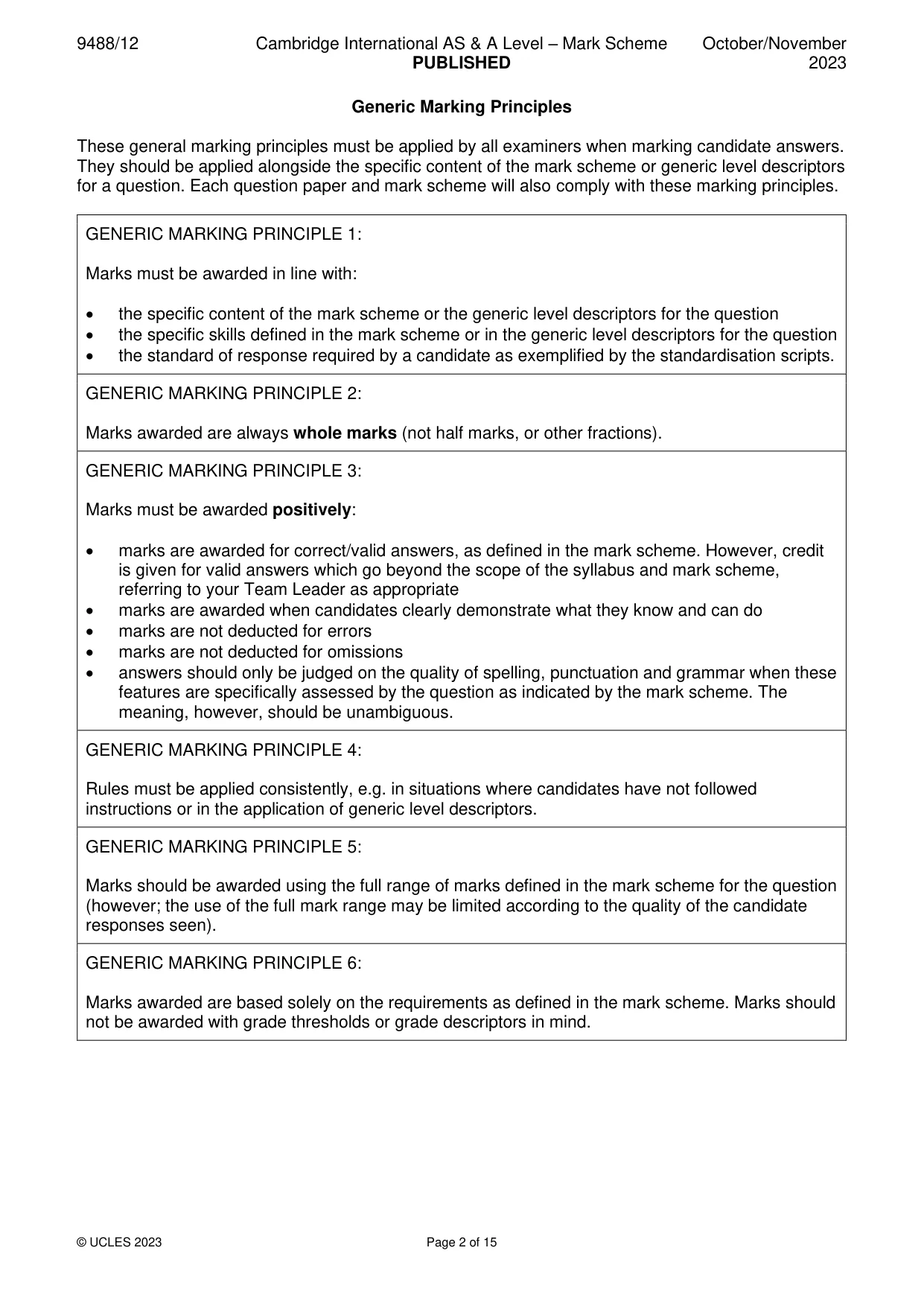
9488/12 Cambridge International AS & A Level – Mark Scheme PUBLISHED October/November 2023 © UCLES 2023 Page 2 of 15 Generic Marking Principles These general marking principles must be applied by all examiners when marking candidate answers. They should be applied alongside the specific content of the mark scheme or generic level descriptors for a question. Each question paper and mark scheme will also comply with these marking principles. GENERIC MARKING PRINCIPLE 1: Marks must be awarded in line with: • the specific content of the mark scheme or the generic level descriptors for the question • the specific skills defined in the mark scheme or in the generic level descriptors for the question • the standard of response required by a candidate as exemplified by the standardisation scripts. GENERIC MARKING PRINCIPLE 2: Marks awarded are always whole marks (not half marks, or other fractions). GENERIC MARKING PRINCIPLE 3: Marks must be awarded positively: • marks are awarded for correct/valid answers, as defined in the mark scheme. However, credit is given for valid answers which go beyond the scope of the syllabus and mark scheme, referring to your Team Leader as appropriate • marks are awarded when candidates clearly demonstrate what they know and can do • marks are not deducted for errors • marks are not deducted for omissions • answers should only be judged on the quality of spelling, punctuation and grammar when these features are specifically assessed by the question as indicated by the mark scheme. The meaning, however, should be unambiguous. GENERIC MARKING PRINCIPLE 4: Rules must be applied consistently, e.g. in situations where candidates have not followed instructions or in the application of generic level descriptors. GENERIC MARKING PRINCIPLE 5: Marks should be awarded using the full range of marks defined in the mark scheme for the question (however; the use of the full mark range may be limited according to the quality of the candidate responses seen). GENERIC MARKING PRINCIPLE 6: Marks awarded are based solely on the requirements as defined in the mark scheme. Marks should not be awarded with grade thresholds or grade descriptors in mind.
Mark scheme, page 3
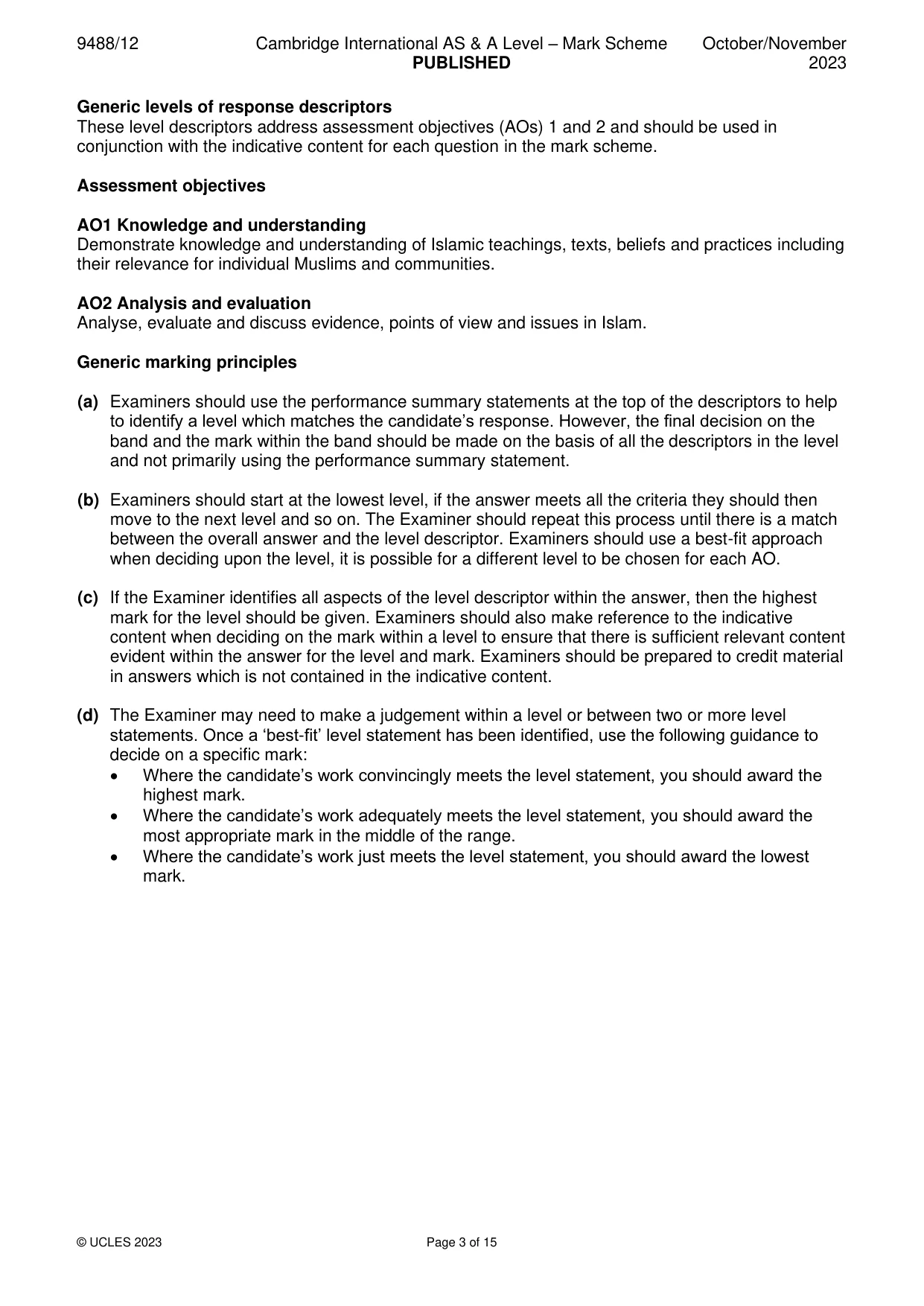
9488/12 Cambridge International AS & A Level – Mark Scheme PUBLISHED October/November 2023 © UCLES 2023 Page 3 of 15 Generic levels of response descriptors These level descriptors address assessment objectives (AOs) 1 and 2 and should be used in conjunction with the indicative content for each question in the mark scheme. Assessment objectives AO1 Knowledge and understanding Demonstrate knowledge and understanding of Islamic teachings, texts, beliefs and practices including their relevance for individual Muslims and communities. AO2 Analysis and evaluation Analyse, evaluate and discuss evidence, points of view and issues in Islam. Generic marking principles (a) Examiners should use the performance summary statements at the top of the descriptors to help to identify a level which matches the candidate’s response. However, the final decision on the band and the mark within the band should be made on the basis of all the descriptors in the level and not primarily using the performance summary statement. (b) Examiners should start at the lowest level, if the answer meets all the criteria they should then move to the next level and so on. The Examiner should repeat this process until there is a match between the overall answer and the level descriptor. Examiners should use a best-fit approach when deciding upon the level, it is possible for a different level to be chosen for each AO. (c) If the Examiner identifies all aspects of the level descriptor within the answer, then the highest mark for the level should be given. Examiners should also make reference to the indicative content when deciding on the mark within a level to ensure that there is sufficient relevant content evident within the answer for the level and mark. Examiners should be prepared to credit material in answers which is not contained in the indicative content. (d) The Examiner may need to make a judgement within a level or between two or more level statements. Once a ‘best-fit’ level statement has been identified, use the following guidance to decide on a specific mark: • Where the candidate’s work convincingly meets the level statement, you should award the highest mark. • Where the candidate’s work adequately meets the level statement, you should award the most appropriate mark in the middle of the range. • Where the candidate’s work just meets the level statement, you should award the lowest mark.
Mark scheme, page 4
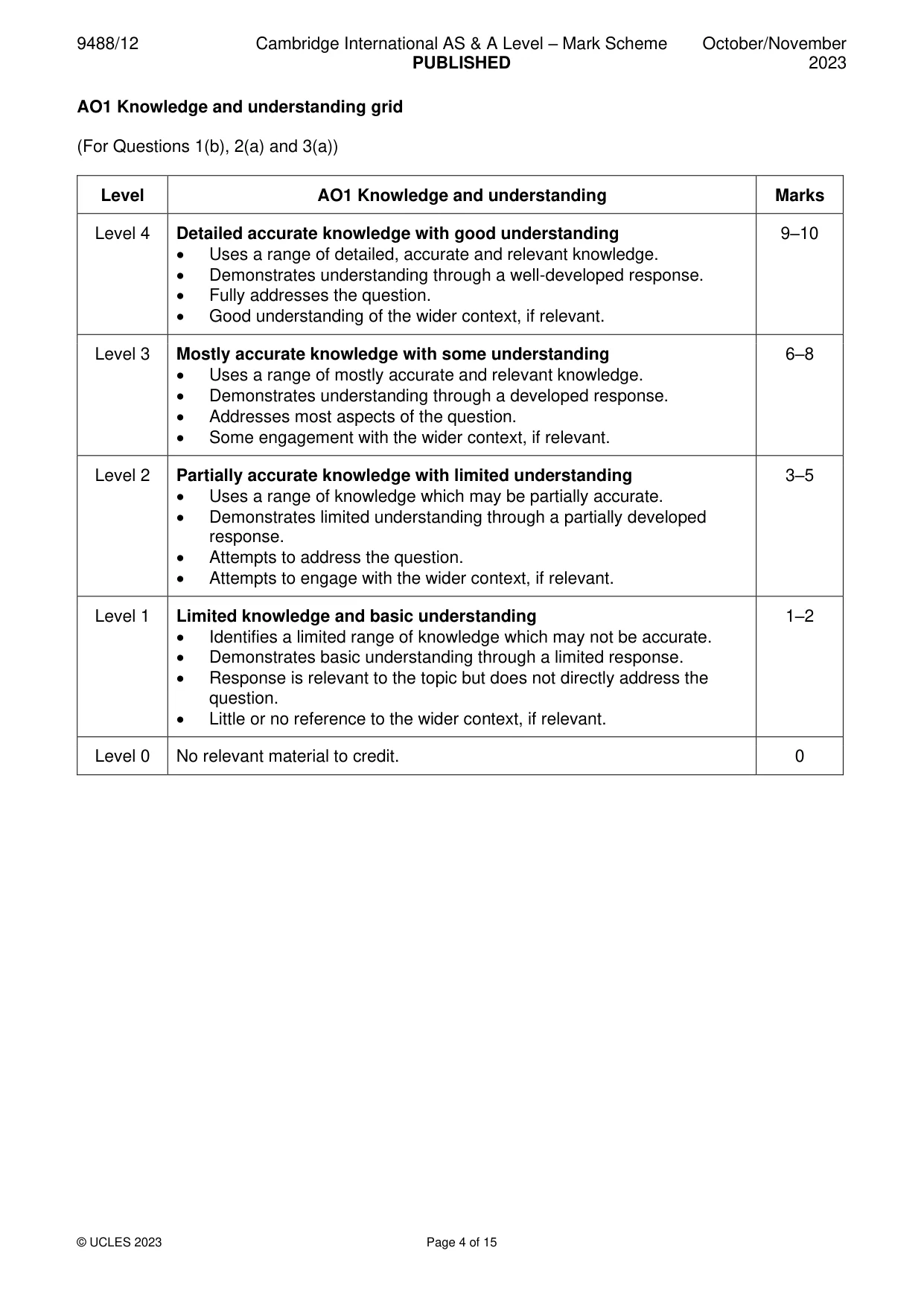
9488/12 Cambridge International AS & A Level – Mark Scheme PUBLISHED October/November 2023 © UCLES 2023 Page 4 of 15 AO1 Knowledge and understanding grid (For Questions 1(b), 2(a) and 3(a)) Level AO1 Knowledge and understanding Marks Level 4 Detailed accurate knowledge with good understanding • Uses a range of detailed, accurate and relevant knowledge. • Demonstrates understanding through a well-developed response. • Fully addresses the question. • Good understanding of the wider context, if relevant. 9–10 Level 3 Mostly accurate knowledge with some understanding • Uses a range of mostly accurate and relevant knowledge. • Demonstrates understanding through a developed response. • Addresses most aspects of the question. • Some engagement with the wider context, if relevant. 6–8 Level 2 Partially accurate knowledge with limited understanding • Uses a range of knowledge which may be partially accurate. • Demonstrates limited understanding through a partially developed response. • Attempts to address the question. • Attempts to engage with the wider context, if relevant. 3–5 Level 1 Limited knowledge and basic understanding • Identifies a limited range of knowledge which may not be accurate. • Demonstrates basic understanding through a limited response. • Response is relevant to the topic but does not directly address the question. • Little or no reference to the wider context, if relevant. 1–2 Level 0 No relevant material to credit. 0
Mark scheme, page 5
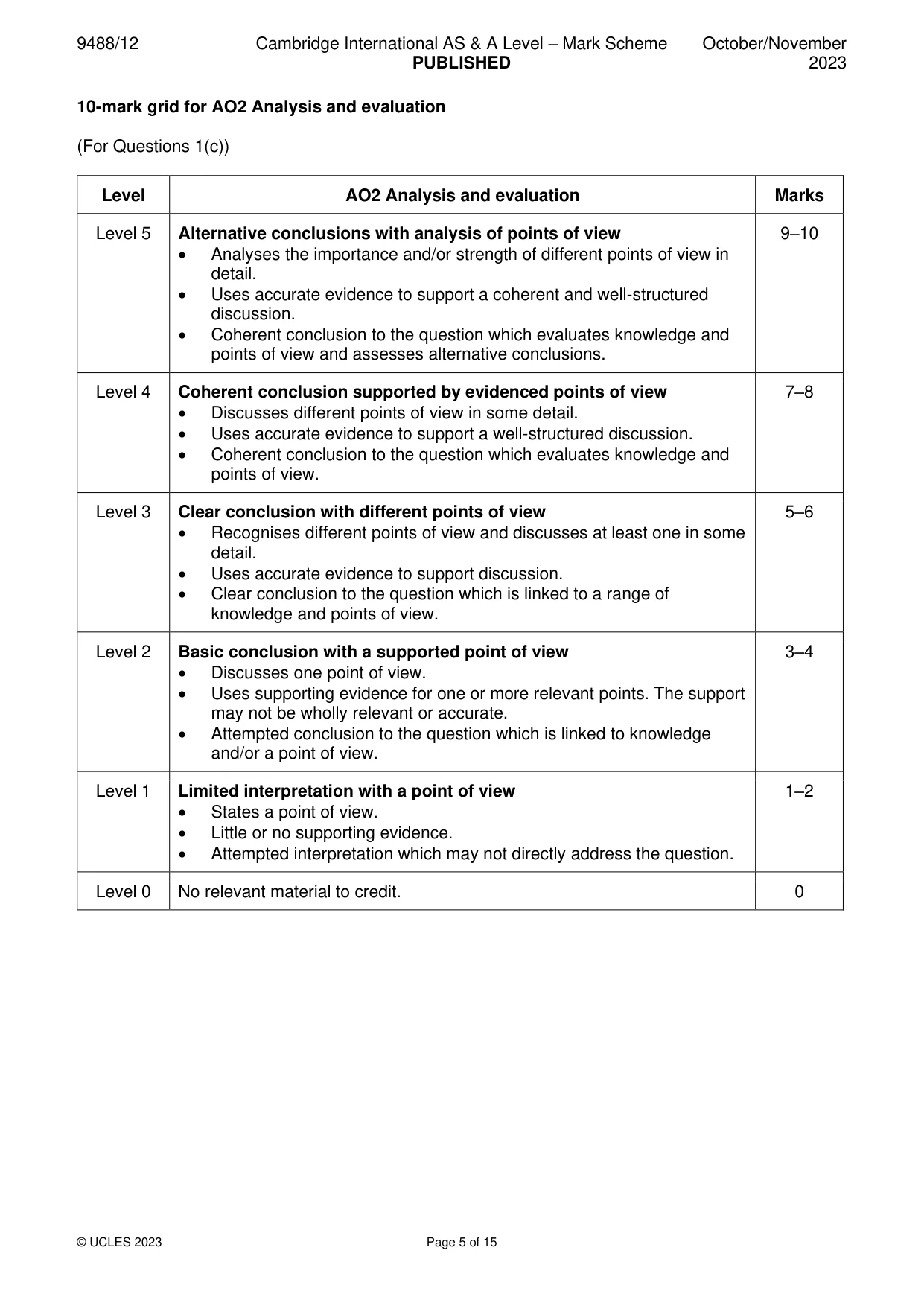
9488/12 Cambridge International AS & A Level – Mark Scheme PUBLISHED October/November 2023 © UCLES 2023 Page 5 of 15 10-mark grid for AO2 Analysis and evaluation (For Questions 1(c)) Level AO2 Analysis and evaluation Marks Level 5 Alternative conclusions with analysis of points of view • Analyses the importance and/or strength of different points of view in detail. • Uses accurate evidence to support a coherent and well-structured discussion. • Coherent conclusion to the question which evaluates knowledge and points of view and assesses alternative conclusions. 9–10 Level 4 Coherent conclusion supported by evidenced points of view • Discusses different points of view in some detail. • Uses accurate evidence to support a well-structured discussion. • Coherent conclusion to the question which evaluates knowledge and points of view. 7–8 Level 3 Clear conclusion with different points of view • Recognises different points of view and discusses at least one in some detail. • Uses accurate evidence to support discussion. • Clear conclusion to the question which is linked to a range of knowledge and points of view. 5–6 Level 2 Basic conclusion with a supported point of view • Discusses one point of view. • Uses supporting evidence for one or more relevant points. The support may not be wholly relevant or accurate. • Attempted conclusion to the question which is linked to knowledge and/or a point of view. 3–4 Level 1 Limited interpretation with a point of view • States a point of view. • Little or no supporting evidence. • Attempted interpretation which may not directly address the question. 1–2 Level 0 No relevant material to credit. 0
Mark scheme, page 6
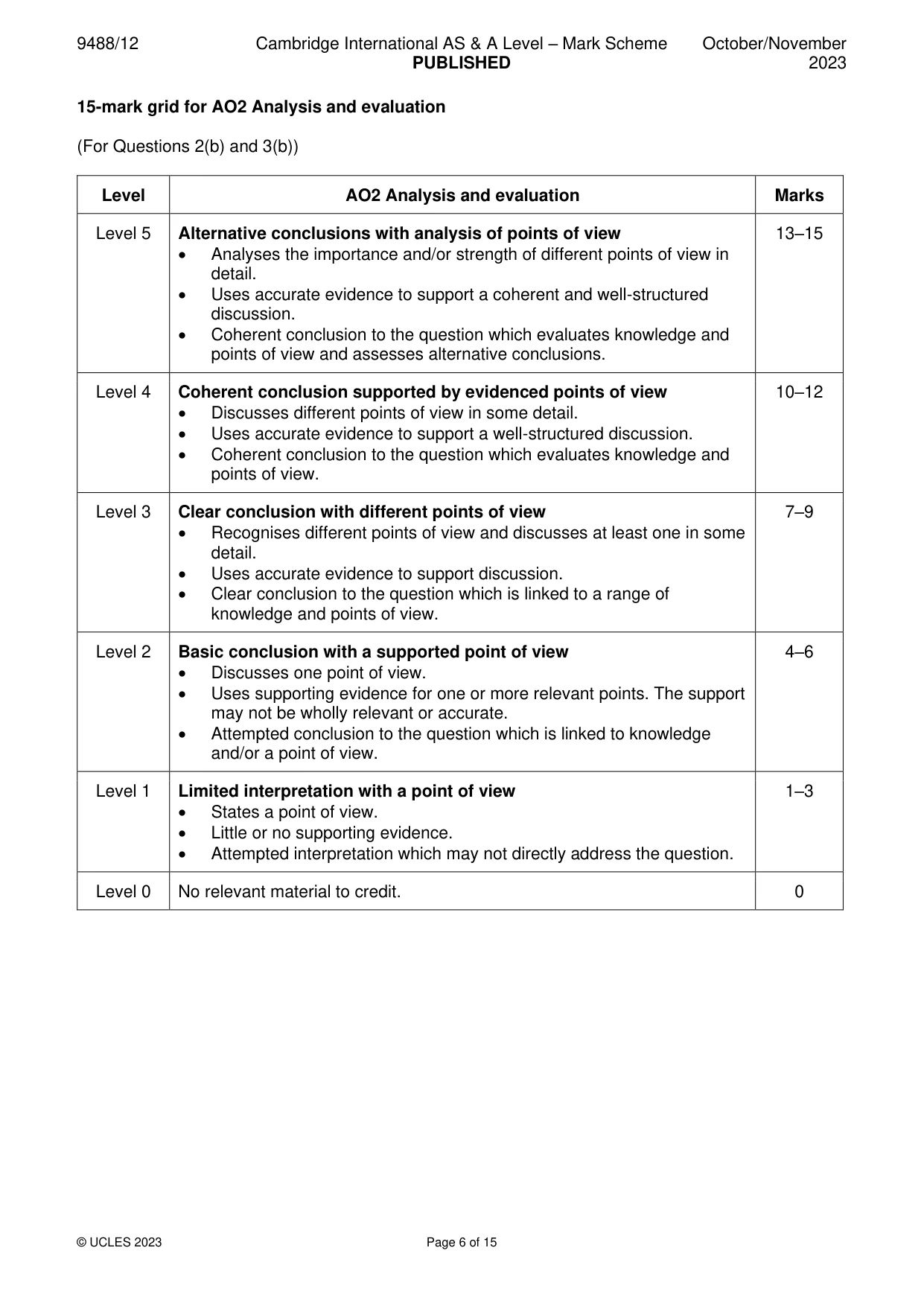
9488/12 Cambridge International AS & A Level – Mark Scheme PUBLISHED October/November 2023 © UCLES 2023 Page 6 of 15 15-mark grid for AO2 Analysis and evaluation (For Questions 2(b) and 3(b)) Level AO2 Analysis and evaluation Marks Level 5 Alternative conclusions with analysis of points of view • Analyses the importance and/or strength of different points of view in detail. • Uses accurate evidence to support a coherent and well-structured discussion. • Coherent conclusion to the question which evaluates knowledge and points of view and assesses alternative conclusions. 13–15 Level 4 Coherent conclusion supported by evidenced points of view • Discusses different points of view in some detail. • Uses accurate evidence to support a well-structured discussion. • Coherent conclusion to the question which evaluates knowledge and points of view. 10–12 Level 3 Clear conclusion with different points of view • Recognises different points of view and discusses at least one in some detail. • Uses accurate evidence to support discussion. • Clear conclusion to the question which is linked to a range of knowledge and points of view. 7–9 Level 2 Basic conclusion with a supported point of view • Discusses one point of view. • Uses supporting evidence for one or more relevant points. The support may not be wholly relevant or accurate. • Attempted conclusion to the question which is linked to knowledge and/or a point of view. 4–6 Level 1 Limited interpretation with a point of view • States a point of view. • Little or no supporting evidence. • Attempted interpretation which may not directly address the question. 1–3 Level 0 No relevant material to credit. 0
Mark scheme, page 7
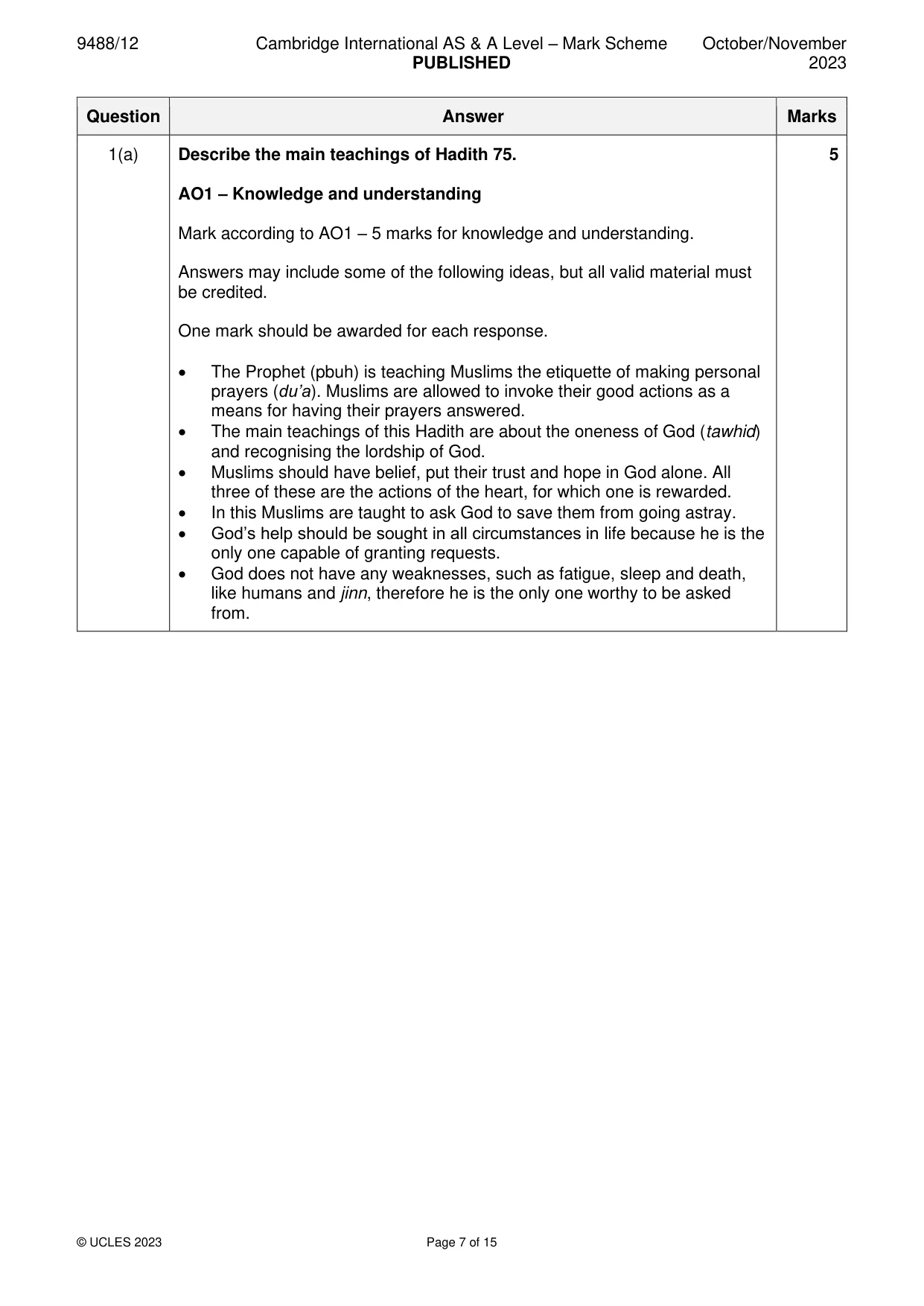
9488/12 Cambridge International AS & A Level – Mark Scheme PUBLISHED October/November 2023 © UCLES 2023 Page 7 of 15 Question Answer Marks 1(a) Describe the main teachings of Hadith 75. AO1 – Knowledge and understanding Mark according to AO1 – 5 marks for knowledge and understanding. Answers may include some of the following ideas, but all valid material must be credited. One mark should be awarded for each response. • The Prophet (pbuh) is teaching Muslims the etiquette of making personal prayers (du’a). Muslims are allowed to invoke their good actions as a means for having their prayers answered. • The main teachings of this Hadith are about the oneness of God (tawhid) and recognising the lordship of God. • Muslims should have belief, put their trust and hope in God alone. All three of these are the actions of the heart, for which one is rewarded. • In this Muslims are taught to ask God to save them from going astray. • God’s help should be sought in all circumstances in life because he is the only one capable of granting requests. • God does not have any weaknesses, such as fatigue, sleep and death, like humans and jinn, therefore he is the only one worthy to be asked from. 5
Mark scheme, page 8
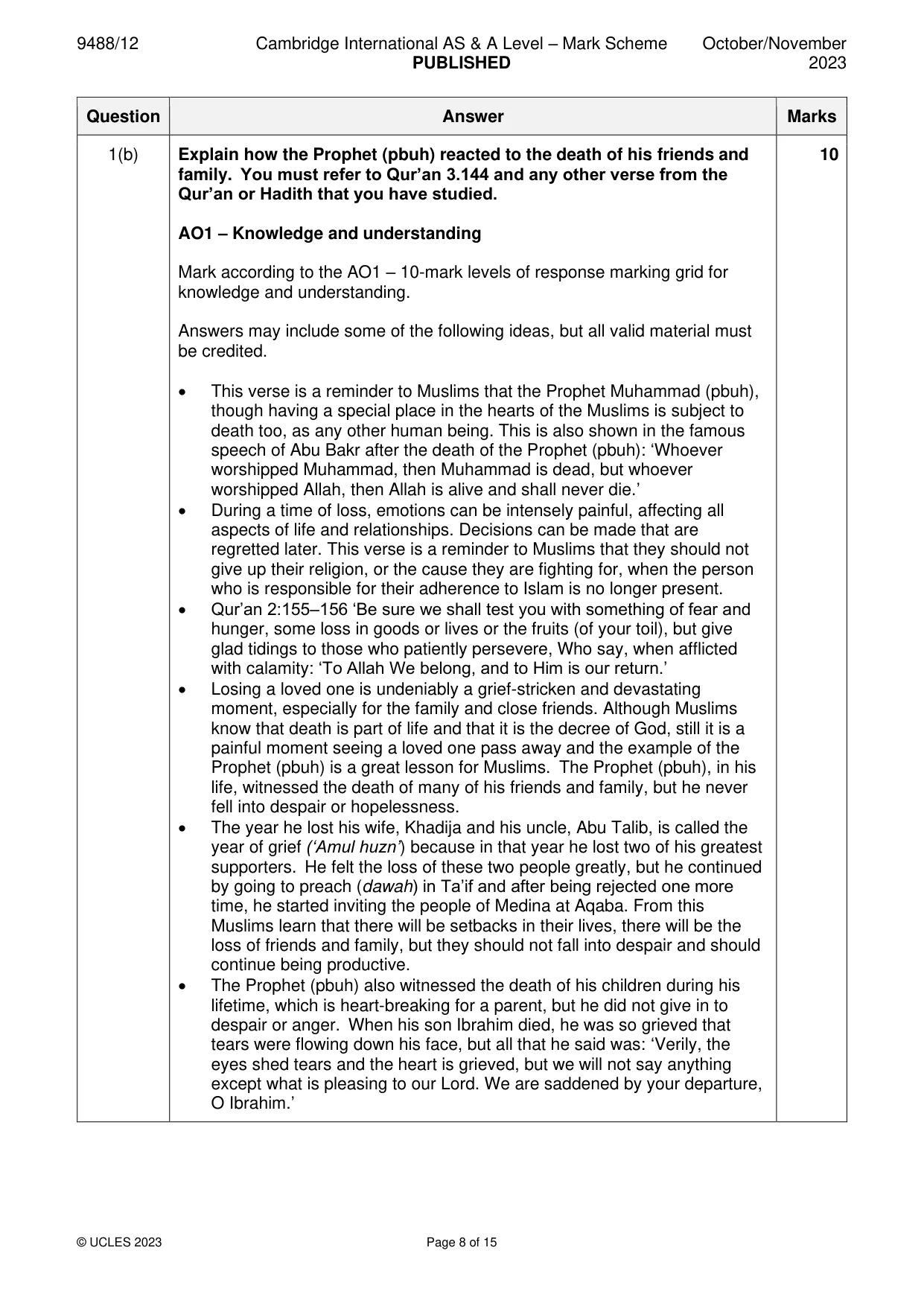
9488/12 Cambridge International AS & A Level – Mark Scheme PUBLISHED October/November 2023 © UCLES 2023 Page 8 of 15 Question Answer Marks 1(b) Explain how the Prophet (pbuh) reacted to the death of his friends and family. You must refer to Qur’an 3.144 and any other verse from the Qur’an or Hadith that you have studied. AO1 – Knowledge and understanding Mark according to the AO1 – 10-mark levels of response marking grid for knowledge and understanding. Answers may include some of the following ideas, but all valid material must be credited. • This verse is a reminder to Muslims that the Prophet Muhammad (pbuh), though having a special place in the hearts of the Muslims is subject to death too, as any other human being. This is also shown in the famous speech of Abu Bakr after the death of the Prophet (pbuh): ‘Whoever worshipped Muhammad, then Muhammad is dead, but whoever worshipped Allah, then Allah is alive and shall never die.’ • During a time of loss, emotions can be intensely painful, affecting all aspects of life and relationships. Decisions can be made that are regretted later. This verse is a reminder to Muslims that they should not give up their religion, or the cause they are fighting for, when the person who is responsible for their adherence to Islam is no longer present. • Qur’an 2:155–156 ‘Be sure we shall test you with something of fear and hunger, some loss in goods or lives or the fruits (of your toil), but give glad tidings to those who patiently persevere, Who say, when afflicted with calamity: ‘To Allah We belong, and to Him is our return.’ • Losing a loved one is undeniably a grief-stricken and devastating moment, especially for the family and close friends. Although Muslims know that death is part of life and that it is the decree of God, still it is a painful moment seeing a loved one pass away and the example of the Prophet (pbuh) is a great lesson for Muslims. The Prophet (pbuh), in his life, witnessed the death of many of his friends and family, but he never fell into despair or hopelessness. • The year he lost his wife, Khadija and his uncle, Abu Talib, is called the year of grief (‘Amul huzn’) because in that year he lost two of his greatest supporters. He felt the loss of these two people greatly, but he continued by going to preach (dawah) in Ta’if and after being rejected one more time, he started inviting the people of Medina at Aqaba. From this Muslims learn that there will be setbacks in their lives, there will be the loss of friends and family, but they should not fall into despair and should continue being productive. • The Prophet (pbuh) also witnessed the death of his children during his lifetime, which is heart-breaking for a parent, but he did not give in to despair or anger. When his son Ibrahim died, he was so grieved that tears were flowing down his face, but all that he said was: ‘Verily, the eyes shed tears and the heart is grieved, but we will not say anything except what is pleasing to our Lord. We are saddened by your departure, O Ibrahim.’ 10
Mark scheme, page 9
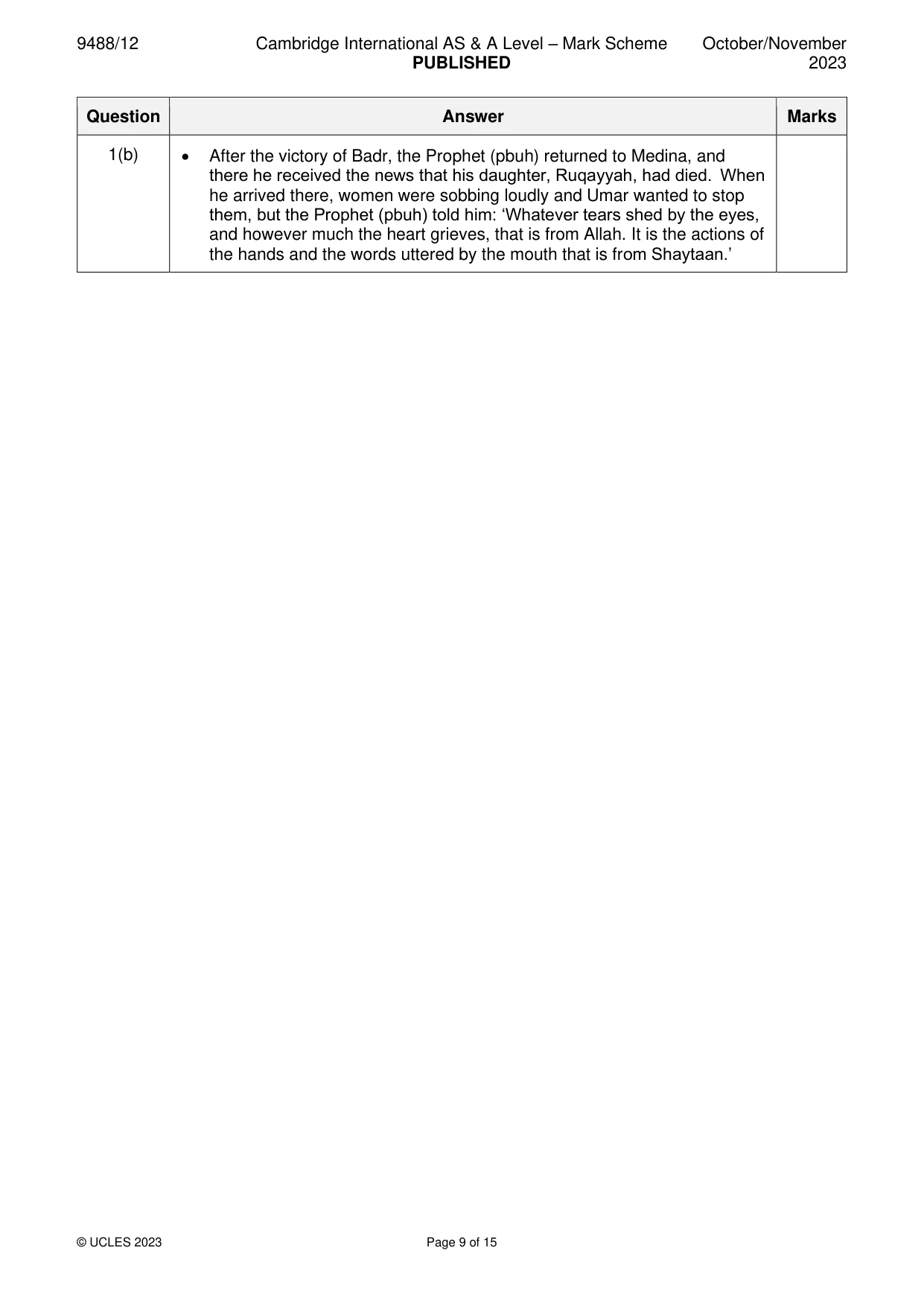
9488/12 Cambridge International AS & A Level – Mark Scheme PUBLISHED October/November 2023 © UCLES 2023 Page 9 of 15 Question Answer Marks 1(b) • After the victory of Badr, the Prophet (pbuh) returned to Medina, and there he received the news that his daughter, Ruqayyah, had died. When he arrived there, women were sobbing loudly and Umar wanted to stop them, but the Prophet (pbuh) told him: ‘Whatever tears shed by the eyes, and however much the heart grieves, that is from Allah. It is the actions of the hands and the words uttered by the mouth that is from Shaytaan.’
Mark scheme, page 10
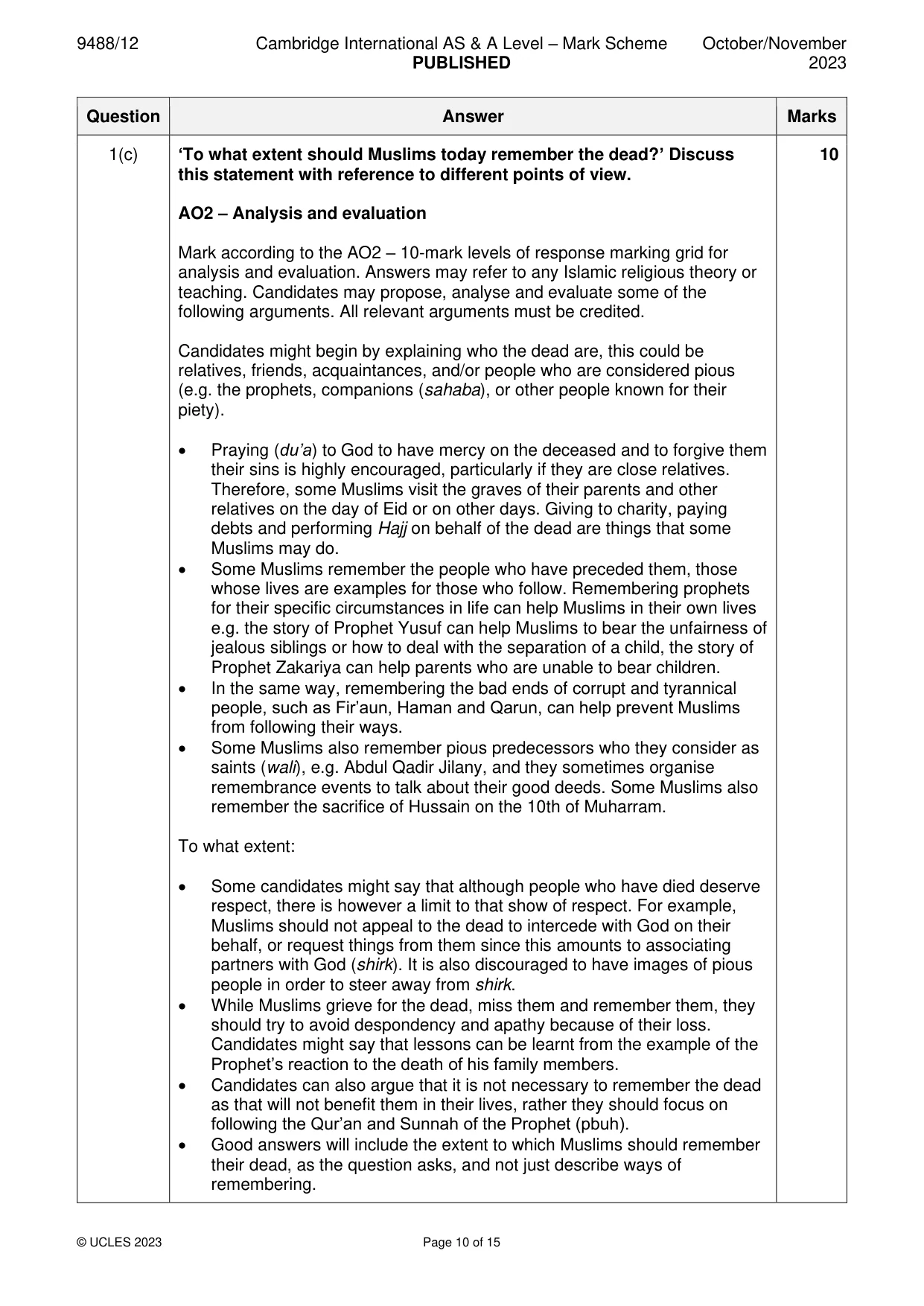
9488/12 Cambridge International AS & A Level – Mark Scheme PUBLISHED October/November 2023 © UCLES 2023 Page 10 of 15 Question Answer Marks 1(c) ‘To what extent should Muslims today remember the dead?’ Discuss this statement with reference to different points of view. AO2 – Analysis and evaluation Mark according to the AO2 – 10-mark levels of response marking grid for analysis and evaluation. Answers may refer to any Islamic religious theory or teaching. Candidates may propose, analyse and evaluate some of the following arguments. All relevant arguments must be credited. Candidates might begin by explaining who the dead are, this could be relatives, friends, acquaintances, and/or people who are considered pious (e.g. the prophets, companions (sahaba), or other people known for their piety). • Praying (du’a) to God to have mercy on the deceased and to forgive them their sins is highly encouraged, particularly if they are close relatives. Therefore, some Muslims visit the graves of their parents and other relatives on the day of Eid or on other days. Giving to charity, paying debts and performing Hajj on behalf of the dead are things that some Muslims may do. • Some Muslims remember the people who have preceded them, those whose lives are examples for those who follow. Remembering prophets for their specific circumstances in life can help Muslims in their own lives e.g. the story of Prophet Yusuf can help Muslims to bear the unfairness of jealous siblings or how to deal with the separation of a child, the story of Prophet Zakariya can help parents who are unable to bear children. • In the same way, remembering the bad ends of corrupt and tyrannical people, such as Fir’aun, Haman and Qarun, can help prevent Muslims from following their ways. • Some Muslims also remember pious predecessors who they consider as saints (wali), e.g. Abdul Qadir Jilany, and they sometimes organise remembrance events to talk about their good deeds. Some Muslims also remember the sacrifice of Hussain on the 10th of Muharram. To what extent: • Some candidates might say that although people who have died deserve respect, there is however a limit to that show of respect. For example, Muslims should not appeal to the dead to intercede with God on their behalf, or request things from them since this amounts to associating partners with God (shirk). It is also discouraged to have images of pious people in order to steer away from shirk. • While Muslims grieve for the dead, miss them and remember them, they should try to avoid despondency and apathy because of their loss. Candidates might say that lessons can be learnt from the example of the Prophet’s reaction to the death of his family members. • Candidates can also argue that it is not necessary to remember the dead as that will not benefit them in their lives, rather they should focus on following the Qur’an and Sunnah of the Prophet (pbuh). • Good answers will include the extent to which Muslims should remember their dead, as the question asks, and not just describe ways of remembering. 10
Mark scheme, page 11
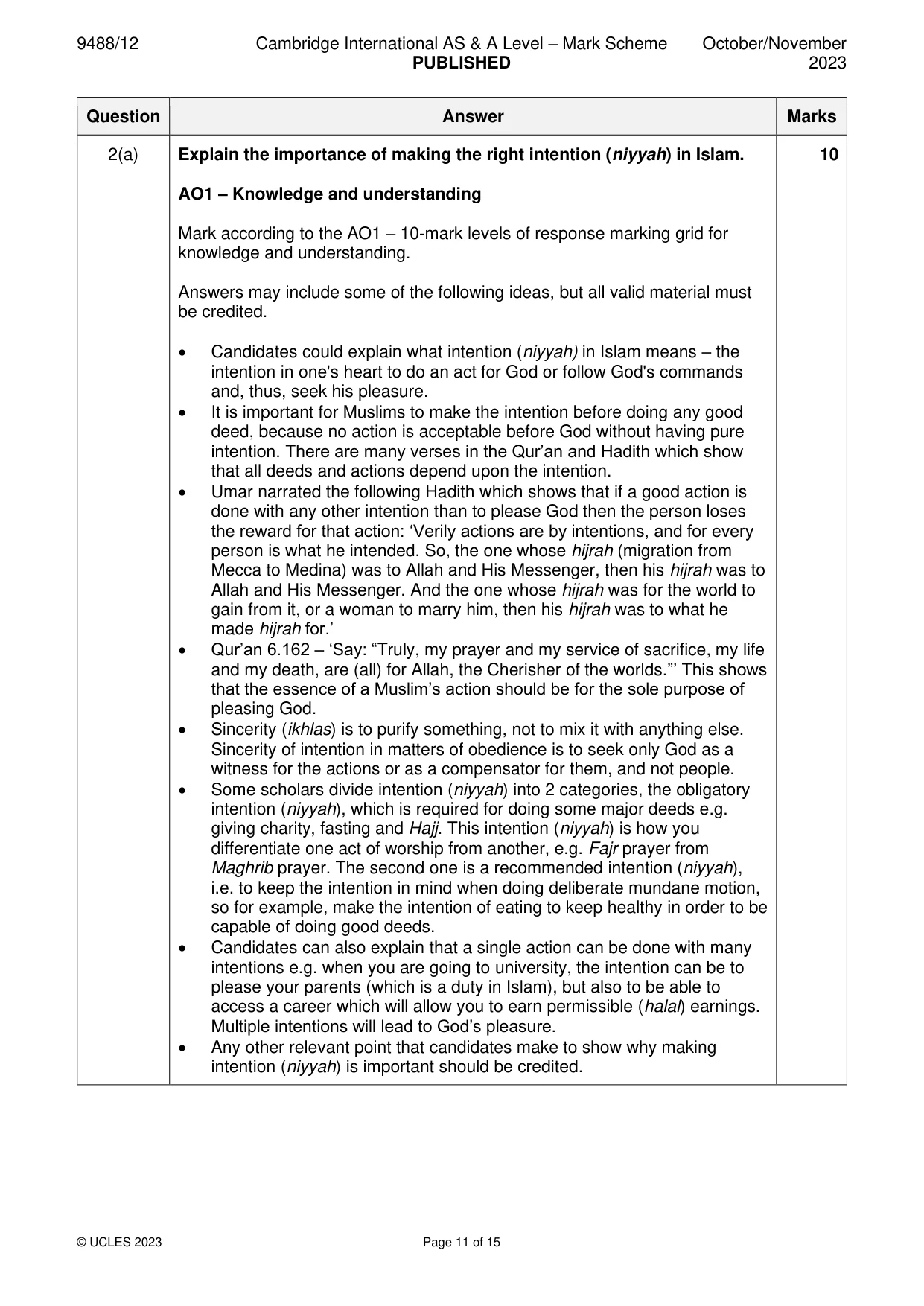
9488/12 Cambridge International AS & A Level – Mark Scheme PUBLISHED October/November 2023 © UCLES 2023 Page 11 of 15 Question Answer Marks 2(a) Explain the importance of making the right intention (niyyah) in Islam. AO1 – Knowledge and understanding Mark according to the AO1 – 10-mark levels of response marking grid for knowledge and understanding. Answers may include some of the following ideas, but all valid material must be credited. • Candidates could explain what intention (niyyah) in Islam means – the intention in one's heart to do an act for God or follow God's commands and, thus, seek his pleasure. • It is important for Muslims to make the intention before doing any good deed, because no action is acceptable before God without having pure intention. There are many verses in the Qur’an and Hadith which show that all deeds and actions depend upon the intention. • Umar narrated the following Hadith which shows that if a good action is done with any other intention than to please God then the person loses the reward for that action: ‘Verily actions are by intentions, and for every person is what he intended. So, the one whose hijrah (migration from Mecca to Medina) was to Allah and His Messenger, then his hijrah was to Allah and His Messenger. And the one whose hijrah was for the world to gain from it, or a woman to marry him, then his hijrah was to what he made hijrah for.’ • Qur’an 6.162 – ‘Say: “Truly, my prayer and my service of sacrifice, my life and my death, are (all) for Allah, the Cherisher of the worlds.”’ This shows that the essence of a Muslim’s action should be for the sole purpose of pleasing God. • Sincerity (ikhlas) is to purify something, not to mix it with anything else. Sincerity of intention in matters of obedience is to seek only God as a witness for the actions or as a compensator for them, and not people. • Some scholars divide intention (niyyah) into 2 categories, the obligatory intention (niyyah), which is required for doing some major deeds e.g. giving charity, fasting and Hajj. This intention (niyyah) is how you differentiate one act of worship from another, e.g. Fajr prayer from Maghrib prayer. The second one is a recommended intention (niyyah), i.e. to keep the intention in mind when doing deliberate mundane motion, so for example, make the intention of eating to keep healthy in order to be capable of doing good deeds. • Candidates can also explain that a single action can be done with many intentions e.g. when you are going to university, the intention can be to please your parents (which is a duty in Islam), but also to be able to access a career which will allow you to earn permissible (halal) earnings. Multiple intentions will lead to God’s pleasure. • Any other relevant point that candidates make to show why making intention (niyyah) is important should be credited. 10
Mark scheme, page 12
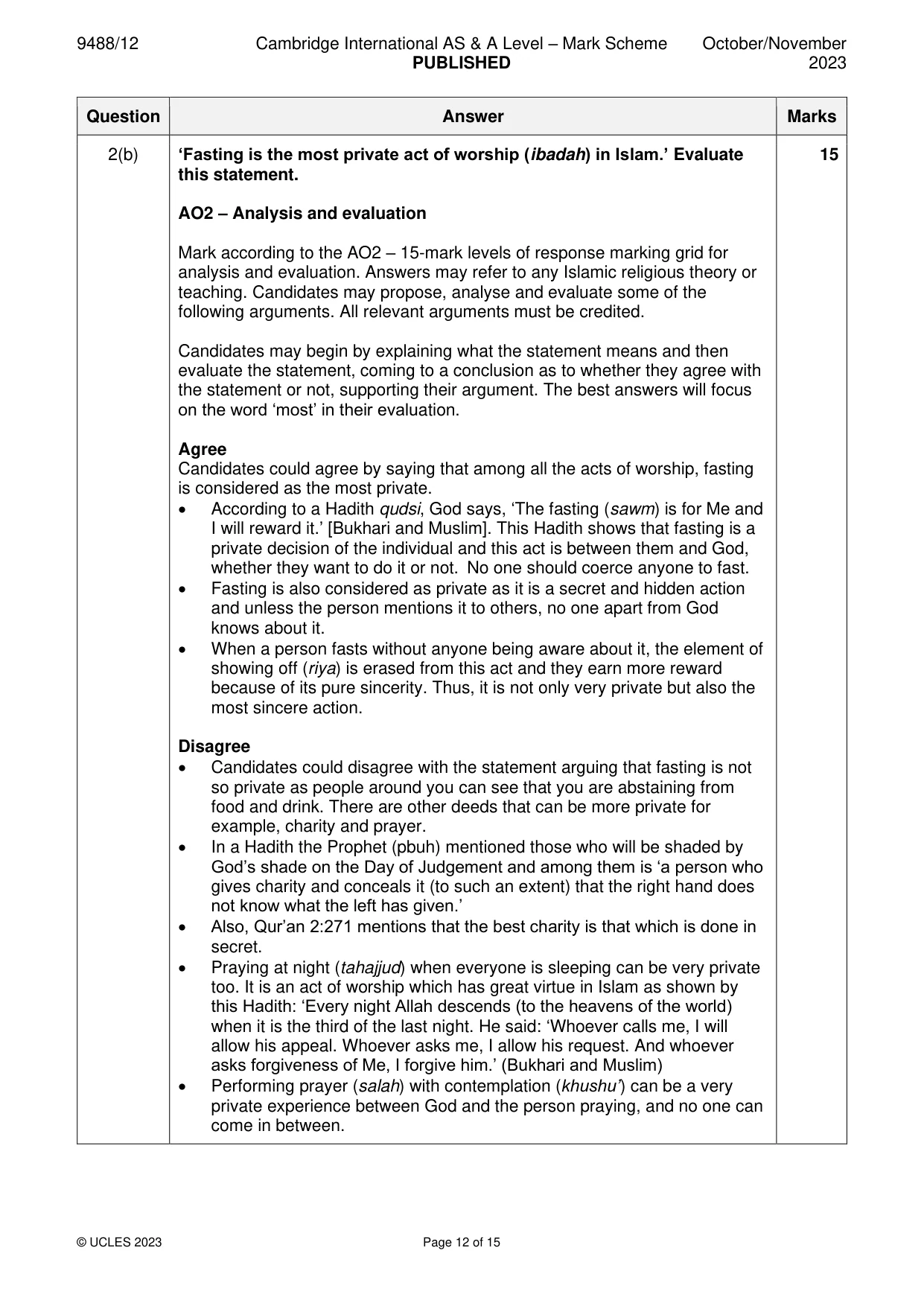
9488/12 Cambridge International AS & A Level – Mark Scheme PUBLISHED October/November 2023 © UCLES 2023 Page 12 of 15 Question Answer Marks 2(b) ‘Fasting is the most private act of worship (ibadah) in Islam.’ Evaluate this statement. AO2 – Analysis and evaluation Mark according to the AO2 – 15-mark levels of response marking grid for analysis and evaluation. Answers may refer to any Islamic religious theory or teaching. Candidates may propose, analyse and evaluate some of the following arguments. All relevant arguments must be credited. Candidates may begin by explaining what the statement means and then evaluate the statement, coming to a conclusion as to whether they agree with the statement or not, supporting their argument. The best answers will focus on the word ‘most’ in their evaluation. Agree Candidates could agree by saying that among all the acts of worship, fasting is considered as the most private. • According to a Hadith qudsi, God says, ‘The fasting (sawm) is for Me and I will reward it.’ [Bukhari and Muslim]. This Hadith shows that fasting is a private decision of the individual and this act is between them and God, whether they want to do it or not. No one should coerce anyone to fast. • Fasting is also considered as private as it is a secret and hidden action and unless the person mentions it to others, no one apart from God knows about it. • When a person fasts without anyone being aware about it, the element of showing off (riya) is erased from this act and they earn more reward because of its pure sincerity. Thus, it is not only very private but also the most sincere action. Disagree • Candidates could disagree with the statement arguing that fasting is not so private as people around you can see that you are abstaining from food and drink. There are other deeds that can be more private for example, charity and prayer. • In a Hadith the Prophet (pbuh) mentioned those who will be shaded by God’s shade on the Day of Judgement and among them is ‘a person who gives charity and conceals it (to such an extent) that the right hand does not know what the left has given.’ • Also, Qur’an 2:271 mentions that the best charity is that which is done in secret. • Praying at night (tahajjud) when everyone is sleeping can be very private too. It is an act of worship which has great virtue in Islam as shown by this Hadith: ‘Every night Allah descends (to the heavens of the world) when it is the third of the last night. He said: ‘Whoever calls me, I will allow his appeal. Whoever asks me, I allow his request. And whoever asks forgiveness of Me, I forgive him.’ (Bukhari and Muslim) • Performing prayer (salah) with contemplation (khushu’) can be a very private experience between God and the person praying, and no one can come in between. 15
Mark scheme, page 13
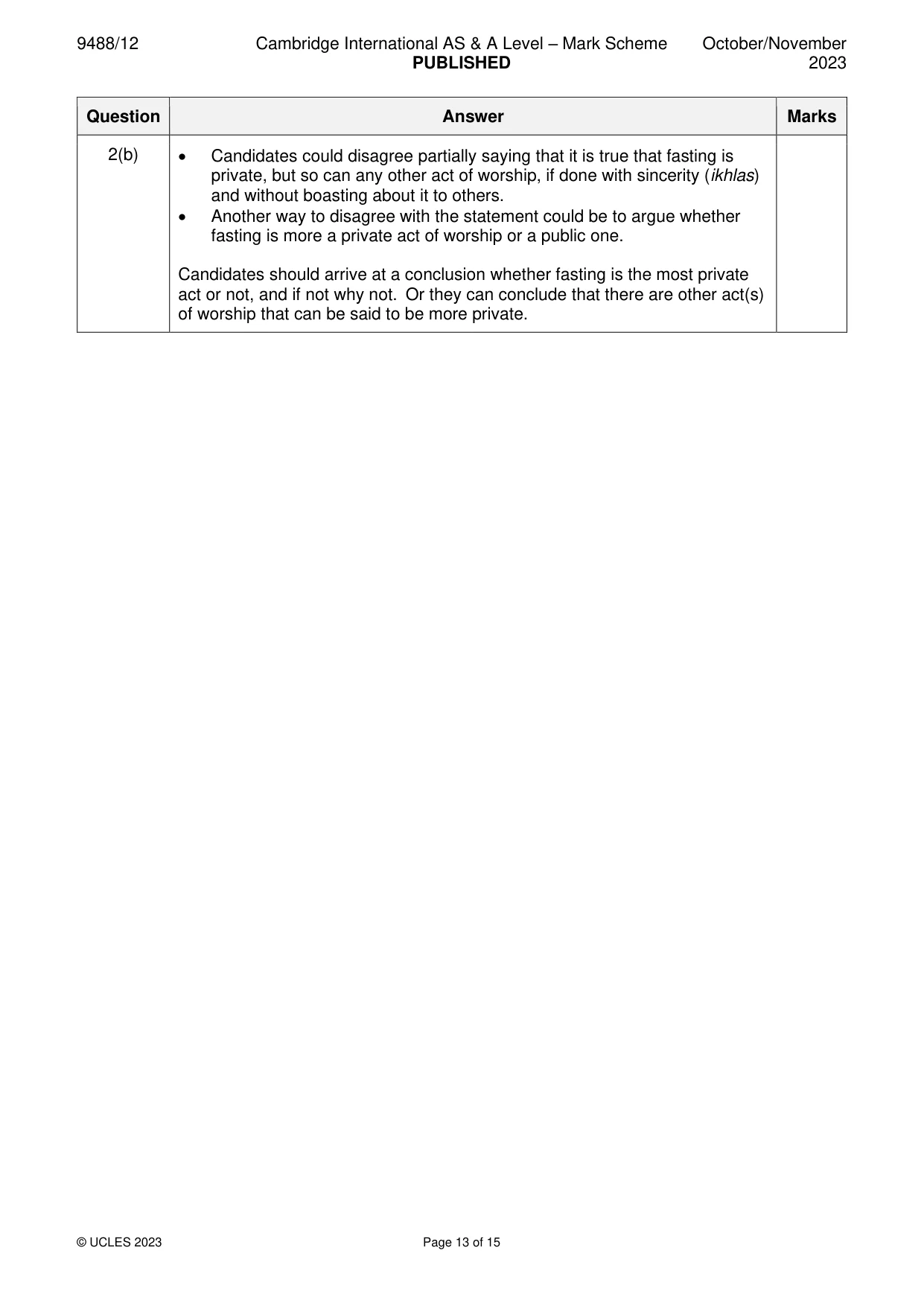
9488/12 Cambridge International AS & A Level – Mark Scheme PUBLISHED October/November 2023 © UCLES 2023 Page 13 of 15 Question Answer Marks 2(b) • Candidates could disagree partially saying that it is true that fasting is private, but so can any other act of worship, if done with sincerity (ikhlas) and without boasting about it to others. • Another way to disagree with the statement could be to argue whether fasting is more a private act of worship or a public one. Candidates should arrive at a conclusion whether fasting is the most private act or not, and if not why not. Or they can conclude that there are other act(s) of worship that can be said to be more private.
Mark scheme, page 14
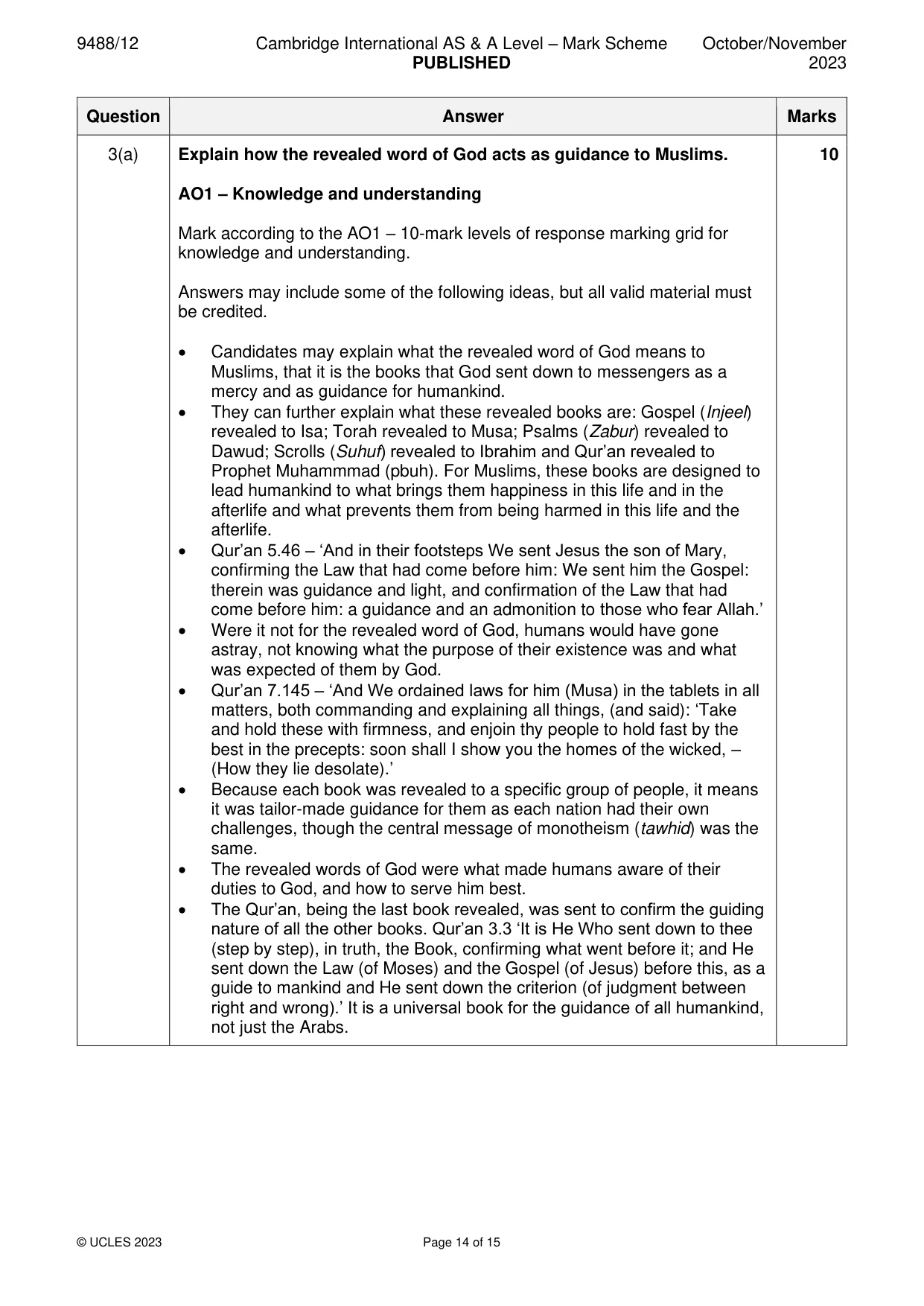
9488/12 Cambridge International AS & A Level – Mark Scheme PUBLISHED October/November 2023 © UCLES 2023 Page 14 of 15 Question Answer Marks 3(a) Explain how the revealed word of God acts as guidance to Muslims. AO1 – Knowledge and understanding Mark according to the AO1 – 10-mark levels of response marking grid for knowledge and understanding. Answers may include some of the following ideas, but all valid material must be credited. • Candidates may explain what the revealed word of God means to Muslims, that it is the books that God sent down to messengers as a mercy and as guidance for humankind. • They can further explain what these revealed books are: Gospel (Injeel) revealed to Isa; Torah revealed to Musa; Psalms (Zabur) revealed to Dawud; Scrolls (Suhuf) revealed to Ibrahim and Qur’an revealed to Prophet Muhammmad (pbuh). For Muslims, these books are designed to lead humankind to what brings them happiness in this life and in the afterlife and what prevents them from being harmed in this life and the afterlife. • Qur’an 5.46 – ‘And in their footsteps We sent Jesus the son of Mary, confirming the Law that had come before him: We sent him the Gospel: therein was guidance and light, and confirmation of the Law that had come before him: a guidance and an admonition to those who fear Allah.’ • Were it not for the revealed word of God, humans would have gone astray, not knowing what the purpose of their existence was and what was expected of them by God. • Qur’an 7.145 – ‘And We ordained laws for him (Musa) in the tablets in all matters, both commanding and explaining all things, (and said): ‘Take and hold these with firmness, and enjoin thy people to hold fast by the best in the precepts: soon shall I show you the homes of the wicked, – (How they lie desolate).’ • Because each book was revealed to a specific group of people, it means it was tailor-made guidance for them as each nation had their own challenges, though the central message of monotheism (tawhid) was the same. • The revealed words of God were what made humans aware of their duties to God, and how to serve him best. • The Qur’an, being the last book revealed, was sent to confirm the guiding nature of all the other books. Qur’an 3.3 ‘It is He Who sent down to thee (step by step), in truth, the Book, confirming what went before it; and He sent down the Law (of Moses) and the Gospel (of Jesus) before this, as a guide to mankind and He sent down the criterion (of judgment between right and wrong).’ It is a universal book for the guidance of all humankind, not just the Arabs. 10
Mark scheme, page 15
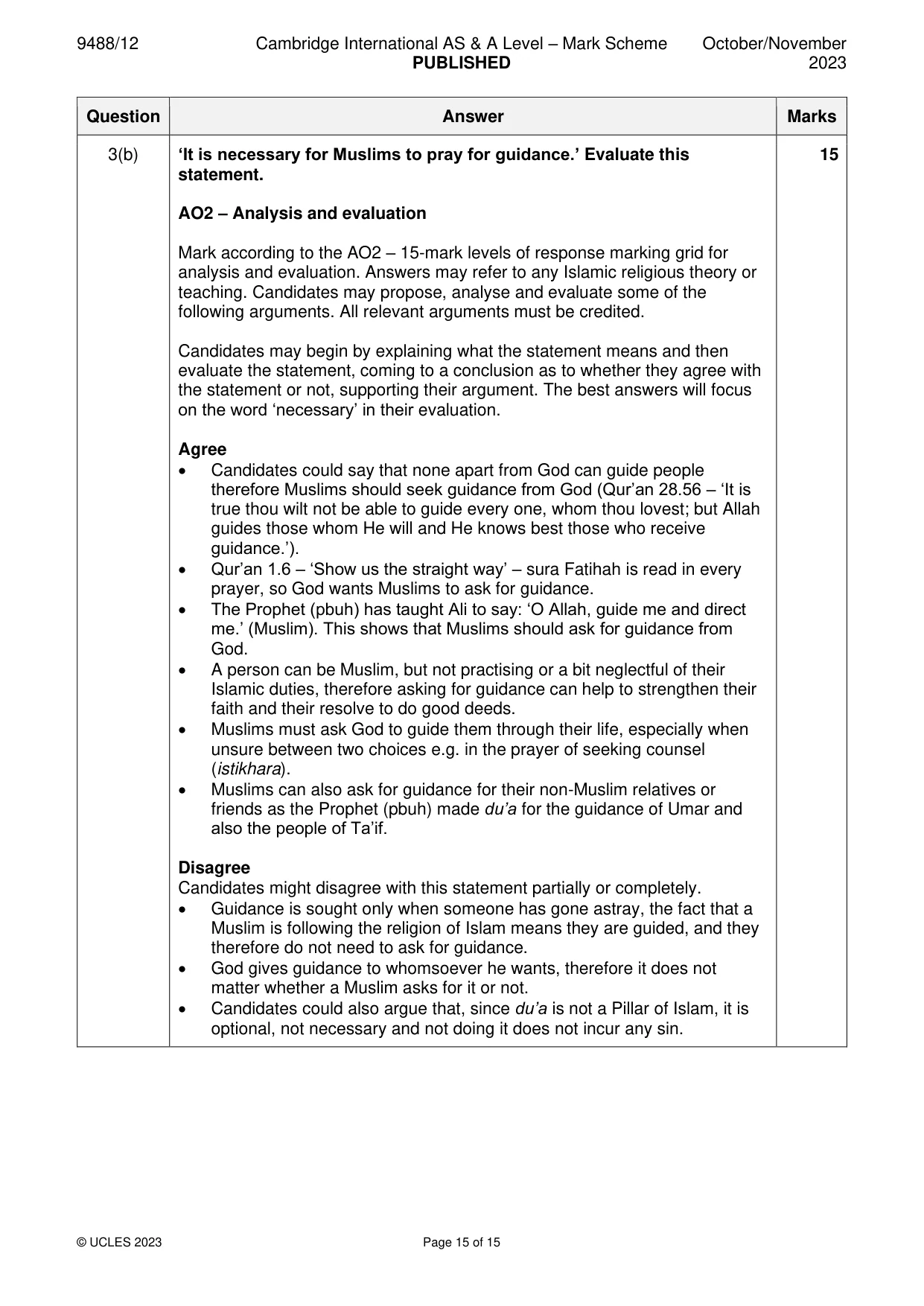
9488/12 Cambridge International AS & A Level – Mark Scheme PUBLISHED October/November 2023 © UCLES 2023 Page 15 of 15 Question Answer Marks 3(b) ‘It is necessary for Muslims to pray for guidance.’ Evaluate this statement. AO2 – Analysis and evaluation Mark according to the AO2 – 15-mark levels of response marking grid for analysis and evaluation. Answers may refer to any Islamic religious theory or teaching. Candidates may propose, analyse and evaluate some of the following arguments. All relevant arguments must be credited. Candidates may begin by explaining what the statement means and then evaluate the statement, coming to a conclusion as to whether they agree with the statement or not, supporting their argument. The best answers will focus on the word ‘necessary’ in their evaluation. Agree • Candidates could say that none apart from God can guide people therefore Muslims should seek guidance from God (Qur’an 28.56 – ‘It is true thou wilt not be able to guide every one, whom thou lovest; but Allah guides those whom He will and He knows best those who receive guidance.’). • Qur’an 1.6 – ‘Show us the straight way’ – sura Fatihah is read in every prayer, so God wants Muslims to ask for guidance. • The Prophet (pbuh) has taught Ali to say: ‘O Allah, guide me and direct me.’ (Muslim). This shows that Muslims should ask for guidance from God. • A person can be Muslim, but not practising or a bit neglectful of their Islamic duties, therefore asking for guidance can help to strengthen their faith and their resolve to do good deeds. • Muslims must ask God to guide them through their life, especially when unsure between two choices e.g. in the prayer of seeking counsel (istikhara). • Muslims can also ask for guidance for their non-Muslim relatives or friends as the Prophet (pbuh) made du’a for the guidance of Umar and also the people of Ta’if. Disagree Candidates might disagree with this statement partially or completely. • Guidance is sought only when someone has gone astray, the fact that a Muslim is following the religion of Islam means they are guided, and they therefore do not need to ask for guidance. • God gives guidance to whomsoever he wants, therefore it does not matter whether a Muslim asks for it or not. • Candidates could also argue that, since du’a is not a Pillar of Islam, it is optional, not necessary and not doing it does not incur any sin. 15
What you needed in this session
Cambridge’s own grade thresholds for 2023 Oct/Nov, Paper 1 · Variant 2. A higher threshold means an easier paper — the bar moves with how the cohort did.