Cambridge A Level Islamic Studies 9488 — 2023 May/June Paper 1 · Variant 2
9488/12/M/J/23 · 50 marks · ≈56 min
The question paper and its mark scheme, free to read here and free to download. This is Cambridge’s own paper, exactly as it was sat.
Question paper4 pages

Mark scheme17 pages
Answers below. Sit the paper first if you are practising.
Paper as text
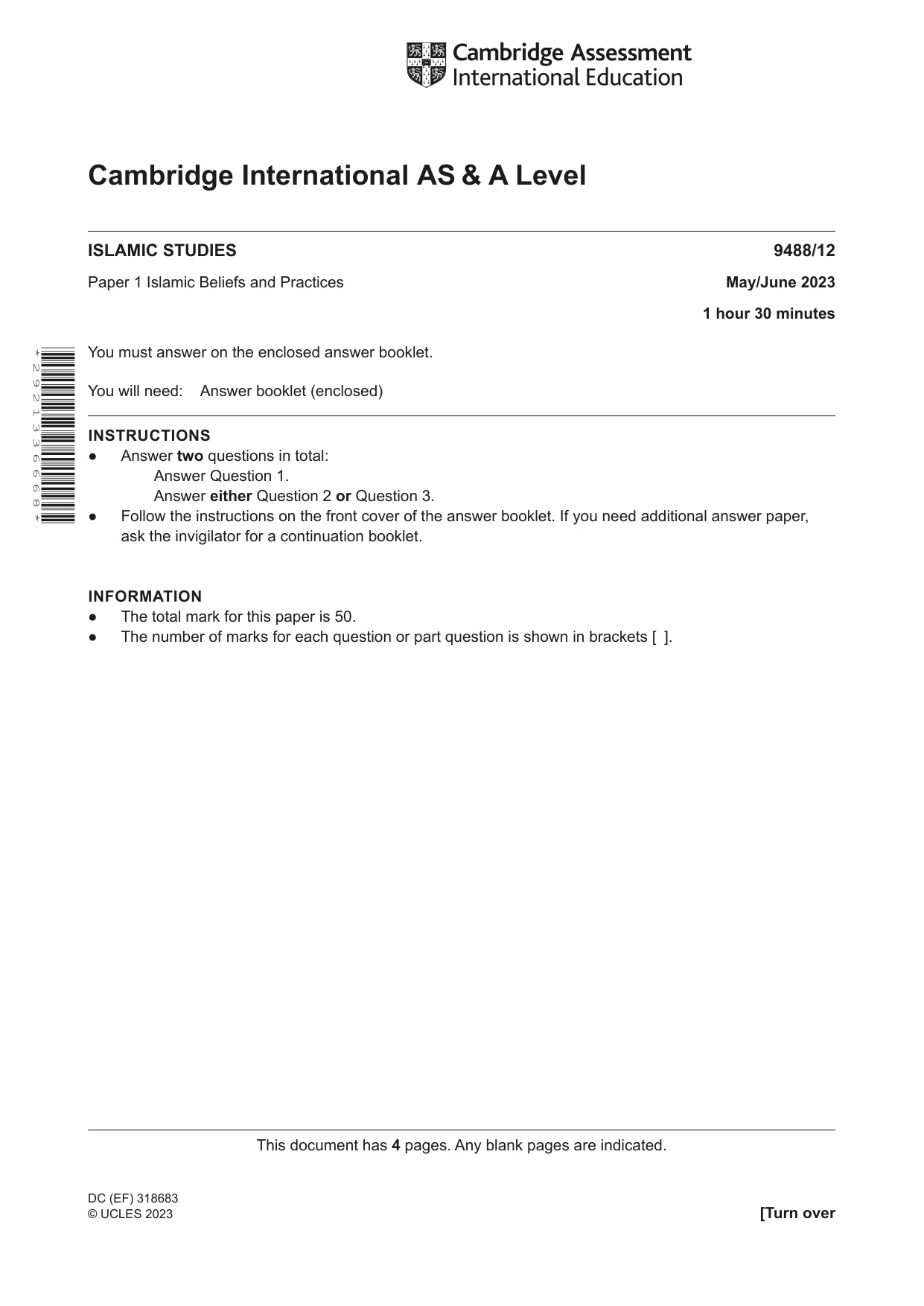
Question paper, page 1
This document has 4 pages. Any blank pages are indicated. [Turn over Cambridge International AS & A Level DC (EF) 318683 © UCLES 2023 * 2 9 2 1 3 3 6 6 6 8 * ISLAMIC STUDIES 9488/12 Paper 1 Islamic Beliefs and Practices May/June 2023 1 hour 30 minutes You must answer on the enclosed answer booklet. You will need: Answer booklet (enclosed) INSTRUCTIONS ● Answer two questions in total: Answer Question 1. Answer either Question 2 or Question 3. ● Follow the instructions on the front cover of the answer booklet. If you need additional answer paper, ask the invigilator for a continuation booklet. INFORMATION ● The total mark for this paper is 50. ● The number of marks for each question or part question is shown in brackets [ ].
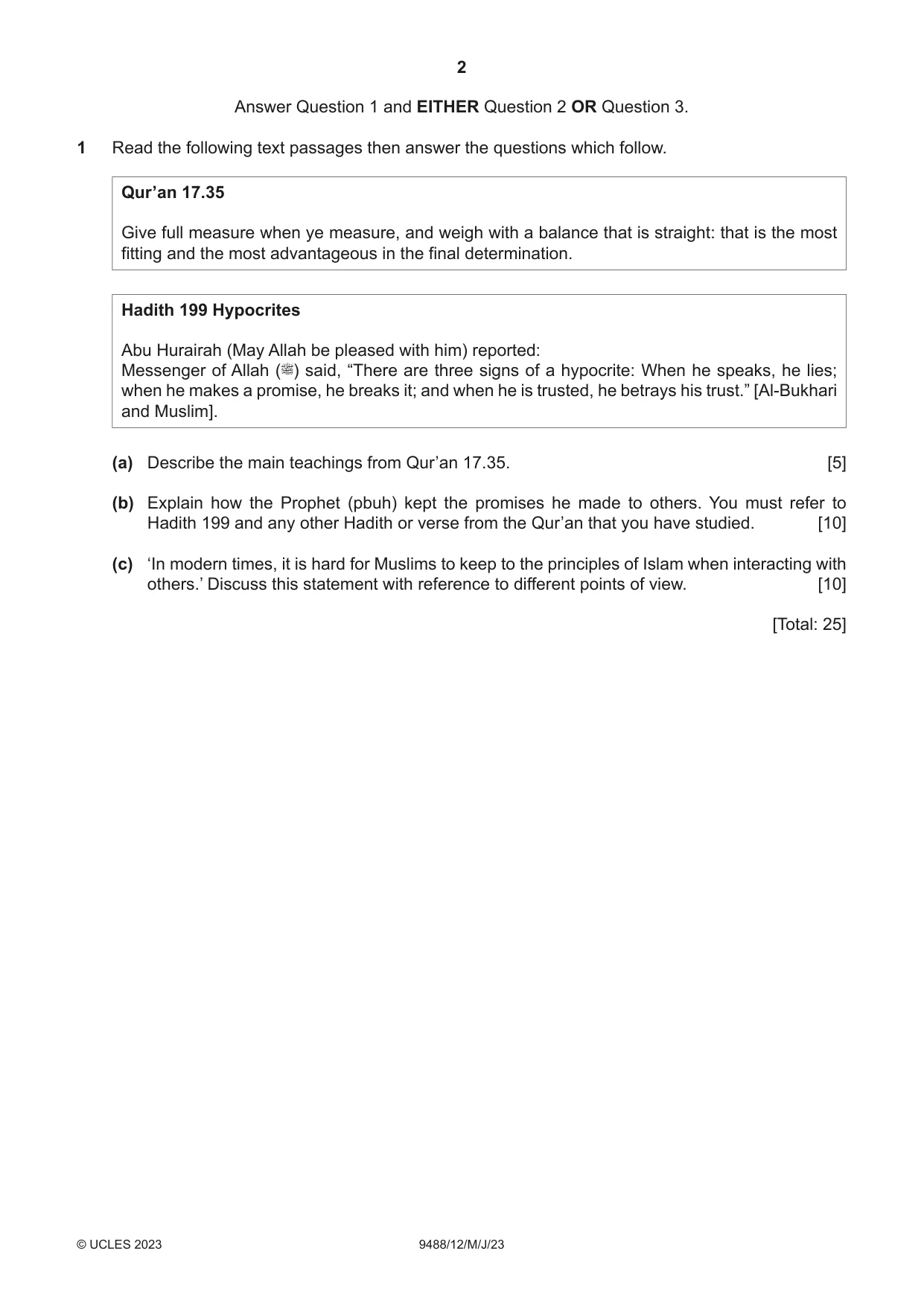
Question paper, page 2
2 9488/12/M/J/23 © UCLES 2023 Answer Question 1 and EITHER Question 2 OR Question 3. 1 Read the following text passages then answer the questions which follow. Qur’an 17.35 Give full measure when ye measure, and weigh with a balance that is straight: that is the most fitting and the most advantageous in the final determination. Hadith 199 Hypocrites Abu Hurairah (May Allah be pleased with him) reported: Messenger of Allah ( )ﷺsaid, “There are three signs of a hypocrite: When he speaks, he lies; when he makes a promise, he breaks it; and when he is trusted, he betrays his trust.” [Al‑Bukhari and Muslim]. (a) Describe the main teachings from Qur’an 17.35. [5] (b) Explain how the Prophet (pbuh) kept the promises he made to others. You must refer to Hadith 199 and any other Hadith or verse from the Qur’an that you have studied. [10] (c) ‘In modern times, it is hard for Muslims to keep to the principles of Islam when interacting with others.’ Discuss this statement with reference to different points of view. [10] [Total: 25]
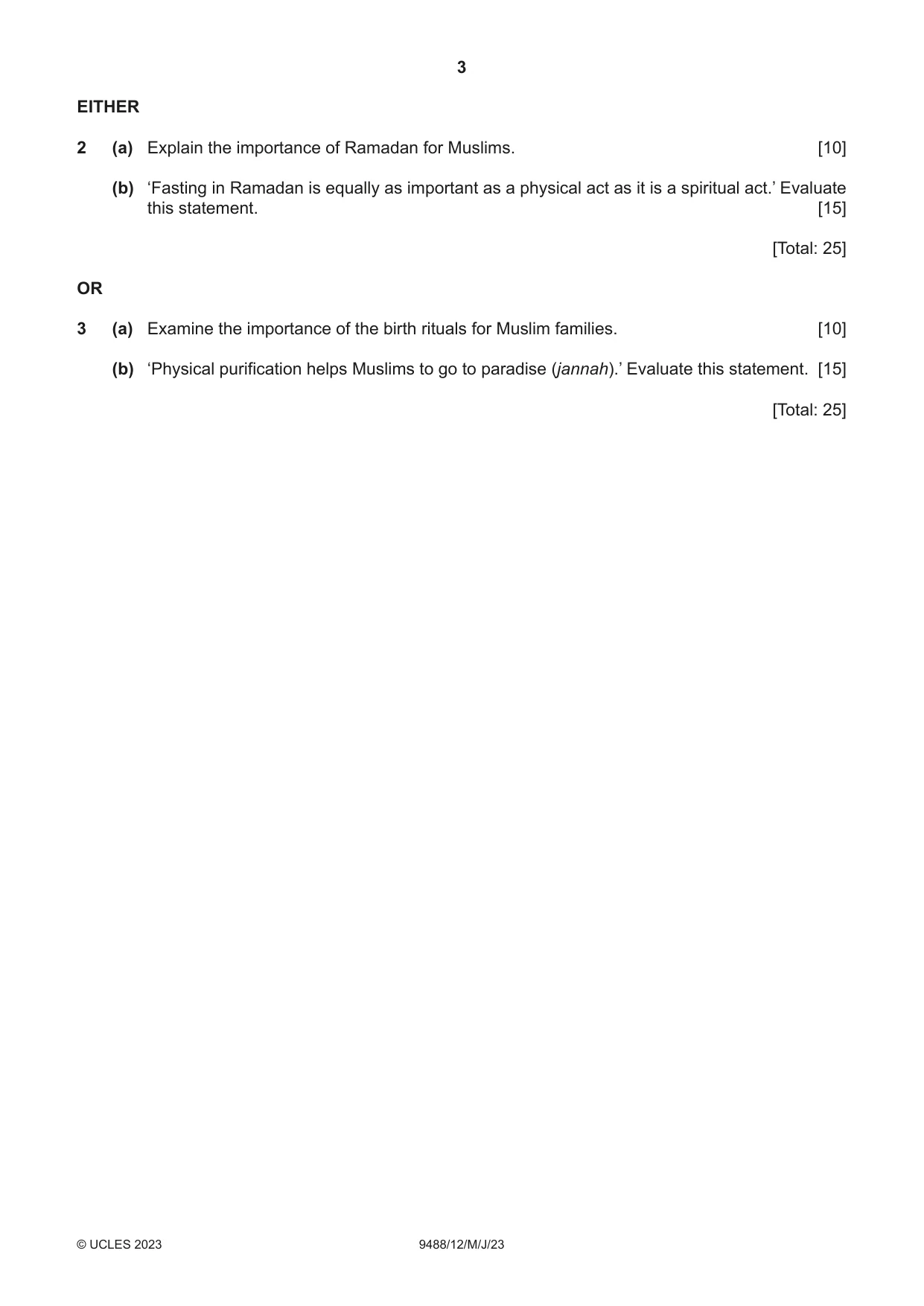
Question paper, page 3
3 9488/12/M/J/23 © UCLES 2023 EITHER 2 (a) Explain the importance of Ramadan for Muslims. [10] (b) ‘Fasting in Ramadan is equally as important as a physical act as it is a spiritual act.’ Evaluate this statement. [15] [Total: 25] OR 3 (a) Examine the importance of the birth rituals for Muslim families. [10] (b) ‘Physical purification helps Muslims to go to paradise (jannah).’ Evaluate this statement. [15] [Total: 25]
Question paper, page 4
4 9488/12/M/J/23 © UCLES 2023 Permission to reproduce items where third‑party owned material protected by copyright is included has been sought and cleared where possible. Every reasonable effort has been made by the publisher (UCLES) to trace copyright holders, but if any items requiring clearance have unwittingly been included, the publisher will be pleased to make amends at the earliest possible opportunity. To avoid the issue of disclosure of answer‑related information to candidates, all copyright acknowledgements are reproduced online in the Cambridge Assessment International Education Copyright Acknowledgements Booklet. This is produced for each series of examinations and is freely available to download at www.cambridgeinternational.org after the live examination series. Cambridge Assessment International Education is part of Cambridge Assessment. Cambridge Assessment is the brand name of the University of Cambridge Local Examinations Syndicate (UCLES), which is a department of the University of Cambridge. BLANK PAGE
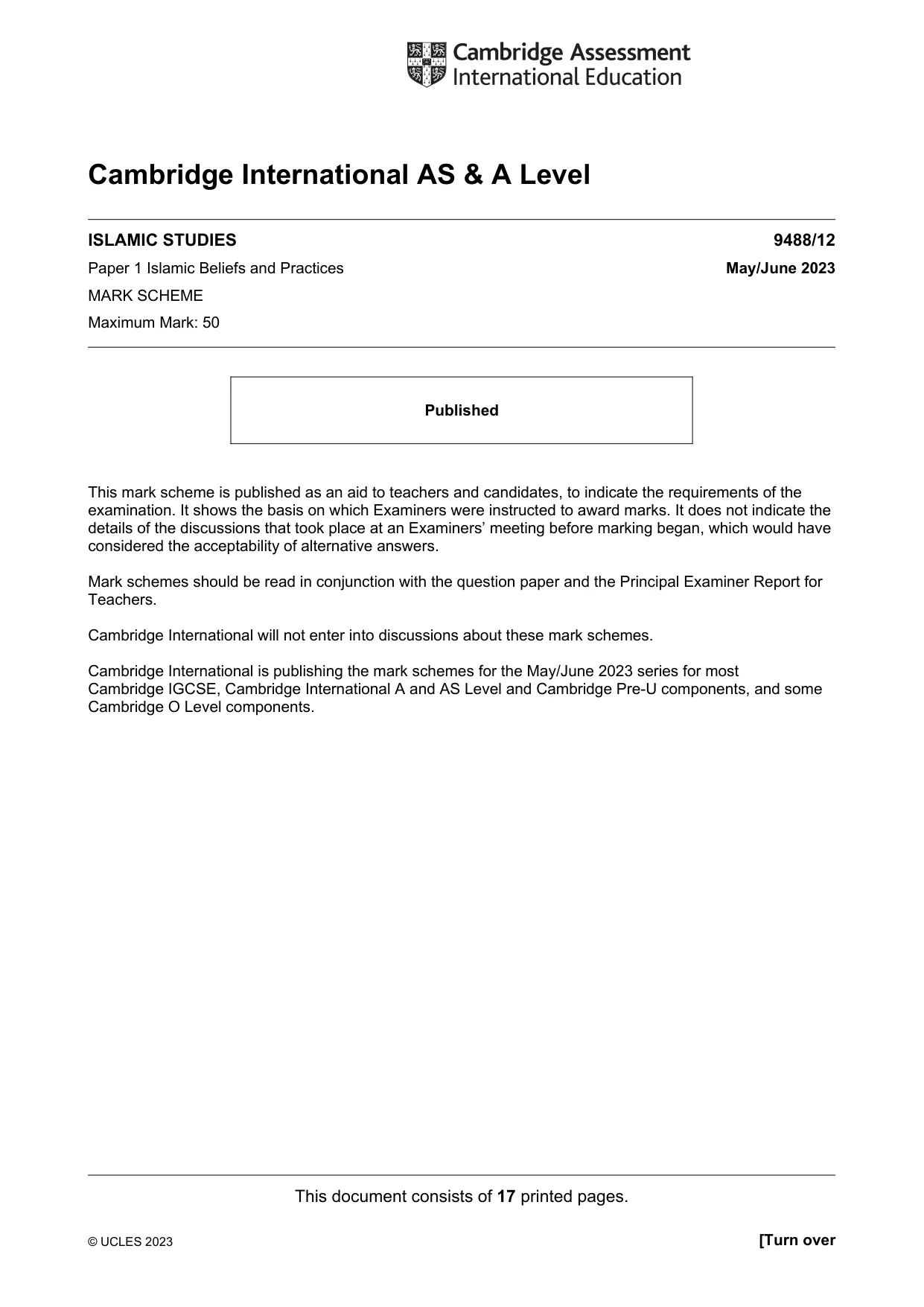
Mark scheme, page 1
This document consists of 17 printed pages. © UCLES 2023 [Turn over Cambridge International AS & A Level ISLAMIC STUDIES 9488/12 Paper 1 Islamic Beliefs and Practices May/June 2023 MARK SCHEME Maximum Mark: 50 Published This mark scheme is published as an aid to teachers and candidates, to indicate the requirements of the examination. It shows the basis on which Examiners were instructed to award marks. It does not indicate the details of the discussions that took place at an Examiners’ meeting before marking began, which would have considered the acceptability of alternative answers. Mark schemes should be read in conjunction with the question paper and the Principal Examiner Report for Teachers. Cambridge International will not enter into discussions about these mark schemes. Cambridge International is publishing the mark schemes for the May/June 2023 series for most Cambridge IGCSE, Cambridge International A and AS Level and Cambridge Pre-U components, and some Cambridge O Level components.
Mark scheme, page 2
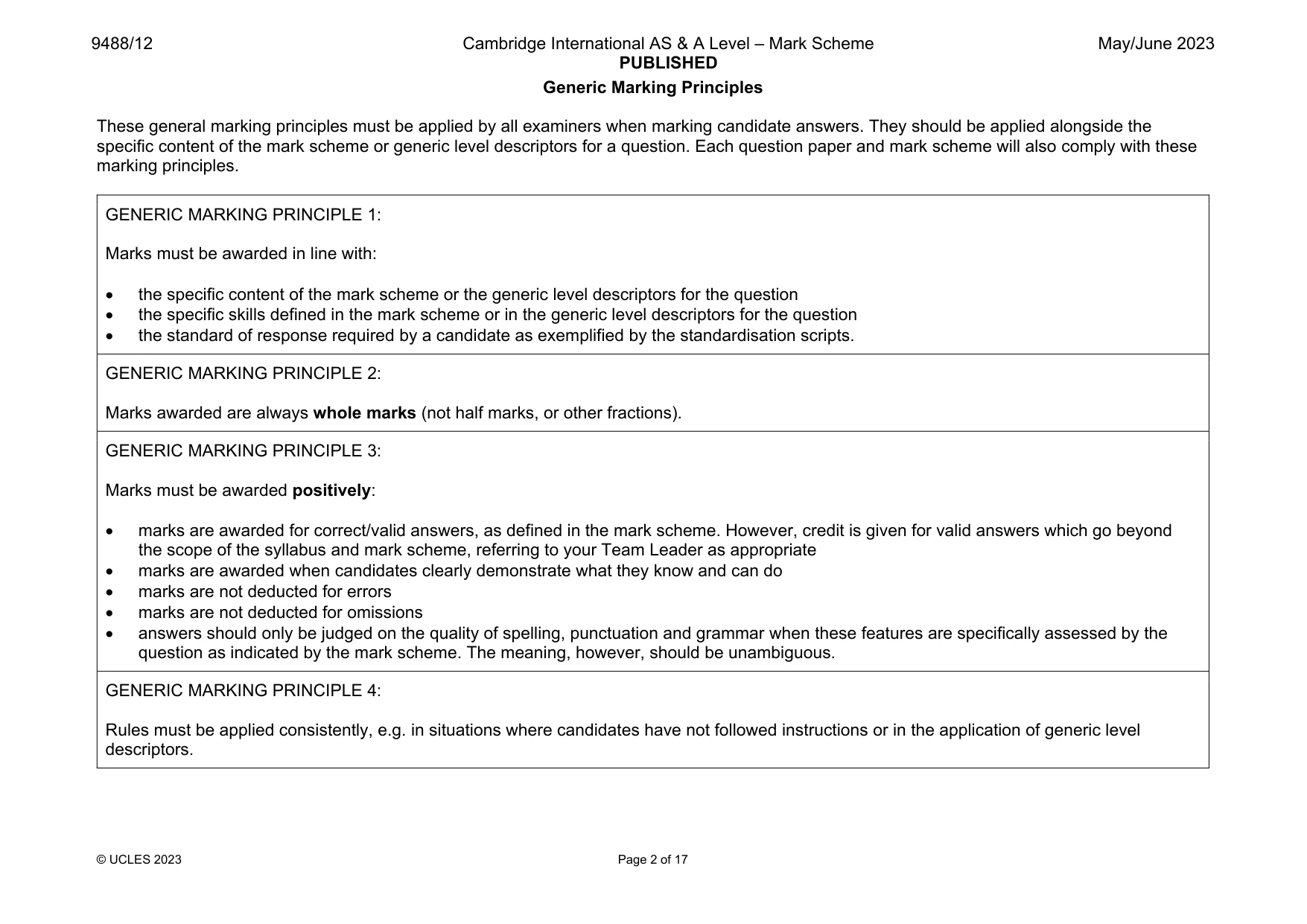
9488/12 Cambridge International AS & A Level – Mark Scheme PUBLISHED May/June 2023 © UCLES 2023 Page 2 of 17 Generic Marking Principles These general marking principles must be applied by all examiners when marking candidate answers. They should be applied alongside the specific content of the mark scheme or generic level descriptors for a question. Each question paper and mark scheme will also comply with these marking principles. GENERIC MARKING PRINCIPLE 1: Marks must be awarded in line with: the specific content of the mark scheme or the generic level descriptors for the question the specific skills defined in the mark scheme or in the generic level descriptors for the question the standard of response required by a candidate as exemplified by the standardisation scripts. GENERIC MARKING PRINCIPLE 2: Marks awarded are always whole marks (not half marks, or other fractions). GENERIC MARKING PRINCIPLE 3: Marks must be awarded positively: marks are awarded for correct/valid answers, as defined in the mark scheme. However, credit is given for valid answers which go beyond the scope of the syllabus and mark scheme, referring to your Team Leader as appropriate marks are awarded when candidates clearly demonstrate what they know and can do marks are not deducted for errors marks are not deducted for omissions answers should only be judged on the quality of spelling, punctuation and grammar when these features are specifically assessed by the question as indicated by the mark scheme. The meaning, however, should be unambiguous. GENERIC MARKING PRINCIPLE 4: Rules must be applied consistently, e.g. in situations where candidates have not followed instructions or in the application of generic level descriptors.
Mark scheme, page 3
9488/12 Cambridge International AS & A Level – Mark Scheme PUBLISHED May/June 2023 © UCLES 2023 Page 3 of 17 GENERIC MARKING PRINCIPLE 5: Marks should be awarded using the full range of marks defined in the mark scheme for the question (however; the use of the full mark range may be limited according to the quality of the candidate responses seen). GENERIC MARKING PRINCIPLE 6: Marks awarded are based solely on the requirements as defined in the mark scheme. Marks should not be awarded with grade thresholds or grade descriptors in mind.
Mark scheme, page 4
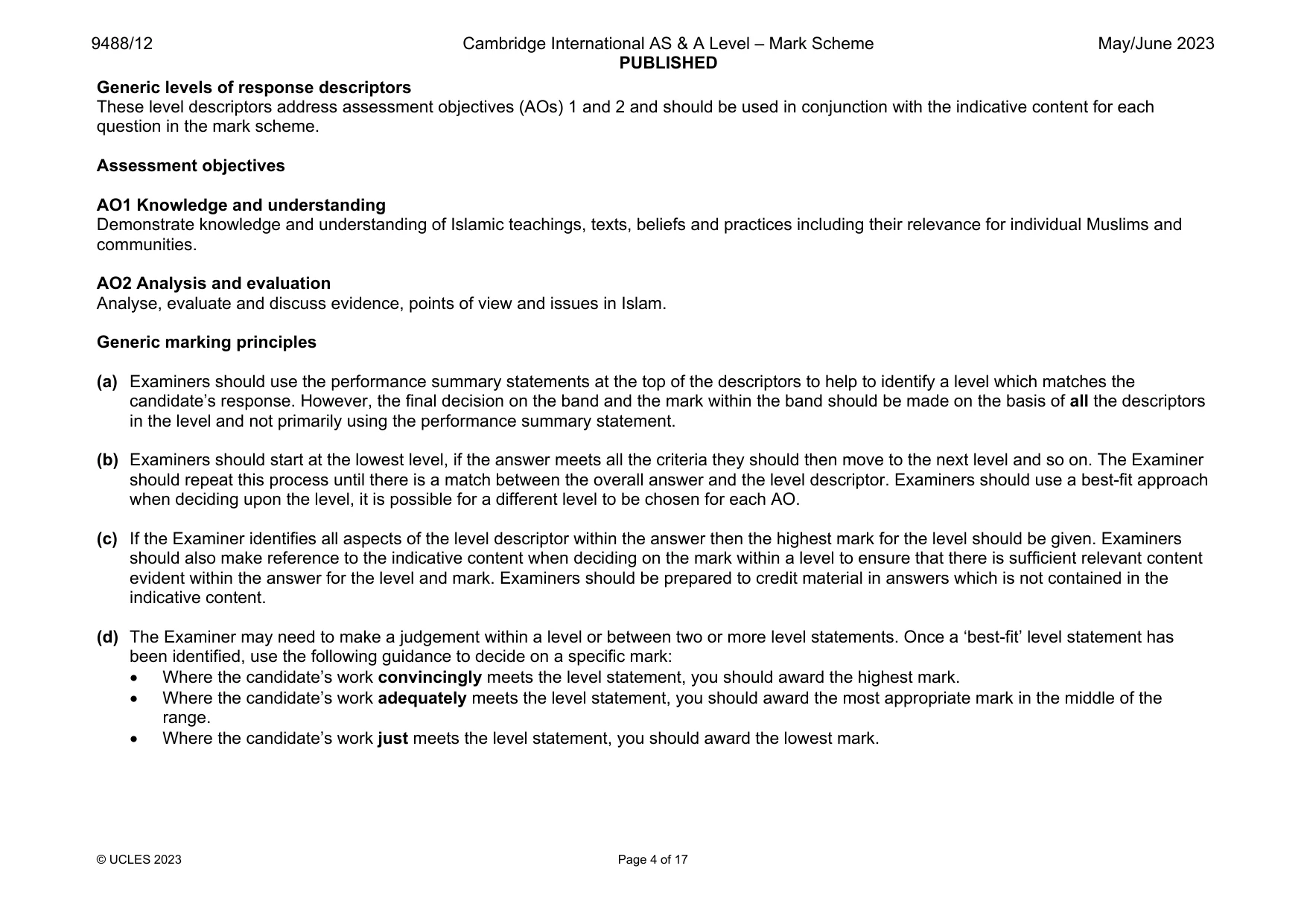
9488/12 Cambridge International AS & A Level – Mark Scheme PUBLISHED May/June 2023 © UCLES 2023 Page 4 of 17 Generic levels of response descriptors These level descriptors address assessment objectives (AOs) 1 and 2 and should be used in conjunction with the indicative content for each question in the mark scheme. Assessment objectives AO1 Knowledge and understanding Demonstrate knowledge and understanding of Islamic teachings, texts, beliefs and practices including their relevance for individual Muslims and communities. AO2 Analysis and evaluation Analyse, evaluate and discuss evidence, points of view and issues in Islam. Generic marking principles (a) Examiners should use the performance summary statements at the top of the descriptors to help to identify a level which matches the candidate’s response. However, the final decision on the band and the mark within the band should be made on the basis of all the descriptors in the level and not primarily using the performance summary statement. (b) Examiners should start at the lowest level, if the answer meets all the criteria they should then move to the next level and so on. The Examiner should repeat this process until there is a match between the overall answer and the level descriptor. Examiners should use a best-fit approach when deciding upon the level, it is possible for a different level to be chosen for each AO. (c) If the Examiner identifies all aspects of the level descriptor within the answer then the highest mark for the level should be given. Examiners should also make reference to the indicative content when deciding on the mark within a level to ensure that there is sufficient relevant content evident within the answer for the level and mark. Examiners should be prepared to credit material in answers which is not contained in the indicative content. (d) The Examiner may need to make a judgement within a level or between two or more level statements. Once a ‘best-fit’ level statement has been identified, use the following guidance to decide on a specific mark: Where the candidate’s work convincingly meets the level statement, you should award the highest mark. Where the candidate’s work adequately meets the level statement, you should award the most appropriate mark in the middle of the range. Where the candidate’s work just meets the level statement, you should award the lowest mark.
Mark scheme, page 5
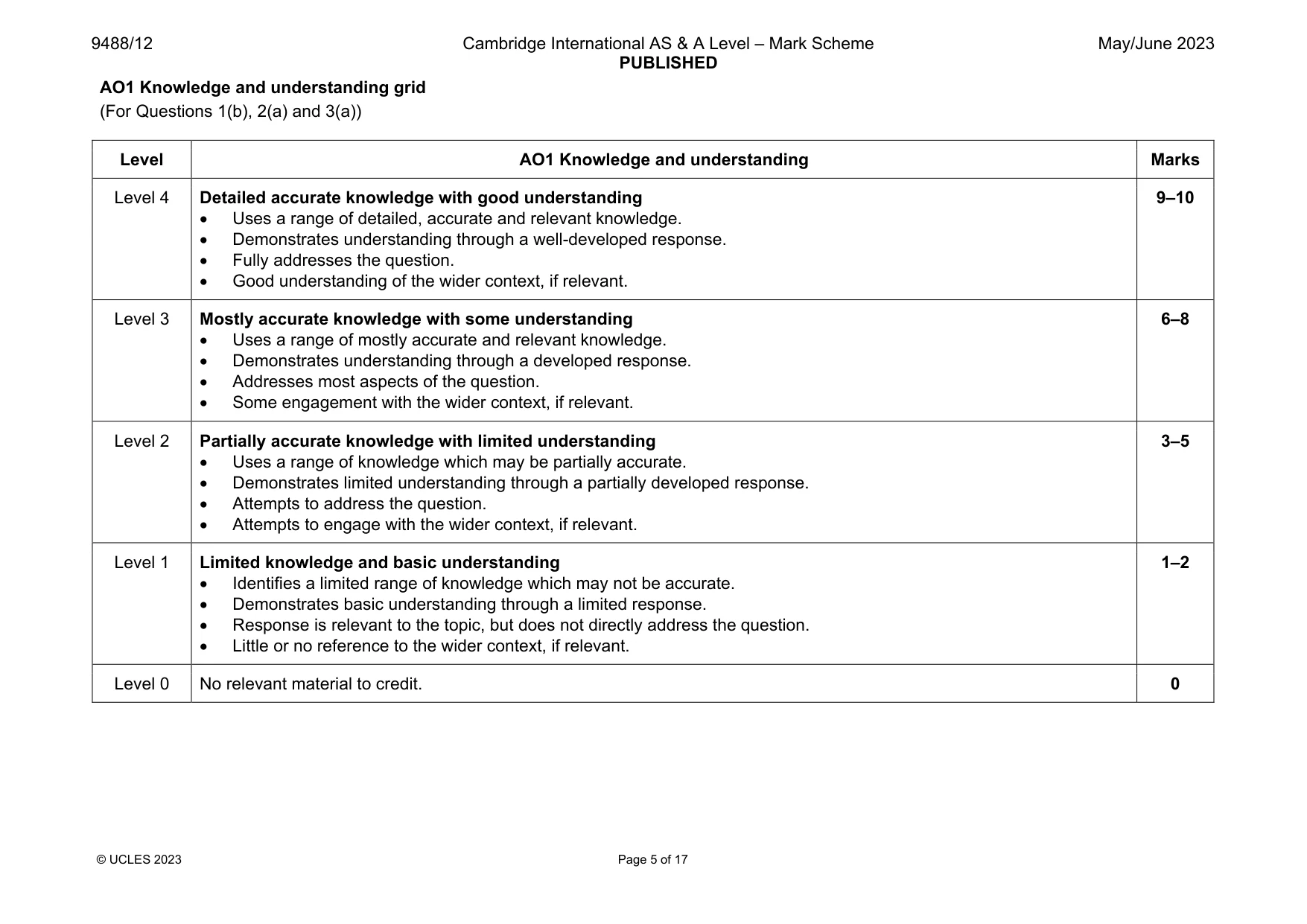
9488/12 Cambridge International AS & A Level – Mark Scheme PUBLISHED May/June 2023 © UCLES 2023 Page 5 of 17 AO1 Knowledge and understanding grid (For Questions 1(b), 2(a) and 3(a)) Level AO1 Knowledge and understanding Marks Level 4 Detailed accurate knowledge with good understanding Uses a range of detailed, accurate and relevant knowledge. Demonstrates understanding through a well-developed response. Fully addresses the question. Good understanding of the wider context, if relevant. 9–10 Level 3 Mostly accurate knowledge with some understanding Uses a range of mostly accurate and relevant knowledge. Demonstrates understanding through a developed response. Addresses most aspects of the question. Some engagement with the wider context, if relevant. 6–8 Level 2 Partially accurate knowledge with limited understanding Uses a range of knowledge which may be partially accurate. Demonstrates limited understanding through a partially developed response. Attempts to address the question. Attempts to engage with the wider context, if relevant. 3–5 Level 1 Limited knowledge and basic understanding Identifies a limited range of knowledge which may not be accurate. Demonstrates basic understanding through a limited response. Response is relevant to the topic, but does not directly address the question. Little or no reference to the wider context, if relevant. 1–2 Level 0 No relevant material to credit. 0
Mark scheme, page 6
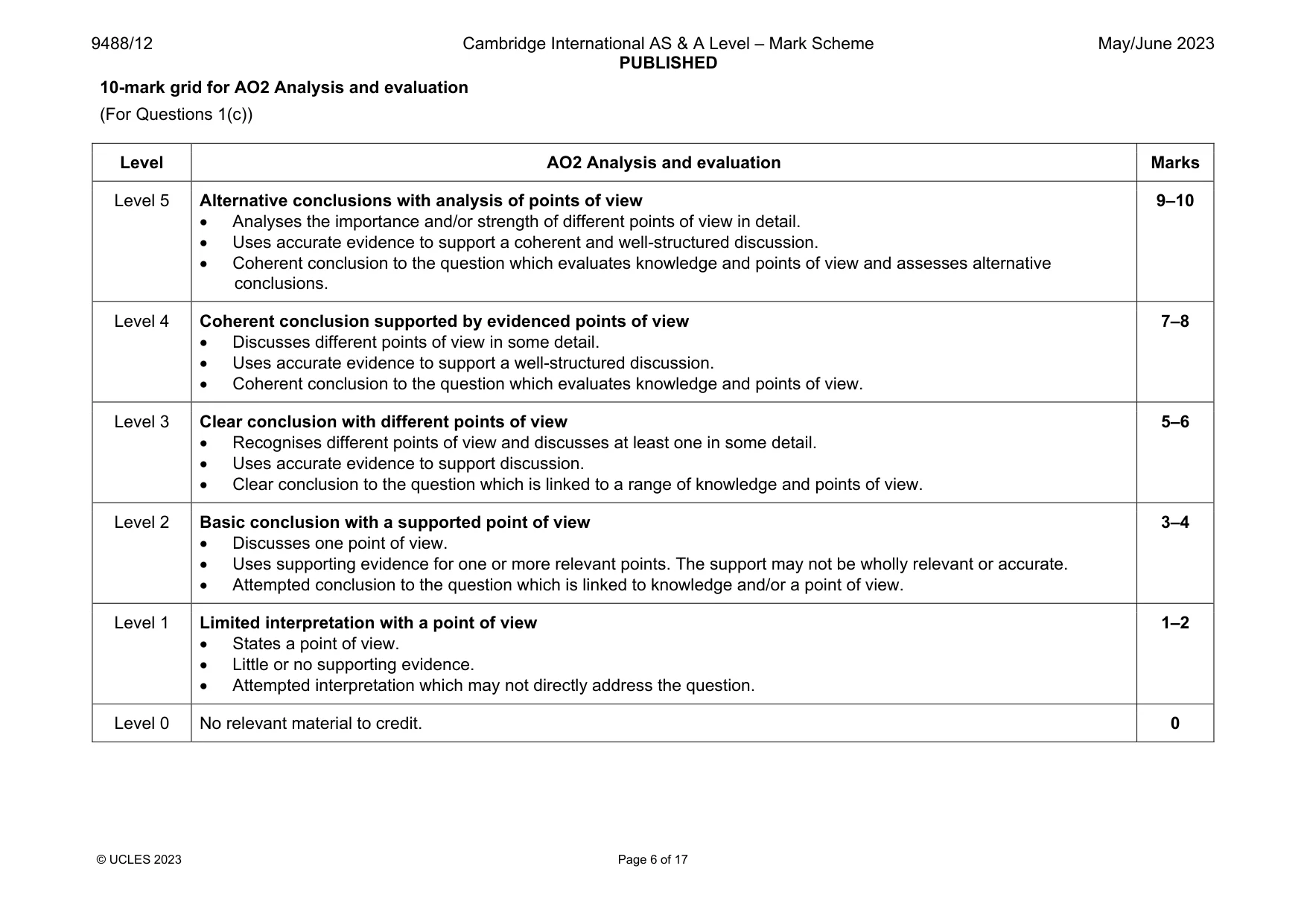
9488/12 Cambridge International AS & A Level – Mark Scheme PUBLISHED May/June 2023 © UCLES 2023 Page 6 of 17 10-mark grid for AO2 Analysis and evaluation (For Questions 1(c)) Level AO2 Analysis and evaluation Marks Level 5 Alternative conclusions with analysis of points of view Analyses the importance and/or strength of different points of view in detail. Uses accurate evidence to support a coherent and well-structured discussion. Coherent conclusion to the question which evaluates knowledge and points of view and assesses alternative conclusions. 9–10 Level 4 Coherent conclusion supported by evidenced points of view Discusses different points of view in some detail. Uses accurate evidence to support a well-structured discussion. Coherent conclusion to the question which evaluates knowledge and points of view. 7–8 Level 3 Clear conclusion with different points of view Recognises different points of view and discusses at least one in some detail. Uses accurate evidence to support discussion. Clear conclusion to the question which is linked to a range of knowledge and points of view. 5–6 Level 2 Basic conclusion with a supported point of view Discusses one point of view. Uses supporting evidence for one or more relevant points. The support may not be wholly relevant or accurate. Attempted conclusion to the question which is linked to knowledge and/or a point of view. 3–4 Level 1 Limited interpretation with a point of view States a point of view. Little or no supporting evidence. Attempted interpretation which may not directly address the question. 1–2 Level 0 No relevant material to credit. 0
Mark scheme, page 7
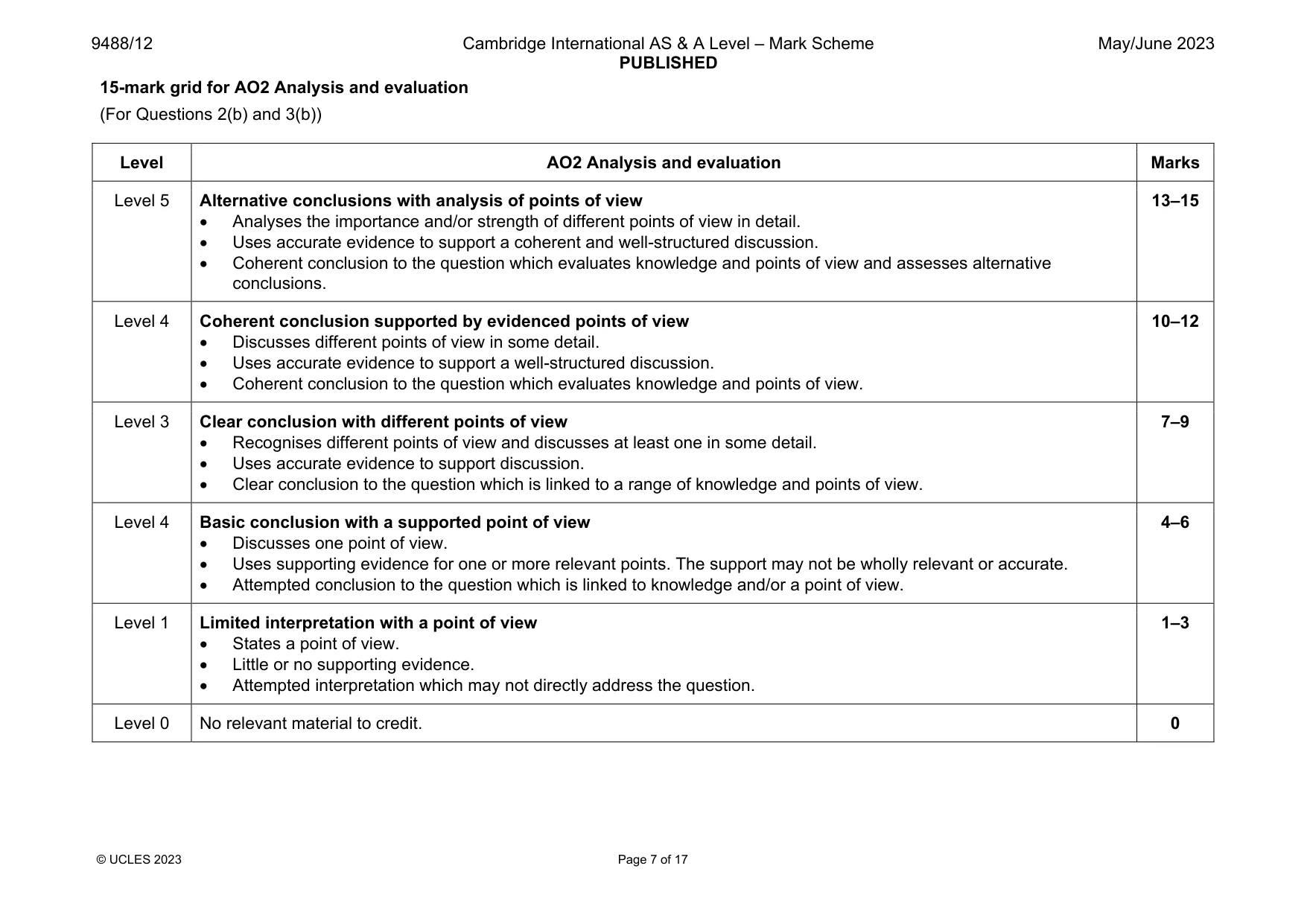
9488/12 Cambridge International AS & A Level – Mark Scheme PUBLISHED May/June 2023 © UCLES 2023 Page 7 of 17 15-mark grid for AO2 Analysis and evaluation (For Questions 2(b) and 3(b)) Level AO2 Analysis and evaluation Marks Level 5 Alternative conclusions with analysis of points of view Analyses the importance and/or strength of different points of view in detail. Uses accurate evidence to support a coherent and well-structured discussion. Coherent conclusion to the question which evaluates knowledge and points of view and assesses alternative conclusions. 13–15 Level 4 Coherent conclusion supported by evidenced points of view Discusses different points of view in some detail. Uses accurate evidence to support a well-structured discussion. Coherent conclusion to the question which evaluates knowledge and points of view. 10–12 Level 3 Clear conclusion with different points of view Recognises different points of view and discusses at least one in some detail. Uses accurate evidence to support discussion. Clear conclusion to the question which is linked to a range of knowledge and points of view. 7–9 Level 4 Basic conclusion with a supported point of view Discusses one point of view. Uses supporting evidence for one or more relevant points. The support may not be wholly relevant or accurate. Attempted conclusion to the question which is linked to knowledge and/or a point of view. 4–6 Level 1 Limited interpretation with a point of view States a point of view. Little or no supporting evidence. Attempted interpretation which may not directly address the question. 1–3 Level 0 No relevant material to credit. 0
Mark scheme, page 8
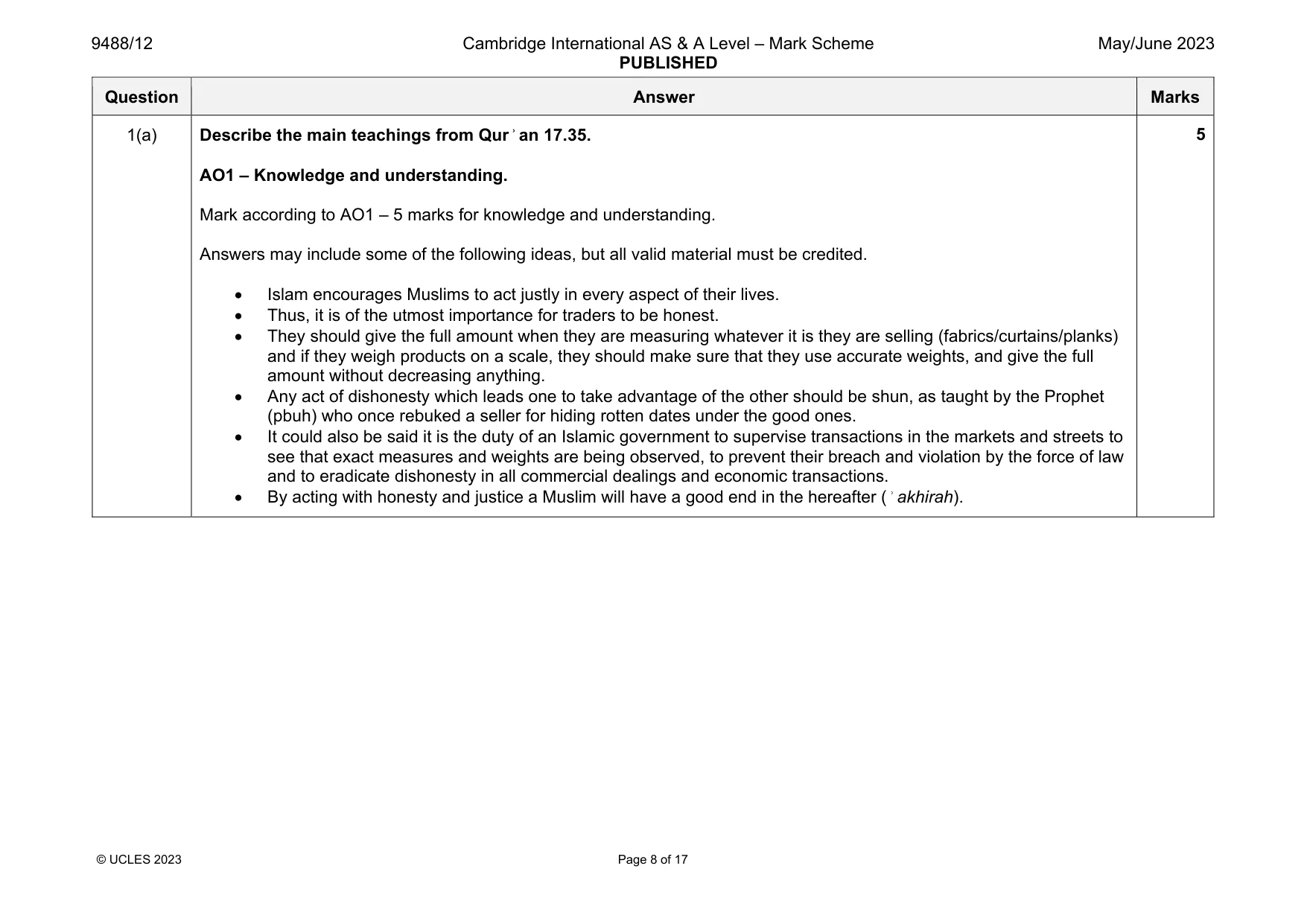
9488/12 Cambridge International AS & A Level – Mark Scheme PUBLISHED May/June 2023 © UCLES 2023 Page 8 of 17 Question Answer Marks 1(a) Describe the main teachings from Qurʾan 17.35. AO1 – Knowledge and understanding. Mark according to AO1 – 5 marks for knowledge and understanding. Answers may include some of the following ideas, but all valid material must be credited. Islam encourages Muslims to act justly in every aspect of their lives. Thus, it is of the utmost importance for traders to be honest. They should give the full amount when they are measuring whatever it is they are selling (fabrics/curtains/planks) and if they weigh products on a scale, they should make sure that they use accurate weights, and give the full amount without decreasing anything. Any act of dishonesty which leads one to take advantage of the other should be shun, as taught by the Prophet (pbuh) who once rebuked a seller for hiding rotten dates under the good ones. It could also be said it is the duty of an Islamic government to supervise transactions in the markets and streets to see that exact measures and weights are being observed, to prevent their breach and violation by the force of law and to eradicate dishonesty in all commercial dealings and economic transactions. By acting with honesty and justice a Muslim will have a good end in the hereafter (ʾakhirah). 5
Mark scheme, page 9
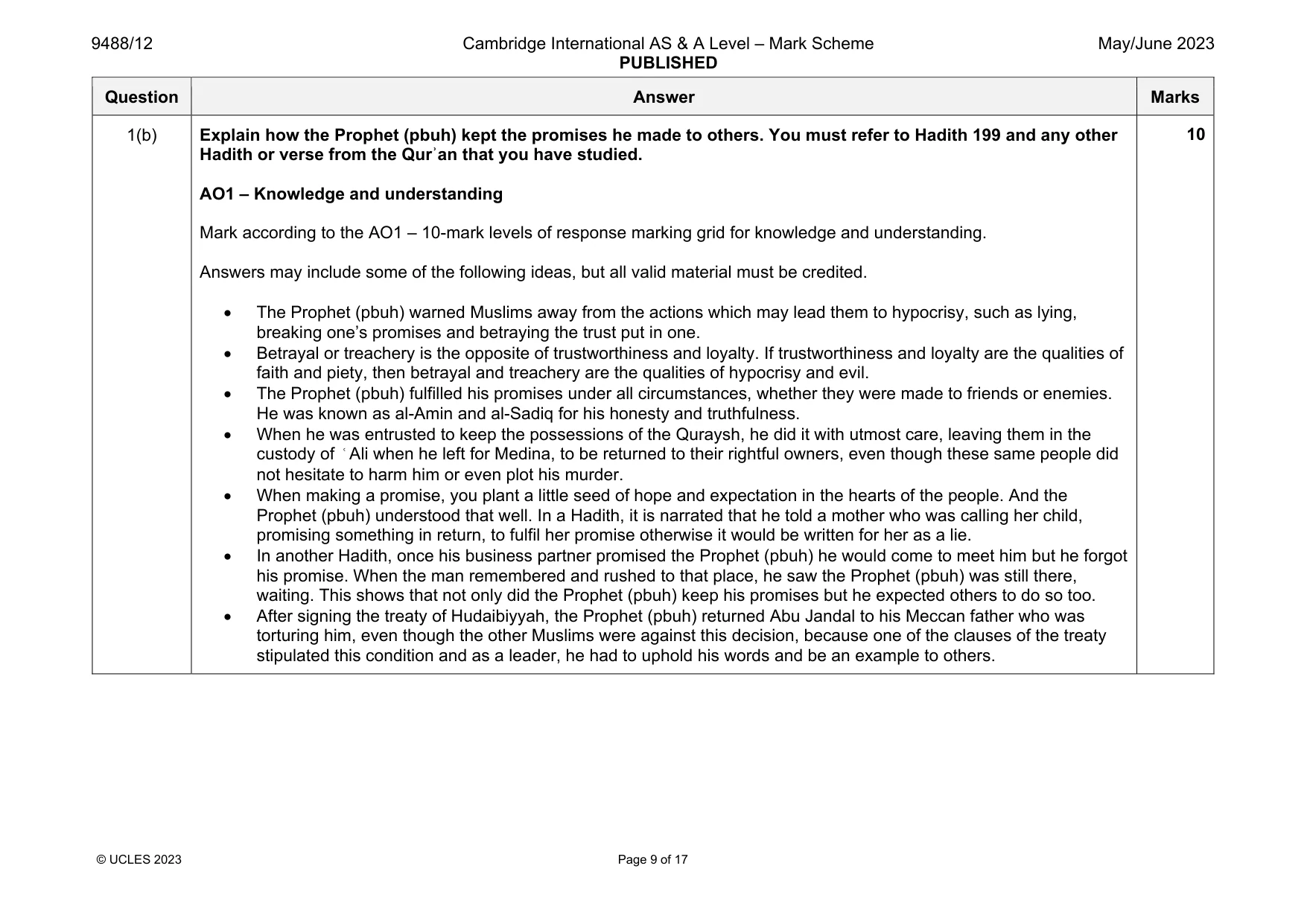
9488/12 Cambridge International AS & A Level – Mark Scheme PUBLISHED May/June 2023 © UCLES 2023 Page 9 of 17 Question Answer Marks 1(b) Explain how the Prophet (pbuh) kept the promises he made to others. You must refer to Hadith 199 and any other Hadith or verse from the Qurʾan that you have studied. AO1 – Knowledge and understanding Mark according to the AO1 – 10-mark levels of response marking grid for knowledge and understanding. Answers may include some of the following ideas, but all valid material must be credited. The Prophet (pbuh) warned Muslims away from the actions which may lead them to hypocrisy, such as lying, breaking one’s promises and betraying the trust put in one. Betrayal or treachery is the opposite of trustworthiness and loyalty. If trustworthiness and loyalty are the qualities of faith and piety, then betrayal and treachery are the qualities of hypocrisy and evil. The Prophet (pbuh) fulfilled his promises under all circumstances, whether they were made to friends or enemies. He was known as al-Amin and al-Sadiq for his honesty and truthfulness. When he was entrusted to keep the possessions of the Quraysh, he did it with utmost care, leaving them in the custody of ʿAli when he left for Medina, to be returned to their rightful owners, even though these same people did not hesitate to harm him or even plot his murder. When making a promise, you plant a little seed of hope and expectation in the hearts of the people. And the Prophet (pbuh) understood that well. In a Hadith, it is narrated that he told a mother who was calling her child, promising something in return, to fulfil her promise otherwise it would be written for her as a lie. In another Hadith, once his business partner promised the Prophet (pbuh) he would come to meet him but he forgot his promise. When the man remembered and rushed to that place, he saw the Prophet (pbuh) was still there, waiting. This shows that not only did the Prophet (pbuh) keep his promises but he expected others to do so too. After signing the treaty of Hudaibiyyah, the Prophet (pbuh) returned Abu Jandal to his Meccan father who was torturing him, even though the other Muslims were against this decision, because one of the clauses of the treaty stipulated this condition and as a leader, he had to uphold his words and be an example to others. 10
Mark scheme, page 10
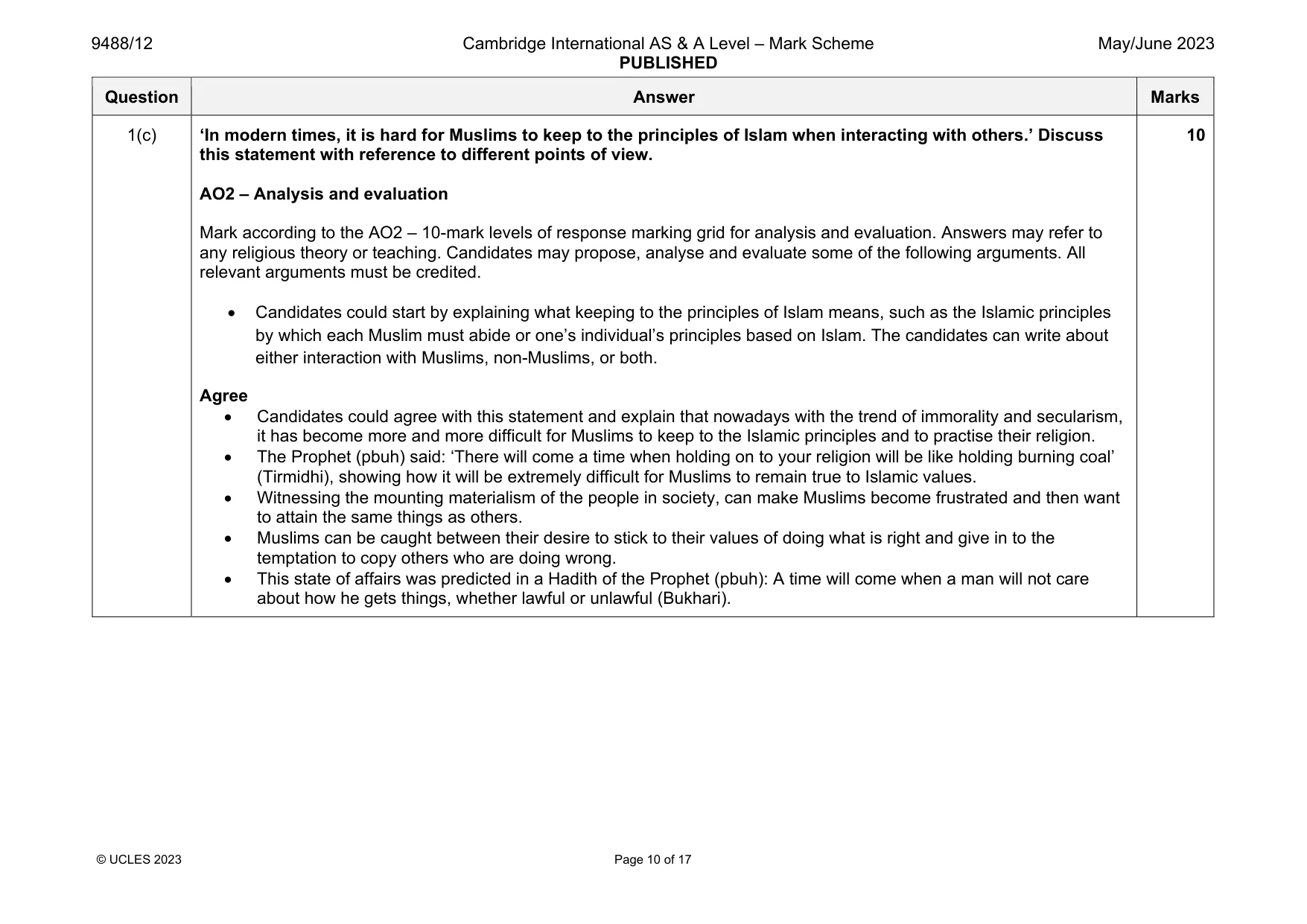
9488/12 Cambridge International AS & A Level – Mark Scheme PUBLISHED May/June 2023 © UCLES 2023 Page 10 of 17 Question Answer Marks 1(c) ‘In modern times, it is hard for Muslims to keep to the principles of Islam when interacting with others.’ Discuss this statement with reference to different points of view. AO2 – Analysis and evaluation Mark according to the AO2 – 10-mark levels of response marking grid for analysis and evaluation. Answers may refer to any religious theory or teaching. Candidates may propose, analyse and evaluate some of the following arguments. All relevant arguments must be credited. Candidates could start by explaining what keeping to the principles of Islam means, such as the Islamic principles by which each Muslim must abide or one’s individual’s principles based on Islam. The candidates can write about either interaction with Muslims, non-Muslims, or both. Agree Candidates could agree with this statement and explain that nowadays with the trend of immorality and secularism, it has become more and more difficult for Muslims to keep to the Islamic principles and to practise their religion. The Prophet (pbuh) said: ‘There will come a time when holding on to your religion will be like holding burning coal’ (Tirmidhi), showing how it will be extremely difficult for Muslims to remain true to Islamic values. Witnessing the mounting materialism of the people in society, can make Muslims become frustrated and then want to attain the same things as others. Muslims can be caught between their desire to stick to their values of doing what is right and give in to the temptation to copy others who are doing wrong. This state of affairs was predicted in a Hadith of the Prophet (pbuh): A time will come when a man will not care about how he gets things, whether lawful or unlawful (Bukhari). 10
Mark scheme, page 11
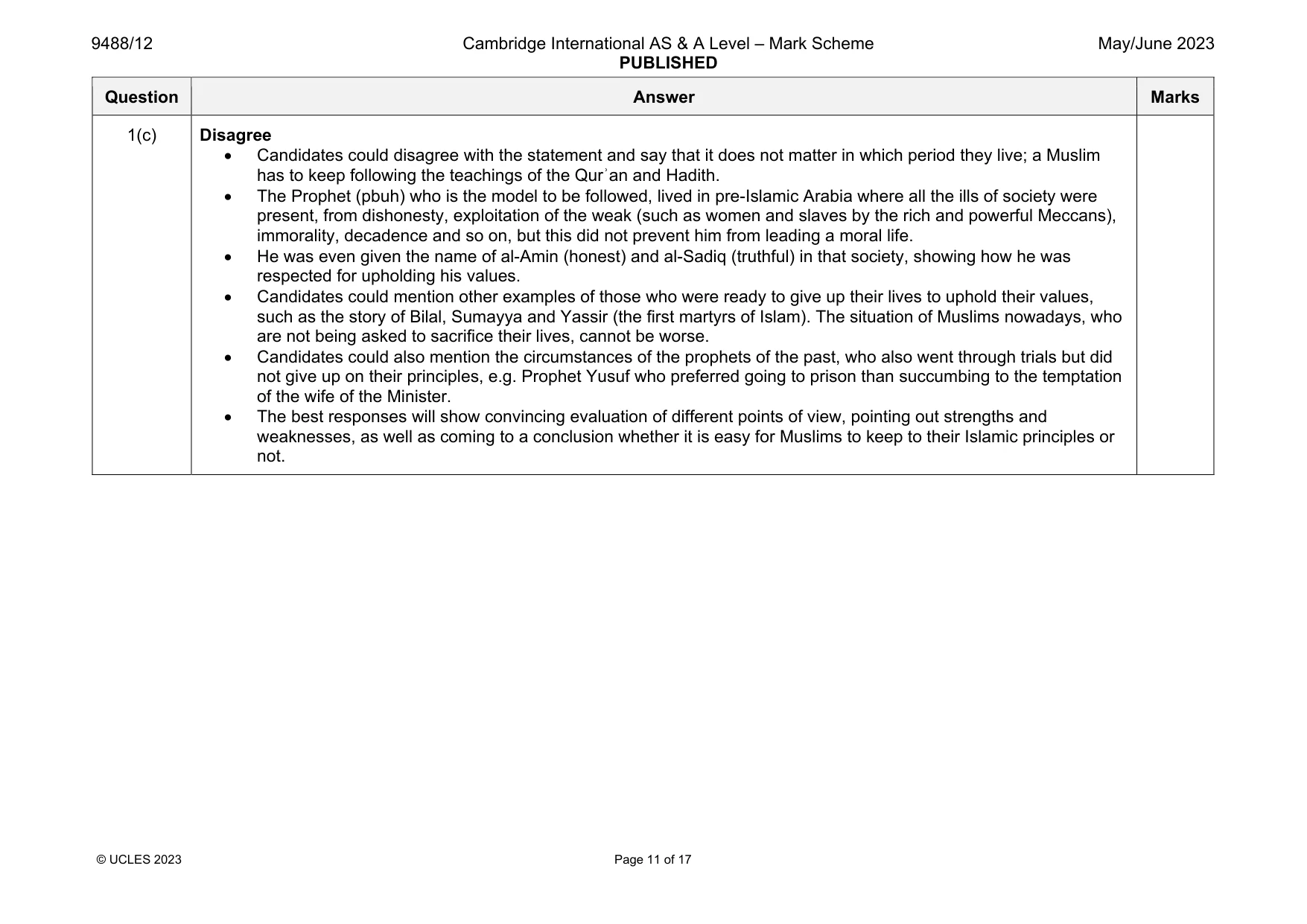
9488/12 Cambridge International AS & A Level – Mark Scheme PUBLISHED May/June 2023 © UCLES 2023 Page 11 of 17 Question Answer Marks 1(c) Disagree Candidates could disagree with the statement and say that it does not matter in which period they live; a Muslim has to keep following the teachings of the Qurʾan and Hadith. The Prophet (pbuh) who is the model to be followed, lived in pre-Islamic Arabia where all the ills of society were present, from dishonesty, exploitation of the weak (such as women and slaves by the rich and powerful Meccans), immorality, decadence and so on, but this did not prevent him from leading a moral life. He was even given the name of al-Amin (honest) and al-Sadiq (truthful) in that society, showing how he was respected for upholding his values. Candidates could mention other examples of those who were ready to give up their lives to uphold their values, such as the story of Bilal, Sumayya and Yassir (the first martyrs of Islam). The situation of Muslims nowadays, who are not being asked to sacrifice their lives, cannot be worse. Candidates could also mention the circumstances of the prophets of the past, who also went through trials but did not give up on their principles, e.g. Prophet Yusuf who preferred going to prison than succumbing to the temptation of the wife of the Minister. The best responses will show convincing evaluation of different points of view, pointing out strengths and weaknesses, as well as coming to a conclusion whether it is easy for Muslims to keep to their Islamic principles or not.
Mark scheme, page 12
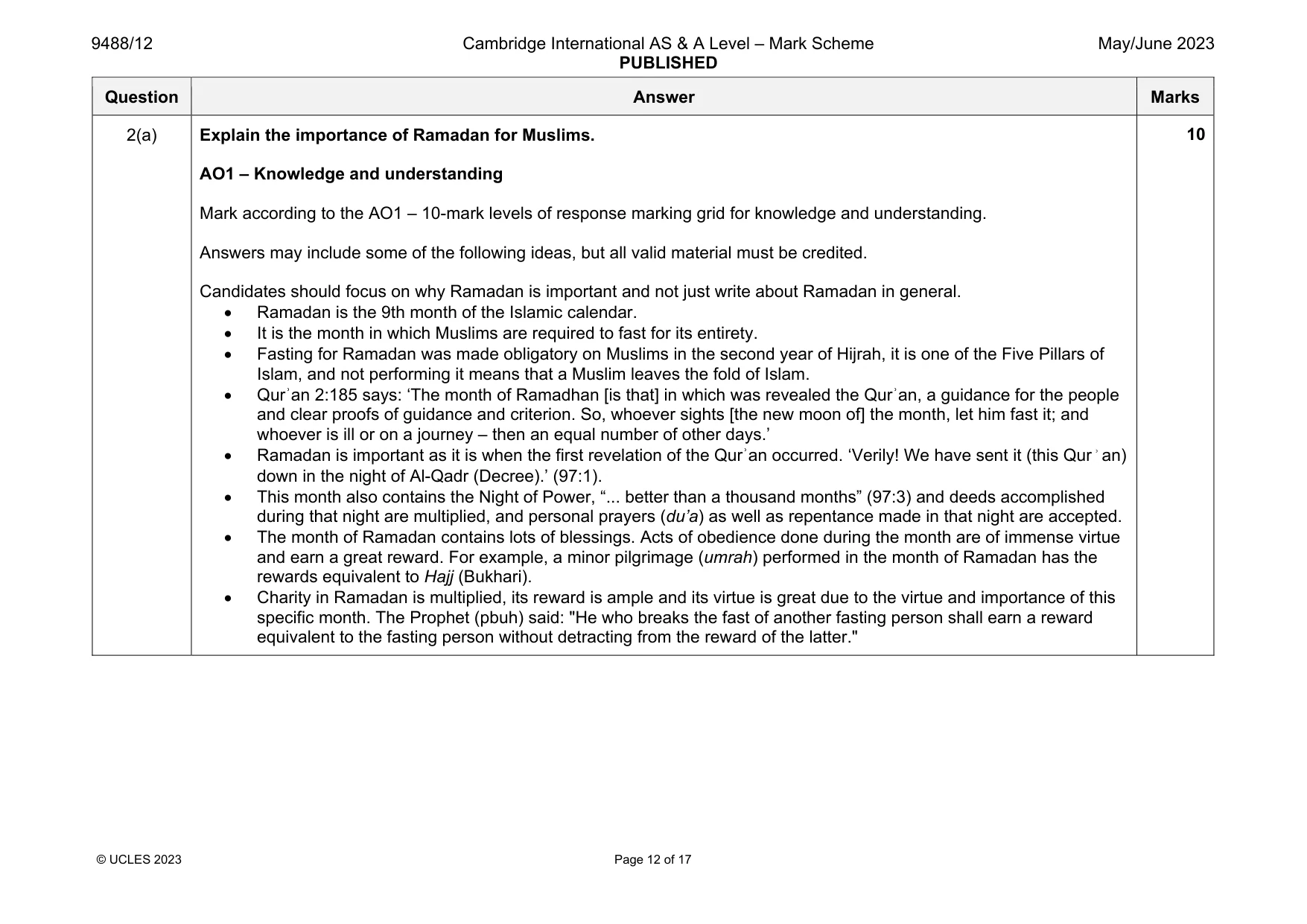
9488/12 Cambridge International AS & A Level – Mark Scheme PUBLISHED May/June 2023 © UCLES 2023 Page 12 of 17 Question Answer Marks 2(a) Explain the importance of Ramadan for Muslims. AO1 – Knowledge and understanding Mark according to the AO1 – 10-mark levels of response marking grid for knowledge and understanding. Answers may include some of the following ideas, but all valid material must be credited. Candidates should focus on why Ramadan is important and not just write about Ramadan in general. Ramadan is the 9th month of the Islamic calendar. It is the month in which Muslims are required to fast for its entirety. Fasting for Ramadan was made obligatory on Muslims in the second year of Hijrah, it is one of the Five Pillars of Islam, and not performing it means that a Muslim leaves the fold of Islam. Qurʾan 2:185 says: ‘The month of Ramadhan [is that] in which was revealed the Qurʾan, a guidance for the people and clear proofs of guidance and criterion. So, whoever sights [the new moon of] the month, let him fast it; and whoever is ill or on a journey – then an equal number of other days.’ Ramadan is important as it is when the first revelation of the Qurʾan occurred. ‘Verily! We have sent it (this Qurʾan) down in the night of Al-Qadr (Decree).’ (97:1). This month also contains the Night of Power, “... better than a thousand months” (97:3) and deeds accomplished during that night are multiplied, and personal prayers (du’a) as well as repentance made in that night are accepted. The month of Ramadan contains lots of blessings. Acts of obedience done during the month are of immense virtue and earn a great reward. For example, a minor pilgrimage (umrah) performed in the month of Ramadan has the rewards equivalent to Hajj (Bukhari). Charity in Ramadan is multiplied, its reward is ample and its virtue is great due to the virtue and importance of this specific month. The Prophet (pbuh) said: "He who breaks the fast of another fasting person shall earn a reward equivalent to the fasting person without detracting from the reward of the latter." 10
Mark scheme, page 13
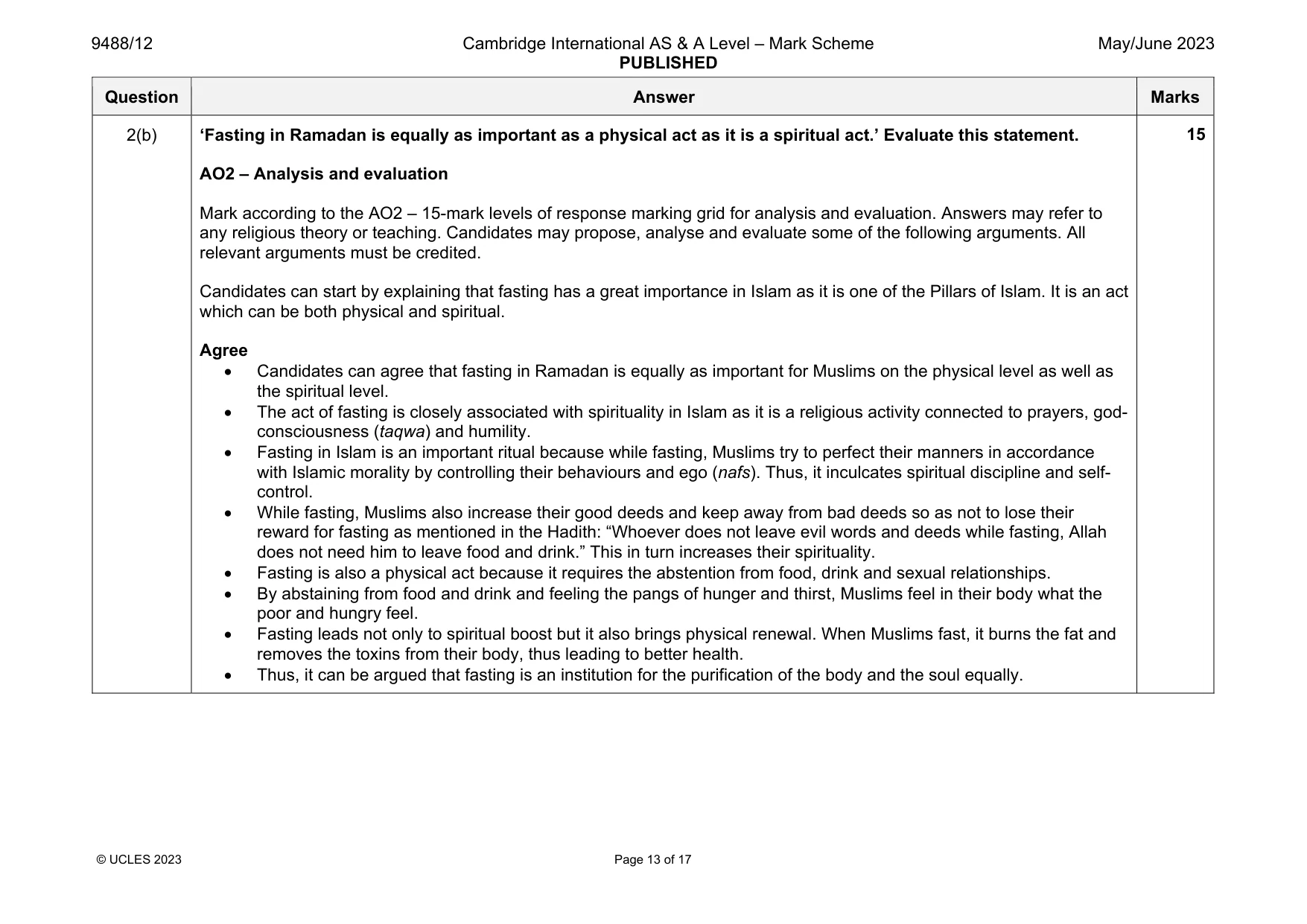
9488/12 Cambridge International AS & A Level – Mark Scheme PUBLISHED May/June 2023 © UCLES 2023 Page 13 of 17 Question Answer Marks 2(b) ‘Fasting in Ramadan is equally as important as a physical act as it is a spiritual act.’ Evaluate this statement. AO2 – Analysis and evaluation Mark according to the AO2 – 15-mark levels of response marking grid for analysis and evaluation. Answers may refer to any religious theory or teaching. Candidates may propose, analyse and evaluate some of the following arguments. All relevant arguments must be credited. Candidates can start by explaining that fasting has a great importance in Islam as it is one of the Pillars of Islam. It is an act which can be both physical and spiritual. Agree Candidates can agree that fasting in Ramadan is equally as important for Muslims on the physical level as well as the spiritual level. The act of fasting is closely associated with spirituality in Islam as it is a religious activity connected to prayers, god- consciousness (taqwa) and humility. Fasting in Islam is an important ritual because while fasting, Muslims try to perfect their manners in accordance with Islamic morality by controlling their behaviours and ego (nafs). Thus, it inculcates spiritual discipline and self- control. While fasting, Muslims also increase their good deeds and keep away from bad deeds so as not to lose their reward for fasting as mentioned in the Hadith: “Whoever does not leave evil words and deeds while fasting, Allah does not need him to leave food and drink.” This in turn increases their spirituality. Fasting is also a physical act because it requires the abstention from food, drink and sexual relationships. By abstaining from food and drink and feeling the pangs of hunger and thirst, Muslims feel in their body what the poor and hungry feel. Fasting leads not only to spiritual boost but it also brings physical renewal. When Muslims fast, it burns the fat and removes the toxins from their body, thus leading to better health. Thus, it can be argued that fasting is an institution for the purification of the body and the soul equally. 15
Mark scheme, page 14
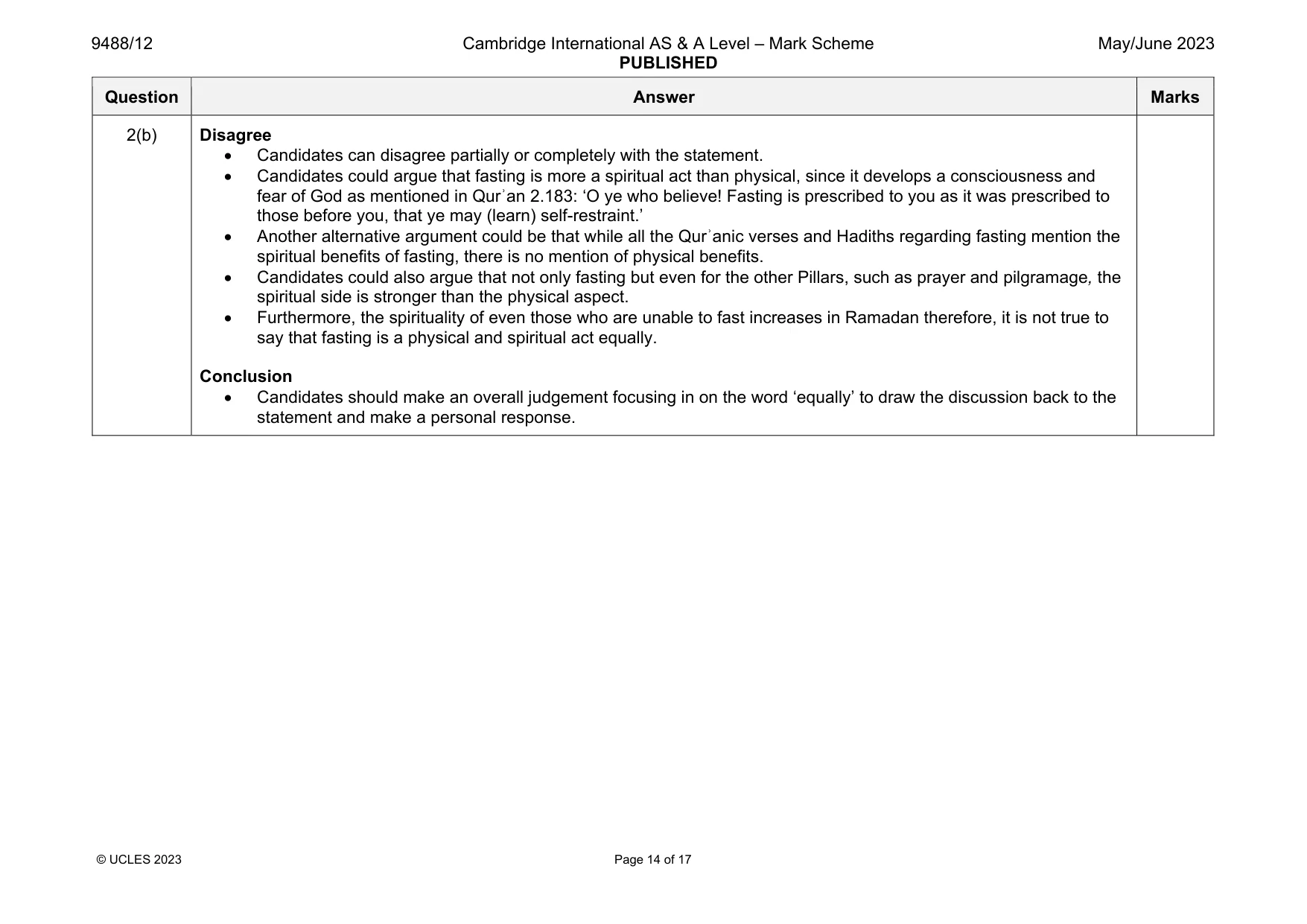
9488/12 Cambridge International AS & A Level – Mark Scheme PUBLISHED May/June 2023 © UCLES 2023 Page 14 of 17 Question Answer Marks 2(b) Disagree Candidates can disagree partially or completely with the statement. Candidates could argue that fasting is more a spiritual act than physical, since it develops a consciousness and fear of God as mentioned in Qurʾan 2.183: ‘O ye who believe! Fasting is prescribed to you as it was prescribed to those before you, that ye may (learn) self-restraint.’ Another alternative argument could be that while all the Qurʾanic verses and Hadiths regarding fasting mention the spiritual benefits of fasting, there is no mention of physical benefits. Candidates could also argue that not only fasting but even for the other Pillars, such as prayer and pilgramage, the spiritual side is stronger than the physical aspect. Furthermore, the spirituality of even those who are unable to fast increases in Ramadan therefore, it is not true to say that fasting is a physical and spiritual act equally. Conclusion Candidates should make an overall judgement focusing in on the word ‘equally’ to draw the discussion back to the statement and make a personal response.
Mark scheme, page 15
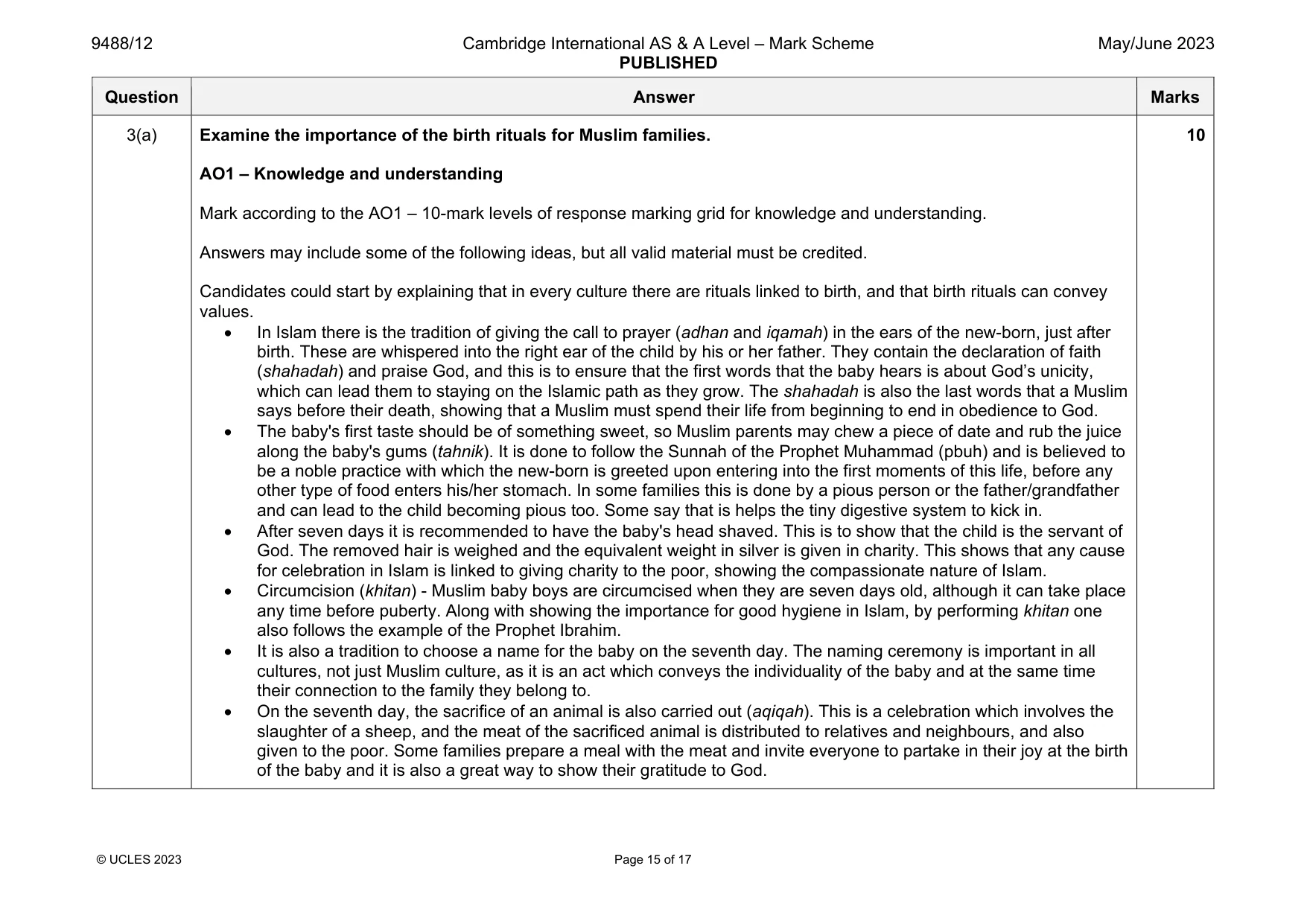
9488/12 Cambridge International AS & A Level – Mark Scheme PUBLISHED May/June 2023 © UCLES 2023 Page 15 of 17 Question Answer Marks 3(a) Examine the importance of the birth rituals for Muslim families. AO1 – Knowledge and understanding Mark according to the AO1 – 10-mark levels of response marking grid for knowledge and understanding. Answers may include some of the following ideas, but all valid material must be credited. Candidates could start by explaining that in every culture there are rituals linked to birth, and that birth rituals can convey values. In Islam there is the tradition of giving the call to prayer (adhan and iqamah) in the ears of the new-born, just after birth. These are whispered into the right ear of the child by his or her father. They contain the declaration of faith (shahadah) and praise God, and this is to ensure that the first words that the baby hears is about God’s unicity, which can lead them to staying on the Islamic path as they grow. The shahadah is also the last words that a Muslim says before their death, showing that a Muslim must spend their life from beginning to end in obedience to God. The baby's first taste should be of something sweet, so Muslim parents may chew a piece of date and rub the juice along the baby's gums (tahnik). It is done to follow the Sunnah of the Prophet Muhammad (pbuh) and is believed to be a noble practice with which the new-born is greeted upon entering into the first moments of this life, before any other type of food enters his/her stomach. In some families this is done by a pious person or the father/grandfather and can lead to the child becoming pious too. Some say that is helps the tiny digestive system to kick in. After seven days it is recommended to have the baby's head shaved. This is to show that the child is the servant of God. The removed hair is weighed and the equivalent weight in silver is given in charity. This shows that any cause for celebration in Islam is linked to giving charity to the poor, showing the compassionate nature of Islam. Circumcision (khitan) - Muslim baby boys are circumcised when they are seven days old, although it can take place any time before puberty. Along with showing the importance for good hygiene in Islam, by performing khitan one also follows the example of the Prophet Ibrahim. It is also a tradition to choose a name for the baby on the seventh day. The naming ceremony is important in all cultures, not just Muslim culture, as it is an act which conveys the individuality of the baby and at the same time their connection to the family they belong to. On the seventh day, the sacrifice of an animal is also carried out (aqiqah). This is a celebration which involves the slaughter of a sheep, and the meat of the sacrificed animal is distributed to relatives and neighbours, and also given to the poor. Some families prepare a meal with the meat and invite everyone to partake in their joy at the birth of the baby and it is also a great way to show their gratitude to God. 10
Mark scheme, page 16
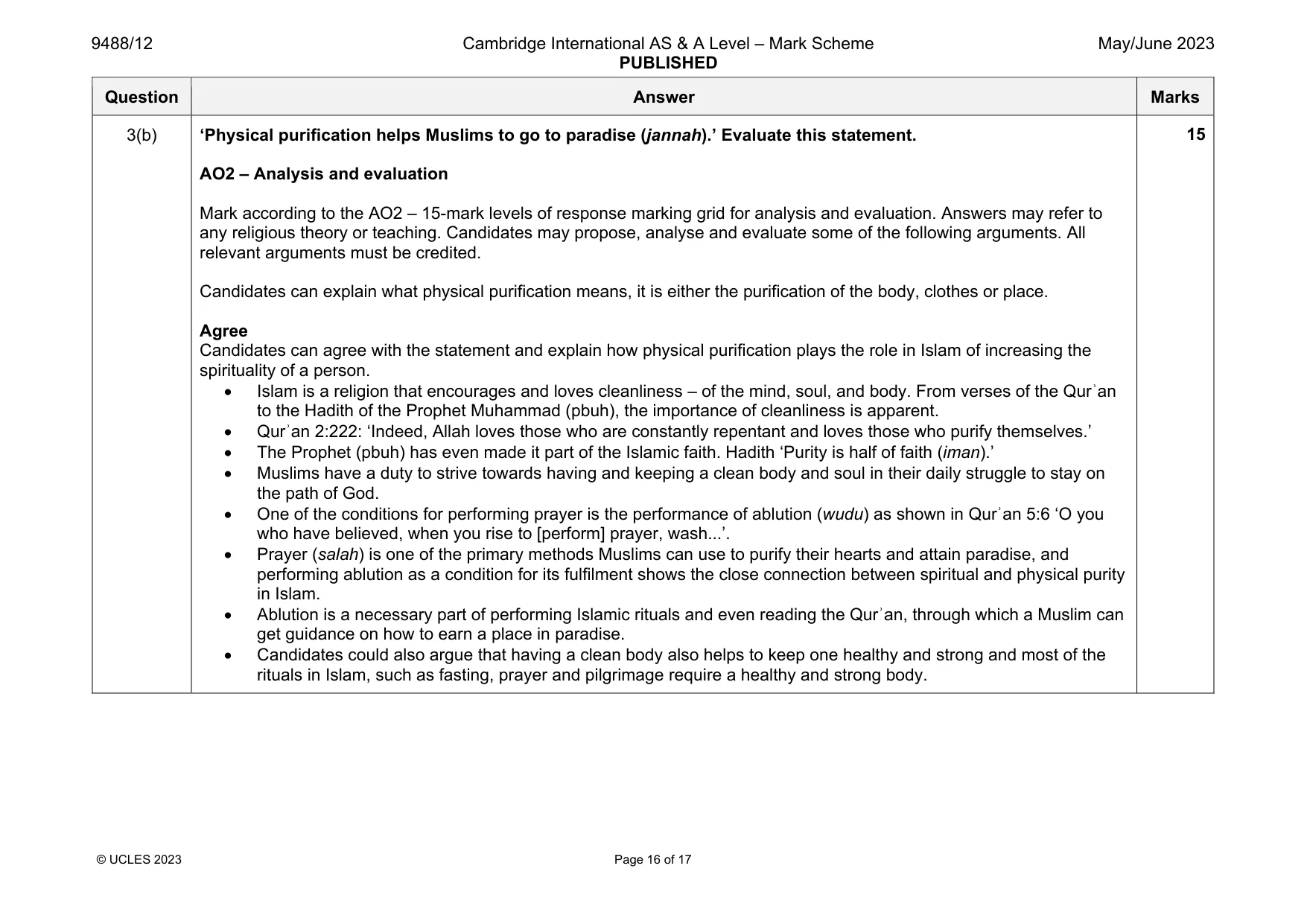
9488/12 Cambridge International AS & A Level – Mark Scheme PUBLISHED May/June 2023 © UCLES 2023 Page 16 of 17 Question Answer Marks 3(b) ‘Physical purification helps Muslims to go to paradise (jannah).’ Evaluate this statement. AO2 – Analysis and evaluation Mark according to the AO2 – 15-mark levels of response marking grid for analysis and evaluation. Answers may refer to any religious theory or teaching. Candidates may propose, analyse and evaluate some of the following arguments. All relevant arguments must be credited. Candidates can explain what physical purification means, it is either the purification of the body, clothes or place. Agree Candidates can agree with the statement and explain how physical purification plays the role in Islam of increasing the spirituality of a person. Islam is a religion that encourages and loves cleanliness – of the mind, soul, and body. From verses of the Qurʾan to the Hadith of the Prophet Muhammad (pbuh), the importance of cleanliness is apparent. Qurʾan 2:222: ‘Indeed, Allah loves those who are constantly repentant and loves those who purify themselves.’ The Prophet (pbuh) has even made it part of the Islamic faith. Hadith ‘Purity is half of faith (iman).’ Muslims have a duty to strive towards having and keeping a clean body and soul in their daily struggle to stay on the path of God. One of the conditions for performing prayer is the performance of ablution (wudu) as shown in Qurʾan 5:6 ‘O you who have believed, when you rise to [perform] prayer, wash...’. Prayer (salah) is one of the primary methods Muslims can use to purify their hearts and attain paradise, and performing ablution as a condition for its fulfilment shows the close connection between spiritual and physical purity in Islam. Ablution is a necessary part of performing Islamic rituals and even reading the Qurʾan, through which a Muslim can get guidance on how to earn a place in paradise. Candidates could also argue that having a clean body also helps to keep one healthy and strong and most of the rituals in Islam, such as fasting, prayer and pilgrimage require a healthy and strong body. 15
Mark scheme, page 17
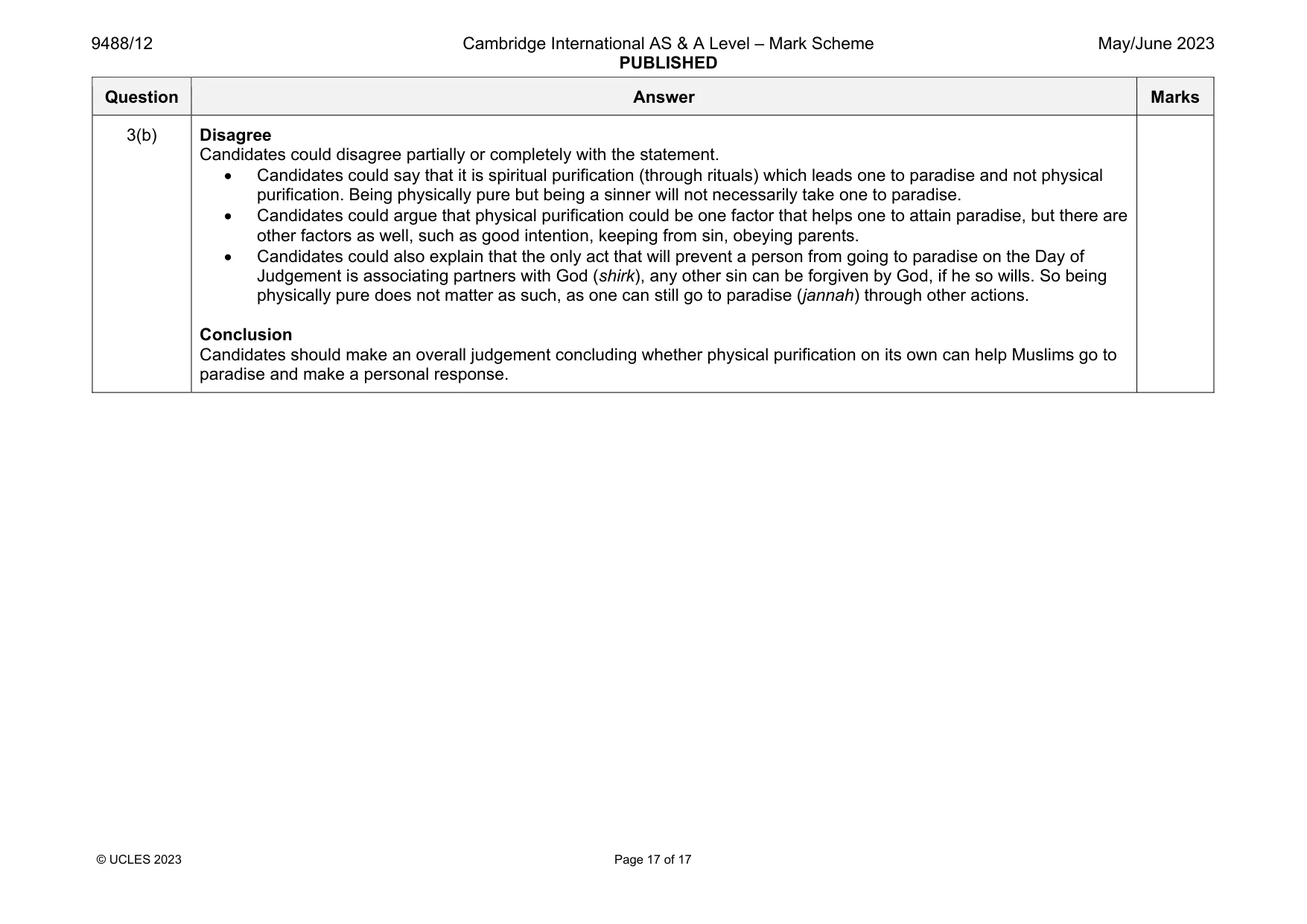
9488/12 Cambridge International AS & A Level – Mark Scheme PUBLISHED May/June 2023 © UCLES 2023 Page 17 of 17 Question Answer Marks 3(b) Disagree Candidates could disagree partially or completely with the statement. Candidates could say that it is spiritual purification (through rituals) which leads one to paradise and not physical purification. Being physically pure but being a sinner will not necessarily take one to paradise. Candidates could argue that physical purification could be one factor that helps one to attain paradise, but there are other factors as well, such as good intention, keeping from sin, obeying parents. Candidates could also explain that the only act that will prevent a person from going to paradise on the Day of Judgement is associating partners with God (shirk), any other sin can be forgiven by God, if he so wills. So being physically pure does not matter as such, as one can still go to paradise (jannah) through other actions. Conclusion Candidates should make an overall judgement concluding whether physical purification on its own can help Muslims go to paradise and make a personal response.
What you needed in this session
Cambridge’s own grade thresholds for 2023 May/June, Paper 1 · Variant 2. A higher threshold means an easier paper — the bar moves with how the cohort did.