Cambridge A Level Islamic Studies 9488 — 2022 Oct/Nov Paper 1 · Variant 2
9488/12/O/N/22 · 50 marks · ≈56 min
The question paper and its mark scheme, free to read here and free to download. This is Cambridge’s own paper, exactly as it was sat.
Question paper4 pages
Mark scheme16 pages
Answers below. Sit the paper first if you are practising.
Paper as text
Question paper, page 1
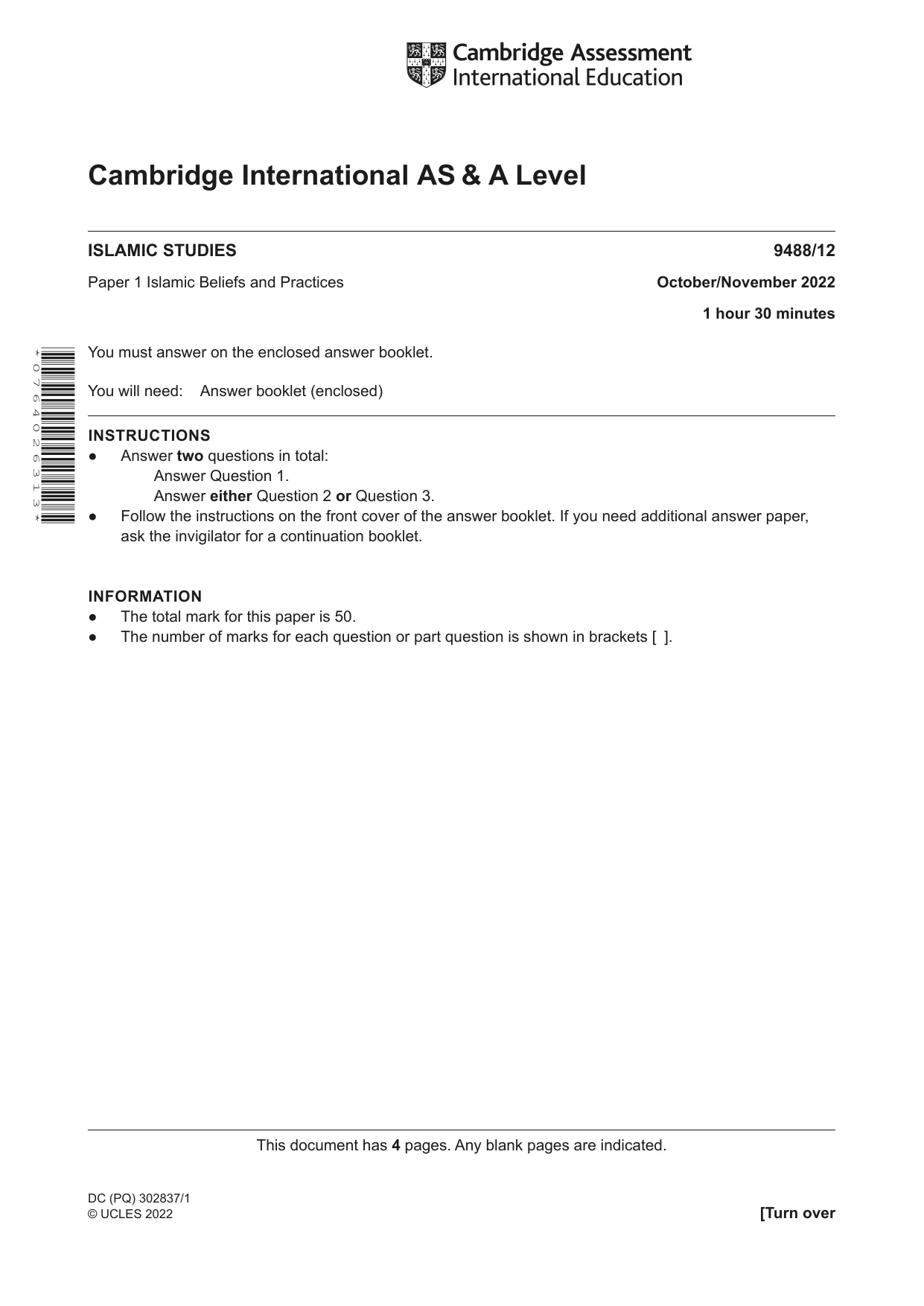
This document has 4 pages. Any blank pages are indicated. [Turn over Cambridge International AS & A Level DC (PQ) 302837/1 © UCLES 2022 ISLAMIC STUDIES 9488/12 Paper 1 Islamic Beliefs and Practices October/November 2022 1 hour 30 minutes You must answer on the enclosed answer booklet. You will need: Answer booklet (enclosed) INSTRUCTIONS ● Answer two questions in total: Answer Question 1. Answer either Question 2 or Question 3. ● Follow the instructions on the front cover of the answer booklet. If you need additional answer paper, ask the invigilator for a continuation booklet. INFORMATION ● The total mark for this paper is 50. ● The number of marks for each question or part question is shown in brackets [ ]. * 0 7 6 4 0 2 6 3 1 3 *
Question paper, page 2
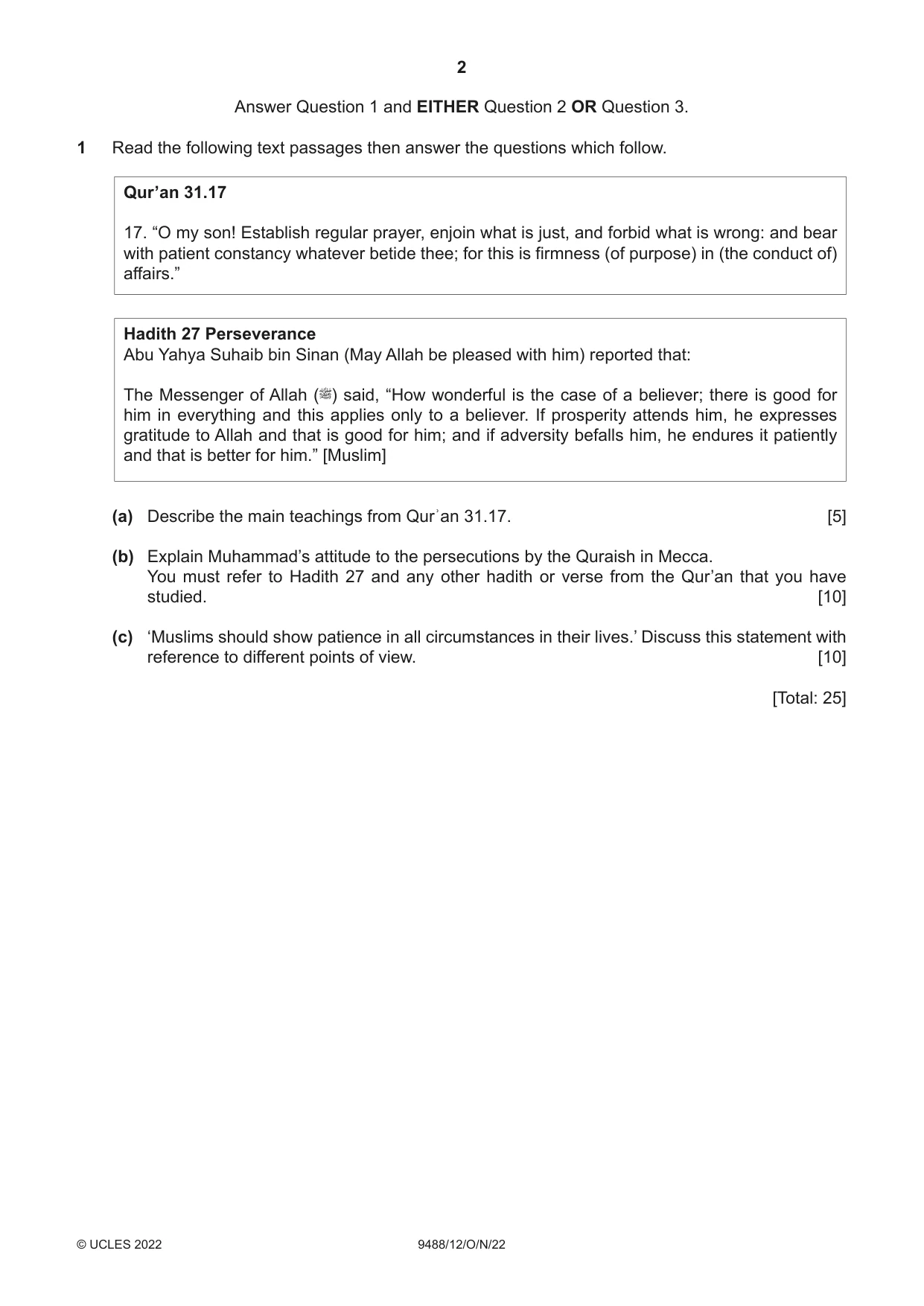
2 9488/12/O/N/22 © UCLES 2022 Answer Question 1 and EITHER Question 2 OR Question 3. 1 Read the following text passages then answer the questions which follow. Qur’an 31.17 17. “O my son! Establish regular prayer, enjoin what is just, and forbid what is wrong: and bear with patient constancy whatever betide thee; for this is firmness (of purpose) in (the conduct of) affairs.” Hadith 27 Perseverance Abu Yahya Suhaib bin Sinan (May Allah be pleased with him) reported that: The Messenger of Allah ( )ﷺsaid, “How wonderful is the case of a believer; there is good for him in everything and this applies only to a believer. If prosperity attends him, he expresses gratitude to Allah and that is good for him; and if adversity befalls him, he endures it patiently and that is better for him.” [Muslim] (a) Describe the main teachings from Qurʾan 31.17. [5] (b) Explain Muhammad’s attitude to the persecutions by the Quraish in Mecca. You must refer to Hadith 27 and any other hadith or verse from the Qur’an that you have studied. [10] (c) ‘Muslims should show patience in all circumstances in their lives.’ Discuss this statement with reference to different points of view. [10] [Total: 25]
Question paper, page 3
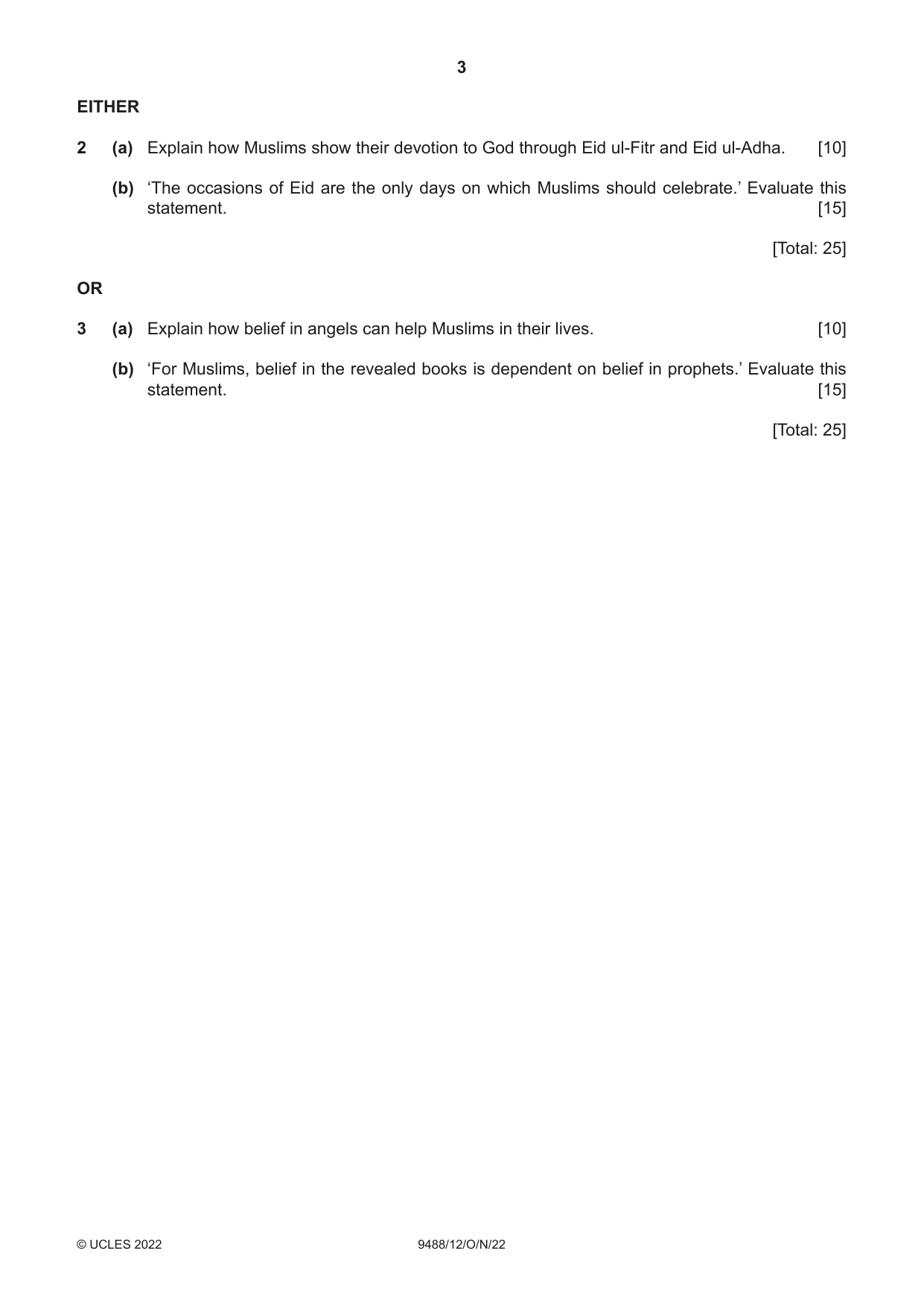
3 9488/12/O/N/22 © UCLES 2022 EITHER 2 (a) Explain how Muslims show their devotion to God through Eid ul-Fitr and Eid ul-Adha. [10] (b) ‘The occasions of Eid are the only days on which Muslims should celebrate.’ Evaluate this statement. [15] [Total: 25] OR 3 (a) Explain how belief in angels can help Muslims in their lives. [10] (b) ‘For Muslims, belief in the revealed books is dependent on belief in prophets.’ Evaluate this statement. [15] [Total: 25]
Question paper, page 4
4 9488/12/O/N/22 © UCLES 2022 Permission to reproduce items where third-party owned material protected by copyright is included has been sought and cleared where possible. Every reasonable effort has been made by the publisher (UCLES) to trace copyright holders, but if any items requiring clearance have unwittingly been included, the publisher will be pleased to make amends at the earliest possible opportunity. To avoid the issue of disclosure of answer-related information to candidates, all copyright acknowledgements are reproduced online in the Cambridge Assessment International Education Copyright Acknowledgements Booklet. This is produced for each series of examinations and is freely available to download at www.cambridgeinternational.org after the live examination series. Cambridge Assessment International Education is part of Cambridge Assessment. Cambridge Assessment is the brand name of the University of Cambridge Local Examinations Syndicate (UCLES), which is a department of the University of Cambridge. BLANK PAGE
Mark scheme, page 1
This document consists of 16 printed pages. © UCLES 2022 [Turn over Cambridge International AS & A Level ISLAMIC STUDIES 9488/12 Paper 1 Islamic Beliefs and Practices October/November 2022 MARK SCHEME Maximum Mark: 50 Published This mark scheme is published as an aid to teachers and candidates, to indicate the requirements of the examination. It shows the basis on which Examiners were instructed to award marks. It does not indicate the details of the discussions that took place at an Examiners’ meeting before marking began, which would have considered the acceptability of alternative answers. Mark schemes should be read in conjunction with the question paper and the Principal Examiner Report for Teachers. Cambridge International will not enter into discussions about these mark schemes. Cambridge International is publishing the mark schemes for the October/November 2022 series for most Cambridge IGCSE™, Cambridge International A and AS Level components and some Cambridge O Level components.
Mark scheme, page 2
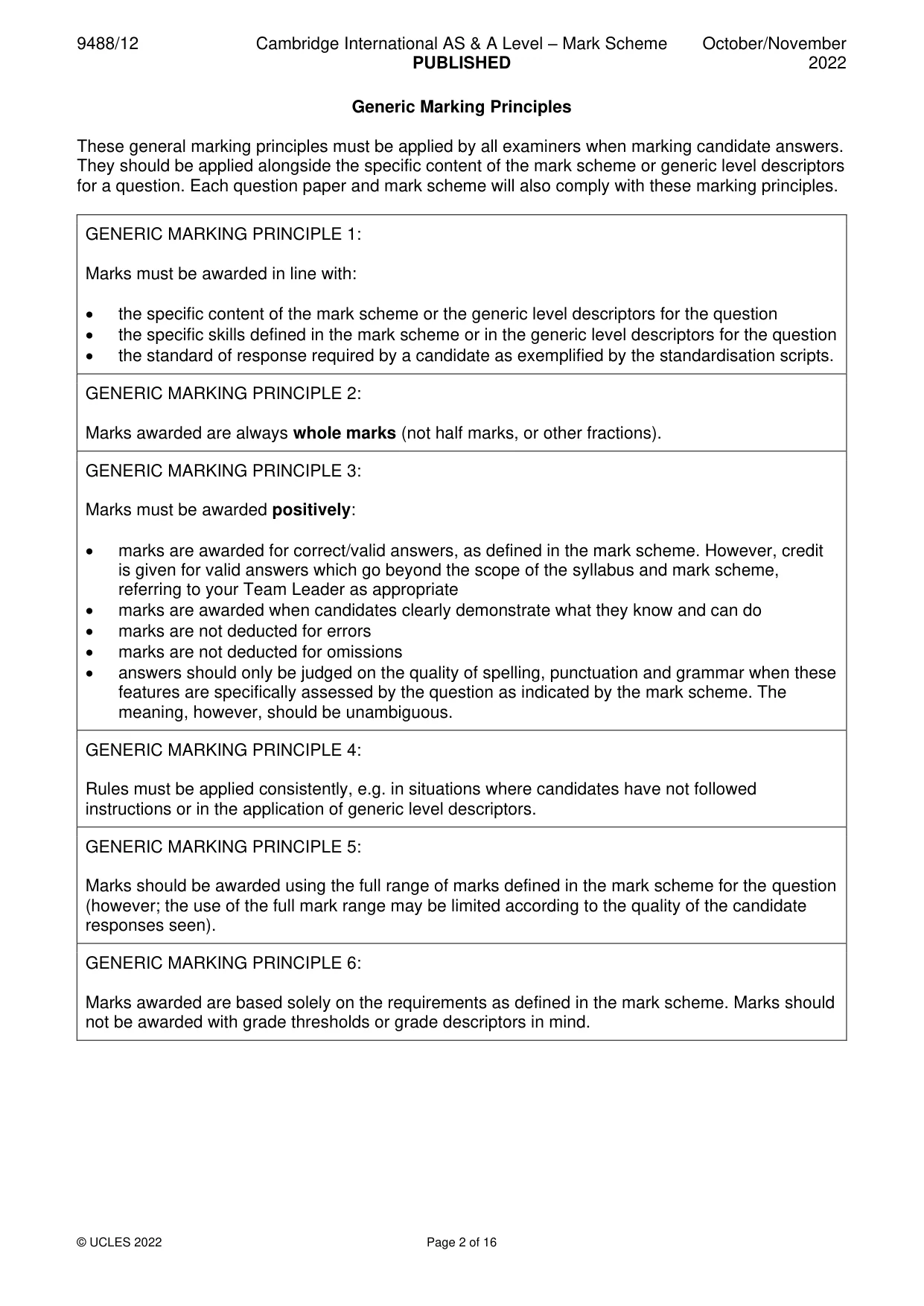
9488/12 Cambridge International AS & A Level – Mark Scheme PUBLISHED October/November 2022 © UCLES 2022 Page 2 of 16 Generic Marking Principles These general marking principles must be applied by all examiners when marking candidate answers. They should be applied alongside the specific content of the mark scheme or generic level descriptors for a question. Each question paper and mark scheme will also comply with these marking principles. GENERIC MARKING PRINCIPLE 1: Marks must be awarded in line with: • the specific content of the mark scheme or the generic level descriptors for the question • the specific skills defined in the mark scheme or in the generic level descriptors for the question • the standard of response required by a candidate as exemplified by the standardisation scripts. GENERIC MARKING PRINCIPLE 2: Marks awarded are always whole marks (not half marks, or other fractions). GENERIC MARKING PRINCIPLE 3: Marks must be awarded positively: • marks are awarded for correct/valid answers, as defined in the mark scheme. However, credit is given for valid answers which go beyond the scope of the syllabus and mark scheme, referring to your Team Leader as appropriate • marks are awarded when candidates clearly demonstrate what they know and can do • marks are not deducted for errors • marks are not deducted for omissions • answers should only be judged on the quality of spelling, punctuation and grammar when these features are specifically assessed by the question as indicated by the mark scheme. The meaning, however, should be unambiguous. GENERIC MARKING PRINCIPLE 4: Rules must be applied consistently, e.g. in situations where candidates have not followed instructions or in the application of generic level descriptors. GENERIC MARKING PRINCIPLE 5: Marks should be awarded using the full range of marks defined in the mark scheme for the question (however; the use of the full mark range may be limited according to the quality of the candidate responses seen). GENERIC MARKING PRINCIPLE 6: Marks awarded are based solely on the requirements as defined in the mark scheme. Marks should not be awarded with grade thresholds or grade descriptors in mind.
Mark scheme, page 3
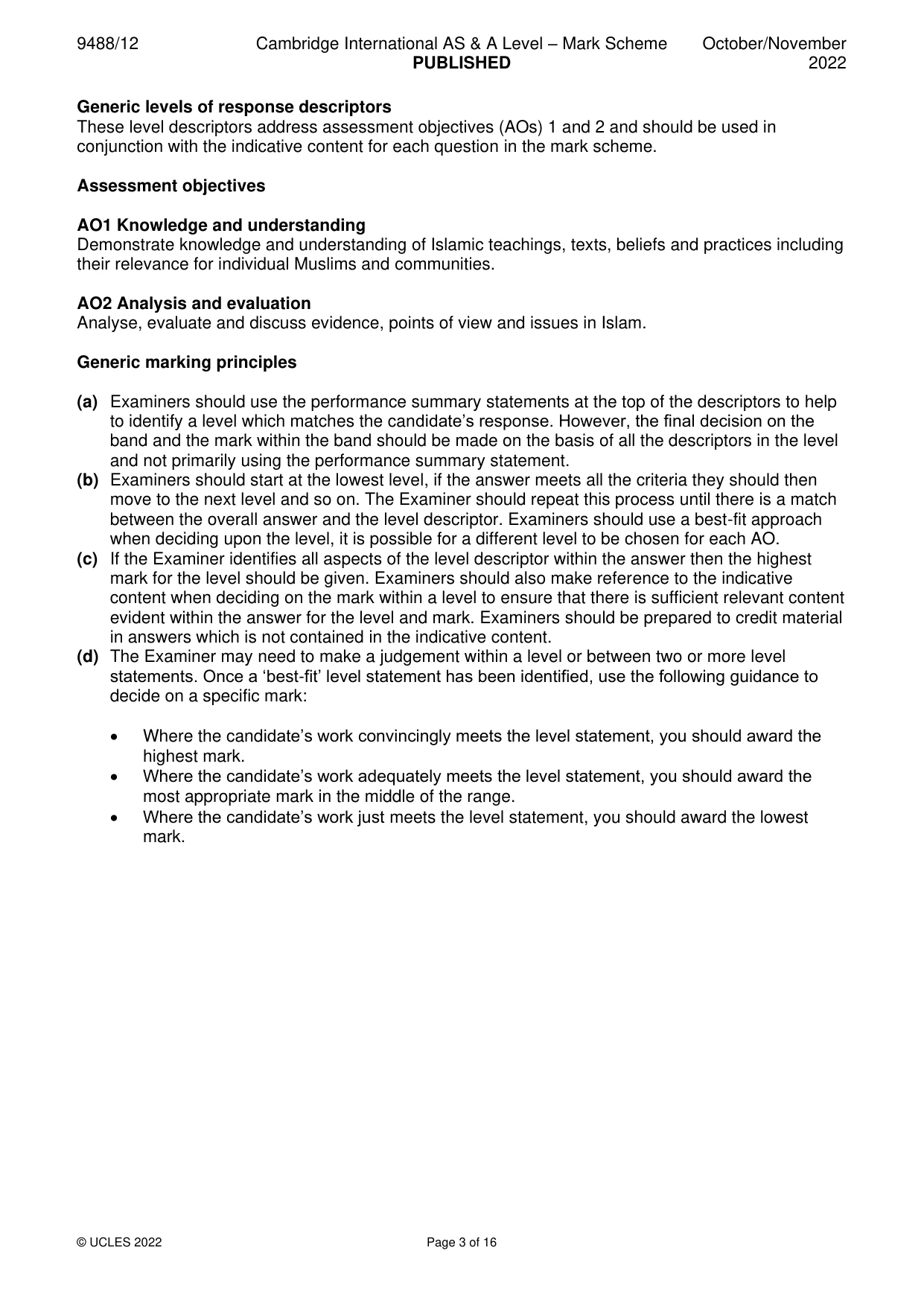
9488/12 Cambridge International AS & A Level – Mark Scheme PUBLISHED October/November 2022 © UCLES 2022 Page 3 of 16 Generic levels of response descriptors These level descriptors address assessment objectives (AOs) 1 and 2 and should be used in conjunction with the indicative content for each question in the mark scheme. Assessment objectives AO1 Knowledge and understanding Demonstrate knowledge and understanding of Islamic teachings, texts, beliefs and practices including their relevance for individual Muslims and communities. AO2 Analysis and evaluation Analyse, evaluate and discuss evidence, points of view and issues in Islam. Generic marking principles (a) Examiners should use the performance summary statements at the top of the descriptors to help to identify a level which matches the candidate’s response. However, the final decision on the band and the mark within the band should be made on the basis of all the descriptors in the level and not primarily using the performance summary statement. (b) Examiners should start at the lowest level, if the answer meets all the criteria they should then move to the next level and so on. The Examiner should repeat this process until there is a match between the overall answer and the level descriptor. Examiners should use a best-fit approach when deciding upon the level, it is possible for a different level to be chosen for each AO. (c) If the Examiner identifies all aspects of the level descriptor within the answer then the highest mark for the level should be given. Examiners should also make reference to the indicative content when deciding on the mark within a level to ensure that there is sufficient relevant content evident within the answer for the level and mark. Examiners should be prepared to credit material in answers which is not contained in the indicative content. (d) The Examiner may need to make a judgement within a level or between two or more level statements. Once a ‘best-fit’ level statement has been identified, use the following guidance to decide on a specific mark: • Where the candidate’s work convincingly meets the level statement, you should award the highest mark. • Where the candidate’s work adequately meets the level statement, you should award the most appropriate mark in the middle of the range. • Where the candidate’s work just meets the level statement, you should award the lowest mark.
Mark scheme, page 4
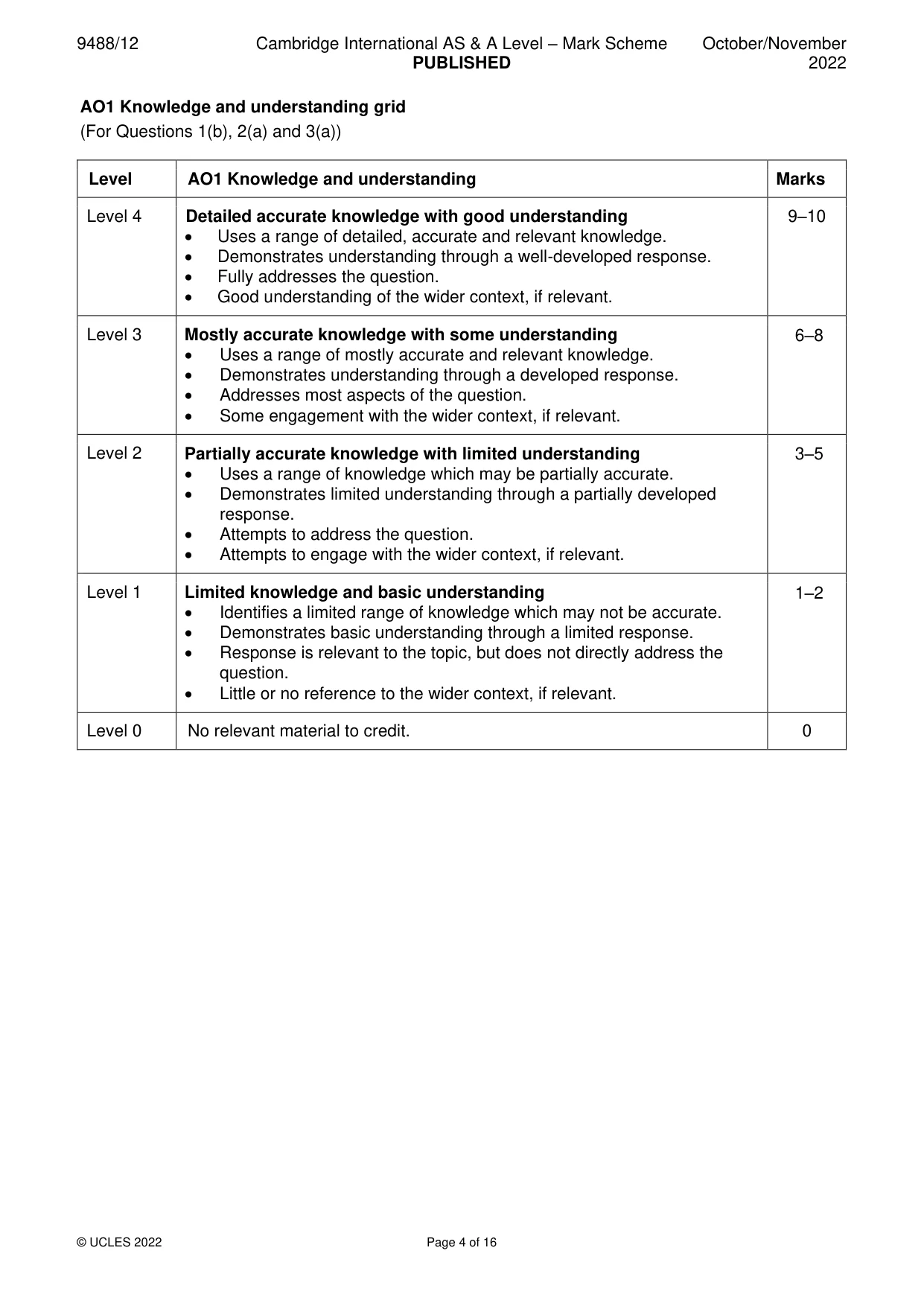
9488/12 Cambridge International AS & A Level – Mark Scheme PUBLISHED October/November 2022 © UCLES 2022 Page 4 of 16 AO1 Knowledge and understanding grid (For Questions 1(b), 2(a) and 3(a)) Level AO1 Knowledge and understanding Marks Level 4 Detailed accurate knowledge with good understanding • Uses a range of detailed, accurate and relevant knowledge. • Demonstrates understanding through a well-developed response. • Fully addresses the question. • Good understanding of the wider context, if relevant. 9–10 Level 3 Mostly accurate knowledge with some understanding • Uses a range of mostly accurate and relevant knowledge. • Demonstrates understanding through a developed response. • Addresses most aspects of the question. • Some engagement with the wider context, if relevant. 6–8 Level 2 Partially accurate knowledge with limited understanding • Uses a range of knowledge which may be partially accurate. • Demonstrates limited understanding through a partially developed response. • Attempts to address the question. • Attempts to engage with the wider context, if relevant. 3–5 Level 1 Limited knowledge and basic understanding • Identifies a limited range of knowledge which may not be accurate. • Demonstrates basic understanding through a limited response. • Response is relevant to the topic, but does not directly address the question. • Little or no reference to the wider context, if relevant. 1–2 Level 0 No relevant material to credit. 0
Mark scheme, page 5
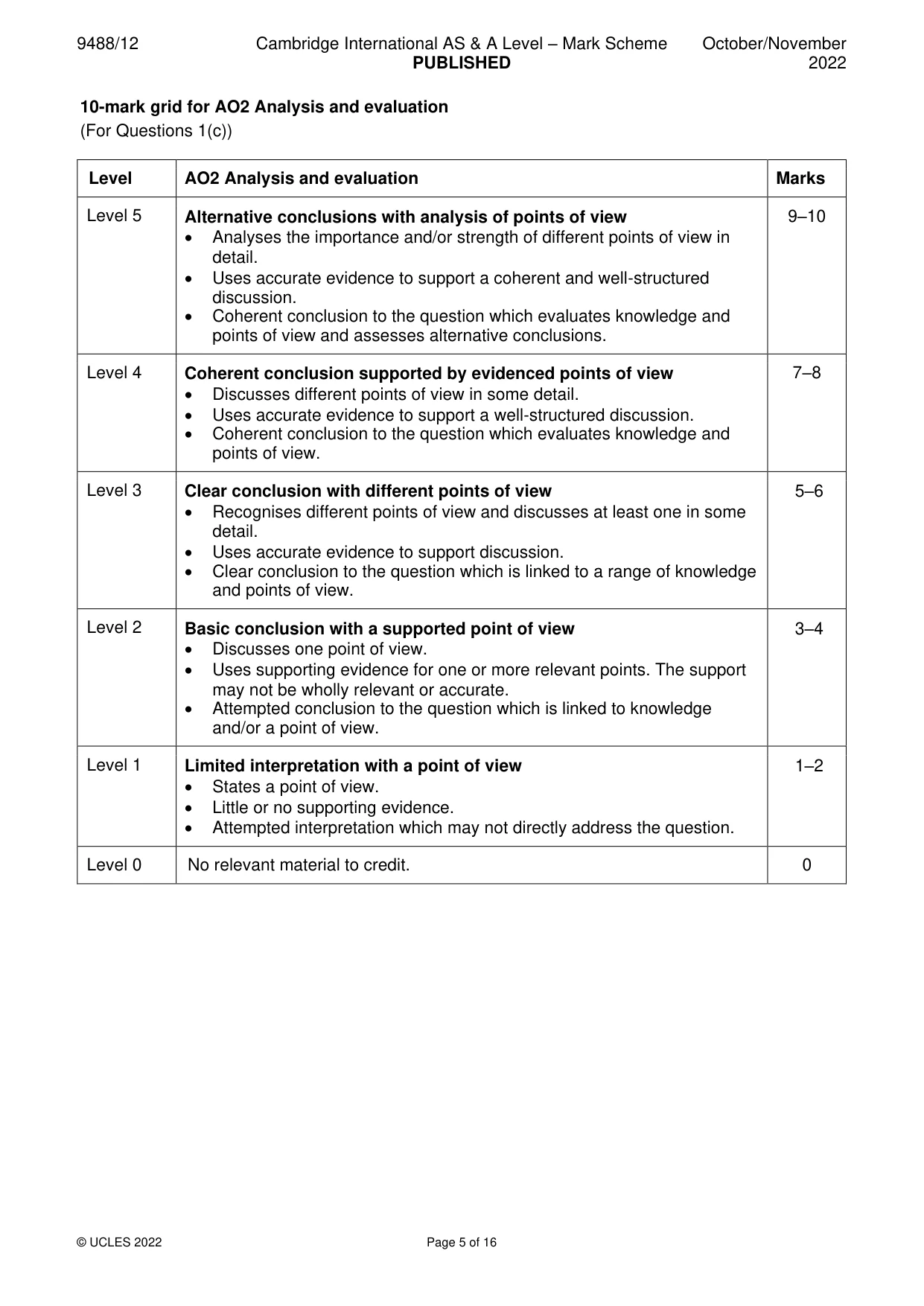
9488/12 Cambridge International AS & A Level – Mark Scheme PUBLISHED October/November 2022 © UCLES 2022 Page 5 of 16 10-mark grid for AO2 Analysis and evaluation (For Questions 1(c)) Level AO2 Analysis and evaluation Marks Level 5 Alternative conclusions with analysis of points of view • Analyses the importance and/or strength of different points of view in detail. • Uses accurate evidence to support a coherent and well-structured discussion. • Coherent conclusion to the question which evaluates knowledge and points of view and assesses alternative conclusions. 9–10 Level 4 Coherent conclusion supported by evidenced points of view • Discusses different points of view in some detail. • Uses accurate evidence to support a well-structured discussion. • Coherent conclusion to the question which evaluates knowledge and points of view. 7–8 Level 3 Clear conclusion with different points of view • Recognises different points of view and discusses at least one in some detail. • Uses accurate evidence to support discussion. • Clear conclusion to the question which is linked to a range of knowledge and points of view. 5–6 Level 2 Basic conclusion with a supported point of view • Discusses one point of view. • Uses supporting evidence for one or more relevant points. The support may not be wholly relevant or accurate. • Attempted conclusion to the question which is linked to knowledge and/or a point of view. 3–4 Level 1 Limited interpretation with a point of view • States a point of view. • Little or no supporting evidence. • Attempted interpretation which may not directly address the question. 1–2 Level 0 No relevant material to credit. 0
Mark scheme, page 6
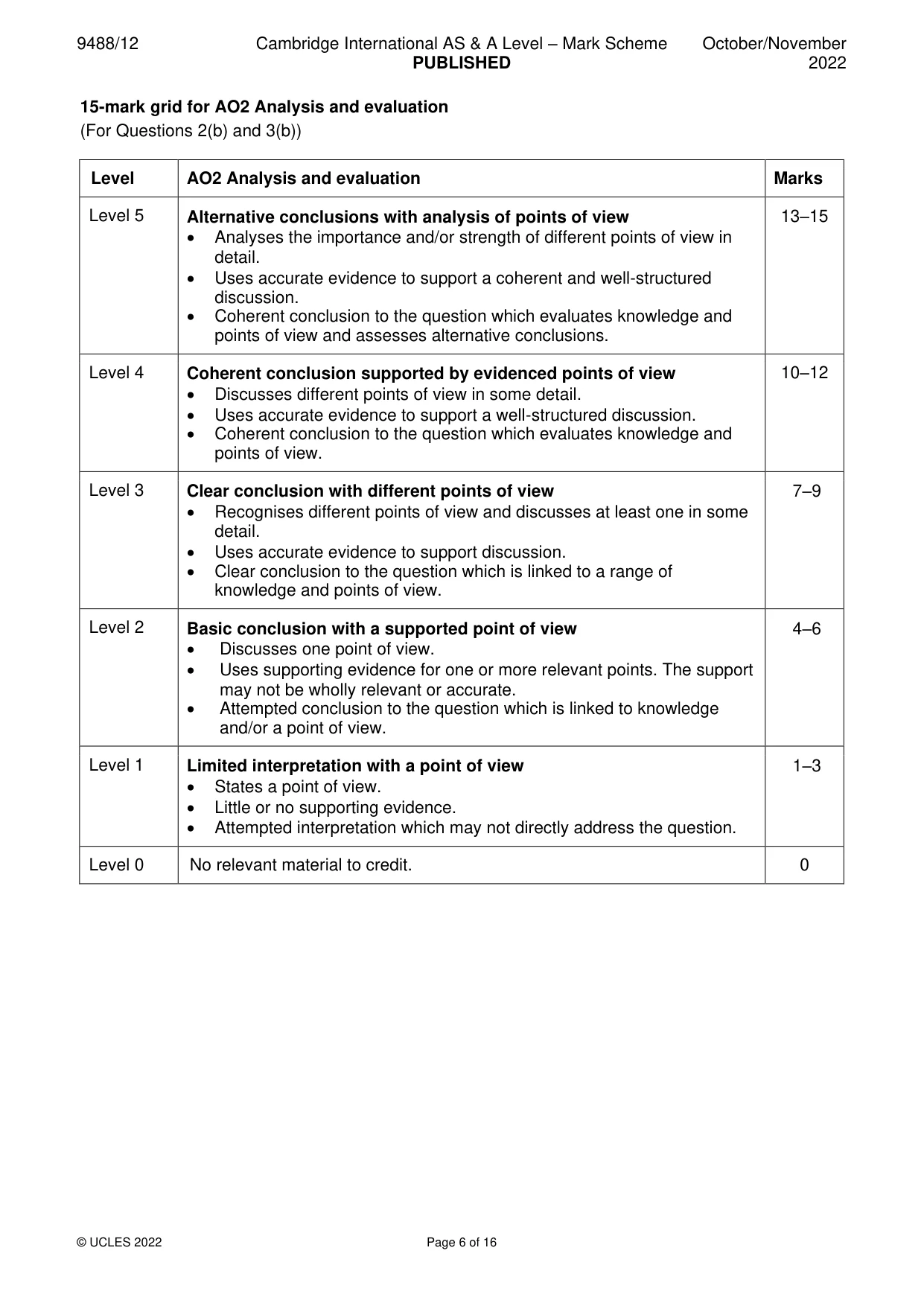
9488/12 Cambridge International AS & A Level – Mark Scheme PUBLISHED October/November 2022 © UCLES 2022 Page 6 of 16 15-mark grid for AO2 Analysis and evaluation (For Questions 2(b) and 3(b)) Level AO2 Analysis and evaluation Marks Level 5 Alternative conclusions with analysis of points of view • Analyses the importance and/or strength of different points of view in detail. • Uses accurate evidence to support a coherent and well-structured discussion. • Coherent conclusion to the question which evaluates knowledge and points of view and assesses alternative conclusions. 13–15 Level 4 Coherent conclusion supported by evidenced points of view • Discusses different points of view in some detail. • Uses accurate evidence to support a well-structured discussion. • Coherent conclusion to the question which evaluates knowledge and points of view. 10–12 Level 3 Clear conclusion with different points of view • Recognises different points of view and discusses at least one in some detail. • Uses accurate evidence to support discussion. • Clear conclusion to the question which is linked to a range of knowledge and points of view. 7–9 Level 2 Basic conclusion with a supported point of view • Discusses one point of view. • Uses supporting evidence for one or more relevant points. The support may not be wholly relevant or accurate. • Attempted conclusion to the question which is linked to knowledge and/or a point of view. 4–6 Level 1 Limited interpretation with a point of view • States a point of view. • Little or no supporting evidence. • Attempted interpretation which may not directly address the question. 1–3 Level 0 No relevant material to credit. 0
Mark scheme, page 7
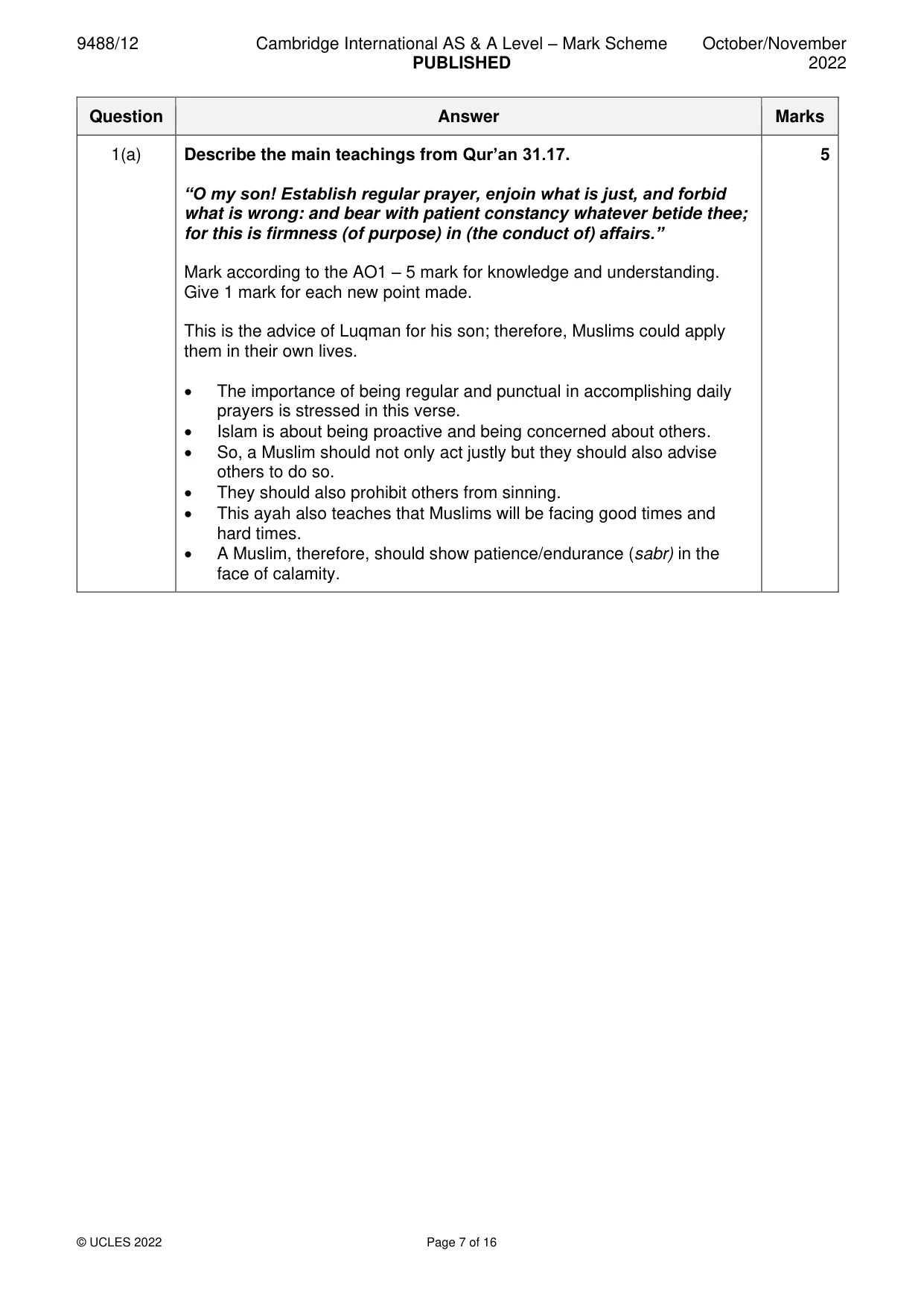
9488/12 Cambridge International AS & A Level – Mark Scheme PUBLISHED October/November 2022 © UCLES 2022 Page 7 of 16 Question Answer Marks 1(a) Describe the main teachings from Qur’an 31.17. “O my son! Establish regular prayer, enjoin what is just, and forbid what is wrong: and bear with patient constancy whatever betide thee; for this is firmness (of purpose) in (the conduct of) affairs.” Mark according to the AO1 – 5 mark for knowledge and understanding. Give 1 mark for each new point made. This is the advice of Luqman for his son; therefore, Muslims could apply them in their own lives. • The importance of being regular and punctual in accomplishing daily prayers is stressed in this verse. • Islam is about being proactive and being concerned about others. • So, a Muslim should not only act justly but they should also advise others to do so. • They should also prohibit others from sinning. • This ayah also teaches that Muslims will be facing good times and hard times. • A Muslim, therefore, should show patience/endurance (sabr) in the face of calamity. 5
Mark scheme, page 8
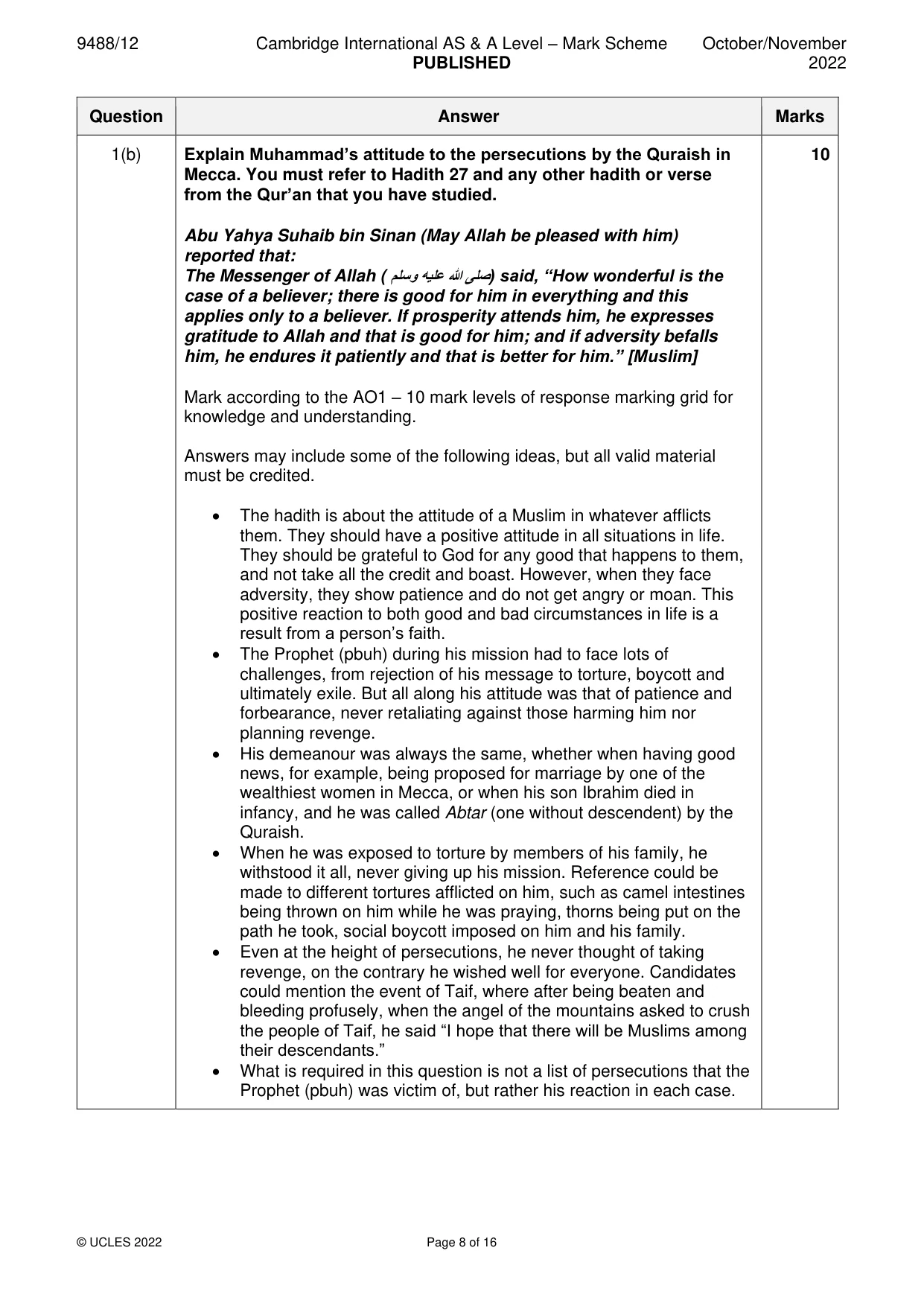
9488/12 Cambridge International AS & A Level – Mark Scheme PUBLISHED October/November 2022 © UCLES 2022 Page 8 of 16 Question Answer Marks 1(b) Explain Muhammad’s attitude to the persecutions by the Quraish in Mecca. You must refer to Hadith 27 and any other hadith or verse from the Qur’an that you have studied. Abu Yahya Suhaib bin Sinan (May Allah be pleased with him) reported that: The Messenger of Allah ( صلى هللا عليه وسلم) said, “How wonderful is the case of a believer; there is good for him in everything and this applies only to a believer. If prosperity attends him, he expresses gratitude to Allah and that is good for him; and if adversity befalls him, he endures it patiently and that is better for him.” [Muslim] Mark according to the AO1 – 10 mark levels of response marking grid for knowledge and understanding. Answers may include some of the following ideas, but all valid material must be credited. • The hadith is about the attitude of a Muslim in whatever afflicts them. They should have a positive attitude in all situations in life. They should be grateful to God for any good that happens to them, and not take all the credit and boast. However, when they face adversity, they show patience and do not get angry or moan. This positive reaction to both good and bad circumstances in life is a result from a person’s faith. • The Prophet (pbuh) during his mission had to face lots of challenges, from rejection of his message to torture, boycott and ultimately exile. But all along his attitude was that of patience and forbearance, never retaliating against those harming him nor planning revenge. • His demeanour was always the same, whether when having good news, for example, being proposed for marriage by one of the wealthiest women in Mecca, or when his son Ibrahim died in infancy, and he was called Abtar (one without descendent) by the Quraish. • When he was exposed to torture by members of his family, he withstood it all, never giving up his mission. Reference could be made to different tortures afflicted on him, such as camel intestines being thrown on him while he was praying, thorns being put on the path he took, social boycott imposed on him and his family. • Even at the height of persecutions, he never thought of taking revenge, on the contrary he wished well for everyone. Candidates could mention the event of Taif, where after being beaten and bleeding profusely, when the angel of the mountains asked to crush the people of Taif, he said “I hope that there will be Muslims among their descendants.” • What is required in this question is not a list of persecutions that the Prophet (pbuh) was victim of, but rather his reaction in each case. 10
Mark scheme, page 9
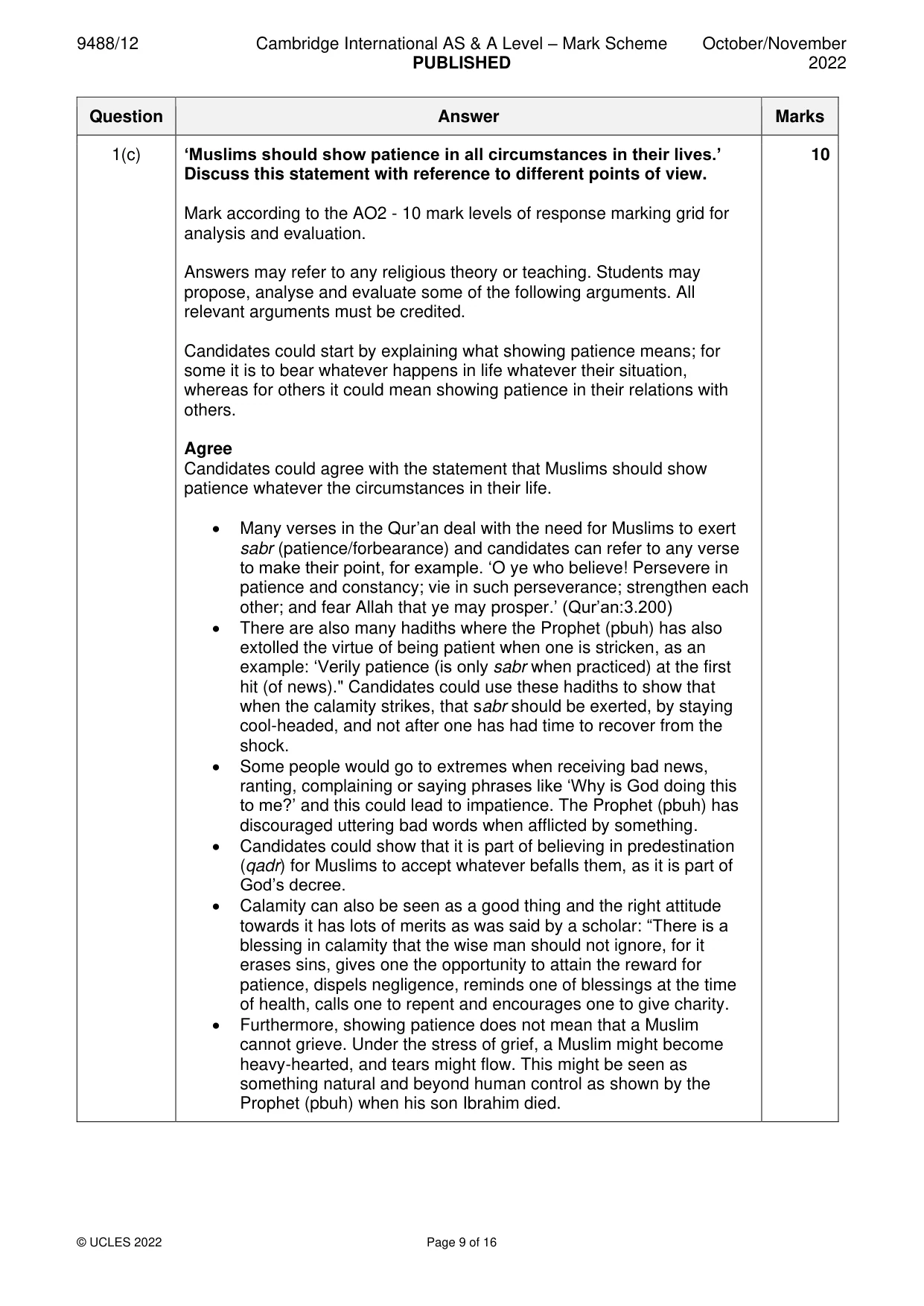
9488/12 Cambridge International AS & A Level – Mark Scheme PUBLISHED October/November 2022 © UCLES 2022 Page 9 of 16 Question Answer Marks 1(c) ‘Muslims should show patience in all circumstances in their lives.’ Discuss this statement with reference to different points of view. Mark according to the AO2 - 10 mark levels of response marking grid for analysis and evaluation. Answers may refer to any religious theory or teaching. Students may propose, analyse and evaluate some of the following arguments. All relevant arguments must be credited. Candidates could start by explaining what showing patience means; for some it is to bear whatever happens in life whatever their situation, whereas for others it could mean showing patience in their relations with others. Agree Candidates could agree with the statement that Muslims should show patience whatever the circumstances in their life. • Many verses in the Qur’an deal with the need for Muslims to exert sabr (patience/forbearance) and candidates can refer to any verse to make their point, for example. ‘O ye who believe! Persevere in patience and constancy; vie in such perseverance; strengthen each other; and fear Allah that ye may prosper.’ (Qur’an:3.200) • There are also many hadiths where the Prophet (pbuh) has also extolled the virtue of being patient when one is stricken, as an example: ‘Verily patience (is only sabr when practiced) at the first hit (of news)." Candidates could use these hadiths to show that when the calamity strikes, that sabr should be exerted, by staying cool-headed, and not after one has had time to recover from the shock. • Some people would go to extremes when receiving bad news, ranting, complaining or saying phrases like ‘Why is God doing this to me?’ and this could lead to impatience. The Prophet (pbuh) has discouraged uttering bad words when afflicted by something. • Candidates could show that it is part of believing in predestination (qadr) for Muslims to accept whatever befalls them, as it is part of God’s decree. • Calamity can also be seen as a good thing and the right attitude towards it has lots of merits as was said by a scholar: “There is a blessing in calamity that the wise man should not ignore, for it erases sins, gives one the opportunity to attain the reward for patience, dispels negligence, reminds one of blessings at the time of health, calls one to repent and encourages one to give charity. • Furthermore, showing patience does not mean that a Muslim cannot grieve. Under the stress of grief, a Muslim might become heavy-hearted, and tears might flow. This might be seen as something natural and beyond human control as shown by the Prophet (pbuh) when his son Ibrahim died. 10
Mark scheme, page 10
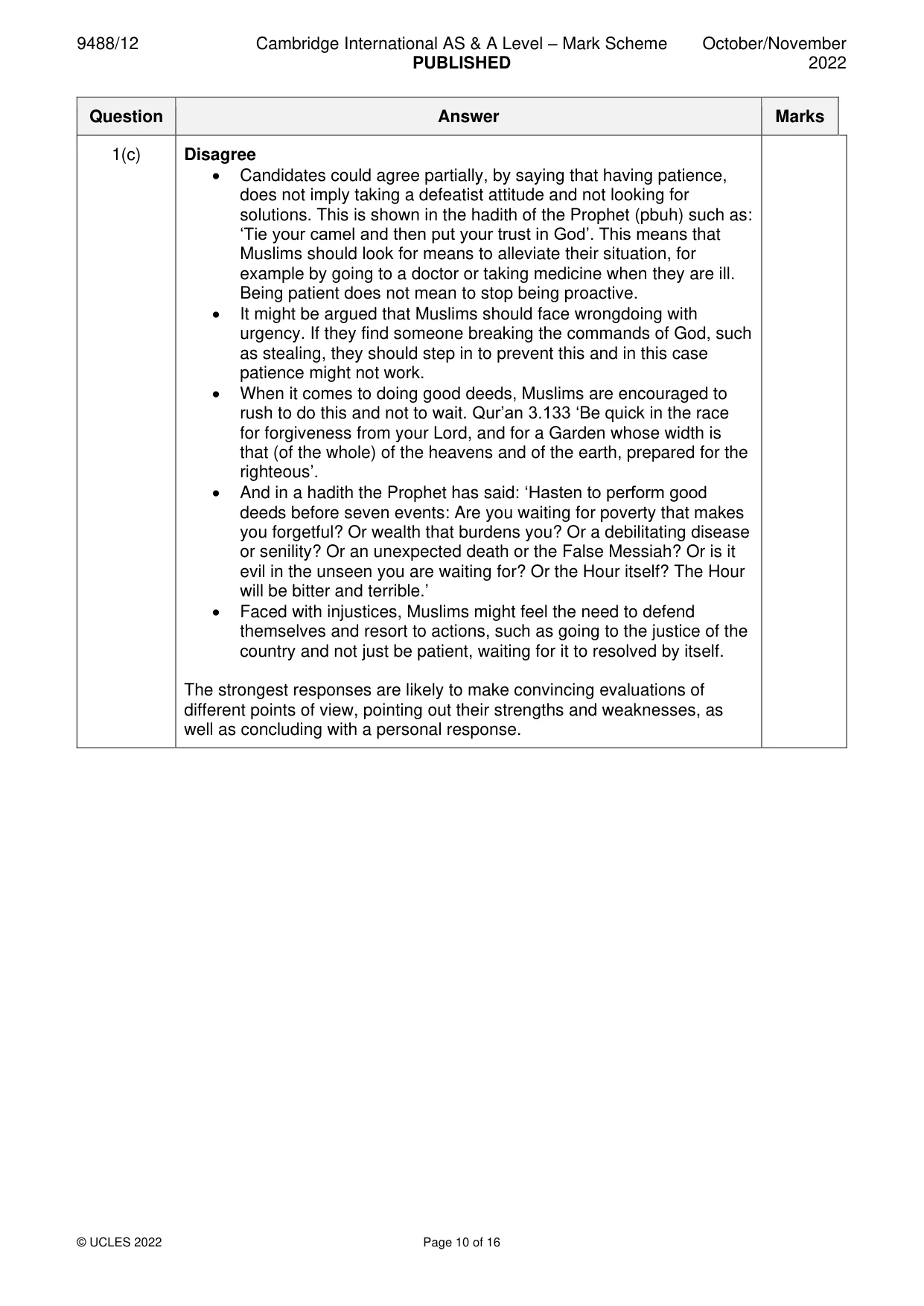
9488/12 Cambridge International AS & A Level – Mark Scheme PUBLISHED October/November 2022 © UCLES 2022 Page 10 of 16 Question Answer Marks 1(c) Disagree • Candidates could agree partially, by saying that having patience, does not imply taking a defeatist attitude and not looking for solutions. This is shown in the hadith of the Prophet (pbuh) such as: ‘Tie your camel and then put your trust in God’. This means that Muslims should look for means to alleviate their situation, for example by going to a doctor or taking medicine when they are ill. Being patient does not mean to stop being proactive. • It might be argued that Muslims should face wrongdoing with urgency. If they find someone breaking the commands of God, such as stealing, they should step in to prevent this and in this case patience might not work. • When it comes to doing good deeds, Muslims are encouraged to rush to do this and not to wait. Qur’an 3.133 ‘Be quick in the race for forgiveness from your Lord, and for a Garden whose width is that (of the whole) of the heavens and of the earth, prepared for the righteous’. • And in a hadith the Prophet has said: ‘Hasten to perform good deeds before seven events: Are you waiting for poverty that makes you forgetful? Or wealth that burdens you? Or a debilitating disease or senility? Or an unexpected death or the False Messiah? Or is it evil in the unseen you are waiting for? Or the Hour itself? The Hour will be bitter and terrible.’ • Faced with injustices, Muslims might feel the need to defend themselves and resort to actions, such as going to the justice of the country and not just be patient, waiting for it to resolved by itself. The strongest responses are likely to make convincing evaluations of different points of view, pointing out their strengths and weaknesses, as well as concluding with a personal response.
Mark scheme, page 11
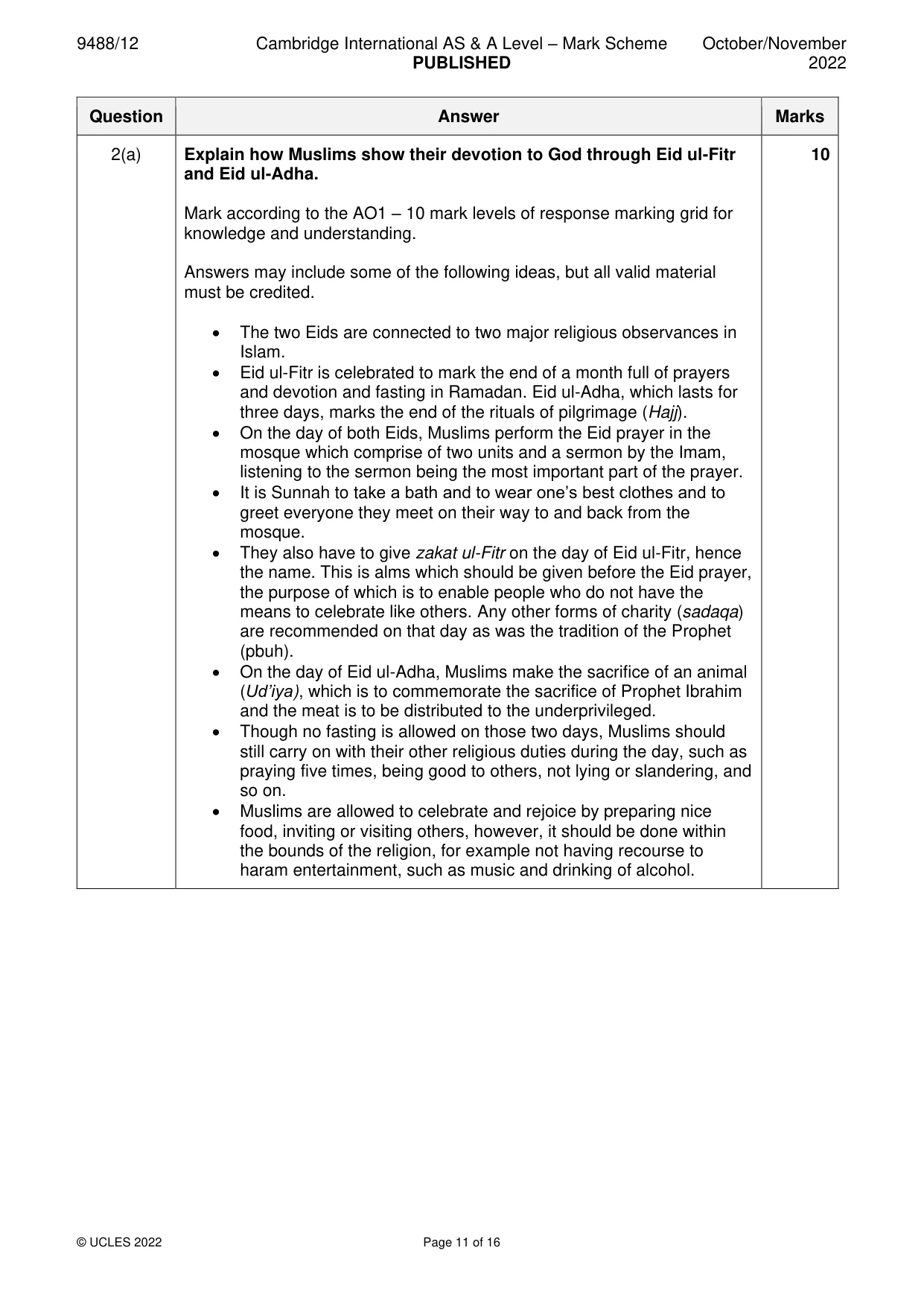
9488/12 Cambridge International AS & A Level – Mark Scheme PUBLISHED October/November 2022 © UCLES 2022 Page 11 of 16 Question Answer Marks 2(a) Explain how Muslims show their devotion to God through Eid ul-Fitr and Eid ul-Adha. Mark according to the AO1 – 10 mark levels of response marking grid for knowledge and understanding. Answers may include some of the following ideas, but all valid material must be credited. • The two Eids are connected to two major religious observances in Islam. • Eid ul-Fitr is celebrated to mark the end of a month full of prayers and devotion and fasting in Ramadan. Eid ul-Adha, which lasts for three days, marks the end of the rituals of pilgrimage (Hajj). • On the day of both Eids, Muslims perform the Eid prayer in the mosque which comprise of two units and a sermon by the Imam, listening to the sermon being the most important part of the prayer. • It is Sunnah to take a bath and to wear one’s best clothes and to greet everyone they meet on their way to and back from the mosque. • They also have to give zakat ul-Fitr on the day of Eid ul-Fitr, hence the name. This is alms which should be given before the Eid prayer, the purpose of which is to enable people who do not have the means to celebrate like others. Any other forms of charity (sadaqa) are recommended on that day as was the tradition of the Prophet (pbuh). • On the day of Eid ul-Adha, Muslims make the sacrifice of an animal (Ud’iya), which is to commemorate the sacrifice of Prophet Ibrahim and the meat is to be distributed to the underprivileged. • Though no fasting is allowed on those two days, Muslims should still carry on with their other religious duties during the day, such as praying five times, being good to others, not lying or slandering, and so on. • Muslims are allowed to celebrate and rejoice by preparing nice food, inviting or visiting others, however, it should be done within the bounds of the religion, for example not having recourse to haram entertainment, such as music and drinking of alcohol. 10
Mark scheme, page 12
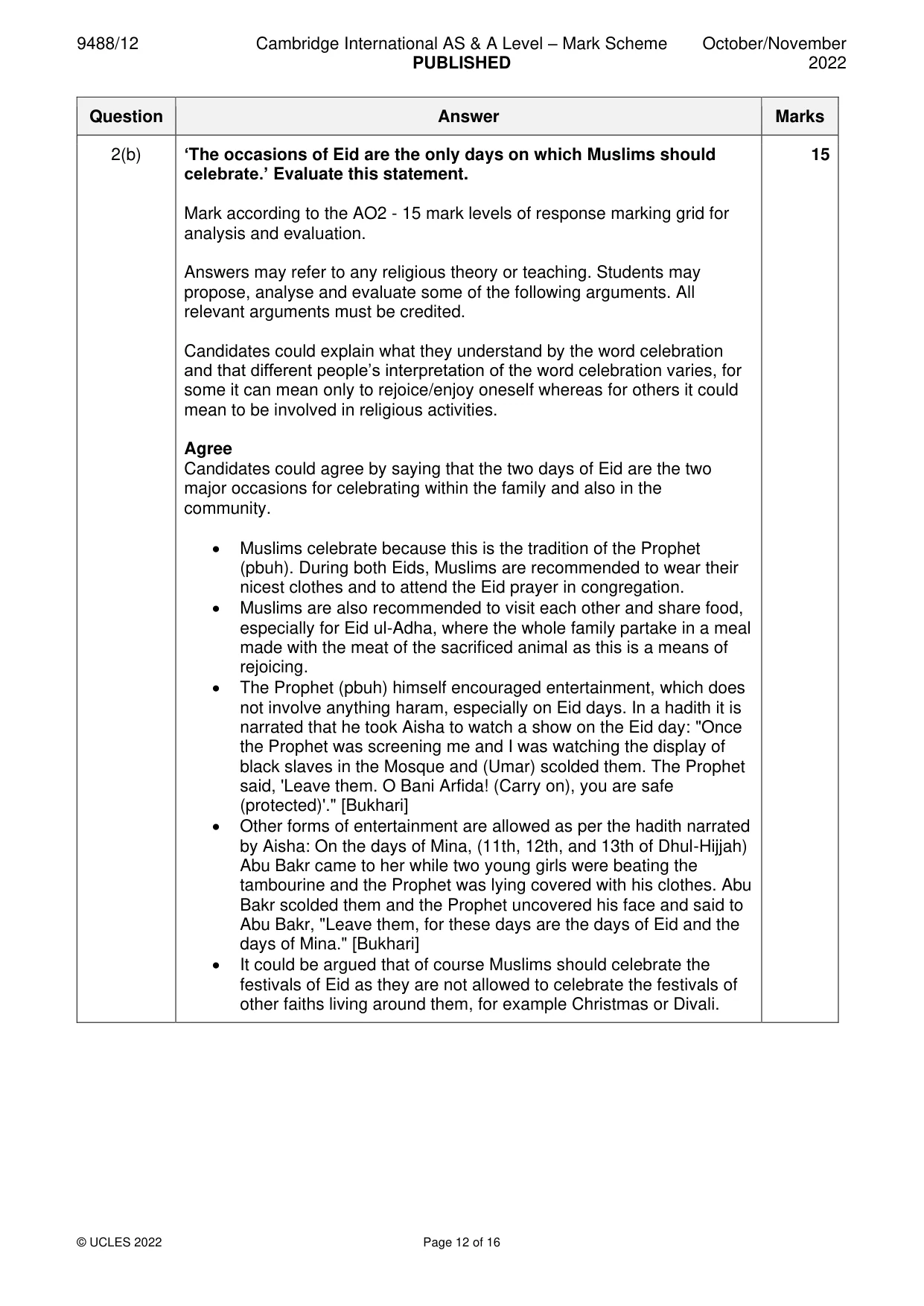
9488/12 Cambridge International AS & A Level – Mark Scheme PUBLISHED October/November 2022 © UCLES 2022 Page 12 of 16 Question Answer Marks 2(b) ‘The occasions of Eid are the only days on which Muslims should celebrate.’ Evaluate this statement. Mark according to the AO2 - 15 mark levels of response marking grid for analysis and evaluation. Answers may refer to any religious theory or teaching. Students may propose, analyse and evaluate some of the following arguments. All relevant arguments must be credited. Candidates could explain what they understand by the word celebration and that different people’s interpretation of the word celebration varies, for some it can mean only to rejoice/enjoy oneself whereas for others it could mean to be involved in religious activities. Agree Candidates could agree by saying that the two days of Eid are the two major occasions for celebrating within the family and also in the community. • Muslims celebrate because this is the tradition of the Prophet (pbuh). During both Eids, Muslims are recommended to wear their nicest clothes and to attend the Eid prayer in congregation. • Muslims are also recommended to visit each other and share food, especially for Eid ul-Adha, where the whole family partake in a meal made with the meat of the sacrificed animal as this is a means of rejoicing. • The Prophet (pbuh) himself encouraged entertainment, which does not involve anything haram, especially on Eid days. In a hadith it is narrated that he took Aisha to watch a show on the Eid day: "Once the Prophet was screening me and I was watching the display of black slaves in the Mosque and (Umar) scolded them. The Prophet said, 'Leave them. O Bani Arfida! (Carry on), you are safe (protected)'." [Bukhari] • Other forms of entertainment are allowed as per the hadith narrated by Aisha: On the days of Mina, (11th, 12th, and 13th of Dhul-Hijjah) Abu Bakr came to her while two young girls were beating the tambourine and the Prophet was lying covered with his clothes. Abu Bakr scolded them and the Prophet uncovered his face and said to Abu Bakr, "Leave them, for these days are the days of Eid and the days of Mina." [Bukhari] • It could be argued that of course Muslims should celebrate the festivals of Eid as they are not allowed to celebrate the festivals of other faiths living around them, for example Christmas or Divali. 15
Mark scheme, page 13
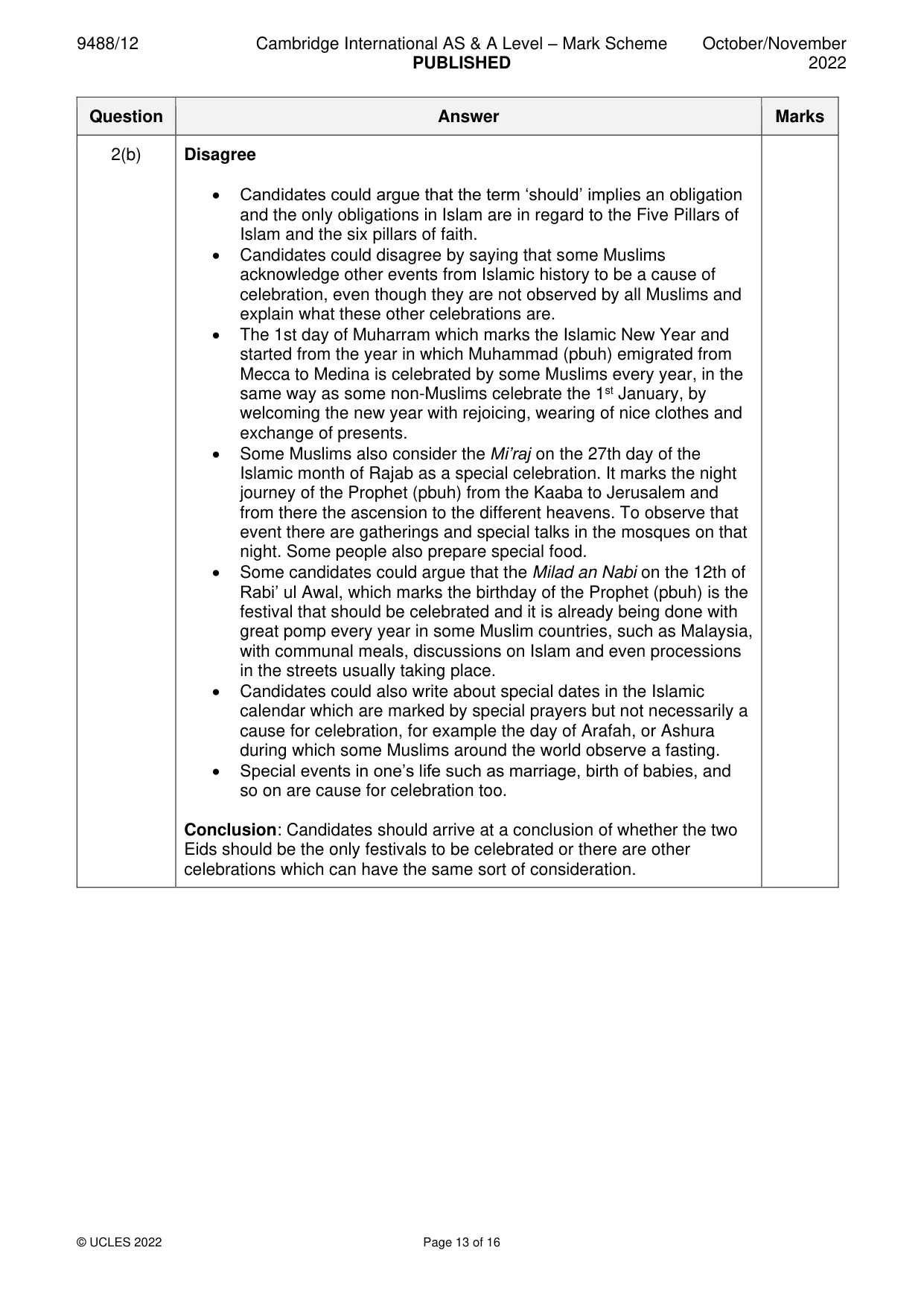
9488/12 Cambridge International AS & A Level – Mark Scheme PUBLISHED October/November 2022 © UCLES 2022 Page 13 of 16 Question Answer Marks 2(b) Disagree • Candidates could argue that the term ‘should’ implies an obligation and the only obligations in Islam are in regard to the Five Pillars of Islam and the six pillars of faith. • Candidates could disagree by saying that some Muslims acknowledge other events from Islamic history to be a cause of celebration, even though they are not observed by all Muslims and explain what these other celebrations are. • The 1st day of Muharram which marks the Islamic New Year and started from the year in which Muhammad (pbuh) emigrated from Mecca to Medina is celebrated by some Muslims every year, in the same way as some non-Muslims celebrate the 1st January, by welcoming the new year with rejoicing, wearing of nice clothes and exchange of presents. • Some Muslims also consider the Mi’raj on the 27th day of the Islamic month of Rajab as a special celebration. It marks the night journey of the Prophet (pbuh) from the Kaaba to Jerusalem and from there the ascension to the different heavens. To observe that event there are gatherings and special talks in the mosques on that night. Some people also prepare special food. • Some candidates could argue that the Milad an Nabi on the 12th of Rabi’ ul Awal, which marks the birthday of the Prophet (pbuh) is the festival that should be celebrated and it is already being done with great pomp every year in some Muslim countries, such as Malaysia, with communal meals, discussions on Islam and even processions in the streets usually taking place. • Candidates could also write about special dates in the Islamic calendar which are marked by special prayers but not necessarily a cause for celebration, for example the day of Arafah, or Ashura during which some Muslims around the world observe a fasting. • Special events in one’s life such as marriage, birth of babies, and so on are cause for celebration too. Conclusion: Candidates should arrive at a conclusion of whether the two Eids should be the only festivals to be celebrated or there are other celebrations which can have the same sort of consideration.
Mark scheme, page 14
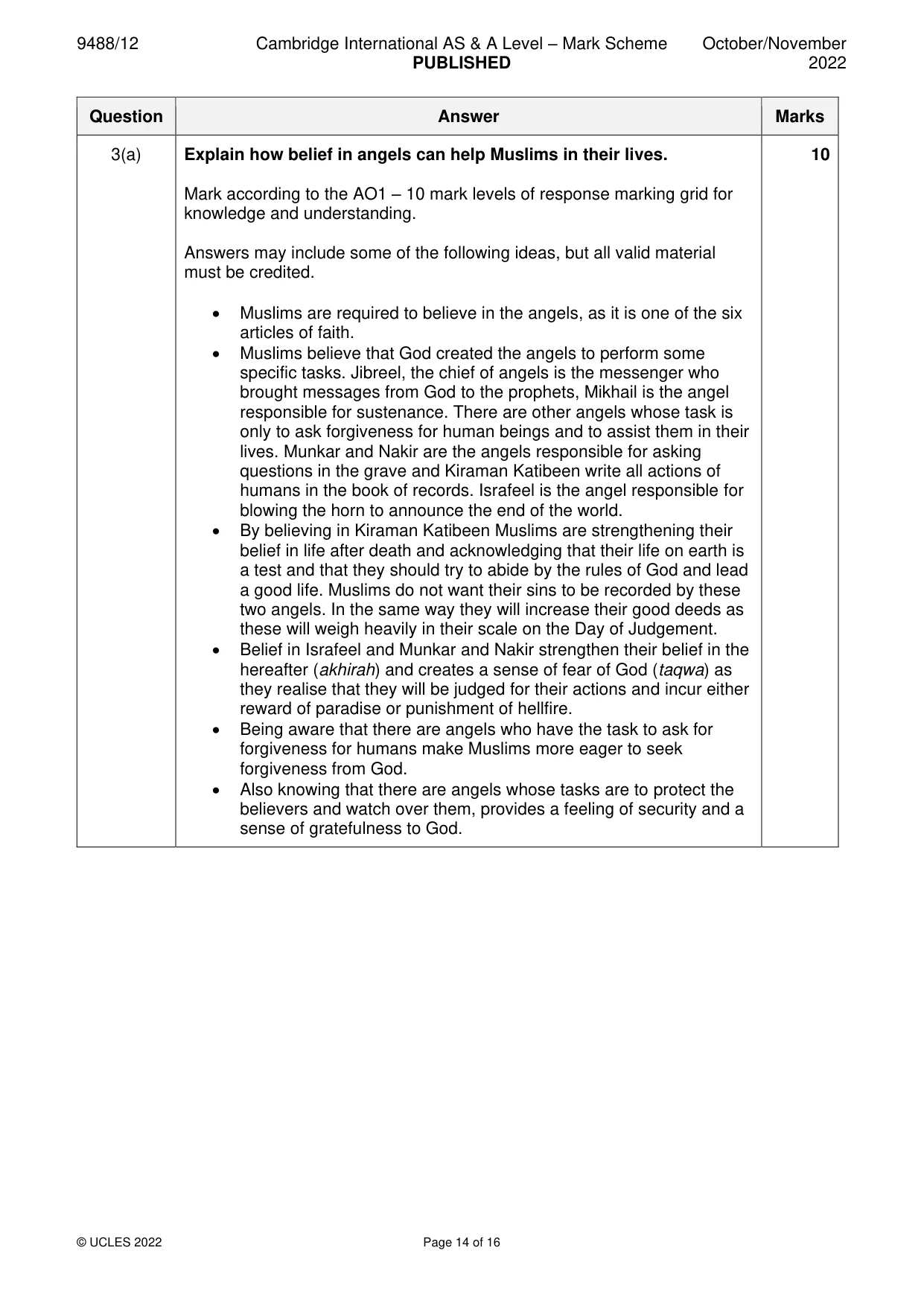
9488/12 Cambridge International AS & A Level – Mark Scheme PUBLISHED October/November 2022 © UCLES 2022 Page 14 of 16 Question Answer Marks 3(a) Explain how belief in angels can help Muslims in their lives. Mark according to the AO1 – 10 mark levels of response marking grid for knowledge and understanding. Answers may include some of the following ideas, but all valid material must be credited. • Muslims are required to believe in the angels, as it is one of the six articles of faith. • Muslims believe that God created the angels to perform some specific tasks. Jibreel, the chief of angels is the messenger who brought messages from God to the prophets, Mikhail is the angel responsible for sustenance. There are other angels whose task is only to ask forgiveness for human beings and to assist them in their lives. Munkar and Nakir are the angels responsible for asking questions in the grave and Kiraman Katibeen write all actions of humans in the book of records. Israfeel is the angel responsible for blowing the horn to announce the end of the world. • By believing in Kiraman Katibeen Muslims are strengthening their belief in life after death and acknowledging that their life on earth is a test and that they should try to abide by the rules of God and lead a good life. Muslims do not want their sins to be recorded by these two angels. In the same way they will increase their good deeds as these will weigh heavily in their scale on the Day of Judgement. • Belief in Israfeel and Munkar and Nakir strengthen their belief in the hereafter (akhirah) and creates a sense of fear of God (taqwa) as they realise that they will be judged for their actions and incur either reward of paradise or punishment of hellfire. • Being aware that there are angels who have the task to ask for forgiveness for humans make Muslims more eager to seek forgiveness from God. • Also knowing that there are angels whose tasks are to protect the believers and watch over them, provides a feeling of security and a sense of gratefulness to God. 10
Mark scheme, page 15
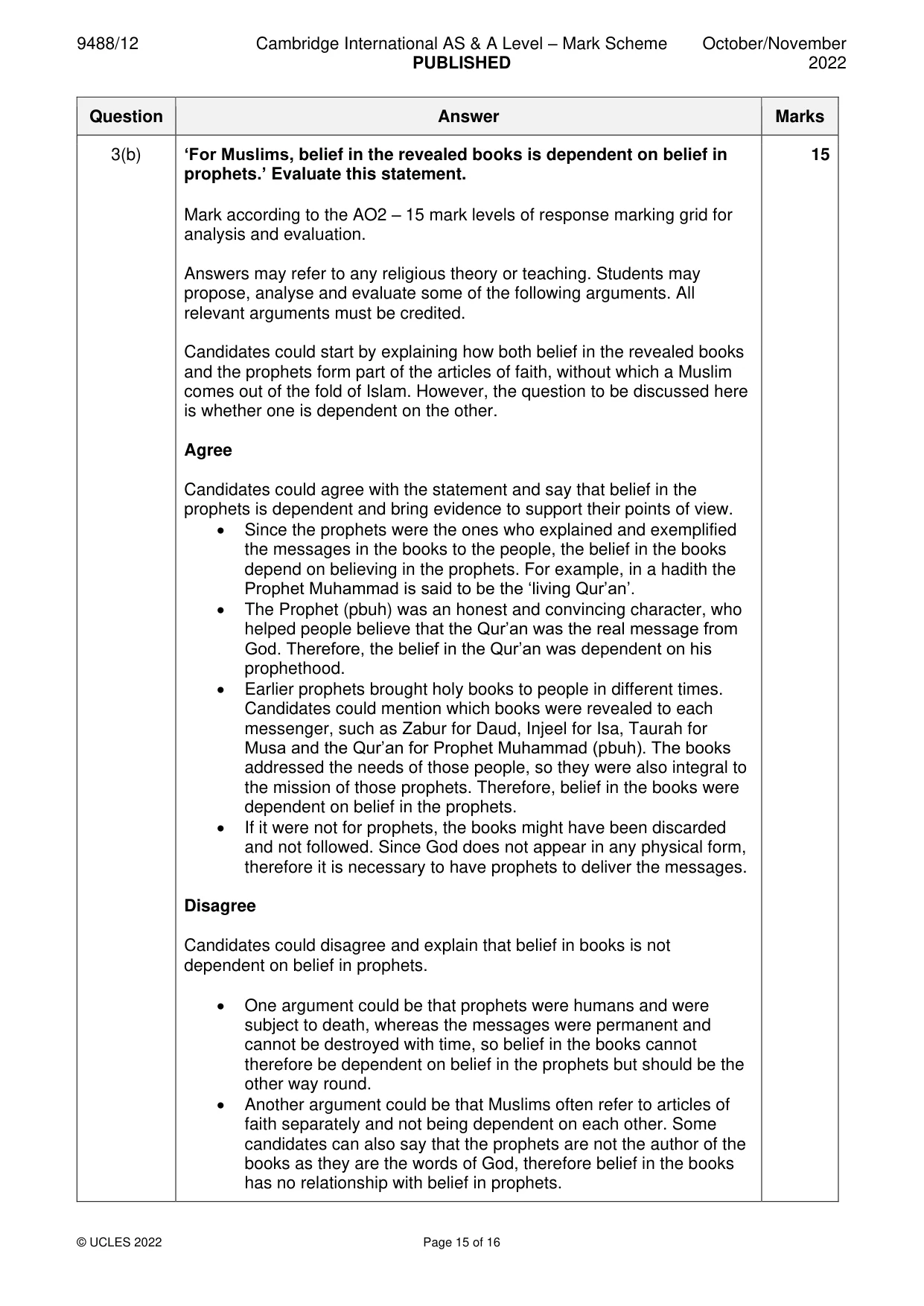
9488/12 Cambridge International AS & A Level – Mark Scheme PUBLISHED October/November 2022 © UCLES 2022 Page 15 of 16 Question Answer Marks 3(b) ‘For Muslims, belief in the revealed books is dependent on belief in prophets.’ Evaluate this statement. Mark according to the AO2 – 15 mark levels of response marking grid for analysis and evaluation. Answers may refer to any religious theory or teaching. Students may propose, analyse and evaluate some of the following arguments. All relevant arguments must be credited. Candidates could start by explaining how both belief in the revealed books and the prophets form part of the articles of faith, without which a Muslim comes out of the fold of Islam. However, the question to be discussed here is whether one is dependent on the other. Agree Candidates could agree with the statement and say that belief in the prophets is dependent and bring evidence to support their points of view. • Since the prophets were the ones who explained and exemplified the messages in the books to the people, the belief in the books depend on believing in the prophets. For example, in a hadith the Prophet Muhammad is said to be the ‘living Qur’an’. • The Prophet (pbuh) was an honest and convincing character, who helped people believe that the Qur’an was the real message from God. Therefore, the belief in the Qur’an was dependent on his prophethood. • Earlier prophets brought holy books to people in different times. Candidates could mention which books were revealed to each messenger, such as Zabur for Daud, Injeel for Isa, Taurah for Musa and the Qur’an for Prophet Muhammad (pbuh). The books addressed the needs of those people, so they were also integral to the mission of those prophets. Therefore, belief in the books were dependent on belief in the prophets. • If it were not for prophets, the books might have been discarded and not followed. Since God does not appear in any physical form, therefore it is necessary to have prophets to deliver the messages. Disagree Candidates could disagree and explain that belief in books is not dependent on belief in prophets. • One argument could be that prophets were humans and were subject to death, whereas the messages were permanent and cannot be destroyed with time, so belief in the books cannot therefore be dependent on belief in the prophets but should be the other way round. • Another argument could be that Muslims often refer to articles of faith separately and not being dependent on each other. Some candidates can also say that the prophets are not the author of the books as they are the words of God, therefore belief in the books has no relationship with belief in prophets. 15
Mark scheme, page 16
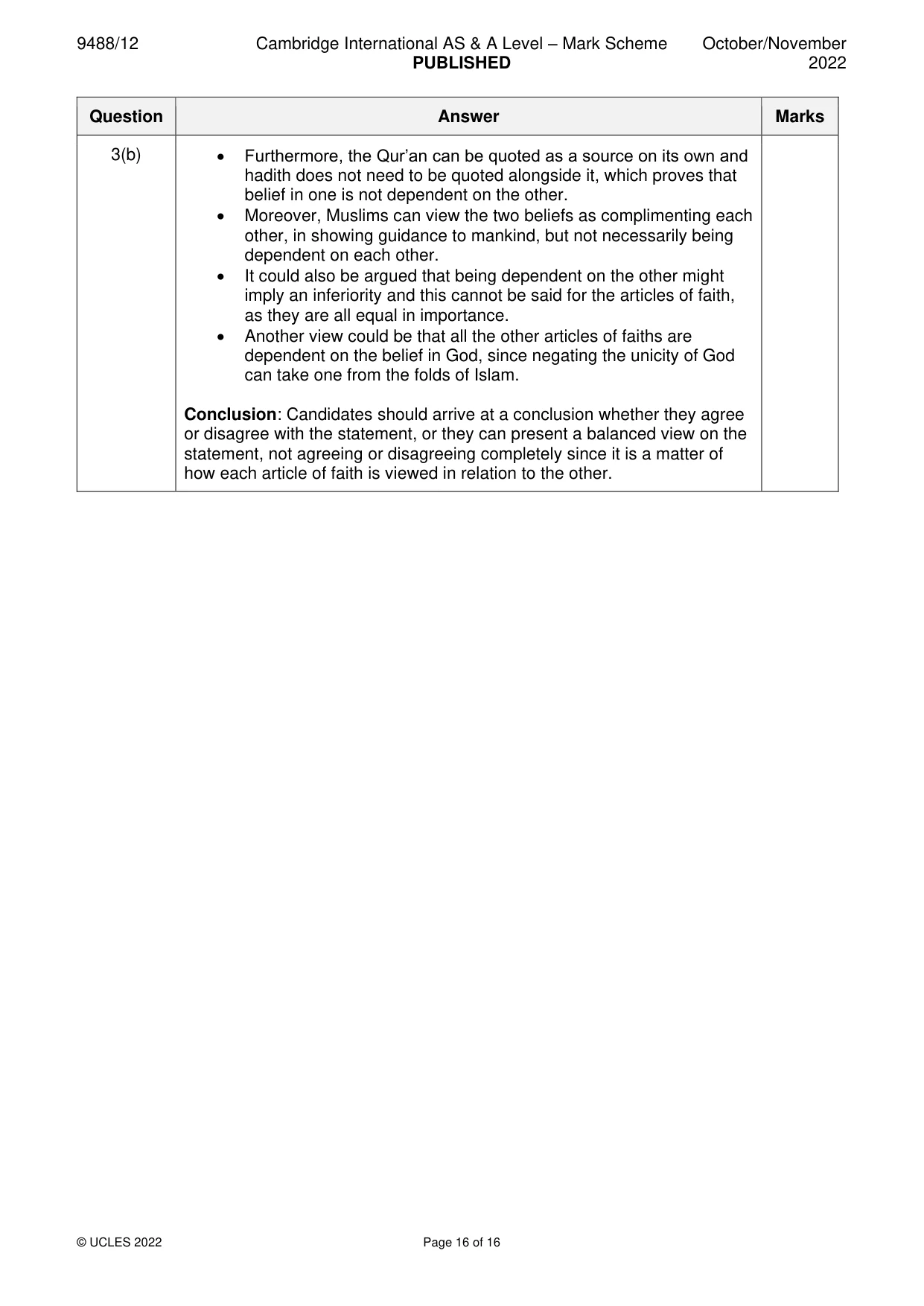
9488/12 Cambridge International AS & A Level – Mark Scheme PUBLISHED October/November 2022 © UCLES 2022 Page 16 of 16 Question Answer Marks 3(b) • Furthermore, the Qur’an can be quoted as a source on its own and hadith does not need to be quoted alongside it, which proves that belief in one is not dependent on the other. • Moreover, Muslims can view the two beliefs as complimenting each other, in showing guidance to mankind, but not necessarily being dependent on each other. • It could also be argued that being dependent on the other might imply an inferiority and this cannot be said for the articles of faith, as they are all equal in importance. • Another view could be that all the other articles of faiths are dependent on the belief in God, since negating the unicity of God can take one from the folds of Islam. Conclusion: Candidates should arrive at a conclusion whether they agree or disagree with the statement, or they can present a balanced view on the statement, not agreeing or disagreeing completely since it is a matter of how each article of faith is viewed in relation to the other.
What you needed in this session
Cambridge’s own grade thresholds for 2022 Oct/Nov, Paper 1 · Variant 2. A higher threshold means an easier paper — the bar moves with how the cohort did.