Cambridge A Level Islamic Studies 9488 — 2024 Oct/Nov Paper 1 · Variant 2
9488/12/O/N/24 · 50 marks · 90 min
The question paper and its mark scheme, free to read here and free to download. This is Cambridge’s own paper, exactly as it was sat.
Question paper4 pages

Mark scheme14 pages
Answers below. Sit the paper first if you are practising.
Paper as text
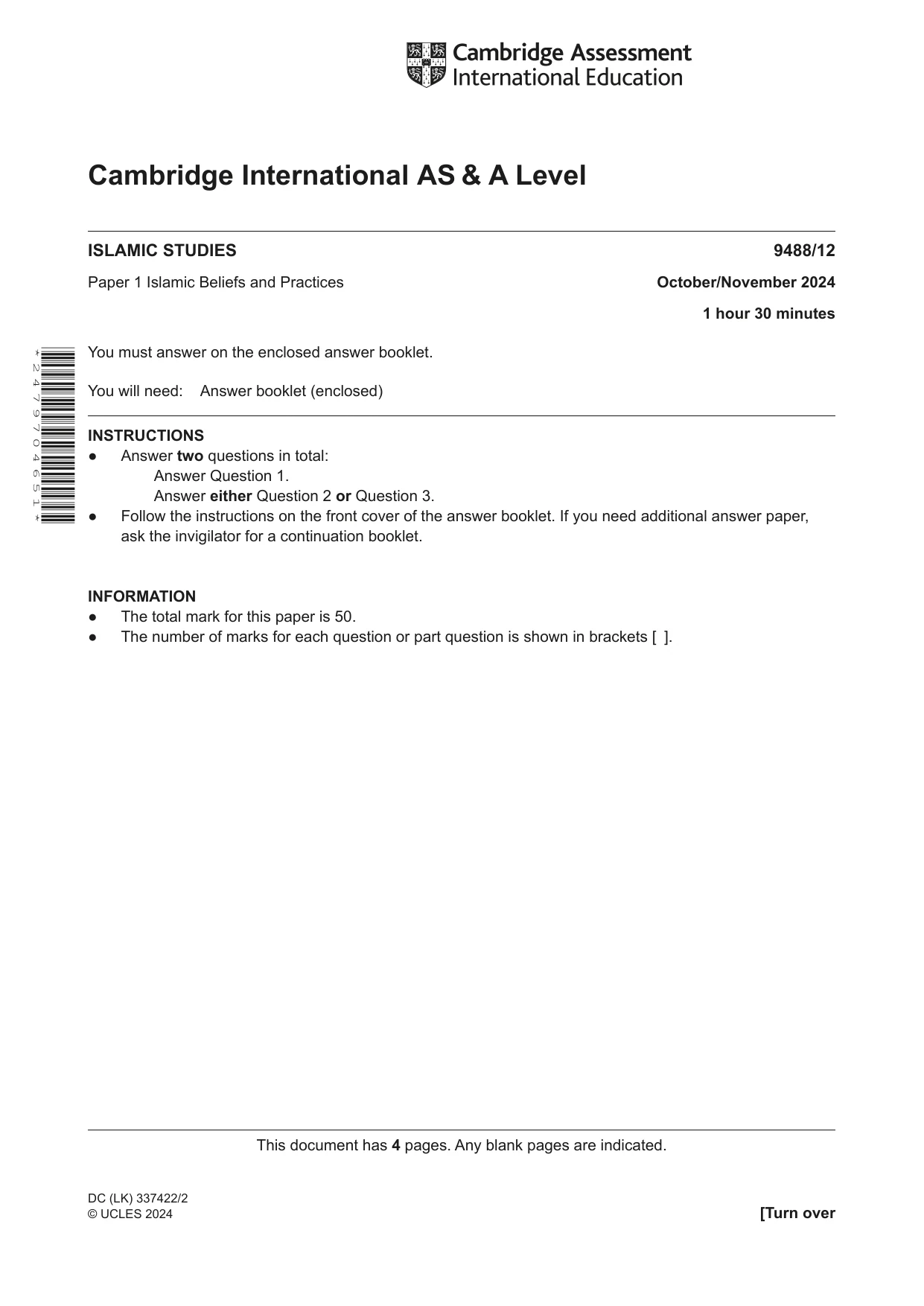
Question paper, page 1
This document has 4 pages. Any blank pages are indicated. [Turn over Cambridge International AS & A Level ISLAMIC STUDIES 9488/12 Paper 1 Islamic Beliefs and Practices October/November 2024 1 hour 30 minutes You must answer on the enclosed answer booklet. You will need: Answer booklet (enclosed) INSTRUCTIONS ● Answer two questions in total: Answer Question 1. Answer either Question 2 or Question 3. ● Follow the instructions on the front cover of the answer booklet. If you need additional answer paper, ask the invigilator for a continuation booklet. INFORMATION ● The total mark for this paper is 50. ● The number of marks for each question or part question is shown in brackets [ ]. * 2 4 7 9 7 0 4 6 5 1 * DC (LK) 337422/2 © UCLES 2024
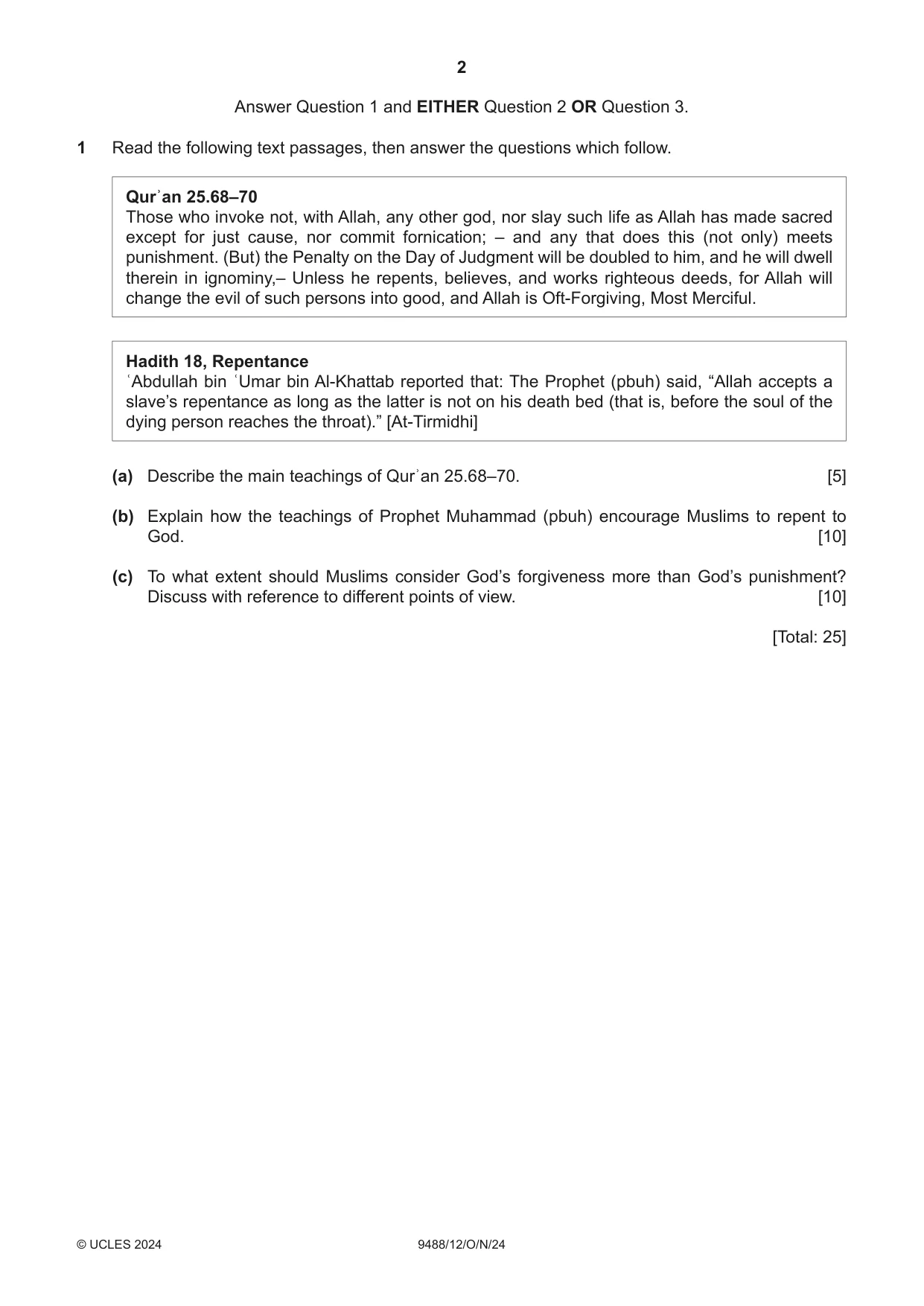
Question paper, page 2
2 9488/12/O/N/24 © UCLES 2024 Answer Question 1 and EITHER Question 2 OR Question 3. 1 Read the following text passages, then answer the questions which follow. Qurʾan 25.68–70 Those who invoke not, with Allah, any other god, nor slay such life as Allah has made sacred except for just cause, nor commit fornication; – and any that does this (not only) meets punishment. (But) the Penalty on the Day of Judgment will be doubled to him, and he will dwell therein in ignominy,– Unless he repents, believes, and works righteous deeds, for Allah will change the evil of such persons into good, and Allah is Oft-Forgiving, Most Merciful. Hadith 18, Repentance ʿAbdullah bin ʿUmar bin Al-Khattab reported that: The Prophet (pbuh) said, “Allah accepts a slave’s repentance as long as the latter is not on his death bed (that is, before the soul of the dying person reaches the throat).” [At-Tirmidhi] (a) Describe the main teachings of Qurʾan 25.68–70. [5] (b) Explain how the teachings of Prophet Muhammad (pbuh) encourage Muslims to repent to God. [10] (c) To what extent should Muslims consider God’s forgiveness more than God’s punishment? Discuss with reference to different points of view. [10] [Total: 25]
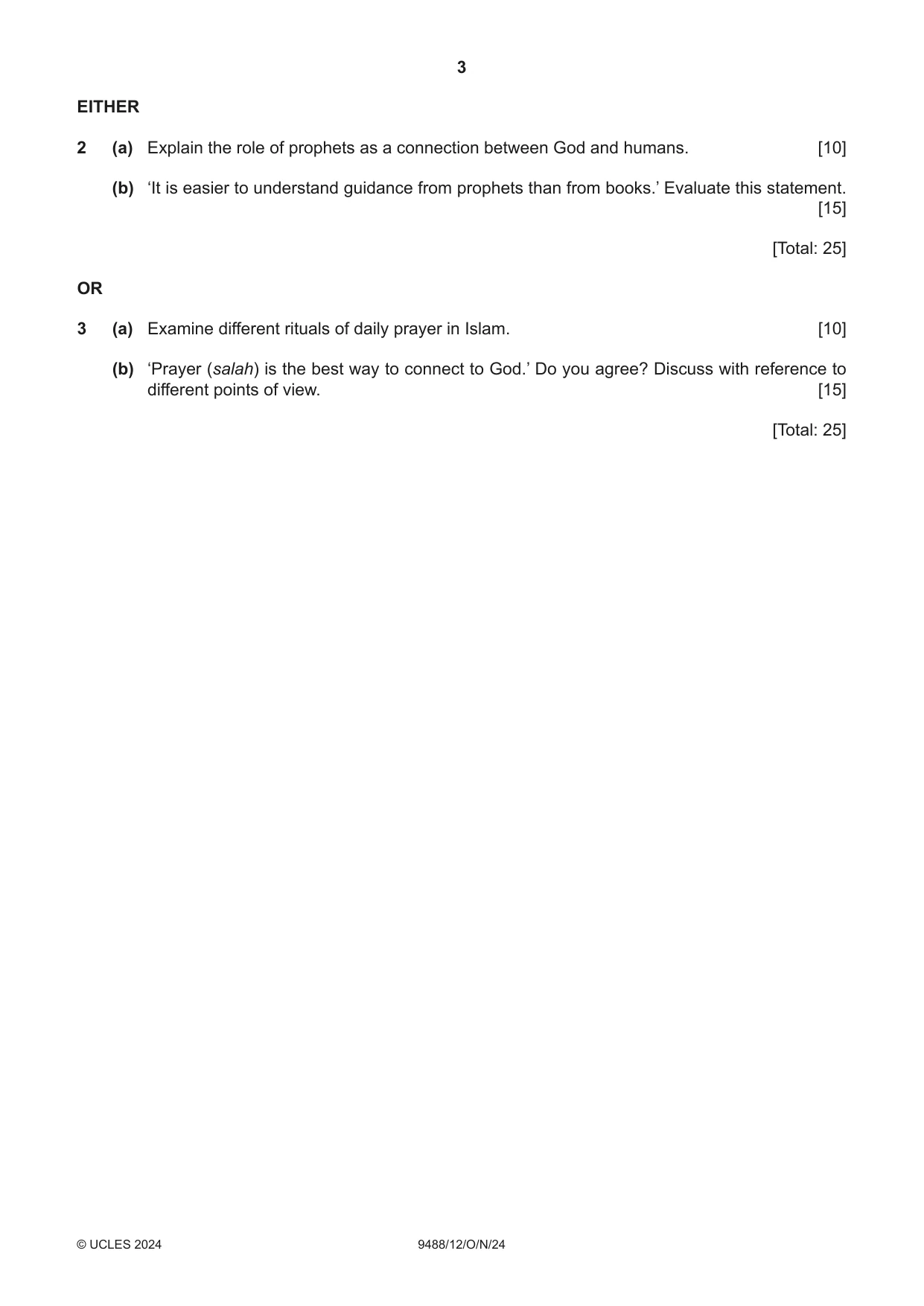
Question paper, page 3
3 9488/12/O/N/24 © UCLES 2024 EITHER 2 (a) Explain the role of prophets as a connection between God and humans. [10] (b) ‘It is easier to understand guidance from prophets than from books.’ Evaluate this statement. [15] [Total: 25] OR 3 (a) Examine different rituals of daily prayer in Islam. [10] (b) ‘Prayer (salah) is the best way to connect to God.’ Do you agree? Discuss with reference to different points of view. [15] [Total: 25]
Question paper, page 4
4 9488/12/O/N/24 © UCLES 2024 To avoid the issue of disclosure of answer-related information to candidates, all copyright acknowledgements are reproduced online in the Cambridge Assessment International Education Copyright Acknowledgements Booklet. This is produced for each series of examinations and is freely available to download at www.cambridgeinternational.org after the live examination series. Cambridge Assessment International Education is part of Cambridge Assessment. Cambridge Assessment is the brand name of the University of Cambridge Local Examinations Syndicate (UCLES), which is a department of the University of Cambridge. BLANK PAGE
Mark scheme, page 1
This document consists of 14 printed pages. © Cambridge University Press & Assessment 2024 [Turn over Cambridge International AS & A Level ISLAMIC STUDIES 9488/12 Paper 1 Islamic Beliefs and Practices October/November 2024 MARK SCHEME Maximum Mark: 50 Published This mark scheme is published as an aid to teachers and candidates, to indicate the requirements of the examination. It shows the basis on which Examiners were instructed to award marks. It does not indicate the details of the discussions that took place at an Examiners’ meeting before marking began, which would have considered the acceptability of alternative answers. Mark schemes should be read in conjunction with the question paper and the Principal Examiner Report for Teachers. Cambridge International will not enter into discussions about these mark schemes. Cambridge International is publishing the mark schemes for the October/November 2024 series for most Cambridge IGCSE, Cambridge International A and AS Level components, and some Cambridge O Level components.
Mark scheme, page 2
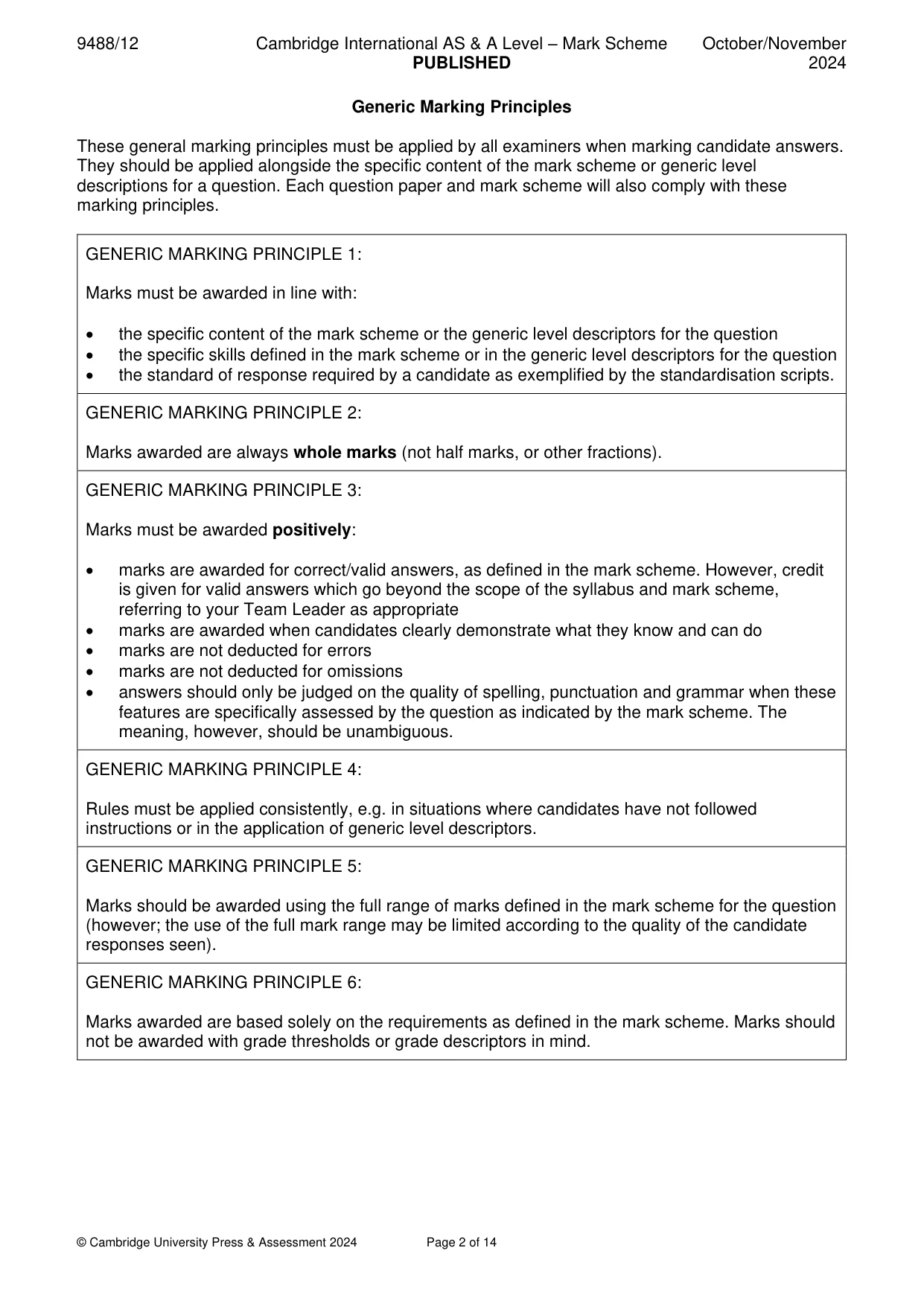
9488/12 Cambridge International AS & A Level – Mark Scheme PUBLISHED October/November 2024 © Cambridge University Press & Assessment 2024 Page 2 of 14 Generic Marking Principles These general marking principles must be applied by all examiners when marking candidate answers. They should be applied alongside the specific content of the mark scheme or generic level descriptions for a question. Each question paper and mark scheme will also comply with these marking principles. GENERIC MARKING PRINCIPLE 1: Marks must be awarded in line with: • the specific content of the mark scheme or the generic level descriptors for the question • the specific skills defined in the mark scheme or in the generic level descriptors for the question • the standard of response required by a candidate as exemplified by the standardisation scripts. GENERIC MARKING PRINCIPLE 2: Marks awarded are always whole marks (not half marks, or other fractions). GENERIC MARKING PRINCIPLE 3: Marks must be awarded positively: • marks are awarded for correct/valid answers, as defined in the mark scheme. However, credit is given for valid answers which go beyond the scope of the syllabus and mark scheme, referring to your Team Leader as appropriate • marks are awarded when candidates clearly demonstrate what they know and can do • marks are not deducted for errors • marks are not deducted for omissions • answers should only be judged on the quality of spelling, punctuation and grammar when these features are specifically assessed by the question as indicated by the mark scheme. The meaning, however, should be unambiguous. GENERIC MARKING PRINCIPLE 4: Rules must be applied consistently, e.g. in situations where candidates have not followed instructions or in the application of generic level descriptors. GENERIC MARKING PRINCIPLE 5: Marks should be awarded using the full range of marks defined in the mark scheme for the question (however; the use of the full mark range may be limited according to the quality of the candidate responses seen). GENERIC MARKING PRINCIPLE 6: Marks awarded are based solely on the requirements as defined in the mark scheme. Marks should not be awarded with grade thresholds or grade descriptors in mind.
Mark scheme, page 3
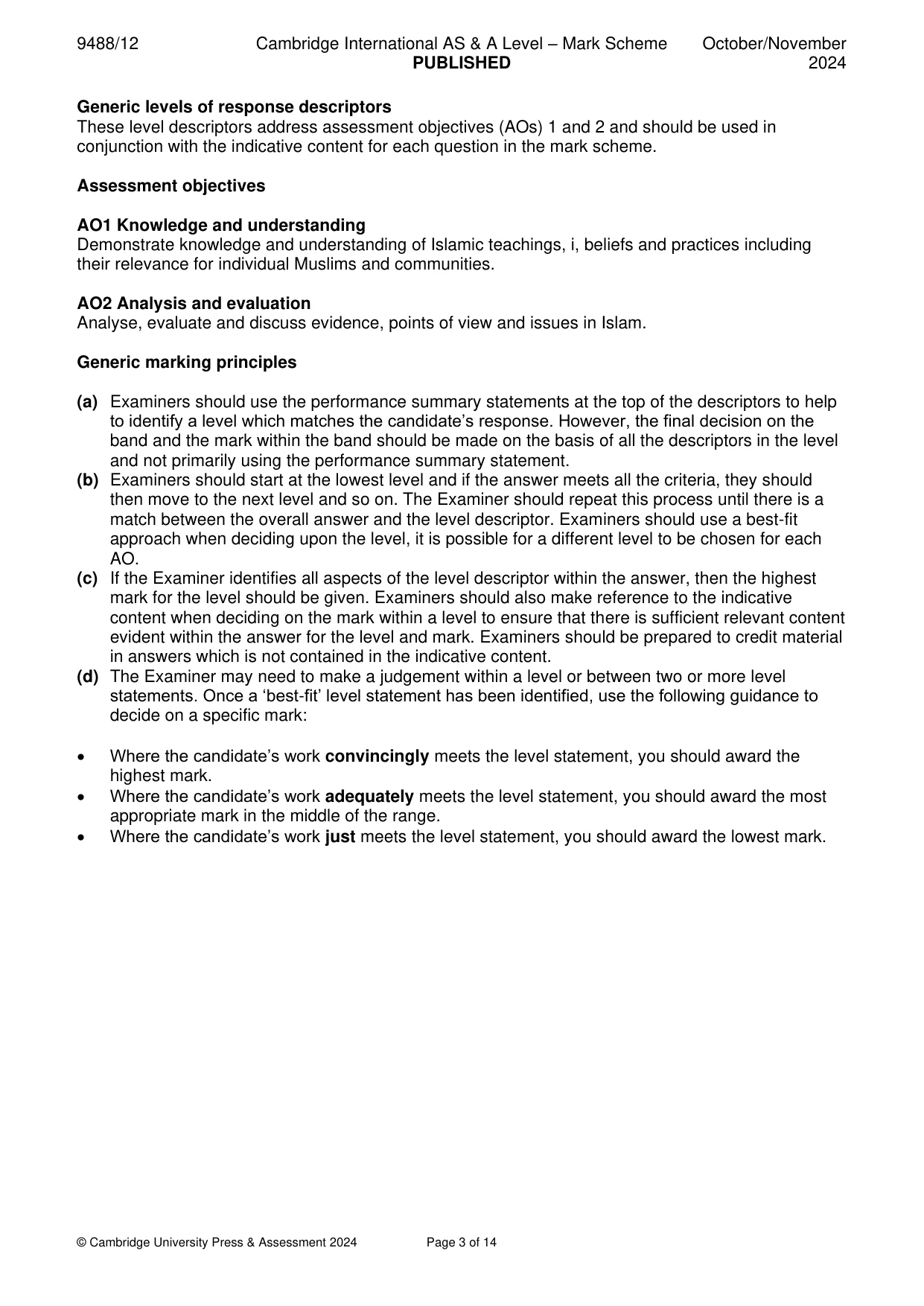
9488/12 Cambridge International AS & A Level – Mark Scheme PUBLISHED October/November 2024 © Cambridge University Press & Assessment 2024 Page 3 of 14 Generic levels of response descriptors These level descriptors address assessment objectives (AOs) 1 and 2 and should be used in conjunction with the indicative content for each question in the mark scheme. Assessment objectives AO1 Knowledge and understanding Demonstrate knowledge and understanding of Islamic teachings, i, beliefs and practices including their relevance for individual Muslims and communities. AO2 Analysis and evaluation Analyse, evaluate and discuss evidence, points of view and issues in Islam. Generic marking principles (a) Examiners should use the performance summary statements at the top of the descriptors to help to identify a level which matches the candidate’s response. However, the final decision on the band and the mark within the band should be made on the basis of all the descriptors in the level and not primarily using the performance summary statement. (b) Examiners should start at the lowest level and if the answer meets all the criteria, they should then move to the next level and so on. The Examiner should repeat this process until there is a match between the overall answer and the level descriptor. Examiners should use a best-fit approach when deciding upon the level, it is possible for a different level to be chosen for each AO. (c) If the Examiner identifies all aspects of the level descriptor within the answer, then the highest mark for the level should be given. Examiners should also make reference to the indicative content when deciding on the mark within a level to ensure that there is sufficient relevant content evident within the answer for the level and mark. Examiners should be prepared to credit material in answers which is not contained in the indicative content. (d) The Examiner may need to make a judgement within a level or between two or more level statements. Once a ‘best-fit’ level statement has been identified, use the following guidance to decide on a specific mark: • Where the candidate’s work convincingly meets the level statement, you should award the highest mark. • Where the candidate’s work adequately meets the level statement, you should award the most appropriate mark in the middle of the range. • Where the candidate’s work just meets the level statement, you should award the lowest mark.
Mark scheme, page 4
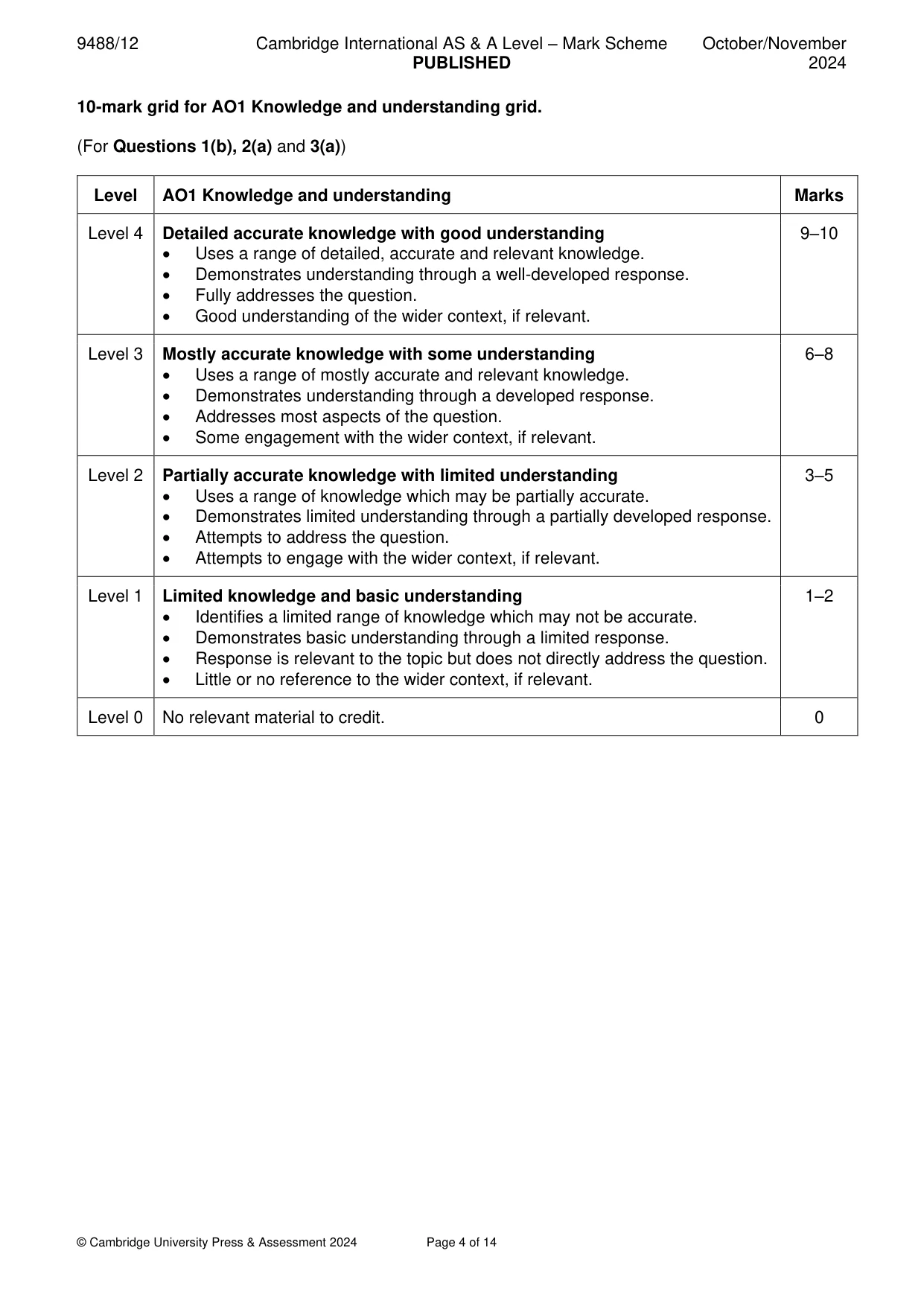
9488/12 Cambridge International AS & A Level – Mark Scheme PUBLISHED October/November 2024 © Cambridge University Press & Assessment 2024 Page 4 of 14 10-mark grid for AO1 Knowledge and understanding grid. (For Questions 1(b), 2(a) and 3(a)) Level AO1 Knowledge and understanding Marks Level 4 Detailed accurate knowledge with good understanding • Uses a range of detailed, accurate and relevant knowledge. • Demonstrates understanding through a well-developed response. • Fully addresses the question. • Good understanding of the wider context, if relevant. 9–10 Level 3 Mostly accurate knowledge with some understanding • Uses a range of mostly accurate and relevant knowledge. • Demonstrates understanding through a developed response. • Addresses most aspects of the question. • Some engagement with the wider context, if relevant. 6–8 Level 2 Partially accurate knowledge with limited understanding • Uses a range of knowledge which may be partially accurate. • Demonstrates limited understanding through a partially developed response. • Attempts to address the question. • Attempts to engage with the wider context, if relevant. 3–5 Level 1 Limited knowledge and basic understanding • Identifies a limited range of knowledge which may not be accurate. • Demonstrates basic understanding through a limited response. • Response is relevant to the topic but does not directly address the question. • Little or no reference to the wider context, if relevant. 1–2 Level 0 No relevant material to credit. 0
Mark scheme, page 5
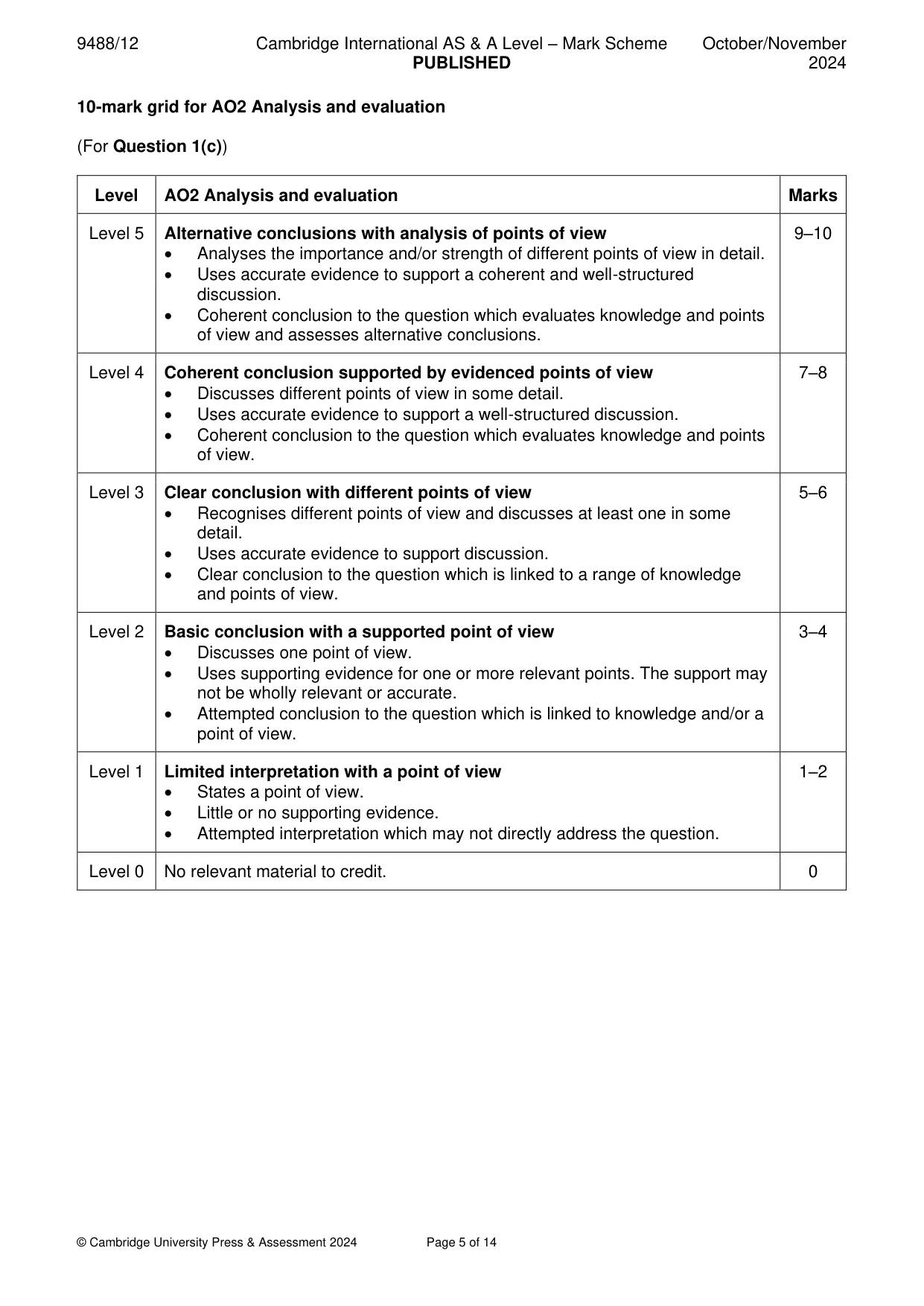
9488/12 Cambridge International AS & A Level – Mark Scheme PUBLISHED October/November 2024 © Cambridge University Press & Assessment 2024 Page 5 of 14 10-mark grid for AO2 Analysis and evaluation (For Question 1(c)) Level AO2 Analysis and evaluation Marks Level 5 Alternative conclusions with analysis of points of view • Analyses the importance and/or strength of different points of view in detail. • Uses accurate evidence to support a coherent and well-structured discussion. • Coherent conclusion to the question which evaluates knowledge and points of view and assesses alternative conclusions. 9–10 Level 4 Coherent conclusion supported by evidenced points of view • Discusses different points of view in some detail. • Uses accurate evidence to support a well-structured discussion. • Coherent conclusion to the question which evaluates knowledge and points of view. 7–8 Level 3 Clear conclusion with different points of view • Recognises different points of view and discusses at least one in some detail. • Uses accurate evidence to support discussion. • Clear conclusion to the question which is linked to a range of knowledge and points of view. 5–6 Level 2 Basic conclusion with a supported point of view • Discusses one point of view. • Uses supporting evidence for one or more relevant points. The support may not be wholly relevant or accurate. • Attempted conclusion to the question which is linked to knowledge and/or a point of view. 3–4 Level 1 Limited interpretation with a point of view • States a point of view. • Little or no supporting evidence. • Attempted interpretation which may not directly address the question. 1–2 Level 0 No relevant material to credit. 0
Mark scheme, page 6
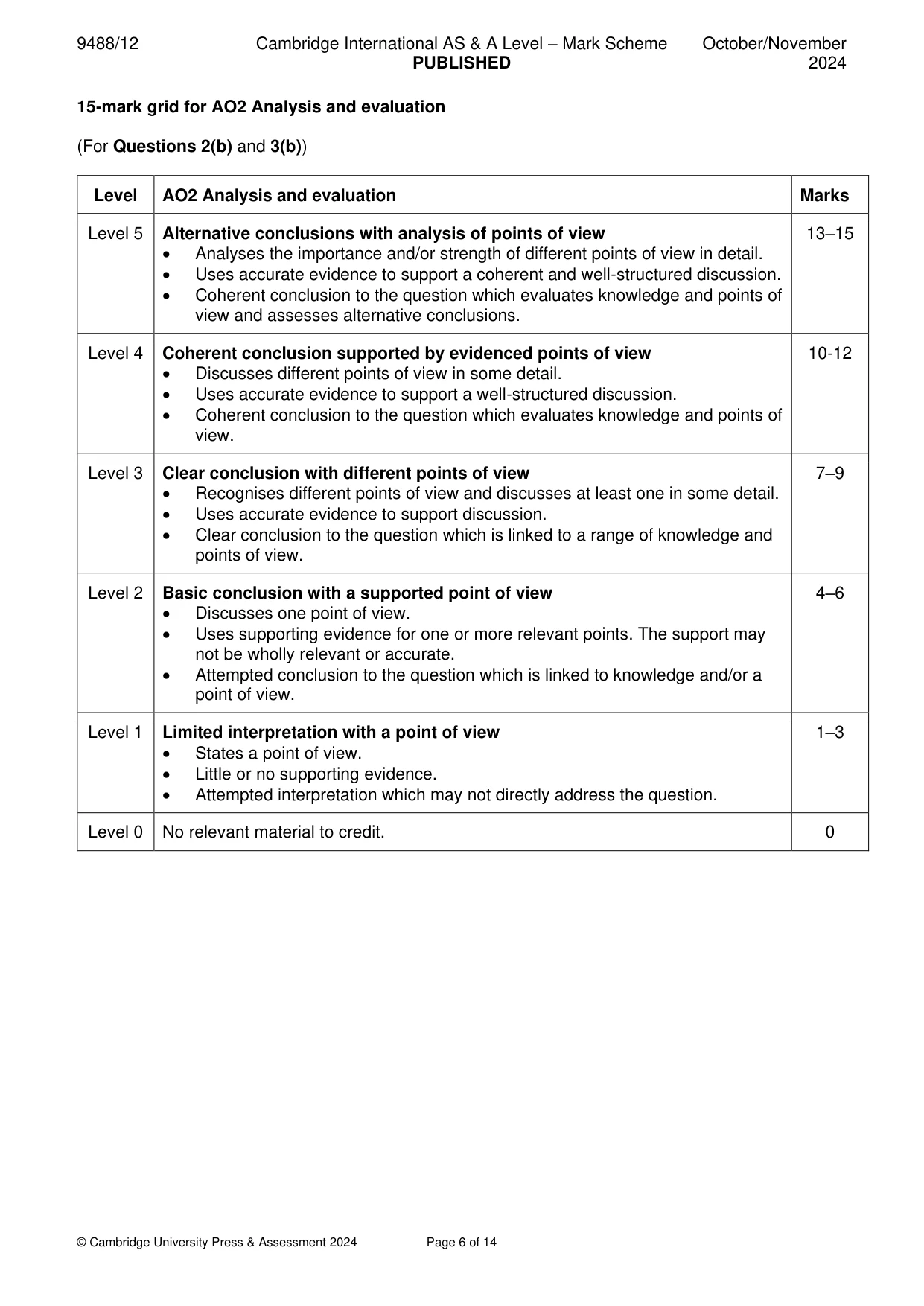
9488/12 Cambridge International AS & A Level – Mark Scheme PUBLISHED October/November 2024 © Cambridge University Press & Assessment 2024 Page 6 of 14 15-mark grid for AO2 Analysis and evaluation (For Questions 2(b) and 3(b)) Level AO2 Analysis and evaluation Marks Level 5 Alternative conclusions with analysis of points of view • Analyses the importance and/or strength of different points of view in detail. • Uses accurate evidence to support a coherent and well-structured discussion. • Coherent conclusion to the question which evaluates knowledge and points of view and assesses alternative conclusions. 13–15 Level 4 Coherent conclusion supported by evidenced points of view • Discusses different points of view in some detail. • Uses accurate evidence to support a well-structured discussion. • Coherent conclusion to the question which evaluates knowledge and points of view. 10-12 Level 3 Clear conclusion with different points of view • Recognises different points of view and discusses at least one in some detail. • Uses accurate evidence to support discussion. • Clear conclusion to the question which is linked to a range of knowledge and points of view. 7–9 Level 2 Basic conclusion with a supported point of view • Discusses one point of view. • Uses supporting evidence for one or more relevant points. The support may not be wholly relevant or accurate. • Attempted conclusion to the question which is linked to knowledge and/or a point of view. 4–6 Level 1 Limited interpretation with a point of view • States a point of view. • Little or no supporting evidence. • Attempted interpretation which may not directly address the question. 1–3 Level 0 No relevant material to credit. 0
Mark scheme, page 7
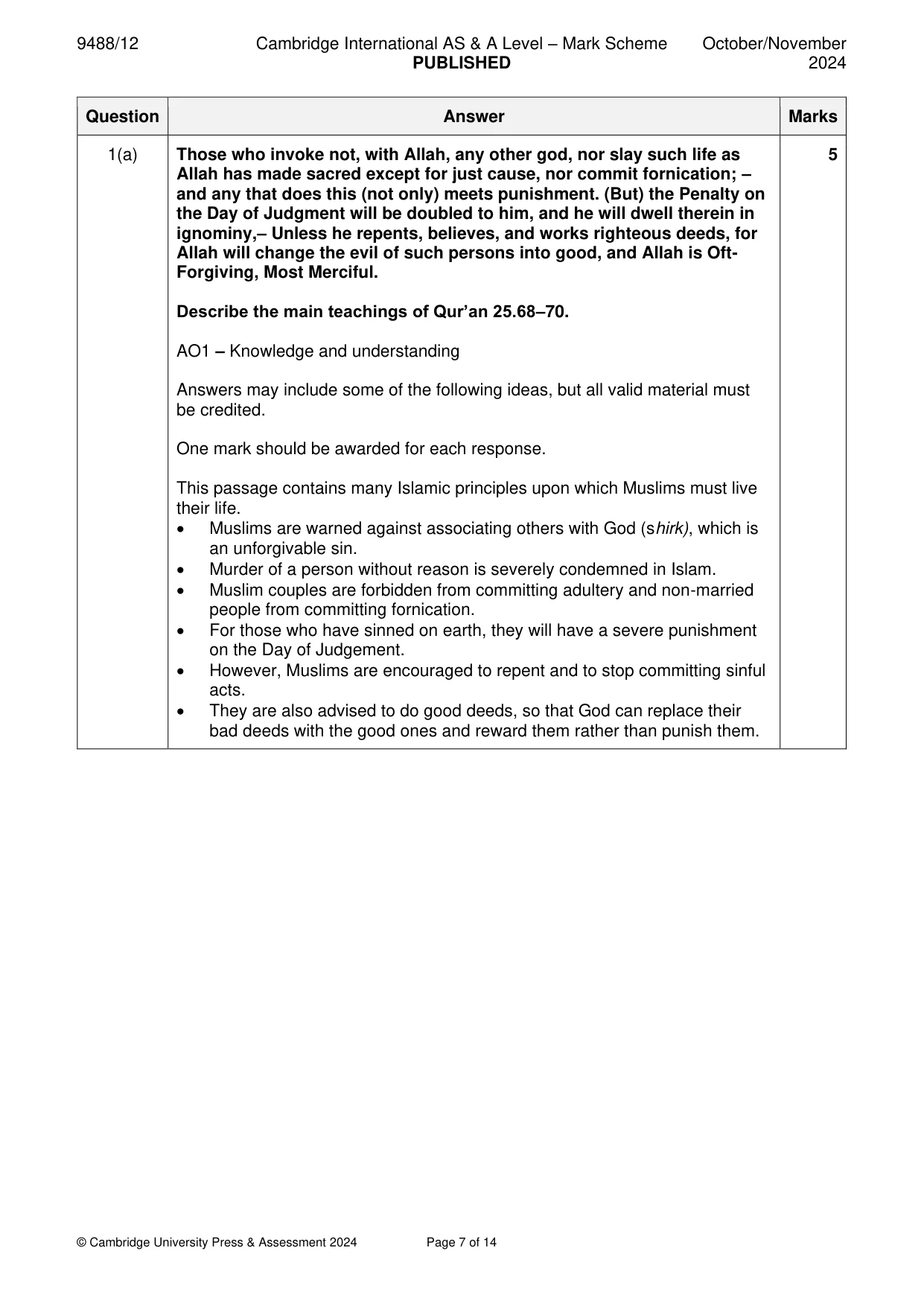
9488/12 Cambridge International AS & A Level – Mark Scheme PUBLISHED October/November 2024 © Cambridge University Press & Assessment 2024 Page 7 of 14 Question Answer Marks 1(a) Those who invoke not, with Allah, any other god, nor slay such life as Allah has made sacred except for just cause, nor commit fornication; – and any that does this (not only) meets punishment. (But) the Penalty on the Day of Judgment will be doubled to him, and he will dwell therein in ignominy,– Unless he repents, believes, and works righteous deeds, for Allah will change the evil of such persons into good, and Allah is Oft- Forgiving, Most Merciful. Describe the main teachings of Qur’an 25.68–70. AO1 – Knowledge and understanding Answers may include some of the following ideas, but all valid material must be credited. One mark should be awarded for each response. This passage contains many Islamic principles upon which Muslims must live their life. • Muslims are warned against associating others with God (shirk), which is an unforgivable sin. • Murder of a person without reason is severely condemned in Islam. • Muslim couples are forbidden from committing adultery and non-married people from committing fornication. • For those who have sinned on earth, they will have a severe punishment on the Day of Judgement. • However, Muslims are encouraged to repent and to stop committing sinful acts. • They are also advised to do good deeds, so that God can replace their bad deeds with the good ones and reward them rather than punish them. 5
Mark scheme, page 8
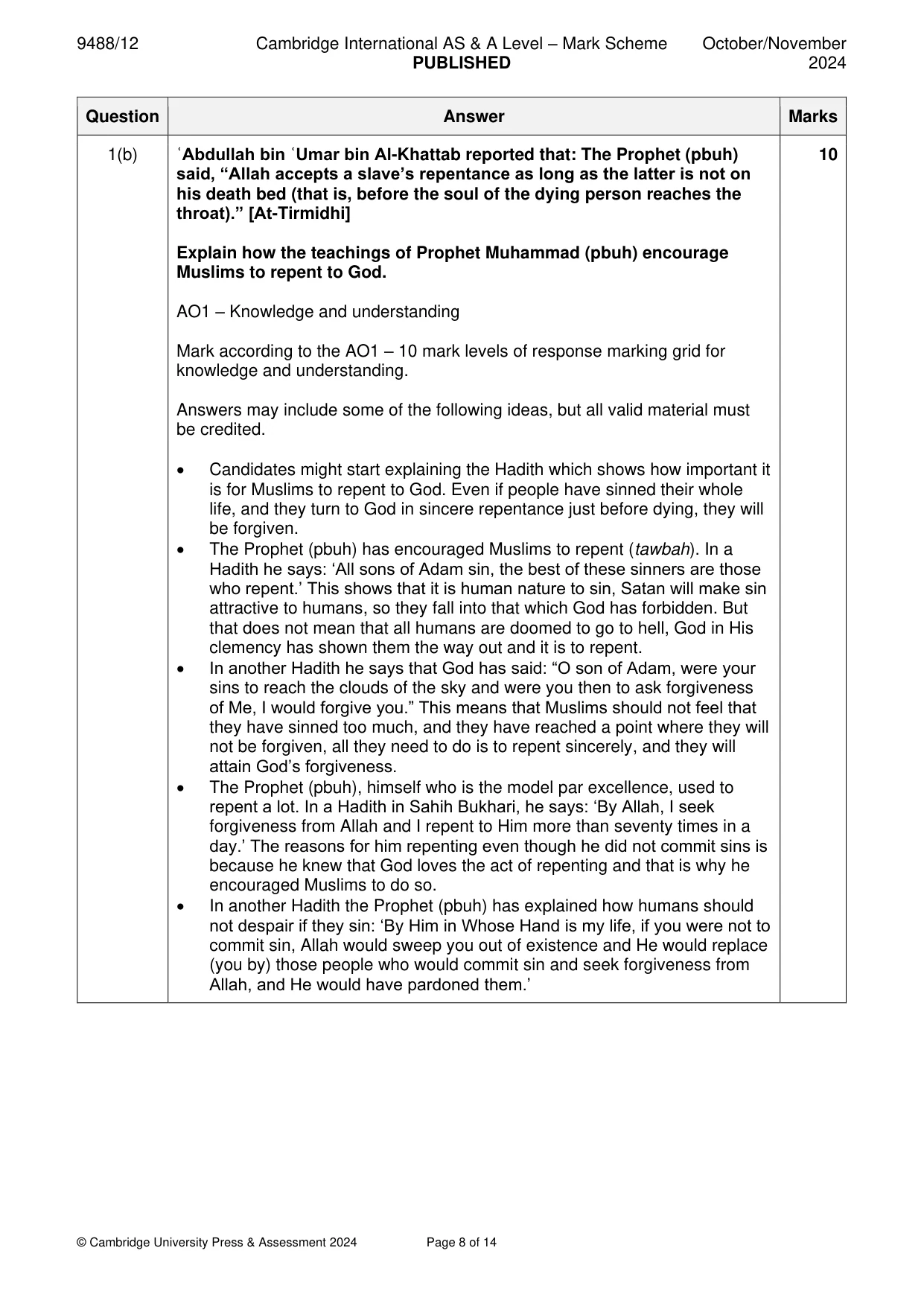
9488/12 Cambridge International AS & A Level – Mark Scheme PUBLISHED October/November 2024 © Cambridge University Press & Assessment 2024 Page 8 of 14 Question Answer Marks 1(b) ʿAbdullah bin ʿUmar bin Al-Khattab reported that: The Prophet (pbuh) said, “Allah accepts a slave’s repentance as long as the latter is not on his death bed (that is, before the soul of the dying person reaches the throat).” [At-Tirmidhi] Explain how the teachings of Prophet Muhammad (pbuh) encourage Muslims to repent to God. AO1 – Knowledge and understanding Mark according to the AO1 – 10 mark levels of response marking grid for knowledge and understanding. Answers may include some of the following ideas, but all valid material must be credited. • Candidates might start explaining the Hadith which shows how important it is for Muslims to repent to God. Even if people have sinned their whole life, and they turn to God in sincere repentance just before dying, they will be forgiven. • The Prophet (pbuh) has encouraged Muslims to repent (tawbah). In a Hadith he says: ‘All sons of Adam sin, the best of these sinners are those who repent.’ This shows that it is human nature to sin, Satan will make sin attractive to humans, so they fall into that which God has forbidden. But that does not mean that all humans are doomed to go to hell, God in His clemency has shown them the way out and it is to repent. • In another Hadith he says that God has said: “O son of Adam, were your sins to reach the clouds of the sky and were you then to ask forgiveness of Me, I would forgive you.” This means that Muslims should not feel that they have sinned too much, and they have reached a point where they will not be forgiven, all they need to do is to repent sincerely, and they will attain God’s forgiveness. • The Prophet (pbuh), himself who is the model par excellence, used to repent a lot. In a Hadith in Sahih Bukhari, he says: ‘By Allah, I seek forgiveness from Allah and I repent to Him more than seventy times in a day.’ The reasons for him repenting even though he did not commit sins is because he knew that God loves the act of repenting and that is why he encouraged Muslims to do so. • In another Hadith the Prophet (pbuh) has explained how humans should not despair if they sin: ‘By Him in Whose Hand is my life, if you were not to commit sin, Allah would sweep you out of existence and He would replace (you by) those people who would commit sin and seek forgiveness from Allah, and He would have pardoned them.’ 10
Mark scheme, page 9
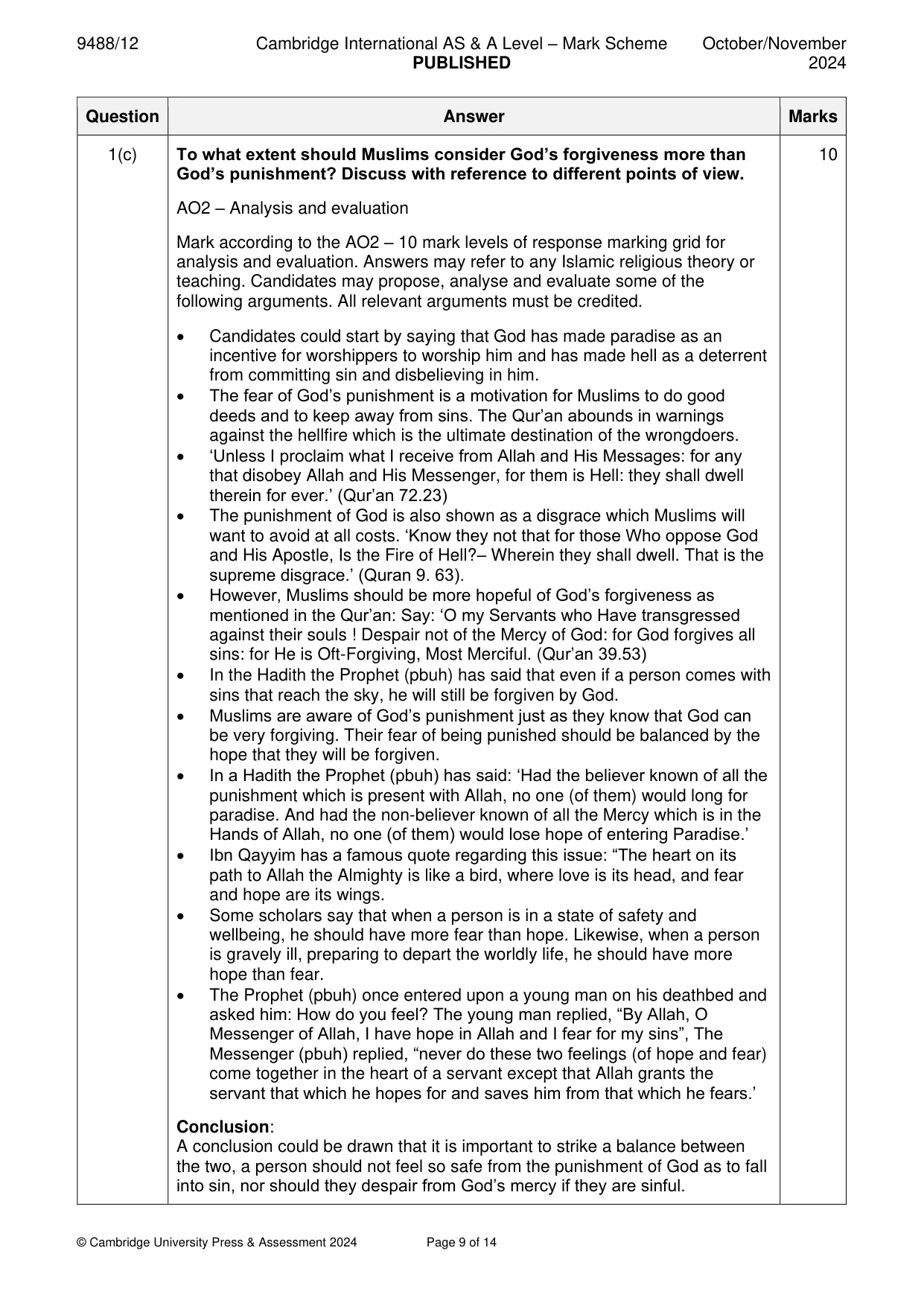
9488/12 Cambridge International AS & A Level – Mark Scheme PUBLISHED October/November 2024 © Cambridge University Press & Assessment 2024 Page 9 of 14 Question Answer Marks 1(c) To what extent should Muslims consider God’s forgiveness more than God’s punishment? Discuss with reference to different points of view. AO2 – Analysis and evaluation Mark according to the AO2 – 10 mark levels of response marking grid for analysis and evaluation. Answers may refer to any Islamic religious theory or teaching. Candidates may propose, analyse and evaluate some of the following arguments. All relevant arguments must be credited. • Candidates could start by saying that God has made paradise as an incentive for worshippers to worship him and has made hell as a deterrent from committing sin and disbelieving in him. • The fear of God’s punishment is a motivation for Muslims to do good deeds and to keep away from sins. The Qur’an abounds in warnings against the hellfire which is the ultimate destination of the wrongdoers. • ‘Unless I proclaim what I receive from Allah and His Messages: for any that disobey Allah and His Messenger, for them is Hell: they shall dwell therein for ever.’ (Qur’an 72.23) • The punishment of God is also shown as a disgrace which Muslims will want to avoid at all costs. ‘Know they not that for those Who oppose God and His Apostle, Is the Fire of Hell?– Wherein they shall dwell. That is the supreme disgrace.’ (Quran 9. 63). • However, Muslims should be more hopeful of God’s forgiveness as mentioned in the Qur’an: Say: ‘O my Servants who Have transgressed against their souls ! Despair not of the Mercy of God: for God forgives all sins: for He is Oft-Forgiving, Most Merciful. (Qur’an 39.53) • In the Hadith the Prophet (pbuh) has said that even if a person comes with sins that reach the sky, he will still be forgiven by God. • Muslims are aware of God’s punishment just as they know that God can be very forgiving. Their fear of being punished should be balanced by the hope that they will be forgiven. • In a Hadith the Prophet (pbuh) has said: ‘Had the believer known of all the punishment which is present with Allah, no one (of them) would long for paradise. And had the non-believer known of all the Mercy which is in the Hands of Allah, no one (of them) would lose hope of entering Paradise.’ • Ibn Qayyim has a famous quote regarding this issue: “The heart on its path to Allah the Almighty is like a bird, where love is its head, and fear and hope are its wings. • Some scholars say that when a person is in a state of safety and wellbeing, he should have more fear than hope. Likewise, when a person is gravely ill, preparing to depart the worldly life, he should have more hope than fear. • The Prophet (pbuh) once entered upon a young man on his deathbed and asked him: How do you feel? The young man replied, “By Allah, O Messenger of Allah, I have hope in Allah and I fear for my sins”, The Messenger (pbuh) replied, “never do these two feelings (of hope and fear) come together in the heart of a servant except that Allah grants the servant that which he hopes for and saves him from that which he fears.’ Conclusion: A conclusion could be drawn that it is important to strike a balance between the two, a person should not feel so safe from the punishment of God as to fall into sin, nor should they despair from God’s mercy if they are sinful. 10
Mark scheme, page 10
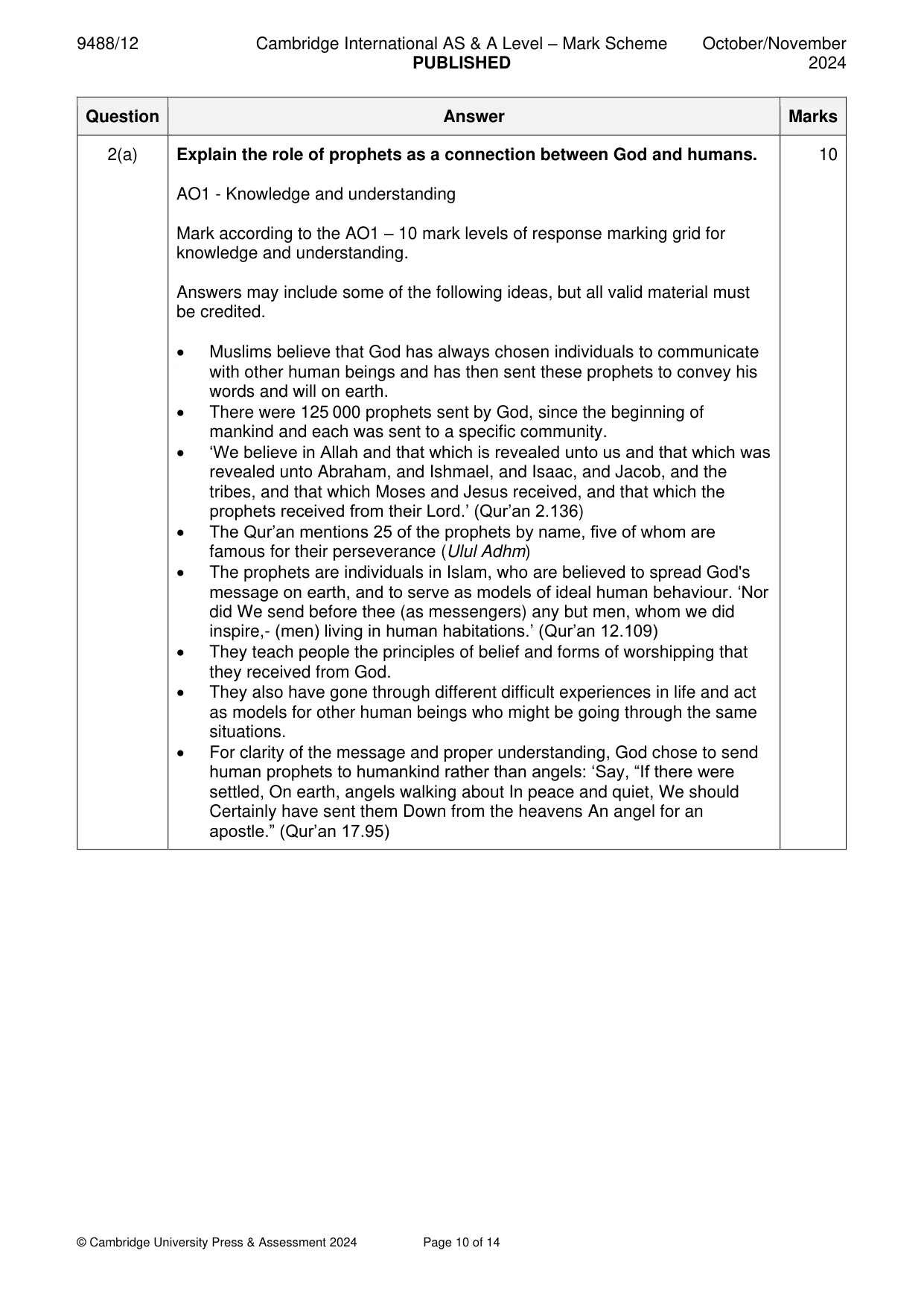
9488/12 Cambridge International AS & A Level – Mark Scheme PUBLISHED October/November 2024 © Cambridge University Press & Assessment 2024 Page 10 of 14 Question Answer Marks 2(a) Explain the role of prophets as a connection between God and humans. AO1 - Knowledge and understanding Mark according to the AO1 – 10 mark levels of response marking grid for knowledge and understanding. Answers may include some of the following ideas, but all valid material must be credited. • Muslims believe that God has always chosen individuals to communicate with other human beings and has then sent these prophets to convey his words and will on earth. • There were 125 000 prophets sent by God, since the beginning of mankind and each was sent to a specific community. • ‘We believe in Allah and that which is revealed unto us and that which was revealed unto Abraham, and Ishmael, and Isaac, and Jacob, and the tribes, and that which Moses and Jesus received, and that which the prophets received from their Lord.’ (Qur’an 2.136) • The Qur’an mentions 25 of the prophets by name, five of whom are famous for their perseverance (Ulul Adhm) • The prophets are individuals in Islam, who are believed to spread God's message on earth, and to serve as models of ideal human behaviour. ‘Nor did We send before thee (as messengers) any but men, whom we did inspire,- (men) living in human habitations.’ (Qur’an 12.109) • They teach people the principles of belief and forms of worshipping that they received from God. • They also have gone through different difficult experiences in life and act as models for other human beings who might be going through the same situations. • For clarity of the message and proper understanding, God chose to send human prophets to humankind rather than angels: ‘Say, “If there were settled, On earth, angels walking about In peace and quiet, We should Certainly have sent them Down from the heavens An angel for an apostle.” (Qur’an 17.95) 10
Mark scheme, page 11
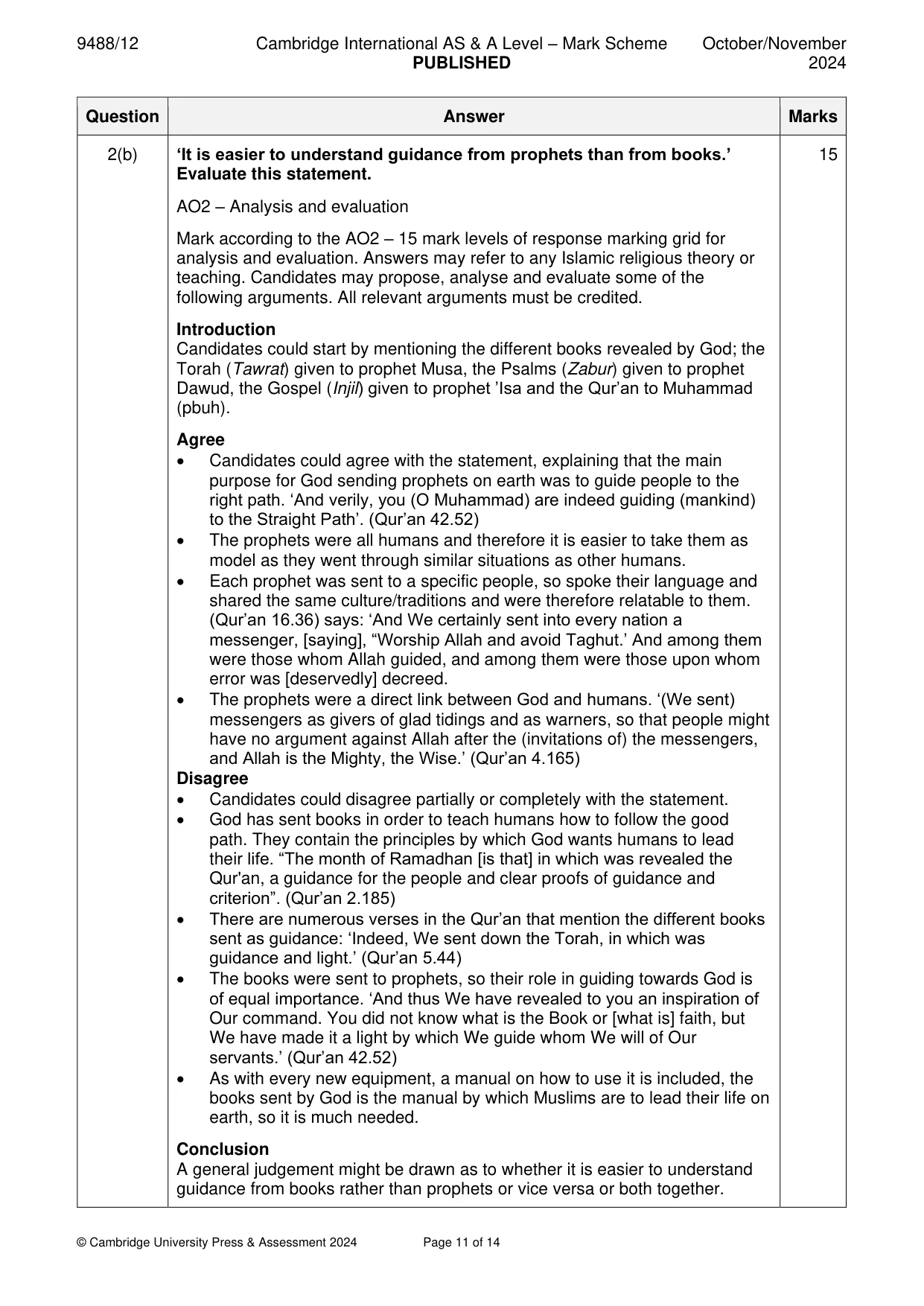
9488/12 Cambridge International AS & A Level – Mark Scheme PUBLISHED October/November 2024 © Cambridge University Press & Assessment 2024 Page 11 of 14 Question Answer Marks 2(b) ‘It is easier to understand guidance from prophets than from books.’ Evaluate this statement. AO2 – Analysis and evaluation Mark according to the AO2 – 15 mark levels of response marking grid for analysis and evaluation. Answers may refer to any Islamic religious theory or teaching. Candidates may propose, analyse and evaluate some of the following arguments. All relevant arguments must be credited. Introduction Candidates could start by mentioning the different books revealed by God; the Torah (Tawrat) given to prophet Musa, the Psalms (Zabur) given to prophet Dawud, the Gospel (Injil) given to prophet ’Isa and the Qur’an to Muhammad (pbuh). Agree • Candidates could agree with the statement, explaining that the main purpose for God sending prophets on earth was to guide people to the right path. ‘And verily, you (O Muhammad) are indeed guiding (mankind) to the Straight Path’. (Qur’an 42.52) • The prophets were all humans and therefore it is easier to take them as model as they went through similar situations as other humans. • Each prophet was sent to a specific people, so spoke their language and shared the same culture/traditions and were therefore relatable to them. (Qur’an 16.36) says: ‘And We certainly sent into every nation a messenger, [saying], “Worship Allah and avoid Taghut.’ And among them were those whom Allah guided, and among them were those upon whom error was [deservedly] decreed. • The prophets were a direct link between God and humans. ‘(We sent) messengers as givers of glad tidings and as warners, so that people might have no argument against Allah after the (invitations of) the messengers, and Allah is the Mighty, the Wise.’ (Qur’an 4.165) Disagree • Candidates could disagree partially or completely with the statement. • God has sent books in order to teach humans how to follow the good path. They contain the principles by which God wants humans to lead their life. “The month of Ramadhan [is that] in which was revealed the Qur'an, a guidance for the people and clear proofs of guidance and criterion”. (Qur’an 2.185) • There are numerous verses in the Qur’an that mention the different books sent as guidance: ‘Indeed, We sent down the Torah, in which was guidance and light.’ (Qur’an 5.44) • The books were sent to prophets, so their role in guiding towards God is of equal importance. ‘And thus We have revealed to you an inspiration of Our command. You did not know what is the Book or [what is] faith, but We have made it a light by which We guide whom We will of Our servants.’ (Qur’an 42.52) • As with every new equipment, a manual on how to use it is included, the books sent by God is the manual by which Muslims are to lead their life on earth, so it is much needed. Conclusion A general judgement might be drawn as to whether it is easier to understand guidance from books rather than prophets or vice versa or both together. 15
Mark scheme, page 12
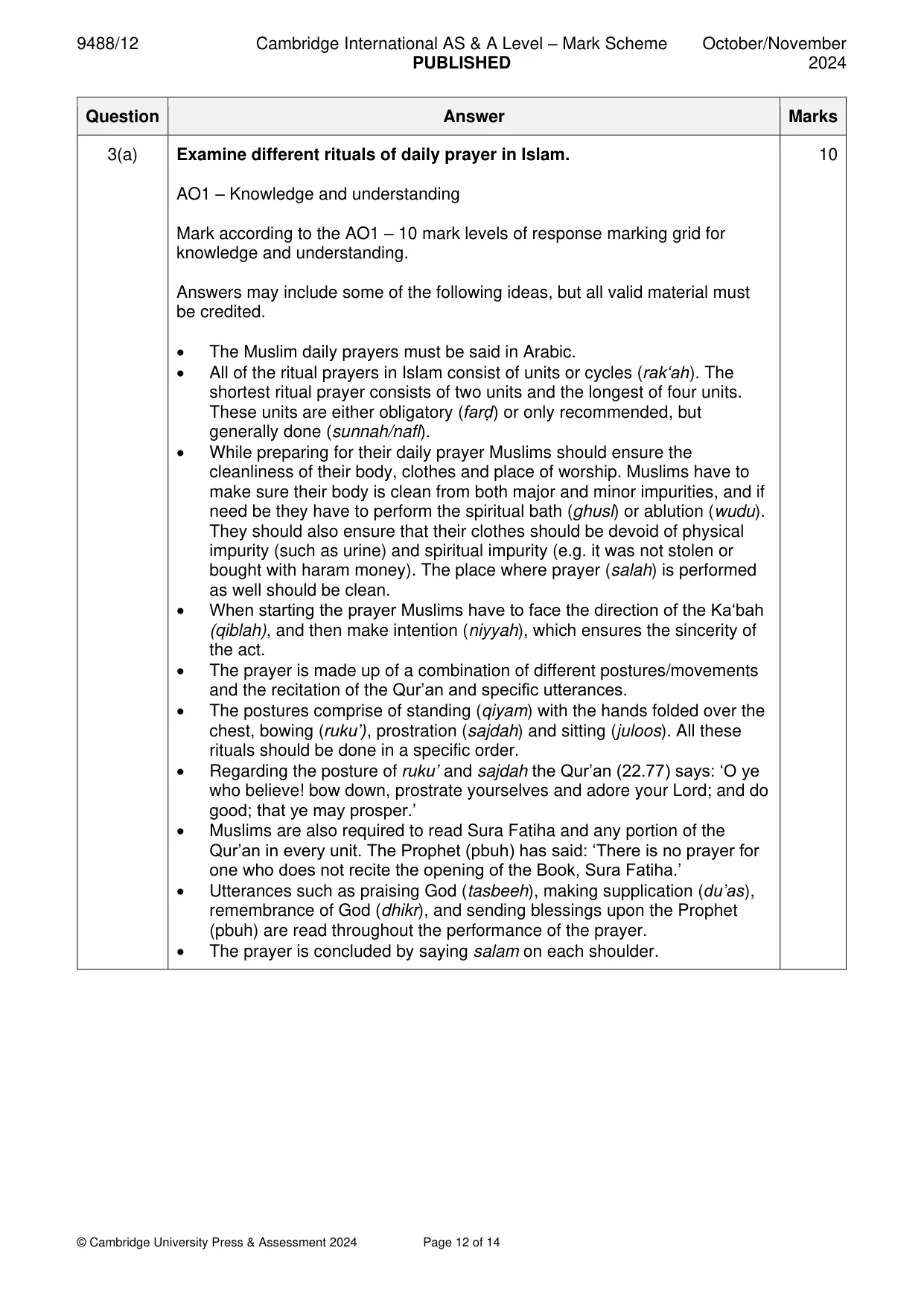
9488/12 Cambridge International AS & A Level – Mark Scheme PUBLISHED October/November 2024 © Cambridge University Press & Assessment 2024 Page 12 of 14 Question Answer Marks 3(a) Examine different rituals of daily prayer in Islam. AO1 – Knowledge and understanding Mark according to the AO1 – 10 mark levels of response marking grid for knowledge and understanding. Answers may include some of the following ideas, but all valid material must be credited. • The Muslim daily prayers must be said in Arabic. • All of the ritual prayers in Islam consist of units or cycles (rak‘ah). The shortest ritual prayer consists of two units and the longest of four units. These units are either obligatory (farḍ) or only recommended, but generally done (sunnah/nafl). • While preparing for their daily prayer Muslims should ensure the cleanliness of their body, clothes and place of worship. Muslims have to make sure their body is clean from both major and minor impurities, and if need be they have to perform the spiritual bath (ghusl) or ablution (wudu). They should also ensure that their clothes should be devoid of physical impurity (such as urine) and spiritual impurity (e.g. it was not stolen or bought with haram money). The place where prayer (salah) is performed as well should be clean. • When starting the prayer Muslims have to face the direction of the Ka‘bah (qiblah), and then make intention (niyyah), which ensures the sincerity of the act. • The prayer is made up of a combination of different postures/movements and the recitation of the Qur’an and specific utterances. • The postures comprise of standing (qiyam) with the hands folded over the chest, bowing (ruku’), prostration (sajdah) and sitting (juloos). All these rituals should be done in a specific order. • Regarding the posture of ruku’ and sajdah the Qur’an (22.77) says: ‘O ye who believe! bow down, prostrate yourselves and adore your Lord; and do good; that ye may prosper.’ • Muslims are also required to read Sura Fatiha and any portion of the Qur’an in every unit. The Prophet (pbuh) has said: ‘There is no prayer for one who does not recite the opening of the Book, Sura Fatiha.’ • Utterances such as praising God (tasbeeh), making supplication (du’as), remembrance of God (dhikr), and sending blessings upon the Prophet (pbuh) are read throughout the performance of the prayer. • The prayer is concluded by saying salam on each shoulder. 10
Mark scheme, page 13
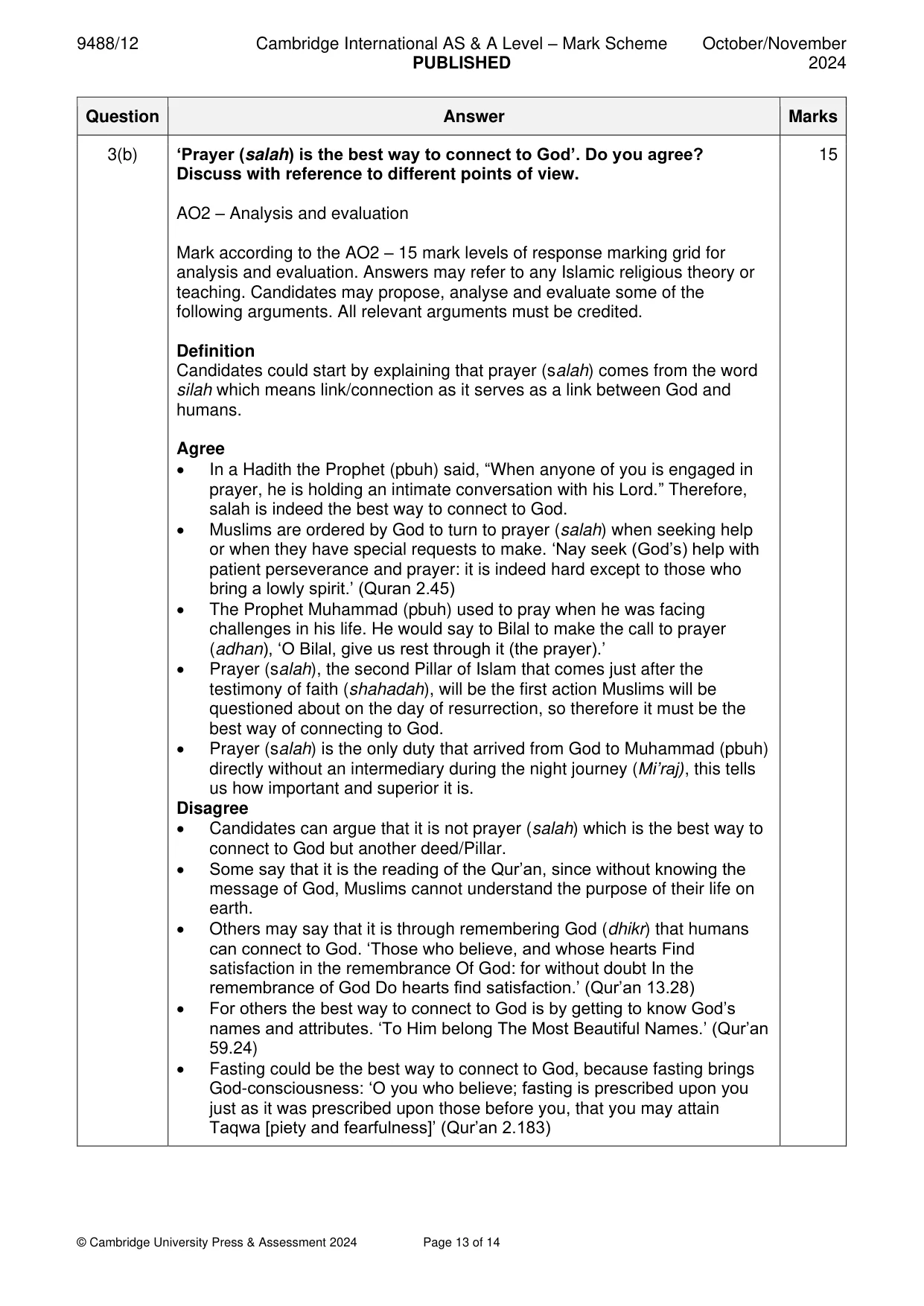
9488/12 Cambridge International AS & A Level – Mark Scheme PUBLISHED October/November 2024 © Cambridge University Press & Assessment 2024 Page 13 of 14 Question Answer Marks 3(b) ‘Prayer (salah) is the best way to connect to God’. Do you agree? Discuss with reference to different points of view. AO2 – Analysis and evaluation Mark according to the AO2 – 15 mark levels of response marking grid for analysis and evaluation. Answers may refer to any Islamic religious theory or teaching. Candidates may propose, analyse and evaluate some of the following arguments. All relevant arguments must be credited. Definition Candidates could start by explaining that prayer (salah) comes from the word silah which means link/connection as it serves as a link between God and humans. Agree • In a Hadith the Prophet (pbuh) said, “When anyone of you is engaged in prayer, he is holding an intimate conversation with his Lord.” Therefore, salah is indeed the best way to connect to God. • Muslims are ordered by God to turn to prayer (salah) when seeking help or when they have special requests to make. ‘Nay seek (God’s) help with patient perseverance and prayer: it is indeed hard except to those who bring a lowly spirit.’ (Quran 2.45) • The Prophet Muhammad (pbuh) used to pray when he was facing challenges in his life. He would say to Bilal to make the call to prayer (adhan), ‘O Bilal, give us rest through it (the prayer).’ • Prayer (salah), the second Pillar of Islam that comes just after the testimony of faith (shahadah), will be the first action Muslims will be questioned about on the day of resurrection, so therefore it must be the best way of connecting to God. • Prayer (salah) is the only duty that arrived from God to Muhammad (pbuh) directly without an intermediary during the night journey (Mi’raj), this tells us how important and superior it is. Disagree • Candidates can argue that it is not prayer (salah) which is the best way to connect to God but another deed/Pillar. • Some say that it is the reading of the Qur’an, since without knowing the message of God, Muslims cannot understand the purpose of their life on earth. • Others may say that it is through remembering God (dhikr) that humans can connect to God. ‘Those who believe, and whose hearts Find satisfaction in the remembrance Of God: for without doubt In the remembrance of God Do hearts find satisfaction.’ (Qur’an 13.28) • For others the best way to connect to God is by getting to know God’s names and attributes. ‘To Him belong The Most Beautiful Names.’ (Qur’an 59.24) • Fasting could be the best way to connect to God, because fasting brings God-consciousness: ‘O you who believe; fasting is prescribed upon you just as it was prescribed upon those before you, that you may attain Taqwa [piety and fearfulness]’ (Qur’an 2.183) 15
Mark scheme, page 14
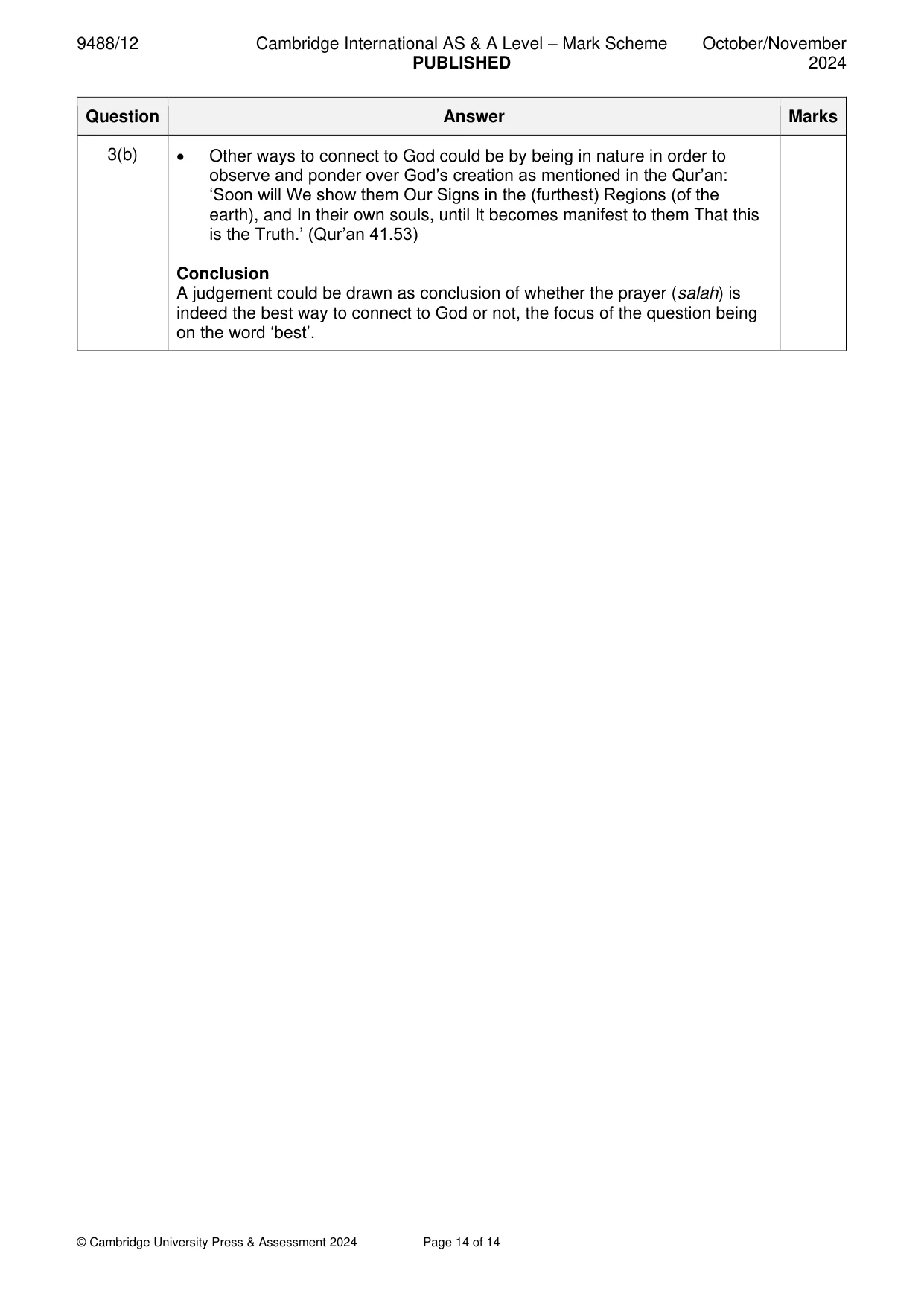
9488/12 Cambridge International AS & A Level – Mark Scheme PUBLISHED October/November 2024 © Cambridge University Press & Assessment 2024 Page 14 of 14 Question Answer Marks 3(b) • Other ways to connect to God could be by being in nature in order to observe and ponder over God’s creation as mentioned in the Qur’an: ‘Soon will We show them Our Signs in the (furthest) Regions (of the earth), and In their own souls, until It becomes manifest to them That this is the Truth.’ (Qur’an 41.53) Conclusion A judgement could be drawn as conclusion of whether the prayer (salah) is indeed the best way to connect to God or not, the focus of the question being on the word ‘best’.
What you needed in this session
Cambridge’s own grade thresholds for 2024 Oct/Nov, Paper 1 · Variant 2. A higher threshold means an easier paper — the bar moves with how the cohort did.