Cambridge A Level Islamic Studies 9488 — 2024 May/June Paper 1 · Variant 2
9488/12/M/J/24 · 50 marks · 90 min
The question paper and its mark scheme, free to read here and free to download. This is Cambridge’s own paper, exactly as it was sat.
Question paper4 pages
Mark scheme16 pages
Answers below. Sit the paper first if you are practising.
Paper as text
Question paper, page 1
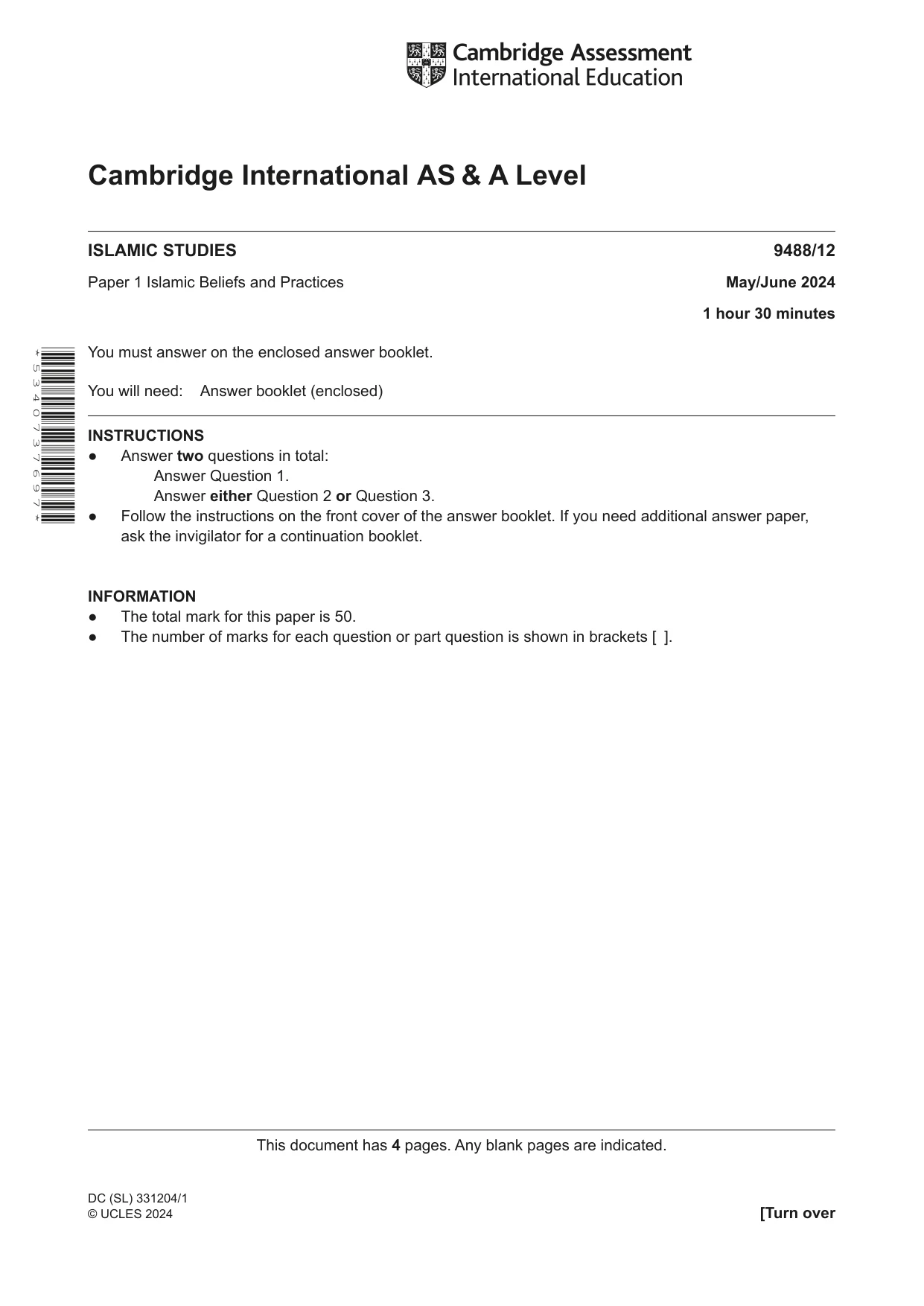
This document has 4 pages. Any blank pages are indicated. [Turn over Cambridge International AS & A Level ISLAMIC STUDIES 9488/12 Paper 1 Islamic Beliefs and Practices May/June 2024 1 hour 30 minutes You must answer on the enclosed answer booklet. You will need: Answer booklet (enclosed) INSTRUCTIONS ● Answer two questions in total: Answer Question 1. Answer either Question 2 or Question 3. ● Follow the instructions on the front cover of the answer booklet. If you need additional answer paper, ask the invigilator for a continuation booklet. INFORMATION ● The total mark for this paper is 50. ● The number of marks for each question or part question is shown in brackets [ ]. * 5 3 4 0 7 3 7 6 9 7 * DC (SL) 331204/1 © UCLES 2024
Question paper, page 2
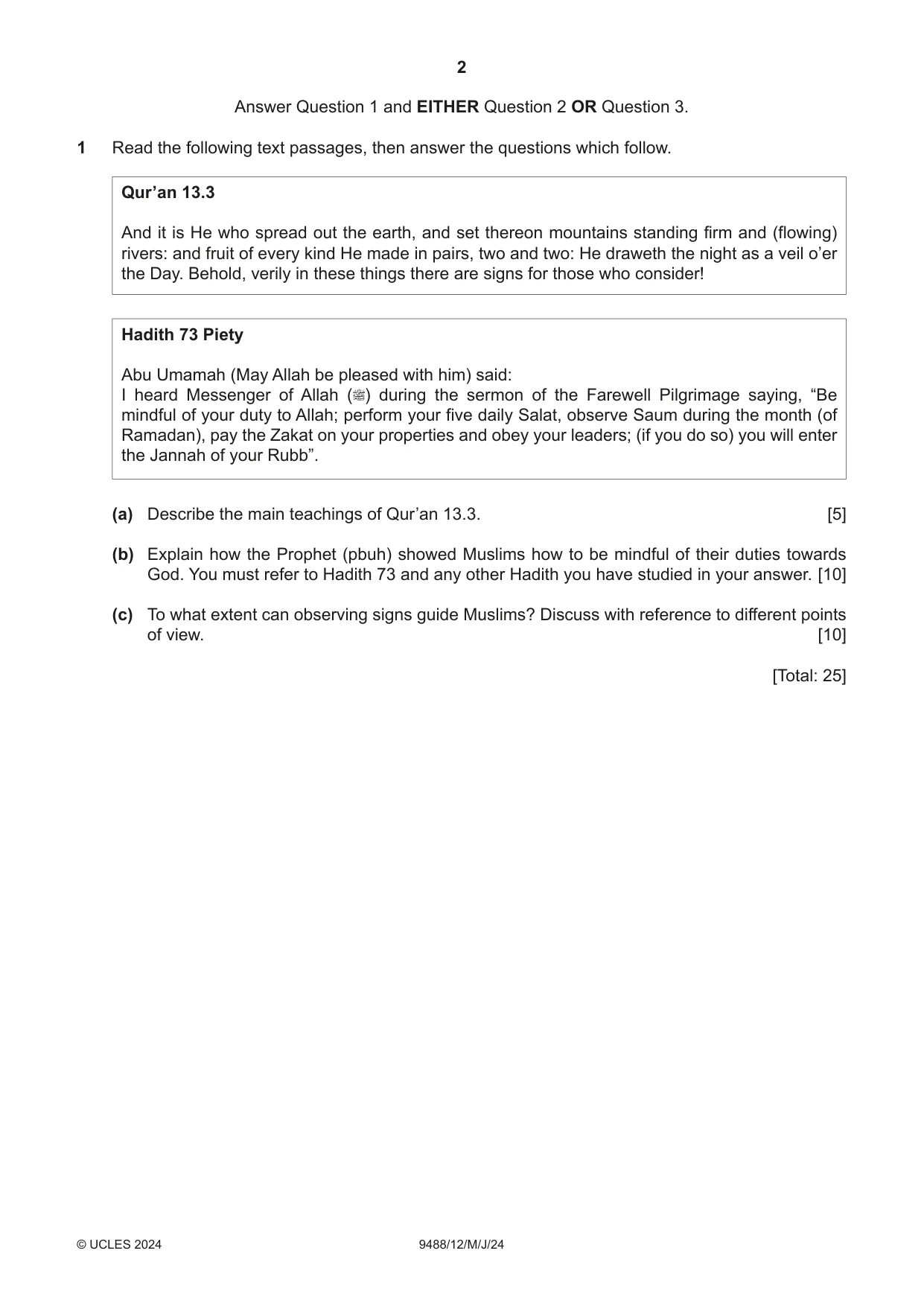
2 9488/12/M/J/24 © UCLES 2024 Answer Question 1 and EITHER Question 2 OR Question 3. 1 Read the following text passages, then answer the questions which follow. Qur’an 13.3 And it is He who spread out the earth, and set thereon mountains standing firm and (flowing) rivers: and fruit of every kind He made in pairs, two and two: He draweth the night as a veil o’er the Day. Behold, verily in these things there are signs for those who consider! Hadith 73 Piety Abu Umamah (May Allah be pleased with him) said: I heard Messenger of Allah (ﷺ) during the sermon of the Farewell Pilgrimage saying, “Be mindful of your duty to Allah; perform your five daily Salat, observe Saum during the month (of Ramadan), pay the Zakat on your properties and obey your leaders; (if you do so) you will enter the Jannah of your Rubb”. (a) Describe the main teachings of Qur’an 13.3. [5] (b) Explain how the Prophet (pbuh) showed Muslims how to be mindful of their duties towards God. You must refer to Hadith 73 and any other Hadith you have studied in your answer. [10] (c) To what extent can observing signs guide Muslims? Discuss with reference to different points of view. [10] [Total: 25]
Question paper, page 3
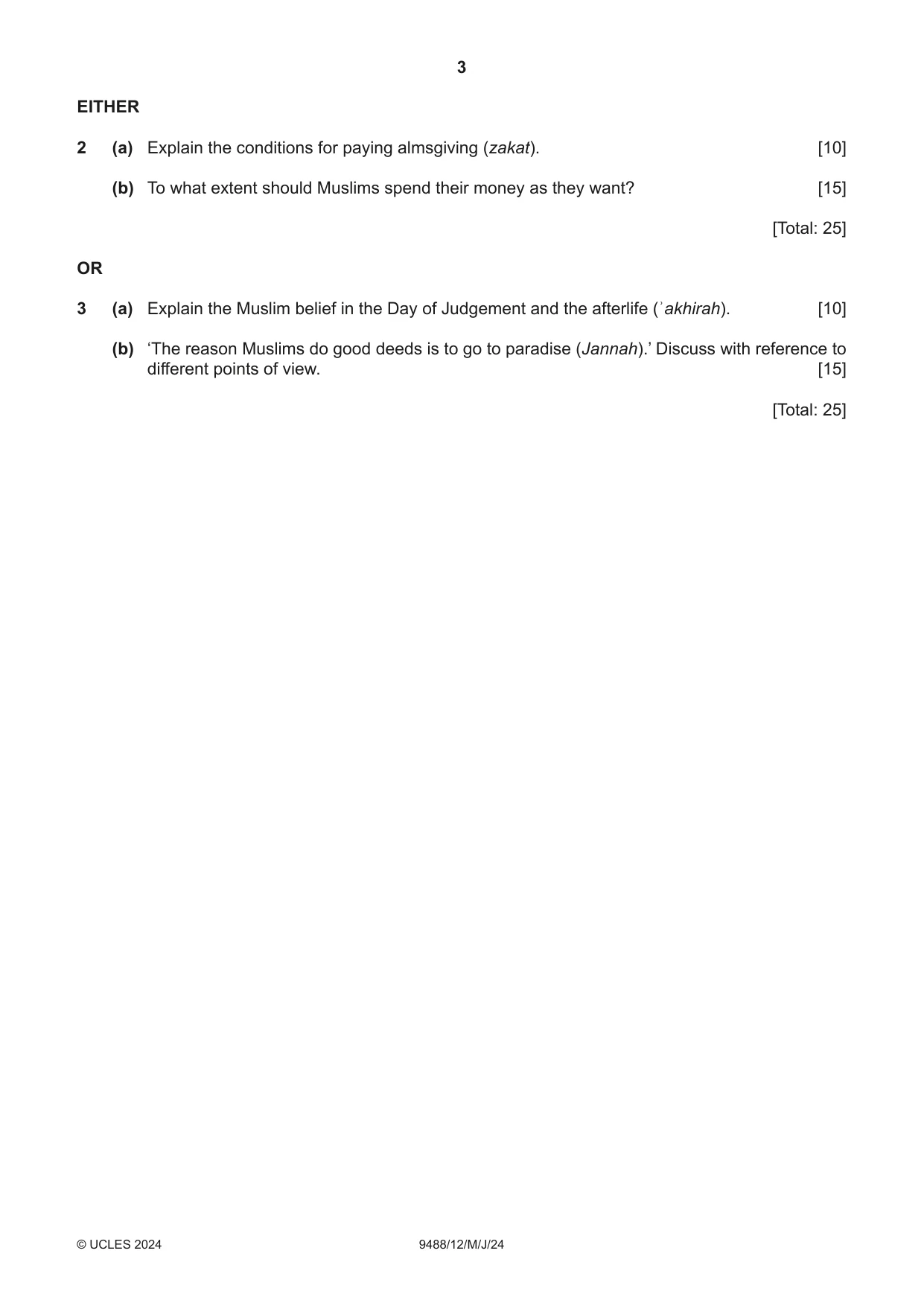
3 9488/12/M/J/24 © UCLES 2024 EITHER 2 (a) Explain the conditions for paying almsgiving (zakat). [10] (b) To what extent should Muslims spend their money as they want? [15] [Total: 25] OR 3 (a) Explain the Muslim belief in the Day of Judgement and the afterlife (ʾakhirah). [10] (b) ‘The reason Muslims do good deeds is to go to paradise (Jannah).’ Discuss with reference to different points of view. [15] [Total: 25]
Question paper, page 4
4 9488/12/M/J/24 © UCLES 2024 Permission to reproduce items where third-party owned material protected by copyright is included has been sought and cleared where possible. Every reasonable effort has been made by the publisher (UCLES) to trace copyright holders, but if any items requiring clearance have unwittingly been included, the publisher will be pleased to make amends at the earliest possible opportunity. To avoid the issue of disclosure of answer-related information to candidates, all copyright acknowledgements are reproduced online in the Cambridge Assessment International Education Copyright Acknowledgements Booklet. This is produced for each series of examinations and is freely available to download at www.cambridgeinternational.org after the live examination series. Cambridge Assessment International Education is part of Cambridge Assessment. Cambridge Assessment is the brand name of the University of Cambridge Local Examinations Syndicate (UCLES), which is a department of the University of Cambridge. BLANK PAGE
Mark scheme, page 1
This document consists of 16 printed pages. © Cambridge University Press & Assessment 2024 [Turn over Cambridge International AS & A Level ISLAMIC STUDIES 9488/12 Paper 1 Islamic Beliefs and Practices May/June 2024 MARK SCHEME Maximum Mark: 50 Published This mark scheme is published as an aid to teachers and candidates, to indicate the requirements of the examination. It shows the basis on which Examiners were instructed to award marks. It does not indicate the details of the discussions that took place at an Examiners’ meeting before marking began, which would have considered the acceptability of alternative answers. Mark schemes should be read in conjunction with the question paper and the Principal Examiner Report for Teachers. Cambridge International will not enter into discussions about these mark schemes. Cambridge International is publishing the mark schemes for the May/June 2024 series for most Cambridge IGCSE, Cambridge International A and AS Level and Cambridge Pre-U components, and some Cambridge O Level components.
Mark scheme, page 2
9488/12 Cambridge International AS & A Level – Mark Scheme PUBLISHED May/June 2024 © Cambridge University Press & Assessment 2024 Page 2 of 16 Generic Marking Principles These general marking principles must be applied by all examiners when marking candidate answers. They should be applied alongside the specific content of the mark scheme or generic level descriptions for a question. Each question paper and mark scheme will also comply with these marking principles. GENERIC MARKING PRINCIPLE 1: Marks must be awarded in line with: the specific content of the mark scheme or the generic level descriptors for the question the specific skills defined in the mark scheme or in the generic level descriptors for the question the standard of response required by a candidate as exemplified by the standardisation scripts. GENERIC MARKING PRINCIPLE 2: Marks awarded are always whole marks (not half marks, or other fractions). GENERIC MARKING PRINCIPLE 3: Marks must be awarded positively: marks are awarded for correct/valid answers, as defined in the mark scheme. However, credit is given for valid answers which go beyond the scope of the syllabus and mark scheme, referring to your Team Leader as appropriate marks are awarded when candidates clearly demonstrate what they know and can do marks are not deducted for errors marks are not deducted for omissions answers should only be judged on the quality of spelling, punctuation and grammar when these features are specifically assessed by the question as indicated by the mark scheme. The meaning, however, should be unambiguous. GENERIC MARKING PRINCIPLE 4: Rules must be applied consistently, e.g. in situations where candidates have not followed instructions or in the application of generic level descriptors.
Mark scheme, page 3
9488/12 Cambridge International AS & A Level – Mark Scheme PUBLISHED May/June 2024 © Cambridge University Press & Assessment 2024 Page 3 of 16 GENERIC MARKING PRINCIPLE 5: Marks should be awarded using the full range of marks defined in the mark scheme for the question (however; the use of the full mark range may be limited according to the quality of the candidate responses seen). GENERIC MARKING PRINCIPLE 6: Marks awarded are based solely on the requirements as defined in the mark scheme. Marks should not be awarded with grade thresholds or grade descriptors in mind.
Mark scheme, page 4
9488/12 Cambridge International AS & A Level – Mark Scheme PUBLISHED May/June 2024 © Cambridge University Press & Assessment 2024 Page 4 of 16 Generic levels of response descriptors These level descriptors address assessment objectives (AOs) 1 and 2 and should be used in conjunction with the indicative content for each question in the mark scheme. Assessment objectives AO1 Knowledge and understanding Demonstrate knowledge and understanding of Islamic teachings, texts, beliefs and practices including their relevance for individual Muslims and communities. AO2 Analysis and evaluation Analyse, evaluate and discuss evidence, points of view and issues in Islam. Generic marking principles (a) Examiners should use the performance summary statements at the top of the descriptors to help to identify a level which matches the candidate’s response. However, the final decision on the band and the mark within the band should be made on the basis of all the descriptors in the level and not primarily using the performance summary statement. (b) Examiners should start at the lowest level and if the answer meets all the criteria, they should then move to the next level and so on. The Examiner should repeat this process until there is a match between the overall answer and the level descriptor. Examiners should use a best-fit approach when deciding upon the level, it is possible for a different level to be chosen for each AO. (c) If the Examiner identifies all aspects of the level descriptor within the answer then the highest mark for the level should be given. Examiners should also make reference to the indicative content when deciding on the mark within a level to ensure that there is sufficient relevant content evident within the answer for the level and mark. Examiners should be prepared to credit material in answers which is not contained in the indicative content. (d) The Examiner may need to make a judgement within a level or between two or more level statements. Once a ‘best-fit’ level statement has been identified, use the following guidance to decide on a specific mark: Where the candidate’s work convincingly meets the level statement, you should award the highest mark. Where the candidate’s work adequately meets the level statement, you should award the most appropriate mark in the middle of the range. Where the candidate’s work just meets the level statement, you should award the lowest mark.
Mark scheme, page 5
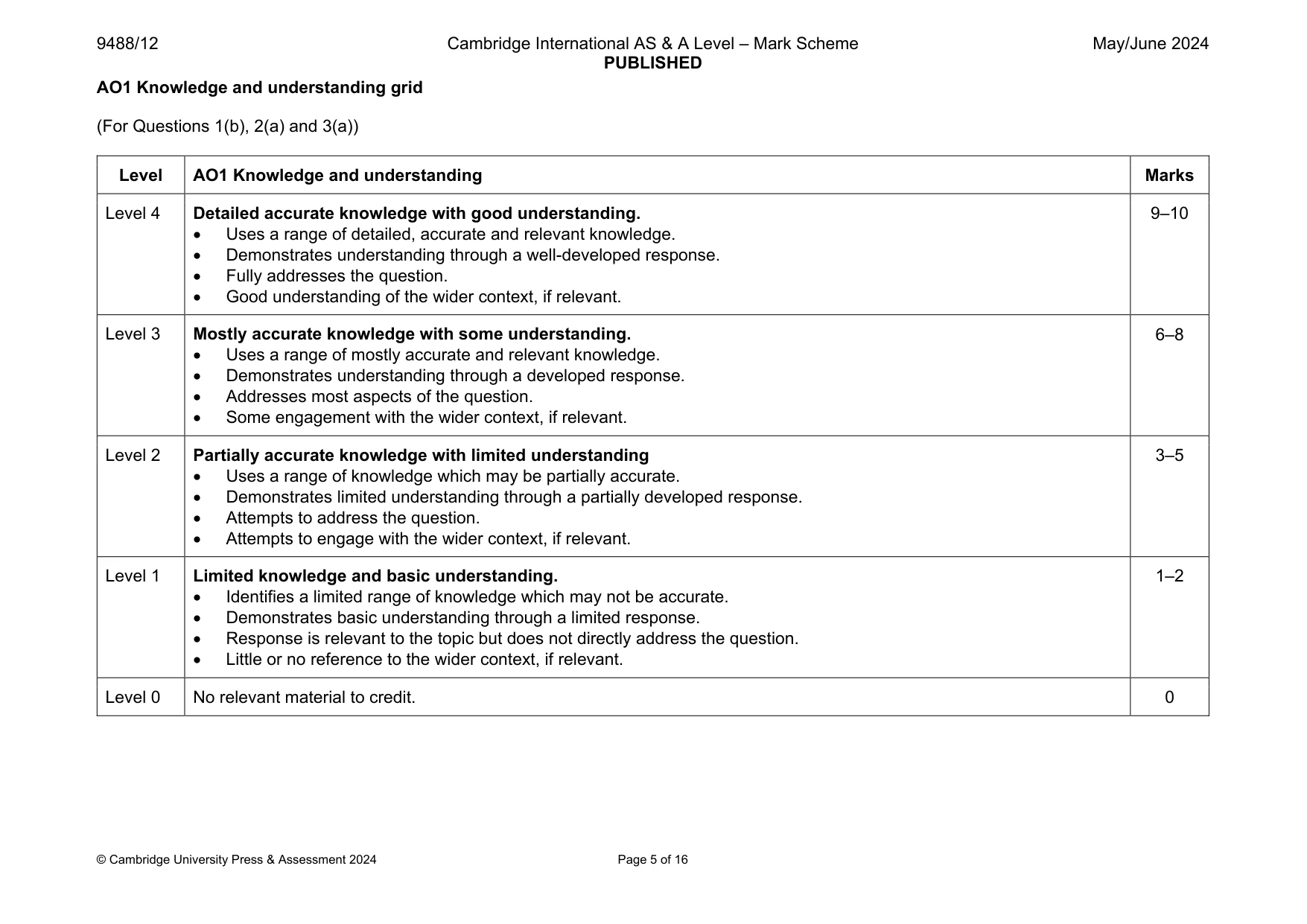
9488/12 Cambridge International AS & A Level – Mark Scheme PUBLISHED May/June 2024 © Cambridge University Press & Assessment 2024 Page 5 of 16 AO1 Knowledge and understanding grid (For Questions 1(b), 2(a) and 3(a)) Level AO1 Knowledge and understanding Marks Level 4 Detailed accurate knowledge with good understanding. Uses a range of detailed, accurate and relevant knowledge. Demonstrates understanding through a well-developed response. Fully addresses the question. Good understanding of the wider context, if relevant. 9–10 Level 3 Mostly accurate knowledge with some understanding. Uses a range of mostly accurate and relevant knowledge. Demonstrates understanding through a developed response. Addresses most aspects of the question. Some engagement with the wider context, if relevant. 6–8 Level 2 Partially accurate knowledge with limited understanding Uses a range of knowledge which may be partially accurate. Demonstrates limited understanding through a partially developed response. Attempts to address the question. Attempts to engage with the wider context, if relevant. 3–5 Level 1 Limited knowledge and basic understanding. Identifies a limited range of knowledge which may not be accurate. Demonstrates basic understanding through a limited response. Response is relevant to the topic but does not directly address the question. Little or no reference to the wider context, if relevant. 1–2 Level 0 No relevant material to credit. 0
Mark scheme, page 6
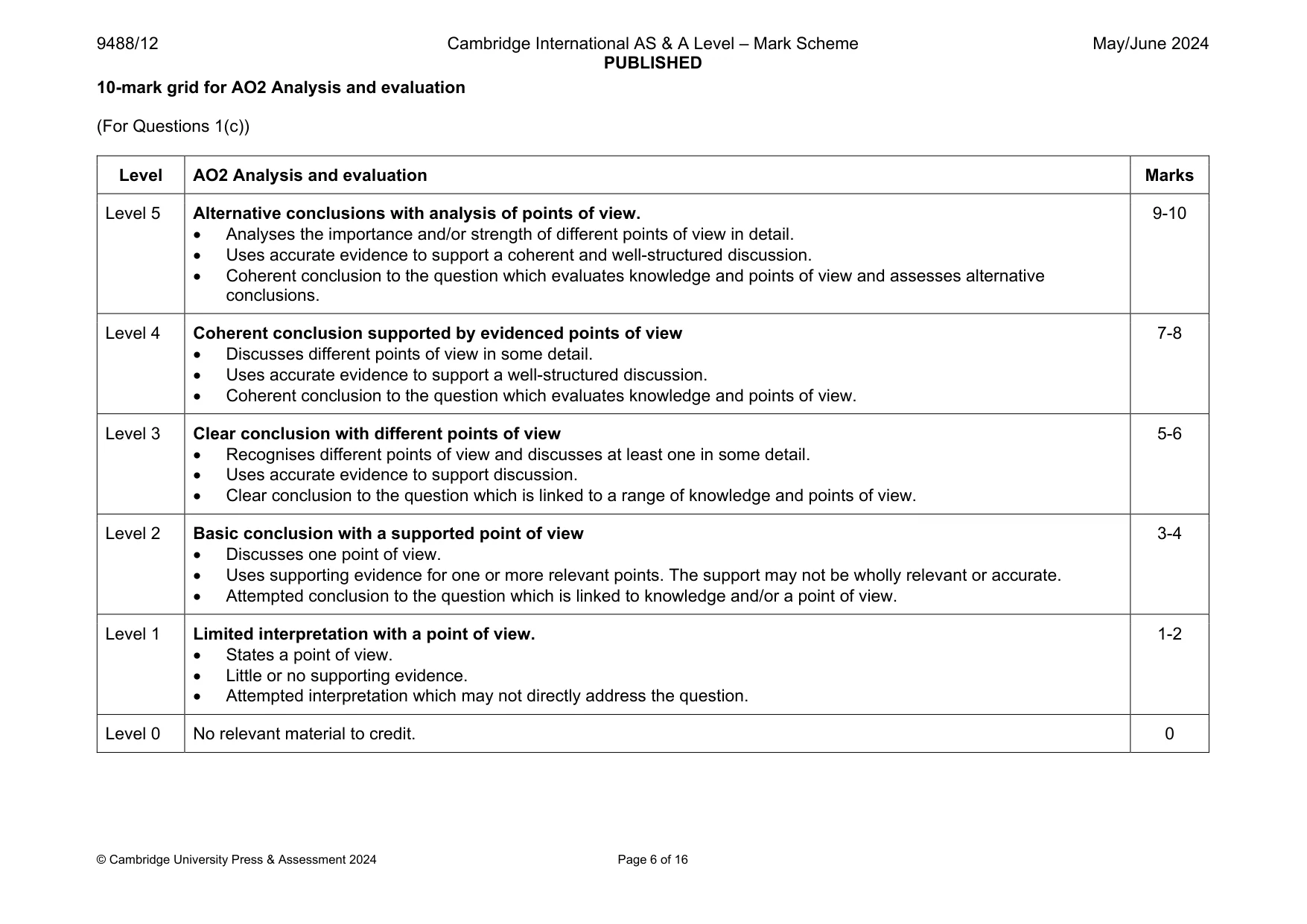
9488/12 Cambridge International AS & A Level – Mark Scheme PUBLISHED May/June 2024 © Cambridge University Press & Assessment 2024 Page 6 of 16 10-mark grid for AO2 Analysis and evaluation (For Questions 1(c)) Level AO2 Analysis and evaluation Marks Level 5 Alternative conclusions with analysis of points of view. Analyses the importance and/or strength of different points of view in detail. Uses accurate evidence to support a coherent and well-structured discussion. Coherent conclusion to the question which evaluates knowledge and points of view and assesses alternative conclusions. 9-10 Level 4 Coherent conclusion supported by evidenced points of view Discusses different points of view in some detail. Uses accurate evidence to support a well-structured discussion. Coherent conclusion to the question which evaluates knowledge and points of view. 7-8 Level 3 Clear conclusion with different points of view Recognises different points of view and discusses at least one in some detail. Uses accurate evidence to support discussion. Clear conclusion to the question which is linked to a range of knowledge and points of view. 5-6 Level 2 Basic conclusion with a supported point of view Discusses one point of view. Uses supporting evidence for one or more relevant points. The support may not be wholly relevant or accurate. Attempted conclusion to the question which is linked to knowledge and/or a point of view. 3-4 Level 1 Limited interpretation with a point of view. States a point of view. Little or no supporting evidence. Attempted interpretation which may not directly address the question. 1-2 Level 0 No relevant material to credit. 0
Mark scheme, page 7
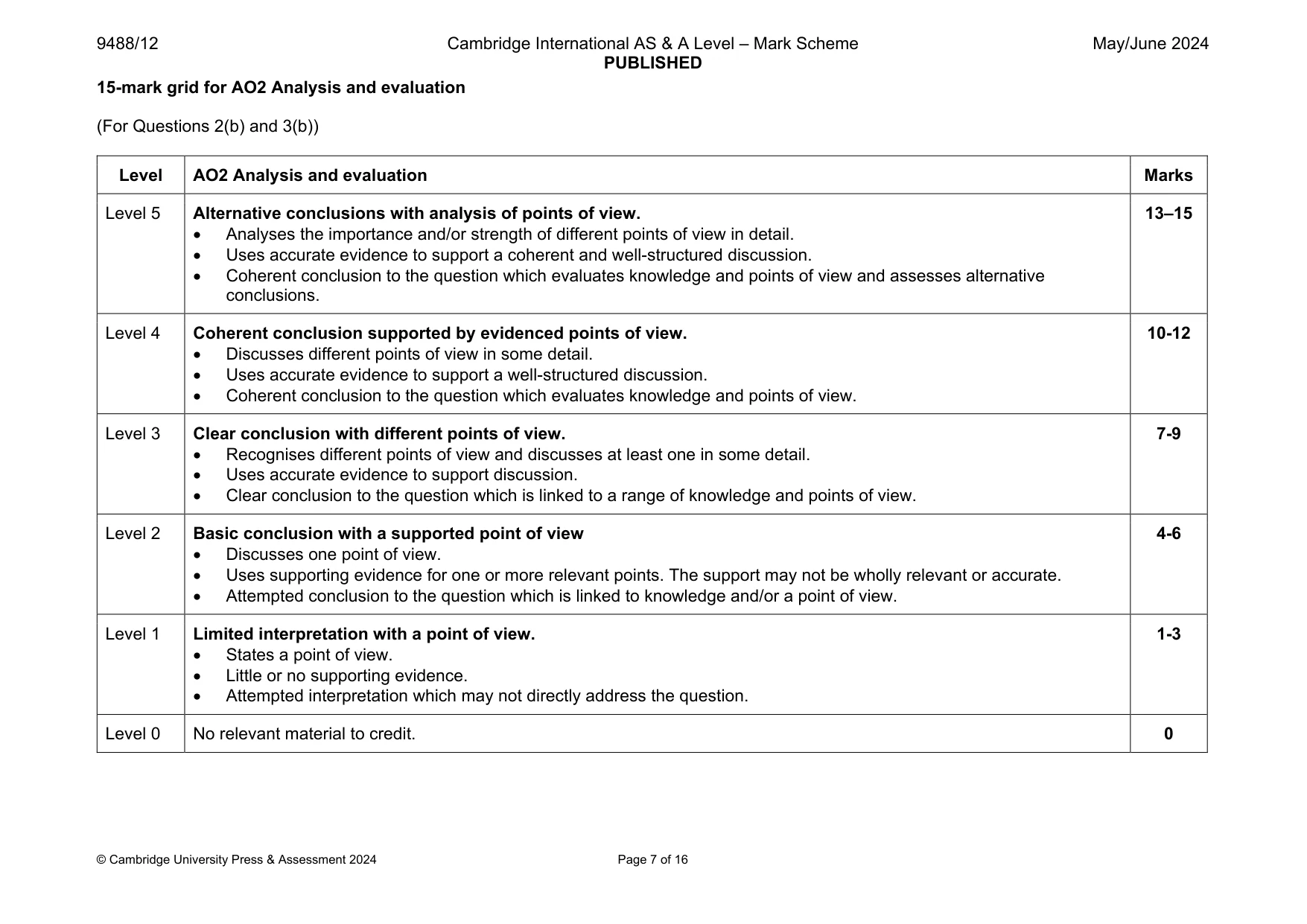
9488/12 Cambridge International AS & A Level – Mark Scheme PUBLISHED May/June 2024 © Cambridge University Press & Assessment 2024 Page 7 of 16 15-mark grid for AO2 Analysis and evaluation (For Questions 2(b) and 3(b)) Level AO2 Analysis and evaluation Marks Level 5 Alternative conclusions with analysis of points of view. Analyses the importance and/or strength of different points of view in detail. Uses accurate evidence to support a coherent and well-structured discussion. Coherent conclusion to the question which evaluates knowledge and points of view and assesses alternative conclusions. 13–15 Level 4 Coherent conclusion supported by evidenced points of view. Discusses different points of view in some detail. Uses accurate evidence to support a well-structured discussion. Coherent conclusion to the question which evaluates knowledge and points of view. 10-12 Level 3 Clear conclusion with different points of view. Recognises different points of view and discusses at least one in some detail. Uses accurate evidence to support discussion. Clear conclusion to the question which is linked to a range of knowledge and points of view. 7-9 Level 2 Basic conclusion with a supported point of view Discusses one point of view. Uses supporting evidence for one or more relevant points. The support may not be wholly relevant or accurate. Attempted conclusion to the question which is linked to knowledge and/or a point of view. 4-6 Level 1 Limited interpretation with a point of view. States a point of view. Little or no supporting evidence. Attempted interpretation which may not directly address the question. 1-3 Level 0 No relevant material to credit. 0
Mark scheme, page 8
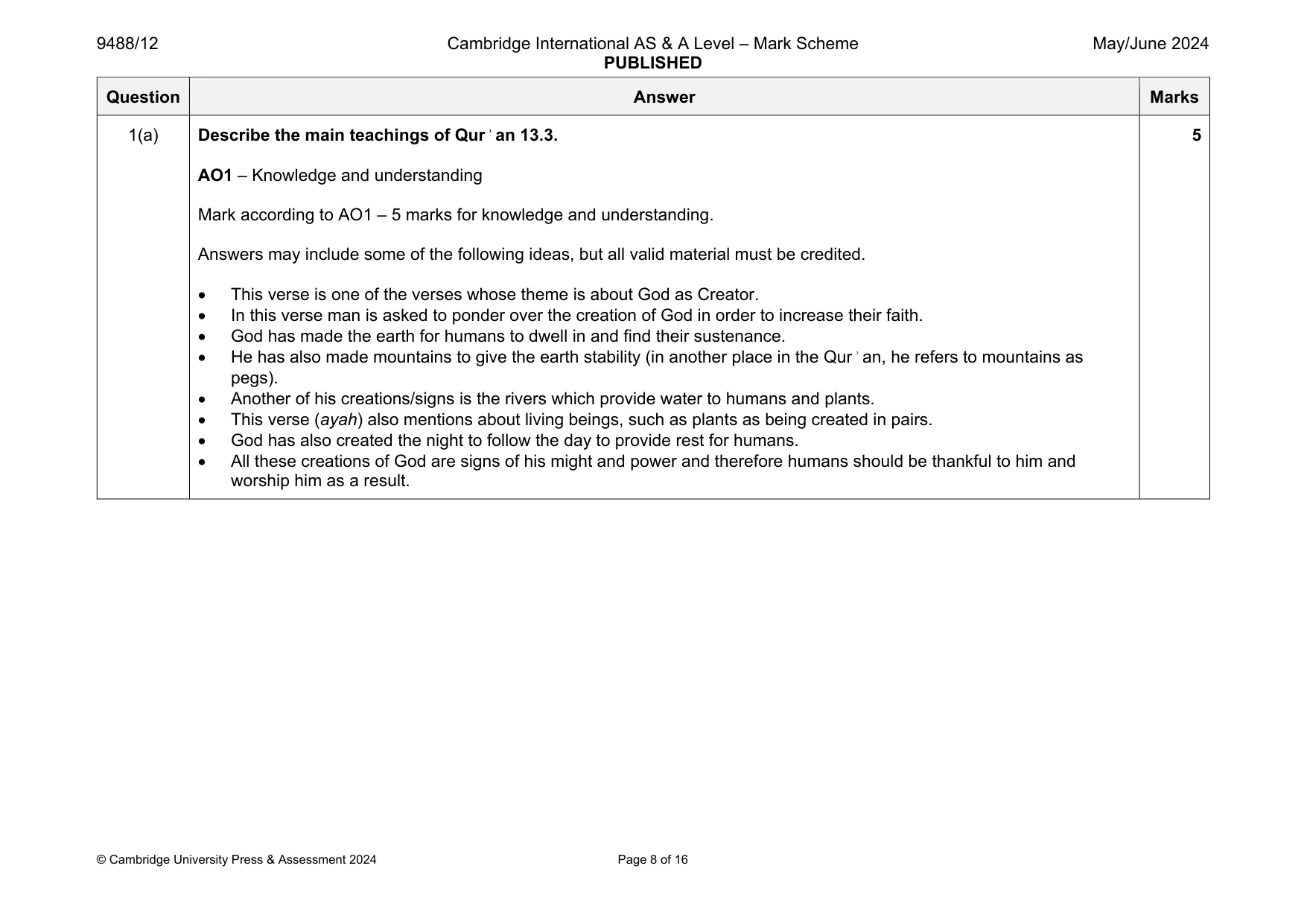
9488/12 Cambridge International AS & A Level – Mark Scheme PUBLISHED May/June 2024 © Cambridge University Press & Assessment 2024 Page 8 of 16 Question Answer Marks 1(a) Describe the main teachings of Qurʾan 13.3. AO1 – Knowledge and understanding Mark according to AO1 – 5 marks for knowledge and understanding. Answers may include some of the following ideas, but all valid material must be credited. This verse is one of the verses whose theme is about God as Creator. In this verse man is asked to ponder over the creation of God in order to increase their faith. God has made the earth for humans to dwell in and find their sustenance. He has also made mountains to give the earth stability (in another place in the Qurʾan, he refers to mountains as pegs). Another of his creations/signs is the rivers which provide water to humans and plants. This verse (ayah) also mentions about living beings, such as plants as being created in pairs. God has also created the night to follow the day to provide rest for humans. All these creations of God are signs of his might and power and therefore humans should be thankful to him and worship him as a result. 5
Mark scheme, page 9
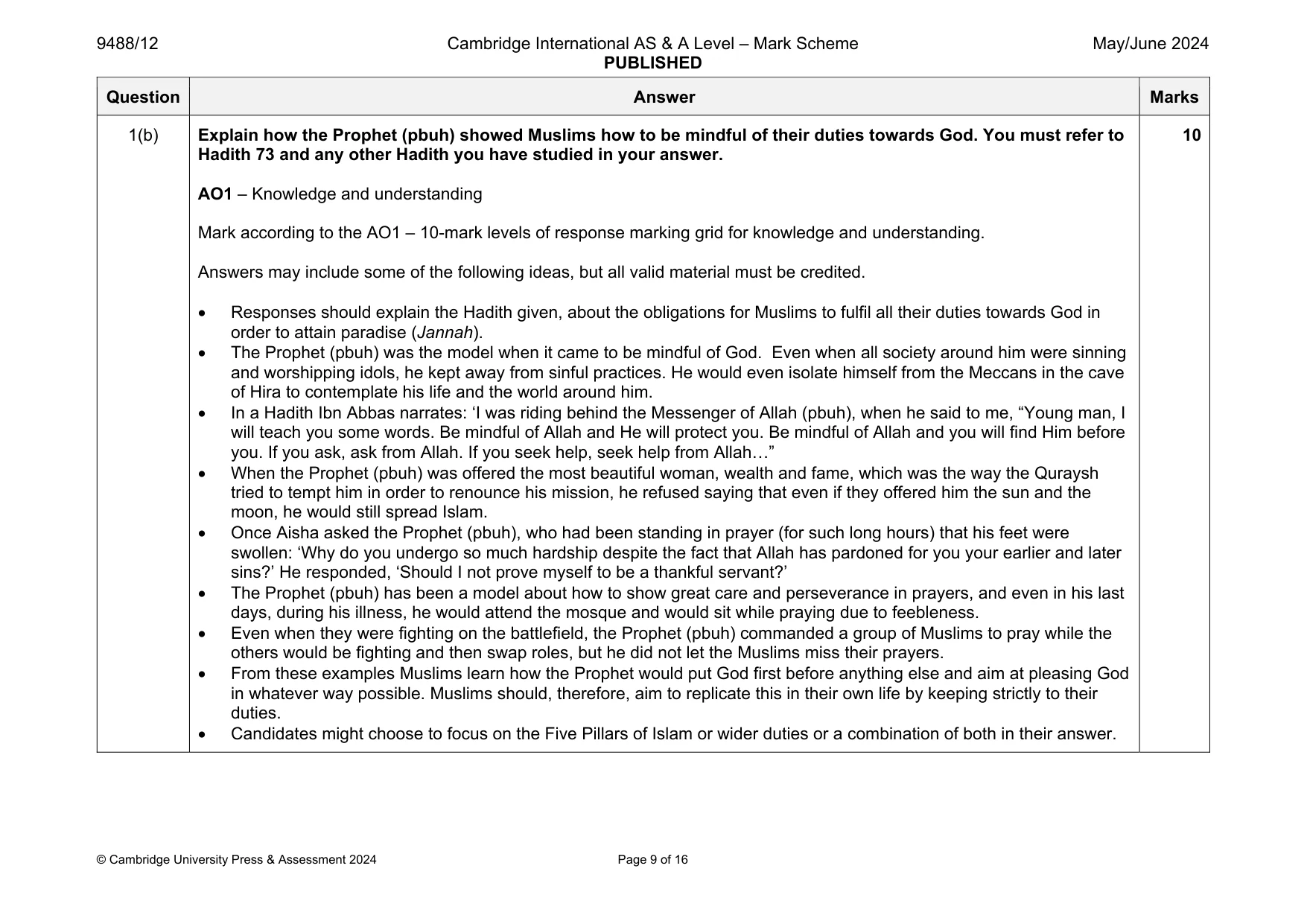
9488/12 Cambridge International AS & A Level – Mark Scheme PUBLISHED May/June 2024 © Cambridge University Press & Assessment 2024 Page 9 of 16 Question Answer Marks 1(b) Explain how the Prophet (pbuh) showed Muslims how to be mindful of their duties towards God. You must refer to Hadith 73 and any other Hadith you have studied in your answer. AO1 – Knowledge and understanding Mark according to the AO1 – 10-mark levels of response marking grid for knowledge and understanding. Answers may include some of the following ideas, but all valid material must be credited. Responses should explain the Hadith given, about the obligations for Muslims to fulfil all their duties towards God in order to attain paradise (Jannah). The Prophet (pbuh) was the model when it came to be mindful of God. Even when all society around him were sinning and worshipping idols, he kept away from sinful practices. He would even isolate himself from the Meccans in the cave of Hira to contemplate his life and the world around him. In a Hadith Ibn Abbas narrates: ‘I was riding behind the Messenger of Allah (pbuh), when he said to me, “Young man, I will teach you some words. Be mindful of Allah and He will protect you. Be mindful of Allah and you will find Him before you. If you ask, ask from Allah. If you seek help, seek help from Allah…” When the Prophet (pbuh) was offered the most beautiful woman, wealth and fame, which was the way the Quraysh tried to tempt him in order to renounce his mission, he refused saying that even if they offered him the sun and the moon, he would still spread Islam. Once Aisha asked the Prophet (pbuh), who had been standing in prayer (for such long hours) that his feet were swollen: ‘Why do you undergo so much hardship despite the fact that Allah has pardoned for you your earlier and later sins?’ He responded, ‘Should I not prove myself to be a thankful servant?’ The Prophet (pbuh) has been a model about how to show great care and perseverance in prayers, and even in his last days, during his illness, he would attend the mosque and would sit while praying due to feebleness. Even when they were fighting on the battlefield, the Prophet (pbuh) commanded a group of Muslims to pray while the others would be fighting and then swap roles, but he did not let the Muslims miss their prayers. From these examples Muslims learn how the Prophet would put God first before anything else and aim at pleasing God in whatever way possible. Muslims should, therefore, aim to replicate this in their own life by keeping strictly to their duties. Candidates might choose to focus on the Five Pillars of Islam or wider duties or a combination of both in their answer. 10
Mark scheme, page 10
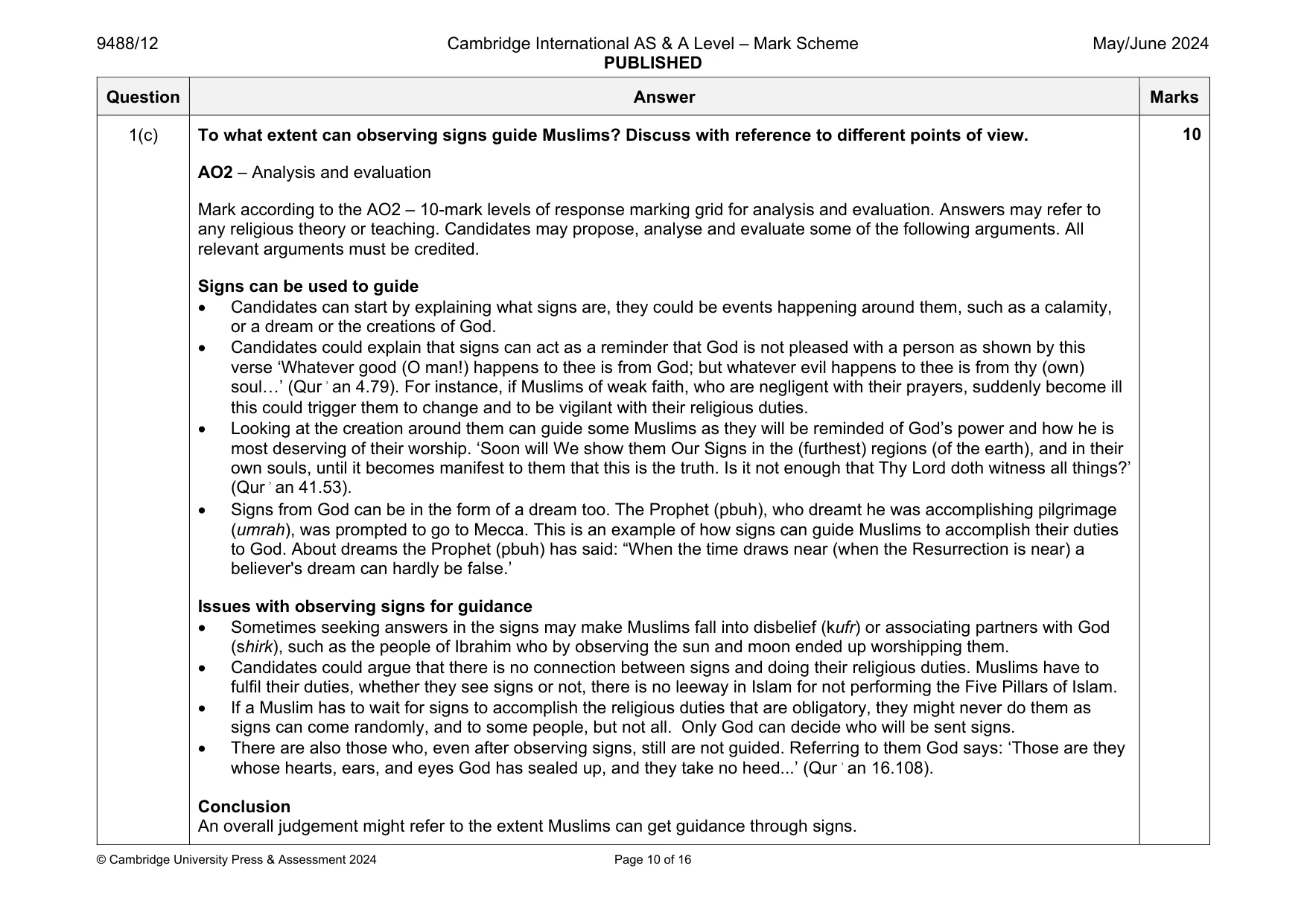
9488/12 Cambridge International AS & A Level – Mark Scheme PUBLISHED May/June 2024 © Cambridge University Press & Assessment 2024 Page 10 of 16 Question Answer Marks 1(c) To what extent can observing signs guide Muslims? Discuss with reference to different points of view. AO2 – Analysis and evaluation Mark according to the AO2 – 10-mark levels of response marking grid for analysis and evaluation. Answers may refer to any religious theory or teaching. Candidates may propose, analyse and evaluate some of the following arguments. All relevant arguments must be credited. Signs can be used to guide Candidates can start by explaining what signs are, they could be events happening around them, such as a calamity, or a dream or the creations of God. Candidates could explain that signs can act as a reminder that God is not pleased with a person as shown by this verse ‘Whatever good (O man!) happens to thee is from God; but whatever evil happens to thee is from thy (own) soul…’ (Qurʾan 4.79). For instance, if Muslims of weak faith, who are negligent with their prayers, suddenly become ill this could trigger them to change and to be vigilant with their religious duties. Looking at the creation around them can guide some Muslims as they will be reminded of God’s power and how he is most deserving of their worship. ‘Soon will We show them Our Signs in the (furthest) regions (of the earth), and in their own souls, until it becomes manifest to them that this is the truth. Is it not enough that Thy Lord doth witness all things?’ (Qurʾan 41.53). Signs from God can be in the form of a dream too. The Prophet (pbuh), who dreamt he was accomplishing pilgrimage (umrah), was prompted to go to Mecca. This is an example of how signs can guide Muslims to accomplish their duties to God. About dreams the Prophet (pbuh) has said: “When the time draws near (when the Resurrection is near) a believer's dream can hardly be false.’ Issues with observing signs for guidance Sometimes seeking answers in the signs may make Muslims fall into disbelief (kufr) or associating partners with God (shirk), such as the people of Ibrahim who by observing the sun and moon ended up worshipping them. Candidates could argue that there is no connection between signs and doing their religious duties. Muslims have to fulfil their duties, whether they see signs or not, there is no leeway in Islam for not performing the Five Pillars of Islam. If a Muslim has to wait for signs to accomplish the religious duties that are obligatory, they might never do them as signs can come randomly, and to some people, but not all. Only God can decide who will be sent signs. There are also those who, even after observing signs, still are not guided. Referring to them God says: ‘Those are they whose hearts, ears, and eyes God has sealed up, and they take no heed...’ (Qurʾan 16.108). Conclusion An overall judgement might refer to the extent Muslims can get guidance through signs. 10
Mark scheme, page 11
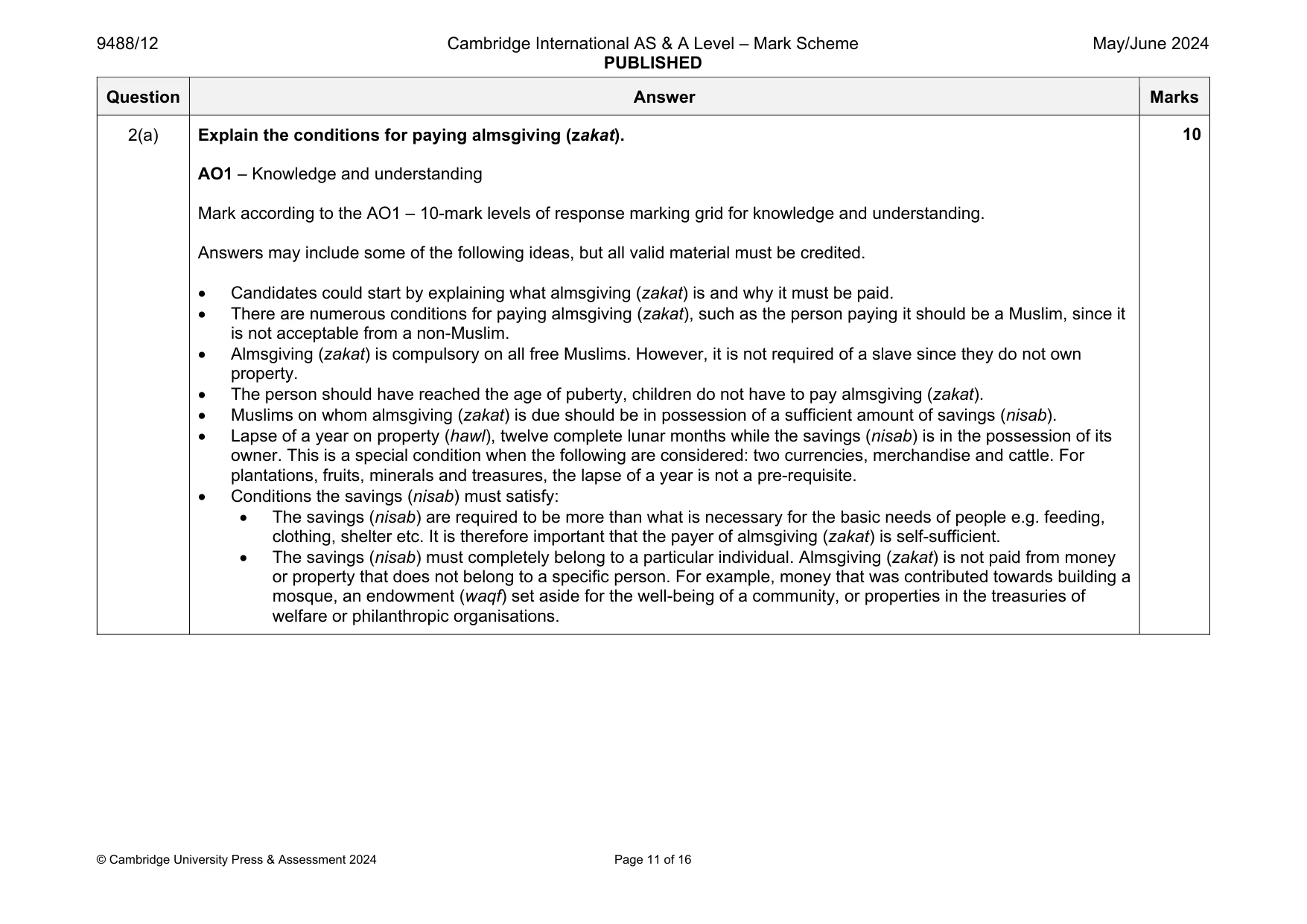
9488/12 Cambridge International AS & A Level – Mark Scheme PUBLISHED May/June 2024 © Cambridge University Press & Assessment 2024 Page 11 of 16 Question Answer Marks 2(a) Explain the conditions for paying almsgiving (zakat). AO1 – Knowledge and understanding Mark according to the AO1 – 10-mark levels of response marking grid for knowledge and understanding. Answers may include some of the following ideas, but all valid material must be credited. Candidates could start by explaining what almsgiving (zakat) is and why it must be paid. There are numerous conditions for paying almsgiving (zakat), such as the person paying it should be a Muslim, since it is not acceptable from a non-Muslim. Almsgiving (zakat) is compulsory on all free Muslims. However, it is not required of a slave since they do not own property. The person should have reached the age of puberty, children do not have to pay almsgiving (zakat). Muslims on whom almsgiving (zakat) is due should be in possession of a sufficient amount of savings (nisab). Lapse of a year on property (hawl), twelve complete lunar months while the savings (nisab) is in the possession of its owner. This is a special condition when the following are considered: two currencies, merchandise and cattle. For plantations, fruits, minerals and treasures, the lapse of a year is not a pre-requisite. Conditions the savings (nisab) must satisfy: The savings (nisab) are required to be more than what is necessary for the basic needs of people e.g. feeding, clothing, shelter etc. It is therefore important that the payer of almsgiving (zakat) is self-sufficient. The savings (nisab) must completely belong to a particular individual. Almsgiving (zakat) is not paid from money or property that does not belong to a specific person. For example, money that was contributed towards building a mosque, an endowment (waqf) set aside for the well-being of a community, or properties in the treasuries of welfare or philanthropic organisations. 10
Mark scheme, page 12
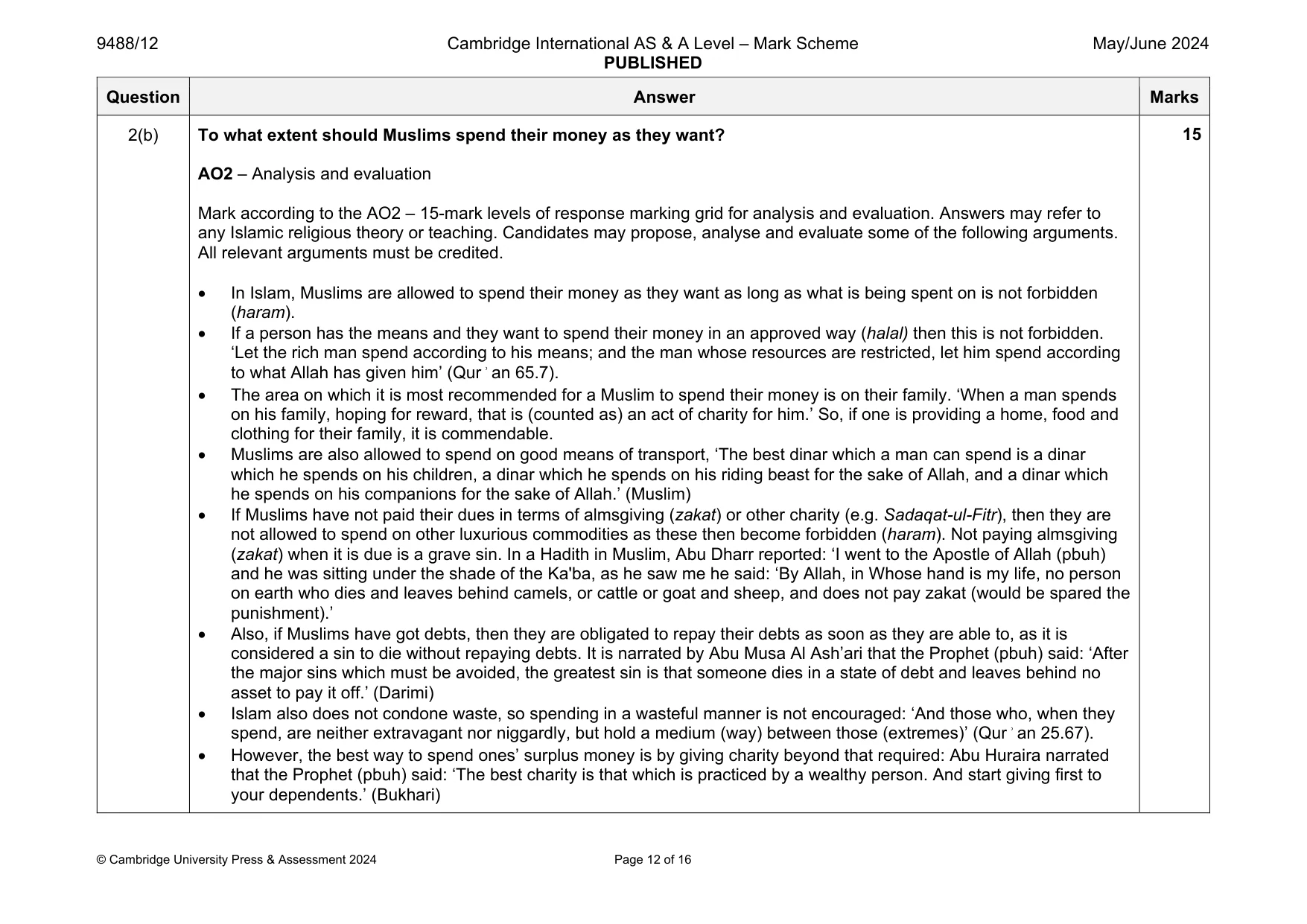
9488/12 Cambridge International AS & A Level – Mark Scheme PUBLISHED May/June 2024 © Cambridge University Press & Assessment 2024 Page 12 of 16 Question Answer Marks 2(b) To what extent should Muslims spend their money as they want? AO2 – Analysis and evaluation Mark according to the AO2 – 15-mark levels of response marking grid for analysis and evaluation. Answers may refer to any Islamic religious theory or teaching. Candidates may propose, analyse and evaluate some of the following arguments. All relevant arguments must be credited. In Islam, Muslims are allowed to spend their money as they want as long as what is being spent on is not forbidden (haram). If a person has the means and they want to spend their money in an approved way (halal) then this is not forbidden. ‘Let the rich man spend according to his means; and the man whose resources are restricted, let him spend according to what Allah has given him’ (Qurʾan 65.7). The area on which it is most recommended for a Muslim to spend their money is on their family. ‘When a man spends on his family, hoping for reward, that is (counted as) an act of charity for him.’ So, if one is providing a home, food and clothing for their family, it is commendable. Muslims are also allowed to spend on good means of transport, ‘The best dinar which a man can spend is a dinar which he spends on his children, a dinar which he spends on his riding beast for the sake of Allah, and a dinar which he spends on his companions for the sake of Allah.’ (Muslim) If Muslims have not paid their dues in terms of almsgiving (zakat) or other charity (e.g. Sadaqat-ul-Fitr), then they are not allowed to spend on other luxurious commodities as these then become forbidden (haram). Not paying almsgiving (zakat) when it is due is a grave sin. In a Hadith in Muslim, Abu Dharr reported: ‘I went to the Apostle of Allah (pbuh) and he was sitting under the shade of the Ka'ba, as he saw me he said: ‘By Allah, in Whose hand is my life, no person on earth who dies and leaves behind camels, or cattle or goat and sheep, and does not pay zakat (would be spared the punishment).’ Also, if Muslims have got debts, then they are obligated to repay their debts as soon as they are able to, as it is considered a sin to die without repaying debts. It is narrated by Abu Musa Al Ash’ari that the Prophet (pbuh) said: ‘After the major sins which must be avoided, the greatest sin is that someone dies in a state of debt and leaves behind no asset to pay it off.’ (Darimi) Islam also does not condone waste, so spending in a wasteful manner is not encouraged: ‘And those who, when they spend, are neither extravagant nor niggardly, but hold a medium (way) between those (extremes)’ (Qurʾan 25.67). However, the best way to spend ones’ surplus money is by giving charity beyond that required: Abu Huraira narrated that the Prophet (pbuh) said: ‘The best charity is that which is practiced by a wealthy person. And start giving first to your dependents.’ (Bukhari) 15
Mark scheme, page 13
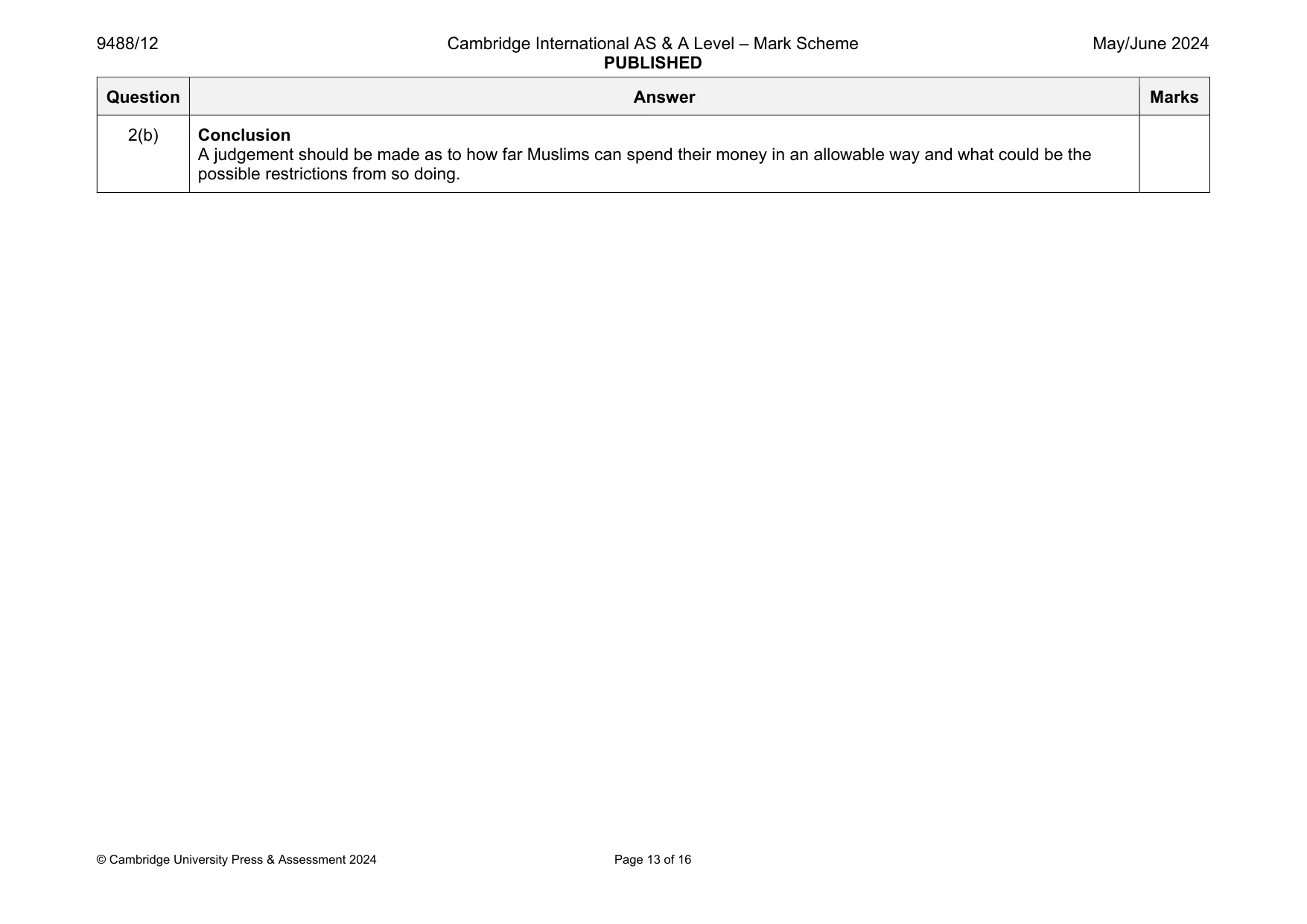
9488/12 Cambridge International AS & A Level – Mark Scheme PUBLISHED May/June 2024 © Cambridge University Press & Assessment 2024 Page 13 of 16 Question Answer Marks 2(b) Conclusion A judgement should be made as to how far Muslims can spend their money in an allowable way and what could be the possible restrictions from so doing.
Mark scheme, page 14
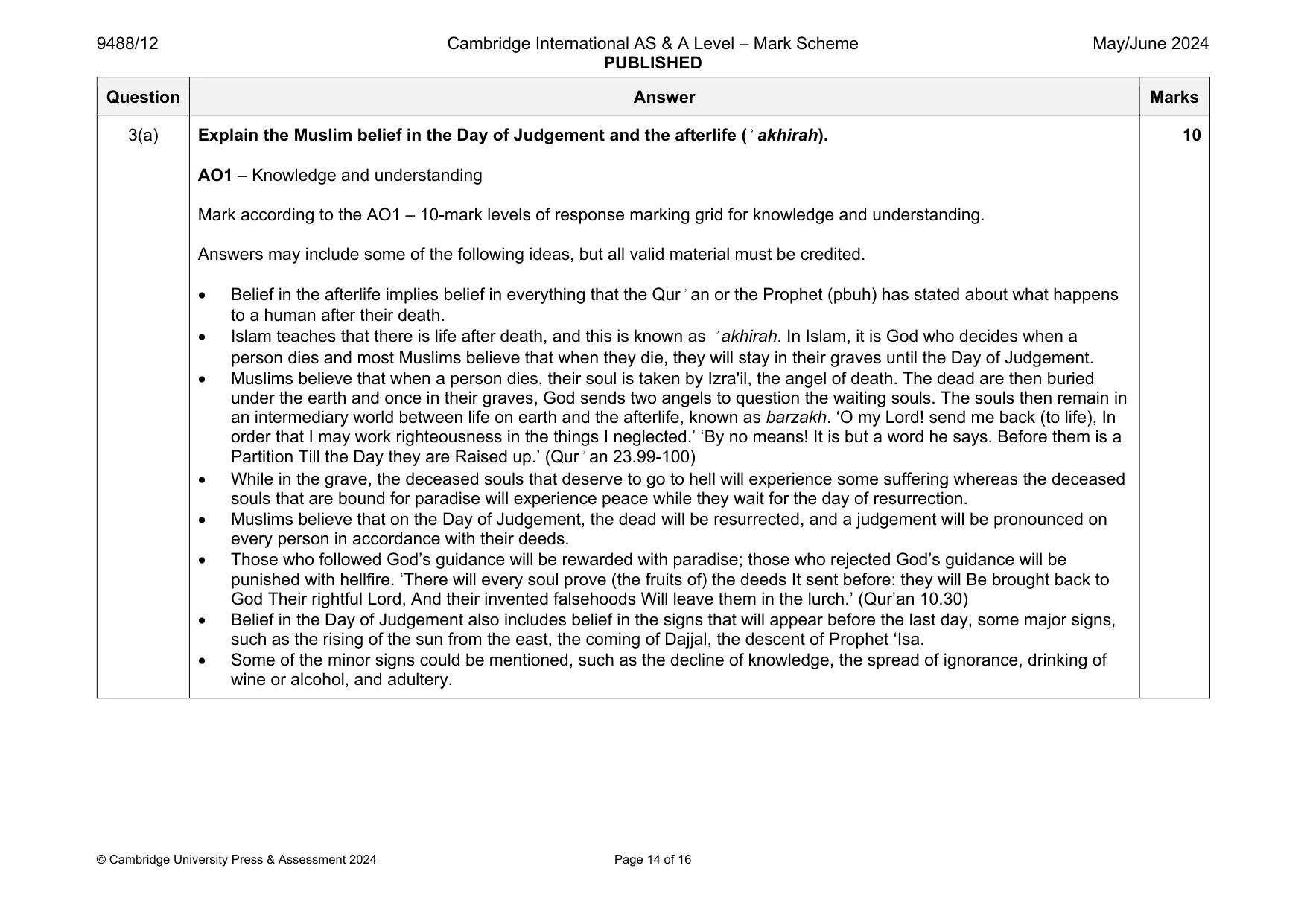
9488/12 Cambridge International AS & A Level – Mark Scheme PUBLISHED May/June 2024 © Cambridge University Press & Assessment 2024 Page 14 of 16 Question Answer Marks 3(a) Explain the Muslim belief in the Day of Judgement and the afterlife (ʾakhirah). AO1 – Knowledge and understanding Mark according to the AO1 – 10-mark levels of response marking grid for knowledge and understanding. Answers may include some of the following ideas, but all valid material must be credited. Belief in the afterlife implies belief in everything that the Qurʾan or the Prophet (pbuh) has stated about what happens to a human after their death. Islam teaches that there is life after death, and this is known as ʾakhirah. In Islam, it is God who decides when a person dies and most Muslims believe that when they die, they will stay in their graves until the Day of Judgement. Muslims believe that when a person dies, their soul is taken by Izra'il, the angel of death. The dead are then buried under the earth and once in their graves, God sends two angels to question the waiting souls. The souls then remain in an intermediary world between life on earth and the afterlife, known as barzakh. ‘O my Lord! send me back (to life), In order that I may work righteousness in the things I neglected.’ ‘By no means! It is but a word he says. Before them is a Partition Till the Day they are Raised up.’ (Qurʾan 23.99-100) While in the grave, the deceased souls that deserve to go to hell will experience some suffering whereas the deceased souls that are bound for paradise will experience peace while they wait for the day of resurrection. Muslims believe that on the Day of Judgement, the dead will be resurrected, and a judgement will be pronounced on every person in accordance with their deeds. Those who followed God’s guidance will be rewarded with paradise; those who rejected God’s guidance will be punished with hellfire. ‘There will every soul prove (the fruits of) the deeds It sent before: they will Be brought back to God Their rightful Lord, And their invented falsehoods Will leave them in the lurch.’ (Qur’an 10.30) Belief in the Day of Judgement also includes belief in the signs that will appear before the last day, some major signs, such as the rising of the sun from the east, the coming of Dajjal, the descent of Prophet ‘Isa. Some of the minor signs could be mentioned, such as the decline of knowledge, the spread of ignorance, drinking of wine or alcohol, and adultery. 10
Mark scheme, page 15
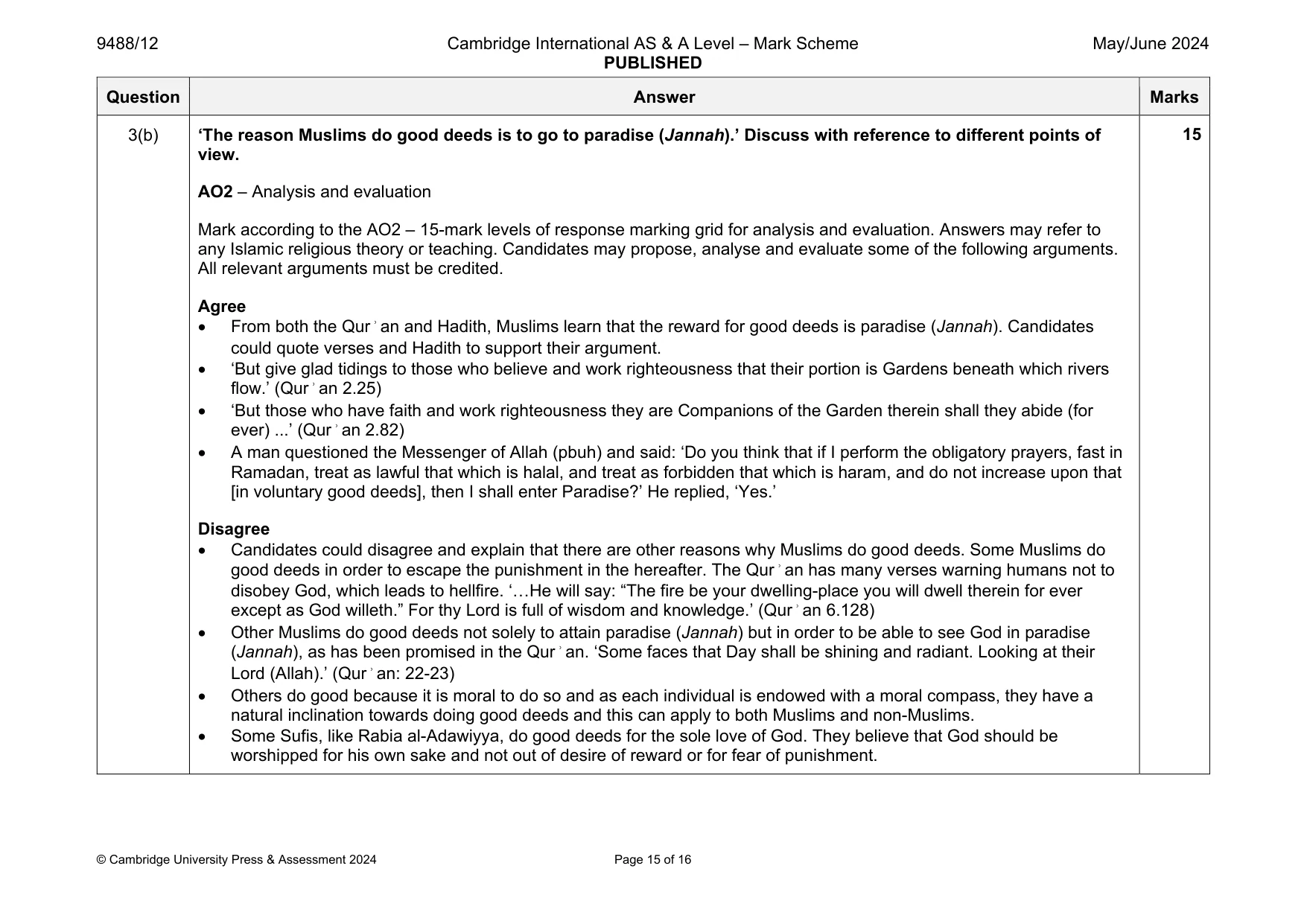
9488/12 Cambridge International AS & A Level – Mark Scheme PUBLISHED May/June 2024 © Cambridge University Press & Assessment 2024 Page 15 of 16 Question Answer Marks 3(b) ‘The reason Muslims do good deeds is to go to paradise (Jannah).’ Discuss with reference to different points of view. AO2 – Analysis and evaluation Mark according to the AO2 – 15-mark levels of response marking grid for analysis and evaluation. Answers may refer to any Islamic religious theory or teaching. Candidates may propose, analyse and evaluate some of the following arguments. All relevant arguments must be credited. Agree From both the Qurʾan and Hadith, Muslims learn that the reward for good deeds is paradise (Jannah). Candidates could quote verses and Hadith to support their argument. ‘But give glad tidings to those who believe and work righteousness that their portion is Gardens beneath which rivers flow.’ (Qurʾan 2.25) ‘But those who have faith and work righteousness they are Companions of the Garden therein shall they abide (for ever) ...’ (Qurʾan 2.82) A man questioned the Messenger of Allah (pbuh) and said: ‘Do you think that if I perform the obligatory prayers, fast in Ramadan, treat as lawful that which is halal, and treat as forbidden that which is haram, and do not increase upon that [in voluntary good deeds], then I shall enter Paradise?’ He replied, ‘Yes.’ Disagree Candidates could disagree and explain that there are other reasons why Muslims do good deeds. Some Muslims do good deeds in order to escape the punishment in the hereafter. The Qurʾan has many verses warning humans not to disobey God, which leads to hellfire. ‘…He will say: “The fire be your dwelling-place you will dwell therein for ever except as God willeth.” For thy Lord is full of wisdom and knowledge.’ (Qurʾan 6.128) Other Muslims do good deeds not solely to attain paradise (Jannah) but in order to be able to see God in paradise (Jannah), as has been promised in the Qurʾan. ‘Some faces that Day shall be shining and radiant. Looking at their Lord (Allah).’ (Qurʾan: 22-23) Others do good because it is moral to do so and as each individual is endowed with a moral compass, they have a natural inclination towards doing good deeds and this can apply to both Muslims and non-Muslims. Some Sufis, like Rabia al-Adawiyya, do good deeds for the sole love of God. They believe that God should be worshipped for his own sake and not out of desire of reward or for fear of punishment. 15
Mark scheme, page 16
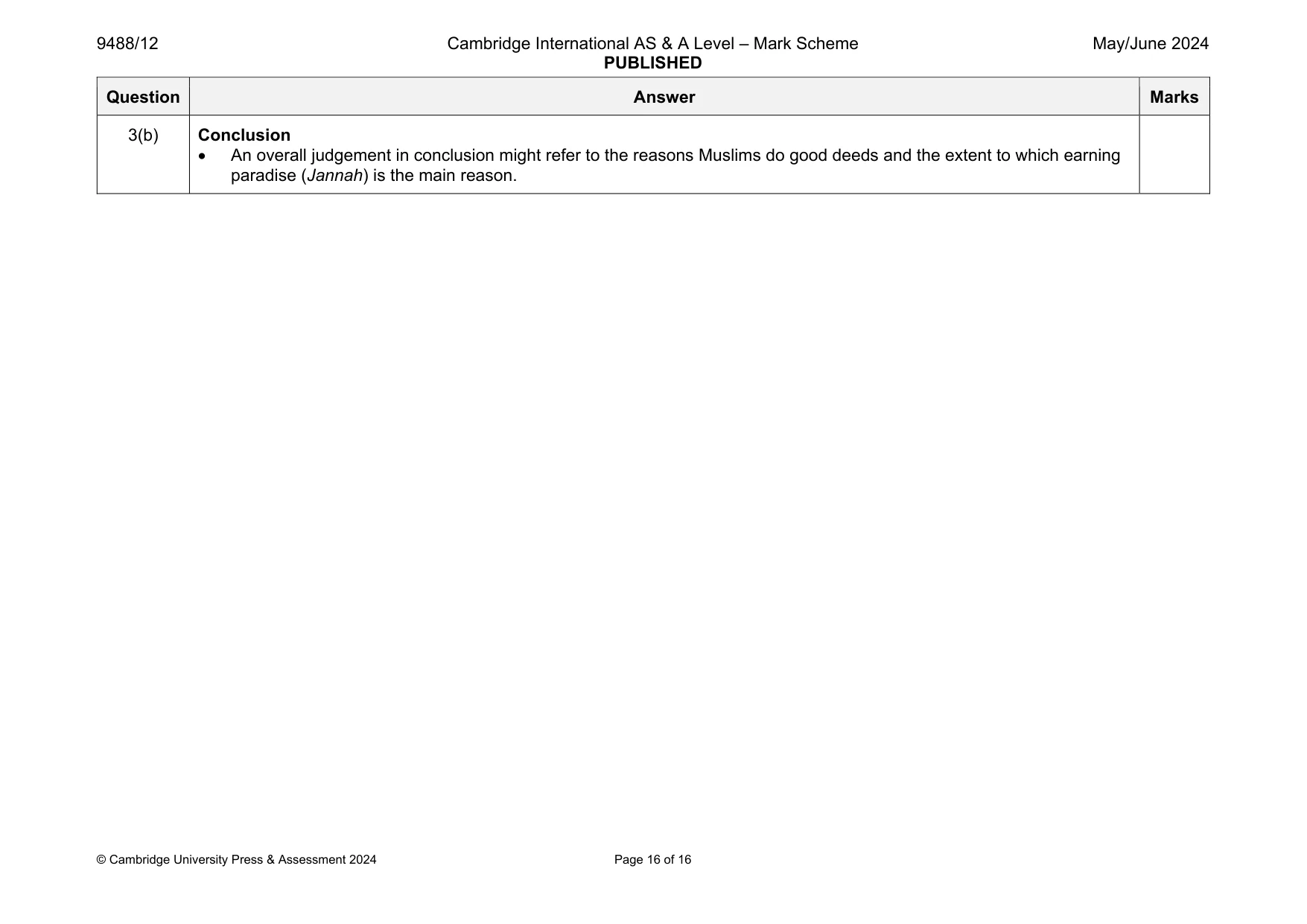
9488/12 Cambridge International AS & A Level – Mark Scheme PUBLISHED May/June 2024 © Cambridge University Press & Assessment 2024 Page 16 of 16 Question Answer Marks 3(b) Conclusion An overall judgement in conclusion might refer to the reasons Muslims do good deeds and the extent to which earning paradise (Jannah) is the main reason.
What you needed in this session
Cambridge’s own grade thresholds for 2024 May/June, Paper 1 · Variant 2. A higher threshold means an easier paper — the bar moves with how the cohort did.