Cambridge A Level Islamic Studies 9488 — 2022 May/June Paper 1 · Variant 2
9488/12/M/J/22 · 50 marks · ≈56 min
The question paper and its mark scheme, free to read here and free to download. This is Cambridge’s own paper, exactly as it was sat.
Question paper4 pages
Mark scheme15 pages
Answers below. Sit the paper first if you are practising.
Paper as text
Question paper, page 1
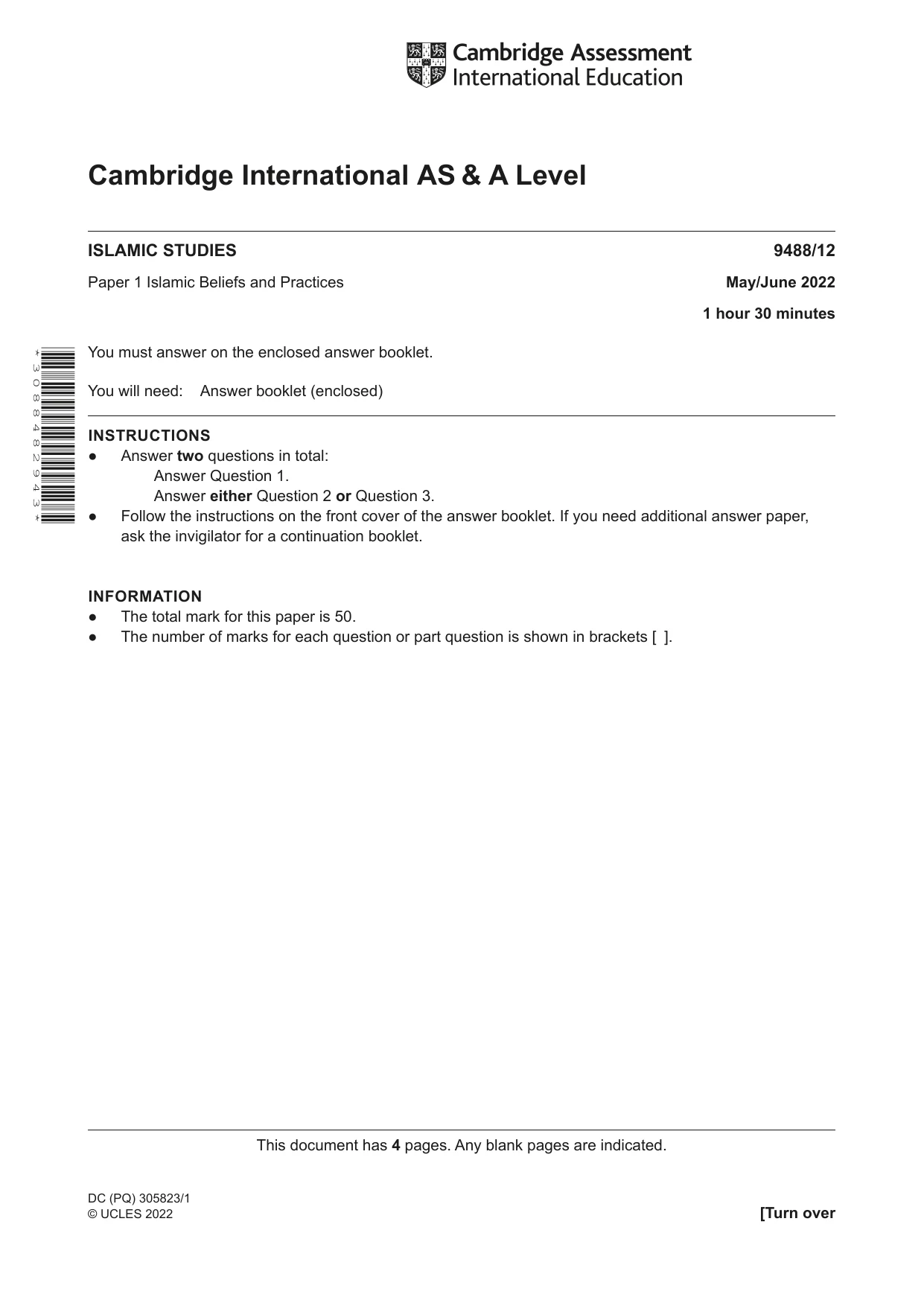
This document has 4 pages. Any blank pages are indicated. [Turn over Cambridge International AS & A Level DC (PQ) 305823/1 © UCLES 2022 ISLAMIC STUDIES 9488/12 Paper 1 Islamic Beliefs and Practices May/June 2022 1 hour 30 minutes You must answer on the enclosed answer booklet. You will need: Answer booklet (enclosed) INSTRUCTIONS ● Answer two questions in total: Answer Question 1. Answer either Question 2 or Question 3. ● Follow the instructions on the front cover of the answer booklet. If you need additional answer paper, ask the invigilator for a continuation booklet. INFORMATION ● The total mark for this paper is 50. ● The number of marks for each question or part question is shown in brackets [ ]. * 3 0 8 8 4 8 2 9 4 3 *
Question paper, page 2
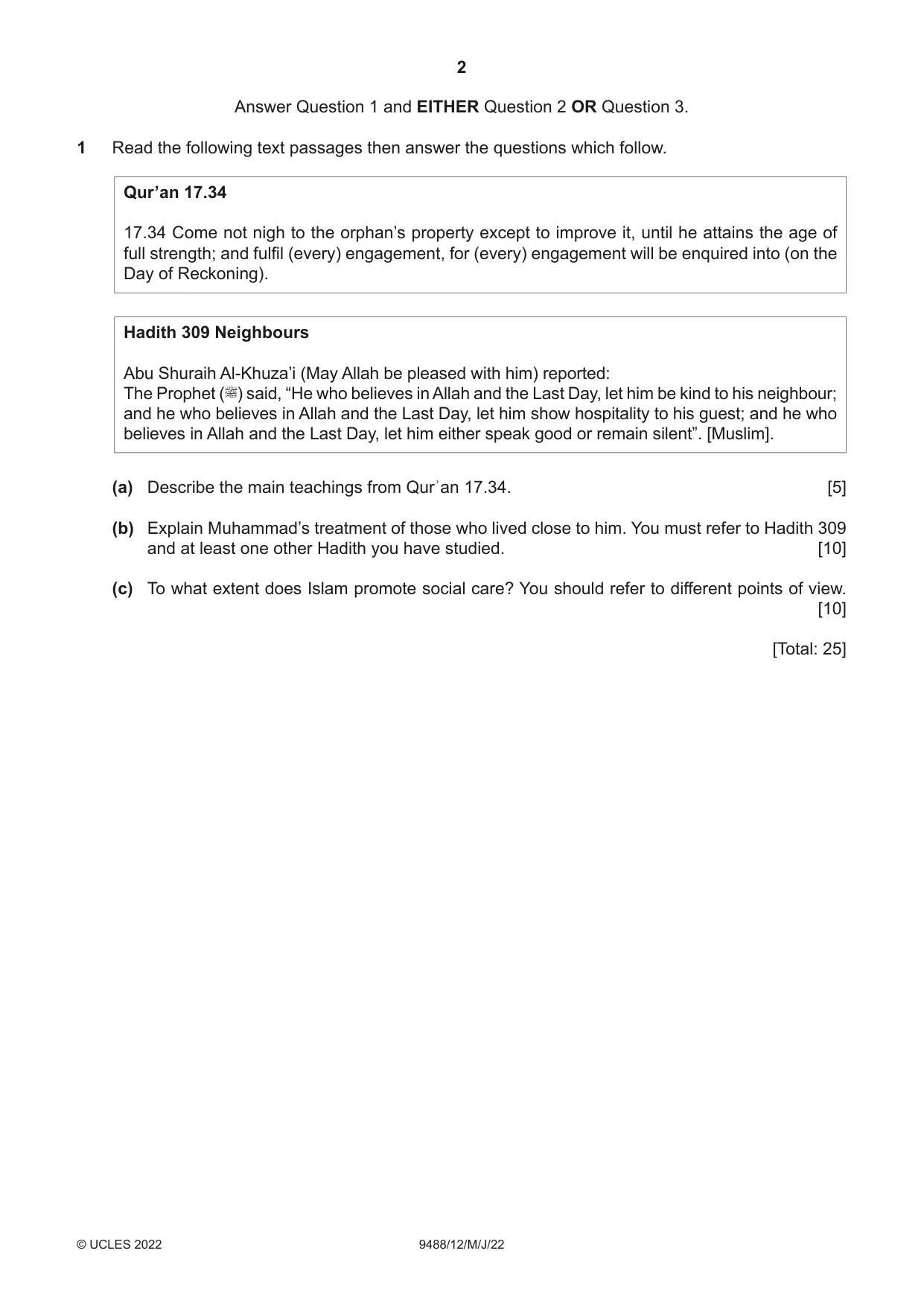
2 9488/12/M/J/22 © UCLES 2022 Answer Question 1 and EITHER Question 2 OR Question 3. 1 Read the following text passages then answer the questions which follow. Qur’an 17.34 17.34 Come not nigh to the orphan’s property except to improve it, until he attains the age of full strength; and fulfil (every) engagement, for (every) engagement will be enquired into (on the Day of Reckoning). Hadith 309 Neighbours Abu Shuraih Al-Khuza’i (May Allah be pleased with him) reported: The Prophet ( )ﷺsaid, “He who believes in Allah and the Last Day, let him be kind to his neighbour; and he who believes in Allah and the Last Day, let him show hospitality to his guest; and he who believes in Allah and the Last Day, let him either speak good or remain silent”. [Muslim]. (a) Describe the main teachings from Qurʾan 17.34. [5] (b) Explain Muhammad’s treatment of those who lived close to him. You must refer to Hadith 309 and at least one other Hadith you have studied. [10] (c) To what extent does Islam promote social care? You should refer to different points of view. [10] [Total: 25]
Question paper, page 3
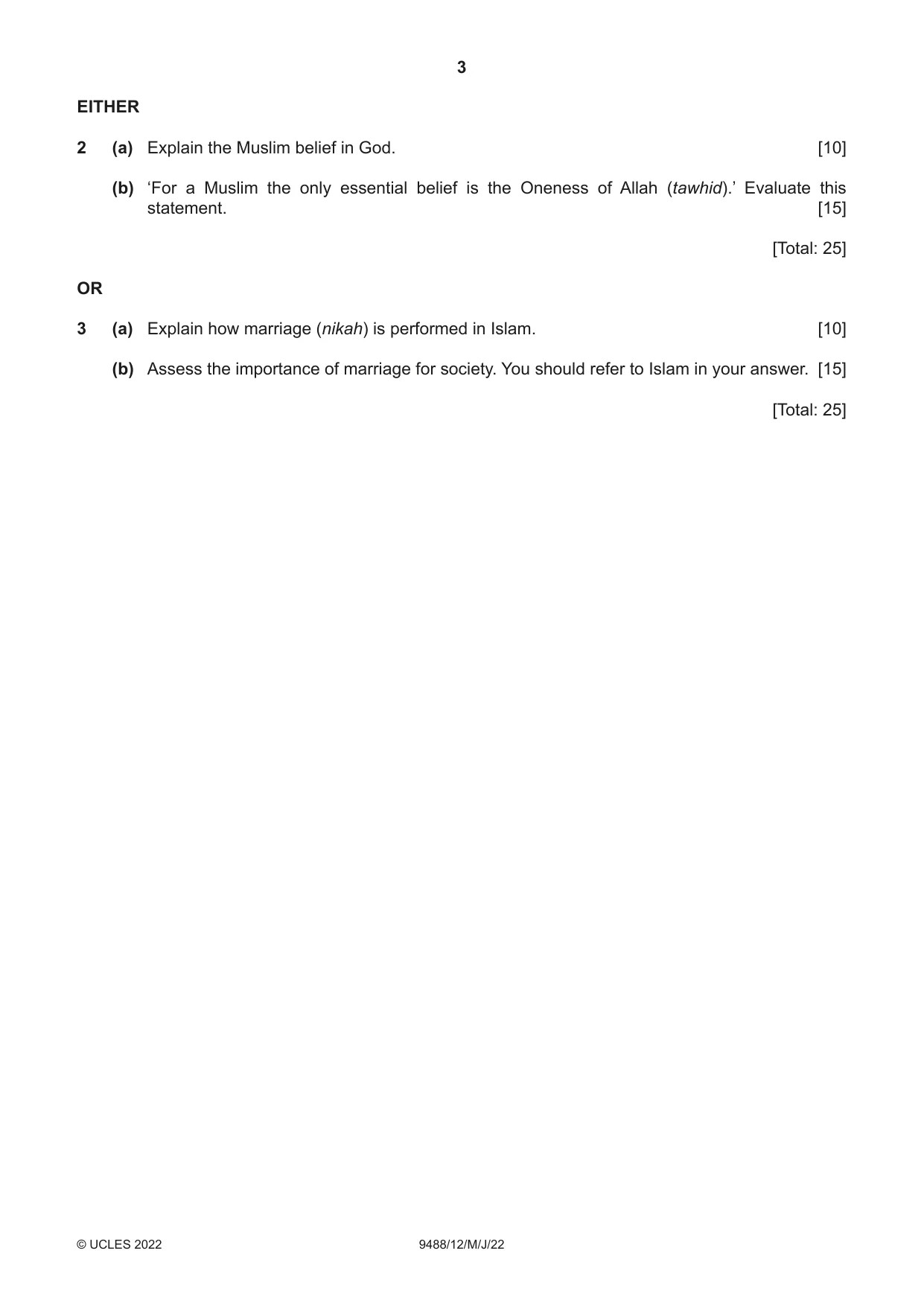
3 9488/12/M/J/22 © UCLES 2022 EITHER 2 (a) Explain the Muslim belief in God. [10] (b) ‘For a Muslim the only essential belief is the Oneness of Allah (tawhid).’ Evaluate this statement. [15] [Total: 25] OR 3 (a) Explain how marriage (nikah) is performed in Islam. [10] (b) Assess the importance of marriage for society. You should refer to Islam in your answer. [15] [Total: 25]
Question paper, page 4
4 9488/12/M/J/22 © UCLES 2022 Permission to reproduce items where third-party owned material protected by copyright is included has been sought and cleared where possible. Every reasonable effort has been made by the publisher (UCLES) to trace copyright holders, but if any items requiring clearance have unwittingly been included, the publisher will be pleased to make amends at the earliest possible opportunity. To avoid the issue of disclosure of answer-related information to candidates, all copyright acknowledgements are reproduced online in the Cambridge Assessment International Education Copyright Acknowledgements Booklet. This is produced for each series of examinations and is freely available to download at www.cambridgeinternational.org after the live examination series. Cambridge Assessment International Education is part of Cambridge Assessment. Cambridge Assessment is the brand name of the University of Cambridge Local Examinations Syndicate (UCLES), which is a department of the University of Cambridge. BLANK PAGE
Mark scheme, page 1
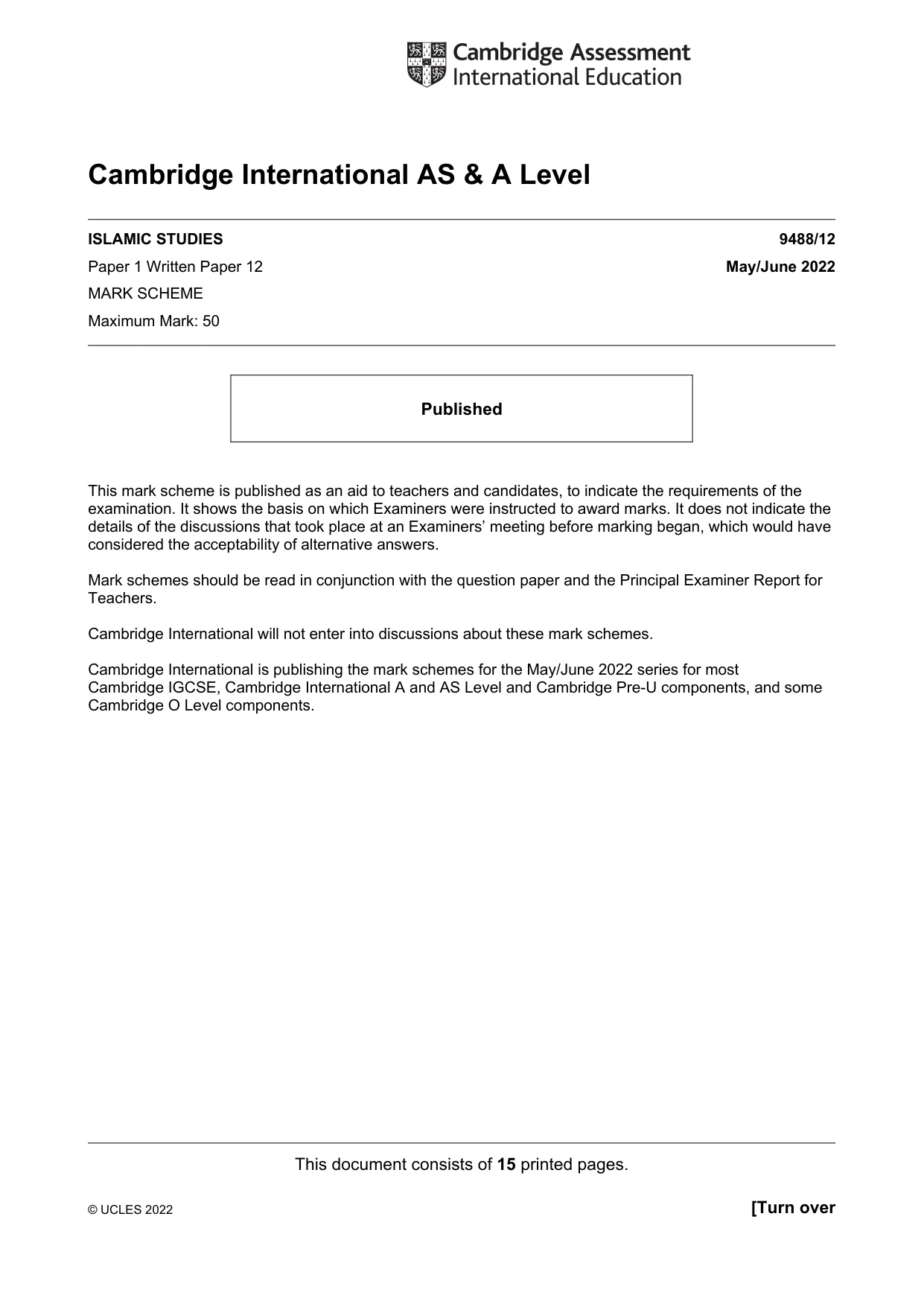
This document consists of 15 printed pages. © UCLES 2022 [Turn over Cambridge International AS & A Level ISLAMIC STUDIES 9488/12 Paper 1 Written Paper 12 May/June 2022 MARK SCHEME Maximum Mark: 50 Published This mark scheme is published as an aid to teachers and candidates, to indicate the requirements of the examination. It shows the basis on which Examiners were instructed to award marks. It does not indicate the details of the discussions that took place at an Examiners’ meeting before marking began, which would have considered the acceptability of alternative answers. Mark schemes should be read in conjunction with the question paper and the Principal Examiner Report for Teachers. Cambridge International will not enter into discussions about these mark schemes. Cambridge International is publishing the mark schemes for the May/June 2022 series for most Cambridge IGCSE, Cambridge International A and AS Level and Cambridge Pre-U components, and some Cambridge O Level components.
Mark scheme, page 2
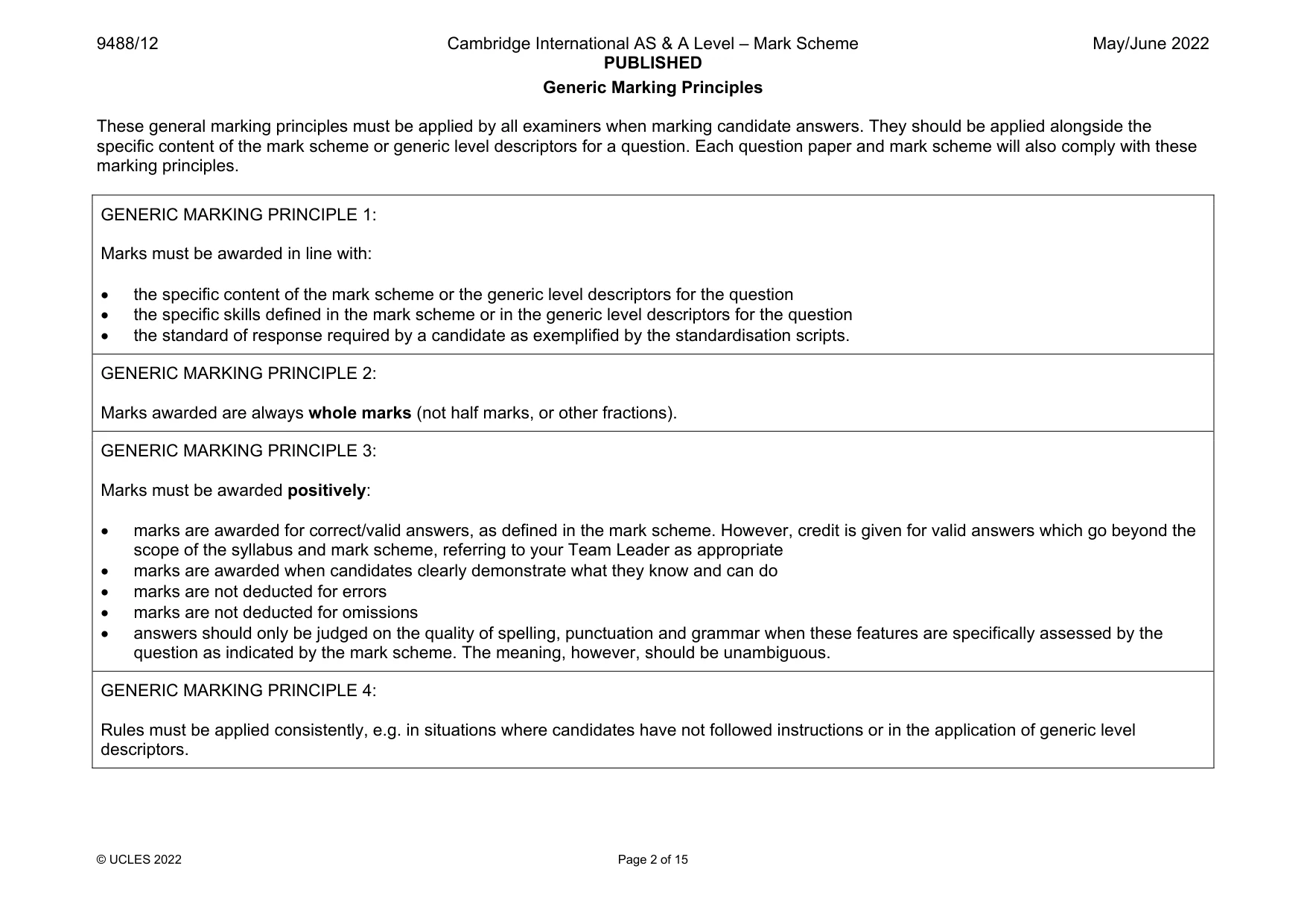
9488/12 Cambridge International AS & A Level – Mark Scheme PUBLISHED May/June 2022 © UCLES 2022 Page 2 of 15 Generic Marking Principles These general marking principles must be applied by all examiners when marking candidate answers. They should be applied alongside the specific content of the mark scheme or generic level descriptors for a question. Each question paper and mark scheme will also comply with these marking principles. GENERIC MARKING PRINCIPLE 1: Marks must be awarded in line with: the specific content of the mark scheme or the generic level descriptors for the question the specific skills defined in the mark scheme or in the generic level descriptors for the question the standard of response required by a candidate as exemplified by the standardisation scripts. GENERIC MARKING PRINCIPLE 2: Marks awarded are always whole marks (not half marks, or other fractions). GENERIC MARKING PRINCIPLE 3: Marks must be awarded positively: marks are awarded for correct/valid answers, as defined in the mark scheme. However, credit is given for valid answers which go beyond the scope of the syllabus and mark scheme, referring to your Team Leader as appropriate marks are awarded when candidates clearly demonstrate what they know and can do marks are not deducted for errors marks are not deducted for omissions answers should only be judged on the quality of spelling, punctuation and grammar when these features are specifically assessed by the question as indicated by the mark scheme. The meaning, however, should be unambiguous. GENERIC MARKING PRINCIPLE 4: Rules must be applied consistently, e.g. in situations where candidates have not followed instructions or in the application of generic level descriptors.
Mark scheme, page 3
9488/12 Cambridge International AS & A Level – Mark Scheme PUBLISHED May/June 2022 © UCLES 2022 Page 3 of 15 GENERIC MARKING PRINCIPLE 5: Marks should be awarded using the full range of marks defined in the mark scheme for the question (however; the use of the full mark range may be limited according to the quality of the candidate responses seen). GENERIC MARKING PRINCIPLE 6: Marks awarded are based solely on the requirements as defined in the mark scheme. Marks should not be awarded with grade thresholds or grade descriptors in mind.
Mark scheme, page 4
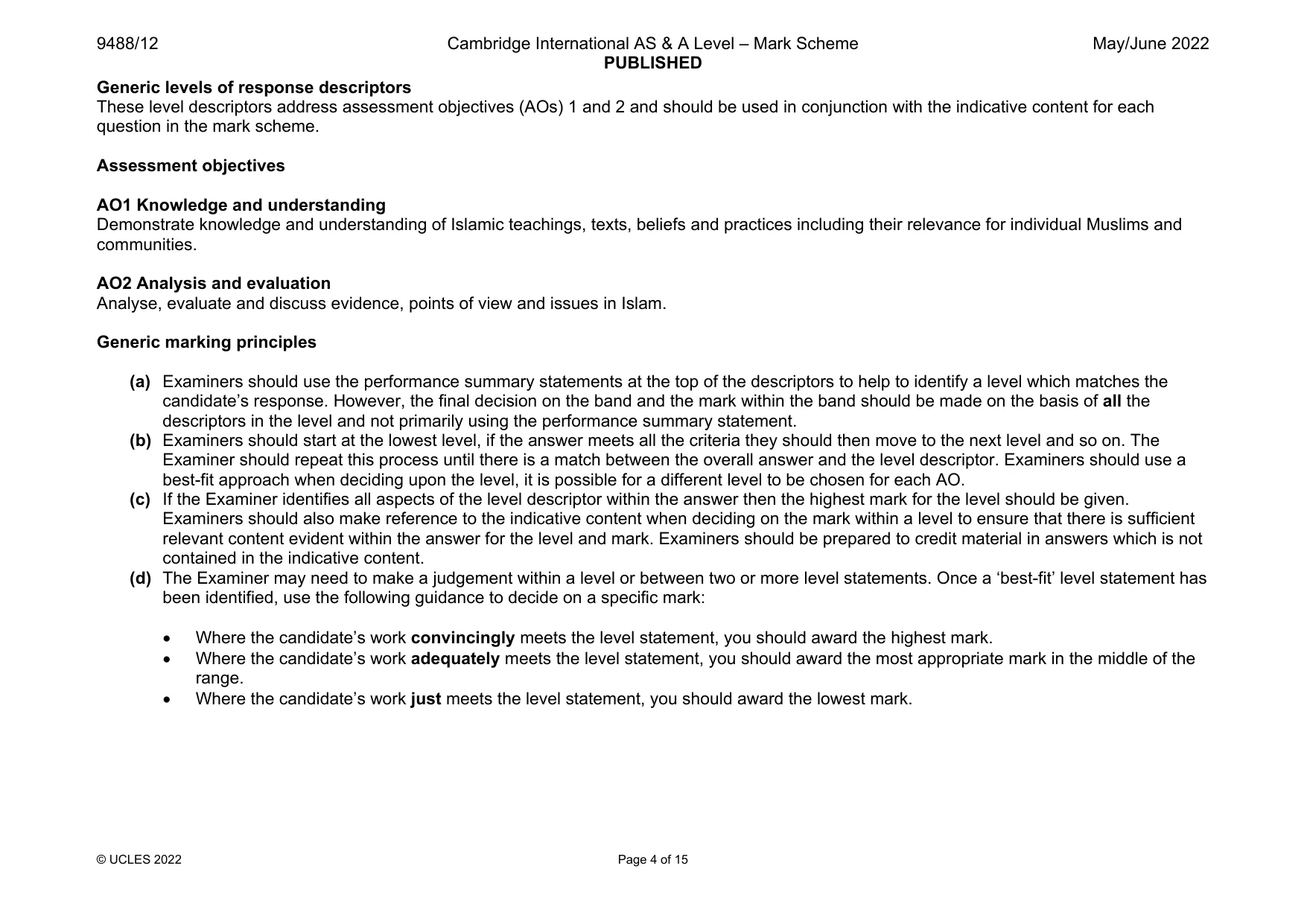
9488/12 Cambridge International AS & A Level – Mark Scheme PUBLISHED May/June 2022 © UCLES 2022 Page 4 of 15 Generic levels of response descriptors These level descriptors address assessment objectives (AOs) 1 and 2 and should be used in conjunction with the indicative content for each question in the mark scheme. Assessment objectives AO1 Knowledge and understanding Demonstrate knowledge and understanding of Islamic teachings, texts, beliefs and practices including their relevance for individual Muslims and communities. AO2 Analysis and evaluation Analyse, evaluate and discuss evidence, points of view and issues in Islam. Generic marking principles (a) Examiners should use the performance summary statements at the top of the descriptors to help to identify a level which matches the candidate’s response. However, the final decision on the band and the mark within the band should be made on the basis of all the descriptors in the level and not primarily using the performance summary statement. (b) Examiners should start at the lowest level, if the answer meets all the criteria they should then move to the next level and so on. The Examiner should repeat this process until there is a match between the overall answer and the level descriptor. Examiners should use a best-fit approach when deciding upon the level, it is possible for a different level to be chosen for each AO. (c) If the Examiner identifies all aspects of the level descriptor within the answer then the highest mark for the level should be given. Examiners should also make reference to the indicative content when deciding on the mark within a level to ensure that there is sufficient relevant content evident within the answer for the level and mark. Examiners should be prepared to credit material in answers which is not contained in the indicative content. (d) The Examiner may need to make a judgement within a level or between two or more level statements. Once a ‘best-fit’ level statement has been identified, use the following guidance to decide on a specific mark: Where the candidate’s work convincingly meets the level statement, you should award the highest mark. Where the candidate’s work adequately meets the level statement, you should award the most appropriate mark in the middle of the range. Where the candidate’s work just meets the level statement, you should award the lowest mark.
Mark scheme, page 5
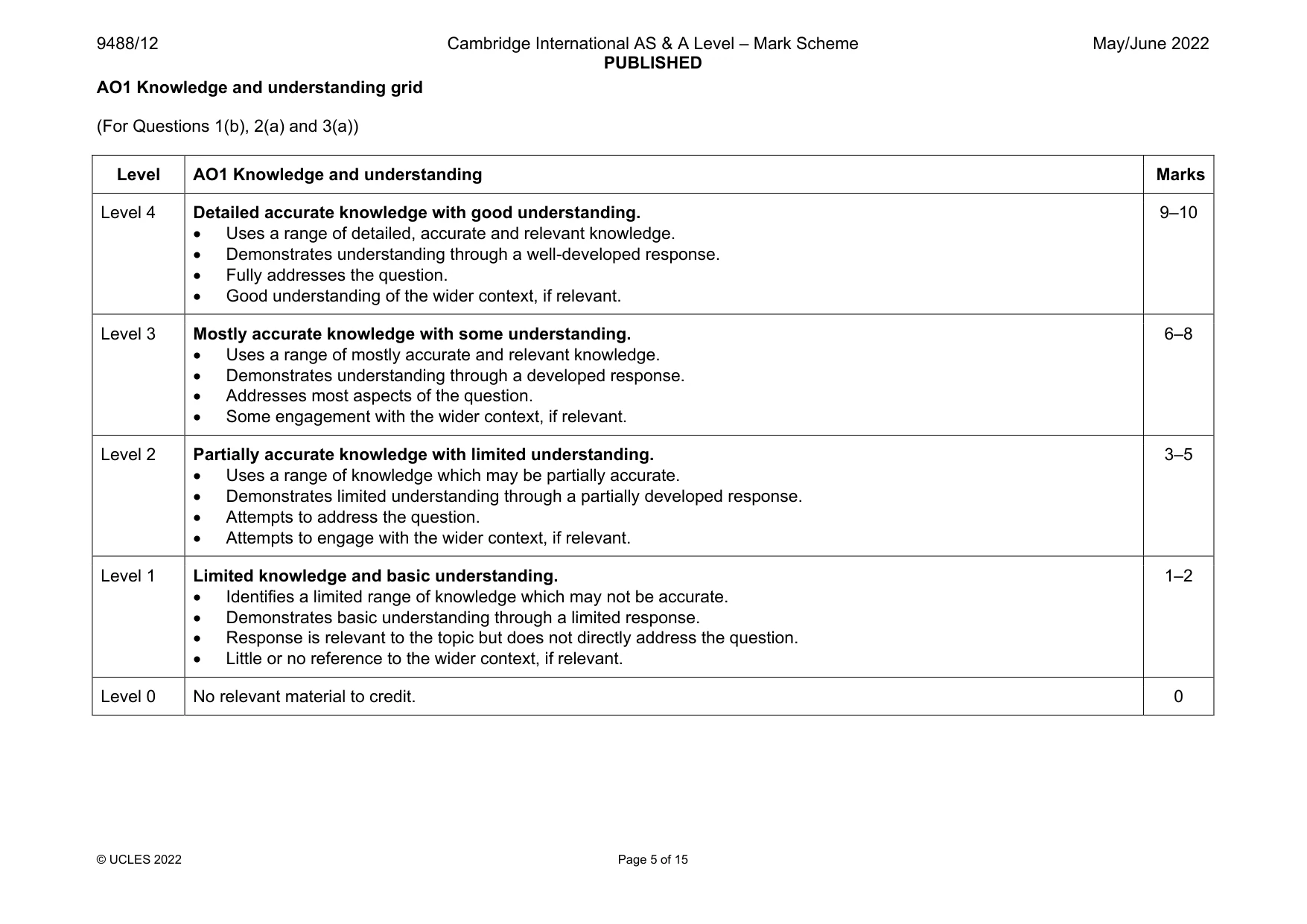
9488/12 Cambridge International AS & A Level – Mark Scheme PUBLISHED May/June 2022 © UCLES 2022 Page 5 of 15 AO1 Knowledge and understanding grid (For Questions 1(b), 2(a) and 3(a)) Level AO1 Knowledge and understanding Marks Level 4 Detailed accurate knowledge with good understanding. Uses a range of detailed, accurate and relevant knowledge. Demonstrates understanding through a well-developed response. Fully addresses the question. Good understanding of the wider context, if relevant. 9–10 Level 3 Mostly accurate knowledge with some understanding. Uses a range of mostly accurate and relevant knowledge. Demonstrates understanding through a developed response. Addresses most aspects of the question. Some engagement with the wider context, if relevant. 6–8 Level 2 Partially accurate knowledge with limited understanding. Uses a range of knowledge which may be partially accurate. Demonstrates limited understanding through a partially developed response. Attempts to address the question. Attempts to engage with the wider context, if relevant. 3–5 Level 1 Limited knowledge and basic understanding. Identifies a limited range of knowledge which may not be accurate. Demonstrates basic understanding through a limited response. Response is relevant to the topic but does not directly address the question. Little or no reference to the wider context, if relevant. 1–2 Level 0 No relevant material to credit. 0
Mark scheme, page 6
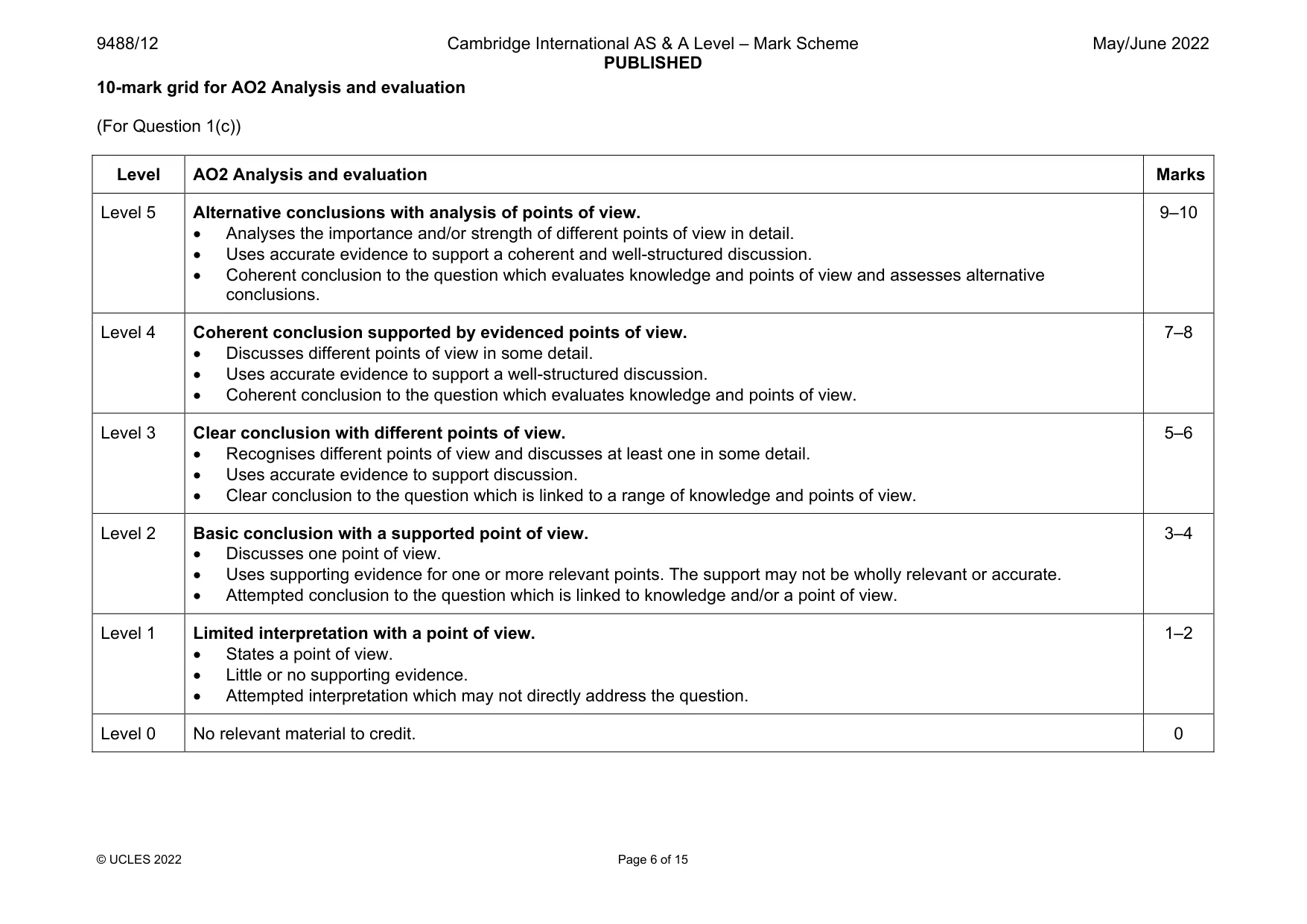
9488/12 Cambridge International AS & A Level – Mark Scheme PUBLISHED May/June 2022 © UCLES 2022 Page 6 of 15 10-mark grid for AO2 Analysis and evaluation (For Question 1(c)) Level AO2 Analysis and evaluation Marks Level 5 Alternative conclusions with analysis of points of view. Analyses the importance and/or strength of different points of view in detail. Uses accurate evidence to support a coherent and well-structured discussion. Coherent conclusion to the question which evaluates knowledge and points of view and assesses alternative conclusions. 9–10 Level 4 Coherent conclusion supported by evidenced points of view. Discusses different points of view in some detail. Uses accurate evidence to support a well-structured discussion. Coherent conclusion to the question which evaluates knowledge and points of view. 7–8 Level 3 Clear conclusion with different points of view. Recognises different points of view and discusses at least one in some detail. Uses accurate evidence to support discussion. Clear conclusion to the question which is linked to a range of knowledge and points of view. 5–6 Level 2 Basic conclusion with a supported point of view. Discusses one point of view. Uses supporting evidence for one or more relevant points. The support may not be wholly relevant or accurate. Attempted conclusion to the question which is linked to knowledge and/or a point of view. 3–4 Level 1 Limited interpretation with a point of view. States a point of view. Little or no supporting evidence. Attempted interpretation which may not directly address the question. 1–2 Level 0 No relevant material to credit. 0
Mark scheme, page 7
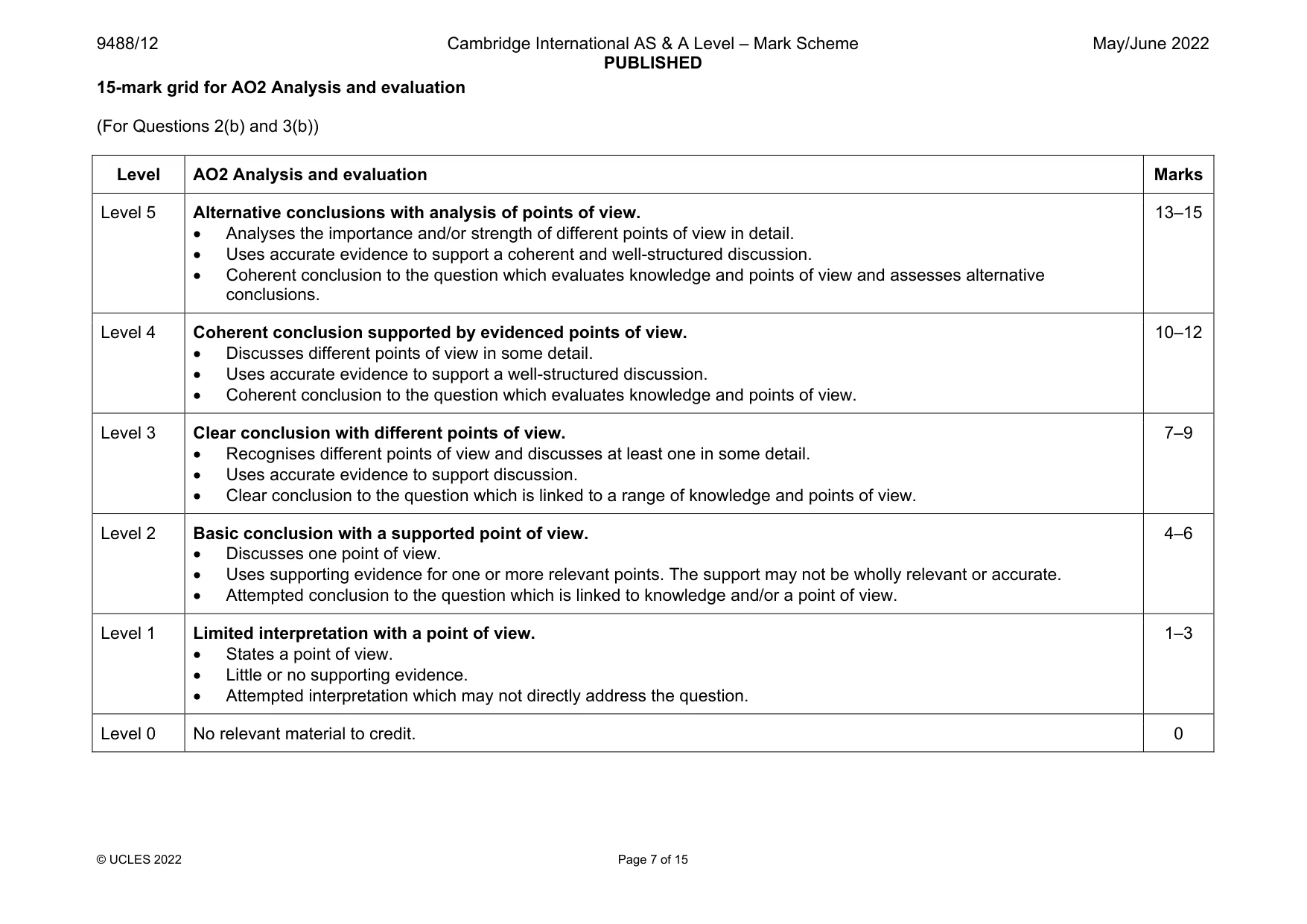
9488/12 Cambridge International AS & A Level – Mark Scheme PUBLISHED May/June 2022 © UCLES 2022 Page 7 of 15 15-mark grid for AO2 Analysis and evaluation (For Questions 2(b) and 3(b)) Level AO2 Analysis and evaluation Marks Level 5 Alternative conclusions with analysis of points of view. Analyses the importance and/or strength of different points of view in detail. Uses accurate evidence to support a coherent and well-structured discussion. Coherent conclusion to the question which evaluates knowledge and points of view and assesses alternative conclusions. 13–15 Level 4 Coherent conclusion supported by evidenced points of view. Discusses different points of view in some detail. Uses accurate evidence to support a well-structured discussion. Coherent conclusion to the question which evaluates knowledge and points of view. 10–12 Level 3 Clear conclusion with different points of view. Recognises different points of view and discusses at least one in some detail. Uses accurate evidence to support discussion. Clear conclusion to the question which is linked to a range of knowledge and points of view. 7–9 Level 2 Basic conclusion with a supported point of view. Discusses one point of view. Uses supporting evidence for one or more relevant points. The support may not be wholly relevant or accurate. Attempted conclusion to the question which is linked to knowledge and/or a point of view. 4–6 Level 1 Limited interpretation with a point of view. States a point of view. Little or no supporting evidence. Attempted interpretation which may not directly address the question. 1–3 Level 0 No relevant material to credit. 0
Mark scheme, page 8
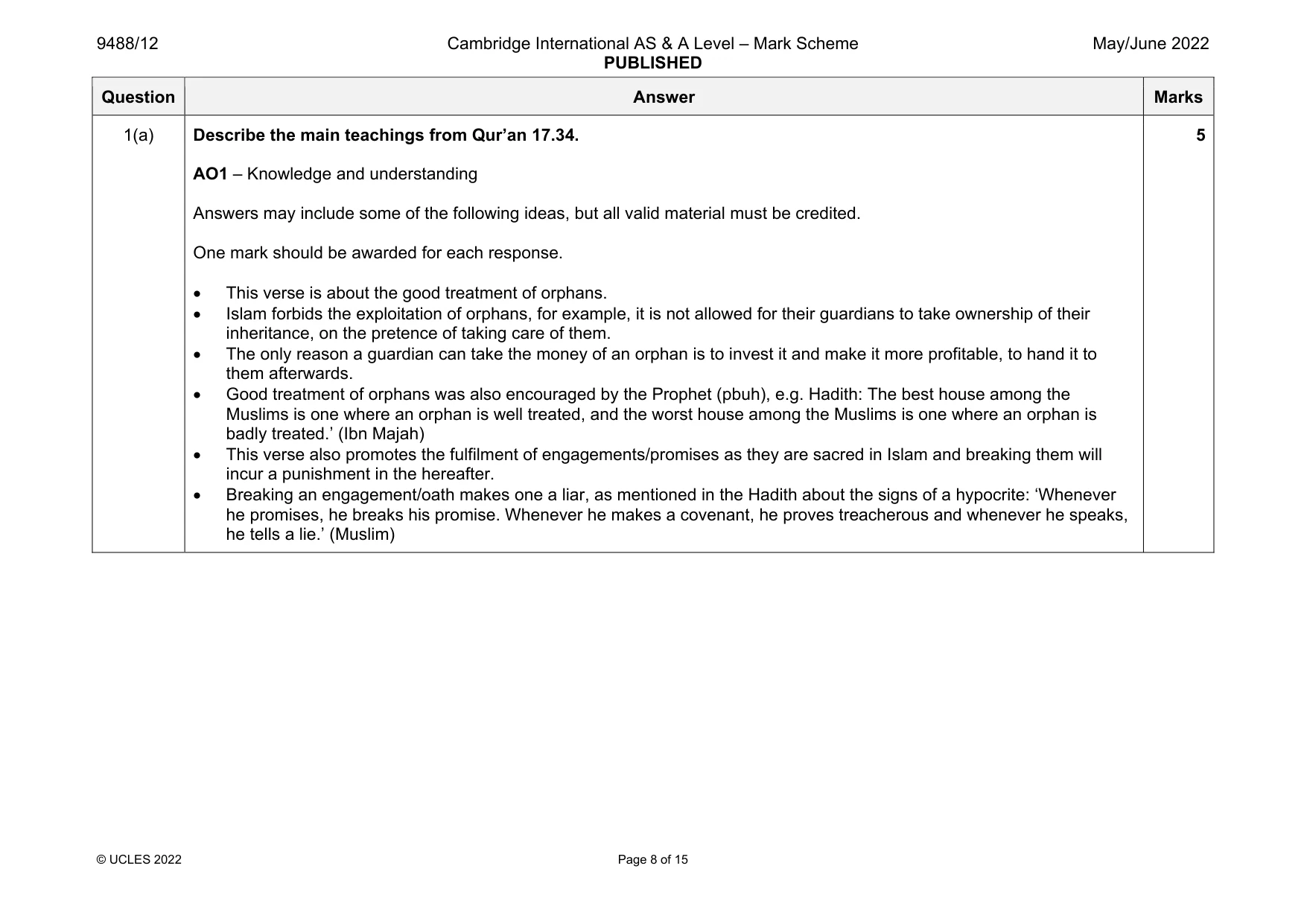
9488/12 Cambridge International AS & A Level – Mark Scheme PUBLISHED May/June 2022 © UCLES 2022 Page 8 of 15 Question Answer Marks 1(a) Describe the main teachings from Qur’an 17.34. AO1 – Knowledge and understanding Answers may include some of the following ideas, but all valid material must be credited. One mark should be awarded for each response. This verse is about the good treatment of orphans. Islam forbids the exploitation of orphans, for example, it is not allowed for their guardians to take ownership of their inheritance, on the pretence of taking care of them. The only reason a guardian can take the money of an orphan is to invest it and make it more profitable, to hand it to them afterwards. Good treatment of orphans was also encouraged by the Prophet (pbuh), e.g. Hadith: The best house among the Muslims is one where an orphan is well treated, and the worst house among the Muslims is one where an orphan is badly treated.’ (Ibn Majah) This verse also promotes the fulfilment of engagements/promises as they are sacred in Islam and breaking them will incur a punishment in the hereafter. Breaking an engagement/oath makes one a liar, as mentioned in the Hadith about the signs of a hypocrite: ‘Whenever he promises, he breaks his promise. Whenever he makes a covenant, he proves treacherous and whenever he speaks, he tells a lie.’ (Muslim) 5
Mark scheme, page 9
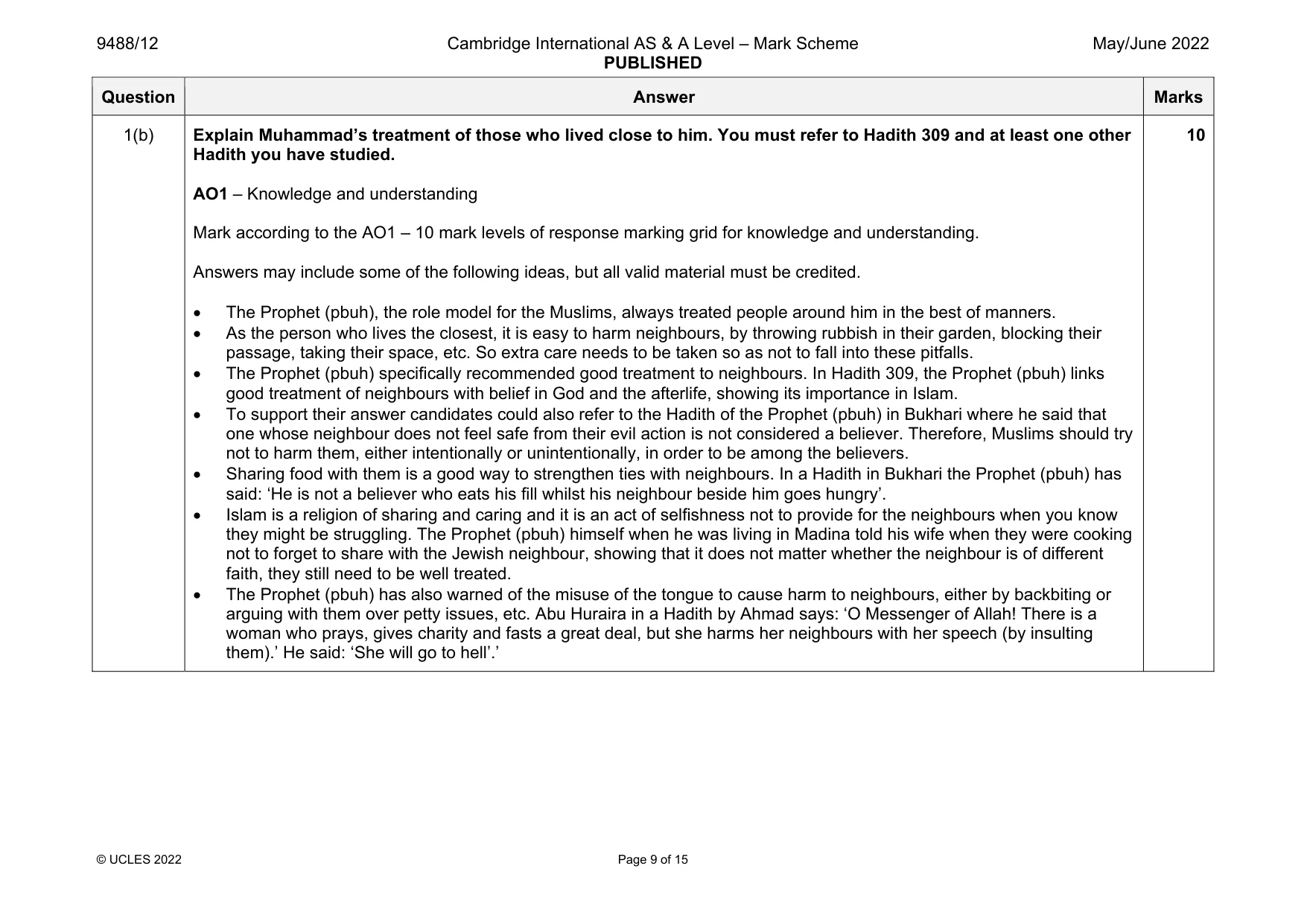
9488/12 Cambridge International AS & A Level – Mark Scheme PUBLISHED May/June 2022 © UCLES 2022 Page 9 of 15 Question Answer Marks 1(b) Explain Muhammad’s treatment of those who lived close to him. You must refer to Hadith 309 and at least one other Hadith you have studied. AO1 – Knowledge and understanding Mark according to the AO1 – 10 mark levels of response marking grid for knowledge and understanding. Answers may include some of the following ideas, but all valid material must be credited. The Prophet (pbuh), the role model for the Muslims, always treated people around him in the best of manners. As the person who lives the closest, it is easy to harm neighbours, by throwing rubbish in their garden, blocking their passage, taking their space, etc. So extra care needs to be taken so as not to fall into these pitfalls. The Prophet (pbuh) specifically recommended good treatment to neighbours. In Hadith 309, the Prophet (pbuh) links good treatment of neighbours with belief in God and the afterlife, showing its importance in Islam. To support their answer candidates could also refer to the Hadith of the Prophet (pbuh) in Bukhari where he said that one whose neighbour does not feel safe from their evil action is not considered a believer. Therefore, Muslims should try not to harm them, either intentionally or unintentionally, in order to be among the believers. Sharing food with them is a good way to strengthen ties with neighbours. In a Hadith in Bukhari the Prophet (pbuh) has said: ‘He is not a believer who eats his fill whilst his neighbour beside him goes hungry’. Islam is a religion of sharing and caring and it is an act of selfishness not to provide for the neighbours when you know they might be struggling. The Prophet (pbuh) himself when he was living in Madina told his wife when they were cooking not to forget to share with the Jewish neighbour, showing that it does not matter whether the neighbour is of different faith, they still need to be well treated. The Prophet (pbuh) has also warned of the misuse of the tongue to cause harm to neighbours, either by backbiting or arguing with them over petty issues, etc. Abu Huraira in a Hadith by Ahmad says: ‘O Messenger of Allah! There is a woman who prays, gives charity and fasts a great deal, but she harms her neighbours with her speech (by insulting them).’ He said: ‘She will go to hell’.’ 10
Mark scheme, page 10
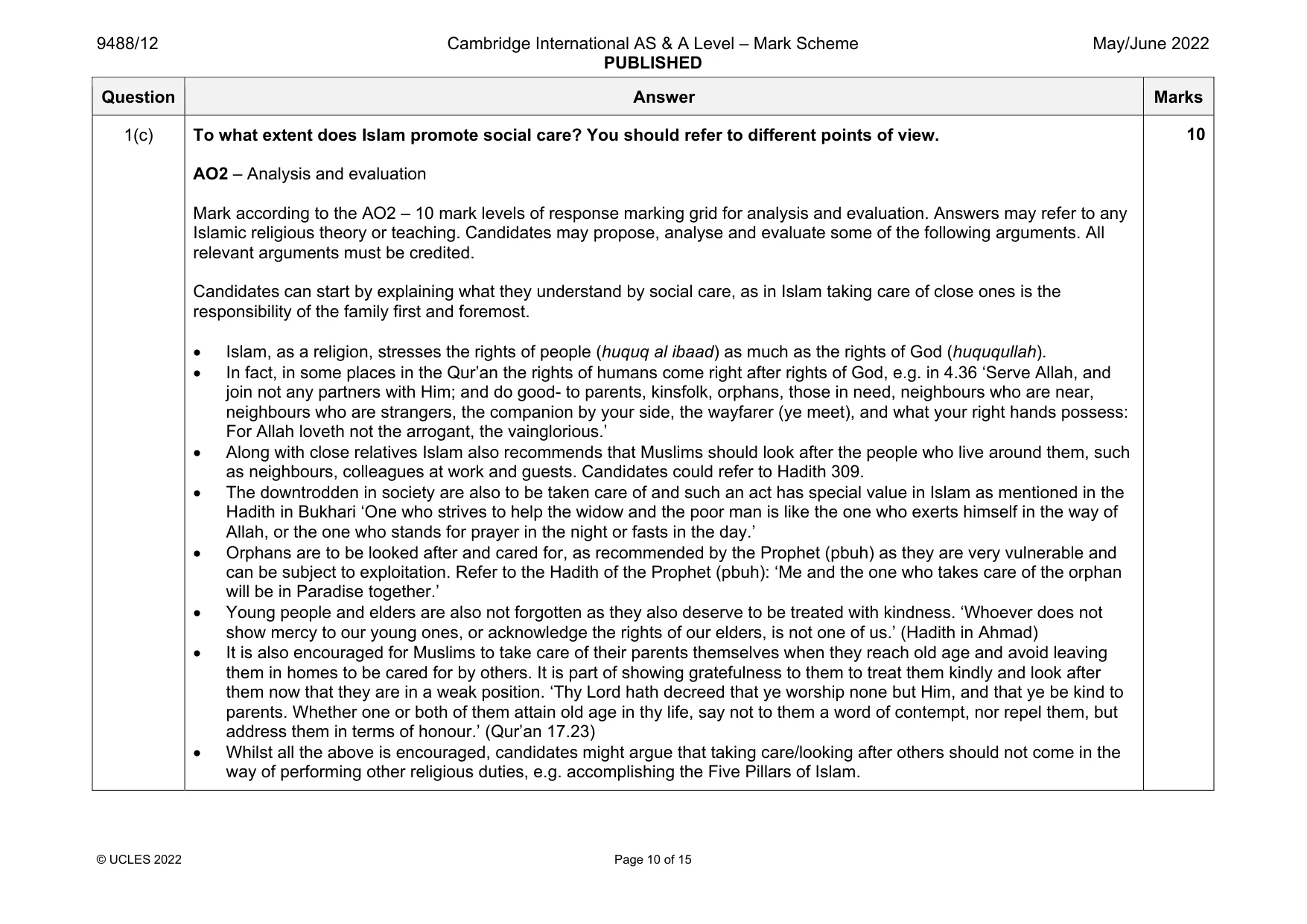
9488/12 Cambridge International AS & A Level – Mark Scheme PUBLISHED May/June 2022 © UCLES 2022 Page 10 of 15 Question Answer Marks 1(c) To what extent does Islam promote social care? You should refer to different points of view. AO2 – Analysis and evaluation Mark according to the AO2 – 10 mark levels of response marking grid for analysis and evaluation. Answers may refer to any Islamic religious theory or teaching. Candidates may propose, analyse and evaluate some of the following arguments. All relevant arguments must be credited. Candidates can start by explaining what they understand by social care, as in Islam taking care of close ones is the responsibility of the family first and foremost. Islam, as a religion, stresses the rights of people (huquq al ibaad) as much as the rights of God (huququllah). In fact, in some places in the Qur’an the rights of humans come right after rights of God, e.g. in 4.36 ‘Serve Allah, and join not any partners with Him; and do good- to parents, kinsfolk, orphans, those in need, neighbours who are near, neighbours who are strangers, the companion by your side, the wayfarer (ye meet), and what your right hands possess: For Allah loveth not the arrogant, the vainglorious.’ Along with close relatives Islam also recommends that Muslims should look after the people who live around them, such as neighbours, colleagues at work and guests. Candidates could refer to Hadith 309. The downtrodden in society are also to be taken care of and such an act has special value in Islam as mentioned in the Hadith in Bukhari ‘One who strives to help the widow and the poor man is like the one who exerts himself in the way of Allah, or the one who stands for prayer in the night or fasts in the day.’ Orphans are to be looked after and cared for, as recommended by the Prophet (pbuh) as they are very vulnerable and can be subject to exploitation. Refer to the Hadith of the Prophet (pbuh): ‘Me and the one who takes care of the orphan will be in Paradise together.’ Young people and elders are also not forgotten as they also deserve to be treated with kindness. ‘Whoever does not show mercy to our young ones, or acknowledge the rights of our elders, is not one of us.’ (Hadith in Ahmad) It is also encouraged for Muslims to take care of their parents themselves when they reach old age and avoid leaving them in homes to be cared for by others. It is part of showing gratefulness to them to treat them kindly and look after them now that they are in a weak position. ‘Thy Lord hath decreed that ye worship none but Him, and that ye be kind to parents. Whether one or both of them attain old age in thy life, say not to them a word of contempt, nor repel them, but address them in terms of honour.’ (Qur’an 17.23) Whilst all the above is encouraged, candidates might argue that taking care/looking after others should not come in the way of performing other religious duties, e.g. accomplishing the Five Pillars of Islam. 10
Mark scheme, page 11
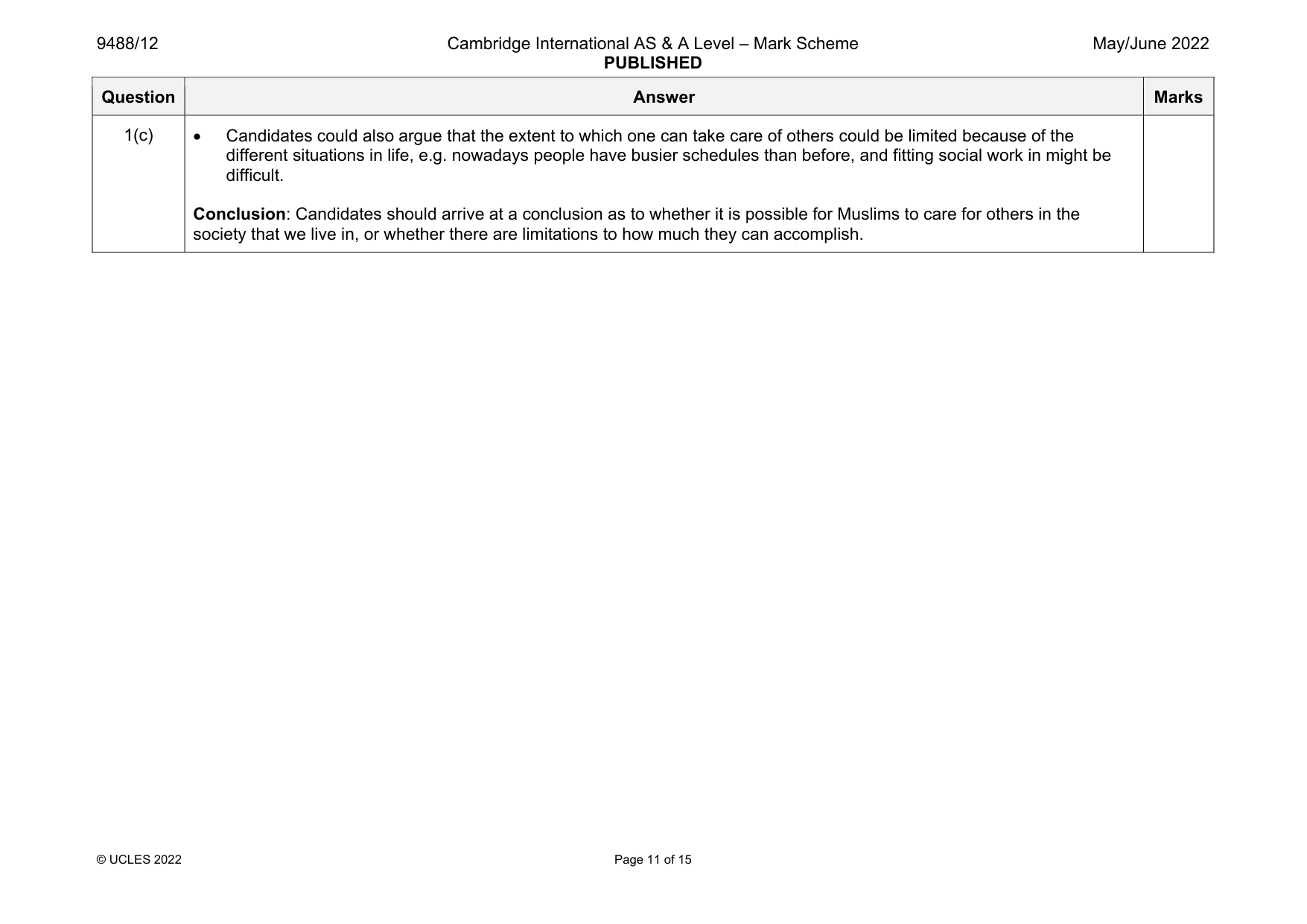
9488/12 Cambridge International AS & A Level – Mark Scheme PUBLISHED May/June 2022 © UCLES 2022 Page 11 of 15 Question Answer Marks 1(c) Candidates could also argue that the extent to which one can take care of others could be limited because of the different situations in life, e.g. nowadays people have busier schedules than before, and fitting social work in might be difficult. Conclusion: Candidates should arrive at a conclusion as to whether it is possible for Muslims to care for others in the society that we live in, or whether there are limitations to how much they can accomplish.
Mark scheme, page 12
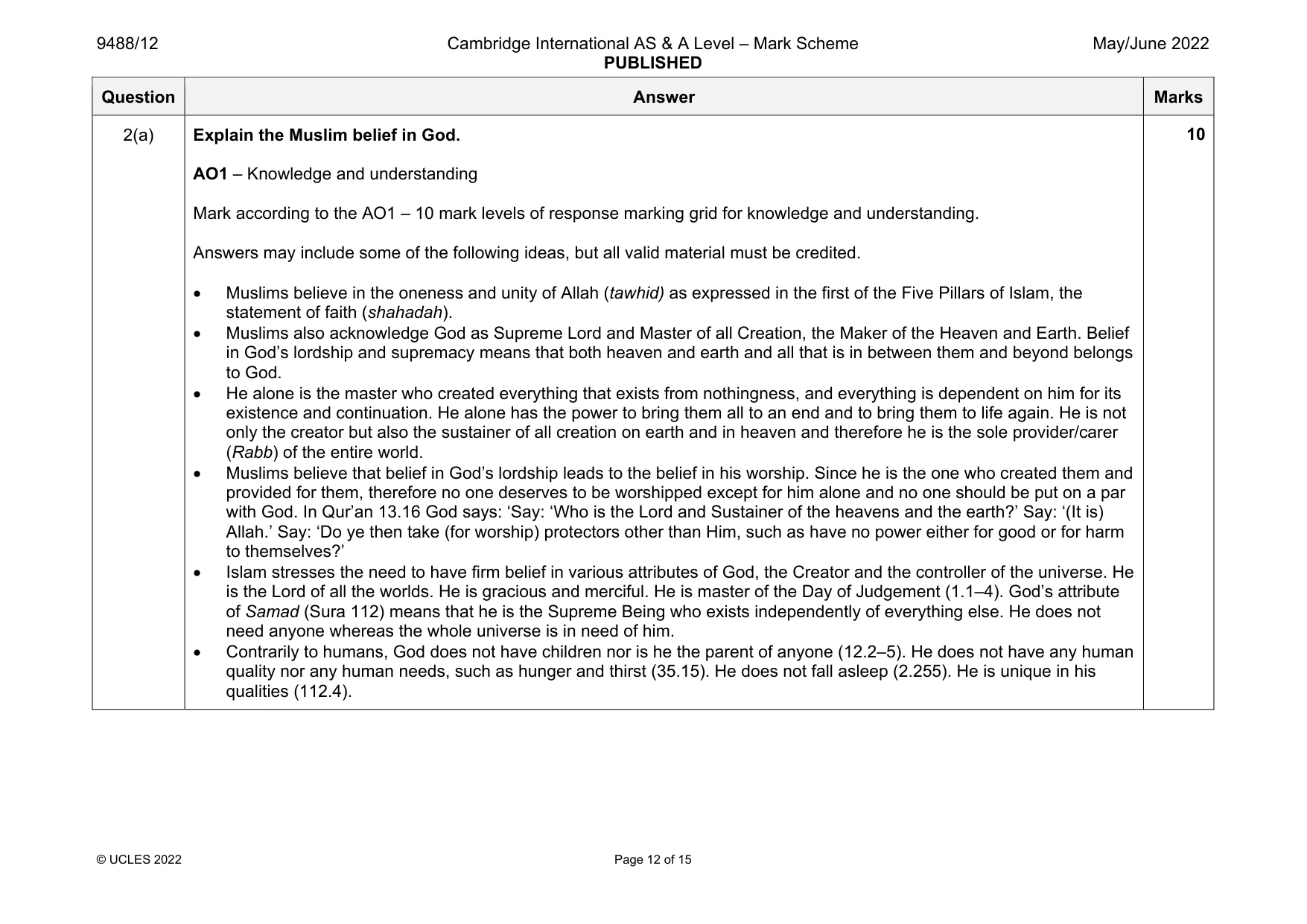
9488/12 Cambridge International AS & A Level – Mark Scheme PUBLISHED May/June 2022 © UCLES 2022 Page 12 of 15 Question Answer Marks 2(a) Explain the Muslim belief in God. AO1 – Knowledge and understanding Mark according to the AO1 – 10 mark levels of response marking grid for knowledge and understanding. Answers may include some of the following ideas, but all valid material must be credited. Muslims believe in the oneness and unity of Allah (tawhid) as expressed in the first of the Five Pillars of Islam, the statement of faith (shahadah). Muslims also acknowledge God as Supreme Lord and Master of all Creation, the Maker of the Heaven and Earth. Belief in God’s lordship and supremacy means that both heaven and earth and all that is in between them and beyond belongs to God. He alone is the master who created everything that exists from nothingness, and everything is dependent on him for its existence and continuation. He alone has the power to bring them all to an end and to bring them to life again. He is not only the creator but also the sustainer of all creation on earth and in heaven and therefore he is the sole provider/carer (Rabb) of the entire world. Muslims believe that belief in God’s lordship leads to the belief in his worship. Since he is the one who created them and provided for them, therefore no one deserves to be worshipped except for him alone and no one should be put on a par with God. In Qur’an 13.16 God says: ‘Say: ‘Who is the Lord and Sustainer of the heavens and the earth?’ Say: ‘(It is) Allah.’ Say: ‘Do ye then take (for worship) protectors other than Him, such as have no power either for good or for harm to themselves?’ Islam stresses the need to have firm belief in various attributes of God, the Creator and the controller of the universe. He is the Lord of all the worlds. He is gracious and merciful. He is master of the Day of Judgement (1.1–4). God’s attribute of Samad (Sura 112) means that he is the Supreme Being who exists independently of everything else. He does not need anyone whereas the whole universe is in need of him. Contrarily to humans, God does not have children nor is he the parent of anyone (12.2–5). He does not have any human quality nor any human needs, such as hunger and thirst (35.15). He does not fall asleep (2.255). He is unique in his qualities (112.4). 10
Mark scheme, page 13
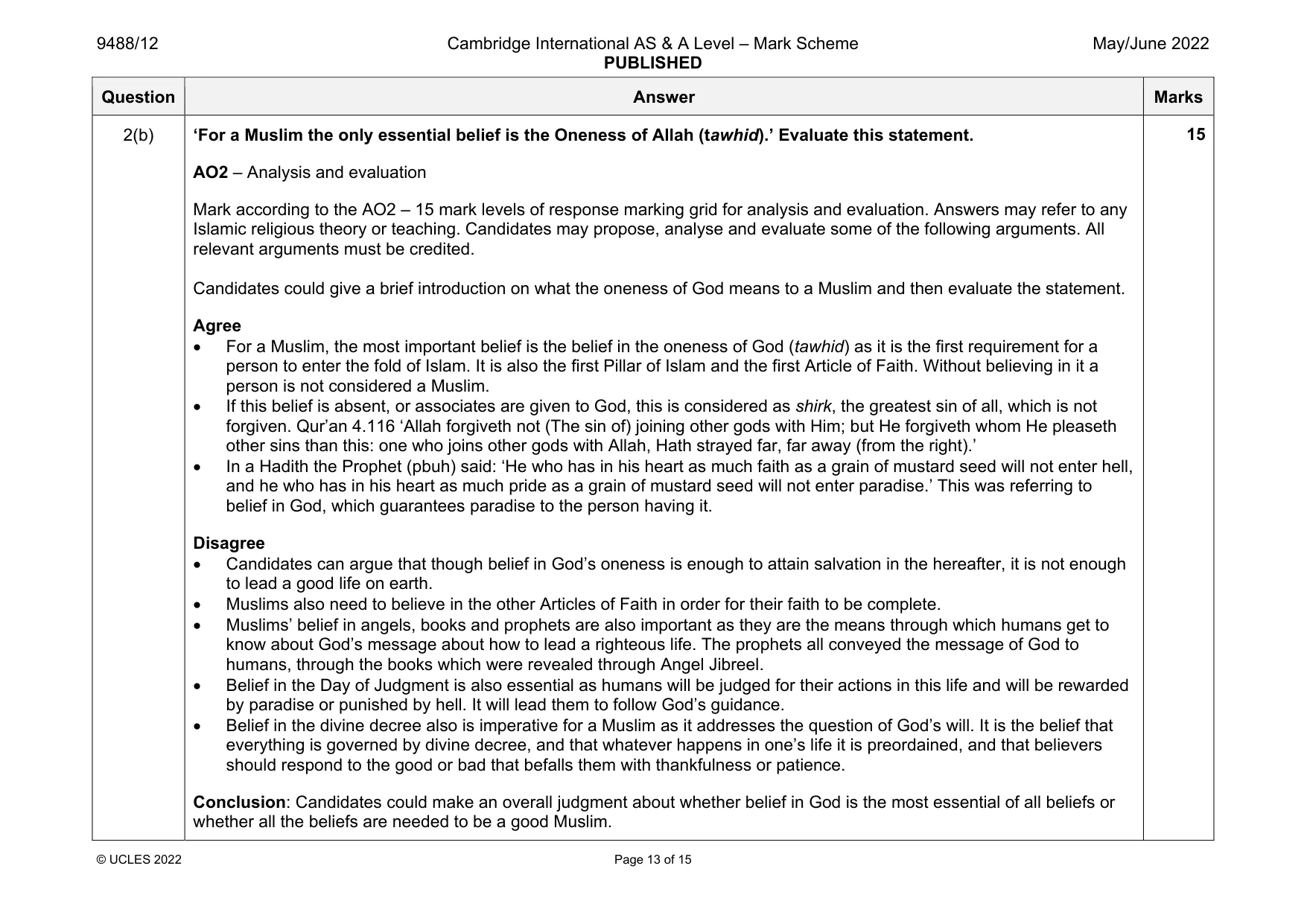
9488/12 Cambridge International AS & A Level – Mark Scheme PUBLISHED May/June 2022 © UCLES 2022 Page 13 of 15 Question Answer Marks 2(b) ‘For a Muslim the only essential belief is the Oneness of Allah (tawhid).’ Evaluate this statement. AO2 – Analysis and evaluation Mark according to the AO2 – 15 mark levels of response marking grid for analysis and evaluation. Answers may refer to any Islamic religious theory or teaching. Candidates may propose, analyse and evaluate some of the following arguments. All relevant arguments must be credited. Candidates could give a brief introduction on what the oneness of God means to a Muslim and then evaluate the statement. Agree For a Muslim, the most important belief is the belief in the oneness of God (tawhid) as it is the first requirement for a person to enter the fold of Islam. It is also the first Pillar of Islam and the first Article of Faith. Without believing in it a person is not considered a Muslim. If this belief is absent, or associates are given to God, this is considered as shirk, the greatest sin of all, which is not forgiven. Qur’an 4.116 ‘Allah forgiveth not (The sin of) joining other gods with Him; but He forgiveth whom He pleaseth other sins than this: one who joins other gods with Allah, Hath strayed far, far away (from the right).’ In a Hadith the Prophet (pbuh) said: ‘He who has in his heart as much faith as a grain of mustard seed will not enter hell, and he who has in his heart as much pride as a grain of mustard seed will not enter paradise.’ This was referring to belief in God, which guarantees paradise to the person having it. Disagree Candidates can argue that though belief in God’s oneness is enough to attain salvation in the hereafter, it is not enough to lead a good life on earth. Muslims also need to believe in the other Articles of Faith in order for their faith to be complete. Muslims’ belief in angels, books and prophets are also important as they are the means through which humans get to know about God’s message about how to lead a righteous life. The prophets all conveyed the message of God to humans, through the books which were revealed through Angel Jibreel. Belief in the Day of Judgment is also essential as humans will be judged for their actions in this life and will be rewarded by paradise or punished by hell. It will lead them to follow God’s guidance. Belief in the divine decree also is imperative for a Muslim as it addresses the question of God’s will. It is the belief that everything is governed by divine decree, and that whatever happens in one’s life it is preordained, and that believers should respond to the good or bad that befalls them with thankfulness or patience. Conclusion: Candidates could make an overall judgment about whether belief in God is the most essential of all beliefs or whether all the beliefs are needed to be a good Muslim. 15
Mark scheme, page 14
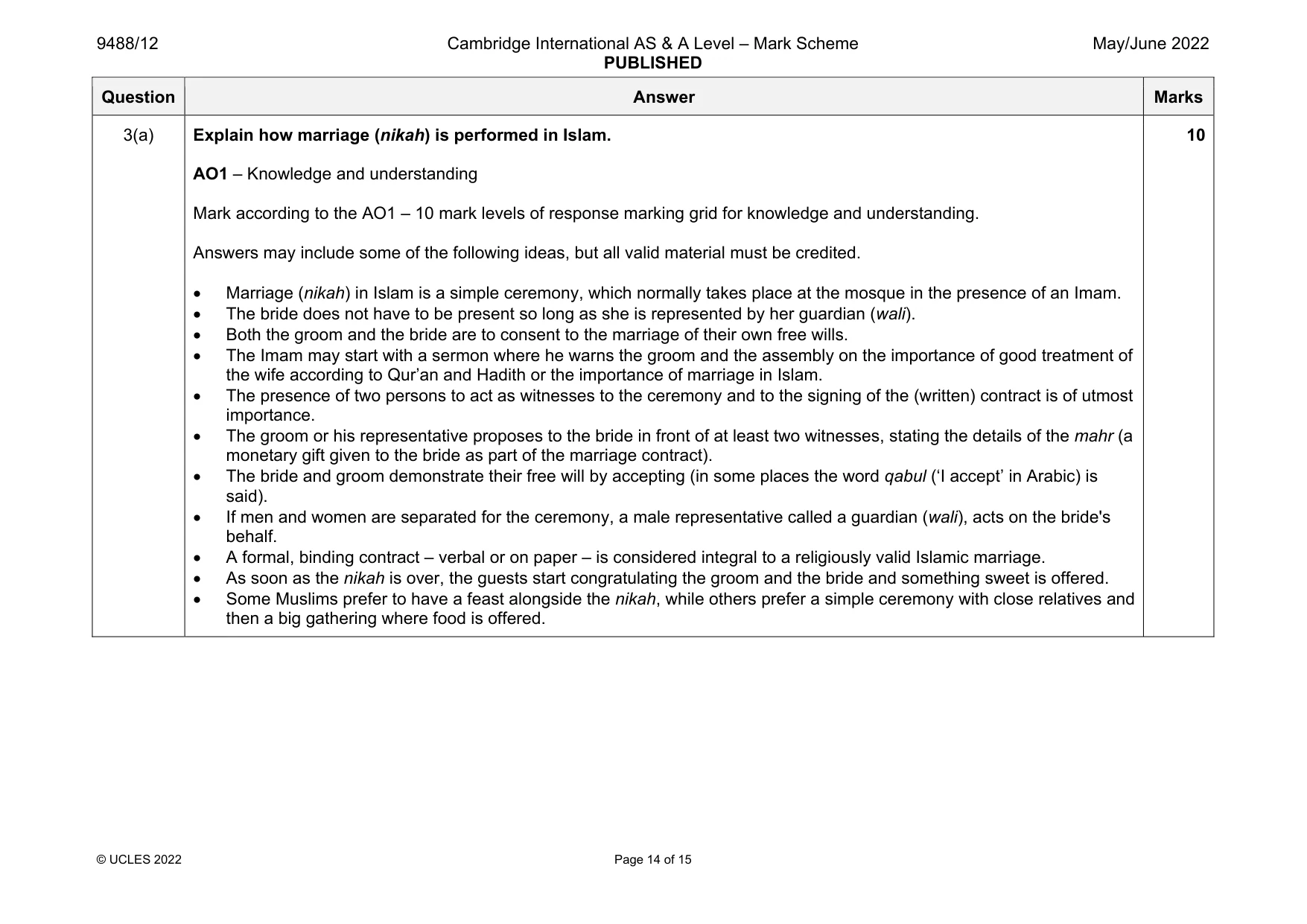
9488/12 Cambridge International AS & A Level – Mark Scheme PUBLISHED May/June 2022 © UCLES 2022 Page 14 of 15 Question Answer Marks 3(a) Explain how marriage (nikah) is performed in Islam. AO1 – Knowledge and understanding Mark according to the AO1 – 10 mark levels of response marking grid for knowledge and understanding. Answers may include some of the following ideas, but all valid material must be credited. Marriage (nikah) in Islam is a simple ceremony, which normally takes place at the mosque in the presence of an Imam. The bride does not have to be present so long as she is represented by her guardian (wali). Both the groom and the bride are to consent to the marriage of their own free wills. The Imam may start with a sermon where he warns the groom and the assembly on the importance of good treatment of the wife according to Qur’an and Hadith or the importance of marriage in Islam. The presence of two persons to act as witnesses to the ceremony and to the signing of the (written) contract is of utmost importance. The groom or his representative proposes to the bride in front of at least two witnesses, stating the details of the mahr (a monetary gift given to the bride as part of the marriage contract). The bride and groom demonstrate their free will by accepting (in some places the word qabul (‘I accept’ in Arabic) is said). If men and women are separated for the ceremony, a male representative called a guardian (wali), acts on the bride's behalf. A formal, binding contract – verbal or on paper – is considered integral to a religiously valid Islamic marriage. As soon as the nikah is over, the guests start congratulating the groom and the bride and something sweet is offered. Some Muslims prefer to have a feast alongside the nikah, while others prefer a simple ceremony with close relatives and then a big gathering where food is offered. 10
Mark scheme, page 15
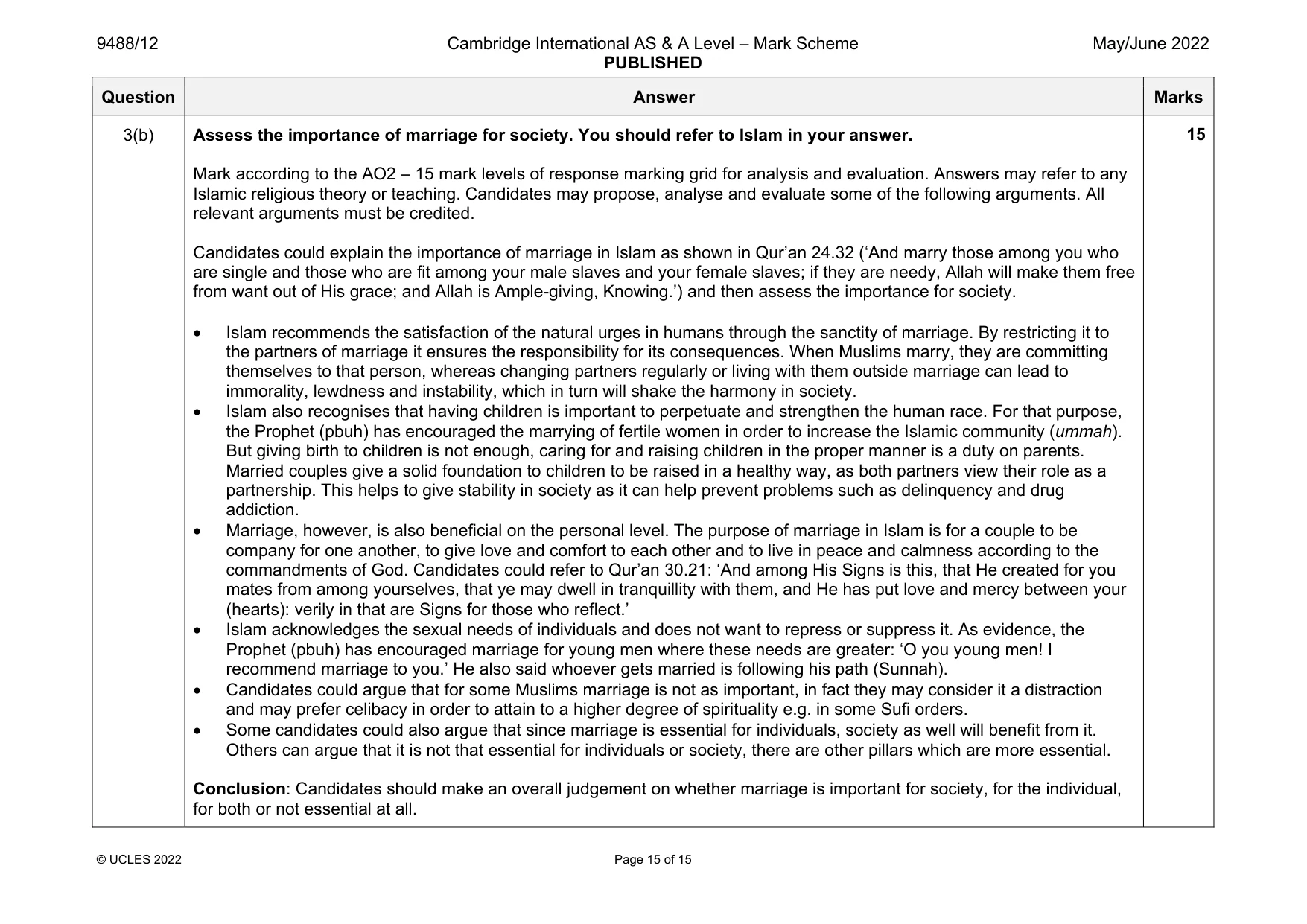
9488/12 Cambridge International AS & A Level – Mark Scheme PUBLISHED May/June 2022 © UCLES 2022 Page 15 of 15 Question Answer Marks 3(b) Assess the importance of marriage for society. You should refer to Islam in your answer. Mark according to the AO2 – 15 mark levels of response marking grid for analysis and evaluation. Answers may refer to any Islamic religious theory or teaching. Candidates may propose, analyse and evaluate some of the following arguments. All relevant arguments must be credited. Candidates could explain the importance of marriage in Islam as shown in Qur’an 24.32 (‘And marry those among you who are single and those who are fit among your male slaves and your female slaves; if they are needy, Allah will make them free from want out of His grace; and Allah is Ample-giving, Knowing.’) and then assess the importance for society. Islam recommends the satisfaction of the natural urges in humans through the sanctity of marriage. By restricting it to the partners of marriage it ensures the responsibility for its consequences. When Muslims marry, they are committing themselves to that person, whereas changing partners regularly or living with them outside marriage can lead to immorality, lewdness and instability, which in turn will shake the harmony in society. Islam also recognises that having children is important to perpetuate and strengthen the human race. For that purpose, the Prophet (pbuh) has encouraged the marrying of fertile women in order to increase the Islamic community (ummah). But giving birth to children is not enough, caring for and raising children in the proper manner is a duty on parents. Married couples give a solid foundation to children to be raised in a healthy way, as both partners view their role as a partnership. This helps to give stability in society as it can help prevent problems such as delinquency and drug addiction. Marriage, however, is also beneficial on the personal level. The purpose of marriage in Islam is for a couple to be company for one another, to give love and comfort to each other and to live in peace and calmness according to the commandments of God. Candidates could refer to Qur’an 30.21: ‘And among His Signs is this, that He created for you mates from among yourselves, that ye may dwell in tranquillity with them, and He has put love and mercy between your (hearts): verily in that are Signs for those who reflect.’ Islam acknowledges the sexual needs of individuals and does not want to repress or suppress it. As evidence, the Prophet (pbuh) has encouraged marriage for young men where these needs are greater: ‘O you young men! I recommend marriage to you.’ He also said whoever gets married is following his path (Sunnah). Candidates could argue that for some Muslims marriage is not as important, in fact they may consider it a distraction and may prefer celibacy in order to attain to a higher degree of spirituality e.g. in some Sufi orders. Some candidates could also argue that since marriage is essential for individuals, society as well will benefit from it. Others can argue that it is not that essential for individuals or society, there are other pillars which are more essential. Conclusion: Candidates should make an overall judgement on whether marriage is important for society, for the individual, for both or not essential at all. 15
What you needed in this session
Cambridge’s own grade thresholds for 2022 May/June, Paper 1 · Variant 2. A higher threshold means an easier paper — the bar moves with how the cohort did.