Cambridge A Level Islamic Studies 9488 — 2021 Oct/Nov Paper 4 · Variant 2
9488/42/O/N/21 · 3 questions · 50 marks · ≈56 min
The question paper and its mark scheme, free to read here and free to download. This is Cambridge’s own paper, exactly as it was sat.
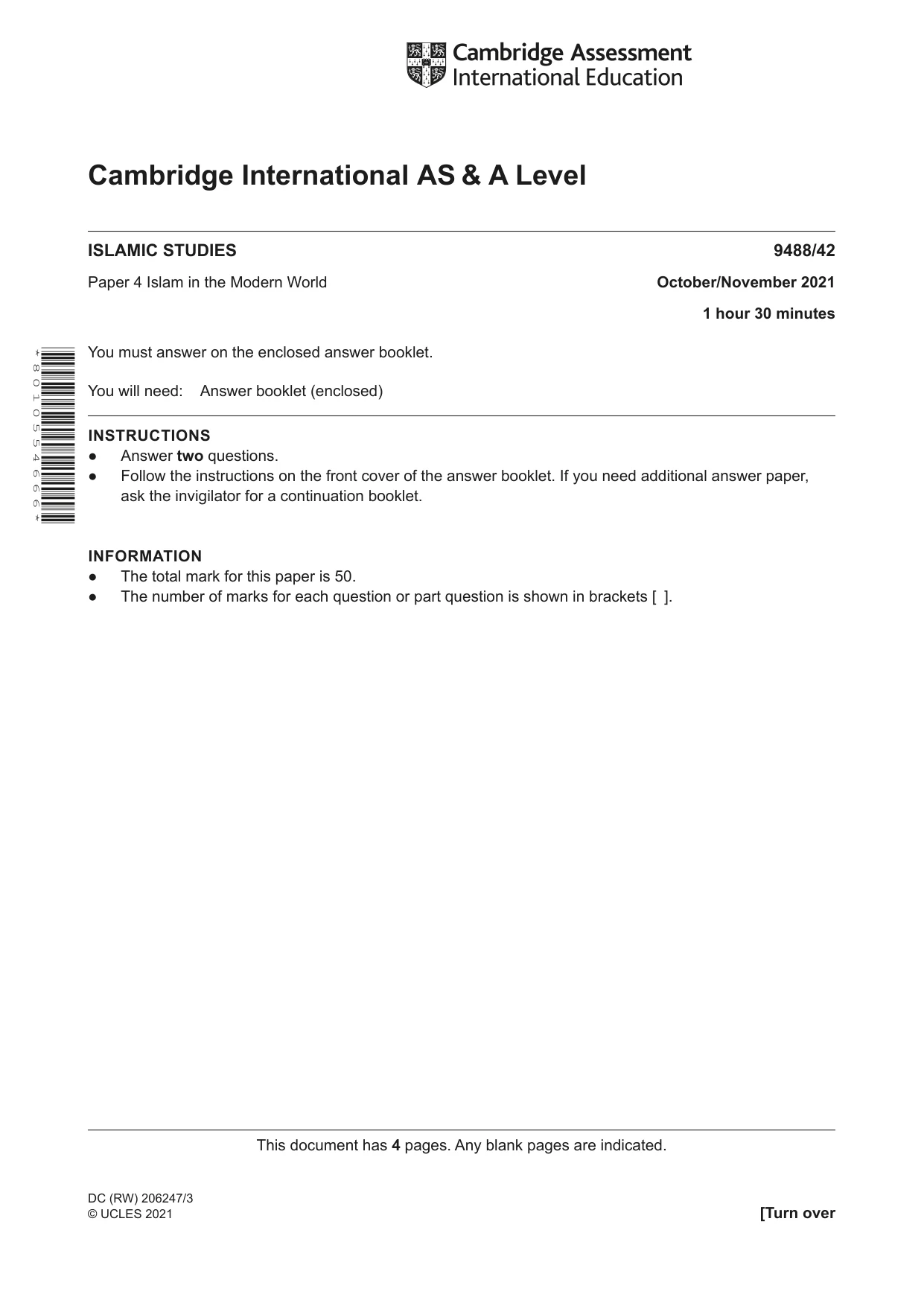
Question paper4 pages


Mark scheme12 pages
Answers below. Sit the paper first if you are practising.
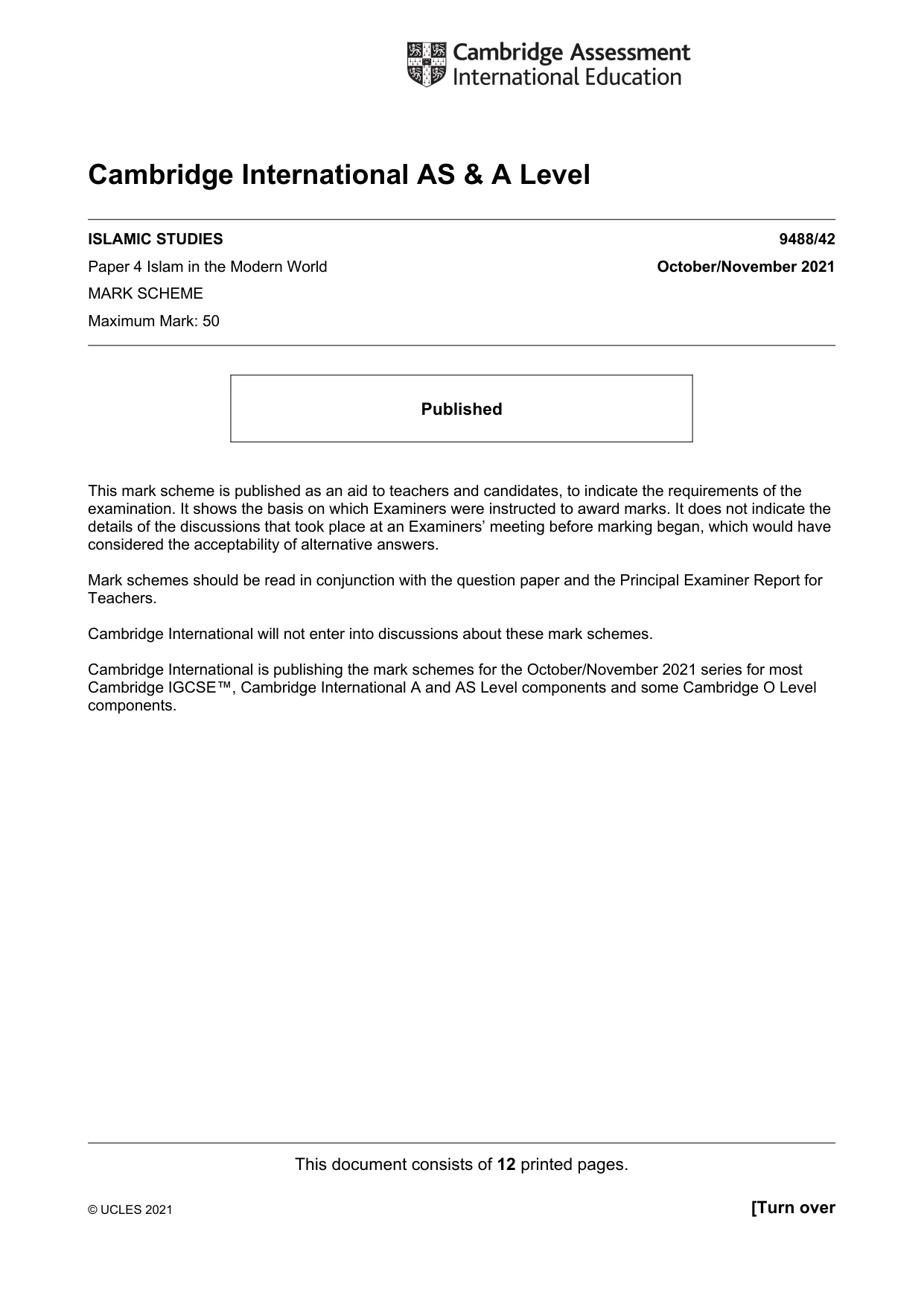
Questions as text
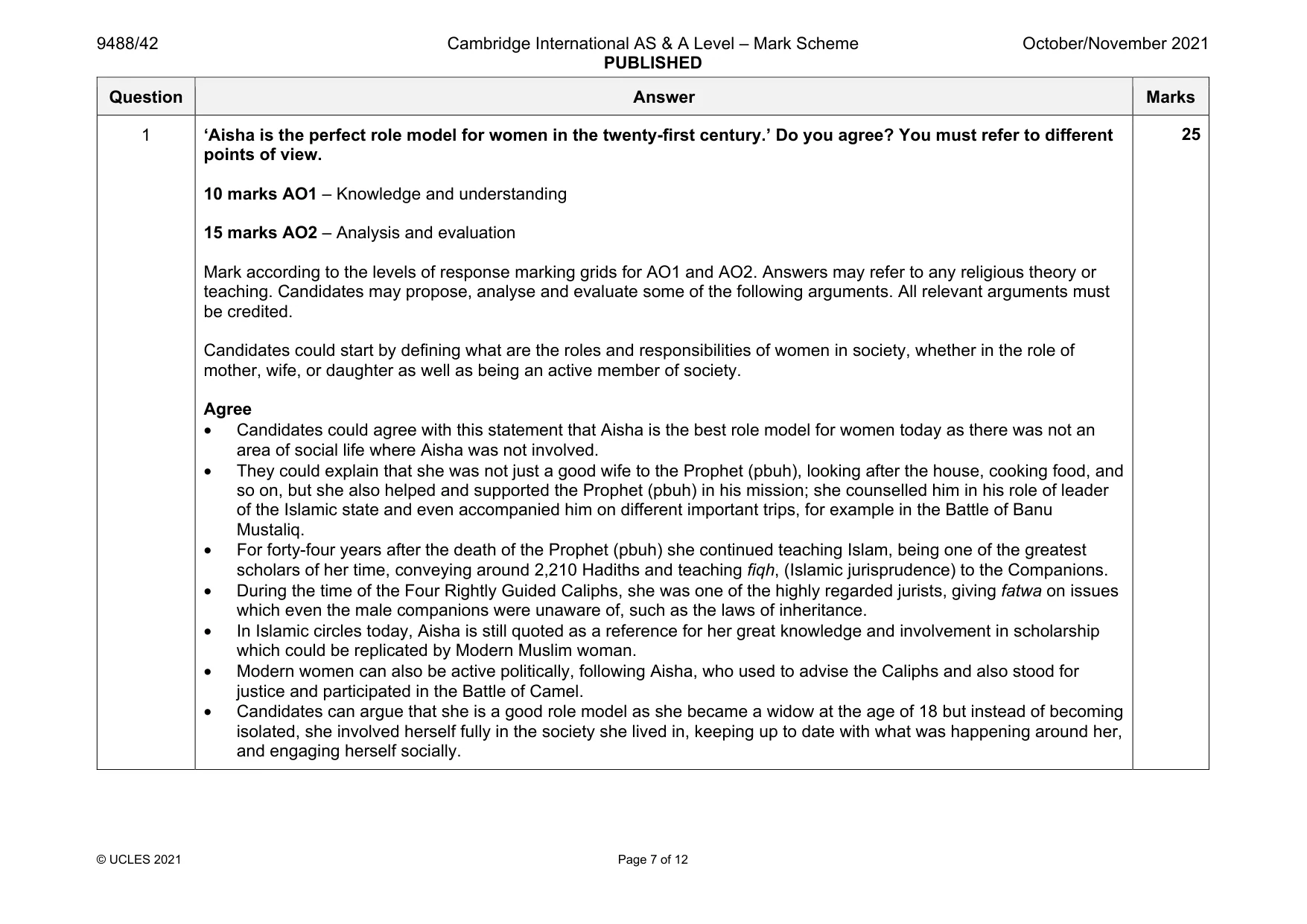
Q1 · ‘Aisha is the perfect role model for women in the twenty-first century.’ Do you agree?
1 ‘Aisha is the perfect role model for women in the twenty-first century.’ Do you agree? You must refer to different points of view. [25]
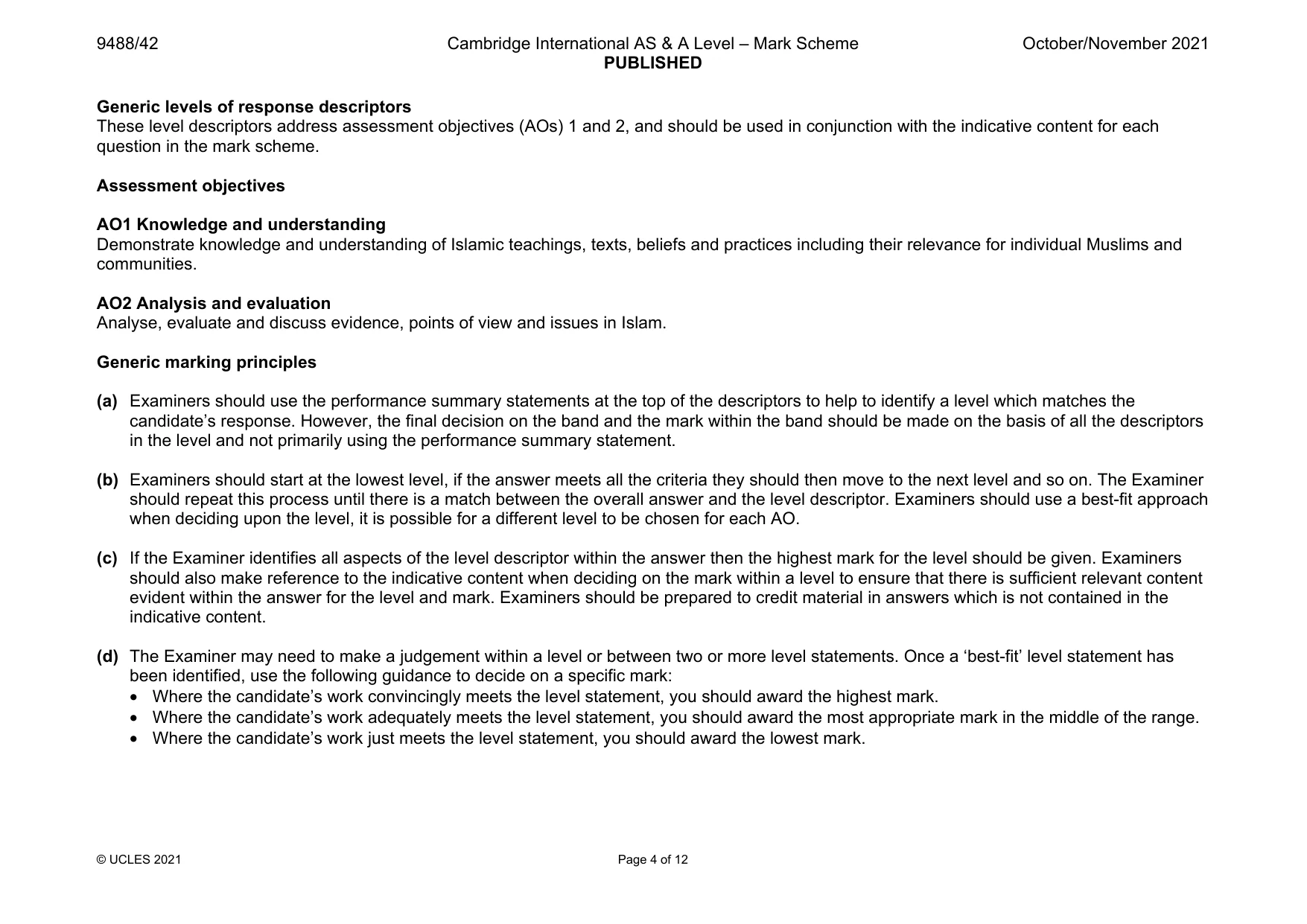
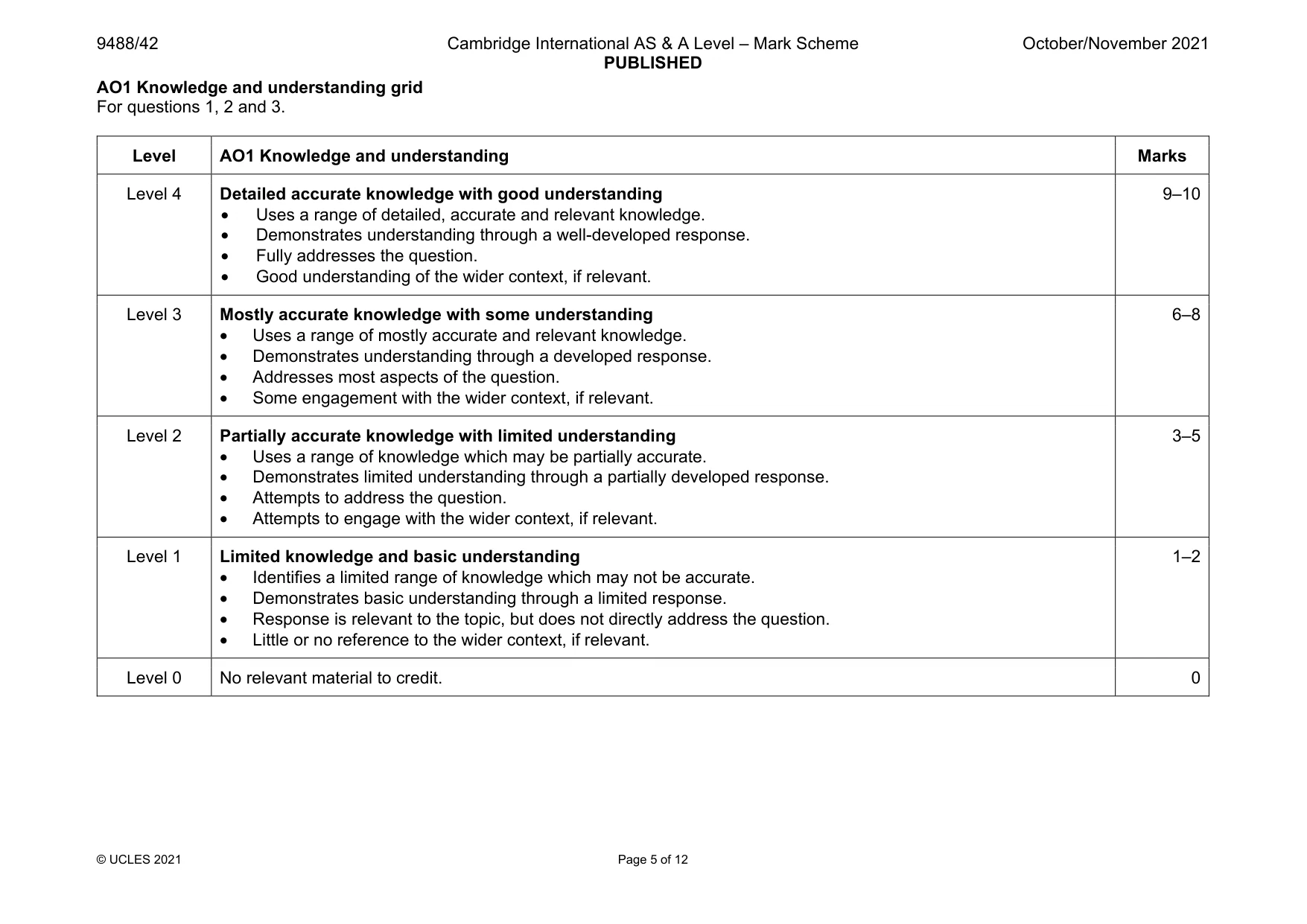
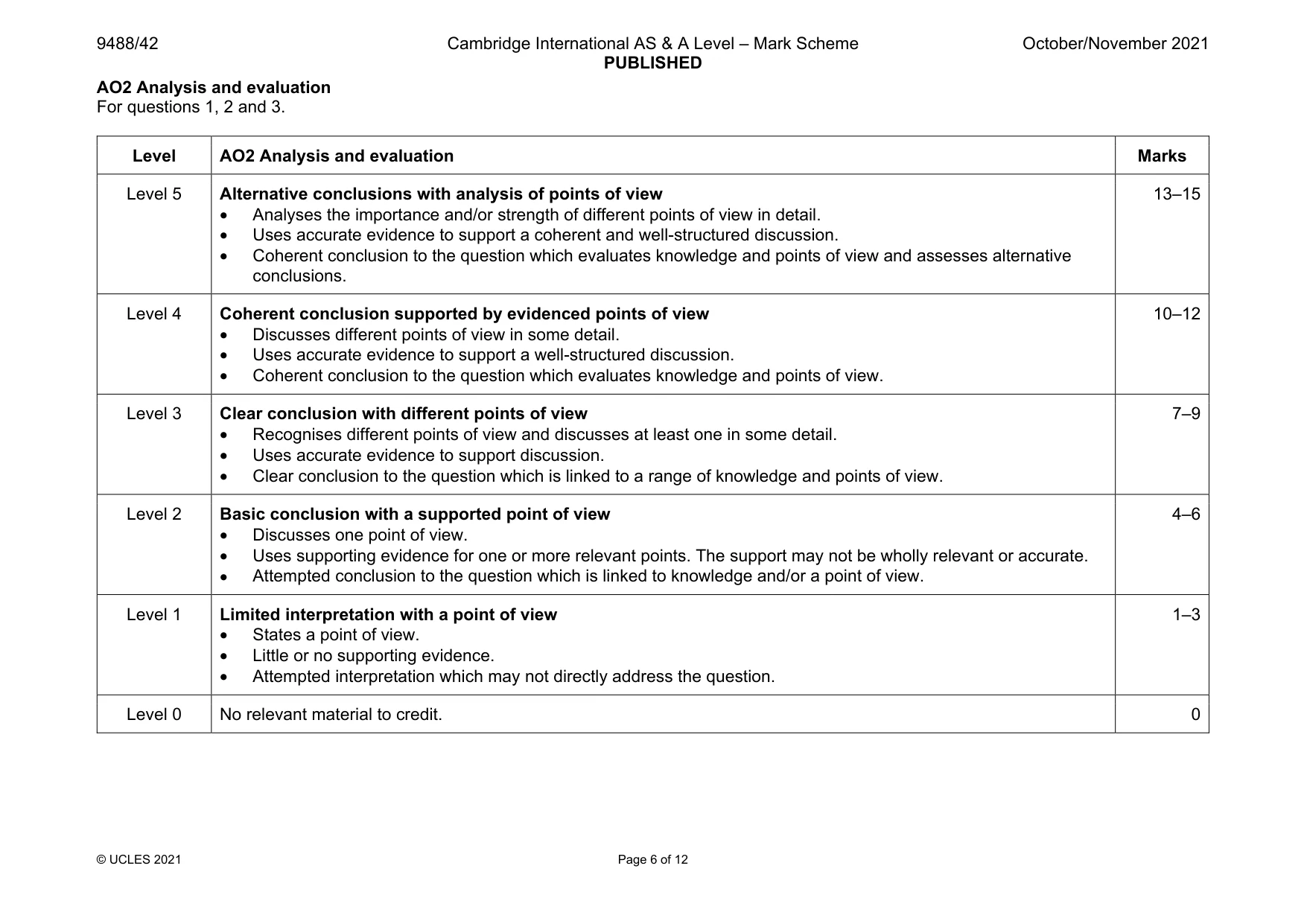
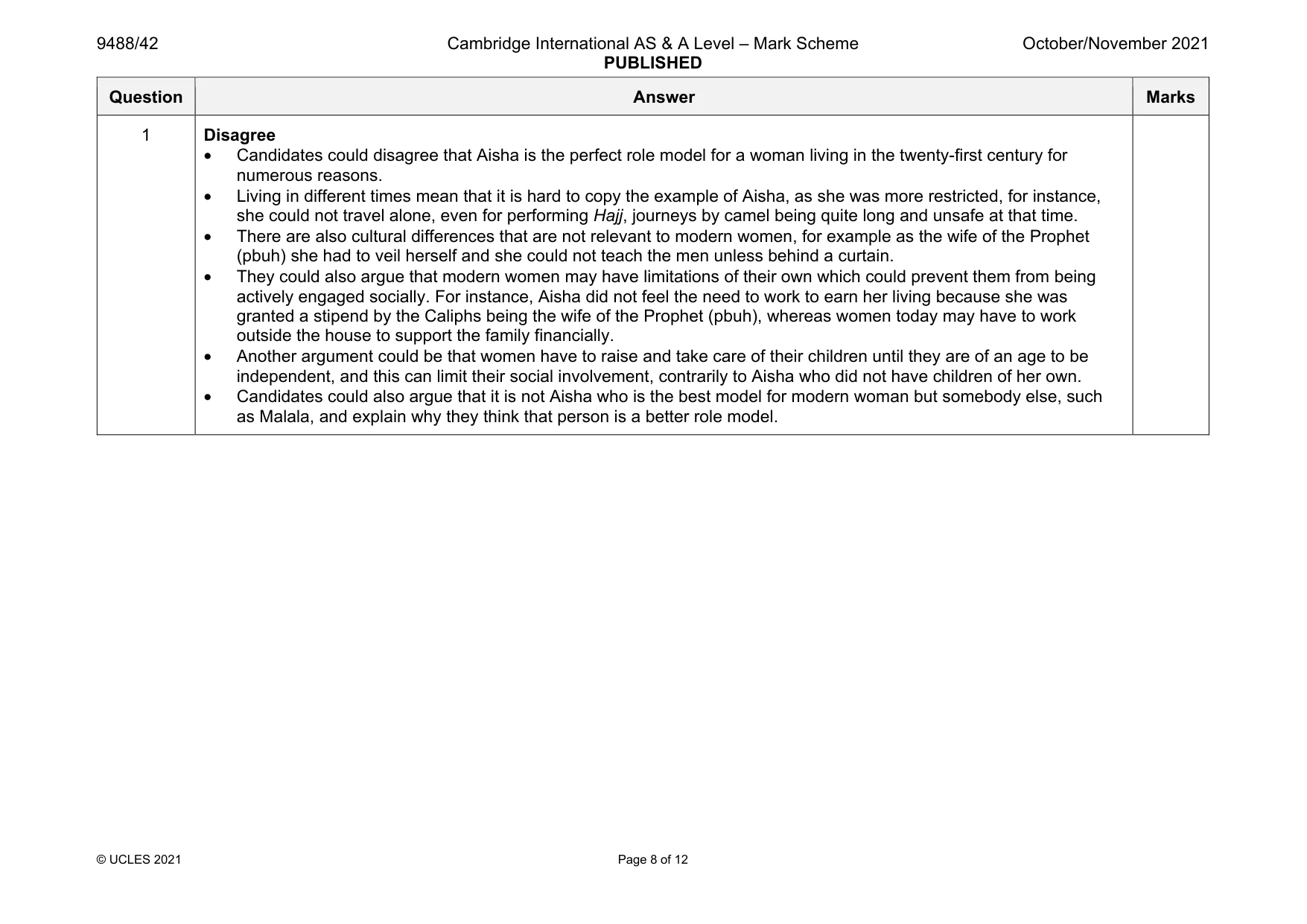
Mark scheme: 1 ‘Aisha is the perfect role model for women in the twenty-first century.’ Do you agree? You must refer to different points of view. 10 marks AO1 – Knowledge and understanding 15 marks AO2 – Analysis and evaluation Mark according to the levels of response marking grids for AO1 and AO2. Answers may refer to any religious theory or teaching. Candidates may propose, analyse and evaluate some of the following arguments. All relevant arguments must be credited. Candidates could start by defining what are the roles and responsibilities of women in society, whether in the role of mother, wife, or daughter as well as being an active member of society. Agree • Candidates could agree with this statement that Aisha is the best role model for women today as there was not an area of social life where Aisha was not involved. • They could explain that she was not just a good wife to the Prophet (pbuh), looking after the house, cooking food, and so on, but she also helped and supported the Prophet (pbuh) in his mission; she counselled him in his role of leader of the Islamic state and even accompanied him on different important trips, for example in the Battle of Banu Mustaliq. • For forty-four years after the death of the Prophet (pbuh) she continued teaching Islam, being one of the greatest scholars of her time, conveying around 2,210 Hadiths and teaching fiqh, (Islamic jurisprudence) to the Companions. • During the time of the Four Rightly Guided Caliphs, she was one of the highly regarded jurists, giving fatwa on issues which even the male companions were unaware of, such as the laws of inheritance. • In Islamic circles today, Aisha is still quoted as a reference for her great knowledge and involvement in scholarship which could be replicated by Modern Muslim woman. • Modern women can also be active politically, following Aisha, who used to advise the Caliphs and also stood for justice and participated in the Battle of Camel. • Candidates can argue that she is a good role model as she became a widow at the age of 18 but instead of becoming isolated, she involved herself fully in the society she lived in, keeping up to date with what was happening around her, and engaging herself socially. Question Answer Marks 1 Disagree • Candidates could disagree that Aisha is the perfect role model for a woman living in the twenty-first century for numerous reasons. • Living in different times mean that it is hard to copy the example of Aisha, as she was more restricted, for instance, she could not travel alone, even for performing Hajj, journeys by camel being quite long and unsafe at that time. • There are also cultural differences that are not relevant to modern women, for example as the wife of the Prophet (pbuh) she had to veil herself and she could not teach the men unless behind a curtain. • They could also argue that modern women may have limitations of their own which could prevent them from being actively engaged socially. For instance, Aisha did not feel the need to work to earn her living because she was granted a stipend by the Caliphs being the wife of the Prophet (pbuh), whereas women today may have to work outside the house to support the family financially. • Another argument could be that women have to raise and take care of their children until they are of an age to be independent, and this can limit their social involvement, contrarily to Aisha who did not have children of her own. • Candidates could also argue that it is not Aisha who is the best model for modern woman but somebody else, such as Malala, and explain why they think that person is a better role model.
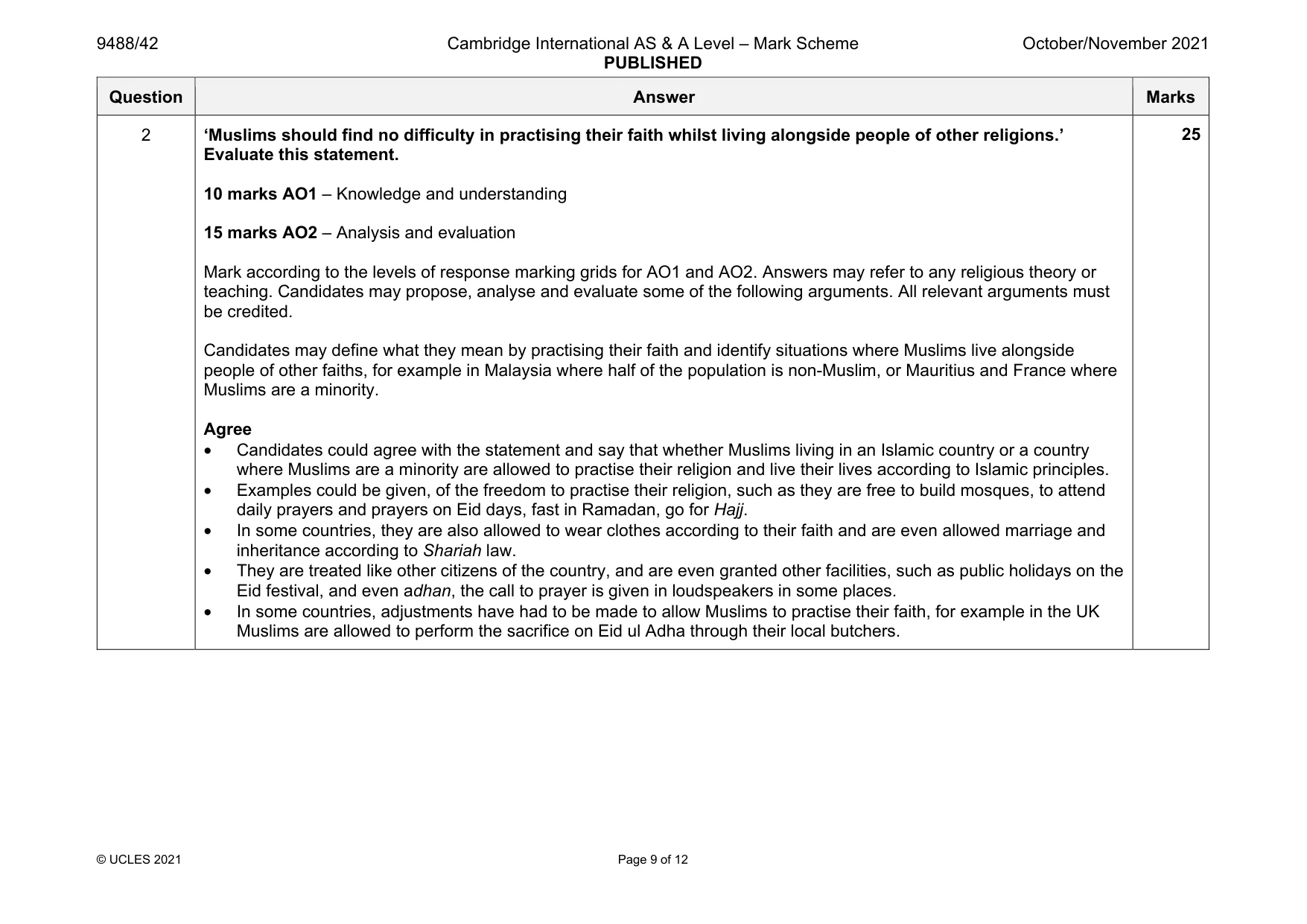
Q2 · ‘Muslims should find no difficulty in practising their faith whilst living alongside…
2 ‘Muslims should find no difficulty in practising their faith whilst living alongside people of other religions.’ Evaluate this statement. [25]
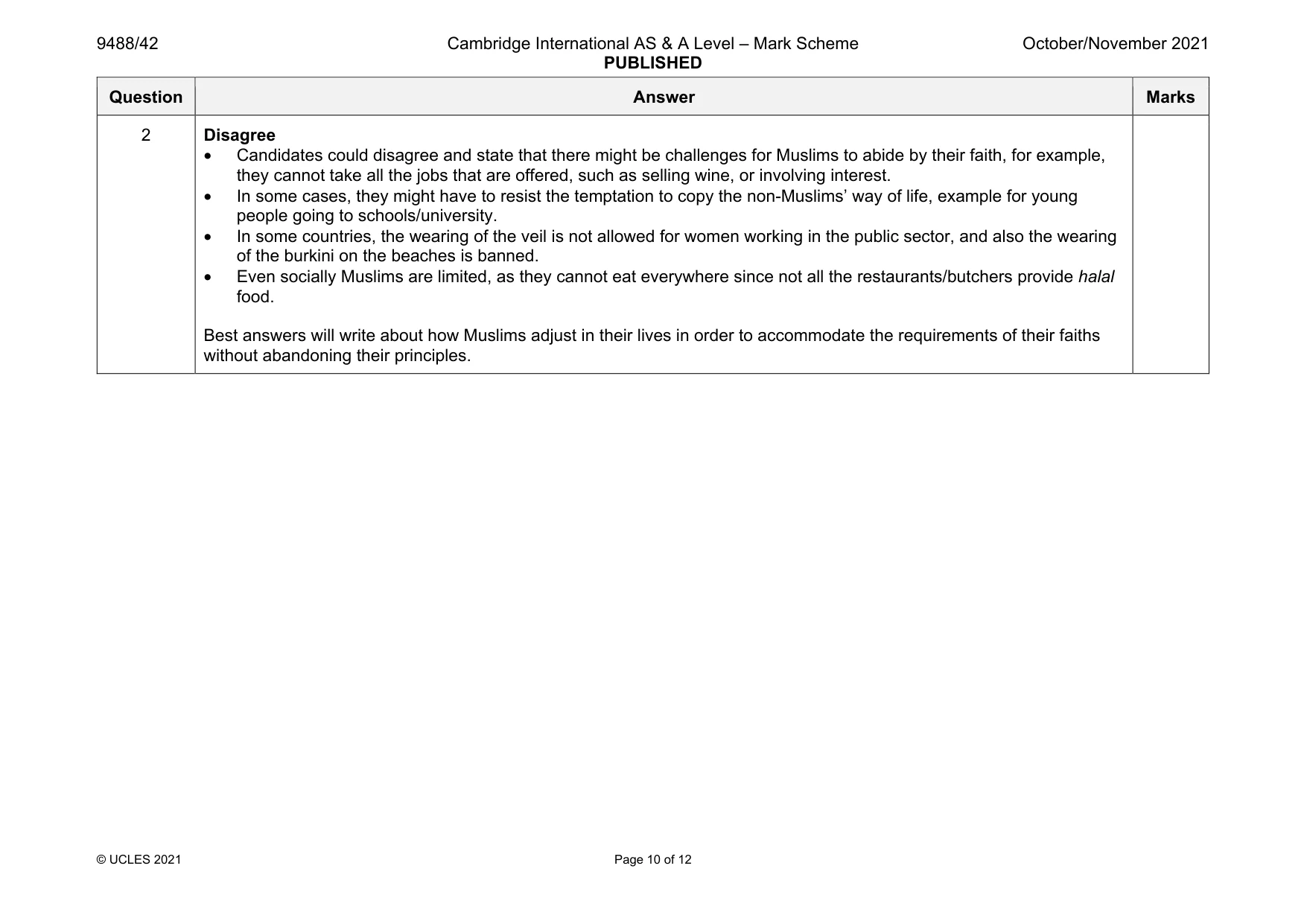
Mark scheme: 2 ‘Muslims should find no difficulty in practising their faith whilst living alongside people of other religions.’ Evaluate this statement. 10 marks AO1 – Knowledge and understanding 15 marks AO2 – Analysis and evaluation Mark according to the levels of response marking grids for AO1 and AO2. Answers may refer to any religious theory or teaching. Candidates may propose, analyse and evaluate some of the following arguments. All relevant arguments must be credited. Candidates may define what they mean by practising their faith and identify situations where Muslims live alongside people of other faiths, for example in Malaysia where half of the population is non-Muslim, or Mauritius and France where Muslims are a minority. Agree • Candidates could agree with the statement and say that whether Muslims living in an Islamic country or a country where Muslims are a minority are allowed to practise their religion and live their lives according to Islamic principles. • Examples could be given, of the freedom to practise their religion, such as they are free to build mosques, to attend daily prayers and prayers on Eid days, fast in Ramadan, go for Hajj. • In some countries, they are also allowed to wear clothes according to their faith and are even allowed marriage and inheritance according to Shariah law. • They are treated like other citizens of the country, and are even granted other facilities, such as public holidays on the Eid festival, and even adhan, the call to prayer is given in loudspeakers in some places. • In some countries, adjustments have had to be made to allow Muslims to practise their faith, for example in the UK Muslims are allowed to perform the sacrifice on Eid ul Adha through their local butchers. Question Answer Marks 2 Disagree • Candidates could disagree and state that there might be challenges for Muslims to abide by their faith, for example, they cannot take all the jobs that are offered, such as selling wine, or involving interest. • In some cases, they might have to resist the temptation to copy the non-Muslims’ way of life, example for young people going to schools/university. • In some countries, the wearing of the veil is not allowed for women working in the public sector, and also the wearing of the burkini on the beaches is banned. • Even socially Muslims are limited, as they cannot eat everywhere since not all the restaurants/butchers provide halal food. Best answers will write about how Muslims adjust in their lives in order to accommodate the requirements of their faiths without abandoning their principles.
Q3 · ‘The competence of a political leader is more important than their faith.’ Do you agree?
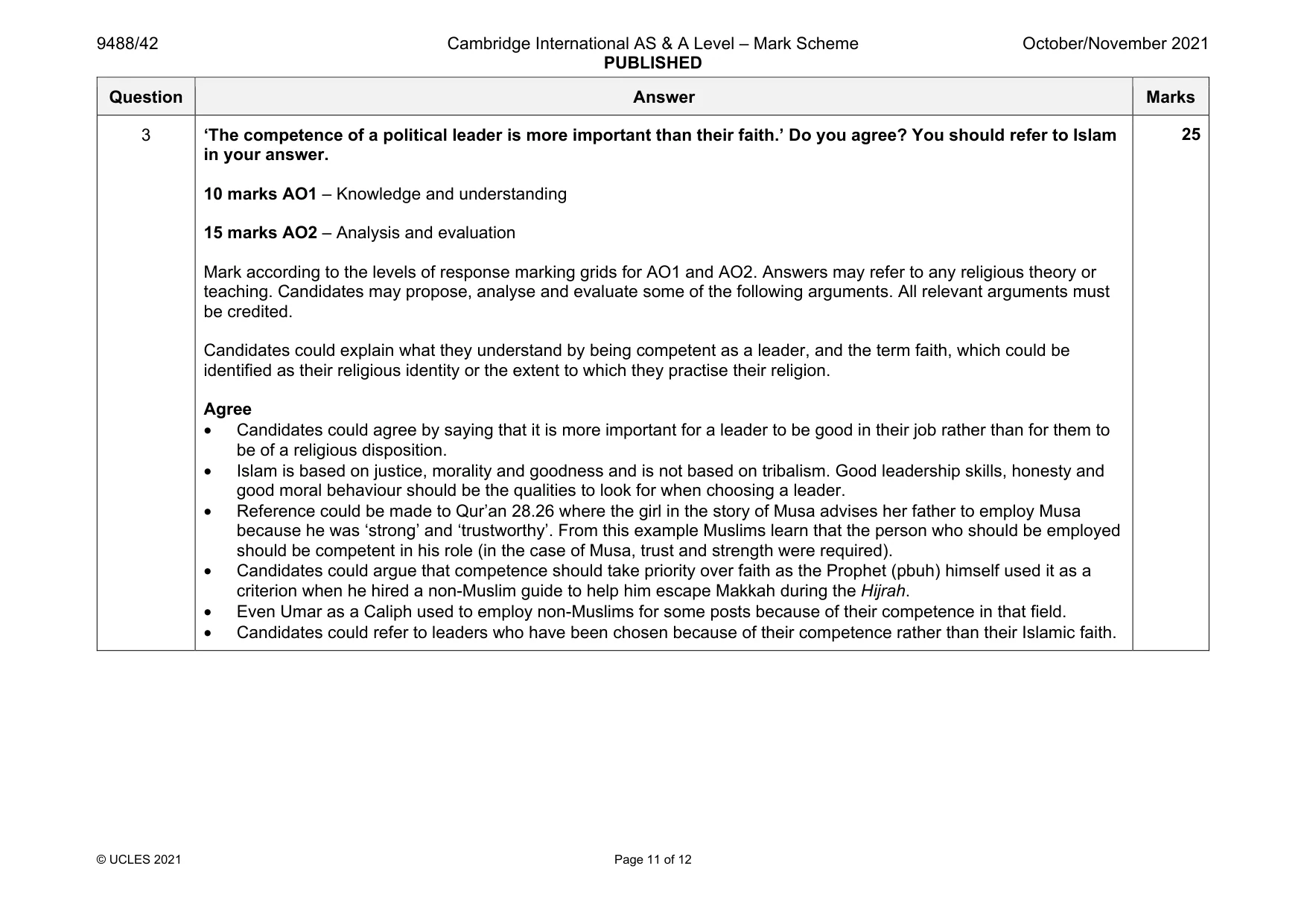
3 ‘The competence of a political leader is more important than their faith.’ Do you agree? You should refer to Islam in your answer. [25]
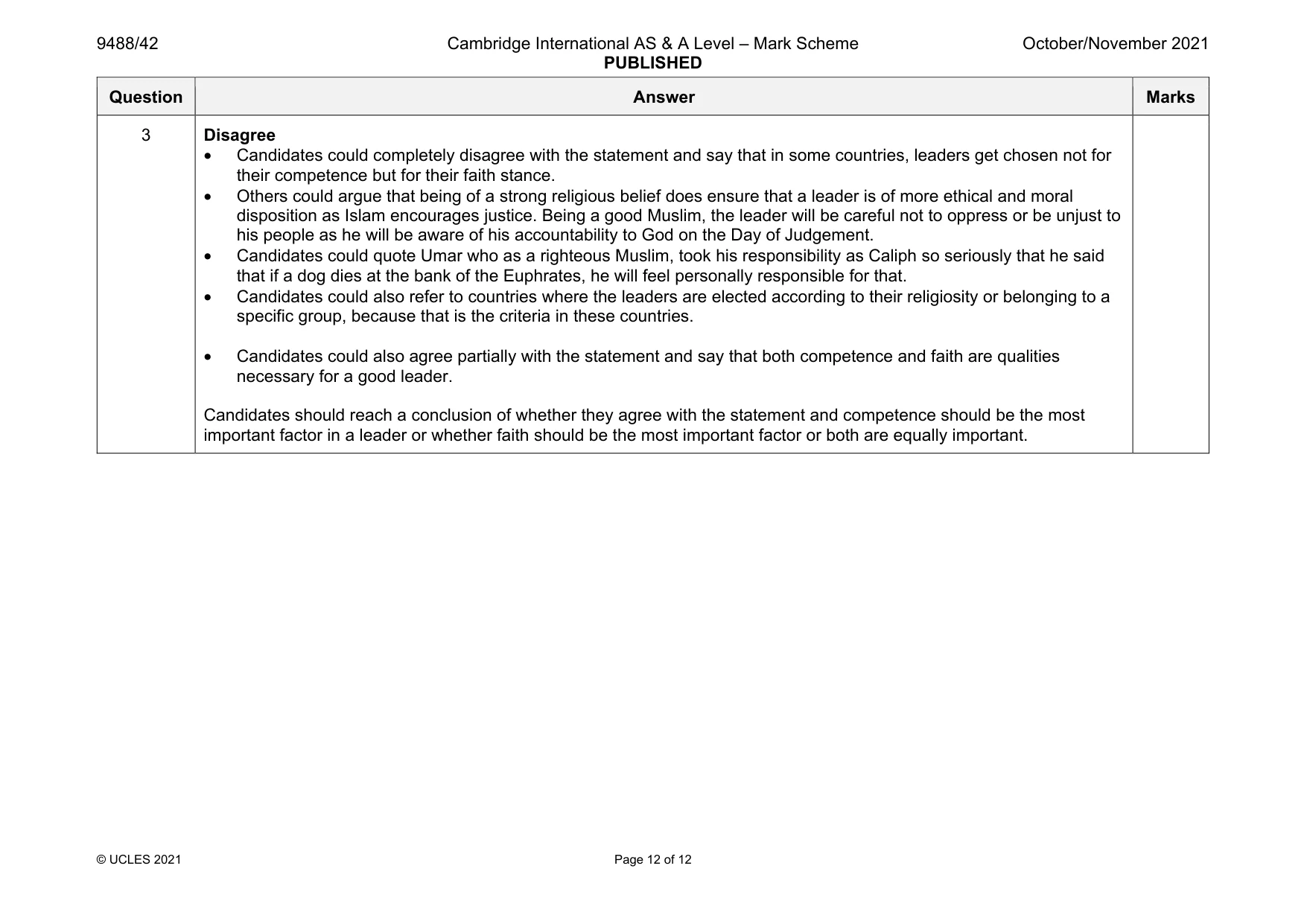
Mark scheme: 3 ‘The competence of a political leader is more important than their faith.’ Do you agree? You should refer to Islam in your answer. 10 marks AO1 – Knowledge and understanding 15 marks AO2 – Analysis and evaluation Mark according to the levels of response marking grids for AO1 and AO2. Answers may refer to any religious theory or teaching. Candidates may propose, analyse and evaluate some of the following arguments. All relevant arguments must be credited. Candidates could explain what they understand by being competent as a leader, and the term faith, which could be identified as their religious identity or the extent to which they practise their religion. Agree • Candidates could agree by saying that it is more important for a leader to be good in their job rather than for them to be of a religious disposition. • Islam is based on justice, morality and goodness and is not based on tribalism. Good leadership skills, honesty and good moral behaviour should be the qualities to look for when choosing a leader. • Reference could be made to Qur’an 28.26 where the girl in the story of Musa advises her father to employ Musa because he was ‘strong’ and ‘trustworthy’. From this example Muslims learn that the person who should be employed should be competent in his role (in the case of Musa, trust and strength were required). • Candidates could argue that competence should take priority over faith as the Prophet (pbuh) himself used it as a criterion when he hired a non-Muslim guide to help him escape Makkah during the Hijrah. • Even Umar as a Caliph used to employ non-Muslims for some posts because of their competence in that field. • Candidates could refer to leaders who have been chosen because of their competence rather than their Islamic faith. Question Answer Marks 3 Disagree • Candidates could completely disagree with the statement and say that in some countries, leaders get chosen not for their competence but for their faith stance. • Others could argue that being of a strong religious belief does ensure that a leader is of more ethical and moral disposition as Islam encourages justice. Being a good Muslim, the leader will be careful not to oppress or be unjust to his people as he will be aware of his accountability to God on the Day of Judgement. • Candidates could quote Umar who as a righteous Muslim, took his responsibility as Caliph so seriously that he said that if a dog dies at the bank of the Euphrates, he will feel personally responsible for that. • Candidates could also refer to countries where the leaders are elected according to their religiosity or belonging to a specific group, because that is the criteria in these countries. • Candidates could also agree partially with the statement and say that both competence and faith are qualities necessary for a good leader. Candidates should reach a conclusion of whether they agree with the statement and competence should be the most important factor in a leader or whether faith should be the most important factor or both are equally important.
What was in this paper
The subtopics covered by these 3 questions, and how many questions each got. Open one in a new tab to see every Cambridge question on it.
What you needed in this session
Cambridge’s own grade thresholds for 2021 Oct/Nov, Paper 4 · Variant 2. A higher threshold means an easier paper — the bar moves with how the cohort did.